
Growing China-Russia alignment signifies Biden policy failure

U.S. has pushed natural competitors into becoming strategic collaborators

Russian President Vladimir Putin, right, and Chinese President Xi Jinping in Beijing on May 16: Their countries are more firmly aligned now than at any time since the 1950s. (Pool via Reuters)

Brahma Chellaney, Nikkei Asia

The strategy of driving a wedge between China and Russia helped the West win the Cold War, not militarily, but geopolitically.

Richard Nixon’s most lasting achievement as U.S. president was orchestrating a diplomatic opening to China two years after Beijing had engaged in seven months of bloody border clashes with the Soviet Union.

Nixon’s co-optation of China, crowned by his February 1972 visit to Beijing, resulted in an informal alliance geared toward containing and rolling back Soviet influence and power. This two-against-one tag-teaming contributed to the Soviet Union’s imperial overstretch and ultimately to the West’s triumph in the Cold War without global combat.

Today, however, the U.S., instead of playing China off against Russia, is becoming the glue that holds the pair together. As a result, an already overextended U.S. seriously risks accelerating its relative decline through strategic overreach.

Alas, it is U.S. President Joe Biden’s foreign policy that has helped turn two natural competitors into strategic collaborators.

A forward-looking approach would have avoided confronting Russia and China simultaneously, lest it drive the two nuclear-armed powers into an unholy alliance. But Biden has managed to lock horns with both Moscow and Beijing simultaneously, though it should be noted that his China policy is comparatively softer and more conciliatory.

It is striking that China and Russia today are more firmly aligned than at any time since the 1950s. Chinese President Xi Jinping and Russian counterpart Vladimir Putin openly share a vision of reshaping the world by ending the era of Western dominance.

The outcome of the recent Xi-Putin meeting marked a defining moment in the two leaders’ commitment to bringing about a “new era.” Their joint statement cast the U.S. as an aggressive hegemon with a Cold War mindset that fosters global insecurity and divisions. “The U.S. must abandon this behavior,” the statement demanded.

China and Russia seem to be providing cover to each other’s expansionism, with Putin extending support to Beijing over Taiwan and Xi endorsing Russia’s efforts to ensure its “sovereignty and territorial integrity” in oblique reference to Putin’s war on Ukraine.

Meanwhile, the rapid advance of Chinese and Russian space capabilities has prompted the Pentagon to quietly embark on a new “Star Wars” plan.

At the global level, the U.S. has only one real challenger — China, which dwarfs Russia in terms of economic output, military spending and other material measures. It is Beijing that seeks to supplant America as the world’s foremost power.

Yet China has been the main beneficiary of Biden’s forceful response to Russia’s invasion of Ukraine. Unprecedented sanctions, which have included the weaponization of international finance, have been a boon for Beijing, turning it into Russia’s banker and expanding international use of the yuan. Russia now generates much of its international export earnings in the Chinese currency and keeps these proceeds mostly in Chinese banks, in effect giving Beijing a share of the returns.

The sanctions, and America’s deepening involvement in the Ukraine war, have left Russia with little choice but to move closer to China, with which it has had a checkered history marked by periods of both cooperation and bloodstained rivalry.

Bilateral trade reached $240 billion last year, a jump from 2020’s $108 billion level. In return for providing a lifeline to the sanctions-stricken Russian economy, China has gained access to some of Russia’s most advanced military technologies.

China has racked up strategic win after win. Nixon’s rapprochement with Beijing led to a 45-year U.S. policy of aiding China’s economic rise, which resulted in the creation of the greatest strategic adversary America has ever faced.

Biden’s punitive approach toward Russia is now effectively further strengthening an aggressive and expansionist China by helping it to accumulate greater economic and military power.

With Russia’s Ukraine aggression tying the U.S. down in Europe, Xi might believe that China has a window of opportunity to achieve the “historic mission” of forcibly annexing Taiwan. Xi recently made his Taiwan goal clearer by declaring that the essence of his national rejuvenation drive is “the unification of the motherland.”

Still, there are limits to how far Beijing is likely to go to cement its “no limits” partnership with Moscow, given the underlying competitive dynamics between the two neighboring powers, including in regions like Central Asia, Northeast Asia and the Artic which each side regards as part of its strategic backyard.

America’s sanctions on Moscow might have spurred China to strengthen its energy security through greater overland imports from Russia that could not be interrupted even if Xi invaded Taiwan. Yet China is wary of overreliance on Russia, which is why it continues to look to other sources of energy supply, in the Middle East and even the U.S.

Russia, for its part, is doing what it can to avoid being seen as China’s junior partner. To Xi’s chagrin, Putin has openly co-opted North Korea as a strategic partner.

Yet the perceived strategic imperative to join forces against their common American enemy, is tying Beijing and Moscow closer together.

Biden’s personal diplomacy with Xi has achieved little in terms of stemming Beijing’s growing alignment with Moscow, which threatens to unravel America’s global preeminence and undermine its national security.

A formal strategic and military alliance between China and Russia, by effectively spawning a pan-Eurasian colossus, would be America’s worst geopolitical nightmare come true.

To forestall that scenario, the U.S. must recalibrate its foreign policy by focusing its attention less on regionally revanchist Russia and more on globally ascendant China. This should include shoring up its deterrent posture in the Indo-Pacific region. If it puts its mind to it, Washington can find a strategy to exploit the historical strategic mistrust between Moscow and Beijing.

Brahma Chellaney is professor emeritus of strategic studies at the Centre for Policy Research in New Delhi and a former adviser to India’s National Security Council. He is the author of nine books, including “Water: Asia’s New Battleground.”
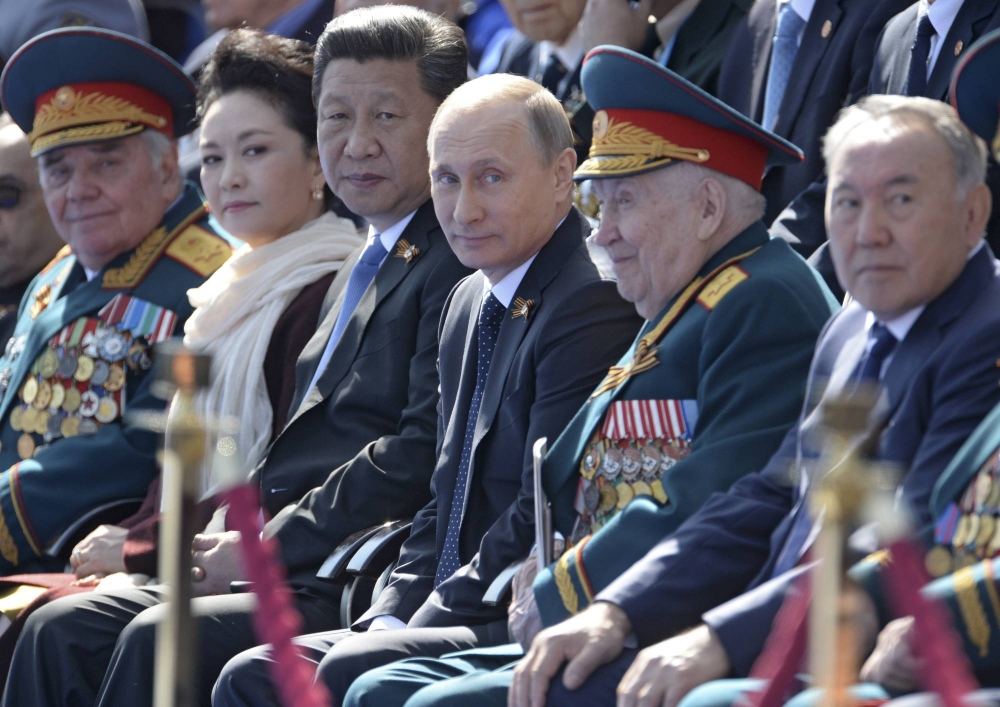
Biden’s focus on Ukraine risks Indo-Pacific security

The U.S. should use diplomacy to achieve a cease-fire in Ukraine as a prolonged conflict could reshape global power dynamics and strengthen China.
The U.S. should use diplomacy to achieve a cease-fire in Ukraine as a prolonged conflict could reshape global power dynamics and strengthen China. | RIA NOVOSTI / VIA REUTERS

BY BRAHMA CHELLANEY
CONTRIBUTING WRITER, The Japan Times

U.S. President Joe Biden has steadily deepened America’s involvement in what is now a war of attrition with Russia in Ukraine. The U.S. congressional approval, after months of wrenching debate, of a $95.3 billion foreign assistance package came after CIA Director Bill Burns warned that, without additional American aid, Ukraine could lose the war to Russia by this year-end.

The assistance package reflects the Biden administration’s skewed strategic priorities: It provides $60.8 billion to help sustain Ukraine’s war effort (with much of the funding going to U.S. defense contractors and the Pentagon), $26.4 billion for Israel and America’s supporting military operations in the Middle East and a stepmotherly $8.1 billion for Taiwan and other security challenges in the Indo-Pacific region, the world’s center of gravity.

Strategic challenges in the Indo-Pacific are mounting, with China stepping up coercive pressures on Taiwan and pursuing aggressive tactics in the South and East China Seas. Meanwhile, the tense military standoff along the long Himalayan frontier between China and India — triggered by furtive Chinese encroachments — is entering its fifth year.

Chinese President Xi Jinping, after snuffing out Hong Kong’s autonomy and redrawing the geopolitical map of the South China Sea, appears to be preparing his country to unify Taiwan by force, although that self-governing island, for most of its history, had no relationship with China and has remained fully outside Chinese control for the last almost 130 years.

Under Xi, China has invested heavily in building up amphibious-assault and other sea power and missile capabilities to overwhelm Taiwan’s defenses and deter the U.S. from coming to its aid. Xi bluntly told Biden at their summit meeting last November that his regime will absorb Taiwan and that the only matter left to be decided is when to take over the island. And recently, Xi cautioned Biden during a phone conversation that Taiwan is “the first red line that must not be crossed in China-U.S. relations.”

One would expect the Biden administration to respond to the looming threat by strengthening deterrence, including urgently bolstering Taiwan’s defenses. Yet, there is a huge backlog in U.S. military sales to Taiwan, with weapons deals announced as long ago as 2017 still unfulfilled.

In fact, Biden is the third straight U.S. president to commit to shifting America’s primary strategic focus to Asia and the wider Indo-Pacific, a region central to the global balance of power and peace. Yet, as he nears the end of his term, Biden, too, has been unable to make that pivot, with U.S. attention and resources now focused squarely on the conflicts in Europe and the Middle East.

The congressional breakthrough on the security assistance package, after a monthslong logjam, will help to shore up Biden’s credibility when his leadership has been questioned on the global stage. But this likely will be a short-lived boost unless Biden uses his new political capital to persuade Europe to take a leadership role on Ukraine and get Israel to end its devastating war in Gaza, whose staggering human toll is also affecting America’s moral standing in the world.

The new Ukraine-related funding can become a significant political asset for Biden in his reelection campaign if he leverages it to push Moscow toward a peace deal, thereby yielding a cease-fire before November. If not, Biden could open himself to political attack at home for sinking tens of billions of additional tax dollars in an endless war that, by deflecting America’s attention away from the pressing Indo-Pacific challenges, is making Taiwan more vulnerable to Chinese aggression.

Indeed, without a peacemaking component, Washington’s new funding for Kyiv could take the pressure off European governments to step up and take primary responsibility for Ukraine.

Without a cease-fire effort, there is also the risk — given how Russia’s military-industrial complex is churning out new missiles and munitions at a frenetic pace — that Russian forces could triumph over Ukraine in a longer war of attrition, despite the fresh U.S. assistance package.

The Biden administration has already provided Ukraine more than $44 billion worth of weapons, maintenance, training and spare parts since the 2022 Russian invasion. Ukraine has also been receiving battlefield targeting data from Western powers.

German Chancellor Olaf Scholz has faced some flak for inadvertently exposing the role of Britain, France and possibly the U.S. in militarily helping direct attacks on Russian targets from Ukraine through “target control.” Scholz said that if Germany followed Britain and France in supplying Ukraine long-range missiles, it would make it a “participant in the war,” too.

Ukraine, however, is losing hope of regaining the 20% of its territory already occupied by Russia. The additional massive U.S. assistance of $60.8 billion may help Ukraine to stave off defeat but it is unlikely to dramatically reverse its fortunes. Indeed, the longer the war extends, the greater the devastation in Ukraine, making reconstruction very costly and onerous.

It would be in America’s own interest to encourage quiet, back-channel diplomacy to explore ways to bring about a cease-fire in a war that continues to have an adverse global impact, including through higher energy and food prices.

A long war could profoundly reshape America’s position in the world, especially by further emboldening its main rival, China, which, despite U.S. threats of punitive action, has become the principal contributor to strengthening the Russian military-industrial complex.

An extended Ukraine war could even formalize a Sino-Russian strategic axis while opening greater space for Xi to accomplish his “historic mission” of incorporating Taiwan.

The plain fact is that the more the U.S. has deepened its involvement in the proxy war against Russia, the more it has hamstrung its China policy, compelling the White House to pursue an approach that is now clearly more carrot than stick.

Faced with difficult choices, leveraging the latest $60.8 billion U.S. funding for Ukraine to bring Russia to the negotiating table is the least bad option for Biden. A cease-fire will create a frozen Ukraine conflict that will keep Moscow preoccupied while letting the U.S. focus less on Russia, the world’s most-sanctioned country, and more on a globally expansionist China.

Brahma Chellaney, a longtime contributor to The Japan Times, is a geostrategist and the author of nine books, including the award-winning “Water: Asia’s New Battleground.”

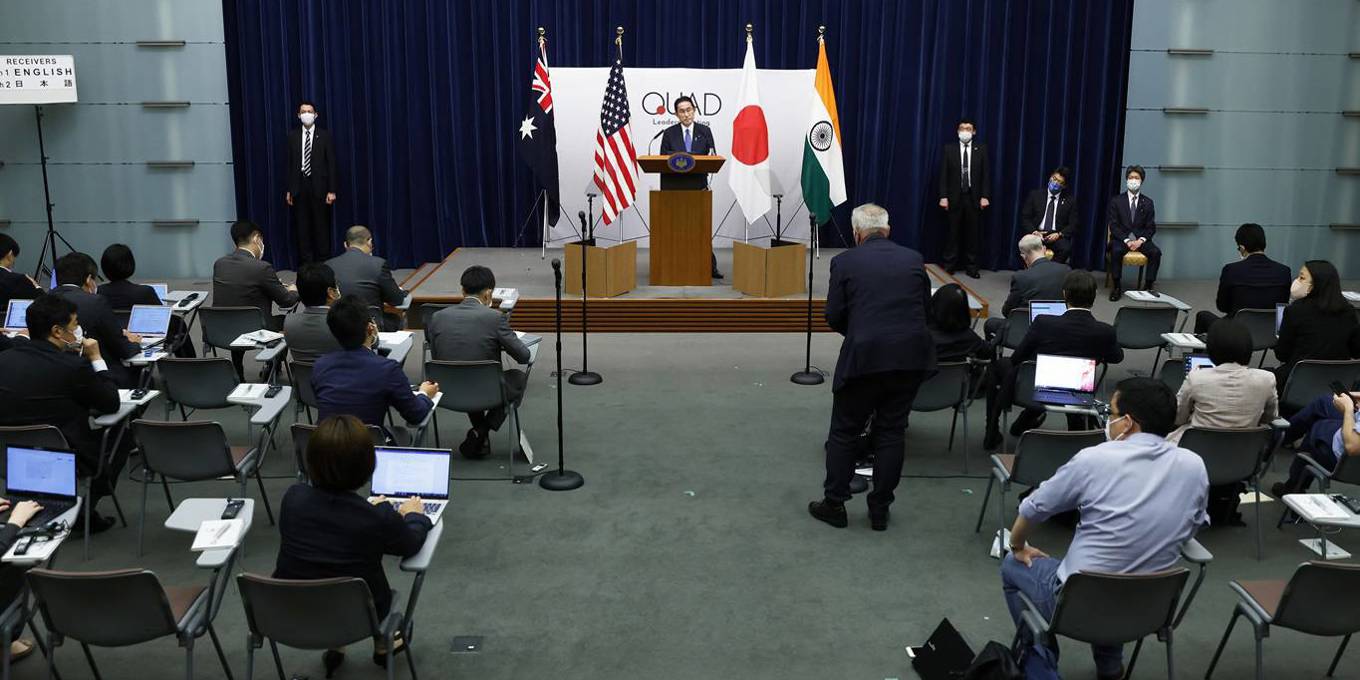
Is the Quad Becoming a Potemkin Alliance?

With conflicts in Europe and the Middle East draining US attention and resources, US President Joe Biden seems to hope that a more conciliatory approach toward China will be enough to maintain stability in the Indo-Pacific. Strengthening the Quad grouping of regional democracies would be a much better bet.

BRAHMA CHELLANEYProject Syndicate

When four of the Indo-Pacific’s leading democracies – Australia, India, Japan, and the United States – revived the long-dormant Quad in 2017, their objective was clear: to create a strategic bulwark against Chinese expansionism and reinforce a stable regional balance of power. But the coalition is now adrift, and the security risks this poses should not be underestimated.

The Quad’s resurrection reflected a paradigm shift in US foreign policy. After decades of engagement with China, including aiding its economic rise, US policymakers – Democrats and Republicans alike – realized that America’s biggest trade partner had become its biggest strategic adversary, bent on replacing it as global hegemon. As US President Joe Biden indicated in his 2022 National Security Strategy, China is “the only competitor with both the intent to reshape the international order and, increasingly, the economic, diplomatic, military, and technological power to advance that objective.”

Biden, like his predecessor, Donald Trump, viewed the Quad as an essential instrument to uphold a “free and open Indo-Pacific” – a concept formulated by the late Japanese Prime Minister Abe Shinzō. So, Biden elevated Quad discussions from the level of foreign ministers – who had been meeting annually since 2019 – to heads of state or government, initiating a flurry of leaders’ summits in 2021-23. But it has been more than a year since the Quad leaders last met, and with the US focused on the upcoming presidential election, their next summit is unlikely to be held before 2025.

The reason for this drop-off is simple: America’s priorities have changed. Russia’s war of aggression against Ukraine – together with the hybrid war the West is waging in response, not to mention renewed conflict in the Middle East – has stymied US efforts to position the Indo-Pacific at the “heart” of its grand strategy. It is striking that the latest US foreign-assistance package provides $60.8 billion for Ukraine but only $8.1 billion for security in the Indo-Pacific, including Taiwan, on which China has set its sights.

With limited resources to dedicate to the Indo-Pacific, Biden seems to hope that he can prevent a war over Taiwan through personal diplomacy with Chinese President Xi Jinping. Last month, in a telephone call with his Chinese counterpart, he stressed the importance of maintaining peace across the Taiwan Strait.

Biden seems to believe that a more conciliatory approach toward China can also forestall the emergence of a comprehensive Sino-Russian alliance. The “no-limits partnership” between China and Russia, reaffirmed during Russian President Vladmir Putin’s recent visit to Beijing, is problematic enough; China already has undercut Western sanctions by providing an economic lifeline to Russia, in exchange for cheap energy and some of Russia’s most advanced military technologies, including air-defense and early-warning systems. A full military alliance, with China supporting the Kremlin’s war machine directly, would be America’s worst geopolitical nightmare.

The problem for Biden is that appeasing China and strengthening the Quad – which Chinese Foreign Minister Wang Yi has decried as the “Indo-Pacific version of NATO” – are fundamentally incompatible. It might not be a coincidence that the Quad leaders have not met since Biden sent a series of cabinet officials to Beijing and met with Xi in California last November.

In fact, Biden has lately shifted his focus to less provocative initiatives like the “Squad,” an emerging unofficial regional grouping involving Australia, Japan, and the Philippines – countries that already have mutual defense treaties with the US. But what good is an anti-China alliance without India? It is, after all, the only power that has truly locked horns with the People’s Liberation Army this century: the tense military standoff along the disputed Himalayan border, triggered by China’s stealthy territorial encroachments, has just entered its fifth year. Moreover, as the leading maritime power in the Indian Ocean, India must play a central role in checking China’s westward naval march from its new citadel, the South China Sea.

The US has also been touting its AUKUS security partnership with Australia and the United Kingdom. But this grouping will not be able to play a meaningful role in Indo-Pacific security until Australia is equipped with nuclear-powered submarines, and that will not happen for another decade.

So far, Biden’s overtures to China have yielded few positive results. On the contrary, Xi has lately intensified coercive pressure on Taiwan, and Chinese provocations in the South China Sea have been increasing. Unless the US changes its approach, it may well fail to deter China from attacking Taiwan or cementing a strategic axis with Russia, just as it failed to deter Russia from invading Ukraine.

To maintain security in the Indo-Pacific, there is no substitute for a strong Quad with a clear strategic mission. Rather than unraveling years of efforts to build a coherent and credible regional strategy, thereby enabling yet more Chinese expansionism, Biden and his fellow Quad leaders must get to work defining such a mission and then commit to pursuing it. Otherwise, the Quad risks becoming a kind of Potemkin grouping. The façade of an alliance will not fool China.

Brahma Chellaney, Professor of Strategic Studies at the New Delhi-based Center for Policy Research and Fellow at the Robert Bosch Academy in Berlin, is the author of nine books, including Water: Asia’s New Battleground (Georgetown University Press, 2011), for which he won the 2012 Asia Society Bernard Schwartz Book Award.

© Project Syndicate, 2024.

Kishida’s zeal on Ukraine comes at Japan’s expense

Japan should be worrying about Taiwan, not Ukraine.

A Patriot missile unit outside the Ministry of Defense in Tokyo in 2017: The government should not be taking weapons out of its air defenses at this time. © AP

Brahma Chellaney, Nikkei Asia

Japan has become one of Ukraine’s most-important financial backers, pouring in some $12.1 billion in aid to support the country’s war-battered economy and its defenses with nonlethal equipment such as anti-drone systems.

“As I often say, Ukraine of today may be East Asia of tomorrow,” Prime Minister Fumio Kishida told a joint session of the U.S. Congress two weeks ago, underlining the rationale for aligning Tokyo closely with America’s de facto proxy war against Russia.

But how does Kishida’s leadership role on Ukraine, including sanctions on Russia and a long-term commitment to support postwar reconstruction, tangibly advance Japan’s strategic interests at a time when its own neighborhood is becoming increasingly dangerous?

Oddly, there has been little debate in Japan on this issue. Yet the country’s deepening engagement with Ukraine at a time it is ill-prepared for armed conflict over Taiwan is a huge strategic mistake.

Ukrainian Prime Minister Denys Shmyhal, left, with Japanese Prime Minister Fumio Kishida at the reconstruction conference held in Tokyo on Feb. 19. © Reuters

The drawn-out Ukraine war is not just impeding the U.S.-led attempt to rein in China’s aggressive expansionism, it is also stretching American resources thinly and weakening Washington’s deterrent posture in the Indo-Pacific region, thereby making a Taiwan Strait crisis more likely.

Kishida’s surprise move in December, at Washington’s urging, to ship Patriot air-defense systems to the U.S. to cover for ones being sent to Kyiv illustrates the risks of a Ukraine-centric approach.

Any Chinese operation to blockade or attack Taiwan would likely intrude into Japanese airspace and waters, conceivably pulling Tokyo into a war over the island democracy. Yet amid signs Chinese President Xi Jinping is preparing his country to go to war over Taiwan, Kishida has agreed to take weapons out of Japan’s air defenses for an increasingly hopeless war in distant Europe.

In fact, with U.S. attention and resources focused on conflicts in Europe and the Middle East, China’s efforts to alter the territorial and maritime status quo in Asia and secure strategic dominance are reaching a tipping point.

Yet some in the West myopically insist that the U.S. must first defeat Russia in Ukraine before pivoting to deter China. As if Xi would wait to move against Taiwan until the U.S. has humiliated Russia in a long war and was then ready to direct greater attention his way. Indeed, the last thing Xi would like is an end to the Ukraine war because that would leave the U.S. free to focus on the Indo-Pacific region.

This explains why China, as Washington now acknowledges, is quietly aiding the Kremlin’s war machine by supplying technologies and geospatial intelligence. The transfers suggest that, before making a move on Taiwan, Xi wants the Ukraine war to further deplete America’s weapons and munitions stocks.

The flip side to America’s deepening involvement in conflicts elsewhere is a desire to avoid direct confrontation with China. This explains U.S. President Joe Biden’s more conciliatory approach to Beijing in recent months, including a greater emphasis on diplomacy than on deterrence.

The U.S. may still be the world’s foremost military power, but it is in no position to meaningfully take on Russia and China simultaneously. According to its own official national security doctrine, the U.S. maintains the military capability to fight and defeat China or Russia with some allied support — but not both simultaneously.

In recent decades, the U.S. has waged overlapping wars, but these were against much weaker states, namely Iraq and Afghanistan. Still, these protracted wars exposed shortcomings in America’s ability to pursue two military missions simultaneously at full tempo.

In this light, Biden has stepped up his administration’s outreach to Beijing to help avert a Chinese attack on Taiwan that could result in a direct war between the U.S. and a near-peer adversary. But with the U.S. looking overextended and Xi viewing Biden’s conciliatory posture as one of weakness, the risks of failing to deter aggression against Taiwan are increasing.

The risks are particularly acute for Japan, whose southernmost islands lie close to Taiwan. As former Prime Minister Taro Aso has warned, if Taiwan falls, “Okinawa could be next.”

Japan should recall that U.S. appreciation of its generous financial support for previous missions has been fleeting.

A classic example is the 1991 Gulf War campaign against Iraq for which Japan contributed $13 billion. Yet then-U.S. Secretary of State James A. Baker III said, “Your ‘checkbook diplomacy,’ like our ‘dollar diplomacy’ of an earlier era, is clearly too narrow.”

Today, Japan needs to shed its zeal toward Ukraine and focus squarely on Taiwan. This should include not sending more Patriots or other defense systems to backstop Kyiv.

An overstretched America and a Japan straining to avert recession must persuade Europe to step up and take primary responsibility for Ukraine, its own neighbor.

To safeguard Asian security and the region’s balance of power, there can be no substitute for a prudent, balanced and forward-looking approach.

With China’s lengthening shadow darkening its doorstep, Japan needs to focus primarily on its combustible neighborhood and prepare for a Taiwan Strait contingency.

This should include assuring its ability to respond to a scenario in which Xi seeks to bring Taiwan to its knees by employing the techniques of incremental expansionism that his regime has successfully honed in the South China Sea without triggering a concerted U.S. response.

Not Ukraine, but the South China Sea of today could be the Taiwan of tomorrow. This means that Japan, without being unduly distracted by developments afar, must find effective ways to beat back China’s hybrid warfare.

Brahma Chellaney is professor emeritus of strategic studies at the Centre for Policy Research in New Delhi and a former adviser to India’s National Security Council. He is the author of nine books, including “Water: Asia’s New Battleground.”

Biden’s massive military aid package neglects the real strategic threat: China

A Great Wall 236 submarine of the Chinese People’s Liberation Army Navy.

BY BRAHMA CHELLANEY, The Hill

The congressional breakthrough on the $95 billion foreign assistance package after months of political wrangling provides President Joe Biden’s administration with arms outlays that are larger than the defense budget of every country other than the United States, China and Russia. Biden now has considerable leverage to further conflict or deterrence across three large geographic regions encompassing more than half of the world — Europe, the Middle East and the Indo-Pacific.

The package effectively opens the floodgates to the greater flow of sophisticated American weapons, especially to Ukraine. In fact, even before Biden signed the foreign assistance bill into law, Ukraine began using longer-range ATACMS missiles against Russian forces that the U.S. had secretly supplied. And as the law took effect, the Pentagon immediately rushed $1 billion worth of American weapons to Ukraine.

The package reflects the Biden administration’s skewed strategic priorities: It provides $60.8 billion for Ukraine in its war of attrition with Russia, with much of the funding going to U.S. defense contractors and the Pentagon; $26.4 billion for Israel and America’s supporting military operations in the Middle East; and a relatively miserly $8.1 billion for Taiwan and other security challenges in the Indo-Pacific region — the world’s center of gravity where America’s main rival, China, is incrementally changing the territorial and maritime status quo.

The congressional logjam over the package had jeopardized the centerpiece of Biden’s foreign policy, which has focused America’s attention and resources on the wars in Europe and the Middle East. But the region central to the global balance of power and peace is the Indo-Pacific.

The longer the U.S. remains involved in the conflicts in Europe and the Middle East, the greater will be the likelihood of China invading Taiwan. It is telling that, under Biden, an overextended America is seeking to dissuade Chinese President Xi Jinping from launching an attack on Taiwan more through diplomacy than deterrence.

Biden’s latest defense budget, and the small outlays for the Indo-Pacific in the $95.3 billion package, show that deterrence against China has assumed a subsidiary policy role. The budget not only underfunds key enabling capabilities for the Indo-Pacific but also cuts programs, including slashing the production goal for Virginia-class submarines from two per year to just one.

China, on the other hand, is engaged in a frenzied naval buildup. China’s surface naval fleet is now already much larger than the American fleet. In terms of number of submarines, China, by embarking on a new generation of nuclear-armed subs, possibly with Russian assistance, is set to go beyond its current near-parity with the U.S. Meanwhile, qualitative improvements in battle force ships and more aggressive tactics by the Chinese navy are already making it more challenging for American ships and submarines to operate in China’s maritime backyard.

The Ukraine war, for its part, has helped raise the specter of the U.S. realizing its worst geopolitical nightmare: a Sino-Russian strategic axis. Secretary of State Anthony Blinken this month called China “the primary contributor” to Russia’s defense industrial base.

The conflict has already exposed NATO’s military shortcomings, including its struggle to scale up weapons and munitions manufacturing to match the output of Russia’s war economy. Chinese President Xi Jinping seems to be aiding the Kremlin’s war machine in an apparent effort to keep the U.S. tied down in Ukraine and further deplete Western arsenals before invading Taiwan.

Against this background, the massive new U.S. funding for Ukraine will further deepen American involvement in the conflict without any prospect of changing the tide of the war. U.S. officials now acknowledge that there is little prospect of Ukraine regaining the 20 percent of its territory already occupied by Russia.

The Biden administration’s narrative on the war has evolved through three distinct phases. In the immediate aftermath of the Russian invasion, the “save Ukraine” narrative was dominant, before being overtaken by the “bleed Russia” narrative, which presented the Western supply of weapons and battlefield intelligence to Ukrainian forces as a cost-effective investment to severely “weaken” an adversary militarily.

Even after the much-hyped Ukrainian counteroffensive floundered last summer, dashing NATO’s hopes of a major military breakthrough against Russia, the administration — anxious not to lose public support for the war — continued to peddle the line that Ukraine was winning the fight against Russia.

The third phase, “help Ukraine stave off defeat,” began more recently, when CIA Director Bill Burns warned that Ukraine could lose the war to Russia by year’s end absent additional American aid. The shift in the narrative from “Ukraine is winning” to “Ukraine may be facing defeat” was jarringly abrupt.

Make no mistake: Even if the new U.S. assistance of $60.8 billion helps Ukraine avert defeat, it is unlikely to dramatically reverse Ukrainian fortunes on the battlefield against a much stronger foe. Indeed, the longer the war extends, the greater is likely to be Ukraine’s devastation, making reconstruction more costly and onerous.

By sending more lethal and longer-range weapons to Ukraine, the U.S. funding, however, carries the risk of triggering a direct NATO conflict with Russia, which has the world’s largest nuclear arsenal. Western powers have also increasingly provided Ukraine battlefield targeting data and even some actual assistance on the ground near the front lines.

German Chancellor Olaf Scholz faced some flak in February for inadvertently exposing the role of Britain, France and possibly the U.S. in militarily helping direct attacks on Russian targets from Ukrainian soil through “target control.” Scholz said that if Germany followed Britain and France in supplying Ukraine with long-range missiles, it would make it a “participant in the war,” too.

Throwing good money after bad and hoping for a miracle isn’t a strategy. Yet that exactly is the basis of the new foreign assistance package.

A wise course for Biden would be to leverage the package by quietly pushing for a ceasefire in the Ukraine war through back-channel diplomacy. The alternative is to sap America’s strength by continuing to invest heavily in a failing war, thereby creating more strategic space for China to overthrow U.S. global preeminence.

Brahma Chellaney is a geostrategist and the author of nine books, including the award-winning “Water: Asia’s New Battleground” (Georgetown University Press).