The Great COVID Coverup

As the world attempts to figure out how to live with COVID-19, it must also commit to identifying the missteps – accidental and otherwise – that caused the pandemic. That means, first and foremost, turning a critical eye toward China.
BRAHMA CHELLANEYProject Syndicate

As the pandemic enters its third year, questions about COVID-19’s origins appear increasingly distant. But if we are to forestall another coronavirus pandemic in the twenty-first century, understanding the causes of the current one is imperative.

Already, COVID-19 has caused more than 5.4 million deaths. But that is just the beginning: the toll of the pandemic includes increased rates of obesityunemploymentpovertydepressionalcoholismhomicidedomestic violencedivorce, and suicide. And, as the Omicron variant fuels record infection rates and disrupts economies in many parts of the world, pandemic fatigue is morphing into pandemic burnout.

Our chances of eliminating COVID-19 now appear increasingly remote. But, as we attempt to figure out how to live with the virus, we must also identify the missteps – accidental and otherwise – that led us here. And that means, first and foremost, turning a critical eye toward China.

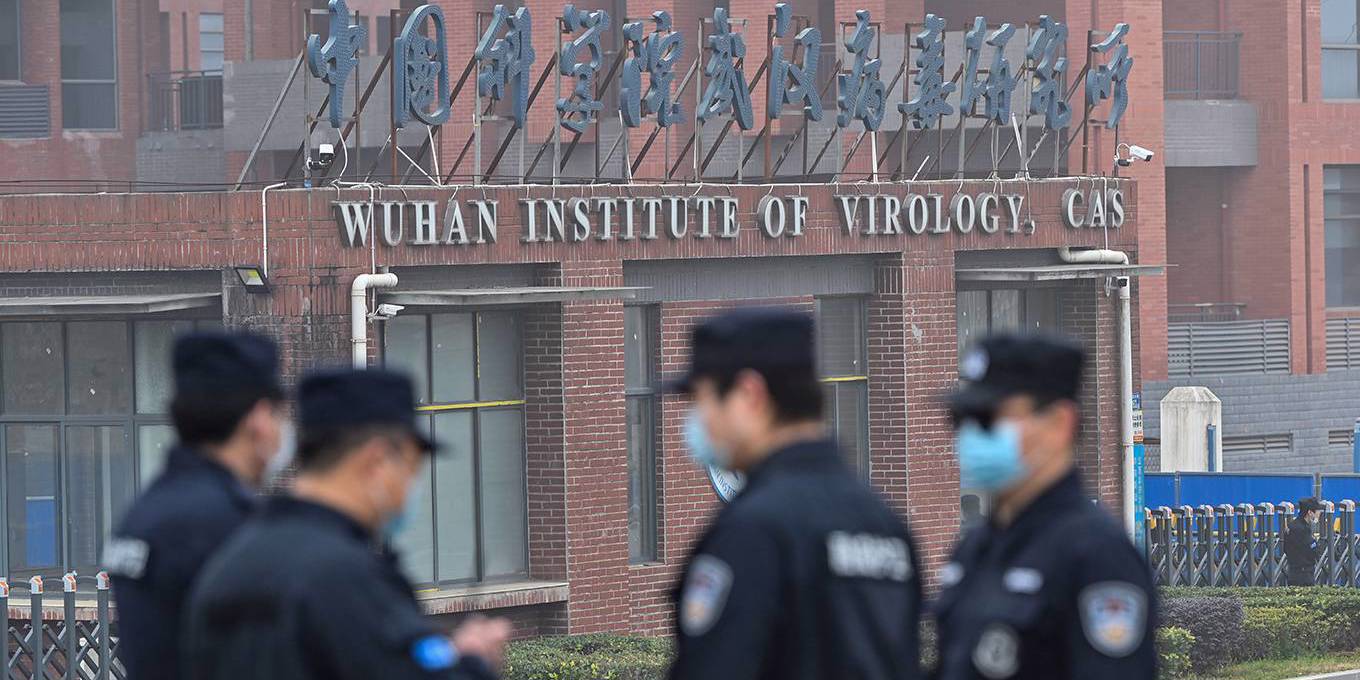
It is well known that Chinese President Xi Jinping’s regime censored early reports that a new, deadly coronavirus had emerged in Wuhan and hid evidence of human-to-human transmission, thereby enabling a local outbreak to become a global calamity. What remains to be determined is whether COVID-19 emerged naturally in wildlife or was leaked from a lab – namely, the Wuhan Institute of Virology (WIV).

Here, too, China has embraced obfuscation rather than transparency. Xi’s regime has blocked an independent forensic inquiry into COVID-19’s origins, arguing that any such investigation amounts to “origin-tracing terrorism.” After Australia called for a probe into China’s handling of the outbreak, Xi’s government punished it with a raft of informal sanctions.

China had help covering up its bad behavior. Early in the pandemic, World Health Organization Director-General Tedros Adhanom Ghebreyesus parroted the Chinese government’s talking points and praised its handling of the outbreak. Instead of verifying China’s claims, the WHO broadcast them to the world.

Yet far from condemning this failure of global health leadership, France and Germany took the lead in nominating Tedros for a second term at the WHO’s helm, and the United States decided not to field a candidate to challenge him. Having run unopposed, Tedros will now lead this critical institution for another five years.

The West also helped China to divert attention from the lab-leak hypothesis. Not only are several labs in the West engaged in research to engineer super-viruses; Western governments have ties to the WIV – a French-designed institute where US-funded research has been carried out. Both the National Institutes of Health and USAID have issued grants to EcoHealth Alliance, a group studying bat coronaviruses in collaboration with WIV researchers.

The US government has not disclosed the full extent of its funding to WIV projects, let alone explained why its agencies would fund research at an institution linked to the Chinese military. A January 2021 State Department fact sheet proclaimed that the US has “a right and obligation to determine whether any of our research funding was diverted to secret Chinese military projects at the WIV.” But why was that risk deemed acceptable in the first place?

The conflicts of interest surrounding the lab-leak hypothesis distorted early discussions about the origins of COVID-19. A letter published in the Lancet in February 2020, signed by a group of virologists, is a case in point. The letter “strongly condemned” those “suggesting that COVID-19 did not have a natural origin.” The message was clear: to lend any credence to the possibility of a lab leak would be unscientific.

The letter turned out to be organized and drafted by the president of EcoHealth Alliance. But by the time the conflicts of interest came to light, it was too late. Major US news organizations and social-media giants were treating the lab-leak hypothesis as a baseless conspiracy theory, with Facebook, Instagram, and Twitter censoring references to a lab accident.

It should always have been clear that the lab-leak hypothesis had merit: the 2004 outbreak of SARS (severe acute respiratory syndrome) in Beijing resulted from such a leak. Instead, frank discussion of the possibility was suppressed until May 2021, when US President Joe Biden announced that a lab accident was one of “two likely scenarios” on which US intelligence agencies would focus, as they carried out a 90-day inquiry into the pandemic’s origins.

By then, however, Chinese authorities had had plenty of time to cover whatever tracks there may have been. Add to that its unwillingness to cooperate in a probe, and it should not be surprising that the inquiry’s results were inconclusive.

But the exercise was apparently enough to convince Biden to take the pressure off China. Despite pledging to “do everything [possible] to trace the roots of this outbreak that has caused so much pain and death around the world,” he did not extend the intelligence inquiry, and he has since avoided any reference to the pandemic’s origins.

Xi announced last September that Chinese labs handling deadly pathogens would face closer scrutiny, but he continues to denounce any insinuation that the coronavirus could have been leaked. Meanwhile, China is profiting from the pandemic; exports are surging. The country has capitalized on the crisis to advance its geopolitical interests, including by stepping up its territorial aggression, from East Asia to the Himalayas.

But a reckoning may yet come. Nearly three-quarters of Americans now believe that it is “likely” that COVID-19 was leaked from the WIV. Moreover, as China’s neo-imperialist ambitions have become clear, unfavorable views of China have reached record highs in many advanced economies. If world leaders wanted a mandate to pursue further inquiries into the pandemic’s origins, it is safe to say they have it.

This is not the first made-in-China pandemic – the country also produced SARS in 2003, the Asian flu in 1957, the Hong Kong flu in 1968, and the Russian flu in 1977. If the world keeps letting China off the hook, it will not be the last.

Brahma Chellaney

Brahma Chellaney, Professor of Strategic Studies at the New Delhi-based Center for Policy Research and Fellow at the Robert Bosch Academy in Berlin, is the author of nine books, including Asian Juggernaut; Water: Asia’s New Battleground; and Water, Peace, and War: Confronting the Global Water Crisis.
© Project Syndicate, 2022.

India must give Taiwan a helping hand

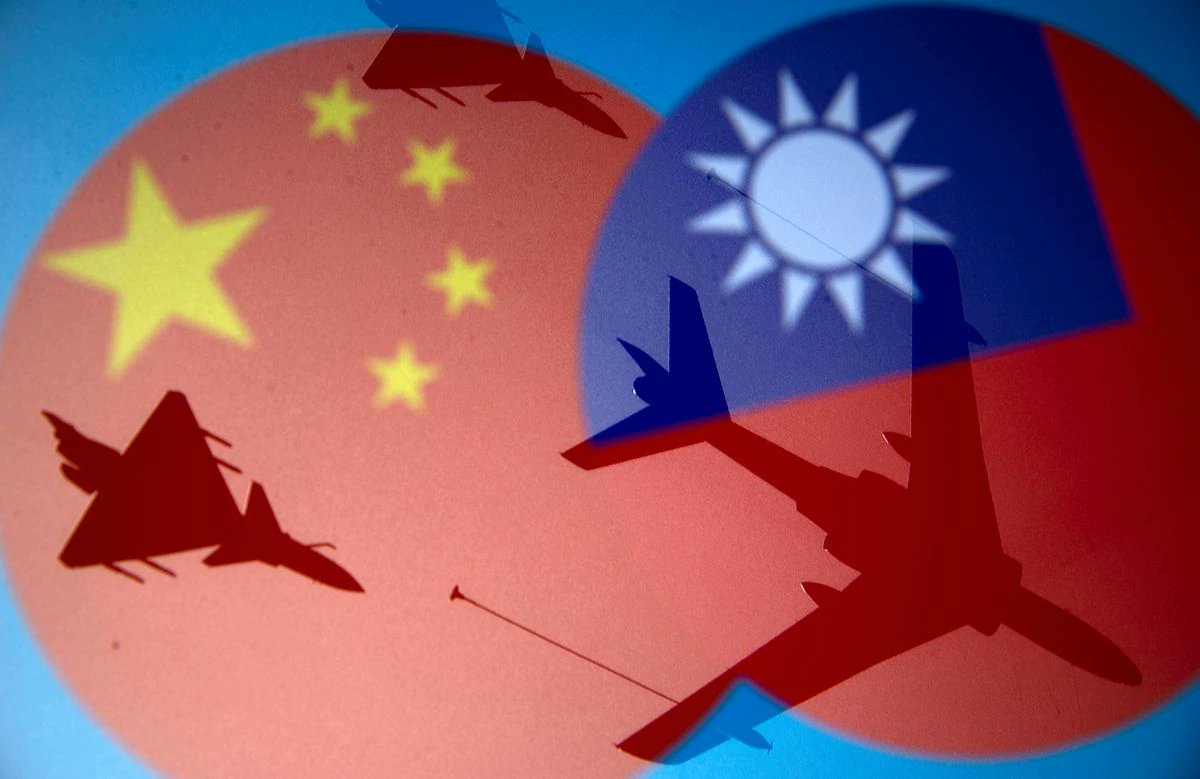
Do you know that Taiwan plays an indirect role in the defense of India because its autonomous existence ties up a sizable portion of China’s armed forces? If China succeeds in recolonizing Taiwan, India’s security will come under greater pressure.

Brahma Chellaney, The Times of India

After swallowing Hong Kong, redrawing the South China Sea’s geopolitical map and encroaching on Indian and Bhutanese borderlands, an expansionist China is itching to move on Taiwan. This island democracy is a technological powerhouse central to the international semiconductor business. Taiwan also plays an indirect role in the defence of India because its autonomous existence ties up a sizable portion of China’s armed forces.

Beijing’s claim that Taiwan has “always been” part of China is dubious, at best, and based on revisionist history. For most of its history, Taiwan was inhabited by Malayo-Polynesian tribes and had no ties with China until the island’s Dutch colonial rulers in the 17th century invited Chinese workers to emigrate. Geographically, Taiwan is closer to the Philippines than China.

The world cannot afford to let Taiwan go the way of the once-autonomous Tibet, which was gobbled up by Mao Zedong’s regime in the early 1950s. Tibet’s annexation remains one of the most far-reaching geopolitical developments in post-World War II history, which resulted in China imposing itself as India’s neighbour and waging unending aggression.

Today, Taiwan has all the attributes of a robust independent state, and most Taiwanese want it to stay that way. But China’s new Mao, Xi Jinping, calls the island’s incorporation a “historic mission”. Xi is working to implement the expansionist agenda that Mao left unfinished, which explains why he has not spared even tiny Bhutan.

In the way a porcupine’s quills protect it from larger predators by making it difficult to digest, Taiwan needs to create porcupine-like defences with weapons like anti-ship and anti-aircraft missiles. By turning a Chinese invasion into a bloody and protracted guerrilla campaign, a porcupine Taiwan would inflict high costs on China, including major military casualties.

But no less important than bolstering its defences is Taiwan’s imperative to carve out greater international space for itself. If Taiwan gains greater presence on the global stage, it will be able to shore up its status as a de facto nation, making it more difficult for China to seize the island in the way it occupied Tibet and Xinjiang soon after coming under communist rule in 1949. The then-independent Tibet, for example, should have applied for United Nations membership shortly after that international body came into existence in 1945, but it never did.

China, as a step towards annexing Taiwan, is working to wipe out its international identity by bribing countries to break off diplomatic ties with Taipei and by vetoing Taiwan’s presence even in international forums. Its poaching has left only 13 nations and the Vatican still recognizing Taiwan.

But recently, China has been forced to eat humble pie by a puny nation. Lithuania, with just 18,500 active military personnel, has set an example for bigger countries on how to stand up to the global Goliath’s bullying. Undeterred by China’s sanctions campaign against it, Lithuania has allowed Taiwan to open a de facto embassy. With some other European states — from the Czech Republic and Poland to Slovakia — already seeking to deepen ties with Taiwan, Lithuania indeed promises to serve as a bellwetherof sorts.

India, locked in several military standoffs with China, needs to think and act creatively, including helping Taiwan by learning from its historical mistake on Tibet. When China invaded Tibet in 1950, India opposed Tibet’s desperate plea for a UN discussion before acquiescing in the Chinese annexation of the buffer, including withdrawing its military escorts from Tibet and handing over Tibet’s postal, telegraph and telephone services that it was running.

If Taiwan is not to go Tibet’s way, India must do its part to help Taiwan reinforce its defences and self-governing status. India must follow the lead of Japan and the US in strengthening ties with Taipei. And it should emulate the example set by minnow Lithuania and allow Taiwan to rename its “Taipei Economic and Cultural Centre” in New Delhi as the “Taiwanese Representative Office”, while rebranding its own mission in Taipei as the “India Representative Office”.

Make no mistake: Taiwan is on the frontline of international defence against Xi’s totalitarianism and expansionism, which have spawned a Muslim gulag in Xinjiang, brutal repression in Tibet and Himalayan aggression. Major democracies must act before it becomes too late to save Taiwan, a democratic success story. If China succeeds in recolonizing Taiwan, India’s security will come under greater pressure.

The writer is professor of strategic studies, Centre for Policy Research.

The Quad needs an economic pillar to stand on

The Quad, a partnership of democracies that had once appeared more concept than reality, has been fortified. But it faces important challenges, including an expansive agenda that could dilute its focus and the absence of an economic pillar to lend support.

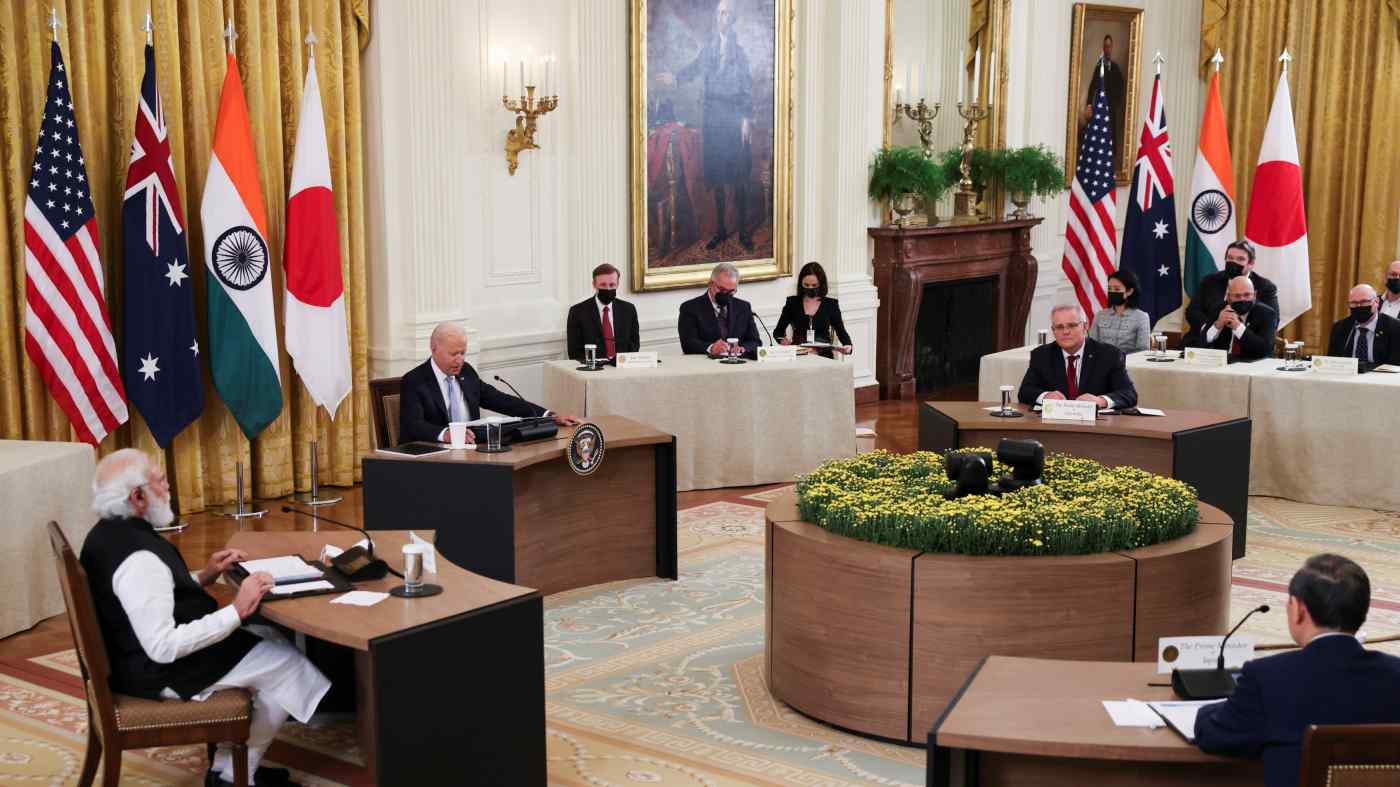
Joe Biden hosts a Quad leaders summit at the White House in September 2021: American, Australian, Indian and Japanese interests are not entirely congruent.   © Reuters

Brahma Chellaney, Nikkei Asia

Resurrected in November 2017, the Australia-India-Japan-United States Quad has come a long way toward cementing a strategic coalition of the leading democracies of the Indo-Pacific region.

But the question of where the Quad is headed has gained greater salience in the wake of the Regional Comprehensive Economic Partnership (RCEP) taking effect with Japan and Australia included in it.

RCEP, billed as the world’s largest trade bloc, and the separate Comprehensive and Progressive Agreement for Trans-Pacific Partnership (CPTPP) seek to promote economic integration around China and Japan, even as Beijing pursues its neo-imperial Belt and Road Initiative (BRI) that has already ensnared some vulnerable states in sovereignty-eroding debt traps. The U.S. and India were to be members of CPTPP and RCEP, respectively, but then both decided not to join.

Chinese Foreign Minister Wang Yi famously mocked the Quad in 2018 as a “headline-grabbing idea” that will dissipate “like the sea foam in the Pacific or Indian Ocean.” However, the Quad, anchored in the free and open Indo-Pacific (FOIP) vision, continues to gain in strength, largely in response to China’s muscular revisionism.Leaders of participating nations at the Regional Comprehensive Economic Partnership meeting in Singapore, pictured in November 2018: the question of where the Quad is headed has gained greater salience in the wake of RCEP taking effect on Jan. 1.   © Reuters

The change of administrations in the U.S. and Japan in 2021 and in Australia in 2018, far from slowing momentum, has helped build continuity, making the Quad’s future more durable.

The past year will be remembered for the first-ever Quad leaders summits — a virtual summit in March, and then an in-person summit at the White House in September. The summits yielded the first-ever Quad joint statements, which articulated a clear-eyed vision. Until then, the pattern was for each state to issue its own statement at the end of a meeting of officials from the Quad countries.

To be sure, when U.S. President Joe Biden was elected, there was uncertainty over the Quad’s future, including whether Biden would carry forward his predecessor’s FOIP strategy. Only after being sworn in did Biden embrace the FOIP concept and speak about the Quad.

There is a reason why the Quad remains central to America’s Indo-Pacific strategy, despite the new, Biden-initiated AUKUS alliance with Australia and Britain. The U.S., given its relative decline, needs its allies more than ever so that, in seeking to address international challenges, American power is augmented with that of its allies and strategic partners. Asian power equilibrium cannot be built without Japan, India and Australia.

In contrast to the AUKUS alliance’s security mission, the Quad now has an agenda extending to geoeconomic issues. While then-U.S. President Donald Trump’s administration helped give the Quad strategic meaning, the Biden administration has sought to reorient the group toward dealing with geoeconomic challenges.

The Quad initiatives since 2021 reflect this new focus. The initiative to build resilient supply chains, for example, extends from the technology and public-health sectors to semiconductors and clean energy. It draws strength from the hard lessons many economies have learned about China-dependent supply chains.

The Quad is also seeking to deliver transparent, high-standard infrastructure by coordinating technical assistance and capacity-building efforts with regional states. The objective is to set up public-private partnership projects that are properly planned and financially and environmentally sustainable, in contrast to China’s BRI projects, many of which have also faced allegations of corruption and malpractice.

The Quad Vaccine Partnership, the most-visible initiative, is aimed at fostering equitable access to COVID-19 vaccines by expanding vaccine manufacturing capacity in the quartet and by donating vaccines to other countries. Vaccine donations collectively by the quartet already rank the largest in the world.

Such initiatives show that the Quad, although catalyzed into action by China’s aggressive actions and irascible behavior, has become more directed toward larger geoeconomic issues.

A partnership of democracies that had once appeared more concept than reality has been fortified, with its leaders pledging to promote a rules-based Indo-Pacific that is “undaunted by coercion.”

However, the Quad’s new attention on global issues, from climate change — Biden’s pet concern — to cybersecurity and the pandemic, risks diluting the group’s Indo-Pacific focus. Its expansive geoeconomic agenda could also weigh it down.

Furthermore, American, Australian, Indian and Japanese interests are not entirely congruent. For example, India, facing the China-Pakistan strategic axis, maintains a land-based defense posture, whereas Australia, Japan and the U.S. are all focused on the maritime domain. And while America’s main objective regarding China is nonmilitary — to counter its geopolitical, ideological and economic challenge to U.S. preeminence — Japan and India confront a direct Chinese threat.

According to Chinese state media commentary, Japan and Australia’s participation in RCEP has taken “the wind out of the Quad’s anti-Chinese sails.” Australia and Japan have consistently refused to bend to Chinese pressure. But they have been lured by the billions of additional dollars that they will likely earn from RCEP’s boosting of regional trade, even as China gains a greater say in shaping trade rules in the Indo-Pacific.

Arrangements like RCEP, CPTPP and BRI, in fact, underscore the imperative for an economic pillar for the FOIP vision in order to give the Quad more comprehensive meaning. The Biden administration says it will unveil an economic framework that will go beyond these arrangements.

The Quad’s security role needs to be complemented with a concretized Indo-Pacific economic dimension so that security and economic interests are fused. Otherwise, if its members pick economic interests over security interests, the Quad’s relevance will erode.

Brahma Chellaney is a geostrategist and author of nine books, including “Asian Juggernaut: The Rise of China, India and Japan.”

A David nation puts the global Goliath in its place

BY BRAHMA CHELLANEY, The Hill

The Chinese Communist Party (CCP) is intrinsically totalitarian, belligerent, arbitrary, expansionist and contemptuous of international law. And under Xi Jinping, the CCP has become more despotic, coercive and punitive. With its “tribute nation” approach to weak, vulnerable states, it seeks to influence their sovereign decisions.

But now a midget nation, with just 18,500 active military personnel, has set an example for bigger countries on how not to succumb to the efforts of the world’s largest, strongest and longest-surviving autocracy to impose its will through coercive pressure.

Lithuania, with a population smaller than the smallest second-tier Chinese city, has stood up to China by defying its threats and letting Taiwan open a representative office in Vilnius, the Lithuanian capital. This action was preceded by Lithuania’s withdrawal from the 17+1, which groups 17 countries of East and Central Europe with China to help promote Xi’s neo-imperial Belt and Road Initiative. And after its defense ministry found that Chinese mobile phones had built-in censorship capabilities, Lithuania advised consumers to ditch such devices. 

With Lithuania now set to open its own representative office in Taipei, Taiwan’s capital, China has ratcheted up its punitive campaign against the Baltic nation of 2.8 million people that prides itself on its role in promoting human rights and democracy. The angry vitriol spewed by the Chinese state media has extended to mocking Lithuania’s puny size. 

Yet, it is particularly galling for the CCP leadership that even translating threats into action and persisting with high-octane denunciations have not brought that minnow to heel.

China’s diplomatic sanctions have included withdrawing its ambassador from Vilnius and expelling the Lithuanian ambassador and then creating a situation that led Lithuania to shut its embassy in Beijing. China has also slapped informal trade sanctions on Lithuania, including imposing a customs block on its exports. And in a bid to disrupt production in Lithuania, China has been denying export permits for items needed by that country’s producers. 

More importantly, the CCP’s weaponization of trade extends to banning multinational companies from using Lithuanian-produced parts and supplies or risk being shut out of the Chinese market. German companies with manufacturing facilities in Lithuania have the most to lose from this ban, with automotive supplier Continental under pressure to close operations there.

Lithuania, a member of the European Union and NATO, may have received little more than verbal support from Washington and Brussels thus far, yet it has refused to buckle under Chinese pressure. 

Lithuania’s oversize place in Chinese diplomacy extends beyond its role as a transit corridor for freight trains from China to Europe. The CCP, as part of its strategy to annex Taiwan, is working to wipe out that island democracy’s international identity by bribing countries to break off diplomatic ties with Taipei. 

China has already poached several of Taiwan’s diplomatic allies – including Burkina Faso, the Dominican Republic, El Salvador, Kiribati, Panama, the Solomon Islands and, most recently, Nicaragua – leaving only 13 nations and the Vatican still recognizing Taiwan as a sovereign nation. To squeeze Taiwan, Beijing has been vetoing its participation even in international forums where Taipei was earlier present, such as the World Health Organization’s decision-making World Health Assembly.

In this light, the CCP is enraged that Lithuania is moving in the other direction by allowing Taiwan to open a de facto embassy. And it worries that Lithuania could serve as a bellwether of sorts for Taiwan securing greater international cooperation. 

The CCP is right to be concerned on that score. Some East and Central European nations, from the Czech Republic and Poland to Slovakia, are already seeking to deepen economic and cultural relations with Taiwan. No wonder Lithuania has been labeled by the CCP media as the “anti-China vanguard” in Europe.

If Taiwan gains greater presence on the international stage, it will be able to shore up its status as a de facto nation, making it more difficult for China to seize the self-governing island in the way it occupied Tibet and Xinjiang soon after coming under communist rule in 1949. The then-independent Tibet, for example, should have applied for United Nations membership shortly after that international body came into existence in 1945, but it never did.

Taiwan, a technological powerhouse with the world’s 22nd-largest economy by gross domestic product, has all the attributes of a robust independent state, and most Taiwanese want it to stay that way. In addition to bolstering its defenses with weapons like anti-ship and anti-aircraft missiles to deter a Chinese invasion, Taiwan needs to expand its global footprint to help safeguard its autonomous status. 

Recognizing Taiwan’s imperative to win broader international support, major democracies – from the United States to Japan – are strengthening ties with Taipei, even as China steps up its campaign to isolate Taiwan. President Biden invited two Taiwanese officials to join the virtual “summit for democracy” that he recently hosted.

Against this background, Lithuania, setting a rare European example of fealty to democratic principles over other interests, has challenged China’s effort to turn Taiwan into an international pariah by permitting a representative office bearing the name “Taiwan” rather than “Chinese Taipei” (used by many nations and the International Olympic Committee) or “Taipei Economic and Cultural Office” (as in Canada and the U.S., for example). About 14 other nations host a “Taipei Representative Office.” But the “Taiwanese Representative Office” in Lithuania is the first such named office, which, according to the Chinese foreign ministry, supplants the one-China principle with “one China, one Taiwan in the world.”

The CCP’s campaign to bully Lithuania into submission was destined to fail because Beijing lacks real leverage over that nation: Lithuania’s exports to China accounted for just 1 percent of total exports, and the Lithuanian imports of Chinese products can be sourced from elsewhere. The CCP campaign was more about sending a warning to the rest of Europe not to follow Lithuania’s lead.

However, by showcasing its hectoring behavior and heavy-handed tactics, the CCP could impel some other nations to follow the Lithuanian example, thereby helping Taiwan to carve out more international space for itself. In other words, winning the geopolitical battle in Lithuania could be a turning point for Taiwan.

More broadly, by opening too many fronts simultaneously through its aggressive actions, the CCP has already dented China’s image, alienated the country’s partners and provoked an international backlash, thus leaving Beijing with only one lever of power — brute force. Simply put, the unbridled ambition, muscular revisionism, international bullying and hubris of the Xi-led CCP is turning it into China’s own worst enemy.

Brahma Chellaney is a geostrategist and the author of nine books, including the award-winning “Water: Asia’s New Battleground” (Georgetown University Press).