
Biden should follow Trump’s lead on China

Chinese President Xi Jinping (R) meets with U.S. Vice President Joe Biden in Davos, Switzerland, Jan. 17, 2017. (Xinhua/Lan Hongguang via Getty Images)

Donald Trump’s tough China policy is his most consequential – and constructive – foreign-policy legacy. Unless President Joe Biden pursues a similar approach, the erosion of US global leadership will become inexorable.

BRAHMA CHELLANEYProject Syndicate

In his inaugural address, US President Joe Biden declared that Americans “will be judged” for how they “resolve the cascading crises of our era.” He expressed confidence that the country would “rise to the occasion,” and pledged that the United States would lead “not merely by the example of our power but by the power of our example.”

The contrast with President Donald Trump’s divisive, isolationist rhetoric could not be sharper. But adopting a different tone is easier than reversing America’s relative decline. To do that, Biden will need to provide wise, forward-looking leadership. And that does not necessarily mean breaking with everything that Trump did.

America’s debilitating political polarization has undermined its international standing. Partisan considerations have hampered – even precluded – the pursuit of long-term foreign-policy objectives. US policy toward a declining Russia, for example, has become hostage to US domestic politics.

Biden’s calls for unity reflect his awareness of this. But the truth is that healing the deep rupture in US society may be beyond any president’s ability, not least because so many Republican voters seem to have abandoned all faith in evidence and expertise. So, rather than becoming consumed by domestic political divisions, Biden must rise above them.

And yet, there is one area where there is broad bipartisan consensus: the need to stand up to China. Trump understood this. Indeed, his tough China policy is his most consequential – and constructive – foreign-policy legacy. Unless Biden pursues a similar approach, the erosion of US global leadership will become inexorable.

The Indo-Pacific region – a global economic hub and geopolitical hotspot – is central to an effective China strategy. Recognizing the region’s immense importance to the world order, China has been steadily reshaping it to serve Chinese interests, using heavy-handed economic coercion, political repression, and aggressive expansionism to have its way from the Himalayas and Hong Kong to the South and East China Seas.

The only way to preserve a stable regional balance of power is with a rules-based, democracy-led order – or, as the Trump administration put it, a “free and open Indo-Pacific.” Over the last year, this vision has spurred the region’s democracies to deepen their strategic bonds and inspired even the faraway democracies of Europe to implement supportive policies. Under the Biden administration’s leadership, countries must now build on this progress, creating a true concert of democracies capable of providing stability and balance in the Indo-Pacific.

Biden seems to understand this. He has made clear his intention to build a united democratic front to counter China. But he is also at risk of undermining his own vision.

For starters, Biden did not embrace the term “Indo-Pacific” until after his electoral victory, and when he did, he replaced “free and open” with “secure and prosperous.” But, whereas “free and open” automatically implies a rules-based, democracy-led order, “secure and prosperous” leaves room for the inclusion of – and even leadership by – autocratic regimes. This ignores the crux of the Indo-Pacific challenge: a revisionist China is actively seeking to supplant the US as the region’s dominant power.

Making matters worse, Biden has signaled a possible reset of ties with China. This would play right into China’s hands.

Trump’s China policy was not just about trade or human rights. It sent the (right) message that China is a predatory communist state without political legitimacy or the rule of law. This helped to tip the scales in America’s favor. Over the last year, unfavorable perceptions of China reached historic highs in many countries. While this was largely because of the made-in-China COVID-19 pandemic, Trump’s ideological onslaught and China’s own aggression – such as on its Himalayan border with India – also played a role.

If the Biden administration abandons economic decoupling and treats China as a major competitor, rather than an implacable adversary, it will tip the scales in the opposite direction, relieving pressure on Chinese President Xi Jinping’s regime and undermining faith in US leadership. This could embolden China to destabilize the Indo-Pacific further, with Taiwan possibly its next direct target.

Moreover, US conciliation would give India second thoughts about aligning itself too closely with the US, and would likely lead to Japan’s militarization – a potential game changer in the Indo-Pacific. It would also facilitate China’s efforts to leverage its vast market to draw in America’s democratic allies – a risk underscored by its recent investment deal with the European Union. All of this would undermine efforts to forge the united democratic front Biden envisions, compounding the threat of China’s aggressive authoritarianism.

The worst choice Biden can make is to seek shared leadership with China in the Indo-Pacific, as some are advocating. Worryingly, Biden’s team does not seem clear on this. In a 2019 essay, Jake Sullivan (Biden’s national security adviser) and Kurt Campbell (Biden’s “Indo-Pacific czar” at the National Security Council) championed “coexistence with China,” describing the country as “an essential US partner.”

To be sure, Sullivan and Campbell did not call for Sino-American joint hegemony, in the Indo-Pacific or beyond. But they also did not take the clear and necessary position that the US must forge a concert of democracies to bring sustained multilateral pressure to bear on China.

After four years of Trump, Biden is right to tout the importance of domestic unity. But a tough line on China is one of the few policy areas behind which Americans can unite. More important, it is the only way to ensure a stable Indo-Pacific and world order.

Brahma Chellaney

Brahma Chellaney, Professor of Strategic Studies at the New Delhi-based Center for Policy Research and Fellow at the Robert Bosch Academy in Berlin, is the author of nine books, including Asian Juggernaut; Water: Asia’s New Battleground; and Water, Peace, and War: Confronting the Global Water Crisis.
© Project Syndicate, 2021.

Don’t Isolate Myanmar

US President Joe Biden’s administration must not ignore how often American sanctions against other countries have worked to China’s advantage. In this light, the US must take a cautious and prudent approach on Myanmar.

BRAHMA CHELLANEYProject Syndicate

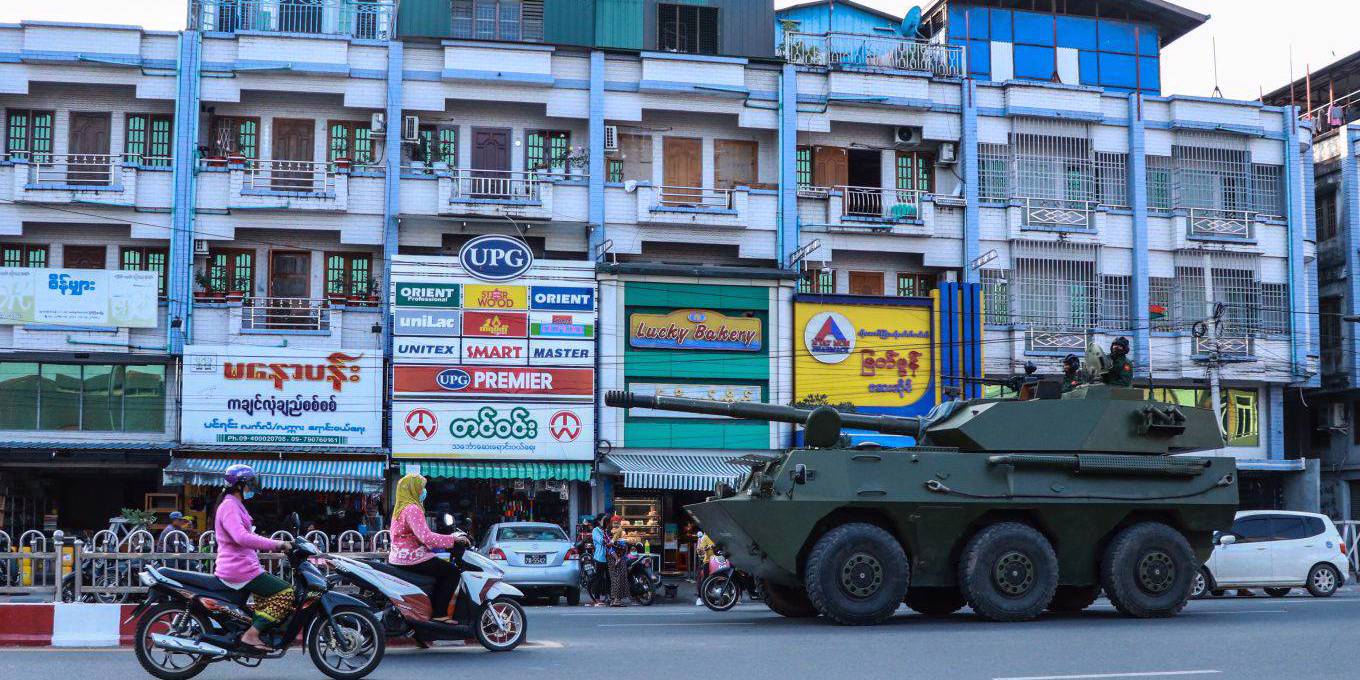
Directly or indirectly, the military has always called the shots in Myanmar. And now that it has removed the decade-old façade of gradual democratization by detaining civilian leaders and seizing power, Western calls to punish the country with sanctions and international isolation are growing louder. Heeding them would be a mistake.

The retreat of the “Myanmar spring” means all the countries of continental Southeast Asia – Thailand, Laos, Cambodia, Vietnam, and Myanmar – are under authoritarian rule, like their giant northern neighbor, China. More fundamentally, the reversal of democratization in Myanmar is a reminder that democracy is unlikely to take root where authoritarian leaders and institutions remain deeply entrenched.

Given this, a punitive approach would merely express democratic countries’ disappointment, at the cost of stymying Myanmar’s economic liberalization, impeding the development of its civil society, and reversing its shift toward closer engagement with democratic powers. And, as in the past, the brunt of sanctions would be borne by ordinary citizens, not the generals.

This is a realistic scenario. US President Joe Biden has warned that the military’s action “will necessitate an immediate review of our sanctions laws,” followed by “appropriate action.” But Biden would do well to consider how US-led sanctions in the past pushed Myanmar into China’s strategic lap, exacerbating regional-security challenges.

Sanctions are a blunt instrument. Thailand’s army chief, with the support of an increasingly unpopular king, has remained ensconced in power in civilian garb since staging a coup in 2014. If the United States can do business with Thailand, where a crackdown on pro-democracy protesters has extended to the use of a feared lèse-majesté law to imprison those who insult the royal family, why hold neighboring Myanmar to a higher standard?

Likewise, the US, India, Japan, and others have established close defense ties with communist-ruled Vietnam. Indeed, the US boasts that in recent years it has established a “robust security partnership” with Vietnam. Only by opening lines of communication and cooperation with Myanmar’s generals can democratic powers hope to influence developments in a strategically important country.

In the past decade, as Myanmar’s democratic transition unfolded, the West neglected to build close relations with the force behind it — the military. Instead, the prevailing Anglo-American approach centered on Aung San Suu Kyi, making her bigger than the cause. That neglect persisted even after Suu Kyi fell from grace over the fate of the country’s Rohingya Muslims, many of whom fled to Bangladesh and some to India during a brutal military campaign to flush out jihadist militants waging hit-and-run attacks.

The West’s lopsided approach eventually contributed to this month’s coup. Today, the US has little influence over Myanmar’s military. The coup leader, General Min Aung Hlaing, and his deputy, General Soe Win, were slapped with US sanctions 14 months ago over the expulsion of the Rohingya. But in responding to the mass detention of Muslims in Xinjiang that it labels “genocide,” the US has spared top Chinese military and party officials, imposing largely symbolic sanctions against lower-ranking functionaries.

Despite their uneven effectiveness and unpredictable consequences, sanctions have remained a favorite – and grossly overused – instrument of Western diplomacy, especially when dealing with the small kids on the global bloc. Non-Western democracies, in stark contrast, prefer constructive engagement.

Japan, for example, has a partnership program with Myanmar’s military that includes capacity-building support and training. Likewise, India’s defense ties with Myanmar extend to joint exercises and operations and supply of military hardware; recently, it gave its neighbor its first submarine. Such ties also seek to counter China’s supply of arms and other aid to Indian tribal insurgents through rebel-controlled northern Myanmar.

Sanctions without engagement have never worked. In 2010, while the US was pursuing a sanctions-only approach to Myanmar, then-President Barack Obama criticized India’s policy of constructive engagement with that country. But within months, Obama embarked on a virtually similar policy, which led to his historic visit to Myanmar in 2012.

Crippling US-led sanctions from the late 1980s paved the way for China to become Myanmar’s dominant trading partner and investor. But in 2011, Myanmar’s bold suspension of a controversial Chinese megaproject, the Myitsone Dam, became a watershed moment for the country’s democratic opening. It set in motion developments that reduced Myanmar’s dependence on China, balanced its foreign policy, and spurred domestic reforms.

Today, nothing would serve Chinese interests more than new US-led efforts to isolate Myanmar, which serves China as a strategic gateway to the Indian Ocean and important source of natural resources. In fact, renewed sanctions and isolation would likely turn Myanmar into another Chinese satellite, like Laos, Cambodia, and Pakistan. As Japan’s state minister for defense, Yasuhide Nakayama, has warned, that outcome would “pose a risk to the security of the region.”

US policymakers must not ignore how often American sanctions against other countries have worked to China’s advantage. They should perhaps be most worried by how sanctions have forced Russia to pivot to China, turning two natural competitors into becoming close strategic partners. And China has been the main trade and investment beneficiary of US sanctions against Iran.

In this light, the US must take a prudent approach to Myanmar. When Biden has expressed a readiness to cooperate with the world’s largest autocracy, China, in areas of mutual interest, he should at least pursue a similar approach with a far weaker Myanmar, where the military is the only functioning institution.

To help influence Myanmar’s trajectory, Biden has little choice but to address what US officials have recognized as a weak spot in American policy – lack of ties with the country’s strongly nationalist military. The US must not turn Myanmar from a partner into a pariah again.

Brahma Chellaney

Brahma Chellaney, Professor of Strategic Studies at the New Delhi-based Center for Policy Research and Fellow at the Robert Bosch Academy in Berlin, is the author of nine books, including Asian Juggernaut; Water: Asia’s New Battleground; and Water, Peace, and War: Confronting the Global Water Crisis.

© Project Syndicate, 2021.