China Is Its Own Worst Enemy

BRAHMA CHELLANEYProject Syndicate

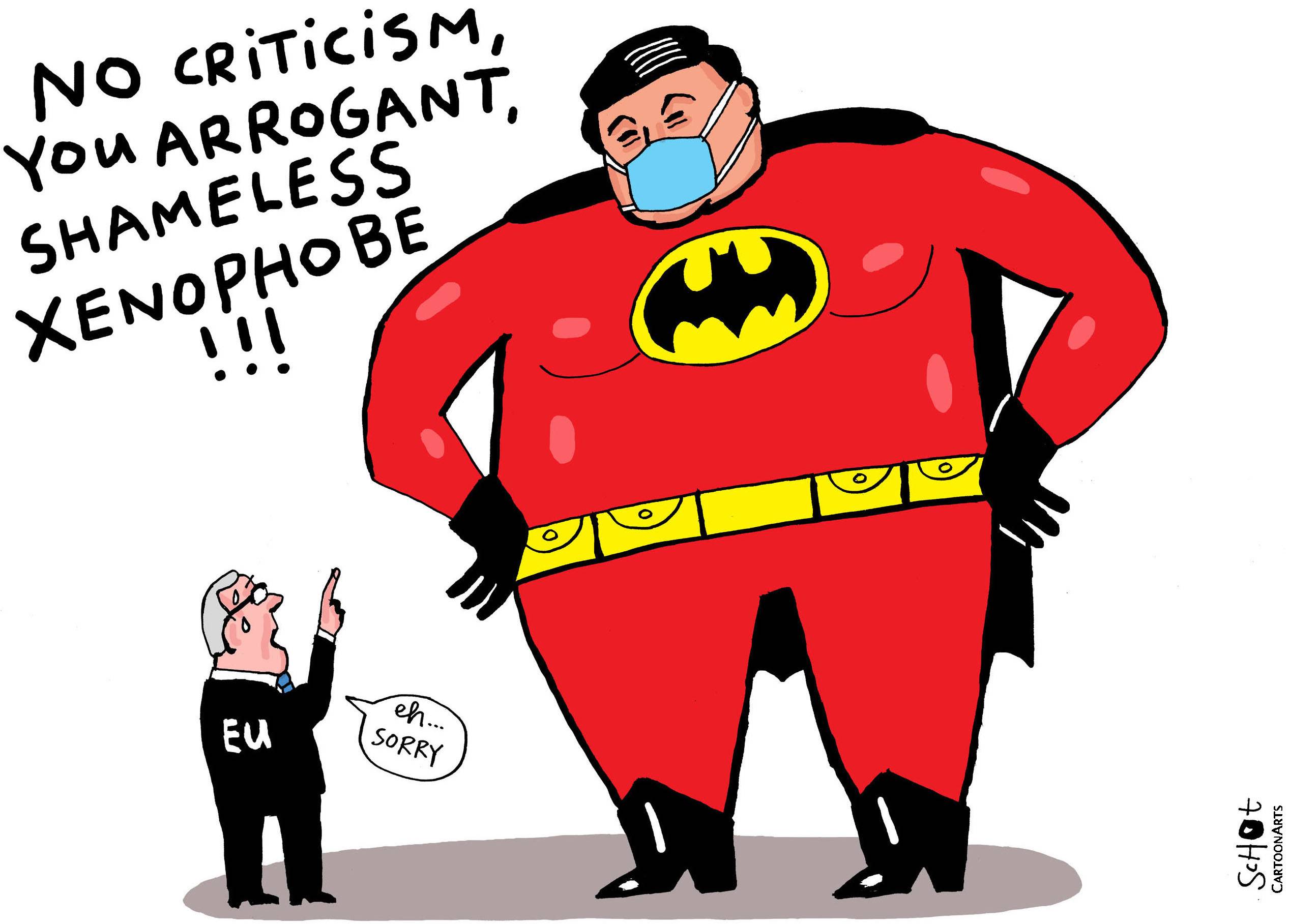
The global backlash against China over its culpability for the international spread of the deadly coronavirus from Wuhan has gained momentum in recent weeks. And China itself has added fuel to the fire, as exemplified by its recent legal crackdown on Hong Kong. From implicitly seeking a political quid pro quo for supplying other countries with protective medical gear, to rejecting calls for an independent international inquiry into the virus’s origins until a majority of countries backed such a probe, the bullying tactics of President Xi Jinping’s government have damaged and isolated China’s communist regime.

The backlash could take the form of Western sanctions as Xi’s regime seeks to overturn Hong Kong’s “one country, two systems” framework with its proposed new national-security laws for the territory, which has been wracked by widespread pro-democracy protests for over a year. More broadly, Xi’s overreach is inviting increasing hostility among China’s neighbors and around the world.

Had Xi been wise, China would have sought to repair the pandemic-inflicted damage to its image by showing empathy and compassion, such as by granting debt relief to near-bankrupt Belt and Road Initiative partner countries and providing medical aid to poorer countries without seeking their support for its handling of the outbreak. Instead, China has acted in ways that undermine its long-term interests.

Whether through its aggressive “Wolf Warrior” diplomacy – named after two Chinese films in which special-operations forces rout US-led mercenaries – or military-backed expansionist moves in China’s neighborhood, Xi’s regime has caused international alarm. In fact, Xi, the self-styled indispensable leader, views the current global crisis as an opportunity to tighten his grip on power and advance his neo-imperialist agenda, recently telling a Chinese university audience that, “The great steps in history were all taken after major disasters.”

China has certainly sought to make the most of the pandemic. After buying up much of the world’s available supply of protective medical equipment in January, it has engaged in price-gouging and apparent profiteering. And Chinese exports of substandard or defective medical gear have only added to the international anger.

While the world grapples with COVID-19, the Chinese military has provoked border flare-ups with India and attempted to police the waters off the Japanese-controlled Senkaku Islands. China has also recently established two new administrative districts in the South China Sea, and stepped up its incursions and other activities in the area. In early April, for example, a Chinese coast guard ship rammed and sank a Vietnamese fishing boat, prompting the United States to caution China to “stop exploiting the [pandemic-related] distraction or vulnerability of other states to expand its unlawful claims in the South China Sea.”

Meanwhile, China has made good on its threat of economic reprisals against Australia for initiating the idea of an international coronavirus inquiry. Through trade actions, the Chinese government has effectively cut off imports of Australian barley and blocked more than one-third of Australia’s regular beef exports to China.

Whereas Japan readily allowed the International Atomic Energy Agency to conduct a full investigation into the 2011 Fukushima nuclear disaster – a probe that helped the country to improve safety governance – China strongly opposed any coronavirus inquiry, as if it had something to hide. In fact, some Chinese commentators denounced calls for an inquiry as racist.

But once a resolution calling for an “impartial, independent and comprehensive evaluation” of the global response to COVID-19 gained the support of more than 100 countries in the World Health Organization’s decision-making body, the World Health Assembly, Xi sought to save face by telling the assembly that “China supports the idea of a comprehensive review.” At the last minute, China co-sponsored the resolution, which was approved without objection.

The resolution, however, leaves it up to the WHO’s controversial director-general, Tedros Adhanom Ghebreyesus, to launch the review “at the earliest appropriate moment.” Tedros, who has been accused of aiding China’s initial COVID-19 cover-up, may decide to wait until the pandemic has come “under control,” as Xi has proposed.

Make no mistake: the world will not be the same after this wartime-like crisis. Future historians will regard the pandemic as a turning point that helped to reshape global politics and restructure vital production networks. Indeed, the crisis has made the world wake up to the potential threats stemming from China’s grip on many global supply chains, and moves are already afoot to loosen that control.

More fundamentally, Xi’s actions highlight how political institutions that bend to the whim of a single, omnipotent individual are prone to costly blunders. China’s diplomatic and information offensive to obscure facts and deflect criticism of its COVID-19 response may be only the latest example of its brazen use of censure and coercion to browbeat other countries. But it represents a watershed moment.

In the past, China’s reliance on persuasion secured its admission to international institutions like the World Trade Organization and helped to power its economic rise. But under Xi, spreading disinformation, exercising economic leverage, flexing military muscle, and running targeted influence operations have become China’s favorite tools for getting its way. Diplomacy serves as an adjunct of the Communist Party’s propaganda apparatus.

Xi’s approach is alienating other countries, in the process jeopardizing their appetite for Chinese-made goods, scaring away investors, and accentuating China’s image problem. Negative views of China and its leadership among Americans have reached a record high. Major economies such as Japan and the US are offering firms relocation subsidies as an incentive to shift production out of China. And India’s new rule requiring prior government approval of any investment from China is the first of its kind.

China currently faces the most daunting international environment since it began opening up in the late 1970s, and now it risks suffering lasting damage to its image and interests. A boomerang effect from Xi’s overreach seems inevitable. A pandemic that originated in China will likely end up weakening the country’s global position and hamstringing its future growth. In this sense, the hollowing out of Hong Kong’s autonomy in the shadow of COVID-19 could prove to be the proverbial straw that breaks the Chinese camel’s back.

Brahma Chellaney

Brahma Chellaney, Professor of Strategic Studies at the New Delhi-based Center for Policy Research and Fellow at the Robert Bosch Academy in Berlin, is the author of nine books, including Asian Juggernaut; Water: Asia’s New Battleground; and Water, Peace, and War: Confronting the Global Water Crisis.
© Project Syndicate, 2020.

The world faces a moment of truth on China

np_file_10723

Brahma Chellaney, The Japan Times

The COVID-19 pandemic has changed the global geopolitical landscape, including triggering a growing backlash against China. The world wants to know why and how a local outbreak in Wuhan turned into a global pandemic that has already killed more than a quarter of a million people. The incalculable human and economic toll continues to mount.

An independent international inquiry will give China a chance to clear the air with the rest of the world. But the Chinese Communist Party vehemently opposes such a probe, viewing it as a mortal threat.

Against this background, the forthcoming session of the World Health Assembly (the decision-making body of the World Health Organization) is shaping up as a test of China’s ability to block an independent investigation into the origins and spread of the new coronavirus that emerged in Wuhan. The European Union is the latest to state that it will back a resolution at the assembly calling for an independent review.

Getting to the bottom of how the COVID-19 virus flared and spread is essential for designing rapid-response efforts to prevent a future local outbreak from spiraling into another pandemic. After all, this is not the first deadly disease to spread globally from China. A Chinese coverup of the 2002-2003 SARS outbreak triggered the world’s first 21st-century pandemic. Even the WHO agrees on the need for an investigation, with its representative in China saying that knowing the origins of the COVID-19 virus is “very important” to prevent “reoccurrence.”

U.S. President Donald Trump has offered China an incentive for cooperation by contrasting a mistake with willful action: “If it was a mistake, a mistake is a mistake. But if they were knowingly responsible, yeah, I mean, then sure there should be consequences.” Beijing, however, has shied away from answering even basic questions.

For example, why did China stop domestic flights from Wuhan from Jan. 23, yet allowed some international flights to continue operating from there, such as charter flights? It aided the international spread of the virus by continuing to encourage foreign travel from other Chinese cities until late March. Also, by the time it belatedly locked down Wuhan, about 5 million of its residents, according to the mayor, had already left the city, with an unknown number flying overseas from other Chinese cities. Simply put, infected travelers from Wuhan seeded outbreaks in many countries.

Another key question is why China has clamped down on further research by Chinese scientists into the virus’s origins. It instituted a new policy mandating prior vetting after several Chinese research papers highlighted dangerous work on bat coronaviruses, with one study concluding that “the killer coronavirus probably originated from a laboratory in Wuhan.”

In fact, authorities shut a Shanghai laboratory for “rectification” a day after its Jan. 12 publication of the coronavirus genome opened the global path to diagnostic tests. China, significantly, has still not shared any live virus sample with the outside world, “making it impossible to track the disease’s evolution,” to quote U.S. Secretary of State Mike Pompeo.

Moreover, China has not given foreign experts access to any facility or location where the virus may have originated, including the Wuhan Institute of Virology. China’s infamous “batwoman,” Shi Zhengli, was leading lab experiments there in manipulating natural coronaviruses from bats.

The dangerous research may explain why China, instead of sharing coronavirus samples with the outside world, chose to destroy its lab samples, according to Pompeo and the Beijing-based Caixin Global news site. U.S. intelligence has confirmed that it is investigating whether the pandemic was “the result of an accident at a laboratory in Wuhan.” Pompeo says there is already “enormous evidence” indicating that the virus came from the Wuhan Institute of Virology lab.

In January, while China was playing down the contagion’s threat, it was quietly engaged in a frenzied import of medical gear — from personal protective equipment to masks. According to a U.S. Department of Homeland Security intelligence report dated May 1, China “intentionally concealed the severity” of the outbreak to facilitate its hoarding. By the time the virus seriously hit Europe, China had bought up much of the global supply of protective gear, including 56 million respirators and masks in the last week of January alone.

Now, China has stepped up a crackdown at home to keep what happened at Wuhan under wraps. According to one account, grieving relatives and their lawyers have been threatened by police and volunteers “who tried to thwart the state’s censorship apparatus by preserving reports about the outbreak have disappeared.”

Just think: If China was not guilty of any coverup, wouldn’t it be welcoming the growing international calls for an independent inquiry and offering to provide assistance to such a probe? Instead, Beijing seems to be showcasing its guilt by belligerently rejecting the pleas for an inquiry. It insists the world must avoid “pointing fingers, demanding accountability and other non-constructive approaches.”

Australia, for example, has come under China’s withering attack for proposing that WHO member nations support an independent inquiry into the origins and spread of the coronavirus. The Chinese ambassador to Australia, calling Australia’s proposal “dangerous,” threatened punishment through Chinese boycotts of Australian wine, beef, tourism and education sectors.

Meanwhile, as the Group of Seven countries, India and others seek a review and reform of the WHO, China’s decision to give an additional $30 million to the agency appears aimed at frustrating such calls. International rules mandate that countries notify the WHO of “a public health emergency of international concern within 24 hours of assessment.” China’s glaring failure to do so has led to calls for introducing WHO inspectors with the power to enter a country to probe a disease outbreak in the style of weapons inspectors.

Make no mistake: Money alone can neither aid China’s strategy to deflect blame for the global crisis nor help defuse the backlash against it. Its carrot-and-stick approach of mixing financial inducements with threats will only fuel greater mistrust of Beijing.

In fact, the pandemic has made the world arrive at its moment of truth: It must break China’s stranglehold on vital supply chains, including by incentivizing foreign manufacturers to move out of China, or else risk a situation in which Beijing weaponizes its leverage.

China’s mercantilist expansionism has led to a spate of new regulations in the EU, Australia, Germany, Spain and Italy. But India’s recent new rule mandating prior scrutiny of Chinese investment in any form — and across all sectors — is the first of its kind. Another major recent move is by Japan, which has set aside $2.2 billion of its pandemic-linked economic support package for a specific purpose: To help Japanese firms shift manufacturing out of China.

Today, the world is looking for answers that only a thorough inquiry can reveal. If China refuses to join such a probe, it will encourage important economies to start distancing themselves from it, through new tariffs, nontariff barriers, relocation of manufacturing and other policy moves. Such systematic “decoupling,” by undermining the communist monopoly on power, would be the CCP’s worst nightmare come true.

Longtime Japan Times contributor Brahma Chellaney is the author of nine books, including the award-winning “Water: Asia’s New Battleground” (Georgetown University Press).

© The Japan Times, 2020.

If there was no coverup, why is China opposing an inquiry?

xijinping_07112019_1

BY BRAHMA CHELLANEYThe Hill

China insists it has been fully transparent and hidden nothing on the killer coronavirus, whose international spread from Wuhan has turned into the greatest global disaster of our time. So why is Beijing rancorously opposing an independent international inquiry into the origins and spread of the coronavirus?

The lethal virus emanated from China, leading to a paralyzing pandemic. The mounting socioeconomic costs of the unparalleled global crisis will remain immeasurable. In this light, is it unreasonable that the world wants to know how and why it happened?

Investigating the pandemic’s genesis is critical for another reason — this is not the first deadly disease to spread globally from China. A Chinese coverup of the 2002-2003 SARS outbreak triggered the world’s first 21st-century pandemic. Getting to the bottom of how the latest pathogen flared and spread is essential for designing rapid-response efforts to prevent a future local disease outbreak from spiraling into yet another pandemic.

Even the World Health Organization (WHO) agrees. This is the organization whose repeated deference helped Beijing to cover its tracks, prompting President Donald Trump to say recently that the WHO “should be ashamed of themselves because they are like the public-relations agency for China.” In fact, several countries seeking an inquiry want the investigation to focus on the pandemic-related roles of both China and the WHO.

The WHO representative in China has said the “origins of virus are very important” to prevent “reoccurrence.” Yet Beijing has shut out even the WHO from its COVID-19 investigations.

Trump has offered China an incentive for cooperation by contrasting a mistake with willful action: “If it was a mistake, a mistake is a mistake. But if they were knowingly responsible, yeah, I mean, then sure there should be consequences.” Beijing, however, has shied away from answering even basic questions.

For example, why did China stop flights from Wuhan to the rest of the country from January 23, yet allowed some international flights from Wuhan, including charter flights, thus facilitating the international spread of the virus? Or why did it recently clamp down on further research by Chinese scientists into the virus’s origins? It instituted a new policy mandating prior vetting after several Chinese research papers highlighted dangerous work on bat coronaviruses, with one study concluding that “the killer coronavirus probably originated from a laboratory in Wuhan.”

In fact, authorities shut a Shanghai laboratory a day after its January 12 publication of the coronavirus genome opened the global path to diagnostic tests. China has not shared any live virus sample with the outside world, “making it impossible to track the disease’s evolution,” to quote Secretary of State Mike Pompeo.

Moreover, China has not given foreign experts access to any facility or location where the virus may have originated, including the Wuhan Institute of Virology. The infamous “batwoman,” Shi Zhengli, was leading lab experiments there in manipulating natural coronaviruses from bats.

The dangerous research may explain why China, instead of sharing any coronavirus sample with the outside world, chose to destroy its lab samples, according to Pompeo and the Beijing-based Caixin Global news site. U.S. intelligence has confirmed that it is investigating whether the pandemic was “the result of an accident at a laboratory in Wuhan.”

Just think — if China was not guilty of any coverup, wouldn’t it be welcoming the growing international calls for an independent inquiry and offering to provide assistance to such a probe? Such an inquiry would give China a chance to clear the air with the rest of the world.

Instead, Beijing seems to be showcasing its guilt by belligerently rejecting the pleas for such an inquiry, including by the European Commission president. China says such calls are destined to fail because the world, in the words of its foreign ministry, must avoid “pointing fingers, demanding accountability and other non-constructive approaches.”

Australia is Exhibit A. The country is more economically tied with China than with its security patron, the United States, which explains why it has long hedged its bets. Yet Australia has come under China’s withering attack for merely proposing that WHO member-nations support an independent inquiry into the origins and spread of the coronavirus. Australia said it will push for such an investigation at the WHO assembly (the decision-making body) when it convenes for its annual meeting on May 17.

In response, the Chinese ambassador to Australia has lashed out at his host country, threatening punishment through Chinese boycotts of Australian wine, beef and tourism and education sectors. Australia, however, is not the only country to call for a probe. Sweden, for example, has echoed Australia’s call.

Meanwhile, as the Group of Seven (G7) countries, India and others seek a review of and to reform the WHO, China’s decision to give an additional $30 million to the agency appears aimed at frustrating such calls. International rules require countries to notify the WHO of “a public health emergency of international concern within 24 hours of assessment.” China’s glaring failure to do so has led to calls for introducing WHO inspectors with the power to enter a country to probe a disease outbreak in the style of weapons inspectors.

Make no mistake: Money alone can neither aid China’s strategy to deflect blame for the current crisis nor help defuse the increasing global backlash against it. Its carrot-and-stick approach of mixing financial inducements with threats will only fuel greater mistrust of Beijing.

China is genuinely worried that, once the crisis passes, battered countries or communities may seek a reckoning, including by suing it for damages. Trump has said that his administration is looking at a “very substantial” compensation claim against China. Against this background, Beijing has aggressively sought to rebrand itself as the world’s counter-pandemic leader, while trying to rewrite the outbreak’s history.

But calls are growing louder across the world to publicly hold China accountable for the pandemic’s mounting human and economic toll. The only way China can silence such calls and begin to repair the serious damage to its image is through an independent international inquiry.

If it blocks such a probe, China will pay enormous costs — not as reparations but by compelling other major economies to restructure their relationships with it, a process that ultimately would end its status as the global hub of vital supply chains. China’s mercantilist expansionism has already led to a spate of new regulations in the European Union, Australia, Germany, Spain and Italy. But India’s recent new rule mandating prior scrutiny of Chinese investment in any form – and across all sectors – is the first of its kind. Another major recent move is by Japan, which has set aside $2.2 billion to help Japanese firms shift manufacturing out of China.

If China refuses to come clean, important countries are likely to start economically distancing themselves from it, through new tariffs, non-tariff barriers, relocation of manufacturing and other policy moves. Eventually, such action could undermine the communist monopoly on power in China.

Brahma Chellaney is the author of nine books, including the award-winning “Water: Asia’s New Battleground” (Georgetown University Press).

© The Hill, 2020.