A Water War in Asia?

A column internationally syndicated by Project Syndicate.

Tensions over water are rising in Asia — and not only because of conflicting maritime claims. While territorial disputes, such as in the South China Sea, attract the most attention — after all, they threaten the safety of sea lanes and freedom of navigation, which affects outside powers as well — the strategic ramifications of competition over transnationally shared freshwater resources are just as ominous.

Asia has less fresh water per capita than any other continent, and it is already facing a water crisis that, according to an MIT study, will continue to intensify, with severe water shortages expected by 2050. At a time of widespread geopolitical discord, competition over freshwater resources could emerge as a serious threat to long-term peace and stability in Asia.

Already, the battle is underway, with China as the main aggressor. Indeed, China’s territorial grab in the South China Sea has been accompanied by a quieter grab of resources in transnational river basins. Reengineering cross-border riparian flows is integral to China’s strategy to assert greater control and influence over Asia.

China is certainly in a strong position to carry out this strategy. The country enjoys unmatched riparian dominance, with 110 transnational rivers and lakes flowing into 18 downstream countries. China also has the world’s most dams, which it has never hesitated to use to curb cross-border flows. In fact, China’s dam builders are targeting most of the international rivers that flow out of Chinese territory.

Most of China’s internationally shared water resources are located on the Tibetan Plateau, which it annexed in the early 1950s. Unsurprisingly, the plateau is the new hub of Chinese dam building. Indeed, China’s 13th five-year plan, released this year, calls for a new wave of dam projects on the Plateau.

Moreover, China recently cut off the flow of a tributary of the Brahmaputra River, the lifeline of Bangladesh and northern India, to build a dam as part of a major hydroelectric project in Tibet. And the country is working to dam another Brahmaputra tributary, in order to create a series of artificial lakes.

China has also built six mega-dams on the Mekong River, which flows into Southeast Asia, where the downstream impact is already visible. Yet, instead of curbing its dam-building, China is hard at work building several more Mekong dams.

Likewise, water supplies in largely arid Central Asia are coming under further pressure as China appropriates a growing volume of water from the Illy River. Kazakhstan’s Lake Balkhash is now at risk of shrinking substantially, much like the Aral Sea — located on the border with Uzbekistan — which has virtually dried up in less than 40 years. China is also diverting water from the Irtysh, which supplies drinking water to Kazakhstan’s capital Astana and feeds Russia’s Ob River.

For Central Asia, the diminished transboundary flows are just one part of the problem. China’s energy, manufacturing, and agricultural activities in sprawling Xinjiang are having an even greater impact, as they contaminate the waters of the region’s transnational rivers with hazardous chemicals and fertilizers, just as China has done to the rivers in its Han heartland.

Of course, China is not the only country stoking conflict over water. As if to underscore that the festering territorial dispute in Kashmir is as much about water as it is about land, Pakistan has, for the second time this decade, initiated international arbitral tribunal proceedings against India under the terms of the 1960 Indus Waters Treaty. The paradox here is that downstream Pakistan has used that treaty — the world’s most generous water-sharing deal, reserving for Pakistan more than 80% of the waters of the six-river Indus system — to sustain its conflict with India.

Meanwhile, landlocked Laos — aiming to export hydropower, especially to China, the mainstay of its economy — has just notified its neighbors of its decision to move ahead with a third controversial project, the 912-megawatt Pak Beng dam. It previously brushed aside regional concerns about the alteration of natural-flow patterns to push ahead with the Xayaburi and Don Sahong dam projects. There is no reason to expect a different outcome this time.

The consequences of growing water competition in Asia will reverberate beyond the region. Already, some Asian states, concerned about their capacity to grow enough food, have leased large tracts of farmland in Sub-Saharan Africa, triggering a backlash in some areas. In 2009, when South Korea’s Daewoo Logistics Corporation negotiated a deal to lease as much as half of Madagascar’s arable land to produce cereals and palm oil for the South Korean market, the ensuing protests and military intervention toppled a democratically elected president.

The race to appropriate water resources in Asia is straining agriculture and fisheries, damaging ecosystems, and fostering dangerous distrust and discord across the region. It must be brought to an end. Asian countries need to clarify the region’s increasingly murky hydropolitics. The key will be effective dispute-resolution mechanisms and agreement on more transparent water-sharing arrangements.

Asia can build a harmonious, rules-based water management system. But it needs China to get on board. At least for now, that does not seem likely.

Brahma Chellaney, Professor of Strategic Studies at the New Delhi-based Center for Policy Research and Fellow at the Robert Bosch Academy in Berlin, is the author of nine books, including Asian Juggernaut, Water: Asia’s New Battleground, and Water, Peace, and War: Confronting the Global Water Crisis.
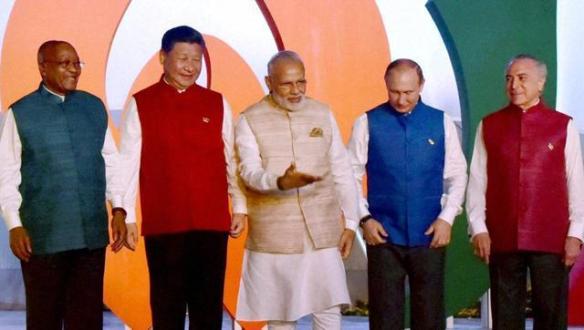
BRICS falls under China’s sway

There’s a real risk that BRICS could unravel under the weight of the BRICS wall of China that Beijing is busy erecting
brics
BY The Japan Times

Adding concrete content to a catchy acronym has become a pressing challenge for BRICS, which brings Brazil, Russia, India, China and South Africa together. BRICS presents itself meretriciously as a powerful grouping. After all, its member-states together represent more than a quarter of the Earth’s landmass, 42 percent of the global population, almost 25 percent of the world’s gross domestic product, and nearly half of the global foreign exchange and gold reserves.

However, as the October BRICS summit in Goa highlighted, there is little in common among its member-states. Although these five emerging economies pride themselves on forming the first important non-Western global initiative, the grouping is still searching to define a common identity and build institutionalized cooperation.

Six years after it expanded from a four-member BRIC to the five-nation BRICS by adding South Africa, it has yet to unveil a common action plan to help bring about fundamental changes in the architecture of global finance and governance or to accelerate the decline of the era of Atlantic dominance.

BRICS lacks the shared political and economic values that bind together the Group of Seven members, who are also tied by security arrangements with the United States. In BRICS, differences outweigh commonalities. As the Goa summit highlighted, China, which is milking BRICS for tangible benefits, represents the biggest challenge to the grouping’s future. Just as China dominates the other new institutions of which it is a founding member — from the Shanghai Cooperation Organization to the Asian Infrastructure Investment Bank (AIIB) — it is using BRICS to assertively push its own interests.

China also dominates the first tangible challenge to the Bretton Woods system, as symbolized by the BRICS-created New Development Bank (NDB) and China’s own initiative, the AIIB.

BRICS has fashioned two instruments — the New Development Bank, which has been given $50 billion in initial capital, and the $100-billion Contingent Reserve Arrangement, or CRA, meant to provide additional liquidity protection to member countries during balance-of-payments problems. Both these instruments have come under China’s sway.

For example, China outmaneuvered India to host the NDB at Shanghai, offering New Delhi a consolation prize — an Indian as the bank’s first president. The CRA — unlike the pool of initial capital to the BRICS bank, with each of the five signatories contributing $10 billion — is being funded 41 percent by China, 18 percent from Brazil, India, and Russia, and 5 percent from South Africa.

Today, China is in the happy situation of overseeing the NDB and the AIIB, not to mention the CRA. Leading two new multilateral banks fits well with Beijing’s strategy to create an “economic hub-and-spoke system” via energy pipelines, strategic highways and ports, and railroad networks. In this scheme, China, as the hub, seeks to draw in raw materials and other natural resources from the spokes, while exporting industrial and consumer goods to them.

China’s “economic hub-and-spoke system” is to parallel America’s military hub-and-spoke system. But it is an “economic hub-and-spoke system” with a strategic mission. China’s infrastructure development in other states is driven, as during the European colonial era, by a specific interest — to advance its own interests while saddling local communities and governments with heavy debt and human and environmental costs.

Against this background, it is not a surprise that China is a revisionist power with respect to the global financial architecture, but a status quo power in regard to the United Nations system. In other words, China supports international institutional reforms that give it a greater say but blocks measures that will dilute its existing status.

So it is an obstacle to restructuring and democratizing the Security Council. It wants to remain Asia’s sole permanent member of the Security Council. And as underscored by its 2016 presidency of the Group of 20, China values the G-20 as a vehicle to enlarge its role in global economic governance while seeking to retain those elements of the present trade and financial architecture that have facilitated its dramatic economic rise.

Meanwhile, it is using BRICS to expand the international role of its currency as part of its quest to build the yuan as a global currency that could one day rival the dollar or euro. So it is lending and trading in yuan with the other BRICS members.

China’s hidden export subsidies, for their part, are steadily undermining manufacturing in the other BRICS states, even as its adept use of tariff and non-tariff barriers shuts out, from its own market, goods and services in which they have a comparative advantage. For example, China’s trade surplus with India has doubled since 2014 alone to nearly $60 billion, threatening India’s domestic manufacturing base. An article last month in China’s state-run Global Times mockingly said: “Let the Indian authorities bark about the growing trade deficit with China. The fact of the matter is they cannot do anything about it.”

At the Goa summit, Chinese President Xi Jinping flexed his muscles to keep the South China Sea issue out of the Goa Declaration and to shield Pakistan from its sponsorship of terrorism, with the declaration citing U.N.-designated terrorist groups in the Middle East but not the ones based in Pakistan.

China’s “core leader” in Goa called for “political solutions” to “regional hotspots” even as his government adds fuel to regional fires through a relentless territorial creep in the South China Sea and by embarking on a $46 billion corridor to the Indian Ocean through Pakistan-held Jammu and Kashmir, a U.N.-recognized disputed region. How can BRICS create rules-based cooperation among its members if international norms of conduct are flouted in such a manner?

The Goa summit indeed was a reminder of China’s lengthening shadow over BRICS. As China uses the grouping to push its own agenda, BRICS has been left carrying the can. The risk is real that the grouping could collapse under the weight of the BRICS wall of China that is being erected.

Brahma Chellaney is a geostrategist and author and a long-standing contributor to The Japan Times.

© The Japan Times, 2016.

Trump could ‘pivot’ to Asia like Obama never did

Trump may well launch his own ‘Asian pivot’ in the vacuum of Obama’s lackluster effort.

Brahma Chellaney, Nikkei Asian Review, November 21, 2016

20161120_southchinasea_article_main_image

U.S. President Barack Obama’s strategic “pivot” toward Asia, unveiled in 2012, attracted much international attention but did little to tame China’s muscular approach to territorial, maritime and trade disputes. Indeed, with the United States focused on the Islamic world, Obama’s much-touted Asian pivot seemed to lose its way somewhere in the arc between Iraq and Libya. Will President-elect Donald Trump’s approach to Asia be different?

In his first meeting with a foreign leader since his surprise Nov. 8 election triumph, Trump delivered a reassuring message to Japanese Prime Minister Shinzo Abe who, in turn, described him as a “trustworthy leader.” In a smart diplomatic move, Abe made a special stop in New York on Nov. 17, en route to the Asia-Pacific Economic Cooperation summit in Peru, to meet face-to-face with Trump, who shares his conservative, nationalistic outlook.

Today, Asia faces the specter of power disequilibrium. Concern that Trump could undo Obama’s pivot to Asia by exhibiting an isolationist streak ignores the fact that the pivot has remained more rhetorical than real. Even as Obama prepares to leave office, the pivot — rebranded as “rebalancing” — has not acquired any concrete strategic content.

If anything, the coining of a catchy term, “pivot,” has helped obscure the key challenge confronting the U.S.: To remain the principal security anchor in Asia in the face of a relentless push by a revisionist China to expand its frontiers and sphere of influence.

Trump indeed could face an early test of will from a China determined to pursue its “salami slicing” approach to gaining regional dominance. In contrast to Russia’s preference for full-fledged invasion, China has perfected the art of creeping, covert warfare through which it seeks to take one “slice” of territory at a time, by force.

With Obama having increasingly ceded ground to China in Asia during his tenure, Beijing feels emboldened, as evident in its incremental expansionism in the South China Sea and its dual Silk Road projects under the “One Belt, One Road” initiative. The Maritime Silk Road is just a new name for Beijing’s “string of pearls” strategy, aimed at increasing its influence in the Indian Ocean. Meanwhile, without incurring any international costs, China aggressively continues to push its borders far out into international waters in a way that no other power has done.

Indeed, boosting naval prowess and projecting power far from its shores are at the center of China’s ambition to fashion a strongly Sino-centric Asia. Boasting one of the world’s fastest-growing undersea fleets, China announced earlier in November that its first aircraft carrier, the Liaoning, is ready for combat. Such revanchist moves will inevitably test the new U.S. administration’s limits.

Tougher approach

In this light, it is difficult to see how Trump can afford to cut back on U.S. military deployments and assets in the Asia-Pacific region. What seems more likely is that Trump will live up to his election campaign promise to invest greater resources in the military. By relaxing some of the Obama-era constraints, Trump, in keeping with his “tough guy” image, could permit the U.S. navy and air force to initiate more aggressive reconnaissance and freedom-of-navigation operations in the South China Sea. He could also invite China’s wrath by getting Japan to join U.S. air and sea patrols in the disputed waters.

Trump is also expected to be more assertive diplomatically than Obama, who refused to speak up even when China occupied the Scarborough Shoal, located well within the Philippines’ exclusive economic zone. The 2012 takeover occurred despite a U.S.-brokered deal under which both Beijing and Manila agreed to withdraw their vessels from the area. Yet the U.S. did nothing in response to China’s move, despite its mutual-defense treaty with the Philippines. That inaction helped spur China’s frenzied creation of artificial islands in the South China Sea.

In late 2013, when China unilaterally declared an air defense identification zone covering territories it claims but does not control in the East China Sea, Obama again hesitated. Indeed, Washington, far from postponing Vice President Joe Biden’s trip to Beijing to express disapproval of the Chinese action, advised U.S. commercial airlines to respect the ADIZ — an action that ran counter to Japan’s advice to its carriers to ignore China’s demand for advance notice of flight plans through the zone. In effect, the U.S. condoned China’s move to establish the ADIZ.

Philippine President Rodrigo Duterte’s much-criticized action to cut his own deal with China, involving billions of dollars in Chinese investment pledges, should be seen in this context. The deal, however, is likely to hold only until the next major Chinese incursion.

The paradox here is that Beijing’s rising assertiveness helped the U.S. return to Asia’s center-stage — yet, even as China became more aggressive with its neighbors, the Obama administration dithered over how to rein in such expansionism or reassure America’s jittery Asian allies. In fact, the more assertive China has become in pressing its territorial and maritime claims, from the East China Sea to the Himalayas, the more reluctant the Obama administration has been to take sides in Asia’s territorial disputes — although they center on Beijing’s efforts to change the status quo with America’s strategic allies or partners.

No less significant is Obama’s failure to provide strategic heft to his Asia pivot. By studiously avoiding disputes with China while working to balance America’s relationships with key Asian states, his administration shied away from tough strategic choices. Indeed, no sooner had the pivot policy been unveiled than a course correction was effected, with the administration tamping down the pivot’s military aspects and laying emphasis instead on greater U.S. economic engagement with Asia. Even the modest measure to permanently rotate up to 2,500 U.S. marines through Darwin, Australia, is yet to be fully implemented.

To countries bearing the brunt of China’s recidivist policies, this lack of clarity has not only raised doubts about the U.S. commitment, but also left them effectively at the mercy of a regional predator. That, in turn, has forced several of them to tread with excessive caution around Chinese concerns and interests.

Shoring up alliances

Far from retreating from Asia, the U.S. under Trump is likely to bolster alliances and partnerships with states around China’s periphery. His administration may even support constitutional and national security reforms in Japan, on the assumption that a Japan that does more for its own defense will help to forestall the emergence of a destabilizing power imbalance in East Asia. Such support will also fit well with Trump’s top priority to halt the erosion of America’s relative power through comprehensive domestic renewal, including reining in the mounting U.S. budget deficit.

Trump’s election, however, has dimmed prospects for full implementation of the 12-nation, Trans-Pacific Partnership trade agreement. The TPP, which excludes not only China but also America’s close friends like India and South Korea, has been presented by Obama as the most important component of his unhinged pivot to Asia. In truth, the TPP is hardly a transformative initiative: With half its members already boasting bilateral free trade agreements with Washington, the TPP’s main effect would have been to create a free trade agreement between Japan and the U.S., which together account for about 80% of the gross domestic product of TPP signatories.

Trade is one area where Trump must deliver on his campaign promises or risk losing his credibility with the blue-collar constituency that helped propel him to victory. His administration not only will seek to renegotiate parts of the TPP — to the discomfit of Abe, who has made the trade deal a pillar of his economic reforms — but also is unlikely to give China a free pass on its trade manipulation. For this and many other reasons, U.S.-China ties could be in for a rough patch.

At a time when the very future of the Asian order looks uncertain, Trump could pivot to Asia in a way Obama did not. But today, no single power, not even the U.S., can shape developments on its own in Asia, including ensuring a rules-based order. His administration will have to work closely with likeminded states — from Japan and Australia to India and Vietnam — to build a stable balance of power in Asia.

Brahma Chellaney is a geostrategist and the author of nine books, including “Water, Peace, and War” (Rowman & Littlefield).

© Nikkei Asian Review, 2016.

China’s sole ally in Asia might get more than it wished for

BY The Japan Times, November 8, 2016

sino-pak-imageWhen China joined hands with the United States earlier this year at the United Nations Security Council to approve the toughest new international sanctions in two decades against North Korea, it implicitly highlighted that Beijing now is left with just one real ally in Asia — Pakistan. Indeed, China has forged with Pakistan one of the closest and most-enduring relationships in international diplomacy.

Mao Zedong famously said China and North Korea were as close as lips are to teeth. Similarly, Beijing now compares its strategic nexus with Pakistan to the closeness between lips and teeth, calling that country its “irreplaceable all-weather friend” and boasting of an “iron brotherhood” with it.

In reality, this is largely a one-sided relationship that is turning Pakistan into China’s client and guinea pig.

For example, Beijing has sold Pakistan outdated or untested nuclear power reactors and prototype weapon systems not deployed by the Chinese military. The two AC-1000 reactors currently under construction near the southern Pakistani port city of Karachi represent a model China has adapted from French designs but not built at home.

According to a recent Pentagon report, Pakistan is not just “China’s primary customer for conventional weapons,” but also is likely to host a Chinese naval hub geared toward power projection in the Indian Ocean region. It is well documented that China helped build Pakistan’s arsenal of nuclear weapons, with covert Chinese nuclear and missile assistance still persisting.

Pakistan is the linchpin of Chinese President Xi Jinping’s dual Silk Road projects, officially known as “One Belt, One Road.”

By launching work on a $46 billion “economic corridor” stretching from Xinjiang to Pakistan’s Chinese-built and-run Gwadar port, Xi has made that country the central link between the twin Silk Road initiatives, which aim to employ geoeconomic tools to create a “Sinosphere” of trade, communications, transportation and security links. The corridor will link up Beijing’s maritime and overland Silk Roads, thereby shortening China’s route to the Middle East by 12,000 km and giving it access to the Indian Ocean, where it would be able to challenge India in its own maritime backyard.

Not surprisingly, Xi has gone out of his way to shield Pakistan, including from accusations that its intelligence service was behind recent grisly terrorist attacks in Afghanistan, Bangladesh and India. For example, Xi ensured that the final communique issued at the end of the Oct. 14-15 summit of the five BRICS countries — Brazil, China, India, Russia and South Africa — omitted any reference to state sponsorship of terror or to any Pakistan-based terrorist group, even as it mentioned organizations like the Islamic State and al-Nusra.

A more potent reminder of such support was China’s action last month in blocking proposed U.N. sanctions on a Pakistan-based terrorist leader Masood Azhar, who heads Jaish-e-Mohammed, a covert front organization for Pakistani intelligence service. It was the sixth time since September 2014 that China singlehandedly thwarted sanctions against Azhar, despite support for the move by all other members of the Security Council’s Resolution 1267 committee, including the United States, Britain and France. Resolution 1267 mandates U.N. sanctions on the Islamic State, al-Qaida and associated individuals and entities.

The Security Council proscribed Jaish-e-Mohammed way back in 2001, yet the group operates openly from its base in Pakistan’s largest province of Punjab. The need for U.N. sanctions against the group’s chief has been underscored by evidence linking him and his group to two terrorist attacks this year on Indian military bases that killed 27 soldiers.

Despite repeatedly vetoing U.N. action against Azhar, China seems unconcerned that it could be seen as complicit in the killing of the Indian soldiers.

Previously, China also blocked U.N. action against some other Pakistan-based terrorist entities or individuals. For example, it came in the way of the U.N. proscribing United Jihad Council chief Syed Salahuddin and probing how U.N.-designated terrorist Hafiz Saeed is still able to raise funds and organize large public rallies in major Pakistani cities. With China’s help, Pakistan escaped U.N. censure for freeing on bail Zaki-ur Rehman Lakhvi, the mastermind of the 2008 Mumbai terrorist strikes.

In fact, with China boosting its strategic investments in Pakistan, Beijing is stepping up its diplomatic, economic and military support to that country. In the process, it is seeking to cement Pakistan’s status as its client.

For example, China has already secured exclusive rights for the next 40 years to run Gwadar, which could become a hub for Chinese naval operations in the Indian Ocean. The Shanghai Stock Exchange, for its part, is poised to take a 40 percent stake in Pakistan’s bourse.

Some analysts like the American author Gordon G. Chang believe that the tide of new Chinese strategic projects, including in divided and disputed Kashmir, is turning Pakistan into China’s “newest colony.”

Indeed, Beijing has persuaded internally torn Pakistan to set up special security forces, including a new 13,000-strong army division, to protect the Chinese projects. Still, the growing security costs of the “economic corridor” to the Indian Ocean prompted a Chinese state paper in September to warn that China “be prepared for potential setbacks,” adding that “it would be unwise to put all its eggs in one basket.”

The fact is that the corridor will cement Pakistan’s status as Beijing’s economic and security client. By tightening China’s grip over the country, it will preclude Pakistan from possibly emulating the example of Myanmar or North Korea to escape Beijing’s clutches.

Indeed, several years before China unveiled its plan to build the corridor, it started stationing its own troops in the Pakistan-held part of Kashmir, ostensibly to shield its ongoing highway, dam and other projects in the mountainous region.

The implications of China’s growing strategic penetration of Pakistan are ominous for the region and for Pakistan’s own future. Concern is increasing in Pakistan that, thanks to the Chinese projects, the country is slipping into a massive debt trap that could compromise its sovereignty and future.

Brahma Chellaney, a professor of strategic studies at the New Delhi-based Center for Policy Research and a fellow at the Robert Bosch Academy in Berlin, is the author of nine books, including “Asian Juggernaut,” “Water: Asia’s New Battleground,” and “Water, Peace, and War: Confronting the Global Water Crisis.” He is a long-standing contributor to The Japan Times.

© The Japan Times, 2016.