Will Trump Crack the Mystery of COVID’s Origin?

Failure to get to the bottom of COVID-19’s origins and spread may not only allow China to evade responsibility, but could also weaken the world’s ability to prevent another global pandemic. Fortunately, there is reason to hope that Donald Trump’s incoming administration will revive the search for an answer.

Brahma ChellaneyProject Syndicate

GENEVA – The COVID-19 pandemic killed an estimated 7.1 million people worldwide, causing global life expectancy to decline by 1.6 years between 2019 and 2021. It disrupted economies, destroyed livelihoods, and strained social cohesion in many countries. Yet no one has been held accountable for it. Will US President-elect Donald Trump change that?

Five years after the emergence of SARS-CoV-2 (the virus that causes COVID-19), we still do not know where the pathogen first arose. Did it emerge naturally in the wet markets of Wuhan, China, or did it escape from the nearby Wuhan Institute of Virology (WIV), where studies into bat coronaviruses were underway?

We do know that China’s government allowed what might have been a local outbreak to morph into a global health crisis. After the first COVID-19 cases were reported in Wuhan, Chinese President Xi Jinping’s regime censored reports about the disease and hid evidence of human-to-human transmission for weeks. Meanwhile, travel to and from Wuhan was allowed to continue unhindered.

Unlike the Muslim gulag in Xinjiang province or naval-base construction in the South China Sea, however, Chinese authorities could not conceal the “novel coronavirus” for long, nor could the rest of the world ignore it once the secret was out. So many people contracted COVID-19 so quickly that many hospitals were soon overwhelmed, leaving many victims to be treated in tents.

China’s government then shifted from concealment to damage control. State media reframed the crisis in Wuhan as a story of successful recovery, while touting unrealistically low mortality rates. Meanwhile, Xi thwarted international efforts to initiate an independent forensic inquiry into COVID-19’s genesis, which he claimed would amount to “origin-tracing terrorism.” The only “investigation” he allowed was a 2021 joint study with the World Health Organization that China controlled and steered.

While Trump, who was president for the first few months of the pandemic, often highlighted the link between China and COVID-19, his successor, Joe Biden, effectively let China off the hook. Less than a week after his inauguration, Biden produced a presidential memorandum urging federal agencies to avoid mentioning the virus’s geographic origins.

Biden’s goal was to stem a rise in bullying, harassment, and hate crimes against Asian Americans and Pacific Islanders. The toxicity of America’s partisan politics meant that pushing back against racism – which Trump and his cohort often stoked – also meant shutting down any discussion of China’s role in causing the crisis. Social-media platforms, mainstream media, and some prominent US scientists (who hid their conflicts of interest) also aided the suppression of debate about COVID-19.

The partisan divide over whether to investigate China’s responsibility for COVID-19 persists to this day. Just last month, Democrats challenged a 520-page report – produced by the Republican-controlled US House Select Subcommittee on the Coronavirus Pandemic – which concluded, after a two-year investigation, that the virus likely escaped from the WIV, faulting the report’s methodology. So, while some US government agencies – including the Department of Energy and the FBI – have given credence to the lab-leak theory, there remains no consensus in Washington.

Failure to get to the bottom of where COVID-19 originated may not only allow China to evade responsibility; it will also weaken the world’s ability to prevent another global pandemic. But there is reason to hope that the incoming Trump administration will revive the search for an answer. Beyond Trump’s own willingness to point the finger at China, some of his cabinet picks – notably, Robert F. Kennedy, Jr., as Secretary of Health and Human Services and Jay Bhattacharya as director of the National Institutes of Health (NIH) – challenged prevailing narratives about COVID-19 (albeit sometimes in dangerous ways).

An effective investigation will require considerable transparency from the US. The NIH, the US government’s medical-research agency, was funding studies on bat coronaviruses at the WIV as far back as 2014. The NIH knew that the work was risky; it was being done in China precisely because the US has stricter rules governing “gain-of-function” research, which involves modifying a biological agent’s genetic structure to confer on it “new or enhanced activity,” such as increasing a pathogen’s transmissibility or virulence. The NIH continued to fund research at the WIV even after multiple State Department cables flagged the lab’s lax safety standards, stopping only after the pandemic began (when it also removed the description of gain-of-function research from its website).

Making matters worse, we now know that the WIV has been carrying out classified research on behalf of the Chinese military since at least 2017. A 2021 State Department fact sheet acknowledged that some US funding for civilian research could have been diverted to secret Chinese military projects at the institute.

One rule of thumb in forensic investigations is to “follow the money,” so the Trump administration should start by disclosing the full extent of US funding of coronavirus research in China. But investigators will also have to “follow the data,” meaning that the US will have to disclose the results of the research it funded in Wuhan, which was part of a collaborative US-China scientific program.

Holding China accountable for its role in the pandemic is only the first step. To safeguard humanity’s future, the Trump administration will also have to address a more fundamental issue: dangerous “gain-of-function” research is still taking place in some labs in China, Russia, and the West. The genetic enhancement of pathogens represents the greatest existential threat to humankind ever produced by science, even greater than nuclear weapons. By tightening rules on such activities – or, ideally, prohibiting lab research that could unleash a pandemic – Trump would leave an important positive legacy.

Brahma Chellaney, Professor of Strategic Studies at the New Delhi-based Center for Policy Research and Fellow at the Robert Bosch Academy in Berlin, is the author of nine books, including Water: Asia’s New Battleground (Georgetown University Press, 2011), for which he won the 2012 Asia Society Bernard Schwartz Book Award.

© Project Syndicate, 2025.

China’s new super-dam carries both geopolitical and environmental risks

By Brahma Chellaney, The Hill

)In this April 24, 2018 photo released by China’s Xinhua News Agency, Chinese President Xi Jinping visits the Three Gorges Dam in central China’s Hubei Province.

The Chinese Communist Party has long thrived on secrecy, and 2024 was no different. As the year was ending, it became clear that Chinese President Xi Jinping’s regime is pressing ahead with a controversial plan that will likely wreak environmental havoc by damming the world’s highest-altitude river as it passes through Earth’s largest canyon.

The dam, the biggest ever conceived, also holds geopolitical risks given its location next to the disputed and heavily militarized China-India border. Indeed, the mammoth dam is being built just before the Himalayan river Yarlung Tsangpo (known downstream as the Brahmaputra) enters India.

Sketchy reports in Chinese state media last month about China’s “approval” of the super-dam’s construction suggest that work is already well underway, given that the project received the go-ahead from the country’s rubber-stamp parliament in March 2021. In fact, Xi’s regime included this dam project in its 2021 five-year economic development plan.

The unparalleled dam, which will cost a staggering $127 billion, highlights the government’s continuing fixation on building the world’s tallest, largest, deepest, longest and highest projects. The new dam will dwarf the biggest dam in the world today, China’s own Three Gorges Dam, whose reservoir is longer than the largest of North America’s Great Lakes.

When completed, the super-dam in southeastern Tibet will generate up to 300 billion kilowatt-hours of electricity yearly — more than triple the 88.2 billion installed capacity of the Three Gorges Dam. Located in central China, the Three Gorges Dam officially uprooted 1.4 million residents to make way for its mammoth reservoir, which submerged two cities, 114 towns and 1,680 villages.

In keeping with its record of secrecy, China has disclosed few details of the super-dam or the number of local Tibetans likely to be displaced, other than to claim that the project would produce “clean” energy. China’s foreign ministry, without saying anything about the dam’s current status, flatly asserted on Dec. 27, “The project will not negatively affect the lower reaches” of the river basin.

In truth, the dam will likely have far-reaching downstream impacts in India and Bangladesh, including altering the cross-border flow and course of the river, which empties into the Bay of Bengal. It will also trap the river’s nutrient-rich silt that helps to naturally fertilize farmlands during the annual monsoonal flooding, as well as sustains marine life.

The dam, in fact, is being built in one of the world’s most species-rich mountainous regions that is known as a biodiversity hotspot. Tibet’s fragile ecosystems are already threatened by climate change and China’s reckless exploitation of the plateau’s vast mineral and water resources. And the super-dam threatens to cause lasting damage to these ecosystems, which play a central role in triggering Asia’s annual monsoons.

To make matters worse, the behemoth dam is in a seismically active area, which raises the specter of a geological disaster. Tibet’s southeastern region is earthquake-prone because it sits on the geological fault line where the Indian Plate and the Eurasian Plate collide. Building the huge dam close to this fault line makes the project potentially a ticking water bomb for downstream communities.

Geopolitically, the megaproject is likely to sharpen the Sino-Indian territorial and border disputes, which date back to China’s 1951 annexation of the then-autonomous Tibet. By occupying the water-rich Tibetan Plateau, where most of Asia’s great river systems originate, China gained significant upstream leverage over multiple neighboring countries to which rivers flow.

Now, the new dam project will give China control over cross-border river flows, thus allowing it to leverage its territorial claim to India’s sprawling, Tibet-bordering Arunachal Pradesh state, which is almost three times the area of Taiwan.

Since 2006, Beijing has been calling Arunachal Pradesh “South Tibet” to assert that it should be part of China. The purported basis of China’s claim to that Indian state, however, has only served to highlight that Tibet remains the core issue in China-India relations.

While maintaining a veil of secrecy over its super-dam project since it was conceived, Beijing has asserted a “legitimate right” to dam the river in a border area. This is in keeping with its longstanding claim that it has “indisputable sovereignty” over waters on its side of the international boundary, including the right to divert as much shared water as it wishes for its legitimate needs.

China is now the world’s most dammed country, with more large dams in operation than the rest of the world combined. China’s dam building has increasingly moved from dam-saturated internal rivers (a number of which are dying) to international rivers.

Over the years, Beijing has kept every major project on an international river under wraps until construction is far enough along that the dam can no longer be hidden from commercially available satellite imagery and the project becomes a fait accompli. In this fashion, China has built 11 giant dams on the Mekong River (and is constructing or planning at least eight more), thereby gaining geopolitical leverage over its Southeast Asian neighbors, but also wreaking serious environmental harms, including recurrent droughts, in the downriver basin.

Against this backdrop, there is growing concern among downstream countries that China is seeking to weaponize the water resources of the Tibetan Plateau, most of whose river systems are transnational in nature. Not content with the 87,000 dams it has, China remains engaged in dam-building frenzy.

Its colossal dam project will not only compel India to prepare for contingencies but also ensure that, despite recent conciliatory moves, mistrust and strategic rivalry continue to define the Sino-Indian relationship. More fundamentally, the project will impose incalculable environmental costs extending from the Himalayas to the delta in Bangladesh.

Brahma Chellaney is a geostrategist and the author of nine books, including the award-winning “Water: Asia’s New Battleground.”

Trump must seize moment to forge ‘soft’ alliance with India

Washington needs New Delhi more than ever to prevail against China

Avatar

Brahma Chellaney, Nikkei Asia

20241226 modi biden

In April 2022, U.S. President Joe Biden’s top economic adviser, Brian Deese, told India that “the costs and consequences” for it would be “significant and long term” if it refused to cooperate with Washington over Russia’s invasion of Ukraine. Two and a half years later, it is apparent, whether by coincidence or design, that America’s once-blossoming strategic partnership with India is fraying.

India’s neutrality in the Ukraine conflict marked just the beginning of a series of disputes that have roiled the bilateral relationship, which Biden has acknowledged is “among the most consequential in the world.”

With the new strains becoming increasingly apparent, U.S.-India ties today are clearly at a low point. Yet, the White House recently declared, “The president is very proud of the way in which our bilateral relationship with India has transformed during his administration.” The relationship may have been transformed — but not exactly in a positive manner, other than stepped-up engagement through the Quad grouping and greater U.S. weapons sales to India, like the latest $3.8 billion drone contract.

In India’s own neighborhood, the divergence of U.S. and Indian interests is becoming stark. The Biden administration has given support to military-backed regimes in Bangladesh and Pakistan but sought to overthrow Myanmar’s military junta through stringent sanctions and “nonlethal” military aid to rebels, even as cross-border arms flows fuel ethnic conflict in India’s Manipur state. Bangladesh’s descent into violent Islamism threatens the security of India, which is already home to millions of illegally settled Bangladeshis.

Salvaging the relationship with India is one of several foreign-policy challenges — from the Ukraine war to the Middle East conflict — that Biden’s successor, Donald Trump, must address after he takes office.

The U.S.-India relationship is key to a stable balance of power in the Indo-Pacific region, the world’s emerging economic and geopolitical hub. Biden’s foreign policy, instead of driving a wedge between China and Russia, has turned the two natural competitors into budding allies. The Sino-Russian unholy alliance against America has made it more imperative for Washington to partner with another nuclear-armed giant, India, especially if the U.S. is to rein in China’s aggressive expansionism.

Restoring the momentum in ties with India, however, will require resolving the differences and concerns that underlie the new strains.

The tensions burst into the open recently when India’s governing Bharatiya Janata Party accused the “U.S. deep state” of using “false narratives” to destabilize India and its business conglomerates, especially the Adani Group, led by Asia’s second-richest man, Gautam Adani, whose major infrastructure projects at home and abroad help advance Prime Minister Narendra Modi’s efforts to showcase India’s rapid strides and enlarge its global footprint.

Biden may have publicly commended Modi’s contribution to strengthening bilateral relations, but he and other prominent U.S. Democrats have barely disguised their antipathy to the Indian leader’s Hindu-nationalist brand of politics. Some U.S. statements during India’s monthslong 2024 election process, by echoing Indian opposition parties’ positions, were viewed by the BJP as an attempt to interfere in the world’s largest democratic exercise.

The simmering bilateral tensions have now come to a head. While New Delhi was still smarting from the dramatic overthrow of Bangladesh Prime Minister Sheikh Hasina’s India-friendly government, the U.S., by filing an indictment against a former Indian intelligence officer in October, implicitly accused elements in Modi’s government of orchestrating a failed plot to kill a New York-based Sikh militant wanted in India on terrorism charges.

And then, by indicting Adani last month on fraud-related charges, centered on alleged bribery in India to win contracts, Washington was widely seen in New Delhi as seeking to indirectly target Modi, given the perceived closeness between the billionaire and the Indian leader.

Those two politically sticky indictments have laid bare the new problems in Washington’s ties with New Delhi and strengthened the view in India that the U.S. legal system has not just been weaponized, as Trump contends, but also has become an instrument of foreign policy. Adani, meanwhile, has responded to the indictment by seeking to cut his U.S.-related risks, including deciding to forgo a Sri Lankan port-related $553 million American loan, which would have been the U.S. government’s largest infrastructure investment in Asia.

The striking irony over the tensions, which have perceptibly soured the mood in New Delhi, is that Modi has come to be seen as India’s most pro-U.S. prime minister ever. While hewing to the country’s traditionally independent approach to international affairs, Modi’s foreign policy has betrayed a not-so-subtle pro-Western tilt.

The new strains in ties with Washington are reinforcing the Indian imperative for better balance and greater maneuverability in foreign policy as a hedge against American unpredictability. This may well explain the agreement India recently reached with China to ease their Himalayan military standoff, which was triggered in 2020 by furtive Chinese encroachments on some Indian borderlands.

Against this backdrop, the future direction of the U.S.-India strategic partnership hinges on the path the incoming Trump administration takes.

Trump’s personal rapport with Modi offers some hope that the U.S. and India may be able to overcome their disputes to invigorate ties. Trump’s first term represented the halcyon days of Washington-New Delhi ties, with the U.S. Indo-Pacific strategy giving India pride of place in American strategy.

Trump, with a reputation of being a wily businessman who seeks to drive a hard campaign, has called India a “very big abuser” of tariffs and will likely demand lower tariffs and greater market access for U.S. products and companies.

But Trump knows the strategic importance of building stronger ties with India, especially given that Washington is unlikely to be able to split China and Russia. If the U.S. is to prevail in its escalating rivalry with China and Russia, and avoid strategic overstretch, it needs India more than ever. Reversing the alienation of America’s most important partner in countering China’s expansionist rise is also crucial for Asian security, as intensifying Chinese coercive pressure threatens to turn Taiwan into the next Ukraine.

Trump has a high favorability rating in India. And by mending bilateral ties, he could seize the historic opportunity to forge a “soft” alliance with India.

Brahma Chellaney, a professor of strategic studies at the independent, New Delhi-based Centre for Policy Research and fellow at the Robert Bosch Academy in Berlin, is the author of nine books, including “Water: Asia’s New Battleground” (Georgetown University Press), which won the Bernard Schwartz Book Award.

The China-India rivalry will define the future of Asia

By Brahma Chellaney, The Hill

China and India have sought in recent weeks to ease a tense military standoff along their mountainous frontier. The drawn-out standoff, triggered by China’s furtive encroachments on the icy borderlands of India’s Ladakh region in 2020, has fostered rival military buildups and intermittent clashes along the Himalayas.

An Oct. 23 meeting between Indian Prime Minister Narendra Modi and Chinese President Xi Jinping on the sidelines of a BRICS summit highlighted mutual interest in improving relations between the Asian giants. Indeed, an agreement was reached for reciprocal steps toward defusing the military standoff and ensuring peace along their disputed frontier, which is one of the world’s longest land borders.

But can a potential thaw in the icy hostility marking bilateral relations blunt the Sino-Indian strategic rivalry, which is defining Asian geopolitics?

The origins of the tensions go back to the early 1950s, when China imposed itself as India’s neighbor by occupying the then-autonomous Tibet, a large region that historically served as a buffer between the Chinese and Indian civilizations. That annexation led to China’s 1962 border war with India. After Mao Zedong’s death in 1976, the two countries restored diplomatic ties, but, despite efforts to establish a modus vivendi, mutual suspicions and antagonisms never disappeared.

In recent years, India is tasting the bitter fruits of Modi’s initial efforts to appease China. The 2020 Chinese territorial encroachments caught India unawares at a time when the country was preoccupied with enforcing one of the world’s strictest lockdowns in response to the COVID-19 pandemic.

Modi came to office in 2014 as a foreign policy novice. He thought that, by resetting the relationship with Beijing, he could help weaken China’s strategic alliance with Pakistan. Pakistan, like China, is a revisionist state that lays claims to sizable swaths of Indian territory. But Pakistan also has employed cross-border terrorism as an instrument of foreign policy.

The China-Pakistan axis has long generated high security costs for India, including raising the specter of a two-front war. Through a “defensive wedge strategy,” in which the status quo power seeks to split a revisionist alliance so as to focus capabilities on the more threatening challenger, India has long sought — unsuccessfully — to break the Sino-Pakistan axis.

The first prime minister from Modi’s Bharatiya Janata (Indian People’s) Party, Atal Bihari Vajpayee, tried to win over Pakistan, famously going there by bus in 1999. Modi, by contrast, focused on befriending China after coming to power, including hosting Xi before any other world leader and opening up the Indian economy for Chinese businesses by delisting China as a “country of concern.”

But Modi’s peace overtures spectacularly backfired. Xi visited India in 2014 bearing an unusual gift — a deep Chinese military incursion into an Indian borderland. This was followed by a bigger Sino-Indian military confrontation in 2017 on the Doklam Plateau, located at the Bhutan-Tibet-India trijunction. And the 2020 Chinese encroachments occurred despite 18 meetings between Modi and Xi over the previous five years.

After taking India on a rollercoaster ride on China, Modi has been injecting greater realism into his policy, including prioritizing military modernization and bolstering border defenses.

As the military standoff has underscored, India, by locking horns with China despite the risk of a full-scale war, openly challenged Chinese capability and power in a way no other power has done in this century. In fact, Xi seriously miscalculated that China would be able to impose the changed status quo on India as a fait accompli without inviting a robust military response.

The standoff has only highlighted Xi’s strategic shortsightedness in turning a once-conciliatory India into a foe that seems determined to forestall a Sinocentric Asia. With Xi accusing the U.S. of “containment from all directions, encirclement and suppression against us,” the last thing China needed to do was to make an enemy of its largest neighbor.

This is similar to how Xi’s muscular revisionism has impelled major shifts in the strategic postures of two other leading Indo-Pacific powers. Japan, by deciding to double its defense spending by 2027, is effectively abandoning its pacifist postwar security policy, and Australia has ended hedging by joining the U.S.-led, anti-China AUKUS alliance.

Today, the Sino-Indian efforts to reduce tensions and pull back forces massed along the common frontier are being driven by different geopolitical factors.

For India, one consideration is to gain greater maneuverability in foreign policy at a time when the once-blossoming strategic partnership with the U.S. has begun to fray, despite President Joe Biden acknowledging that this relationship is “among the most consequential in the world.”

China, for its part, is facing increasing Western pushback against its expansionism. With its economy already sputtering, China is running into long-term growth constraints, including a shrinking and rapidly aging population and slowing productivity increase. By contrast, India — which has one of the world’s most youthful populations with a median age of 28.4 — appears poised to reap a demographic dividend. While India’s economy remains smaller than China’s, it is now growing faster than any other important economy.

Whereas the People’s Liberation Army of China largely relies on conscripts who ostensibly “volunteer” for two years of service at age of 18, India’s all-volunteer military is considered the world’s most experienced force in hybrid mountain warfare. India’s military edge in the high-altitude Himalayan environment, however, could be blunted by China’s superior air power capabilities, including missile prowess.

Against this backdrop, Xi and Modi have sought to defuse the Himalayan military crisis without losing face. While deescalating tensions along the frontier makes eminent sense for both leaders, the Sino-Indian rivalry is unlikely to weaken. In fact, this rivalry promises to shape the Asian and global balance of power.

Brahma Chellaney is a geostrategist and the author of nine books, including the award-winning “Water: Asia’s New Battleground.”

Little reason for the West to exult over Assad’s downfall

A boy holding a rifle borrowed from a Syrian opposition fighter poses on the top of a government forces tank that was left on a street, at the Umayyad Square in Damascus, Syria, Wednesday, Dec. 11, 2024. (AP Photo/Leo Correa)

By Brahma Chellaney, The Hill

With the dramatic fall of Syrian President Bashar Assad’s autocratic regime, the West may have achieved its objective in Syria. But the success could impose enduring costs on Western, and especially European, security.

Assad’s secular regime has been replaced by violent jihadist forces that Western governments regard as terrorists. On President Joe Biden’s watch, first Afghanistan and now Syria have emerged as jihadist citadels. As has already happened in Afghanistan under Taliban rule, the victorious Islamist leaders in Syria have pledged to introduce a system based on Islamic law. 

The main insurgent group that spearheaded the lightning blitz to Damascus seeks to establish a caliphate and has had historic links to both al-Qaeda and the Islamic State (or ISIS). Formerly known as the Al Nusrah Front, it was officially labeled a foreign terrorist organization by the United States in 2014. 

Yet by seeking to engage with its victorious leadership, including sending secret messages to it, Biden is making the same mistake he did following his disastrous withdrawal from Afghanistan, when he drew specious distinctions between “good” and “bad” terrorists, in a bid to obscure both the significance of the Taliban’s takeover and his administration’s outreach to that terrorist militia.  

The current effort to portray this murderous band of terrorists as a reforming group that now cultivates an image of tolerance parallels the 2021 attempt, in the aftermath of Kabul’s fall, to rebrand the Taliban leadership as moderate. Washington is today considering removing its $10 million bounty on Abu Mohammad al-Jolani, the head of this terrorist army, who is claiming to have turned over a new leaf. 

But just as the Taliban has turned Afghanistan into a terrorist super-state, Jolani could make Syria a breeding ground for transnational terrorists that share the Taliban’s ideology and commitment to violent jihad. Those waging violent jihad can never be moderate.   

Make no mistake: The surge of violent jihadism in Syria goes back to a multiyear CIA covert project to overthrow Assad — a $1 billion program that President Barack Obama initiated after seven months of NATO airstrikes toppled another secular dictator, Libya’s Muammar Gaddafi.  

The Syria project — the second largest in the CIA’s history after its 1980s’ covert operation against Soviet forces in Afghanistan — trained and armed anti-Assad rebels from 2012 onward, furthering the jihadist movement and helping spawn the Islamic State in the Syria-Iraq belt, before President Donald Trump shut it down in 2017, calling the program “massive, dangerous and wasteful.” He also stated that some of the U.S.-supplied weapons went to al-Qaeda, an organization that emerged from the CIA-trained Afghan “mujahideen.” 

More broadly, the destabilization of Libya, Syria and Iraq resulted in a major refugee influx into Europe — 1.1 million into Germany alone in 2015. This, in turn, led to a surge of radical Islamism in several European countries, with terror attacks in Munich, Nice, Brussels, Paris and elsewhere necessitating a slew of antiterrorist measures. The new challenges contributed to a resurgence of nativism, populism and antiimmigrant sentiment across Europe, transforming politics. 

Today, the Syrian Rebels’ victory represents a huge boost for global jihadism, including for enlisting new recruits. The Islamist arc extending from the Middle East to North Africa’s Maghreb region could pose a challenge to Europe in the way countries located next to the Afghanistan-Pakistan belt are paying a security price. 

The beleaguered Assad regime, economically and politically weakened by regional developments and the almost decade-long U.S. control of production from Syrian oil fields, fell to the Islamist militants without putting up a fight.

Assad, and his late father, Hafez Assad, ruled Syria for over half a century, forming the longest political legacy in the Arab world. But, as U.S. interventions have shown, when a secular autocrat is overthrown in the Muslim world, the forces of radical Islam usually take over. This often leads to violent upheaval and societal transformation, including imposition of Medieval practices, with women’s status reduced to that of chattels.

This is what happened in Afghanistan after President Mohammed Najibullah was driven out of office in 1992, in Iraq after Saddam Hussein’s overthrow in 2003, and in Libya when Qaddafi was ousted in 2011. Arab Spring “revolutions” elsewhere spawned new strongmen or civil war. Libya, meanwhile, remains a failed state.

Even in Bangladesh, the recent U.S.-supported regime change has led to an upsurge of Islamist violence, with jihadists seeking to Arabize Islam by targeting the country’s syncretic traditions.  

In multiethnic Syria, the seizure of Damascus by Sunni Islamist fighters is unlikely to end the 13-year-long civil war. The recrudescence of bloody sectarian conflicts and power struggles in Syria could send a new wave of refugees to Europe, including radicalized Muslims.

In fact, with the downfall of one of the last remaining secular, anti-jihadist rulers in the Middle East, the partition of Syria looks more likely.

To be sure, Ukraine, too, faces partition: a Trump-backed ceasefire in the nearly three-year war would leave one-fifth of Ukrainian territory under Russian control. But Syria’s partition will be along sectarian lines, as happened in 1947 when Pakistan was carved out of India. Syria could eventually be divided into four parts: A large Sunni state in the center, comprising more than two-thirds of Syria; a U.S.-backed Kurdistan in the northeast, a Druze zone in the south; and an Alawite strip along the Mediterranean coast.  

The West has won the battle against Assad and delivered a strategic setback to his patron, Russia, whose interest long centered on maintaining its several military bases in Syria for power projection in the Middle East. But, having forgotten the lesson of 9/11 to shun the path of geopolitical expediency and focus on long-term interests, the West risks losing the already-flailing global war on terror, especially as the war’s fronts multiply as an unintended byproduct of its own policies. 

Brahma Chellaney is a geostrategist and the author of nine books, including the award-winning “Water: Asia’s New Battleground.”

Biden’s vexed foreign policy legacy leaves hard choices ahead

By Brahma Chellaney, The Hill

(AP Photo/Ben Curtis) President Joe Biden boards Air Force One at Amilcar Cabral international airport on Sal island, Cape Verde Monday, Dec. 2, 2024.

President Biden wanted his foreign policy to be grounded in both realism and moral values, even as he came to define competition between democracies and autocracies as the central geopolitical struggle of today. Given his lifetime of foreign policy experience in Washington, did Biden manage to build a distinct legacy for which he will be remembered?

“America is back” was Biden’s refrain when he took office. But, with the balance of power shifting as the world becomes multipolar, translating that slogan into practice proved increasingly challenging.

In fact, thanks to Biden’s actions (or inaction), the incoming Trump administration faces difficult policy choices on the Ukraine war and China’s aggressive expansionism in Asia, as well as containing the Middle East conflicts.

With Biden’s foreign policy having driven Russia and China into an “unholy alliance” against the U.S., the new administration must also find ways to shove a wedge between these two nuclear powers, lest their growing collaboration unravel America’s global preeminence.

America’s eroding global primacy already signifies that Washington must work not just with its traditional allies but also with new partners to meaningfully exercise power and influence.

However, the Biden White House’s Cold War-style “us-vs.-them” rhetoric, while bracing for some Americans, undercut the U.S. imperative to forge new partnerships, including to isolate Russia over its invasion of Ukraine. The non-Western world largely chose to remain neutral on the Ukraine conflict, including even U.S. allies such as Israel, Turkey and the Gulf Arab states.

A less rigid, more adaptive approach would likely have served American diplomacy better. After all, in the eyes of countless non-American observers, Biden’s foreign policy generally did not square with his claim that the U.S. was leading a global battle for democracy against autocracy.

From visiting Communist-ruled Vietnam and fist-bumping Saudi Crown Prince Mohammed bin Salman to propping up a military-installed regime in Bangladesh, Biden undercut his own “democracy vs. autocracy” narrative. To make matters worse, he remained silent on Ukrainian President Volodymyr Zelensky’s own moves toward authoritarianism.

Zelensky has effectively snuffed out the country’s nascent democracy by outlawing opposition parties and independent media outlets and cracking down on dissent. In fact, Zelensky, who remains in office despite his five-year term having ended in May, has essentially followed in the footsteps of his nemesis, Russian President Vladimir Putin.

Biden’s foreign policy used democracy and human rights promotion as a geopolitical tool to selectively target some nations while turning a blind eye to abuses in nondemocratic states whose leadership is friendly to America’s regional interests.

But nothing proved more damaging to the credibility of Biden’s diplomacy than the president’s backing of Israel’s devastating military operations in Gaza, puncturing his claim of pursuing a values-based foreign policy.

While standing by America’s longtime ally Israel was understandable given the existential crisis that country faces from hostile regional forces, Biden’s policy, by stepping up supply of weapons and other aid to Israel as it staged its military assaults, effectively condoned the large-scale destruction and human suffering in Gaza.

Worse still, this approach has left the U.S. internationally isolated and in a defensive crouch for almost a year. There is no better illustration of this than last month’s American veto of a U.N. Security Council resolution — supported by the other 14 members — calling for “immediate and unconditional release of all hostages” as well as “immediate access [to] humanitarian assistance” in Gaza. It was the fourth time the U.S. blocked a Security Council resolution demanding a ceasefire.

This all puts the incoming administration in a challenging situation that demands forward-looking and innovative approaches to international diplomacy to advance American interests.

Trump could use his personal rapport with Israeli Prime Minister Benjamin Netanyahu to convince him that his drive for permanent victory, instead of tangibly advancing Israel’s security, may be making the country’s situation more tenuous. Israel needs a more stable, not a more troubled, neighborhood.

More broadly, American interests demand a more pragmatic and balanced approach to human rights and democracy promotion, given that China and, to a lesser extent, Russia are gaining greater influence in the non-Western world. Democracy and human rights promotion may have a legitimate role in American foreign policy, but if pursued selectively or disproportionately, the U.S. will have few countries outside the Western bloc to partner with.

But, more fundamentally, the incoming administration’s biggest foreign policy challenge is to disentangle the U.S. from the wars in Ukraine and the Middle East so that it can focus attention and resources on revitalizing America’s economic security and arresting its relative decline.

The only real winner from the Ukraine war, which Biden has escalated in his final days in office, is China, America’s main challenger at the global level, which dwarfs Russia in terms of economic output, military spending and other material measures.

China has more than doubled its nuclear-weapons arsenal since 2020 and is expanding its conventional forces faster than any other country has since World War II. It is using its growing might to supplant the U.S. as the dominant power in the Indo-Pacific, a region that will shape the next world order.

Biden’s troubled legacy has also contributed to an increasing line of countries seeking to join the BRICS grouping, the world’s first major non-U.S. international initiative that represents a search for a post-American world.

Brahma Chellaney is a geostrategist and the author of nine books, including the award-winning “Water: Asia’s New Battleground.”

Bangladesh’s Descent into Islamist Violence

An unstable Bangladesh mired in radical Islamism and political violence has long been India’s geopolitical nightmare. One hopes that the US soon recognizes that this is not conducive to its interests, either, and puts pressure on Bangladesh’s interim government to protect its minorities and restore stability.

Brahma ChellaneyProject Syndicate

In August, popular protests – and a harsh government crackdown – culminated in the military-backed ouster of Bangladeshi Prime Minister Sheikh Hasina, who lurched toward authoritarianism. But far from ushering in a democratic transition, the regime change has plunged Bangladesh into deeper turmoil, with mounting human-rights abuses and lawlessness by ascendant Islamist groups threatening to turn the country into yet another global flash point.

Hasina may have forsaken her democratic credentials once in power – in 1990, six years before she was first elected prime minister, she led the pro-democracy uprising that toppled Bangladesh’s military ruler – but the “iron lady” also kept both the powerful military and Islamist movements in check.

As South Asia has seen firsthand, military-backed regimes tend to crush anti-government protests, whereas militaries with unfulfilled ambitions might facilitate violent unrest to create a pretext to swoop in, seize power, and “restore order.” Bangladesh’s military refused to enforce a lockdown even as protesters rampaged through the streets, and as soon as Hasina was gone, it installed an interim administration. Tellingly, the military packed her off to India even before she could formally resign.

To be sure, the interim regime is led by Muhammad Yunus, a Nobel Peace Prize laureate, who was selected with the support of the student-led, Islamist-backed protest movement. But the 84-year-old Yunus has become little more than the civilian face of what is effectively military-mullah rule. And despite lacking constitutional legitimacy, the interim regime has offered no time frame for holding national elections.

Instead, the regime has overseen new curbs on press freedom, including “persistent attacks, ill-motivated lawsuits, and widespread harassment.” The credentials of 167 journalists have been revoked without explanation, and 129 journalists have been slapped with trumped-up murder, abduction, or assault charges. Scholars, lawyers, and others – anyone viewed as a critic of the regime – have also faced legal harassment. In a single week in October, more than 7,000 individuals were arrested, and political detainees have sometimes suffered physical assaults while in custody.

Last week, the regime trained its sights on a Hindu monk, who was arrested on charges of sedition after leading peaceful protests demanding protections for Bangladesh’s Hindu minority. But Hindus are under attack in Bangladesh. They have been the victims of jihadist mobs, which have also targeted other minorities, including Buddhists, Christians, indigenous people, and members of Islamic sects that Islamists consider heretical. At one anti-Hindu protest, Islamist marchers chanted, “Catch them and slaughter them.”

It is not difficult to see why Islamist violence is gaining ground. The interim regime has lifted bans on jihadist groups with links to terrorism and freed violence-glorifying Islamist leaders, including one who was convicted for the murder of a secularist blogger. Yunus’s administration also seeks to remove the reference to secularism in the constitution. All this appeasement has emboldened the Islamists, who have, at times, sought to enforce their own extreme vision of morality by hounding “immodestly” dressed women.

In the four months since Hasina’s ouster, hundreds of Bangladeshis have died as a result of violence. The situation has become so dire that even the secretary general of the Islamist-leaning Bangladesh Nationalist Party – the arch-rival of Hasina’s secular Awami League – has criticized the regime, lamenting that “people are shedding each other’s blood” on the streets and “newspaper offices are being set on fire.”

Meanwhile, Bangladesh’s once-booming economy is in shambles, with growth slowing, stocks sinking to their lowest level since the COVID-19 pandemic, and foreign debt spiraling upward. The ratings agency Moody’s recently downgraded its outlook for Bangladesh’s economy from “stable” to “negative,” and cut the country’s credit rating from B1 to B2, sending the country’s bonds deeper into junk territory. These problems will not go away, even if Bangladesh is granted the billions of dollars in bailouts it has requested.

Neighboring India is watching events in Bangladesh with considerable apprehension (and, when it comes to attacks on Hindus, significant anger). Fears are rising that Bangladesh will go the way of the dysfunctional Pakistan, a terrorist hub and key source of regional insecurity. If nothing else, India would face an influx of refugees. With millions of illegally settled Bangladeshis already living within India’s borders, this would present the country with an unpalatable choice between taking on more than it can handle and turning away people fleeing religious or political persecution.

Hasina’s ouster has thrown into sharp relief the divergence between India’s perspective and that of the United States, which has welcomed the regime change. This contrast can also be seen elsewhere in India’s immediate neighborhood. Under President Joe Biden, the US has aided the military-backed regime in Pakistan and provided “non-lethal” military aid to the rebels attempting to overthrow Myanmar’s military junta, even as cross-border arms flows fuel ethnic conflict in India’s Manipur state.

Fortunately, there is reason to think that US President-elect Donald Trump will rethink some of these stances – starting with America’s approach to Bangladesh. Trump has a long-standing aversion to America’s foreign commitments, and he is probably no fan of Yunus, who maintains close ties with prominent US Democrats and publicly lamented Trump’s 2016 victory over Hillary Clinton. Shortly before the recent US election, Trump posted: “I strongly condemn the barbaric violence against Hindus, Christians, and other minorities who are getting attacked and looted by mobs in Bangladesh, which remains in a total state of chaos.”

An unstable Bangladesh mired in radical Islamism and political violence has long been India’s geopolitical nightmare. One hopes that the US soon recognizes that this is not conducive to its interests either, and puts pressure on Bangladesh’s interim regime to protect minorities and restore stability. Beyond strengthening regional security, such a policy shift could go some way toward restoring America’s fraying relationship with India.

Brahma Chellaney, Professor of Strategic Studies at the New Delhi-based Center for Policy Research and Fellow at the Robert Bosch Academy in Berlin, is the author of nine books, including Water: Asia’s New Battleground (Georgetown University Press, 2011), for which he won the 2012 Asia Society Bernard Schwartz Book Award.

© Project Syndicate, 2024.

US-led dual deterrence is key to Taiwan’s security

Taipei Times, December 2, 2024

US president-elect Donald Trump is inheriting from President Joe Biden a challenging situation for American policy in the Indo-Pacific region, with an expansionist China on the march and threatening to incorporate Taiwan, by force if necessary.

US policy choices have become increasingly difficult, in part because Biden’s policy of engagement with China, including investing in personal diplomacy with President Xi Jinping (習近平), has not only yielded little but also allowed the Chinese military to gain a stronger footing in the South China Sea and the Taiwan Strait.

In Xi’s Nov. 16 Lima meeting with a diminished Biden, the Chinese strongman signaled little interest in softening his aggressive foreign policy or easing China’s coercive pressures on Taiwan. In fact, Xi reportedly singled out President William Lai Ching-te (賴清德) by name and cited not one but four Chinese “red lines” that he said America must not cross if it wanted to maintain peace in the region.

“The Taiwan question, democracy and human rights, China’s path and system, and China’s development right are four red lines for China. They must not be challenged,” Xi cautioned Biden, according to the Chinese readout of the meeting. In other words, the US must not even seek to challenge the Chinese Communist Party-run totalitarian system by promoting democracy and human rights in China.

Meanwhile, Hong Kong’s sentencing of 45 pro-democracy leaders to long prison terms for a non-violent offense marks the final step in Xi’s crushing of all dissent and snuffing out Hong Kong’s autonomy. Like in the South China Sea, where China has changed the geopolitical map by expanding its maritime borders and building 27 military outposts on disputed islands, Xi’s success in Hong Kong has come without incurring any international costs.

All this increases the dangers for Taiwan. Yet, with the wars in Ukraine and the Middle East claiming America’s attention and resources, and draining US stocks of critical munitions and air defense systems, the last thing Biden wanted is greater tensions with China. This explained his conciliatory moves to help ease Chinese concerns. For example, Biden declared while visiting Hanoi in September 2023, “I don’t want to contain China … we’re not looking to hurt China, sincerely.”

The reluctance to tangibly push back against China’s aggressive expansionism, however, has come at the expense of America’s own security and trade interests. It could also make Sino-US conflict more likely in the post-Biden era.

The new Trump administration will have to deal with Xi’s drive to secure strategic dominance for China in Asia, including his willingness to risk conflict to accomplish that.

Xi’s recurring vow to “reunify” Taiwan with China has no basis in international law or history. But it raises the possibility that Xi might make good on his pledge to take control of Taiwan.

In fact, as China takes steps like encroaching on Taiwan’s air-defense zone and encircling the island through large-scale military exercises, it creates the risk of a war that would transform global geopolitics. The military exercises appear to be dress rehearsals for possible aggression, including enforcing a quarantine or military blockade of Taiwan.

While a military blockade would be tantamount to an act of war, an undeclared quarantine of Taiwan to interdict its vital shipments like energy and block access to its ports could be enforced by China’s maritime militias and coast guard — the world’s largest and most militarized — with the People’s Liberation Army playing only a supporting role. In keeping with China’s strategy of camouflaging offense as defense and relying on deception, stealth and surprise to advance its objectives, Beijing could blame aggressive moves by Taiwan or its supporters like the US for provoking China to order “law enforcement” in its “own waters.”

The Trump administration will have to be ready to respond to such a contingency in order to prevent Taiwan’s throttling.

If Trump were to disentangle the US from the wars in Ukraine and the Middle East, America would be able to focus its attention and resources on the Indo-Pacific region, the center of Chinese expansionism. Trump’s reelection represents a powerful mandate to stop the Ukraine war and, in doing so, help revitalize American power and influence. A majority of Ukrainians, according to the latest Gallup poll, now favor a negotiated end to the war as soon as possible.

The new US administration will need to prioritize safeguarding Taiwan’s autonomous status. This is critical not just to international security but also to America’s continued global preeminence.

To be sure, Trump is likely to demand that Taiwan pay the US for helping defend it from China, just as he is expected to seek higher payments from Japan and South Korea to cover the cost of the more than 80,000 American troops deployed on Japanese or South Korean territories. In his first term, though, Trump stepped up weapons sales to Taipei and sent senior officials to visit Taiwan, including his secretary of health and human services.

Today, the key to Taiwan remaining self-governing is America’s focus on dual deterrence — strengthening US-led deterrence in Asia while bolstering Taiwan’s defenses so that it has the capability to thwart an invasion. A robust dual-deterrent posture will also likely prevent a Chinese quarantine or military blockade of Taiwan.

Such a strategy could benefit from an economic component, given Taiwan’s vulnerability to China’s economic coercion. China (including Hong Kong) accounted for 35.2 percent of Taiwan’s exports and 20.3 percent of its imports last year. A US free trade agreement with Taiwan would help Taipei to diversify its outbound and inbound trade flows away from China.

Taipei also needs more concrete US support to beat back China’s efforts to turn Taiwan into an international pariah. The new US administration would do well to assist Taiwan in enlarging its diplomatic footprint internationally.

Brahma Chellaney, professor of strategic studies at the independent Center for Policy Research in New Delhi, is the author of nine books, including the award-winning Water: Asia’s New Battleground (Georgetown University Press).

Not so noble: The geopolitics of the Nobel Peace Prize

By Brahma Chellaney, The Hill

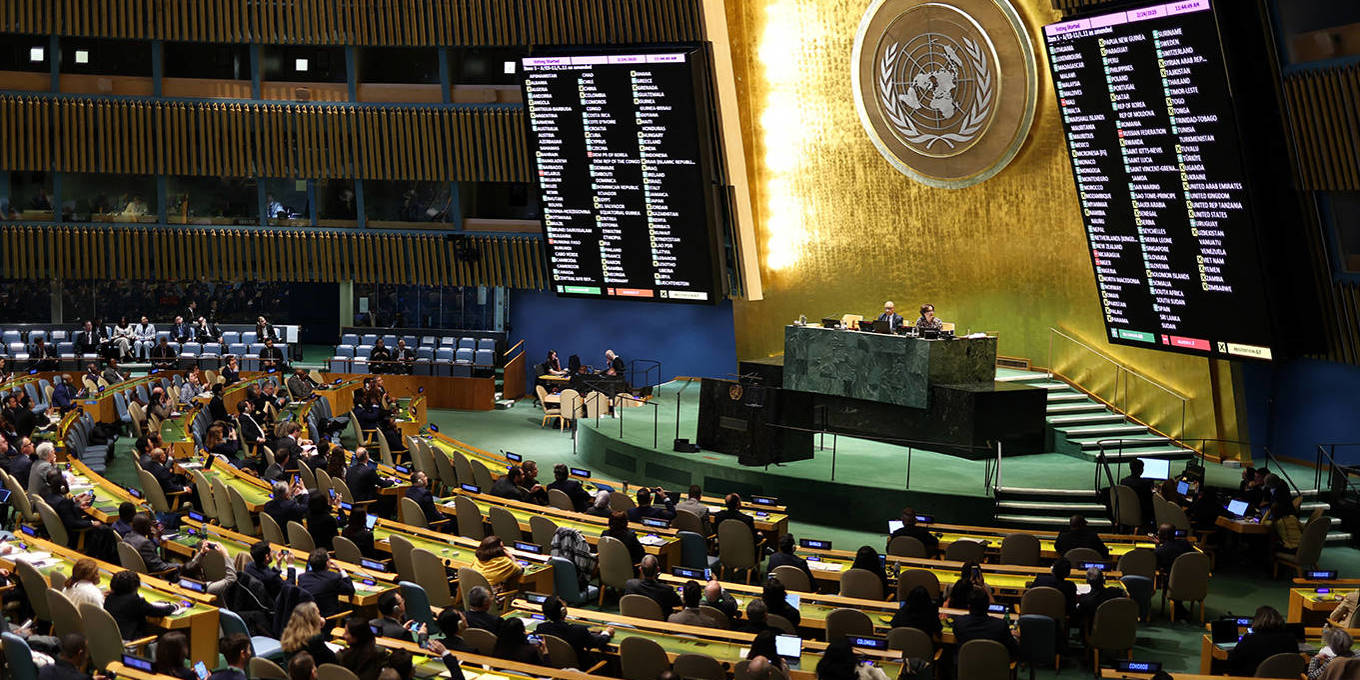
The Nobel Prize season ended last month when winners of the six different awards were announced for their outstanding accomplishments in fields ranging from medicine to literature. But over the years, no award has generated more controversy than the Nobel Peace Prize.

This year’s Peace Prize to the Japanese atomic bomb survivors’ group Nihon Hidankyo came as a surprise, signifying a welcome respite from the award’s increasing politicization.

The six prizes, each worth 10 million Swedish kronor ($917,000), are named after Alfred Nobel, a wealthy Swedish industrialist who made his fortune selling cannons and munitions, including the explosives he invented — dynamite and gelignite. The prizes are handed out on Dec. 10, the anniversary of Nobel’s 1896 death. While the Peace Prize winner is selected and honored in Norway, the other Nobel awardees are chosen by the Nobel Foundation in Stockholm, where the prizes are handed out.

Alfred Nobel’s will stipulated that the Peace Prize should go to “the person who shall have done the most or the best work for fraternity between nations, for the abolition or reduction of standing armies, and for the holding and promotion of peace congresses.”

But an examination of the 104 Peace Prizes awarded since 1901 shows that this prize has not developed in line with what Nobel laid down. As the official Peace Prize website acknowledges, the parameters for selecting a winner have expanded over the decades to include humanitarian work, democracy and human rights, climate and environmental change and other issues.

Worse still, the Peace Prize committee in Oslo has increasingly allowed geopolitical considerations to guide the selection of an awardee. In fact, the Nobel Peace Prize has become more about geopolitics than about peace. Consequently, the prize over the years has gone to a number of undeserving recipients. The prize runs the risk of losing its legitimacy.

President Barack Obama had been in office for less than one year when the Norwegian Nobel Committee decided in 2009 to award him the Peace Prize for “his extraordinary efforts to strengthen international diplomacy and cooperation between peoples” and “his work for a world without nuclear weapons.”

The stunning decision was met with criticism in the U.S., including from some Obama supporters. He received the prize not for his accomplishments but merely for succeeding President George W. Bush, whose invasion of Iraq on false pretenses made him deeply unpopular internationally.

Far from being a peacemaker, Obama in office relied, like Bush, on hard power, even as he deplored the ethos of “might makes right.” Obama waged serial military campaigns from Somalia and Yemen to Iraq and Syria. His 2011 U.S.-led military campaign removing Libya’s Moammar Gadhafi from power created an enduring failed state, while his effort to overthrow Syrian President Bashar Assad helped spawn the terrorist Islamic State organization.

And while championing “a nuclear-free world,” Obama led an extensive modernization of the American nuclear arsenal, stoking a new arms race.

Another Nobel Prize recipient, Muhammad Yunus, today presides over rampant human rights abuses in Bangladesh. In August, the 84-year-old Yunus was installed as head of an interim regime by the country’s powerful military, which, capitalizing on deadly violent protests, packed Prime Minister Sheikh Hasina off to neighboring India before she could formally resign.

Yunus pioneered microcredit, or giving small loans to rural families, for which he and the Grameen Bank that he headed jointly received a Nobel Prize in 2006 — not in economics but for peace, after former President Bill Clinton lobbied for him. While presenting Yunus with the Peace Prize, the head of the Norwegian Nobel Committee said, “In 2002, Bill Clinton put it this way: ‘Dr. Yunus is a man who long ago should have won the Nobel Prize and I’ll keep saying that until they finally give it to him.’ Now Clinton will no longer need to remind us.”

Underscoring the award’s geopolitical agenda, the committee chairman hoped that “this peace prize will represent a possible approach to the Muslim part of the world” given the post-9/11 tendency to “demonize Islam.” He added, “It is an important task for the Nobel Committee to try to narrow the gap between the West and Islam.”

Bangladesh, with Yunus as the regime’s nominal head, is today effectively under military-clerical rule and faces a growing risk of sliding into chaos. The country is wracked by Islamist attacks, including on religious and ethnic minorities; extrajudicial killings; and arbitrary arrests, with the regime jailing thousands just last month.

The Peace Prize has even gone to people who did more to scuttle peace than to promote it. One such awardee was Henry Kissinger, whose disastrous decisions while serving under President Richard Nixon resulted in immense death and destruction across vast regions, including the U.S. carpet-bombing of Cambodia and Laos. North Vietnamese leader Le Duc Tho, who was jointly awarded the prize with Kissinger, declined his half of the spoils, as he did not want to share the award with a war hawk.

The Peace Prize Committee has often demonstrated its geopolitical activism by awarding the prize to Western-backed anti-regime activists in the developing world, from Aung San Suu Kyi to Liu Xiaobo, or by seeking to promote the bridging of regional divides. For example, the 2014 prize was given jointly to a Pakistani Muslim and an Indian Hindu.

Against this background, the Peace Prize has become not only increasingly controversial but also, as one author put it, “the world’s most reviled award.” This year’s uncontroversial award to the Japanese organization of survivors of the U.S. atomic bombings of Hiroshima and Nagasaki may be an effort to restore international faith in the prize.

But for such an effort to succeed, the Peace Prize Committee must no longer give the award to make a geopolitical point. It should stick to Alfred Nobel’s mandate that the prize be given for international peace and disarmament — not for human rights promotion, civil rights work, environmental protection, economic opportunities for the poor or antigovernment activism.

Brahma Chellaney is a geostrategist and the author of nine books, including the award-winning “Water: Asia’s New Battleground.”

America Must Stand Up to Asia’s Bully

China has not hesitated to use highly aggressive tactics in its effort to expand its control over the South China Sea and end America’s primacy in the Indo-Pacific region. If the US does not start pushing back, China will grow only bolder – and more dominant.

Brahma ChellaneyProject Syndicate

China has not hesitated to use highly aggressive tactics in its effort to expand its control over the South China Sea and end America’s primacy in the Indo-Pacific region. If the US does not start pushing back, China will grow only bolder – and more dominant.

Chinese President Xi Jinping’s “Chinese dream” of global preeminence depends significantly on achieving dominance in the South China Sea and ending America’s primacy in the Indo-Pacific region, an emerging global economic and geopolitical hub. And China has not hesitated to use coercive tactics in service of these objectives.

In recent years, boats belonging to countries whose territorial claims China disregards, such as the Philippines and Vietnam, have faced blockades, rammingwater-cannon attacks, and even bladed-weapon assaults by Chinese vessels. Offshore energy operations endure regular harassment. Simply fishing in waters China calls its own can expose a person to a Chinese attack with iron pipes. Such violent confrontations have heightened regional tensions and undermined stability in a crucial corridor linking the Pacific and Indian Ocean.

One might have expected the United States to take action to rein in China’s behavior, especially given its mutual defense treaty with the Philippines. And yet, three successive presidents – Barack Obama, Trump, and Joe Biden – have failed to offer anything beyond statements of support and symbolic action. In 2012, Obama allowed China’s brazen seizure of the disputed Scarborough Shoal from the Philippines to go unpunished.

This was hardly the first time the US failed to live up to its defense commitments to the Philippines. In 1995, the Philippines requested US help to block Chinese forces from capturing Mischief Reef, located just 129 nautical miles from the Philippine island of Palawan. US President Bill Clinton, smarting over the termination three years earlier of America’s right to maintain military bases in the Philippines, refused. Mischief Reef is now an important Chinese military base.

The more China has gotten away with, the bolder it has become. Following the capture of the Scarborough Shoal, Xi embarked on a land-reclamation frenzy, creating 1,300 hectares (3,200 acres) of new land in the South China Sea, including seven artificial islands that now serve as forward operating bases. China has built 27 military outposts on disputed islands, which now bristle with short-range missiles, reconnaissance gear, radar systems, and laser and jamming equipment. Its larger islands also feature aircraft hangars, runways, and deep-water harbors. By unilaterally redrawing South China Sea’s geopolitical map, China is ensuring that it is uniquely positioned to project power in the region.

Even as China has gradually eroded the Philippines’ security – including Philippine control of areas within its exclusive economic zone (EEZ) – the US has continued to underscore its “ironclad” defense commitment to its ally. Late last year, the Biden administration affirmed that any armed third-party attack against the Philippine military, coast guard, aircraft, or public vessels “anywhere in the South China Sea” is covered by the US-Philippines Mutual Defense Treaty. Yet China remains unpunished – and undeterred.

What explains this yawning gap between rhetoric and action? First and foremost, the US fears escalation, especially when its resources and attention are being consumed by the wars in Ukraine and the Middle East. Moreover, the US prefers not to weigh in on sovereignty disputes in the South China Sea, where it has no territorial claims of its own. It has not even taken a position on the sovereignty of the Japanese-administered Senkaku Islands, which China also claims.

The US has, however, made clear that its security treaty with Japan covers those islands and cautioned against “any unilateral action that seeks to undermine Japan’s administration.” It should do the same for the Philippines, stating unequivocally that its treaty commitment to the country covers any efforts to compel a change in areas currently under Philippine administrative control, including Second Thomas Shoal, which China has been attempting to besiege.

In support of this stance, the US could cite the 2016 ruling by an international arbitration tribunal that China’s territorial claims in the South China Sea have “no legal basis” and that Chinese actions within the Philippine EEZ violated the Philippines’ sovereignty. But China’s open contempt for that ruling should dispel any hope that the South China Sea’s future will be decided by international law, which is why the US must be prepared to back up such a statement with action.

If the US does stand up for its treaty ally, it can take advantage of the nine Philippine naval and air bases to which it has gained access within the last decade, two of which are located just across from Taiwan and southern China. If it does not, China will continue to solidify its dominance over the South China Sea, thereby cornering the region’s rich energy and fishery resources and gaining the ability to disrupt supply chains and punish countries for acts it deems unfriendly.

China will not stop at the South China Sea. Under Xi’s leadership, China has used a similar combination of deception, bullying, coercion, and surprise to expand its territorial control elsewhere, from the East China Sea to the Himalayas, sparing not even the tiny country of Bhutan. As with any bully, the only way to stop China is to confront it with a credible challenger. The US must be that challenger, and it should start by defending the Philippines.

Brahma Chellaney, Professor of Strategic Studies at the New Delhi-based Center for Policy Research and Fellow at the Robert Bosch Academy in Berlin, is the author of nine books, including Water: Asia’s New Battleground (Georgetown University Press, 2011), for which he won the 2012 Asia Society Bernard Schwartz Book Award.

© Project Syndicate, 2024.