The lasting lesson of 1962

Brahma Chellaney

As the 50th anniversary year of China’s 1962 invasion, 2012 should serve as a time of reflection on what lessons that attack still holds for India.

Given that the Year of the Dragon — a monster that has been universal since before biblical times — begins on January 23, this year holds significance for China’s other neighbors as well. After all, the declared intent of the 1962 war — “to teach a lesson” — was publicly restated in the 1979 Chinese aggression against Vietnam and appeared to guide Beijing’s top-heavy response in the boat incident with Japan in the fall of 2010.

By roaring at its neighbors and picking territorial fights with them, China lived up to the Year of the Tiger that 2010 represented in its astrology. Then in 2011, the Year of the Rabbit, China seemed to emulate that burrowing animal. It blasted more tunnels through mountain ranges in its borderlands. And — as was apparent, for example, from its use of different cards against India, including the stapled-visa issue and cross-frontier incursions — it demanded “carrots” (rabbit’s favorite) to eschew irascible behavior. Will it breathe fire in the Year of the Dragon?

One facet of China’s grand strategy has remained constant over the years. Strategic deception and military surprise are enduring elements in Chinese strategy. The 1962 war was a classic example of the fusion of these two elements.

Integral to deception is taking an opponent by surprise, as emphasized in Sun Tzu’s Art of War some 2,500 years ago. Since the Communists came to power, China has been involved in the largest number of military conflicts in Asia. In all these conflicts, Chinese forces struck with no forewarning.

Indeed, a 2010 Pentagon report points out that China has repeatedly carried out military pre-emption in the name of defense: in 1950 (Tibet invasion, followed immediately by entry into Korean War), 1962, the 1969 border conflict with the Soviet Union, and the 1979 attack on Vietnam. According to the report, “The history of modern Chinese warfare provides numerous case studies in which China’s leaders have claimed military pre-emption as a strategically defensive act.” China’s seizure of the Paracel Islands from Vietnam in 1974 was another example of offense as defense.

The 1962 attack — justified as a defensive act by Beijing, which used Nehru’s unguarded remarks (“our instructions are to free our territory”) to brand India the aggressor — stands out for China’s masterly blending of deception and surprise. The invasion, mounted from two separate fronts, caught India off guard. The “stab-in-the-back” was best summed up by Nehru, who told the nation that “a powerful and unscrupulous opponent, not caring for peace or peaceful methods” had returned “evil for good.”

The aggression was cleverly planned and timed. It coincided with the start of the Cuban missile crisis, which put the Soviet Union and the U.S. on the edge of a nuclear Armageddon. And the very day the U.S. quarantine of Cuba was lifted to help end the Cuban missile crisis, China ceased its 32-day aggression against India. The cunning timing — just when global attention was focused on averting a nuclear catastrophe — ensured that India received no outside help.

The deception began much earlier, in keeping with the utility of deception in Chinese strategic culture for both peacetime functions and warfighting applications. One example of peacetime deception was Premier Zhou En-lai’s 1960 New Delhi visit, during which he dangled the carrot of a border settlement without putting his money where his mouth was. Of course, it didn’t take much effort to trick the Indians, who had convinced themselves that by merely signing the 1954 Panchsheel Agreement, they had bought peace with China.

If anything, this agreement — which incorporated five principles of peaceful coexistence — provided a perfect cover for China to launch aggressive plans against India, including its quiet construction of a highway through the Aksai Chin Plateau in the state of Jammu and Kashmir and furtive nibbling at Indian territories across the Himalayas. The period up to 1954 marked Communist China’s annexation and consolidation of rule in Tibet, whereas the post-1954 phase heralded its belligerence toward India, culminating in the surprise invasion. The iniquitous Panchsheel Agreement — under which India, without any quid pro quo, surrendered its extra-territorial rights in Tibet and recognized the “Tibet region of China” — constituted a watershed in opening the path to hostilities.

It took a war humiliation for India to wake up to the reality that a nation can get peace only if it is able to defend peace.

Today, as part of its larger game of deception, China identifies Taiwan as the primary focus of its defense strategy. That is to divert international attention from its single-mindedness on achieving broader military goals. Taiwan serves metaphorically as a red carpet on which to invite all the bulls while Beijing busily seeks to accomplish bigger tasks.

If the countries around India have become battlegrounds for China’s moves to encircle India, it is because Beijing heeds Sun Tzu’s counsel: “Contain an adversary through the leverage of having made its neighbourhood hostile.” According to Sun Tzu’s core guidance, “The ability to subdue the enemy without any battle is the ultimate reflection of the most supreme strategy.”

China employs deception to also camouflage its refusal to accept the territorial status quo with several of its neighbours. It is disturbing the status quo even on cross-border river flows. The insistence on changing the status quo, coupled with its strategic opacity and penchant to take an adversary by surprise, only increases the unease in Asia over its rise. Indeed, the more than three-decade-old border talks with India mesh well with China’s use of strategic deception.

As long as the territorial status quo is not accepted, the possibility that the Chinese military will strike again cannot be ruled out. As U.S. National Intelligence Director James Clapper said in his prepared testimony before the Senate Select Committee on Intelligence on January 31, “The Indian Army believes a major Sino-Indian conflict is not imminent but the Indian military is strengthening its forces in preparation to fight a limited conflict along the disputed border, and is working to balance Chinese power projection in the Indian Ocean.”

Prime Minister Manmohan Singh’s emphatic statement in the Lok Sabha in December 2011 that “China will not attack India” thus seems more than gratuitous. Can anyone turn a blind eye to the Chinese state-run newspaper and military publications launching an anti-India tirade and warning New Delhi of the consequences of a confrontation with China? Some military analysts in China have publicly discussed the merits of a 1962-style short, sharp, decisive border war that helps put India in its place for the next few decades? Disturbingly, the more timorous Singh has been, the more belligerent China has become.

India needs to counter the asymmetrical capabilities China is fashioning to take an adversary by surprise. Its anti-satellite (ASAT) weapons, for example, are being designed to “shock and awe” in space. China is already waging a quiet cyber-war, as if to underscore its ability to sabotage vital infrastructure in wartime. Moreover, its military is developing a blitzkrieg approach to warfare: a surprise blitz will seek to stun, confound and overwhelm an opponent.

The lasting lesson of 1962 is that India must be ready to repulse any kind of attack, including by undercutting the aggressor where it is the weakest. Otherwise, China’s Achilles’ heel — Tibet — will become a stronger launch-pad for aggressive acts.

A version of this article appeared in The Times of India of January 22, 2012.

Copyrighted material. Reprinting this article without written consent will constitute a violation of international copyright law. 

Asia’s Natural-Born Allies

A Project Syndicate column

At a time when China’s economic, diplomatic, and military rise casts the shadow of a power disequilibrium over Asia, the just-concluded visit of Japanese Prime Minister Yoshihiko Noda to India cemented a fast-growing relationship between two natural allies. Now the task for Japan and India is to add concrete strategic content to their ties.

Asia’s emerging balance of power will be determined principally by events in East Asia and the Indian Ocean. Japan and India thus have an important role to play in preserving stability and helping to safeguard vital sea-lanes in the wider Indo-Pacific region — a region defined not only by the confluence of the Indian and Pacific Oceans, but also by its significance for world trade and energy supplies.

Asia’s booming economies are coastal, so maritime democracies like Japan and India must work together to help build a stable, liberal, rules-based order in Asia. As Indian Prime Minister Manmohan Singh said at the East Asia Summit (EAS) meeting in Bali last month, Asia’s continued rise is not automatically assured, and is “dependent on the evolution of a cooperative architecture.”

Japan and India — as energy-poor countries heavily reliant on oil imports from the Persian Gulf — are seriously concerned by mercantilist efforts to assert control over energy supplies and the transport routes for them. So the maintenance of a peaceful and lawful maritime domain, including unimpeded freedom of navigation, is critical to their security and economic well-being. That is why they have agreed to start holding joint naval and air exercises from 2012 — just one sign of a shift from emphasizing shared values to seeking to protect shared interests.

Indeed, despite their messy domestic politics and endemic scandals, India and Japan have the fastest-growing bilateral relationship in Asia today. Since they unveiled a “strategic and global partnership” in 2006, their political and economic engagement has deepened remarkably.

A growing congruence of strategic interests led to their 2008 Joint Declaration on Security Cooperation, a significant milestone in building a stable Asian order, in which a constellation of states linked by common interests has become critical to ensuring equilibrium at a time when ongoing power shifts accentuate security challenges.

The joint declaration was modeled on Japan’s 2007 defense-cooperation accord with Australia — the only other country with which Japan, a US military ally, has a security-cooperation arrangement. The India-Japan security declaration, in turn, spawned a similar Indian-Australian accord in 2009.

A free-trade agreement between Japan and India, formally known as the Comprehensive Economic Partnership Agreement (CEPA), entered into force in August. And, in response to China’s punitive use of its monopoly on rare-earths production to cut off such exports to Japan during the fall of 2010, Japan and India have agreed to joint development of rare earths, which are vital for a wide range of green-energy technologies and military applications.

Today, the level and frequency of official bilateral engagement is extraordinary. Noda’s visit to New Delhi was part of a commitment by the two countries to hold an annual summit, attended by their prime ministers.

More important, Japan and India now conduct several annual ministerial dialogues: a strategic dialogue between their foreign ministers; a security dialogue between their defense ministers; a policy dialogue between India’s commerce and industry minister and Japan’s minister of economy, trade and industry; and separate ministerial-level energy and economic dialogues.

And, to top it off, Japan, India, and the US initiated a trilateral strategic dialogue in Washington on December 19. Getting the US on board can only bolster India-Japan cooperation. As Japanese Foreign Minister Koichiro Gemba said recently, “Japan and the US are deepening a strategic relationship with India,” and the trilateral dialogue is “a specific example of collaboration” among the three leading Asia-Pacific democracies. Such collaboration is likely to become quadrilateral with Australia’s inclusion.

Japan and India need to strengthen their still-fledgling strategic cooperation by embracing two ideas, both of which demand a subtle shift in Japanese thinking and policy. One is to build interoperability between their formidable naval forces, which, in cooperation with other friendly navies, can undergird peace and stability in the Indo-Pacific region. As former Japanese Prime Minister Shinzo Abe put it in a recent speech in New Delhi, the aim should be that “sooner rather than later, Japan’s navy and the Indian navy are seamlessly interconnected.” Currently, Japan has naval interoperability only with US forces.

The second idea is to co-develop defense systems. India and Japan have missile-defense cooperation with Israel and the US, respectively. There is no reason why they should not work together on missile defense and other technologies for mutual security. Their defense cooperation must be comprehensive and not be limited to strategic dialogue, maritime cooperation, and occasional naval exercises.

There is no ban on weapon exports in Japan’s US-imposed Constitution, only a longstanding government decision, which in any case has just been relaxed. In fact, the original decision related to weapons, not technologies.

The most-stable economic partnerships in the world, including the Atlantic community and the Japan-US partnership, have been built on the bedrock of security collaboration. Economic ties that lack the underpinning of strategic partnerships tend to be less stable and even volatile, as is apparent from the economic relationships that India and Japan have with China. Through close strategic collaboration, Japan and India must lead the effort to build freedom, prosperity, and stability in the Indo-Pacific region.

Brahma Chellaney, Professor of Strategic Studies at the Center for Policy Research, is the author of Water: Asia’s New Battleground.

Copyright: Project Syndicate, 2011.

You might also like to read more from  or see our home page.

The world’s most “dammed” country

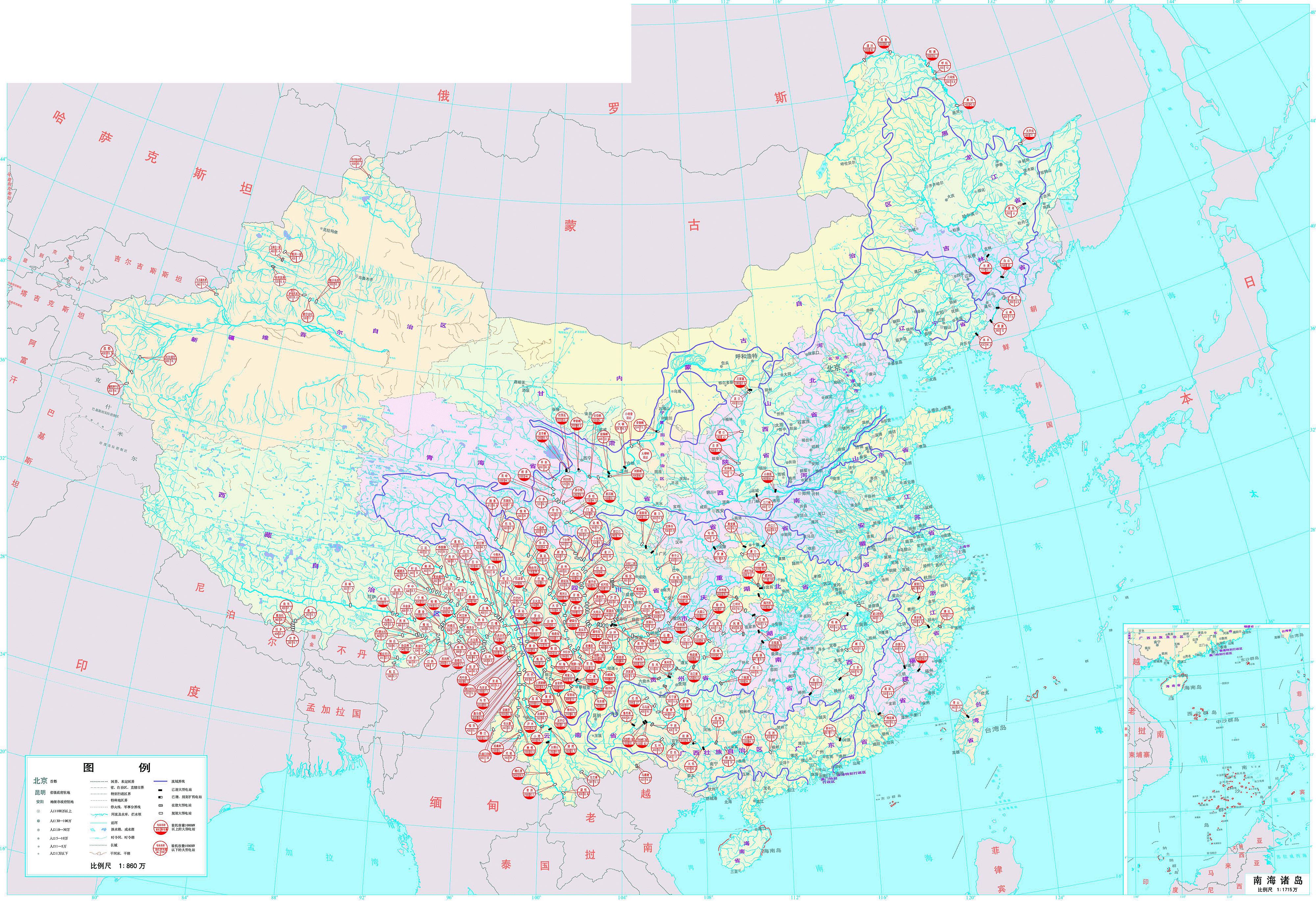
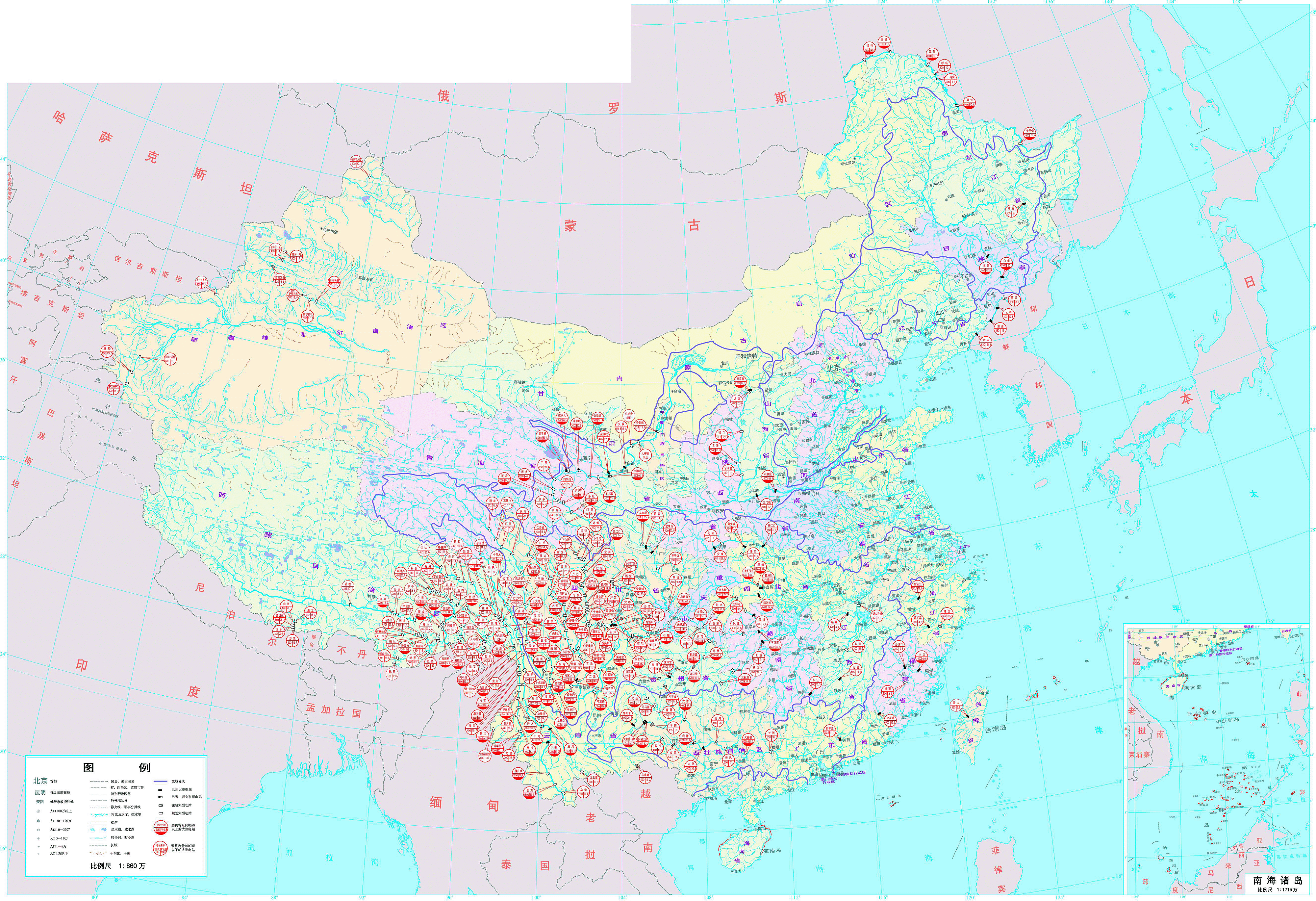
The map of planned new dams released by state-run HydroChina Corporation in 2010 shows that China's dam-building spree is anything but slowing. It reveals the planned construction of a dam twice as large as the Three Gorges Dam at Metog (‘‘Motuo’’ in Chinese), just before the Brahmaputra River enters India.

Brahma Chellaney

India Today, December 26, 2011

China’s frenzied dam building recently hit a wall in Myanmar, whose bold decision to halt a controversial Chinese dam project on its territory has acted as a catalyst to a series of developments, including the first visit of a US secretary of state to that country in more than half a century. Despite the setback in Myanmar, China remains the world’s biggest dam builder at home and abroad. No country in history has built more dams than China. In fact, China today boasts more dams at home than the rest of the world combined. 

Before the Communists came to power in 1949, there were only 22 dams of any significant size in China. But now China has more than half of the almost 50,000 dams in the world that are classified as “large” because they have a height of at least 15 m or a storage capacity of more than 3 million cubic metres. This feat means that China has completed on an average at least one large dam per day since 1949. If dams of all sizes are counted, the number in China surpasses 85,000.

Another striking fact is that China is also the global leader in exporting dams. Its state-run companies today are building more dams overseas than the other international dam builders put together. As many as 37 Chinese financial and corporate entities are involved in more than 100 major dam projects in the developing world. Profit motives and a diplomatic effort to showcase its engineering prowess drive China to build dams overseas. China’s declaratory policy of “non-interference in domestic affairs” actually serves as a virtual licence to pursue dam projects that flood ethnic-minority lands and forcibly uproot people in other countries, just as it is doing at home by shifting its dam-building focus from the dam-saturated internal rivers to the international rivers originating in the Tibetan plateau, Xinjiang, Inner Mongolia, and Manchuria.

China contends that its role as the global leader in exporting dams has created a “win-win” situation for the host countries and its companies. Yet evidence from a number of project sites shows that those dams are imposing serious costs. These projects, in fact, often serve to inflame anti-Chinese sentiment, as underscored by grassroots protests at several sites in Asia, Africa and Latin America. Indeed, by taking much of the workforce from home to build dams and other projects abroad-a practice that runs counter to its own 2006 regulations that call for “localisation”-China reinforces a perception that it is engaged in exploitative practices. Chinese convicts have also been used as labourers on projects in countries too poor and weak to protest.

As the world’s most “dammed” country, China is already the     world’s largest producer of hydropower, with an installed generating capacity of more than 170 gigawatts. Yet its ambitious plans to significantly boost hydro-generating capacity by damming international rivers have embroiled it in water disputes with almost all neighbours, even North Korea. More broadly, China’s dam-building passion has spawned two developments. First, Chinese companies now dominate the global hydropower-equipment export market. And second, the growing clout of the state-run hydropower industry within China has led Beijing to aggressively seek dam projects overseas by offering attractive, low-interest loans to other governments. At home, it recently unveiled a mammoth $635-billion fresh investment in water infrastructure over the next decade, more than a third of which is to be channelled for building dams, reservoirs, and other supply structures.

China’s over-damming of rivers and its inter-river and inter-basin water transfers have already wreaked havoc on the natural ecosystems, causing fragmentation and depletion of rivers and thereby promoting exploitation of groundwater beyond the nature’s replenishment capacity. The social costs have been even more staggering, a fact reflected in Prime Minister Wen Jiabao’s stunning admission in 2007 that China relocated a total of 22.9 million Chinese since 1949 to make way for water projects-a number bigger than the entire population of Australia, Romania or Chile. Since that admission, another 3,50,000 residents, mostly poor villagers, have been officially uprooted. So, by official count alone, 1,035 citizens on an average have been forcibly evicted daily in the past 62 years for water projects.

With Beijing now increasingly damming transnational rivers such as the Mekong, Salween, Brahmaputra, Irtysh, Illy and Amur, the new projects threaten to “export” the serious degradation haunting China’s internal rivers to those rivers. The time has come to exert concerted external pressure on Beijing to rein in its dam frenzy and embrace international environmental standards. 

Brahma Chellaney is the author of the newly released Water: Asia’s New Battleground. (c) India Today, 2011.

Build Japan-India naval ties

By BRAHMA CHELLANEY  Japan Times  December 28, 2011

At a time when the specter of power disequilibrium looms large in Asia, the visit of Prime Minister Yoshihiko Noda to India offers an opportunity to the two natural allies to help promote Asian stability by adding concrete strategic content to their fast-growing relationship. Japan and India need to build close naval collaboration.

The balance of power in Asia will be determined by events principally in two regions: East Asia and the Indian Ocean. Japan and India thus have an important role to play to advance peace and stability and help safeguard vital sea lanes in the wider Indo-Pacific region.

Asia’s booming economies are bound by sea, and maritime democracies like Japan and India must work together to help build a stable, liberal, rules-based order in Asia. Whereas 97 percent of India’s international trade by volume is conducted by sea, almost all of Japan’s international trade is ocean-borne. As energy-poor countries heavily dependent on oil imports from the Persian Gulf region, the two are seriously concerned by mercantilist efforts to assert control over energy supplies and transport routes. The maintenance of a peaceful and lawful maritime domain, including unimpeded freedom of navigation, is thus critical to their security and economic well-being.

In this light, Japan and India have already agreed to start holding joint naval exercises from the new year. This is just one sign that they now wish to graduate from emphasizing shared values to seeking to jointly protect shared interests. Today, the fastest growing bilateral relationship in Asia is between India and Japan. Since they unveiled a “strategic and global partnership” in 2006, their political and economic engagement has deepened remarkably.

Their growing congruence of strategic interests led to the 2008 Joint Declaration on Security Cooperation, a significant milestone in building Asian power stability. A constellation of Asian states linked by strategic cooperation and sharing common interests has become critical to ensuring equilibrium at a time when the ongoing power shifts are accentuating the security challenges that now exist in Asia.

The joint declaration was modeled on Japan’s 2007 defense-cooperation accord with Australia — the only country with which Tokyo has a security-cooperation declaration. Japan, of course, is tied to the United States militarily since 1951 by a treaty. The India-Japan security agreement, in turn, spawned a similar India-Australian accord in 2009.

A free-trade accord between Japan and India, formally known as the comprehensive economic partnership agreement (CEPA), entered into force just three months ago. By covering more than 90 percent of the trade as well as a wide range of services, rules of origin, investment, intellectual property rights, customs rules and other related issues, CEPA promises to significantly boost bilateral trade, which remains small in comparison with Japan’s and India’s trade with China. India is already beginning to emerge as a favored destination in Asia for Japanese foreign direct investment.

In response to China’s use of its monopoly on rare-earths production to punitively cut off such exports to Japan during the fall of 2010, Japan and India have agreed to the joint development of rare earths, which are vital for a wide range of green energy technologies and military applications.

Today, the level and frequency of India-Japan official engagement is extraordinary. Noda’s New Delhi visit is part of a bilateral commitment to hold an annual summit meeting of the prime ministers. More important, Japan and India now have a series of annual minister-to-minister dialogues: a strategic dialogue between their foreign ministers; a defense dialogue between their defense ministers; a policy dialogue between India’s commerce and industry minister and Japan’s minister of economy, trade and industry; and separate ministerial-level energy and economic dialogues.

Supporting these high-level discussions is another set of talks, including a two-plus-two dialogue led jointly by India’s foreign and defense secretaries and their Japanese vice minister counterparts, a maritime security dialogue, a comprehensive security dialogue, and military-to-military talks involving regular exchange visits of the chiefs of staff.

To top it off, Japan, India, and the U.S. have initiated a trilateral strategic dialogue, whose first meeting was in Washington last week. Getting the U.S. on board will bolster the convergences of all three partners and boost India-Japan cooperation.

As Japanese Foreign Minister Koichiro Gemba said recently, “Japan and the U.S. are deepening a strategic relationship with India,” and the trilateral dialogue is “a specific example of collaboration” among the three leading Asia-Pacific democracies.

Bilaterally, Japan and India need to strengthen their still-fledgling strategic cooperation by embracing two ideas, both of which demand a subtle shift in Japanese thinking and policy. One is to build interoperability between their naval forces. These forces — along with other friendly navies — can undergird peace and stability in the Indo-Pacific region. As former Prime Minister Shinzo Abe put it in a recent speech in New Delhi, the aim should be that “sooner rather than later, Japan’s navy and the Indian navy are seamlessly interconnected.” Presently, Japan has naval interoperability only with U.S. forces.

Another idea is for the two countries to jointly develop defense systems. India and Japan have missile-defense cooperation with Israel and the U.S., respectively. There is no reason why they should not work together on missile defense and on other technologies for mutual security. Their defense cooperation must be comprehensive and not be limited to strategic dialogue, maritime cooperation, and occasional naval exercises.

There is no ban on weapon exports in Japan’s U.S.-imposed Constitution, only a long-standing Cabinet decision, which in any event has been loosened. That decision, in fact, related to weapons, not technologies.

Japan and India should remember that the most-stable economic partnerships in the world, including the trans-Atlantic ones and the Japan-U.S. partnership, have been built on the bedrock of security collaboration. Economic ties that lack the support of strategic partnerships tend to be less stable, as is apparent from Japan’s and India’s economic relationships with China.

Through close strategic collaboration, Japan and India must lead the effort to build freedom, prosperity and stability in the Indo-Pacific region.

Brahma Chellaney is a professor at the independent Center for Policy Research in New Delhi.

The Japan Times: Wednesday, Dec. 28, 2011. (c) All rights reserved.

China’s Dam Frenzy

China is the world's most "dammed" country, yet its future is drying up.

Striking facts:

  • China boasts more dams than the rest of the world combined.
  • Before the Communists came to power in 1949, there were only 22 dams of any significant size in China. But now China has more than half of the world’s almost 50,000 large dams.
  • This feat means that China has completed on average at least one large dam per day since 1949. If dams of all sizes are counted, the number in China surpasses 85,000.
  • According to Wen Jiabao, China has relocated a total of 22.9 million citizens since 1949 to make way for water projects. So, by official count alone, 1,035 citizens on average have been forcibly evicted daily in the past 62 years for water projects.
  • China is also the global leader in exporting dams. Its state-run companies today are building more dams overseas than the other international dam builders put together.

Internationally syndicated column by Project Syndicate

China’s frenzied dam-building hit a wall recently in Burma (Myanmar), where the government’s bold decision to halt a controversial Chinese-led dam project helped to ease the path to the first visit by a US secretary of state to that country in more than a half-century.

The now-stalled $3.6 billion Myitsone Dam, located at the headwaters of Burma’s largest river, the Irrawaddy, was designed to pump electricity exclusively into China’s power grid, despite the fact that Burma suffers daily power outages. The State-Owned Assets Supervision and Administration Commission of China’s State Council hailed Myitsone as a model overseas project serving Chinese interests. The Burmese decision thus shocked China’s government, which had begun treating Burma as a reliable client state (one where it still has significant interests, including the ongoing construction of a multibillion-dollar oil and natural-gas pipeline).

Despite that setback, China remains the world’s biggest dam builder at home and abroad. Indeed, no country in history has built more dams than China, which boasts more dams than the rest of the world combined.

Before the Communists came to power in 1949, China had only 22 dams of any significant size. Now the country has more than half of the world’s roughly 50,000 large dams, defined as having a height of at least 15 meters, or a storage capacity of more than three million cubic meters. Thus, China has completed, on average, at least one large dam per day since 1949. If dams of all sizes are counted, China’s total surpasses 85,000.

According to the United Nations Food and Agriculture Organization, China’s dams had the capacity to store 562.4 cubic kilometers of water in 2005, or 20% of the country’s total renewable water resources. Since then, China has built scores of new dams, including the world’s largest: the Three Gorges Dam on the Yangtze River.

China is also the global leader in exporting dams. Its state-run companies are building more dams overseas than all other international dam builders put together. Thirty-seven Chinese financial and corporate entities are involved in more than 100 major dam projects in the developing world. Some of these entities are very large and have multiple subsidiaries. For instance, Sinohydro Corporation — the world’s largest hydroelectric company — boasts 59 overseas branches.

Both the profit motive and a diplomatic effort to showcase its engineering prowess drive China’s overseas dam-building efforts. China’s declared policy of “noninterference in domestic affairs” actually serves as a virtual license to pursue dam projects that flood lands and forcibly uproot people — including, as with Myitsone, ethnic minorities — in other countries. But it is doing the same at home by shifting its focus from dam-saturated internal rivers to the international rivers that originate in the Tibetan plateau, Xinjiang, Inner Mongolia, and Manchuria.

China contends that its role as the global leader in exporting dams has created a “win-win” situation for host countries and its own companies. But evidence from a number of project sites shows that the dams are exacting a serious environmental toll on those hosts.

As a result, the overseas projects often serve to inflame anti-Chinese sentiment, reflected in grassroots protests at several sites in Asia, Africa, and Latin America. Moreover, by using a Chinese workforce to build dams and other projects abroad — a practice that runs counter to its own “localization” requirement, adopted in 2006 — China reinforces a perception that it is engaged in exploitative practices.

As the world’s most dammed country, China is already the largest producer of hydropower globally, with a generating capacity of more than 170 gigawatts. Yet ambitious plans to boost its hydro-generating capacity significantly by damming international rivers have embroiled the country in water disputes with most neighbors, even North Korea.

More broadly, China’s dam-building passion has spawned two key developments. First, Chinese companies now dominate the global hydropower-equipment export market. Sinohydro alone, having eclipsed Western equipment suppliers like ABB, Alstom, General Electric, and Siemens, claims to control half the market.

Second, the state-run hydropower industry’s growing clout within China has led the government to campaign aggressively for overseas dam projects by offering low-interest loans to other governments. At home, it recently unveiled a mammoth new $635 billion investment program in water infrastructure over the next decade, more than a third of which will be channeled into building dams, reservoirs, and other supply structures.

China’s over-damming of rivers and its inter-river and inter-basin water transfers have already wreaked havoc on natural ecosystems, causing river fragmentation and depletion and promoting groundwater exploitation beyond the natural replenishment capacity.

The social costs have been even higher, a fact reflected in Chinese Prime Minister Wen Jiabao’s stunning admission in 2007 that, since 1949, China has relocated a total of 22.9 million Chinese to make way for water projects — a figure larger than the populations of Australia, Romania, or Chile. Since then, another 350,000 residents — mostly poor villagers — have been uprooted.

So, by official count alone, 1,035 citizens on average have been forcibly evicted for water projects every day for more than six decades. With China now increasingly damming transnational rivers such as the Mekong, Salween, Brahmaputra, Irtysh, Illy, and Amur, the new projects threaten to “export” the serious degradation haunting China’s internal rivers to those rivers. The time has come to exert concerted external pressure on China to rein in its dam frenzy and embrace international environmental standards.

Brahma Chellaney, Professor of Strategic Studies at the New Delhi-based Center for Policy Research, is the author of Asian Juggernaut and the newly released Water: Asia’s New Battleground.

Copyright: Project Syndicate, 2011.
http://www.project-syndicate.org

Asia’s water stress challenges growth and security

Growing water shortages threaten Asia’s economic and political rise by creating obstacles to continued rapid economic growth, by stoking interstate and intrastate tensions over shared resources, and by raising new security risks. 
Japan Times, December 3, 2011

Water, the most vital of all resources, has emerged as a key issue that will determine whether Asia is headed toward cooperation or competition. After all, the driest continent in the world is not Africa, but Asia, where availability of freshwater is not even half the global annual average of 6,380 cubic meters per inhabitant.

When the estimated reserves of rivers, lakes and aquifers are added up, Asia has less than one-tenth of the waters of South America, Australia and New Zealand, not even one-fourth of North America, almost one-third of Europe and moderately less than Africa per inhabitant. Yet the world’s fastest-growing demand for water for food and industrial production and for municipal supply is in Asia, which now serves as the locomotive of the world economy.

Today, the fastest-growing Asian economies are all at or near water-stressed conditions, including China, India, South Korea, Vietnam and Indonesia. But just three or four decades ago, these economies were relatively free of water stress. Now if we look three or four decades ahead, it is clear that the water situation will only exacerbate, carrying major implications for rapid economic growth and inter-riparian relations.

Yet Asia continues to draw on tomorrow’s water to meet today’s needs. Worse still, Asia has one of the lowest levels of water efficiency and productivity in the world. Against this background, it is no exaggeration to say that the water crisis threatens Asia’s economic and political rise and its environmental sustainability. For investors, it carries risks that potentially are as damaging as nonperforming loans, real estate bubbles and political corruption. Water has also emerged as a source of increasing competition and discord within and between nations, spurring new tensions over shared basin resources and local resistance to governmental or corporate decisions to set up water-intensive industries.

These developments raise the question whether the risks of water conflict are higher in Asia than elsewhere in the world. With Asia becoming the scene of increasingly fierce intrastate and interstate water competition, the answer clearly is yes. Water is a new arena in the Asian Great Game.

In fact, water wars — in a political, diplomatic, or economic sense — are already being waged between riparian neighbors in several Asian regions, fuelling a cycle of bitter recrimination and fostering mistrust that impedes broader regional cooperation and integration. Without any shots being fired, rising costs continue to be exacted. The resources of transnational rivers, aquifers and lakes have become the target of rival appropriation plans.

With a river or groundwater basin often becoming tied with a nation’s identity, ownership and control over its resources is considered crucial to national interests. That has helped give rise to grand but environmentally questionable ideas — from China’s Great Western Route to divert river waters from the Tibetan Plateau to its parched north and South Korea’s politically divisive four-rivers project, to India’s now-stalled proposal to link up its important rivers and Jordan’s plan to save the dying Dead Sea by bringing water from the Red Sea through a 178-km canal, which is also to serve as a source for desalinated drinking water.

Several factors have contributed to the Asian water crisis, which is leading to river and aquifer degradation. One is that Asia is not only the largest and most-populous continent but also the fastest developing. How the swift economic rise of Asia has brought water resources under increasing pressure can be seen from the fact that most Asian economies now are water-stressed.

The exceptions are few: Bhutan, Burma, Papua New Guinea, Laos, Cambodia, Brunei and Malaysia.

Unlike the fossils fuels, mineral ores and timber that they import even from distant lands, the Asian economies must make do with their own water resources, a significant share of which is in transnational watercourses. This fact only serves as a strong incentive for some nations to try and commandeer internationally shared waters before they leave their national borders. Given the critical role of water in economic modernization, this continent has emerged at the centre of the global water challenges.

Another factor is consumption growth, as a consequence of rising prosperity. The plain fact is that on average Asians are consuming more resources, including water, food, oil and energy. The consumption growth is best illustrated by the changing diets, especially the greater intake of meat, whose production is notoriously water-intensive.

A third factor is the role of irrigation in accentuating the Asian water stress. Asia more than doubled its total irrigated cropland just between 1960 and 2000. Once a continent of serious food shortages and recurrent famines, Asia opened the path to its dramatic economic rise by emerging as a net food exporter on the back of this unparalleled irrigation expansion.

Asia now boasts the leonine proportion of the world’s surface land under irrigation. About 70 percent of the world’s 301 million hectares of land equipped for irrigation is in Asia alone, making it the global irrigation hub. Just three sub-regions of Asia — South Asia, China and Southeast Asia — by themselves account for about 50 percent of the world’s total irrigated land.

It is thus hardly a surprise that Asia leads the world in the total volume of freshwater withdrawn for agriculture. Indeed, almost 74 percent of the total global freshwater withdrawals for agriculture by volume are made in Asia alone.

Water literally is food in Asia. Yet the growth of rice and wheat output in Asia, after the dramatic increases of the previous quarter-century, has actually slowed since the late 1990s, raising concerns that Asian countries will become major food importers, roiling the international market. The international food market is not large enough to meet major import demands from Asia.

A fourth factor is that the fastest increase in water demand in Asia is now coming not from agriculture but from the industrial sector and urban households, in keeping with the fact that this continent has become the seat of the world’s fastest industrialization and urbanization.

A final factor linked to Asia’s water stress is the large-scale impoundment of water resources through dams, barrages, reservoirs and other human-made structures without factoring in long-term environmental considerations. Dams, to be sure, bring important benefits. But upstream dams on rivers shared by two or more nations or provinces in an era of growing water stress often carry broader political and social implications, especially because they can affect water quality and quantity downstream. Dams can also alter fluvial ecosystems, damage biodiversity and promote coastal erosion and saltwater intrusion.

Asia is not just the global irrigation hub; it is also the world’s most dam-dotted continent. China, the world’s biggest dam builder, alone has slightly more than half of the approximately 50,000 large dams on the planet. Most of the best dam sites in Asia already have been taken. Yet the numerous new dam projects in Asia show that the damming of rivers is still an important priority for policymakers. Such a focus on dam building has only intensified intrastate and interstate water disputes and tensions in Asia, with implications for regional security and stability.

The countries likely to bear the brunt of upstream diversion of waters are those located farthest downstream on rivers like the Brahmaputra, Mekong and Tigris-Euphrates: Bangladesh, whose very future is threatened by climate and environmental change; Vietnam, a rice bowl of Asia; and Iraq, still internally torn. Cross-border water appropriations from the Illy River threaten to turn Kazakhstan’s Lake Balkhash into another Aral Sea, which is dying.

So, the big question is: How can Asian nations prevent the sharpening struggle for water resources from becoming a tipping point for overt conflict? To contain the security risks, Asian states must invest more in institutionalized cooperation on trans-boundary basin resources in order to underpin strategic stability, protect continued economic growth and promote environmental sustainability.

The harsh truth is that only four of the 57 transnational river basins in Asia have a treaty covering water sharing or other institutionalized cooperation. These are the Mekong, Ganges, Indus and Jordan river basins. The absence of a cooperative arrangement in most Asian transnational basins is making inter-country water competition a major security risk, increasing the likelihood of geopolitical tensions and instabilities.

With its multitude of inter-country basins, Asia cannot continue to prosper without building political and technological partnerships to help stabilize inter-riparian relations, encourage greater water efficiency, promote environmental sustainability, take on practicable conservation strategies, and invest in clean-water technologies. If Asian states are to address their water challenges, they will need to embrace good practices on the strategic planning and management of water resources.

This article is excerpted from Brahma Chellaney’s latest book, “Water: Asia’s New Battleground” (Georgetown University Press, 2011).

Can you hear the Chinese whispers grow louder?

By pressuring New Delhi to deny the Dalai Lama a public platform of "any form," Beijing is seeking to undercut the exiled Tibetan leader's value for India.

New moves of an encircler

Just as China is seeking to extend its annexation of Tibet to India’s northeastern state of Arunachal Pradesh, it is seeking to extend its containment of India to the Dalai Lama. And to contain the Dalai Lama, it brazenly demands India’s cooperation.

Brahma Chellaney, The Times of India, December 4, 2011

As geopolitical rivals, India and China face each other over a highly disputed border. The inviolability of virtually the entire 4,057 km border — one of the longest in the world — has been called into question by China’s increasing cross-frontier military incursions and its calculated refusal to mutually draw a fully agreed line of control along the Himalayas.

The amount of Indian land China occupies or openly covets tops 135,000 square kilometres, or approximately the size of Costa Rica. China currently has unresolved land and sea border disputes with 11 other neighbours. But in comparison with China’s territorial disputes with other neighbours now or even in the past, its land disputes with India stand out for their sheer size and importance.

Beijing’s last-minute postponement of a scheduled round of border talks constitutes no real loss for New Delhi because China has used these 30-year-long negotiations to keep India engaged while blocking any real progress. Even as Beijing has since 2006 provocatively revived its claim to Arunachal Pradesh and concurrently stepped up cross-border forays in all sectors, New Delhi has stayed locked in these fruitless talks.

Let’s be clear: These talks, constituting the longest and the most-barren process between any two nations post-World War II, have only aided the Chinese strategy to mount more military pressure while working to hem in India behind the cover of engagement.

For example, by deploying several thousand troops in Pakistan-occupied Kashmir and playing the Kashmir card against India in various ways, China has clearly signalled its intent to squeeze India on Jammu and Kashmir. The military pressure China has built up on Arunachal may just be tactical. The plain fact is that India’s vulnerability in J&K has been heightened by the new Chinese military encirclement.

To help undermine the Dalai Lama’s role, Beijing is now exerting pressure on India to deny the Tibetan leader any kind of public platform. The recent diplomatic spat, as the Chinese foreign ministry has acknowledged, was not just about the Dalai Lama’s address to a religious conference that overlapped with the now-scrapped talks. Rather, Beijing brashly insists that India not provide him a public platform of “any form.”

Beijing draws encouragement from its success in bringing India’s Tibet stance in full alignment with the Chinese line. In 2003, the aging and ailing Prime Minister Atal Bihari Vajpayee surrendered India’s last remaining leverage on Tibet when he formally recognized the cartographically dismembered Tibet that Beijing calls the Tibet Autonomous Region (TAR) as “part of the territory of the People’s Republic of China.” In recent years, even as Beijing has mocked India’s territorial integrity, New Delhi has not sought to subtly add some flexibility to its Tibet stance.

In fact, Prime Minister Manmohan Singh’s climbdown in first suspending bilateral defence exchanges and then meekly resuming them has only emboldened Beijing. India froze defence exchanges in response to Beijing’s stapled-visa policy on J&K and its refusal to allow the Northern Command chief to head an Indian military delegation to China. Yet Singh personally delivered a two-in-one concession to Beijing earlier this year, agreeing to resume defence talks by delinking them from the stapled-visa issue and dropping the Northern Command chief as the Indian military team’s leader.

Even in the latest dust-up, where was the need for the Indian President to first agree to inaugurate the international Buddhist conference and then chicken out even after the Chinese had cancelled the scheduled border talks? The Prime Minister too backed out from the conference, where he was to be the “guest of honour.”

Just as Beijing compelled New Delhi to climb down on the defence talks, it is likely to drive a hard bargain on the border talks, even though their indefinite suspension can only help bare the actions of the encircler, which wishes to expand its 1951 Tibet annexation to Arunachal.

China has upped the ante on the Dalai Lama because it recognizes that he remains a major strategic asset for India. By asking New Delhi to go beyond denying him a political platform to denying him even a religious platform, it is seeking to extend its containment of India to the Dalai Lama. And it wants India’s help in this endeavour.

Actually, China has embarked on a larger strategy to cement its rule on an increasingly restive Tibet by bringing Tibetan Buddhism under the tight control of an atheist state. From its capture of the Panchen Lama institution to its decree to control the traditional process of finding the reincarnation of any senior lama who passes away, Beijing is acting long term. It is also waiting to install its own marionette as the next Dalai Lama when the present incumbent dies. Only India can foil this broader strategy — and it must for the sake of its own interests.

The writer is a strategic analyst.

(c) The Times Of India, 2011.

‘Our’ Islamists

Project Syndicate — Column internationally syndicated

“These gentlemen are the moral equivalent of America’s founding fathers”—Ronald Reagan told reporters after meeting the Afghan mujahedeen leaders at the White House in 1985

Following the death of Libya’s Muammar el-Qaddafi, Libya’s interim government announced the “liberation” of the country. It also declared that a system based on sharia (Islamic law), including polygamy, would replace the secular dictatorship that Qaddafi ran for 42 years. Swapping one form of authoritarianism for another seems a cruel letdown after seven months of NATO airstrikes in the name of democracy.

In fact, the Western powers that brought about regime change in Libya have made little effort to prevent its new rulers from establishing a theocracy. But this is the price that the West willingly pays in exchange for the privilege of choosing the new leadership. Indeed, the cloak of Islam helps to protect the credibility of leaders who might otherwise be seen as foreign puppets.

For the same reason, the West has condoned the rulers of the oil sheikhdoms for their longstanding alliance with radical clerics. For example, the decadent House of Saud, backed by the United States, not only practices Wahhabi Islam – the source of modern Islamic fundamentalism – but also exports this fringe form of the faith, gradually snuffing out more liberal Islamic traditions. Yet, when the Saudi Crown Prince died recently, the US stood by silently as the ruling family appointed its most reactionary Islamist as the new heir to the throne.

So intrinsic have the Arab monarchs become to US interests that the Americans have failed to stop these cloistered royals from continuing to fund Muslim extremist groups and madrasas in other countries. From Africa to South and Southeast Asia, Arab petrodollars have played a key role in fomenting militant Islamic fundamentalism that targets the West, Israel, and India as its enemies. The US interest in maintaining pliant regimes in oil-rich countries trumps all other considerations.

With Western support, the oil monarchies, even the most tyrannical, have been able to ride out the Arab Spring, emerging virtually unscathed. For the US, the sheikhdoms that make up the Gulf Cooperation Council – Saudi Arabia, Kuwait, Bahrain, Qatar, the United Arab Emirates, and Oman – are critical for geostrategic reasons as well. After withdrawing its forces from Iraq, the US is considering using Kuwait as a new military hub to expand its military presence in the Persian Gulf region and foster a US-led “security architecture,” under which its air and naval patrols would be regionally integrated.

NATO-led regime change in Libya – which holds the world’s largest reserves of the light sweet crude oil that American and European refineries prefer – was not really about ushering in an era of liberal democracy. The new Libya faces uncertain times. The only certain element is that its new rulers will remain beholden to those who helped to install them. US Senator John McCain has already announced that the new Libyan rulers are “willing to reimburse us and our allies” for the costs of effecting regime change.

America’s troubling ties with Islamist rulers and groups were cemented in the 1980’s, when the Reagan administration used Islam as an ideological tool to spur armed resistance to the Soviet occupation of Afghanistan. In 1985, at a White House ceremony attended by several Afghan mujahideen – the jihadists out of which the Taliban and al-Qaeda evolved – Reagan gestured toward his guests and declared, “These gentlemen are the moral equivalent of America’s Founding Fathers.”

Yet the lessons of the anti-Soviet struggle in Afghanistan have already been forgotten, including the need to focus on long-term goals rather than short-term victories. The Obama administration’s current effort to strike a Faustian bargain with the Taliban, for example, ignores America’s own experience of the consequences of following the path of expediency.

Another lesson that has been ignored is the need for caution in training Islamic insurgents and funneling lethal arms to them to help overthrow a regime. In Libya, bringing the myriad rebel militias under government control is likely to prove difficult, potentially creating a jihadist citadel at Europe’s southern doorstep.

Exponents of US policy argue that in war it is sometimes necessary to choose the lesser of two evils. Unsavory allies – ranging from Islamist militias to regimes that bankroll militant Islamic fundamentalism overseas – may be an unavoidable price to be paid in the service of larger interests.

Paradoxically, the US practice of propping up malleable Islamist rulers in the Middle East often results in strong anti-US sentiment, as well as support for more independent and “authentically” Islamist forces. When elections are held, it is such autonomous Islamists who often emerge as winners, as in Gaza and Tunisia.

The fight against Islamist terrorism can succeed only by ensuring that states do not strengthen those forms of Islamic fundamentalism that extol violence as a religious tool. Unfortunately, with the US willfully ignoring the lessons of the recent past, the extremists are once again waiting in the wings.

Brahma Chellaney, Professor of Strategic Studies at the New Delhi-based Center for Policy Research, is the author of Asian Juggernaut and the newly released Water: Asia’s New Battleground.

Copyright: Project Syndicate, 2011.
http://www.project-syndicate.org

Ingenuous Indian Diplomacy

BRAHMA CHELLANEY
The Economic Times, November 12, 2011


It is well known that Indian politicians are hard-headed while serving their personal interests but faint-hearted while dealing with national interests. India’s Pakistan policy, for example, remains based on hopes and gushy expectations, rather than any farsighted strategy. Prime Minister Manmohan Singh still dreams of open borders with terror-exporting Pakistan.

The Indian wishful thinking on Pakistan was on public display at the just-concluded SAARC summit in the Maldives, where Singh hyped his bilateral meeting with Pakistani Prime Minister Yusuf Raza Gilani as if Gilani were the top decision-maker in Pakistan.

More important, Gilani thanked India for its two recent favours: At the WTO not vetoing the European Union’s special trade concessions for Pakistan, and helping Pakistan to enter the UN Security Council. Singh, however, has secured no reciprocal concession from Pakistan, not even the actual grant of most-favoured-nation status to India.

Fifteen years after India gave Pakistan MFN status, the Pakistani Cabinet last week decided merely to open bilateral negotiations on a reciprocal MFN grant. Islamabad is seeking to leverage an action that it is obligated to undertake under WTO rules. The lack of MFN reciprocity has thus far blocked the opening of normal Indo-Pakistan trade and required most traded products to move via a third country like the UAE. Yet, even before normal trade has opened, India at the Maldives meeting promised a Preferential Trade Agreement with Pakistan.

The EU trade concessions to Pakistan are significant because they exempt as many as 75 Pakistani products from duties for three years. This will allow Pakistan to earn several hundred million euros annually through tariff-free exports to the large, 27-nation EU market while undercutting similar Indian exports.

At the WTO’s trade committee, India first objected to this EU move because it flouts the WTO rules for a level-playing field among trading partners. But last month — after receiving several demarches from EU states — India withdrew its objection, without having secured anything in return from Pakistan.

In a fundamentally competitive world marked by the aggressive pursuit of relative gains, Indian diplomacy has stood out for not learning from mistakes and continuing to operate on ingenuous premises. It is not uncommon for Indian leaders to feed to the nation dreams sold to them by others — or their own personal dreams.

In dealing with Pakistan, India has assumed that Islamabad will do what New Delhi does well — jettison beliefs, perceptions and policies overnight. Pakistan has no intention of discarding terrorism as an instrument of state policy. Even with the US, Pakistan still plays games, continuing to shield its own militant proxies despite coming under mounting American pressure. If the powerful US has been unable to rein in Pakistan’s actions in the Afghanistan theatre, can India realistically persuade Islamabad to go after the terrorist groups it has nurtured?

Whereas Pakistan’s India policy has remained consistent for long, India’s Pakistan policy continues to send out contradictory and confusing signals. Just three days after the Indian home secretary said there has been no change in Pakistan’s official support for terrorism against India, the aging and increasingly clueless external affairs minister declared this week that the trust deficit with Pakistan is “shrinking.” Singh, for his part, hailed Gilani — widely regarded as the Pakistani military’s man — as “a man of peace.”

No less disturbing is the timing of India’s new bonhomie with Pakistan just when the latter has come under increasing US pressure. The mood in America has changed to the extent that strategists are openly calling for the “containment” of Pakistan, with one author even suggesting that the U.S. should “start regarding it as an enemy — at least as far as the Afghan War is concerned.”

Instead of taking advantage of the new American spotlight on Pakistan’s roguish conduct, New Delhi has done exactly the opposite: It has come to the aid of Islamabad by singing the virtues of an “uninterrupted and uninterruptible” dialogue and seeking to “write a new chapter” of peace. In fact, the external affairs minister publicly advised the US and Pakistan, “two friendly powers,” to amicably settle all “outstanding” issues, as if terrorism is not an outstanding matter in the Indo-Pakistan relationship.

Worse still, India has effectively sidelined the issue regarding the involvement of Pakistani state actors in the 26/11 terrorist strikes. By agreeing to welcome a supposed judicial commission from Pakistan, India is only aiding the Pakistani game-plan to shield the key masterminds through dilatory and deflective tactics and to create an impression that a due process is under way.

One possible explanation for India’s coming to Pakistan’s succour at this hour — a course that actually mocks the memory of the 26/11 victims — is that Singh needs to divert attention away from corruption scandals that have undermined his credibility and brought him under a political siege. Because nothing seems to be going right for him domestically, he has stepped up foreign travels and hyped progress in diplomatic ties with Pakistan.

Singh’s fixation on quasi-failed Pakistan has been an enduring element of his stint in office — an obsession that has made him shy away from drawing the right lesson from his past blunder at Sharm el-Sheikh (where he included Baluchistan in the agenda) or at Havana (where he turned the terror sponsor into a fellow victim of terror and set up the infamous Joint Anti-Terror Mechanism).

If India’s Pakistan policy is adrift, it is not entirely due to Singh, however. It was Singh’s predecessor, Atal Bihari Vajpayee, who laid the foundation of an ad hoc, personality-driven, meandering approach toward Pakistan that said goodbye to institutionalized policymaking.

The weak-in-the-knees Vajpayee took India on a jarring roller-coaster ride with an ever-shifting policy on Pakistan. It was under Vajpayee that personal rather than professional characteristics began to define India’s policy. And it was Vajpayee’s Agra invitation that helped Pervez Musharraf to come out of the international doghouse for staging a military coup. Singh is following in Vajpayee’s footsteps.

The author is a professor of strategic studies at the New Delhi-based Centre for Policy Research.

(c) The Economic Times, 2011.

America’s troubling support for oil-rich Islamist regimes

1982: U.S. President Ronald Reagan dedicates the Space Shuttle Columbia to the resistance fighters — the jihadists — in Afghanistan. He proclaimed: “Just as the Columbia, we think, represents man’s finest aspirations in the field of science and technology, so too does the struggle of the Afghan people represent man’s highest aspirations for freedom. I am dedicating, on behalf of the American people, the March 22nd launch of the Columbia to the people of Afghanistan.” Watch his announcement on YouTube.

1983: “To watch the courageous Afghan freedom fighters battle modern arsenals with simple hand-held weapons is an inspiration to those who love freedom,” President Reagan publicly declared on March 21, 1983.

1985: “These gentlemen are the moral equivalent of America’s Founding Fathers.” — President Reagan, introducing the Afghan mujahedeen leaders to the media at the White House. Two such moral equivalents, Osama bin Laden and Taliban chief Mullah Mohammed Omar, later became America’s nemesis.

By BRAHMA CHELLANEY
The Japan Times, November 8, 2011

https://i0.wp.com/www.twfigurines.de/modern/muj/muj07.jpg

When Libya’s interim government announced the “liberation” of the country on October 23, it declared that a system based on the Islamic Sharia, including polygamy, will replace the secular dictatorship that Moammar Gadhafi ran for 42 years. “We, as a Muslim nation, have taken Islamic Sharia as the source of legislation; therefore, any law that contradicts the principles of Islam is legally nullified,” declared interim leader Mustafa Abdul Jalil.

Swapping one evil for another may seem a cruel political comedown after seven months of relentless NATO airstrikes in the name of promoting democracy in Libya — an air war, with special-forces support, that enabled the ragtag rebel militias to triumph but left a vast trail of death and destruction.

The Western powers that militarily effected the regime change in Libya have made little effort to stop its new rulers from establishing a theocratic system founded on Islamic jurisprudence.

For the United States, Britain and France, such a political turn is an unavoidable price to pay to have their own men in power. The Islamist embrace indeed helps protect the credibility of men who otherwise may be seen as foreign puppets in their society.

This is the same reason why these powers have condoned the rulers of the oil sheikdoms for their long-standing alliance with radical clerics. For example, the U.S.-backed House of Saud not only practices the century-old political tradition of Wahhabi Islam — the source of modern Islamic fundamentalism — but also exports this fringe form of Islam, with the result that the more liberal Islamic traditions elsewhere are being gradually snuffed out.

Yet when the Saudi crown prince died recently, Washington did not seek to encourage a more reform-oriented replacement. Now named as next in line to the king is Nayef bin Abdul Aziz, seen in Washington as a dependable ally despite his close ties with jihad-extolling clerics and his role as the head of the kingdom’s well-oiled security apparatus, which routinely carries out beheadings, floggings, and eye-gougings. Nayef has been dubbed the new “crown prince of darkness.”

So critical have the Arab monarchs become to U.S. interests that Washington has failed to stop these cloistered kings from continuing to fund Muslim extremist groups and madrasas in other countries. From Africa to South and Southeast Asia, Arab petrodollars have played a key role in fomenting militant Islamic fundamentalism that targets the West, Israel, and India as its enemies.

In fact, U.S. policy winked at this year’s Saudi military intervention in Bahrain to help crush the prodemocracy movement of the majority Shiite community. The Saudi intervention actually paralleled the 1979 Soviet intervention to bolster a besieged regime in Kabul — an invasion that led to the multibillion-dollar, CIA-led arming of Afghan rebels and the consequent rise of transnational Islamic terrorists, including al-Qaida.

The plain fact is that the U.S.-led regional strategy, far from being forward-looking, is driven by narrowly defined geopolitical interests. The imperative to have pliant regimes in oil-rich countries trumps other considerations and concerns, including political repression and the costs that women pay in Islamist-oriented states.

As a result, the U.S. still props up the Wahhabist monarchs in the Arab world, even as the relatively secular Arab states — Syria, Libya and Iraq — have fallen victim to U.S.-sponsored regime change or sanctions. The absence of oil resources in another more-secular Arab state — Egypt — made its long-standing ruler, Hosni Mubarak, dispensable for U.S. policy when he came under a popular siege domestically.

With the U.S. support they enjoy, the most-tyrannical regimes — the oil monarchies — have been able to ride out the Arab Spring, emerging virtually unscathed. For the U.S., the six monarchical states that make up the Gulf Cooperation Council — Saudi Arabia, Kuwait, Bahrain, Qatar, the United Arab Emirates, and Oman — are also critical for strategic interests.

After withdrawing its forces from Iraq, Washington plans to use Kuwait as a new military hub to expand its military presence in the Persian Gulf region and foster a U.S.-led “security architecture,” under which its air and naval patrols would be regionally integrated.

NATO’s regime change in Libya — which has the world’s largest reserves of light sweet crude, the top-notch oil that American and European refineries prefer — was clearly not about ushering in an era of liberal democracy.

Having been born in blood, the new Libya faces uncertain times. The only certain element is that its new rulers will remain beholden to those that helped install them.

U.S. Senator John McCain has already announced after meeting the new Libyan rulers that they are “willing to reimburse us and our allies” for the costs of effecting the regime change. Given that the U.S. Treasury Department alone holds $37 billion worth of frozen Libyan assets, paying the estimated $1.2-billion bill for the NATO military mission may seem a small price for Libya.

More fundamentally, America’s troubling ties with Islamist rulers and groups were cemented in the 1980s when the Reagan administration openly employed Islam as an ideological tool to spur the spirit of jihad against the Soviet intervention in Afghanistan.

The blatant use of Islam for geopolitical aims fostered a series of developments that have come to haunt the security of the free world, including the rise of the mujahideen, or “holy warriors,” the inculcation of a jihad culture in Pakistan by a U.S.-backed military ruler, Zia ul-Haq, and the birth of the Pakistan-fathered Afghan Taliban in which the CIA served as the midwife.

It was at a White House ceremony attended by some “holy warriors” from the Afghanistan-Pakistan belt in the mid-1980s that President Ronald Reagan proclaimed the mujahideen as the “moral equivalent of America’s Founding Fathers.”

Two such moral equivalents, Osama bin Laden and Taliban chief Mullah Mohammed Omar, later became America’s nemesis. Whereas the U.S. finally killed bin Laden in a daring raid deep inside Pakistan this year, it is still seeking to cut a deal with Mullah Omar and his Quetta Shura to help secure a face-saving exit from the decade-long war in Afghanistan.

Make no mistake: International terrorism and the modern-day Frankenstein monsters are the haunting by-products of the war against atheism and communism that the U.S. was supposed to have won.

Yet the lessons from that war have already been forgotten, including the need to keep the focus on long-term goals and not be carried away by political expediency and narrow geopolitical objectives.

The current attempt to strike a Faustian bargain with the Taliban, for example, ignores the very lesson from the creation of this evil force.

Another lesson that has fallen by the wayside is the need for caution in training Islamic insurgents and funneling lethal arms to them to help overthrow a regime. In Libya, bringing the myriad rebel militias under government control is likely to prove difficult, potentially creating a jihadist citadel at the southern doorsteps of Europe. Yet the regime-change success in Libya is likely to encourage greater Western indirect military support to Sunni rebels seeking to oust Syrian President Bashar Assad’s authoritarian but secular regime, which has banned face veils in universities.

It has been argued by exponents of the U.S. policy approach that because a war runs on expediency, with strange bedfellows involved as partners, unsavory allies are unavoidable — ranging from Islamist militias to regimes that bankroll militant Islamic fundamentalism overseas. After all, to get rid of Nazism, the allies needed Soviet leader Josef Stalin.

However, these advocates overlook the fact that Stalin did not create Hitler or foster Nazism; nor was Stalin’s removal necessary to eradicate Nazism.

Paradoxically, the U.S. practice of propping up malleable but Islamist rulers in the Middle East creates a street-level situation not only laden with strong anti-U.S. sentiment but also support for more authentically Islamist and independent forces. So, if elections are held, it is such autonomous Islamists that often emerge as winners, as the diverse cases of Gaza and Tunisia attest.

This trend, in turn, encourages U.S. policy to back rulers that espouse Islamist beliefs as the legitimating credo of their hold on power.

Let’s be clear: The global fight against terrorism can succeed only by ensuring that states do not contribute in any way to the rise of virulent Islamic fundamentalism extolling violence as a sanctified religious tool. Yet today, history is in danger of repeating itself.

The brutal killing of Gadhafi by his NATO-backed captors and the macabre public display of his body for several days in another city populated by a rival tribe were redolent of the manner in which former Afghan President Najibullah was dragged out of the United Nations compound in Kabul by the Taliban in 1996, beaten, shot dead, and hung from a traffic barricade.

What followed was unending bloodletting that has turned Afghanistan into an open sore for regional and international security.

In this light, will Libya become another jihadist haven?

Brahma Chellaney is author of “Asian Juggernaut” (Harper, 2010) and “Water: Asia’s New Battleground” (Georgetown University Press, 2011).

The Japan Times: Tuesday, Nov. 8, 2011. (C) All rights reserved