Age of the water wars

As competition for this precious resource grows, water will be a key to war and peace 

BRAHMA CHELLANEY, The Globe and Mail, Published Wednesday, Oct. 09, 2013

In an increasingly water-stressed world, shared water resources are becoming an instrument of power, fostering competition within and between nations and exacerbating impacts on ecosystems. This week’s Budapest World Water Summit is the latest initiative in the search for ways to mitigate the pressing challenges.

Consider some sobering facts: Bottled water at the grocery store is already more expensive than crude oil on the spot market. More people today own or use a cellphone than have access to water-sanitation services.

Unclean water is the greatest killer on the globe, yet a fifth of humankind still lacks easy access to potable water. More than half of the global population currently lives under water stress — a figure projected to increase to two-thirds during the next decade.

Potentially calamitous water shortages in the coming decades in the densely populated parts of Asia, the Middle East and North Africa — the world’s most-parched regions — could produce large numbers of “water refugees” and overwhelm some states’ institutional capacity to contain the effects. The struggle for water is already escalating interstate and intrastate tensions.

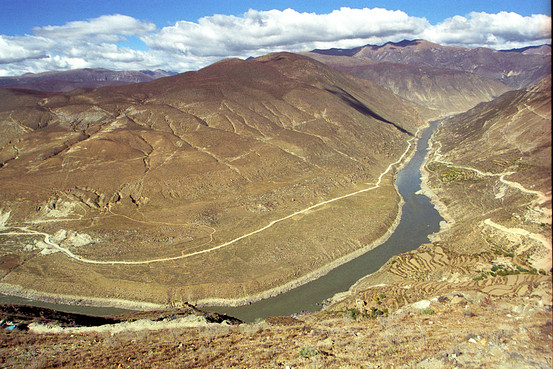
108_2013_b1-chellany-water-w8201_s640x467Downstream Egypt, for example, uses the bulk of the Nile River’s water, yet it is now threatening unspecified reprisals against Ethiopia’s ongoing construction of the Grand Renaissance Dam. China, already the world’s most-dammed nation and unrivaled hydro-hegemon, has approved the construction of 54 new dams — many of them on rivers that are the lifeblood for countries in Southeast and South Asia — as it seeks to build a strategic grip on transboundary water flows.

Turkey, like China, is trying to reinforce its regional riparian dominance by accelerating an ambitious dam-building program, which threatens to diminish cross-border flows into Syria and Iraq. The internal war in Syria and the continuing sectarian bloodletting in Iraq have muted regional opposition to Turkey’s dam-building spree.

Meanwhile, intrastate water-sharing disputes have become common, although they receive little coverage in the international media. Water conflicts within culturally diverse nations, such as Afghanistan, Pakistan, Yemen and Sudan, often assume ethnic dimensions, thereby accentuating internal-security challenges.

But as illustrated by the disputes, for example, within the United States, Spain and Australia, intra-country water conflict is not restricted to the developing world. Water conflicts in America have spread from the arid west to the east. Violent water struggles, however, occur mostly in developing nations, with resource scarcity often promoting environmental degradation and perpetuating poverty.

Adequate access to natural resources has been a key factor, historically, in peace and war. Water, however, is very different from other natural resources. A person can live without love but not without water.

There are substitutes for a number of resources, including oil, but none for water. Countries can import, even from distant lands, fossil fuels, mineral ores, and resources originating in the biosphere, such as fish and timber. But they cannot import the most vital of all resources, water — certainly not in a major or sustainable manner. Water is essentially local and very expensive to ship across seas.

Scarce water resources generate conflict. Even the origin of the word “rival” is tied to water competition. It comes from the Latin rivalis, or one who uses the same stream.

Water’s paradox is that it is a life preserver, but it can also be a life destroyer when it becomes a carrier of deadly bacteria or comes in the deluge of a tsunami, a flash flood, or a hurricane. Many of the greatest natural disasters of our time have been related to water. A recent example is the Fukushima disaster, which triggered a triple nuclear meltdown.

Because of global warming, potable water is set to come under increasing strain even as oceans rise and the intensity and frequency of storms and other extreme weather events increases.

Rapid economic and demographic expansion has already turned potable water into a major issue across large parts of the world. Lifestyle changes, for example, have spurred increasing per-capita water consumption in the form of industrial and agricultural products.

It is against this background that water wars, in a political and economic sense, are already being waged between competing states in several regions, including by building dams on international rivers or, if the country is located downstream, by resorting to coercive diplomacy to prevent such construction. U.S. intelligence has warned that such water conflicts could turn into real wars.

According to a report reflecting the joint judgment of U.S. intelligence agencies, the use of water as a weapon of war or a tool of terrorism appears more likely in the next decade in some regions. The InterAction Council, comprising more than 30 former heads of state or government, meanwhile, has called for urgent action, saying some countries battling severe water shortages risk failing. The U.S. State Department, for its part, has upgraded water to “a central U.S. foreign policy concern.”

Water stress is also imposing mounting socioeconomic costs. Commercial or state decisions in many countries on where to set up new manufacturing or energy plants are increasingly being constrained by inadequate local water availability.

The World Bank has estimated the economic cost of China’s water problems at 2.3 percent of its GDP. But thus far China isn’t even under water stress — a term internationally defined as the availability of less than 1,700 cubic meters of water per head per year. Economies that are already water-stressed, ranging from South Korea and India to Egypt and Morocco, are paying a higher price.

Water is a renewable but finite resource. Nature’s fixed water-replenishment capacity limits the world’s renewable freshwater resources to nearly 43 trillion cubic meters per year. But the human population has almost doubled since 1970 alone, while the global economy has grown even faster.

Consumption growth has become the single biggest driver of water stress. Rising incomes, for example, have promoted changing diets, especially a greater intake of meat, the production of which is notoriously water-intensive. It is about 10 times more water-intensive to produce beef than to produce plant-based calories and proteins.

In this light, water is becoming the world’s next major security and economic challenge.

Although no modern war has been fought just over water, this resource has been an underlying factor in several armed conflicts. With the era of cheap, bountiful water having been replaced by increasing supply and quality constraints, the risks of overt water wars are now increasing.

Avoiding water wars will require rules-based cooperation, water sharing and dispute-settlement mechanisms. However, there is still no international water law in force, and most of the regional water agreements are toothless, lacking monitoring and enforcement rules and provisions formally dividing water among users. Worse still, unilateralist appropriation of shared resources is endemic in the parched world, especially where despots rule.

The international community thus confronts a problem more pressing than peak oil, economic slowdown and other oft-cited challenges. Indeed, this core problem holds the key to other challenges because of water’s nexuses with global warming, energy shortages, stresses on food supply, population, pollution, environmental degradation, global epidemics and natural disasters.

Brahma Chellaney is a geostrategist and the author, most recently, of “Water, Peace, and War”(Rowman & Littlefield, 2013).

(c) The Global and Mail, 2013.

Wages of Mishandling Pakistan

  Brahma Chellaney, The Economic Times, October 9, 2013

Prime Minister Manmohan Singh’s recent state visit to Washington generated a lot of media coverage, not in the U.S. (where the media literally took no note of it) but in India, thanks to the planeload of journalists that Singh took with him. Rarely before had an Indian prime minister’s state visit to U.S. been so invisible to Americans.

If the American media did notice Singh, it was only at the fag end of his trip when he met with his Pakistani counterpart in New York. That put the spotlight, however briefly, on the India-Pakistan equation rather than on the Indo-U.S. relationship. New Delhi doesn’t like the India-Pakistan hyphenation, yet its own actions can be counterproductive. Singh defiantly met Nawaz Sharif, disregarding both public opinion at home and the Pakistani military’s increased hostility.

But before meeting Sharif, Singh complained to US President Barack Obama about Pakistan’s continuing export of terrorism — a complaint that prompted Sharif to purportedly compare Singh with a whining “dehati aurat.” By grumbling to Obama, Singh implicitly expressed his government’s helplessness in countering Pakistani terrorism, besides signalling that his meeting with Sharif was at the U.S. request. In fact, the state department welcomed his discussion with Sharif, saying “dialogue is a positive step forward and we’ll continue to encourage that.”

If Singh believed that holding political dialogue with Pakistan’s new civilian government was important, a New York meeting at the foreign minister level would have sufficed at this stage, especially since no one expected a meeting between the two PMs to break new ground.

Yet the extent to which Singh went to save his September 29 meeting with Sharif can be gauged from one troubling fact: news about the September 24 Pakistani cross-border raid into the Keran sector — which triggered a two-week gunbattle between Indian army troops and the intruders — was not released by the government until after the Singh-Sharif meeting. It is unfortunate the government allowed the political exigencies of a meeting in New York to take precedence over the imperative to inform the nation about a major intrusion involving Pakistani special forces.

It is crystal clear that India’s Pakistan policy has lost all sense of direction. Indeed, it is so adrift that it has emboldened the Pakistan army to carry out multiple acts of aggression across the line of control this year without fear of Indian retribution — from the decapitation of two Indian soldiers and the separate killing of five troops to the Samba raid and the Keran incursion. Sadly, the government has also sowed factionalism in the army’s senior hierarchy by playing favourites and targeting the ex-chief, Gen. V.K. Singh, through media plants.

Worse still, the government has restrained the army both from responding appropriately and effectively to cross-border aggression and from giving out any information to the media on Pakistani (or Chinese) border violations. The restraint order has crimped the army’s traditional leeway to act preemptively against an impending aggression and to inflict a just retribution for any cross-border attack.

Can any force be turned into a veritable sitting duck struggling to fend off repeated aggression? By allowing the army’s operational imperatives to be trumped by the government’s meandering and clueless foreign policy, army chief Gen. Bikram Singh faces an unflattering reality on his record: His stint as chief has coincided with a pattern of rising cross-border aggression by Pakistan (and China).

Let’s be clear: Battling repeated cross-border encroachments on terms dictated by the enemy — a tradition India set in 1999 when it fought the entire Kargil War on Indian territory on Pakistan’s terms — is anything but sound strategy. Indeed, it is an invitation to bringing the country’s border security under siege.

More fundamentally, why has it become a virtual custom since the late 1990s for an Indian prime minister’s meeting with Pakistan’s leader to invariably spell trouble for India? Atal Bihari Vajpayee publicly bemoaned that his peace bus to Lahore in February 1999 was “hijacked and taken to Kargil.” Still, he went to Pakistan in early 2004 for a second time as PM — a trip that sowed the seeds of Pakistan’s stepped-up export of terrorism in the subsequent years.
With his blow-hot-blow-cold approach, the sphinx-like Vajpayee executed several U-turns in his Pakistan policy, which traversed through Lahore, Kargil, Kandahar, Agra, and Parliament House, before culminating in Islamabad on his second trip to Pakistan.

The scandal-tainted Singh has brought a nasty “gift” for his nation from each meeting with a Pakistani counterpart.

Apart from the latest Keran surprise, Singh came back from Sharm el-Sheikh after arming Pakistan with the Baluchistan card against India, while he returned from Havana earlier after declaring that the exporter of terrorism is actually a “victim of terrorism” like India.

In the absence of a long-term strategic blueprint, coupled with the marginalization of the ministry of external affairs and other professional bodies, Indian foreign policy increasingly is being driven by ad hoc, personal interventions of the prime minister — with serious costs to national interest.

Brahma Chellaney is a strategic affairs expert.

(c) The Economic Times, 2013.

Another Afghanistan in the making?

By Brahma Chellaney, Washington Times, October 1, 2013

Clipboard01

President Obama has aborted his planned military attack on Syria, but the proxy war that pits America and its allies against Russia is set to intensify in that critically located nation, with further horrific consequences for civilians and the likely proliferation of transnational terrorists.

The proxy war injects greater volatility into the Arab world, where internal tumult risks recasting the entire Arab state system, centered on a series of artificial states created in the last century by departing colonial powers.

The Washington-Moscow deal to strip Syria of its chemical arms will have little effect on the internal war there, one of the world’s bloodiest conflicts. This conflict has been fueled by Russian and Western arms supplies to rival sides. Indeed, Russia and the U.S.-British-French combination are determined to continue their 2-year-old proxy war in an already fractured Syria. Who cares for civilians?

Most of the estimated 100,000 deaths in the Syrian violence have been caused by foreign-origin weapons, largely made in the proxy-war-waging countries that have shed crocodile tears over civilian deaths in an Aug. 21 sarin attack in suburban Damascus. The U.S. arms supply to rebels is primarily bankrolled by the oil sheikdoms.

In this light, the key questions relate to Syria’s future: Will a new international-terrorist hub emerge that stretches across much of northern Syria and into the Sunni areas of Iraq? Will Syria’s fate be different from that of Afghanistan?

The Syria issue is about more than just President Bashar Assad or chemical weapons: It is integral to the geopolitical clash between the Sunni Middle East, which remains under the U.S.-British-French sway, and the Shiite crescent stretching from Iran through Iraq, Syria and Lebanon to the Mediterranean Syrian port of Tartus, Russia’s only military base outside the former Soviet Union. With Russia emerging as a great-power patron in the Shiite crescent, the United States and the region’s two former colonial powers, Britain and France, are seeking to safeguard the regional geopolitical hegemony that they have enjoyed since the early 1970s, when Egypt switched sides.

Over the decades, the United States has cemented close ties with Sunni Islamist rulers, including the cloistered Arab monarchs who fund Muslim extremist groups and madrassas overseas. Washington has already forgotten the main lesson from the Sept. 11, 2001, terrorist strikes — that it must focus on long-term strategic goals rather than short-term tactical victories. One reminder of that is President Obama’s current effort to strike a Faustian bargain with the thuggish Afghan Taliban.

Since the 1990s, espousing military action as humanitarianism has been the common leitmotif uniting American neoconservatives and liberal interventionists — the hawks on the left who were most vocal recently in promoting a war against Syria. The serial interventionists have failed to take a good, hard look at the lessons of America’s past interventions. For example, those who took the United States to war in Libya have ignored how that “humanitarian” intervention has boomeranged, creating a lawless Islamist state affecting its neighbors’ security.

In backing jihad against Mr. Assad’s autocratic rule, Mr. Obama’s policy has inadvertently strengthened the hands of radical Islamists. The CIA-aided, faction-ridden Free Syrian Army is in danger of being eclipsed by the pro-al Qaeda insurgent groups designated as terrorist organizations by the U.S. State Department — the al-Nusra Front and the Islamic State of Iraq and the Levant.

The risk of an Iraq-style “soft” partition of Syria is high. Indeed, in a July 18 briefing, Mr. Obama’s spokesman, Jay Carney, declared that Mr. Assad “will never rule all of Syria again.” This was a reminder that the unstated goal of Mr. Obama’s military stalemate in Syria is an eventual partition, with Mr. Assad’s power confined to a rump Syria. As former National Security Adviser Zbigniew Brzezinski has acknowledged, “A stalemate is in our interest” — a Machiavellian scenario to lock regime and rebel forces in mutually debilitating combat.

However, with jihadists already in control of much of northern Syria, the danger, as the CIA’s former deputy director, Michael J. Morell, has warned, is that an al Qaeda haven could emerge. This is exactly what happened earlier in Afghanistan as an unintended byproduct of America’s proxy war against the Soviet forces there.

In fact, the transition from covert to overt aid to Syrian rebels by the CIA has occurred much faster than it did in the 1980s Afghanistan, although Syria has already become a magnet for foreign Sunni jihadists. As happened when the United States armed the Afghan mujahedeen, the CIA’s arms supply — far from winning loyal surrogates in Syria — is likely to end up empowering radical forces with transnational ties that extol and perpetrate violence as a religious tool.

For some in Washington and for America’s regional allies — the petro-sheikdoms, Israel and Turkey — the proxy war in Syria is really part of a larger proxy war to contain Iran. The grinding proxy war in Syria thus promises to exact increasing costs regionally and internationally while allowing the U.S.-allied regional autocrats from Abu Dhabi to Ankara to step up their repression at home without fear of international censure. Russia, meanwhile, will continue to prop up the Assad regime.

Given the increasingly murky geopolitics in spite of a rising tide of Syrian civilian displacement, suffering and death, Syria seems set to meet the fate of Afghanistan, a source of regional instability for more than a generation and where the United States is seeking to end its longest-ever military conflict, which has already cost it nearly $1 trillion dollars.

Brahma Chellaney is a geostrategist and the author of “Water, Peace, and War” (Rowman & Littlefield Publishers, 2013).

(c) The Washington Times, 2013.

Southern Asia: A unique nuclear triangle

Brahma Chellaney

Politics and Strategy: The Survival Editors’ Blog

In the two decades since I published an essay in Survival on South Asian nuclearization, one of my conclusions has been proven right, but another wrong. The South Asian nuclear genie remains uncontrolled, as I anticipated. But contrary to my doubt then, India and Pakistan have completed the transition from covert to overt capabilities by conducting nuclear-explosive tests, adopting a nuclear doctrine and deploying nuclear weapons. More strangely, Pakistan now boasts the world’s fastest-growing nuclear arsenal. Indeed, according to several international estimates, its arsenal of nuclear warheads is larger than that of India, which, with China to its north, faces two closely aligned nuclear-armed neighbours.

India’s recent test launch of the Agni V ballistic missile, which can reach Beijing, served as a fresh reminder that the Indian nuclear-deterrence programme is primarily focused on China, with Pakistan remaining subordinate in nuclear planning. To be sure, it was the Sino-Pakistani nuclear nexus — cemented by transfers of Chinese nuclear and missile technology to Islamabad — that propelled India to shed its posture of nuclear ambiguity and go overtly nuclear in 1998. Since then, China’s rapidly accumulating military and economic power, and its increasing assertiveness on territorial disputes, have increased the importance of the nuclear deterrent for India. Given its retaliation-only posture, India has focused its attention in the past decade on erecting a triad of land-based, air-deliverable and submarine-based nuclear capabilities that can survive an enemy first strike.

Strikingly, neither India’s economic rise nor its graduated action to put in place a ‘small but credible’ nuclear force is seen internationally as a threat, unlike the deep concerns that China’s ascent continues to generate. A 2008 civilian nuclear deal between the United States and India, in fact, has come to symbolise their new strategic partnership. International proliferation-related concern instead has focused on Pakistan’s rapid expansion of its nuclear arsenal that has put it on a path to overtake Britain as the world’s fifth-largest nuclear-weapons power. Unstable Pakistan is heavily dependent on foreign aid, yet it has ramped up production of bomb-grade materials.

Nuclear weapons have not prevented Pakistan’s slide into a jihadist dungeon. Given its military’s sponsorship of jihad under the nuclear umbrella and the jihadist infiltration of the armed forces, the biggest international concern relates to the safety of Pakistani nuclear warheads and fissile materials. Compounding this concern is the fact that Pakistan’s military, intelligence and nuclear establishments remain outside civilian oversight. Such concern, along with major gaps in American intelligence about Pakistan’s weapons of mass destruction, has made that country a principal target of US ‘black budget’ surveillance, according to recent revelations. Yet the only plausible scenario of Pakistani nukes falling into Islamist hands is an intra-military struggle in which the jihadists within the armed forces gain ascendancy.

Southern Asia remains the only region in the world where three contiguous neighbours, sharing disputed land frontiers, form a nuclear triangle that pits two of them against the third party. The regional intersection of nuclear issues, terrorism, territorial disputes, competition over natural resources and nationalism creates complex and dangerous challenges. This region will continue to serve as a reminder that any progress in an inter-state context on nuclear issues, including nuclear confidence-building measures, cannot happen independently of the broader geopolitics.

Brahma Chellaney is a Professor of Strategic Studies at the New Delhi-based Centre for Policy Research. His article,‘The Challenge of Nuclear Arms Control in South Asia’, appeared in Survival, 35:3 (1993).

America’s Islamist Allies of Convenience

By Brahma Chellaney, Project Syndicate column

In just one decade, the United States has intervened militarily in three Muslim-majority countries and overthrown their governments. Now the same coalition of American liberal interventionists and neoconservatives that promoted those wars is pushing for punitive airstrikes in Syria without reflecting on how US policy has ended up strengthening Islamists and fostering anti-Americanism. Indeed, the last “humanitarian intervention” has clearly backfired, turning Libya into a breeding ground for transnational militants.

As the intense US debate about President Barack Obama’s proposed use of military force highlights, the attack-Syria push is not about upholding America’s national interest. Rather, the desire to protect US “credibility” has become the last refuge of those seeking yet another war in the wider Middle East.

If “credibility” were purged from the debate and the focus placed squarely on advancing long-term US interests, it would become apparent that an attack on Syria might not yield even temporary geopolitical gains. Beyond the short term, it would unleash major unintended consequences, potentially including an Iraq-style “soft” partition of Syria and the creation of a haven for extremists stretching across much of Islamist-controlled northern Syria and into the Sunni areas of Iraq.

Indeed, an attack would most likely increase America’s reliance on unsavory Islamist rulers in countries ranging from Saudi Arabia and Qatar to Turkey and the United Arab Emirates. Some Arab monarchs have pledged to bankroll the U.S. attack — an investment that they would easily recover, given that the war talk has already increased oil prices.

Al Qaeda-type groups already have gained ground in the Middle East and North Africa as an unintended byproduct of US policies, creating fertile conditions for stepped-up international terrorism in the coming years. The US invasion and occupation of Iraq, for example, created a major opening for Al Qaeda, whose affiliates now represent the Sunni struggle against the Shia-dominated government.

Likewise, regime change in Libya aided the rise of Al Qaeda-linked militants, leading to the killing in Benghazi of the US ambassador. A system based on sharia (Islamic law) has been imposed, human-rights abuses are legion, and cross-border movement of weapons and militants has undermined the security of Libya’s neighbors.

Meanwhile, America’s support for the regimes in Yemen and Saudi Arabia has contributed to the rise of Al Qaeda in the Arabian Peninsula. In parts of southern Yemen, an Al Qaeda affiliate, Ansar al-Sharia, functions as a de facto government.

In Syria, where sizable chunks of territory are already under Islamist control and the pro-Al Qaeda Al Nusra Front overshadows the US-backed Free Syrian Army, the Obama administration is staring at the bitter harvest of its previous policy choices. Airstrikes now would merely make matters worse by undercutting the FSA’s grassroots legitimacy and aiding Islamist forces.

Farther east, the US wants an “honorable” exit from Afghanistan — the longest war in its history — through a peace deal with the Taliban, its main battlefield opponent. In seeking to co-opt the Taliban — an effort that has resulted in the Taliban establishing what amounts to a diplomatic mission in Doha, Qatar — the US is bestowing legitimacy on a thuggish militia that enforces medieval practices in the areas under its control.

America’s dalliances with Islamist-leaning political forces — and governments — have been guided by the notion that the cloak of Islam helps to protect the credibility of leaders who might otherwise be seen as foreign puppets. That simply will not work, even in the short term. On the contrary, until the Egyptian army removed him from the presidency, the Muslim Brotherhood’s Mohammed Morsi was coming to be seen by many as America’s man in Cairo.

In the long term, the US will gain nothing — and risk much — by continuing to back oil sheikhdoms that fund Muslim extremist groups and madrasas from the Philippines and India to South Africa and Venezuela. By supporting Islamist rulers, the US is contributing to a trend evident from the Maghreb to the badlands of Afghanistan and Pakistan — Muslims killing Muslims.

American policy has also contributed to a growing conflict between Islamist and secular forces in Muslim countries. This is best illustrated by Turkey, where Obama has ignored Prime Minister Recep Tayyip Erdoğan’s heavy-handed efforts to annul free speech and turn himself into a twenty-first-century Sultan.

There and elsewhere, the US, motivated by the larger geopolitical goal of containing Shia Iran and its regional allies, has embraced Sunni rulers steeped in religious and political bigotry, even though they pose a transnational threat to the values of freedom and secularism. Moreover, the clash within Islam is likely to be destabilizing regionally and counterproductive to the interests of the free world.

Against this background, Obama should heed the doctrine proposed in 1991 by General Colin Powell. The Powell doctrine stipulates that the US should use military force only when a vital national-security interest is at stake; the strategic objective is clear and attainable; the benefits are likely to outweigh the costs; adverse consequences can be limited; broad international and domestic support has been obtained; and a plausible exit strategy is in place.

Given the US record since the doctrine was formulated, another criterion should be added: the main beneficiaries of military intervention are not America’s mortal enemies.

(c) Project Syndicate, 2013.

Chemical Weapons: Fact and Fiction

Chemical arms, a poor nation’s deterrent, are far less effective than modern conventional weapons

Brahma Chellaney, The Japan Times, September 13, 2013

U.S. President Barack Obama’s plan to bomb Syria for alleged use of poison gas has raised two questions that remain pertinent despite the proposed international monitoring and eventual destruction of that country’s chemical-weapon arsenal: Is gassing people more inhumane or reprehensible than killing with Tomahawk missiles, drones and other conventional weapons? And are chemical weapons inherently prohibited in international law, just like genocide and slavery?

These questions are also important because Obama’s request to Congress for authorization to attack Syria was not about any specific threat to U.S. or international security. Rather, the planned attack was intended for retribution to save the president’s credibility that he believed was on the line.

Let’s be clear: Chemical weapons — including choking agents like chlorine gas, blister agents such as mustard gas, arsenic- or cyanide-based blood agents, and nerve agents like sarin — are far less effective than modern conventional weapons, which kill with greater precision and lethality.

Technological advances, in fact, have made conventional weapons capable of leaving a greater trail of death than any poison gas. They kill, maim and terrorize in ways not much different than chemical weapons. Some conventional explosives and napalm (a petrochemical incendiary whose use against military targets remains lawful despite the notoriety it gained during the Vietnam War) indeed can cause lingering, painful death.

Chemical weapons have a low kill ratio, which makes them scarcely effective on the battlefield. If anything, they are more effective off the battlefield than on the battlefield. Moreover, their employment often demands favorable weather and geographic conditions. If the military intent were to incapacitate enemy army units without killing them, chemical weapons potentially make for more humane warfare than conventional weapons.

But because they are cheap, easy to manufacture, and serve as a poor nation’s deterrent, chemical arms have fallen out of favor with the powerful, who portray them as “immoral weapons.” To protect their advantage in conventional weapons, great powers have promoted a taboo against chemical-weapon use.

To be sure, chemical arms can become weapons of terror in the hands of extremists, as exemplified by the Aum Shinrikyo cult’s 1995 sarin attack in the Tokyo subway that killed 13 commuters.

Chemical arms have been used by combatants since ancient times, with the oldest archeological evidence of chemical warfare being found, ironically, in modern-day Syria. Before the advent of nuclear weapons, chemical weapons came to be regarded as weapons of mass destruction. Their extensive use in World War I, especially in the form of mustard or chlorine gas, created revulsion and fear of future chemical attacks. However, the use made little difference to the military outcome.

A corpse from the napalm attack on Tokyo

In fact, the total fatalities from the chemical-weapon strikes accounted for much less than one percent of the World War I deaths, and were lower than the toll from a single U.S. napalm attack on Tokyo on March 10, 1945. At least 100,000 Japanese died on that day when some 300 B-29 bombers dropped 1,700 tons of incendiary bombs — the deadliest air raid of World War II.

Against this background, why do the hundreds allegedly killed by the regime of President Bashar al-Assad in an August 21 sarin attack count for more than the estimated 100,000 slain in Syria’s grinding civil war, including many killed by insurgents aided by the U.S. and its repressive Islamist allies, such as the rulers of Qatar, Saudi Arabia and Turkey? Why is it any worse to be killed by sarin than to be decapitated by insurgents, a growing number of whom hew to al-Qaeda ideology?

The Obama administration’s visceral, bomb-Syria stand has obscured such questions.

International efforts since the late 19th century to outlaw chemical weapons have been hampered by repeated national breaches of legal obligations. The 1899 Hague Convention prohibited the use of projectiles with the “sole object” of diffusing “asphyxiating or deleterious gases” — a ban that was openly flouted in World War I. The violations spawned the 1925 Geneva Protocol banning the use of poison gas as a weapon — a still-binding prohibition breached with impunity by several parties.

The 1993 Chemical Weapons Convention (CWC) went further and outlawed the production, stockpile, transfer and use of chemical weapons. Some countries have not signed or ratified it, including Syria, Israel, North Korea, Egypt and Myanmar. Some parties strongly suspected of possessing chemical weapons, including China and Pakistan, did not declare any stockpile. By declaring former production facilities, China, however, tacitly admitted that it had built chemical weapons and destroyed them before ratifying the CWC.

Of the seven declared possessor states under the CWC, the largest arsenals are held by the U.S. and Russia, which have both missed the convention’s final extended deadline of 2012 for the destruction of all stockpiles. What impact will this contravention have on the CWC’s integrity?

Only India, South Korea and Albania among the seven declared possessor states verifiably eliminated their stockpiles by the initial deadline of March 2009. The U.S. says its stockpile destruction will not finish before 2023, more than a decade after the extended cut-off date.

When the U.S. sprayed 76 million liters of Agent Orange, a toxic defoliant, during the Vietnam War, it was not a party to the Geneva Protocol, which it embraced soon after that war ended.

But America’s use of white phosphorus as an incendiary weapon and direct tool of warfare during the 2004 siege of Falluja city in occupied Iraq raised a troubling question about its compliance with international obligations. Studies have reported a sharp rise in cancer, leukemia and congenital birth defects in Fallujah in the years since.

White phosphorous, like other chemicals not listed in the CWC schedules, can be legally employed for noncombat purposes (for example, as a flare to illuminate the battlefield or to produce smoke to disguise troop movements) but not “as a method of warfare” relying on its “toxic properties.”

Before Iraqi President Saddam Hussein fell out of favor with Washington, the Reagan administration acquiesced in his regime’s gassing of Iranian troops during the protracted Iraq-Iran war.

Declassified CIA papers and interviews with former officials, as highlighted by the journal Foreign Policy recently, confirm what has long been known — that Washington not only turned a blind eye to Iraq’s repeated use of sarin and mustard gas from 1983 to 1988, but also facilitated the gassing of Iranian troops by providing Saddam Hussein with satellite reconnaissance data on location of Iranian units.

It is against this backdrop that Obama — facing both international isolation and congressional defeat — sought to build a legal case to bomb Syria. His task was made uphill by factors extending beyond the varied and often-shifting justifications proffered by his team and his decision to bypass the United Nations.

First, Syria is not a party to the CWC, whose enforcement, in any event, vests with the Security Council. Syria in 1968 did sign the 1925 Geneva Protocol, yet that protocol provides no basis for use of force because it relates to interstate war, not intrastate conflict. Second, in a world in which national stockpiles of chemical arms still exist, few can argue that such weapons are inherently prohibited in international law, regardless of treaties. The “norm” against their use indeed has repeatedly been violated since 1925.

Allegations and counter-allegations of chemical-weapon use in the Syrian civil war have been rife since last year. Several instances of alleged use were reported in the spring of this year, eventually prompting the United Nations to send a team of investigators to Syria in August.

While the inspectors were probing those cases, another instance of alleged use in suburban Damascus on August 21 made international headlines because of a rebel video. Even as the UN inspectors turned to investigating the newest incident, Obama peremptorily declared his intent to punitively bomb Syria.

Why did Obama zoom in on the August 21 incident and ignore the earlier instances? One plausible explanation is that while some of the earlier incidents appeared to point to chemical-weapon use by insurgents, with Syrian army soldiers among the victims, the August 21 victims were all civilians in a rebel-held neighborhood.

Carla del Ponte, a leading member of the UN Independent International Commission of Inquiry on Syria, told Swiss TV in May that there were “strong, concrete suspicions but not yet incontrovertible proof” that rebels had used sarin. Ms. Del Ponte, a former Swiss attorney-general and prosecutor with the International Criminal Tribunal for the former Yugoslavia, said: “I was a little bit stupefied by the first indications we got… they were about the use of nerve gas by the opposition.” The comments prompted the commission to issue a statement that stressed — without denying Ms. Del Ponte’s remarks — that it had “not reached conclusive findings.”

Contrast that with the August 21 incident claims, which have been ratcheted up progressively. The British reported “at least 350” civilians were killed in that attack; the Americans then released a much higher but incredulously precise fatality toll of 1,429; immediately thereafter, U.S. Secretary of State John Kerry thundered that the world cannot allow Assad to gas “thousands” of his people. The French followed up by claiming the attack involved “massive” use of sarin — an assertion picked up by the White House.

The full truth on the various incidents may never be known. Still, it cannot be discounted that the rebels probably were the first to carry out a chemical-weapon attack in the civil war.

In this light, the Russian proposal to make Syria sign the CWC and have monitors take control of its chemical-weapon armory opens a possible diplomatic solution, including reducing poison-gas-related risks in that country.

It could also bail out an isolated Obama from a predicament of his own making — his insistence that he will break international law to punish Syria for breaching a fanciful international legal tradition.

Brahma Chellaney is a geostrategist and the author, most recently, of “Water, Peace, and War” (Rowman & Littlefield, 2013). 

(c) The Japan Times, 2013.

Dicey dalliances with Islamists

By Brahma Chellaney, The Japan Times

rebels

Syrian rebels prepare to summarily execute captured soldiers.

U.S. President Barack Obama’s insistence on employing air power to punish Syria even if such a war breaches international law and unleashes major unintended consequences is just the latest chapter in a more than two-year U.S. policy whose calculations have gone wrong in backing jihad against Syrian President Bashar Assad’s dictatorial rule. Military strikes could compound Obama’s policy missteps, including inadvertently strengthening the hands of gun-toting Islamists.

Before an internal insurrection in 2011 turned Syria into a proxy battleground for regional and global powers, the country probably was the most liberal, secular Muslim state in the arc of Islam. Today, it is a broken state — its social fabric in tatters, its physical infrastructure largely wrecked, and its cities pummeled daily by urban warfare, with much of the northern region under the sway of hardline Islamist groups, especially the Al Nusra Front.

As also happened in Afghanistan from the 1980s and more recently in Libya, the spirit of jihad the United States helped instill in Syria to overthrow Assad — along with the supply of petrodollar-funded Western arms through Turkey and Jordan — has spawned hardcore Islamist militants wedded to the al-Qaida ideology. Al Nusra now overshadows the Free Syrian Army, established with help from the U.S. and the region’s old colonial powers, Britain and France.

In another major setback for Obama’s policy, the once-tottering Assad regime has not only survived but consolidated its hold in Damascus and militarily gained the upper hand across much of the central and southern regions, with rebel hold limited to some pockets, including in suburban Damascus.

The setbacks have compelled Obama to fundamentally alter his goals. From aiming to topple the Assad regime — a prospect that seemed so likely until last year that CIA teams in Turkey extended their rebel-support operations to northern Syria before this region came under the sway of the pro-al-Qaida groups — Obama has swung to seeking a military stalemate in Syria.

Obama believes a protracted stalemate, despite its high humanitarian cost, would eventually open up a possible negotiated settlement. Because regime forces currently have the upper hand against the rebels, he wants to level the playing field by degrading their capabilities through concentrated air strikes.

The visceral response to the alleged poison-gas attack — despite the relatively small number of fatalities from it compared with the death toll in the continuing civil war — shows that the chemical-weapon issue is just a fig leaf for Obama’s Mission Stalemate, a scenario that will keep regime and rebel forces at each other’s throats, thereby ensuring the Assad government’s continual bleed and bottling up the independent Islamist groups. Given that Obama’s missteps has left him with only bad options on Syria, he has settled for ensuring a military stalemate where Arabs kill Arabs, with the rebel weapons for killing paid for by Arab sheiks.

The resolve to correct the military balance in Syria by wiping out much of the air capability of the ascendant government forces, however, will exact a heavy price regionally.

The U.S. will not be able to control the developments its attack triggers. Indeed, the larger fallout will likely increase America’s reliance on unsavory Islamist rulers in countries ranging from Saudi Arabia and Qatar to Turkey and the United Arab Emirates. There is also the distinct prospect of an al-Qaida haven stretching across northern Syria and into Iraq.

The spread of Muslim radicalism across large parts of the world has created a fertile ground for greater international terrorism. As an unintended byproduct of U.S. policies in support of or against regimes, al-Qaida type groups have gained ground in the Middle East and North Africa.

The U.S. invasion and occupation of Iraq created a major opening for al-Qaida, whose affiliates now represent the Sunni struggle against Iraq’s Shiite-dominated government. Grisly bombings have become commonplace.

Regime change in Libya has brought chaos and the rise of al-Qaida, leading to the Benghazi killing of the U.S. ambassador. It has also exacerbated human-rights abuses and humanitarian suffering, imposed a system based on Shariah law, and promoted cross-border movement of weapons and militants to haunt neighbors’ security.

America’s propping up of the regimes in Yemen and Saudi Arabia has contributed to the rise of the group, al-Qaida in the Arabian Peninsula. Meanwhile, by allowing the Taliban to open a de facto diplomatic mission in Doha, Qatar, Obama has signaled U.S. desperation to cut a deal with this thuggish, Pakistan-backed Afghan militia that enforces medieval Islamic practices in the areas it controls.

So what can be done? The lesson U.S. policymakers must heed is to take the long-range view and not be guided by narrow geopolitical considerations that involuntarily strengthen Islamists.

Unfortunately, U.S. policy’s dalliance with Islamist-leaning rulers has long been guided by the consideration that the cloak of Islam helps to protect the credibility of leaders who might otherwise be seen by their public as foreign puppets.

Washington must now stop condoning the rulers of the oil sheikdoms for their alliance with radical clerics and for exporting militant Islam. It must also cease providing political succor to Islamists elsewhere. Until the military ousted him, the Muslim Brotherhood’s Mohammed Morsi was America’s man in Cairo.

By supporting Islamist rulers, Washington — even if unintentionally — has promoted a growing conflict between Islamist and secular forces in Muslim countries, best illustrated by Turkey, which was wracked by unprecedented anti-government protests this summer. Obama has mollycoddled Prime Minister Recep Tayyip Erdogan by ignoring his heavy-handed efforts to annul secularism and free speech, and turn himself into a 21st-century sultan.

Erdogan, who as Istanbul’s mayor declared that “our only goal is an Islamic state,” has jailed more journalists than any other country, including China, and thrown one in five of Turkey’s generals and half of its admirals in jail since becoming prime minister in 2003. Today, he is Obama’s most hawkish ally against Assad.

Motivated by the larger geopolitical goal of containing Shiite Iran and its regional allies, U.S. policy has myopically embraced Sunni rulers steeped in religious and political bigotry, even though they pose a transnational threat to the values of freedom and secularism. Arab monarchs have continued to fund Muslim extremist groups and madrassas (Islamic schools) in other countries — from the Philippines and India to South Africa and Venezuela.

U.S.-British-French policies in the arc of Islam, even if by accident, are contributing to an internally driven trend evident from the Maghreb to the Afghanistan-Pakistan belt — Muslims killing Muslims. This trend, of course, has been principally aided by the export of Wahhabi Islam by the sheiks in Riyadh, Doha, Abu Dhabi and elsewhere, and by the consequent rise of Islamist groups. These policies have averted the feared clash between civilizations, yet they have been a factor in the ongoing clash within a civilization. The effects of this clash are likely to be destabilizing regionally and counterproductive to the interests of the free world.

Against this background, Obama would do well to heed tea party icon Sarah Palin’s advice on Syria, “Let Allah sort it out” — unless Obama believes Allah has chosen him to do that.

Brahma Chellaney is a geostrategist and the author, most recently, of “Water, Peace, and War” (Rowman & Littlefield, 2013).

(c) The Japan Times, 2013.

Obama’s Great Asian Dawdle

BY BRAHMA CHELLANEY, Washington Times, September 2, 2013

The U.S. is shying away from China’s stealth aggression.

The more assertive Beijing has become, the more reluctant U.S. President Barack Obama has been to take sides in Asian territorial disputes, although they center on a combative China’s efforts to change the territorial status quo with America’s strategic allies or partners. Washington’s feckless Asia policy has helped deepen the security dilemma of several Asian states on how to protect their territorial and economic rights against China’s power grab.

Washington has made it amply clear that despite its “pivot” toward Asia, it will not put American lives at risk to defend its allies’ territorial claims against Beijing or act in ways detrimental to its close engagement with China. Defense Secretary Chuck Hagel even said in an August 28 BBC interview that the U.S. does not look at China’s military buildup as a threat.

Indeed, there has been a course correction in the Obama administration’s “pivot” policy. After initially raising Asian expectations about a robust U.S. response to China’s assertiveness, Washington has tamped down the military aspects of its “pivot,” lest it puts it on the path of taking on Beijing. Instead it has started laying emphasis on the economic aspects.

Obama’s Asia policy has treaded a course of neutrality on territorial disputes between China and its neighbors, while seeking to reap the economic and strategic benefits of closer engagement with Asian states.

Washington, for example, is chary of getting drawn into Sino-Japanese territorial disputes, although Tokyo is its close ally and U.S. forward military deployments in Japan are a linchpin of America’s strategy to retain primacy in Asia. In fact, the Japanese-controlled Senkaku Islands to which China has laid claim are close to Okinawa, home to the largest U.S. military presence in Asia.

Similarly, even as China purposely badgers India along the Himalayan frontier, Washington has shied away from cautioning Beijing against any attempt to change the territorial status quo by force. In fact, on a host of Asian disputes, including China’s claim since 2006 to India’s Austria-size Arunachal Pradesh state, Washington has chosen not to antagonize Beijing and stayed neutral.

Even in a case when China has forcibly changed the status quo — by taking effective control since last year of the Scarborough Shoal, located in the South China Sea within the Philippines’ exclusive economic zone — the Obama team has done little more than counsel restraint and talks. With Chinese vessels this year present near the Second Thomas Shoal, the lesson the Philippines is learning that might remains right in international relations and that its security dependence on Washington is no check on the intruding colossus.

The paradox is that China’s rising assertiveness has helped the U.S. to return to Asia’s center-stage, yet Obama is wary of taking sides in the territorial disputes. The only issue on which Washington has spoken up is freedom of navigation in the South China Sea.

The China factor, which has allowed the U.S. to strengthen its existing military relationships and build new strategic partnerships in Asia, can remain useful for America only if it is seen by its allies and partners as a credible guarantor of stability and security in Asia. That is a function not of its military strength but of its political will.

To be sure, Washington has an interest in preventing the emergence of a Sino-centric Asia. But it has no interest in getting entangled in Asia’s territorial feuds. If it can, it would like to find a way to support its allies and partners in their disputes with China, but without alienating Beijing — a tough balancing act.

For example, the Obama administration has said the U.S. security treaty with Japan covers the Senkaku Islands because they “are under Japanese jurisdiction,” yet “we also stress that we don’t take a position on the sovereignty of the Senkaku Islands.” How reassured can Japan be with such doublespeak?

Washington indeed has advised Tokyo and Beijing repeatedly to sort out their dispute peacefully. Some U.S. analysts who have served in the government have urged Washington not to issue a “blank check” to an uncompromising Japan that refuses to negotiate with Beijing on the dispute.

If China were to employ military force in the dispute, would the U.S. take all necessary actions, including the use of its military capability, to repulse a Chinese action that was confined to the 7-square-kilometer disputed real estate in the East China Sea? The Obama administration has simply said that despite China’s increasing intrusions into the Senkaku waters, “we do not envision that this current tension will rise to that level in any foreseeable scenario.”

Tokyo, skeptical that the U.S. will go to war with China to back Japan’s territorial rights, wants a clear U.S. defense guarantee. The Obama administration, however, has balked at Tokyo’s November 2012 proposal that the U.S.-Japan alliance’s defense guidelines be updated to specifically include the Senkakus.

America’s larger chariness has seemingly encouraged China to up the ante against several neighbors. For example, after gradually increasing the frequency of its incursions into Senkaku waters since September 2012, China is now focusing on increasing their duration. Similarly, China’s land incursions into India’s Ladakh region, after going up in frequency, are this year being staged intermittently for longer duration.

This pattern appears designed to pressure an opponent to cut a deal on Chinese terms, in keeping with Beijing’s stratagem on territorial disputes — what is ours is ours and what is yours is negotiable.

China, despite its bluster, is unlikely to wage open war against a determined, well-armed opponent for fear it may get a bloody nose, as happened in 1979 when it invaded Vietnam. Yet the possibility of an overt war resulting from mistake or miscalculation cannot be ruled out.

Even if no open war flares, Japan and several other Asian states already face China’s war by stealth. Through a clever strategy of furtive, incremental encroachments, China is actually undercutting the value of its opponents’ security relationships with Washington. Compounding this situation is Washington’s signal to its allies and partners that it is their own responsibility to safeguard territories that China covets.

Given Washington’s hands-off approach to Beijing’s creeping, covert warfare — designed to change facts on the ground slowly without having to fire a single shot — the relevance of U.S. security assurances to China’s neighbors risks becoming largely symbolic. In fact, the U.S. has sent out a contradictory message: It wants its allies to do more for their own security, yet it has scowled at Japan’s interest in acquiring offensive capability to deter aggression, asking Tokyo to consider the plan’s potential negative fallout in East Asia.

China’s aggressive stance thus poses difficult challenges for America’s allies and partners. For these states, the logical response to their security predicament would be to bolster defenses; build partnerships with each other to create a web of interlocking strategic relationships; and deepen their strategic engagement with Washington but without expecting the U.S. to come to their aid in a military contingency in which American interests are not at stake directly.

Brahma Chellaney is a geostrategist and the author, most recently, of “Water, Peace, and War” (Rowman & Littlefield, 2013).

 (c) Washington Times, 2013.

Cheek-turners as leaders

Image

Brahma Chellaney, INDIA TODAY, September 2, 2013, Upfront column, page 10

George Washington famously said, “If we desire to avoid insult, we must be able to repel it; if we desire to secure peace—one of the most powerful instruments of our rising prosperity—it must be known that we are at all times ready for war.” India, however, has stomached not just insults but also acts of cross-border aggression by Pakistan while continuing to sing peace to its tormentor, a smaller state by every yardstick. No amount of terror has convinced India to change course—not even the Pakistani-scripted attacks on symbols of Indian power, including Parliament, Red Fort, stock exchange, national capital, business capital and IT capital.

Each act of aggression has been greeted with inaction and stoic tolerance. For a succession of prime ministers, every new attack has effectively been more water under the bridge. Manmohan Singh—the weakest and most clueless of them—has put even the internationally unprecedented Mumbai terrorist siege behind him by delinking dialogue from terrorism and resuming cricketing ties.

If anyone questions this approach of turning the other cheek to every Pakistani (or Chinese) attack, government propagandists retort, “Do you want war?” This mirrors the classic argument of appeasers that the only alternative to appeasement is all-out war. As the proverbial extremists, appeasers are able to see only the extreme ends of the policy spectrum: Propitiation and open warfare.

UpfrontThe appeasers thus have presented India with a false choice: Either persevere with pusillanimity or risk a full-fledged war. This false choice, in which the only alternative to appeasement is military conflict, is an immoral and immoderate line of argument designed to snuff out any legitimate debate on rational options. There are a hundred different options between these two extremities that India must explore and pursue. Indeed, only a policy approach that avoids the extremes of abject appeasement and thoughtless provocation can have merit.

The appeasers also argue that neighbours cannot be changed. So, as Singh has said blithely, “a stable, peaceful, and prosperous Pakistan” is in India’s “own interest.” But political maps are never carved in stone, as the breaking away of South Sudan, East Timor and Eritrea has shown. Didn’t Indira Gandhi change political geography in 1971? In fact, the most-profound global events in recent history have been the disintegration of several states, including the Soviet Union and Yugoslavia. Even if India cannot change its neighbours, it must seek to change their behaviour so that it conforms to international norms.

Yet India has shied away from employing even non-coercive options to discipline a wayward Pakistan, which is waging low-intensity unconventional warfare. Rather than squeeze Pakistan economically and diplomatically, India is doing just the opposite. Similarly, India has stepped up its propitiation of China, in spite of facing a Sino-Pak pincer offensive centred on Jammu and Kashmir: Chinese incursions into Ladakh have increased in parallel with Pakistani ceasefire violations. Still, Singh is determined to meet his Pakistan counterpart in New York and later pay obeisance to an increasingly combative China on yet another trip to Beijing.

By going with an outstretched hand to adversaries still engaged in hostile actions, India repeatedly has got the short end of the stick. Nothing better illustrates India’s clap-when-given-a-slap approach than the way it portrayed the 19-km Chinese encroachment in April-May as a mere “acne” and tried to cover up the Pakistan Army’s role in the recent Indian soldiers’ killing. A hawk is defined in the U.S. as someone who seeks the use of force pre-emptively against another country. But in India—reflecting the ascendancy of cheek-turners and the country’s consequent descent as an exceptionally soft state—a hawk has come to signify someone who merely advises against turning the other cheek to a recalcitrant or renegade neighbour.

An easy way for Indian diplomacy to make the transition from timidity to prudence is to start spotlighting plain facts on cross-border aggression. Yet the Indian political class is so busy feathering its own nests that it is willing to even twist facts about how soldiers were martyred and suppress figures showing a rising pattern of Chinese incursions.

How does one explain that leaders, while shrewd and calculating in political life, have pursued a fundamentally naïve foreign policy that has shrunk India’s regional strategic space and brought its security under siege? The answer lies in one word: Corruption. Untrammelled corruption has spawned a political class too compromised to safeguard national interests. Appeasement thus thrives, with the ministry of external affairs effectively being turned into the ministry of external appeasement. India’s reputation as weak-kneed indeed has become the single most important factor inviting aggression, spurring a vicious circle.

Brahma Chellaney is a geostrategist and author.

(c) India Today, 2013.

An insecurity trap of India’s own making

Brahma Chellaney, Mint, August 15, 2013

India can no longer evade the question as to why its regional adversaries are able to carry out cross-border acts of aggression with impunity.

Have you thought of why India faces unending cross-border acts of aggression while persisting with a process of dialogue and peace building? Is it merely because India has scofflaw neighbours? Or can at least part of the blame be pinned on India’s pursuit of a foreign policy driven by neither pragmatism nor statecraft?

Take the challenge from Pakistan, a country 1/13th India’s size economically: After suffering each attack since the late 1990s, India has had the same debate, largely centred on the merit of staying put in the process of talks with Islamabad. Few ask the real questions: How many more attacks is India willing to bear? Is there no limit to India’s patience? What has outraged the country over the two recent back-to-back Pakistani acts of aggression — the suicide raid on the Indian consulate in Jalalabad and the ambush-killing of five soldiers along the line of control (LoC) — is more the government’s meek response and prevarications than the attacks themselves.

A key plank of Pakistan’s jihad strategy against India is deniability. Carry out an attack, deny involvement, keep India engaged in talks to serve as a continuing cover, and execute the next attack. This strategy can fool no one. But India’s political class is so corrupt and compromised that it has little time to look beyond self-interest.

Indian leaders are very protective of their own interests. Indeed they have an overinflated view of themselves. Their hard-headedness in serving personal interests contrasts with their faint-heartedness in shielding national interests. If they had spent just a quarter of their time on their primary duty — protection of national interest — the country wouldn’t be in the mess it is today, with the economy sinking, national security under siege, and pessimism reigning.

The foundation of India’s present weak-kneed foreign policy was actually laid between 1999 and 2004 by Atal Bihari Vajpayee, who executed more policy U-turns than probably any other prime minister since independence. Vajpayee’s roller-coaster policy on Pakistan exacted a major toll on institutionalized policy-making, exposing India’s glaring inadequacy to set and unwaveringly pursue clear goals.

Under Vajpayee — who also surrendered India’s Tibet card in a 2003 Beijing visit — personal rather than professional characteristics defined India’s foreign policy. His shifting Pakistan stance traversed through Lahore, Kargil, Kandahar, Agra, and Parliament, before culminating in Islamabad on his second trip to Pakistan as prime minister. It was Vajpayee’s 2001 Agra invitation that helped Pervez Musharraf to come out of the international doghouse for staging a military coup.

In an operation with no parallel in modern world history, the Indian military was kept in war-ready position against Pakistan for 10 months, ostensibly to force Pakistan to dismantle its terrorist infrastructure. Yet, without accomplishing any objective, Vajpayee called off the costly, self-debilitating operation, which the then Navy chief later labelled the “most punishing mistake.” Worse still, Vajpayee during his 2004 Islamabad visit hailed as a big gain Pakistan’s commitment on paper to not let its territory to be used for cross-border terrorism — the very assurance Musharraf had given before Operation Parakram began.

Vajpayee’s swinging policy pendulum emboldened his successor, Manmohan Singh — a foreign-policy greenhorn — to pursue a blinkered approach that blended naiveté with appeasement, thereby inviting greater acts of aggression against India. Mistaking tactics for strategy, Singh has treated the process of engagement with Pakistan (and China) as an end in itself, losing sight of the purpose — putting an end to acts of aggression.

Singh’s fixation on quasi-failed Pakistan has paralleled Vajpayee’s quest to make peace with that implacable enemy. The Vajpayee and Singh eras will also be remembered for the corruption in public life, with scandals at times sought to be deflected through peace building with Pakistan. A famous son-in-law in each of the two eras came to symbolize unbridled corruption.

In this light, is it any surprise that personal and not professional characteristics have shaped India’s foreign policy for almost 15 years now? This trend marks goodbye to institutionalized policymaking.

Singh, of course, has taken appeasement to unmatched levels. In 2006 at Havana, he equated the exporter of terrorism with the victim of its terrorism, setting up the infamous and now-defunct joint anti-terror mechanism. Three years later at Sharm el-Sheikh, Singh included Baluchistan in the agenda — grist for the Pakistani propaganda mill that India was fomenting the insurrection there. This blunder allowed Pakistan to externalize the Baluch problem by turning its terrorism target, India, into the principal accused.

Even the savagery last January when Pakistani troops chopped two Indian soldiers and took away one severed head as a “trophy” failed to stop Singh from returning to business as usual with Pakistan, in spite of his own promise to the nation that it won’t be business as usual. The result is that Singh’s constant engagement of Pakistan has yielded uninterrupted Pakistani acts of military brutality and terror. In fact, the worst acts of cross-border aggression have occurred during Singh’s stint as prime minister.

Instead of dictating terms to Pakistan, India allows Pakistan to retain initiative. Each time India is caught by surprise, it does little more than react passively. Whereas Pakistan’s India policy has remained consistent for long, India’s ad hoc Pakistan policy continues to inflict self-injury.

Make no mistake: India has fashioned its own insecurity trap. To break out of it, it must pursue a clearheaded, goal-oriented foreign policy focused on an assertive promotion of national interests. That process can begin only if India stops looking at inter-country relations through rose-coloured glasses and establishes professional policymaking.

Brahma Chellaney is a professor at the Centre for Policy Research in New Delhi.

(c) Mint, 2013