How the U.S. Bolsters China’s Pakistan Strategy at Its Own Expense

The U.S. highlights the rot in its Pakistan policy by feting Gen. Sharif in Washington, where he held talks with Vice President Biden, the secretaries of state and defense, and the CIA chief. The visit showed how the U.S. coddles Pakistani generals at the expense of Pakistan’s elected government.

995098-COAS-1447996768-510-640x480

Brahma Chellaney, China-US Focus

Strategic weapon transfers, loans, and political support allow China to use Pakistan as a relatively inexpensive counterweight to India. Yet, oddly, America also extends unstinted financial and political support to Pakistan, a country that has mastered the art of pretending to be a U.S. ally while hosting those that kill U.S. soldiers in Afghanistan. Washington’s present approach bolsters China’s Pakistan strategy but undercuts its own interests.

U.S. President Barack Obama’s decision to sell an additional eight nuclear-capable F-16 fighter jets to Pakistan is just the latest example of America persistently rewarding a country that still refuses to snap its ties with terrorists or observe other international norms. By showering Pakistan with billions of dollars in aid annually, the U.S. has made the financially-struggling country one of this century’s largest recipients of American assistance.

Terrorists reared by the Pakistani military’s Inter-Services Intelligence (ISI) agency continue to train inside Pakistan for cross-border operations in India and Afghanistan. The Afghan Taliban’s top leaders remain holed up in Pakistan, which also hosts sanctuaries for those waging hit-and-run campaigns in Afghanistan. Pakistan has not come clean even in regards to who helped Osama bin Laden hide for years in a military garrison town near its capital.

Yet, the U.S. has allowed itself to be repeatedly duped by Pakistan’s false promises. U.S. policy has not only turned Uncle Sam into Uncle Sucker but also made it easy for Pakistan to merrily run with the foxes and hunt with the hounds.

Over the past 13 years, the U.S. has given Pakistan more than $31 billion in aid and other financial support. And like China, it has been arming Pakistan with lethal weapons.

Under Obama and his predecessor, George W. Bush, the weapon systems that have flowed to Pakistan or are to be provided include eight P-3C Orion maritime aircraft, 18 new and 14 used F-16s, one Perry-class missile frigate,six C-130E Hercules transport aircraft, 100 Harpoon anti-ship missiles, 2,007 TOW anti-armor missiles, 500 AMRAAM air-to-air missiles, 500 Sidewinder air-to-air missiles, 1,450 2,000-pound bombs, six AN/TPS-77 surveillance radars, 115 M-109 self-propelled howitzers, 20 AH-1F Cobra attack helicopters, and 15 Scan Eagle unmanned aerial vehicles.

More recently, Washington, in a nearly $1 billion deal with Pakistan, agreed to supply 15 AH-1Z Viper attack helicopters, 1,000 Hellfire II missiles, and targeting and positioning systems. The U.S. justification for arming Pakistan with such sophisticated weapons has been that they are needed for counterterrorism, as if the “bad” terrorists that Pakistan seeks to battle (while taking care of the “good” ones) have acquired naval, air, and ground-force capabilities.

Consider another issue: Despite Pakistan’s duplicity in the fight against terrorism, Washington continues to extend carrots to Pakistani military commanders in hopes of convincing them to sever their ties with all terrorist groups and to bring the Taliban to Afghanistan peace talks. Hope seems to spring eternal.

Yet, the U.S.’s Pakistan policy has also failed to deliver on other fronts, including reining in Pakistan’s nuclear-weapons program and promoting a genuine democratic transition there. With the development of a robust civil society remaining stunted, jihad culture is now deeply woven into Pakistan’s national fabric. And despite an elected government in office, the military rules the roost in Pakistan.

Indeed, Prime Minister Nawaz Sharif has been forced to let the military take charge of foreign policy and national security. Army chief Gen. Raheel Sharif (not related to the prime minister) calls the shots on key issues. The government’s main responsibility is now limited to the economy, yet it cannot touch the financial prerogatives of the military, which, according to some estimates, consumes 26% of all tax receipts.

With the military, intelligence, and nuclear establishments not answerable to the government, Pakistan has been frenetically expanding its nuclear arsenal, building even low-yield tactical nukes for use on the battlefield against India. The arsenal provides the generals the nuclear shield to harbor terrorists without inviting military retaliation from India.

More than ever, Pakistan stands out as a military with a country, rather than a country with a military.

Against this background, if Pakistan is to become a moderate, stable country, the military’s viselike grip on power must be broken and the ISI made accountable. However, the U.S., far from seeking to address Pakistan’s skewed civil-military relations, has been mollycoddling Gen. Sharif, awarding him the U.S. Legion of Merit for his contributions to “peace and security.” Shortly, the general will pay another high-profile visit to Washington for talks with top officials.

More ominously, the U.S. has explored the idea of cutting a nuclear deal with Pakistan. Dangling the offer of a “nuclear mainstreaming” Pakistan — as advocates of the exploratory talks call it — carries a double risk: Incentivizing breach of norms by a state sponsor of terrorism, andlegitimizing a nuclear program built through theft of technology, deception, and clandestine transfers from China. A deal would also whitewash the biggest nuclear-proliferation scandal in history, known as the A.Q. Khan affair.

As long as Pakistan’s nuclear-weapons program remains outside government control, any American attempt to limit it would fail.

The U.S.’s Pakistan strategy, despite a long record of failure, remains focused too much on carrots and too little on sticks or disincentives.Obama has spurned congressional advice to suspend some aid to Pakistan and impose travel restrictions and other sanctions on Pakistani officials known to have ties to terrorists.

Worse still, Obama’s recent move to keep U.S. troops in Afghanistan indefinitely, leaving a withdrawal decision to his successor, means that the U.S. will continue to fight the war on the wrong side of the Afpak border while still rewarding the Taliban’s backer, Pakistan.

It is time for America to stop getting duped and fix its broken Pakistan policy, which permits the Pakistani military to nurture more transnational terrorists and Islamists. The policy also plays into China’s hands by unwittingly aiding Beijing’s designs and helping to cement the Sino-Pakistan nexus. Pakistan is a valued asset for China to keep India boxed in, but a burden for America’s geostrategic interests.

Washington must balance its carrots by employing an appropriate level of sticks to force change in Pakistan’s behavior. Sustained U.S. pressure is vital to encourage a reformed Pakistan at peace with itself.
© China-US Focus, 2015.

The Western Roots of Anti-Western Terror

By Brahma Chellaney

A column internationally syndicated by Project Syndicate.

unnamedThe Islamic State’s horrific attacks in Paris provide a stark reminder that Western powers cannot contain – let alone insulate themselves from – the unintended consequences of their interventions in the Middle East. The unraveling of Syria, Iraq, and Libya, together with the civil war that is tearing Yemen apart, have created vast killing fields, generated waves of refugees, and spawned Islamist militants who will remain a threat to international security for years to come. And the West has had more than a little to do with it.

Obviously, Western intervention in the Middle East is not a new phenomenon. With the exceptions of Iran, Egypt, and Turkey, every major power in the Middle East is a modern construct created largely by the British and the French. The United States-led interventions in Afghanistan and Iraq since 2001 represent only the most recent effort by Western powers to shape the region’s geopolitics.

But these powers have always preferred intervention by proxy, and it is this strategy – training, funding, and arming jihadists who are deemed “moderate” to fight against the “radicals” – that is backfiring today. Despite repeated proof to the contrary, Western powers have remained wedded to an approach that endangers their own internal security.

It should be obvious that those waging violent jihad can never be moderate. Yet, even after acknowledging that a majority of the Free Syrian Army’s CIA-trained members have defected to the Islamic State, the US recently pledged nearly $100 million in fresh aid for Syrian rebels.

France, too, has distributed aid to Syrian rebels, and it recently began launching airstrikes against the Islamic State. And that is precisely why France was targeted. According to witnesses, the attackers at Paris’s Bataclan concert hall – where most of the night’s victims were killed – declared that their actions were President François Hollande’s fault. “He didn’t have to intervene in Syria,” they shouted.

To be sure, France has a tradition of independent-minded and pragmatic foreign policy, reflected in its opposition to the 2003 US-led invasion and occupation of Iraq. But after Nicolas Sarkozy became President in 2007, France aligned its policies more firmly with the US and NATO, and participated actively in toppling Libyan leader Muammar el-Qaddafi in 2011. And after Hollande succeeded Sarkozy in 2012, France emerged as one of the world’s most interventionist countries, undertaking military operations in the Central African Republic, the Ivory Coast, Mali, the Sahel, and Somalia before launching its airstrikes in Syria.

Such interventions neglect the lessons of history. Simply put, nearly every Western intervention this century has had unforeseen consequences, which have spilled over borders and ultimately prompted another intervention.

It was no different in the late twentieth century. In the 1980s, under President Ronald Reagan, the US (with funding from Saudi Arabia) trained thousands of Islamic extremists to fight against the Soviet Union in Afghanistan. The result was Al Qaeda, whose actions ultimately prompted President George W. Bush’s invasion of Afghanistan and provided a pretext for invading Iraq. As then-Secretary of State Hillary Clinton admitted in 2010, “We trained them, we equipped them, we funded them, including somebody named Osama bin Laden….And it didn’t work out so well for us.”

And yet, disregarding this lesson, Western powers intervened in Libya to topple Qaddafi, effectively creating a jihadist citadel at Europe’s southern doorstep, while opening the way for arms and militants to flow to other countries. It was this fallout that spurred the French counter-terrorist interventions in Mali and the Sahel.

Having barely stopped to catch their breath, the US, France, and Britain – with the support of Wahhabi states like Saudi Arabia and Qatar – then moved to bring down Syrian President Bashar al-Assad, fueling a civil war that enabled the Islamic State to seize territory and flourish. With the group rapidly gaining control over vast areas extending into Iraq, the US – along with Bahrain, Jordan, Qatar, Saudi Arabia, and the United Arab Emirates – began launching airstrikes inside Syria last year. France joined the effort more recently, as has Russia.

Though Russia is pursuing its military campaign independently of the Western powers (reflecting its support for Assad), it, too, has apparently become a target, with US and European officials increasingly convinced that the Islamic State was behind October’s crash of a Russian airliner in the Sinai Peninsula. That incident, together with the Paris attacks, may spur even greater outside military involvement in Syria and Iraq, thereby accelerating the destructive cycle of intervention. Already, the danger that emotion, not reason, will guide policy is apparent in France, the US, and elsewhere.

What is needed most is a more measured approach that reflects the lessons of recent mistakes. For starters, Western leaders should avoid playing into the terrorists’ hands, as Hollande is doing by calling the Paris attacks “an act of war” and implementing unprecedented measures at home. Instead, they should heed Margaret Thatcher’s advice and starve terrorists of “the oxygen of publicity on which they depend.”

More important, they should recognize that the war on terror cannot credibly be fought with unsavory allies, such as Islamist fighters or fundamentalist-financing sheikhdoms. The risk of adverse unintended consequences – whether terrorist blowback, as in Paris, or military spillovers, as in Syria – is unjustifiably high.

It is not too late for Western powers to consider the lessons of past mistakes and recalibrate their counterterrorism policies accordingly. Unfortunately, this appears to be the least likely response to the Islamic State’s recent attacks.

© Project Syndicate, 2015.

Tail wags the dog

More than ever, Pakistan stands out as a military with a country, rather than a country with a military. In handling Pakistan, the U.S. must remember the old adage: “Fool me once, shame on you. Fool me twice, shame on me.”

Brahma Chellaney, Nikkei Asian Review

Having mastered the art of pretending to be an ally of the U.S. while working to undercut its interests, including aiding its battlefield foes, Pakistan has merrily been playing a double game. Yet, the U.S. continues to arm it with sophisticated weapons and provide multibillion-dollar aid to prop it up.

U.S. President Barack Obama meets Pakistan’s Prime Minister Nawaz Sharif at the White House in Washington on Oct. 22. © Reuters

President Barack Obama’s decision to sell an additional eight nuclear-capable F-16 fighter jets to Pakistan is just the latest example of the U.S. persistently rewarding a country that refuses to cut its ties with violent jihadists or observe other international norms. Indeed, by showering a financially struggling Pakistan with generous aid, the U.S. has made the country one of the largest recipients of U.S. assistance.

Through its financial and political support, the U.S. unwittingly enables Pakistan’s export of terrorism. As two American scholars, C. Christine Fair and Sumit Ganguly, suggested in the journal Foreign Affairs, “If Washington cannot end Pakistan’s noxious behaviors, it should at least stop sponsoring them.”

The Pakistani military’s Inter-Services Intelligence agency continues to aid the Afghan Taliban, which has killed hundreds of U.S. troops in Afghanistan, while nurturing other terrorists for cross-border operations in India and Afghanistan.

Yet, over the past 13 years, the U.S. has given Pakistan more than $18 billion in economic and military aid and $13 billion from the Coalition Support Funds. U.S. policy has made it easy for Pakistan to free ride, turning Uncle Sam into Uncle Sucker.

Since President George W. Bush upgraded U.S. relations with Pakistan by designating it a Major Non-NATO Ally, a lot of U.S. weapon systems have flowed to the country, which has encouraged it to ratchet up hostility with India.

The weapon supplies include eight P-3C Orion maritime aircraft, 18 new and 14 used F-16s, one Perry-class missile frigate, six C-130E Hercules transport aircraft, 100 Harpoon anti-ship missiles, 2,007 TOW anti-armor missiles, 500 AMRAAM air-to-air missiles, 500 Sidewinder air-to-air missiles, 1,450 2,000-pound bombs, six AN/TPS-77 surveillance radars, 115 M-109 self-propelled howitzers, 20 AH-1F Cobra attack helicopters, and 15 Scan Eagle unmanned aerial vehicles.

The Obama administration, in a nearly $1 billion deal with Pakistan, recently agreed to supply 15 AH-1Z Viper attack helicopters, 1,000 Hellfire II missiles, and targeting and positioning systems. However, its move a year ago to equip the Pakistani navy with eight GRC43M cutter vessels for medium to long endurance coverage of the northern Arabian Sea has run into congressional opposition.

The U.S. justification for arming Pakistan with such lethal weapons has been that they are needed for counterterrorism, as if the “bad” terrorists that Pakistan seeks to fight (while taking care of the “good” ones) have acquired sophisticated naval, air and ground-force capabilities. In reality, the U.S., despite emerging as India’s largest arms supplier, has sought to equip Pakistan with specific systems to offset some of India’s military advantages, even though Pakistan refuses to accept the territorial status quo on the subcontinent and continues to train and export terrorists.

While emboldening Pakistan’s antagonism and intransigence, U.S. policy, paradoxically, pushes for an India-Pakistan “peace” dialogue.

Consider another issue. Despite Pakistan’s duplicity in the fight against terrorism, Washington, largely because of its interests in Afghanistan and other regional considerations, has shied away from imposing any costs on the Pakistani military for nurturing jihadist forces. Instead, it continues to extend carrots to Pakistani military leaders in hopes of convincing them to sever ties with all terrorist groups and to bring the Taliban to the Afghan peace talks.

Short-term factors have led the U.S. to forge even closer institutional ties with the Pakistani army and the ISI, the main wielders of power in Pakistan. The F-16 decision followed Obama’s U-turn on U.S. troop withdrawal from Afghanistan.

Significantly, Washington’s Pakistan policy has failed to deliver on other fronts as well, including curbing Pakistan’s nuclear weapons program and promoting a genuine democratic transition there. While the development of a robust civil society remains stunted, jihadist culture is now deeply woven into Pakistan’s national fabric. Despite an elected government in office, the military rules the roost in Pakistan.

The most powerful person is not Prime Minister Nawaz Sharif, but Army chief General Raheel Sharif. Gen. Sharif, who is not related to the prime minister, calls the shots on key issues. Without staging an overt military coup, Gen. Sharif has encroached on the authority of the elected civilian leadership.

In fact, the prime minister has been compelled to let the military take charge of foreign policy and national security, including all aspects of internal security. So the government’s main responsibility is limited to the economy, yet it cannot touch the financial prerogatives of the military, which consumes 26% of all tax receipts, according to some estimates.

With the military, intelligence and nuclear establishments not answerable to an elected government, Pakistan has been expanding its nuclear arsenal, building even low-yield tactical nukes for battlefield use against India. The arsenal provides the generals the nuclear shield to harbor terrorists without inviting military retaliation from India.

More than ever, Pakistan stands out as a military with a country, rather than a country with a military.

If Pakistan is to become a moderate, stable country, the military’s viselike grip on power must be broken and the ISI made accountable. However, far from seeking to address Pakistan’s skewed civil-military relations, the U.S. has been mollycoddling Gen. Sharif, awarding him the U.S. Legion of Merit for his contributions to “peace and security.” Washington will soon host the general on another high-profile visit.

This behavior has also encouraged U.S. allies to pamper Gen. Sharif. British Prime Minister David Cameron held talks with Gen. Sharif earlier this year at Downing Street, while new Afghan President Ashraf Ghani started his Pakistan visit by meeting the general first.

More ominously, the U.S. has explored the idea of cutting a nuclear deal with Pakistan. Dangling the offer of “nuclear mainstreaming” Pakistan, as advocates of the exploratory talks call it, carries a double risk: Incentivizing breach of norms by a state sponsor of terrorism, and legitimizing a nuclear program built through the theft of technology, deception, and clandestine transfers from China. A deal would also whitewash the biggest nuclear proliferation scandal in history, known as the A.Q. Khan affair after the Pakistani nuclear scientist who supplied nuclear know-how to rogue states such as Libya and North Korea.

The irony is that those in Washington who worry about a rogue commander in Pakistan seizing control of a nuclear bomb seem oblivious to the fact that the Pakistani military has already been radicalized and the ISI has turned rogue, with its jihadist rampages spawning more dangerous Islamists.

As long as Pakistan’s nuclear weapons program remains outside government control, any U.S. attempt to limit it will remain a false hope.

The real problem with U.S. policy is that it refuses to learn from past mistakes. For example, the U.S. failure or unwillingness to bring the ISI to heel parallels its ineffectual air war against Islamic State in Iraq and Syria, which bears an acronymic affinity with the ISI. ISI and ISIS became powerful, respectively, because of misguided U.S. policies of arming jihadists in Afghanistan in the 1980s and in Syria in recent years.

Washington’s Pakistan strategy, despite a long record of failure, remains focused too much on carrots and too little on sticks. Obama has spurned congressional advice earlier this year to suspend some aid to Pakistan and impose travel restrictions and other sanctions on Pakistani officials known to have ties to terrorists. Even those that harbored Osama bin Laden in a Pakistani military garrison town have gone scot-free.

Worse still, Obama’s recent move to keep U.S. troops in Afghanistan indefinitely, leaving any withdrawal decision to his successor, means that the U.S. will continue to fight the war on the wrong side of the Afghan-Pakistani border while rewarding the Taliban’s backer, Pakistan.

It is time for the U.S. to stop being duped and instead fix its broken Pakistan policy. It must begin by bridging the gap between policy and practice, including employing some sticks. Sustained U.S. pressure is vital to encourage a reformed Pakistan.

In handling Pakistan, U.S. policymakers must remember the old adage: “Fool me once, shame on you. Fool me twice, shame on me.”

Brahma Chellaney is a geostrategist and the author of nine books, including the award-winning “Water: Asia’s New Battleground.”

© Nikkei Asian Review, 2015.

Murky politics hobble progress on climate change

Brahma Chellaney, Nikkie Asian Review

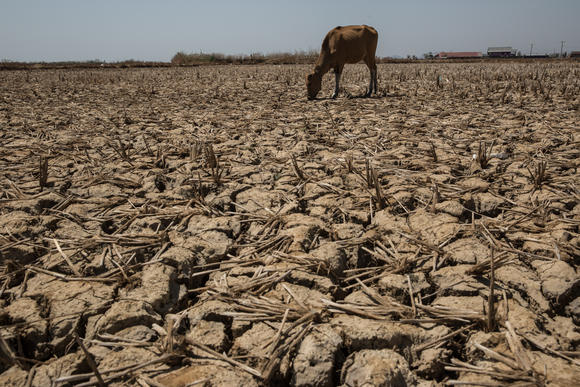
A cow grazes in a parched rice field in Makassar, Indonesia. (Photo by Getty Images)

A cow grazes in a parched rice field in Makassar, Indonesia. (Photo by Getty Images)

Humanity is altering natural ecosystems more rapidly than it is reaching an adequate scientific understanding of the implications of such change. It is widely known that the overuse of energy, water, land, minerals and biological resources is contributing to climate change. But human activities that deplete natural resources and degrade ecosystems are also threatening international, regional and local security.

Moreover, the growing gap between near-term development objectives and long-term human aspirations means that the costs of development are being passed onto future generations.

Yet the international agenda to combat global warming has become politically loaded. Important actors have tacked onto the agenda their own economic and other interests — which explains why the process to negotiate a successor regime to the Kyoto Protocol has been painfully long. Such factors will no doubt be evident at the forthcoming United Nations climate change conference in Paris.

Make no mistake: The future of human civilization hinges on sustainable development. There are several historical examples of societies fatally undermining their ecological security, with the resultant eco-meltdown leading to their fall. Two examples are the early Sumerian civilization, which emerged in the lower basin of the Tigris and Euphrates rivers, and Central America’s Maya civilization. In both cases, land and water degradation stunted food production, setting the stage for their downfall.

Today, the threat from unsustainable human practices has reached global proportions. Indeed, human-induced changes of natural systems have become so profound that the Earth has entered what Nobel Prize-winning chemist Paul Crutzen calls the Anthropocene, a new geological age in which human civilization — not nature — is the dominant force, driving major alterations in the planet’s ecosystems.

As rising regional temperatures clearly illustrate, climate stability is becoming a casualty of such anthropogenic transformations.

Forward and backward

The 20th century brought unprecedented progress but also profound damage to ecosystems, with humans altering or degrading up to 50% of the Earth’s land, modifying natural flows of about two-thirds of all rivers, and driving one-quarter of all bird species and many large mammal species to extinction. Populations of large herbivores like elephants, hippos and rhinos are dwindling at a startling rate.

According to U.N.-Water, a United Nations agency, about half the world’s wetlands have been lost since the early 20th century, while aquatic ecosystems have lost 50% of their biodiversity since just the mid-1970s.

Human-induced climate change creates a vicious spiral. For example, a warmer climate reduces the amount of highly reflective snow cover, which in turn allows more radiation from the sun to be absorbed by the ground and water, further increasing temperatures.

Global emissions of planet-warming greenhouse gases, however, continue to grow at more than 1% yearly. Every 24 hours, the world dumps over 90 million tons of such gases into the atmosphere, treating it like an open sewer.

Effectively controlling the buildup of greenhouse gases in the atmosphere demands fundamental policy and lifestyle changes. But as seen over the nearly quarter-century since the conclusion of the United Nations Framework Convention on Climate Change, setting out international goals on paper is easier than faithfully implementing them.

The binding targets set under the UNFCCC-linked Kyoto Protocol, which took effect in 2005, required a manageable cut of around 5% in emissions of six greenhouse gases to bring them below the participating industrialized countries’ 1990 levels over a five-year period from 2008 to 2012. The specific targets varied from country to country. But many of the industrialized economies and countries in transition that voluntarily became parties to the Kyoto Protocol failed to live up to their respective obligations.

Not surprisingly, climate-related challenges have become more acute. We are now at a crunch point. And yet climate politics are only becoming murkier.

Global warming is eating away at Greenland’s ice sheet. (Photo by Getty Images)

To be sure, there are continuing gaps in our scientific understanding of the phenomenon of climate change. Climate science is still young and offers no clear answers to some critical questions.

Thanks to focused research on human activities and their impact, the public now knows more about the anthropogenic factors contributing to global warming than about the Earth’s own natural climatic variations. What, for example, caused the “little ice age” from about the 15th to the 19th centuries? Further scientific research is needed to understand the phenomenon of natural climatic shifts, which usually extend over several centuries.

In view of such gaps, it is easy to either exaggerate or underestimate the impact of climate change. Yet its effects are likely to be serious, even according to the most conservative estimates.

Some water-related implications of global warming are already beyond dispute. Shifts in precipitation and runoff patterns will lead to greater hydrological variability, negatively affecting food production in some regions. Meanwhile, water stress is set to intensify and spread to new areas, owing to accelerated glacial thaw, more-frequent cycles of flooding and drought, and degradation of watercourses.

New criteria needed

But, as negotiations ahead of the Paris conference illustrate, the subject of climate change has become highly politicized, with competing interests seeking to shape — to their own advantage — the outcome of a new international agreement on climate. This trend serves as a reminder that climate change is not just a matter of science but also a matter of geopolitics.

Beyond negotiating specific targets in a new climate pact aimed at building a low-carbon future, the world confronts a more fundamental question — how to break the link between economic development and adverse impacts on the environment and climate. This challenge is compounded by the fact that the measure of economic growth in our world is ever-increasing production and consumption.

The concept of development is actually broad-based and encompasses far more than just economic growth rates. The widely acknowledged benchmarks of comprehensive development include protection of the biological and physical environments, public health, low income disparity, social equity, resource conservation and environmental sustainability. Likewise, national progress must be measured not merely in terms of gross domestic product but also in terms of how well human needs are met, using other measures of comprehensive development.

The world, unfortunately, has made the mistake of overemphasizing GDP growth, which demands more and more consumption, even as many societies are becoming more unequal and facing popular discontent.

At the same time, climate change is challenging the world’s ability to innovate and live in harmony with nature. But we do not have to wait for new technological innovations to open up potential solutions. Changes in human practices and preferences could readily create a more sustainable world right now.

At the national and international level, this means making the right energy and development choices. And at the individual level, it means embracing a more sustainable lifestyle that makes for better and healthier living.

Given that climate change is likely to spur more frequent and intense natural disasters, building resilience — the ability to avoid significant disruptions due to global-warming-driven changes or shocks — is also essential.

To lessen the effects of climate change, countries must also strategically invest in ecological restoration — by growing and preserving rainforests, conserving wetlands, shielding species critical to ecosystems and restoring rivers and other natural heritage sites. Such programs can even help regulate regional climate, slowing soil and coastal erosion and controlling droughts and flooding.

Global warming starkly illustrates how the most pressing challenges today are international in nature and thus demand collective international responses. Geopolitical games and growing international divisiveness, however, are hindering effective action on the global challenges.

If we are to preserve our planet for future generations, we must move from the Anthropocene epoch to the “Sustainocene” age. But such a transition will require development and energy policies anchored in the goal of environmental and climate protection.

Brahma Chellaney is a geostrategist and the author, most recently, of “Water, Peace, and War: Confronting the Global Water Crisis.”

© Nikkie Asian Review, 2015.

China’s freshwater grab

BY

The Japan Times, November 2, 2015
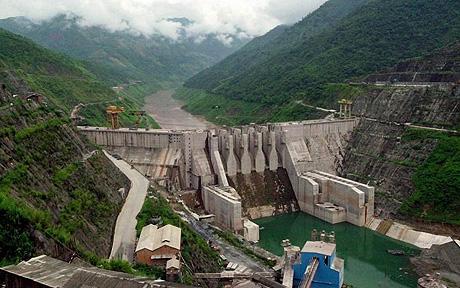
yunnan_dam_1422405c

Just as China is working to change the territorial or maritime status quo from the western Himalayas to the East China Sea, its dam-building frenzy is designed to appropriate internationally shared water resources. Beijing is seeking to present a fait accompli to its downstream neighbors by quietly building dams on the transnational Amur, Arun, Brahmaputra, Illy, Irtysh, Mekong and Salween rivers.

In the latest development, Beijing has announced that it has completed — ahead of schedule — the world’s highest-elevation dam at Zangmu, Tibet. It said that all six power-generating units of the $1.6 billion project on River Brahmaputra have become fully operational.

China is now racing to complete several additional dams located in close proximity to each other on that river. This cascade of dams is likely to affect the quality and quantity of downstream flows into India and Bangladesh.

Only five rivers in the world carry more water than the Brahmaputra and only one — China’s Yellow River — carries more silt. The Brahmaputra is the world’s highest-altitude river. It represents a unique fluvial ecosystem largely due to the heavy load of high-quality nutrient-rich silt it carries from forbidding Himalayan heights.

The Brahmaputra’s annual flooding cycle helps fertilize overworked soils in northeast India’s Assam plains and large parts of Bangladesh, where the river is the biggest source of water supply. The silt-movement impediment by China’s upstream dam projects constitutes a bigger threat to the biophysical vitality of the river and downstream plains than even diminution of cross-border flows.

Several factors have whetted China’s drive to increasingly tap the resources of international rivers, including an officially drawn link between water and national security, the country’s emergence as the global center of dam building, the state-run hydropower industry’s growing clout and the rise of water nationalism at a time of increasing water stress in the northern Chinese plains. With dam building reaching virtual saturation levels in the ethnic Han heartland, the hydro-engineering focus has shifted to minority homelands, from where rivers flow to other countries.

China’s centralized, mega-project-driven approach to water resources has turned it into the world’s most dam-dotted country. This approach is the antithesis of the policy line in India, where water is a state (not federal) subject under the Constitution and where anti-dam nongovernmental organizations are powerful. India’s Narmada Dam project, which remains incomplete decades after its construction began, symbolizes the power of NGOs.

The largest dam India has built since its independence — the 2,000-megawatt Tehri Dam on River Bhagirathi — pales in comparison to China’s giant projects, such as the 22,500-megawatt Three Gorges Dam and the new mega-dams on the Mekong River like Xiaowan, which dwarfs Paris’s Eiffel Tower in height, and Nuozhadu, which boasts a 190-sq.-km reservoir.

The water situation in India, however, is far worse than in China. China’s population is just marginally larger than India’s, but its internally renewable water resources (2,813 billion cubic meters per year) are almost twice as large as India’s. In aggregate water availability, including external inflows (which are sizable in India’s case), China boasts virtually 50 percent larger resources than India.

India’s surface-water storage capacity — an important measure of any nation’s ability to deal with drought or seasonal imbalances in water availability — is one of the world’s lowest. Amounting to 200 cubic meters per head per year, it is more than 11 times lower than China’s. The 2030 Water Resources Group, an international unit, has warned that India is likely to face a 50 percent deficit between water demand and supply by 2030.

Yet, even as China’s dam builders target rivers flowing to India, including the Brahmaputra, Indus, Sutlej and Arun (Kosi), New Delhi has failed to evolve a strategic, long-term approach to the country’s pressing water challenges. In fact, no country faces a bigger challenge than India from China’s throttlehold on the headwaters of Asia’s major transnational rivers and from its growing capability to be the upstream controller by re-engineering trans-boundary flows through dams.

New Delhi has to brace for China moving its dam building from the upper and middle reaches to the lower, border-hugging sections of the rivers flowing to India. The Brahmaputra is particularly a magnet for China’s dam builders because this river’s cross-border annual discharge of 165.4 billion cubic meters into India is greater than the combined trans-boundary flows of the key rivers running from Chinese territory to Southeast Asia. China is expected to embark on Mekong-style mega-dams as it gradually moves its dam building on the Brahmaputra to the area where the river takes a horseshoe bend to enter India, forming the world’s longest and steepest canyon in the process.

To be sure, China’s riparian dominance poses a wider challenge in Asia as it remains impervious to the interests of downstream states and to international norms. Backed by its political control over water-rich minority homelands and by its rapid expansion of upstream hydro-engineering infrastructure, China’s riparian ascendancy is creating a tense and potentially conflict-laden situation where water allocations to co-riparian states in the future could become a function of its political fiat. Indeed, Beijing pays little heed to the interests of even friendly countries, as illustrated by its heavy upstream damming of the Mekong and Salween — Southeast Asia’s largest rivers.

The situation serves as a reminder that power equations are central to riparian relations. If upstream actions are undertaken by a power armed with superior military and economic capabilities and geopolitical influence, the lower riparian state can do little more than protest, unless a water-sharing agreement between the two countries provides for international adjudication or arbitration at the request of one side.

China, however, has refused to enter into a water-sharing arrangement with any co-riparian nation, even though its control over the Tibetan plateau (the starting place of major international rivers) and Xinjiang (the source of the transnational Irtysh and Ili rivers) has armed it with unparalleled hydro-hegemony. Such refusal means it can persist with its frenetic construction of upstream dams, barrages, reservoirs and irrigation systems on international rivers flowing to Central, South and Southeast Asia and to Russia.

By contrast, treaties, agreements or arrangements relating to major shared rivers govern relations between riparian neighbors in South, Southeast and Central Asia.

A balance between rights and obligations is at the heart of how to achieve harmonious, rules-based relations on water-resource issues. Transparency, collaboration and sharing are the building blocks of water peace. China’s unilateralist course on shared freshwater resources, however, indicates that — as in the South China Sea — it wants and insists on getting its own way.

Brahma Chellaney, a geostrategist, is the author of nine books, including, most recently, “Water, Peace, and War: Confronting the Global Water Crisis.”

© The Japan Times, 2015.

Why Japan Should Rearm

Ensuring long-term peace in Asia requires an active role for Japan. By pursuing reforms that enable it to defend itself better, Japan would enhance its capacity to forestall the emergence of a destabilizing power imbalance in East Asia – with far-reaching benefits for Asia and the rest of the world.

BRAHMA CHELLANEY

A column internationally syndicated by Project Syndicate

unnamed

Japan’s political resurgence is one of this century’s most consequential developments in Asia. But it has received relatively little attention, because observers have preferred to focus on the country’s prolonged economic woes. Those woes are real, but Japan’s ongoing national-security reforms and participation in the new 12-country Trans-Pacific Partnership have placed it firmly on the path to reinventing itself as a more secure, competitive, and internationally engaged country.

Japan has historically punched above its weight in world affairs. In the second half of the nineteenth century, Japan became Asia’s first modern economic success story. It went on to defeat Manchu-ruled China and Czarist Russia in two separate wars, making it Asia’s first modern global military power. Even after its crushing World War II defeat and occupation by the United States, Japan managed major economic successes, becoming by the 1980s a global industrial powerhouse, the likes of which Asia had never seen.

Media tend to depict Japan’s current economic troubles in almost funereal terms. But, while it is true that the economy has stagnated for more than two decades, real per capita income has increased faster than in the US and the United Kingdom so far this century. Moreover, the unemployment rate has long been among the lowest of the wealthy economies, income inequality is the lowest in Asia, and life expectancy is the longest in the world.

In fact, it is Japan’s security, not its economy, that merits the most concern today – and Japan knows it. After decades of contentedly relying on the US for protection, Japan is being shaken out of its complacency by fast-changing security and power dynamics in Asia, especially the rise of an increasingly muscular and revisionist China vying for regional hegemony.

Chinese military spending now equals the combined defense expenditure of France, Japan, and the UK; just a decade ago, pacifist Japan outspent China on defense. And China has not hesitated to display its growing might. In the strategically vital South China Sea, the People’s Republic has built artificial islands and military outposts, and it has captured the disputed Scarborough Shoal from the Philippines. In the East China Sea, it has unilaterally declared an air-defense identification zone covering territories that it claims but does not control.

With US President Barack Obama hesitating to impose any costs on China for these aggressive moves, Japan’s leaders are taking matters into their own hands. Recognizing the inadequacy of Japan’s existing national-security policies and laws to protect the country in this new context, the government has established a national security council and moved to “normalize” its security posture. By easing Japan’s longstanding, self-imposed ban on arms exports, boosting defense spending, and asserting its right to exercise “collective self-defense,” the government has opened the path for Japan to collaborate more actively with friendly countries and to pursue broader overseas peacekeeping missions.

To be sure, Japan’s security-enhancing efforts have so far been limited in scope, and do not open the way for the country to become a militaristic power. Restrictions on deployment of offensive weapons, for example, remain in place.

Nonetheless, the government’s moves have proved divisive in a country where pacifism is embedded in the constitution and widely supported by the population. A recent survey by the Pew Research Center found that only 23% of Japanese want their country to play a more active role in Asian security. Another survey last year revealed that only 15.3% of Japanese – the lowest proportion in the world – were willing to defend their country, compared to 75% of Chinese.

But the reality is that ensuring long-term peace in Asia demands a stronger defense posture for Japan. Indeed, reforms that enable Japan to defend itself better, including by building mutually beneficial regional partnerships, would enhance its capacity to forestall the emergence of a destabilizing power imbalance in East Asia.

It is now up to Japan’s government to win over its own citizens, by highlighting the difference between pacifism and passivity. Japan would not encourage or support aggression; it would simply take a more proactive role in securing peace at the regional and global levels.

A more confident and secure Japan would certainly serve the interests of the US, which could then depend on its close ally to take more responsibility for both its own security and regional peace. Americans increasingly seem to recognize this, with 47% of respondents in the Pew survey supporting a more active role for Japan in Asian security.

But there remain questions about precisely how self-sufficient Japan would have to be to carry out this “proactive pacifism” – a term popularized by Prime Minister Shinzo Abe – consistently and effectively. Would Japan need to become a truly independent military power, with formidable deterrent capabilities like those of the UK or France?

The short answer is yes. While Japan should not abandon its security treaty with the US, it can and should rearm, with an exclusive focus on defense.

Of course, unlike the UK and France, Japan does not have the option to possess nuclear weapons. But it can build robust conventional capabilities, including information systems to cope with the risk of cyber warfare. Beyond bolstering Japanese security and regional stability, such an effort would likely boost Japan’s GDP and yield major profits for American defense firms.

As a status quo power, Japan does not need to match Chinese military might. Defense is, after all, easier than offense. Still, the rise of a militarily independent Japan would constitute a game-changing – and highly beneficial – development for Asia and the rest of the world.

© Project Syndicate, 2015.

Bottled risk

A column internationally syndicated by Project Syndicate.

BottledOver the last 15 years, the bottled-water industry has experienced explosive growth, which shows no sign of slowing. In fact, bottled water – including everything from “purified spring water” to flavored water and water enriched with vitamins, minerals, or electrolytes – is the largest growth area in the beverage industry, even in cities where tap water is safe and highly regulated. This has been a disaster for the environment and the world’s poor.

The environmental problems begin early on, with the way the water is sourced. The bulk of bottled water sold worldwide is drawn from the subterranean water reserves of aquifers and springs, many of which feed rivers and lakes. Tapping such reserves can aggravate drought conditions.

But bottling the runoff from glaciers in the Alps, the Andes, the Arctic, the Cascades, the Himalayas, Patagonia, the Rockies, and elsewhere is not much better, as it diverts that water from ecosystem services like recharging wetlands and sustaining biodiversity. This has not stopped big bottlers and other investors from aggressively seeking to buy glacier-water rights. China’s booming mineral-water industry, for example, taps into Himalayan glaciers, damaging Tibet’s ecosystems in the process.

Much of today’s bottled water, however, is not glacier or natural spring water but processed water, which is municipal water or, more often, directly extracted groundwater that has been subjected to reverse osmosis or other purification treatments. Not surprisingly, bottlers have been embroiled in disputes with local authorities and citizens’ groups in many places over their role in water depletion, and even pollution. In drought-seared California, some bottlers have faced protests and probes; one company was even banned from tapping spring water.

Worse, processing, bottling, and shipping the water is highly resource-intensive. It takes 1.6 liters of water, on average, to package one liter of bottled water, making the industry a major water consumer and wastewater generator. And processing and transport add a significant carbon footprint.

The problems do not stop when the water reaches the consumer. The industry depends mainly on single-serve bottles made from polyethylene terephthalate (PET), the raw materials for which are derived from crude oil and natural gas. In the 1990s, it was PET that turned water into a portable, lightweight convenience product.

But PET does not decompose; and, while it can be recycled, it usually is not. As a result, bottled water is now the single biggest source of plastic waste, with tens of billions of bottles ending up as garbage every year. In the United States, where the volume of bottled water sold last year increased by 7% from 2013, 80% of all plastic water bottles become litter, choking landfills.

Of course, higher rates of recycling could improve this situation substantially. For example, Germany has successfully promoted recycling with a combination of smart regulations and incentives, such as machines at supermarkets that return deposits in exchange for bottles (often brought in by the poor). But recycling entails the use of even more resources.

Some might argue that the safety and health benefits of bottled water offset these environmental consequences. But those benefits are little more than a marketing ploy. Although tap water in the West occasionally has quality problems, so does bottled water. The industry’s own production process sometimes causes contamination and forces major recalls.

Indeed, tap water is often healthier than bottled water. Chemical treatment means that processed bottled water may lack fluoride, which is naturally present in most groundwater or is added in tiny amounts to municipal water supplies to promote dental health.

There are also health concerns over the potential leaching of chemical compounds from PET bottles, as well as from the large reusable polycarbonate containers in which bottlers deliver water to homes and offices. Suboptimal storage conditions – which include, for example, prolonged exposure to sunlight and heat – can cause potent estrogenic activity in bottled water, exposing consumers to chemicals that alter the function of the endocrine system by mimicking the role of the body’s natural hormones.

To be sure, these consequences are not going unnoticed. In the US, environmental concerns have prompted some university campuses and at least 18 national parks to ban the sale of bottled water.

The bottled-water industry sees the danger as well – and is doing everything possible to keep public opinion on its side. To that end, big water bottlers like Nestlé, PepsiCo, and Coca-Cola Company have taken a page out of the playbook of energy behemoths like ExxonMobil, BP, and Shell, by pursuing “green” initiatives.

But make no mistake: Bottled water is compounding the world’s resource and environmental challenges. It is making it harder to deliver potable water to the world’s poor. It delivers no health benefits over clean tap water. And it does not even taste better; indeed, blind taste tests reveal that people cannot tell the difference between bottled and tap water.

Obviously, tap water needs an image overhaul. Unfortunately, it lacks the marketing muscle and advertising budgets that have powered the dramatic growth of the bottled-water industry. When a product that is cheaper and better does not prevail, that is bad news for consumers. When the product is water, we all lose.

© 1995-2015 Project Syndicate.

Sri Lanka vote deals blow to China

Brahma Chellaney, Nikkei Asian Review

CMb73DxWsAA7qbk

China’s political investment in Sri Lankan strongman Rajapaksa, in the expectation that he would be a long-lasting autocrat, has backfired.

The crucial Aug. 17 parliamentary election in Sri Lanka — what increasingly looks like a “swing state” in the sharpening geopolitics of the Indian Ocean region — was a close contest, giving no party an absolute majority and thus ensuring the next government will be coalition-based. But in one respect, the poll outcome was decisive: By thwarting pro-China ex-president Mahinda Rajapaksa’s political comeback bid, it represented a defeat for Chinese diplomacy.

Sri Lanka, located virtually at the center of the Indian Ocean, straddles some of the world’s busiest sea lanes. Beijing has already pumped billions of dollars into this small, strategically located island-nation, seeking to turn it into a pivot of its “Maritime Silk Road” to Africa, the Middle East and Europe. The Maritime Silk Road is the new name for China’s strategy of building a so-called “string of pearls” along vital Indian Ocean shipping routes. Sri Lanka — where China has already built the large Hambantota port — is central to the Maritime Silk Road initiative.

The Chinese diplomatic drive in Sri Lanka, however, faces an uncertain future following two setbacks this year. The first came in January, with the shock defeat of Rajapaksa the first time around, to one-time ally Maithripala Sirisena in the presidential contest. Rajapaksa, during his nearly decade-long rule marked by increasing authoritarianism and accusations of nepotism and corruption, cozied up to China, awarding Beijing major contracts designed to make his country a key stop on the Chinese nautical “road.”

On Sri Lanka’s terms

When Sirisena won the presidency, however, he suspended the Chinese construction of a $1.4 billion, Dubai-style city on reclaimed land off Colombo, the capital. Several other Chinese projects have also been put off or delayed as Sirisena has ordered investigations into corruption and environmental breaches. Investigations are also underway into an alleged $1.1 million bribe paid by a Chinese state-run company to Rajapaksa’s failed presidential re-election campaign and the alleged role of his two brothers and his wife in misappropriating public funds.

Now, with the latest election results thwarting Rajapaksa’s bid to return to power as prime minister, China faces difficult choices in Sri Lanka. Pro-Western Prime Minister Ranil Wickremesinghe, whose United National Party has emerged as the largest party in the 225-member parliament, falling just short of an absolute majority, has promised to continue investment ties with Beijing but on Sri Lanka’s own terms, saying he welcomes “competitive” foreign direct investment proposals from all countries.

Sirisena and Wickremesinghe have also underscored the imperative to “rebalance” relations with China. Under their leadership, Sri Lanka’s once-flagging relations with the U.S., India and Japan have significantly improved. Still, most of the stalled Chinese projects in Sri Lanka are likely to eventually resume after incorporating environmental safeguards, which might see some of them eventually scaled back.

China’s larger strategic ambitions in Sri Lanka, however, appear to have dimmed. Without Rajapaksa at the helm, China will be hard put to pursue “dual-use” infrastructure projects in Sri Lanka that serve both military and civilian purposes. One classic example of a dual-purpose project is Colombo’s new Chinese-owned commercial seaport, where two Chinese nuclear submarines and a warship docked last year during Rajapaksa’s family-dominated reign.

Plan B — the Maldives

With Sri Lanka slipping from its strategic grasp, Beijing might be forced to focus on its “Plan B” — the Maldives. China has been interested in leasing one of the 1,200 islands of the politically torn Maldives — the flattest state in the world and the smallest country in Asia in terms of population.

The Maldives recently adopted a constitutional amendment allowing foreign ownership of land, raising concern in New Delhi that the new law could open the path to the establishment of a Chinese naval base in India’s strategic backyard. But Maldivian President Abdulla Yameen, in a recent letter to Indian Prime Minister Narendra Modi, said his government had no intention of allowing any country to set up a military base there.

The fact is that, with the international spotlight on its land reclamation and building of outposts in the South China Sea, China has quietly turned its sights to the Indian Ocean, the world’s new center of geopolitical gravity. China’s determination to take the sea route to gain regional hegemony was underscored by its new defense white paper, which outlined a plan for its navy to shift focus from “offshore waters defense” to “open seas protection.” In fact, the international attention on China’s land reclamation in the South China Sea has deflected attention from the artificial island it began building off Colombo before Sirisena suspended the megaproject to create a metropolis on 233 hectares of reclaimed land, with 108 hectares of the real estate to be owned by the state-owned company, China Communications Construction.

China’s heavy political investment in Rajapaksa, in the expectation that he would be a long-lasting autocrat, has clearly miscarried. Rajapaksa has been a war hero for many in the country’s dominant Sinhalese community but a war criminal for others: He is accused of presiding over war crimes while ruthlessly crushing a 26-year ethnic-Tamil insurgency in 2009 — a success that cost the lives of up to 40,000 civilians in the government’s final offensive against Tamil rebels. But his ouster in January revealed that many of his supporters seemed to have tired of the man for many reasons, not least the accusations of brazen nepotism, steady expansion of presidential powers, muzzling of civil liberties and favoring of China — even at the cost of national sovereignty.

“The dictatorial ways of Rajapaksa”

His successor, Sirisena, besides lifting restrictions on the media and the judiciary, has shed some of the Rajapaksa-expanded powers of the president and restored a two-term limit for an incumbent. This has strengthened the position of the prime minister, prompting Rajapaksa, ironically, to bid for that post. The choice for voters in the parliamentary election was between a return to the dictatorial ways of Rajapaksa, who blamed his political rivals for slowing economic growth by putting on hold the mainly China-backed infrastructure projects, and strengthening the “people’s revolution” that led to full-fledged democracy being restored in January — or as the campaign posters of Wickremesinghe’s UNP put it, between “jungle law” and “good governance.”

The outcome of the election, held peacefully with high voter turnout, represents a triumph of democracy. By handing Rajapaksa his second electoral defeat in eight months, it ensures that Sri Lanka will chart an independent foreign policy. It shows that genuine democracy works as a bulwark against the state mortgaging its sovereignty to become a key component of an external power’s regional strategy. By the same token, the erosion of democracy in the Maldives — where the country’s first democratically elected president, Mohamed Nasheed, was forced to resign at gunpoint in 2012 and who is now serving a 13-year jail term — creates risks for the state to get sucked into great-power rivalries in the Indian Ocean region. With Sri Lanka’s election over, it seems a good time to reflect on that point.

Brahma Chellaney, a geostrategist and author of nine books, is professor of strategic studies at the independent Center for Policy Research in New Delhi and a Richard von Weizsacker Fellow at the Robert Bosch Academy in Berlin. 

© Nikkei Asian Review, 2015.

Too much, too little, too dirty

Asia’s water woes take many forms — and they’re about to get worse

BRAHMA CHELLANEY, Nikkie Asian Review

20150723Freshwater_article_main_imageThe centrality of water is a recurring theme in various religions. The Bible — largely written amid water scarcity — associates drought with the wrath of God. “By means of water,” says the Quran, “we give life to everything.” Hindu gods and goddesses related to water are tied to fertility or to new beginnings.

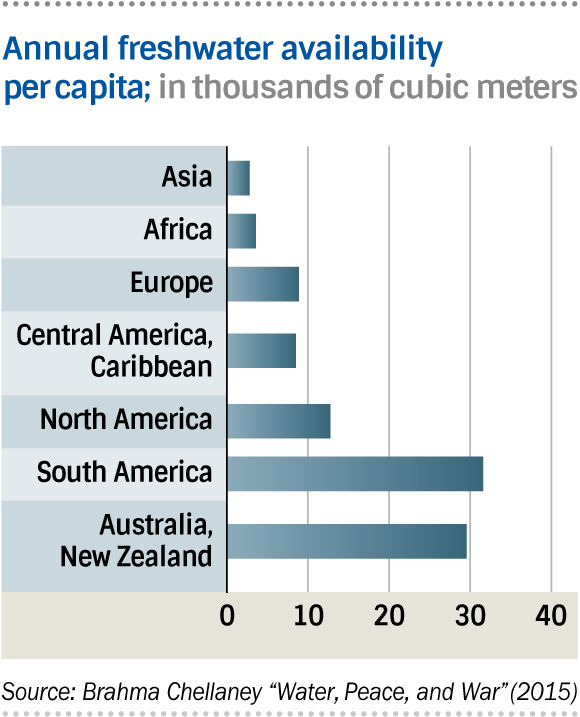
Asia, the world’s driest continent per capita, symbolizes the paradox of water: a giver of life that can also be a destroyer when it becomes a carrier of deadly microbes or takes the form of a flood.

Asia struggles with water problems of almost every kind. The region’s biggest natural disasters this century have been water-related: The tsunami that struck Japan’s northeastern coast in 2011 caused a triple nuclear meltdown at the Fukushima Daiichi nuclear plant, and the 2004 Indian Ocean tsunami left behind a huge swath of death and destruction.

Flooding this summer has caused fatalities and widespread damage in parts of southern China and eastern India, and a serious drought is ravaging countries as disparate as North Korea, Thailand and Vietnam. Contaminated water, meanwhile, continues to be a major problem across much of Asia, which has some of the world’s worst water pollution.

Unfortunately for Asia, these problems are set to become even worse. Global warming and El Nino — a warm, irregularly occurring current in the Pacific Ocean that can cause significant changes in temperature and rainfall — are triggering more frequent droughts and flooding, especially in the summer monsoon season.

El Nino events occur at unpredictable times, sometimes more than five years apart. The current El Nino threatens to inflict serious economic damage in South and Southeast Asia. The agriculture sector, the leading employer in many countries, is particularly vulnerable. According to a Citigroup report, prolonged drought and the resultant crop losses could lead to higher food prices in several Asian nations.

Over the longer term, freshwater supplies are likely to come under increasing strain as oceans rise and the intensity and frequency of storms and other extreme weather events increases. Cycles of severe flooding and drought brought on by climate change will render the availability of potable water even more uncertain. This could exact significant human and economic costs, especially in financially strapped countries such as densely populated Bangladesh — the world’s seventh- most populous nation.

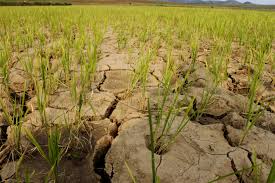
Parched field

A parched field in North Korea

North Korea says an unparalleled drought is currently exacerbating its food crisis. Pyongyang, having learned from a famine in the late 1990s that killed at least 600,000 people, has improved its agricultural management and set aside stockpiles of food, putting it in a somewhat better position to deal with the latest drought. But because copious amounts of water are needed for energy extraction, processing and production, North Korea’s severe water shortages have hit electricity generation, leading to frequent blackouts.

In much of Southeast Asia, parched conditions and above-average temperatures have forced farmers to leave their fields fallow. A prolonged drought has affected all five provinces in Vietnam’s coffee- producing Central Highlands. As a result, the country’s coffee exports have dropped 40% compared with last year.

In Thailand, the government has unveiled a $1.77 billion aid package for farmers affected by drought. About 1 million farmers have received loans so far. The drought is concentrated in seven of the country’s 67 provinces, but its wider impact on rivers and lakes has prompted water rationing in nearly a third of the country.

Drought conditions have also affected rice cultivation in parts of neighboring Laos and Cambodia, where some water sources have dried up, though a partial rebound in rainfall in July has brought respite to some drought-stricken regions. At the opposite extreme, heavy flooding this year has affected up to 4 million people in China, while torrential monsoon downpours displaced many in eastern India.

Australia’s extremes of drought and flooding, which seesaw with the cycles of El Nino and its cold-current counterpart La Nina, should serve as a warning for Asia. The country’s longest drought in more than a century lasted from 1996 until 2010 (even longer in some areas) and was followed by serious flooding in 2010 and 2011.

Global warming threatens to increase morbidity and mortality.

As floods and droughts become more severe and runoff patterns shift, variations in Asia’s hydrological cycle — the sequence of precipitation, evaporation and transpiration — are set to grow. This could threaten food production in some countries, unless crop varieties emerge that are more drought- and flood-resistant.

The accelerated melting of snow in mountain ranges and faster thawing of glaciers in the Tibetan Plateau and the Himalayas will likely trigger serious flooding in downstream countries in the warm months, followed by an irreversible depletion of river flows.

At the local level, persistent water scarcity is already leading to the use of strong-arm
tactics. Villagers in some parts of South and Central Asia now hire private security guards to protect their wells, tanks and ponds from water thieves. In these parched areas, water has become a precious resource worth fighting for.

Solutions needed

Given the current situation, Asia must begin finding ways to mitigate its water challenges through intelligent, efficient resource management. Without such efforts, the region could become trapped in a vicious cycle of increasing water stress, environmental degradation and conflict. Large numbers of subsistence farmers would
also be forced into cities and other areas with relatively better water availability.

20150723Waterstorage_article_main_imageFor starters, Asian governments must change policies that are exacerbating human impacts on ecosystems. Water subsidies, for example, keep prices low, encouraging wasteful use, while subsidized electricity and diesel fuel for farmers has
promoted the uncontrolled extraction of groundwater, causing wetlands, lakes and
streams to dry up.

Overexploitation of coastal aquifers, meanwhile, allows seawater to intrude and replace the lost freshwater. The failure of governments to check deforestation and the depletion of swamps — important natural water absorption and storage systems — contributes to cycles of chronic flooding and drought and spurs the desertification of grasslands.

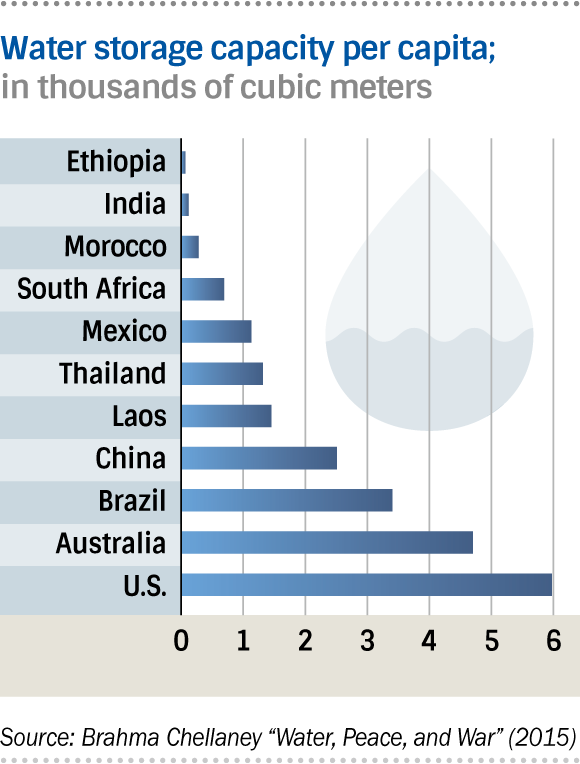
Asian countries must enhance their water infrastructure to increase distribution efficiency and mitigate imbalances in water availability. Storing water in the wet season for release in the dry is one way to ease seasonal imbalance. But most nations in Asia, with the exception of dam-dotted China, have a relatively low per capita water storage capacity by global standards.

Because warmer air carries more moisture, the increase in average temperatures has helped to raise global rainfall, especially in the tropics. Asia’s monsoons are projected to strengthen further. To compensate for decreased river flows, rainwater capture on a large but environmentally sustainable scale will likely be critical.

Rainwater harvesting is, in fact, an ancient and relatively low-cost technique invented in Asia. Its revival in cities ranging from Singapore to the southern Indian metropolises of Bangalore and Chennai makes it one of the most promising frontiers in the battle to ease local water shortages.

Water stress is often accompanied by a fall in water quality. But when water quality is maintained, the impact of water scarcity can be better managed. If the region’s water-stressed economies are to raise their water productivity levels, they must begin by increasing their water quality.

Asia needs new market mechanisms, public-private partnerships, innovative practices, conservation and astute water management to advance affordable solutions. Increasing the diversity of water supply for agriculture and energy should be a key goal of improved water management. The power sector’s role in contributing to water stress, for example, could be curtailed by utilizing non-freshwater sources — including seawater, impaired groundwater and recycled water — for cooling.

The close nexus between water, energy and food demands that these three critical resources be integrated into national policy frameworks to promote synergistic approaches. Asian governments cannot afford to waste time to address their pressing resource and environmental challenges.

Brahma Chellaney, a geostrategist and author of “Water: Asia’s New Battleground,” is currently a Richard von Weizsaecker fellow at the Robert Bosch Academy in Berlin.

© Nikkie Asian Review, 2015.

The forgotten nuclear deal

BY BRAHMA CHELLANEYThe Japan Times

a-chechen-woman-holding-h-0015The current international attention on the nuclear deal with Iran obscures another much-trumpeted nuclear accord signed a decade ago — between the United States and India. On the 10th anniversary of the U.S.-India nuclear deal, six words sum it up: Built on hype, deflated by reality. Indeed, it has become the forgotten nuclear deal.

When it was unveiled by U.S. President George W. Bush and Indian Prime Minister Manmohan Singh in Washington on July 18, 2005, the deal was touted as a major transformative initiative — one that would serve as a “basis for expanding bilateral activities and commerce in space, civil nuclear energy and dual-use technology.” Bush, while leaving office, declared: “We opened a new historic and strategic partnership with India.”

The deal indeed symbolized warming ties between the once-estranged democracies. The deal also became a legacy-building issue for Bush and Singh, just as U.S. President Barack Obama sought the Iran nuclear accord as the biggest diplomatic achievement of his presidency.

At its core, the Indo-U.S. deal-making centered on finding a compromise between an India determined to safeguard its nuclear military program and an America that insisted on imposing stringent nonproliferation conditions. As part of the deal to bring India into the international nuclear mainstream, New Delhi opened the sizable Indian civilian nuclear program to permanent international inspections, signed an additional protocol with the Vienna-based International Atomic Energy Agency, dismantled its Cirus plutonium-production reactor, and harmonized its export policies with the guidelines of U.S.-led technology-control regimes.

But a decade later, the deal’s much-advertised energy, technological and strategic benefits for India still seem elusive. Indeed, the deal has yet to be commercialized. The premise on which it was founded — that India could build energy “security” by importing high-priced, foreign fuel-dependent reactors — was, in any case, a pipe dream. For the U.S., however, the deal was more geostrategic in nature, designed to make India a major U.S. arms client and coopt it as a quasi-ally.

The deal did help place the U.S.-India relationship on a much-higher pedestal. But bilateral ties had begun to significantly improve much before the deal. And the strategic rationale that has brought the two countries closer remains independent of the deal. For the U.S., displacing Russia as India’s largest arms supplier has been a diplomatic coup.

Given the heavy political investment in it, the deal eventually will be operationalized, however belatedly. It will, however, take a minimum of 10 years thereafter for the first nuclear power reactor under the deal to come on line in India.

After all, the international plant-construction time frame, with licensing approval, now averages at least a decade, with the vast majority of reactors currently under construction in the world plagued by serious delays and cost overruns. For example, the Areva-designed plant in Finland, on Olkiluoto Island, is running at least nine years behind schedule, with its cost projected to rise from €3.2 billion to €8.5 billion. The Russian-origin plant at Kudankulam, at the southern tip of India, took 13 years to be completed, with the second of its two reactors yet to be commissioned. In this light, the U.S.-India deal is expected to deliver its first commissioned reactor a generation after being signed.

If India’s reactor imports were governed by “technical and commercial viability” — in Prime Minister Narendra Modi’s words — not a single contract would be feasible. The stalled Indian negotiations with the French firm, Areva, over the price of power suggest that the deal’s commercialization would be dictated neither by technical nor commercial viability but by the extent to which India is willing to fork out subsidies to support high-priced imported reactors.

Indeed, it is a moot question whether the deal will ever yield substantive energy benefits, given the exorbitant price of foreign-origin reactors, the concomitant need to heavily subsidize electricity generated by such plants, and the grassroots safety concerns over the Fukushima-type multi-plant nuclear parks that India has earmarked for Westinghouse, GE-Hitachi and Areva, each of which is to sell prototype Light Water Reactor (LWR) models presently not in operation anywhere in the world. The accident-stricken Fukushima reactors were also the first of their kind.

Adding to India’s risks from proposed import of prototype models is its plan to induct a multiplicity of different LWR technologies from the U.S., France and Russia. Given the several different reactor technologies already in operation or under development in India, such imports will likely exacerbate the country’s maintenance and safety challenges.

The nuclear power dream has faded globally. The crash of oil and gas prices, coupled with skyrocketing reactor-construction costs, has made nuclear power’s economics more unfavorable than ever. Few new reactors are under construction in the West, with the troubled nuclear power industry desperate for exports.

Even as the global role of nuclear power appears set to become marginal, India stands out today as the sole country in the world wedded to major reactor-import plans.

Washington has long pandered to the Indian weakness for the deal’s consummation, with its decade-long negotiations characterized by shifting goalposts.

Gone is the pretense of Washington extending India “full” nuclear cooperation or granting it “the same benefits and advantages as other leading countries with advanced nuclear technology, such as the U.S.,” as the 2005 deal stated. Gone also is the original accord that India would “assume the same responsibilities and practices” as America.

Instead of meeting its commitment to adjust domestic laws and guidelines of U.S.-led multilateral regimes to “enable full civil nuclear energy cooperation and trade with India,” the U.S. actually worked with its Congress and with the Nuclear Suppliers Group (NSG) to bar exports to India of what New Delhi really needs — civilian enrichment and reprocessing equipment and technology, even though such transfers would be under international safeguards.

As a senator, Obama helped insert an important provision in the India-specific Hyde Act of 2006. The so-called Obama Amendment stipulates that the supply of nuclear fuel to India be “commensurate with reasonable operating requirements.” This amendment negated Singh’s pledge to India’s Parliament — that India intended, with U.S. support, to develop “a strategic reserve of nuclear fuel to guard against any disruption of supply for the lifetime of India’s reactors.”

Consider another issue: Years after the U.S. pledged to bring India into the four American-led technology-control cartels — the NSG, Missile Technology Control Regime, Australia Group, and Wassenaar Arrangement — India is still pleading for its admission. It is now filing a formal application for admission to each regime, in the hope that the U.S. would be more forthcoming in its support than it has been so far.

Even in the event that India is admitted to the regimes, the technology controls it still faces will not go away. These regimes are designed to harmonize export policies, not to promote technology trade among member-states.

The key fact is that U.S. nonproliferation policy has yet to treat India on a par with another nuclear-armed country outside the Nuclear Non-Proliferation Treaty (NPT) fold, Israel.

Against this background, India’s diplomatic overinvestment in the deal has already made it harder for it to address more fundamental issues in its warming relations with the U.S., including an increasingly one-sided defense relationship and munificent U.S. aid implicitly subsidizing the Pakistani military’s export of terrorism.

Could the deal with Iran follow the trajectory of the deal with India — a great strategic move, followed by protracted negotiations on follow-up steps, moving goalposts, and the gradual diminution of the original accord? It is possible, but in one fundamental aspect, the two situations are different: Even without a nuclear accord, the U.S. and India would still have become close partners.

Brahma Chellaney is a geostrategist, author and longtime Japan Times contributor.

© The Japan Times, 2015.