
Donald Trump’s embrace of a country he long excoriated for its role in sponsoring terrorism reflects the fact that Saudi Arabia is a cash cow for American defense, energy and manufacturing companies.
BY BRAHMA CHELLANEY, The Japan Times
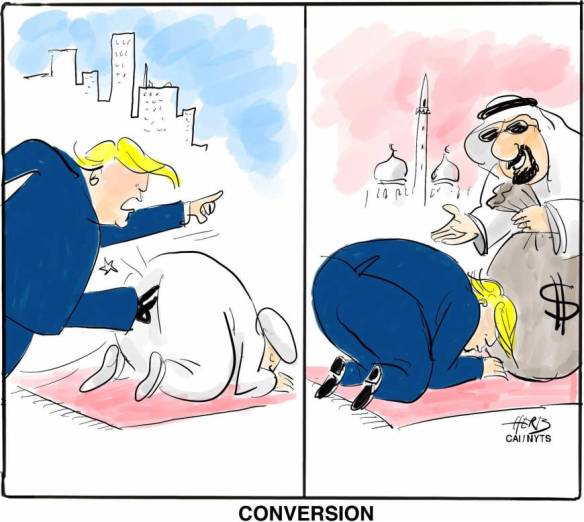
Want evidence that money speaks louder than the international imperative to counter a rapidly metastasizing global jihadi threat, as symbolized by the latest attack in Manchester? Look no further than U.S. President Donald Trump’s recent visit to the world’s chief ideological sponsor of jihadism, Saudi Arabia. The trip yielded business and investment deals for the United States valued at up to almost $400 billion, including a contract to sell $109.7 billion worth of arms to a country that Trump previously accused of being complicit in 9/11.
By exporting Wahhabism — the hyper-conservative strain of Islam that has instilled the spirit of martyrdom and become the source of modern Islamist terror — Saudi Arabia is snuffing out the more liberal Islamic traditions in many countries. Indeed, Saudi Arabia’s Wahhabi fanaticism is the root from which Islamist terrorist organizations ranging from the Islamic State group (which claimed responsibility for the Manchester concert attack) to al-Qaida draw their ideological sustenance.
The Manchester attack, occurring close on the heels of Trump’s Saudi visit, has cast an unflattering light on his choice of a decadent theocracy for his first presidential visit overseas. The previous four U.S. presidents made their first trips to a neighboring ally — either Mexico or Canada, which are flourishing democracies. But Trump, the businessman, always seeks opportunities to strike deals, as underscored by his 100-day trade deal with the world’s largest autocracy, China.
But Trump is not alone. In thrall to Saudi money, British Prime Minister Theresa May traveled to Riyadh six weeks before Trump on her most controversial visit since taking office. As if to signal that a post-Bexit Britain would increasingly cozy up to rich despotic states, May flew to Saudi Arabia shortly after triggering Article 50, an action that started a two-year countdown for her country’s exit from the European Union. She has also stepped up her courting of China and enthusiastically endorsed Beijing’s “One Belt, One Road” program, which many EU states see as lacking in transparency and social and environmental accountability.
Anglo-American support and weapons have aided Saudi war crimes in Yemen, which is now on the brink of famine. Mass starvation would ensue there if the Saudis execute their threat to attack the city of Hodeida, now the main port for entry of Yemen’s food supplies. Britain alone has sold over £3 billion worth of arms to Riyadh since the cloistered Saudi royals began their bombardment and naval blockade of Yemen more than two years ago. While London is planning to sell more weapon systems, Trump’s arms package for the Saudis includes guided munitions that were held up by his predecessor, Barack Obama.
Salvaging the global war on terror demands a sustained information campaign to discredit the ideology of radical Islam. But as long as Saudi Arabia continues to shield its insidious role in aiding and abetting extremism by doling out multibillion-dollar contracts to key powers like the U.S. and Britain, it will be difficult to bring the war on terror back on track.
Trump exemplifies the challenge. In a speech to leaders from across the Muslim world who had gathered in Saudi Arabia, the “Make America Great Again” campaigner championed “Make Islam Great Again.” After earlier saying “Islam hates us” and calling for a “total and complete shutdown” of Muslims entering the U.S., Trump described Islam as “one of the world’s great faiths” and urged “tolerance and respect for each other.”
It was weird, though, that Trump spoke about the growing dangers of Islamic extremism from the stronghold of global jihadism, Saudi Arabia. The new Global Center for Combating Extremist Ideology that he opened in Riyadh promises to stand out as a symbol of U.S. hypocrisy.
The long-standing U.S. alliances with Arab monarchs have persisted despite these royals bankrolling Islamic militant groups and Islamic seminaries in other countries. Trump cannot hope to deliver credible or enduring counterterrorism results without disciplining Saudi Arabia, Qatar and the other oil sheikhdoms that continue to export Islamic radicalism. But he has already discovered that this is no easy task.
For example, the U.S. alliance with Saudi Arabia yields exceptionally huge contracts and investments for the American economy. In short, Saudi Arabia is a cash cow for American defense, energy and manufacturing companies, as the latest mega-deals illustrate.
Against this background, Trump’s embrace of a country that he long excoriated reflects the success of the American “deep state” in taming him. Hyping the threat from Iran, even if it fuels the deep-seated Sunni-Shiite rivalry, helps to bolster U.S. alliances with Arab royals and win lucrative arms contracts.
Ominously, Trump in Saudi Arabia spoke of building a stronger alliance with Sunni countries, with U.S. officials saying the defense arrangements could evolve into an “Arab NATO.” However, the Sunni arc of nations is not only roiled by deep fissures, but also it is the incubator of transnational jihadis who have become a potent threat to secular, democratic states near and far. IS, al-Qaida, the Taliban, Laskar-e-Taiba, Boko Haram and al-Shabaab are all Saudi-inspired Sunni groups that blend hostility toward non-Sunnis and anti-modern romanticism into nihilistic rage.
In this light, Trump’s Sunni-oriented approach could worsen the problems of jihadism and sectarianism, undermining the anti-terror fight.
The murky economic and geopolitical considerations presently at play foreshadow a long and difficult international battle against the forces of terrorism. The key to battling violent Islamism is stemming the spread of the ideology that has fostered “jihad factories.” There can be no success without closing the wellspring of terrorism — Wahhabi fanaticism. But who will have the courage to bell the cat?
A long-standing contributor to The JapanTimes, Brahma Chellaney is a geostrategist and the author of nine books, including “Water, Peace, and War” (Rowman & Littlefield).
 Pakistan is an incorrigibly scofflaw state for whom international law matters little. Still, India was left with no option but to haul Pakistan before the International Court of Justice after a secret Pakistani military court sentenced to death a former Indian naval officer, Kulbhushan Jadhav, for being an Indian “spy”. At a time when there was no hope to save Jadhav, the ICJ interim order has come as a shot in the arm for India diplomatically.
 CPEC — OBOR’s flagship programme, which will cement Pakistan’s status as China’s economic and security client — has become a convenient cover for Beijing to include major strategic projects, stretching from Gilgit-Baltistan to Pakistan’s Chinese-built Gwadar port. The Bunji and Bhasha dams are also claimed to be part of CPEC, which, by linking the maritime and overland “Silk Roads” that China is creating, will gravely impinge on India’s security. A grateful Pakistan has given China exclusive rights to run Gwadar port for the next 40 years.



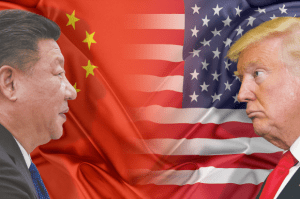 The wily Xi, during his impending two-day visit to Mar-a-Lago, will seek to capitalize on Trump’s penchant to cut deals. Indeed, Trump, the author of The Art of the Deal, appears eager to strike deals with Xi on trade and security issues — back-door deals that could potentially leave America’s allies in Asia out in the cold.
 Russia may be in decline economically and demographically, but, in strategic terms, it is a resurgent power, pursuing a major military rearmament program that will enable it to continue expanding its global influence. One of the Kremlin’s latest geostrategic targets is Afghanistan, where the United States remains embroiled in the longest war in its history.
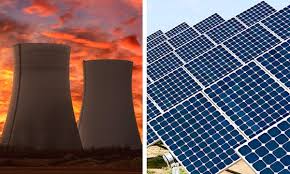 It is often said that China could become the first country in the world to age before it gets rich. India faces no such spectre. However, India has already become the first important economy in the world to take on onerous climate-related obligations before it has provided electricity to all its citizens.
 Stagecraft and Statecraft
You must be logged in to post a comment.