
Beijing’s annual trade surplus with India is large enough for it to finance one China-Pakistan Economic Corridor (CPEC) every calendar year and still have a few billion dollars to spare.
Brahma Chellaney, The Hindustan Times, June 29, 2017
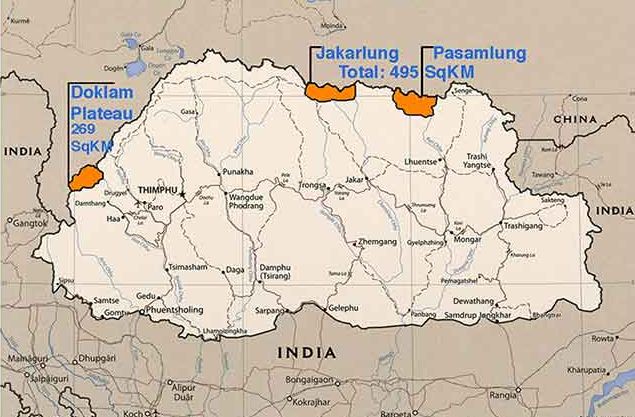
Just as Indian Prime Minister Narendra Modi was meeting US President Donald Trump at the White House, Beijing ratcheted up pressure on India by officially publicizing a military standoff at the Sikkim-Bhutan-Tibet tri-junction. The shadow of China’s muscle flexing over the Modi-Trump discussions paralleled what happened when Chinese President Xi Jinping paid an official visit to India in 2014. Xi arrived on Modi’s birthday bearing an unusual gift for his host — a major Chinese military encroachment into Ladakh’s Chumar region. And Chinese Premier Li Keqiang’s 2013 visit was preceded by a 19-kilometre incursion into Ladakh’s Depsang Plateau.
In China’s Sun Tsu-style strategy, diplomacy and military pressure, as well as soft and hard tactics, go hand-in-hand. In the same way, China’s xenophobic nationalism goes hand-in-hand with its economic globalization project. Similarly, Beijing poses as a champion of free trade even as it abuses free-trade rules to maintain high trade barriers and to subsidize its exports. In effect, China has grown strong by quietly waging a trade war. China has held border talks with India while its forces perched on the upper heights of the Tibetan massif have staged fresh incursions.
In Beijing’s view, India is a critical “swing state” that increasingly is moving to the US camp, undercutting Xi’s ambition to establish a Sino-centric Asia through an expanded tianxia system of the 15th century. Given India’s vantage geographical location, China needs its participation to plug key gaps in Xi’s “One Belt, One Road” (OBOR) project. But India not only boycotted Xi’s OBOR summit but has also portrayed OBOR as an opaque, neo-colonial enterprise seeking to ensnare smaller, cash-strapped states in a debt trap.
China, by encroaching on Bhutan’s Doklam enclave, may have orchestrated the tri-junction standoff not so much to cast a shadow over the Modi-Trump discussions as to warn Modi that his increasing tilt toward America will carry long-term costs. China is already stepping up its direct and surrogate threats against India. One example is the proliferation of incursions and other border incidents since the 2005 Indo-US nuclear deal, which laid out a strategic framework for the US to co-opt India. China is also waging psy-war through media.
With Chinese forces aggressively seeking to nibble away at Indian territory, India’s Himalayan challenge has been compounded by a lack of an integrated approach that blends military, economic and diplomatic elements into a coherent strategy. Modi, for example, has allowed China’s trade surplus with India to double on his watch to almost $60 billion. By comparison, India’s trade surplus with the US is about half of that, yet Trump wants urgent Indian action to balance the two-way trade.
By importing $5 worth of goods from China for every $1 worth of exports to it, India not only rewards Chinese belligerence but also foots the bill for Beijing’s encirclement strategy. Beijing’s annual trade surplus with India is large enough for it to finance one China-Pakistan Economic Corridor (CPEC) every calendar year and still have a few billion dollars to spare. India’s most powerful weapon against China is trade. Given China’s proclivity to deploy trade as a political weapon, as against South Korea in the latest case, why doesn’t India take a page out of the Chinese playbook?
India also needs to eschew accommodating rhetoric that plays into China’s hands. Modi’s recent statement that — despite the boundary dispute — “not a single bullet has been fired” was music to Chinese ears, with Beijing going out of its way to welcome it. In truth, China’s bullet-less Himalayan aggression, as the Sikkim episode demonstrates, is similar to the way it has expanded its control in the South China Sea. Indian statements should not give comfort to an adversary that employs furtive, creeping actions to alter the frontier bit by bit.
Meanwhile, China, by arbitrarily suspending Indians’ pilgrimage to the sacred duo of Mount Kailash and Lake Mansarover, is reminding New Delhi to review its Tibet policy. To blunt China’s Tibet-linked claims to Indian territories and to defend against the growing Chinese pressure, India must subtly reopen Tibet as an outstanding issue. Theoretically, India has a better historical claim to Kailash-Mansarover than China has to Arunachal, where no Han Chinese set foot until the 1962 invasion.
Make no mistake: Despite the cosy ties with Washington, India, essentially, is on its own against China. It needs to bolster its border defences and boost its nuclear and missile deterrent capabilities. The U.S., with a price tag of up to $3 billion, is offering 22 unarmed MQ-9B unmanned aerial vehicles (UAVs) for surveillance, not the “hunter-killer” UAVs India needs to counter the emerging Indian Ocean threat from China. By investing that kind of money, India could develop potent new deterrent instruments against China — intercontinental ballistic missiles (ICBMs) and long-range cruise missiles, the symbols of power in today’s world.
Brahma Chellaney is a geostrategist and author.

 The Indian government recently approved the construction of 10 commercial nuclear power reactors of indigenous design, initiating the largest nuclear building program in the world since the 2011 Fukushima disaster in Japan. The global nuclear power industry is still reeling from that calamity: Just three of Japan’s 42 reactors are currently operating, while France — the poster child for nuclear power — plans to cut its reliance on atomic energy significantly.
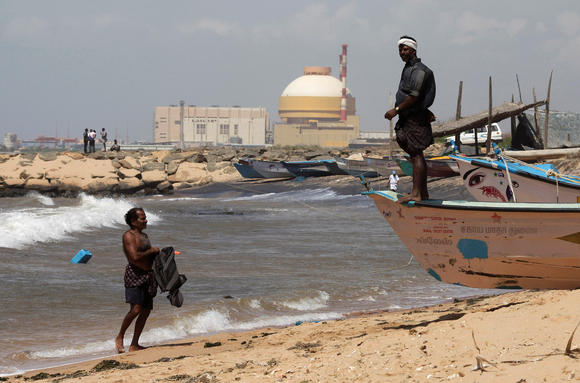
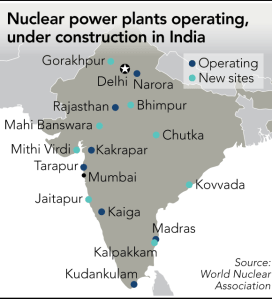 Nuclear power may be on a downward trajectory globally, yet it has earned a rightful place in India’s energy mix. The country’s domestic nuclear power industry, without technological assistance from overseas, has done a good job in beating the mean global plant-construction time frame and in producing electricity at a price that is the envy of Western reactor vendors. As a result, power from domestic reactor models is competitive with cheap coal-fired electricity. By contrast, in the U.S., where five reactor closures have been announced since 2013, utilities are seeking greater state subsidies to keep other nuclear plants operating.
 BRAHMA CHELLANEY
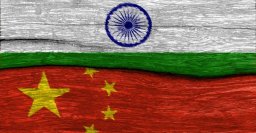 China’s fast-growing trade surplus with India, which has doubled to almost $60 billion on Modi’s watch, has increased Chinese President Xi Jinping’s territorial assertiveness. The absence of clarity about the frontier – China reneged on a 2001 promise to exchange maps with India – serves as cover for the PLA’s aggression, with China denying all incursions and claiming that its troops are operating on “Chinese land.” But, by acquiescing on bilateral trade – the dumping of Chinese-made steel on the Indian market is just
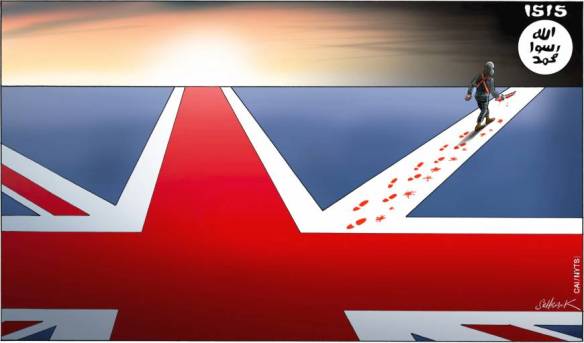
 After the Soviets left, however, many of those holy warriors ended up forming al-Qaeda, the Taliban, and other terrorist groups. Some, such as Osama bin Laden, remained in the Afghanistan-Pakistan belt, turning it into a base for organizing international terrorism, like the September 11, 2001, attacks in the US. Others returned to their home countries – from Egypt to the Philippines – to wage terror campaigns against what they viewed as Western-tainted governments. “We helped to create the problem that we are now fighting,” then-Secretary of State Hillary Clinton

 Pakistan is an incorrigibly scofflaw state for whom international law matters little. Still, India was left with no option but to haul Pakistan before the International Court of Justice after a secret Pakistani military court sentenced to death a former Indian naval officer, Kulbhushan Jadhav, for being an Indian “spy”. At a time when there was no hope to save Jadhav, the ICJ interim order has come as a shot in the arm for India diplomatically.
 CPEC — OBOR’s flagship programme, which will cement Pakistan’s status as China’s economic and security client — has become a convenient cover for Beijing to include major strategic projects, stretching from Gilgit-Baltistan to Pakistan’s Chinese-built Gwadar port. The Bunji and Bhasha dams are also claimed to be part of CPEC, which, by linking the maritime and overland “Silk Roads” that China is creating, will gravely impinge on India’s security. A grateful Pakistan has given China exclusive rights to run Gwadar port for the next 40 years.
 Stagecraft and Statecraft
You must be logged in to post a comment.