Brahma Chellaney, The Japan Times
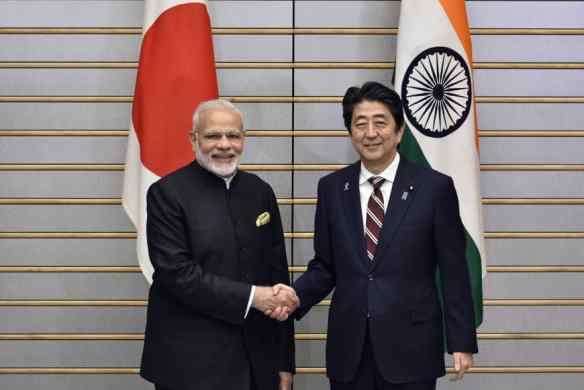
The spotlight on the Beijing summit between Shinzo Abe and Chinese President Xi Jinping cannot obscure the more substantive discussions starting Sunday between the Japanese prime minister and his Indian counterpart, Narendra Modi, in Tokyo. Whereas Japan-China ties are unlikely to easily return to normal, the Abe-Modi summit will cement the Japan-India relationship as Asia’s fastest growing and open the path to a military logistics pact to allow access to each other’s bases.
The entente between Asia’s richest democracy and its largest is a central pillar of the “free and open Indo-Pacific” strategy that U.S. President Donald Trump’s administration is assertively pushing. Indeed, Abe is the architect of the “free and open Indo-Pacific” concept, which he formally unveiled more than two years ago while addressing African leaders in Nairobi.
Today, Japan and India serve as the linchpins for establishing an Indo-Pacific order based on the principles of the rule of law, free trade, freedom of navigation and peaceful resolution of disputes. The Trump administration openly acknowledges the critical importance of the Japan-India relationship to achieving a “free and open” Indo-Pacific.
Trump’s Indo-Pacific strategy is really the successor to the “pivot” to Asia, which was announced by President Barack Obama’s administration in 2011 and became subsequently known as the “rebalance” to Asia. Like the “pivot,” the Indo-Pacific strategy is founded on the realization that the United States needs to correct its disproportionate focus on the Middle East by reorienting its policy to reflect Asia’s central importance to long-term American interests.
Asian security competition is occurring largely in the maritime context, which explains the increasing use of the term “Indo-Pacific” — representing the fusion of two oceans, the Indian and the Pacific. The geo-economic competition is also gaining traction in this region, which boasts the world’s fastest-growing economies, the fastest-increasing military expenditures and naval capabilities, the fiercest competition over natural resources, and the most dangerous hot spots. The Indo-Pacific thus holds the key to global security and a new world order.
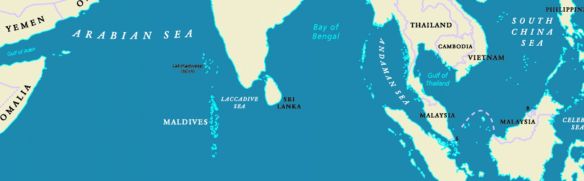
The broadening of America’s “pivot” to a wider region that includes the Indian Ocean is also a riposte to China’s “Belt and Road” initiative, whose largest investments in infrastructure projects are concentrated in the Indian Ocean Rim. And as China’s first overseas naval base at Djibouti and its acquisition of several unpopulated islets in the Maldives illustrate, the Indian Ocean is also becoming Beijing’s geostrategic focus after its success in creating and militarizing artificial islands in the South China Sea.
Against this background, Abe and Modi, besides signing an accord Monday to build maritime domain awareness through partnership, will set in motion the process for the Japanese and Indian militaries to clinch a logistics-sharing agreement, formally known as the Acquisition and Cross Servicing Agreement (ACSA). A logistics-sharing accord has become imperative for the two militaries, given the number of joint maneuvers they hold, including three-way exercises involving the U.S. Navy in the Indian Ocean and the Pacific.
An ACSA with India will help Japan to project its rising naval power in the Indian Ocean, including allowing Japanese ships to get fuel and servicing at Indian naval bases. The Maritime Self-Defense Force will also be able to secure access to Indian naval facilities in the Andaman and Nicobar islands, located close to the western entrance to the Malacca Straits through which sizable shares of Japan’s and China’s trade and fuel imports pass.
With the loosening of the legal and constitutional constraints on the military under Abe, the MSDF, instead of focusing merely on territorial defense of the homeland, is now able to operate far beyond Japanese shores. Indeed, Japan’s new readiness to participate in regional security, including through joint military exercises and training, is making it a critical player in the changing geostrategic dynamics in the Indo-Pacific.
India has signed military logistics pacts with the U.S. and France, both of which have strategically located bases in the Indian Ocean and the Pacific. A logistics-sharing agreement with Japan, along with greater bilateral maritime cooperation, will help the Indian Navy expand its footprint to the western Pacific.
The plain fact is that Japan and India, in the absence of any historical baggage or major strategic disagreement, are natural allies that share largely complementary interests. In fact, Japan has the distinction of being the only country that has been allowed to undertake infrastructure and other projects in India’s sensitive northeast (bordering Myanmar, Tibet, Bhutan and Bangladesh), as well as in the Andaman and Nicobar islands.
If Japan and India add concrete security content to their relationship, their strategic partnership could potentially be a game changer in Asia. The emphasis on boosting trade and investment must be balanced with greater strategic collaboration. As Japanese Ambassador to India Kenji Hiramatsu put it, “Defense and security ties now need to catch up.”
Abe’s summit with Xi — and Modi’s earlier summit with the Chinese president in Wuhan in April — cannot hide the fact that Japan and India face a serious challenge from a revisionist and muscular China. In fact, it is the Trump administration’s pressure on Beijing on trade, technology and other fronts that has prompted Xi to reach out to Abe and Modi.
Xi is probably hoping that Japan, like it did after the 1989 Tiananmen Square massacre of student-led protesters, will help to bail out his country at a time when America’s China policy is undergoing a fundamental shift. Japan was one of the first countries to lift post-Tiananmen economic sanctions, an action that paved the way for Emperor Akihito’s 1992 historic visit to China.
But Japan, like the U.S., has now shed its China blinkers and embraced a more realistic, clear-eyed approach to relations with Beijing. India too is under no illusion that a Xi-led China is going to discard its bullying and rule-breaking, and become a good neighbor.
In this light, the Abe-Modi summit offers an opportunity to discuss how the Tokyo-New Delhi duet can contribute to the larger U.S.-initiated effort to build strategic equilibrium, power stability and maritime security in the Indo-Pacific. As for Washington, it needs to evolve a clear strategy to deal with the changing status quo in the South China Sea, a highly strategic corridor that is central to a truly “free and open” Indo-Pacific.
Longtime Japan Times contributor Brahma Chellaney is a geostrategist.
 The newly appointed US Special Representative for Afghanistan Reconciliation



 Pakistan has turned into the Mecca of international terrorism even as its new prime minister, Imran “Taliban” Khan, has promised to make his country a Medina-like welfare state. Pakistan, however, is battling a deepening financial crisis, largely exacerbated by its “all-weather” ally, China. Beijing has imposed unfair deals on, and stepped up capital-goods exports to, Pakistan under its so-called Belt and Road Initiative.
 Stagecraft and Statecraft
The backlash against China can be seen elsewhere, too. The recent annual Pacific Islands Forum meeting was one of the most contentious in its history. Chinese policies in the region, together with the Chinese delegation leader’s behavior at the event itself, drove the president of Nauru – the world’s smallest republic, with just 11,000 inhabitants – to condemn China’s “arrogant” presence in the South Pacific. China cannot, he declared, “dictate things to us.”
When it comes to trade, US President Donald Trump’s escalating trade war with China is grabbing headlines, but Trump is far from alone in criticizing China. With policies ranging from export subsidies and nontariff barriers to intellectual-property piracy and tilting the domestic market in favor of Chinese companies, China represents, in the words of Harvard’s Graham Allison, the “most protectionist, mercantilist, and predatory major economy in the world.”
As the largest merchandise exporter in the world, China is many countries’ biggest trading partner. Beijing has leveraged this role by employing trade to punish those that refuse to toe its line, including by imposing import bans on specific products, halting strategic exports (such as rare-earth minerals), cutting off tourism from China, and encouraging domestic consumer boycotts or protests against foreign businesses.
The fact is that China has grown strong and rich by flouting international trade rules. But now its chickens are coming home to roost, with a growing number of countries imposing antidumping or punitive duties on Chinese goods. And as countries worry about China bending them to its will by luring them into debt traps, it is no longer smooth sailing for the BRI.
Beyond Trump’s tariffs, the European Union has filed a complaint with the World Trade Organization about China’s practices of forcing technology transfer as a condition of market access. China’s export subsidies and other trade-distorting practices are set to encounter greater international resistance. Under WTO rules, countries may impose tariffs on subsidized goods from overseas that harm domestic industries.
Now, Chinese President Xi Jinping finds himself not only defending the BRI, his signature foreign-policy initiative, but also confronting domestic criticism, however muted, for flaunting China’s global ambitions and thereby inviting a US-led international backlash. Xi has discarded one of former Chinese strongman Deng Xiaoping’s most famous dicta: “Hide your strength, bide your time.” Instead, Xi has chosen to pursue an unabashedly aggressive strategy that has many asking whether China is emerging as a new kind of imperialist power.
International trade has afforded China enormous benefits, enabling the country to become the world’s second-largest economy, while lifting hundreds of millions of people out of poverty. The country cannot afford to lose those benefits to an international backlash against its unfair trade and investment practices.
China’s reliance on large trade surpluses and foreign-exchange reserves to fund the expansion of its global footprint makes it all the more vulnerable to the current pushback. In fact, even if China shifts its strategy and adheres to international rules, its trade surplus and foreign-currency reserves will be affected. In short, whichever path it chooses, China’s free ride could be coming to an end.
© Project Syndicate, 2018.