
Brahma Chellaney, The Hindustan Times
Following President Abdulla Yameen’s surprise defeat in the Maldivian election, the air of self-congratulation that pervades in New Delhi risks obscuring the challenges. India ought to learn from its experience with Sri Lanka, where China has retained its influence and leverage even after authoritarian President Mahinda Rajapaksa was thrown out by voters in early 2015. In the Maldives, China may be down, but it’s not out and could, as in Sri Lanka, re-establish its clout through debt-trap diplomacy.
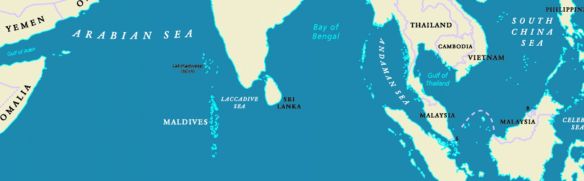
The Maldivian archipelago, despite its tiny population, is of key importance to Indian security, given that it sits astride critical sea lanes through which much of India’s shipping passes. From the Indian naval station on the Lakshadweep island of Minicoy, the Maldives’ northernmost Thuraakunu Island is just 100 kilometers away.
The election victory of opposition candidate Ibrahim Mohamed Solih against an increasingly autocratic Yameen cannot by itself roll back the deep strategic inroads China made during the incumbent president’s rule. To be sure, the outcome represents a triumph of Indian patience. Had India militarily intervened in the Maldives, it could have provoked a nationalistic backlash and strengthened Islamist forces in a country that has supplied the world’s highest per-capita number of foreign fighters to terrorist groups in Syria and Iraq.
After Yameen in February declared a state of emergency and jailed Supreme Court justices and political opponents, India came under pressure, including from the Maldivian opposition, to intervene militarily, as it did once before — in 1988 when it foiled an attempted coup. But unlike in 1988, no legitimate authority was inviting India to send in forces. By erring on the side of caution, and by holding out an intervention threat if the voting were not free and fair, India aided the electoral outcome.
Contrast this with Indian missteps in Nepal, where India woke up belatedly to the political machinations in Kathmandu that led to a flawed new Constitution being promulgated. India then backed the Madhesi movement for constitutional amendments — an agitation that triggered a five-month border blockade of essential supplies to Nepal. The resulting Nepalese grassroots backlash against India eventually contributed to the China-aided communists sweeping Nepal’s 2017 elections.
The restoration of full democracy in the Maldives after, hopefully, a smooth transfer of power on November 17 will be a diplomatic boost for India. However, in India’s larger strategic backyard, China continues to systematically erode Indian clout. Indeed, the Maldivian election result coincided with a major development underscoring Nepal’s pro-China tilt. After implementing a transit transport agreement with China to cut dependence on India, communist-ruled Nepal — under Chinese pressure — has reversed its previous government’s cancellation of the $2.5 billion Budhi-Gandaki Dam project. China bagged the project without competitive bidding. It massively inflated the project cost, which will leave Nepal struggling to repay the Chinese debt.
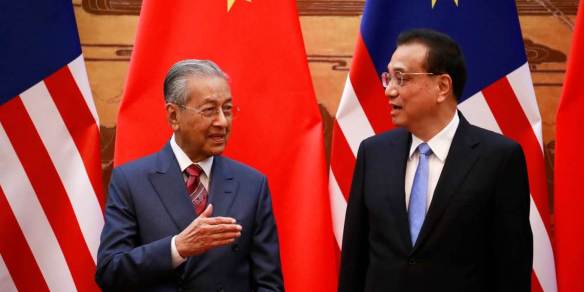
Yameen, who signed major financing and investment deals with Beijing, will be departing after pushing the Maldives to the brink of a Chinese debt trap. Can the Maldives still escape debt entrapment by emulating the example set by Malaysia’s Mahathir Mohamad, who recently cancelled Chinese projects worth almost $23 billion? Or is the Maldives, like Sri Lanka, already so indebted that it will remain under China’s sway? Nearly 80% of the Maldives’ external debt — equivalent to about one-quarter of its GDP — is owed to China.
Even without any new contracts, the Maldivian debt to China will rise because of the Chinese projects already completed or initiated, thus allowing Beijing to retain its favourite source of leverage. Indeed, Beijing will seek to court Yameen’s successor just as it has in Sri Lanka wooed Rajapaksa’s successor, who has disclosed that China has “gifted” him $300 million “for any project of my wish,” besides constructing South Asia’s largest kidney hospital in his electoral district.
In this light, the post-Yameen Maldives — like Nepal, Bangladesh and Sri Lanka — would likely seek to balance relations with India and China, thus reinforcing how Beijing has fundamentally altered geopolitics in a subregion New Delhi long considered its natural sphere of influence. As Maldives’ closest partner, a proactive India must leverage its ties. India should assist in infrastructure development and be willing to refinance Maldives’ Chinese debt so as to achieve lower costs and a longer-term maturity profile.
India will have to closely watch China’s activities in the unpopulated Maldivian islands it managed to lease during Yameen’s reign. China is muscling its way into India’s maritime backyard, including sending warships to the Maldives and signing an accord for an ocean observatory there that could provide critical data for deploying Chinese nuclear submarines. The new Maldivian government should be left in no doubt about India’s “red lines”.
Brahma Chellaney is a geostrategist and author.


 Pakistan has turned into the Mecca of international terrorism even as its new prime minister, Imran “Taliban” Khan, has promised to make his country a Medina-like welfare state. Pakistan, however, is battling a deepening financial crisis, largely exacerbated by its “all-weather” ally, China. Beijing has imposed unfair deals on, and stepped up capital-goods exports to, Pakistan under its so-called Belt and Road Initiative.


 Stagecraft and Statecraft
The backlash against China can be seen elsewhere, too. The recent annual Pacific Islands Forum meeting was one of the most contentious in its history. Chinese policies in the region, together with the Chinese delegation leader’s behavior at the event itself, drove the president of Nauru – the world’s smallest republic, with just 11,000 inhabitants – to condemn China’s “arrogant” presence in the South Pacific. China cannot, he declared, “dictate things to us.”
When it comes to trade, US President Donald Trump’s escalating trade war with China is grabbing headlines, but Trump is far from alone in criticizing China. With policies ranging from export subsidies and nontariff barriers to intellectual-property piracy and tilting the domestic market in favor of Chinese companies, China represents, in the words of Harvard’s Graham Allison, the “most protectionist, mercantilist, and predatory major economy in the world.”
As the largest merchandise exporter in the world, China is many countries’ biggest trading partner. Beijing has leveraged this role by employing trade to punish those that refuse to toe its line, including by imposing import bans on specific products, halting strategic exports (such as rare-earth minerals), cutting off tourism from China, and encouraging domestic consumer boycotts or protests against foreign businesses.
The fact is that China has grown strong and rich by flouting international trade rules. But now its chickens are coming home to roost, with a growing number of countries imposing antidumping or punitive duties on Chinese goods. And as countries worry about China bending them to its will by luring them into debt traps, it is no longer smooth sailing for the BRI.
Beyond Trump’s tariffs, the European Union has filed a complaint with the World Trade Organization about China’s practices of forcing technology transfer as a condition of market access. China’s export subsidies and other trade-distorting practices are set to encounter greater international resistance. Under WTO rules, countries may impose tariffs on subsidized goods from overseas that harm domestic industries.
Now, Chinese President Xi Jinping finds himself not only defending the BRI, his signature foreign-policy initiative, but also confronting domestic criticism, however muted, for flaunting China’s global ambitions and thereby inviting a US-led international backlash. Xi has discarded one of former Chinese strongman Deng Xiaoping’s most famous dicta: “Hide your strength, bide your time.” Instead, Xi has chosen to pursue an unabashedly aggressive strategy that has many asking whether China is emerging as a new kind of imperialist power.
International trade has afforded China enormous benefits, enabling the country to become the world’s second-largest economy, while lifting hundreds of millions of people out of poverty. The country cannot afford to lose those benefits to an international backlash against its unfair trade and investment practices.
China’s reliance on large trade surpluses and foreign-exchange reserves to fund the expansion of its global footprint makes it all the more vulnerable to the current pushback. In fact, even if China shifts its strategy and adheres to international rules, its trade surplus and foreign-currency reserves will be affected. In short, whichever path it chooses, China’s free ride could be coming to an end.
© Project Syndicate, 2018.