Weaponizing water

Brahma Chellaney, DNA newspaper

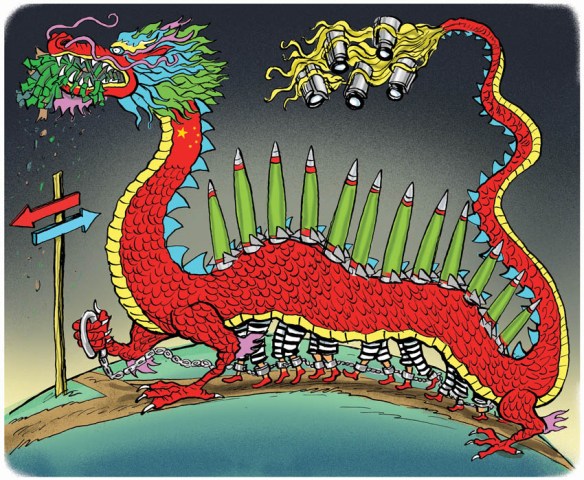
NIDS - CopyJust as China has changed the status quo in the South China Sea through an island-building strategy, it is working to re-engineer cross-border flows of international rivers that originate in Tibet, which Beijing annexed in 1951.

No country will be more affected by China’s dam frenzy than India because of one telling statistic: Out of the 718 billion cubic metres of surface water that flows out of Chinese-held territory yearly, 347 billion cubic meters (or 48.3% of the total) runs directly into India. Several major Indian rivers originate in Tibet, including the Brahmaputra, the Kosi, the Sutlej and the Indus.

China already boasts more large dams than the rest of the world put together. More importantly, it has emerged as the key obstacle to building institutionalized collaboration on shared water resources in Asia.

In contrast to the bilateral water treaties between many of its neighbours, China rejects the concept of a water-sharing arrangement or joint, rules-based management of common resources.

India has water-sharing treaties with both the countries located downstream to it: Pakistan and Bangladesh. These treaties govern the Indus and the Ganges.

By contrast, China, despite its unrivalled international status as the source of river flows to more than a dozen countries, stands out for not having a single water-sharing arrangement with any neighbour.

India’s treaties with Pakistan and Bangladesh have actually set new principles in international water law. The 1996 Ganges treaty — which coincided with the 25th anniversary of Bangladesh’s Indian-assisted independence — set a new standard by guaranteeing delivery of specific water quantities in the critical dry season.

The Indus treaty stands out as the world’s most generous water pact, in terms of both the sharing ratio (80.52% of the aggregate water flows in the six-river Indus system are reserved for Pakistan) and the total volume of basin waters for the downstream state (Pakistan gets 90 times greater volume of water than Mexico’s share under a 1944 pact with the US).

China, in rejecting the 1997 UN convention that lays down rules on shared water resources, contended that an upstream power has the right to assert absolute territorial sovereignty over the waters on its side of the international boundary — or the right to divert as much water as it wishes for its needs, irrespective of the effects on a downriver state.

Today, by building mega-dams and reservoirs in its borderlands, China is working to divert the flows of major rivers that are the lifeline of lower riparian states.

Since the last decade, China’s major dam building has moved from dam-saturated internal rivers to international rivers located in ethnic-minority homelands like Tibet. On the Brahmaputra, China is racing to complete several additional dams located in close proximity to each other. This cascade of dams is likely to affect the quality and quantity of downstream flows into India and Bangladesh.

Only five rivers in the world carry more water than the Brahmaputra and only one — mainland China’s Yellow River — carries more silt. The Brahmaputra is the world’s highest-altitude river. It represents a unique fluvial ecosystem largely due to the heavy load of high-quality nutrient-rich silt it carries from forbidding Himalayan heights.

The Brahmaputra’s annual flooding cycle helps to re-fertilize overworked soils in India’s Assam plains and large parts of Bangladesh, where the river is the biggest source of water supply. The silt-movement impediment by China’s upstream dam projects constitutes a bigger threat to the biophysical vitality of the river and to the soil fertility of downstream plains than even the likely diminution of cross-border flows.

China’s centralized, mega-projects-driven approach to water resources is the antithesis of the policy in India, where water is a state (not federal) subject under the Constitution and where anti-dam non-governmental organizations (NGOs) are powerful. India’s Narmada Dam project, which remains incomplete decades after its construction began, symbolizes the power of NGOs.

The largest dam India has built since independence — the 2,000-megawatt Tehri Dam on River Bhagirathi — pales in comparison to China’s giant projects, such as the 22,500-megawatt Three Gorges Dam and the new mega-dams on the Mekong like Xiaowan, which dwarfs Paris’s Eiffel Tower in height, and Nuozhadu, which boasts of a 190-square-km reservoir.

China’s population is just marginally larger than India’s, but its internally renewable water resources (2,813 billion cubic meters per year) are almost twice as large as India’s. In aggregate water availability, including external inflows (which are sizeable in India’s case), China boasts virtually 50% larger water resources than India.

India’s surface-water storage capacity — an important measure of any nation’s ability to deal with drought or seasonal imbalances in water availability — is one of the world’s lowest: Amounting to 200 cubic metres per head per year, it is more than 11 times lower than China’s. The 2030 Water Resources Group, an international unit, has warned that India is likely to face a 50% deficit between water demand and supply by 2030.

In the coming years, China, by ramping up construction of dams on trans-Himalayan rivers, could fashion water into a political weapon against India.

(He is author of award-winning “Water: Asia’s New Battleground”.)

© DNA newspaper, 2018.

Canada must stand up to China the bully

JQFM7K6NTVCLJEC5JJUAIZCPO4

In clear reprisal for Canada’s U.S.-sought arrest of the daughter of Huawei’s founder, China has detained two Canadians on charges of undermining its national security but has shied away from taking any action against the United States. This is in keeping with Beijing’s record of acting only against the weaker side, even if it happens to be a U.S. ally.

For example, when the United States installed its Terminal High Altitude Area Defense (THAAD) anti-missile system in South Korea, China used its economic leverage to retaliate against South Korea, not against the U.S. The heavy-handed economic sanctions imposed on South Korea in 2017, partly extending into this year, illustrated Beijing’s use of trade as a political weapon.

Similarly, after U.S. President Donald Trump signed the Taiwan Travel Act in March, which encourages official visits between the United States and the island, China staged war games against Taiwan and bribed the Dominican Republic and Burkina Faso to break diplomatic ties with Taipei. The United States, however, faced no consequences.

Now, while intensifying a punitive campaign against Canada, China has adopted a tempered approach toward the United States, even though Canadian authorities arrested Meng Wanzhou at the behest of U.S. prosecutors for alleged bank fraud related to violations of sanctions against Iran. In fact, Chinese Foreign Minister Wang Yi has bent over backward to emphasize that while confrontation hurts the U.S.-China relationship, co-operation benefits both countries.

Such is the Chinese effort to mollify the power behind Ms. Meng’s arrest that, in recent days, Beijing has made trade-related concessions to help defuse tensions with Washington. Contrast this with the way China has followed up on its threats of retaliation against Canada by arresting a former Canadian diplomat, Michael Kovrig, and then detaining Michael Spavor, a Canadian writer and entrepreneur living in the Chinese province of Liaoning. Ms. Meng’s release on bail has apparently not allayed Beijing’s anger against Ottawa.

Such behaviour fits the classic definition of a bully, whether in school or on the international stage – one that engages in unwanted, aggressive behaviour by taking advantage of an imbalance of power.

In fact, with its foreign policy favouring strong-arm methods over mutual understanding, China’s neighbours increasingly view it as a bully. U.S. Defence Secretary Jim Mattis correctly said at a Senate Appropriations Committee hearing that China pursues a “tribute nation” approach to other countries and aspires for “veto power” over their sovereign decisions.

This approach helps explain why Chinese President Xi Jinping’s Belt and Road Initiative (BRI) has started to run into resistance in a number of countries. Essentially an imperial project aimed at making real the mythical Middle Kingdom, BRI has sought to lure countries desperate for infrastructure investments into China’s strategic orbit. Countries neglected by multilateral lending institutions initially flocked to BRI, but now, partner countries worry about Beijing ensnaring them in sovereignty-eroding debt traps.

China’s penchant for bullying also explains why it essentially remains a friendless power. It lacks any real strategic allies. Indeed, the more power China has accumulated, the greater has been its difficulty in gaining genuine allies, underscoring that leadership demands more than brute might. Contrast this with the strong network of allies and partners that the United States maintains globally.

China’s increasing authoritarianism at home under Mr. Xi has fostered an overtly muscular foreign policy that has counterproductively contributed to China’s lonely rise. A senior U.S. official warned in 2016 that Beijing risks erecting “a Great Wall of self-isolation.”

China, a trade cheat that has also employed non-tariff tools to punish countries as diverse as Japan, Mongolia and the Philippines, is now getting a taste of its own medicine. With Ms. Meng’s arrest, the U.S. showed that it has more powerful non-tariff weapons. China’s elites are rattled – angry but also fearful that any one of them could meet a similar fate while traveling to the West.

Ms. Meng’s arrest was significant for another reason. As former U.S. defence secretary Ash Carter says in a recent Harvard University essay, Beijing has a history of staging provocations that coincide with high-level diplomacy. For example, the start of Mr. Xi’s 2014 state visit to India coincided with a deep Chinese military incursion into the Indian Himalayan region of Ladakh.

The fact that Ms. Meng’s arrest coincided with the Trump-Xi dinner meeting on Dec. 1 in Buenos Aires signalled to Beijing, however unintentionally, that others can pay it back in the same coin.

More importantly, Mr. Trump has shown how active U.S. pressure on China, as opposed to imploration or admonition, can yield concessions. Without the United States withdrawing its 10-per-cent tariffs on US$250-billion worth of Chinese goods, Beijing has begun lifting, following the Buenos Aires talks, its restrictions on imports of U.S. food, energy and cars. Those restrictions had been placed in retaliation for the 10-per-cent tariffs. The United States’ threat to increase them to 25 per cent and possibly extend them to all imports from China forced Beijing’s hand.

When a country pursues an accommodating approach toward Beijing, an emboldened China only ups the ante. Deference to China usually invites bullying, while standing up to it draws respect and a readiness to negotiate and shore-up cooperation.

Ottawa would do well to remember this fact as it grapples with the escalation of the diplomatic feud by a country that seeks to play the aggrieved victim while acting as the bully.

Brahma Chellaney is a geostrategist and the author of nine books, including the award-winning Water, Peace, and War.

© The Globe and Mail, 2018.

India’s Kartarpur Headache

New Delhi must proactively thwart Pakistan’s effort to revive Sikh militancy in Punjab

5B204A47-5AAB-4B9E-86A6-02A3AE0A4F4D

Brahma Chellaney, The Times of India, December 14, 2018

Prime Minister Narendra Modi recently raked up the issue as to why Kartarpur today is in Pakistan, not India. At Simla in 1972, for example, India could have traded the return of captured territories and 93,000 prisoners of war for a Kashmir settlement and border adjustments to secure Kartarpur — and more. Yet, despite holding all the cards, Indira Gandhi surrendered at the negotiating table India’s major gains from martyrs’ sacrifices.

In effect, Indira pardoned Pakistan in the style of Prithviraj Chauhan, who routed invader Mahmud Ghori on the battlefield, only to set him free — an action that encouraged Ghori to return later to wage the Second Battle of Tarain, where he defeated and executed the Rajput ruler. Just like Prithviraj Chauhan, Indira paid with her life for her blunder. Left free to avenge 1971, Pakistan, before focussing on the Kashmir Valley, engineered a bloody Sikh militancy that ultimately spawned Indira’s assassination.

Against this background, Modi must pay heed to Punjab Chief Minister Amarinder Singh’s warning that the Pakistan army and Inter-Services Intelligence, with the aim of reviving Sikh militancy, planned the Kartarpur corridor even before Imran Khan took office. Pakistan’s army chief has taken a keen interest in the corridor plan, which explains his presence at the Kartarpur ceremony. The corridor, if it opens, will likely become a major security headache for India.

India, unfortunately, chose the 10th anniversary period of the four-day Mumbai terrorist attacks for the corridor’s cornerstone-laying ceremonies in India and Pakistan. This not only conveyed a regrettable message that India lacked a sense of remembrance, but also handed the 26/11 perpetrator, Pakistan, a propaganda coup.

Indeed, Pakistan used the occasion to ominously greet the Indian delegation with Sikh separatist posters and an in-house Sikh militant. The ill-timed ceremonies apparently were intended to let Modi take a positive message to the G-20 summit in Buenos Aires.

Over seven decades, India has bent over backwards to make peace with Pakistan, only to be repeatedly kicked in the face. Consider, for example, India’s globally unparalleled water generosity in the form of the 1960 Indus Waters Treaty. Or its big-heartedness at Tashkent and Simla.

Or India’s initiation of “composite dialogue” in the 1990s, Atal Bihari Vajpayee’s bus journey to Lahore, his Agra summit with General Pervez Musharraf, his second Pakistan visit in the twilight of his rule and, just months after 26/11, Manmohan Singh’s Chamberlainian appeasement at Sharm el-Sheikh.

Or take the olive branches Modi has extended — from inviting Nawaz Sharif  to his 2014 inauguration and opening an unpublicized dialogue at the national security adviser-level to making a surprise Lahore visit and later sending his foreign minister to Islamabad. Nothing has worked.

Indeed, India’s peace initiatives and magnanimity have had the opposite effect of emboldening Pakistan’s scofflaw actions. Modi’s Lahore visit, for example, led to the Pakistan military’s scripting of terrorist attacks on a raft of Indian security bases, from Pathankot to Uri. Yet, on the 26/11 anniversary eve, Modi oddly voiced hope that the Kartarpur corridor would have the same momentous impact in uniting two societies that the Berlin Wall’s fall had.

The 10th anniversary of 26/11 should have been a sombre occasion to remember the victims of one of modern history’s worst terrorist carnages and to spotlight Pakistan’s continued protection of the masterminds. India ought to have reminded Pakistan that its day of reckoning will come before long.

Unfortunately, amid the corridor-related fervour, India did not remember even the martyrs, such as the cop Tukaram Omble, who, by ensuring Ajmal Kasab’s capture alive, provided the clinching evidence of Pakistan’s involvement in 26/11.

India laid the corridor cornerstone on its side of the border on the opening day of the 26/11 anniversary period, with an oblivious Indian vice president calling it a “historic day”! Indeed, such was the oozing zeal that India sent not one but two ministers to the Pakistan-side ceremony.

Make no mistake: Pakistan may be isolated and cash-strapped, yet it gladly remains a terrorist state. Lest we forget, the Nirankari sect guru’s 1980 assassination paved the way for Pakistan to script terrorism in India. To incite tensions and militancy in Punjab, Pakistan, as the first line of attack, targeted Nirankaris, who are at odds with mainstream Sikhs as they believe in a living guru and reject the militant brotherhood of the Khalsa.

Just when Pakistan has laid bare its designs to use the Kartarpur corridor to indoctrinate and radicalize Sikh pilgrims from India, a recent attack on Nirankari worshippers outside Amritsar with a Pakistan-origin grenade suggests the ISI may be reviving its old strategy.

Sikh militancy cost India dearly, triggering the disastrous Operation Bluestar and a PM’s killing. Its potential resurgence at a time when illicit drugs from Pakistan have become a scourge in Punjab could possibly tear India apart. India, with its ostrich-like approach and perennial preoccupation with electoral politics, would do well to remember the old adage, “a stitch in time saves nine”, lest history — to quote Karl Marx — repeat itself, “first as tragedy, then as farce”.

Brahma Chellaney is a geostrategist.

© The Times of India, 2018.

Fair Observer talks to Brahma Chellaney

In this edition of The Interview, Fair Observer talks to Brahma Chellaney, a prominent Indian intellectual and author.

Bordered by the Indian Ocean, the Arabian Sea and the Bay of Bengal, India is the second most populous country and, arguably, the biggest democracy in the world. The World Bank and the International Monetary Fund recognize India as the sixth largest economy on the planet.

Despite significant economic growth in recent decades, India faces its own set of challenges. Poverty in India is still a serious concern, even though the country is no longer home to the largest number of poor people in the world; that country is Nigeria. However, figures show two-thirds of people in India live in poverty.

India’s dynamic foreign policy and the willingness of countries to forge a close partnership with New Delhi as a nascent global power pose a serious challenge to a world order in which the US, Russia, China and the EU are competing for dominance. India’s huge energy demands also mean that oil and gas producers have a difficult job vying with each other and satisfying the needs of the third biggest energy-consuming country in the world.

The efforts of Jawaharlal Nehru, the first prime minister of India who is referred to as the architect of Indian foreign policy, paved the way for the foundation of the Non-Aligned Movement (NAM) in 1961. India is a major member of the NAM and was its president from 1983 until 1986. Today, India maintains the same neutrality in international affairs, but tries to play an active role on the global stage through diversifying its economic partners, engaging in UN peacekeeping missions and keeping an eye on a possible permanent seat in the UN Security Council.

In this edition of The Interview, Fair Observer talks to Brahma Chellaney, a prominent Indian intellectual and author, about India’s foreign policy, its economy and its relations with neighboring countries in South Asia.

The transcript has been edited for clarity.

Kourosh Ziabari: The International Monetary Fund’s World Economic Outlook predicts that India will experience a 7.4% growth in its gross domestic product by 2019 and that the figure would be 7.7% for 2020. How has India achieved such remarkable economic growth that even surpasses the United States and China?

Brahma Chellaney: Ever since India embarked on economic reforms in the early 1990s, its GDP growth has accelerated. Under the government led by Prime Minister Narendra Modi’s predecessor, Manmohan Singh, GDP growth surpassed 8% annually. Critics blame the Modi government’s missteps, including demonetization of high-value currency notes and a hastily introduced goods and services tax, for slowing the economic growth. However, the government’s tax and regulatory reforms, despite inflicting short-term pain, will likely help accelerate GDP growth in the medium to long-term.

India, however, needs to invest greater resources in education, human resources development and achieving autonomous technological capabilities in order to sustain economic growth in the years ahead.

Ziabari: International reports show that the number of ceasefire violations along the India-Pakistan border have increased significantly in 2017 and 2018. Do you think tensions will be alleviated between the two countries in the New Year, especially since the new Pakistani PM Imran Khan seems to be determined to make peace with India?

Chellaney: Pakistan has turned into the mecca of terrorism, even as its new leader promises a medina-like welfare state. In Pakistan, no prime minister has been allowed to complete a full five-year term. When a prime minister falls foul of the deep state, a bendable judiciary, opposition and bureaucracy are used to smear the leader’s reputation and oust him or her. Every prime minister has been thrown out on charges of corruption and incompetence.

The latest military-engineered election has changed little in Pakistan, a country still struggling to be at peace with itself. The Pakistani military will remain the puppet master calling the shots from behind the scenes, with Imran Khan as its newest puppet. Khan is a supporter of the military-backed jihadists and Islamists and a religious zealot himself.

Today, caught in mounting debt to China, Pakistan is in desperate need for an international bailout package. Against this background, Pakistan will remain a principal source of regional instability and the fountainhead of transnational terrorism. Its neighbors, including India and Afghanistan, can expect little change in Pakistan’s behavior.

Ziabari: How do you think the US and European Union’s sanctions on Russia will impact India’s economy? Do you think there will be a problem in Russia’s delivery of the S-400 air defense system to India as a result of US sanctions that make the payments difficult?

Chellaney: A generation after the Cold War ended, the Washington power elites remain obsessively fixated on Russia, although Russia’s economy today is just one-tenth the size of China’s and its military spending one-fifth of China.

Pressure from the power elites has led the Trump administration to impose at least four rounds of sanctions on Russia this year, even though better relations with Moscow can help to put discreet checks on China’s overweening ambitions. With its vast economic and military potential, China clearly represents the main threat to US interests. But the current US sanctions-centered approach to Russia has only compelled Moscow to pivot to China.

The US sanctions policy toward Russia also has gratuitously introduced a major irritant in relations with India. A new Russia-centered sanctions law took effect earlier this year. Known as Countering America’s Adversaries Through Sanctions Act, or CAATSA, the law uses the sanctions threat to wean countries off their craving for Russian weapons, so as to boost America’s own arms sales.

The US has already overtaken Russia as the top arms seller to India. Yet it is seeking to pressure India to reduce its imports of Russian arms. India cannot snap its defense ties with Moscow. With India going ahead with a deal to buy the interceptor-based S-400 Triumf air and anti-missile defense system from Russia, the US Congress has passed a waiver legislation that grants India conditional waiver from the CAATSA sanctions.

Ziabari: Iran is the second largest supplier of India’s oil. Will the new US sanctions against Iran affect the oil trade between Tehran and New Delhi? Is India legally bound to follow the US lead in sanctioning Iran and cutting off crude imports from that country?

Chellaney: India, the second-largest importer of Iranian oil after China, is a major victim of the new US sanctions against Iran and Russia. By implicitly mounting two-pronged pressure on New Delhi on energy and defense fronts, Washington has implicitly underscored the risks for India of pursuing a foreign policy too closely aligned with America. By slapping a nation with punitive sanctions, the US seeks to block trade and financial activities with that country even by other states.

Such extraterritorial sanctions — which it euphemistically labels “secondary” sanctions — run counter to international law. Yet the US uses its unmatched power to turn national actions into global measures. As the world’s reserve currency that greases the wheels of the global financial system, the US dollar arms America with tremendous leverage, making US sanctions the most powerful in the world. Most international transactions, from banking to oil, are conducted in US dollars. Through its Iran-related sanctions, the US wants to influence the energy-import policy of India, which currently imports more than three-fourths of its crude oil requirements.

Washington is seeking to sell more oil and gas to India and also encouraging it to switch imports from Iran to Saudi Arabia and other US allies. Iran, however, has long been a major oil supplier to India. It will remain important for India’s energy-import diversification strategy. The US has granted India a six-month waiver from its Iran-related oil sanctions. In addition, the US has granted a waiver for India’s Pakistan-bypassing transportation corridor to Afghanistan via Iran. India is investing in modernizing the Chabahar Port.

Ziabari: In one of your articles, you praised President Donald Trump for trying to contain China and hold back its economic and political growth. However, many observers say that Trump is not a reliable politician and does not take advice from the right people. Do you think his lack of political experience will be a threat to India as well?

Chellaney: Any US administration’s policies are made not just by the president, but by the whole team the president has assembled. Washington is more polarized and divided than ever before. Yet it is highly significant that, in this environment, a bipartisan consensus has emerged that the decades-old US policy of “constructive engagement” with China has failed and must be replaced with active and concrete counteraction. The China policy change that is underway, therefore, will likely outlast the Trump presidency because it will be difficult for a successor to reverse it and go back to trustful cooperation.

The policy change does not seek to hold back China’s economic and political growth. Rather the aim is to make China comply with international rules and norms. For example, China has long been cheating on World Trade Organization rules. It is important to note that, despite the policy change that is underway, China still gets a free pass on human-rights abuses — from holding a million or more Muslims from Xinjiang province in internment camps to carrying out the forced disappearance of the Interpol chief. Had Russia set up such internment camps, the US response would likely have been swift and resolute.

Ziabari: You once wrote that the President Trump has tried to “sweet-talk autocratic leaders,” such as North Korea’s Kim Jong-un and Russia’s Vladimir Putin, to encourage them to make concessions. Why didn’t he try this option with Iran? Has his flattering of the North Korean and Russian leaders paid off?

Chellaney: Trump lavishes praise on autocratic foreign leaders that he is seeking to extract concessions from. Even more than Kim and Putin, Trump has lavished praise on China’s Xi Jinping, calling him “terrific” and “great.” In fact, Trump has flattered no foreign leader like Xi. Yet Trump has managed so far to wrest no major concessions from Xi. This explains why the Trump administration has targeted China with tariffs on $250 billion worth of imports into the US from there. As for Kim, Trump has succeeded in getting North Korea to declare a moratorium on nuclear and missile testing. But Kim is unlikely to give up his nuclear weapons entirely. That is the only card he has.

Trump’s Iran policy is short-sighted and counterproductive to US interests. His Iran policy has been greatly influenced by neoconservatives, election campaign donors and other interests tied to Israel. This explains why Trump has pursued a hardline approach toward Iran.

Ziabari: There are indications that India is forfeiting its democratic values. India’s top court recently ruled that movie theaters should be required to play India’s national anthem before screening movies. The country ranks 140th out of 179 in Reporters Without Borders’ Press Freedom Index. It is 136th out of 163 countries in the Global Peace Index 2018. Restrictions on Muslim Indians continue to remain in place. Do you think India is still a serious democracy?

Chellaney: You must be kidding that there are “restrictions” on Muslims in India. Muslims have the same rights as Hindus, Buddhists, Christians and others in India. Discrimination on the basis of religion is unlawful under the Indian Constitution.

India’s democracy certainly faces challenges. But it is widely recognized that India remains a robust and proud democracy. In fact, it is the world’s largest democracy. The Indian media is one of the freest in the world. And Indian courts regularly overturn government decisions. If anything, India has an activist judiciary that often appears to encroach on the executive branch’s powers.

In fact, democracy remains India’s greatest asset. While the concepts of democratic freedoms and the rule of law are normally associated with the West, India can claim ancient traditions bestowing respect to such values. Basic freedoms for all formed the linchpin of the rule in third century BC of Emperor Ashoka who, as Nobel laureate Amartya Sen has pointed out, “did not exclude women and slaves as Aristotle did.”

Ziabari: What are the foreign policy priorities of India as of today? What is India doing to in order to consolidate its international standing and fulfill its economic aspirations?

Chellaney: India has long cherished “strategic autonomy” and sought to stay clear of formal alliances. That won’t change. However, in an important shift, India is moving from nonalignment to multi-alignment. This means India is going from its long-held nonalignment to a contemporary, globalized practicality.

There is an important difference between nonalignment and multi-alignment. Nonalignment implies a passive stance as a bystander. Multi-alignment, by contrast, permits an active and participatory role, including building close strategic partnerships with likeminded powers.

India cannot, and will not, be a lackey of any power. Because of its geographical location, India is the natural bridge between the West and the East, and between Europe and Asia. Through forward thinking and a dynamic foreign policy, India is seeking to truly play the role of a bridge between the East and the West, including serving as a link between the competing demands of the developed and developing worlds. At a time of heightened geopolitical tensions, the world needs such a bridge-builder.

Ziabari: Prime Minister Narendra Modi visited Rwanda and Uganda earlier this year before traveling to South Africa for the BRICS summit. Historically, there have been large Indian communities across Africa that contributed to the economic prosperity of the continent. What is India looking for in rejuvenating its relations with African nations?

Chellaney: India has had close historical ties with Africa. Today, India is seeking to revive those ties. Take the Indian Ocean region, which extends from Australia to eastern and southern Africa. The Indian Ocean region has emerged as the world’s major energy and trade seaway, as well as the center of the challenges of the 21st-century world — from terrorism and extremism to piracy and safety of sea-lanes of communication.

India is attempting to build a web of strategic partnerships with key littoral states in the Indian Ocean rim. The partnerships incorporate trade accords, defense and energy cooperation, and strategic dialogue. India’s focus includes countries adjacent to chokepoints such as the Strait of Hormuz, Iran; the Strait of Malacca, namely Singapore, Indonesia and Malaysia; the Bab el-Mandab, which are Djibouti and Eritrea; and the Cape of Good Hope and the Mozambique Channel, namely South Africa and Mozambique.

Not only does BRICS include South Africa, but also South Africa’s president will be the chief guest at India’s Republic Day parade on January 26, 2019. India and Japan have launched the Asia-Africa Growth Corridor in partnership with a number of African countries. In addition, India has offered a $1 billion line of credit to African countries.

The views expressed in this article are the author’s own and do not necessarily reflect Fair Observer’s editorial policy.
When one nation’s dam-building rage threatens an entire continent’s future

rage

Brahma Chellaney, DailyO

China is the world’s biggest dam builder, with the country boasting more dams than the rest of the world combined. China is also the world’s largest exporter of dams.

In Nepal, where China-backed communists are in power, Beijing has just succeeded in reviving a lucrative dam project, which was scrapped by the previous Nepalese government as China had won the contract without competitive bidding. The reversal of the previous government’s cancellation of the $2.5 billion Budhi-Gandaki Dam project has come after Nepal’s communist rulers implemented a transit transport agreement with China to cut dependence on India.

China is building dams in two other countries neighbouring India, Myanmar and Pakistan, including in areas torn by ethnic separatism (as in northern Myanmar) and in a United Nations-designated disputed territory like the Pakistan-occupied portion of Jammu and Kashmir. Yet it loudly protests when the Dalai Lama merely visits Arunachal Pradesh, claiming it to be a “disputed territory”, although only Beijing disputes India’s control over Arunachal. The UN does not recognize Arunachal as disputed.

China has also held out threats against India jointly exploring with Vietnam for offshore hydrocarbons in Vietnam’s own exclusive economic zone (EEZ). Yet it has no compunctions about unveiling projects — under the so-called China-Pakistan Economic Corridor — in Pakistan-occupied Jammu and Kashmir. Domestically, most of China’s mega-water projects are now concentrated on the Tibetan Plateau, a sprawling region it forcibly absorbed in the early 1950s.

By building an array of new dams on rivers flowing to other countries, Beijing seems set to roil inter-riparian relations in Asia and make it more difficult to establish rules-based water cooperation and sharing.

China has emerged as the key impediment to building institutionalized collaboration in Asia on shared water resources. In contrast to the bilateral water treaties between many of its neighbours, China rejects the concept of a water-sharing arrangement or joint, rules-based management of common resources.

The long-term implications of China’s dam programme for India are particularly stark because several major rivers flow south from the Tibetan plateau. India has water-sharing treaties with both the countries located downstream from it: the Indus pact with Pakistan guarantees the world’s largest cross-border flows under any treaty regime, while the Ganges accord has set a new principle in international water law by granting Bangladesh an equal share of downriver flows in the dry season.

China, by contrast, does not have a single water-sharing treaty with any neighbour.

Yet most of Asia’s international rivers originate in territories that China annexed after its 1949 communist “revolution”. The Tibetan Plateau is the world’s largest freshwater repository and the source of Asia’s greatest rivers, including those that are the lifeblood of mainland China, South Asia and Southeast Asia. Other Chinese-held homelands of ethnic minorities contain the headwaters of rivers such as the Irtysh, Illy and Amur, which flow to Russia and Central Asia.

China’s dam programme on international rivers is following a well-established pattern: Build modest-size dams on a river’s uppermost difficult reaches, and then construct larger dams in the upper-middle sections as the river picks up greater water volume and momentum, before embarking on mega-dams in the border area facing the neighbouring country. The cascade of mega-dams on the Mekong River, for example, is located in the area just before the river enters continental Southeast Asia.

Many of China’s new dam projects at home are concentrated in the seismically active southwest, covering parts of the Tibetan Plateau. The restart of dam building on the Salween River after a decade-long moratorium is in keeping with a precedent set on other river systems: Beijing temporarily suspends a controversial plan after major protests flare so as to buy time — before resurrecting the same plan.

The Salween — Asia’s last largely free-flowing river — runs through deep, spectacular gorges, glaciated peaks and karst on its way into Myanmar and along the Thai border before emptying into the Andaman Sea. Its upstream basin is inhabited by 16 ethnic groups, including some, like the Derung tribe, with tiny populations numbering in the thousands. As one of the world’s most biologically diverse regions, the upper basin boasts more than 5,000 plant species and nearly half of China’s animal species.

China’s action in lifting the moratorium and starting work on dams on the Tibet-originating Salween threatens the region’s biodiversity and could uproot endangered aboriginal tribes. There is also the risk that the weight of huge, new dam reservoirs could accentuate seismic instability in a region prone to recurrent earthquakes.

No country is more vulnerable to China’s re-engineering of trans-boundary flows than India. The reason is that India alone receives nearly half of the river waters that leave Chinese-held territory. According to United Nations figures, a total of 718 billion cubic meters of surface water flows out of Chinese territory yearly, of which 347 billion cubic meters (or 48.3 per cent of the total) runs directly into India.

China already has a dozen dams in the Brahmaputra River basin and one each on the Indus and the Sutlej rivers. On the Brahmaputra, it is currently constructing several more. Its dam building is likely to gradually move to Tibet’s water-rich border with Arunachal as the Brahmaputra makes a U-turn to enter India.

If Asia is to prevent water wars, it must build institutionalized cooperation in trans-boundary basins in a way that co-opts all riparian neighbours. If a dominant riparian country refuses to join, such institutional arrangements — as in the Mekong basin — will be ineffective. The arrangements must be centred on transparency, unhindered information flow, equitable sharing, dispute settlement, pollution control, and a commitment to refrain from any projects that could materially diminish trans-boundary flows.

China, undeterred by the environmental degradation it is wreaking, has made the control and manipulation of river flows a pivot of its power. It is past time for New Delhi to speak up on China’s dam-building threat to India’s security and well-being.

Brahma Chellaney is a geostrategist and the author of nine books, including the award-winning “Water: Asia’s New Battleground”.

India’s internal security is porous

John-Chau-Photo

Brahma Chellaney, The Hindustan Times

The unlawful, and fatal, expedition of a young American evangelist adventurer to a remote island that is home to the world’s last known pre-Neolithic tribe has highlighted India’s lax internal-security controls and the threat to endangered indigenous communities from interlopers. The episode also casts an unflattering light on the ministry of home affairs (MHA), which, to cover up its lapses, has sought to obscure the truth.

Although lionized as a martyr in the US evangelical media, John Allen Chau was a wilful intruder. He trespassed on a prohibited island to impose his religion on a tiny, highly endangered tribe whose seclusion and privacy are legally protected. Worse still, his repeated intrusions into their peaceful, self-contented world might have exposed the Sentinelese — with no resistance to outsiders’ common diseases and already on the brink of extinction — to deadly pathogens. One crazed man’s conduct may have put an entire tribe’s survival at risk.

On his first intrusion into their North Sentinel Island, the Sentinelese, setting an example for the so-called civilized world, did not subject Chau to Abu Ghraib-style torture or even detain him. Yet, undeterred by the tribe’s warning not to return, a recalcitrant Chau over the next two days repeatedly came back to the island, disparaging it as “Satan’s last stronghold”, according to his own diary notes, released by his mother. The son of a refugee father who fled China during the Cultural Revolution and converted to Christianity in the US, Chau described in his notes how he hid from Indian coastal patrols under cover of darkness to make his criminal forays into an island forbidden even to Indians and Indian forces.

The ease with which he broke Indian laws and evaded onshore and offshore checks is a sad commentary on India’s internal security. The Andaman and Nicobar (A&N) chain is a critical asset for India’s national security. Located just northwest of the Malacca Strait, the archipelago offers India control of a chokepoint that is China’s greatest maritime vulnerability.

A&N is also home to some of the world’s most-endangered tribes. After the ravages of British colonial rule, when the archipelago’s aboriginal communities were systematically decimated, only some tribes still survive. But their member numbers are dwindling. For example, the Jarawas, one of the first tribes to fall prey to British excesses, are vanishing, in an example of how contact with outsiders can doom an indigenous community.

Chau, instead of applying for a missionary visa, abused India’s e-visa on arrival system for tourists by hiding his real purpose. He neither registered with the Foreigners Regional Registration Office nor sought the mandatory permission under the separate aborigine and forest protection laws before undertaking a mission he plotted through previous A&N visits. Yet, in isolated but militarily sensitive Andaman, no agency spotted the Chinese-looking American, although Chinese and Pakistanis need MHA’s clearance to be there.

In June, MHA lifted the requirement for foreigners to secure a Restricted Area Permit (RAP) to visit 29 A&N islands “in the interest of promoting tourism and [their] overall development”. The decision smacked of utter recklessness: About one-third of the 29 islands, including North Sentinel, are home to endangered tribes and not open to tourism or development under the aborigine law. RAP’s lifting implicitly emboldened Chau’s exploits, although foreigners, like Indians, still need special permission under the aborigine and forest acts to visit any tribal-reserved island.

Caught flat-footed by Chau’s forays, an embarrassed MHA contradicted the Andaman police to claim there was no evidence that he was on a mission to evangelize. Had Chau’s own detailed accounts of his motives and exploits not become public, the MHA’s misinformation would have prevailed. To cover its back, MHA now claims it lifted RAP for tribal-reserved islands, not for tourism, but to promote the “flow of people, particularly anthropologists and other researchers”, although no foreign expert is left on these tribes. Thanks to MHA’s ineptitude, we may never know if an external group funded Chau’s mission, which he ominously undertook just before Thanksgiving, an annual whitewash of white settlers’ mass killing of millions of Native Americans.

Internal security has historically been India’s Achilles’ heel — a frailty that invited repeated foreign invasions, plunder and subjugation. Yet, with India not fully absorbing the lessons of history, internal security has remained its paramount weakness under successive governments. Developments continue to expose glaring gaps in its internal security — from the entry of foreign extremists, criminals and illegal migrants to recurrent terrorist attacks, such as the recent strike on Nirankari worshippers with a Pakistan-made grenade.

With India’s internal security under increasing pressure, the endangered tribes’ future has grown even more uncertain.

Brahma Chellaney is a geostrategist.

© The Hindustan Times, 2018.

A U.S.-based agency broke laws to send an evangelist to his death

The Kansas City-based All Nations missionary agency and the agent it dispatched to India’s forbidden North Sentinel Island, John Allen Chau, broke a whole raft of Indian laws or regulations, including the following:

  1. Visa law (Chau falsely entered India as a tourist, when the agency should have sought for him a “missionary visa,” which is what India grants to those coming for religious work. The “e-visa on arrival” form for tourists specifically asks if the applicant will engage in missionary activity).
  2. The 1956 Protection of Aboriginal Tribes Regulation (the agency or its agent should have taken the mandatory permission under this law on this form).
  3. Regulations under the Indian Forest Act, 1927, applicable to natural forest reserves, including the primordial rainforest of North Sentinel. (A visit to the North Sentinel Island, among other reserves, is prohibited.)

The aboriginal and forest protection laws remain applicable despite the lifting of the so-called Restricted Area Permit requirement for foreigners. The removal of the “permit” requirement merely leveled the playing field for foreigners and Indians: Now both foreigners and Indians need to secure the same permissions — under the aboriginal and forest protection laws.

Also, as part of the tourist visa regulation applicable to the Andaman and Nicobar island chain, Chau should have registered with the Foreigners Regional Registration Office on arriving in Port Blair, the archipelago’s capital. But he didn’t.

In addition, Chau’s broke the tribe’s unwritten law by repeatedly intruding into their island over three days, despite warnings from the tribespeople to stop trespassing. This made him a serial offender for the tribespeople, who, after initially handling him with remarkable restraint, dealt with him in the way modern legal systems punish repeat offenders.

Chau was recruited by the agency’s international executive leader, Mary Ho, who told the Washington Post that Chau had traveled to India as a tourist, without the proper missionary visa, as missionary visas “aren’t easy to come by.”  In statements to other American papers or news portals, the All Nations agency has defended its action in sending Chau to the North Sentinel Island, claiming that India’s MHA had lifted RAP requirement in August for North Sentinel. Here’s one sample: https://goo.gl/GoNyqG.

Chau’s own 13-page diary notes, however, show that he was fully aware of the unlawful nature of his mission, which is why, according to his own admission, he evaded Indian coastal patrols under cover of darkness. (The prohibition on travel to the North Sentinel Island actually extends to a five-kilometer exclusion zone around it.) Chau appears to have used his previous visits to the Andaman archipelago for reconnaissance planning, including learning to dodge Indian coastal patrols. On his last visit, he spent four full weeks in the Andaman chain before undertaking his fateful trip to North Sentinel.

The challenge of building a “free and open” Indo-Pacific

p8-chellaney-a-20181122-870x580

How can the United States succeed in establishing a truly “free and open” Indo-Pacific when the region’s most-important corridor — the South China Sea — has come under China’s de facto control and is thus neither free nor open?

Brahma Chellaney, The Japan Times

The Indo-Pacific is emerging as the center of global power and wealth, with security dynamics changing rapidly in the region. The contest for regional influence pits America’s new strategy for a “free and open Indo-Pacific” (FOIP) — a concept authored by Japanese Prime Minister Shinzo Abe — against China’s “Belt and Road” initiative (BRI), which U.S. Vice President Mike Pence last weekend mocked as a “constricting belt” and a “one-way road.”

As speculation grows that the deep-water commercial port China is building at Koh Kong in Cambodia could become dual-purpose docks, just as Pakistan’s Chinese-controlled Gwadar port has acquired a strategic dimension, Pence at the APEC summit announced that the United States will partner with its ally Australia to build a naval base on Papua New Guinea’s Manus Island.

Two recent summits have also highlighted the changing power dynamics — between Chinese President Xi Jinping and Japanese Prime Minister Shinzo Abe in Beijing, and between Abe and Indian Prime Minister Narendra Modi in Japan.

Japan and India have reason to try and improve strained ties with China. But as China has come under greater U.S. pressure on trade, technology and other fronts, it has sought to ease tensions with its geopolitical rivals, Japan and India. Pence cited Xi’s outreach to Japan as one sign “China got the message” about Washington’s new position.

Indeed, in response to the mounting American pressure, Xi this month emphasized his personal relationship with U.S. President Donald Trump and called for “a plan that both can accept.” In recent days, Xi’s government has even submitted a list of concessions that Trump has rebuffed as inadequate.

This shows how active American pressure, as opposed to mere admonitions, can result in improving China’s behavior. When a nation pursues an accommodating approach toward Beijing, an emboldened China ups the ante. But while deference usually invites bullying, standing up to China draws respect and a readiness to negotiate and make concessions.

At the heart of the changing U.S. policy on China are two key priorities — ending its trade-distorting policies and developing the new Indo-Pacific strategy through the FOIP concept.

Trump’s predecessor, Barack Obama, attempted to “pivot’ to Asia. The pivot, unveiled in 2011, attracted a lot of international attention but had little impact in shaping the regional geostrategic landscape.

For example, it did nothing to tame China’s territorial and maritime revisionism. In fact, it was on Obama’s watch, after he had unveiled the pivot, that China created and militarized islands in the South China Sea, thereby fundamentally transforming the situation there. North Korea, for its part, made rapid nuclear and missile advances.

With Obama’s attention diverted by developments in the Middle East and Russia’s takeover of Crimea, his pivot to Asia got lost somewhere in the arc between the Syria-Iraq belt and Ukraine.

Of course, under his pivot policy, the shift of more U.S forces to the Asia-Pacific gained momentum, along with a focus on investing in high-end capabilities with relevance to the Indo-Pacific, including electronic warfare, cyber and space. But Obama’s pivot policy never acquired a clear vision, and critics contended that it merely repackaged some policies initiated by Obama’s predecessor, George W. Bush.

Against this background, the Trump administration’s FOIP strategy, with its clearer vision and objectives, looks like the true pivot to Asia. This is largely because of the paradigm shift underway in America’s China policy.

The ongoing shift in China policy has spawned the FOIP strategy, which extends to the Indian Ocean — the new geostrategic focus of China, after its success in changing the South China Sea status quo in its favor. The FOIP strategy’s economic and security objectives are clearly being influenced by the evolving China-policy shift.

The real architect of the FOIP concept, however, is Abe, who unveiled that idea in mid-2016 in Nairobi. The term, “Indo-Pacific,” of course, has been in use since the 1990s. And the Obama administration publicly embraced the Indo-Pacific term so as to factor in the emerging strategic realities in the Indian Ocean region, which traditionally was not considered part of the Asia-Pacific. But it was Abe who, by prefixing the words “free and open” to Indo-Pacific, devised the concept that is now shaping Washington’s strategic reorientation.

U.S. foreign policy traditionally has not embraced a concept authored by a foreign leader. The U.S. adoption of the FOIP concept is a rare exception.

Washington’s Indo-Pacific strategy, however, faces some tough challenges, not least because of the hedging policies of some U.S. allies. Caught between an unpredictable and transactional Trump administration and an arrogant and pushy China, some U.S. friends find themselves between a rock and a hard place.

Moreover, some U.S. allies, including Australia and South Korea, view their economic relations with China to be as important as their security ties with the U.S. The last thing they want is for American policy to force them to choose between the U.S. and China. America’s own neutrality on disputes between China and its neighbors, including in the South and East China seas and the Himalayas, encourages its friends to hedge their bets.

Another challenge for Washington relates specifically to the South China Sea, a highly strategic corridor connecting the Indian and Pacific oceans. How can the Indo-Pacific be “free” and “open” when its most-important sea corridor is neither free nor open?

To be sure, this is a difficult challenge. At this stage, how could the U.S. undo what China has done in the South China Sea without provoking a war? The Trump team inherited this problem from the Obama administration. Trump recently accused the Obama administration of having been “impotent” on the South China Sea issue.

The Trump administration, to be sure, has stepped-up freedom-of-navigation operations in the South China Sea. But let’s be clear: Such operations neither credibly deter China nor reassure America’s regional allies.

Without a clear plan to deal with the changing status quo there, the South China Sea will remain a critical missing link in Washington’s larger Indo-Pacific strategy.

Meanwhile, the Australia-India-Japan-U.S. “Quad,” despite the hype, has yet to live up to its promise. Abe, incidentally, is also the author of the idea to create a club of the four leading Indo-Pacific democracies. The Quad’s origins date back to Abe’s initial 2006-2007 stint as prime minister, when he received active support from then U.S. Vice President Dick Cheney. Thanks to Abe’s push, the Quad evolved out of the U.S.-India-Japan-Australia “regional core group” that U.S. President George W. Bush announced to deal with the December 2004 Indian Ocean tsunami disaster.

Since the Quad was revived a year ago, its member-states have met at the level of senior bureaucrats, including for the third time last week in Singapore. But no ministerial-level meeting has been held thus far. This may explain why the Quad’s institutionalization has yet to take off.

Quad members must start coordinating their approaches to effectively create a single regional strategy. And they need to build broader collaboration with other important players in the Indo-Pacific, as well as with strategically located small countries.

More fundamentally, progress on building a rules-based Indo-Pacific order is linked to addressing the regional imperative for strategic equilibrium, a goal at the core of Abe’s foreign policy. Playing by international rules and not seeking to redraw borders by force are central to peace and security.

Longtime Japan Times contributor Brahma Chellaney is a geostrategist and the author of nine books, including the award-winning “Water: Asia’s New Battleground.”

© The Japan Times, 2018.

Democracy in danger in yet another Asian nation

President Sirisena’s bloodless coup in Sri Lanka is backfiring. By bringing governance to a standstill, it is undermining the president. And by seeking to install Rajapaksa as prime minister, Sirisena sends a chilling message to the minorities and human-rights activists.

https_s3-ap-northeast-1.amazonaws.compsh-ex-ftnikkei-3937bb4images159416624951-5-eng-GBRTR4G76V

Once allies and now enemies: President Maithripala Sirisena, right, with Ranil Wickremesinghe, whom he has sought to oust as prime minister.   © Reuters

Brahma Chellaney, Nikkei Asian Review

Democracy worldwide today “finds itself battered and weakened,” says the U.S.-based Freedom House think tank. Nowhere is this truer than in Asia, where only a small number of states are genuine democracies.

Political freedom is already losing ground from Bangladesh to Hong Kong. The latest developments in Sri Lanka put the future of one of Asia’s oldest democracies at serious risk.

The island’s strategic location close to the world’s busiest sea lanes has helped intensify international concern over President Maithripala Sirisena’s recent unconstitutional actions that smack of the kind of authoritarianism that his predecessor, Mahinda Rajapaksa, had mastered. Sri Lanka’s vantage location has made it a “swing state” in the regional tussle for maritime ascendancy between China and democratic allies headed by India, the U.S., Japan and Australia.

Rajapaksa, who ended Sri Lanka’s 26-year-old civil war by brutally crushing rebels from the minority Tamil community, led the island-nation with an iron fist for a decade. In a stunning upset in early 2015, the strongman lost the presidential election to Sirisena, a minister in his cabinet who defected before the vote to become the common opposition candidate. Sirisena won in partnership with Ranil Wickremesinghe, who became prime minister.

The duo came to power on the promise of resolving Sri Lanka’s crisis of accountability and democratic governance and saving the country from a Chinese debt trap. China, in return for shielding Rajapaksa at the United Nations from allegations of war crimes, had won major infrastructure contracts during his rule and became the leading lender to a country it saw as vital to the completion of President Xi Jinping’s Maritime Silk Road.

Sirisena and Wickremesinghe, however, never jelled as partners. Their bickering turned into an open feud this year as Sirisena reneged on his promise not to seek a second term and began undercutting Wickremesinghe, who wanted to be the next president.

In recent days shockingly undemocratic steps have plunged Sri Lanka into political crisis. Sirisena joined forces with Rajapaksa to stage a political coup d’etat: Rajapaksa was hurriedly sworn in at night as prime minister after the president dismissed Wickremesinghe.

A 2015 constitutional amendment had expressly removed the president’s power to summarily fire the prime minister.

Amid outrage at home and abroad, Sirisena suspended Parliament to prevent Wickremesinghe — who has refused to accept his dismissal — from proving that he commanded a majority. In the meantime, with the United States, India and the European Union mounting pressure for a swift vote in Parliament even as China plowed a lonely furrow in recognizing the new prime minister, Sirisena sought to engineer a majority for Rajapaksa through political horse-trading, with lawmakers reportedly offered bribes to defect to his side.

On November 9, after Sirisena’s own party admitted failure to contrive majority support for Rajapaksa, the president dismissed Parliament and called parliamentary elections on January 5, about 20 months ahead of schedule. This action — which faces a challenge in the Supreme Court — was unlawful because, under Sri Lanka’s constitution, Parliament can be dissolved only when less than six months of its five-year term is left or when two-thirds of the lawmakers assent.

Sirisena’s power grab underscores the corrosive legacy of Rajapaksa’s family-centered quasi-dictatorship, which was marked by accusations of brazen nepotism, steady expansion of presidential powers, muzzling of civil liberties, and growth of Chinese influence.

The current crisis, however, should not obscure the country’s fundamental challenges in relation to ethnic reconciliation, human rights, justice and economic stability.

For example, postwar policies since the 2009 defeat of the Tamil Tiger rebels, far from promoting reconciliation, have engendered dangerous new ethnic and religious divides. The spread of anti-Muslim violence prompted the government in March to declare a state of emergency.

Despite the horrific human cost of the war, Rajapaksa emerged as a hero among the ethnic-Sinhalese majority, who are mainly Buddhist. An emboldened Rajapaksa stepped up efforts to fashion a mono-ethnic identity for a multiethnic Sri Lanka.

Rajapaksa’s bid to return to power sends a chilling message to the predominantly Hindu Tamils and to the Muslims, who together make up about a quarter of the country’s 22 million population.

Today, thousands of mainly Tamil families are still seeking information about loved ones who were forcibly taken away, pleading for return of land seized by the army or calling for the release of prisoners the government acknowledges it is holding.

Meanwhile, with the country slipping into debt entrapment, Sri Lanka’s China dilemma has only deepened. Unable to pay the accumulated Chinese debt, Sri Lanka was forced to hand over its strategically located Hambantota port to China last December under a 99-year lease valued at $1.12 billion. China, thanks to its leverage, has even secured new projects.

In a landmark speech last month that signaled a shift in America’s China policy, U.S. Vice President Mike Pence cited Sri Lanka as a victim of Beijing’s debt-trap diplomacy and warned that Hambantota could “soon become a forward military base for China’s growing blue-water navy.”

Today, the choice for Sri Lanka is between shaping its own destiny through political stability and getting sucked into great-power games through internal disarray.

By engineering a national crisis that has resulted in dueling prime ministers, with Rajapaksa pitted against Wickremesinghe, the wily Sirisena has sought to clear the way for another term for himself as president.

Whatever trajectory the present crisis takes, the damage to the country’s democratic institutions will not be easy to repair. This is especially so because of the broken promises and retrograde measures.

The president who was elected to prevent abuses and excesses of power again through constitutional change has himself abused the power of his office. In fact, he has reached a Faustian bargain with the man whose 2005-2015 presidency brought democracy under siege.

More fundamentally, Sri Lanka illustrates that free and fair elections, by themselves, do not guarantee genuine democratic empowerment at the grassroots level or adherence to constitutional rules by those in power. In fact, Sri Lanka is a reminder that democratic progress is reversible unless the rule of law is firmly established and the old, entrenched forces are held to account for their rapacious past.

Brahma Chellaney, a geostrategist and author of nine books, is professor of strategic studies at the independent Center for Policy Research in New Delhi and a Fellow at the Robert Bosch Academy in Berlin. © Nikkei Asian Review, 2018.

A Concert of Indo-Pacific Democracies

8f1f3fb6-dda2-11e8-bb7b-3484094c71b9_1320x770_223539

The deepening relationship between Japan and India serves the goal of forestalling the emergence of a China-centric Asia. If they can leverage their relationship to generate progress toward broader cooperation among the region’s democracies, the vision of a free and open Indo-Pacific may be achievable.

BRAHMA CHELLANEY, a column internationally syndicated by Project Syndicate

On his week-long tour of Asia, US Vice President Mike Pence has been promoting a vision of a “free and open” Indo-Pacific region, characterized by unimpeded trade flows, freedom of navigation, and respect for the rule of law, national sovereignty, and existing frontiers. The question is whether this vision of an Indo-Pacific free of “authoritarianism and aggression” is achievable.

One country that seems willing to contribute to realizing this vision is Japan. In fact, Japanese Prime Minister Shinzo Abe is the originator of the “free and open Indo-Pacific” concept that lies at the heart of President Donald Trump’s new strategy, the successor to Barack Obama’s  “pivot” to Asia.

Having historically punched above its weight internationally, Japan is responding to China’s muscular rise by strengthening its own position in the region. Taking advantage of its considerable assets – the world’s third-largest economy, substantial high-tech skills, and a military that has recently been freed of some legal and constitutional constraints – Japan is boosting its geopolitical clout.

Japan’s world-class navy has already begun operating far beyond the country’s waters in order to establish its position in the region. For example, in order to challenge China’s claims in the South China Sea, a Japanese submarine and three destroyers carried out naval drills there in September. “Japan’s willingness to participate in Asian security,” former US Defense Secretary Ash Carter recently said, “makes it an increasingly important player in the region.”

But creating a free and open Indo-Pacific is not the job of one country alone. Establishing the stable balance of power needed to realize Pence’s vision will require all of the region’s major democracies – from Japan and India to Indonesia and Australia – to come together.

The good news is that Abe seems to recognize the importance of cooperation among Asia’s democratic powers. For example, in discussing the natural alliance between the region’s richest democracy and its largest one, he declared: “A strong India benefits Japan, and a strong Japan benefits India.”

With that in mind, Abe and his Indian counterpart, Narendra Modi, recently held a summit that opened the way for a military logistics pact that would give each country’s armed forces access to the other’s bases. Beyond instituting a joint “two plus two” dialogue among the countries’ foreign and defense ministers, Abe and Modi agreed to deepen naval and maritime-security cooperation and collaborate on projects in third countries, including Myanmar, Bangladesh, and Sri Lanka, to enhance strategic connectivity in the Indo-Pacific.

At the summit, Japan and India devised a new motto for the bilateral relationship: “Shared security, shared prosperity, and shared destiny.” The comfort and camaraderie shown by Abe and Modi during their meeting, held at Abe’s private vacation home near Mount Fuji, stood in stark contrast to the stony expressions and somber handshakes on display when, just two days earlier, Abe had met Chinese President Xi Jinping in Beijing.

Cooperation between India and Japan builds on, among other things, the trilateral India-Japan-US “Malabar” naval exercises. Malabar has become an important component of the effort to defend freedom of navigation and overflight in the Indo-Pacific region, through which two-thirds of global trade travels. If India signed a military logistics agreement with Japan, as it has with the US, the Indian navy would be better able to expand its footprint to the western Pacific, while enabling Japan to project its naval power in the Indian Ocean.

Fortunately, relations among the Indo-Pacific’s four key maritime democracies – Australia, India, Japan, and the US – are stronger than ever, characterized by high-level linkages and intelligence-sharing. These countries should institutionalize their “quad” initiative, with the India-Japan dyad forming the cornerstone of efforts to pursue wider collaboration in the region.

But such collaboration will face considerable obstacles. For starters, the relationship between Japan and America’s other closest East Asian ally, South Korea, continues to be  by history.

The issue of “comfort women,” Korean women who were coerced into providing sexual services to Japanese troops during World War II, has long been particularly contentious. A 2015 agreement, endorsed by Abe and former South Korean President Park Geun-hye, claimed to resolve the issue “irreversibly”: Japan offered its apology and one billion yen ($8.8 million) for a fund created to help the victims.

But, earlier this year, Park’s successor, Moon Jae-in, rejected the deal, arguing that it did not adequately serve the victims or the public. More recently, South Korea’s Supreme Court ordered a major Japanese steelmaker to compensate the “victims of forced labor” during Japan’s colonial rule of Korea, even though a 1965 bilateral agreement was supposed to have settled “completely and finally” all such claims.

The rancorous relationship between Japan and South Korea plays directly into China’s hands. While South Korea obviously should not disregard its history, it should find a way to move past its colonial subjugation and form new, mutually beneficial relationships with Japan, much as India, Taiwan, the Philippines, and Indonesia have done with their former colonizers.

Another potential impediment to a concert of Indo-Pacific democracies is domestic instability in key countries. In strategically located Sri Lanka, for example, President Maithripala Sirisena has ousted Prime Minister Ranil Wickremesinghe (despite the latter’s parliamentary majority) and called a snap election, even though the constitution does not give him the power to do either. A weakening of the country’s democracy could have strategic ramifications for an economically integrated but politically divided Indo-Pacific.

Nonetheless, the deepening relationship between Japan and India serves the goal of forestalling the emergence of a China-centric Asia. If Japan and India – after China, the region’s most influential countries – can leverage their relationship to generate progress toward a broader concert of democracies in the region, the vision of a free and open Indo-Pacific may be achievable after all.

© Project Syndicate, 2018.