Trump’s Dangerous Liaison With Pakistan

Featured

With a combination of flattery, symbolic gestures, and promises of personal enrichment, Pakistan seems to have cracked the code for dealing with US President Donald Trump. Meanwhile, the United States has turned its back on India – and on a strategic partnership that is crucial for countering China.

Brahma ChellaneyProject Syndicate

Donald Trump’s first social-media post of 2018, during his initial presidential term, highlighted his mounting frustration with Pakistan. Over the preceding 15 years, he lamented, the United States had “foolishly” handed the country more than $33 billion in aid, and gotten “nothing but lies and deceit” in return. He subsequently suspended security assistance to Pakistan over its support for terrorists, including its concealment of Osama bin Laden for almost a decade after the September 11, 2001, terrorist attacks.

Today, Pakistan continues to provide safe haven, as well as military and intelligence aid, to terrorist groups. It also remains a close ally of China – which, despite reaching a trade truce with the Trump administration earlier this month, remains America’s leading rival. Yet, far from admonishing Pakistan, the US is now eagerly pursuing closer ties with it.

Trump administration officials have justified this reversal by casting Pakistan as a valuable partner in efforts to contain Iran and rein in terrorist groups that could threaten US interests in the region. But Pakistan has proved time and again that it is not a reliable security partner, and there is no reason to think this has changed. The real explanation for Trump’s embrace of Pakistan probably lies in the convergence of his personal financial interests and his transactional approach to foreign policy.

Consider the controversial investment deal Pakistan signed in April with World Liberty Financial, a cryptocurrency firm majority-owned by the Trump family. The firm’s CEO, Zach Witkoff – son of Steve Witkoff, Trump’s special envoy to the Middle East – leads a company in which both the Trumps and the Witkoff family are  the principal beneficiaries. The deal has alarmed ethics watchdogs and former US officials, who warn that Trump’s business entanglements are bleeding into US foreign policy (Trump insists that conflict-of-interest rules do not apply to him). It has also reinforced a regional perception that personal enrichment is Trump’s top foreign-policy priority, further undermining US credibility.

The romance continued in July, when the US and Pakistan announced that they had reached a trade agreement. While the details have not been fully disclosed, Pakistan has celebrated the reduction in US tariffs and the prospect of increased US investment. Pakistani officials declared that the deal “marks the beginning of a new era of economic collaboration especially in energy, mines and minerals, IT, cryptocurrency, and other sectors.”

Since then, Pakistan has sought to build an image as a potential supplier of critical minerals that could help the US reduce its dependence on China’s near-monopoly over rare earths. In September, its military-linked Frontier Works Organization signed a $500 million agreement with the private firm US Strategic Metals (USSM) to develop critical-mineral deposits in Pakistan.

For Pakistan, this was not so much a business deal as a diplomatic coup. When Prime Minister Shehbaz Sharif and Pakistan’s powerful military leader, Field Marshal Asim Munir, subsequently met with Trump in the Oval Office, they presented him with a polished wooden box containing mineral samples. Soon after, Pakistan dispatched a token shipment of enriched rare earths and other critical minerals to the US – a largely symbolic gesture meant to seal the new alignment.

But it is far from clear that Pakistan will be able to deliver meaningful quantities of rare earths to the US. The country’s oft-repeated assertion that it possesses $6-8 trillion in mineral wealth is based on unverified estimates, and most of the claimed reserves lie in Balochistan and Khyber Pakhtunkhwa provinces, where active insurgencies make large-scale extraction highly risky. As one analyst quipped, “Pakistan has long promised gold and delivered gravel.”

Trump is particularly susceptible to such grand promises, especially when they are accompanied by personal flattery. It is no accident that Pakistan’s leaders have lavished Trump with over-the-top praise, even nominating him for the Nobel Peace Prize he so covets. For a president whose diplomacy often hinges on personal rapport, such gestures can have an outsize impact. It seems that Pakistan has cracked the Trump code. Emboldened, Pakistan’s leaders have pushed through a constitutional amendment that elevates the army chief – whom Trump extols as his “favorite field marshal” – to the position of de facto ruler, reducing the elected government to little more than a civilian façade.

For India, the Trump administration’s embrace of Pakistan feels like betrayal. The country has spent over two decades cultivating a strategic partnership with the US, grounded in shared democratic values and a mutual desire to counter China. Now, the US is actively working against India’s diplomatic and security interests.

The problem extends beyond Trump’s deal-making with Pakistan. Last May, after a three-day military clash between India and Pakistan ended in a ceasefire, Trump publicly took credit for stopping the fighting. India flatly denied the claim, with Prime Minister Narendra Modi stating that he had never even spoken to Trump during the conflict. But Trump stuck to his story, crediting his own trade threats, rather than India’s targeted airstrikes, for the truce.

This undermined Modi’s standing at home and reinforced the view in India that the US cannot be trusted. Modi’s refusal to endorse Trump’s bid for a Nobel Peace Prize deepened the rift. Soon, the spat spiraled into a trade war, with Trump imposing a 25% tariff – later raised to 50% – on imports from India, supposedly over India’s own trade barriers and continued purchases of Russian oil.

In India’s view, the tariffs amounted to political retribution – an extension of the diplomatic feud over Pakistan. After all, the European Union, Japan, and Turkey have not faced secondary US sanctions over their large Russian energy purchases, and pro-Trump Hungary, which gets some 90% of its energy from Russia, received an explicit sanctions exemption from his administration.

For India, these are more than diplomatic setbacks. They threaten to unravel a hard-won strategic partnership, which successive US administrations have recognized as critical to Indo-Pacific security. By letting Pakistan win him over with flattery, symbolic gestures, and the promise of personal enrichment, Trump is putting the entire region at risk, much like America’s Cold War leaders did with their cynical policies toward South Asia.

Brahma Chellaney, Professor of Strategic Studies at the New Delhi-based Center for Policy Research and Fellow at the Robert Bosch Academy in Berlin, is the author of nine books, including Water: Asia’s New Battleground (Georgetown University Press, 2011), for which he won the 2012 Asia Society Bernard Schwartz Book Award.

© Project Syndicate, 2025.

Taiwan in the age of Trump: Navigating the perils of US unpredictability

Featured

Brahma Chellaney, Taipei Times

Donald Trump’s return to the White House has offered Taiwan a paradoxical mix of reassurance and risk. Trump’s visceral hostility toward China could reinforce deterrence in the Taiwan Strait. Yet his disdain for alliances and penchant for transactional bargaining threaten to erode what Taiwan needs most: a reliable US commitment.

Taiwan’s security depends less on US power than on US reliability, but Trump is undermining the latter. Deterrence without credibility is a hollow shield.

Trump’s China policy in his second term has oscillated wildly between confrontation and conciliation. One day, he threatens Beijing with “massive” tariffs and calls China America’s “greatest geopolitical threat”; the next day, he boasts of his “beautiful friendship” with strongman Xi Jinping (習近平) and dangles the prospect of a “big, beautiful trade deal.”

This policy whiplash now defines Taiwan’s strategic dilemma. For Xi, inconsistency in Washington is not confusion — it is a potential opportunity for Beijing.

The most immediate concern for Taiwan is security. Trump’s national security team may be hawkish on China, but the president’s own words send mixed signals. His claim that Taiwan has “stolen” the US semiconductor industry, and his suggestion that the island must “pay” America for its defense, reveal a mindset that treats a democratic partner as a negotiable asset.

Consider his deliberate ambiguity on whether the United States would defend Taiwan. Trump prizes flexibility and wields unpredictability as leverage. But in the Taiwan context, such volatility invites miscalculation. It emboldens Beijing to probe US resolve while forcing Taipei to prepare for both extremes — an American president who might sell arms one day and trade them away the next.

America’s commitment to Taiwan is not an act of charity but a crucial test of Washington’s strategy for ensuring a free and open Indo-Pacific region. If Washington were to treat Taiwan’s defense as a matter for negotiation, every US ally in Asia would take note. A president who views security commitments as liabilities rather than force multipliers risks unraveling US-led alliances.

Economically, Trump’s aggressive trade stance toward China also cuts both ways for Taiwan. The Washington-Beijing trade war has accelerated the relocation of supply chains away from China, benefiting Taiwan’s manufacturing and high-tech sectors and making TSMC indispensable to the global economy.

Yet the US unpredictability driving decoupling also threatens Taiwan’s prosperity. Trump’s tariff policies have rarely spared allies. His hints at new duties on foreign-made semiconductors and his relentless “America First” rhetoric make clear that strategic alignment offers no immunity from economic nationalism. Taiwan’s lesson is straightforward: it must continue to diversify export markets and deepen trade ties with other democracies.

Diplomatically, Trump’s instincts make it harder for Taiwan to boost its international profile. Under President Joe Biden, the United States worked closely with allies through the G7 and Quad to underscore that peace and stability in the Taiwan Strait are shared global interests. That coordination gave Taipei indirect backing. Trump, by contrast, prefers bilateral deals that showcase US leverage, not collective purpose. He often sees allies not as partners but as free riders.

If this unilateralist approach takes hold, Taiwan could face a grim scenario: sharper US-China rivalry without the stabilizing framework of coordinated US-led deterrence. Japan and South Korea, wary of being dragged into a US-China clash, might hedge — leaving Taiwan more isolated just when it needs a united front.

Taiwan cannot control the impulses of a mercurial American president. But it can — and must — control how it responds.

To help offset presidential unpredictability, one imperative is to institutionalize ties with the stable pillars of US policymaking — Congress, the Pentagon, and the State Department. Expanding those linkages, especially through defense dialogues, arms co-production, and high-level exchanges, will help Taiwan hedge against sudden policy reversals.

More importantly, Taiwan must double down on self-reliance. Its shift toward asymmetric defense, civil resilience, and whole-of-society preparedness is the right strategy. Trump’s volatility only heightens the need for Taiwan to hold the line alone — at least until US support arrives, if it arrives. A deterrence posture built on self-defense credibility reduces both temptation and opportunity for Chinese adventurism.

Taiwan’s best safeguard against US unpredictability is to make itself indispensable to the democratic world. Stronger partnerships with Japan, India, Australia, and Europe can transform it from a regional flashpoint into a global stake in the balance of power. Once embedded in the world’s economic and security networks, Taiwan becomes not a chip to be bargained but a cornerstone of the free world’s credibility.

More fundamentally, Taiwan’s challenge under Trump 2.0 is to harness the deterrent benefits of a tougher US posture toward China while insulating itself from the risks of a volatile presidency. This requires balancing strategic alignment with strategic autonomy: staying close enough to Washington to strengthen deterrence, yet independent enough to withstand political mood swings there.

Trump’s unpredictability may not be new, but its consequences for Taiwan could be fateful. The island’s security, economy, and diplomacy all hinge on navigating a US policy that can suddenly shift with a social media post. The paradox is that a more assertive America may deter China, but a more erratic one could also embolden it.

For Taiwan, the challenge is not just to weather US unpredictability, but to rise above it — by anchoring its destiny to the shared purpose of the free world.

Brahma Chellaney, professor of strategic studies at the independent Center for Policy Research in New Delhi, is the author of nine books, including the award-winning Water: Asia’s New Battleground (Georgetown University Press).

India’s Kabul return may recast global Taliban policy

Featured

New Delhi’s embassy reopening reflects a realist approach to regional relations

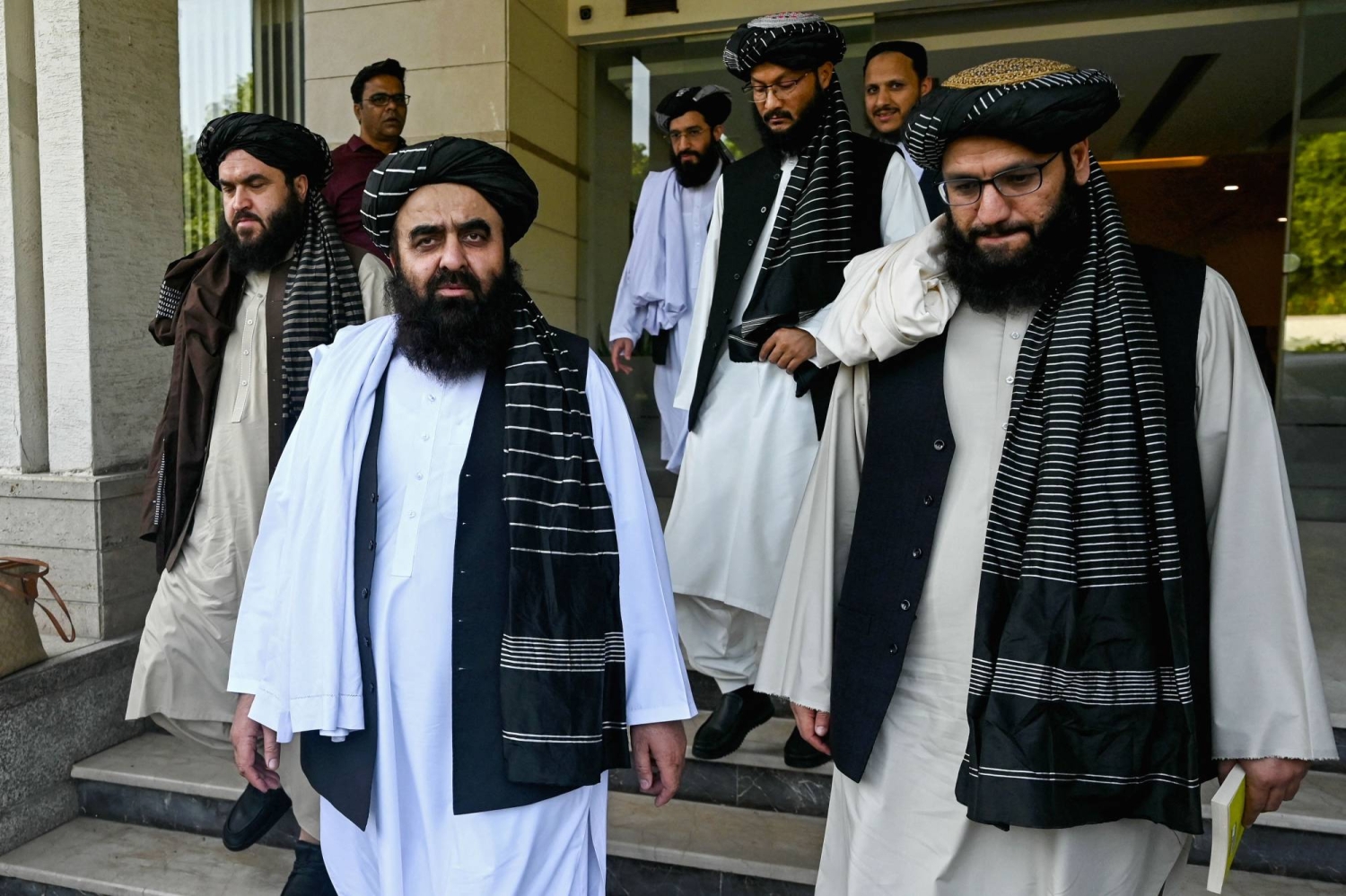
Afghan Foreign Minister Amir Khan Muttaqi (center) leaves after attending a news conference at the Embassy of Afghanistan in New Delhi on Oct. 12. The reopening of India's embassy in Kabul followed Muttaqi’s recent visit to India's capital.
Afghan Foreign Minister Amir Khan Muttaqi (center) leaves after attending a news conference at the Embassy of Afghanistan in New Delhi on Oct. 12. The reopening of India’s embassy in Kabul followed Muttaqi’s recent visit to India’s capital. | AFP-JIJI

By Brahma Chellaney, Contributing Writer, The Japan Times

By reopening its embassy in Kabul on Oct. 21, India has chosen engagement over isolation — a move that could prompt other major democracies, from Japan to the United States, to follow suit.

The decision restores direct communication with the Taliban rulers at a time when Pakistan’s airstrikes last month triggered several days of border conflict with Afghanistan, sharply worsening bilateral relations. India’s move also signals a readiness to deal with those in power — however unpalatable — to safeguard its long-term interests in Afghanistan and beyond.

The reopening followed Taliban Foreign Minister Amir Khan Muttaqi’s recent visit to India, enabled by a special United Nations sanctions exemption. While marking a cautious reset in India-Taliban relations, the visit indicated a shift in Afghanistan’s regional power dynamics as New Delhi and Kabul seek to counterbalance the influence of China and Pakistan.

The Taliban, meanwhile, are resisting U.S. President Donald Trump’s pressure to let America reclaim Bagram Airbase, which served as the nerve center of America’s 20-year war in Afghanistan. On Sept. 20, Trump warned that “bad things” would happen to Afghanistan if it did not return control of Bagram to the United States.

For New Delhi, the decision reflects a hard-nosed recognition of reality: The Taliban are in control and ignoring them would mean ceding ground to geopolitical rivals.

For more than three years, India maintained only a minimal presence in Afghanistan, limiting itself to humanitarian aid and discreet contacts through intermediaries. The cautious stance stemmed from India’s deep discomfort with the Taliban’s ideology and their historic ties to anti-India, Pakistan-backed terrorist groups. Yet as the regional landscape shifts, pragmatism is overtaking principle.

The embassy reopening suggests that the Taliban have provided credible assurances — both on the security of Indian personnel and on ensuring that Afghan territory will not be used by groups hostile to India. These guarantees, if honored, would mark a sharp break from the 1990s when the Taliban regime hosted Pakistani terrorist outfits like Lashkar-e-Taiba and Jaish-e-Mohammed.

Some skepticism is warranted. Critics argue that reopening the embassy lends de facto legitimacy to a regime that continues to suppress women’s rights and exclude minorities from governance. India has carefully avoided formally recognizing the Taliban regime. Yet, in practice, reopening the embassy implies a gradual normalization of relations.

India’s engagement rests less on trust than on calculation: It is safer to have a diplomatic foothold than to operate from the sidelines. For New Delhi, the calculus is strategic rather than moral: Regaining influence in Afghanistan is essential to India’s security and to balancing Pakistani and Chinese leverage.

India has long been among Afghanistan’s leading development partners. It has invested billions of dollars in infrastructure, education and health projects — from the Salma Dam and the Afghan Parliament building to the Indira Gandhi Children’s Hospital in Kabul. These investments won India enduring goodwill among Afghans and embodied its soft-power approach to regional influence.

The Taliban’s return in 2021 froze most projects and raised fears that India’s hard-won gains would erode. The return of Indian diplomats will help safeguard these assets and could revive stalled initiatives, especially in sectors that benefit ordinary Afghans rather than the Taliban leadership.

For India, economic engagement is also a means to reassert its strategic footprint. Trade and connectivity form the backbone of this renewed outreach. New Delhi is keen to expand the use of Iran’s Chabahar Port — a vital alternative to the China-run Gwadar Port in Pakistan — for trade with Afghanistan and Central Asia.

Facing isolation and sanctions, the Taliban have sought Indian participation in mining and infrastructure projects. Afghanistan’s vast untapped reserves of lithium, copper and rare earths could eventually become a new arena for cooperation, though the political risk remains high.

The timing is significant. The sharp deterioration in Afghanistan-Pakistan ties opened a window for India to reengage. The India-Taliban rapprochement represents a major setback for Pakistan, whose Inter-Services Intelligence agency spent over 25 years nurturing the Taliban as a strategic asset.

More broadly, India’s approach reflects a shift toward issue-based realism in its neighborhood policy. Across South Asia, New Delhi has been recalibrating its diplomacy — engaging whoever holds power, including the Islamist-leaning regimes in Bangladesh and the Maldives and Myanmar’s military junta. In Afghanistan, India will have to walk a fine line: supporting the rights and aspirations of the Afghan people while engaging the Taliban to ensure the country does not again become a sanctuary for anti-India terrorism.

That balancing act is complicated by the international community’s divided stance. While some countries — such as China, Russia, Turkey, Iran and Pakistan — have accredited ambassadors to the Taliban regime, others, especially in the West, remain unwilling to go beyond limited humanitarian engagement.

The Trump administration, however, has sent high-level officials to Kabul for meetings with the Taliban, signaling a shift toward more direct engagement on certain issues. U.S. officials like Special Envoy for Hostage Response Adam Boehler discussed possible economic arrangements, security cooperation and even an American presence at Bagram.

Like Washington’s pragmatic engagement with the Taliban, India’s return to Kabul represents a quiet but consequential recalibration. It reflects a recognition that in a volatile region, diplomatic absence is a luxury no major power can afford. Engagement gives India leverage, intelligence and access — tools indispensable for managing the crosscurrents of regional security.

India’s action could now lead other important players to also choose realism over principle, tacitly acknowledging that effective diplomacy often requires engaging regimes as they are, not as one wishes them to be. Strategic absence in Afghanistan is no longer a viable option.

Brahma Chellaney, a longstanding contributor to The Japan Times, is the author of nine books, including “Water: Asia’s New Battleground.”

From peace to power: How the Nobel Peace Prize turned political

Featured

Opposition leader Maria Corina Machado greets supporters during a protest against Venezuelan President Nicolas Maduro the day before his inauguration for a third term in Caracas, Venezuela, on Jan. 9, 2025. Photo by Associated Press

By Brahma Chellaney, The Hill

The Oslo-based Nobel Peace Prize committee may have turned down President Trump’s latest bid for glory. Yet by honoring Venezuelan opposition leader María Corina Machado — at a time when Trump is openly backing efforts to topple the government in Caracas — it has laid bare the extent to which the peace prize has become a political instrument.

Trump’s allies have predictably fumed over his snub, and the White House itself drove the point home by accusing the Nobel jury of putting “politics over peace.”

But Machado, Venezuela’s “iron lady,” has long courted the Trump camp and even dedicated her prize “to the people of Venezuela and to President Trump for his decisive support of our cause.” In an NPR interview, she went further, declaring that if Trump succeeded in overthrowing President Nicolás Maduro, it would “ignite regime change” across the Americas — including in Cuba to Nicaragua.

Over the decades, no Nobel award has courted more controversy than the peace prize, which — unlike the other five Nobel awards chosen by the Stockholm-based Nobel Foundation — is selected and bestowed in Norway. The prizes bear the name of Alfred Nobel, the Swedish arms tycoon who made his fortune selling cannons and explosives.

The irony is enduring: An arms dealer’s legacy, now dispensed by a committee that too often confuses politics for peace. Nobel’s own will was explicit. The prize, he wrote, should go to the person who has done “the most or the best work for fraternity between nations, for the abolition or reduction of standing armies, and for the holding and promotion of peace congresses.”

That mandate has been repeatedly ignored. Geopolitical convenience, not peace, has become the guiding principle. Machado’s award — ostensibly for “promoting democratic rights for the people of Venezuela” — reads less like a tribute to peacebuilding and more like an endorsement of regime change.

Trump, of course, is no peacemaker, despite his victory lap for brokering a Gaza ceasefire. By ordering airstrikes on Iran, he betrayed his own 2025 inaugural pledge that his “proudest legacy will be that of a peacemaker and unifier.”

Yet the Peace Prize has gone before to war-makers and bloodstained militarists. Henry Kissinger, architect of the secret carpet-bombing of Cambodia and Laos, shared the 1973 award. Yitzhak Rabin, who oversaw the “force, might, and beatings” policy during the Palestinians’ First Intifada, was another laureate.

Far from honoring genuine peacemakers, the Nobel committee has often used the award to advance Western foreign policy interests. Machado is simply the latest in a long line of anti-regime figures crowned to signal Western solidarity.

Aung San Suu Kyi, now detained in Myanmar, and China’s Liu Xiaobo, whose 2010 award froze Norway’s ties with Beijing for six years, are prime examples. Oslo eventually pledged not to support actions undermining “China’s core interests.” When the committee blamed Beijing for Liu’s premature death in 2017, it apparently forgot its own geopolitical calculus.

Then there is Muhammad Yunus. Awarded the peace prize in 2006, he was hailed as a bridge between Islam and the West at a time when post-9/11 fears had gripped the West. Today, Yunus presides over rampant rights abuses and extrajudicial killings as head of an Islamist-leaning regime in Bangladesh. Yet the Nobel committee, having served its political purpose, looks the other way.

Such choices erode the moral authority that once gave the peace prize its aura. By turning it into a geopolitical signal, the committee diminishes its power to inspire genuine peacemakers. Instead of being a universal emblem of hope, the prize risks becoming a partisan badge of ideological alignment.

There is another danger: Politicized prizes can deepen the conflicts they claim to ease. When the Nobel committee sides publicly with one faction in a polarized nation, it emboldens that camp while hardening the regime’s resolve — fueling repression under the convenient label of “foreign interference.”

The committee’s habit of rewarding intentions over achievements makes things worse. The peace prize has become a tool to encourage desired political transitions rather than celebrate actual peacemaking.

If the committee continues to align its selections with geopolitical agendas rather than universal peace principles, it risks moral bankruptcy. A prize seen as a tool of soft power cannot credibly honor those who challenge power.

The Nobel committee still has time to restore integrity to the world’s most famous award. It can begin by returning to Alfred Nobel’s mandate: rewarding tangible efforts to reduce armed conflict and foster fraternity between nations. That would mean fewer political signals, fewer premature coronations, and a renewed focus on results, not rhetoric.

The world does not need another politicized trophy. It needs a genuine celebration of peacemaking — one that transcends ideology, resists manipulation and reclaims its moral core. Only then can the Nobel Peace Prize once again stand as what it was meant to be: A beacon of peace in an increasingly divided world.

Brahma Chellaney is the author of nine books, including the award-winning “Water: Asia’s New Battleground.”

Xi’s Purges Reveal His Insecurity

Featured

From surveilling and repressing Chinese citizens to firing and prosecuting potential rivals, Chinese President Xi Jinping seems able to rule only through fear. But fear is not a foundation for long-term stability, and the more Xi seeks to consolidate power, the more vulnerable his position becomes.

Brahma ChellaneyProject Syndicate

During his 13 years in power, Xi Jinping has steadily tightened his grip on all levers of authority in China – the Communist Party of China (CPC), the state apparatus, and the military – while expanding surveillance into virtually every aspect of society. Yet his recent purge of nine top-ranking generals, like those before it, shows that he still sees enemies everywhere.

After taking power in 2012, Xi launched a crackdown on corruption within the CPC and the People’s Liberation Army (PLA). The campaign was initially popular, because China’s one-party system is rife with graft and abuse of power. But it soon became clear that enforcement was highly selective – a tool not for building a more transparent or effective system, but for consolidating power in Xi’s hands. In Xi’s China, advancement depends less on competence or integrity than on earning the leader’s personal trust.

But even after more than a decade of promoting only loyalists, Xi continues to dismiss officials regularly, including top military commanders. According to the US Office of the Director of National Intelligence, nearly five million officials at all levels of government have been indicted for corruption under Xi. And this is to say nothing of those who simply disappear without explanation.

True to form, Xi’s regime claims that the military leaders swept up by his latest purge – including General He Weidong, a member of the Politburo, Vice Chair of the Central Military Commission, and the third-highest-ranking figure in China’s military hierarchy – committed “disciplinary violations” and “duty-related crimes.” But a more plausible explanation is that Xi is playing an interminable game of Whac-a-Rival, desperately trying to preserve his grip on power.

Xi’s fears are not entirely misplaced: each new purge deepens mistrust among China’s elite and risks turning former loyalists into enemies. From Mao Zedong to Joseph Stalin, there is ample evidence that one-man rule breeds paranoia. By now, Xi may well have lost the ability to distinguish allies from foes. At 72, Xi remains so insecure in his position that, unlike even Mao, he has refused to designate a successor, fearing that a visible heir could hasten his own downfall.

None of this bodes well for China. By refusing to lay the groundwork for an eventual leadership transition, Xi sharply increases the risk that the end of his rule – however that comes – will usher in political instability. In the meantime, Xi’s emphasis on personal fealty over ideological conformity is weakening institutional cohesion in a system once grounded in collective leadership. Coupled with his arbitrary firings and prosecutions, Chinese governance is now increasingly defined by sycophancy and anxiety, rather than competence and consistency.

China’s military is paying a particularly steep price for Xi’s insecurity. In recent years, the PLA has undergone sweeping structural reforms aimed at transforming it into a modern fighting force capable of “winning informationized wars.” But Xi’s purges risk undermining this effort by disrupting military planning and leadership. For example, his abrupt removal in 2023 of the leaders of the PLA’s Rocket Force, which oversees China’s arsenal of nuclear and conventional missiles, may have jeopardized China’s strategic deterrent.

Replacing experienced commanders with untested loyalists might ensure Xi’s political survival – and Chinese leaders have often used the military to safeguard their own power – but it does nothing for national security. And when generals are preoccupied primarily with political survival, both morale and operational readiness suffer. Can the PLA fight and win a war against a major adversary like the United States or India while operating under the political constraints Xi has imposed on it?

So far, Xi has advanced his expansionist agenda through stealth and coercion rather than open warfare. But a paranoid leader surrounded by sycophants unwilling or unable to challenge him is always at risk of strategic miscalculation. Recall that Stalin decimated the Red Army’s leadership on the eve of the Nazi invasion – with disastrous results. In Xi’s case, it might be China that does the invading, if he orders an amphibious assault on Taiwan.

For all the pomp surrounding China’s rise, the country is beset by structural problems, including a slowing economy, rising youth unemployment, and an aging and declining population. Popular discontent may well be growing, but it is masked by repression, just as any potential challenge to Xi’s leadership is preempted by purges and prosecutions. Ultimately, Xi seems able to rule only through fear.

But fear is not a foundation for long-term stability. A leader consumed by fear of disloyalty may command obedience but not genuine fidelity. Obedience is not merely a poor substitute for strength; it can become a source of fragility, as it leaves little room for creativity, competency, or collaboration. The great irony of Xi’s approach is that the more he seeks to consolidate power in his own hands, the more vulnerable his rule becomes.

Mao’s purges culminated in chaos and national trauma. Xi’s methods are more sophisticated, but the underlying logic is the same – as could be the results.

Brahma Chellaney, Professor of Strategic Studies at the New Delhi-based Center for Policy Research and Fellow at the Robert Bosch Academy in Berlin, is the author of nine books, including Water: Asia’s New Battleground (Georgetown University Press, 2011), for which he won the 2012 Asia Society Bernard Schwartz Book Award.

© Project Syndicate, 2025.

Trump’s foreign policy: Isolationist rhetoric, interventionist reality

Featured

By Brahma Chellaney, The Hill

The U.S. has carried out scores of covert and overt regime-change operations since the last century. Scholarly consensus is clear: such interventions rarely advance U.S. interests and usually produce unintended consequences that recoil on America itself.

Yet President Trump’s administration is engaged in a barely disguised effort to topple President Nicolás Maduro’s regime in Venezuela.

The dissonance between Trump’s rhetoric and policy could not be starker. He has repeatedly denounced decades of U.S. intervention abroad, especially military-backed attempts at regime change and “nation-building.” After his 2016 victory, he declared: “We will stop racing to topple foreign regimes that we know nothing about, that we shouldn’t be involved with.”

But in contrast to this “America First” non-interventionist pose, Trump’s approach to Venezuela has been one of the most sustained U.S. campaigns for regime overthrow in recent memory. His strategy has included crippling sanctions, narcoterrorism indictments against Maduro and his associates, and naval deployments under the fig leaf of an anti-narcotics operation.

In recent weeks, after ordering strikes on Venezuelan boats that killed at least 21 people, Trump dispatched warships, surveillance planes and even an attack submarine — a show of force calculated to weaken and ultimately topple Maduro.

Such adventurism clashes with Trump’s latest bid to crown himself a global peacemaker. At the United Nations, he claimed he had “ended seven un-endable wars” and boasted “everyone” wanted him to win the Nobel Peace Prize. The problem is that some of the seven “wars” never existed, others remain unresolved, and in one case (the Israel-Iran conflict) Trump joined the fight by ordering U.S. bombing of Iranian nuclear sites. In his telling, this was peace by another name.

In 2023, Trump thundered, “Either the Deep State destroys America or we destroy the Deep State.” Yet since returning to the White House, he has often acted as executor of the very Deep State agenda he rails against. His distinction seems to be that the Deep State should confine itself to foreign entanglements while steering clear of domestic politics.

Trump’s Venezuela gambit ignores the long trail of regime-change debacles, from Guatemala and Chile to Afghanistan and Libya. Libya, since the 2011 overthrow of Muammar Qaddafi, remains a a failed state. The roots of Iran’s 1979 Islamic Revolution can be traced to the 1953 CIA-led Operation Ajax, which ousted a democratically elected prime minister and installed the Shah’s dictatorship.

Similarly, U.S. involvement in the 1973 Chilean coup achieved the goal of removing a socialist president but at the cost of propping up Augusto Pinochet’s brutal dictatorship. The coup stained America’s reputation and left scars that still shape Chilean politics.

Even failed regime-change efforts have produced blowback. Violent jihadism in Syria was fueled by a multiyear CIA program — the second largest in its history after the 1980s Afghan campaign — to topple Bashar al-Assad. Launched in 2012 under Barack Obama, the $1 billion project trained and armed anti-Assad rebels, inadvertently boosting jihadist forces and helping spawn the Islamic State. Trump himself shut it down in 2017, acknowledging that U.S.-supplied weapons had ended up in the hands of al-Qaeda, which had emerged from CIA-trained Afghan “mujahideen.” 

The destabilization of Libya, Syria and Iraq fueled a refugee influx into Europe — 1.1 million into Germany alone in 2015. That wave, in turn, stoked radical Islamism across Europe, with terror attacks in Munich, Nice, Brussels and Paris.

Most recently, following Assad’s downfall last December, Trump embraced Syria’s new president — a former jihadist warlord with al-Qaeda roots whose regime has intensified sectarian violence against non-Sunni minorities. When terrorists become American assets, America’s moral authority is collateral damage.

The history of U.S. regime-change operations reveals three recurring outcomes. First, regime replacement usually yields civil war, prolonged insurgency or outright state collapse. Second, interventions more often install authoritarian rule than foster democracy. Third, interference breeds resentment, undermines U.S. credibility as a defender of democracy and galvanizes extremist movements.

Venezuela holds the world’s largest proven oil reserves, which helps explain Trump’s zeal for regime change there. U.S. oil sanctions are designed to choke off Maduro’s main source of revenue and force his ouster. But they have created a severe humanitarian crisis, fueling Latin America’s largest refugee exodus in history and straining Venezuela’s neighbors, especially Colombia and Peru.

Trump has brushed aside both the human suffering and the sobering lessons of past adventures. Oil, not democracy, is the real prize he seeks in Venezuela.

By personalizing foreign policy to the point where major decisions hinge on impulse rather than consultation with national security professionals, Trump has heightened the risk of miscalculation. His Venezuela gambit may yet produce the same blowback that has defined so many regime-change campaigns — leaving the U.S. weaker, not stronger, in Latin America and beyond.

Brahma Chellaney is the author of nine books, including the award-winning “Water: Asia’s New Battleground.”
What Western media call insurrection at home, they call revolution abroad

Featured

The selective storytelling applies double standards in domestic vs. global coverage

Bangladeshis celebrate in Dhaka on Aug. 5, the first anniversary of student-led protests that ousted former Prime Minister Sheikh Hasina.

By Brahma Chellaney
Contributing Writer, The Japan Times

Imagine if Western media had described the mob attack on the U.S. Capitol on Jan. 6, 2021, not as lawlessness and an assault on democracy but as democratic ferment against a corrupt system beholden to money and power. The thought is absurd. Yet in the Global South, politically driven riots — sometimes even violent mob attacks on state institutions — are routinely depicted in Western outlets as righteous uprisings against venal elites.

Western media have perfected a seductive but dangerous narrative: the romanticized tale of youth-led “revolutions” toppling supposedly repressive, graft-ridden governments abroad. In just the past month, coverage of political unrest in Madagascar, Nepal, Indonesia and the Philippines has followed the same script. The ouster of Sheikh Hasina in Bangladesh in 2024 was packaged as a heroic liberation, only for Islamist repression and chaos to follow.

This is not journalism. It is selective storytelling that applies one moral framework at home and abandons it abroad. What would be denounced as sedition in Washington is rebranded as democratic awakening in a fragile state.

Take Nepal. After mobs began torching one state institution after another — parliament, the supreme court, ministries, banks and even armories — the elected government fell. The West’s narrative machine promptly lionized the new interim prime minister, Sushila Karki, as an “anti-corruption crusader” and Gen Z icon. Her lack of constitutional legitimacy and her husband’s record as a 1973 plane hijacker barely merited a footnote. What mattered was a simple, digestible story: angry young people overthrowing a corrupt regime.

Such hero-making privileges narrative satisfaction over factual complexity. The coordinated arson that gutted Nepal’s public institutions was framed not as criminal destruction but as “youthful idealism.” In reality, democracy requires functioning courts, legislatures and bureaucracies — the very institutions that mobs incinerated. To glorify their destruction is not to defend democracy but to undermine it.

The double standards extend beyond violent upheavals. Consider disasters. In principle, journalism demands sensitivity in reporting grief. In practice, Western coverage of tragedies abroad often traffics in voyeurism, cultural stereotyping and sensationalism.

Japan’s 2011 Fukushima disaster is one case: Victims’ suffering was reduced to a backdrop for lurid stories about radiation. Workers at the nuclear plant were stereotyped as “nuclear samurai,” “human sacrifices” or “nuclear ninjas on a suicide mission.” Never mind that preventive evacuations ensured no radiation deaths occurred. Grossly misleading comparisons to Chernobyl fed hysteria rather than clarity.

The COVID-19 pandemic revealed the same skew. According to the World Health Organization, more people officially died in the West than in the non-Western world. The United States led in both cases and deaths. Yet the images Western audiences saw were overwhelmingly from India, Brazil or Africa. When India was ravaged by a two-month wave in the pandemic’s Delta phase, Western media beamed out haunting images of burning pyres and gasping patients in hospitals where foreign crews intruded even into emergency wards. But when mass graves were dug in New York or refrigerated trucks lined Western streets to store bodies, the imagery was sanitized.

Africa has long borne the brunt of such stereotypes. Coverage of the 2014 to 2016 Ebola epidemic, which killed 11,325 people, was drenched in images of body bags, burial rituals and despair. The Pulitzer Prize went to a photographer who shadowed body collectors. The fact that the epidemic was confined to three countries barely registered. To global audiences, Ebola became an “African” disease, cementing a continent-wide stigma.

This pattern extends to war. Western media rarely show images of dead American or European soldiers. Yet they freely publish photographs of slain Afghans, Iraqis, Libyans or Syrians. Grief is privatized at home but paraded abroad.

To be sure, Western outlets are not monolithic, nor are they incapable of occasionally sensationalizing domestic tragedy. But the larger pattern is unmistakable: When violence or disaster occurs outside the West, journalistic norms of restraint, accuracy and dignity are loosened or abandoned.

Why does this matter? Because Western media double as global media. Their frames and images shape international perceptions. When arson and mob violence are repackaged as “revolution” abroad, they gain moral cover that fuels instability rather than reform. When death and disaster are depicted through exoticized lenses, whole societies are reduced to stereotypes.

Consistency is the real test of credibility. If storming Congress is insurrection in Washington, storming parliament cannot be celebrated as democratic ferment in Nepal. If images of mass funerals in New York are shielded from the public eye, burning bodies in New Delhi should not be broadcast as a global spectacle.

The bifurcated lens does not merely distort. It legitimizes abroad what it denounces at home. It excuses destruction when it happens in the Global South while criminalizing it when it happens in the West.

It is time for Western media to abandon these double standards. Thoughtful, responsible journalism requires applying the same rules of coverage everywhere: respect for facts, consistency in moral frameworks and sensitivity toward human suffering. Otherwise, what poses as universal reporting is little more than cultural narcissism disguised as news.

Brahma Chellaney is a geostrategist and the author of nine books, including “Water: Asia’s New Battleground.”

Trump’s Peacemaker Hype

Featured

It takes a special kind of genius to end wars that never started. Trump has achieved what no military general in history ever managed: ending wars that never began. No shots fired, no armies on the march — yet Trump claims three historic triumphs

Brahma ChellaneyProject Syndicate

GENEVA – “Everyone says that I should get a Nobel Peace Prize,” US President Donald Trump told the United Nations General Assembly this week, because “I ended seven un-endable wars in seven months.” The boast was classic Trump: extravagantly formulated, unironically delivered, and patently false.

A recent poll indicates that only 22% of US adults believe that Trump deserves the Nobel Prize – a far cry from “everyone” – with 76% of respondents stating that he does not deserve it. Perhaps this reflects the fact that Trump has not ended seven wars. Arguably, he has not even ended one.

Some of Trump’s claims were pure fiction. For example, he took credit for ending a war between Egypt and Ethiopia. But, although bilateral tensions over the Grand Ethiopian Renaissance Dam have simmered for years, they have never boiled over into war. Likewise, Trump claimed to have ended a nonexistent war between Kosovo and Serbia. Despite considerable hostility – and a history of violent clashes – the two countries have not been at war since the 1990s. No war is easier to end than one that has never started.

Perhaps Trump’s most risible invention was the war – “a bad one” – between Armenia and Cambodia, countries located over 4,000 miles (6,500 kilometers) apart that have never had any conflict whatsoever. Armenia did clash with neighboring Azerbaijan this year, and Trump convinced both countries’ leaders to sign a joint declaration aimed at ending their decades-long conflict. But progress on implementing that agreement has stalled, and the accord is in danger of unraveling. That Trump would consider this conflict “ended” reveals the depth of his ignorance about peacemaking.

The same goes for the war between the Democratic Republic of Congo and Rwanda. Trump does have a set piece to point to: a “wonderful” US-mediated deal. But while the war may have ended on paper, deadly clashes continue.

As for Cambodia, it engaged in skirmishes with its neighbor Thailand in July over their contested border. But Trump’s attempts at economic coercion did little to defuse the crisis. What brought the fighting to an end was the Association of Southeast Asian Nations’ diplomacy, with this year’s ASEAN chair, Malaysian Prime Minister Anwar Ibrahim, hosting the Cambodian and Thai leaders for face-to-face talks in Kuala Lumpur. While the underlying border dispute, centered largely on ownership and control of ancient Hindu temples, remains unresolved, the “immediate and unconditional” ceasefire that Anwar brokered halted the violence.

This is not the only example of Trump taking credit for others’ foreign-policy acumen. After Pakistan-backed terrorists massacred Indian tourists in Indian-administered Kashmir in April, India took decisive and carefully calibrated retaliatory action, launching military strikes on Pakistani terror camps. It was this show of force that made Pakistan back down, but Trump would have the world believe that he single-handedly mediated an end to the conflict using his favorite tool: trade threats. So absurd and relentless were his boasts that Indian officials publicly refuted him.

Trump’s most audacious claim, however, was that he ended the war between Israel and Iran. In reality, Trump gave Israel the green light to strike Iranian positions; deployed American military assets to help Israel shoot down Iran’s missiles and drones; and ordered the bombing of Iranian nuclear sites – severely undermining the global nonproliferation regime in the process. If this is Trump’s idea of peacemaking, one dreads to think what his version of warmongering would look like.

Trump’s Nobel Peace Prize campaign has followed a familiar pattern: invent or inflate a problem, claim to have solved it, and then demand a reward. From his photo ops with North Korean leader Kim Jong-un to his Middle East “peace deals” (which merely formalized existing relations between the Gulf states and Israel), Trump engages in theater, not diplomacy – performances staged for headlines and applause. The Norwegian Nobel Committee, one suspects, will not be fooled. The same cannot be said for Trump’s base.

Trump’s absurd claims not only undermine US credibility abroad but also carry real risks. For starters, they trivialize genuine peacemaking. Ending wars is among the most difficult tasks in international politics. It demands quiet diplomacy, painstaking negotiations that address the root causes of conflict, and a commitment to following through on any agreement. Trump has shown little interest in such work. All he cares about is fanfare.

Moreover, false declarations of peace can mask unresolved conflicts and undermine the vigilance needed to prevent new flare-ups, which could ignite with even greater ferocity. Such proclamations can also erode accountability for diplomatic failures – and even for reckless military actions like those Trump sanctioned against Iran.

Trump’s claim to have ended seven “un-endable” wars is best understood as a case study in self-delusion. Branding is not leadership. Real peace depends on leaders who know the difference. But in Trump’s world, peace is not the absence of war, but the presence of applause.

Brahma Chellaney, Professor of Strategic Studies at the New Delhi-based Center for Policy Research and Fellow at the Robert Bosch Academy in Berlin, is the author of nine books, including Water: Asia’s New Battleground (Georgetown University Press, 2011), for which he won the 2012 Asia Society Bernard Schwartz Book Award.

© Project Syndicate, 2025.

China’s Himalayan mega-dam is a global threat

Featured

The largest dam ever conceived symbolizes China’s bid, from oil to water, for 21st-century dominance

Avatar

Brahma Chellaney

Nikkei Asia

20250912 dam

China is about to upend the world’s hydrological balance — with consequences as far-reaching as climate change itself.

Its $168 billion Himalayan super-dam represents not merely the world’s costliest infrastructure project but also one of its riskiest. What Beijing portrays as an engineering marvel is in fact an ecological disaster in the making.

The dam is being constructed on the Yarlung Zangbo River (also known as the Brahmaputra), just before it curves into India. The project’s significance was underscored by the fact that Chinese Premier Li Qiang, flanked by senior officials and leaders of major state-owned enterprises, formally announced the groundbreaking in July, although satellite imagery had indicated activity at the site for some time.

The last time a Chinese leader inaugurated a dam project was 1994, when then-Premier Li Peng presided over the groundbreaking ceremony for the Three Gorges Dam on the Yangtze River. That symbolic parallel underscores the magnitude of the Brahmaputra mega-dam — an undertaking that will surpass the Three Gorges in scale, ambition and peril.

The Three Gorges Dam was initially celebrated as a modern wonder but is now widely recognized as an environmental and social disaster: It displaced more than a million people, triggered recurrent landslides, degraded water quality and disturbed seismic stability. Its mammoth reservoir has even slightly slowed the Earth’s rotation.

China’s new megaproject is in an even more fragile setting: one of the world’s most seismically active zones, straddling a heavily militarized frontier where Beijing claims India’s sprawling Arunachal Pradesh state as “South Tibet.” Constructing the world’s largest dam atop a geological fault line is more than reckless — it is a calculated gamble with catastrophic potential. Any collapse, whether from structural weakness or reservoir-induced seismicity, would devastate India’s northeast and Bangladesh, placing tens of millions at risk.

The dam, designed to generate nearly three times the electricity of the Three Gorges Dam, was approved by the National People’s Congress in March 2021. Yet the project remained cloaked in secrecy until the recent announcement, true to Beijing’s pattern of concealing work on major dams along international rivers until commercially available satellite imagery makes it impossible to hide.

The Brahmaputra, unlike most rivers, is an ecological lifeline, sustaining one of the world’s most biodiverse regions as it descends sharply from Himalayan heights to form the longest and steepest canyon on Earth — twice as deep as America’s Grand Canyon. It is here that China is constructing the behemoth dam to tap the unparalleled concentration of river energy.

Originating in Tibet’s mountain springs, the world’s highest-altitude major river flows through India and Bangladesh, supporting agriculture, fisheries and dense populations. Its annual floods, while destructive, flush toxins, recharge groundwater and deposit nutrient-rich sediment vital for farming. The super-dam will upend this rhythm, trapping silt, shrinking Bangladesh’s delta already imperiled by rising seas and depriving Indian farmers of natural fertilization cycles. Saltwater intrusion and catastrophic floods would become more frequent.

But Beijing sees water not just as a resource; it sees it as power. By placing a mega-dam just before the river leaves Tibet, China would acquire a hydraulic chokehold over hundreds of millions downstream.

Control over oil once defined global power. And, in the 21st century, control over transboundary rivers may prove just as decisive. With the dam, China would hold the ability to weaponize water without firing a shot.

The dam’s enormous price tag reflects not just ambition to generate enormous amounts of electricity but a determination to cement China’s hydro-hegemony through dominance over Asia’s lifelines. This would give Beijing the same strategic leverage over water as OPEC once enjoyed over oil — but with far greater immediacy for the daily survival of populations.

In fact, since annexing Tibet in 1951, China has become the source of cross-border river flows to more countries than any other upstream power. It has built more large dams than the rest of the world combined, with its spree since the 1990s focused on international rivers. Its 11 giant dams on the Mekong have already wreaked havoc downstream, deepening droughts and undercutting livelihoods in Thailand, Laos, Cambodia and Vietnam.

Yet Beijing continues to reject any form of water sharing. It has signed no water-sharing treaty with any neighbor, nor joined the 1997 U.N. Watercourses Convention — the only global treaty governing shared rivers — preferring instead to assert “indisputable sovereignty” over all waters within its borders.

The stakes extend beyond Asia. Tibet is warming twice as fast as the global average, accelerating glacier melt and permafrost thaw. With its towering height rising into the troposphere, the Tibetan Plateau shapes the Asian monsoons, stabilizes climate across Eurasia and influences the Northern Hemisphere’s atmospheric general circulation — the vast system of winds that helps define different climate zones by transporting warm air from the equator toward higher latitudes.

Tampering with the plateau’s hydrology is not just a regional gamble; it is a planetary risk. Altered river flows from Tibet will ripple outward into weather systems, food security and even migration patterns far beyond Asia.

If Beijing succeeds in monopolizing transboundary rivers, other states may be tempted to follow, eroding fragile cooperative frameworks elsewhere — from the Nile Basin to the Tigris-Euphrates. The mega-dam is thus not merely Asia’s problem but the world’s. The precedent it sets could destabilize water security worldwide at a moment when droughts and extreme weather are already straining societies.

This gargantuan dam is a geopolitical and ecological catastrophe in waiting, with its dangers already coming into view. Silence is complicity: The international community must press China to respect international water norms.

Brahma Chellaney, a professor of strategic studies at the independent New Delhi-based Centre for Policy Research and fellow at the Robert Bosch Academy in Berlin, is the author of nine books, including “Water: Asia’s New Battleground,” which won the Bernard Schwartz Book Award.

The fracturing world order

Featured

By Brahma Chellaney, The Hill

The tectonic plates of global power are shifting. The American-led postwar order is eroding without a clear successor. In this uncertain interregnum, there is a growing risk of the world fracturing into rival geopolitical and economic blocs, threatening both prosperity and peace.

Two recent events in China encapsulate this transformation. On Aug. 31 to Sept. 1, leaders gathered in Tianjin for the annual summit of the Shanghai Cooperation Organization, a 10-nation grouping that began as a regional security forum but has steadily expanded its scope and ambition. With China in the driver’s seat, the group is made up mostly of autocracies.

Soon after, on Sept. 3, China staged a massive military parade in Beijing to commemorate the end of the Sino-Japanese War and World War II. Yet far from celebrating peace, the event showcased Chinese military might, with a guest list that read like a who’s who of the world’s strongmen. They included Russian President Vladimir Putin, North Korea’s Kim Jong-un, Myanmar junta chief Min Aung Hlaing, and the presidents of Iran, Cuba, Belarus and Vietnam. They make up the so-called “Axis of Upheaval” — a loose coalition of states determined to reshape the Western-led global order.

The juxtaposition was telling. The summit highlighted how Beijing and Moscow are institutionalizing their strategic alignment, while the military parade underlined the solidarity of a growing authoritarian camp. For China and Russia, the Shanghai Cooperation Organization serves as both a symbol and an instrument of their deepening cooperation — from joint military exercises to efforts at shaping the economic and security architecture of Eurasia.

For Washington and its allies, these gatherings sent a clear signal: An alternative power bloc is taking shape.

President Trump is accelerating the reordering of the international system, though not in the way he believes. Trump may think he is bending nations to his will, but history could record something else: the corrosion of America’s alliances and partnerships, the erosion of its credibility and the acceleration toward a truly multipolar world. By elevating disruption into his governing creed, Trump is unwittingly providing the very shock therapy the international system needs to break free from U.S. dominance.

This geopolitical realignment is mirrored in the economic sphere. Globalization, once seen as irreversible, has stalled and may even be going into reverse. Protectionist policies are proliferating.

Washington has turned to tariffs, subsidies and secondary sanctions to advance its geopolitical ends. Beijing is promoting yuan-based settlement mechanisms and alternative supply chains, while procuring gold at a voracious pace to insulate itself from Western financial pressure, including potential sanctions.

What is emerging is not a single global marketplace but a patchwork of rival trading and financial blocs.

The consequences are already visible. The U.S. push to “de-risk” supply chains has triggered costly reshoring and diversification strategies. Technology is splitting into parallel ecosystems. Energy markets, too, are fragmenting, with Russian oil and gas exports largely shifting from Europe to Asia. In finance, competing payment systems are gaining traction, threatening to erode the central role of the U.S. dollar.

At the same time, the spread of armed conflicts shows how economic and geopolitical fractures feed on each other. In recent years, the number of wars and crises has risen, each with ripple effects on energy prices, supply chains and refugee flows.

The turbulence reflects a world in transition: the slow decline of the U.S.-led order without the emergence of a stable successor. It is the dawn of a new era — fractured, fiercely contested and dangerously unpredictable.

This moment echoes the 1930s — not in its specifics, but in its warning. Then, a world system changing between orders witnessed the emergence of competing economic blocs, fueling nationalist rivalries that eventually erupted into global war. The challenge today is not merely to manage competition, but to prevent economic, technological and ideological fragmentation from spiraling into chaos. That requires leadership, restraint and imagination — qualities in short supply.

In this environment, much will depend on how “swing states” position themselves. A recent report by the Center for a New American Security identified six such states as pivotal to the emerging global order: Brazil, India, Indonesia, Saudi Arabia, South Africa and Turkey. Each is multi-aligned, seeking to balance ties with the U.S., China and Russia rather than choosing sides. Collectively, they wield the ability to influence whether the world fragments into hostile blocs or maintains a degree of pluralism and connectivity.

India is perhaps the most critical of these nations. As the only long-established democracy in the Shanghai Cooperation Organization, it is trying to prevent the grouping from acquiring an overtly anti-Western orientation, even as it participates in Western-led forums such as the Quad and, as a special invitee, the Group of 7.

Brazil, like India, is charting an independent course on trade and climate, while Saudi Arabia and Turkey are expanding ties eastward without severing links to the West. These countries demonstrate that the binary framing of “democracies versus autocracies” does not reflect the real complexity of international politics.

The danger, however, is that intensifying U.S.-China rivalry could reduce the room for maneuver for such states. If Washington sharpens its protectionist edge while Beijing doubles down on its authoritarian partnerships, the middle ground will narrow. Economic and security fragmentation could harden into a bipolar structure — two camps with little trust, minimal cooperation and heightened risk of confrontation.

That outcome is not inevitable. But preventing it will require conscious effort. Multilateral frameworks must be strengthened, not abandoned. Global cooperation — on climate change, pandemic preparedness, food security and technology standards — must be preserved despite geopolitical tensions. Above all, great powers must recognize that fragmentation carries grave risks not just for growth but for stability.

The world has been here before. The lesson of the 20th century is that when trade and politics fracture into competing blocs, confrontation follows. Unless today’s drift is reversed, the coming decade may bring not just the end of globalization, but the return of bloc-driven conflict.

Brahma Chellaney is the author of nine books, including the award-winning “Water: Asia’s New Battleground.”