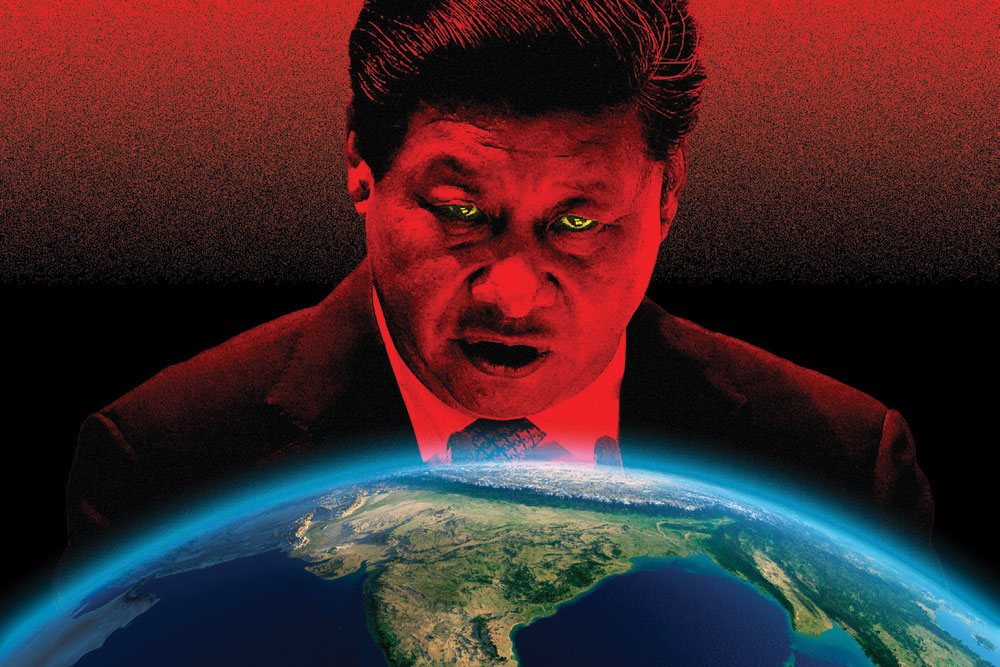
America’s Broken Democracy

Brahma Chellaney, The New Indian Express

In his national security strategy released in October, U.S. President Joe Biden promised to focus on restoring a damaged democracy at home. But the first-ever indictment of a former president in American history is likely to deepen the divide in an already bitterly polarized United States. Biden, far from promoting national reconciliation and healing as president, has proved as divisive as his predecessor, Donald Trump.

After the unsealing of the indictment, the criminal case against Trump looks even weaker than expected.

Indeed, some of former Trump’s fiercest critics, like Mitt Romney, have slammed the Manhattan district attorney’s case against the former president (who is running again for the same office) as flimsy and designed “to fit a political agenda.” Legal experts say it sets a dangerous precedent to go after political opponents. The district attorney belongs to the same party as Biden, against whom Trump is running.

According to a Quinnipiac University poll, more than two-thirds of Americans think U.S. democracy is broken. America’s image as a flawed democracy is likely be reinforced by the weaponization of the justice system, which is what Trump’s indictment represents.

The essence of democracy is that those in office will not misuse their power to go after political opponents. Yet high-profile political prosecutions through the misuse of the judicial apparatus are increasing in democracies.

For example, Brazil’s current president, Luiz Inácio “Lula” da Silva, was in 2017 convicted for alleged corruption and jailed until the country’s Supreme Court ruled that the judge who presided over the trial was biased against da Silva. Indeed, that judge became justice minister under President Jair Bolsonaro, who possibly would not have been elected in 2018 had da Silva not been in prison.

Stretching the law to target Biden’s leading opponent will make it more difficult for the U.S. to heal the deep split in society and transcend hardened polarization. Trump’s indictment followed the FBI’s unusual raid last August on his Mar-a-Lago residence in search of classified documents. Ironically, classified documents from Biden’s time as vice president were subsequently discovered at his Delaware home and elsewhere.

As president, Trump’s remarks often bore the hallmarks of bombastic assertions. But he also at times displayed refreshing candour and honesty on U.S. national security and foreign policy, which made him a key target of the “Deep State”, thus spurring false Russia-collusion claims and two failed impeachments.

To be sure, democratic ethics and values have come under growing pressure across the free world. The fever of polarizing politics has risen largely because the quality of political leadership has declined in almost all democratic countries. Instead of seeking national reconciliation, leaders have fanned the embers of divisive politics.

Media outlets have helped amplify such hyper-partisanship. They not only reflect but also drive the polarization in many democracies. Instead of adhering to a guiding ethic to report news objectively and in a balanced way, many newspapers and TV channels market, not report, news. According to one Gallup poll, Americans’ trust in the media has sunk to just 36%.

Many democracies are intensely polarized — from South Africa and India to South Korea and Brazil. Public trust in politicians across the democratic world has reached an all-time low.

But the U.S. is so polarized that it has been referred to as “One America, Two Nations.” It has morphed into the Polarized States of America, with both sides of the political divide resorting to inflammatory rhetoric and fuelling the deep divide.

Thanks to the widening schism between the two sides — which are segregated in their own ideological silos — tolerance for opposing views is increasingly in short supply. Such is America’s political divide that people holding rival beliefs are unwilling to even communicate with each other.

The partisan divide extends even to foreign policy. While U.S. public opinion surveys show that China has left Russia far behind to become America’s greatest enemy, far more Democrats than Republicans remain fixated on Russia. This has a bearing on actual policy, with Biden more focused on a declining Russia than on a globally expansionist China.

Meanwhile, the U.S. continues to move further away from the healing and unity Biden called for in his inauguration speech. Far from helping to end what he described as the “uncivil war” between liberals and conservatives, Biden has added fuel to the divisive politics. As Biden acknowledges in his national security strategy, “We live at a moment of passionate political intensities and ferment that sometimes tears at the fabric of the nation”.

U.S. hyper-partisan politics is plumbing new depths, cementing political divisions and poisoning national discourse. It is also undermining America’s international standing. This has emboldened the world’s largest and longest-surviving autocracy, China, to cheekily lecture the U.S. on human rights and democracy. For example, Yang Jiechi, the leader of the Chinese delegation at the March 2021 talks in Anchorage, Alaska, delivered a 16-minute jeremiad against U.S. hypocrisy and double standards.

Instead of fixing its broken democracy, the U.S. seeks regime change in the countries it targets — from Russia to Myanmar and Iran. It also lectures other countries, including India, on human rights, even as the human rights situation remains appalling within the U.S., where police kill more than 1,000 civilians each year.

For example, the State Department annually releases country reports on human rights practices that target America’s friends and foes alike. Meanwhile, the killing and maiming of unarmed Black people by police in the U.S. continues to increase.

The blunt truth is that hyper-partisan politics and debilitating polarization are not just weighing American democracy down, but also threatening to erode America’s global pre-eminence. After all, the bitterly divisive politics impedes the pursuit of long-term objectives.

Given the relative decline of its power, the U.S. needs a dynamic, forward-looking president who can unify an increasingly divided country. A poll last year found that almost two-thirds of Americans believe that the U.S. is on the wrong track under Biden.

Against this background, the last thing America needed is a criminal case against a former president that represents a further erosion of legal and democratic norms. More than China or Russia, America’s biggest enemy is within: It needs to find ways to move past its politics of polarization and vituperation so as to heal the wide divide in society.

Brahma Chellaney is a geostrategist and author of nine books, including “Water: Asia’s New Battleground”.

Is India’s China policy faltering?

Brahma Chellaney  |  Open magazine

The United States and India are close friends today, but American policy has long undermined Indian security, first by arming Pakistan as a counterweight to India from the 1950s onward and then aiding China’s rise following President Richard Nixon’s opening to China. That helped create an expansionist power on India’s northern borders. As president, Donald Trump acknowledged that his predecessors “created a monster” by facilitating China’s rise.

Under President Xi Jinping, China seems determined to achieve hegemony in Asia, which explains its stealth border aggression against India in April 2020 that has resulted in continuing military standoffs along the Himalayan border. India-China relations have fallen to their lowest point in decades, with no end in sight to the border confrontation between the two countries.

Yet, amid the military standoffs, Xi’s regime persists with provocative actions against India, including seeking to open new fronts. The fact that Beijing continues to provoke India without incurring any tangible costs points to a faltering China policy under Prime Minister Narendra Modi.

Despite the imperative to create incentives and disincentives to influence China’s conduct, New Delhi has shied away from substantive action, other than reinforcing military deployments and stepping up infrastructure development along the Himalayan frontier in response to the buildup of Chinese forces. The Indian government has refused to employ economic and diplomatic cards against Beijing, let alone name and shame China for its continuing border aggression.

Unfortunately for New Delhi, American policy under President Joe Biden is likely to further embolden Xi’s regime, with China’s neighbours likely to bear the brunt of the heightened Chinese revisionism.

Biden’s preoccupation with Russia, including bleeding it on the Ukrainian battlefields, limits his administration’s strategic space to deal with the threat from a globally expansionist China. The US may still be the world’s foremost military power but it is in no position to meaningfully take on Russia and China simultaneously.

The only potential winner from the war in Ukraine is likely to be America’s main rival, China. A recent report from a Washington-based organization said that China was already the “biggest winner” from the Western sanctions on Moscow. China has become Russia’s banker and most-important trade partner. China is also building an energy safety net through greater overland oil and gas flows from Russia at heavily discounted prices, thereby setting up secure supply lines that cannot be interrupted even if it invaded or blockaded Taiwan.

Indeed, the longer and deeper the US is involved in the war in Ukraine, the greater will be the dual likelihood of Xi launching aggression against Taiwan and Washington’s strategic nightmare — a Sino-Russian strategic axis — turning into reality. By compelling Russia (now the world’s most-sanctioned country) to pivot to China, US sanctions policy is chipping away at India’s strategic interests by making it more difficult to build Asian power equilibrium.

TAIWAN, THE NEXT UKRAINE?

The big question facing the world today is whether Taiwan could become the next Ukraine. If China were to succeed in incorporating Taiwan, Chinese military and strategic pressure on India would intensify. Indeed, India could bear the brunt of the geopolitical fallout from such a development.

Just as Russian President Vladimir Putin was clear about his plans for invading Ukraine, so has Xi been explicit about absorbing Taiwan.

The live-fire Chinese military drills around Taiwan last August, by simulating an air and sea blockade, demonstrated China’s combat capability to accomplish Xi’s “historic mission” to absorb that island. The drills allowed Chinese troops to practice enforcing Taiwan’s gradual economic strangulation or quarantine, suggesting that Xi could prefer a strategy of calibrated squeeze so as to force that island democracy to merge with China.

Make no mistake: Chinese aggression against Taiwan would likely have a greater global fallout than Russia’s invasion of Ukraine. Conflict over Taiwan would shape the new global order. A Chinese takeover of Taiwan would upend the balance of power in the Indo-Pacific region, and irreparably damage America’s reputation as a reliable ally, prompting US allies to re-evaluate their alliances.

The US National Security Council has projected that China’s annexation of Taiwan “could disrupt the world economy to the tune of more than $1 trillion.” Taiwan, after all, is the world’s unrivalled superpower in semiconductors. Just the giant Taiwan Semiconductor Manufacturing Company (TSMC) accounts for more than 90% of the global output of the most advanced semiconductors.

Xi seems pleased that the war in Ukraine is revealing Western military shortcomings, with weapons in short supply, critical munitions being depleted, and US capacity to restock insufficient, even as the American and European political consensus on the war is weakening.

Such shortcomings could tempt Xi, before moving on Taiwan, to help further deplete US weapons arsenals through indirect arms shipments to Russia, forcing the West to increase arms supplies to Ukraine. Xi is already aiding Putin’s war to a limited extent by supplying navigation equipment, jamming technology, fighter-jet parts, and semiconductors to sanctioned Russian entities.

Those in the West that say a negotiated armistice in Ukraine would only embolden Beijing’s designs against Taiwan overlook the fact that Xi, given his own cost-free expansionism from the South China Sea to the Himalayas, does not need to learn from Russia that aggression works. As a recent report from the influential think tank Rand Corporation suggested, a protracted Ukraine war — with its constant flows of US money and weapons and dangerously elevated risk of NATO-Russia conflict — would crimp a US pivot to the growing China challenge.

Xi, after changing the territorial status quo in the South China Sea and the Himalayas, is itching to move against Taiwan. With Russia tying the US down in the European theatre, Xi has greater strategic room to forcibly incorporate Taiwan. The issue is no longer if but when Xi will move against Taiwan.

Taiwan’s autonomous existence presently ties up a sizable portion of the armed forces of China, which also faces a strong US-Japan alliance in the defence of that island.

India likewise is helping Taiwanese defences by tying down a complete Chinese theatre force, which could otherwise be employed against Taiwan. Admiral Mike Gilday, the US Navy chief, said last August that India presents China a two-front problem: “They [Indians] now force China to not only look east, toward the South China Sea and the Taiwan Strait, but they now have to be looking over their shoulder at India”.

Still, given the looming spectre of Chinese aggression, deterring an attack on Taiwan has become more pressing than ever. Admiral Philip Davidson, who led the US Indo-Pacific Command, told the US Congress in 2021 that a Chinese invasion of Taiwan could happen by 2027. But US intelligence now reportedly believes that Xi could move against Taiwan much earlier, possibly during President Biden’s current term. As US Secretary of State Antony Blinken said some months ago, China seems determined to absorb Taiwan “on a much faster timeline” than it had previously contemplated.

Biden’s surrender of Afghanistan to a terrorist militia in August 2021, and his growing involvement in the Ukraine war after failing to deter a Russian invasion of that country, have presented the US in a weakened position. Xi’s designs against Taiwan are also being encouraged by the failure of the unprecedented US-led Western sanctions to bring about economic collapse or regime change in Russia or even to force Russian forces to retreat from Ukraine. Economic war on this scale has never been waged against any country before.

Taiwan’s fall would significantly advance China’s hegemonic ambitions in Asia, not least by enabling China to break out of the “first island chain” that runs from the Japanese archipelago, through Taiwan, the Philippines, and on to Borneo, enclosing China’s coastal seas.

The security implications for India of Taiwan’s annexation would be particularly ominous. The largest Asian territory Beijing covets is the northeastern Indian state of Arunachal Pradesh, which is almost three times as large as Taiwan. If Taiwan’s falls, China’s attention would shift to Arunachal Pradesh.

Against this background, it has become imperative for India, the US, Japan and Australia to step up consultations with each other, and with Taipei, on how they could contribute to shoring up Taiwan’s defences and deterring a Chinese attack on that island.

To be sure, America’s role is central to Taiwan’s autonomous future. If the US fails to prevent Taiwan’s subjugation, it would be widely seen as unable or unwilling to defend any other ally, including Japan, which hosts more American soldiers than any other foreign country.

The only thing that can deter China from attacking Taiwan is an understanding with certitude that it would incur unbearably high costs.

PROVOKING INDIA

The enduring costs of China’s stealthy land grabs in Ladakh in April 2020 have transformed the Himalayan frontier, fostering rival military buildups and raising the risks of armed conflict. External Affairs Minister S. Jaishankar acknowledged recently that the India-China border situation remains “very fragile” and, with rival forces deployed in close proximity, “dangerous”, while the Army chief Gen. Manoj Pande said China is building new military infrastructure along the border “at a very hectic pace”.

More fundamentally, China’s actions, including the forward deployment of artillery, missiles and bombers, are turning what was once a lightly patrolled frontier into a perennially hot border. The Tibetan Plateau has become a vast military base for China, which enjoys the advantage of a relatively flat terrain against India.

For India, a hot border means the diversion of even greater resources for frontier defence. This development would not only make it more difficult for India to focus on its broader strategic competition with China, but also further strengthen China’s alliance with Pakistan with the shared goal to box India in and present it with a two-front war scenario.

Not content with the military standoffs in Ladakh, China has more recently built up offensive new forces along the Arunachal and Sikkim borders and in occupied Doklam. Over the past winter, it aggressively deployed thousands of additional troops along the border of Arunachal Pradesh and thousands more near India’s “chicken-neck”, a narrow, 22-kilometer-wide corridor that connects the country’s northeast to the mainland. Xi’s Lunar New Year inspection in February of the Chinese military’s combat readiness against India showed how involved he is in the Himalayan military confrontation.

Relations between Beijing and New Delhi may be at a nadir, but that hasn’t stopped Xi’s regime from continuing to provoke India. This only exposes India’s China policy as ineffectual.

In December, Chinese forces attempted to seize key mountaintop positions in the Yangtse area of Tawang, which is the birthplace of a previous Dalai Lama. Tawang controls access to Bhutan’s Sakteng Wildlife Sanctuary, which China has claimed since mid-2020.

China, meanwhile, has stepped up its campaign to Sinicize names of places in India’s sprawling Arunachal state. It released this month a new set of Chinese names for places in Arunachal Pradesh. Enacting a Land Borders Law in 2021 and then accelerating the Sinicization of places in Arunachal seem part of a well-thought-out revanchist strategy.

Yet India’s Ministry of External Affairs issued a tame response to Beijing’s latest provocation, that too a day late, which allowed China to hog the headlines with its action. The MEA has yet to grasp that timely communication is critical for foreign policy in an era in which social media and mass media increasingly help shape narratives. It invariably is slow to respond to China’s infowar, psy-ops or lawfare. At times it even fails to respond.

Meanwhile, China is possibly seeking to open a front against India in the Bay of Bengal by assisting Myanmar’s militarization of the Coco Islands, which are a northern extension of the Andaman and Nicobar chain. Myanmar’s military regime, increasingly isolated and squeezed by US-led Western sanctions, is in no position to build military facilities on its own on the Coco Islands. The plain fact is that Western sanctions are counterproductively pushing Myanmar into China’s arms.

Separated from India’s North Andaman Island by the 20-kilometer-wide Coco Channel, the Coco Islands were historically Indian possessions. But in 1887, after a British lighthouse keeper was killed by an Indian, the Calcutta-based British colonial authorities transferred jurisdiction of the Coco Islands to Rangoon. India gained independence before Myanmar, yet Prime Minister Jawaharlal Nehru’s government failed to assert Indian control over the Coco Islands.

The fact that Xi’s regime is seeking to open new fronts against India — from Tawang to the Coco Islands — casts an unflattering light on the Modi government’s China policy. China is also continuing to build up force levels along the Himalayas even as its military standoffs with India enter the 35th month.

To Modi’s credit, India has refused to buckle to the increasing Chinese military pressure. India has more than matched China’s Himalayan military deployments. By locking horns with China in this manner despite the risk of a full-scale war, India has openly challenged Chinese capability and power in a way no other power, including the US, has done in this century.

China’s April 2020 land-grabs in Ladakh and the consequent military standoffs have set in motion a major Indian defence buildup. India has ramped up construction of new border infrastructure, and last month appointed a committee of secretaries to fast-track all such projects.

So, why has India, despite its strong military response, failed to persuade China to end the border crisis or deter it from committing other acts of aggression?

The answer is that Indian policymakers have failed to comprehend that deterrence can never be effective without a comprehensive approach that extends beyond military-power projection to the use of all available tools, including economic and diplomatic leverage. The Modi government’s ban on numerous Chinese mobile phone apps, its restriction of Chinese companies’ access to official Indian contracts, and its launch of tax and customs probes against Chinese phone makers have been no more than an annoyance for Beijing.

India’s overly defensive, risk-averse approach, including a reluctance to impose tangible costs, is aiding China’s strategy of having its cake and eating it too.

In fact, New Delhi has allowed China’s bilateral trade surplus to far surpass India’s total defence budget (the world’s third largest). Last year, China’s trade surplus with India jumped nearly 50% — from $69.38 billion in 2021 to $101.02 billion in 2022. This means that the Indian trade deficit with just one country, China, now accounts for about 64% of India’s total global trade deficit.

China’s international trade surplus is now the main engine of its slowing economy, allowing it to finance its aggressive manoeuvres in the Himalayas and other Indo-Pacific theatres. And India last year contributed 11.51% to China’s overall trade surplus of $877.6 billion.

This shows that India, instead of establishing disincentives to Chinese military belligerence, has handed Beijing a potent incentive to sustain its aggressive behaviour and even seek to open new fronts.

India is reluctant to even impose any diplomatic costs on China. Far from launching a diplomatic offensive to spotlight the Chinese aggression, New Delhi remains reticent to name and shame China, even as Beijing has had no hesitation in raking up the Kashmir issue at the United Nations Security Council. Indeed, New Delhi maintains a normal diplomatic relationship with Beijing.

Furthermore, New Delhi still uses euphemisms to describe the Himalayan crisis: “unilateral change of status quo” for China’s aggression; “friction points” for captured areas; and “full restoration of peace and tranquillity,” or rollback of the Chinese intrusions, for bilateral relations to become “normal” again.

While publicly contending that bilateral ties cannot return to normal as long as disengagement and de-escalation don’t happen, India is pursuing normal relations with China in the economic and diplomatic realms. In effect, despite its rhetoric, India is doing exactly what China wants — separating the border confrontation from the rest of the relationship. It is thus no wonder that Beijing gloats over what it calls a “recovery momentum” in ties with India.

The long-term implications of China’s actions are ominous for Indian security. Consider, for example, China’s frenzied construction of new military infrastructure along the inhospitable Himalayan border. This big buildup either signals that Beijing sees war as likely, or that it intends to ramp up sustained pressure on India over the long-term.

Indeed, tying India down along the long Himalayan frontier could even help China secure a greater foothold in the Indian Ocean. Opening a maritime front against India, including by gaining a foothold on the Coco Islands, would complete its strategic encirclement of India.

Since Sardar Patel’s forewarning to Nehru that the Chinese communists intended to annex Tibet—a warning Nehru dismissed—India has repeatedly failed to take China’s words and moves seriously, only to pay a heavy price later. Some in India today are scoffing at China’s stepped-up campaign to Sinicize names of places in Arunachal Pradesh, terming it silly.

But there seems a method to the Chinese madness. China enacts a Land Borders Law one and a half years after its land-grabs in Ladakh and then accelerates the Sinicization of places in Arunachal, which suggests that this is part of a well-thought-out revanchist strategy.

By renaming places in Arunachal Pradesh, China is perhaps laying the groundwork for waging war to “reclaim” that region. Whether it would succeed or not in such an endeavour is a moot point, but it would be a mistake on India’s part to dismiss the Chinese move as little more than a meaningless effort to rename places under Indian control.

The 2021 Land Borders Law was enacted primarily with the aim of advancing China’s territorial revisionism in the Himalayas. The law effectively negates the possibility of peacefully resolving the territorial disputes with India. Instead of mutually settled borders, the law enables unilaterally imposed borders.

The Land Borders Law also extends to transboundary river waters. With Xi’s regime approving the construction near the India border of a “super dam” larger than even the Three Gorges Dam, this law seeks to uphold China’s “legitimate rights and interests” over the Tibet-originating cross-border rivers.

Xi is increasingly using lawfare (or the misuse and abuse of domestic law for strategic ends) to underpin China’s expansionism. Xi, for example, used a new national security law to crush Hong Kong’s pro-democracy movement and bring the city into political lockstep with the Chinese Communist Party (CCP) in breach of China’s United Nations-registered treaty with Britain.

Who predicted that Xi-led China would redraw the geopolitical map of the South China Sea without firing a single shot or without incurring any international costs? No one. It would be a serious mistake to discount the possibility of Xi launching aggression against Taiwan.

If Taiwan falls, China’s next target in the name of “reunification” would likely be Arunachal Pradesh.

Against this background, India needs to rethink and recalibrate its China policy. India needs a wiser, more forward-looking China policy that leverages Indian buying power and diplomatic strength. India should be less reactive and more proactive. For example, why should salami-slicing be the prerogative of only the Chinese side?

Given that Beijing’s claims on Indian territories are based on its occupation of Tibet, including calling Arunachal Pradesh “South Tibet”, it is self-defeating for New Delhi to still hew to the stance that Tibet is an integral part of China. New Delhi must adopt a more nuanced approach, including referring to the Himalayan border as the “Indo-Tibetan” frontier and showing in its official maps that India borders Tibet.

India also needs to find ways to stop Beijing from reaping rewards of aggression. For starters, it must address its burgeoning trade deficit with China, including by slashing non-essential imports. It is very counterproductive to India’s interests that New Delhi is effectively underwriting the economic and geopolitical power of an adversary that is playing the long game in the Himalayas and the Indian Ocean.

America’s Interest in Ending the Ukraine Crisis

BRAHMA CHELLANEY, Project Syndicate

After more than a year of fighting, it is clear that neither side in the Russia-Ukraine war can win on the battlefield. A negotiated ceasefire is the only way out of the current military deadlock, and it must happen before Russia and China cement a strategic axis that weakens the West and leaves Taiwan more vulnerable than ever.

The recent face-to-face meeting in New Delhi between US Secretary of State Antony Blinken and Russian Foreign Minister Sergey Lavrov – the first such high-level interaction since the start of Russia’s full-scale invasion of Ukraine – suggests that diplomacy may no longer be a dirty word.

The ten-minute meeting on the sidelines of the G20 gathering occurred after US National Security Adviser Jake Sullivan reportedly urged Ukraine to show Russia that it is open to negotiating an end to the war. Together, these recent developments offer a glimmer of hope that a ceasefire is within the realm of the possible.

The war in Ukraine, which has shaken the foundations of the international order, is in many ways a proxy war between the world’s two major powers, with Russia backed by China and Ukraine backed by the United States. Over the past year, the war has triggered global energy and food crises, spurred higher inflation amid slowing global growth, and heightened the risks – underscored by Russia’s recent downing of a US drone over the Black Sea – of a direct Russia-NATO conflict.

And yet, after more than a year of fighting, it is clear that the conflict has settled into a war of attrition, with both sides struggling to make significant advances on the battlefield. A ceasefire is the only way out of this military deadlock, but reaching an agreement could take a long time. The 1950-53 Korean War, for example, was deadlocked for two years before an armistice agreement was reached.

Russian President Vladimir Putin clearly believes that a prolonged war of attrition works in his favor, enabling his army to wreak havoc on Ukraine and testing Western resolve. To overwhelm Ukrainian air defenses, Russia is launching more missiles simultaneously, including its Kinzhal hypersonic weapons, which are all but impossible to shoot down. Despite the flood of Western weapons systems it has received, Ukraine is in no position to thwart Russia’s intensifying aerial assaults.

But it is also becoming increasingly clear that Russia cannot achieve its strategic objective in Ukraine. It may have occupied nearly one-fifth of the country’s territory but it has created a more hostile neighbor and reinvigorated NATO, which is now poised to admit Finland and most likely Sweden. Moreover, many of the unprecedented sanctions the West has imposed on Russia will likely endure beyond the war and inflict long-lasting damage on the Russian economy.

At the same time, US President Joe Biden’s “hybrid war” strategy, which seeks to cripple Russia through soft-power techniques and the weaponization of global finance, has failed to bring about Putin’s downfall or turn the ruble into “rubble,” as Biden vowed in the early stages of the war. The US-led sanctions regime has severely limited Russia’s ability to resupply its forces but has fallen short of halting the Kremlin’s war machine. While the sanctions have dented its earnings from energy exports, Russia has found willing buyers for its oil and natural gas in non-Western markets (albeit at a discount).

Short of a collapse in morale causing Russian soldiers to surrender en masse – which is a possibility, given the history of the Russian army – it is unlikely that Ukraine will be able to force Russia to withdraw fully from the territories it has occupied in the country’s east and south. While the US has committed to upholding Ukraine’s territorial integrity, restoring Ukrainian control over these regions seems like a distant goal at best.

Meanwhile, China is the only country that stands to benefit from a protracted conflict. As a recent report by the Washington, DC-based Free Russia Foundation says, China is already the “biggest winner” from the Western sanctions on Russia. China has become Russia’s banker and most important trade partner, using the war to implement an energy safety net by securing greater Russian oil and gas supplies that could not be disrupted even if China decided to invade Taiwan.

The more the US is dragged into the war in Ukraine, the greater the likelihood that China invades Taiwan and America realizes its worst geopolitical nightmare: a Sino-Russian strategic axis. The US may remain the world’s foremost military power for now, but taking on the combined force of China and Russia would be a herculean task.

The war has already exposed the West’s military shortcomings, such as depletion of supplies of critical munitions, America’s struggle to scale up weapons manufacturing, and the weakening of the US-European consensus on Ukraine. All this could tempt Chinese President Xi Jinping to seek to deplete Western arsenals further before invading Taiwan, by indirectly shipping arms to Russia and forcing the US and other governments to increase weapons supplies to Ukraine. Xi is already aiding Putin’s war to a limited extent by supplying Russia and sanctioned Russian entities with drones, navigation equipment, jamming technology, fighter-jet parts, and semiconductors.

While some in the West believe that a negotiated ceasefire in Ukraine would embolden China to attack Taiwan, Xi does not need Russia to show him that aggression works. China’s own cost-free expansionism, from the South China Sea to the Himalayas, is all the proof he needs.

As a recent RAND report points out, a protracted Ukraine war is not in America’s interest. A prolonged conflict would lead to increased flows of US money and weapons into Ukraine, elevating the risk of a NATO-Russia conflict and hindering the ability of the US to respond to the China challenge. As Biden has already acknowledged, a “negotiated settlement” is the only way to end the war – better to seek it now than after months or years of bloodshed and devastation.

Brahma Chellaney

Brahma Chellaney, Professor of Strategic Studies at the New Delhi-based Center for Policy Research and Fellow at the Robert Bosch Academy in Berlin, is the author of nine books, including Asian Juggernaut; Water: Asia’s New Battleground; and Water, Peace, and War: Confronting the Global Water Crisis.

© Project Syndicate, 2023.

Why a de facto Japan-India alliance can be a game changer

Indian Prime Minister Narendra Modi, left, meets with Japanese Prime Minister Fumio Kishida in Tokyo on Sept. 27, 2022. © Reuters

The India-Japan relationship is central to Indo-Pacific region’s power equilibrium and stability

Brahma Chellaney, Nikkei Asia

Japanese Prime Minister Fumio Kishida’s trip this coming weekend to New Delhi, close on the heels of Australian counterpart Anthony Albanese’s own India tour, is indicative of growing strategic cooperation among the Indo-Pacific region’s major democracies.

Just as Germany’s rapid rise prior to World War I led to the Triple Entente among France, Britain and Russia, China’s aggressive expansionism has given the key Indo-Pacific democracies strong impetus to work together as a countervailing coalition.

The Quad, though without the form of a formal alliance, represents an emerging entente among the Indo-Pacific region’s four leading democracies: Australia, India, Japan and the U.S.

More fundamentally, the Indo-Pacific power balance will be determined, first and foremost, by events in East Asia and the Indian Ocean. This in turn makes the Japan-India relationship central to the region’s power equilibrium and stability.

Unlike the U.S. and Australia, India and Japan, which share frontiers with China, have seen their security come under direct pressure from Chinese President Xi Jinping’s muscular revisionism.

Kishida has pledged to double defense spending over the next five years following his government’s release of a new National Security Strategy which concluded that the country faces “the most severe and complex security environment since the end of World War II.”

This would potentially give Japan the world’s third-largest military budget, after the U.S. and China.

India, now No. 3 in defense spending, has been locked in a tense, 34-month military standoff with China along their disputed Himalayan border after being taken unawares by stealth incursions into Ladakh, its northernmost territory. India-China relations are at their lowest level in decades as clashes continue to erupt intermittently.

By locking horns with Beijing despite the risk of full-scale war, India may have openly challenged Chinese capability and power in a way no other power has done yet in this century.

Yet there is growing recognition in New Delhi and Tokyo — this year’s Group of 20 and Group of Seven presidents, respectively — that no single democratic power can impose sufficient costs on Xi’s regime for its maritime and territorial revisionism, much less compel Beijing to change course.

In this light, Japan and India, which are China’s main peer rivals in Asia and are strategically located on its opposite flanks, aim to frustrate Beijing’s ambition to achieve hegemony in Asia by forging deepening strategic and economic bonds.

By working together to constrain Chinese behavior without provoking escalation or open conflict, Japan and India can also help stabilize Asian power dynamics.

To be sure, Japanese and Indian defense priorities are not the same.

As an island nation, Japan has traditionally focused on maritime defense, a posture reinforced by the growing frequency of China’s forays into the territorial waters and airspace around the Senkaku Islands, which Beijing calls the Diaoyu.

China’s “gray zone” tactics just below the threshold of armed conflict have been so successful in the South China Sea that it is seeking to replicate them against Japan in the East China Sea.

India, faced with the strengthening China-Pakistan strategic nexus, maintains a land-based defense posture. It is the only Quad member to have gone to war with China in the post-World War II period.

There are important parallels between the way Xi’s regime is pursuing its territorial revisionism against Japan and India, including following a strategy of attrition, friction and containment to weigh them down and strengthen its own claims of sovereignty over disputed areas.

Against this backdrop, Japan and India share common strategic objectives in the Indo-Pacific region. An economically ascendant India and a politically rising Japan are both seeking to uphold the present Asian order. After all, the alternative would be a Sinocentric Asia inimical to their interests.

Unlike China, India and Japan are not seen as hungry for the land and resources of others. Indeed, Japan has not fired a shot in anger since its defeat in World War II, while India’s rise has not been accompanied by greater assertiveness toward its neighbors.

In fact, Japan-India cooperation is driven by complementary interests, the absence of historical baggage or disputes, and a shared vision for a rules-based order free from unilateralism or coercion.

To underpin a liberal and values-based order, the two countries in 2017 created the Asia-Africa Growth Corridor, but it remains much smaller than China’s ambitious Belt and Road Initiative. In India’s politically sensitive northeast region, sandwiched between Chinese-ruled Tibet, Myanmar and Bangladesh, Japan is the only foreign government that New Delhi has allowed to participate in infrastructure projects.

Impediments to speedier development of India-Japan collaboration are essentially bureaucratic and cultural: Ethnically and linguistically diverse India contrasts starkly with comparatively homogenous Japan, some of whose companies struggle to navigate New Delhi’s bureaucracy and regulatory environment.

The stakes could not be higher for India and Japan. Without building a de facto alliance that puts discreet checks on the exercise of Chinese power, the two are likely to bear the brunt of Beijing’s revisionist policies.

Japan and India need to quietly move from emphasizing shared values to jointly advancing shared interests, including thwarting China’s effort to establish itself as the hegemon of an illiberal regional order. Their close strategic collaboration can help lay the foundation for what late Japanese Prime Minister Shinzo Abe called a “democratic security diamond” in the Indo-Pacific region.

Brahma Chellaney is professor of strategic studies at the Center for Policy Research in New Delhi and a former adviser to India’s National Security Council. He is the author of nine books, including “Water: Asia’s New Battleground.”

South Asia’s Looming Water War

For any treaty to survive, the advantages it confers on all parties must outweigh the duties and responsibilities it imposes. The Indus Waters Treaty – widely considered the world’s most generous water-sharing pact – is nowhere near meeting that standard for India, and it is in Pakistan’s interest to remedy that.

BRAHMA CHELLANEYProject Syndicate

More than six decades ago, the world’s most generous water-sharing pact was concluded. Under the Indus Waters Treaty (IWT), upstream India left the lion’s share of the waters from the subcontinent’s six-river Indus system for downstream Pakistan. But repeated Pakistani efforts to use the treaty to disrupt India’s efforts to safeguard its own water security have driven India to rethink its largesse.

Last month, India issued notice to Pakistan that it intends to negotiate new terms for the IWT. In its current form, the treaty permits the World Bank to refer any India-Pakistan disagreement to either a neutral international expert or a court of arbitration in The Hague. But India contends that Pakistan, with its repeated bids for international intercession to block modestly sized Indian hydropower projects over technical objections, has abused and even breached the IWT’s dispute-settlement provisions.

India’s frustration intensified last October when the World Bank appointed both a neutral expert and a court of arbitration, under two separate processes, to resolve differences with Pakistan over India’s Kishenganga and Ratle hydroelectric projects in Jammu and Kashmir. India claims that the arbitral court proceedings, which began two days after it issued its notice to Pakistan, contravene the IWT, so it is boycotting them. The World Bank, for its part, has acknowledged that “carrying out the two processes concurrently poses practical and legal challenges.”

India’s renegotiation plan – which focuses on barring third parties from intervening in bilateral disputes under the IWT – appears to be a direct response to these developments. But, as India well knows, Pakistan is highly unlikely to agree to negotiations. This suggests that India’s recent notice to Pakistan is just its opening gambit. The next step may well be an attempt to force Pakistan’s hand on its long-term sponsorship of cross-border terrorism.

This has been coming for some time. Six years ago, after an attack by Pakistan-based terrorists on the Indian military in Jammu and Kashmir killed 19 troops, Indian Prime Minister Narendra Modi declared that “blood and water cannot flow together.” In a sense, his statement got to the heart of the IWT, which India pursued precisely to improve relations with Pakistan and avoid bloodshed on the subcontinent.

When the IWT was signed in 1960, Sino-Indian tensions were high, so India effectively attempted to trade water for peace with its other large neighbor, Pakistan. The IWT – under which India keeps less than 20% of the total basin waters – is the only international water agreement embodying the doctrine of restricted sovereignty, with the upstream country agreeing to forego significant use of a river system for the benefit of its downstream counterpart.

But the deal appeared only to whet Pakistan’s appetite for the Indian-administered region of Jammu and Kashmir, through which the largest three rivers of the Indus system flow. Five years later, in 1965, Pakistan launched a surprise war – the second conflict between the two countries over the region’s status.

All the while, the IWT guaranteed to Pakistan a huge share of Jammu and Kashmir’s water – the region’s main natural resource. This hampered economic development, led to chronic electricity shortages, and fueled popular frustration in that territory. And when India attempted to address the region’s energy crunch by building run-of-the-river hydropower plants – which are permitted by the Indus treaty, and would not materially alter transboundary water flows – Pakistan did everything it could to block progress.

Ironically, Pakistani officials and lawmakers have sometimes issued their own calls to renegotiate the IWT, with the Pakistani Senate even passing a 2016 resolution to “revisit” the treaty and “make new provisions” that favored Pakistan. But far from advancing Pakistan’s interests, such actions have merely reminded the Indian public that, at a time of growing water stress, the Indus treaty is an albatross around their country’s neck.

To be sure, Pakistan has plenty of its own water-related problems. A deep divide has emerged between downriver provinces and the upriver Punjab province, which appropriates the bulk of the Indus waters to sustain its profligate agricultural practices. Punjab’s water diversion – aided by large China-backed dams in the Pakistani portion of Kashmir, including the massive Diamer Bhasha Dam – is turning the Indus Delta into a saline marsh, which represents a major ecological disaster.

But none of this is the fault of the IWT, which is clearly in Pakistan’s interest to safeguard. To do that, Pakistan must stop focusing only on its treaty-related rights, while neglecting its responsibilities. This includes rethinking the use of terrorism as an instrument of state policy – a tactic that runs counter to the spirit of the IWT and threatens to drive India unilaterally to withdraw from it.

Such action would not cause river flows to Pakistan suddenly to stop, as India lacks the kind of hydro infrastructure this would require, and has no plans to change that. But it would enable India to pursue reasonable hydro projects without dam reservoirs, regardless of Pakistani objections. More fundamentally, it would sever a crucial diplomatic thread between India and Pakistan.

For any treaty to survive, the advantages it confers on all parties must outweigh the duties and responsibilities it imposes. The IWT is nowhere near meeting that standard for India, which has so far accrued no tangible benefits from it. What has been called the “world’s most successful water treaty” has overwhelmingly benefited Pakistan, which has a powerful incentive to abandon its combative approach and embrace the compromise and cooperation needed to save it.

Brahma Chellaney

Brahma Chellaney, Professor of Strategic Studies at the New Delhi-based Center for Policy Research and Fellow at the Robert Bosch Academy in Berlin, is the author of nine books, including Asian Juggernaut; Water: Asia’s New Battleground; and Water, Peace, and War: Confronting the Global Water Crisis.

© Project Syndicate, 2023.

Russian war sanctions show why U.S. must rethink its strategies

Trade penalties have tended to benefit China, Washington’s top rival

Brahma Chellaney, Nikkei Asia

Russian President Vladimir Putin holds talks with Chinese leader Xi Jinping via a video link from Moscow on Dec. 30, 2022: The sanctions are bringing America’s two main adversaries closer together. © Sputnik/Kremlin/Reuters

The flight of a Chinese reconnaissance balloon across the continental U.S. for several days before it was shot down has put into stark relief the fact that a rising China, not a declining Russia, poses the biggest threat to America.

Indeed, a number of observers believe that the biggest beneficiary of Western sanctions against Russia over its invasion of Ukraine has been Beijing, not Kyiv. This reminder of sanctions’ side effects should be moving Washington to rethink its approach, rather than relying ever more heavily on trade penalties.

Sanctions have long been a favorite foreign policy tool of the White House and the U.S. Congress, even though they rarely change the behavior of targeted countries. But with the relative decline of American power, the efficacy of sanctions has been noticeably eroding.

The unprecedented American-led sanctions against Moscow have had a global impact without reining in the Kremlin’s war machine or pushing Russian President Vladimir Putin to the negotiating table. At the same time, they are helping China to advance its economic and strategic interests.

“China has emerged, by a wide margin, to be Russia’s most important trade partner. It now receives about 20% of Russia’s total exports and is the source of over 35% of Russia’s total imports,” the Free Russia Foundation, a Washington-based advocacy group, said last month in a study based on 40 million customs records. It called China the “biggest winner” from Western punitive measures.

The sanctions are bringing America’s two main adversaries, China and Russia, closer together, cementing their anti-Western partnership and boosting bilateral trade in military technologies and equipment.

In exchange for greater access to Russian military technology, China has been aiding Moscow’s war in Ukraine by supplying navigation equipment, jamming technology and fighter jet parts to sanctioned entities, according to customs records reviewed by Washington research center C4ADS and The Wall Street Journal.

Russia and China, although natural competitors, have grown closer since the U.S. started to sanction Moscow over its 2014 seizure of Crimea from Ukraine.

But Chinese President Xi Jinping does not need to learn from Russia that aggression works, given his own expansionistic maneuvering from the South China Sea to the Himalayas. Indeed, none of his actions, including redrawing the geopolitical map and his mass incarceration of more than 1 million Muslims in Xinjiang have drawn a sanctions response remotely comparable to that imposed on Russia.

But the largely ineffectual sanctions campaign against Moscow looks likely to embolden Xi’s designs on Taiwan, especially since comparable penalties against Beijing would have even less impact given the much larger size of China’s economy and the countermeasures it has undertaken. Just as Putin was clear about his plans for invading Ukraine, so has Xi been explicit about absorbing Taiwan.

Meanwhile, Europe’s shift from cheap Russian energy to importing costlier supplies from elsewhere has opened the path for China to build a safety net that could withstand Western sanctions and even a blockade in the event of war over Taiwan. China has significantly boosted overland oil and gas flows from Russia at heavily discounted prices, setting up a supply line that would be difficult to interrupt.

U.S.-led sanctions have failed to change the behavior of other targets, too, including North Korea, Myanmar, Iran, Cuba, Syria and Venezuela. In each case, the penalties have only reinforced the regime’s renegade behavior.

Iran and North Korea have made significant advances in their nuclear, missile and drone programs while facing some of the harshest sanctions that the U.S. and its allies have ever imposed. Iranian drones are also playing an important role in Russia’s bombing campaign in Ukraine, while North Korea recently surprised Seoul by flying five drones through South Korean airspace for five hours, with one nearing the president’s office and none being shot down.

China has usually been quick to seize opportunities arising from a sanctions-hit country’s isolation. As a result, U.S. sanctions often help advance Beijing’s commercial and strategic interests.

For example, American trade penalties have pushed resource-rich Myanmar and Iran into China’s arms. China has not only emerged as a top investor in, and security partner of, Iran, but also has almost cornered Tehran’s oil exports at a hefty discount.

Asked about European Union sanctions over human rights violations, Cambodian Prime Minister Hun Sen told attendees at Nikkei’s 2021 Future of Asia conference, “If I don’t rely on China, who will I rely on?”

The fact that sanctions often tend to be a blunt instrument prompted U.S. President Joe Biden’s administration in its early days to order an internal review of American sanctions programs to understand their utility and consequences.

According to a declassified version of the review released in October 2021, the U.S. should assess whether sanctions are “the right tool for the circumstances” before imposing them, and coordinate punitive measures with allies to magnify their impact and achieve clear policy objectives.

The review, however, has done little to moderate the growing U.S. use of sanctions. While the Biden administration often acts in coordination with America’s allies, this support does not guarantee the penalties’ effectiveness as the West is no longer economically dominant.

Washington, instead of developing objective criteria for the circumstances that would justify sanctions, allows moral outrage and narrow geopolitical considerations to drive its sanctions policy. This needs to change, or its overreach could accelerate the relative decline of U.S. wealth and power.

Brahma Chellaney is professor emeritus of strategic studies at the Center for Policy Research in New Delhi and a former adviser to India’s National Security Council. He is the author of nine books, including “Water: Asia’s New Battleground.”

Could the “Chinese Century” Belong to India?

Project Syndicate

As India considers how to make the most of its demographic dividend, China has reported its first annual population decline since 1961. At the same time, the West is courting India for trade and security partnerships, and attempting to shift its supply chains away from China, in part to limit Chinese technological development. And while analysts predict that India will become the world’s third-largest economy by 2027, many are now questioning China’s ability to overtake the United States as the world’s largest within the next few decades.

In this Big Question, we ask Pranab BardhanBrahma ChellaneyPinelopi Koujianou Goldberg, and Yi Fuxian whether the economic fortunes of India and China will continue to diverge, and what that could mean for the global economy.

BRAHMA CHELLANEY

Chinese President Xi Jinping seems to be in a hurry to achieve what he calls the “Chinese dream” – that is, China’s global preeminence. With a demographic crisis looming, economic growth stalled, and the global environment becoming increasingly unfavorable, Xi seems to have concluded that China has a narrow window of strategic opportunity to shape the international order in its favor. So, his appetite for risk has grown.

But, while China remains a middle-income country, long-term structural constraints – including a shrinking and rapidly aging population, slowing productivity growth, and massive debts – are already beginning to bite. This could severely hamper Xi’s ability to advance his ambitions and even threaten China’s status as the world’s factory.

India, by contrast, has demographics on its side. With a median age of 28.4, India is one of the world’s youngest countries. This large youthful population is propelling rapid economic growth, contributing to a consumption boom, and driving innovation, reflected in the emergence of a world-class information economy. About one-fifth of the world’s working-age population is likely to live in India by 2025.

India has about 600 million more people than all of Europe’s 44 countries combined. Moreover, India is the first developing economy that, from the beginning, has strived to modernize and prosper through a democratic system, despite the challenges posed by its cultural and ethnic diversity. And, unlike China, India is not seen as hungry for the land and resources of others, and its rise has not been accompanied by greater assertiveness.

But for the century to belong to India, the country must make the most of its relatively low labor costs and Western companies’ growing interest in shifting production away from China to become a manufacturing powerhouse. This would not only be good for the global economy; India’s accelerated rise could also help counter Chinese expansionism.

Brahma Chellaney

Brahma Chellaney, Professor of Strategic Studies at the New Delhi-based Center for Policy Research and Fellow at the Robert Bosch Academy in Berlin, is the author of nine books, including Asian Juggernaut; Water: Asia’s New Battleground; and Water, Peace, and War: Confronting the Global Water Crisis.

© Project Syndicate, 2023.

Xi’s India visit unlikely to restore border peace

How China and India try to leverage Xi’s two likely visits to India this year for the G-20 and SCO summits will be closely watched internationally

Brahma Chellaney, The Times of India

To Prime Minister Narendra Modi’s credit, India has more than matched China’s Himalayan military deployments, refusing to put up with its furtive territorial encroachments of April 2020 in eastern Ladakh. So, why has the robust Indian military response failed to persuade China to defuse the almost 33-month frontier crisis or deter it from opening new fronts, like when it attempted to intrude into Tawang last month?

The answer to this question is in the newly released bilateral trade figures, which show that China’s trade surplus with India has jumped nearly 50% in just one year — from $69.38 billion in 2021 to $101.02 billion in 2022. This means that the Indian trade deficit with just one country, China, now accounts for about 64% of India’s total global trade deficit.

Another paradox is that China’s bilateral trade surplus has been ballooning since it launched its border aggression, surpassing by 2021 India’s total defence budget (the world’s third largest). China’s international trade surplus is now the main engine of its slowing economy, allowing it to finance its aggressive manoeuvres in the Himalayas and other Indo-Pacific theatres. And India last year contributed 11.51% to China’s overall trade surplus of $877.6 billion.

In effect, India is underwriting China’s economic and geopolitical power. This shows how India, instead of establishing disincentives to Chinese military belligerence, has handed Beijing a potent incentive to sustain its aggression.

To emerge as a global power, India must become a manufacturing powerhouse so that factory work helps lift Indian youths out of poverty. But the avalanche of imports from China has already devastated a key job creator — the micro, small and medium enterprises (MSME) industry. Opening the floodgates to “Made in China” is also decimating the “Make in India” initiative.

By refusing to cut even non-essential imports from China, including of cheap, substandard goods, India not only harms its economic interests, but also allows its recalcitrant adversary to have its cake and eat it too.

The Modi government’s reluctance to leverage India’s buying power is just one facet of its increasingly confusing China policy. It has also been loath to impose any diplomatic costs. Indeed, it has scrupulously refrained from naming and shaming China for its expansionist creep, even as Beijing has raked up the Kashmir issue at the UN Security Council.

Importantly, the government still uses euphemisms to describe the military crisis: “unilateral change of status quo” for China’s aggression; “friction points” for captured areas; and “full restoration of peace and tranquillity” for rollback of the Chinese intrusions and military deployments.

Soft-pedalling the aggression, unfortunately, only aids China’s strategy of downplaying the severity of the border crisis so as to shield its booming trade surplus and deflect global attention from its use of force to change the territorial status quo. The Chinese aggression also draws encouragement from India’s disinclination to impose meaningful costs on Beijing, with New Delhi restricting its retaliation to largely symbolic actions, such as banning Chinese mobile phone apps.

Despite tens of thousands of Indian troops in the Himalayas hunkered down for the brutal winter, the government seems keen to host Chinese President Xi Jinping for two separate summits this year — the G-20 Summit and the Shanghai Cooperation Organization Summit. A Xi visit could catalyse efforts to ease the military crisis. But Beijing is likely to leverage the importance of a Xi visit for either summit to mould the terms of any such deal.

This kind of a scenario could compound India’s dual blunder in vacating the strategic Kailash Heights and accepting Chinese-designed “buffer zones” in three separate Ladakh areas. The Galwan, Pangong and Gogra-Hot Springs “buffer zones” have come up largely on lands that were under India’s exclusive patrolling jurisdiction, with Indian forces retreating further back into Indian territory.

China is playing the long game in the Himalayas through its frenzied buildup of warfare infrastructure. Its new security installations, roads, helipads, electronic warfare facilities, dual-use border villages and other assets position it strongly in the long run. Just as China has shown little interest over the decades in settling the border dispute, its frenetic buildup of new border infrastructure suggests that it wants, not peace and tranquillity, but a “hot” frontier to bog India down.

So, no deal linked to a Xi visit is likely to truly restore border peace. In fact, India’s approach of letting China reap rewards of aggression has made restoration of status quo ante in eastern Ladakh illusory, with a Chinese Communist Party mouthpiece dubbing a return to the April 2020 positions as “unrealistic fantasies” in India.

It is not too late for Indian decision-makers to grasp China’s true intentions, and recognize that deterrence can never be effective without a comprehensive approach that extends beyond military-power projection to the use of all available tools, including economic leverage, to impose costs.

Brahma Chellaney is a geostrategist and author.

The Limits of Japan’s Military Awakening

While Japan’s move toward rearmament is welcome, the embrace of Tomahawk missiles and hypersonic weapons alone will not force China to stop waging hybrid warfare. Japan must also find ways to frustrate China’s furtive efforts to alter the regional status quo while avoiding the risk of open combat.

Brahma Chellaney, Project Syndicate

For decades, Japan has based its international clout on economic competitiveness, not military might. But, with China’s lengthening shadow darkening its doorstep, Japan now seems to be abandoning its pacifist postwar security policy – which capped defense spending at about 1% of GDP and shunned offensive capabilities – in favor of assuming a central role in maintaining security in the Indo-Pacific region.

Last month, Japan unveiled a bold new national-security strategy, which includes a plan to double defense expenditure within five years. That spending – amounting to some $320 billion – will fund Japan’s largest military build-up since World War II, and implies the world’s third-largest defense budget, after the US and China. Importantly, the new strategy includes acquisition of preemptive counterstrike capabilities, such as Tomahawk cruise missiles from the United States, and the development of its own hypersonic weapons.

Japan began laying the groundwork for this shift under former Prime Minister Abe Shinzō, who was assassinated last July. On Abe’s watch, Japan increased defense spending by about 10%, and, more significantly, reinterpreted (with parliament’s approval) the country’s US-imposed “peace constitution” to allow the military to mobilize overseas for the first time since WWII. Abe also sought to amend Article 9 of the constitution, which renounces “the threat or use of force” by Japan, but his efforts were stymied by popular protests.

Prime Minister Fumio Kishida has not run into the same resistance. On the contrary, opinion polls show that a majority of Japanese support the military build-up. A similar shift has taken place in Kishida himself, who was widely considered a dove when he was foreign minister – a label that he publicly embraced.

The impetus for this shift is clear. In 2013, the year Xi Jinping became China’s president, Japan’s national-security strategy called China a strategic partner. According to the updated strategy, by contrast, China represents “an unprecedented and the greatest strategic challenge in ensuring the peace and security of Japan.” China’s incremental but unrelenting expansionism under Xi has rendered Japan’s pacifist stance untenable.

This is more apparent than ever in the wake of Russia’s invasion of Ukraine, which has intensified fears that China could pursue a military option against Taiwan, which is effectively an extension of the Japanese archipelago. Last August, five of the nine missiles China fired during military exercises in the waters around Taiwan landed in Japan’s exclusive economic zone. Japan understandably views Taiwan’s security as vital for its own.

Japan is not the only once-conciliatory power to respond to Xi’s muscular revisionism with a newfound determination to bolster its defenses and forestall the emergence of a Sinocentric Indo-Pacific. Australia and India have embarked on the same path.

Moreover, a similar trend toward militarization has emerged among Japan’s Western allies. Germany, another pacifist country, has pledged to boost its defense spending to 2% of GDP (the same level Kishida is targeting) and accept a military leadership role in Europe. The United Kingdom has already surpassed the 2%-of-GDP level, yet aims to double its defense spending by 2030. The US has just hiked its already-mammoth military spending by 8%. And Sweden and Finland are joining a reinvigorated NATO.

While Japan’s rearmament is more widely accepted than ever – and for good reason – it is unlikely to be enough to deter China’s expansionist creep. After all, despite having the world’s third-largest defense budget, India has been locked in a military standoff with China on the disputed Himalayan border since 2020, when stealth encroachments by the People’s Liberation Army caught it by surprise. Clashes continue to erupt intermittently, including just last month.

Unlike Russia, which launched a full frontal assault on Ukraine, China prefers salami tactics, slicing away other countries’ territories with a combination of stealth, deception, and surprise. The PLA’s so-called “Three Warfares,” which focus on the psychological, public-opinion, and legal aspects of conflict, has enabled China to secure strategic victories in the South China Sea – from seizing the Johnson South Reef in 1988 to occupying the Scarborough Shoal in 2012 – while barely firing a shot.

Because China generally avoids armed conflict, it incurs minimal international costs for its actions, even as it unilaterally redraws the geopolitical map of the South China Sea and nibbles away at Bhutan’s borderlands, one pasture at a time. The government in Beijing managed to decimate Hong Kong’s autonomy without facing significant Western sanctions.

All this impunity has only emboldened Xi, who is now seeking to replicate the South China Sea strategy in the East China Sea by escalating maritime and aerial incursions to strengthen its claims to the Japanese-administered Senkaku Islands. It has even tried to police the waters off the Senkakus.

Japan’s response to China’s provocations has so far remained restrained, to say the least: no Japanese defense minister has so much as conducted an aerial inspection of the Senkakus, lest it anger China. Yet Japan’s embrace of Tomahawk missiles and hypersonic weapons does not necessarily represent an effective means of resisting China’s hybrid warfare, either. For that, Japan must find ways to frustrate China’s furtive efforts to alter the status quo while avoiding the risk of open combat.

Japan’s push to become more self-reliant on defense should be welcomed. Improved defense capabilities will translate into a more confident and secure Japan – and a more stable Indo-Pacific. But if Japan is to “disrupt and defeat” threats, as the national-security strategy puts it, Japanese leaders must move proactively to beat China at its own game.

Brahma Chellaney

Brahma Chellaney, Professor of Strategic Studies at the New Delhi-based Center for Policy Research and Fellow at the Robert Bosch Academy in Berlin, is the author of nine books, including Asian Juggernaut; Water: Asia’s New Battleground; and Water, Peace, and War: Confronting the Global Water Crisis.

© Project Syndicate, 2023.

Will 2023 be a better year for international peace and public health?

BY BRAHMA CHELLANEY, The Hill

Armed conflict, not peace, defined 2022, thanks to Russia’s invasion of Ukraine and raging wars elsewhere, from Yemen and Syria to Ethiopia. Internal conflict, meanwhile, exacerbated in several countries, from the Pakistan-Afghanistan belt to Myanmar and Nigeria.

But what has stood out is the international fallout from the war in Ukraine, which, by contributing to global energy and food crises, has affected countries across the world.

Will 2023 be a better year for international peace and stability? And is there any prospect of the global energy and food crises easing and the COVID-19 pandemic finally coming under full control?

The disruption in global energy markets, which has led to soaring energy prices, is largely linked to Europe’s rapid shift away from cheap Russian energy, which long powered its growth. Given that the European Union accounts for 11 percent of global energy consumption, its switch to alternative sources at a time when international oil and LNG supplies are already tight is having an adverse global impact.

High energy prices have spurred runaway inflation in many countries. And high inflation, in turn, has triggered a cost-of-living crisis. The specter of a global recession looms large in 2023.

Meanwhile, just when COVID-19 fears are easing and relative normalcy is returning in everyday life, the COVID-19 tsunami in China threatens to spread new strains globally.

Three years ago, Chinese President Xi Jinping’s regime created a global pandemic with its coverup and slow response to the COVID-19 outbreak at home. Now, it has put the world in peril again by abruptly abandoning its unsustainable “zero COVID” policy and easing almost all restrictions in one go, resulting in a huge COVID-19 surge in China that has reignited fears that the country could export new variants.

That probability has been heightened by another factor: China, instead of containing the current COVID spike within its borders, has just lifted all international-travel restrictions for Chinese, leading to a major boom in sales of air tickets out of the country.

This is redolent of how China spawned the pandemic: After COVID originated within its borders, it allowed residents of Wuhan and other virus-battered areas of Hubei province to travel abroad but imposed domestic-travel restrictions on them so that they did not take the coronavirus to Beijing, Shanghai and other Chinese cities. In fact, it was only after COVID cases with Wuhan links were detected in Thailand and South Korea that China belatedly acknowledged its coronavirus outbreak through the party-run People’s Daily on Jan. 21, 2020, including admitting human-to-human spread.

It’s a testament to China’s rising power that, without incurring any international costs, it has effectively stonewalled international investigations into the origins of the COVID-19 virus, including its possible escape from the military-linked Wuhan Institute of Virology.

President Biden’s administration, meanwhile, has effectively let China off the hook, in part because American government agencies – from the National Institutes of Health to USAID – funded dangerous research on bat coronaviruses at this Wuhan lab.

More broadly, although 2022 was not a good year for peace, 2023 may not be much better, given the new cold war.

It is worth remembering that competition and conflict are inherent in a world in which there is no supranational government to enforce international law or protect the weaker states against the more powerful states. This explains why weak, vulnerable states seek protection by aligning themselves with one great power or the other.

The harsh truth about international law is this: International law is powerful against the powerless but powerless against the powerful. Just the history of the past 25 years is replete with examples of big powers invading small, weak nations, including reducing several of them to failed or failing states.

International conflict often arises when major powers attempt to maximize their security, including by asserting spheres of influence or seeking to contain rival or emerging powers. If one great power feels that a nation within its traditional sphere of influence is drifting into the orbit of a rival power, it will use all possible means to try to reverse that direction, as exemplified by Russia’s brutal invasion of Ukraine.

While seeking to consolidate its hold on the nearly one-fifth of Ukrainian territory it occupies, Russia has since October launched volleys of cruise missiles and drones at Ukraine’s critical infrastructure, especially its energy grid, in an apparent strategy of undermining morale by throwing that country into cold and darkness amid freezing winter temperatures. Ukraine, despite a growing arsenal of Western advanced weapons, including air-defense systems, has been unable to stop such debilitating attacks, resulting in widespread power outages becoming common.

In the U.S., meanwhile, the “save Ukraine” narrative has been eclipsed by the “bleed Russia dry” narrative, which is rooted in the belief that the costs to the American taxpayers for providing weapons, battlefield intelligence and other aid to Ukraine are dwarfed by the benefits.

The U.S. directed about $50 billion in assistance to Ukraine in 2022, and its new $1.66-trillion spending plan includes $45 billion in additional aid for that country. The assistance may be massive (it is the largest U.S. aid to any European nation in more than seven decades), yet its proponents contend that, from a bang-per-buck perspective, it is highly cost-effective in helping to degrade an enemy’s military capabilities for a single-digit share of America’s annual defense budget — without the loss of a single American soldier.

In this light, the war is unlikely to end anytime soon, despite its devastating costs for Ukraine and its people.

Eventually, when Russia and the U.S. both realize that they are unlikely to achieve their key objectives in Ukraine, a negotiated settlement to the conflict could emerge.

But with the Ukraine war diverting America’s attention away from the growing strategic challenges in the Indo-Pacific region, the danger is growing that China could move against Taiwan. U.S. intelligence now reportedly believes that Xi could act against Taiwan before the 2024 U.S. presidential election.

A Chinese attack on Taiwan would likely have a greater global impact than the Russian invasion of Ukraine.

America’s role is central to preventing a Chinese takeover of Taiwan, a technological powerhouse with the world’s 22nd-largest economy by gross domestic product. The new $1.66-trillion spending plan, however, provides just $2 billion for Taiwan (and in loans, not grants), prompting the chairman of the Senate Foreign Relations Committee, Sen. Bob Menendez (D-N.J.), to quip, “We say we want to meet the China challenge but then we don’t fund Taiwan in a way that is necessary.”

Against this background, 2023 is likely to prove a challenging year for international peace, especially as the war in Ukraine grinds on and China persists with its expansionism in the Indo-Pacific, including intensifying coercive pressure on Taiwan.

Meanwhile, with politics coming ahead of public health, the threat from the pandemic is far from over. Whether COVID-19 had a natural or human-made origin remains unknown.

As we look ahead, the enduring lesson from the failure to unravel the genesis of a pandemic that has killed some 6.7 million people, including more Americans than did World War II, is that “gain of function” research of the type conducted in Wuhan is the greatest existential threat to humankind ever produced by science — a bigger threat than nuclear weapons.

Such research to enhance the virulence or infectiousness of pathogens by altering their genetic make-up is continuing in some labs in the West, China and Russia. And it needs to stop.

Brahma Chellaney is a geostrategist and the author of nine books, including the award-winning “Water: Asia’s New Battleground” (Georgetown University Press). Follow him on Twitter @Chellaney.