China can’t just keep building the world’s biggest dam in secret

The Brahmaputra super-dam project poses risks for India and Bangladesh

Brahma Chellaney, Nikkei Asia

The Three Gorges Dam discharges water to lower reservoir levels following heavy rain. China latest hydropower project would be three times bigger. © Reuters

China is unmatched as the world’s hydro hegemon, with more large dams in service than every other country combined. Now it is building the world’s first super dam, close to its heavily militarized frontier with India.

This megaproject, with a planned capacity of 60 gigawatts, would generate three times as much electricity as the Three Gorges Dam, now the world’s largest hydropower plant. China, though, has given few updates about the project’s status since the National People’s Congress approved it in March 2021.

Opacity about the development of past projects has often served as cover for quiet action. Beijing has a record of keeping work on major dam projects on international rivers under wraps until the activity can no longer be hidden in commercially available satellite imagery.

The super dam is located in some of the world’s most treacherous terrain, in an area long thought impassable.

Here, the Brahmaputra, known to Tibetans as the Yarlung Tsangpo, drops almost 3,000 meters as it takes a sharp southerly turn from the Himalayas into India, with the world’s highest-altitude major river descending through the globe’s longest and steepest canyon.

Twice as deep as the U.S. Grand Canyon, the Brahmaputra gorge holds Asia’s greatest untapped water reserves while the river’s precipitous fall creates one of the greatest concentrations of river energy on Earth. The combination has acted as a powerful magnet for Chinese dam builders.

The behemoth dam, however, is the world’s riskiest project as it is being built in a seismically active area. This makes it potentially a ticking water bomb for downstream communities in India and Bangladesh.

The southeastern part of the Tibetan Plateau is earthquake prone because it sits on the geological fault line where the Indian and Eurasian plates collide.

The 2008 Sichuan earthquake, along the Tibetan Plateau’s eastern rim, killed 87,000 people and drew international attention to the phenomenon of reservoir-triggered seismicity (RTS).

Some Chinese and American scientists drew a link between the quake and Sichuan’s Zipingpu Dam, which came into service two years earlier near a seismic fault. They suggested that the weight of the several hundred million cubic meters of water impounded in the dam’s reservoir could have triggered RTS or severe tectonic stresses.

But even without a quake, the new super dam could be a threat to downriver communities if torrential monsoon rains trigger flash floods in the Great Bend of the Brahmaputra. Barely two years ago, some 400 million Chinese were put at risk after record flooding endangered the Three Gorges Dam.

Meanwhile, the 11 large dams China has built on the upper reaches of the Mekong have had many negative ecological impacts, including recurrent drought, for downriver nations. But not only is China constructing more big dams on the Mekong, it is now also turning its attention to tapping the bounteous water resources in the Brahmaputra Basin.

In pursuing its controversial megaproject on the Brahmaputra, China is cloaking its construction activity to mute international reaction.

China presented the super dam project for the approval of the National People’s Congress only after it had built sufficient infrastructure to start transporting heavy equipment, materials and workers to the remote site.

Barely two months after parliament’s approval two years ago, Beijing announced that it had accomplished the feat of completing a “highway through the world’s deepest canyon.” That highway ends very close to the Indian border.

The following month, Beijing announced the launch of a new rail line from Lhasa to Nyangtri, a frontier military base less than 16 kilometers from the India border. In fact, President Xi Jinping began a surprise tour of Tibet in July 2021 from Nyangtri, taking the new train from there to the regional capital.

The new infrastructure indicates that work on the dam’s foundation likely began quietly after the opening of the railroad and highway.

The Brahmaputra was one of the world’s last undammed rivers until China began constructing a series of midsized dams on sections upstream from the famous canyon. With its dam building now moving close to border areas, China will in due course be able to leverage transboundary flows in its relations with rival India.

But the brunt of the environmental havoc that the megaproject is likely to wreak will be borne by Bangladesh, in the last stretch of the river. The environmental damage, however, is likely to extend up through Tibet, one of the world’s most biodiverse regions. In fact, with its super dam, China will be desecrating the canyon region which is a crucial Tibetan holy place.

A cardinal principle of water peace is transparency. The far-reaching strategic, environmental and inter-riparian implications of the largest dam ever conceived make it imperative that China be transparent. Only sustained international pressure can force Beijing to drop the veil of secrecy surrounding its project.

Brahma Chellaney is professor emeritus of strategic studies at the Center for Policy Research in New Delhi and a former adviser to India’s National Security Council. He is the author of nine books, including “Water: Asia’s New Battleground.”

America’s Myanmar Policy Is All Wrong

China’s rapidly growing footprint in Myanmar is America’s strategic loss, and it is the direct result of America’s own policies. Rather than closing the door on dialogue by imposing stringent sanctions, the United States should be co-opting Myanmar’s military leaders for its own strategic benefit.

BRAHMA CHELLANEYProject Syndicate

A recent joint statement by US President Joe Biden and Indian Prime Minister Narendra Modi “expressed deep concern about the deteriorating situation in Myanmar,” and called for a constructive dialogue to aid the country’s transition toward an inclusive federal democratic system. Unfortunately, the US-led sanctions policy has undercut this goal and made a bad situation worse.

While inflicting misery on Myanmar’s ordinary citizens, Western sanctions have left the ruling military elites relatively unscathed, giving the junta little incentive to loosen its political grip. The primary beneficiary has been China, which has been allowed to expand its foothold in a country that it values as a strategic gateway to the Indian Ocean and an important source of natural resources.

This development has amplified regional security challenges. For example, Chinese military personnel are now helping to build a listening post on Myanmar’s Great Coco Island, which lies just north of India’s Andaman and Nicobar Islands, the home to the Indian military’s only tri-service command. Once operational, this new spy station will likely assist China’s maritime surveillance of India, including by monitoring nuclear submarine movements and tracking tests of missiles that often splash down in the Bay of Bengal.

In a way, history is repeating itself. Starting in the late 1980s, previous US-led sanctions paved the way for China to become Myanmar’s dominant trading partner and investor. That sanctions regime lasted until 2012, when Barack Obama heralded a new US policy and became the first US president to visit Myanmar. In 2015, Myanmar elected its first civilian-led government, ending decades of military dictatorship.

In February 2021, however, the military staged a coup and detained civilian leaders such as Aung San Suu Kyi, prompting the Biden administration to re-impose wide-ranging sanctions. Importantly, this reversal of Myanmar’s democratic project was precipitated by earlier targeted US measures against the military leadership – including the commander-in-chief, Min Aung Hlaing – for rampant human-rights abuses against Rohingya Muslims that forced most to flee to Bangladesh. After President Donald Trump’s administration slapped sanctions on Hlaing and other top commanders in July 2019, the generals lost any incentive to sustain Myanmar’s democratization. A year and a half later, they had toppled the civilian government, after denouncing the results of the November 2020 national election as fraudulent.

The lesson for Western policymakers should be clear. Individually sanctioning foreign officials – which is essentially a symbolic gesture – can seriously hamper US diplomacy and cause unintended consequences. (Indeed, China continues to rebuff the Biden administration’s requests for direct military talks as a means of protesting US sanctions on General Li Shangfu, who became China’s defense minister in March.)

America’s longstanding lack of ties with Myanmar’s nationalist military – the only functioning institution in a culturally and ethnically diverse society – has been an enduring weakness of its policy toward the country. Owing to this limitation, Suu Kyi achieved the status of a virtual saint in the Western imagination, only for the feted Nobel Peace Prize winner’s reputation to fall precipitously after she defended her country’s Rohingya policy against accusations of genocide.

Now that the junta leaders are sanctioned and the civilian leaders are under detention, the US has little leverage to influence political developments in Myanmar. Instead, America and its allies have ratcheted up the sanctions and lent support to the armed resistance to military rule. To that end, a Myanmar-specific provision added to the 2023 US National Defense Authorization Act authorizes “non-lethal assistance” for anti-regime armed groups, including the People’s Defense Force, a notional army established by the shadow National Unity Government. Biden now has considerable latitude to aid Myanmar’s anti-junta insurrection, just as Obama did when he provided “non-lethal assistance,” in the form of battlefield support equipment, to Ukrainian forces and Syrian rebels.

But such interventions are likely to plunge Myanmar into greater disorder and poverty without advancing US interests. Even in the unlikely event that the disparate groups behind the armed insurrection manage to overthrow the junta, Myanmar would not re-emerge as a democracy. Rather, it would become a Libya-style failed state and a bane to regional security. It would also remain a proxy battleground between Western powers and China and Russia. A United Nations report estimates that, since the coup, Myanmar has imported at least $1 billion worth of weapons and dual-use goods, principally from China and Russia.

China’s rapidly growing footprint in Myanmar is America’s strategic loss. But it doesn’t have to be this way. Given its strategic location, Myanmar could be co-opted into America’s Indo-Pacific strategy through a gradual easing of sanctions in response to positive moves by the junta.

Given that sanctions naturally close the door to dialogue and influence, they should never be employed as the first tool of foreign policy. After the Thai army chief seized power in a coup in 2014, the US wisely eschewed sanctions and opted for engagement, which helped safeguard Thailand’s thriving civil society. That strategy eventually led to the general’s defeat in the recent national election.

Restoring democracy in Myanmar can be achieved only gradually by engaging with the country’s military rulers and offering them incentives to reverse course. Sanctions without engagement have never worked. If Biden can closely engage with China – the world’s largest, strongest, and longest-surviving autocracy – including by sending the CIA director, the secretary of state, and secretary of the treasury to Beijing in quick succession, he should at least open lines of communication with Myanmar’s junta.

Just as the military-monarchy alliance has long shaped political developments in Thailand, where the generals have seized power 12 times over the last nine decades, Myanmar’s armed forces have traditionally asserted themselves as the country’s most powerful political player. That was evident when they retained their power under the 2008 constitution that helped bring Suu Kyi to power. Without a shift in US policy toward gradual engagement with the junta, Myanmar will remain the playground of great powers, with no hope for a new democratic opening.

Brahma Chellaney

Brahma Chellaney, Professor of Strategic Studies at the New Delhi-based Center for Policy Research and Fellow at the Robert Bosch Academy in Berlin, is the author of nine books, including Asian Juggernaut; Water: Asia’s New Battleground; and Water, Peace, and War: Confronting the Global Water Crisis.

© Project Syndicate, 2023.

Modi in America

Plenty of skeptics in the West believe that US efforts to cement ties with India will disappoint, not least because of India’s longstanding policy of non-alignment. But the US and India are united by shared strategic interests, beginning with the maintenance of a rules-based Indo-Pacific free of coercion.

BRAHMA CHELLANEYProject Syndicate

No bilateral relationship has deepened and strengthened more rapidly over the last two decades than the one between the United States and India. In fact, Narendra Modi’s upcoming visit to the US will be his eighth as India’s prime minister, and his second since US President Joe Biden took office. The US has at least as much to gain from the growing closeness as India does.

India just overtook China in population size, and although its economy remains smaller, it is growing faster. In fact, India is now the world’s fastest-growing major economy, with GDP having already surpassed that of the United Kingdom and on track to overtake that of Germany. India thus represents a major export market for the US, including for weapons.

But commercial opportunities are just the beginning. In an era of sharpening geopolitical competition, the US is seeking partners to help it counter the growing influence – and assertiveness – of China (and its increasingly close ally Russia). India is an obvious partner for its fellow democracies in the West, though what it really represents is a critical “swing state” in the struggle to shape the future of the Indo-Pacific and the world order more broadly. The US cannot afford for it to swing toward the emerging Russia-China alliance.

Consider America’s quest to bolster supply-chain resilience through so-called friend-shoring. As Treasury Secretary Janet Yellen has explained, India is among the “trusted trading partners” with which the US is “proactively deepening economic integration,” as it attempts to diversify its trade “away from countries that present geopolitical and security risks” to its supply chain.

India is also integral to maintaining peace and stability in the Indo-Pacific. Its military standoff with China – now entering its 38th month – is a case in point. By refusing to back down, India is openly challenging Chinese expansionism, while making it more difficult for China to make a move on Taiwan. Biden has not commented on the confrontation, but he is certainly paying attention. It is telling that both Defense Secretary Lloyd Austin and National Security Adviser Jake Sullivan visited New Delhi this month.

Already, India holds more military exercises with the US than any other power, and as of 2020, it had signed all four of the “foundational” agreements that the US maintains with all its allies. This means that the two countries, among other things, provide reciprocal access to each other’s military facilities and share geospatial data from airborne and satellite sensors. Meanwhile, India’s involvement in the Quad – along with the US, Australia, and Japan – has lent the grouping much-needed strategic heft.

Fortifying the strategic relationship with India is one of the rare issues eliciting bipartisan consensus in the US. The latest invitation to Modi to address the US Congress – he is the first Indian leader to do so twice – came from Democratic and Republican leaders alike.

Nonetheless, plenty of skeptics in the West believe that US efforts to cement strategic ties with India will disappoint. For example, one commentator recently declared that India will never be an ally of the US, and another argued that treating India as a key partner will not help the US in its geopolitical competition with China.

A key concern is India’s commitment to retaining its strategic independence. While India has rarely mentioned non-alignment since Modi came to power, in practice, it has been multi-aligned. As it has deepened its partnerships with democratic powers, it has also maintained its traditionally close relationship with Russia.

But India’s relationships with the US and Russia seem to be moving in opposite directions. India is building a broad and multifaceted partnership with the US – covering everything from cooperation on human spaceflight to the construction of resilient semiconductor supply chains – whereas its relationship with Russia now seems limited almost exclusively to defense and energy.

Nonetheless, India is not prepared to shun Russia, as the West has since the invasion of Ukraine, not least because India still views Russia as a valuable counterweight to China. In India’s view, China and Russia are not natural allies at all, but natural competitors that have been forced together by US policy. A Sino-Russian strategic axis serves neither India’s nor America’s interests, yet, much to India’s frustration, the US appears to have little interest in rethinking its policy.

This is not the only area where India believes that US policy undermines Indian security interests. India also takes issue with America’s insistence on maintaining severe sanctions on Myanmar and Iran, while coddling Pakistan, where mass arrestsdisappearances, and torture have become the norm. The US is now threatening visa sanctions against officials of Bangladesh’s secular government – which is locked in a battle against Islamist forces – if it believes they are undermining elections that are due early next year.

The US is not accustomed to being challenged by its partners. Its traditional, Cold War-style alliances position the US as the “hub” and its allies as the “spokes.” But this will never work with India. As the White House’s Asia policy czar, Kurt Campbell, has acknowledged, “India has a unique strategic character,” and “a desire to be an independent, powerful state.” Far from a US client, India “will be another great power.”

Campbell is right. But that does not mean that the skeptics are also right. While a traditional treaty-based alliance with India would not work, the kind of soft alliance the US is pursuing, which requires no pact but does include, as Campbell also underlined, “people-to-people ties” and cooperation on “technology and the like,” can benefit both sides.

The US and India are united by shared strategic interests, not least in maintaining a rules-based Indo-Pacific free of coercion. As long as China remains on its current course, so will the Indo-American relationship.

Brahma Chellaney

Brahma Chellaney, Professor of Strategic Studies at the New Delhi-based Center for Policy Research and Fellow at the Robert Bosch Academy in Berlin, is the author of nine books, including Asian Juggernaut; Water: Asia’s New Battleground; and Water, Peace, and War: Confronting the Global Water Crisis.

© Project Syndicate, 2023.

Is the U.S. seeking regime change in Bangladesh?

U.S. visa-sanctions threat against Bangladeshi officials is likely to be counterproductive to the cause of democracy promotion

Bangladesh Prime Minister Sheikh Hasina contends that the U.S. is pursuing a strategy of regime change in her country. (Pool via Reuters)

Brahma Chellaney, Nikkei Asia

How does one explain the fact that the administration of U.S. President Joe Biden has made Bangladesh a focus of its democracy promotion efforts by dangling the threat of visa sanctions against officials who undermine free elections while staying silent on the undeclared martial law situation in Pakistan, where mass arrests, disappearances and torture have become political weapons?

The short answer is that U.S. promotion of democratic rights has long been selective, with geopolitical considerations often dominant. The pursuit of moral legitimacy for the cause of democracy promotion has also contributed to making sanctions the tool of choice for U.S. policymakers.

In the case of Bangladesh, the Biden administration is seeking to leverage two other factors: that close relatives of many Bangladeshi politicians live in the U.S. or Britain, including Prime Minister Sheikh Hasina’s son who holds an American green card; and that the bulk of Bangladesh’s exports go to the West, with the U.S. the top destination.

Few can object to what Secretary of State Antony Blinken says is the U.S. goal: that Bangladesh’s next election in early 2024 is free and fair. However, his threat to withhold visas from individuals “responsible for, or complicit in, undermining the democratic election process” is hardly conducive to the promotion of this aim. If anything, it is likely to prove counterproductive.

Hasina, daughter of the country’s independence leader and first head of state, contends that the U.S. is pursuing a strategy of regime change in her country. “They are trying to eliminate democracy and introduce a government that will not have a democratic existence,” she told parliament in April. “It will be an undemocratic action.”

Leading a secular government since 2009 that Bangladesh’s Islamists detest, Hasina has given the country political stability and rapid economic growth, although the global economic fallout from the Ukraine war is now weighing on the country’s finances.

Bangladesh’s impressive growth trajectory stands in stark contrast to the chronic political and economic turmoil seen in Pakistan, which today is teetering on the brink of default. Yet while Bangladesh was excluded from the Summits for Democracy convened in 2021 and earlier this year by Biden, Pakistan was invited both times though it did not attend either.

While continuing to reward Pakistan by prioritizing short-term geopolitical considerations, the Biden administration has been criticizing democratic backsliding in Bangladesh. In 2021, it designated Bangladesh’s elite Rapid Action Battalion and six of its current and former leaders as complicit in, or engaged in, serious human rights abuses in relation to the country’s war on drugs, effectively freezing all their assets in the U.S.

In December, Peter Haas, the U.S. ambassador to Bangladesh, insolently demanded that the authorities investigate a deadly clash between police and members of the Bangladesh Nationalist Party, which is the country’s largest opposition party and has allied itself with radical Islamist parties. More recently, Blinken told Bangladeshi Foreign Minister Abdul Momen of his “concerns about violence against, and intimidation of, the media and civil society,” according to a State Department statement.

Blinken’s wielding of the visa-sanctions stick is clearly aimed at members of Hasina’s government, including law enforcement and other security officials, although the announcement of the new policy also mentioned members of opposition parties.

But sanctioning foreign officials usually serves no more than a symbolic purpose while hampering diplomacy. It can also have unintended consequences.

Earlier this month, Beijing rebuffed Washington’s request for a meeting in Singapore between U.S. Defense Secretary Lloyd Austin and Gen. Li Shangfu, his Chinese counterpart. Beijing cited Li’s presence on a U.S. sanctions list to which he was added five years before his appointment in March as defense minister.

It could even be argued that U.S. sanctions against Min Aung Hlaing, the commander-in-chief of the Myanmar military, alongside three other senior commanders, contributed to the coup that ousted the country’s civilian government in 2021, as the generals may have felt they had little to lose personally by going ahead. Added sanctions since then have only exacerbated Myanmar’s internal situation and driven the country closer to China.

From Myanmar and Iran to Belarus and Cuba, U.S. sanctions have failed to bring about political change. The relative decline of American influence and the ongoing shift in global power from the West to the East are making U.S.-led sanctions less and less effective. However, with the West still controlling the global financial architecture and the dollar remaining the world’s primary reserve currency, sanctions are still an attractive option for American policymakers.

The new hard line toward Dhaka makes little sense. The Hasina government could be a significant partner in the U.S. war on terror and in improving Asian security. Instead, bilateral relations are under strain. No one from the Biden administration even met with Hasina when she visited Washington last month for discussions with the World Bank and International Monetary Fund.

While in Singapore this month, Austin declared that America “will not flinch in the face of bullying or coercion” from China. But bullying and coercion are also unlikely to advance U.S. interests in Bangladesh.

In fact, bullying the world’s seventh-most populous country, far from helping to promote a free and fair election, is more likely to revive painful memories of how the U.S. looked the other way in 1971 as the Pakistani military brutally resisted Bangladesh’s efforts to achieve independence from Islamabad, slaughtering up to 3 million people. What is Washington really after now?

Brahma Chellaney is professor emeritus of strategic studies at the Center for Policy Research in New Delhi and a former adviser to India’s National Security Council. He is the author of nine books, including “Water: Asia’s New Battleground.”
A ceasefire in Ukraine is in America’s interest

BY BRAHMA CHELLANEY, The Hill

If Russia’s invasion of Ukraine has shaken the foundations of the international order, a Chinese takeover of Taiwan would lead to a profound global geopolitical reordering — including ending America’s global preeminence. The longer the Ukraine war continues to distract the United States from the growing challenges in the Indo-Pacific region, the greater the risk of a Chinese attempt to throttle Taiwan through an informal blockade.

It is clear that the single greatest threat to American security is posed not by a declining Russia but by an ascendant China that is seeking to supplant the U.S. as the world’s preeminent power. Still, President Biden rightly emphasizes the importance of talks with Beijing, with Defense Secretary Lloyd Austin calling dialogue “not a reward” but “a necessity” after his Chinese counterpart declined to hold a meeting with him on the sidelines of the Asia Security Summit in Singapore.

Oddly, however, the Biden administration shuns dialogue and diplomacy with Russia, thus prolonging a war in Ukraine that, far from advancing America’s long-term interests, is a drain on U.S. resources. The war is revealing Western military shortcomings, with America’s critical munitions being depleted and capacity to restock proving insufficient. 

The last thing Chinese President Xi Jinping wants is an end to the Ukraine war, because that would leave the U.S. free to focus on the Indo-Pacific. 

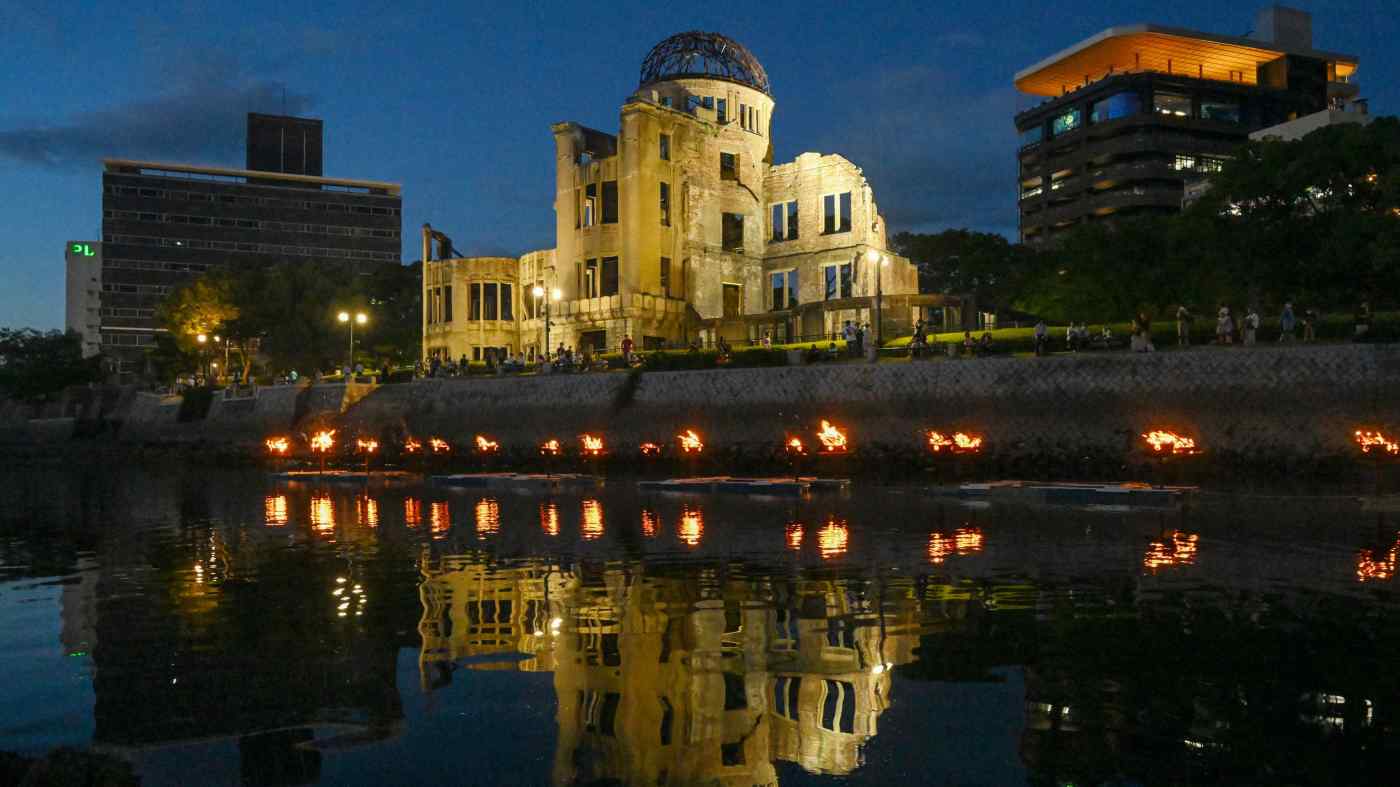
Biden’s strategy is to continue bleeding Russia in Ukraine. In fact, Biden’s joint communiqué with the other Group of Seven leaders in Hiroshima, Japan, May 20 committed to “increasing the costs to Russia” while pledging “unwavering support for Ukraine for as long as it takes.” 

In a separate statement on Ukraine issued a day earlier, the G7 leaders announced steps to “further restrict Russia’s access to our economies” and tighten the unprecedented sanctions against Moscow. 

More ominously, Biden and the other six leaders put forth maximalist demands for an end to the war in Ukraine, including that Russia “completely and unconditionally withdraw its troops and military equipment from the entire internationally recognized territory of Ukraine.” But, with the conflict settling into a war of attrition that inhibits either side from making significant battlefield advances, a complete and unconditional Russian withdrawal is unlikely to ever happen. In fact, after formally annexing the vast swaths of Ukrainian territory it has seized, Russia has been fortifying its defenses to hold on to its war gains.

In their joint statement, Biden and the other G7 leaders have also committed to efforts to ensure “Russia pays for the long-term reconstruction of Ukraine.” 

Their statement states that the G7 states “will continue to take measures available within our domestic frameworks to find, restrain, freeze, seize, and, where appropriate, confiscate or forfeit the assets of those individuals and entities that have been sanctioned in connection with Russia’s aggression.” It continues, “We reaffirm that, consistent with our respective legal systems, Russia’s sovereign assets in our jurisdictions will remain immobilized until Russia pays for the damage it has caused to Ukraine.” 

Not only is the unilateral impoundment of Russian assets contrary to a rules-based international order, but the maximalist demands set out by the G7 leaders are a recipe for an unending conflict, which can only benefit China economically and strategically while weakening Russia and sapping Western strength. 

With the age of Western dominance already in retreat, a long war in Ukraine would accelerate the shift in global power from the West to the East. 

Meanwhile, CIA Director Bill Burns’s recent clandestine visit to Beijing exemplifies Biden’s efforts to placate China as he ramps up sanctions and military pressure on Russia. While seeking economic collapse and regime change in Russia, Biden has tried to reassure Xi with what Beijing says are “Five Nos”: No to changing China’s communist system; no to seeking U.S. economic decoupling from China; no to a policy of “one China, one Taiwan”; no to containing China; and no to a new Cold War with China. 

The White House may not have directly corroborated such commitments, but similar formulations can be found in the Biden administration’s public declarations, including an assurance in the administration’s Indo-Pacific strategy that the U.S. “objective is not to change the PRC [People’s Republic of China],” the world’s most populous, strongest and longest-surviving autocracy.

Biden is mistaken if he thinks he can bring around China or dissuade it from ganging up with Russia against America. Xi is determined to make China a world power second to none. Indeed, China and Russia, with important allies like Iran, are in the process of forming a “Eurasian Axis” to challenge the American-led global order, including the status of the dollar as the world’s primary reserve currency. 

Against this backdrop, it would be in America’s interest to encourage quiet diplomacy to explore ways to bring about a ceasefire in a war that is having a negative worldwide impact by triggering energy and food crises, which in turn contribute to high inflation and slowing global growth. Ukraine’s impending launch of its long-planned counteroffensive, meanwhile, promises to heighten the risk of a direct Russia–NATO conflict. 

Even as Ukrainian President Volodymyr Zelensky warns that “a large number of soldiers will die” in his country’s counteroffensive because Russia retains the upper hand in air power, Kyiv, with U.S. backing, continues to reject proposals of peace talks that do not center on Russia first vacating the areas it has occupied.

After more than 15 months of war, it is clear that neither Russia nor Ukraine and its Western allies is in a position to achieve its primary strategic objectives. A ceasefire is the only way out of the current military deadlock. 

In the Korean War, it took two years of military stalemate to achieve an armistice agreement. A similarly long delay in reaching an armistice agreement in the current war would mean greater bloodshed and devastation without either side making any significant strategic gains. 

An extended Ukraine war will help formalize a Sino-Russian strategic axis while increasing the likelihood of Chinese aggression against Taiwan. By contrast, a frozen Ukraine conflict arising from a ceasefire will keep Moscow preoccupied while letting America focus less on Russia, the world’s most-sanctioned country, and more on a globally expansionist China.

Brahma Chellaney is a geostrategist and the author of nine books, including the award-winning “Water: Asia’s New Battleground” (Georgetown University Press).

Bedlam in Afghanistan and Pakistan

Following former Pakistani Prime Minister Imran Khan’s arrest, Pakistan has been thrown into turmoil. This explosion of political unrest, coupled with the Afghan Taliban regime’s support for terrorists, has grave implications for international security.

BRAHMA CHELLANEYProject Syndicate

Afghanistan and Pakistan are sinking deeper into disarray, and the United States bears a significant share of the blame. As long as this long-troubled region remains mired in turmoil, Islamist terrorism will continue to thrive, with grave implications for international security.

Begin with Afghanistan. In the nearly 22 months since the US abandoned the country to the Pakistan-backed Taliban militia, a terrorist super-state has emerged. Beyond committing atrocities against the Afghan people and re-imposing medieval practices, including reducing Afghan women’s status to that of chattels, the Taliban has sustained cozy ties with al-Qaeda and several other terror groups.

As a leaked Pentagon assessment reports, Afghanistan has become a safe haven and staging ground for al-Qaeda and Islamic State terrorists planning attacks on targets in Asia, Europe, and the US. This should come as no surprise. The Taliban regime’s cabinet includes a veritable who’s who of international terrorists and narcotics traffickers, and it was in Kabul last year that an American drone strike killed al-Qaeda leader and United Nations-designated global terrorist Ayman al-Zawahiri.

While the Islamic State may be seeking to expand its international operations from Afghanistan, it is al-Qaeda’s alliance with the Taliban that poses the greater long-term international threat. When the US withdrew suddenly from the country, it not only abandoned its allies there, but also left behind billions of dollars’ worth of sophisticated American military equipment, in addition to several military bases, including the strategically valuable Bagram airbase. The Taliban is now the world’s only terrorist organization with its own air force, however rudimentary.

In a 12-page document issued last month, President Joe Biden’s administration sought to shift the blame for the Afghan fiasco onto Donald Trump, claiming that Biden’s “choices for how to execute a withdrawal from Afghanistan were severely constrained by conditions created by his predecessor.” But, while the Trump administration undoubtedly cut a terrible deal with the Taliban, it was Biden who – overruling his top military generals – made the choices that triggered Afghanistan’s descent into chaos and facilitated the Taliban’s swift return to power.

US policy toward Pakistan has also been deeply misguided. It is thanks to a longstanding partnership with the US that Pakistan’s military and its rogue Inter-Services Intelligence (ISI) agency have been able to use terrorism as an instrument of state policy against neighboring countries. The Trump administration seemed to recognize this, and pledged to keep Pakistan at arm’s length until it ended its unholy alliance with terrorist organizations.

But the Biden administration has reversed this policy. Even though Pakistan played an integral role in enabling the Taliban – which the ISI helped create in the early 1990s – to defeat the US in Afghanistan, the Biden administration helped the Pakistani government stave off debt default last year. Soon after, the US unveiled a $450-million deal to modernize Pakistan’s US-supplied F-16s (which it values as delivery vehicles for nuclear weapons). The US then helped Pakistan get off the “gray list” maintained by the Paris-based Financial Action Task Force, the inter-governmental agency combating terrorist financing.

Today, Pakistan is facing profound political instability, rooted in a skewed civil-military relationship. Pakistan’s military has long been untouchable. It has ruled directly for 33 years. And when not technically in power, it has insisted on a pliant civilian administration that defers to the generals’ de facto leadership. Pakistan’s military, and its intelligence and nuclear establishment, have never answered to the civilian government. On the contrary, since 2017, two prime ministers have been ousted after falling out of favor with the military.

But supporters of one of those prime ministers, Imran Khan, are now mounting the first direct challenge to the military’s authority since Pakistan’s founding 75 years ago. Following Khan’s arrest on corruption charges earlier this month, mass protests erupted across Pakistan. Demonstrators stormed military properties, including the army headquarters and a major ISI facility, and set ablaze a top army commander’s home.

As the political crisis unfolds, Pakistan continues to teeter on the brink of default. It is being kept afloat by short-term loans from allies, until it can convince the International Monetary Fund to restart a suspended bailout program. This gives the international community leverage to force change in the country.

It is developments at home, especially the unprecedented anti-military protests, that have the greatest potential to force a rebalancing of civilian-military relations. But the military will not go down without a fight: the creeping shadow of military rule has already led to mass arrests, with the chief of army staff announcing trials under military law of civilians charged in the recent violence. The military could declare a state of emergency, in order to give itself carte blanche to stifle dissent, or it could stage another coup. The conflict could also erupt into civil war – ideal conditions for international terrorist forces to thrive.

For now, Pakistan remains a hub of terrorism and is contributing significantly to Afghanistan’s destabilization. Unless the nexus between Pakistan’s military and terrorist groups is severed, the situation in Afghanistan will not improve, and the battle against international terrorism will not be won.

Brahma Chellaney

Brahma Chellaney, Professor of Strategic Studies at the New Delhi-based Center for Policy Research and Fellow at the Robert Bosch Academy in Berlin, is the author of nine books, including Asian Juggernaut; Water: Asia’s New Battleground; and Water, Peace, and War: Confronting the Global Water Crisis.

© Project Syndicate, 2023.

It is crunch time for the Quad

Biden is the third straight U.S. leader unable to reorder Washington’s strategic priorities

Brahma Chellaney, Nikkei Asia

U.S. President Joe Biden’s last-minute cancellation of his planned appearance at a Quad summit in Australia will strengthen the perception that the war of attrition in Ukraine is deflecting Washington’s attention from mounting security challenges in the Indo-Pacific region.

Citing the imperative of cutting a deal with congressional leaders to avert a looming U.S. debt default, Biden also scrapped plans to stop in Papua New Guinea for what was to be the first visit by a U.S. president to a Pacific Island nation.

The dual cancellations will reinforce questions about America’s commitment to the Indo-Pacific, which is shaping up as the world’s economic and geopolitical hub.

If Russia’s invasion of Ukraine has shaken the foundations of the international order, as many observers contend, a Chinese takeover of Taiwan would usher in a new global order by ending America’s preeminence and irreparably damaging the U.S.-led alliance system. Yet the Biden administration remains overly focused on European security.

Biden’s planned Pacific tour next week had promised to put the international spotlight back on the Indo-Pacific and would have signaled that Washington had not taken its eye off the region despite America’s increasing involvement in the Ukraine war in terms of providing weapons, training and battlefield targeting data to Kyiv.

Only China can be pleased by Biden’s decision to simply return to the White House after the Group of Seven summit in Hiroshima, Japan.

Just as China is the sole country really benefiting from the conflict in Ukraine, Biden’s scrapped visits are likely to bolster Chinese ambitions in the Pacific while setting back Washington’s efforts to contain Beijing’s growing influence. Using its economic power and the world’s largest naval fleet, China has been making rapid inroads among Pacific island nations.

The last thing Chinese President Xi Jinping, left, wants is an end to the Ukraine war because that would leave the U.S. free to focus on the Indo-Pacific.   © Reuters

Biden’s canceled visits serve as a fresh reminder that hyperpartisan politics and hardened polarization in the U.S. are crimping the country’s foreign policy. Indeed, America’s partisan divide has a direct bearing on its foreign policy priorities, with Republicans most concerned about China and Democrats about Russia, according to opinion polls.

Indian Prime Minister Narendra Modi plans to proceed without Biden to Papua New Guinea for a summit with Pacific island leaders, and then to go on to Australia.

India has been steadily expanding its outreach to strategically located Pacific nations, stepping up foreign aid and establishing the Forum for India-Pacific Island Cooperation. Meanwhile, around 24,000 people have registered to welcome Modi to Stadium Australia in Sydney next Tuesday.

More broadly, the Quad summit’s cancellation could not come at a worse time for a grouping that is already at a crossroads.

The Quad was resurrected during U.S. President Donald Trump’s term but summits among its leaders began only after Biden took office in 2021. Despite this increased engagement, the Quad’s challenges have been growing due to the absence of a clearly defined strategic mission for the group.

Biden is the third straight U.S. president to commit to shifting America’s primary strategic focus to Asia and the wider Indo-Pacific. But the deepening U.S. involvement in the Ukraine conflict, coupled with the possibility that the war could drag on for a long time, suggests that he, too, could fail to genuinely make a pivot.

As if that were not bad enough, Biden has saddled the Quad with an increasingly expansive agenda that dilutes its Indo-Pacific strategic focus.

Biden’s Indo-Pacific strategy, unveiled last year, underlined how the Quad has turned its attentions to everlasting universal challenges ranging from climate change and cybersecurity to global health and resilient supply chains. Such an ambitious agenda has little to do with the Quad’s original core objectives, including acting as a bulwark against Chinese expansionism and ensuring a stable balance of power in the Indo-Pacific.

By pursuing a strategy to bleed Russia in Ukraine, Biden may be weakening a major adversary, but he is also sapping America’s strength.

The war is revealing Western military shortcomings, with weapons in short supply, critical munitions depleted, and U.S. capacity to restock insufficient. More fundamentally, it is distracting America from growing Indo-Pacific challenges.

The last thing Chinese President Xi Jinping wants is an end to the Ukraine war because that would leave the U.S. free to focus on the Indo-Pacific.

Indeed, before moving on Taiwan, Xi could seek to further deplete U.S. weapons arsenals through indirect arms shipments to Russia that could force the West to send more supplies to Ukraine. To a limited extent, Xi is already aiding Russian President Vladimir Putin’s war by supplying drones, navigation equipment, jamming technology, fighter-jet parts and semiconductors to sanctioned Russian entities.

Against this backdrop, the Ukraine war is accentuating the Quad’s challenges, even while its leaders continue to regularly hold discussions, including an expected gathering on the sidelines of the G-7 summit in Hiroshima where Modi and Australian Prime Minister Anthony Albanese will appear as special guests.

To acquire clear strategic direction and meaning, the Quad must focus on dealing with Indo-Pacific challenges, not global ones. Without a distinct strategic vision and agenda, the Quad will have little impact and just be an ineffective talking shop.

Brahma Chellaney is professor emeritus of strategic studies at the Center for Policy Research in New Delhi and a former adviser to India’s National Security Council. He is the author of nine books, including “Water: Asia’s New Battleground.”

The Sino-Indian Rivalry Is Reshaping Asia

By standing up to China, India has openly challenged Xi Jinping’s expansionism in a way that no other world power has done. The current military stalemate in the Himalayas serves as yet another reminder that Xi has picked a border fight with India that he cannot win.

BRAHMA CHELLANEYProject Syndicate

Three years after China stealthily began encroaching on India’s territory in the Himalayas, no end is in sight for the two countries’ border standoff. While the rival military buildups and intermittent clashes have received little attention in the West, the escalating border confrontation has set in motion a long-term rivalry that could reshape Asian geopolitics.

By locking horns with China despite the risk of a full-scale war, India has openly challenged Chinese power in a way no other world power, including the United States, has done in this century. Chinese President Xi Jinping’s strategic overreach has caused India to shift away from its previous appeasement policy and accelerate its military buildup, turning a potential partner into an enduring foe, while appearing determined to forestall a Sinocentric Asia.

Similarly, Xi’s muscular revisionism and geopolitical ambitions have forced Japan and Australia to readjust their strategic frameworks and work to counter China’s expansionism in the Indo-Pacific. By drawing up plans to double defense spending by 2027, Japan has effectively abandoned its pacifist postwar national-security policy. Australia, for its part, has renounced its previous hedging approach and joined the AUKUS defense pact with the US and the United Kingdom.

China’s attempt in spring 2020 to occupy hundreds of square kilometers in the icy borderlands of India’s northernmost Ladakh region, at a time when India was enforcing the world’s strictest national lockdown, amounted to a cynical effort to exploit the COVID-19 pandemic to further Xi’s strategic aims. But Xi miscalculated when he assumed that China could force India to accept the new status quo as a fait accompli. Since then, India has more than matched China’s military deployments, fueling the largest-ever military buildup in the Himalayas, one of the world’s most inhospitable regions.

With India refusing to buckle, Xi has sought to overwhelm its defenses by opening up a new front in the eastern Himalayas, more than 2,000 kilometers (1,242 miles) from China’s 2020 land grabs. In December 2022, a Chinese incursion into the strategically crucial border state of Arunachal Pradesh was repelled by Indian forces, reportedly with help from US intelligence.

In an effort to strengthen its territorial claim and provoke India, China has Sinicized the names of sites in Arunachal Pradesh. Calling Arunachal Pradesh “South Tibet,” the Chinese government has asserted that the sprawling state – more than twice the size of Taiwan – is “Chinese territory” and that Sinicizing Indian lands is its “sovereign right.”

All this has given India a stake in Taiwan’s continued autonomous status. If Taiwan were to fall to China, the Austria-sized Arunachal Pradesh could become the Chinese government’s next target for “reunification.” China’s annexation of Tibet in 1951 proved to be one of the most significant geopolitical developments in post-World War II history, giving China common borders with India, Nepal, Bhutan, and northwest Myanmar. A Chinese takeover of Taiwan could lead to a similar geopolitical reordering, enabling Chinese naval forces to break out of the “first island chain” and easily access the Pacific.

China’s claim that Taiwan has “always been” part of China is historically dubious. Taiwan did not become a Chinese province before the late nineteenth century, and China lost control of the island just eight years later, when the Qing Dynasty ceded it to Japan in perpetuity following its defeat in the 1895 Sino-Japanese War. But in laying claim to Taiwan, Xi is working to complete Mao Zedong’s expansionist vision of a “Greater China.”

Similarly, Tibet is the key to Chinese expansionism in the Himalayas despite the fact that it was a part of China only when China itself was occupied by outsiders like the Mongols and the Manchus. Because it cannot claim any Han-Chinese connection, its territorial claims in the Himalayas rest on alleged Tibetan ecclesial or tutelary links. Even tiny Bhutan has not been spared; China has been nibbling away at its borderlands.

Against this backdrop, India’s willingness to stand up to China is crimping Xi’s expansionist agenda. As Admiral Michael M. Gilday, the US Navy’s chief of naval operations, put it last year, India presents China with a “two-front” problem. “They [Indians] now force China to not only look east, toward the South China Sea and the Taiwan Strait, but they now have to be looking over their shoulder at India,” he said.

Moreover, the Sino-Indian rivalry has flared up at a time when China’s economy is running into long-term constraints, including a shrinking and rapidly aging population and slowing productivity growth. By contrast, India, which has one of the world’s youngest populations with a median age of 28.4, is reaping a demographic dividend. While its GDP is still smaller than China’s, it is the world’s fastest-growing major economy.

Given that its military is the world’s most experienced in hybrid mountain warfare, India has an edge in the high-altitude Himalayan environment. Moreover, in contrast to India’s all-volunteer military, the Chinese People’s Liberation Army largely relies on conscripts who ostensibly “volunteer” for two years of service after they reach the age of 18. That helps explain why China has chosen to engage in stealth encroachments rather than direct combat.

The current military stalemate in the Himalayas serves as yet another reminder that Xi has picked a border fight with India that he cannot win. With the US-China rivalry deepening, the last thing China needed was to make a permanent enemy of its largest neighbor. Ultimately, bringing India and America closer could prove to be Xi’s lasting legacy – an unintended consequence that threatens to undermine his regime’s aggressive irredentism.

Brahma Chellaney

Brahma Chellaney, Professor of Strategic Studies at the New Delhi-based Center for Policy Research and Fellow at the Robert Bosch Academy in Berlin, is the author of nine books, including Asian Juggernaut; Water: Asia’s New Battleground; and Water, Peace, and War: Confronting the Global Water Crisis.

© Project Syndicate, 2023.

A Chinese spy station in India’s strategic backyard?

China’s Yuan Wang 5 arrives at Chinese-run Hambantota International Port in Sri Lanka on Aug. 16, 2022. © AP

Brahma Chellaney, Nikkei Asia

China appears to be building a military listening post on Great Coco Island, which sits between the Bay of Bengal and the Andaman Sea just north of the Andaman and Nicobar archipelago where India has multiple naval and air force facilities and about 210 kilometers southwest of the mouth of Myanmar’s Irrawaddy River. 

Such a spy station could be used to carry out maritime surveillance, reconnaissance and intelligence collection against India — and would highlight how U.S.-led sanctions are exacerbating regional-security challenges by pushing military-ruled Myanmar into China’s strategic lap.

Great Coco Island, measuring nearly 8 sq. kilometers and home to around 1,500 people, is one of three main islands in Myanmar’s Coco group, which also includes several small islets. The Coco Islands are separated from India’s North Andaman Island by the 20-km wide Coco Channel.

Beijing and Naypyitaw have each denied Chinese involvement in militarizing the Coco Islands. However, satellite images of an expanded airstrip, new aircraft hangars, a large pier and a radar station with a protective dome indicate that military infrastructure is rapidly going up on Great Coco, previously home to rudimentary infrastructure.

In recent months, India has confronted Myanmar with satellite imagery and other intelligence about assistance being provided by China for building military and dual-use facilities on Great Coco. Chinese military engineers and other personnel have been spotted there, Indian officials say.

A causeway is under construction at the southern end of Great Coco to connect it with a neighboring island, where the clearing of forested land suggests a further extension of facilities.

China has a record of issuing denials while expanding its strategic footprint through stealthy but incremental moves. It set up its first overseas military base in Djibouti while insisting it had no such plan.

A more striking example is how China turned its artificially created islands in the South China Sea into forward military bases soon after President Xi Jinping, standing with then-U.S. President Barack Obama in the White House Rose Garden in 2015, said, “China does not intend to pursue militarization.”

The U.S. believes that China is working to establish an international network of logistics and base infrastructure while concealing the terms of its agreements with host nations and the intended purpose of dual-use facilities that it finances, possibly including a naval outpost in Cambodia. Facilities under scrutiny include commercial ports in Hambantota, Sri Lanka, and Gwadar, Pakistan that have been taken over by Chinese state-owned companies.

China’s large spy ships, which serve as mobile listening and tracking platforms, are also playing a role. One such ship, the Yuan Wang 5, docked at Hambantota International Port last August despite Indian protests. The Yuan Wang 6 appeared in the Indian Ocean in December when New Delhi tested the Agni 5 intercontinental ballistic missile.

Myanmar’s junta, faced with crippling Western sanctions and foreign-backed armed resistance to its rule, has neither the capability nor the motivation to build sophisticated maritime reconnaissance and surveillance facilities on remote Great Coco on its own. At a time when it is struggling to retake control of large swaths of the country, the last thing it would do is build a spy station directed at friendly India, which has refused to join the American-led sanctions campaign.

The Indian military’s only tri-service command is headquartered at a base in the Andaman and Nicobar Islands capital of Port Blair, seen here in 2014. © Reuters

But Beijing has the means, strategic impetus and ambition to set up facilities to monitor Indian activities, including naval communications and movements, satellite launches and tests of missiles which often splash down in the Bay of Bengal. China has long had interest in the Coco Islands, with talk of building a signals-intelligence facility there first surfacing in the early 1990s.

U.S.-led sanctions against Myanmar are now working to China’s advantage just as they did for nearly a quarter of a century before Obama’s historic Myanmar visit in 2012 heralded a change of policy. In response to the military’s February 2021 seizure of power, U.S. President Joe Biden promptly reimposed sanctions without heeding the history of how China had earlier become Myanmar’s dominant trading partner and investor.

The militarization of the Coco Islands will extend China’s growing penetration of Myanmar, which serves Beijing as a strategic gateway to the Indian Ocean, an important source of natural resources and a major market for its arms exports.

To bypass the narrow Malacca Strait between Peninsular Malaysia and the Indonesian island of Sumatra, Beijing has been investing heavily in the China-Myanmar Economic Corridor. The initiative includes a deep-sea port at Kyaukpyu and seeks to facilitate direct energy imports overland into Yunnan province.

In the past, the Coco Islands were administratively grouped with the Andaman and Nicobar Islands, but British colonial authorities split off the Cocos after the killing of a British lighthouse keeper by an Indian in 1877, reassigning responsibility to their outpost in Rangoon, now Yangon.

In 1942, the island groups were reunited by invading Japanese forces, who soon passed control to Indian nationalist forces fighting for independence from British rule. But upon independence in 1947, the Indian government did not assert control over the Cocos which then stayed with Burma as it too moved toward independence from the U.K. 

Spread across 750 km, the Andaman and Nicobar Islands give India commanding oversight over a key stretch of the main sea lanes that connect East Asia with Europe and the Middle East. The islands’ strategic importance in relation to the Malacca Strait explains why the Indian military’s only tri-service command is headquartered there.

China’s strategic foothold on the Coco Islands, if confirmed, will not only weaken this Indian advantage but also create a new maritime threat to India.

Is America’s global preeminence under threat?

FILE – The American and Chinese flags wave at Genting Snow Park ahead of the 2022 Winter Olympics, Feb. 2, 2022, in Zhangjiakou, China. The Commerce Department is tightening export controls to limit China’s ability to get advanced computing chips, develop and maintain supercomputers, and make advanced semiconductors. (AP Photo/Kiichiro Sato, File)

BY BRAHMA CHELLANEY, The Hill

If it is to remain the world’s preeminent power, the United States must focus its attention on the globally ascendant and expansionist China, which, as President Biden acknowledged in his 48-page national security strategy in October, “is the only country with both the intent to reshape the international order and, increasingly, the economic, diplomatic, military and technological power to advance that objective.”

The subsequently released National Defense Strategy bluntly stated that China represents “the most comprehensive and serious challenge to U.S. national security.”

Yet America’s deepening involvement in the proxy war with Russia over Ukraine’s future is deflecting U.S. attention from the core challenge posed by China. Instead of exploring a ceasefire agreement to halt what has increasingly become a war of attrition, with neither side in a position to make major advances on the battlefield, the Biden administration and several U.S. allies are training thousands of new Ukrainian military recruits and rapidly arming Ukraine for a spring offensive to help it regain some of its Russia-occupied territories.

With the West sending 40 percent of all its weapons to Ukraine since December, the flow of arms has become a torrent. But offense is inherently much tougher than defense. A major spring offensive by Ukrainian forces (relying on newly supplied Western equipment and with mostly new recruits) could result in massive casualties on their side.

In fact, the longer the war in Ukraine extends, the greater is the likelihood of two tectonic developments unfolding: Russia and China cementing a strategic axis against the West; and Chinese President Xi Jinping launching aggression against Taiwan.

In the second half of the Cold War, following President Nixon’s opening to China, the U.S. co-opted China against the Soviet Union, gradually turning the Sino-American relationship into an informal alliance geared toward containing and rolling back Soviet influence. This two-against-one competition contributed to the Soviet Union’s imperial overstretch and, ultimately, to the West’s triumph in the Cold War without armed conflict.

Today, a two-against-one competition is emerging again, but with China and Russia bandying together against the U.S.

A forward-looking U.S. administration would avoid confronting Russia and China simultaneously, and instead seek to play one off against the other. Yet, U.S. policy is helping turn two natural competitors, Russia and China, into close strategic partners. Consequently, the U.S. seriously risks accelerating its relative decline through strategic overreach

U.S. sanctions policy is promoting a mutually beneficial partnership between Russia and China by helping advance a natural division of strategic priorities. China’s primary focus is on its periphery, stretching from Japan across Southeast Asia to India, while Russia’s attention is concentrated largely on Eastern and Central Europe. While Russia seeks to regain influence among states bordering its western flank, China’s muscular revisionism is aimed at establishing “hegemony along its periphery, especially regarding Taiwan, the South China Sea and India.”

Today, with Russia tying the U.S. down in the European theater, Xi has greater strategic room to achieve what he has called China’s “historic mission” — the forcible absorption of Taiwan.

The issue is no longer if but when Xi will move against Taiwan, a thriving democracy that also happens to be the world’s semiconductor superpower. Just the giant Taiwan Semiconductor Manufacturing Company (TSMC) accounts for more than 90 percent of the global output of the most advanced semiconductors. The U.S. National Security Council has projected that a Chinese takeover of TSMC could cause a more than $1 trillion disruption of the global economy, besides threatening U.S. military and technological leadership.

In his first speech as a third-term president on March 13, Xi unambiguously linked the incorporation of Taiwan to the success of his national rejuvenation policy, saying the “essence” of his great rejuvenation drive was “the unification of the motherland.” 

More ominously, at a time when his communist regime has unveiled new air-raid shelters in cities across the strait from Taiwan; new military readiness laws, including to more easily activate reservists; and new countrywide mobilization offices, Xi said last month that China must prepare for war to cope with a new phase of ideological and geostrategic “struggle.” Before demitting office as premier, Li Keqiang also called for heightened “preparations for war.” 

After changing the territorial status quo in the South China Sea and the Himalayas, Xi is itching to move against Taiwan, despite the risk of direct conflict with the U.S.

Before meeting Xi in Bali, Indonesia, in November, Biden had said he wanted to discuss “red lines” in the tense relationship with Beijing. But it was Xi who, in great detail, spelled out China’s No. 1 red line — Taiwan. A lengthy account in the Chinese readout of the meeting said Xi “stressed that the Taiwan question is at the very core of China’s core interests, the bedrock of the political foundation of China-U.S. relations, and the first red line that must not be crossed in China-U.S. relations.”

Xi, in speeches at home last month, singled out the U.S. as China’s foe and then joined hands with Russian President Vladimir Putin in explicitly identifying America in a nine-point joint statement as their common adversary.

Against this backdrop, deterring China from upending the world order by invading Taiwan has become more imperative than ever for the Biden administration.

But instead of committing sufficient resources to defend Taiwan, the administration is signaling anxiety over America’s dependency on that island’s cutting-edge chip industry. It is ramping up U.S. chip-making capacity with the help of American companies that have pledged tens of billions of dollars for semiconductor projects.

The scale of the ramp-up in the U.S. chip-making plans has been likened to America’s Cold War-era investments in the space race following the Soviet Union’s launch of its Sputnik satellite in 1957.

More fundamentally, the U.S. should be addressing its strategic overstretch, not exacerbating it through greater entanglement in European security. The current U.S. focus on containing Russia’s regional ambitions is at the cost of countering China’s drive to supplant America as the world’s foremost power.

The longer the U.S. is involved in the war in Ukraine, the greater will be the strategic space for China to advance its expansionist agenda, including by accelerating its accumulation of military and economic power.

Meanwhile, Biden, by opposing a unilateral change in the Taiwan status quo without credibly signaling a genuine willingness to defend the island militarily, risks encouraging China to launch aggression that takes the U.S. by surprise.

In fact, just when Xi is seeking to raise the cost of American intervention over Taiwan, the U.S., in supporting Ukraine, is rapidly depleting its munitions stockpiles and exposing its woefully inadequate capacity to restock, setting off alarm bells in Washington.

If Russia’s invasion of Ukraine has shaken the foundations of the international order, as many in the West believe, a Chinese takeover of Taiwan would usher in a new global order by ending America’s global preeminence and undermining the U.S.-led alliance system. It would change the trajectory of the 21st century in the way that World War I transformed the 20th.

Brahma Chellaney is a geostrategist and author of nine books, including “Water: Asia’s New Battleground” (Georgetown University Press), which won the Bernard Schwartz Award.