BY BRAHMA CHELLANEY, OPINION CONTRIBUTOR, The Hill
The global horror at Hamas’s barbarism against children, women and the elderly, followed by the harrowing images of death and destruction from the Israeli military’s pummeling of Gaza, have obscured an ugly truth: Israel aided the birth of the Frankenstein monster it is now seeking to crush.
In the 1980s, influenced by the CIA’s training and arming of mujahideen (Islamic holy warriors) in Pakistan from multiple countries to fight against Soviet forces in Afghanistan, Israel aided the rise of the Islamist Hamas as a rival to the secular Palestinian Liberation Organization (PLO) and its dominant faction, Yasser Arafat’s Fatah.
The first Intifada that flared in 1987 as a spontaneous protest movement against the Israeli occupation of Palestinian lands was a wake-up call for Israel. To divide and undermine the nationalist Palestinian movement led by Arafat, Israel lent support to the anti-PLO Hamas, which was formed in the early days of the Intifada under the leadership of Sheikh Ahmed Yassin, a quadriplegic and partially blind cleric.
Israel’s fundamental objective was to thwart the implementation of the two-state solution for resolving the Israeli-Palestinian conflict. By aiding the rise of an Islamist terrorist group whose charter rejected recognizing the Israeli state, Israel sought to undermine the idea of a two-state solution, including curbing Western support for an independent Palestinian homeland.
Hamas actually emerged out of the Israeli-financed Islamist movement in the Gaza Strip. Israel’s military governor of Gaza, Brig. Gen. Yitzhak Segev, disclosed in 1981 that he had been given a budget for funding the Palestinian Islamist movement to help counter the support and power of Palestinian secularists.
U.S. ambassador to Israel Daniel Kurtzer said in late 2001 that, “Israel perceived it to be better to have people [Palestinians] turning toward religion rather than toward a nationalistic cause,” resulting in the growth of the Islamist movement in the Palestinian territories “with the tacit support of Israel.” And a former American ambassador to Saudi Arabia, Charles Freeman, argued that, “Israel started Hamas,” adding, “It was a project of Shin Bet [the Israeli domestic intelligence agency], which had a feeling that they could use it to hem in the PLO.”
Arafat, for his part, called Hamas “a creature of Israel,” telling the Italian newsmagazine L’Espresso in late 2001 that “Hamas was constituted with the support of Israel. The aim was to create an organization antagonistic to the PLO. They received financing and training from Israel.” Avner Cohen, a former Israeli religious affairs official who was involved in Gaza for more than two decades, echoed Arafat’s words in 2009, saying, “Hamas, to my great regret, is Israel’s creation.”
Israel’s spy agency Mossad was long involved in a divide-and-rule strategy in the occupied territories. In a 1994 book, “The Other Side of Deception,” a Mossad whistleblower explained the rationale behind aiding Hamas: “An Arab world run by fundamentalists would not be a party to any negotiations with the West, thus leaving Israel again as the only democratic, rational country in the region.”
About seven years before the killing of Osama bin Laden by U.S. special forces in Pakistan, Israel assassinated Hamas founder Sheikh Yassin via missile strike in 2004. But by then Hamas — the first Islamic group to embrace the use of suicide bombers — had become an uncontrollable terrorist monster.
Israel’s tacit ties with Islamists paralleled America’s use of jihadists against the Soviet Union. The CIA-trained mujahideen became Al Qaeda and the Taliban. As then–Secretary of State Hillary Clinton admitted in 2010, “We trained them, we equipped them, we funded them, including somebody named Osama bin Laden … And it didn’t work out so well for us.”
America’s troubling ties with Islamist rulers, groups and warriors were cemented when President Ronald Reagan’s administration employed Islam as an ideological tool to spur jihad against the Soviet forces that invaded Afghanistan. In 1985, at a White House ceremony attended by several mujahideen from Afghanistan, Reagan declared, “These gentlemen are the moral equivalent of America’s Founding Fathers.”
Israel, like the U.S., may have been guided by the proverb, “the enemy of my enemy is my friend.” But, as history attests, “the enemy of my enemy,” far from being a friend, often openly turns into a foe.
Yet Israel and the U.S. have both been reluctant to draw appropriate lessons from the Western roots of international jihadist terrorism. Under President Obama, America and its allies toppled Libyan leader Muammar Qaddafi, creating a still-lawless jihadist citadel at Europe’s southern doorstep. They then moved to overthrow Syrian President Bashar al-Assad, fueling a civil war that enabled the rise of the Islamic State (or ISIS), many of whose foot soldiers were CIA-trained, anti-Assad jihadists.
Israel likewise maintained its covert nexus with Hamas even after the 1993 Oslo I Accords and its 2005 military withdrawal from the Gaza Strip. In fact, Qatar, a longtime sponsor of jihadist groups, funneled $1.8 billion to Hamas just between 2012 and 2021 with the consent of Israel, which thought that a regular flow of funding would discourage Hamas from challenging the status quo.
Former President Jimmy Carter said in a 2013 CNN interview that he met with Hamas leaders several times and they appeared willing to accept the existence of Israel, but that Netanyahu’s determination to impose a “one-state solution” precluded any meaningful negotiations.
Netanyahu reportedly told a Likud party’s meeting in 2019, “Anyone who wants to thwart the establishment of a Palestinian state has to support bolstering Hamas and transferring money to Hamas,” adding, “This is part of our strategy — to isolate the Palestinians in Gaza from the Palestinians in the West Bank.”
Israel’s current military operations cannot crush Palestinian aspirations for statehood. But Hamas’s capability can be sufficiently degraded in the current war so that it no longer poses a potent threat to Israel.
The bigger challenge comes from the terrorism-glorifying ideology of Hamas and other Islamists. Western and Israeli funding of Islamists since the 1980s, including the help of oil sheikhdoms, has fomented militant Islamic fundamentalism that, paradoxically, targets the West and Israel as its enemies.
After the Gaza war ends, the West and Israel need to join hands to discredit the ideology of radical Islam through a long and sustained campaign of persuasion, not bombs and bullets.
Brahma Chellaney is a geostrategist and the author of nine books, including the award-winning “Water: Asia’s New Battleground.”
The latest round of talks between China and Bhutan over their unsettled border concluded last week with an agreement about the responsibilities and functions of a new joint technical team set up to demarcate the frontier.
The team was formed as the result of an agreement the two governments reached in August. That in turn followed a 2021 memorandum of understanding to expedite the border talks, which have been going on since 1984.
Despite these recent outward signs of accord, however, China and Bhutan in fact remain far apart and a resolution to the border talks is not imminent.
For China, the talks are a way to deflect attention from its incremental encroachments into Bhutanese territory, one pasture and one valley at a time. Beijing has linked fundamental resolution of its border claims to the establishment of bilateral diplomatic relations and securing permission to open an embassy in Thimphu.
That is a sensitive point. Under a 1949 treaty of friendship, Bhutan pledged “to be guided by the advice of the government of India in regard to its external relations.” In a revised 2007 treaty, this promise was reframed as a commitment by both countries to “cooperate closely with each other on the issues relating to their national interests.”
India, however, remains the de facto security guarantor of Bhutan, which is a diplomatic minnow. It has no official diplomatic relations with any of the five permanent members of the U.N. Security Council and only India, Bangladesh and Kuwait have embassies in the Bhutanese capital.
To be sure, China has also dragged out the border settlement talks it launched with India in 1981. Seeking to replicate in the Himalayas its expansionism in the South China Sea, Beijing has made stealth encroachments on Indian borderlands. China’s ongoing military standoff with India at multiple points along their frontier was triggered by Chinese incursions into the northernmost Indian territory of Ladakh in April 2020.
In Bhutan, Beijing is seeking to carve out a strategic footprint in the way it has done in nearby Nepal, which also has close ties to India. China’s influence has been on the rise in recent years in Nepal, as it has poured money into loans and infrastructure projects despite concerns from observers about the sustainability of the debt Kathmandu is taking on.
It was Mao Zedong’s 1951 annexation of Tibet, whose religion and culture have shaped Bhutanese society, that made China the neighbor of Bhutan as well as of Nepal and India.
Mao considered Tibet to be the palm of China’s right hand. In turn, he saw the “fingers” of that hand, “to be liberated” in due course, as Bhutan, Nepal, and what are now the Indian territories of Ladakh, Sikkim and Arunachal Pradesh. Chinese incursions into the borderlands of the five fingers in recent years suggest that President Xi Jinping may be seeking to complete Mao’s expansionist vision.
Beijing has previously signaled a willingness to withdraw from areas it has occupied in northern Bhutan, including the sacred, monastery-rich valley of Beyul Khenpajong, if Thimphu were to give up some of its western borderlands. Since 2017, China has been encroaching on Bhutan’s western regions as well, including the Doklam Plateau, a Sino-Indian strategic flashpoint, despite a 1998 commitment “not to resort to unilateral action to alter the status quo of the border.”
By building military roads through Bhutanese territory and planting settlers on encroached land, China has effectively opened a new front on India’s most vulnerable point, the Siliguri Corridor that connects the country’s remote northeast to its heartland. The corridor, sandwiched between Tibet, Nepal, Bhutan and Bangladesh, is barely 22 kilometers wide at its narrowest point.
The settlements, roads and military facilities China has constructed on occupied land suggest that the encroachments may not be rolled back, even if Beijing eventually reached a border settlement with Bhutan.
If anything, Beijing has continued to up the ante against Bhutan. In 2020, it laid claim to the Sakteng Wildlife Sanctuary, home to some of the world’s most-endangered mammals, in the east of Bhutan. The fact that this sanctuary can be accessed only through the Indian state of Arunachal Pradesh suggests that the move was directed against both Bhutan and India. Chinese maps already show Arunachal Pradesh — more than twice the size of Bhutan — as part of China.
Against this backdrop, it is scarcely a surprise that a Sino-Bhutanese border settlement is still not on the cards. Indeed, Bhutanese Prime Minister Lotay Tshering said in March that demarcation of the frontiers of Bhutan, China and India where they converge at the Doklam Plateau can be done only trilaterally.
“It is not up to Bhutan alone to solve the problem,” he told an interviewer. “We are three.”
Bhutan remains treaty-bound to respect Indian interests. India remains opposed to the cession of Bhutanese territory to China, particularly around the Doklam Plateau. So while Bhutan and China may reach more incremental agreements on how to take forward their talks, the end still appears nowhere in sight.
Brahma Chellaney is professor emeritus of strategic studies at the Centre for Policy Research in New Delhi and a former adviser to India’s National Security Council. He is the author of nine books, including “Water: Asia’s New Battleground.”
When on October 7 more than 1,000 Hamas militants entered Israel and carried out terrorist atrocities against largely civilians and took more than 200 hostages back to the Gaza Strip, they not only exposed perhaps the worst security and intelligence failure in the country’s 75-year history but also set in motion developments beyond their own control.
In stark contrast to the restraint India exercised in response to the 2008 horrific Mumbai terrorist attacks that were devised by the Pakistani military intelligence, Israel has treated the Hamas slaughter as a kind of Pearl Harbor moment. While India under then-Prime Minister Manmohan Singh chose to impose no costs on Pakistan, thereby emboldening the Pakistani military establishment to stage further major cross-border terrorist attacks, Israel wasted no time in planning and launching a massive military operation to “wipe out” Hamas and thereby help deter others in the neighbourhood from launching daring terror strikes against Israeli targets.
Today, as Israel pummels Gaza, its military offensive is deepening a humanitarian crisis in the Gaza Strip while raising the prospects of a geopolitical reordering in the Middle East. Yet, despite satellite imagery indicating that a quarter of all buildings in northern Gaza have already been wrecked by Israeli strikes, Prime Minister Benjamin Netanyahu has rejected global appeals for a ceasefire, including from allies like France and Australia, describing them as calls for Israel to “surrender to terrorism”.
Israel has gone to war with Hamas several times before, including in 2009, 2012, 2014, 2018 and 2021. The scale of the present war is unprecedented, as underlined by Israel’s mobilisation of 360,000 reservists and the evacuation of 250,000 Israelis from their homes. With Israeli airstrikes flattening entire neighbourhoods in Gaza and killing thousands, the global horror at the barbarism of Hamas’ actions against children, women and the elderly is in danger of giving way to international revulsion over the growing human toll of the Israeli bombing campaign, which has become one of the most intense of the 21st century.
Hamas, though, has long used human shields in conflicts with Israel, and its armed militants remain embedded among Gazan civilians.
More ominously, with the Israeli military currently engaged in low-level fighting on three additional fronts—Lebanon, Syria and the West Bank—the risks of a widening war cannot be discounted. It is to avert a wider conflict that US President Joe Biden has deployed additional American naval and air assets in the Middle East. A wider war would undermine US interests, including by increasing the strategic space for China and Russia.
Biden’s new military deployments in the Middle East are in keeping with the interventionist foreign policy that he has pursued since taking office. Biden’s first military action (in Syria) came barely five weeks after he entered the White House.
Israeli Prime Minister Benjamin Netanyahu and US President Joe Biden in Tel Aviv, October 18, 2023 (Photo: Reuters)
Most members of Biden’s national security team are considered “liberal interventionists”, or hawks on the left who cheered America’s past wars and who have helped deepen US involvement in the current war in Ukraine. It was the liberal interventionists who, under President Barack Obama, engineered the disastrous US-led interventions in Libya and Syria. Today, the ruling alliance of liberal interventionists and neoconservatives (neocons) in Washington is pushing Russia into an alliance with China.
It did not take long for the neocons and liberal interventionists in Washington to define the Hamas atrocities against Israel as an attack on American interests and call for a larger war to take on Iran. On Biden’s orders, the US military on October 26 carried out strikes on purported “Iranian proxies” in Syria. US Defence Secretary Lloyd Austin described them as “precision self-defence strikes” against two facilities in eastern Syria used by Iran’s Islamic Revolutionary Guard Corps and its affiliates.
Biden’s new military deployments in the Middle East are in keeping with the interventionist foreign policy that he has pursued since taking office. It did not take long for the neocons and liberal interventionists in Washington to define the Hamas atrocities against Israel as an attack on American interests and call for a larger war to take on Iran
Meanwhile, unlike many wartime leaders, the increasingly unpopular Netanyahu is struggling to rally Israelis to his side, given the scant public trust in his leadership. Netanyahu’s effort to pin the blame for the Hamas surprise attack on the heads of Israeli military intelligence and Shin Bet, the domestic intelligence service, triggered a political backlash, forcing him to delete his post on X. “Under no circumstances and at no stage was Prime Minister Netanyahu warned of war intentions on the part of Hamas”, his post had read. “On the contrary, the assessment of the entire security echelon, including the head of military intelligence and the head of Shin Bet, was that Hamas was deterred and was seeking an arrangement”.
To be sure, the Hamas attack took even the US by surprise. US National Security Advisor Jake Sullivan, in an essay published in the Foreign Affairs journal just before the October 7 attack, boasted that “we have de-escalated crises in Gaza and restored direct diplomacy between the parties after years of its absence”. After the Hamas atrocities, the journal allowed Sullivan to remove such lines from the online version of the essay.
Whatever the outcome of the Gaza war, the political career of Netanyahu, who has been in power for 14 of the past 16 years, seems doomed. Biden’s re-election prospects also have dimmed.
Biden’s approval rating, even before the conflict flared in the Middle East, had sunk to the lowest level since he took office. But Biden’s “unwavering support” for Netanyahu’s Gaza war has split the Democratic Party at home, antagonised America’s allies and partners in the Islamic world and, by alienating many young Americans and progressives, seriously set back his re-election chances. If he faces voters with the US still involved in two separate wars, he would likely lose.
THE ROOTS OF THE CONFLICT
Almost everything about the Israel-Palestine conflict is contentious, including its roots. Some experts trace the origins of the conflict to Britain’s 1917 Balfour Declaration during World War I in support of the establishment of “a national home for the Jewish people” in Palestine, then an Ottoman region with a minority Jewish population. Named after the then British foreign secretary, the declaration fostered Jewish-Palestinian enmity. Other experts, however, trace the roots of the conflict to the late 19th century, when the rise of Zionism encouraged Jewish migration to the Holy Land.
Aftermath of an Israeli airstrike that hit the Al-Shati refugee camp in Gaza City, October 24, 2023 (Photo: Getty Images)
The Israel-Palestine problem, like continuing conflicts elsewhere, including in the Indian subcontinent and Africa, is the direct legacy of British colonialism. The “divide and rule” policies of the world’s biggest colonial power, Britain, extended even to its exit strategy. For example, Britain ensured that not only would a united, strong India not be possible but also that an independent India would be perpetually weighed down by serious challenges.
Hundreds of millions in the world still suffer from the lingering consequences of British colonialism. As then-South African President Thabo Mbeki put it in 2005, colonialism left a “common and terrible legacy of countries deeply divided on the basis of race, colour, culture and religion.”
British Prime Minister David Cameron acknowledged in 2011 that the legacy of British colonialism was responsible for many of the world’s enduring problems. “As with so many of the problems of the world, we are responsible for their creation in the first place,” Cameron said in Pakistan, a British-created state that still defines itself by what it is against—India—rather than by what it is for.
There may be no direct link between the two raging wars, yet each could impinge on the other. After the start of hostilities in the Middle East, ‘Ukraine fatigue’ in the West has become more apparent. Just as the Ukraine war led to soaring international food and fuel prices and hyper-inflation, the Gaza war, if it widens, could disrupt oil supplies
British colonialists liked redrawing political frontiers, as they did in the Middle East after World War I. Indeed, it was British colonialism that laid the foundation of the State of Israel in the period between December 1917 (when the British army occupied Jerusalem) and May 14, 1948, the date on which David Ben-Gurion, the head of the Jewish Agency, proclaimed the birth of Israel with US support. In that period, while mollifying Palestinian élites by offering the prospect of an independent Palestine, Britain quietly encouraged Jewish migration to Palestine and subsidised Jewish settlements and defences against native Palestinians.
Ever since the establishment of the State of Israel, Israelis and Palestinians have been at war. Israel’s creation sparked the first Israeli-Arab War, which ended in 1949 with 750,000 Palestinians displaced and the sub-region divided into three entities: the State of Israel, the West Bank (of the Jordan River), and the Gaza Strip.
The biggest turning point came in June 1967 when Israel pre-emptively attacked Egypt and Syria and dramatically changed the political and water map of its sub-region. In just a six-day war, Israeli forces captured vast swaths of territory, seizing the Sinai Peninsula and Gaza Strip from Egypt; the West Bank and East Jerusalem from Jordan; and the Golan Heights from Syria. As a result, Israel more than tripled the size of the area under its control—from 21,000 square kilometres to 67,000 square kilometres.
The Six-Day War, as it is known, still stands out for the successful Israeli grab of the sub-region’s water resources. By seizing control of the water-rich Golan Heights and the aquifer-controlling West Bank, Israel reaped tremendous water spoils: the war left it in control of sizeable groundwater resources and all of the Jordan River’s headwaters.
The clash of the two coalitions increases the significance of the Global South as a ‘swing’ factor in geopolitics. The weight of the Global South is growing while the power of the West is weakening. The Middle East and Northern Africa (MENA) region is a key front in the struggle between the two coalitions for influence in the Global South
Groundwater is a larger source of supply than surface water in this sub-region. And the West Bank sits on substantial groundwater in the form of a multi-aquifer system, with the groundwater outflow to Israel estimated at a sizeable 325 million cubic metres a year. In 1981, Israel formally annexed the strategic Golan Heights, which not only serves as the headwaters of the Jordan River but also controls Israel’s major water sources, including those that feed its main freshwater lake, Tiberias (also known as Lake Kinneret, or the Sea of Galilee).
Simply put, Palestinians have been living under Israeli occupation since 1967, with Israel usurping Palestinian natural resources and tightly regulating any expansion of the water infrastructure in Palestinian areas.
Israel has made peace with some of its Arab neighbours, including Egypt, with which it signed the 1978-79 Camp David Accords and returned the Sinai Peninsula. Israel also signed a peace treaty with Jordan in 1994 but without returning the West Bank and East Jerusalem. After Egypt and Jordan, the United Arab Emirates and Bahrain agreed in 2020 under the US-brokered Abraham Accords to become the third and fourth Arab countries to normalise relations with Israel.
Israel’s conflict with Palestinians, however, has persisted, despite the 1993 Oslo I Accords and the 1995 Oslo II Accords. The Fatah party led by Mahmoud Abbas controls the Palestinian Authority from the West Bank, while Hamas, until Israel recently declared war on it, was de facto governing the Gaza Strip after winning parliamentary elections in 2006.
Over the years, Palestinian frustration and anger have triggered a recurring cycle of violent protests and Israeli crackdown. In 1987, Palestinians in the West Bank and Gaza Strip rose up against the Israeli occupation in what is known as the first Intifada, which lasted until 1993. Then in 2000, after then-Israeli Prime Minister Ariel Sharon’s visit to the al-Aqsa mosque—the third holiest site in Islam—the second Intifada began, lasting until 2005. During the height of that uprising in 2002, Israel began constructing a concrete, 712-kilometre barrier wall around the West Bank that the International Court of Justice (ICJ) ruled in 2004 was violative of international law. Israel, however, ignored the ICJ’s call for dismantling the wall.
Israeli police on the Temple Mount after incidents of violence near the Al-Aqsa mosque, May 10, 2021 (Photo: Getty Images)
More fundamentally, Israel has gradually consolidated its regional pre-eminence, with the outcome of past wars precluding any real challenger. Its peace agreements with Jordan and Egypt have helped reinforce the message to others in the Arab world that it is too powerful to be taken on militarily, thus leaving only diplomatic options. Before the latest war began, even Saudi Arabia was discussing with the US a deal that would normalise its relations with Israel.
Today, Israel, despite a small population of 9.4 million, surpasses the combined military strength of its Arab neighbours—Egypt, Jordan, Syria and Lebanon. It has one of the world’s most powerful militaries, with vast air power. And Israel enjoys a nuclear-weapons monopoly in the Middle East that only Iran is seeking to clandestinely challenge. Another key fact is that Israel’s $564 billion economy is larger than that of all of its immediate neighbours combined.
Hamas emerged out of an Israeli-financed Islamist movement in the Gaza Strip. Arafat called Hamas ‘a creature of Israel’. Israel, like the US, may have been guided by the proverb ‘the enemy of my enemy is my friend’. This is not an Arab but a Sanskrit proverb. But, as history attests, ‘the enemy of my enemy’, far from being a friend, has often openly turned into a foe sooner or later
HOW THE CHICKENS CAME HOME TO ROOST
The outrage over the atrocities against Israeli civilians by Hamas has helped obscure Israel’s role in the rise of that terrorist militia. In the 1980s when the CIA trained and armed “mujahideen” (or Islamic holy warriors) in Pakistan from multiple countries to wage jihad against Soviet forces in Afghanistan, thereby spawning Al Qaeda and international terrorists like Osama bin Laden, Israel aided the rise of the Islamist Hamas as a rival to the secular Palestinian Liberation Organization (PLO) and its dominant faction, Yasser Arafat’s Fatah.
The first Intifada that flared in 1987 as a spontaneous protest movement against the Israeli occupation of Palestinian lands shook Israel. To divide and undermine the nationalist Palestinian movement led by Arafat, Israel lent support to the anti-PLO Hamas that was formed under the leadership of Sheikh Ahmed Yassin, a quadriplegic and partially blind cleric, in the early days of the Intifada uprising.
The fundamental Israeli objective was to thwart the implementation of a two-state solution centred on the establishment of an independent Palestinian state. By aiding the rise of a terrorist group whose charter rejected recognising the Israeli state, Israel sought to undermine the idea of a two-state solution, including curbing Western support for a Palestinian homeland.
In fact, Hamas emerged out of an Israeli-financed Islamist movement in the Gaza Strip. Brigadier General Yitzhak Segev disclosed that, as Israel’s military governor in Gaza during 1981-86, he routed Israeli government funds to the Palestinian Islamist movement as a “counterweight” to the dominant Palestinian secularists.
US Ambassador to Israel Daniel Kurtzer said in late 2001 that, “Israel perceived it to be better to have people [Palestinians] turning toward religion rather than toward a nationalistic cause,” resulting in the growth of the Islamist movement in the Palestinian territories “with the tacit support of Israel”. And a former US ambassador to Saudi Arabia, Charles Freeman, said, “Israel started Hamas,” adding, “It was a project of Shin Bet [the Israeli domestic intelligence agency], which had a feeling that they could use it to hem in the PLO”.
Ever since the establishment of the State of Israel, Israelis and Palestinians have been at war. Israel’s creation sparked the first Israeli-Arab War, which ended in 1949 with 750,000 Palestinians displaced and the sub-region divided into three entities: the State of Israel, the West Bank and the Gaza Strip
Arafat, for his part, called Hamas “a creature of Israel”, telling the Italian newspaper L’Espresso in late 2001 that “Hamas was constituted with the support of Israel. The aim was to create an organization antagonistic to the PLO. They received financing and training from Israel”. A former Israeli religious affairs official who was involved in Gaza for more than two decades, Avner Cohen, echoed Arafat’s words in 2009, saying, “Hamas, to my great regret, is Israel’s creation”.
The spy agency, Mossad, was also involved in Israel’s divide-and-rule game in the occupied territories. In a 1994 book, The Other Side of Deception, Mossad whistleblower Victor Ostrovsky explained the rationale for aiding Hamas: “Supporting the radical elements of Muslim fundamentalism sat well with the Mossad’s general plan for the region. An Arab world run by fundamentalists would not be a party to any negotiations with the West, thus leaving Israel again as the only democratic, rational country in the region”.
About seven years before the killing of bin Laden by US special forces in a helicopter assault on his hideout near Islamabad, Israel assassinated Hamas founder Yassin by a missile strike in 2004. But by then Hamas had emerged as a major terrorist menace after becoming the first Islamic group to embrace the use of suicide bombers.
The plain fact is that Israel’s tacit ties with Islamists paralleled America’s use of jihadists against communism and Soviet influence. As then-US Secretary of State Hillary Clinton admitted in 2010, “We trained them, we equipped them, we funded them, including somebody named Osama bin Laden… And it didn’t work out so well for us”.
Defence Minister Moshe Dayan (centre), Chief of Staff Yitzhak Rabin and General Uzi Narkiss (left) in the Old City of Jerusalem after its capture by Israeli forces in the Six-Day War of 1967 (Photo: Getty Images)
America’s troubling ties with Islamist rulers and groups were cemented when President Ronald Reagan’s administration employed Islam as an ideological tool to spur jihad against the Soviet forces in Afghanistan. In 1985, at a White House ceremony attended by several mujahideen from Afghanistan, Reagan gestured toward his guests and declared, “These gentlemen are the moral equivalent of America’s Founding Fathers.”
The Six-Day War still stands out for the successful Israeli grab of the sub-region’s water resources. By seizing control of the water-rich Golan Heights and the aquifer-controlling West Bank, Israel reaped tremendous water spoils. Palestinians have been living under Israeli occupation since 1967
Israel, like the US, may have been guided by the proverb “the enemy of my enemy is my friend”. This is not an Arab but a Sanskrit proverb that gained currency some 1,000 years before Prophet Muhammad. But, as history attests, “the enemy of my enemy”, far from being a friend, has often openly turned into a foe sooner or later.
Yet, Israel and the US have both declined to draw appropriate lessons from the Western roots of international jihadist terrorism. While Obama was in office, the US and its allies toppled Libyan leader Muammar al-Gaddafi, effectively creating a jihadist citadel at Europe’s southern doorstep. They then moved to overthrow Syrian President Bashar al-Assad, fuelling a civil war that enabled the rise of the Islamic State (ISIS), many of whose foot soldiers were CIA-trained, anti-Assad jihadists.
Israel likewise persisted with its dalliance with Hamas even after the 1993 Oslo Accords and its military withdrawal from the Gaza Strip in 2005. In fact, Qatar, a long-time sponsor of violent jihadists, funnelled some $1.8 billion to Hamas between 2012 and 2023 with the consent of Israel, which naïvely believed that such regular flow of funding would discourage Hamas from challenging the status quo.
Violence in Nablus during the First Intifada, January 29, 1988 (Photo: AFP)
Former US President Jimmy Carter told an interviewer in 2013 that he met Hamas leaders several times and they appeared willing to accept the existence of Israel but that Netanyahu’s determination to impose a “one-state solution” precluded any meaningful negotiations.
Netanyahu, for his part, reportedly told a meeting of his Likud party’s Knesset members in 2019 that “Anyone who wants to thwart the establishment of a Palestinian state has to support bolstering Hamas and transferring money to Hamas,” adding, “This is part of our strategy—to isolate the Palestinians in Gaza from the Palestinians in the West Bank”.
The Hamas surprise attack on Israel holds lessons for other countries on the frontlines against international terrorism, including India. The first lesson is to never rest on one’s oars as terrorists will innovate by crafting new means for launching surprise attacks. Another lesson is to impose sustained costs on state sponsors of terror. Israel, unfortunately, allowed Qatar to keep funding Hamas
By doing whatever it could to undermine the Palestinian Authority, Israel continued to empower Hamas until the chickens came home to roost recently.
Israel’s current military operations cannot crush Palestinians’ aspirations for statehood or destroy Hamas’ terrorism-glorifying ideology. Hamas’ capability, however, can be sufficiently degraded in the current war so that it no longer poses a potent threat to Israel.
A GEOPOLITICAL REORDERING?
The present confluence of international crises, conflicts and wars poses a growing global danger and highlights geopolitical churning at a time when the world is at a crossroads, with the United Nations (UN) in irreversible decline. The war in Gaza, like the war in Ukraine, is making the world more divided, including accentuating the North-South and East-West divides.
This trend portends greater international divisiveness in the coming years. The hardening gridlock at the UN Security Council, ironically, may increase the role of the traditionally weak UN General Assembly, which on October 27 adopted a resolution calling for a “humanitarian truce” and an end to Israel’s Gaza siege, which has largely prevented food, medicine, fuel and other essential goods from entering that enclave. While the US and Israel voted against it, the resolution was adopted with the support of 120 countries, including some of Israel’s Western allies like France and Spain.
In modern history, wars, not peace, have shaped the international order and international institutions. The present US-led global order, including the monetary order as symbolised by the Bretton Woods institutions, emerged from World War II. And so did the UN. This explains why meaningfully reforming the UN in peacetime has proved virtually impossible.
US President Bill Clinton with Israeli Prime Minister Yitzhak Rabin and Palestinian leader Yasser Arafat at the White House after the signing of the Oslo Accords, September 13, 1993 (Photo: AFP)
The present wars in the Middle East and Europe could lead to major shifts in the international order, especially if Israel’s war drags on or triggers a wider conflict.
There may be no direct link between the two raging wars, yet each could impinge on the other. For example, after the start of hostilities in the Middle East, ‘Ukraine fatigue’ in the West has become more apparent, signalling that Western support for Kyiv seems set to erode. Just as the Ukraine war led to soaring international food and fuel prices and hyper-inflation, the Gaza war, if it widens, could disrupt oil supplies.
What is clear is that the world is on the cusp of major geopolitical change. Such change could also potentially reshape the global financial order and trade patterns.
After all, the wars in Ukraine and Gaza essentially are great-power conflicts, pitting two major coalitions against each other. On one side are the US and its allies that are supporting both Israel and Ukraine. And on the other side are China, Russia, Iran and North Korea. The deployment in Israel of US military officers with vast experience in urban combat, including a Marine Corps general, shows how deeply the Biden administration is involved in Israel’s Gaza war.
The clash of the two coalitions increases the significance of the Global South as a ‘swing’ factor in the global geopolitical competition. Countries in the Global South reject a return to the with-us or against-us approach of the Cold War era. For example, they have generally declined to participate in Western sanctions or otherwise isolate Russia.
The weight of the Global South is growing at a time when the power of the West is weakening. The world’s fastest-growing economies are largely in the Global South, which has long been frustrated by the sidelining of its interests in global discussions. The Middle East and Northern Africa (MENA) region is a key front in the struggle between the two coalitions for influence in the Global South. But America’s support for Israel’s Gaza war has set back US diplomatic interests in the largely Islamic MENA.
Israel has made peace with some of its Arab neighbours, including Egypt, with which it signed the 1978-79 Camp David Accords. Israel also signed a peace treaty with Jordan in 1994. The UAE and Bahrain agreed in 2020 under the Abraham Accords to normalise relations with Israel. Israel’s conflict with Palestinians, however, has persisted, despite the 1993 Oslo I Accords and the 1995 Oslo II Accords
Israel’s war would likely have a significant impact in MENA, a region long blighted by Western military interventions. With the exceptions of Iran, Egypt and Turkey, every major power in the Greater Middle East is a modern construct created largely by the British and the French. Today, failed states like Libya and Yemen epitomise the enduring costs of foreign military interventions.
Make no mistake: The outcome of what Israel calls a “self-defence war” is likely to shape its own future. Without prudent and limited military objectives achievable without continuing mass civilian casualties in Gaza, Israel risks worsening its regional security environment. Directly occupying densely populated Gaza would impose major military and economic costs on Israel at a time when its armed forces are already overstretched and its economic growth is taking a beating.
More broadly, the Hamas surprise attack on Israel holds lessons for other countries on the frontlines against international terrorism, including India. The first lesson is to never rest on one’s oars as terrorists will innovate by crafting new means for launching surprise attacks. Too often, counterterrorism strategies seek to prevent a repeat of past types of attacks without looking ahead at innovative new techniques that may be applied by terrorists. Another lesson is to impose sustained costs on state sponsors of terror. Israel, unfortunately, allowed Qatar to keep funding Hamas.
Meanwhile, with the US now involved in two separate wars and its stocks of munitions already running critically low, Biden is working to mend ties with China, in the hope of averting a third war—over Taiwan. After sending a string of cabinet officials to Beijing since May, the White House effectively suspended the 2022 US controls on exports of semiconductors and chip-making equipment to Beijing by granting South Korea’s Samsung and SK Hynix in October an indefinite waiver to export such technology to China.
Even before the Gaza war began, the US sought to partly address its dwindling reserves of munitions by shipping cluster bombs to Ukraine, as Biden acknowledged in a CNN interview. But now US munitions transfers to Israel are further depleting American stockpiles, even as a war over Taiwan can scarcely be ruled out. So, seeking desperately to stabilise Sino-US relations, Biden will hold a summit with Chinese President Xi Jinping on the sidelines of the Asia-Pacific Economic Cooperation (APEC) leaders meeting, which will be held in San Francisco during November 12-18.
Before moving against Taiwan, Xi would like the Israel and Ukraine wars to last as long as possible so that US military stocks are furthered drained. If and when he moves on Taiwan, he could goad China’s ally, North Korea, to open another front. A two-war scenario in Asia, with simultaneous conflicts in the Taiwan Strait and the Korean Peninsula, would be a geopolitical and military nightmare for the US.
Israel’s war, meanwhile, is increasing the salience of Qatar, the gas-rich speck of a country that has transformed itself from a regional gadfly into an international rogue elephant by funding violent jihadists across the MENA region—from the Muslim Brotherhood to Hamas. Qatar hosts two major American military bases. And the US last year rewarded Qatar by designating it as its ‘Major Non-NATO Ally’ (MNNA), a status enjoyed by 17 other countries, including Pakistan but not India. Qatar played a key role in the US-Taliban accord that eventually returned that terrorist militia to power in Afghanistan.
Today, Qatar is leveraging its ties with Hamas to serve as a go-between for Israeli-Hamas negotiations, including over the hostages. As an Israeli official put it on October 25, “Qatar is becoming an essential party and stakeholder in the facilitation of humanitarian solutions. Qatar’s diplomatic efforts are crucial at this time.”
The US and Israel may have cosy ties with Qatar but that has not stopped Qatar from jailing eight Indian former navy men for allegedly spying on the Qatari submarine programme for Israel. After a secret trial, the eight were recently awarded the death penalty. The reported charges against the eight seem bizarre as Qatar’s naval expansion is taking shape in foreign shipyards, mainly in Italy and Turkey. Without being tamed, this rogue elephant could become a bigger threat to regional and international security.
Israel’s war, meanwhile, has sparked a debate over a key question: “Is it a war crime to kill civilians?” Experts are citing the laws of war, which consist of four 1949 Geneva Conventions, their two Additional Protocols of 1977, the Hague Conventions of 1899 and 1907, as well as various weapons conventions. Lost in the debate is a harsh truth: International law is powerful against the powerless but powerless against the powerful.
Brahma Chellaney is a geostrategist and the author of two award-winning books on water: Water, Peace, and War; and Water: Asia’s New Battleground.
Taiwan is on the front line of international defense against expansionist authoritarianism. Yet, US President Joe Biden’s proposed new aid package includes US$61.4 billion for the war in Ukraine, US$14.3 billion to help Israel fight its war against Hamas, and just US$2 billion for security assistance for allies and partners in the Indo-Pacific region.
The wars Ukraine and Israel are fighting should not obscure Taiwan’s vulnerability to a Chinese attack.
Indeed, the defense of Taiwan must assume greater significance for international security, given that three successive US administrations have failed to credibly push back against China’s expansionism in the South China Sea, whose geopolitical map Beijing has fundamentally altered. Having already swallowed Hong Kong, China may be itching to move on Taiwan, whose incorporation Chinese President Xi Jinping (習近平) has called a “historic mission.” By rehearsing amphibious and air attacks, China has displayed a willingness to seize Taiwan by force.
With the US attention now focused on the wars that Ukraine and Israel are fighting, Xi could be tempted to move against Taiwan at an opportune time. Xi must be observing how Biden’s transfers of critical munitions to Israel are depleting US stockpiles, which were already running low because the US sent Ukraine more than two million artillery shells and other ammunition. Xi could choose to wait until US arsenals deplete further.
In a Taiwan war scenario, the US would likely come to Taipei’s defense not singlehandedly but as part of a coalition, by seeking to rope in its two main allies in East Asia, Japan and South Korea. From Iraq, Afghanistan and Libya to Ukraine, the US has led “coalitions of the willing” in wars.
In fact, any Chinese operation to cut off access to Taiwan would likely intrude into Japanese airspace and likely pull Japan into the conflict. This was apparent when five Chinese missiles landed in Japan’s exclusive economic zone last year during China’s live-fire military drills around Taiwan that effectively simulated an air and sea blockade.
South Korea, however, may find it difficult to directly assist US-led operations to help Taiwan repulse a Chinese attack. This writer’s recent discussions in Seoul indicated that, given its overriding priority to deter a North Korean attack, South Korea would likely be reluctant to get drawn into a Taiwan Strait conflict for fear that that this could create an opening for North Korea to launch aggression — or at least military provocations — against it.
South Korea’s military strength, in any case, centers on its ground forces, not on naval and air forces that would be central to Taiwan’s defense against a Chinese attack.
In fact, a South Korea that directly aided Taiwan’s defense against a Chinese attack would likely face serious punishment from China, which could even push North Korea to open a front against South Korea.
To make matters worse, Russia also appears to be fashioning a North Korea card against South Korea. South Korea’s indirect supply of critical munitions to Ukraine via the US was a likely factor in Russia’s hosting of North Korean leader Kim Jong-un last month. Russian President Vladimir Putin had warned that Seoul would face consequences if it supplied weapons to Ukraine.
Since late last year, South Korea has shipped at least hundreds of thousands of artillery shells to the US, thereby allowing America to continue supplying such munitions to Ukraine for use in fighting Russia. More broadly, the war in Ukraine has helped turn South Korea into a major arms exporter, including of tanks, missiles, howitzers, armored vehicles and warplanes.
Against this backdrop, Russia now seems willing to play the North Korea card against South Korea, including by dangling the threat of transferring sensitive technologies to Pyongyang. North Korea, whose second attempt to launch a spy satellite into orbit failed in August, is seeking access to Russian technologies in return for possibly aiding Russia’s war effort in Ukraine by supplying artillery shells and rockets.
In relation to China, the risk for Seoul would be that, even if it refrained from coming to Taiwan’s aid in a war scenario, Beijing would view South Korea as providing indirect assistance to US-led operations, including logistic and weapons support. Beijing thus could possibly egg on North Korea to rein in South Korea.
A two-war scenario in Asia, with simultaneous conflicts in the Taiwan Strait and the Korean Peninsula, would be a geopolitical and military nightmare for the US, which is currently struggling to meet its weapons commitments to Ukraine and Israel in the wars they face.
In this light, deterring a Chinese attack on Taiwan ought to assume greater priority in US policy. Taiwan cannot be allowed to become the next Ukraine or Hong Kong.
Taiwan’s subjugation would significantly advance China’s hegemonic ambitions in Asia and upend the balance of power in the Indo-Pacific, not least by enabling China to break out of the so-called first island chain.
America’s role is central to Taiwan’s autonomous future. A US that fails to prevent Taiwan’s subjugation would be widely seen as unable or unwilling to defend any other ally, including Japan, which hosts more American troops than any other foreign nation. This, in turn, could unravel US alliances in Asia.
Brahma Chellaney, a professor of strategic studies at the New Delhi-based Center for Policy Research, is the author of nine books, including the award-winning Water: Asia’s New Battleground (Georgetown University Press).
Canadian Prime Minister Justin Trudeau’s recent claim that India’s government might be linked to the fatal shooting of a Sikh separatist on Canadian soil has sent bilateral relations into a tailspin. Even if the current diplomatic ruckus eases, Canada’s refusal to rein in violent Sikh separatism will continue to fuel bilateral tension with India.
Rarely have two major democracies descended into as ugly a diplomatic spat as the one now unfolding between Canada and India. With the traditionally friendly relationship already at its lowest point ever, both sides are now engaging in quiet diplomacy to arrest the downward spiral, using the United States, a Canadian ally and Indian partner, as the intermediary. But even if the current diplomatic ruckus eases, Canada’s tolerance of Sikh separatist activity on its territory will continue to bedevil bilateral ties.
The current dispute began when Canadian Prime Minister Justin Trudeau sensationally claimed that there were “credible allegations” about a “potential link” between India’s government and the fatal shooting in June of Hardeep Singh Nijjar, a Sikh separatist and Canadian citizen, on Canadian soil. India’s government fired back by demanding that Canada reduce its diplomatic staff in India, suspending new visas for Canadians, and accusing Canada of making “absurd” accusations to divert attention from its status as “a safe haven for terrorists.”
Nijjar was hardly the only Sikh separatist living in Canada. In fact, the country has emerged as the global hub of the militant movement for “Khalistan,” or an independent Sikh homeland. The separatists constitute a small minority of the Sikh diaspora, concentrated in the Anglosphere, especially Canada. Sikhs living in India – who overwhelmingly report that they are proud to be Indian – do not support the separatist cause.
With British Columbia as their operational base, the separatists are waging a strident campaign glorifying political violence. For example, they have erected billboards advocating the killing of Indian diplomats (with photos), honored jailed or killed terrorists as “martyrs,” built a parade float on which the assassination of former Indian Prime Minister Indira Gandhi was re-enacted, and staged attacks on Indian diplomatic missions in Canada. They have also held referenda on independence for Khalistan in Canada.
But, much to India’s frustration, Canada has been reluctant to take strong action to rein in Sikh separatism. Trudeau’s first official visit to India in 2018 turned into a disaster after it was revealed that a convicted Sikh terrorist who had spent years in a Canadian prison following the attempted assassination of a visiting Indian state cabinet minister had made it onto the Canadian guest list. At last month’s G20 summit in New Delhi, Indian Prime Minister Narendra Modi gave Trudeau a dressing-down for being soft on violent extremists.
It was against this tense backdrop that Trudeau made his allegations about Nijjar’s murder. When countries have linked foreign agents to a domestic death – for example, in 2010, when the Dubai police chief accused Mossad, Israel’s intelligence service, of killing a Hamas commander in a local luxury hotel – they have typically presented video, audio, or forensic evidence. And they have mostly avoided blaming the government that the foreign agents represent.
Trudeau, by contrast, cast blame directly on the Indian government without presenting a scintilla of evidence. He says the allegations are based on credible intelligence, apparently from a “Five Eyes” partner country (Australia, New Zealand, the United Kingdom, or the United States), but refuses to declassify the information or share it with Indian authorities.
Trudeau apparently has not provided “any facts” even to Canadian opposition leader Pierre Poilievre, a member of the Privy Council. And, according to the premier of British Columbia, the province where the killing occurred, the intelligence briefing he received on the matter included only information “available to the public doing an internet search.”
Meanwhile, Canadian investigators have not made a single arrest in the case. This has left many wondering to what extent Canada’s powerful but unaccountable intelligence establishment controls its foreign policy.
In any case, there is no doubt that Sikh radicals wield real political influence in Canada, including as funders. Trudeau keeps his minority government afloat with the help of Jagmeet Singh, the New Democratic Party’s Sikh leader and a Khalistan sympathizer. According to a former foreign policy adviser to Trudeau’s government, action was not taken to choke off financing for the Khalistani militants because “Trudeau did not want to lose the Sikh vote” to Singh.
Canada must wake up to the threat posed by its Sikh militants. Rising drug-trade profitability and easy gun availability in British Columbia have contributed to internecine infighting among Khalistan radicals in the province. The volatile combination of Sikh militancy, the drug trade, and gangland killings has serious implications for Canadian security, but it is not only Canadians who are in danger.
Under Trudeau’s father, then-Prime Minister Pierre Trudeau, Canada’s reluctance to rein in or extradite Sikh extremists wanted in India for terrorism led to the 1985 twin bombings targeting Air India flights. One attack killed all 329 passengers, most of whom were of Indian origin, on a flight from Toronto; the other misfired, killing two baggage handlers at Tokyo’s Narita Airport. With Khalistani militants continuing to idolize Talwinder Singh Parmar – the terrorist that twoseparate Canadian inquiries identified as the mastermind behind the bombings – history is in danger of repeating itself.
By reopening old wounds, not least those created by the Air India attacks, Trudeau’s accusations have created a rare national consensus in fractious and highly polarized India, with many calling for the government to put sustained pressure on Canada to start cleaning up its act. But more bitterness and recriminations will not restore the bilateral relationship. For that, both sides must use effective, cooperative diplomacy to address each other’s concerns.
Brahma Chellaney, Professor of Strategic Studies at the New Delhi-based Center for Policy Research and Fellow at the Robert Bosch Academy in Berlin, is the author of nine books, including Water: Asia’s New Battleground (Georgetown University Press, 2011), for which he won the 2012 Asia Society Bernard Schwartz Book Award.
For nearly four decades since the deadly Air India flight bombing, New Delhi has put up with the Anglosphere countries’ sheltering of violence-espousing extremists from India. Now a critical moment has been reached when India needs to demonstrate the political will to keep these countries under sustained pressure so that they begin cleaning up their act at home.
The Khalistan movement may be practically dead in India but it is alive and kicking in sections of the Sikh diaspora living in the five Anglosphere countries, thanks to those nations tolerating the operations of extremist Sikh groups that are promoting or glorifying terrorism against the Indian state and its diplomats and citizens. These English-speaking countries, which are tied together by the so-called Five Eyes intelligence-sharing partnership, receive the bulk of Indian students studying abroad and also are home to large Indian immigrant communities.
Notwithstanding the absence of any real support for Khalistan in India and the rejection of religious secessionism by the majority of overseas Sikhs, violence-espousing separatism has grown among Sikh radicals sheltered by the US, Britain, Canada, Australia and, to a smaller extent, New Zealand. Worse still, these foreign-based militants are aiding, financing or orchestrating violence in Punjab and elsewhere in India. In cases where such extremists entered India to stage terror attacks, a number of them were arrested or killed by police in shootouts.
Abroad, the modus operandi of Khalistanis is to take control of cash-rich gurudwaras, using them as a base both for stoking militancy among other Sikhs and for funding terrorist activities by diverting proceeds from narcotics trafficking and worshippers’ donations. To win political protection, such foreign-based militants also contribute, at times generously, to political parties’ electoral campaigns, especially to help preferred candidates win. Canada is a prime example of that.
Control of gurudwaras, no less importantly, gives such militants cover as supposed religious figures. For example, the slain Canadian terrorist, Hardeep Singh Nijjar, who had an Interpol red corner notice against him since 2014 in connection with multiple terrorism cases in India, has been described in the Canadian media as “president” of a gurudwara and “a Sikh preacher”. Such labels help obscure the fact that Nijjar was a terrorist fugitive from India when he entered Canada on a fake passport under the name Ravi Sharma, before he eventually become the Canada-based head of the Khalistan Tiger Force.
The foreign-based Khalistanis also draw recruits from Punjab by financing their emigration or non-immigrant relocation to an Anglosphere country. Malleable youths in Punjab are sponsored for non-immigrant visas, including for work in gurudwaras. Once abroad, the youths, after indoctrination and financial help, serve as “foot soldiers” of the local Khalistan brigade.
Making things murkier is increasing evidence of an unholy nexus between some Anglosphere security or intelligence agencies and prominent Khalistanis. Key extremists are not just being shielded by such agencies; some also serve as intelligence assets, including possibly Gurpatwant Singh Pannu, an American-Canadian dual citizen who recently made headlines by ordering Hindu Canadians, on pain of punishment, to flee from Canada. It is telling that Pannu, like some other Anglosphere-based Khalistani terrorists wanted in India, continues to operate with impunity.
After Nijjar’s killing in June, Khalistanis in the US, especially those residing in California (where many Sikh radicals are based), received warnings from the Federal Bureau of Investigation (FBI) about potential threats to their lives. According to one report, FBI agents individually contacted such radicals to warn that their lives could be at risk.
It is such shielding of the militants, without reining in their growing violence-endorsing extremism, that resulted in twin attacks on the Indian consulate in San Francisco this year. The first occurred in March just hours after Khalistani militants stormed the Indian high commission in London and pulled down the Indian flag. And the second attack came less than four months later, with the Khalistani arsonists quickly posting online a video of the blazing fire they set inside the consulate compound.
Yet, having failed again to protect the consulate, the US merely condemned the attack. And, despite the fire the militants set inside the compound, it qualified the attack as “reported vandalism” and “attempted arson”.
How would the US have reacted had some militants staged twin attacks on one of its consulates in India, setting ablaze some structures, and India did little more than condemn the attack, including seeking to downplay it by calling it reported vandalism and attempted arson? Or how would Canada react if India sheltered gun-toting Quebecois who pursued violent anti-Canadian separatism from Indian soil?
The US inaction, for example, has led India’s anti-terror agency to issue a reward for information over the attacks on the San Francisco consulate. And the Indian government has been constrained to issue a travel advisory warning Indians of the “growing anti-India activities and politically condoned hate crimes and political violence in Canada”.
Meanwhile, Britain, despite an Indian-origin prime minister at the helm, remains a hotbed of anti-India Sikh and Islamist militancy. In fact, as if seeking to emulate its colonial-era “divide-and-rule” policy in India and elsewhere, Britain has long hosted Sikh and Kashmiri secessionists from India, doing little to contain their violent separatism.
Today, Britain has become a safe refuge for Indian financial fraudsters and those accused of terrorism and other crimes in India. London’s failure to protect Indian diplomatic missions and diplomats from militant assaults has led to copycat attacks elsewhere in the Anglosphere, including in San Francisco. The attack on the Indian high commission in London in March was not the first storming: On India’s Independence Day in 2019, for example, extremists from India and Pakistan attacked the high commission, smashing windows and causing other damage.
Oddly, in shielding leading Khalistanis, Western intelligence services are implicitly aiding Pakistan’s efforts to destabilize India. Pakistan’s rogue Inter-Services Intelligence (ISI) agency has actively aided the Khalistan movement, including facilitating military training. For example, the ISI-trained Nijjar went on to establish a training camp for new recruits near Mission, which is about one hour east of Vancouver by car. At this camp, new recruits were trained to use AK-47s and other weapons.
India’s concerns about the operations of Sikh and Kashmiri terrorists from the Anglosphere countries actually go back to the 1980s, when an Indian diplomat was murdered in Birmingham in Britain and a bomb downed an Air India flight from Toronto, killing all 329 people on board. Organized by Khalistani extremists operating out of Canada’s British Columbia province, the Air India bombing, until 9/11, was the worst act of terrorism in the sky.
Today, by continuing to shield dangerous Khalistani terrorists or extremists, the Anglosphere countries are imperilling Indian interests and security. It is as if some Western governments wish to employ the Khalistan card as political leverage against India. Allowing provocations from the Khalistani diaspora in the Anglosphere to go unchecked could even impinge on the interests of Sikhs in India by affecting the traditionally harmonious Hindu-Sikh relations and close bonds.
Canada is ground zero for Khalistan militancy
Canada is both a refuge and a haven — a refuge for migrants from many countries, and a haven for activists, militants and even international terrorist fugitives, including from major democracies like India.
On India, Canada has come full circle: From the early 1980s, it ignored India’s protests over the growing operations of violent Khalistanis from Canadian soil, including the evidence it received from New Delhi, thereby emboldening the extremists to carry out the 1985 Air India flight bombing and a couple of other attacks. In more recent years, by disregarding the detailed intelligence dossiers New Delhi has presented about how Canadian Khalistanis are fomenting terrorism in India, Ottawa brought bilateral ties under increasing strain, before Prime Minister Justin Trudeau dealt a grievous blow to the Indo-Canadian relationship by hurling a bombshell accusation at New Delhi.
Trudeau’s wilful tolerance of violent Khalistanis has followed similar indulgence of Sikh terrorists by his late father. In 1982, then-Prime Minister Pierre Trudeau turned down the request of the Indian government headed by Indira Gandhi to extradite Babbar Khalsa chief Talwinder Parmar. Permitted to stay ensconced in Canada, Parmar went on to become the mastermind of the Air India flight bombing.
Two separate Canadian probes identified Parmar as the chief terrorist behind the bombing of Air India Flight 182. The main probe, a commission of inquiry led by former Supreme Court justice John Major, submitted its report in 2010—25 years after the bombing. The commission of inquiry was set up belatedly—only after a probe led by Bob Rae, an independent adviser to the minister for public safety, submitted its report in 2005. Ottawa extended little cooperation to New Delhi in investigating a bombing whose victims were largely Indian-origin Canadians and Indian nationals. In fact, in the period after the bombing, damning evidence about Canada’s sins of commission and omission was destroyed.
Despite the findings of the two inquiries, Justin Trudeau’s partner in keeping his minority government afloat, New Democratic Party leader Jagmeet Singh, told CBC Television in 2017 that he doubted that Parmar was the true architect of the Air India bombing. He also refused to denounce Canadian Sikhs who glorify Parmar as a martyr. Jagmeet Singh—“a committed Khalistani,” in the recent words of another prominent Canadian Sikh politician, Ujjal Dosanjh—was denied an Indian visa in 2013 over his “anti-India” activities.
Meanwhile, the growing nexus between Sikh militants and criminal and drug networks has contributed to increasing gangland killings in British Columbia. Indeed, Nijjar’s murder came amid sharpening inter-gang rivalries among Khalistanis, largely driven by mounting profitability from the drug trade and easy availability of guns.
Against this backdrop, Canada today serves as ground zero for Khalistan militancy, with British Columbia the global headquarters of Sikh extremists promoting or glorifying terrorism. In per-capita terms, there seem to be far more Khalistanis in Canada than any other country, including India, Britain or the US.
Ominously, money and muscle have helped the Khalistan movement to rapidly enlarge its footprint among Sikhs in Canada, currently estimated to number about 7.7 lakhs. Indeed, such is the growing sway of Khalistanis that they already dominate Sikh politics in Canada, drowning out the voices of moderate Sikhs that do not support secessionism. The majority of Canadian Sikhs, however, remain peaceful and uninterested in violent religious separatism.
But, with Canadian authorities looking the other way, the Khalistani extremists have incited hate and violence, held a Khalistan-linked referendum, and glorified then-Prime Minister Indira Gandhi’s 1984 assassination through a parade float in Brampton, Ontario, that sought to immortalize her assassins. The Khalistanis have also issued death threats and announced cash rewards for attacks. Their targets include Indian diplomats, not just in Canada but also elsewhere, including the current Indian ambassador to the US, who is a Sikh.
Still, internecine infighting among rival factions continues to plague the Khalistan movement in Canada. The toxic intersection of violent separatism, drug trade and gun culture holds significant implications for Canada’s own long-term security. Yet Ottawa remains reluctant to crack down on this nexus.
Trudeau’s political blunders, including cultivating the vote of radical Sikhs and turning a blind eye to the hate and violence they incite, have now extended to personally meeting with and honouring a Nazi war criminal, before arranging for this Canada-based Nazi veteran from Ukraine to receive a standing ovation in the Canadian Parliament in the presence of a cheering Ukrainian President Volodymyr Zelensky.
The tribute to the Nazi veteran, without vetting his background, and the Trudeau-initiated diplomatic spat with India are both helping to shine a spotlight on Canada’s unenviable status as a safe haven for terrorists, war criminals and other extremists from multiple countries. Canada has long been home to international fugitives, with Pierre Trudeau once famously saying that he chose not to prosecute Nazi war criminals in Canada lest it inflame European expat communities.
Meanwhile, on Justin Trudeau’s watch, there has been a steady diminishment of Canada’s place in the world, thanks to his missteps and blunders.
For example, Justin Trudeau inadvertently highlighted his cosy ties to Khalistanis by including a convicted Sikh terrorist, Jaspal Atwal, on his 2018 trip to India. The visit was marred by revelations that Atwal, who went to prison after being convicted in 1986 of the attempted assassination of an Indian state cabinet minister visiting Vancouver Island, was formally invited to a reception in honour of Trudeau at Canada House, the official residence of the country’s high commissioner in New Delhi. During the earlier Mumbai leg of the visit, Atwal was photographed posing with Trudeau’s wife, Sophie Grégoire Trudeau, as well as Canadian cabinet ministers and MPs.
In fact, during Trudeau’s disastrous 2018 trip to India, the then chief minister of Punjab, Amarinder Singh, made a point of handing the Canadian PM in Amritsar a list of terrorism-promoting Khalistani operatives based in Canada. Nijjar was one of the names on the list. Earlier, while voicing concern that Sikh extremists were “infiltrating” Trudeau’s cabinet, Amarinder Singh famously snubbed Trudeau’s then defence minister, Harjitt Sajjan, when Sajjan visited India in 2017.
Take another disquieting example: Canada has given refuge to a key assassin of Bangladesh’s founding father, Sheikh Mujibur Rahman. Bangladesh Prime Minister Sheikh Hasina has repeatedly urged Trudeau over several years to extradite Nur Chowdhury, who is thought to have personally fired the bullets that killed her father. Chowdhury was convicted in absentia. But Trudeau continues to drag his feet over the issue.
The latest blunder in Ottawa in honouring a Nazi war criminal further dents Canada’s international image—and Trudeau’s standing at home.
Canada must start cleaning up its act at home, or else its growing reputation as a sanctuary for international fugitives would become indelibly etched in the collective consciousness of the world. India has already officially labelled Canada as “a safe haven for terrorists, for extremists, and for organized crime”, as the Ministry of External Affairs spokesperson put it.
Trudeau bites off more than he can chew
Let us be clear: Trudeau’s September 18 statement in the House of Commons was not about Canadian security agencies finding evidence of India’s role in Nijjar’s killing but, as he put it, “credible allegations” of a “potential” India “link” to the murder. Months after Nijjar’s killing, Canadian police have not been able to arrest a single suspect in connection with the shooting.
With no arrests, let alone any evidence, Trudeau aired just allegations, knowing that such a step would seriously damage Canada’s relations with the world’s fastest-growing major economy. The phrase “credible allegations”, in fact, is an oxymoron. There is credible evidence, but any allegation is simply an allegation.
When India sought to share intelligence with Canada after 2014 on the violent Sikh separatists operating from Canadian soil, Ottawa refused to take it, contending that “intelligence is not evidence”. That contention is correct: Intelligence is not evidence but mere information whose authenticity and evidentiary value must be established.
Yet, in an ironical twist, Canada’s prime minister has now levelled serious allegations against India on the basis of intelligence that Ottawa will not even share with India. As the Indian external affairs ministry has categorically stated, “No specific information has been shared by Canada on this case, either then or before or after”.
Look at another jarring paradox: Since taking office some eight years ago, Trudeau has refused to cooperate with New Delhi to help address longstanding Indian concerns over the growing Canadian Sikh extremism directed against India. But Trudeau now, with US backing, insists that India cooperate with Canada in probing the Canadian government’s allegations, without Ottawa declassifying the claimed intelligence about the India link to the killing or confidentially sharing the intelligence with New Delhi.
If Trudeau had any convincing intelligence linking India to the killing, he would by now have declassified it, instead of repeatedly airing mere suspicions. The absence of hard evidence, in fact, has led the Trudeau government to plant stories in the Canadian media about intercepts of communications between Indian diplomats after Nijjar’s murder. The intercepts might be about celebratory chatter over a dreaded terrorist’s death, but such conversations can hardly attest to an Indian government role in the killing.
Indeed, with Trudeau having already rushed to a conclusion before Canadian security agencies have managed to collect evidence, we may never know the truth about Nijjar’s killing. One critical eyewitness to the murder, Malkit Singh, who was Nijjar’s gurudwara aide, has suggested that the killers were Sikhs. “He described them as wearing ‘a Sikh get-up’, with hoodies pulled over small pughs [pagris] on their heads and masks over their ‘bearded faces’,” according to a Washington Post report.
Contrast Trudeau’s evidence-free allegations against India with the video, audio or forensic evidence other countries have presented in the past while linking foreign agents to a killing on their soil. And also contrast Trudeau’s direct linking of the Indian government to the killing with the restraint other countries have often exercised, casting the blame on foreign agents for a murder but not the governments they represent so as not to preclude the involvement of rogue elements.
For example, when 11 Israeli agents assassinated Hamas commander Mahmoud al-Mabhouh in a Dubai hotel room in 2010, the United Arab Emirates painstakingly collected a trove of investigative evidence before publicly releasing compelling surveillance footage and photographs of the agents—but without accusing the Israeli government or Mossad of involvement.
The US government’s reaction to Trudeau’s allegations against New Delhi was initially muted to help protect America’s relationship with India. But after the American and Canadian media reported that Canada had received no support from its Western allies in its diplomatic spat with India, US National Security Adviser Jake Sullivan and Secretary of State Anthony Blinken chipped in. But their grating words for New Delhi could only have ruffled Indian feathers.
Sullivan, for example, stated that was no “special exemption” for any country in the matter of extra-territorial killings and that there has to be accountability, which is why the US, he said, was in touch with India at “high levels”. But why would India, to defend its interests, seek any “special exemption” from the Big Daddy of extra-territorial assassinations? While India has never before been accused of assassinating anyone on Western soil, the US is the longstanding world record holder in extra-territorial assassinations.
Here is the reality check: America’s siding with Canada shows that its relationship with any of its Five Eye allies will always take precedence over its ties with India. After all, the Five Eye countries are America’s closest allies and bound together by treaty arrangements, while India is just a strategic partner.
But the fact that the intelligence Washington shared with Ottawa, however sketchy, helped embolden Trudeau to pick a geopolitical fight with India could have a bearing on the direction of U.S.-India ties, not least by reinforcing India’s imperative for preserving its strategic autonomy. The task of building mutual trust becomes harder.
Less clear is what Ottawa and, implicitly, Washington have sought to achieve against India through allegations arising from the murky world of espionage, where the line between information and disinformation gets easily blurred for geopolitical ends. Can vague, unsubstantiated allegations about a “potential” India link to a terrorist killing serve any purpose, other than to make New Delhi rethink its nascent foreign-policy tilt toward the West?
More fundamentally, Trudeau’s gambit, instead of putting India in the international dock, appears to have boomeranged. At home, Trudeau has faced increasing pressure to come clean and present hard evidence to back his allegations against India.
Furthermore, his allegations, instead of creating international solidarity against India, are only helping to focus global attention on what prominent Canadians have long expressed concern about—Canada’s role as a safe haven for terrorists, war criminals and other extremists. India’s longstanding concern over Ottawa’s reluctance to rein in the Khalistan movement and extradite extremists wanted in India for terrorist acts is now getting attention even in the Canadian media.
New Delhi, however, should not expect Trudeau to back down. Trudeau’s track record shows that he never admits that he was wrong. Instead, he seeks to palm off blame to someone else. Even in the tribute-to-a-Nazi case, he has refused to take responsibility, with the House of Commons speaker becoming the fall guy.
The truth about Trudeau, however unpalatable, is that he is a serial hypocrite. For example, while shedding crocodile tears over the killing of a dreaded Sikh terrorist that his government long shielded, including by rebuffing New Delhi’s demand to send him over for prosecution, Trudeau has cited the importance of a “rules-based order.” But in August 2022, Trudeau extolled the US assassination of Ayman al-Zawahiri, a 71-year-old retired terrorist living with his children and grandchildren in a Kabul apartment, hailing the hit-job as “a step toward a safer world”.
Trudeau has accused New Delhi of interfering in Canada’s internal affairs. Yet, illustrating his blatant interference in India’s domestic affairs, Trudeau in 2020 cheered on anti-government Indian farmers blockading highways near New Delhi. While defending protesters’ rights half a world away, Trudeau declared a national emergency in Canada last year to crush peaceful protests against his mandatory COVID-19 vaccination policy, calling their blockades a security threat akin to terrorism. The gun-toting terrorists in Canada, meanwhile, remain untouched by his government.
It is such stunning hypocrisy that has contributed to plunging Indo-Canadian relations to their lowest point ever. Not surprisingly, India today identifies terrorism as the core issue troubling its ties with Ottawa, with its travel advisory warning Indian nationals that Canada is plagued by “politically condoned” violence.
Canada’s indulgence of Sikh separatists, in general, and Sikh terrorists, in particular, has increasingly rankled India. During his term in office, Trudeau has employed freedom of expression as a cover to allow rising anti-India activities of Sikh extremists, as if Canada has no laws against hate or incitement to violence. The extremists openly espouse political violence as a legitimate tool to achieve Khalistan.
With the Paris-based Financial Action Task Force (FATF) content to look the other way, Canada has done little to ensure that its territory is not used for terrorist financing. Former Canadian Security Intelligence Service (CSIS) Director Ward Elcock has raised the question whether Ottawa is wilfully “tolerating terrorist groups operating from Canada”. As Elcock put it, “There is a history in this country of Sikh extremism verging into terrorism”. Cutting off terrorist financing would help choke the Khalistan movement in Canada.
But make no mistake: The rising concern over Canada’s harbouring of terrorists and extremists is not just about Indo-Canadian relations or Indian security; it also holds implications for wider security. A day may come when Canadian Khalistanis carry out a major terrorist strike in Canada or a third country.
After all, Ottawa appears to have learned no lesson from the 1985 Air India flight bombing. Nor is there recognition in Ottawa that it is easier to damage a bilateral relationship with a fellow democracy than to rebuild it.
The emergence of Canada as the international epicentre of Khalistan militancy, however, should not obscure the broader role of the Anglosphere in sheltering and shielding Sikh extremists fomenting terrorism in India. Still, good relations with the Anglosphere countries are pivotal to the wider pursuit of India’s diplomatic interests. India must leverage access to its huge market, including trade deals, as well as geopolitical and military cooperation to bring the Anglosphere countries under sustained pressure to stop tolerating violent Khalistanis.
Brahma Chellaney is a geostrategist and the author of two award-winning books on water: Water, Peace, and War; and Water: Asia’s New Battleground.
Under Trudeau, Canada has become Khalistani extremism’s global hub. He cannot cite free speech law to defend inaction as Canada has other laws against hate and incitement to violence that should be invoked.
Canadian Prime Minister Justin Trudeau has tried to deflect attention away from his cosy political ties to radicals and his government’s indulgence of violence-espousing Khalistanis by seeking to put India in the dock with an astounding allegation. Trudeau’s evidence-free claim should not obscure a larger problem confronting India — the five Anglosphere countries’ sheltering of Sikh extremists that endorse violence as a legitimate tool to achieve Khalistan.
The Khalistan idea has few takers among Sikhs in India, as the highly regarded, Washington-based Pew Research Centre highlighted in a poll released in 2021. The survey found that 95% of Sikhs are “very proud to be Indians”. In fact, 70% of Sikhs believe “a person who disrespects India cannot be a Sikh”. Even in Canada and other English-speaking countries, Khalistan supporters make up just a fraction of the Sikh diaspora.
Yet an unholy combination of two factors is keeping Khalistan militancy alive overseas. The first is Pakistan’s funding, support and possible training of Khalistanis in a bid to destabilize India, as a Hudson Institute report brought out.
More surprising is the role of Canada, Britain, the US, Australia and, marginally, New Zealand, as if no lesson has been learned from the 1985 bombing by Khalistani extremists of an Air India flight from Toronto that killed all 329 people on board. These countries continue to look the other way as Sikh radicals step up their militancy from Western soil, including issuing death threats and calls to violence. The inaction has emboldened the extremists to vandalize Indian diplomatic missions and Hindu temples and threaten Indian diplomats.
Long before Trudeau’s allegation plunged Indo-Canadian ties to their lowest ebb, New Delhi was urging the Anglosphere countries to rein in the rising tide of Khalistani militancy directed at India. Instead what India got were nasty surprises — from militants storming the Indian High Commission in London and dual attacks on the Indian consulate in San Francisco to an anti-India parade in Canada seeking to immortalize Prime Minister Indira Gandhi’s assassins.
Khalistani militancy is particularly acute in Canada, which explains why its British Columbia province has become the global hub of the Khalistan movement. With India’s patience wearing thin, Prime Minister Narendra Modi, in a frosty meeting with Trudeau during the G-20 summit, gave him a dressing-down for being soft on Sikh terrorists.
To keep his minority government afloat, Trudeau depends on support from the New Democratic Party leader Jagmeet Singh, a Khalistan sympathizer. With the tail wagging the dog, Trudeau has pandered to hardline Canadian Sikhs. Take just one example: Trudeau cheered on Indian farmers blockading highways near New Delhi and then later, in the style of an autocrat, declared a national emergency in Canada and crushed peaceful protests against his COVID-19 vaccination policy, calling their blockades a security threat akin to terrorism.
Yet Trudeau refuses to act against the real terrorists in Canada that threaten Indian security. Harbouring violent extremists also threatens Canadian and international security because a day may come when Canadian Khalistani militants carry out a major terrorist strike within Canada or another Western country.
Canada’s record of shielding Khalistani terroristsis a case of“like father, like son”. Trudeau’s father, Prime Minister Pierre Trudeau, turned down Indira Gandhi’s 1982 request for extradition of Babbar Khalsa chief Talwinder Parmar who, according to Canada’s official probe, went on to become the mastermind of the Air India flight bombing. Today, the growing nexus between Khalistani extremists and criminal bands in British Columbia has spawned gangland killings.
In this light, Trudeau’s allegation against India clearly seems a diversionary tactic to help obscure sordid facts, including the continued cover he is giving to operations of Khalistani militants in the name of free speech. His allegation is based not on any police-collected evidence but on purported inputs from the murky world of espionage. In the spy games, geopolitics often trumps facts.
India should not allow Trudeau to deflect attention from Canada’s answerability on becoming a safe haven for militants promoting or glorifying terrorism. Canada cannot cite free speech law to defend inaction because it has other laws against hate or incitement to violence that ought to be invoked. Without curbing its Khalistani militancy, Canada could undermine its internal security, becoming one day the Pakistan of the West.
Indian diplomacy must also exert sustained pressure on the other Anglosphere countries to stop countenancing the rising anti-India activities of extremist Khalistani groups operating from their territories. The paradox is that even as a tilt toward the West is becoming apparent in Indian foreign policy, the Anglosphere countries seem to be looking at the violent Khalistani extremists they shelter as potential leverage against India. Mutual respect and mutual security are indispensable to an informal alliance between the West and India.
For starters, Canada and India must arrest the downward spiral in their relations through quiet diplomacy. With no significant conflict of strategic interest, these two major democracies ought to be close partners. Trudeau can secure India’s cooperation on the murder probe if he is willing to clean up his act at home — in Canada’s own long-term interest.
The end of China’s four-decade-long economic boom has thrown into relief the emergence of Asia’s other demographic giant as a geopolitical and economic force. But while India appears stable and resurgent under Prime Minister Narendra Modi, its future will depend on its ability to maintain political stability and rapid economic growth.
China’s sharp economic slowdown has raised alarm bells around the world. But it has also thrown into relief the rise of another demographic powerhouse next door. The Indian economy grew at an impressive 7.8% annual rate in the second quarter of 2023, and the country recently reached an important milestone by becoming the first to land a spacecraft on the Moon’s potentially water-rich south pole. And, India’s ascent, unlike China’s, has not been accompanied by an increasingly assertive foreign policy or an appetite for other countries’ territory.
As India’s geopolitical, economic, and cultural clout grows, so does its global footprint. China’s “decline,” as some have begun to call the conclusion of the country’s four-decade-long economic boom, opens new opportunities for the Indian economy and other developing and emerging countries.
Earlier this year, India reached another milestone when its population officially surpassed that of China, which had been the world’s most populous country for more than 300 years. While China’s shrinking, rapidly aging population is likely to impede economic growth and may curtail its geopolitical ambitions, India – one of the world’s youngest countries, with a median age of 28.2 – is poised to reap a huge demographic dividend.
But the driving force behind India’s emergence as a major global power is its rapid economic growth. While India’s GDP is still smaller than China’s, the country is currently the world’s fastest-growing major economy and is projected to account for 12.9% of global growth over the next five years, surpassing the United States’ 11.3% share.
In addition to fueling a consumption boom, India’s youthful population is also driving innovation, as evidenced by the country’s world-class information economy and its recent moon landing, which the country managed to achieve despite a national space budget equivalent to roughly 6% of what the US spends on space missions. Having already surpassed the United Kingdom, its former colonial ruler, India’s GDP is poised to overtake that of Japan and Germany to become the world’s third-largest economy by 2030, behind the US and China.
Given its increasingly unstable neighborhood, it should come as no surprise that India has the world’s third-largest defense budget. The deepening strategic alliance between China and Pakistan underscores India’s precarious position as the only country bordering two nuclear-armed revisionist states with expansionist ambitions. Moreover, for the past three years, India has been locked in a tense military standoff with China along its Himalayan border. Bilateral relations, marked by intermittent clashes in the disputed Tibet-Ladakh border region, are at their lowest point in decades.
By confronting China despite the risk of a full-scale war, India has challenged Chinese power in a way no other country has done in this century. But despite leaning toward forging closer ties with the West, India remains hesitant to enter into formal military alliances with Western countries.
Western powers are partly to blame. US President Joe Biden’s reluctance to comment on the Sino-Indian military standoff, let alone openly support India, has sent a clear signal that India is responsible for its own defense. Given that the country’s future growth hinges on its ability to defend itself against external threats, India will likely step up its efforts to modernize its conventional armed forces and enhance its nuclear deterrence.
The escalating geopolitical rivalry between China and India could also impede efforts to unite the Global South and transform the BRICS group into a credible alternative to the G20 and G7. The BRICS countries (Brazil, Russia, India, China, and South Africa) recently agreed to expand the group by adding six new members: Saudi Arabia, the United Arab Emirates, Egypt, Ethiopia, Argentina, and Iran. Given the 11 members’ divergent interests, BRICS+ will likely find it even harder to reach consensus on any major issue.
Meanwhile, China’s economic slump could prompt President Xi Jinping to double down on his expansionist agenda. Biden recently characterized the stagnating Chinese economy as a “ticking time bomb,” warning that, “When bad folks have problems, they do bad things.” China’s controversial new national map, which depicts vast areas of India, Malaysia, the Philippines, Vietnam, Taiwan, and Bhutan (and even a bit of Russia) as Chinese territory, underscores the threat posed by China’s increasingly aggressive behavior.
In addition to these external threats, India’s future will be shaped by its response to domestic economic challenges. Prime Minister Narendra Modi has made great strides in modernizing the notoriously outdated Indian bureaucracy and promoting e-government to reduce red tape and attract foreign direct investment. His government has invested heavily in upgrading and expanding the country’s infrastructure, implemented regulatory reforms, and sought to boost domestic manufacturing through Modi’s “Make in India” initiative. But to transform itself into a global manufacturing hub, India must invest in human capital, particularly in education and training.
Moreover, India’s size and diversity also pose enormous challenges. India may be the first developing economy that, from the beginning, has pursued modernization and prosperity through a democratic system. But as one of the world’s most culturally diverse countries, its seemingly never-ending election cycle has often fueled division and polarization.
But, despite its US-style polarized politics, India’s democratic framework has served as a pillar of stability. By fostering open expression and dialogue, the Indian political system has empowered grassroots communities and individuals, enabling members of historically marginalized classes and castes to rise to the highest levels of policymaking.
Whether India can maintain its current upward trajectory will depend on its ability to maintain political stability, rapid economic growth, domestic and external security, and a forward-looking foreign policy. Success would enhance India’s global standing and help advance US interests in the Indo-Pacific, the world’s new geopolitical fulcrum and home to its fastest-growing economies.
Brahma Chellaney, Professor of Strategic Studies at the New Delhi-based Center for Policy Research and Fellow at the Robert Bosch Academy in Berlin, is the author of nine books, including Water: Asia’s New Battleground (Georgetown University Press, 2011), for which he won the 2012 Asia Society Bernard Schwartz Book Award.
Canada and India are friends, not foes. But Prime Minister Justin Trudeau, by countenancing the rising anti-India activities of extremist Sikh groups in Canada, has brought relations with New Delhi under increasing strain during his term in office. Now, with his statement in the House of Commons on Monday, he has created an unusual diplomatic crisis between two major democracies.
Mr. Trudeau’s extraordinary statement was not about Canadian security agencies finding evidence of India’s involvement in the killing of a Canadian Sikh extremist, Hardeep Singh Nijjar. Rather, his statement was only about “allegations,” which he called credible, of a “potential” India “link” to the murder. More than three months after Mr. Nijjar’s killing, homicide investigators have not arrested a single suspect in connection with the shooting.
In this light, why would Mr. Trudeau air such allegations at this stage, knowing that doing so would hold serious implications for Canada’s relations with India? It has already sparked tit-for-tat expulsions of diplomats and plunged Canada-India relations to their lowest ebb.
A wiser approach would have been to charge all the suspects and present evidence of any Indian government involvement in a court of law. But with no arrests, let alone evidence, Mr. Trudeau has dealt a major blow to Ottawa’s bilateral relationship with New Delhi by echoing the allegations of Canadian Sikh extremists who have held India responsible from the day Mr. Nijjar was shot.
India has never been accused of carrying out an assassination on Western soil, even though it has long been the target of major international terrorist attacks. India’s concerns about the operations of Sikh and Kashmiri terrorists from Anglosphere countries go back to the 1980s, when an Indian diplomat was murdered in Birmingham in Britain and a bomb downed an Air India flight from Toronto, killing all 329 people on board.
Assassinating dissidents abroad is what authoritarian regimes do. India is the world’s largest democracy, and it has not taken down even the United Nations-designated, Pakistan-based terrorists wanted for horrific attacks such as the 2008 Mumbai massacre. Mr. Nijjar, allegedly associated with a small Sikh militant group in Canada, was not on India’s list of most-wanted terrorists.
Significantly, Mr. Trudeau’s allegation came just days after he was chastised by Indian Prime Minister Narendra Modi during the G20 summit for being soft on Sikh terrorists. Mr. Modi conveyed to the Canadian Prime Minister that New Delhi had “strong concerns about continuing anti-India activities of extremist elements in Canada. They are promoting secessionism and inciting violence … The nexus of such forces with organized crime, drug syndicates and human trafficking should be a concern for Canada as well.”
India, which accused Mr. Trudeau on Tuesday of sheltering Sikh “terrorists and extremists,” has been rankled by what appear to be increasing threats against Indian diplomatic missions and diplomats in Canada. Mr. Trudeau’s minority government depends on support from the New Democratic Party leader Jagmeet Singh, who in the past has participated in events where Sikh extremists have demanded the creation of Khalistan, or a Sikh homeland carved out of India. At one such event in 2016, a speaker endorsed the use of political violence as a “legitimate form of resistance” to achieve Khalistan.
The Khalistan movement, however, has little support among Sikhs in India. Even in Canada and other English-speaking countries, such separatists make up a minority of the Sikh diaspora. But what the secessionists lack in numbers, they make up through a pitched campaign that, disturbingly, often glorifies political violence.
To be sure, rising Sikh separatist activity in Canada is not the only issue that has caused bad blood between Mr. Trudeau and Mr. Modi. In 2020, Mr. Trudeau cheered on largely Sikh farmers blockading highways near New Delhi. But while defending protesters’ rights half a world away, Mr. Trudeau declared a federal emergency in Canada last year to quash blockades of Canadians protesting his COVID-19 vaccination policy. The stunning hypocrisy has not been forgotten in New Delhi.
At a time when a major global geopolitical reordering is under way, Canada and India, which have no major clash of strategic interest, should be close partners. Indeed, their shared goals, including universal adherence to international law, make them natural allies. Against this backdrop, Mr. Trudeau’s evidence-free claim against India is not just astounding; it threatens to further corrode Canada’s relations with the world’s fastest-growing major economy.
Repairing the damage to the bilateral relationship may take time but it must begin in earnest after the present diplomatic crisis is over. This may only happen after a change of government in Ottawa.
Brahma Chellaney is the author of nine books on international geopolitics, a professor of strategic studies at the independent Centre for Policy Research in New Delhi, and a Richard von Weizsäcker Fellow of the Robert Bosch Academy in Berlin.
The G20 summit in New Delhi, which brought presidents, prime ministers and monarchs together, was a high point in Indian diplomacy at a time when rival China is grappling with multiple crises, from a dramatic economic downturn to growing domestic discontent. The summit’s adoption of a 37-page consensus document outlining the roadmap for a more sustainable and peaceful global future underscored India’s burgeoning economic and geopolitical clout.
Few had expected the summit to be a success, given the international divisiveness. The war in Ukraine has created a deep divide between the West and the Sino-Russian bloc. There is also a Western clash with a rising Global South. But by bridging global divides, India helped build consensus.
The rising international profile of the world’s largest democracy comes at a time when India is positioning itself as a potential mediator between the West and Russia. There is also growing Western recognition that India is well placed to serve as a key counterweight to communist China’s neo-imperial ambitions.
A fully agreed joint communique was not the only achievement of the summit. The real value of any G20 summit lies not in the pious commitments that world leaders make (which are rarely honoured) but as a venue for bilateral, trilateral or even quadrilateral meetings between the various heads of state or government. The New Delhi summit was no exception.
The discussions on the margins of the summit led to the announcement of an ambitious US-led plan to build a rail and shipping corridor linking India with the Middle East and Europe.
As part of the US approach to counter China’s decade-old Belt and Road Initiative (BRI) through alternative arrangements, the corridor proposal was portrayed by American President Joe Biden as a “real big deal” that would link Middle East countries by railway and connect them to India and Europe through port interconnections, thus helping the flow of energy and trade, including by slashing shipping times and costs. Prime Minister Narendra Modi, for his part, called the proposal “a big connectivity initiative” that would permit “future generations to dream bigger”.
To be sure, the corridor initiative was not the only plan to counter the BRI that emerged from the summit. The US won the summit’s endorsement for reshaping and scaling up multilateral development banks like the World Bank and the International Monetary Fund by significantly boosting their lending capacities. This would help counter China’s predatory lending practices by providing an alternative means of financing for infrastructure and development projects.
China’s lending binge has made it the world’s largest sovereign creditor to developing countries. Almost every Chinese loan issued in the last decade has included a secrecy clause compelling the borrowing country not to disclose the loan’s terms—or even the loan’s existence. Many African, Asian and Latin American countries have become ensnared in a debt trap, leaving them highly vulnerable to Chinese pressure to pursue policies that advance China’s economic and geopolitical interests. According to one study, the loan contracts give China “broad latitude to cancel loans or accelerate repayment if it disagrees with a borrower’s policies”.
Xi’s absence was China’s loss
Chinese President Xi Jinping’s absence at the G20 summit drew international attention to China’s military and political tensions with India. The two demographic giants have been locked in a 41-month-long military standoff triggered by China’s stealth territorial intrusions into Ladakh in April 2020.
With Chinese forces massed along the India border, it would have been odd for Xi to visit New Delhi without taking the initiative to defuse the border confrontation with India. In the tense border crisis, India has more than matched China’s forward deployment of forces. Consequently, tens of thousands of troops on each side have been facing off along the Indo-Tibetan border.
By deciding to skip the G20 summit, Xi may have done India a favour. It would have been particularly galling to India had Xi visited New Delhi even as China’s border aggression continued.
The only way to end the military standoff is through a deal to implement a sequential process of disengagement, de-escalation and de-induction of rival forces. But no deal can emerge unless the aggressor state is willing to settle matters.
One would have expected the Indian invitation to Xi to attend the G20 summit to catalyse efforts to defuse the dangerous border confrontation. After all, the risk of the military standoff escalating to intense bloody clashes or even a limited border war can no longer be discounted, given the large-scale forward military deployments by both sides.
In fact, military-to-military talks were held at different levels a few weeks before the G20 and BRICS summits. Indian media reports on the talks suggested that there was some forward movement to help defuse the border crisis in a gradual manner.
But, at the political level, Xi’s regime appeared to recoil from concluding a deal with India. This was apparent from the failure of the Xi-Modi talks on the sidelines of the BRICS summit in Johannesburg to achieve any progress toward ending the military standoff.
Indeed, as if to underline its hardline stance, Beijing issued a statement that undiplomatically claimed that the meeting at Johannesburg took place at Modi’s “request,” a claim India said was untrue.
The condescension inherent in that statement was apparent from its implicit advice to India to put up with China’s April 2020 land grabs in Ladakh so that the two countries can “handle properly the border issue” and stabilize their relations. Indeed, by regurgitating the same position that Beijing has held for over three years, the statement signalled that China was unwilling to climb down to some extent to help end the military standoff with India that is now in its fourth year.
The plain fact is that Xi has been wearing his intransigence on his sleeve. He created the border crisis by ordering the stealthy territorial encroachments on key borderlands of Ladakh. And now he refuses to reach a compromise settlement with India to end the border confrontation.
Simply put, the ball remains in China’s court.
However, in ordering the intrusions into Ladakh, Xi seriously miscalculated that China would be able to impose the changed territorial status quo on India as a fait accompli, without inviting a robust Indian military response. By locking horns with China even at the risk of sparking a full-scale war, India is openly challenging Chinese power and capability in a way that no other country has done in this century.
Embarrassed by the strong Indian military challenge, Xi’s regime has sought to exert greater pressure on India by deploying more Chinese forces in offensive positions, by constructing new warfare infrastructure along the frontier, and by mounting infowar and psychological operations against India.
All that, however, risks making a permanent enemy of India. This runs counter to China’s own long-term interests.
It is apparent that Xi is caught in a military crisis of his own making. His efforts to compel India to buckle have come a cropper.
Meanwhile, Xi’s regime has stepped up its buildup of military infrastructure and capabilities across the entire frontier with India, from the Aksai Chin plateau and the Uttarakhand-Tibet border to the Sikkim-Tibet and Arunachal-Tibet frontier. It is engaged in the frenzied construction of new permanent military structures as if it were preparing for war. Its construction activities are compelling India to focus on expanding its own military infrastructure along the Himalayan frontier.
The key question is: What are the strategic and military objectives that are driving China’s frenetic construction activity along the India frontier?
The construction of new permanent military structures appears designed to consolidate China’s existing territorial control, aggressively assert its claims to other Indian territories, and deter any Indian operation to regain lost territory.
But the hectic construction activity also appears aimed at a broader strategic mission — to stop India from opening another front against China when Xi decides to move against Taiwan.
Just as China invaded India in 1962 during the US-Soviet Cuban missile crisis, a Taiwan attack could offer India a historic opportunity to settle the Himalayan border. China may be seeking to constrict such an Indian option by creating new warfare infrastructure on its side of the India frontier, including boring tunnels and shafts in mountainsides to set up reinforced troop shelters and command positions as well as underground weapons storage facilities.
In any event, by digging in for the long haul and creating a “hot” border, China is doubling down on a more aggressive strategy against India. There seems little prospect of a return to the status quo ante along the frontier, even if a deal of some sorts was reached in the future to ease military tensions.
A more dangerous China?
The dilemma that Xi faces is how to resolve the India border crisis without losing face, especially at a time when China is facing mounting challenges at home and abroad. The external challenges extend far beyond India.
The fact is that, under Xi, China is turning into its own worst enemy. It is picking geostrategic fights with all of the world’s other major powers except Russia. This is possibly unprecedented in modern world history.
Xi, for his part, has shown an increasing appetite for taking major risks, as the South and East China Seas, the Himalayas and Hong Kong show. He is willing to ruthlessly run roughshod over international law and norms.
Through his aggressive revisionism, Xi has counterproductively set in motion trends in the Indo-Pacific region that seem antithetical to China’s long-term interests.
Australia has abandoned hedging and joined the AUKUS alliance against China. India is being driven closer to the United States even as it seeks to maintain its strategic autonomy. Japan has been shaken out of its complacency by China’s pursuit of Asian hegemony. And people in Taiwan are increasingly embracing a Taiwanese identity that is distinct from that of China.
Xi’s foreign policy is an outgrowth of his domestic despotism. Under Xi’s leadership, the ruling Communist Party has established an Orwellian techno-totalitarian surveillance state that seeks to bend reality to the illusions that it propagates. Egged on by state propaganda, Chinese nationalism has become feverish and vitriolic.
Yet, Xi’s domestic challenges are getting acute, from a remarkable economic downturn to a battered public trust in the party’s ability to manage the country. China is grappling with worsening macroeconomic conditions and falling investor confidence. Add to that picture high youth unemployment and an aging workforce.
Unless reversed, the economic slump over time is likely to undermine regime stability and constrain China’s geopolitical ambitions. The economic slowdown is already undercutting the Communist Party’s rationale for monopolizing power — that only it can deliver rapid growth.
Biden, calling a stagnant China a “ticking time bomb,” warned recently that, “When bad folks have problems, they do bad things.” In a reminder of that, Beijing released a new national map late last month showing inside China vast swaths of Indian land and the territories of several other neighbours, including tiny Bhutan.
The map, which drew protests from several neighbouring countries, illustrates the “bad things” Beijing is willing to do. One can expect more “bad things” from Beijing.
The party and the regime are now packed with men loyal to Xi. The tightening grip of a dictator without checks and balances, and with yes men around him, represents a major Chinese weakness because it is likely to spawn more miscalculations. It could even lead to a ruinous miscalculation.
That risk is heightened by the fact that Xi seems to be in a hurry to achieve what he calls the “Chinese dream”—that is, achieve China’s global pre-eminence.
With a demographic crisis deepening, economic growth stalled, and the global environment becoming increasingly unfavourable to China, Xi seems to have concluded that China has a narrow window of strategic opportunity to shape the international order in its favour. So, his appetite for risk has perceptibly grown.
In this light, as China’s economic and geopolitical fortunes sink, the risks to Taiwan and India from an aggressive China are bound to increase.
India thus has to be on its guard. Just as Mao Zedong invaded India in 1962 after his disastrous “Great Leap Forward” initiative created a manmade famine that killed countless millions of Chinese, Xi’s growing troubles could tempt him to launch a military adventure against India to help restore his standing at home and abroad.
When Mao launched his war against India, his mission, as his premier put it, was to “teach India a lesson.” Xi may be itching to teach India another lesson in order to cut it down to size and open the path to Chinese hegemony in Asia.
In military terms, defence generally has a significant advantage over offense because it is easier to protect and hold than to advance, destroy and seize. This is particularly true about mountain warfare. In mountainous terrain, the defending force can defeat an attacking force much larger than its own.
With one of the world’s largest and most-experienced mountain warfare armies, India is well placed, even without fully matching China’s military capabilities, to effectively defend itself against any Chinese aggression.
The key is not to be taken by surprise again. India failed to foresee the 2020 Chinese aggression coming largely because its foreign policy was focused on befriending China. Despite the 2017 Chinese capture of almost the entire Doklam Plateau, India allowed the “Wuhan spirit” and “Chennai connect” lullabies—like the old Hindi-Chini bhai bhai pitch—to lull it into complacency. The result is that, for more than three years, India has been locked in a costly and dangerous military standoff with China, after losing access to some strategic borderlands in Ladakh that it traditionally patrolled.
Deception, stealth and surprise have long been the key elements in China’s warfare strategy. If India were to taken unawares again, it would prove extremely costly for it because any Chinese military adventure would likely seek to leave India humiliated. But if India anticipates and effectively resists an attack, China will get a bloody nose.
Brahma Chellaney is a geostrategist and the author of two award-winning books on water: Water, Peace, and War; and Water: Asia’s New Battleground.



 A banner erected by the Indian army near Pangong Tso lake along the country’s frontier with China. © AP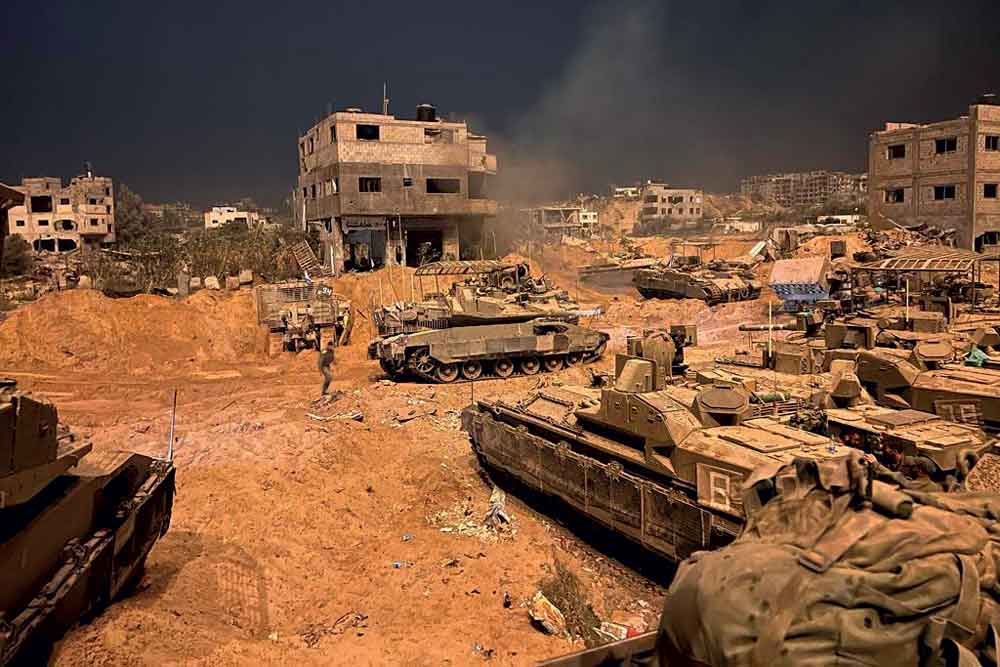
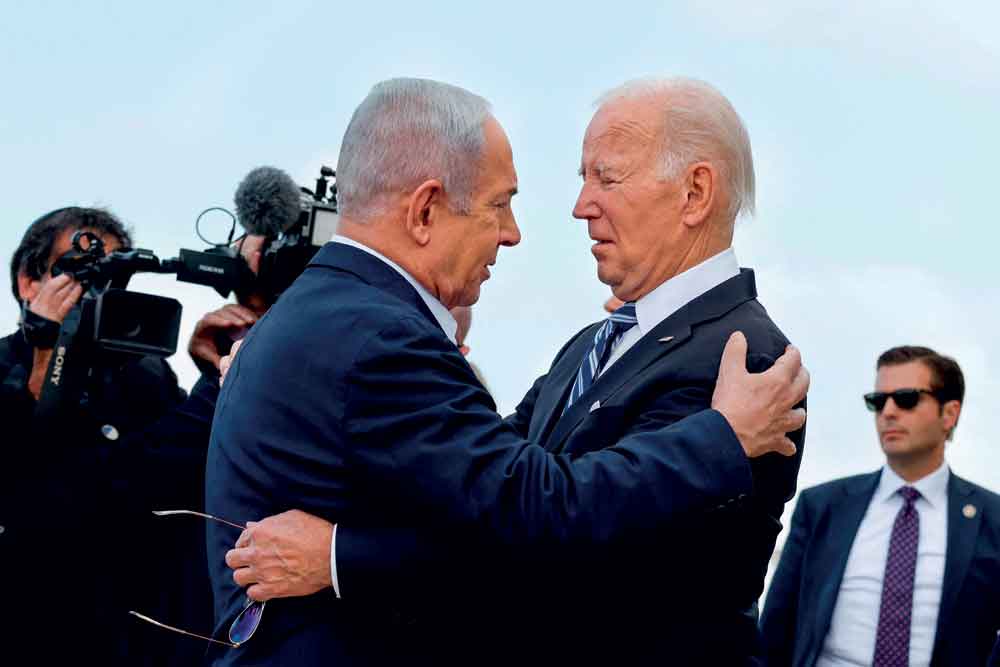
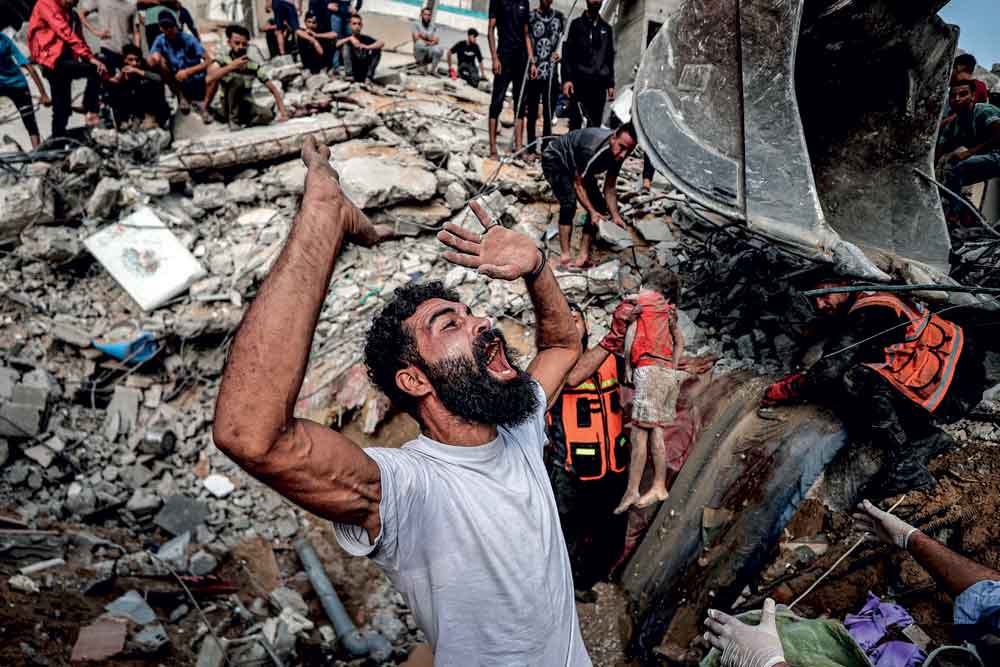
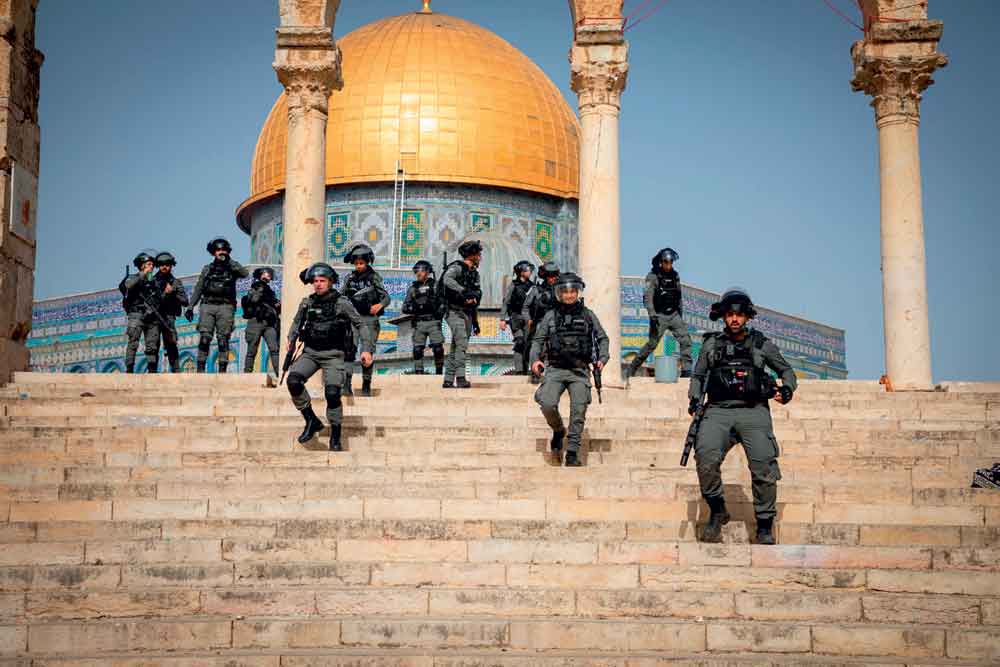
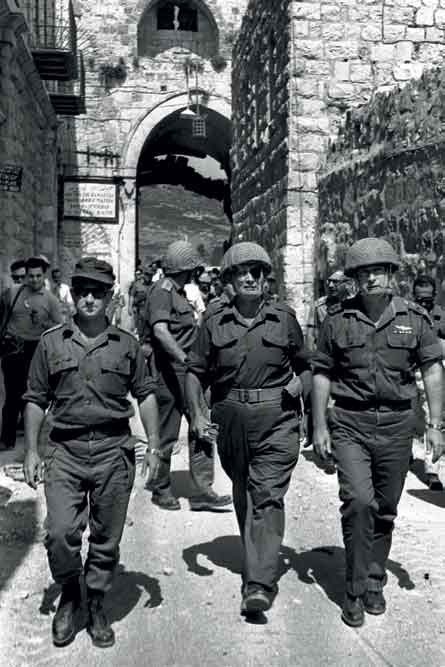
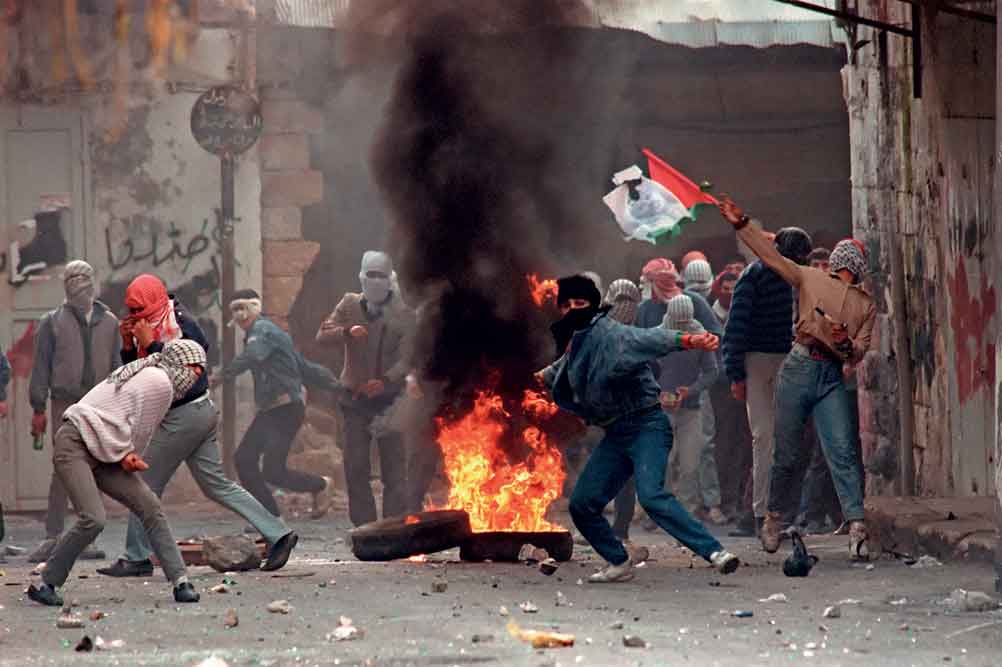
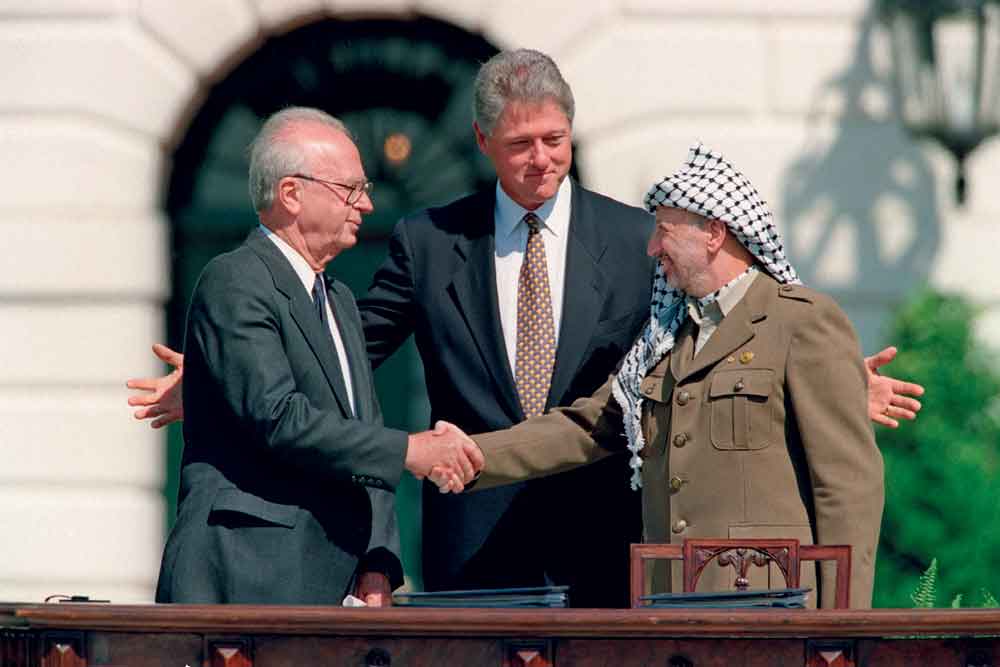


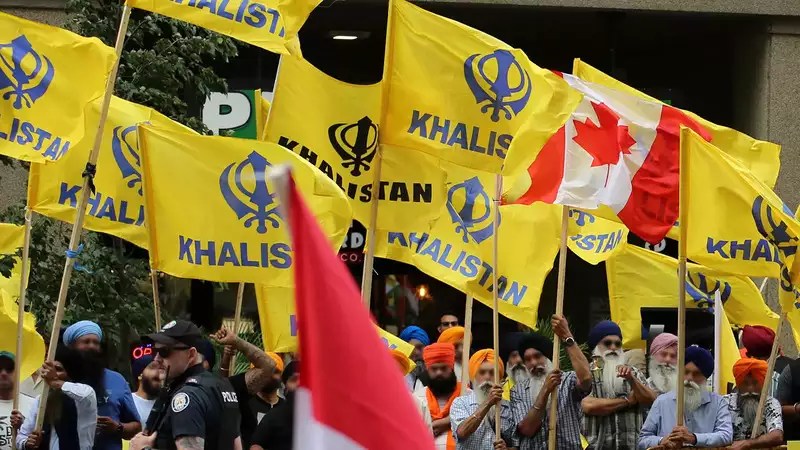


 Stagecraft and Statecraft
You must be logged in to post a comment.