With conflicts in Europe and the Middle East draining US attention and resources, US President Joe Biden seems to hope that a more conciliatory approach toward China will be enough to maintain stability in the Indo-Pacific. Strengthening the Quad grouping of regional democracies would be a much better bet.
When four of the Indo-Pacific’s leading democracies – Australia, India, Japan, and the United States – revived the long-dormant Quad in 2017, their objective was clear: to create a strategic bulwark against Chinese expansionism and reinforce a stable regional balance of power. But the coalition is now adrift, and the security risks this poses should not be underestimated.
The Quad’s resurrection reflected a paradigm shift in US foreign policy. After decades of engagement with China, including aiding its economic rise, US policymakers – Democrats and Republicans alike – realized that America’s biggest trade partner had become its biggest strategic adversary, bent on replacing it as global hegemon. As US President Joe Biden indicated in his 2022 National Security Strategy, China is “the only competitor with both the intent to reshape the international order and, increasingly, the economic, diplomatic, military, and technological power to advance that objective.”
Biden, like his predecessor, Donald Trump, viewed the Quad as an essential instrument to uphold a “free and open Indo-Pacific” – a concept formulated by the late Japanese Prime Minister Abe Shinzō. So, Biden elevated Quad discussions from the level of foreign ministers – who had been meeting annually since 2019 – to heads of state or government, initiating a flurry of leaders’ summits in 2021-23. But it has been more than a year since the Quad leaders last met, and with the US focused on the upcoming presidential election, their next summit is unlikely to be held before 2025.
The reason for this drop-off is simple: America’s priorities have changed. Russia’s war of aggression against Ukraine – together with the hybrid war the West is waging in response, not to mention renewed conflict in the Middle East – has stymied US efforts to position the Indo-Pacific at the “heart” of its grand strategy. It is striking that the latest US foreign-assistance package provides $60.8 billion for Ukraine but only $8.1 billion for security in the Indo-Pacific, including Taiwan, on which China has set its sights.
With limited resources to dedicate to the Indo-Pacific, Biden seems to hope that he can prevent a war over Taiwan through personal diplomacy with Chinese President Xi Jinping. Last month, in a telephone call with his Chinese counterpart, he stressed the importance of maintaining peace across the Taiwan Strait.
Biden seems to believe that a more conciliatory approach toward China can also forestall the emergence of a comprehensive Sino-Russian alliance. The “no-limits partnership” between China and Russia, reaffirmed during Russian President Vladmir Putin’s recent visit to Beijing, is problematic enough; China already has undercut Western sanctions by providing an economic lifeline to Russia, in exchange for cheap energy and some of Russia’s most advanced military technologies, including air-defense and early-warning systems. A full military alliance, with China supporting the Kremlin’s war machine directly, would be America’s worst geopolitical nightmare.
The problem for Biden is that appeasing China and strengthening the Quad – which Chinese Foreign Minister Wang Yi has decried as the “Indo-Pacific version of NATO” – are fundamentally incompatible. It might not be a coincidence that the Quad leaders have not met since Biden sent a series of cabinet officials to Beijing and met with Xi in California last November.
In fact, Biden has lately shifted his focus to less provocative initiatives like the “Squad,” an emerging unofficial regional grouping involving Australia, Japan, and the Philippines – countries that already have mutual defense treaties with the US. But what good is an anti-China alliance without India? It is, after all, the only power that has truly locked horns with the People’s Liberation Army this century: the tense military standoff along the disputed Himalayan border, triggered by China’s stealthy territorial encroachments, has just entered its fifth year. Moreover, as the leading maritime power in the Indian Ocean, India must play a central role in checking China’s westward naval march from its new citadel, the South China Sea.
The US has also been touting its AUKUS security partnership with Australia and the United Kingdom. But this grouping will not be able to play a meaningful role in Indo-Pacific security until Australia is equipped with nuclear-powered submarines, and that will not happen for another decade.
So far, Biden’s overtures to China have yielded few positive results. On the contrary, Xi has lately intensified coercive pressure on Taiwan, and Chinese provocations in the South China Sea have been increasing. Unless the US changes its approach, it may well fail to deter China from attacking Taiwan or cementing a strategic axis with Russia, just as it failed to deter Russia from invading Ukraine.
To maintain security in the Indo-Pacific, there is no substitute for a strong Quad with a clear strategic mission. Rather than unraveling years of efforts to build a coherent and credible regional strategy, thereby enabling yet more Chinese expansionism, Biden and his fellow Quad leaders must get to work defining such a mission and then commit to pursuing it. Otherwise, the Quad risks becoming a kind of Potemkin grouping. The façade of an alliance will not fool China.
Brahma Chellaney, Professor of Strategic Studies at the New Delhi-based Center for Policy Research and Fellow at the Robert Bosch Academy in Berlin, is the author of nine books, including Water: Asia’s New Battleground (Georgetown University Press, 2011), for which he won the 2012 Asia Society Bernard Schwartz Book Award.
Japan has become one of Ukraine’s most-important financial backers, pouring in some $12.1 billion in aid to support the country’s war-battered economy and its defenses with nonlethal equipment such as anti-drone systems.
“As I often say, Ukraine of today may be East Asia of tomorrow,” Prime Minister Fumio Kishida told a joint session of the U.S. Congress two weeks ago, underlining the rationale for aligning Tokyo closely with America’s de facto proxy war against Russia.
But how does Kishida’s leadership role on Ukraine, including sanctions on Russia and a long-term commitment to support postwar reconstruction, tangibly advance Japan’s strategic interests at a time when its own neighborhood is becoming increasingly dangerous?
Oddly, there has been little debate in Japan on this issue. Yet the country’s deepening engagement with Ukraine at a time it is ill-prepared for armed conflict over Taiwan is a huge strategic mistake.
The drawn-out Ukraine war is not just impeding the U.S.-led attempt to rein in China’s aggressive expansionism, it is also stretching American resources thinly and weakening Washington’s deterrent posture in the Indo-Pacific region, thereby making a Taiwan Strait crisis more likely.
Kishida’s surprise move in December, at Washington’s urging, to ship Patriot air-defense systems to the U.S. to cover for ones being sent to Kyiv illustrates the risks of a Ukraine-centric approach.
Any Chinese operation to blockade or attack Taiwan would likely intrude into Japanese airspace and waters, conceivably pulling Tokyo into a war over the island democracy. Yet amid signs Chinese President Xi Jinping is preparing his country to go to war over Taiwan, Kishida has agreed to take weapons out of Japan’s air defenses for an increasingly hopeless war in distant Europe.
In fact, with U.S. attention and resources focused on conflicts in Europe and the Middle East, China’s efforts to alter the territorial and maritime status quo in Asia and secure strategic dominance are reaching a tipping point.
Yet some in the West myopically insist that the U.S. must first defeat Russia in Ukraine before pivoting to deter China. As if Xi would wait to move against Taiwan until the U.S. has humiliated Russia in a long war and was then ready to direct greater attention his way. Indeed, the last thing Xi would like is an end to the Ukraine war because that would leave the U.S. free to focus on the Indo-Pacific region.
This explains why China, as Washington now acknowledges, is quietly aiding the Kremlin’s war machine by supplying technologies and geospatial intelligence. The transfers suggest that, before making a move on Taiwan, Xi wants the Ukraine war to further deplete America’s weapons and munitions stocks.
The flip side to America’s deepening involvement in conflicts elsewhere is a desire to avoid direct confrontation with China. This explains U.S. President Joe Biden’s more conciliatory approach to Beijing in recent months, including a greater emphasis on diplomacy than on deterrence.
The U.S. may still be the world’s foremost military power, but it is in no position to meaningfully take on Russia and China simultaneously. According to its own official national security doctrine, the U.S. maintains the military capability to fight and defeat China or Russia with some allied support — but not both simultaneously.
In recent decades, the U.S. has waged overlapping wars, but these were against much weaker states, namely Iraq and Afghanistan. Still, these protracted wars exposed shortcomings in America’s ability to pursue two military missions simultaneously at full tempo.
In this light, Biden has stepped up his administration’s outreach to Beijing to help avert a Chinese attack on Taiwan that could result in a direct war between the U.S. and a near-peer adversary. But with the U.S. looking overextended and Xi viewing Biden’s conciliatory posture as one of weakness, the risks of failing to deter aggression against Taiwan are increasing.
The risks are particularly acute for Japan, whose southernmost islands lie close to Taiwan. As former Prime Minister Taro Aso has warned, if Taiwan falls, “Okinawa could be next.”
Japan should recall that U.S. appreciation of its generous financial support for previous missions has been fleeting.
A classic example is the 1991 Gulf War campaign against Iraq for which Japan contributed $13 billion. Yet then-U.S. Secretary of State James A. Baker III said, “Your ‘checkbook diplomacy,’ like our ‘dollar diplomacy’ of an earlier era, is clearly too narrow.”
Today, Japan needs to shed its zeal toward Ukraine and focus squarely on Taiwan. This should include not sending more Patriots or other defense systems to backstop Kyiv.
An overstretched America and a Japan straining to avert recession must persuade Europe to step up and take primary responsibility for Ukraine, its own neighbor.
To safeguard Asian security and the region’s balance of power, there can be no substitute for a prudent, balanced and forward-looking approach.
With China’s lengthening shadow darkening its doorstep, Japan needs to focus primarily on its combustible neighborhood and prepare for a Taiwan Strait contingency.
This should include assuring its ability to respond to a scenario in which Xi seeks to bring Taiwan to its knees by employing the techniques of incremental expansionism that his regime has successfully honed in the South China Sea without triggering a concerted U.S. response.
Not Ukraine, but the South China Sea of today could be the Taiwan of tomorrow. This means that Japan, without being unduly distracted by developments afar, must find effective ways to beat back China’s hybrid warfare.
Brahma Chellaney is professor emeritus of strategic studies at the Centre for Policy Research in New Delhi and a former adviser to India’s National Security Council. He is the author of nine books, including “Water: Asia’s New Battleground.”
The congressional breakthrough on the $95 billion foreign assistance package after months of political wrangling provides President Joe Biden’s administration with arms outlays that are larger than the defense budget of every country other than the United States, China and Russia. Biden now has considerable leverage to further conflict or deterrence across three large geographic regions encompassing more than half of the world — Europe, the Middle East and the Indo-Pacific.
The package effectively opens the floodgates to the greater flow of sophisticated American weapons, especially to Ukraine. In fact, even before Biden signed the foreign assistance bill into law, Ukraine began using longer-range ATACMS missiles against Russian forces that the U.S. had secretly supplied. And as the law took effect, the Pentagon immediately rushed $1 billion worth of American weapons to Ukraine.
The package reflects the Biden administration’s skewed strategic priorities: It provides $60.8 billion for Ukraine in its war of attrition with Russia, with much of the funding going to U.S. defense contractors and the Pentagon; $26.4 billion for Israel and America’s supporting military operations in the Middle East; and a relatively miserly $8.1 billion for Taiwan and other security challenges in the Indo-Pacific region — the world’s center of gravity where America’s main rival, China, is incrementally changing the territorial and maritime status quo.
The congressional logjam over the package had jeopardized the centerpiece of Biden’s foreign policy, which has focused America’s attention and resources on the wars in Europe and the Middle East. But the region central to the global balance of power and peace is the Indo-Pacific.
The longer the U.S. remains involved in the conflicts in Europe and the Middle East, the greater will be the likelihood of China invading Taiwan. It is telling that, under Biden, an overextended America is seeking to dissuade Chinese President Xi Jinping from launching an attack on Taiwan more through diplomacy than deterrence.
Biden’s latest defense budget, and the small outlays for the Indo-Pacific in the $95.3 billion package, show that deterrence against China has assumed a subsidiary policy role. The budget not only underfunds key enabling capabilities for the Indo-Pacific but also cuts programs, including slashing the production goal for Virginia-class submarines from two per year to just one.
China, on the other hand, is engaged in a frenzied naval buildup. China’s surface naval fleet is now already much larger than the American fleet. In terms of number of submarines, China, by embarking on a new generation of nuclear-armed subs, possibly with Russian assistance, is set to go beyond its current near-parity with the U.S. Meanwhile, qualitative improvements in battle force ships and more aggressive tactics by the Chinese navy are already making it more challenging for American ships and submarines to operate in China’s maritime backyard.
The Ukraine war, for its part, has helped raise the specter of the U.S. realizing its worst geopolitical nightmare: a Sino-Russian strategic axis. Secretary of State Anthony Blinken this month called China “the primary contributor” to Russia’s defense industrial base.
The conflict has already exposed NATO’s military shortcomings, including its struggle to scale up weapons and munitions manufacturing to match the output of Russia’s war economy. Chinese President Xi Jinping seems to be aiding the Kremlin’s war machine in an apparent effort to keep the U.S. tied down in Ukraine and further deplete Western arsenals before invading Taiwan.
Against this background, the massive new U.S. funding for Ukraine will further deepen American involvement in the conflict without any prospect of changing the tide of the war. U.S. officials now acknowledge that there is little prospect of Ukraine regaining the 20 percent of its territory already occupied by Russia.
The Biden administration’s narrative on the war has evolved through three distinct phases. In the immediate aftermath of the Russian invasion, the “save Ukraine” narrative was dominant, before being overtaken by the “bleed Russia” narrative, which presented the Western supply of weapons and battlefield intelligence to Ukrainian forces as a cost-effective investment to severely “weaken” an adversary militarily.
Even after the much-hyped Ukrainian counteroffensive floundered last summer, dashing NATO’s hopes of a major military breakthrough against Russia, the administration — anxious not to lose public support for the war — continued to peddle the line that Ukraine was winning the fight against Russia.
The third phase, “help Ukraine stave off defeat,” began more recently, when CIA Director Bill Burns warned that Ukraine could lose the war to Russia by year’s end absent additional American aid. The shift in the narrative from “Ukraine is winning” to “Ukraine may be facing defeat” was jarringly abrupt.
Make no mistake: Even if the new U.S. assistance of $60.8 billion helps Ukraine avert defeat, it is unlikely to dramatically reverse Ukrainian fortunes on the battlefield against a much stronger foe. Indeed, the longer the war extends, the greater is likely to be Ukraine’s devastation, making reconstruction more costly and onerous.
By sending more lethal and longer-range weapons to Ukraine, the U.S. funding, however, carries the risk of triggering a direct NATO conflict with Russia, which has the world’s largest nuclear arsenal. Western powers have also increasingly provided Ukraine battlefield targeting data and even some actual assistance on the ground near the front lines.
German Chancellor Olaf Scholz faced some flak in February for inadvertently exposing the role of Britain, France and possibly the U.S. in militarily helping direct attacks on Russian targets from Ukrainian soil through “target control.” Scholz said that if Germany followed Britain and France in supplying Ukraine with long-range missiles, it would make it a “participant in the war,” too.
Throwing good money after bad and hoping for a miracle isn’t a strategy. Yet that exactly is the basis of the new foreign assistance package.
A wise course for Biden would be to leverage the package by quietly pushing for a ceasefire in the Ukraine war through back-channel diplomacy. The alternative is to sap America’s strength by continuing to invest heavily in a failing war, thereby creating more strategic space for China to overthrow U.S. global preeminence.
Brahma Chellaney is a geostrategist and the author of nine books, including the award-winning “Water: Asia’s New Battleground” (Georgetown University Press).
The West’s strategic overreach vis-à-vis Russia is not only alienating much of the rest of the world, but also providing a windfall for its real rival, China. Unless it changes course, the West is likely to lose its global supremacy, including its hold on the international financial architecture.
MUNICH – Since Russia launched its full-scale invasion of Ukraine more than two years ago, the West has desperately sought ways to punish Russia without harming itself in the process. It has mostly failed.
So far, not even unprecedented sanctions have derailed Russia’s economy, let alone compelled the Kremlin to change its behavior. Instead, Russia has pivoted to a war economy: it now produces nearly three times as many munitions as NATO, including more missiles than it was producing before the war began.
Much of the West, by contrast, is facing economic stagnation, owing not least to the switch away from cheap Russian energy to costlier supplies from elsewhere. The United Kingdom is officially in recession, and there has been no growth in the eurozone since the third quarter of 2022, when gas prices surged, leading the European Central Bank to start raising interest rates to stem runaway inflation. Higher fuel prices have helped turn former economic powerhouse Germany into the worst-performing developed economy.
European growth is not the only casualty of Western sanctions against Russia. The US dollar – which was already facing “stealth erosion” before the Ukraine war – appears to have lost some of its global influence, even in oil markets, as countries pursue alternatives to the greenback in response to the West’s decision to weaponize finance. Meanwhile, rising gold purchases by central banks in China, Turkey, India, Kazakhstan, and Eastern Europe, coupled with greater geopolitical uncertainty, have helped drive prices to a record high.
The European Commission’s move to seize the profits generated by frozen Russian central-bank assets would reinforce these trends. Given the centrality of central banks in the global financial system, their assets have historically been considered sacrosanct. But Russia’s assets – over two-thirds of which are held by the Brussels-based clearing house Euroclear – were frozen unilaterally by Western governments, without authorization from the International Court of Justice or the United Nations Security Council, as required by international law.
Now, with “Ukraine fatigue” weakening Western support for continued military and financial aid, the European Commission wants to start tapping the €3.25 billion ($3.45 billion) in annual accrued interest on the frozen assets. Under its current proposal, most of the revenues would be channeled through the European Peace Facility, which refunds EU states for sending arms to Ukraine, with the rest going to the EU’s central budget, to be used to strengthen Ukraine’s weapons-manufacturing capacity.
But such a move would be unlikely to help turn the tide in the Ukraine war. What Ukraine really needs more than weapons and funds are new recruits to replenish the ranks of its exhausted and depleted forces. Here, its options are limited: not even draconian conscription practices have been able to offset the growing troop shortfall.
What seizing Russia’s earnings would do is set a dangerous precedent in international law and deal a blow to Europe’s credibility as a champion of a rules-based world order; the Commission’s proposed “legal pathway” amounts to lawfare, pure and simple. It would also signal to other countries that their money is not safe in the West, thereby strengthening further their incentive to seek alternatives to Western institutions and currencies. If this trend continues, the West’s financial-sanctions arsenal will be weakened considerably. Already, the West’s routine use of sanctions is reducing their impact.
Not only do Western sanctions fail to change the behavior of the government being targeted, whether Russia, Iran, Myanmar, or Syria; they also almost invariably advance China’s commercial and strategic interests. In fact, no country is profiting more from Russia’s invasion of Ukraine – and the West’s response to it – than China.
Beyond expanding the international use of the renminbi, Western sanctions against Russia created an opportunity for China to secure greater cheap supplies of Russian oil, gas, and grains. Transported along secure overland routes, these supplies would likely continue being delivered even in the event of a war with the West, easing a major source of anxiety for China over its designs on Taiwan.
Moreover, China has more than doubled its nuclear-weapons arsenal since 2020, and it is expanding its conventional forces faster than any other country has since World War II. Yet the West is so fixated on punishing Russia that China has managed to avoid much scrutiny, let alone pushback. US President Joe Biden, for example, is now attempting to “manage competition” with China by laying greater stress on diplomacy than on deterrence, with his latest budget woefully underfunding key enabling capabilities for the Indo-Pacific and even slashing the production target for Virginia-class submarines from two per year to just one. Small wonder that China is quietly oiling the Kremlin’s war machine. For China, the longer the West stays distracted, the better.
Make no mistake: China poses a far greater threat to Western interests and the rules-based world order than Russia. Whereas Russia’s designs are largely confined to its neighborhood, China has the ambition to supplant the US as the preeminent global power. It may well also have the means: China’s population and economy are about ten times larger than Russia’s, and China spends some four times as much as Russia on its military.
The West, which accounts for just 12% of the global population, should not underestimate the potential consequences of simultaneously enabling China’s increasingly aggressive rise and alienating the rest of the world. Unless it abandons its strategic overreach vis-à-vis Russia and turns its attention to its real rival, China, the West is likely to lose its global supremacy, including its hold on the international financial architecture.
Brahma Chellaney, Professor of Strategic Studies at the New Delhi-based Center for Policy Research and Fellow at the Robert Bosch Academy in Berlin, is the author of nine books, including Water: Asia’s New Battleground (Georgetown University Press, 2011), for which he won the 2012 Asia Society Bernard Schwartz Book Award.
Can US dialogue and cooperation with the communist dictatorship in Beijing help avert a Taiwan Strait crisis? Or is US President Joe Biden playing into Chinese President Xi Jinping’s (習近平) hands?
With America preoccupied with the wars in Europe and the Middle East, Biden is seeking better relations with Xi’s regime. The goal is to responsibly manage US-China competition and prevent unintended conflict, thereby hoping to create greater space for the two countries to work together in areas where their interests align.
The existing wars have already stretched US military resources thin, and the last thing Biden wants is yet another war. So, to forestall a war over Taiwan, Biden has made a series of overtures to Xi’s regime, including stressing, along with his G7 partners, that the West is seeking to “de-risk” its relationship with China, not “decouple” from the world’s second-largest economy.
Notably, after sending a string of cabinet officials to Beijing, Biden held a summit meeting with Xi in Woodside, California, last November. Biden’s recent phone call with Xi was part of the ongoing effort, as the White House put it, to responsibly manage ties with China.
But what stands out is the current US focus on a thaw with Beijing, instead of concentrating on deterring China’s aggressive expansionism. In fact, with Biden’s China strategy incorporating no clear vision of success, a “managed competition” has become an end in itself, instead of being a means to an end.
That deterrence has assumed a subsidiary role in policy is apparent from Biden’s latest proposed defense budget, which reinforces the administration’s approach of not taking the China threat seriously. It significantly underfunds key enabling capabilities for the Indo-Pacific and even cuts programs, including slashing the production goal for Virginia-class submarines from two per year to just one.
Funding just one Virginia-class attack boat is a break from the US navy’s steady two-per-year demand signal. The US is committed to selling up to three Virginia-class submarines to Australia in the 2030s under the AUKUS deal, which would make the American submarine deficit worse. In fact, America’s fiscal year 2025 budget seeks only six new battle force ships while retiring 10.
Contrast that with the way China churns out ever more weapon systems and platforms, with its surface naval fleet now significantly larger than the American fleet in number of ships. And, in terms of number of submarines, China, by embarking on a new generation of nuclear-armed subs, possibly with Russian assistance, is set to go beyond its current near parity with the US.
Meanwhile, qualitative improvements in battle force ships and more aggressive tactics by the Chinese navy are already making it more difficult for American ships and submarines to operate in China’s maritime backyard.
Make no mistake: Biden’s more conciliatory approach to China has so far yielded no tangible dividends. It has neither eased Beijing’s coercive pressures on Taiwan nor diminished China’s aggressive efforts to entrench its dominance in the South China Sea.
If anything, it has only emboldened China’s pursuit of strategic dominance in Asia. Washington now admits that China is even aiding Russia’s war in Ukraine by transferring technologies and sharing geospatial intelligence.
According to Beijing’s readout, Xi cautioned Biden during their recent phone conversation that Taiwan is a “red line that must not be crossed.”
With Xi preparing China for war against Taiwan, it has become more imperative than ever for the US to strengthen deterrence, including bolstering Taiwan’s defenses.
Yet, there is a huge backlog in US military sales to Taiwan, with weapons deals announced as long ago as 2017 still unfulfilled. For Taiwan, the US Congress previously authorized a US$1 billion-a-year replenishment of drawdown funding, but that has been slashed to US$500 million in the Pentagon’s latest budget.
In contrast to the Biden administration’s generous weapons shipments to Ukraine, there appears no urgency in providing arms to Taiwan to counter China’s increasing aggressiveness.
The administration also seems loath to address its resolve gap by stating unambiguously that the US has the strategic intent and political will to defend Taiwan against an attack.
Biden, asked last September whether American forces would defend Taiwan if China attacked, replied with a caveat, “Yes, if in fact there was an unprecedented attack.” But what would be the US response if, instead of an unprecedented attack, Xi launched a wily strategy of gradually escalating aggression against Taiwan anchored in stealth, deception and surprise?
Deterrence — or peace through strength, as it is commonly called — has stood the test of time. It has prevented wars of aggression. But failure to build and sustain adequate deterrent capabilities, by signaling weakness, can invite aggression.
Deterrence, however, must always be accompanied by diplomacy so as to forestall a destabilizing arms race or unintended conflict and create space for eventual compromise and reconciliation.
Under then-US president Ronald Reagan, the US grand strategy against the Soviet Union was designed to apply maximum pressure on the Soviet Union — diplomatic, ideological, economic and military — while pursuing a policy of engagement with Moscow. It was as much carrot as it was stick, contributing ultimately to the Soviet Union’s disintegration.
By contrast, Biden’s approach to China is more carrot than stick. “I don’t want to contain China,” Biden gratuitously declared while visiting Hanoi last September. “We’re not trying to hurt China.” The goal, Biden said, is “getting the relationship right” between the US and China.
Biden has repeatedly assured Xi that the US would not seek to change China’s political system or direct alliances against it.
Prioritizing diplomacy over deterrence has resulted in a strange paradox: the stronger established power, in attempting to preserve the status quo, is seeking to appease the revisionist power, whose expansionism continues apace.
Brahma Chellaney, professor of strategic studies at the independent Center for Policy Research in New Delhi, is the author of nine books, including the award-winning Water: Asia’s New Battleground (Georgetown University Press).
With the wars in Ukraine and Gaza stretching its military resources thin, a direct confrontation with China is the last thing the US needs. But America’s refusal to rein in China’s aggressive expansionism, not least in the South China Sea, may well make a clash more likely – and more destructive.
HANOI – For over a decade now, China has been working stealthily to alter the territorial and maritime status quo in the Indo-Pacific – an effort that has increasingly stoked tensions with regional neighbors like Australia, India, Japan, Taiwan, and several Southeast Asian countries, as well as the United States. And with US attention and resources focused on conflicts in Europe and the Middle East, China has lately become even more aggressive in its expansionism. Chinese regional hegemony is closer than ever.
Almost daily, China finds a new way to bully Taiwan, which Chinese President Xi Jinping has repeatedly pledged to “reunify” with the mainland (though that objective has no basis in international law or history). As China takes steps like encroaching on Taiwan’s air-defense zone and encircling the island with warships, it raises the risk of a war that would transform global geopolitics.
There are war clouds also gathering over the Himalayas, where a military standoff triggered by China’s repeated furtive encroachments on India’s borderlands has dragged on for nearly four years. And in the East China Sea, China’s intrusions into the territorial waters and airspace of the Japanese-controlled Senkaku Islands, which China claims as its own, are fueling Japan’s drive toward rearmament.
But the biggest risks of escalation may well lie in the South China Sea, where China’s aggressive efforts to entrench its dominance have regularly led to dangerous near-confrontations, including with US warships and aircraft. For years, China has been working relentlessly to cement its dominance over the South China Sea and exploit that region’s vast resources and strategic position as a critical corridor through which one-third of global shipping passes.
To this end, China has constructed artificial islands atop remote reefs and atolls and transformed them into forward military bases. Though these activities constitute a blatant violation of international law, including a 2016 ruling by an arbitral tribunal at The Hague that invalidated Chinese claims in the South China Sea, there has been little pushback from three successive US administrations. As a result, China has managed to expand its maritime borders unilaterally without firing a single shot.
Now, China’s navy and air force routinely patrol its neighbors’ exclusive economic zones (EEZs), and its coast guard – the world’s largest and most militarized – has conducted “intrusive patrols” of others’ offshore oil and gas fields. Chinese coast-guard vessels, including megaships, wantonly employ “non-lethal” weapons like high-pressure water cannons and long-range acoustic devices.
Moreover, China has been sending its navy and coast guard to shadow, hound, and harass vessels belonging to the US, as well as to smaller neighbors, such as the Philippines and Vietnam, with territorial claims in the area. Even fishing boats have been targeted and destroyed. With Chinese ships now being deliberately designed for “ramming” and “shouldering” other vessels, it seems clear that China will become more aggressive in asserting its territorial claims – and the associated fishing and energy-exploration rights – in the South China Sea.
China’s militarization of the South China Sea poses the greatest threat to the Philippines and Vietnam. But whereas Vietnam pursues an independent foreign policy, which its prime minister calls a historical imperative, the Philippines is a longstanding US ally, with a mutual defense treaty in place since 1951.
And yet, when it comes to China’s expansionism in the South China Sea, the US has largely left the Philippines to fend for itself. In 2012, when China occupied the Scarborough Shoal, a traditional Philippine fishing ground located within the country’s EEZ, US President Barack Obama’s administration stayed silent. Since then, China has steadily eroded the Philippines’ control of other areas within its EEZ, but the US has offered its ally little beyond statements of support.
This is unlikely to change any time soon. With the wars in Ukraine and Gaza stretching American military resources thin, a direct confrontation with China is the last thing the US needs. But refusing to stand up to China may well make a clash more likely – and more destructive.
Already, the US has allowed China to gain such a strong footing in the South China Sea that restoring the status quo of just a decade ago would be all but impossible without a full-scale war. And, as the recent increase in provocations in the South China Sea indicate, Xi is bolder than ever, despite the rising risk of escalation, accidental or otherwise. In the meantime, America’s failure to rein in China’s aggressive expansionism is undermining its own security and trade interests.
US President Joe Bideninsists that the US wants “competition with China, not conflict.” But China wants strategic dominance – beginning with the South China Sea – and it is willing to risk conflict to get it. The South China Sea has become a test of American resolve, which Xi is expecting Biden to fail. The world, especially the countries on the front lines of Chinese expansionism, can only hope that Xi is wrong, and that the US finds ways to rein in China without armed conflict.
Brahma Chellaney, Professor of Strategic Studies at the New Delhi-based Center for Policy Research and Fellow at the Robert Bosch Academy in Berlin, is the author of nine books, including Water: Asia’s New Battleground (Georgetown University Press, 2011), for which he won the 2012 Asia Society Bernard Schwartz Book Award.
The military standoff along the long Himalayan frontier between China and India may not be grabbing international headlines these days given the open warfare raging elsewhere in the world, but the threat of the confrontation returning to armed conflict cannot be discounted.
Last week, Indian Foreign Minister S. Jaishankar called the Chinese border situation “very tense and dangerous.” Both sides have been significantly ramping up deployments of troops and weapons, girding for the possibility of war.
Soon to enter its fifth year, the current standoff was triggered by furtive Chinese encroachments into India’s northernmost territory of Ladakh in April 2020, just before thawing ice would normally reopen Himalayan access routes after the brutal winter.
Ahead of this year’s spring thaw and possible new Chinese provocations, India moved an additional 10,000 troops to the frontier. “The possibility that we may face a similar situation that we faced in 2020 is keeping us active all the time,” Indian Defense Secretary Giridhar Aramane said last month.
China has also been expanding its troop presence and frenetically building warfare-related infrastructure along the inhospitable frontier. This has includedboring tunnels and shafts in mountainsides to set up command positions, reinforced troop shelters and weapons-storage facilities.
In addition, it has planted settlers in new militarized border villages that are becoming the equivalent of the artificial islands it created in the South China Sea to serve as forward military bases.
About 100,000 troops remain locked in a faceoff along the border’s westernmost Ladakh sector. Another key sector is the vulnerable area where the borders of Tibet, Bhutan and India’s Sikkim state meet, a 22-kilometer-wide corridor known as “the chicken neck” due to the crooked way it connects India’s northeast to the country’s heartland.
There are also troop faceoffs in the eastern Himalayas along Tibet’s long border with India’s Arunachal Pradesh state. This has long been a heavily militarized area, largely because China claims the Indian state is part of Tibet, although the Dalai Lama, the exiled Tibetan leader, says this has no historical basis.
Talks to de-escalate tensions along the frontier have made little progress. In January, Indian Army chief Gen. Manoj Pande said the standoff would continue until China rolled back from its Ladakh encroachments, calling restoration of the previous frontier line “our first aim to achieve.”
Despite taking some flak at home for losing border areas to Chinese encroachment, Indian Prime Minister Narendra Modi continues to seek a negotiated end to the crisis.
While his government has banned numerous Chinese apps, blocked investments by certain Chinese companies and launched enforcement actions against others over alleged tax and foreign exchange violations, it has not imposed broad sanctions against its northern neighbor.
Consequently, despite the border confrontation, China’s annual trade surplus with India has continued to rise; it is now larger than India’s annual defense spending.
Modi discussed the crisis in brief with Chinese President Xi Jinping on the sidelines of multilateral summits in November 2022 and August 2023. Jaishankar reiterated earlier this month that New Delhi remains “committed to finding a fair, reasonable” agreement.
Now Xi is faced with the challenge of resolving the Himalayan military crisis without losing face.
For four years, tens of thousands of Chinese troops have remained deployed in extremely harsh conditions along the Himalayan frontier. If Xi somehow came to an agreement with Modi about undoing China’s territorial encroachments, he would face questions about why he embarked on the aggression in the first place.
The longer the standoff persists, though, the greater the risk that Beijing turns India into an enduring enemy, a development that would weigh down China’s global and regional ambitions.
Xi has already been confronted by his failure to anticipate India’s robust military and strategic response, with the standoff driving New Delhi closer to Washington. It also set in motion a major military buildup and modernization drive, as illustrated by a flight test last week to demonstrate that India now can put multiple independently targetable nuclear warheads on a single intercontinental ballistic missile.
Since the standoff began, India has tested several other leading-edge missile systems, including a hypersonic cruise missile, a hybrid missile-torpedo for use against submarines and aircraft carriers, an anti-radiation missile for destroying radar-equipped air defense systems and a new generation, intermediate-range ballistic missile capable of carrying nuclear or conventional warheads.
India has also been importing major weapon systems from the U.S. as well as France and other sources. In November, Defense Minister Rajnath Singh told his U.S. counterpart that their two governments are “in agreement on strategic issues, including countering China’s aggression.” India’s growing alignment with the U.S. undoubtedly worries Xi.
Without the elements of stealth, deception and surprise that characterized China’s 2020 encroachments, the People’s Liberation Army would be hard put to get the better of India’s armed forces in a Himalayan war. While the PLA relies heavily on conscripts, India has an all-volunteer force that is considered the world’s most experienced in mountain warfare.
As two of the world’s most ancient civilizations, China and India need to find ways to peacefully coexist as neighbors and to cooperate on shared objectives. But it is far from certain that reconciliation between the two most populous nations will be possible while Xi and the Chinese Communist Party remain in power.
Brahma Chellaney is professor emeritus of strategic studies at the Centre for Policy Research in New Delhi and a former adviser to India’s National Security Council. He is the author of nine books, including “Water: Asia’s New Battleground.”
When Beijing says “Taiwan has always been an inalienable part of China” and calls this “an indisputable legal and historical fact,” it promotes a claim that has absolutely no basis in international law or history.
But by aggressively stating that claim time and again over the years, it has made many in the world believe that fiction, especially when the dominant Western media outlets are reluctant to challenge the Chinese narrative.
Indeed, some international publications now use the phrase “reunify” without quotation marks while referring to Beijing’s Taiwan goal.
The truth is that Taiwan, for most of its history, had no relationship with China and has remained fully outside Chinese control for the last 129 years since 1895 when, following defeat in the First Sino-Japanese War, China’s Manchu-run Qing government signed the Treaty of Shimonoseki that ceded Taiwan to Japan.
In international law, a territorial claim must be based on lasting and peaceful exercise of sovereignty over the entire territory concerned.
But Taiwan has never been an integral part of China in history. And the only outside power that secured control over all of Taiwan was Japan.
While Taiwan remained under Japanese colonial rule until 1945, Japan officially renounced its sovereignty over it only in the 1951 San Francisco Peace Treaty, but without the transferee being identified.
The communist-led People’s Republic of China, having exercised no territorial sovereignty over Taiwan, lacks the legal standing to lay claim to the island democracy.
In fact, the Chinese Communist Party (CCP), founded in 1921, long regarded Taiwan as a foreign territory and articulated for the first time its goal of “liberating” the island just months before it seized power in Beijing in 1949.
Beijing, likewise, dubiously claims that the Japanese-administered Senkaku Islands have always been part of China. There is unquestionably no concrete evidence that China ever had effective control over those islands.
In fact, China began claiming the Senkakus only after a United Nations agency’s report in 1969 referred to the possible existence of oil reserves in the East China Sea.
It was not until the early 1970s that Chinese documents began applying the name “Diaoyu” (釣魚) to the Senkakus and claiming they were part of China.
Sinicizing the names of the territories it claims is a standard tactic of the CCP, which it is also applying to the Himalayan borderlands of India, Bhutan and Nepal.
This tactic is designed to lend credence to its assertion that the areas it covets have always been part of China.
For example, in three separate batches between 2017 and 2023, Beijing renamed a number of places in India’s sprawling Himalayan state of Arunachal Pradesh, which is almost three times larger than Taiwan.
When India protested, Beijing doubled down, contending that Arunachal Pradesh is its own “territory” and Sinicizing names of places there is “China’s sovereign right.”
Such aggressive tactics, including claiming that a region controlled by another country has been part of China since ancient times, help over time to gain wide international recognition that the territory concerned is disputed.
This then encourages China to disturb the territorial status quo through stealthy maneuvers or encroachments.
China’s nearly four-year-long Himalayan military standoff with India has its origins in the April 2020 furtive Chinese encroachments on key borderlands in the northernmost Indian territory of Ladakh, which is located 2,000 kilometers from Arunachal Pradesh.
India, challenging Chinese power and capability, has more than matched China’s Himalayan military deployments and made clear that the standoff would continue until Beijing agrees to restore status quo ante.
More broadly, China, under President Xi Jinping (習近平), has been pushing expansive territorial claims in Asia on the basis of an ingenious principle — “what is ours is ours and what is yours is negotiable.”
It is telling that these territorial claims, from the East and South China Seas to the Taiwan Strait and the Himalayas, are based not on international law but on revisionist history. China’s weak legal case was highlighted by the 2016 Hague ruling, when an international arbitral tribunal invalidated Chinese claims in the South China Sea.
Yet, such is Beijing’s unmitigated scorn for international law that, in defiance of the Hague ruling, it has accelerated its expansionism in the South China Sea, turning its seven human-made islands into forward military bases and gradually securing greater and greater control of this critical corridor between the Pacific and Indian Oceans.
China’s “nine-dash line” encompassing much of the South China Sea exemplifies how it uses alleged history to pursue aggressive expansionism.
But Beijing’s manipulation of history extends beyond advancing extravagant territorial claims.
It also uses history to instill among the Chinese an abiding sense of grievance over the 110 years of national humiliation that China suffered up to the communist takeover in Beijing.
While Beijing misses no opportunity to shame Japan with the history card, its selective historical memory is highlighted by Chinese school textbooks, which black out the Chinese invasion and annexation of Tibet in the early 1950s and the wars it unleashed against India (1962) and Vietnam (1979).
In fact, as the mythical Middle Kingdom, China claims to be the mother of all civilizations, weaving legend with history to claim a dual historical entitlement — to recover “lost” lands and become a world power second to none. This helps to rationalize its muscular foreign policy, which seeks to make real the legend that drives the CCP’s revisionist history — China’s centrality in the world.
In the name of “reunification,” Xi seems determined to annex Taiwan, just as Mao Zedong (毛澤東) occupied the then-autonomous and resource-rich Tibet.
Chinese aggression against Taiwan would constitute the biggest threat to world peace in a generation.
It has thus become imperative to contest Beijing’s strange fairy tale that Taiwan was part of China since time immemorial.
Taiwan has all the attributes of a robust independent state, and most Taiwanese want it to stay that way.
After all, why would the Taiwanese be willing to give up their freedoms and be absorbed by the world’s largest autocracy, which is also a technology-driven Orwellian surveillance state?
People in Taiwan, in fact, have developed an identity that is distinct from that of Chinese citizens.
Brahma Chellaney, a professor of strategic studies at the independent Center for Policy Research in New Delhi, is the author of nine books, including the award-winning Water: Asia’s New Battleground (Georgetown University Press).
Few would doubt that India’s international profile and geopolitical weight have been rising, making it a key ‘swing’ state in the current transition from the US-led, post-World War II order to a new global order. Despite growing international turbulence, as underlined by crises, conflicts, wars and new threats, Indian foreign policy displays dynamism and confidence.
This is apparent from the close strategic partnerships India has built or reinforced with rival major powers, including the US and Russia. In fact, India is being courted by all the great powers.
Because India confronts what might be called the “tyranny of geography” in its own region—that is, serious external threats from virtually all directions—it must pursue extra-regional options to advance its economic and security interests. India, the region’s geographical hub, may be the world’s largest democracy but authoritarian structures have not been fully dismantled in neighbouring countries.
An unstable neighbourhood, to be sure, heightens the danger of spill-over effects for India, which would threaten its internal security. For example, the ethnic violence in Manipur state has been accentuated by the illegal influx of thousands of ethnic Chin from violence-torn Myanmar, which risks turning into a failed state because of crippling US-led sanctions and escalating armed attacks by insurgents attempting to overthrow the military junta.
Against this backdrop, India has little choice but to reach out beyond its immediate neighbourhood to help surmount the “tyranny of geography”. This explains the priority it attaches to expanding diplomatic and economic relations with other regions.
In the Middle East, for example, India’s expanding footprint owes a lot to the close relations Prime Minister Narendra Modi has forged with Israel and important Arab states. Modi, although accused by his critics of promoting Hindu nationalism, has built a strong personal rapport with the rulers of the Persian Gulf sheikhdoms, which are the citadels of Wahhabi Islam, the source of modern Islamic fundamentalism.
Modi, who on his seventh visit to the United Arab Emirates (UAE) recently inaugurated the first stone-built Hindu temple in the entire Middle East, refers to the Emirati president, Sheikh Mohamed bin Zayed Al Nahyan, as his “brother”. The UAE, the most liberal and forward-looking of the Gulf states, has rapidly emerged as one of the largest investors in, and a close trade and security partner of, India.
India, the world’s third-biggest importer of oil, sources 65 per cent of its crude imports from the Gulf states, which are also supplying fast-increasing quantities of liquefied natural gas (LNG) to the country. The nearly 9 million Indian expats in the Gulf region, including the world’s largest Indian diaspora of 3.4 million in the UAE, account for about 30 per cent of the $90 billion global remittance flowing to India yearly. Known to be disciplined, dedicated, hard-working and peaceable, the Indian expats in the Middle East are one of India’s most distinct soft power assets.
With size comes geopolitical, economic and cultural power. And with power comes respect. With its cherished foreign-policy autonomy and willingness to break with conventional methods and shibboleths, India is well placed to serve as a go-between in the Ukraine war and as a mediator in the Israeli-Palestinian conflict
Consider another region, East Asia, where India has bolstered trade and strategic ties with historic rivals Japan and South Korea. India has virtual free trade agreements (FTA) with these two countries, which today are seeking to overcome the historical baggage that still weighs down their bilateral relationship. India-Japan military exercises now extend to all three domains—air, maritime and land—and cover strategic, operational and tactical levels.
The neighbourhood constraints make it imperative for India to build stronger ties not just with the other major powers but also with important countries located in different regions.
KEY FACTORS
Several factors are central to a country’s international position, including its political and economic trajectory. Without political stability at home, economic growth will likely suffer.
Despite the plethora of political parties in India that largely team up in coalitions, especially before elections, the country has been fortunate to have enjoyed political stability under three successive prime ministers—Atal Bihari Vajpayee, Manmohan Singh (more so in his first term than his scandals-filled second tenure), and Narendra Modi.
Contrast that with the unending political crisis in military-dominated, China-indebted Pakistan, with that nation now confronting the worst economic crisis in its history. Indeed, the phrase “international basket case” might better apply to Pakistan today than it did to Bangladesh in 1971 when it won independence despite the Pakistani military’s genocide, in which three million people were killed, 200,000 women were confined in rape camps, and 10 million more people were forced to flee to India.
Under Sheikh Hasina, who has led a secular government since 2009 that Bangladeshi Islamists detest, Bangladesh has had political stability and rapid economic growth. Bangladesh’s impressive-growth trajectory stands in stark contrast to the chronic political and economic turmoil in Pakistan, which is still teetering on the brink of default.
Against this background, India’s continued rise hinges on sustained political stability at home. A stable, forward-thinking government can frame and pursue long-term strategic goals, including further accelerating economic growth, advancing development of critical and emerging technologies (including semiconductors, which have grown into a key international geopolitical battleground), underpinning military prowess with an expanded weapons-manufacturing base at home, strengthening nuclear-weapon, missile and drone capabilities, and bolstering internal security and social cohesion.
The 1998 nuclear weapons’ tests proved to be a watershed moment for India, raising its international profile and setting in motion the process for the US to gradually lift most of its technology sanctions against New Delhi. For more than a quarter of a century, the US had kept the world’s largest democracy under sanctions, while it actively aided communist China’s rise and armed Pakistan against India. And, as the <New York Times> reported in 1998, the US and China covertly helped Pakistan to build its nuclear bomb.
It was fortunate for India’s security and upward trajectory that the nuclear weapons’ tests were carried out six weeks after Vajpayee took office. Had Vajpayee waited six months, there probably would have been no such tests, given how the heady allure of power and its corrupting effects can easily weaken political resolve.
The five underground nuclear tests in 1998 exposed the utter failure of US policy to keep India from going overtly nuclear by employing technology sanctions and diplomatic pressure. Predicting test yields accurately holds the key to manufacturing sophisticated nuclear weapons. And, as underscored by post-shot radiochemical analyses, the yields from the five tests were in line with what the Indian scientists had aimed for.
Left to lick its wounds, the US began quietly reversing its policy towards India through diplomatic outreach, including closed-door talks. In mid-1999, Bill Clinton became the first American president to openly side with India against Pakistan in wartime when he successfully pressured then-Pakistani Prime Minister Nawaz Sharif to pull back his forces from the areas that they had furtively encroached upon in Ladakh’s Kargil region. And about eight months later, Clinton heralded a new beginning in Washington’s relationship with New Delhi by paying a five-day visit to India, the first by a US president in almost a quarter-century.
Since then, America’s embrace of India has persisted (and strengthened) under four succeeding presidents—George W Bush, Barack Obama, Donald Trump, and Joe Biden.
India’s rapid economic growth, with the Indian economy now the fastest growing among major countries, has reinforced bipartisan support in Washington for a closer partnership with New Delhi. US exports to India have boomed. Indeed, the US has become an important source of even crude oil and petroleum products for India, which is the world’s third-largest oil consumer after America and China.
UAE President Sheikh Mohamed bin Zayed Al Nahyan and Prime Minister Narendra Modi in Abu Dhabi, February 13, 2024 (Photo: PIB)
Meanwhile, the profound development that helped transform India’s global position—its going overtly nuclear—now figures little in the Indian or American discourse.
Yet India now faces an ongoing build-up of nuclear and missile forces in its neighbourhood, especially by China. The unprecedented speed and scale of the Chinese nuclear build-up appears to be linked to President Xi Jinping’s international expansionism as China seeks global primacy by 2049, the centenary of communist rule.
Modi refers to the Emirati President, Sheikh Mohamed bin Zayed Al Nahyan, as his ‘brother’. The UAE, the most liberal and forward-looking of the Gulf states, has rapidly emerged as one of the largest investors in, and a close trade and security partner of, India
The huge nuclear-weapons build-up is set to lengthen China’s shadow over Asia while heightening military tensions with its main Asian rivals—India and Japan. India, alas, has remained smugly content with the outcome of its 1998 tests, instead of seeking to enhance the credibility of its nuclear deterrent through a stockpile-stewardship programme that includes subcritical and other hydronuclear experiments. Today, India needs to pay close attention to Xi’s nuclear frenzy.
India’s global standing, in more recent years, has also benefited from two other factors, both China-related.
The first is the West’s belated recognition of Xi’s imperialist ambitions, which have spawned China’s aggressive expansionism almost since he came to power in 2012. Xi seems to believe that China has a narrow window of strategic opportunity to modify the international order in its favour before it confronts a deepening demographic crisis, stalled economic growth, and an unfavourable global environment. Accordingly, Xi has shown an increasing appetite for taking major risks.
President Biden, in his 48-page national security strategy released in October 2022, made clear that over the long term the US was more worried about China’s moves to “layer authoritarian governance with a revisionist foreign policy” than it was about a sanctions-battered Russia, whose strategic ambitions are regionally confined. China “is the only country with both the intent to reshape the international order and, increasingly, the economic, diplomatic, military and technological power to advance that objective,” the strategy report said.
It has become clear to many Americans that China is not a friend or a partner but rather an adversary bent on global dominance by supplanting the US. Multiple opinion surveys have shown that the number of Americans who view China as their country’s “greatest enemy” or “greatest threat” has more than doubled since 2020, increasing to over half of US adults. As an adversary in American eyes, Russia is now a distant second to China.
History will record 2020 as a watershed year for Beijing when international attitudes visibly changed and many economies learned hard lessons about China-dependent supply chains. The tide began to turn when the Chinese Communist Party (CCP) hid crucial information from the world about the Wuhan-originating Covid-19, even as it attempted to capitalise on the pandemic, first by hoarding medical products (a market China dominates) and then by stepping up aggressive expansionism. The April 2020 Chinese encroachments on key borderlands in Ladakh occurred while India was enforcing perhaps the world’s strictest pandemic-related national lockdown.
Today, Western companies’ growing interest in shifting production away from China so as to reduce risk through diversification opens opportunities for India to address its manufacturing deficit. The US, after all, confronts a troubling reality: Its biggest source of imported goods has emerged as its biggest strategic adversary.
More fundamentally, until the US began regarding China as a threat to its core interests and looking at India as a potential counter-balancer to Beijing, Americans tended to think about India as if it were linked by a hyphen to Pakistan.
The US now recognises the larger geopolitical importance of India, which has long been locked in a strategic rivalry with China. India may never formally align itself with Western powers but it will remain an independent, rising power whose strategic interests mesh more with the West.
The People’s Liberation Army Rocket Force’s DF-41 ICBM launchers at a parade in Beijing (Photo: AP)
The second factor is the end of China’s US-assisted, four-decade-long economic boom. Economic growth has stalled to the point where China is being called a “drag” on world output by the International Monetary Fund (IMF) and others. In fact, China’s long-term economic prospects are dimming, with the country experiencing demographic decline and high youth unemployment. The property market that long fuelled its growth is now mired in a prolonged downturn.
Economists have compared China’s demographic crisis, which has resulted in its labour force already peaking, to the one that brought Japan’s economic boom to a standstill in the 1990s.
India, by contrast, has demographics on its side. With a median age of 28.4, India is one of the world’s youngest countries, with the promise of reaping a significant demographic dividend.
India faces an ongoing build-up of nuclear and missile forces by China. The speed and scale of the Chinese nuclear build-up appears to be linked to Xi Jinping’s international expansionism as China seeks global primacy by 2049
The Modi government, to help turn India into a global manufacturing hub, has invested enormously in infrastructure, while cutting red tape, relaxing rules and opening the way for more foreign direct investment. Leveraging India’s geopolitical clout, the government is inviting multinationals, which are looking to diversify manufacturing and supply chains, to set up their manufacturing base in India.
The push to turn India into a global manufacturing hub has included luring international chipmakers to the country with generous state subsidies. India is to bear half the cost of any semiconductor projects it approves.
Chinese President Xi Jinping (Photo: AFP)
This push also extends to local manufacturing of military equipment and munitions, given that India’s heavy dependence on imports for defence requirements constrains both the country’s economic potential and its strategic autonomy. For example, drawing on the lessons of the Ukraine war about the critical importance of munitions, two private-sector defence facilities built at a cost of $362 million outside Kanpur have just started producing small, medium and large calibre ammunition for the armed forces.
LEARNING ON THE JOB Indian foreign policy, with pragmatism as its hallmark, may be geared towards reinventing India as a more competitive, confident and secure country claiming its rightful place in the world. Indeed, a non-doctrinaire foreign-policy approach powered by ideas, not ideology, has long defined Indian diplomacy.
However, this does not mean that India has had a distinct foreign-policy doctrine or vision. The fundamental weakness under successive prime ministers has been the excessive personalisation of foreign policy.
Charles-Maurice de Talleyrand, Napoleon’s famous foreign minister, prescribed a basic rule for foreign policy: “by no means show too much zeal”. In India’s case, oozing zealousness and gushy expectations have undermined realism recurrently. In this century alone, zeal has been to Indian prime ministers—from Vajpayee and Manmohan Singh to Modi—what grand strategy is to great powers.
Ill-served by obsequious bureaucrats, Indian leaders have rushed to believe what they wanted to believe. Consequently, India has repeatedly and jarringly cried betrayal, not by friends but by adversaries in whom it chose to repose trust. Instead of acknowledging their own naïveté, Indian leaders, when taken for a ride, have cast the entire blame on the opponents’ duplicity.
A key reason why India, to its chagrin, has repeatedly found history repeating itself is that virtually every prime minister, although unschooled in national security at the time of assuming office, has sought to reinvent the foreign-policy wheel, rather than learning from the blunders of the preceding prime ministers. To make matters worse, intellectuals and the media usually shrink from closely scrutinising foreign policy moves.
Consider Vajpayee’s record: In just five years, between 1999 and 2004, several major policy U-turns were executed. Under Vajpayee—who formally surrendered India’s Tibet card during a 2003 Beijing visit—personal rather than professional characteristics came to define India’s foreign policy.
Vajpayee’s roller-coaster policy on Pakistan exposed India’s glaring inadequacy to set and unwaveringly pursue clear goals. His Pakistan policy traversed multiple U-turns—from his bus ride to Lahore, the war in Kargil, the hijacking to Kandahar of an Indian jetliner, and the summit in Agra to the Pakistan-scripted attack on the Indian Parliament. It then culminated in his second trip to Pakistan as prime minister. It was Vajpayee’s 2001 Agra summit invitation that helped dictator Pervez Musharraf to come out of the international doghouse for staging a military coup.
The Modi government, to help turn India into a global manufacturing hub, has invested enormously in infrastructure, while cutting red tape, relaxing rules and opening the way for more foreign direct investment
In an operation with no parallel in modern world history, the Indian Army, under <Operation Parakram>, was kept in a war-ready position against Pakistan through forward deployments for 10 months, avowedly to force Pakistan to dismantle its state-built terrorist infrastructure. Yet, without accomplishing any objective, Vajpayee called off the costly, self-debilitating operation, which the then Navy chief later labelled the “most punishing mistake”. Worse still, Vajpayee during his 2004 Islamabad visit hailed as a big gain Pakistan’s commitment on paper to not let its territory be used for cross-border terrorism—the very empty assurance General Musharraf had given before Vajpayee initiated <Operation Parakram>.
Vajpayee’s swinging policy pendulum emboldened his successor, Manmohan Singh—a foreign-policy greenhorn—to pursue a blinkered approach that blended his unvarnished naivety with open appeasement, thereby inviting greater acts of aggression against India. Mistaking tactics for strategy, Singh treated the process of engagement with the country’s regional adversaries as an end in itself, losing sight of the purpose—putting an end to acts of aggression.
Singh’s fixation on quasi-failed Pakistan paralleled Vajpayee’s quest to make peace with that implacable enemy. Singh, however, took appeasement to unmatched levels.
For example, at Havana in 2006, he equated the state sponsor of terrorism (Pakistan) with the victim of its terrorism (India), agreeing infamously to set up a joint anti-terror mechanism. Then, three years later at Sharm El-Sheikh, Singh permitted Pakistan to include Balochistan in the bilateral agenda. This blunder—which immediately became grist for the Pakistani propaganda mill—allowed Pakistan to try and externalise the Baloch problem by turning its terrorism target, India, into the principal accused, by claiming that India was behind the separatist insurrection in Balochistan.
Even the savagery of intruding Pakistani troops, who chopped two Indian soldiers and took away one severed head as a ‘trophy’, failed to stop Singh from returning to business-as-usual with Pakistan. The result was that Singh’s policy of engagement with Pakistan yielded increasingly daring and brutal acts of cross-border terrorism.
Then came Modi at the helm. In seeking to befriend the country’s regional adversaries, did Modi draw any lessons from India’s bitter (and costly) experiences under the leadership of Manmohan Singh and Vajpayee? Absolutely not.
Like his predecessors, while learning on the job at the expense of the nation, Modi indeed set out to reinvent the foreign-policy wheel.
For example, Modi’s unannounced visit to Lahore in late 2015, as part of his personal outreach to then-Prime Minister Nawaz Sharif, resulted in the Pakistani military’s orchestration of a series of terrorist attacks on Indian military bases and camps in Jammu & Kashmir and Punjab. Today, the India-Pakistan relationship is virtually frozen.
Furthermore, Modi did not see the Chinese incursions into Ladakh coming because his vision seemed to have been clouded by the hope that, by appeasing China and its leader, Xi Jinping, he could reset the bilateral relationship and weaken China’s ties with Pakistan.
Modi met Xi 18 times over five years, with the hype over the meetings helping to lull India into a false sense of complacency. In the run-up to the April 2020 Chinese encroachments, India ignored various warning signs, including China’s unusual combat exercises in wintertime with new types of tanks and howitzers designed for high-altitude warfare, as well as its frenzied construction of new military installations along the Himalayan frontier.
External Affairs Minister S Jaishankar and US Secretary of State Antony Blinken at the Munich Security Conference, February 17, 2024 (Photo: Getty Images)
Although deception, concealment and surprise have often accompanied Chinese aggression in Asia, the Modi government ignored the lesson from its own bitter experience over the Doklam Plateau in 2017. After the India-China troop standoff at Doklam ended with the August 2017 disengagement accord, China built permanent military structures and seized control of most of the Bhutan-claimed Doklam in ways that had echoes of its expansionism in the South China Sea. It then sought to apply the same model of expansionism against India, which is what led to its Ladakh land grabs.
The result is that India now confronts the worst border crisis with China since the 1962 war, with the major military standoff between the two Asian giants about to enter the fourth year. The standoff is imposing major costs on India and China while raising the spectre of armed conflict.
India’s rapid economic growth, with the Indian economy now the fastest growing among major countries, has reinforced bipartisan support in Washington for a closer partnership with New Delhi. US exports to India have boomed
External Affairs Minister S Jaishankar recently contended that the Modi government follows Sardar Patel’s “realism”, not Jawaharlal Nehru’s “romanticism”. But Modi’s “realism” has come the hard way—after his own “romanticism” backfired.
This background underscores why India needs to shift from excessive personalisation of policy to institutionalised policy-making. Such a shift will ensure a more clearheaded and goal-oriented foreign policy that is focused on an assertive promotion of national interests and on long-term objectives.
INDIA’S SIZE MATTERS
India’s geopolitical importance is likely to only grow, despite Modi’s critics at home and abroad claiming democratic backsliding under his leadership. India is a raucous democracy that confronts intensifying partisanship and polarisation. In this hyper-partisan setting, Modi has become a lightning rod for critics that accuse him of being a strongman pursuing divisive policies and favouring populism over constitutionalism. Such criticisms mirror the attacks on Donald Trump when he was in the White House.
But while opinion surveys show that most Indians hold their democracy in high regard, more than two-thirds of Americans think their country’s democracy is broken, despite Biden being in the White House. Indeed, a study by an international think-tank has designated the US as a “backsliding” democracy.
The plain fact is that India, a country the size of a continent, will remain an important factor in the global balance of power.
Who can ignore India’s massive population (now the world’s largest), its nuclear weapons and growing military might, its expanding and relatively young labour force (even as those in most industrialised countries are ageing and, in some cases, shrinking), its tradition of a strong elite education, its culture of entrepreneurialism, and its ties to the big and influential Indian diaspora that extends from Southeast Asia and the Middle East to North America?
With size comes geopolitical, economic and cultural power. And with power comes respect.
The upward trajectory of the world’s largest democracy will continue, unless it slips into serious political instability that leads to internal disarray.
India has long been a powerful voice for the Global South. But, in an increasingly divided world, India can be the bridge-builder between the East and the West, and between the North and the South. With its cherished foreign-policy autonomy and willingness to break with conventional methods and shibboleths, India is well placed to serve as a go-between in the Ukraine war and as a mediator in the Israeli-Palestinian conflict.
China’s economic and geopolitical rise since the 1990s helped reshape the world. Now India, if it can get its act together, has an opening to change the world again with its own economic and geopolitical rise.
Brahma Chellaney is a geostrategist and the author of two award-winning books.
Quad leaders meet on the sidelines of the G7 summit in Hiroshima in May 2023: Another summit is unlikely to happen until early 2025. (Pool via Reuters)
When U.S. President Joe Biden took office in 2021, he ardently embraced the Quad initiative that had been revived by his predecessor, Donald Trump, elevating discussions in the four-nation grouping with Australia, India and Japan to the level of summits of national leaders instead of just meetings of foreign ministers.
Biden first brought his counterparts together in March 2021 online, due to the COVID-19 pandemic. The White House then hosted the first in-person Quad summit six months later.
Yet after a flurry of similar meetings, including an informal gathering in Hiroshima, Japan last May on the sidelines of a Group of Seven summit at which the four leaders committed to jointly “meet the challenges” facing the Indo-Pacific region, there is no tangible plan in place now for another summit.
Indeed, U.S. Ambassador to India Eric Garcetti has suggested that the next summit will likely have to wait until after November’s presidential election.
This in effect probably rules out any fresh summit before early 2025 even as regional security challenges mount, with China applying increasing coercive pressure on Taiwan in the wake of the presidential election victory of the Democratic Progressive Party’s Lai Ching-te and further tensions building along China’s frontiers with India and Bhutan, and with the Philippines in the South China Sea.
If that was not discouraging enough, it must be noted also that little concrete progress has been made in the six Quad working groups established over the last three years, covering critical and emerging technologies, climate change, cybersecurity, infrastructure, space and COVID-19 vaccines.
To be sure, an overly ambitious agenda, as underscored by the working groups’ focus on diverse global issues, has constrained the Quad’s ability to produce tangible results.
The Quad, as a grouping of just four democracies, is in little position to manage universal challenges. Yet this is the course Biden has taken the Quad on, with the result that the group’s Indo-Pacific security objectives have sometimes taken a back seat to discussion of global challenges.
The Quad’s core agenda, as affirmed by the U.S. in 2019, is supposed to center on realizing members’ vision of a free and open Indo-Pacific region. This should mean effectively acting as a bulwark against Chinese expansionism and ensuring a stable balance of power in a region that brings together the Indian and Pacific Oceans.
But Biden’s policy of engagement with China may explain why, despite a changing geostrategic landscape in the Indo-Pacific region, the Quad now lacks clear strategic direction and resolve.
With the wars in Ukraine and the Middle East claiming America’s attention and resources, and draining stocks of critical munitions and air defense systems, the last thing Biden wants is conflict or even greater tensions with China.
This likely explains his moves to ease Chinese concerns.
“I don’t want to contain China,” Biden declared while visiting Hanoi last September. “We’re not trying to hurt China.”
The goal, he said, is “getting the relationship right” between the world’s two leading powers. Biden earlier assured Chinese President Xi Jinping that the U.S. would not seek to change China’s political system nor direct alliances against it.
After sending a string of cabinet officials to Beijing for discussions, Biden made a promise to “responsibly manage the relationship” during talks with Xi in San Francisco on the sidelines of the Asia-Pacific Economic Cooperation summit last November.
The stepped-up effort to steady the fraught Sino-U.S. relationship thus may have contributed to U.S. soft-pedaling of the Quad. Indeed, the four Quad leaders pointedly did not convene when they were all together at the Group of 20 summit in New Delhi last September as they did in Hiroshima four months before.
The question then is whether Biden’s policy of coexistence and cooperation with China is paying dividends.
It would not seem so. Xi, seeing America distracted with Europe and the Middle East, has upped the ante by stepping up coercion of Taiwan. There have also been more frequent Chinese provocations and maritime incidents in the South China Sea, including with U.S. aircraft and ships.
Xi may even see a window of opportunity for more dramatic action over Taiwan. At the same time, the new U.S. cold war with Russia has pushed Moscow closer to Beijing and turned China into its banker and most important trade partner, risking the creation of a pan-Eurasian axis that could further overstretch America and accelerate its relative decline.
While Xi is still willing to talk to the U.S., his actions suggest that, despite a slowing economy, he believes China, with a ramped-up nuclear arsenal, is in a position of strategic strength that it must leverage.
Against this backdrop, it would be a mistake to relegate the Quad to the periphery or turn it into a mere showpiece.
If anything, it is time to refocus the Quad’s attention on the strategic challenges in the Indo-Pacific region, as it remains critical to the global balance of power and world peace. This means reaffirming the Quad’s strategic mission of preserving the present regional order. Without that, the goal of a free and open Indo-Pacific could become illusory.
Brahma Chellaney is professor emeritus of strategic studies at the Centre for Policy Research in New Delhi and a former adviser to India’s National Security Council. He is the author of nine books, including “Water: Asia’s New Battleground.”
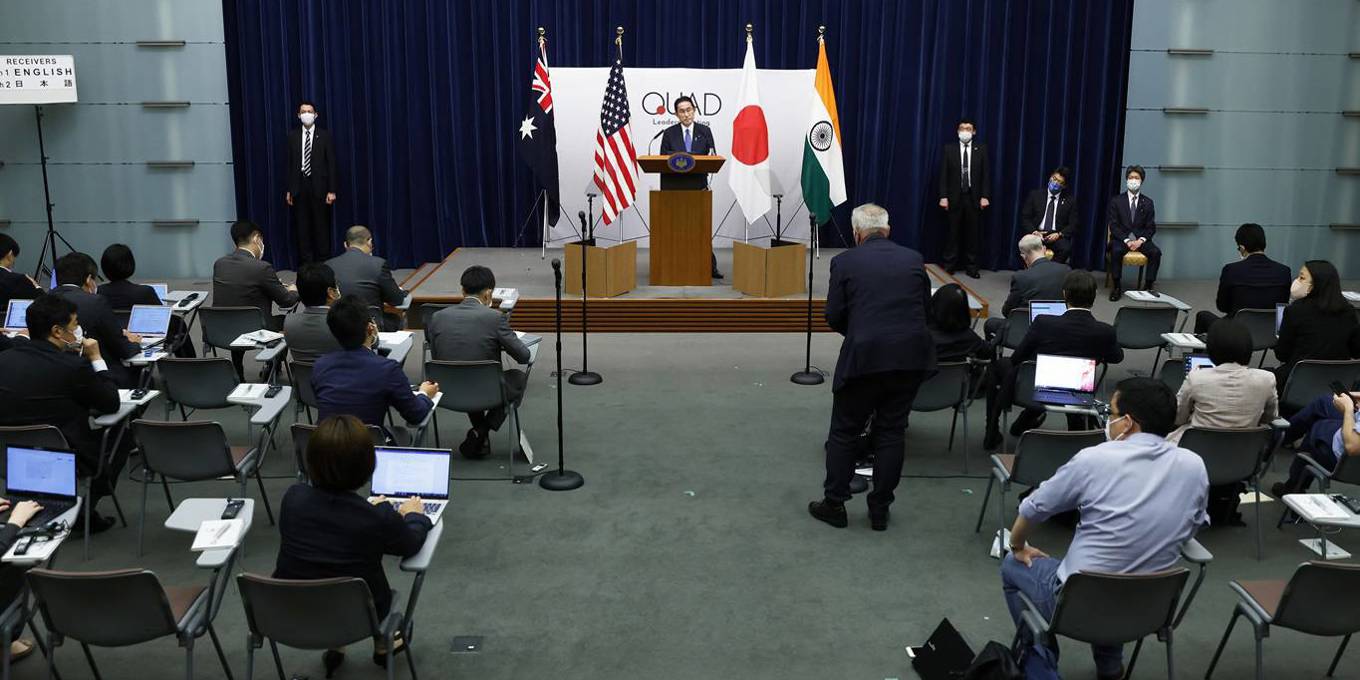


 Ukrainian Prime Minister Denys Shmyhal, left, with Japanese Prime Minister Fumio Kishida at the reconstruction conference held in Tokyo on Feb. 19. © Reuters



 Indian Prime Minister Narendra Modi, right, has discussed the Himalayan crisis with Chinese President Xi Jinping at two separate multilateral summits. © Reuters
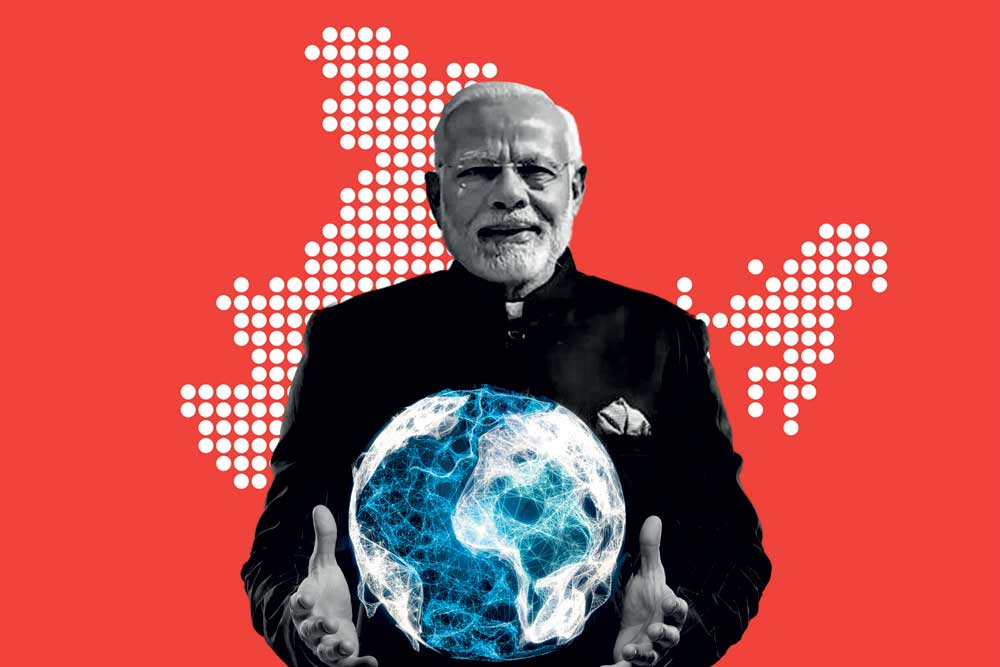
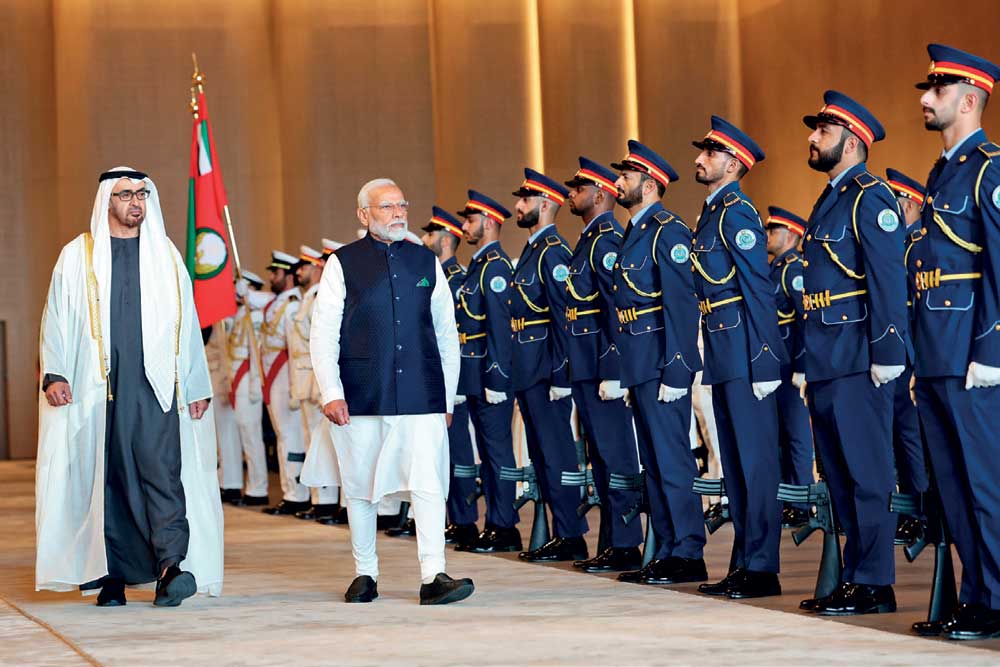
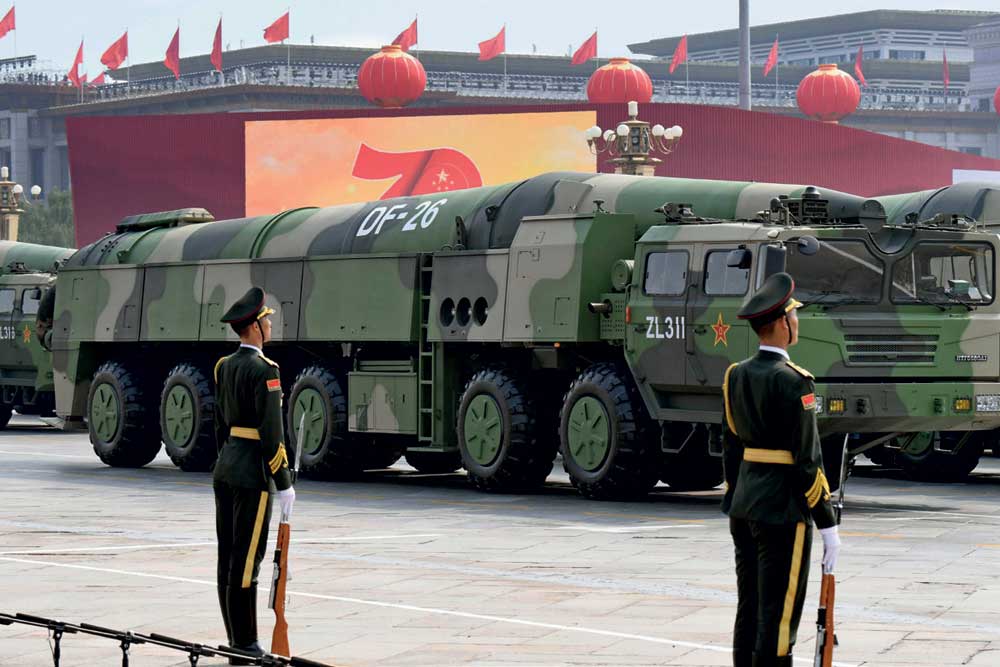
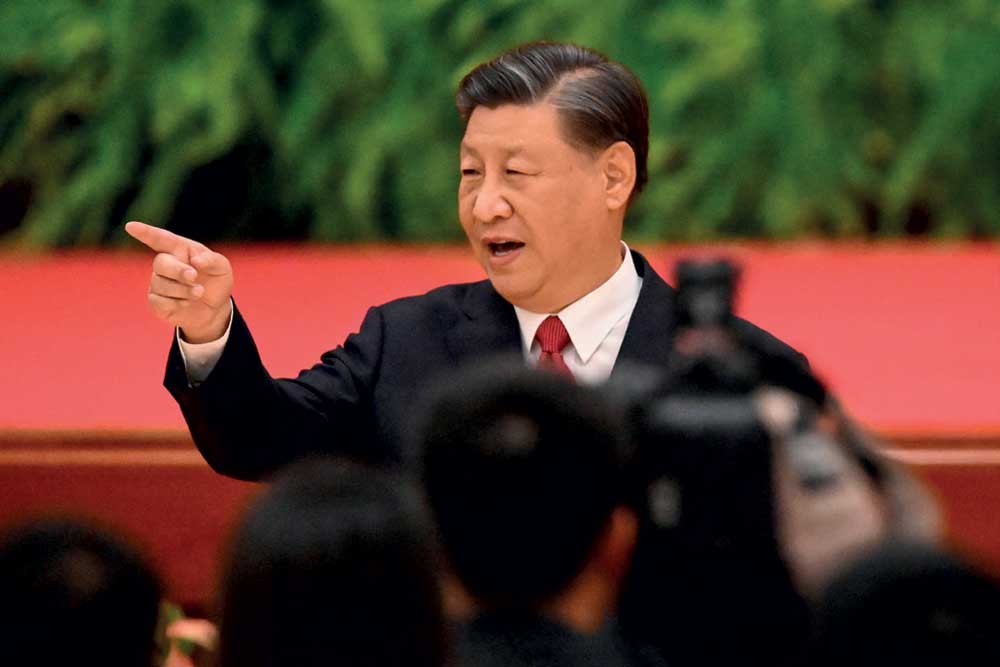
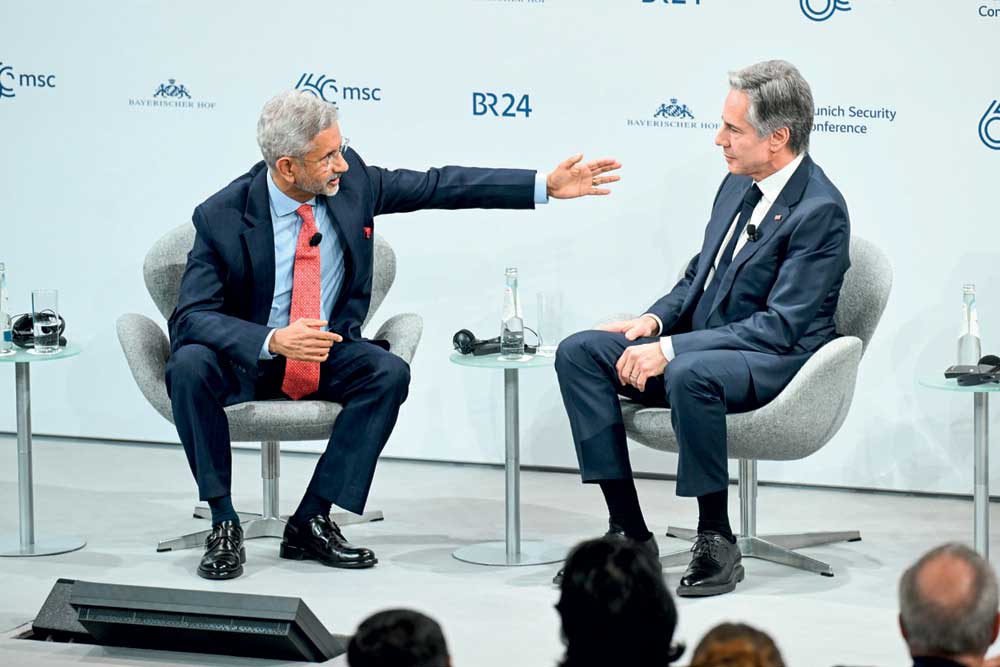

 Stagecraft and Statecraft
You must be logged in to post a comment.