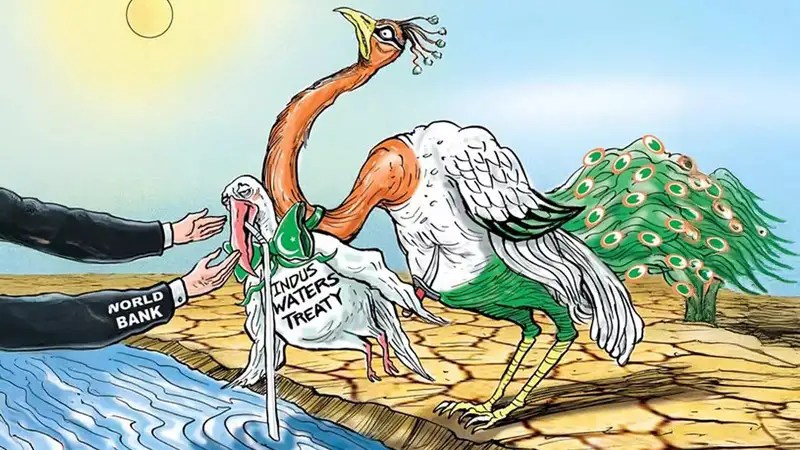
When the Indus Waters Treaty (IWT) was signed in 1960, it was an act of extraordinary generosity on India’s part. Despite being the upper riparian state, India reserved for Pakistan over 80% of the Indus Basin waters. Almost 65 years later, IWT remains the world’s most generous water-sharing treaty.
The treaty was a bet on peace — on the hope that India’s water largesse would help usher in subcontinental stability and collaboration. Pakistan, however, has repaid India’s generosity not with gratitude, but with grenades and guns.
From the 2001 attack on Parliament to the 2008 horrific Mumbai massacre, and from the 2016 Uri raid to the 2019 Pulwama bombing — the pattern of Pakistan-scripted terrorism has been unmistakable. The pattern underscores a strategic doctrine of asymmetric warfare, relying on terrorist proxies. And yet, even as Pakistan kept on repaying water munificence with blood, India continued to honour the treaty.
But now the national anger over the latest terrorist massacre in Pahalgam, where Hindu tourists were singled out and slaughtered, has compelled Prime Minister Narendra Modi to take a legal step — putting the IWT “in abeyance”. This is not about water alone. It is about principle, sovereignty and the right to protect one’s people. International law is clear: when a treaty’s foundational conditions collapse — or when one party persistently breaches it — the other party has the right to suspend or withdraw.
A country that repeatedly enables attacks on innocent civilians should forfeit the benefits of a legal arrangement designed for peaceful cooperation. The IWT is not a river-sharing agreement in isolation; it is a mechanism of trust, and trust has been systemically dismantled.
Moreover, the world is not unfamiliar with treaty withdrawals. The US unilaterally exited the Anti-Ballistic Missile (ABM) treaty in 2002 and the Intermediate-Range Nuclear Forces (INF) treaty in 2019 — citing national security threats both times. Sovereign states are entitled to defend themselves when cooperation becomes a cover for aggression. Why should India be any different?
Even within the bounds of the IWT, Pakistan has not acted in good faith. In fact, it has weaponized the IWT itself, abusing the treaty’s mechanisms to delay or sabotage Indian infrastructure projects and prevent India from utilising its legitimate share of the waters by repeatedly escalating minor engineering issues to international arbitration or adjudication. And still, India waited.
Now, India is signalling that endless patience should not be mistaken for weakness. Article 60 of the Vienna Convention on the Law of Treaties (VCLT) permits a state to suspend or withdraw from a treaty in the event of a material breach by the other party. International law also provides for a fundamental change in circumstances as a valid reason for treaty withdrawal, as laid out in Article 62 of the VCLT. India is not a party but the VCLT is reflective of customary international law.
However, India, despite citing both a fundamental change of circumstances and Pakistan’s material breach, has chosen neither to suspend nor withdraw from the IWT, deciding instead to place the treaty “in abeyance”, a term not formally defined in international law. The tentative step may suggest that the govt is seeking to deliver a strategic warning to compel behaviour change without burning diplomatic bridges just yet.
India has neither the intent nor the hydro-infrastructure to disrupt downstream flows. Its adversary is the Pakistani deep state, not the Pakistani people. India has thus made clear it will act responsibly, ensuring no humanitarian crisis is triggered.
Contrast India’s restraint and caution with China’s aggressive unilateralism. China has refused to negotiate a water-sharing treaty with any of its downstream neighbours. On the Brahmaputra, it is building a super-dam, the largest ever conceived, near the seismically active border with India, potentially creating a ticking water bomb.
Although India dwarfs Pakistan in terms of economic output, military spending and other material measures, successive Indian governments have allowed Pakistan to gore India with impunity by not pursuing a consistent Pakistan policy. Even today, after the Pakistani army chief’s recent call for civilizational war with India implied mortal combat, some policy-makers believe that India can compel a neighbour consumed by hatred to change behaviour. It is thus no wonder that — the latest horrific massacre notwithstanding — India appears loath to exit a treaty that hangs like the proverbial albatross from its neck.
India should offer an alternative water-sharing framework that is conditional on peace and verifiable conduct. The IWT model, based on unconditional trust, with India left to bear the burdens without any benefits, has failed.
More fundamentally, without India mustering the political will to impose sustained and multifaceted costs, Pakistan will remain Ground Zero for the international terrorist threat. India’s restraint has been historic. Now, history demands resolve.
Bangladesh’s recent descent into lawlessness poses a foreign policy challenge for President Trump, especially because his predecessor supported last August’s regime change there.
The world’s most densely populated country (excluding microstates and mini-states) risks sliding into jihadist chaos, threatening regional and international security.
Bangladesh has also emerged as a sore point in U.S.-India relations, with the issue likely to figure in Indian Prime Minister Narendra Modi’s discussions with Trump at the White House this week. New Delhi is smarting from the overthrow of Bangladesh Prime Minister Sheikh Hasina’s India-friendly government and the installation of a new military-chosen “interim” administration with ties to Islamists whom India sees as hostile.
The new regime is led by the 84-year-old Muhammad Yunus, who publicly lamented Trump’s 2016 election win as a “solar eclipse” and “black day.” Yunus received the 2006 Nobel Peace Prize after former President Bill Clinton lobbied for him, a fact the Norwegian Nobel Committee chairman acknowledged in his award ceremony speech.
Megadonor Alex Soros — who says that “Trump represents everything we don’t believe in” while vowing to “fight back” — has pledged continued support to the regime in Bangladesh, where he recently went by private jet to meet Yunus, despite the country’s downward spiral into violent jihadism. This was his second meeting with Yunus since September, when the two met in New York.
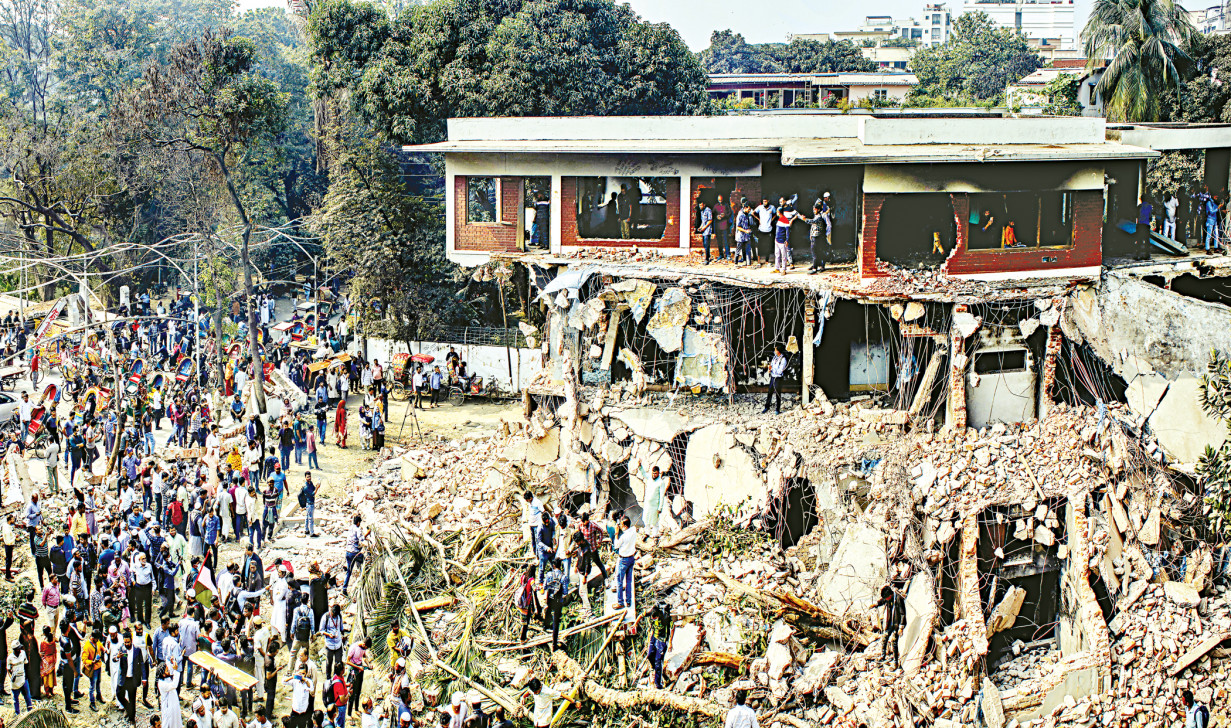
The lawlessness in Bangladesh was on stark display last week as regime supporters went on a rampage, setting ablaze or demolishing properties in a coordinated manner, including the national memorial to Hasina’s assassinated father, Sheikh Mujibur Rahman, the country’s charismatic founding leader. Mobs also looted and burned down Hasina’s private residence and the homes of several leaders of her Awami League party.
In a sign of regime complicity in the attacks, security forces stood by and watched quietly as mobs ran amok, including storming the memorial museum, where the country’s independence was proclaimed in 1971. The attackers, after failing to burn down the memorial with the fire they lit, brought excavators and manually tore down the memorial over two days, prompting Islamist celebrations at the site with an Islamic State banner. Only after the various attacks were over did Yunus appeal for calm.
The razing of the memorial museum, which was originally the founding leader’s residence and where he and much of his family were murdered in a 1975 predawn army coup, could help advance the current regime’s effort to redefine or erase key aspects of Bangladesh’s history. In fact, this was the second assault on the memorial since the regime change, with the first attack leaving it partially damaged and without family archives owing to looting and arson.
Last week’s spate of attacks across the nation showed why the regime, as Bangladeshi media highlighted, is struggling to restore law and order or reverse the downturn in a once-booming economy, which, under Hasina’s secular government, lifted millions of people out of poverty. Now, as foreign reserves plummet and foreign debt spirals upward, the country is seeking international bailouts.
Since its first coup in 1975, which led to more military interventions and counter-coups, Bangladesh has remained trapped in a cycle of violence and deadly retributions. The military-backed ouster of Hasina — the “iron lady” who kept both the military and Islamist movements in check, but who lurched toward authoritarianism — followed weeks of student-led, Islamist-dominated violent protests.
After police fired on rioting protesters, mobs captured dozens of policemen, beating them to death and hanging the bodies of some from bridges. A total of 858 people reportedly died in what the Yunus regime and its supporters have called a “revolution.” The military used the violence to pack Hasina off to neighboring India before she could even resign.
Violence, however, has only escalated under the Yunus administration, especially against political opponents, religious and ethnic minorities, and anyone seen as a critic of the regime. Just days before the American election in November, Trump posted, “I strongly condemn the barbaric violence against Hindus, Christians, and other minorities who are getting attacked and looted by mobs in Bangladesh, which remains in a total state of chaos.”
Islamist violence has gained ground largely because Yunus has lifted bans on jihadist groups with links to terrorism and freed violence-glorifying Islamist leaders. Hundreds of Islamists have escaped from prisons. Extremist groups — including Hizb ut-Tahrir, proscribed by several Western governments as an international terrorist threat — now operate freely in Bangladesh, from demolishing shrines of minorities to staging anti-Trump marches.
In fact, a dysfunctional Bangladesh is becoming a mirror image of its old nemesis, Pakistan, from which it seceded following a bloody war of liberation that left up to 3 million civilians dead in a genocide led by the Pakistani military.
Given the country’s porous borders, the current violence and chaos in Bangladesh affect India’s security. Already home to millions of illegally settled Bangladeshis, India faces growing pressure on its borders from those seeking to flee religious or political persecution in Bangladesh. Fearing infiltration by freed terrorists, India has sought to tighten border security. A lawless Bangladesh is also not in America’s interest.
As Trump seeks to build on his rapport with Modi to restore America’s fraying relationship with India, a shift away from the Biden policy of mollycoddling the Yunus regime could help ease Indian security concerns. If the U.S.-India strategic partnership is to advance a stable balance of power in Asia, the two powers must work in sync with one another in India’s own neighborhood to help build mutual trust.
A boy holding a rifle borrowed from a Syrian opposition fighter poses on the top of a government forces tank that was left on a street, at the Umayyad Square in Damascus, Syria, Wednesday, Dec. 11, 2024. (AP Photo/Leo Correa)
With the dramatic fall of Syrian President Bashar Assad’s autocratic regime, the West may have achieved its objective in Syria. But the success could impose enduring costs on Western, and especially European, security.
Assad’s secular regime has been replaced by violent jihadist forces that Western governments regard as terrorists. On President Joe Biden’s watch, first Afghanistan and now Syria have emerged as jihadist citadels. As has already happened in Afghanistan under Taliban rule, the victorious Islamist leaders in Syria have pledged to introduce a system based on Islamic law.
The main insurgent group that spearheaded the lightning blitz to Damascus seeks to establish a caliphate and has had historic links to both al-Qaeda and the Islamic State (or ISIS). Formerly known as the Al Nusrah Front, it was officially labeled a foreign terrorist organization by the United States in 2014.
Yet by seeking to engage with its victorious leadership, including sending secret messages to it, Biden is making the same mistake he did following his disastrous withdrawal from Afghanistan, when he drew specious distinctions between “good” and “bad” terrorists, in a bid to obscure both the significance of the Taliban’s takeover and his administration’s outreach to that terrorist militia.
The current effort to portray this murderous band of terrorists as a reforming group that now cultivates an image of tolerance parallels the 2021 attempt, in the aftermath of Kabul’s fall, to rebrand the Taliban leadership as moderate. Washington is today considering removing its $10 million bounty on Abu Mohammad al-Jolani, the head of this terrorist army, who is claiming to have turned over a new leaf.
But just as the Taliban has turned Afghanistan into a terrorist super-state, Jolani could make Syria a breeding ground for transnational terrorists that share the Taliban’s ideology and commitment to violent jihad. Those waging violent jihad can never be moderate.
Make no mistake: The surge of violent jihadism in Syria goes back to a multiyear CIA covert project to overthrow Assad — a $1 billion program that President Barack Obama initiated after seven months of NATO airstrikes toppled another secular dictator, Libya’s Muammar Gaddafi.
The Syria project — the second largest in the CIA’s history after its 1980s’ covert operation against Soviet forces in Afghanistan — trained and armed anti-Assad rebels from 2012 onward, furthering the jihadist movement and helping spawn the Islamic State in the Syria-Iraq belt, before President Donald Trump shut it down in 2017, calling the program “massive, dangerous and wasteful.” He also stated that some of the U.S.-supplied weapons went to al-Qaeda, an organization that emerged from the CIA-trained Afghan “mujahideen.”
More broadly, the destabilization of Libya, Syria and Iraq resulted in a major refugee influx into Europe — 1.1 million into Germany alone in 2015. This, in turn, led to a surge of radical Islamism in several European countries, with terror attacks in Munich, Nice, Brussels, Paris and elsewhere necessitating a slew of antiterrorist measures. The new challenges contributed to a resurgence of nativism, populism and antiimmigrant sentiment across Europe, transforming politics.
Today, the Syrian Rebels’ victory represents a huge boost for global jihadism, including for enlisting new recruits. The Islamist arc extending from the Middle East to North Africa’s Maghreb region could pose a challenge to Europe in the way countries located next to the Afghanistan-Pakistan belt are paying a security price.
The beleaguered Assad regime, economically and politically weakened by regional developments and the almost decade-long U.S. control of production from Syrian oil fields, fell to the Islamist militants without putting up a fight.
Assad, and his late father, Hafez Assad, ruled Syria for over half a century, forming the longest political legacy in the Arab world. But, as U.S. interventions have shown, when a secular autocrat is overthrown in the Muslim world, the forces of radical Islam usually take over. This often leads to violent upheaval and societal transformation, including imposition of Medieval practices, with women’s status reduced to that of chattels.
This is what happened in Afghanistan after President Mohammed Najibullah was driven out of office in 1992, in Iraq after Saddam Hussein’s overthrow in 2003, and in Libya when Qaddafi was ousted in 2011. Arab Spring “revolutions” elsewhere spawned new strongmen or civil war. Libya, meanwhile, remains a failed state.
Even in Bangladesh, the recent U.S.-supported regime change has led to an upsurge of Islamist violence, with jihadists seeking to Arabize Islam by targeting the country’s syncretic traditions.
In multiethnic Syria, the seizure of Damascus by Sunni Islamist fighters is unlikely to end the 13-year-long civil war. The recrudescence of bloody sectarian conflicts and power struggles in Syria could send a new wave of refugees to Europe, including radicalized Muslims.
In fact, with the downfall of one of the last remaining secular, anti-jihadist rulers in the Middle East, the partition of Syria looks more likely.
To be sure, Ukraine, too, faces partition: a Trump-backed ceasefire in the nearly three-year war would leave one-fifth of Ukrainian territory under Russian control. But Syria’s partition will be along sectarian lines, as happened in 1947 when Pakistan was carved out of India. Syria could eventually be divided into four parts: A large Sunni state in the center, comprising more than two-thirds of Syria; a U.S.-backed Kurdistan in the northeast, a Druze zone in the south; and an Alawite strip along the Mediterranean coast.
The West has won the battle against Assad and delivered a strategic setback to his patron, Russia, whose interest long centered on maintaining its several military bases in Syria for power projection in the Middle East. But, having forgotten the lesson of 9/11 to shun the path of geopolitical expediency and focus on long-term interests, the West risks losing the already-flailing global war on terror, especially as the war’s fronts multiply as an unintended byproduct of its own policies.
An unstable Bangladesh mired in radical Islamism and political violence has long been India’s geopolitical nightmare. One hopes that the US soon recognizes that this is not conducive to its interests, either, and puts pressure on Bangladesh’s interim government to protect its minorities and restore stability.
In August, popular protests – and a harsh government crackdown – culminated in the military-backed ouster of Bangladeshi Prime Minister Sheikh Hasina, who lurched toward authoritarianism. But far from ushering in a democratic transition, the regime change has plunged Bangladesh into deeper turmoil, with mounting human-rights abuses and lawlessness by ascendant Islamist groups threatening to turn the country into yet another global flash point.
Hasina may have forsaken her democratic credentials once in power – in 1990, six years before she was first elected prime minister, she led the pro-democracy uprising that toppled Bangladesh’s military ruler – but the “iron lady” also kept both the powerful military and Islamist movements in check.
As South Asia has seen firsthand, military-backed regimes tend to crush anti-government protests, whereas militaries with unfulfilled ambitions might facilitate violent unrest to create a pretext to swoop in, seize power, and “restore order.” Bangladesh’s military refused to enforce a lockdown even as protesters rampaged through the streets, and as soon as Hasina was gone, it installed an interim administration. Tellingly, the military packed her off to India even before she could formally resign.
To be sure, the interim regime is led by Muhammad Yunus, a Nobel Peace Prize laureate, who was selected with the support of the student-led, Islamist-backed protest movement. But the 84-year-old Yunus has become little more than the civilian face of what is effectively military-mullah rule. And despite lacking constitutional legitimacy, the interim regime has offered no time frame for holding national elections.
Instead, the regime has overseen new curbs on press freedom, including “persistent attacks, ill-motivated lawsuits, and widespread harassment.” The credentials of 167 journalists have been revoked without explanation, and 129 journalists have been slapped with trumped-up murder, abduction, or assault charges. Scholars, lawyers, and others – anyone viewed as a critic of the regime – have also faced legal harassment. In a single week in October, more than 7,000 individuals were arrested, and political detainees have sometimes suffered physical assaults while in custody.
Last week, the regime trained its sights on a Hindu monk, who was arrested on charges of sedition after leading peaceful protests demanding protections for Bangladesh’s Hindu minority. But Hindus are under attack in Bangladesh. They have been the victims of jihadist mobs, which have also targeted other minorities, including Buddhists, Christians, indigenous people, and members of Islamic sects that Islamists consider heretical. At one anti-Hindu protest, Islamist marchers chanted, “Catch them and slaughter them.”
It is not difficult to see why Islamist violence is gaining ground. The interim regime has lifted bans on jihadist groups with links to terrorism and freed violence-glorifying Islamist leaders, including one who was convicted for the murder of a secularist blogger. Yunus’s administration also seeks to remove the reference to secularism in the constitution. All this appeasement has emboldened the Islamists, who have, at times, sought to enforce their own extreme vision of morality by hounding “immodestly” dressed women.
In the four months since Hasina’s ouster, hundreds of Bangladeshis have died as a result of violence. The situation has become so dire that even the secretary general of the Islamist-leaning Bangladesh Nationalist Party – the arch-rival of Hasina’s secular Awami League – has criticized the regime, lamenting that “people are shedding each other’s blood” on the streets and “newspaper offices are being set on fire.”
Meanwhile, Bangladesh’s once-booming economy is in shambles, with growth slowing, stocks sinking to their lowest level since the COVID-19 pandemic, and foreign debt spiraling upward. The ratings agency Moody’s recently downgraded its outlook for Bangladesh’s economy from “stable” to “negative,” and cut the country’s credit rating from B1 to B2, sending the country’s bonds deeper into junk territory. These problems will not go away, even if Bangladesh is granted the billions of dollars in bailouts it has requested.
Neighboring India is watching events in Bangladesh with considerable apprehension (and, when it comes to attacks on Hindus, significant anger). Fears are rising that Bangladesh will go the way of the dysfunctional Pakistan, a terrorist hub and key source of regional insecurity. If nothing else, India would face an influx of refugees. With millions of illegally settled Bangladeshis already living within India’s borders, this would present the country with an unpalatable choice between taking on more than it can handle and turning away people fleeing religious or political persecution.
Hasina’s ouster has thrown into sharp relief the divergence between India’s perspective and that of the United States, which has welcomed the regime change. This contrast can also be seen elsewhere in India’s immediate neighborhood. Under President Joe Biden, the US has aided the military-backed regime in Pakistan and provided “non-lethal” military aid to the rebels attempting to overthrow Myanmar’s military junta, even as cross-border arms flows fuel ethnic conflict in India’s Manipur state.
Fortunately, there is reason to think that US President-elect Donald Trump will rethink some of these stances – starting with America’s approach to Bangladesh. Trump has a long-standing aversion to America’s foreign commitments, and he is probably no fan of Yunus, who maintains close ties with prominent US Democrats and publicly lamented Trump’s 2016 victory over Hillary Clinton. Shortly before the recent US election, Trump posted: “I strongly condemn the barbaric violence against Hindus, Christians, and other minorities who are getting attacked and looted by mobs in Bangladesh, which remains in a total state of chaos.”
An unstable Bangladesh mired in radical Islamism and political violence has long been India’s geopolitical nightmare. One hopes that the US soon recognizes that this is not conducive to its interests either, and puts pressure on Bangladesh’s interim regime to protect minorities and restore stability. Beyond strengthening regional security, such a policy shift could go some way toward restoring America’s fraying relationship with India.
Brahma Chellaney, Professor of Strategic Studies at the New Delhi-based Center for Policy Research and Fellow at the Robert Bosch Academy in Berlin, is the author of nine books, including Water: Asia’s New Battleground (Georgetown University Press, 2011), for which he won the 2012 Asia Society Bernard Schwartz Book Award.
The next US administration led by Donald Trump will have to navigate an uncertain world, a fragile economy and hardened polarisation at home at a time when a new age of international relations is dawning. The crises, conflicts and wars that are currently raging highlight just how profoundly the global geopolitical landscape has changed in recent years, with America’s own power and influence coming under increasing challenge. Great-power rivalries have again become central to international relations, with the US now pitted against a prospective Sino-Russian alliance.
Thanks to outgoing President Joe Biden, the US is deeply involved in the wars in Ukraine and the Middle East that have exacerbated global divisions. The risk is growing that, unlike its indirect entanglement in the wars in Ukraine and the Middle East, the US could be directly involved in a war over Taiwan if China launches aggression against that island democracy.
For Chinese President Xi Jinping, who has called Taiwan’s incorporation into China a “historic mission”, the longer the wars continue in Ukraine and the Middle East, the better. An end to the Ukraine war would leave the US free to focus on the Indo-Pacific, a critical region that will shape the next global order.
China’s expansionism is centred in the Indo-Pacific, from the East and South China Seas and the Taiwan Strait to the Himalayas. Xi must be pleased that US transfers of critical munitions, smart bombs, missiles and other weaponry to Ukraine and Israel are depleting American stockpiles and exposing America’s inadequate industrial capacity to restock weapons and ammunition.
The US has played a critical role in bankrolling the Ukrainian fight against the invading Russian forces, with Congress approving almost $175 billion in military and non-defence assistance. But American assistance has been unable to turn the tide in the war, with Russia still making slow but steady territorial gains in eastern Ukraine. Almost one-fifth of Ukraine’s territory is currently in Russian control.
One key reason for Russian advances is that, more than weapons and funds, Ukraine needs new recruits to replenish the ranks of its exhausted and depleted forces. But even draconian conscription practices have not been able to offset Ukraine’s mounting troop shortfall. Many Ukrainian soldiers on the front lines today are in their 40s and 50s.
Meanwhile, the US dollar—which, according to an International Monetary Fund (IMF) paper, was facing “stealth erosion” before the Ukraine war—now confronts a more open but nascent challenge to its global dominance in response to the West’s weaponisation of finance and seizure of Russia’s earnings on its central-bank assets that have been frozen by Western governments. As countries explore alternatives to the dollar, the greenback is beginning to lose some of its global influence, especially in oil markets.
Meanwhile, as a hedging strategy, central banks in many countries—especially China, Turkey, India, Kazakhstan, and in Eastern Europe—have increasingly been buying gold. Such hoarding, coupled with greater geopolitical uncertainty, has helped drive gold.
Rebuilding trust with India ought to be a priority for Trump. Strategic partnership between the world’s most powerful democracies is pivotal to equilibrium in the Indo-Pacific, including hindering China’s westward naval march from the South China Sea. As Admiral Mike Gilday said, India’s centrality to a stable Asian power balance makes it an essential US partner
The US-led Western decisions to weaponise finance and seize interest earned on frozen Russian central-bank assets have caused deepening disquiet in the non-Western world, helping to build support in BRICS to explore alternative arrangements, including new cross-border payment mechanisms invulnerable to political pressures or interventions. Some countries are also reassessing their heavy reliance on the US dollar in international transactions and reserve holdings.
The fact that more than 30 countries have applied to join BRICS shows that countries from the Global South are eager to lessen their vulnerabilities to Western pressures by enlarging their geopolitical options. They view membership in BRICS, the world’s first major non-US international initiative, as useful both as a hedging strategy and to navigate increasing global geopolitical turbulence and uncertainty.
The US cannot be pleased that BRICS is becoming a magnet to pluralise the world order. Reshaping the present US-led global order may not be easy but what unites the BRICS countries is the goal of achieving a multipolar international system. This is driven by the shared belief that only multipolarity can put checks on hegemonic power, which, if left unchecked, could undermine international peace, stability and economic growth.
More fundamentally, the Trump administration cannot ignore the fact that China poses a far greater threat than Russia to Western interests and the US-led order. Whereas Russia’s designs are largely confined to its own neighbourhood, China is seeking to supplant the US as the world’s foremost power. It also has the means: China’s economy, like its population, is about 10 times larger than Russia’s, and China spends four times as much as Russia on its military.
China is currently engaged in the largest peacetime military buildup in history. It has more than doubled its nuclear-weapons arsenal since 2020, and is expanding its conventional forces faster than any other country since World War II.
At a time when a majority of Americans believe that the nation’s power is declining on the world stage, the Trump administration needs a more realistic balancing of America’s key geopolitical objectives. Without such rebalancing, the US may well fail to deter China from attacking Taiwan
Yet, by focusing on the wrong enemy (with Biden only strengthening American policy fixation on Russia), the US has crimped its ability to counter the greater challenge that China poses. For example, with its military resources already stretched thin by its involvement in the wars in Ukraine and the Middle East, the US is dedicating insufficient attention and resources to countering Chinese expansionism in the Indo-Pacific.
Indeed, China has been the main beneficiary of Biden’s forceful response to Russia’s invasion of Ukraine. Unprecedented US-led sanctions, including the weaponisation of international finance, have been a boon for Beijing, turning it into Russia’s banker and expanding international use of the yuan. Russia now generates much of its international export earnings in the Chinese currency and keeps these proceeds mostly in Chinese banks, in effect giving Beijing a share of the returns.
At a time when a majority of Americans believe that the nation’s power is declining on the world stage, the Trump administration needs a more realistic balancing of America’s key geopolitical objectives. Without such rebalancing, the US may well fail to deter China from attacking Taiwan or cementing its strategic axis with Russia, just as Biden failed to deter Russia from invading Ukraine.
If objectively seen, a protracted Ukraine war is not in America’s interest. But bringing an end to the war demands dialogue and diplomacy, which Biden has shunned with Moscow.
India is one of the few countries that can play a mediating role in the Ukraine war, and Prime Minister Narendra Modi has been ready to broker a ceasefire. After the presidential inauguration ceremony on January 20, will American policy begin to shift in favour of a ceasefire in Ukraine? Given that a negotiated deal is the only way to halt the war, it is better to seek it sooner rather than after months or years of more bloodshed and devastation.
BIDEN’S LEGACY
The Trump administration will need to repair the damage the Indo-American relationship has suffered during Biden’s presidency. Before Biden, every American president since the 1990s left the relationship with India in stronger shape than what he inherited. But with US-India relations now strained, Biden is bequeathing the troubled ties to his successor to mend.
An ageing Biden seemed unable to grasp that the blossoming US-India partnership is too important to lose.
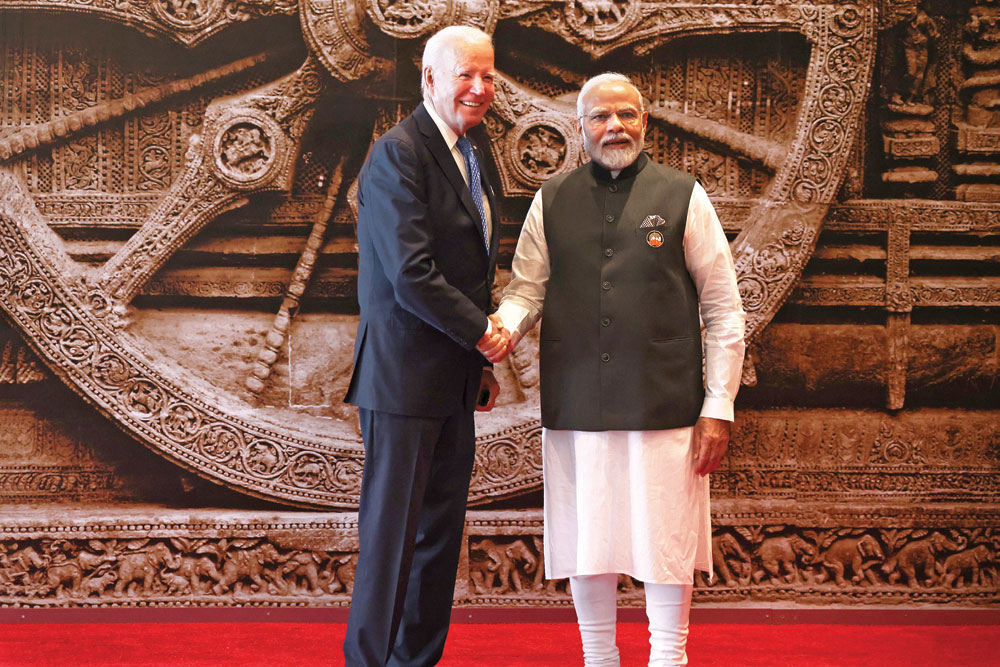
US President Joe Biden and Narendra Modi at the G20 Summit, New Delhi, September 9, 2023 (Photo: Getty Images)
While needling India, he prioritised outreach to China, resumed coddling of Pakistan, and stayed mum on China’s encroachments on Indian lands, including the resulting military standoff. Biden’s $450-million modernisation of Pakistan’s F-16 fleet evoked bitter memories of the US arming Pakistan against India and supporting the initial development of the Pakistani nuclear bomb during the Cold War.
Biden’s cognitive decline, which ultimately led the Democratic Party elites to force him to end his re-election campaign, may have been a factor in the US-India relationship cooling, especially as others in his inner circle gradually gained an increasing say in decision-making. The new tensions between Washington and New Delhi can only please Beijing, Moscow and Islamabad.
Biden’s national-security team largely comprised “liberal interventionists”, or hawks on the left, who, among other things, tactlessly exerted pressure on New Delhi to drop its neutrality on the Ukraine war and even sought to leverage the Khalistan card against India. On the eve of Modi’s US visit for the Quad summit in September, Khalistan radicals were hosted by the White House, where they were briefed by senior administration and intelligence officials.
Biden’s top economic adviser, Brian Deese, touched a raw nerve in India when he threatened in 2022 that “the costs and consequences” for it would be “significant and long-term” if it stayed neutral on the war. After New Delhi rebuffed the US pressure to pick a side in the Ukraine war or face consequences, Secretary of State Antony Blinken, speaking to the media in April 2022 in the presence of the visiting Indian defence and foreign ministers, took a swipe at India, alleging “a rise in human rights abuses”.
With every diplomatic spat with New Delhi, Blinken resurrected the human rights card against India.
The jarring fact is that, while maintaining close cooperation with a wide array of undemocratic governments and staying mum on their human rights abuses, the Biden administration has used human rights promotion as a geopolitical tool to bring pressure on countries to toe its line, including through US government-funded organisations like Freedom House. As Blinken repeatedly showed, human rights concerns are raised as leverage even against a friendly democracy like India. This geopolitics-driven approach only undermines American credibility.
Team Biden had no qualms about interfering in other countries’ elections, as it did in India. It used some of the talking points of Indian Opposition politicians to criticise the Modi government. It sought to cast aspersions on India’s legal processes, although the Biden administration faced heat at home for weaponising the justice system against political opponents
It is also striking that as Biden’s cognitive decline became more apparent, the scourge of rising Khalistan militancy in the US and Canada started casting a lengthening shadow over Washington’s relations with New Delhi. The US and Canadian allegations of alleged Indian assassination plots against terrorism-glorifying Khalistan extremists in North America have sought to obscure the role of American and Canadian security agencies in shielding such elements as potential assets against India. It is telling that at the centre of the Canadian- US diplomatic row with India have been two Sikh militants designated by India as terrorists—Hardeep Singh Nijjar and Gurpatwant Singh Pannun.
Khalistan militancy may be practically dead in India, but many Indians are asking whether some Anglosphere agencies are seeking to revive it in Punjab by using extremists in the Sikh diaspora.
Biden’s cognitive decline, of course, had a wider apparent impact on the conduct of foreign relations. For example, Biden’s memory issues, including doing things that he had earlier pledged not to do, may well explain why his risk appetite grew in the Ukraine war, especially as he became more and more beholden to the American “deep state”.
With the flow of sophisticated Western weapons to Ukraine failing to stem Russian advances or force Russia to retreat from the areas it has occupied, Biden progressively escalated American involvement in the war by embracing ideas that he had earlier said were taboo. For instance, he permitted Ukraine to use American-provided weapons to strike inside Russia despite having declared earlier that any Ukrainian attack on Russian territory with US-supplied missiles would go against his mandate to “avoid World War III”.
Biden’s overriding focus on punishing Russia not only pushed Moscow closer to Beijing but also threatened to exacerbate India’s security challenges. A Sino-Russian military and strategic alliance would directly impinge on Indian interests.
After New Delhi rebuffed the US pressure to pick a side in the Ukraine war, Antony Blinken took a swipe at India, alleging ‘a rise in human rights abuses’. With every diplomatic spat with New Delhi, Blinken resurrected the human rights card against India
It was in the twilight of Biden’s presidency that the US-backed regime change in Bangladesh occurred and that Washington, in concert with Ottawa, escalated the row with India over North America-based Khalistan militants.
In the run-up to the 2024 General Election in India, the Biden administration began targeting the Modi government on issues ranging from human rights to the implementation of a new Indian law that grants citizenship to non-Muslim refugees who fled religious persecution in neighbouring Islamic countries.
Biden has long alleged Russian interference in US elections. He even imposed sanctions against Russia in 2021 over its alleged meddling in American elections. But Team Biden had no qualms about interfering in other countries’ elections, as it did in the world’s largest democratic exercise in India. It used some of the talking points of Indian Opposition politicians to criticise the Modi government. It even sought to cast aspersions on India’s legal processes, although the Biden administration has faced heat at home for weaponising the justice system against political opponents.
New Delhi found it troubling that the Biden administration set Canadian Prime Minister Justin Trudeau against India by sharing sketchy intelligence with Ottawa. Trudeau admitted before a federal inquiry recently that he relied on raw “intelligence and not hard evidentiary proof” when he triggered the downward spiral in Canada-India relations in September 2023 by alleging India’s “potential link” with Nijjar’s killing.
But unlike Trudeau, who made the allegation against India from the floor of the Canadian parliament, the US allegation of a failed Indian plot to kill Pannun did not come from Biden or any of his cabinet members but from lower-level officials who briefed the media about the unsealing of an indictment. The US indictment alleged a murder-for-hire scheme that was remarkably amateurish: an Indian operative, at an Indian intelligence officer’s purported direction, tried to arrange the killing of Pannun on US soil, but the hitman he hired long-distance from India turned out to be an undercover law enforcement officer.
Biden has not spoken a single word against India while Trudeau has continued to personally lead the charge against New Delhi.
China has been the beneficiary of Biden’s response to Russia’s invasion of Ukraine. US-led sanctions, including the weaponisation of finance, have been a boon for Beijing, turning it into Russia’s banker and expanding international use of the Yuan
The US and India, as partners in the Quad, may agree on larger issues in the Indo-Pacific, including a stable balance of power, maritime security, and settlement of inter-country disputes without coercion and on the basis of international law. But in India’s own neighbourhood, the divergence in US and Indian interests has been laid bare by the Biden administration.
Instead of working with New Delhi in India’s neighbourhood, the Biden administration pursued policies in South Asia that it knew were injurious to core Indian interests. It is telling that Washington has been coddling military-backed governments in Pakistan and Bangladesh while seeking to overthrow Myanmar’s military junta, including through stringent sanctions and “non-lethal” military aid to rebels, despite the spillover effects on Indian border states like Manipur.
The US-supported regime change in Bangladesh, followed by Washington’s silence on ongoing human-rights abuses there, including atrocities against minorities, represented just the latest wake-up call for New Delhi. What many saw as a “colour revolution” in Bangladesh came after Biden’s disastrous withdrawal of US forces from Afghanistan effectively surrendered that country to a Pakistan-reared terrorist militia, including leaving behind billions of dollars of weapons for it.
Bangladesh is now pretty much under military-mullah rule, with Muhammad Yunus just the nominal head of the army-installed “interim” regime. The upsurge of Islamist violence, and the regime’s political vendettas and release of terrorists from jail indicate that Bangladesh will struggle to restore economic momentum or regain investor confidence.
Wherever the US has directly or indirectly intervened over the years to bring about regime change, chaos has usually followed in that country, with Islamist or other extremist forces gaining ascendancy. The murder and mayhem in Bangladesh illustrate how that country faces destabilisation, with far-reaching consequences extending beyond its borders, especially for India.
As one of its parting shots at India, the Biden administration has slapped sanctions against 19 Indian firms for their alleged export of “dual-use” items to Russia. The term “dual-use” is defined by Washington so broadly that sanctions can be justified against whichever target it selects. The 19 Indian firms, which figure in a larger list of companies from multiple countries slapped with sanctions, have been accused of exporting just a paltry $2 million worth of items to Russia. Compare that with the flow of more than $200 billion in Western military and other aid to Ukraine.
RESTORING TRUST
These are challenging times for US-India relations. Undermining what should be America’s most important strategic partnership in Asia makes little strategic sense, especially if the US wishes to genuinely pivot to the Indo-Pacific. But without mutual respect, the US-India strategic partnership can scarcely advance.
A country as large and proud as India cannot become just another Japan or Britain to the US. A friend does not mean a follower. Nor is a Cold War-style “us versus them” approach relevant today. A less rigid, more adaptive approach will serve American diplomacy better.
Washington must remember that India has hewed to an independent approach to international affairs under successive governments. This approach is unlikely to change given that New Delhi believes in friendship without dependence.
Furthermore, the US and India are both bitterly polarised democracies, and each government should consciously avoid saying anything that could give a handle to the other’s domestic critics. Important figures within the Democratic Party during the Biden presidency, however, barely concealed their hostility to Modi and what they saw as his brand of Hindu nationalism.
Rebuilding mutual trust with India ought to be a priority for the Trump administration. Strategic partnership between the world’s most powerful and most populous democracies is pivotal to equilibrium in the Indo-Pacific, including hindering China’s westward naval march from its new citadel, the South China Sea. As Admiral Mike Gilday, chief of US naval operations, said in 2022, India’s centrality to a stable Asian power balance makes it an essential US partner.
India, a founder and leader of the Non-Aligned Movement, now makes little mention of nonalignment. Instead, it is multi-aligned and building close partnerships with democratic powers from Asia to Europe.
India now holds more annual military exercises with America than any other country. The US has become a key supplier of weapons systems to India, as underscored by the recent deal, valued at nearly $4 billion, to sell 31 armed MQ-9B High Altitude Long Endurance (HALE) drones.
India has signed the four “foundational” agreements that the US maintains with all its close defence partners. These accords range from providing reciprocal access to each other’s military facilities and securing military communications to sharing geospatial data from airborne and satellite sensors.
Booming US exports to India—perhaps the world’s fastest-growing market today—reinforce bipartisan support in Washington for a closer partnership with New Delhi. In addition to weapons, the US has rapidly become an important source of crude oil and petroleum products for India, which is the world’s third-largest oil consumer after America and China.
India’s importance as the world’s ultimate swing state is likely to grow, especially as Russia and China deepen their entente. Instead of driving a wedge between these two natural competitors, US policy has helped turn China and Russia into close strategic partners. Biden compounded his blunder in helping to build a Sino-Russian axis by impelling India to seek a thaw with China as a hedge against American unpredictability.
If the US is not to accelerate its relative decline through strategic overreach, it needs India more than ever. But without mutual respect and trust, the US-India strategic partnership could wither away.
Brahma Chellaney is a geostrategist and the author of two award-winning books: Water, Peace, and War; and Water: Asia’s New Battleground.
Bangladesh, the world’s eighth-most populous country, is at a crossroads following a military-backed regime change and violent upheaval. Amid purges, extrajudicial killings, arbitrary arrests, systematic attacks on religious and ethnic minorities, and the freeing of jailed terrorists, one development stands out — an upsurge of radical Islamism across the country.
Since its violent birth in 1971, Bangladesh has been struggling to evolve into a full-fledged democracy, with the powerful military’s two-dozen coups or coup attempts casting an enduring shadow over the country’s politics.
Today, empowered by the overthrow of Prime Minister Sheikh Hasina on Aug. 5, when the military packed her off to neighboring India before she could formally resign, Islamists are asserting themselves on the streets.
Student marchers holding black flags or banners of the Islamic State group are calling for a caliphate. Islamists are harassing and mistreating women for not wearing veils, exposing their stomachs while wearing saris, or for having short hair. Some attacks on women have been brutal, including on mountaineer Shayla Bithi, a national icon.
The Hizbut Tahrir extremist group, proscribed by Hasina and several Western governments as an international terrorist threat, is now operating freely in Bangladesh, holding big rallies. A memorial for police officers killed while repulsing a terrorist attack mainly on foreigners at a famous cafe in Dhaka, the capital, was demolished and a Hizbut Tahrir poster put up.
Since the overthrow of Hasina’s secular government, which kept Islamists and the military in check but became increasingly undemocratic, hundreds of Islamist-backed attacks have been reported on Hindus, Christians, Buddhists and the tribespeople that inhabit the country’s southeastern hill tracts. Hindus, the largest minority, are bearing the brunt of such violence.
During the most important religious occasion of the long-persecuted Hindus, Islamists seized the podium from worshippers at a site and sang a song calling for an Islamist revolution.
According to a U.S. intelligence assessment, Islamic State created a terrorist network in 2015 with the goal of “overthrowing the Bangladeshi government to establish a fundamentalist Islamic state.” The recent regime change has clearly emboldened Islamic State supporters and sympathizers.
Seeking to Arabize Islam in Bangladesh, extremists are targeting the country’s syncretic tradition of Sufism by demolishing shrines and attacking preachers in an effort to wipe out the Sufi culture. Violent attacks have also extended to members of the Ahmadiyya sect, which Islamists refuse to accept as Muslim.
Jihadists, especially those belonging to the student wing of the Hasina-proscribed Jamaat-e-Islami organization, played a key role in the violent, youth-led uprising that overthrew the 76-year-old “Iron Lady.” Hundreds of people were killed in the violence, many by police shooting but also in shooting by rioters, some of whom, according to the new military-installed regime, looted powerful sniper rifles from law enforcement personnel or government armories.
Mob attacks on some 450 police stations reduced them to burned-out shells. Crowds captured dozens of police officers, beating them to death and hanging the bodies of some from bridges in Dhaka.
Today, lawlessness still rules Bangladesh. Amid political vendettas, mob violence and targeted attacks have persisted under the new regime, which is led by the 84-year-old Nobel Peace Prize winner Muhammad Yunus but includes a leader of the radical Hefazat-e-Islam organization that seeks the rule of Islamic law.
Yunus has sought to appease jihadists, including meeting with Islamist leaders. His regime, despite lacking constitutional legitimacy, has lifted bans on Islamist groups and freed jailed terrorists and convicted jihadists, including the chief of the outlawed al-Qaida-affiliate Ansar al-Islam. Hundreds of more Islamists have escaped from prisons.
Furthermore, to Islamist delight, the new regime is rewriting Bangladesh’s history, including attempting to erase or obscure the role of its charismatic founding leader, Sheikh Mujibur Rahman, whose statues and portraits have been defaced or dismantled. Rahman, Hasina’s father, was killed by army officers in the first coup in 1975.
While mollycoddling Islamists, the regime has been making large-scale arrests of critics and political opponents and even scholars and journalists, often on fake murder charges. It also removed the chief justice and the five other most-senior Supreme Court justices.
Just in the first week of October, according to official figures, 7,018 people were arbitrarily jailed. At least 129 journalists have been slapped with trumped-up murder, abduction or assault charges. To make matters worse, political detainees often face physical assault in courts, with a retired Supreme Court justice needing emergency surgery after being badly beaten up.
To be sure, the army is today calling the shots behind a civilian facade, just as it did during 2007-2008 when it kept an interim civilian-led regime in power after staging a coup. The military sees Yunus, the regime’s nominal head, as its fall guy.
Meanwhile, the economic and human toll from the Islamist violence in Bangladesh, including attacks on factories, hospitals and hotels, is increasing. In a case of apparent mass murder, 182 people are still listed missing and presumed dead from the Aug. 27 burning down of an $84 million tire-manufacturing plant, the country’s largest.
Bangladesh is urgently seeking more than $5 billion in financial aid from international lenders to rescue its economy, which was one of the world’s fastest-growing until 2021 but is now in dire straits. The garment industry, which last year accounted for 85% of the country’s total export earnings, is today in turmoil due to vandalism, arson and labor unrest, with many factories shut. Is that correct?
It will not be easy to restore economic activity or reestablish the confidence of foreign investors given that Islamists now have free rein to violently push their revisionist agenda.
In fact, risk is growing that the world’s most densely populated country, excluding microstates and mini-states, could slide into jihadist chaos.
Brahma Chellaney, a professor of strategic studies at the independent, New Delhi-based Centre for Policy Research and fellow at the Robert Bosch Academy in Berlin, is the author of nine books, including “Water: Asia’s New Battleground” (Georgetown University Press), which won the Bernard Schwartz Book Award.
Regime change brought about by popular uprisings rarely leads to democratic breakthroughs. Yet Western powers have often supported coups and takeovers – regardless of the new regime’s democratic credentials – in order to advance their own geopolitical and economic interests.
With great-power rivalries again at the center of international relations, democratic governments have been relying on secret statecraft to shape or sway regimes in weaker states, including by supporting or aiding regime change. Far from advancing democracy globally, these efforts are exacerbating its vulnerabilities at a time when authoritarianism is on the rise.
To be sure, local militaries – with or without external backing – remain the leading drivers of regime change. In Pakistan, for example, the military reasserted its traditional dominance over government in 2022, when it engineered the ouster of Prime Minister Imran Khan. In Bangladesh, the military recently took advantage of a violent student-led uprising to compel Prime Minister Sheikh Hasina to flee the country, before installing an interim civilian-led administration headed by Nobel laureate Muhammad Yunus.
But external powers also often play a key role in driving regime change. Yes, the mechanisms remain murky. Since strategic skullduggery rarely leaves any political fingerprints, intervening powers can plausibly deny involvement, leaving independent analysts struggling to distinguish fact from fiction.
Nonetheless, it is usually fairly easy to see where an external power gets its leverage. China, for example, is the world’s largest trading economy and official creditor for developing countries. While the details of China’s loan agreements are far from transparent, there is no doubt that it attaches many strings to its funding, which increase its leverage over borrowers, possibly even driving them into sovereignty-eroding debt traps.
The United States, for its part, dominates the international financial architecture, enjoys considerable leverage over traditional lenders like the World Bank and the International Monetary Fund, and issues the world’s main reserve currency. With these levers, it has significant power to reward or punish countries, including by imposing painful economic sanctions.
The US has long been accused of – and sometimes admitted to – helping to topple or prop up foreign regimes, including by meddling in elections or aiding uprisings, such as the “color revolutions” in some post-Soviet states. Some have even alleged that the US played a role in the recent overthrow of Khan in Pakistan and Hasina in Bangladesh, though US officials have denied any involvement.
The question is what a democracy like the US hopes to achieve by contributing to regime change. The answer cannot be lasting democratic breakthroughs, which rarely arrive in the wake of popular uprisings. Instead, countries are likely to face political instability, social disorder, and economic disruption. That is certainly the case in Bangladesh, which is now facing chaos and violence, with mobs burning down factories, hospitals, hotels, and homes.
A more likely explanation – for which there is ample evidence – is that Western powers are seeking to advance their own geopolitical and economic interests by supporting “friendly” regimes and driving out “unfriendly” ones. The regimes’ democratic credentials (or lack thereof) seem to matter little here, though Western powers do prefer that there is a pretense of democracy.
This helps to explain why military takeovers are often followed by elections or the installation, as in Bangladesh, of a government with a civilian face: military leaders hope to bolster the new government’s international legitimacy and, in many cases, retain access to Western financial assistance. After all, the US is legally required to cut off aid to a country after a coup. After the military junta returned to power in Myanmar in 2021, US President Joe Biden’s administration imposed stringent sanctions on the country and, later, began providing non-lethal aid to anti-junta forces.
But US leaders take great care in deciding which military takeovers to label as “coups.” Of the more than two dozen military coups or indirect takeovers that have taken place in the last 15 years, the US refrained from condemning about half, because it considered the regime change favorable to its regional interests. In this sense, the US has often sacrificed democracy at the altar of geopolitics.
Elections alone – even if competitive – do not guarantee popular empowerment or adherence to constitutional rules, especially when the military holds decisive power. While the international community might view a civilian-led government positively – even if it is merely a façade for continued military control – domestic legitimacy may well be lacking, even when the coup-makers shed their uniforms and rebrand themselves “civilian” leaders, as the Thai army chief did after seizing power in 2014. (He remained in office as the country’s “civilian” prime minister for nine years.)
Democracy is in retreat globally. Many populations are facing the erosion of their political rights and civil liberties. Even the world’s leading democracies are suffering from low public trust in governments and bitterly polarized politics. And closed autocracies now outnumber liberal democracies. By accepting or tolerating military rule – even behind a civilian façade – Western powers will only accelerate this trend.
Brahma Chellaney, Professor of Strategic Studies at the New Delhi-based Center for Policy Research and Fellow at the Robert Bosch Academy in Berlin, is the author of nine books, including Water: Asia’s New Battleground (Georgetown University Press, 2011), for which he won the 2012 Asia Society Bernard Schwartz Book Award.
The recent violent upheaval that led to a military-backed regime change in Bangladesh, followed by the country’s pleas for $6.5 billion in international bailouts, raise concerns about the future direction of the world’s eighth most-populous country.
The toppling of Prime Minister Sheikh Hasina’s government has also triggered an ominous resurgence of radical Islamism, including systematic attacks on religious minorities.
As recently as 2022, Bangladesh was seen internationally as headed toward rapid economic development. But today, nothing better illustrates the unraveling of Bangladesh’s economic success story than its urgent requests for a new $3 billion International Monetary Fund bailout, as well as $1.5 billion from the World Bank and $1 billion each from the Asian Development Bank and the Japan International Cooperation Agency.
Hasina, while becoming increasingly undemocratic during her over 15-year reign, gave Bangladesh political stability and impressive economic growth, before the global economic fallout from the Ukraine war began weighing on Bangladeshi finances. In fact, the country’s stability and remarkable-growth trajectory stood in stark contrast to the chronic political and economic turmoil in Pakistan, from which Bangladesh seceded in 1971 following a bloody war of liberation that left up to 3 million civilians dead in a genocide perpetrated by the Pakistani army and other pro-Pakistan forces.
Today, the military-picked interim civilian-led regime is struggling to restore the rule of law and revive an economy pummeled by large-scale mob violence and destruction that both preceded and followed Hasina’s overthrow in a youth-led uprising, with her loss of support from the powerful military proving decisive. The military has traditionally been a key player in Bangladeshi politics.
Several hundred people were killed in the violence, many in police firings but also in shootings by Islamists and other rioters, some of whom, according to the new regime, looted rifles from law-enforcement officers and others. Mobs also captured some policemen, beating them to death. At least 44 policemen were killed by mobs, with bodies of some hung from bridges in Dhaka, the nation’s capital.
With the overthrow of the 76-year-old “Iron Lady,” the Islamists have returned with a vengeance, resulting in widespread attacks on the country’s long-persecuted and dwindling Hindu minority.
To make matters worse, political vendettas have gained momentum, as the new regime has engaged in or condoned human rights abuses, including purges, arbitrary arrests, physical assaults on political detainees in courts and curtailment of the rights to liberty and freedom of expression. Academics, journalists, former justices, local officials, lawyers, political opponents and other dissidents have also been jailed on trumped-up murder charges.
In a case last weekend, an ailing, 75-year-old retired Supreme Court justice, after being arrested in a dehumanizing manner, was so badly beaten up in a magistrate’s court, including repeatedly kicked in the groin, that he needed emergency surgery.
All this raises the question whether Bangladesh could go the way of Pakistan, whose broken economy and dysfunctional politics have engendered unending violence, including Islamist extremism and cross-border terrorism. Elections in Pakistan have failed to weaken the vise-like grip of its military on national politics.
Like in Pakistan, the military in Bangladesh has now returned as the final arbiter in national politics, with the army chief becoming the power behind the throne. As if to let the cat out of the bag, M. Sakhawat Hussain, a retired military general holding a minister-level position in the interim regime, warned those pursuing political extortion that he had “requested the army chief to break your legs.” The interim administration, led by an 84-year-old Nobel Peace Prize winner, Muhammad Yunus, lacks constitutional legitimacy.
The Bangladeshi military holds substantial commercial assets in multiple economic sectors, like Pakistan’s armed forces.
Just as Pakistan continues to teeter on the brink of default, the Bangladesh economy is in dire straits, with foreign reserves dwindling rapidly, inflation spiraling, the banking sector in turmoil and economic activity largely at a standstill. It will not be easy to restore the confidence of foreign investors after the large-scale looting, vandalism and arson since July. Many countries’ advisories against travel to Bangladesh remain in effect.
Today, the Islamist resurgence poses a serious law-and-order challenge in Bangladesh, as it has long done in Pakistan. In fact, just as Pakistan’s military maintains cozy alliances with militant groups, the Bangladesh military has had a nexus with radical Islamists.
Hasina’s secular government had cracked down on such violent religious groups. But amid the protests, mobs broke into prisons and freed hundreds of radical Islamists and terrorists, including those wanted in India for terror activity. The attacks on prisons began more than two weeks before the government’s toppling, but gathered pace in the aftermath of Hasina’s forced departure to India. The Hizb ut-Tahrir extremist group, which was proscribed by Hasina and some Western governments, is now operating freely in Bangladesh, holding big rallies.
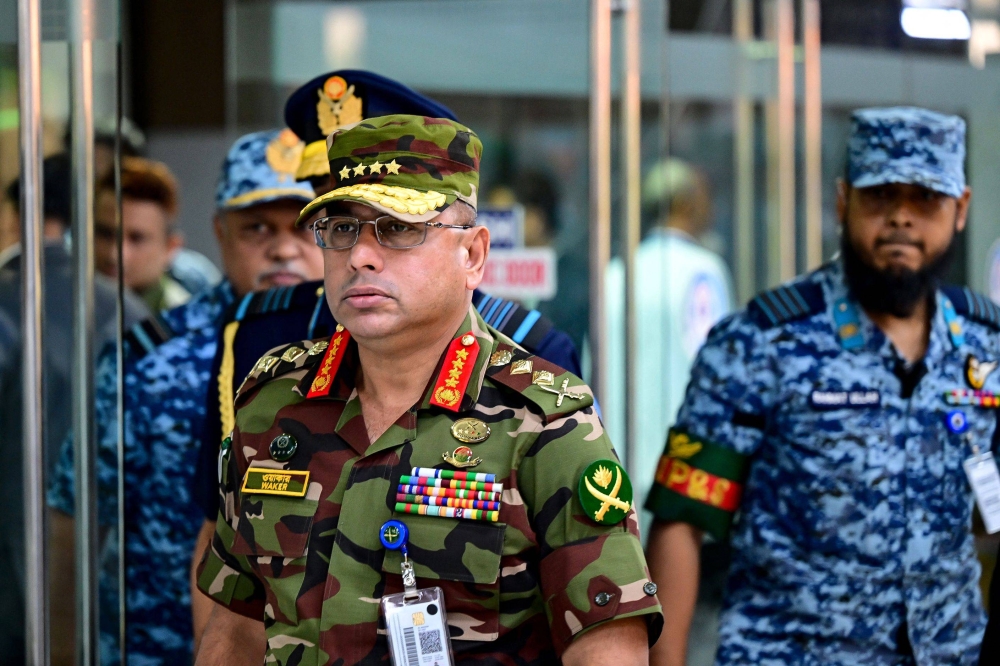
It was Bangladesh’s chief of the army, Gen. Waker-uz-Zaman, who told the nation in a televised address on Aug. 5 that Hasina had quit and left the country, saying he was “taking full responsibility” and would help to “form an interim government.”
But, instead of a broad-based government of national unity, a partisan administration is now in office that includes two student protest leaders, a hard-line Islamist preacher and three retired military generals. This has contributed to continuing purges, as well as revenge attacks and killings.
Bangladesh is a highly polarized country with a poisonous political culture that, over the decades, has fostered a cycle of frenzied violence and deadly retributions. The recent brutal violence is the latest example.
Without sincere efforts to initiate national reconciliation and healing, the deep splits in Bangladesh will likely stoke greater hate, vengeance and economic disruption, with the risk that the nation could become a mirror image of its old nemesis, Pakistan.
Brahma Chellaney is a geostrategist and the author of nine books, including “Water: Asia’s New Battleground.”
The ouster of Bangladeshi Prime Minister Sheikh Hasina’s government is just the latest example of political volatility in South Asia – a region that has struggled to achieve stability, let alone democratization. This is generating acute security and economic risks for the region’s main power, India.
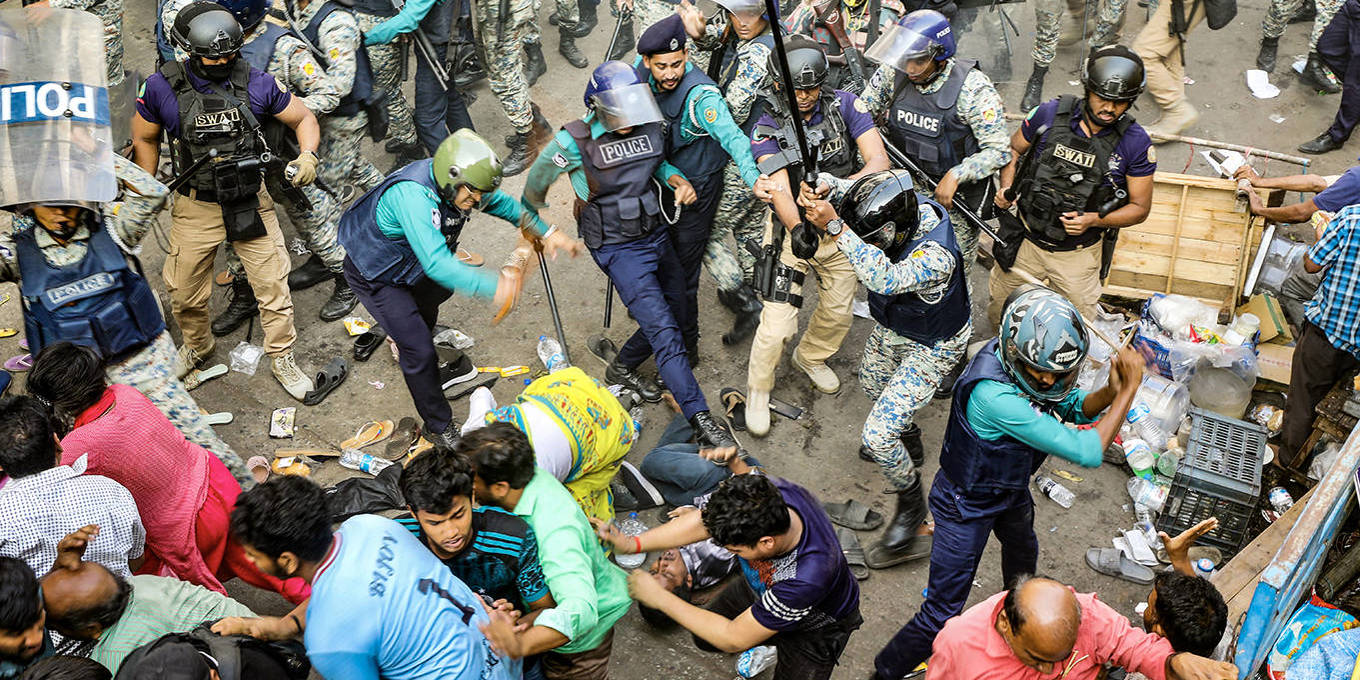
Street clashes in Dhaka, Bangladesh. (Rajib Dhar / Associated Press)
Violent student-led, Islamist-backed protests in Bangladesh have toppled Prime Minister Sheikh Hasina’s government, and mob attacks targeting those viewed as supporters of her secular Awami League party – in particular, the country’s dwindling Hindu minority – are proliferating. At a time when neighboring Myanmar is engulfed in violence and the Pakistan-Afghanistan belt remains fertile ground for cross-border terrorism, political upheaval in Bangladesh, two years after the overthrow of Sri Lanka’s government, is the last thing India, the regional power, needs.
Achieving lasting political stability in South Asia would require entrenching democracy. But this is no easy feat. India notwithstanding, the region remains in thrall to longstanding autocratic traditions and centralization of power. Hasina, for example, had become autocratic during her more than 15 years in office. In this context, popular demands for democracy are far more likely to lead to violence and political chaos than to smooth political transitions.
As Hasina has shown, autocratic leaders do not necessarily survive popular challenges to their rule. Consider the chaos that engulfed Sri Lanka in 2022, when a severe economic crisis triggered mass protests against the Rajapaksa brothers’ dynastic, un-democratic regime. Though President Gotabaya Rajapaksa, like Hasina, initially unleashed a violent crackdown, his opponents proved too powerful. Like Hasina, he gave up and fled the country, without even formally resigning. Sri Lankan protesters then occupied the presidential palace, much as Bangladeshi mobs have ransacked Hasina’s sprawling official residence.
But when an autocrat is toppled, it is often the military – not a democratic government – that takes over, even if behind a civilian facade. Bangladesh is no exception. The military has attempted at least two dozen coups since the country’s violent birth in 1971, and ruled for a number of extended periods since its 1975 assassination of Bangladesh’s charismatic founding leader, Sheikh Mujibur Rahman.
Hasina, who is Rahman’s daughter, stood out for her success at keeping the military (and Islamists) in check, at least until last week, when the army chief refused to continue supporting her crackdown on rampaging protesters. The military then facilitated her escape to India and established an interim government of civilian “advisers” who have little experience with national issues.
To be sure, some South Asian countries have made some progress toward democracy. In particular, Bhutan’s democratic transition is proceeding apace, thanks to a benevolent king who has supported the transition from a traditional monarchy to a parliamentary system. Earlier this year, the country’s fourth national election brought an opposition party to power.
But elections alone – even if competitive – do not guarantee popular empowerment or adherence to constitutional rules, especially when the military holds decisive power. Consider Pakistan, which held elections earlier this year. The military’s preferred candidate, Shehbaz Sharif, returned as prime minister, but his government will survive only at the pleasure of the country’s effective ruler, the army chief. Until the rule of law is firmly entrenched and those wielding extra-constitutional power are unequivocally reined in, democratic progress will remain limited and reversible.
Myanmar learned this the hard way. Though the military had called the shots in the country since independence in 1948, it began ceding power to a nascent civilian government in 2015, filling the country with hope for a democratic future. But in February 2021 – barely six years later – it staged a coup. This time, however, resistance has proved intense, and heavily armed insurgent groups – some receiving “non-lethal aid” from the United States – are managing to expand their territorial control. In response, the military junta has stepped up punitive air strikes and artillery barrages.
The violence and deepening humanitarian crisis are fueling instability beyond Myanmar’s borders. Already, more than 32,000 ethnic Chin have sought refuge in India’s Mizoram state, and thousands more have fled to the state of Manipur, where their arrival has stoked violent ethnic conflict. And it is not just the Chin: India is also home to millions of illegal immigrants from Bangladesh, whose ranks are set to grow as desperate Hindus flee Islamist attacks against them.
When it comes to security risks, immigration is just the beginning. Political turbulence in the Maldives – which began in 2012, when Islamist radicals forced the country’s democratically elected president to resign at gunpoint – has enabled China to gain a foothold in India’s maritime backyard. This year, China signed a military pact with the Maldives and docked a giant marine research ship in a Maldivian port. Meanwhile, Islamist radicals are expanding their grassroots base, establishing ISIS and al-Qaeda cells on the archipelago.
Mounting economic pressures compound the security risks. Pakistan has repeatedly sought International Monetary Fund bailouts in recent years. And Hasina’s overthrow could usher in hard times for the once-booming Bangladeshi economy, as the country’s foreign reserves dwindle rapidly. None of this is conducive to regional prosperity. As long as South Asian countries remain plagued by political instability, strong and sustainable economic growth will remain elusive.
The difficulty of maintaining political stability and advancing democratization can also be seen in Nepal – a country with which India has close cultural and historical ties. Last month, the country swore in its 14th government in just 16 years, led by four-time prime minister, K.P. Sharma Oli, of the pro-China Marxist-Leninist Party. Oli, who spent years in jail in the 1970s and 1980s for waging war against the state, is Nepal’s fifth head of government in five years, having replaced another former communist guerrilla, Pushpa Kamal Dahal.
All of this puts India, the world’s largest democracy and South Asia’s geographical hub, in a difficult situation. It must minimize the spillover effects of political and economic instability in its neighborhood, even as it continues to seek economic and strategic partnerships far beyond its troubled region.
Brahma Chellaney, Professor of Strategic Studies at the New Delhi-based Center for Policy Research and Fellow at the Robert Bosch Academy in Berlin, is the author of nine books, including Water: Asia’s New Battleground (Georgetown University Press, 2011), for which he won the 2012 Asia Society Bernard Schwartz Book Award.
Many media accounts have credited the toppling of Bangladesh Prime Minister Sheikh Hasina’s government almost entirely to a student-led uprising. Unmentioned are either the army’s role in the overthrow, including packing the “Iron Lady” off to India, or the military’s return as the final arbiter in Bangladeshi national politics.
In reality, the regime change in the world’s eighth most-populous country amounts to a quiet military coup behind a civilian facade.
By installing an interim civilian government made up of only “advisers,” the coup leaders have not only forestalled U.S.-led sanctions but also helped foster a romanticized Western media narrative of a student-led “revolution” in the country.
The appointment of Muhammad Yunus as the “chief adviser,” or the head of the interim administration, has only helped mask military rule. The 84-year-old Yunus, a longtime friend of Bill and Hillary Clinton, received the 2006 Nobel Peace Prize for pioneering microcredit, or giving small loans to rural families to help alleviate poverty.
With the duration and scope of powers of the interim administration undefined, its advisers work essentially at the direction of the military brass, especially the army chief, Gen. Waker-uz-Zaman, the power behind the throne. The advisers include two students who led the protests, a hardline Islamist leader and two retired army generals, one of them tasked with restoring law and order in the country.
To be clear, violent student-led, Islamist-backed protests against Hasina’s 15-year secular but increasingly undemocratic reign helped force her out of office. But the decisive factor that ended her rule was loss of support from the country’s powerful army. With protesters rampaging through the streets of the capital of Dhaka, the army’s refusal to enforce a government-ordered lockdown put Hasina’s own personal safety at risk, allowing the military to prevail upon her to flee the country.
No sooner had the 76-year-old Hasina departed for India aboard a military transport plane than mobs ransacked the prime minister’s sprawling official residence, looting every item that could be carried away, from paintings and furniture to fish from the pond.
Driving Hasina into exile appears not to have been a spur-of-the-moment military decision, but rather central to a well-thought-out plan for an indirect army takeover of the country. The international costs of killing a sitting prime minister in a coup, or putting her in prison without due process, were considered too high, making her forced banishment a better choice for the military brass.
Bangladesh’s decades-old cycle of political violence, after all, began with the predawn murder of Hasina’s father, the country’s charismatic founding leader, Sheikh Mujibur Rahman, in a 1975 army coup. President Rahman was killed by army officers in cold blood — along with his wife, three sons and their wives — while they were asleep at Rahman’s residence. Hasina, just 28 years old then, survived because she was abroad at that time.
What followed was prolonged political turmoil that prevented democracy from taking root. Coups and countercoups resulted in extended periods of military rule in the world’s most densely populated large country.
Bangladesh has no regional adversary, yet it has maintained a relatively large military with more than 200,000 personnel. Since external defense is not a major responsibility, the military has long pursued political machinations. When not ruling directly, it has sought to wield political power through pliant civilian-led governments.
Hasina kept the military and Islamist militancy in check, until the army chief used the student-led uprising to engineer her ouster by letting mob violence go beyond the control of police and paramilitary forces. Hasina had appointed Zaman as the army chief just weeks before her downfall, taking comfort in the fact that the general was married to her cousin.
Hasina’s fall, however, triggered a near-total collapse of the state, leading to widespread looting, vandalism, revenge killings and systematic attacks on the country’s small and long-persecuted Hindu minority. But with the mission accomplished by Hasina’s departure, the army chief finally pressed his troops into action to control the situation, including letting them fire on rioting protesters.
With its focus on profit and power, the military has a long history of abuses, as well as a nexus with radical Islamists. And like the military in Pakistan, from which Bangladesh seceded in 1971 after up to three million Bengalis died in a Pakistani genocide, the Bangladeshi armed forces maintain extensive commercial business interests, extending from real estate and hotels to banking, manufacturing and shipbuilding.
After this month’s silent coup, not only will democratization become more difficult, but already-weak civilian oversight over the military could evaporate.
Yet, with a U.S.-friendly interim administration having replaced the Hasina government, which the Biden administration openly targeted over democratic backsliding, Washington has little reason to impose coup-related aid restrictions on Bangladesh.
More than two dozen coups have occurred across the world since 2009, but the U.S. failed to formally condemn about half of those military takeovers because it saw them as favorable to American interests. Washington usually calls out a coup — an action legally necessitating a cutoff of U.S. foreign assistance — when the takeover is detrimental to American power and influence in the region.
Over the years, the U.S. has maintained cozy ties with military or military-backed regimes in Bangladesh. And it views the latest regime change as a positive development. But the White House and the State Department have denied Hasina’s allegation of U.S. involvement in her overthrow.
Still, with purges and crackdowns in full swing even as the nation remains in disarray, Bangladesh faces the daunting task of restoring the rule of law and reviving an economy battered by large-scale mob violence and destruction.






 Stagecraft and Statecraft
You must be logged in to post a comment.