Brahma Chellaney, Mint, December 4, 2013
Last May, US President Barack Obama recalled the warning of James Madison — America’s fourth president — that “no nation could preserve its freedom in the midst of continual warfare”. Yet, despite ending the decade-long US occupation of war-ravaged Iraq, Obama hasn’t exactly been a man of peace. He militarily engineered a regime change in Libya that has backfired, plunging that country in chaos. He almost went to war against Syria before a Russian initiative forced him to abort the planned attack. CIA’s training and arming of rebels, however, is helping to turn Syria into another Afghanistan.
In this light, it may surprise few that Obama has had second thoughts on his promise to bring home by the end of next year all the 45,000 American troops currently in Afghanistan, where the US is waging what already is the longest war in its history. Indeed, he has opted for US military bases and counterterrorism operations in Afghanistan post-2014 by maintaining a large residual force of up to 12,000 NATO troops, mostly American.
Obama’s recent security accord with Afghan President Hamid Karzai dooms America to a perpetual but low-intensity war post-2014 in lawless Afghanistan. The agreement permits a US-led counterterrorism and training mission lasting “until the end of 2024 and beyond” unless terminated with two years’ advance notice. This will mean virtually indefinite US troop presence in Afghanistan with a mandate, as the text says, to “conduct combat operations”.
Before clinching the accord with Karzai, Obama did not consult with the US Congress about the merits of committing America to long-term military engagement in Afghanistan. Congress had allowed his predecessor, George W. Bush, to use military force against those who “planned, authorized, committed, or aided” the 9/11 attacks, as well as against governments that harboured them — a limited authority that spawned an expansive military intervention that has already cost nearly a trillion dollars and killed tens of thousands of people over the past 12 years.
Even before any US debate on his decision to go in for strong military basing in Afghanistan, Obama has mounted increasing pressure on Karzai to sign the agreement by December end. He sent his national security adviser, Susan Rice, to Kabul recently to warn the Afghan leader that failure to do so would compel Washington to withdraw all troops before 2015.
The Loya Jirga, or assembly of Afghan tribal leaders, has put its imprimatur on the accord, which grants the US important concessions, including a controversial immunity for American troops from Afghan law and permitting US special operations forces to conduct raids on private Afghan homes. Washington leveraged the promise of billions of dollars in annual security and economic aid to cash-strapped Afghanistan to secure these concessions. However, Karzai — concerned about leaving behind a legacy as the main facilitator of a long-term US military presence — has threatened to delay the signing until his successor is elected in next April’s presidential election.
In any event, Obama needs a separate deal with the Afghan Taliban, or else US military bases would likely come under intense insurgent attacks after 2014. Indeed, Washington is seeking to cut a broader deal with the Taliban to allow it to “honourably end” the war next year — an objective that has prompted it to kiss and make up with Pakistan, which shelters the top Taliban leadership. Washington recently restored its $1.6-billion aid flow to Islamabad.
Obama’s post-2014 Afghan strategy risks perpetuating the same mistake that has led America to falter in the ongoing war — limiting US military operations to Afghanistan in the binational Afpak region that has become a single geopolitical unit, with militant sanctuaries, command-and-control structure and support infrastructure for the Afghan insurgency located on the other side of the Durand Line. Terrorism and insurgency have never been defeated anywhere in the world without cutting off transboundary sustenance and support.
In recent years, the US has carried out from Afghanistan a series of air and drone strikes in Pakistan’s tribal Waziristan region, targeting the nemesis of the Pakistani military — the Pakistani Taliban. But to preserve the option of reaching a Faustian bargain with its main battlefield opponent — the Afghan Taliban — the US has not carried out a single air, drone or ground attack against that militia’s leadership, which is ensconced in Pakistan’s Baluchistan province, to the south of Waziristan.
In seeking to co-opt the Afghan Taliban, Washington seems unconcerned that it is bestowing legitimacy on a terrorist militia which, according to a recent UN report, raised $155 million last year from illicit opium production. Even if Washington succeeded in cutting a deal with the motley Afghan Taliban, powerful factions within the militia may not honour it.
Obama has not explained how a residual American force, even if sizable, would make a difference in Afghanistan when a much larger force is staring at defeat. A long-term US military presence, besides boosting the militants’ cause, will compel Washington to work with the Janus-faced Pakistani army and intelligence. But if the Afghan Taliban returned to power with Pakistan’s support post-2014, the development would unleash a fresh reign of Islamist terror and allow transnational terrorists to re-establish a major base in Afghanistan, thereby sucking US forces into bloody counterterrorism operations. It would be as if history had come full circle.
Brahma Chellaney is a professor at the Centre for Policy Research, New Delhi.
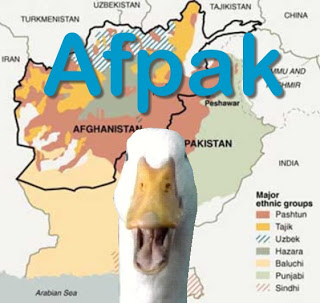
 The Durand Line — arbitrarily bisecting ethnic Pashtun and Baloch homelands — is the Afghan-Indian border the British demarcated in 1893 and which later became the frontier between Afghanistan and Pakistan. Decades after Pakistan’s creation in 1947, the Durand Line remains a mythical border, with successive Afghan governments refusing to recognize it and the validity of the porous line challenged by daily cross-frontier movement of people and extremists.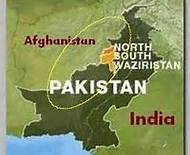


 Brahma Chellaney,
  Prime Minister Manmohan Singh’s recent state visit to Washington generated a lot of media coverage, not in the U.S. (where the media literally took no note of it) but in India, thanks to the planeload of journalists that Singh took with him. Rarely before had an Indian prime minister’s state visit to U.S. been so invisible to Americans.
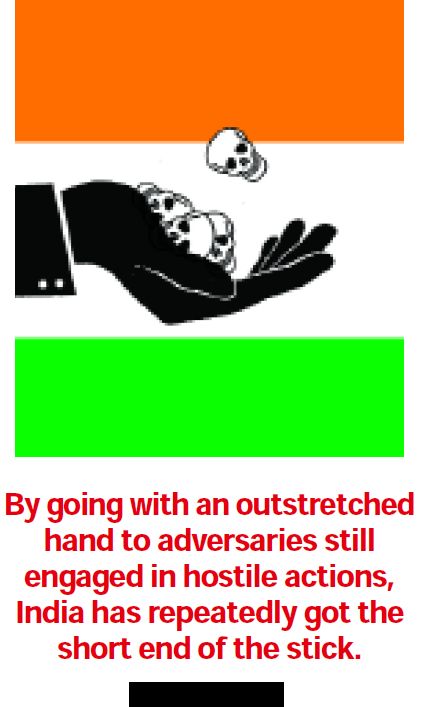
 Yet the extent to which Singh went to save his September 29 meeting with Sharif can be gauged from one troubling fact: news about the September 24 Pakistani cross-border raid into the Keran sector — which triggered a two-week gunbattle between Indian army troops and the intruders — was not released by the government until after the Singh-Sharif meeting. It is unfortunate the government allowed the political exigencies of a meeting in New York to take precedence over the imperative to inform the nation about a major intrusion involving Pakistani special forces.
 More fundamentally, why has it become a virtual custom since the late 1990s for an Indian prime minister’s meeting with Pakistan’s leader to invariably spell trouble for India? Atal Bihari Vajpayee publicly bemoaned that his peace bus to Lahore in February 1999 was “hijacked and taken to Kargil.” Still, he went to Pakistan in early 2004 for a second time as PM — a trip that sowed the seeds of Pakistan’s stepped-up export of terrorism in the subsequent years.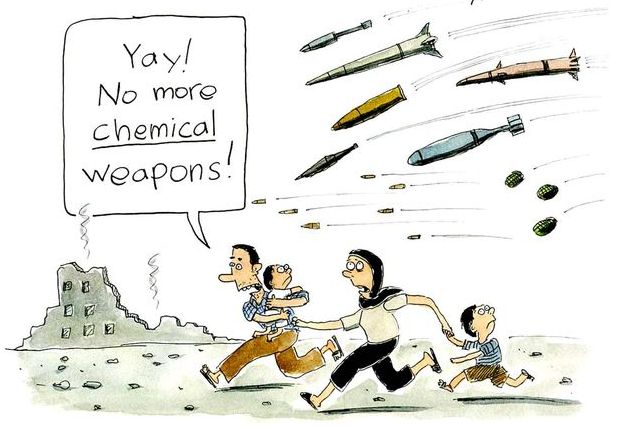
 In just one decade, the United States has intervened militarily in three Muslim-majority countries and overthrown their governments. Now the same coalition of American liberal interventionists and neoconservatives that promoted those wars is pushing for punitive airstrikes in Syria without reflecting on how US policy has ended up strengthening Islamists and fostering anti-Americanism. Indeed, the last “humanitarian intervention” has clearly backfired, turning Libya into a breeding ground for transnational militants.
 Likewise, regime change in Libya aided the rise of Al Qaeda-linked militants, leading to the killing in Benghazi of the US ambassador. A system based on sharia (Islamic law) has been imposed, human-rights abuses are legion, and cross-border movement of weapons and militants has undermined the security of Libya’s neighbors.
 Stagecraft and Statecraft
You must be logged in to post a comment.