How alliances of convenience spur deadly terrorism

p7-Chellaney-a-20151121

Brahma ChellaneyWith the horrific Paris attacks refocusing global spotlight on the scourge of international terrorism, we should not forget the factors that continue to aid the rise of jihadist forces. The international fight against transnational Islamic terrorism can never succeed as long as short-term geostrategic interests prompt Western powers to form alliances of convenience that strengthen fundamentalist forces extolling violence as a sanctified tool of religion.

Islamic terrorism poses an existential threat to liberal, pluralistic states everywhere, not just in the West. So, the interventionist policies of some powers that unwittingly bolster Islamist forces threaten not just their internal security but also that of other democracies with sizable Muslim populations.

Make no mistake: The war on terror cannot be credibly fought with treacherous allies, such as jihadist rebels and fundamentalism-exporting sheikhdoms. Indeed, the pursuit of near-term geostrategic goals at the cost of long-term interests has created an energized international jihadist threat and fostered greater transnational terrorism. The focus on securing short-term gains is helping to inflict long-term pain on the international community.

The notion that Western powers can aid “moderate” jihadists in faraway lands — training them in how to make and detonate bombs and arming them with lethal weapons — and yet not endanger their own security has repeatedly been shown to be false. The training and arming of such militants in collaboration with reactionary Islamist sheikhdoms has only allowed these countries’ cloistered royals to play double games and bankroll Muslim extremist groups and madrasas in many countries.

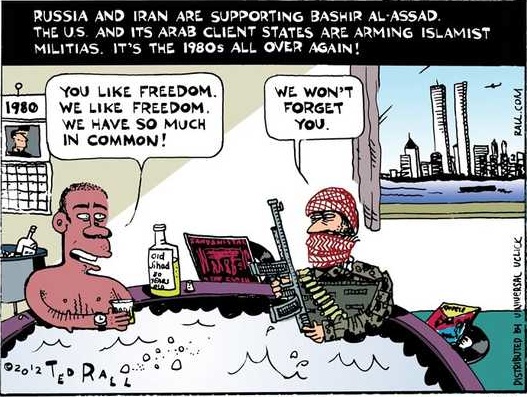
In fact, it is the state and non-state allies of convenience since the 1980s — when the CIA trained and armed thousands of anti-Soviet Afghan rebels with Arab petrodollars and the help of Pakistan’s rogue Inter-Services Intelligence (ISI) agency — that have come to haunt the security of Western and non-Western democracies alike.

In 1985, at a White House ceremony attended by several Afghan top-ranking “mujahedeen” — the jihadists out of which Al Qaeda emerged — President Ronald Reagan gestured toward his guests and declared, “These gentlemen are the moral equivalent of America’s Founding Fathers.” It was the Reagan administration’s use of Islam as an ideological tool to spur jihad against the Soviet military intervention in Afghanistan that created Al Qaeda, undermining the security of several regional states.

As secretary of state, Hillary Clinton admitted in a 2010 ABC News interview that, “We trained them, we equipped them, we funded them, including somebody named Osama bin Laden. And then when we finally saw the end of the Soviet Army crossing back out of Afghanistan, we all breathed a sigh of relief and said, okay, fine, we’re out of there. And it didn’t work out so well for us.”

Today, the Islamic State of Iraq and Syria, or ISIS, has emerged as a new international monster because the lesson from Al Qaeda’s rise has been ignored. This is apparent from President Barack Obama’s recent decision to ramp up U.S. support to Syrian rebels with nearly $100 million in fresh aid. The decision has come despite the vast majority of the CIA-trained “moderate” jihadists having defected with their weapons to ISIS. Now, ISIS wages its terror campaigns largely with Western weapons and with many Western-trained fighters.

France finds itself increasingly in the crosshairs of terrorism in large part because of President François Hollande’s interventionist impulse. A political lightweight who became president by accident in 2012, Hollande has shown himself to be one of the world’s most interventionist leaders, despite being a socialist. Serial interventions have come to define the “Hollande doctrine.”

Under Hollande’s leadership, France has conducted military operations in Ivory Coast, Somalia, Mali, Central African Republic and the Sahel, provided assistance to Syrian rebels as part of a U.S.-led effort to topple President Bashar al-Assad and, more recently, launched airstrikes in Iraq and Syria. When U.S. President Barack Obama considered sending the U.S. military into combat in Syria in 2013, one foreign leader egging him on was Hollande.

Hollande’s happy interventions, especially in the Middle East, have angered radical elements in France’s sizable Arab immigrant community. Hollande was singled out by name by some of those who carried out the November 13 attacks in Paris. Despite several new security measures being implemented after the Charlie Hebdo attack, including a sweeping surveillance law in the supposed cradle of liberty, France has become more vulnerable to terrorist strikes. Hollande now wants the French Constitution amended.

More broadly, almost every Western intervention in the wider Middle East has triggered unforeseen internal and cross-border consequences. Creating a vicious circle of action and reaction, the unintended effects have then prompted another Western intervention in due course to control the fallout.

For example, many of the Arab and other jihadists trained by the CIA in Pakistan, as part of the Reagan administration’s clandestine war against the Soviet Union in Afghanistan, later returned to their homelands to wage terror campaigns against governments they viewed as tainted by Western influence. Such Al Qaeda-linked militants were linked to Egyptian President Anwar Sadat’s assassination and to terrorist attacks on several U.S. targets in the Middle East in the 1990s. Large portions of the multibillion-dollar covert U.S. aid for anti-Soviet Islamic guerrillas were siphoned off by the conduit — Pakistan’s ISI — to ignite a bloody insurgency in the Jammu and Kashmir state of India, which bore the brunt of the unintended consequences of the Russian and U.S.-led interventions in Afghanistan from 1979 to 1989.

More than a decade after its proxy war drove Soviet forces out of Afghanistan, the U.S. — following the September 11, 2001, terror attacks at home — invaded Afghanistan. Over 14 years later, it is still embroiled in that war.

Take another example: The U.S.-French-British toppling of strongman Muammar Gaddafi in 2011 has turned Libya into a battle-worn wasteland that now serves as a happy hunting ground for ISIS, Al Qaeda and other jihadists. This has opened the door to the flow of arms and militants to other countries, leading to the French military’s antiterrorist operations from Mali to the Sahel.

No state has unravelled faster and become a terrorist haven due to foreign intervention than Libya. Yet the U.S. has endlessly debated the 2012 killing of four Americans in Benghazi, including its ambassador, but sidestepped the Obama-made disaster that Libya represents. Indeed, one of the first acts of the short-lived successor regime that the Western powers installed in Tripoli was to introduce Shariah — Islamic law rooted in the ultra-extreme Wahhabi form of Sunni Islam.

Today, a lawless Libya continues to export jihad and guns across the Sahel and undermine the security of fellow Maghreb countries and Egypt. As a jihadist stronghold, it also poses a potential threat to European security.

Likewise, the operation led by the U.S., France and Britain to overthrow Assad not only contributed to turning the once-peaceful, secular Syria into a jihadist bastion and vast killing field but also enabled ISIS to rise from its base in northern Syria as a powerful, marauding army that has gained control over vast swaths of territory extending to Iraq.

That, in turn, prompted Obama more than 14 months ago to launch an open-ended bombing campaign against ISIS in Syria and Iraq. According to Henry Kissinger, the “destruction of ISIS is more urgent than the overthrow of Bashar Assad, who has already lost over half of the area he once controlled. Making sure that this territory does not become a permanent terrorist haven must have precedence.”

Obama’s ineffectual air war, however, has done little to contain ISIS but prompted Russia to launch its own airstrikes. The bomb-triggered crash of a Russian jetliner over the Sinai Peninsula and the ISIS-linked Paris attacks now threaten to deepen outside powers’ military involvement in Syria and Iraq and thereby set off a fresh circle of action and reaction.

More fundamentally, the toppling of secular despots in Iraq and Libya and the attempt to overthrow a similar autocrat in Syria have paved the way for the rise of violent extremists in the Sunni arc that stretches from the Maghreb-Sahel region of North Africa to the Afghanistan-Pakistan belt. Several largely Sunni countries, including Syria, Iraq, Yemen, Libya, Somalia and Afghanistan, have become de facto partitioned, while Jordan and Lebanon face a similar spectre of succumbing to Sunni extremist violence.

In fact, the U.S.-French-British campaign to oust Assad — with the support of Wahhabi sheikhdoms like Saudi Arabia and Qatar — began on the wrong foot by seeking to speciously distinguish between “moderate” and “radical” jihadists. Those waging jihad by the gun can never be moderate, which is why many CIA-trained Syrian rebels have joined ISIS.

Western powers must reconsider their regional strategies, which have long depended on allies of convenience ranging from despotic Islamist rulers, as in the Persian Gulf, to Islamist militias of the type that were used to drive out Soviet forces from Afghanistan or to overthrow Gaddafi. By continuing to shower Pakistan with generous aid and lethal arms, the U.S. unwittingly enables Pakistani export of terrorism to India and Afghanistan.

The West’s dubious allies, ranging from Qatar to Pakistan, have made the international terrorism problem worse. How can the international community combat the ISIS ideology when a major Western ally like Saudi Arabia has played an important role in funding the spread of such ideology and Salafi jihadism?

Western powers must shine a light on their past mistakes so that they don’t repeat them. The Western focus ought to be on securing long-term goals rather than on achieving short-term victories through alliances of convenience.

The larger lesson that should not be forgotten is that unless caution is exercised in training and arming Islamic militants in any region, the chickens could come home to roost. Jihad cannot be confined within the borders of a targeted nation, however distant, as Afghanistan, Syria and Libya illustrate. The involvement of French and Belgian nationals in the Paris attacks indicates how difficult it is to geographically contain the spread of the jihad virus.

© Mint, 2015.

How the U.S. Bolsters China’s Pakistan Strategy at Its Own Expense

The U.S. highlights the rot in its Pakistan policy by feting Gen. Sharif in Washington, where he held talks with Vice President Biden, the secretaries of state and defense, and the CIA chief. The visit showed how the U.S. coddles Pakistani generals at the expense of Pakistan’s elected government.

995098-COAS-1447996768-510-640x480

Brahma Chellaney, China-US Focus

Strategic weapon transfers, loans, and political support allow China to use Pakistan as a relatively inexpensive counterweight to India. Yet, oddly, America also extends unstinted financial and political support to Pakistan, a country that has mastered the art of pretending to be a U.S. ally while hosting those that kill U.S. soldiers in Afghanistan. Washington’s present approach bolsters China’s Pakistan strategy but undercuts its own interests.

U.S. President Barack Obama’s decision to sell an additional eight nuclear-capable F-16 fighter jets to Pakistan is just the latest example of America persistently rewarding a country that still refuses to snap its ties with terrorists or observe other international norms. By showering Pakistan with billions of dollars in aid annually, the U.S. has made the financially-struggling country one of this century’s largest recipients of American assistance.

Terrorists reared by the Pakistani military’s Inter-Services Intelligence (ISI) agency continue to train inside Pakistan for cross-border operations in India and Afghanistan. The Afghan Taliban’s top leaders remain holed up in Pakistan, which also hosts sanctuaries for those waging hit-and-run campaigns in Afghanistan. Pakistan has not come clean even in regards to who helped Osama bin Laden hide for years in a military garrison town near its capital.

Yet, the U.S. has allowed itself to be repeatedly duped by Pakistan’s false promises. U.S. policy has not only turned Uncle Sam into Uncle Sucker but also made it easy for Pakistan to merrily run with the foxes and hunt with the hounds.

Over the past 13 years, the U.S. has given Pakistan more than $31 billion in aid and other financial support. And like China, it has been arming Pakistan with lethal weapons.

Under Obama and his predecessor, George W. Bush, the weapon systems that have flowed to Pakistan or are to be provided include eight P-3C Orion maritime aircraft, 18 new and 14 used F-16s, one Perry-class missile frigate,six C-130E Hercules transport aircraft, 100 Harpoon anti-ship missiles, 2,007 TOW anti-armor missiles, 500 AMRAAM air-to-air missiles, 500 Sidewinder air-to-air missiles, 1,450 2,000-pound bombs, six AN/TPS-77 surveillance radars, 115 M-109 self-propelled howitzers, 20 AH-1F Cobra attack helicopters, and 15 Scan Eagle unmanned aerial vehicles.

More recently, Washington, in a nearly $1 billion deal with Pakistan, agreed to supply 15 AH-1Z Viper attack helicopters, 1,000 Hellfire II missiles, and targeting and positioning systems. The U.S. justification for arming Pakistan with such sophisticated weapons has been that they are needed for counterterrorism, as if the “bad” terrorists that Pakistan seeks to battle (while taking care of the “good” ones) have acquired naval, air, and ground-force capabilities.

Consider another issue: Despite Pakistan’s duplicity in the fight against terrorism, Washington continues to extend carrots to Pakistani military commanders in hopes of convincing them to sever their ties with all terrorist groups and to bring the Taliban to Afghanistan peace talks. Hope seems to spring eternal.

Yet, the U.S.’s Pakistan policy has also failed to deliver on other fronts, including reining in Pakistan’s nuclear-weapons program and promoting a genuine democratic transition there. With the development of a robust civil society remaining stunted, jihad culture is now deeply woven into Pakistan’s national fabric. And despite an elected government in office, the military rules the roost in Pakistan.

Indeed, Prime Minister Nawaz Sharif has been forced to let the military take charge of foreign policy and national security. Army chief Gen. Raheel Sharif (not related to the prime minister) calls the shots on key issues. The government’s main responsibility is now limited to the economy, yet it cannot touch the financial prerogatives of the military, which, according to some estimates, consumes 26% of all tax receipts.

With the military, intelligence, and nuclear establishments not answerable to the government, Pakistan has been frenetically expanding its nuclear arsenal, building even low-yield tactical nukes for use on the battlefield against India. The arsenal provides the generals the nuclear shield to harbor terrorists without inviting military retaliation from India.

More than ever, Pakistan stands out as a military with a country, rather than a country with a military.

Against this background, if Pakistan is to become a moderate, stable country, the military’s viselike grip on power must be broken and the ISI made accountable. However, the U.S., far from seeking to address Pakistan’s skewed civil-military relations, has been mollycoddling Gen. Sharif, awarding him the U.S. Legion of Merit for his contributions to “peace and security.” Shortly, the general will pay another high-profile visit to Washington for talks with top officials.

More ominously, the U.S. has explored the idea of cutting a nuclear deal with Pakistan. Dangling the offer of a “nuclear mainstreaming” Pakistan — as advocates of the exploratory talks call it — carries a double risk: Incentivizing breach of norms by a state sponsor of terrorism, andlegitimizing a nuclear program built through theft of technology, deception, and clandestine transfers from China. A deal would also whitewash the biggest nuclear-proliferation scandal in history, known as the A.Q. Khan affair.

As long as Pakistan’s nuclear-weapons program remains outside government control, any American attempt to limit it would fail.

The U.S.’s Pakistan strategy, despite a long record of failure, remains focused too much on carrots and too little on sticks or disincentives.Obama has spurned congressional advice to suspend some aid to Pakistan and impose travel restrictions and other sanctions on Pakistani officials known to have ties to terrorists.

Worse still, Obama’s recent move to keep U.S. troops in Afghanistan indefinitely, leaving a withdrawal decision to his successor, means that the U.S. will continue to fight the war on the wrong side of the Afpak border while still rewarding the Taliban’s backer, Pakistan.

It is time for America to stop getting duped and fix its broken Pakistan policy, which permits the Pakistani military to nurture more transnational terrorists and Islamists. The policy also plays into China’s hands by unwittingly aiding Beijing’s designs and helping to cement the Sino-Pakistan nexus. Pakistan is a valued asset for China to keep India boxed in, but a burden for America’s geostrategic interests.

Washington must balance its carrots by employing an appropriate level of sticks to force change in Pakistan’s behavior. Sustained U.S. pressure is vital to encourage a reformed Pakistan at peace with itself.

© China-US Focus, 2015.

The Western Roots of Anti-Western Terror

By Brahma Chellaney

A column internationally syndicated by Project Syndicate.

unnamedThe Islamic State’s horrific attacks in Paris provide a stark reminder that Western powers cannot contain – let alone insulate themselves from – the unintended consequences of their interventions in the Middle East. The unraveling of Syria, Iraq, and Libya, together with the civil war that is tearing Yemen apart, have created vast killing fields, generated waves of refugees, and spawned Islamist militants who will remain a threat to international security for years to come. And the West has had more than a little to do with it.

Obviously, Western intervention in the Middle East is not a new phenomenon. With the exceptions of Iran, Egypt, and Turkey, every major power in the Middle East is a modern construct created largely by the British and the French. The United States-led interventions in Afghanistan and Iraq since 2001 represent only the most recent effort by Western powers to shape the region’s geopolitics.

But these powers have always preferred intervention by proxy, and it is this strategy – training, funding, and arming jihadists who are deemed “moderate” to fight against the “radicals” – that is backfiring today. Despite repeated proof to the contrary, Western powers have remained wedded to an approach that endangers their own internal security.

It should be obvious that those waging violent jihad can never be moderate. Yet, even after acknowledging that a majority of the Free Syrian Army’s CIA-trained members have defected to the Islamic State, the US recently pledged nearly $100 million in fresh aid for Syrian rebels.

France, too, has distributed aid to Syrian rebels, and it recently began launching airstrikes against the Islamic State. And that is precisely why France was targeted. According to witnesses, the attackers at Paris’s Bataclan concert hall – where most of the night’s victims were killed – declared that their actions were President François Hollande’s fault. “He didn’t have to intervene in Syria,” they shouted.

To be sure, France has a tradition of independent-minded and pragmatic foreign policy, reflected in its opposition to the 2003 US-led invasion and occupation of Iraq. But after Nicolas Sarkozy became President in 2007, France aligned its policies more firmly with the US and NATO, and participated actively in toppling Libyan leader Muammar el-Qaddafi in 2011. And after Hollande succeeded Sarkozy in 2012, France emerged as one of the world’s most interventionist countries, undertaking military operations in the Central African Republic, the Ivory Coast, Mali, the Sahel, and Somalia before launching its airstrikes in Syria.

Such interventions neglect the lessons of history. Simply put, nearly every Western intervention this century has had unforeseen consequences, which have spilled over borders and ultimately prompted another intervention.

It was no different in the late twentieth century. In the 1980s, under President Ronald Reagan, the US (with funding from Saudi Arabia) trained thousands of Islamic extremists to fight against the Soviet Union in Afghanistan. The result was Al Qaeda, whose actions ultimately prompted President George W. Bush’s invasion of Afghanistan and provided a pretext for invading Iraq. As then-Secretary of State Hillary Clinton admitted in 2010, “We trained them, we equipped them, we funded them, including somebody named Osama bin Laden….And it didn’t work out so well for us.”

And yet, disregarding this lesson, Western powers intervened in Libya to topple Qaddafi, effectively creating a jihadist citadel at Europe’s southern doorstep, while opening the way for arms and militants to flow to other countries. It was this fallout that spurred the French counter-terrorist interventions in Mali and the Sahel.

Having barely stopped to catch their breath, the US, France, and Britain – with the support of Wahhabi states like Saudi Arabia and Qatar – then moved to bring down Syrian President Bashar al-Assad, fueling a civil war that enabled the Islamic State to seize territory and flourish. With the group rapidly gaining control over vast areas extending into Iraq, the US – along with Bahrain, Jordan, Qatar, Saudi Arabia, and the United Arab Emirates – began launching airstrikes inside Syria last year. France joined the effort more recently, as has Russia.

Though Russia is pursuing its military campaign independently of the Western powers (reflecting its support for Assad), it, too, has apparently become a target, with US and European officials increasingly convinced that the Islamic State was behind October’s crash of a Russian airliner in the Sinai Peninsula. That incident, together with the Paris attacks, may spur even greater outside military involvement in Syria and Iraq, thereby accelerating the destructive cycle of intervention. Already, the danger that emotion, not reason, will guide policy is apparent in France, the US, and elsewhere.

What is needed most is a more measured approach that reflects the lessons of recent mistakes. For starters, Western leaders should avoid playing into the terrorists’ hands, as Hollande is doing by calling the Paris attacks “an act of war” and implementing unprecedented measures at home. Instead, they should heed Margaret Thatcher’s advice and starve terrorists of “the oxygen of publicity on which they depend.”

More important, they should recognize that the war on terror cannot credibly be fought with unsavory allies, such as Islamist fighters or fundamentalist-financing sheikhdoms. The risk of adverse unintended consequences – whether terrorist blowback, as in Paris, or military spillovers, as in Syria – is unjustifiably high.

It is not too late for Western powers to consider the lessons of past mistakes and recalibrate their counterterrorism policies accordingly. Unfortunately, this appears to be the least likely response to the Islamic State’s recent attacks.

© Project Syndicate, 2015.

Tail wags the dog

More than ever, Pakistan stands out as a military with a country, rather than a country with a military. In handling Pakistan, the U.S. must remember the old adage: “Fool me once, shame on you. Fool me twice, shame on me.”

Brahma Chellaney, Nikkei Asian Review

Having mastered the art of pretending to be an ally of the U.S. while working to undercut its interests, including aiding its battlefield foes, Pakistan has merrily been playing a double game. Yet, the U.S. continues to arm it with sophisticated weapons and provide multibillion-dollar aid to prop it up.

U.S. President Barack Obama meets Pakistan’s Prime Minister Nawaz Sharif at the White House in Washington on Oct. 22. © Reuters

President Barack Obama’s decision to sell an additional eight nuclear-capable F-16 fighter jets to Pakistan is just the latest example of the U.S. persistently rewarding a country that refuses to cut its ties with violent jihadists or observe other international norms. Indeed, by showering a financially struggling Pakistan with generous aid, the U.S. has made the country one of the largest recipients of U.S. assistance.

Through its financial and political support, the U.S. unwittingly enables Pakistan’s export of terrorism. As two American scholars, C. Christine Fair and Sumit Ganguly, suggested in the journal Foreign Affairs, “If Washington cannot end Pakistan’s noxious behaviors, it should at least stop sponsoring them.”

The Pakistani military’s Inter-Services Intelligence agency continues to aid the Afghan Taliban, which has killed hundreds of U.S. troops in Afghanistan, while nurturing other terrorists for cross-border operations in India and Afghanistan.

Yet, over the past 13 years, the U.S. has given Pakistan more than $18 billion in economic and military aid and $13 billion from the Coalition Support Funds. U.S. policy has made it easy for Pakistan to free ride, turning Uncle Sam into Uncle Sucker.

Since President George W. Bush upgraded U.S. relations with Pakistan by designating it a Major Non-NATO Ally, a lot of U.S. weapon systems have flowed to the country, which has encouraged it to ratchet up hostility with India.

The weapon supplies include eight P-3C Orion maritime aircraft, 18 new and 14 used F-16s, one Perry-class missile frigate, six C-130E Hercules transport aircraft, 100 Harpoon anti-ship missiles, 2,007 TOW anti-armor missiles, 500 AMRAAM air-to-air missiles, 500 Sidewinder air-to-air missiles, 1,450 2,000-pound bombs, six AN/TPS-77 surveillance radars, 115 M-109 self-propelled howitzers, 20 AH-1F Cobra attack helicopters, and 15 Scan Eagle unmanned aerial vehicles.

The Obama administration, in a nearly $1 billion deal with Pakistan, recently agreed to supply 15 AH-1Z Viper attack helicopters, 1,000 Hellfire II missiles, and targeting and positioning systems. However, its move a year ago to equip the Pakistani navy with eight GRC43M cutter vessels for medium to long endurance coverage of the northern Arabian Sea has run into congressional opposition.

The U.S. justification for arming Pakistan with such lethal weapons has been that they are needed for counterterrorism, as if the “bad” terrorists that Pakistan seeks to fight (while taking care of the “good” ones) have acquired sophisticated naval, air and ground-force capabilities. In reality, the U.S., despite emerging as India’s largest arms supplier, has sought to equip Pakistan with specific systems to offset some of India’s military advantages, even though Pakistan refuses to accept the territorial status quo on the subcontinent and continues to train and export terrorists.

While emboldening Pakistan’s antagonism and intransigence, U.S. policy, paradoxically, pushes for an India-Pakistan “peace” dialogue.

Consider another issue. Despite Pakistan’s duplicity in the fight against terrorism, Washington, largely because of its interests in Afghanistan and other regional considerations, has shied away from imposing any costs on the Pakistani military for nurturing jihadist forces. Instead, it continues to extend carrots to Pakistani military leaders in hopes of convincing them to sever ties with all terrorist groups and to bring the Taliban to the Afghan peace talks.

Short-term factors have led the U.S. to forge even closer institutional ties with the Pakistani army and the ISI, the main wielders of power in Pakistan. The F-16 decision followed Obama’s U-turn on U.S. troop withdrawal from Afghanistan.

Significantly, Washington’s Pakistan policy has failed to deliver on other fronts as well, including curbing Pakistan’s nuclear weapons program and promoting a genuine democratic transition there. While the development of a robust civil society remains stunted, jihadist culture is now deeply woven into Pakistan’s national fabric. Despite an elected government in office, the military rules the roost in Pakistan.

The most powerful person is not Prime Minister Nawaz Sharif, but Army chief General Raheel Sharif. Gen. Sharif, who is not related to the prime minister, calls the shots on key issues. Without staging an overt military coup, Gen. Sharif has encroached on the authority of the elected civilian leadership.

In fact, the prime minister has been compelled to let the military take charge of foreign policy and national security, including all aspects of internal security. So the government’s main responsibility is limited to the economy, yet it cannot touch the financial prerogatives of the military, which consumes 26% of all tax receipts, according to some estimates.

With the military, intelligence and nuclear establishments not answerable to an elected government, Pakistan has been expanding its nuclear arsenal, building even low-yield tactical nukes for battlefield use against India. The arsenal provides the generals the nuclear shield to harbor terrorists without inviting military retaliation from India.

More than ever, Pakistan stands out as a military with a country, rather than a country with a military.

If Pakistan is to become a moderate, stable country, the military’s viselike grip on power must be broken and the ISI made accountable. However, far from seeking to address Pakistan’s skewed civil-military relations, the U.S. has been mollycoddling Gen. Sharif, awarding him the U.S. Legion of Merit for his contributions to “peace and security.” Washington will soon host the general on another high-profile visit.

This behavior has also encouraged U.S. allies to pamper Gen. Sharif. British Prime Minister David Cameron held talks with Gen. Sharif earlier this year at Downing Street, while new Afghan President Ashraf Ghani started his Pakistan visit by meeting the general first.

More ominously, the U.S. has explored the idea of cutting a nuclear deal with Pakistan. Dangling the offer of “nuclear mainstreaming” Pakistan, as advocates of the exploratory talks call it, carries a double risk: Incentivizing breach of norms by a state sponsor of terrorism, and legitimizing a nuclear program built through the theft of technology, deception, and clandestine transfers from China. A deal would also whitewash the biggest nuclear proliferation scandal in history, known as the A.Q. Khan affair after the Pakistani nuclear scientist who supplied nuclear know-how to rogue states such as Libya and North Korea.

The irony is that those in Washington who worry about a rogue commander in Pakistan seizing control of a nuclear bomb seem oblivious to the fact that the Pakistani military has already been radicalized and the ISI has turned rogue, with its jihadist rampages spawning more dangerous Islamists.

As long as Pakistan’s nuclear weapons program remains outside government control, any U.S. attempt to limit it will remain a false hope.

The real problem with U.S. policy is that it refuses to learn from past mistakes. For example, the U.S. failure or unwillingness to bring the ISI to heel parallels its ineffectual air war against Islamic State in Iraq and Syria, which bears an acronymic affinity with the ISI. ISI and ISIS became powerful, respectively, because of misguided U.S. policies of arming jihadists in Afghanistan in the 1980s and in Syria in recent years.

Washington’s Pakistan strategy, despite a long record of failure, remains focused too much on carrots and too little on sticks. Obama has spurned congressional advice earlier this year to suspend some aid to Pakistan and impose travel restrictions and other sanctions on Pakistani officials known to have ties to terrorists. Even those that harbored Osama bin Laden in a Pakistani military garrison town have gone scot-free.

Worse still, Obama’s recent move to keep U.S. troops in Afghanistan indefinitely, leaving any withdrawal decision to his successor, means that the U.S. will continue to fight the war on the wrong side of the Afghan-Pakistani border while rewarding the Taliban’s backer, Pakistan.

It is time for the U.S. to stop being duped and instead fix its broken Pakistan policy. It must begin by bridging the gap between policy and practice, including employing some sticks. Sustained U.S. pressure is vital to encourage a reformed Pakistan.

In handling Pakistan, U.S. policymakers must remember the old adage: “Fool me once, shame on you. Fool me twice, shame on me.”

Brahma Chellaney is a geostrategist and the author of nine books, including the award-winning “Water: Asia’s New Battleground.”

© Nikkei Asian Review, 2015.

Obama’s lesson in how to not make peace in Afghanistan

BY BRAHMA CHELLANEYThe Japan Times

p9-Chellaney-a-20150513-870x593The just-concluded exploratory “peace” talks in Qatar between Afghan President Ashraf Ghani’s government and the Taliban militia obscure the continuing combat role in Afghanistan of the United States, which facilitated these discussions. Months after U.S. President Barack Obama declared an end to America’s “combat role” in Afghanistan, U.S. troops are still regularly carrying out strikes on Taliban positions, while U.S. special operations forces continue to raid suspected insurgent hideouts.

The U.S., after militarily toppling the Taliban from power in Afghanistan in 2001, has spent 14 years battling this militia in a still-raging war whose goal in recent time has turned farcically to making peace with the enemy. The result is that America’s longest war in history is getting even longer, with Obama’s overtures to the Taliban exposing fatal flaws in his Afghan policy.

Amending the name of the U.S.-led NATO intervention in Afghanistan from Operation Enduring Freedom to Operation Resolute Support with effect from Jan. 1 has changed little, despite the Afghan forces shouldering increased warfighting responsibilities.

The White House claims that U.S. strikes now are essentially for protection of American soldiers still stationed in Afghanistan and for combating al-Qaida remnants. In truth, it is the Taliban’s advances that are triggering everyday U.S. combat missions, including warplane and drone attacks and Special Operations raids.

Ghani, who has yet to appoint a defense minister, allows the U.S. to run the war, content to play second fiddle to Gen. John F. Campbell, the top American commander in Afghanistan.

The Taliban militia, despite its recent talks with the Afghan government, has stepped up attacks on members of Afghanistan’s military and police. One such attack, which inflicted heavy casualties on a police unit in Badakhshan province, occurred while the talks were under way in Qatar.

Civilians, however, continue to bear the brunt of the fighting. The United Nations documented 10,548 civilian casualties — a record — in increased ground fighting just last year.

Obama has already missed the 2014 deadline he himself laid down for withdrawal of U.S. forces from Afghanistan. Now he is set to miss his revised deadline to pull out U.S. troops by January 1, 2016. Scrapping the scheduled halving by this year-end of the about 10,000 U.S. troops still deployed, the White House recently decided to maintain the current force level into 2016. Indeed, the duration of U.S. military presence has become open-ended.

The war, which has left 2,315 American troops killed and 20,000 wounded, has already cost nearly $1 trillion.

Obama’s premature declaration that America’s long military campaign against the Taliban is over will be remembered much like his predecessor George W. Bush’s 2003 “Mission Accomplished” speech on the Iraq war. It was Obama that ended Bush’s Iraq war. Yet by 2014, Obama was back at war in Iraq, relying on the same 2002 congressional authorization that Bush secured for military action there.

In Afghanistan, the main enemy of U.S. forces is the Pakistan-backed Taliban, which has already inflicted far more casualties among American and allied forces than al-Qaida and the Islamic State have managed to do in the countries where they operate. Yet Obama refuses to treat the medieval-theology-hewing Taliban as a terrorist organization. Indeed, the White House has sought to paint the Taliban as a moderate force that can be politically accommodated in Afghanistan’s power structure as part of a peace deal.

Obama’s plans, however, have been upset by the Taliban continuing to play for time. The militia, for example, has rebuffed the idea of a ceasefire.

Still, Obama’s pursuit of a peace deal led him to release top Taliban figures from Guantanamo Bay last year and to allow the Taliban in 2013 to set up in Qatar’s capital Doha a virtual embassy in exile, complete with a flag and other trappings of a diplomatic mission.

Five hardened Taliban militants (two of them wanted for war crimes) were freed not so much to secure the release of a U.S. soldier — Sergeant Bowe Bergdahl, who has now been charged with desertion — as to set the stage for talks with the Taliban, which had sought their freedom as a precondition for direct talks. The release of the five — the “hardest of hard core,” according to Senator John McCain — belied U.S. claims that it doesn’t negotiate with militants over hostages or seek a deal with terrorists. Two of them, Mohammad Fazie and Mullah Nori, are suspected of carrying out massacres of Sunni Tajiks and Shiite Hazaras in Afghanistan.

The Taliban’s Doha office, which was shut after its opening angered then Afghan President Hamid Karzai, has become active again, as the U.S. has eased some restrictions on the Taliban leadership, including travel bans.

Tragically, Obama’s overtures to the Taliban have yielded little more than talks about talks, with the militia dragging its feet on negotiating a peace deal. The May 3-4 “unofficial” talks in Qatar — hosted by the Qatari government and the Pugwash Council — produced only broad thoughts, including that “foreign forces have to leave Afghanistan soon,” that Afghanistan will have an “Islamic” government, and that more discussions are necessary to sustain the “peace process.”

The Obama policy has failed to get the Pakistani military to stop sheltering Taliban’s top leadership or to cease treating the militia as an invaluable asset for gaining “strategic depth” in Afghanistan against India. Obama has showered Pakistan with generous aid to secure its cooperation, unveiling $1 billion recently in new assistance flow and another $1 billion package of missiles, helicopters and other weapons.

More fundamentally, Obama’s faltering strategy to win over the Taliban serves as a cautionary tale of how not to make peace with an enemy. Indeed, in a reflection of America’s shrinking options, its success or failure in Afghanistan now hinges on a limited issue — whether it can prevent the Taliban from marching into Kabul.

Despite Obama’s decision to put off a further drawdown of U.S. forces, the Taliban continues to incrementally gain ground. For example, its forces have advanced to the outskirts of the capital of the northern province of Kunduz.

The Taliban, with its top leadership ensconced in Pakistan, no longer has a centralized command and command. Its field commanders are becoming increasingly autonomous.

Worried about desertions from its ranks to the ISIS, a new player in Afghanistan that claimed responsibility for the April 18 series of deadly explosions in the eastern city of Jalalabad that left at least 34 people dead, the Taliban knows that a peace deal offering Obama what he wants — a way to declare victory before his exit from office — will be its death knell. In fact, to stop the erosion in its support, the Taliban is seeking to match the brutal tactics of the ISIS.

The Taliban’s larger strategy to return to power is simply to wait out the Americans.

Before it is too late, Obama must replace his wishful peace-deal pursuit with a clear focus on bolstering the Afghan security forces and finding ways to eliminate the Taliban’s cross-border sanctuaries in Pakistan.

Brahma Chellaney is a geostrategist and the author of “Water: Asia’s New Battleground,” winner of the 2012 Bernard Schwartz Award.

© The Japan Times, 2015.

Obama’s Failed Afghan Peace Strategy

A column internationally syndicated by Project Syndicate.

2e8098f118f74f0d1c11096a1728d45a.landscapeSince toppling the Taliban regime in Afghanistan 14 years ago, the United States has been waging a non-stop battle against its foot soldiers. Locked in a war that has already cost nearly $1 trillion, the US has now shifted its focus to making peace with the enemy. It will not work.

Months after President Barack Obama declared that America’s “combat role” in Afghanistan was over, the US and its allies continue to carry out airstrikes on Taliban positions regularly, while American special operations forces continue to raid suspected insurgent hideouts. In fact, beyond an increased role for Afghan forces in the fighting, the situation in the country has changed little since “Operation Enduring Freedom” was renamed “Operation Resolute Support.”

Obama’s premature declaration will be remembered much like his predecessor George W. Bush’s 2003 “Mission Accomplished” speech, which proclaimed the end of major combat operations in Iraq long before they actually ended. Indeed, the overwhelming majority of casualties in Iraq were yet to occur.

Nor is this the first time that Obama has jumped the gun. In October 2011, he announced that he was bringing “the long war in Iraq” to an end by withdrawing all US troops. Yet, last year, the US was back at war in Iraq, this time in an effort to rein in the Islamic State, with Obama relying on the same congressional authorization that Bush secured for military action there a decade before.

In Afghanistan, the Obama administration has already missed the 2014 deadline, set in 2011, for withdrawing US forces. And it has rescinded another self-imposed deadline, having scrapped its plan to halve the number of US troops still deployed in Afghanistan – currently around 10,000 – by the end of this year.

So America’s military intervention in Afghanistan is now open-ended – and the fighting is not subsiding. On the contrary, the recent escalation of Taliban attacks indicates that the approaching summer fighting season will be among the most intense since the war began.

The Taliban has already inflicted far more casualties among US and allied forces than Al Qaeda and the Islamic State combined. A total of 2,215 American troops have been killed in Afghanistan, and another 20,000 wounded, since 2001. The United Nations documented a record-breaking 10,548 conflict-related civilian casualties just last year.

Yet Obama has refused to designate the Taliban as a terrorist organization, leaving it off the list of terrorist networks mentioned, for example, in his recent joint statement with Indian Prime Minister Narendra Modi. Instead, his administration has sought to portray the Taliban as a moderate force that can be accommodated within Afghanistan’s political system.

Moreover, in 2013, Obama allowed the Taliban to establish what was essentially an embassy in exile in Doha, Qatar, complete with a flag and other diplomatic trappings. And, last year, the US released five top Taliban leaders – including Mohammad Fazl and Mullah Nori, who are suspected of carrying out massacres of Sunni Tajiks and Shia Hazaras in Afghanistan – from the Guantánamo Bay detention center.

In releasing the five, the Obama administration claimed that it was simply doing what was necessary to secure the return by the Taliban of Sergeant Bowe Bergdahl (who has now been charged with desertion). But the real objective was clear: to lay the groundwork for direct talks with the Taliban. The move not only belied US claims that it does not negotiate with terrorists; it also failed to bring the Taliban militia to the negotiating table.

With these concessions, the US has revealed to the Taliban – and the world – its desperation to achieve a face-saving settlement that would enable it, at long last, to escape the Afghan quagmire. It is no wonder that the Taliban chief, Mullah Muhammad Omar, hailed the release of his five comrades as evidence that his militia is “closer to the harbor of victory.”

The Obama administration’s desperation is similarly apparent in the generous aid that it has provided to Pakistan, including an imminent arms deal worth almost $1 billion, in an effort to secure the country’s cooperation on counter-terrorism. Yet the Pakistani military continues to shelter the top leadership of the Taliban, which it regards as an invaluable asset for gaining “strategic depth” in Afghanistan against India.

America’s success or failure in Afghanistan now hinges on a single limited issue: whether it can prevent the Taliban from marching into Kabul. By highlighting its desperate search for an exit, the US has given the Taliban the upper hand, letting the militia’s leaders know that they can simply wait it out.

Delaying a further drawdown of US forces will be inadequate to convince the Taliban otherwise. With its top leadership ensconced in Pakistan and its field commanders in Afghanistan becoming increasingly autonomous, the Taliban no longer has a centralized command. And, fearing desertions to the Islamic State, it knows that giving Obama what he wants – a peace deal that enables him to declare victory before his term ends in January 2017 – would be its death knell.

America’s faltering Afghan strategy should serve as a cautionary tale of how not to make peace with an enemy. It is time for Obama to recognize that a political settlement with the Taliban is simply wishful thinking. Instead, he should focus on bolstering Afghanistan’s security forces and identifying ways to eliminate the Taliban militia’s sanctuaries in Pakistan. After all, terrorists are not in the business of making peace; America should not think otherwise.

India’s Pakistan policy adrift

Brahma Chellaney, Mint, March 26, 2015

sharifmodi--621x414In his first eight months in office, Prime Minister Narendra Modi impressed many with his foreign-policy skills. For example, he signalled that India’s response to Pakistan’s strategy to inflict death by a thousand cuts will no longer be survival by a thousand bandages; rather the response will be punitive so as to have a deterrent effect and help reform Pakistan’s conduct. Pakistan’s stepped-up ceasefire violations were met with a punishing mortar-for-bullet response.

Yet today, Modi’s Pakistan policy looks barely different from his predecessor’s. Since U.S. President Barack Obama’s New Delhi visit, there has been a major transformation in India’s Pakistan policy. Obama pitched strongly for India’s re-engagement with Pakistan, dwelling on that theme at great length during his famous chai per charcha with Modi. His line of reasoning manifestly left a deep impression on Modi.

This is apparent from India’s policy somersaults on two critical issues. The first U-turn — resumption of bilateral dialogue — raises troubling questions about the logic behind it. Such re-engagement even as Pakistan exports terror encourages it to persist with its roguish conduct. Few thus should be surprised by the return of terror attacks to Jammu and Kashmir. Since the Obama visit, Modi’s conciliatory gestures have included a telephone call to his Pakistani counterpart, Nawaz Sharif, and then a letter to him — hand-delivered by the Indian foreign secretary — in which the Indian leader said he looks forward to visiting Islamabad early next year for the SAARC summit.

The second U-turn is no less puzzling: India conveyed to Pakistan last month that its high commissioner in New Delhi can meet Hurriyat separatists on any occasion other than when official talks are about to begin. In other words, Modi has yielded ground even on the issue that led him to cancel talks with Pakistan last August. The Pakistani high commissioner, in keeping with the Indian advisory, met first with Hurriyat’s Syed Ali Shah Geelani immediately after the foreign secretary-level talks in Islamabad and then this week with a seven-member Hurriyat delegation led by Mirwaiz Umer Farooq.

Now consider another issue — the government’s dispatch of a reluctant minister, General V.K. Singh, to the Pakistan Day event. General Singh is not just any minister of state. As a former Army chief, he deserves due respect. In the Indian system, even civil servants at times try to ride roughshod over service chiefs. In this case, it was the government itself that did not accord due respect to a former Army chief by sending him as its representative to an event bristling with the presence of Pakistan’s Hurriyat surrogates. Look at the paradox: Just months after Modi broke off talks with Pakistan over its high commissioner’s meeting with Hurriyat leaders, he sends Gen. Singh to the Hurriyat-infested Pakistan Day event.

Modi swept to power in India’s biggest election victory in a generation because voters expected him to usher in qualitative change. The hope was that he would be a transformative leader. Today, ironically, the lack of self-respect that permeated Manmohan Singh’s Pakistan policy risks seeping into the Modi government’s actions.

With Modi’s policy adrift, Pakistan feels emboldened not just by his U-turns, but also by other political developments in India, including the Bharatiya Janata Party sacrificing principles at the altar of political expediency by entering into an alliance with the People’s Democratic Party in Jammu and Kashmir and the Modi government putting up with the J&K government’s release of the pro-Pakistan militant Masarat Alam. The opportunistic political alliance in J&K is between the architect of the cave-in in the December 1989 Rubiya Sayed kidnapping — a case in which the release of five jailed Kashmiri extremists triggered overt militancy, fuelling terrorism — and the party whose government at the centre hand-delivered top terrorists to hijackers in Kandahar in final hours of 1999, resulting in India entering the new century with ignominy.

Other than the tool of dialogue, India has little direct leverage over Pakistan. The tool of dialogue thus must be employed judiciously to help change Pakistan’s conduct. If talks are held even when Pakistan’s belligerence remains intense, it will blunt the instrument of dialogue.

Yet India has long had difficulty staying its course. For example, just months after the unparalleled Mumbai attacks by 10 Pakistani gunmen, Manmohan Singh not only reengaged Pakistan at the highest level but signed a joint statement at Sharm-el-Sheikh in which a reference to Baluchistan was included as if to implicate India in fomenting the insurrection there. Modi’s own suspension of talks lasted barely seven months. India’s unconditional resumption of dialogue each time only reinforces Pakistan’s conviction that its provocations carry no costs because even if the dialogue process were suspended again, India will reopen talks for two reasons — U.S. pressure, and Indian foreign policy’s blow-hot-blow-cold traditions.

Today, Islamabad has reason to gloat over how its unbending intransigence has again brought India to the negotiating table and gained Pakistan a licence for interacting with Kashmiri separatists. Pakistan’s Hurriyat stooges are there to take diktats from their Pakistani handlers, not to ensure peace and stability in the Kashmir Valley.

After 10 months in office, Modi needs to fix the broken Pakistan policy he inherited from Manmohan Singh, rather than concoct a mirror image of the same policy. It is high time for India to abandon the notion that it has no option but to stay stuck in the old failed policy of holding dialogue even as Pakistan remains intransigent. And it must stop facilitating Pakistan’s interactions with Hurriyat separatists. Will Pakistan allow any Indian official to meet Baloch secessionists or the protest leaders in Shia-majority Gilgit-Baltistan? If an Indian diplomat defiantly met any Pakistan-based separatist, that secessionist would either disappear for good or be quickly tried before a military court and executed.

Brahma Chellaney is a professor of strategic studies at the Centre for Policy Research.

© Mint, 2015.

Modi’s risky Pakistan gambit  

Brahma Chellaney, Hindustan Times, February 18, 2015

05e72e3c-1844-451c-a1b4-d7787ddfa22fwallpaper1After nuclear concessions to America on accident liability and parallel safeguards, Prime Minister Narendra Modi is now opening talks with Pakistan, as sought by U.S. President Barack Obama. The charade of sending the foreign secretary on a SAARC tour so as to create a cover for discussions in Islamabad cannot obscure the fact that Modi has reversed course and agreed to reopen talks with Pakistan unconditionally. His move, oddly, came right after hostile statements on India by Pakistani Prime Minister Nawaz Sharif and his foreign policy adviser, Sartaj Aziz.

The sequence leading to the resumption of talks undergirds the Obama effect: Separately in January, US Secretary of State John Kerry at the Vibrant Gujarat Summit and Obama in New Delhi exhort Modi to reopen talks with Pakistan. Then this month, Modi sends his petroleum minister to Pakistan for discussions on the planned U.S.-backed gas pipeline from Turkmenistan. Soon thereafter, Obama telephones Sharif, who rails against India. Just hours later, Modi calls Sharif and sings peace, conveying his decision to send his foreign secretary to Islamabad.

At the chai per charcha with Modi, Obama focused largely on one issue: Pakistan. A defensive Modi, instead of questioning the U.S. policy of propping up Pakistan with munificent aid and arms and thereby emboldening its hostility toward India, explained to Obama that he wanted to open talks with Pakistan after the Peshawar killings but was compelled to put off the decision due to continued Pakistani ceasefire violations and the attempt to free U.N.-designated terrorist Zaki-ur-Rehman Lakhvi. Modi even pointed out that, as a friendly signal, he telephoned Sharif after the Peshawar attack and made Indian schools honour the victims with a two-minute silence.

Among Obama’s first actions after returning home from India were to unveil more than $1 billion in fresh aid to Pakistan in his budget proposals and to invite Chinese President Xi Jinping on a state visit, while his ambassador in India made clear that the U.S. will work with India and Pakistan to promote “constructive dialogue” between them. Pakistan remains a top recipient of US aid. Unable to certify to Congress that Pakistan is preventing its territory from being used for terror attacks, Obama has used a national-security waiver to keep aid flowing to the world’s Terorristan. Such aid has encouraged Pakistan’s generals to nurture terrorist surrogates, rapidly expand their nuclear arsenal, and call the shots in domestic policy.

Consider this jarring paradox: Obama twice lectured a secular and diverse India in recent weeks on religious tolerance, only to get Modi to open talks with the Islamic republic where non-Sunni minorities are methodically being decimated. But what prompted Modi — who has projected a nimble, non-doctrinaire foreign policy with pragmatism as its trademark — to yield to pressure that he could have resisted?

Modi is opening talks at a time when the Sharif government is very weak. Pakistan’s power balance has titled decisively in favour of the other Sharif who is the Army chief, with the military savouring its triumphs in a series of bruising clashes with the government. The military is firmly back in the driver’s seat without staging an overt coup. The politically impotent Sharif is in no position to pursue rapprochement with India.

Yet Modi has yielded ground even on the issue that led to the cancellation of the last round of talks, with his government conveying to Pakistan that its high commissioner in New Delhi can meet Hurriyat separatists on any occasion other than when official talks are about to begin. Modi’s zigzag suggests that, despite his proactive diplomacy, he has yet to fully fix the broken Pakistan policy that he inherited from Manmohan Singh, whose 10-year tenure was marked by escalating cross-border terrorism even as Singh sought peace with Islamabad at any price.

The Pakistani military, as its intense ceasefire violations since last summer have shown, is intent on shining an international spotlight on the Kashmir issue, not on altering the India-Pakistan dynamic through improved bilateral relations. Talks with India under a tottering civilian government that is in no position to compromise on any issue suit the generals’ agenda. By reviving pairing with India, bilateral talks allow the country that risks failing to regain strategic relevance, including by highlighting the issue closely tied to its generals’ extraordinary power and privilege — Kashmir.

In this light, the renewed “peace process” can produce more process but no peace. Fresh talks are unlikely to alter the calculus of the Pakistani establishment, which is determined to checkmate India’s rise by whatever means — fair or foul — it deems advantageous. Terrorism is one favoured instrument.

In statecraft, talks are a means to an end, not an end in themselves. However, the Modi government is focusing just on the means — the process of talks — knowing well that India can secure no end in a situation where Pakistan’s generals are wielding increasing power and the Pakistani foreign ministry is a weak actor. Opening talks without any prospect for meaningful progress is not sound diplomacy. It risks sending the wrong message and inviting greater aggression. Modi’s Pakistan gambit could embolden the sponsors of terror to step up cross-border attacks, as happened under the cover of previous “peace” talks. Army chief Dalbir Singh recently cautioned, “The terror infrastructure in Pakistan is still intact,” with new terror attacks in Jammu and Kashmir showing “Pakistan’s desperation.”

Modi’s dynamism and motivation in diplomacy in the past months has spurred hope of Indian foreign policy finally gaining a distinct geostrategic imprint and direction. His recent actions, however, highlight what has long blighted foreign policy — ad hoc and personality-driven actions that confound tactics with strategy. To advance long-term national interests, Modi must embrace institutionalized, integrated policymaking.

Brahma Chellaney is a geostrategist, author and professor.

© The Hindustan Times, 2015.

Pakistan’s New Leaf?

Brahma Chellaney

A column internationally syndicated by Project Syndicate.

As U.S. Secretary of State, Hillary Clinton bluntly told Pakistan in 2011 that “you can’t keep snakes in your backyard and expect them only to bite your neighbors.” But her warning (“eventually those snakes are going to turn on” their keeper), like those of other American officials over the years, including presidents and CIA chiefs, went unheeded.

17pakistan-hp-slide-03-articleLarge-v2The snake-keeper’s deepening troubles were exemplified by the recent massacre of 132 schoolchildren in Peshawar by militants no longer under the control of Pakistan’s generals. Such horror is the direct result of the systematic manner in which the Pakistani military establishment has reared jihadist militants since the 1980s as an instrument of state policy against India and Afghanistan. By continuing to nurture terrorist proxies, the Pakistani military has enabled other militants to become entrenched in the country, making the culture of jihad pervasive.

The Peshawar massacre was not the first time that the world’s leading state sponsor of terrorism became a terror victim. But the attack has underscored how the contradiction between battling one set of terror groups while shielding others for cross-border undertakings has hobbled the Pakistani state.

As a result, the question many are asking is whether, in the wake of the Peshawar killings, the Pakistani military, including its rogue Inter-Services Intelligence (ISI) agency, will be willing to break its ties with militant groups and dismantle the state-run terrorist infrastructure. Unfortunately, developments in recent months, including in the aftermath of the Peshawar attack, offer little hope.

On the contrary, with the military back in de facto control, the civilian government led by Prime Minister Nawaz Sharif is in no position to shape developments. And, despite the increasing blowback from state-aided militancy, the generals remain too wedded to sponsoring terrorist groups that are under United Nations sanctions – including Lashkar-e-Tayyiba (LeT) and the Haqqani network – to reverse course.

Reliance on jihadist terror has become part of the generals’ DNA. Who can forget their repeated denial that they knew the whereabouts of Osama bin Laden before he was killed by US naval commandos in a 2011 raid on his safe house in the Pakistani garrison city of Abbottabad? Recently, in an apparent slip, a senior civilian official – Sharif’s national security adviser, Sartaj Aziz – said that Pakistan should do nothing to stop militants who do not intend to harm Pakistan.

The nexus among military officers, jihadists, and hardline nationalists has created a nuclear-armed “Terroristan” that will most likely continue to threaten regional and global security. State-reared terror groups and their splinter cells, some now operating autonomously, have morphed into a hydra. Indeed, as the country’s civilian political institutions corrode, its nuclear arsenal, ominously, is becoming increasingly unsafe.

Pakistan is already a quasi-failed state. Its anti-India identity is no longer sufficient to stem its mounting contradictions, which are most apparent in the two incarnations of the Taliban: the Afghan Taliban, which is the Pakistani military’s surrogate, and the Pakistani Taliban – formally known as Tehreek-e-Taliban Pakistan (TTP) – which is the military’s nemesis. Pakistan also provides sanctuary to the Afghan Taliban’s chief, Mullah Mohammad Omar (and also harbors a well-known international fugitive, the Indian organized crime boss Dawood Ibrahim).

Meanwhile, Hafiz Saeed, the founder of the ISI’s largest surrogate terror organization, LeT, remains the generals’ darling, leading a public life that mocks America’s $10 million bounty on his head and the UN’s inclusion of him on a terrorist list. Earlier this month, Pakistani authorities aided a large public rally by Saeed in Lahore, including by running special trains to ferry in participants, so that the architect of the November 2008 Mumbai terrorist attack (among many others) could project himself as some sort of messiah of the Pakistani people.

Yet none of that stopped Pakistan’s Chief of Army Staff, Raheel Sharif, and ISI Director-General Rizwan Akhter from rushing to Kabul after the Peshawar attack to demand that President Ashraf Ghani and the U.S.-led military coalition extradite TTP chief Mullah Fazlullah or allow Pakistani forces to go in after him. In other words, they seek the help of Afghanistan and the U.S. to fight the Pakistani Taliban while unflinchingly aiding the Afghan Taliban, which has been killing Afghan and NATO troops.

Such is the generals’ Janus-faced approach to terrorism that six years after the Mumbai attacks, Pakistan has yet to try the seven Pakistani perpetrators in its custody. Indeed, under the cover of indignation over the Peshawar attack, the leading suspect in the case – UN-designated terrorist Zaki-ur-Rehman Lakhvi, who served as LeT’s operations chief – secured bail. International outrage soon forced Pakistan to place him in preventive detention for up to three months.

Those who believe that the Peshawar massacre might serve as a wakeup call to the Pakistani military should ask why the generals have ignored hundreds of earlier wakeup calls. Despite the blowback imperiling Pakistan’s future, the generals show no sign that they have tired of running with the hare and hunting with the hounds.

The international community should stop placing its hope in some abrupt change of heart on the generals’ part. Creating a moderate Pakistan at peace with itself can only be a long-term project, because it hinges on empowering a feeble civil society and, ultimately, reining in the military’s role in politics. As long as the military, intelligence, and nuclear establishments remain unaccountable to the civilian government, Pakistan, the region, and the world will continue to be at risk from the jihadist snake pit that the country has become.

© Project Syndicate, 2014.

Chickens of terror come home to roost

Brahma Chellaney, Mint, December 23, 2014

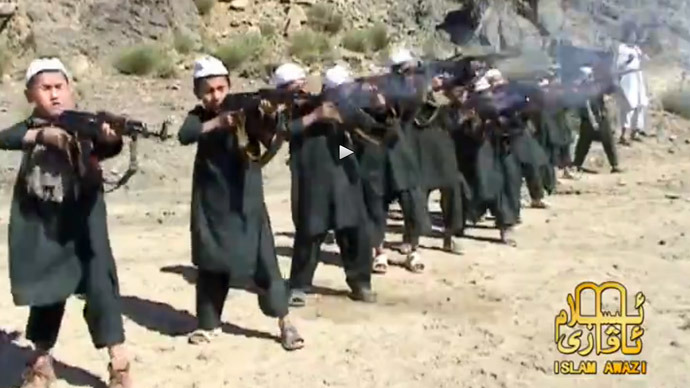
Kids firing heavy weaponry at terror-training camp in Pakistan

Kids firing heavy weaponry at terror-training camp in Pakistan

For the world’s leading state sponsor of terrorism — Pakistan — the chickens are coming home to roost with a vengeance, as the Peshawar massacre has shown. Then US Secretary of State Hillary Clinton had publicly warned Pakistan three years ago that keeping “snakes in your backyard” was dangerous as “those snakes are going to turn on” it. Pakistani generals dismissed her warning with disdain. With its Inter-Services Intelligence (ISI) agency in the vanguard, the Pakistani military has continued to blithely nurture “good” terrorists for cross-border undertakings while battling “bad” militants that fail to toe its line. Its dual-track approach has now become so deeply entrenched that Pakistan risks approaching the point of no return.

Ironically, Pakistani military officers learned how to rear and employ snakes from the US Central Intelligence Agency (CIA). CIA and ISI partnered in the 1980s Afghan jihad by creating mujahedeen — the militants out of which Al Qaeda and the Taliban evolved. “We helped to create the problem that we are now fighting”, Hillary Clinton candidly told Fox News in 2010, referring to how the US equipped mujahedeen with “Stinger missiles and everything else”.

The problem so spawned undermined the security of India more than any other country. ISI, as the conduit, siphoned off large portions of the US multibillion-dollar military aid for the mujahedeen to trigger an insurgency in India’s Punjab and then Jammu and Kashmir (J&K) in the 1980s. The US did not penalize Pakistan.

Rather, narrow geopolitical interests after 9/11 prompted America to shower Pakistan with renewed military and economic aid, with that country still a top recipient of US assistance, which has aggregated to more than $30 billion since 2001. Such generous aid — by propping up Pakistan, including with weapon transfers—has given Pakistani generals little incentive to hunt down the snakes in their backyard or stop unleashing them on India and Afghanistan. Even as American aid continues to fatten the Pakistani military, a “Pakistan fatigue” — accelerated by the new US wars in Syria and Iraq — has left little motivation in Washington to salvage a crumbling Pakistan policy.

India thus is on its own to deal with the scourge of infiltrating snakes, with Pakistan’s jihad-inspired war on it showing no sign of abating. Indeed, with Pakistan’s ceasefire violations triggering a fierce Indian response, Pakistani generals are now using terrorist proxies to attack security camps in J&K, as highlighted by the cross-border raid in Uri that left 11 troops dead. The way Pakistani authorities recently helped UN-designated terrorist Hafiz Saeed — the architect of the Mumbai attacks — to stage a large Lahore rally added insult to injury for India.

It was unrealistic to believe Pakistan would bring the Mumbai perpetrators to justice after having reared them. Manmohan Singh’s commitment to “uninterruptible dialogue” with Pakistan as part of his peace-at-any-price approach only brought serial outrages against India. Narendra Modi has done well to craft a clearer policy on Pakistan that blends a firm response to provocations (best illustrated by India’s mortar-for-bullet retort to Pakistani ceasefire violations since September) with friendly signals (for example, inviting Sharif to his inauguration and asking schools nationally to honour the victims of the Peshawar attack with a two-minute silence).

To focus on his broader regional and global agenda without being weighed down by a venomous issue, Modi has effectively sidelined Pakistan in his policy priorities. After all, no nation gets peace by merely seeking peace or staying put in talks with a recalcitrant neighbour. Securing peace demands that a nation must be able to defend peace, including by imposing deterrent costs when peace is violated.

Important countries go to extraordinary lengths to shun and squeeze scofflaw or renegade states. It has taken America 53 years to agree to establish normal diplomatic relations with tiny Cuba but without lifting its trade embargo. It took the US almost a quarter century to resume full diplomatic ties with Myanmar. And after 61 years, the chill in America’s relations with North Korea persists. New Delhi has always maintained full diplomatic relations with Islamabad, even though Pakistan is effectively a rogue or terrorist state waging a “war of a thousand cuts” against India.

Not just that, India continues to unilaterally extend Most Favoured Nation (MFN) trade benefits to Pakistan and adhere to the 1960 Indus Waters Treaty — the world’s most generous water-sharing pact that reserves over 80% of the six-river Indus system’s waters for Pakistan. With Pakistan expecting eternal Indian water munificence even as it bleeds India, the same question must haunt Pakistani generals as Lady Macbeth in William Shakespeare’s Macbeth: “Will all great Neptune’s ocean wash this blood clean from my hand?”

As long as Pakistan persists with its unconventional war, New Delhi must not reward it with talks or any new generosity. In any case, with the Pakistani military back in the driving seat without staging an overt coup, the politically castrated Nawaz Sharif is in no position to deliver on any deal with India. India, while shining an intense spotlight on officially sponsored Pakistani terrorism, should shun Pakistan until it adheres to well-established international norms.

How can Pakistan be a normal state when an abnormal situation prevails there? A moderate, stable Pakistan can emerge only if ISI is cut down to size and the military establishment brought under civilian oversight — steps still distant.

Until then, India must heed a German proverb: “Look before you leap, for snakes among sweet flowers do creep”.

Brahma Chellaney is professor of strategic studies at the Centre for Policy Research in New Delhi.

(c) Mint, 2014.