
East Asia’s Defining Moment

By BRAHMA CHELLANEY

International Herald Tribune: December 22, 2012

Portrait of Brahma Chellaney

The overlapping power transitions in East Asia’s three main economies promise to mark a defining moment in the region’s tense geopolitics. After the ascension in China of Xi Jinping, regarded by the People’s Liberation Army as its own man, Japan’s swing to the right in its parliamentary election seems set to fuel nationalist passion on both sides of the Sino-Japanese rivalry at a time when their brewing territorial spat in the East China Sea has created new risks to regional peace and stability.

South Korea’s presidential election swept another conservative to power, but one who supports conditional rapprochement with North Korea — a line at variance with the policies of departing President Lee Myung-bak and President Obama to keep Pyongyang punitively isolated. Park Geun-hye, the first woman to be elected president in a country that ranks poorly in gender equality, says she intends to tread the middle path between unconditional engagement and uncompromising chastisement.

Park Geun-hye, the 60-year-old daughter of the military general who served as South Korea’s dictator for 18 years until 1979, will assume the presidency in February — a month before Xi, the new leader of the ruling Communist Party, becomes China’s president — while Shinzo Abe, a vocal nationalist, will return as Japan’s prime minister a day after Christmas.

Abe, as prime minister in 2006 and 2007, proposed a concert of democracies in the Asia-Pacific — an idea that spawned the Quadrilateral Initiative of Australia, India, Japan and the United States. Although China’s strong response prevented the “quad” from developing into a formal institution, the four countries have been building strategic collaboration on a bilateral and — in the case of India, Japan and America — even trilateral basis.

East Asia’s political transitions threaten to exacerbate regional challenges, which include the need to institute a stable balance of power and dispense with historical baggage that weighs on interstate relationships. Booming trade has failed to moderate territorial and historical disputes, highlighting that economic interdependence by itself cannot deliver regional stability unless rival states undertake genuine efforts to mend their political relations.

The timing of the political transitions is particularly problematic for the Obama administration, which has been urging China and Japan to peacefully resolve their disputes, while keeping the Stalinist regime in North Korea under stringent sanctions and seeking to promote strategic cooperation between its two allies, South Korea and Japan.

South Korea’s decade-long “sunshine policy” of engagement with North Korea was reversed by the neoconservative Lee after he took office in 2008, triggering a series of tit-for-tat actions that brought the South-North relationship to a low by 2010.

Despite Pyongyang’s successful rocket launch last week in defiance of U.N. Security Council resolutions, Lee’s successor and colleague in the Saenuri Party, Park, has promised to allow humanitarian aid to the North and to try to meet its young leader Kim Jong-un, who is less than half her age. Kim came to power a year ago following the death of his father. Park’s more moderate approach could undercut Obama’s sanctions-centered policy just when Pyongyang has signaled open defiance of U.S. and U.N. pressure.

Washington’s diplomatic efforts notwithstanding, the new strains in South Korea’s relationship with Japan, owing to the revival of historical issues, may also not be easy to mend. Earlier this year, Lee, at the last minute, canceled the scheduled signing of a military intelligence-sharing pact with Japan, besides scrapping a bilateral plan to finalize a military-related Acquisition and Cross-Servicing Agreement. Weeks later, Lee provocatively visited the contested islets known as the Dokdo Islands in South Korea (which controls them) and the Takeshima Islands in Japan.

Park may seek to similarly pander to nationalist sentiment at home by taking a tough stance against Japan, especially to play down her father’s collaboration with the Japanese military while Korea was under Japanese colonial rule.

China, meanwhile, has launched a new campaign of attrition against Japan over the Senkaku Islands. By sending patrol ships frequently to the waters around the islands — and by violating the airspace over them — Beijing has sought to challenge Japan’s decades-old control, despite the risk that an incident could spiral out of control.

This assertiveness followed often-violent anti-Japanese protests in China in September. An informal Chinese boycott of Japanese goods has led to a sharp fall in Japan’s exports to China, raising the risk of another Japanese recession. China remains Japan’s largest overseas market. A nationalist backlash in Japan is in turn fanning nationalism in China, where the Communist Party has made ultranationalism the legitimating credo of its monopoly on power. Consequently, China and Japan find themselves in a vicious circle that is difficult to escape.

The risks to peace in East Asia posed by increasing nationalism and militarism are highlighted by the rise of a new Chinese dynasty of “princelings” — the sons of revolutionary heroes who have widespread contacts in the military. In fact, what distinguishes Xi, a former military reservist, from China’s other civilian leaders is his strong relationship with the military, whose rising clout has underpinned China’s increasingly muscular foreign policy.

Against this background, the central challenge for East Asia’s three largest economies is to resolve the historical issues that are preventing them from charting a more stable and prosperous future. As a Russian proverb warns, “Forget the past and lose an eye; dwell on the past and lose both eyes.”

Brahma Chellaney, a professor of strategic studies at the New Delhi-based Center for Policy Research, is the author, most recently, of “Asian Juggernaut.” 

(c) International Herald Tribune/New York Times, 2012.

The art of war, Chinese style

By BRAHMA CHELLANEY  Japan Times  December 14, 2012

The recent 50th anniversary of China’s invasion of India attracted much discussion, especially within India. Yet the debate shied away from drawing the broader, long-term lessons for Asian security.

The lessons are also relevant for China’s other neighbors because the 1962 war helped uncover the key elements of Beijing’s war-fighting doctrine — a doctrine it brought into play in 1969 (provoking bloody border clashes with Soviet forces), 1974 (occupying the Paracel Islands), 1979 (invading Vietnam), 1988 (seizing Johnson Reef), and 1995 (grabbing Mischief Reef). In each of those aggressions, the major 1962 elements were replicated.

As a 2010 Pentagon report citing the 1962 war, among others, put it, “The history of modern Chinese warfare provides numerous case studies in which China’s leaders have claimed military pre-emption as a strategically defensive act.” In fact, a 2010 essay in the Qiu Shi Journal — the ideological and theoretical organ of the Chinese Communist Party’s central committee — underscored the centrality of “offense as defense” in Chinese policy by declaring that “Throughout the history of new China, peace in China has never been gained by giving in, only through war. Safeguarding national interests is never achieved by mere negotiations, but by war.”

Unlike India, which still naively believes that it gained independence through nonviolence, not because a war-debilitated Britain could no longer hold on to its colonies, “new China” was born in blood after a long civil war. And it was built on blood, with Mao Zedong and other revolutionaries ever ready to employ force internally and externally. No sooner had the new China been established than it doubled its territorial size by forcibly absorbing Xinjiang and Tibet. Domestically, countless millions perished in witch-hunts, fratricidal killings and human-made disasters.

In fact, Mao attacked India after his “Great Leap Forward” created the worst famine in recorded world history, with the resulting damage to his credibility serving as a strong incentive for him to reassert his leadership through a war. The military victory over India indeed helped him to consolidate his grip on power, besides raising his international stature.

Yet, like a rape victim being scolded for inviting the attack, India was repeatedly rapped by some analysts during the anniversary debate for having brought on the Chinese aggression through “provocative” gestures and moves.

When the Chinese military marched hundreds of miles south to occupy the then-independent Tibet, bringing Han soldiers in large numbers to the Himalayan frontiers for the first time and setting the stage for China’s furtive encroachment on Indian territory, this supposedly did not constitute sufficient grounds for India to try to guard its undefended Himalayan borders. So when India belatedly deployed some units of its army, the action became, in Beijing’s words, a “forward policy” — a term lapped up by biddable analysts and still being bandied about.

The duplicity in China’s claims indeed became clear some years earlier. For example, after a 1959 Chinese border attack killed some Indian soldiers, Soviet leader Nikita Khrushchev raised that issue with Mao Zedong at their summit in Beijing on October 2 1959. “Why did you have to kill people on the border with India?” Khrushchev asked Mao after arriving straight from his historic Camp David summit with U.S. President Dwight Eisenhower. Sarcastically rejecting Beijing’s claim that India started it, he commented: “Yes, they [the Indian soldiers] began to shoot and they themselves fell dead.”

The Soviet transcript of that meeting, published by the Washington-based Cold War International History Project Bulletin, indicates that Khrushchev believed that Mao deliberately designed that border attack and new tensions with India to sabotage Moscow’s efforts to reach detente with the U.S.

India does not commemorate war anniversaries the way the United States does — with annual ceremonies honoring its fallen heroes. For example, at the exact time the Japanese began bombing Pearl Harbor 71 years earlier, commemorations were held last weekend at Pearl Harbor and memorials elsewhere, drawing thousands of Americans. India, in fact, has not built a single memorial to honor those who were martyred in 1962 or any of its other wars. China, by contrast, has a 1962 war memorial in Tibet and its Beijing military museum depicts India as the “aggressor.”

In this light, the 50th anniversary of what American scholar Roderick MacFarquhar has dubbed “Mao’s India War,” which killed 3,270 Indian troops and 725 Chinese, ought to have served as a time for reflection on its larger lessons. By baring key features of Beijing’s warfighting doctrine, the 42-day war indeed holds lasting lessons for India and other countries locked in territorial disputes with China.

Here are six of the 1962 principles China replicated in its subsequent aggressions: (1) take the adversary by surprise to maximize political and psychological shock; (2) strike only when the international and regional timing is opportune; (3) hit as fast and as hard as possible by unleashing “human wave” assaults; (4) be willing to take military gambles; (5) mask offense as defense; and (6) wage war with the political objective to “teach a lesson” — an aim publicly acknowledged by Beijing in the 1962 and 1979 attacks.

The Chinese strategy to choose an opportune moment to strike became evident before 1962 when China invaded Tibet in October 1950 while the world was preoccupied with the Korean war. China’s rapid success in seizing eastern Tibet emboldened it to intervene in Korea.

The classic case of opportunistic timing, however, was 1962: The attack coincided with the Cuban missile crisis, which threatened to trigger nuclear Armageddon and helped cut off India from potential sources of international support. But no sooner had the U.S. signaled an end to the faceoff with the Soviet Union by terminating Cuba’s quarantine than China declared a unilateral cease-fire. Such was the shrewd timing that throughout the Chinese attack, the international spotlight remained on the U.S.-Soviet showdown, not on China’s bloody invasion of India.

Similarly, China seized the Paracel Islands from South Vietnam in 1974 after the U.S. military withdrawal from there had created a strategic vacuum. It occupied the disputed Johnson Reef in the Spratlys in 1988 when Moscow’s support for Vietnam had petered out after the Soviets stopped using Cam Ranh Bay as a major forward deployment base. And in 1995, China seized Mischief Reef when the Philippines stood isolated after having forced the U.S. to close its major military bases at Subic Bay and elsewhere on the archipelago.

The 1979 attack on Vietnam occurred after Chinese leader Deng Xiaoping convinced U.S. President Jimmy Carter during his Washington visit that a “limited military action” against Vietnam was essential to contain Soviet and Vietnamese influence in Southeast Asia and to force Hanoi to withdraw its forces from Cambodia. After 29 days, China ended its Vietnam invasion and withdrew, claiming Hanoi had been sufficiently chastised.

It is apparent that new China hews to ancient theorist Sun Tzu’s advice: “All warfare is based on deception. … Attack where the enemy is unprepared; sally out when it does not expect you. These are the strategist’s keys to victory.”

Brahma Chellaney is the author of “Asian Juggernaut” (Harper, 2010) and “Water: Asia’s New Battleground” (Georgetown University Press, 2011).

(c) Japan Times, 2012.

The shock value of North Korea’s satellite launch

BRAHMA CHELLANEY

The Globe and Mail, December 13, 2012

The success of impoverished, sanctions-battered North Korea in placing a satellite in orbit is a major political boost and propaganda boon for its untested leader, Kim Jong-un, especially because rival South Korea has twice failed in similar efforts. But Wednesday’s launch, just days before Japan and South Korea elect new governments, threatens to make the already tense regional geopolitics murkier and complicate U.S. diplomatic strategy in northeast Asia.

The launch shows the rapid strides the reclusive communist country has made in rocket technology. Just last April, a similar rocket exploded 90 seconds after liftoff. But in barely eight months, North Korea fixed the technical glitches and successfully launched its Unha-3 rocket.

For a country that already has an arsenal of short- and medium-range ballistic missiles and claims to possess nuclear arms, the launch of a satellite was clearly a political project designed to earn prestige at home and abroad. Coming a year after the death of his father, it allows Kim Jong-un to consolidate power by presenting himself as a tough leader who openly defied United Nations Security Council resolutions and international pressures.

The launch’s political fallout promises to bring U.S. President Barack Obama’s North Korea policy under withering criticism at home. It could also have a bearing on Sunday’s Japanese parliamentary election and next Wednesday’s South Korean presidential election but in diametrically opposite ways – by aiding the campaign of the leftist Moon Jae-in of the opposition Democratic Unity Party in South Korea, and bolstering support for Japanese nationalist and other rightist candidates.

Mr. Moon is locked in a close contest with the ruling New Frontier Party’s candidate, Park Geun-hye, the daughter of former president Park Chung-hee, who seized power in a military coup in 1961. The rocket launch has come as a fresh reminder to voters of the failure of South Korean President Lee Myung-bak’s policy to squeeze North Korea.

After the neo-conservative Mr. Lee took office in February of 2008, he reversed his country’s decade-long “sunshine policy” toward North Korea, choosing to cut off bilateral aid and step up pressure on Pyongyang. That, in turn, prompted the North to scale back inter-Korean contact, carry out provocative actions that included missile tests, and ratchet up bellicose rhetoric. Relations between the two Koreas dropped to a low in 2010 after the death of 46 South Korean sailors in the sinking of a warship – blamed on a North Korean torpedo attack – and the North’s shelling of the South’s Yeonpyeong Island.

In Japan, the North Korean launch only reinforces the likelihood of a new right-wing government after more than three years of rule by the left-leaning Democratic Party of Japan. Shinzo Abe, the probable next prime minister, and his Liberal Democratic Party have vowed to take a tougher line on North Korea. They have also called for revising the war-renouncing Article 9 of Japan’s U.S.-imposed Constitution.

The North Korean rocket’s military significance is small compared with the expected political fallout. Theoretically, the Unha-3 gives Pyongyang an intercontinental ballistic missile capability. But, in practice, it will take the North Koreans years to try to translate that latent capability into a reality, chiefly for two reasons.

First, a launch vehicle is merely fired into outer space, while any long-range ballistic missile is designed to re-enter the Earth’s atmosphere from outer space – a task that demands a sophisticated re-entry vehicle that can withstand the heat and stress. And second, the Unha-3 carried a tiny satellite weighing less than 100 kilograms, while compact nuclear warheads on ICBMs weigh, on average, more than 10 times that.

There’s little room for the international community to slap additional sanctions on Pyongyang: North Korea is already one of the world’s most heavily sanctioned countries, with China its only economic partner. Even Western food aid has been used as leverage against North Korea, despite the larger risks of turning food into a political weapon.

If anything, the rocket launch reflects a failure of international efforts to rein in North Korea through United Nations-sponsored sanctions. These sanctions, far from disciplining Pyongyang, have acted as a spur to its missile launches, nuclear tests and covert weapons trades with other problem states such as Pakistan and Iran.

Nuclear, missile and space programs symbolize strategic autonomy and heft, and it’s not an accident that today’s main proliferation threats emanate from countries that have come under increasing international pressure – North Korea, Iran and Pakistan. This is a reminder that pressure and sanctions alone will not deliver results.

Engagement is usually necessary to influence developments within any problem state. Mr. Obama’s reversal of America’s long-standing sanctions policy on Myanmar has set in motion positive developments and helped dispel proliferation-related concerns about that country’s ties with North Korea. It’s now time for Mr. Obama to review his sanctions-only approach toward North Korea if that country is to be dissuaded from committing more acts of defiance.

Brahma Chellaney, professor of strategic studies at the Center for Policy Research in New Delhi, is the author of Asian Juggernaut and Water: Asia’s New Battleground.

 (c) The Globe and Mail, 2012.

America’s Unhinged “Pivot”

A Project Syndicate column internationally distributed

President Barack Obama’s first foreign trip since winning a second term highlights Asia’s new centrality to America’s economy and security. But Obama’s Asian tour also underscores the main question about American policy in the region: Will the United States’ “pivot” to Asia acquire concrete strategic content, or will it remain largely a rhetorical repackaging of old policies?

The United States, quick to capitalize on regional concerns triggered by China’s increasingly muscular self-assertion, has strengthened its military ties with existing Asian allies and forged security relationships with new friends. But the heady glow of America’s return to center-stage in Asia has obscured key challenges in remaining the region’s principal security anchor in the face of China’s strategic ambitions.

One challenge is the need to arrest the erosion of America’s relative power, which in turn requires comprehensive domestic renewal, including fiscal consolidation. But the need for spending cuts also raises the prospect that the US might be unable to finance a military shift toward the Asia-Pacific region — or, worse, that it be forced to retrench there.

The US under Obama has increasingly ceded ground to China, a trend that admittedly began when the Bush administration became preoccupied with the wars in Afghanistan and Iraq. This has spurred doubts about America’s ability to provide strategic heft to its “pivot” by sustaining a higher level of commitment in the Asia-Pacific region, where it already maintains 320,000 troops. The proposed deployment of an additional 2,500 Marines in Australia is largely symbolic.

In fact, after raising Asians’ expectations of a more robust US response to China’s growing assertiveness, the Obama administration has started to tamp down the military aspects of its “pivot,” emphasizing instead greater US economic engagement with Asian countries. That change has come as a relief to those in the region who fear being forced to choose between the US and China. But, for the countries bearing the brunt of China’s recalcitrant approach to territorial and maritime disputes, this emphasis raises new doubts about America’s commitment.

In fact, the economic reorientation of the US “pivot” corrects a policy that had overemphasized the military component and put the US on a path toward conflict with China. It was Secretary of State Hillary Clinton who signaled a more hawkish US stance on China with her tough talk at the 2010 Association of Southeast Asian Nations (ASEAN) Regional Forum in Hanoi; now she is moderating that position by promoting trade and investment during her visits to Asian countries.

Obama, too, is highlighting the economic aspects of the U.S. “pivot,” portraying his Asia tour as an effort to generate more domestic manufacturing jobs through higher exports to “the most rapidly growing and dynamic region in the world.” But his historic visit to Myanmar — the first ever by a U.S. president — is as much about trade as it is about weaning a strategically located, resource-rich country from Chinese influence. Paradoxically, it was the U.S. sanctions policy that penalized Myanmar but condoned China for crushing prodemocracy protests in 1988 and 1989, respectively, that helped push the former into the latter’s strategic lap.

The refocus on trade and economic issues has also prompted Washington to promote the Trans-Pacific Partnership, which aims to create a new Asia-Pacific free-trade group that excludes China. Moreover, the U.S. is emphasizing the importance of the East Asia Summit and ASEAN, whose summit overlaps with the EAS meeting in Phnom Penh that Obama will be attending.

The U.S. course correction is being dictated by another consideration as well: America has nothing to gain from taking sides in China’s disputes with its neighbors – unless, of course, U.S. interests are directly at stake, as in the South China Sea, where Chinese maritime claims pose a threat to freedom of navigation.

Regard for its own national interest explains why America has charted a course of tacit neutrality on the revival of Sino-Indian territorial disputes, including China’s sudden resurrection of a claim to the large Himalayan Indian state of Arunachal Pradesh. Similarly, the U.S. has urged both China and Japan to resolve peacefully their dispute over the Japanese-controlled Senkaku Islands. America’s main goal is to prevent the Sino-Japanese standoff from escalating to the point that it would be forced — against its own interests — to take Japan’s side.

When U.S. Defense Secretary Leon Panetta met Chinese leader Xi Jinping in China in September, he got “an earful” that the U.S. should stay out of the Sino-Japanese dispute. Indeed, amid the orchestrated anti-Japanese protests in China in September, Panetta — instead of advising China to rein in the often-violent demonstrations — publicly reiterated America’s neutrality in the struggle over control of the islands.

The correction in U.S. policy actually extends even to terminology. American diplomats have now abandoned the term “pivot” altogether, owing to its military connotation, in favor of “rebalancing.”

Whatever one calls it, the new policy approach is all about China, with America bolstering alliances and friendships with countries around China’s periphery, including India, Japan, the Philippines, Vietnam, Indonesia, and South Korea. Yet the Obama administration continues to deny that China is at the center of its strategy. In fact, it is reluctant to say or do anything publicly that might raise China’s hackles.

The Asia-Pacific region will loom larger in Obama’s second-term agenda, especially as the ongoing U.S. troop withdrawal ends the Afghanistan war by 2014. But Obama will have to define a clearer U.S. policy, addressing address China’s rapid rise under an authoritarian regime that aggressively pursues border claims and whips up nationalism at home. The U.S. and the rest of Asia must not merely adjust to China; they must seek to shape a China that plays by the rules.

Brahma Chellaney, Professor of Strategic Studies at the New Delhi-based Center for Policy Research, is the author of Asian Juggernaut and Water: Asia’s New Battleground.

(c) Project Syndicate, 2012.

How China wages war: Six key principles of its warfighting doctrine

China gave India a “lesson” in 1962. Study it now.

Brahma ChellaneyNewsweek, November 5, 2012, OPINION: pages 12-13

THE REST of the world may have forgotten the anniversary, but a neglected border war that took place 50 years ago is now more pertinent than ever. Before dawn on the morning of October 20, 1962, the People’s Liberation Army launched a surprise attack, driving with overwhelming force through the eastern and western sections of the Himalayas, deep into northeastern India. On the 32nd day of fighting, Beijing announced a unilateral ceasefire, and the war ended as abruptly as it had begun. Ten days later, the Chinese began withdrawing from the areas they had penetrated on India’s eastern flank, between Bhutan and Burma, but they kept their territorial gains in the West—part of the original princely state of Jammu and Kashmir. India had suffered a humiliating rout, and China’s international stature had grown substantially.

Today, half a century after the Sino-Indian War, the geopolitical rivalry between the world’s two main demographic titans is again sharpening, as new disputes deepen old rifts. Booming bilateral trade has failed to subdue their rivalry and military tensions, and China has largely frittered away the political gains of its long-ago victory. But the war’s continuing significance extends far beyond China and India. By baring key elements of Beijing’s strategic doctrine, it offers important lessons, not only to China’s neighbors but also to the U.S. military. Here are just six of the principles the People’s Republic of China relied on in attacking India—and will undoubtedly use again in the future.

SURPRISE China places immense value on blindsiding its adversaries. The idea is to inflict political and psychological shock on the enemy while scoring early battlefield victories. This emphasis on tactical surprise dates back more than 2,000 years, to the classic Chinese strategist Sun Tzu, who argued that all warfare is “based on deception” and offered this advice on how to take on an opponent: “Attack where he is unprepared; sally out when he does not expect you. These are the strategist’s keys to victory.” The Chinese started and ended the 1962 war when India least expected it. They did much the same thing when they invaded Vietnam in 1979.

CONCENTRATE China’s generals believe in hitting as fast and as hard as possible, a style of warfare they demonstrated in their 1962 blitzkrieg against India. The aim is to wage “battles with swift outcome” (su jue zhan). This laser focus has been a hallmark of every military action Communist China has undertaken since 1949.

STRIKE FIRST Beijing doesn’t balk at using military force for political ends. On the contrary, China has repeatedly set out to “teach a lesson” to adversaries so they will dare not challenge Beijing’s interests in the future. Chinese Premier Zhou Enlai explained that the 1962 war was meant to “teach India a lesson.” Paramount leader Deng Xiaoping used the same formulation in 1979 when he became the first Chinese Communist leader to visit Washington and told America’s then-president Jimmy Carter that “Vietnam must be taught a lesson, like India.” China invaded its Southeast Asian neighbor just days later. (India’s foreign minister happened to be in China at the time of the invasion, seeking to revive the bilateral relationship that had been frozen since 1962.) China ended its Vietnam invasion and withdrew from Vietnam after 29 days, declaring that Hanoi had been sufficiently chastised.

WAIT FOR IT Choose the most opportune moment. The 1962 war was a classic case: the attack coincided with the Cuban missile crisis, which brought the world to the brink of nuclear Armageddon and thereby distracted potential sources of international support for India. No sooner had the U.S. signaled an end to the face-off with Moscow than China declared a unilateral ceasefire in its invasion of India. During the war, the international spotlight remained on the U.S.-Soviet showdown, not on China’s bloody invasion of a country that then had good relations with both the U.S. and the Soviet Union.

The pattern has persisted. After America pulled out of South Vietnam, China seized the Paracel Islands. In 1988, when Moscow’s support for Vietnam had faded and Afghanistan had killed the Soviets’ enthusiasm for foreign adventures, China occupied the disputed Johnson Reef in the Spratlys. And in 1995, when the Philippines stood isolated after having forced the U.S. to close its major military bases at Subic Bay and elsewhere on the archipelago, China seized Mischief Reef.

RATIONALIZE Beijing likes to camouflage offense as defense. “The history of modern Chinese warfare provides numerous case studies in which China’s leaders have claimed military preemption as a strategically defensive act,” the Pentagon said in a 2010 report to Congress. The report cited a long list of examples, including the 1962 war, 1969 (when China provoked border clashes with the Soviet Union), the 1979 invasion of Vietnam, and even 1950, when China intervened in the Korean War. Beijing called its 1962 invasion a “defensive counterattack,” a term it subsequently used for the invasion of Vietnam and the seizure of the Paracel Islands, Johnson Reef, and Mischief Reef.

DARE Risk-taking has long been an integral feature of Chinese strategy. Willingness to take military gambles was evident not only under Mao Zedong’s zigzag helmsmanship but even when the rigorously pragmatic Deng invaded Vietnam, disregarding the possibility of Soviet intervention. And the risk-taking paid off each time. The past success may give Beijing confidence to take even more chances in the future, especially now that China has second-strike nuclear capability and unprecedented economic and conventional military strength.

The 1962 war took place at a time when the People’s Republic was poor, internally troubled, and without nuclear weapons. But it showed the world how China’s generals think. And it helps explain why Beijing’s rapidly growing military power is raising serious concern.■

Brahma Chellaney is the author of Asian Juggernaut (Harper, 2010) and Water: Asia’s New Battlefield (Georgetown University Press, 2011), which won the 2012 Bernard Schwartz Award.

(c) Newsweek, 2012.

The Lessons of the China-India War

Column internationally distributed by Project Syndicate.

This month marks the 50th anniversary of China’s military attack on India, the only foreign war that communist-ruled China has won. Yet that war failed to resolve the disputes between the world’s two most populous countries, and its legacy continues to weigh down the bilateral relationship. While their economic heft is drawing increasing international attention, their underlying strategic rivalry over issues ranging from land and water to geopolitical influence in other regions usually attracts less notice.

The international importance of the China-India relationship reflects the fact that together they account for 37% of humanity. Although they represent markedly different cultures and competing models of development, they share a historical similarity that helps shape both countries’ diplomacy: each freed itself from colonial powers around the same time.

Throughout their histories, the Indian and Chinese civilizations were separated by the vast Tibetan plateau, limiting their interaction to sporadic cultural and religious contacts; political relations were absent. It was only after China’s annexation of Tibet in 1950-1951 that Han Chinese troops appeared for the first time on India’s Himalayan frontiers.

Just over a decade later, China surprised India’s ill-prepared army by launching a multi-pronged attack across the Himalayas on October 20, 1962. Chinese Premier Zhou Enlai publicly said that the war was intended “to teach India a lesson.”

Taking an enemy by surprise confers a significant tactical advantage in war, and the invasion inflicted an immense psychological and political shock on India that greatly magnified the initial military advances that China achieved. China’s blitzkrieg created a defeatist mindset in India, forcing its army to retreat to defensive positions. India, fearing unknown consequences, even shied away from employing its air power, although the Chinese military lacked effective air cover for its advancing forces.

After more than a month of fighting, China declared a unilateral ceasefire from a position of strength, having seized Indian territory. The Chinese simultaneously announced that they would begin withdrawing their forces on December 1, 1962, vacating their territorial gains in the eastern sector (where the borders of India, Myanmar, Tibet, and Bhutan converge) but retaining the areas seized in the western sector (in the original princely state of Jammu and Kashmir). These withdrawal parameters meshed with China’s pre-war aims.

Just as Mao Zedong started his invasion of Tibet while the world was preoccupied with the Korean War, so he chose a perfect time to invade India, as recommended by the ancient strategist Sun Tzu. The attack coincided with a major international crisis that brought the United States and the Soviet Union within a whisker of nuclear war over the stealthy deployment of Soviet missiles in Cuba. China’s unilateral ceasefire coincided with America’s formal termination of its naval blockade of Cuba, marking the end of the missile crisis.

Mao’s shrewd timing ensured India’s isolation from sources of international support. Throughout the invasion, the international spotlight was on the potential US-Soviet nuclear showdown, not on the bloody war raging in the Himalayan foothills.

India’s humiliating rout hastened the death of its prime minister, Jawaharlal Nehru; but it also set in motion the country’s military modernization and political rise.

Fifty years later, tensions between India and China are rising again amid an intense geopolitical rivalry. Their entire 4,057-kilometer border — one of the longest in the world — remains in dispute, without a clearly defined line of control in the Himalayas.

This situation has persisted despite regular Chinese-Indian talks since 1981. In fact, these talks constitute the longest and most futile negotiating process between any two countries in modern history. During a 2010 visit to New Delhi, Chinese Premier Wen Jiabao stated bluntly that sorting out the border disputes “will take a fairly long period of time.” If so, what does China (or India) gain by continuing the negotiations?

As old wounds fester, new issues have begun roiling bilateral relations. For example, since 2006 China has initiated a new territorial dispute by claiming the eastern sector (the Austria-size Arunachal Pradesh state), from which its forces withdrew in 1962, describing it as “Southern Tibet.”

A perceptible hardening of China’s stance toward India since then is also reflected in other developments, including Chinese strategic projects and the country’s military presence in the Pakistani-held portion of Kashmir, a region where the disputed borders of India, China, and Pakistan converge.

Indian defense officials have reported increased military incursions by Chinese troops in recent years. In response, India has been beefing up its military deployments along the border to prevent any Chinese land grab. It has also launched a crash program to improve its logistical capabilities by constructing new roads, airstrips, and advanced landing stations along the Himalayas.

The larger strategic rivalry between the world’s largest autocracy and its biggest democracy has also sharpened, despite their fast-rising trade. In the past decade, bilateral trade has risen more than 20-fold, to $73.9 billion, making it the only area in which bilateral relations have thrived.

Far from helping to turn the page on old disputes, this commerce has been accompanied by greater Sino-Indian geopolitical rivalry and military tension. Booming bilateral trade is no guarantee of moderation between countries.

Although China set out to teach India a “lesson,” the 1962 war failed to achieve any lasting political objectives and only embittered bilateral relations. The same lesson is applicable to the Sino-Vietnamese context: In 1979, China replicated the 1962 model by launching a surprise blitzkrieg against Vietnam that Chinese leader Deng Xiaoping admitted was designed to “teach a lesson.” After 29 days, China ended its invasion, claiming that Vietnam had been sufficiently chastised.  But the lesson that Deng seems to have drawn from the PLA’s poor performance against Vietnam is that China, like India, needed to modernize every aspect of its society.

Brahma Chellaney, Professor of Strategic Studies at the New Delhi-based Center for Policy Research, is the author of Asian Juggernaut and Water: Asia’s New Battleground.

(c) Project Syndicate, 2012.

China’s Made-in-America Success Story

Column internationally distributed by Project Syndicate. September 2012

America’s strategy in Asia for more than a century has sought a stable balance of power to prevent the rise of any hegemon. Yet the United States, according to its official National Security Strategy, is also committed to accommodating “the emergence of a China that is peaceful and prosperous and that cooperates with us to address common challenges and mutual interests.” So America’s Asia policy has in some ways been at war with itself.

In fact, the US has played a key role in China’s rise. For example, rather than sustain trade sanctions against China after the Tiananmen Square massacre in 1989, the US decided instead to integrate the country into global institutions. But US foreign policy had been notable for a China-friendly approach long before that.

In 1905, President Theodore Roosevelt, who hosted the peace conference in Portsmouth, New Hampshire, after the Russo-Japanese War, argued for the return of Manchuria to Manchu-ruled China and for a balance of power in East Asia. The war ended up making the US an active participant in China’s affairs.

After the Communists seized power in China in 1949, the US openly viewed Chinese Communism as benign, and thus distinct from Soviet Communism. And it was after the Communists crushed the pro-democracy movement in 1989 that the US helped to turn China into an export juggernaut that has accumulated massive trade surpluses and become the principal source of capital flows to the US.

America’s policy toward Communist China has traversed three stages. In the first phase, America courted Mao Zedong’s regime, despite its 1950-1951 annexation of Tibet and domestic witch hunts, such as the Hundred Flowers Campaign, the brief liberalization that many Western observers believe was a ploy designed to flush out opponents. Courtship gave way to estrangement during the second phase, as US policy for much of the 1960’s sought to isolate China.

The third phase began immediately after the 1969 Sino-Soviet military clashes, with the US actively seeking to exploit the rift in the Communist world by aligning China with its anti-Soviet strategy. Although China clearly instigated the bloody border clashes, America sided with Mao’s regime. That helped to lay the groundwork for the China “opening” of 1970-1971, engineered by US National Security Adviser Henry Kissinger, who until then had no knowledge of the country.

Since then, the US has pursued a conscious policy of aiding China’s rise. Indeed, President Jimmy Carter sent a memo to various US government departments instructing them to help in China’s rise — an approach that remains in effect today, even as America seeks to hedge against the risk that Chinese power gives rise to arrogance. Indeed, even China’s firing of missiles into the Taiwan Strait in 1996 did not change US policy. If anything, the US has been gradually loosening its close links with Taiwan, with no US cabinet member visiting the island since those missile maneuvers.

Seen in this light, China’s spectacular economic success — including the world’s largest trade surplus and foreign-currency reserves — owes much to US policy from the 1970’s on. Without the significant expansion in US-Chinese trade and financial relations, China’s growth would have been much slower and more difficult to sustain.

Allies of convenience during the second half of the Cold War, the US and China emerged from it as partners tied by interdependence. America depends on China’s trade surplus and savings to finance its outsize budget deficits, while China relies on its huge exports to the US to sustain its economic growth and finance its military modernization. By plowing more than two-thirds of its mammoth foreign-currency reserves into US dollar-denominated assets, China has gained significant political leverage.

China is thus very different from previous US adversaries. America’s interests are now so closely intertwined with China that a policy to isolate or confront it is not feasible. Even on the issue of democracy, the US prefers to lecture other dictatorships rather than the world’s largest autocracy.

Yet it is also true that the US is uneasy about China’s not-too-hidden aim to dominate Asia — an objective that runs counter to US security and commercial interests and to the larger goal of securing a balance in power in Asia. To avert Chinese dominance, the US has already started to build countervailing influences and partnerships, without making any attempt to contain China.

For the US, China’s growing power actually helps to validate its forward military deployments in Asia, maintain existing allies in the region, and win new strategic partners. Indeed, an increasingly assertive China has proven a diplomatic boon for the US in strengthening and expanding its Asian security relationships.

The lesson is clear: The muscle-flexing rise of a world power can strengthen the strategic relevance and role of a power in relative decline. Barely a decade ago, the US was beginning to feel marginalized in Asia, owing to several developments, including China’s “charm offensive.” But now America has returned firmly to center stage. South Korea has beefed up its military alliance with the US; Japan has backed away from an effort to persuade the US to move its Marine base out of Okinawa; Singapore has allowed the US Navy to station ships; Australia is hosting US Marine and other deployments; and India, Vietnam, Indonesia, and the Philippines, among others, have drawn closer to the US as well.

But no one should have any illusions about US policy. Despite America’s “pivot” to Asia, it intends to stick to its two-pronged approach: seek to maintain a balance of power with the help of strategic allies and partners, while continuing to accommodate a rising China.

Brahma Chellaney, Professor of Strategic Studies at the New Delhi-based Center for Policy Research, is the author of Asian Juggernaut and Water: Asia’s New Battleground.

(c) Project Syndicate, 2012.

Reprinting material without written consent from Project Syndicate is a violation of international copyright law. To secure permission, please contact us.

New Political Geography with Old Power Geometry

Power shifts but international institutional reforms stall

The international institutional structure has remained largely static since the mid-20th century rather than evolving with the changing power realities and challenges. Reforming and restructuring the international system poses the single biggest challenge to preserving global peace, stability and continued economic growth. A 21st-century world cannot remain indefinitely saddled with 20th-century institutions and rules.

Power shifts are an ongoing phenomenon in history. The global power structure continually evolves. Although the focus currently is on the post-Cold War power changes, the Cold War era itself witnessed important shifts.

For example, it was only after the Cold War began that the Soviet Union rose as a global military power, although it failed to become a true economic power. By the second half of the Cold War, Japan and Germany emerged from the ruins of World War II as formidable economic giants. And in keeping with the profound technological and geopolitical changes since the late 1980s, power shifts have become even more pronounced, as underscored by the gradual rise of the East since the 1990s.

The United States emerged as the sole superpower due to a quirk of history — the sudden, unexpected collapse of the Soviet Union. Indeed, when viewed against history, the existence of a single superpower is highly unusual. Even at its pinnacle, the British Empire did not parallel the American Empire in global ascendancy.

Britain was not the hegemon in Europe, so it could not be the global hegemon. In fact, Britain’s failure to gain preeminence in Europe, where it faced Russia, Germany and France, motivated it to concentrate on distant lands. That is how Pax Britannica was established.

The fact is that there has never been a global hegemon on the lines of America. The normal pattern in history is one of uneasy coexistence among several great powers. So, the emergence of a single superpower post-1991 was an anomalous development.

If the international institutional structure is to be recast, the U.S. must begin to adjust to the ongoing shift in its own status from being a global hegemon to turning into less than a global hegemon, yet remaining the world’s leading power. The world is gradually moving toward the normal condition in history — coexistence among quite a few great powers.

A liberal, rules-based international order for the 21st century can be developed if sincere efforts begin toward that goal. That task demands making the international institutional structure more relevant to the newly emerging challenges and power realities.

In essence, this will be possible if the U.S. is willing to take the lead to reform the international institutions before events overwhelm the present system. The choice is to either restructure the international order while international peace prevails or allow developments to take us back to the pattern of past history — namely, decisive change has come only after a major bloody war involving great powers, with the victors of that war shaping the new international system. That is what happened in 1945, 1919, 1815, and 1713. The choice today is to either break free from that historical pattern or remain a prisoner of history.

The world presently is in transition, although we still do not know what the new order would look like. Until recent years, a handful of powers made all the international decisions on global trade, economy, peace, and security. But the emergence of new players in the geopolitical marketplace is fundamentally changing the global power dynamics. With the “new kids on the block” extending their influence beyond their immediate region, the list of players shaping international relations is growing.

The new powers legitimately seek greater participation in international institutions and their decision-making. The power shifts and new global challenges actually symbolize the birth-pangs of a new world order, making far-reaching institutional reforms inescapable.

Changes indeed are already beginning to occur, but rather modestly. For example, the G-20, composed of both wealthy and emerging economies, has replaced the G-8 as the main forum for discussions concerning the global economy. The G-20’s formation, however, was an improvisation designed to defer genuine reforms in the Bretton Woods system. The slow pace of quota and governance reforms in the International Monetary Fund and the reluctance to restructure the World Bank to create a more dynamic institution that breaks free from its donor-recipient straitjacket only highlight the need for a reformed international financial architecture.

Meanwhile, the risks to global economic growth have grown due to several factors, including the large, capricious cross-border capital flows, the Eurozone crisis, and the excessive volatility in commodity prices.

More broadly, the challenge is to accommodate not only the new powers that have been emerging since the Cold War’s end but also the new powers that emerged before the Cold War ended. Indeed, the powers that emerged before the Cold War’s end do not pose any of the special challenges that China does, in the sense that they are liberal democracies promoting rules-based international governance and eschewing muscle-flexing.

Geoeconomics is not dictating geopolitics, as some pundits had romantically visualized when the Cold War came to an end. In fact, politics today drives economics, with political risk dominating the financial markets. But not to accommodate the powers that emerged by the 1980s would only signal that a country counts as a power only when it begins to flex its muscles.

Take Germany, the only booming economy in the eurozone today. Should it not be accommodated as a rule-maker, rather than remaining a rule-taker?

China’s dramatic rise parallels Japan’s phenomenal rise as a major power during the Meiji Era (1867-1912). The difference is that Japan, after having re-emerged as an economic powerhouse from the ashes of World War II, has run into economic stagnation since the 1990s. However, one of the least-noticed developments in Asia in this century has been Japan’s political resurgence. With its pride and assertiveness rising, the nationalist impulse has become conspicuous. Tokyo is intent on influencing Asia’s power balance.

China is beginning to exercise influence far beyond its shores. The larger discussion on accommodating China in the international system, however, misses one key fact: China is already heavily accommodated in the present international order, to an extent that no new power of the past half a century has been. Yet, this cosseted insider has turned into a key obstacle to accommodating other new powers.

China’s accommodation occurred not because of its rising power. China was still backward, poor and internally torn when it was made an integral member of the “hard core” of global geopolitics — the system that deals with international peace and security issues: the United Nations Security Council. In that sense, China is the luckiest of all the new powers.

In fact, Indian Prime Minister Jawaharlal Nehru rejected a U.S. suggestion in the 1950s that India take China’s place in the Security Council. The officially blessed selected works of Nehru quote him as stating on record: “Informally, suggestions have been made by the U.S. that China should be taken into the U.N. but not in the Security Council and that India should take her place in the Council. We cannot, of course, accept this as it means falling out with China and it would be very unfair for a great country like China not to be in the Council.” The selected works also cite Nehru as telling Soviet Premier Marshal Nikolai Bulganin in 1955 why India wasn’t interested in joining the Security Council in place of China: “I feel we should first concentrate on getting China admitted.”

It is thus no accident that China today is a status quo power with regard to the United Nations system, seeking to remain Asia’s sole permanent member in the Security Council and opposing its enlargement, but is a revisionist power on the global financial architecture, seeking an overhaul of the Bretton Woods system.

Today, the world is at a defining moment in its history. Some of the challenges it confronts are unique, ranging from accelerated global warming to cybercrime and the spreading international reach of terrorism.

Healthy, effective international institutions have become critical to building genuine cooperation and power stability. The most pressing challenges are global in nature and demand effective international intervention. Yet the “democratic deficit” of existing international institutions and their inadequacy to play a forward-looking approach has become glaring. This must be addressed for the sake of international security and stability.

Brahma Chellaney is a fellow at the Nobel Institute in Oslo and the author of “Asian Juggernaut” (HarperCollins) and “Water: Asia’s New Battleground” (Georgetown University Press).

China’s Political Storm

Project Syndicate column internationally distributed.

As senior leaders are purged and retired provincial officials publicly call for Politburo members to be removed, it has become clear that China is at a crossroads. China’s future no longer looks to be determined by its hugely successful economy, which has turned the country into a world power in a single generation. Instead, the country’s murky and increasingly fractured politics are now driving its fate.

One need look no further than the ongoing power struggle in the run-up to this autumn’s planned leadership changes, or official figures showing that rural protests have been increasing at the same rate as China’s GDP. The sudden downfall of Bo Xilai — and the call from Yunnan Province for the removal of the two Politburo members closest to him — is just one example of the no-holds-barred infighting now taking place in Zhongnanhai, the closed leadership compound in Beijing. Indeed, the internecine squabbles are said to be so vicious that there have been rumors, denied by the regime, that the Communist Party’s congress at which a new president and prime minister are to be anointed this autumn, might be postponed.

The Party’s abrupt vilification of Bo after lauding him for his leadership in Chongqing has fueled public cynicism over his orchestrated downfall and laid bare the leadership’s thin ideological core. If China is to preserve its gains in global stature, it must avoid a political hard landing. For the time being, at least five different scenarios are conceivable.

Re-equilibration: The Party protects its legitimacy, keeps the military subordinate, and manages to put a lid on popular dissent. In other words, the status quo prevails for the foreseeable future. This is the least likely scenario, owing to deepening internal Party disagreements and rising popular discontent.

Implosion: This likelihood of political disintegration, economic collapse, and social disorder may be no higher than that of re-equilibration. The government’s fixation on weiwen, or stability maintenance, has resulted in China becoming the world’s only important country whose official internal-security budget is larger than its official national-defense budget.

This underscores the extent to which authorities have to carry out internal repression to perpetuate one-party rule and maintain control over the restive ethnic-minority homelands that make up more than 60% of China’s landmass. But it may also explain why one self-immolation in Tunisia helped to kindle the Arab Spring, whereas some three dozen self-immolations by Tibetan monks and nuns have failed to ignite a similar popular movement against the Chinese state.

The Soviet Union imploded because the party was the state, and vice versa. China, by contrast, has established strong institutional capacity, a multi-tiered federal structure, a tradition of civilian leadership turnover every ten years, and a well-oiled, sophisticated security apparatus that has kept pace with technological advances. Thus, China’s government can pursue a policy of wai song nei jin — relaxed on the outside, vigilant internally.

Guided reform: A process of gradual political change begins, in keeping with outgoing Premier Wen Jiabao’s warning that without “urgent” reforms, China risks turmoil and disruption of economic growth. Can China emulate the recent example of neighboring Myanmar (Burma), which has initiated significant, if still tenuous, political reforms?

As the political heirs of the country’s Communist revolutionaries, the third-generation leaders that are taking over the reins of power in China may possess a strong pedigree, but they are also scarred and limited by it. These so-called princelings are trapped in the same political culture that led to the death of millions of Chinese and the continuing repression of opponents (real or imagined). They do not look like political reformers in the slightest.

Great leap backward: A new “Cultural Revolution” erupts, as the clique in power ruthlessly seeks to suppress dissent within and outside the establishment. As the Dalai Lama recently warned, there are still plenty of “worshippers of the gun” in power in China. Indeed, such is China’s political system that only the strongest advance. One fallen princeling, Bo, has been accused of cruelty and corruption — traits that are endemic in China’s cloistered but fragmented oligarchy, which values family lineage and relies on networks of allies.

Praetorian takeover: The People’s Liberation Army rules from behind a civilian mask, increasingly calling the shots with government officials, who are beholden to it. While the civilian leadership has become diffuse (every Chinese leader since Mao Zedong has been weaker than his predecessor), the military has enjoyed greater autonomy and soaring budgets since 1990. Indeed, the Party, having ceased to be a rigid monolith obedient to a single leader, has become dependent on the military for its political legitimacy and to ensure domestic order.

The PLA’s growing political clout has been manifest in the sharpening power struggle within the Party. In recent weeks, an unusual number of senior military officers have published articles in official newspapers calling for Party discipline and unity, and alluding to the military’s role in containing the infighting.

Another development is the increasing tendency of military generals to speak out of turn on strategic issues and undercut diplomatic strategy. The simple truth is that the foreign ministry is the Chinese government’s weakest branch, often overruled or simply ignored by the security establishment, which is ever ready to upstage even the Party.

China’s internal politics has a bearing on its external policy. The weaker the civilian leadership has become, the more China has been inclined to discard Deng Xiaoping’s dictum tao guang yang hui (hide brightness, nourish obscurity). China has lately taken more to the spotlight than to the shadows. Under any plausible scenario, a restrained and stable Chinese foreign policy may become more difficult.

Brahma Chellaney, Professor of Strategic Studies at the New Delhi-based Center for Policy Research, is the author of Asian Juggernaut and Water: Asia’s New Battleground.

(c) Project Syndicate, 2012.

A Dam-Building Race in Asia: How to Contain the Geopolitical Risks

Brahma Chellaney

A paper published by The Transatlantic Academy, Washington, DC, May 2012

Introduction 

Asia’s phenomenal economic rise has attracted a lot of attention in international policy circles but the sharpening water competition this growth has triggered is less well known. Water has emerged as a source of increasing competition and underlying discord between many Asian nations, spurring new tensions over the resources of transnational rivers. Asia’s fastest-growing economies are all at or near water-stressed conditions, underscoring how water shortages threaten to hamper the continent’s continued rapid economic growth. For investors, the Asian water crisis carries risks that are at least as potentially damaging as nonperforming loans, real estate bubbles, and political corruption.
Dam building on transnational rivers is at the heart of the inter-riparian tensions in Asia. Asia is already the world’s most dam-dotted continent: It has more dams than the rest of the world combined. Yet the numerous new dam projects in Asia show that the damming of rivers is still an important priority for policymakers. In the West, dam building has largely petered out. In Asia, however, the construction of new dams continues in full swing.

Like arms racing, “dam racing” has emerged as a geopolitical concern in Asia, where the world’s fastest economic growth is being accompanied by the world’s fastest increase in military spending and the world’s fiercest competition for natural resources, especially water and energy. As riparian neighbors compete to appropriate resources of shared rivers by building dams, reservoirs, barrages, irrigation networks, and other structures, the relationships between upstream and downstream states are often characterized by mutual distrust and discord.

This paper warns that just as the scramble for energy resources has defined Asian geopolitics since the 1990s, the struggle for water is now likely to define many inter-country relationships. At a time when many territorial disputes and separatist struggles in Asia are being driven by resource issues — extending from the energy-rich South and East China Seas to the water-rich Tibet and Kashmir — water indeed is becoming the new oil. But unlike oil — dependence on which can be reduced by either tapping other sources of energy or switching to other means of generating electricity — there is no substitute for water. Asian economies are the world’s leading importers of resources like mineral ores, hydrocarbons, and timber, importing them from distant lands. But they have no such import choice on water.

The paper, drawing on the author’s book on Asian water challenges published last fall by the Georgetown University Press, examines how the rising geopolitical risks arising from the dam-building competition can be stemmed. It does so by examining the broader water tensions and competition, which center on four distinct zones: China and its neighbors; South Asia; Southeast Asia; and Central Asia, where the Soviet Union’s disintegration left a still-festering water discord among the five so-called “stans” — Kazakhstan, Uzbekistan, Kyrgyzstan, Tajikistan, and Turkmenistan.

The overexploitation of river resources has only promoted unbridled groundwater extraction, resulting in rapidly falling water tables across much of Asia. The scope of this paper, however, is limited to analyzing how the resources of shared rivers have become the target of rival appropriation plans, in what can be described as a silent hydrological warfare. Driving the rival dam-building plans and the accompanying water nationalism is the notion that sharing waters is a zero-sum game. The danger that the current or new riparian disputes may escalate to conflict looms large on the Asian horizon, with important implications for Asia’s continued rapid economic-growth story and for inter-riparian relations.

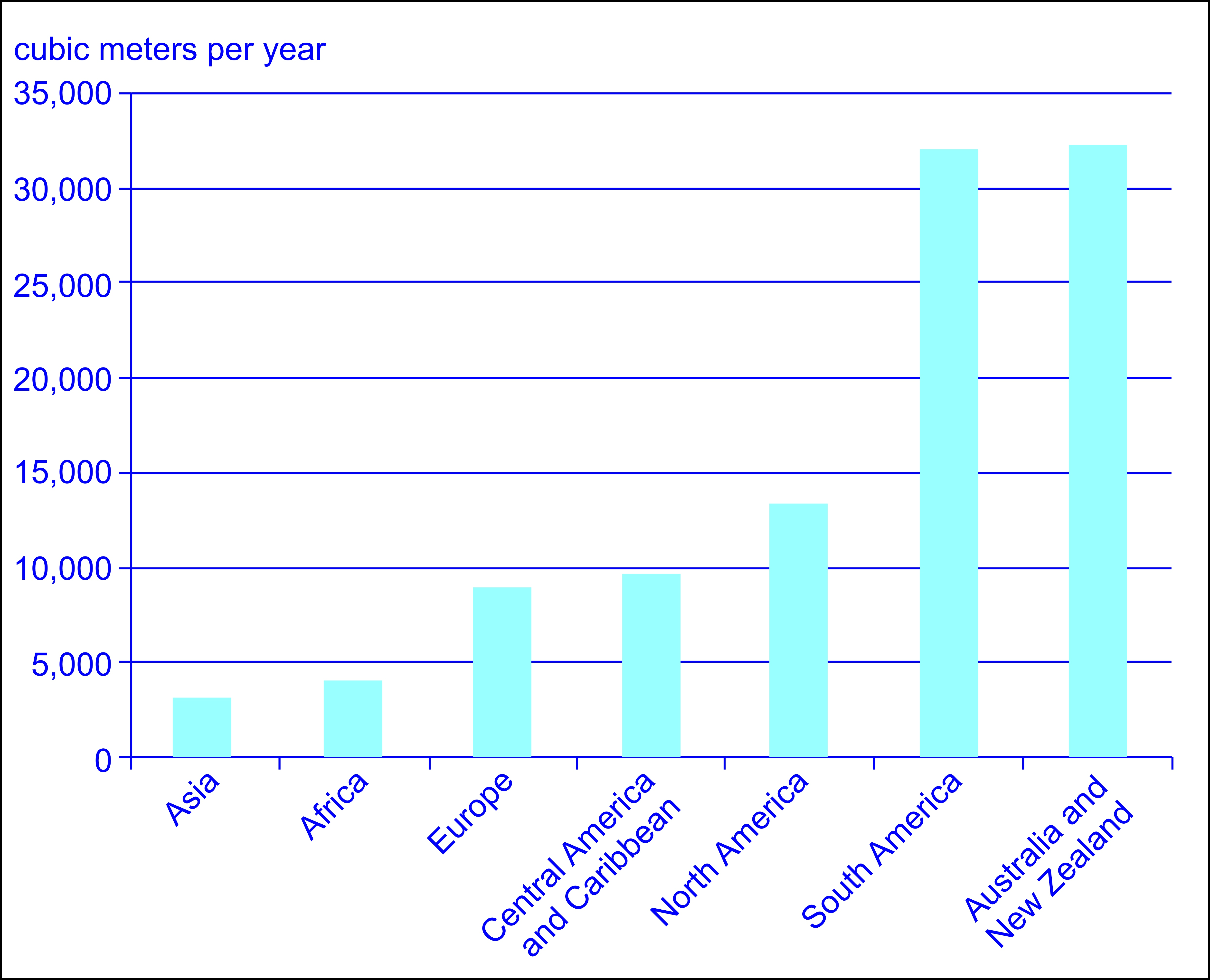
Different continents’ water resources

The challenges posed by the frenetic dam building, however, come with new opportunities to break with business as usual and adopt water conservation and efficiency as well as cooperative approaches in order to help sustainably manage shared water resources and underpin mutual development goals and environmental security. What Asia  needs is institutionalized water cooperation between co-riparian states, with clear rules on building dams on transnational rivers, so as to minimize apprehensions and promote greater regional cooperation.

Only cooperative water institutional mechanisms can help mitigate the risks arising from the rush to dam rivers and create an upstream hydroengineering infrastructure that could potentially arm upstream states with tremendous political and economic leverage over downriver nations. Such cooperation will need to be based on transparency, information sharing, independent environmental impact assessment, dispute-settlement mechanisms, water pollution control, and a mutual commitment to refrain from undertaking projects that could materially diminish transboundary river flows.

Download the full paper here.