Qatar’s Jihad

67e2a98e9348513e60f11393c235650b.square

An internationally syndicated column by Project Syndicate

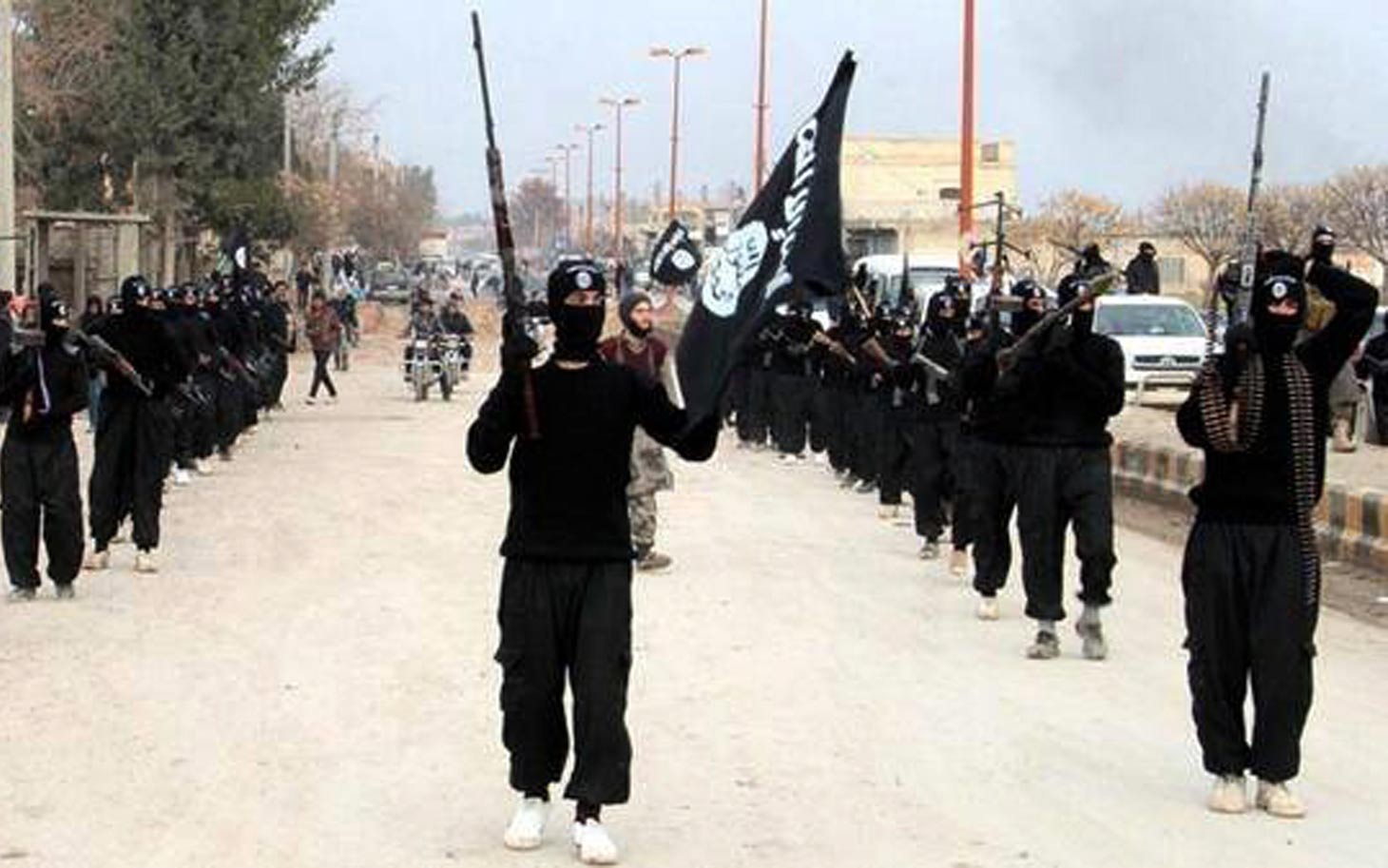
Qatar may be tiny, but it is having a major impact across the Arab world. By propping up violent jihadists in the Middle East, North Africa, and beyond, while supporting the United States in its fight against them, this gas-rich speck of a country – the world’s wealthiest in per capita terms – has transformed itself from a regional gadfly into an international rogue elephant.

imagesUsing its vast resources, and driven by unbridled ambition, Qatar has emerged as a hub for radical Islamist movements. The massive, chandeliered Grand Mosque in Doha – Qatar’s opulent capital – is a rallying point for militants heading to wage jihad in places as diverse as Yemen, Tunisia, and Syria. As a result, Qatar now rivals Saudi Arabia – another Wahhabi state with enormous resource wealth – in exporting Islamist extremism.

But there are important differences between Qatar and Saudi Arabia. Qatar’s Wahhabism is less severe than Saudi Arabia’s; for example, Qatari women are allowed to drive and to travel alone. In Qatar, there is no religious police enforcing morality, even if Qatari clerics openly raise funds for militant causes overseas.

Given this, it is perhaps unsurprising that, whereas Saudi Arabia’s sclerotic leadership pursues reactionary policies rooted in a puritanical understanding of Islam, Qatar’s younger royals have adopted a forward-thinking approach. Qatar is the home of the Al Jazeera satellite television channel and Education City, a district outside of Doha that accommodates schools, universities, and research centers.

Similar inconsistencies are reflected in Qatar’s foreign policy. Indeed, the country’s relationship with the United States directly contradicts its links with radical Islamist movements.

Qatar hosts Al Udeid air base – with its 8,000 American military personnel and 120 aircraft, including supertankers for in-flight refueling – from which the US directs its current airstrikes in Syria and Iraq. Camp As-Sayliyah – another facility for which Qatar charges no rent – serves as the US Central Command’s forward headquarters. In July, Qatar agreed to purchase $11 billion worth of US arms.

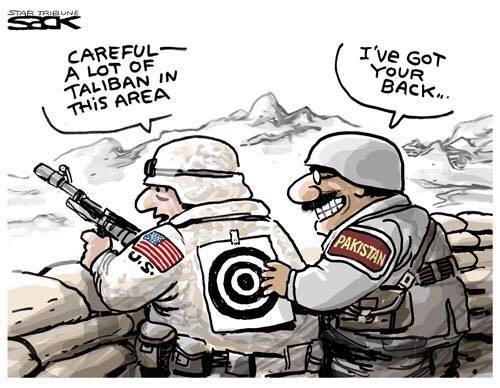
Moreover, Qatar has used its leverage over the Islamists that it funds to help secure the release of Western hostages. And it hosted secret talks between the US and the Pakistan-backed Afghan Taliban. To facilitate the negotiations, Qatar provided a home, with US support, to the Taliban’s de facto diplomatic mission – and to the five Afghan Taliban leaders released earlier this year from US detention at Guantánamo Bay.

In other words, Qatar is an important US ally, a supplier of weapons and funds to Islamists, and a peace broker all at the same time. Add to that its position as the world’s largest supplier of liquefied natural gas and the holder of one of its largest sovereign-wealth funds, and it becomes clear that Qatar has plenty of room to maneuver – as well as considerable international clout. Germany’s government found that out when it was forced to retract its development minister’s statement that Qatar played a central role in arming and financing the Islamic State.

Qatar’s growing influence has important implications for the balance of power in the Arab World, especially with regard to the country’s rivalry with Saudi Arabia. This competitive dynamic, which surfaced only recently, represents a shift from a long history of working in tandem to export Islamist extremism.

Both Qatar and Saudi Arabia generously supplied weapons and funds to Sunni extremists in Syria, opening the door for the emergence of the Islamic State. Both have bolstered the Afghan Taliban. And both contributed to Libya’s transformation into a failed state by aiding Islamist militias. During the 2011 NATO campaign to overthrow Colonel Muammar el-Qaddafi, Qatar even deployed ground troops covertly inside Libya.

Today, however, Qatar and Saudi Arabia are on opposite sides. Qatar, along with Turkey, backs grassroots Islamist movements like the Muslim Brotherhood and its offshoots in Gaza, Libya, Egypt, Tunisia, Iraq, and the Levant. That pits it against Saudi Arabia and countries like the United Arab Emirates, Egypt, and Jordan, whose rulers view such movements as an existential threat, with some, including the House of Saud, investing in propping up autocratic regimes like their own.

In this sense, Qatar’s tack has produced a rare schism within the Gulf Cooperation Council, whose members collectively possess nearly half of the world’s oil reserves. The proxy competition among rival monarchies, which led some of them to withdraw their ambassadors from Qatar in March, is intensifying violence and instability throughout the region. For example, the UAE, with Egyptian assistance, secretly carried out airstrikes in August to stop Qatari-aided Islamist militias from gaining control of the Libyan capital, Tripoli.

Qatar’s leaders are willing to challenge their neighbors for a simple reason: They believe that the grassroots Islamist movements they support – which, in their view, represent majority political aspirations – eventually will win. Anticipating that such groups will increasingly shape Arab politics, displacing strongman regimes, Qatar has set out to empower them.

In doing so, Qatar is destabilizing several countries and threatening the security of secular democracies far beyond the region. For the sake of regional and international security, this elephant must be tamed.

Brahma Chellaney, Professor of Strategic Studies at the New Delhi-based Center for Policy Research, is the author of Asian Juggernaut; Water: Asia’s New Battleground; and Water, Peace, and War: Confronting the Global Water Crisis.

© 1995-2014 Project Syndicate. 

Obama, a serial interventionist

The U.S. invaded Afghanistan to get rid of the Taliban, yet today it seeks a peace deal with that enemy. And now Obama has declared a new war to get rid of the Islamic State — a war that is likely to broaden into something more geopolitical in nature.

Brahma Chellaney, The Japan Times
ObamaAmerica’s Nobel Peace Prize laureate president, Barack Obama, who helped turn Libya into a failed state by toppling ruler Muammar Gaddafi, has started a new war in Syria and Iraq even as the U.S. remains embroiled in the Afghanistan war. Obama’s air war in Syria — his presidency’s seventh military campaign in a Muslim nation and the one likely to consume his remaining term in office — raises troubling questions about its objectives and his own adherence to the rule of law.

While it has become imperative to contain the Islamic State (IS), a Sunni jihadist army that has imposed a despotic medieval order in the territories under its control, any fight against terrorism can be effectively waged only if it respects international law and reinforces global norms and does not become an instrument to pursue narrow, geopolitical interests. After all, all strains of the cancer of Islamist terrorism — not just the type IS represents — need to be eliminated.

Ever since America launched its “war on terror” in 2001 under Obama’s predecessor, George W. Bush, the scourge of international terrorism, ominously, has spread deeper and wider in the world. Jihadist forces extolling terror as a sanctified tool of religion have gained ground in a number of countries. Once-stable nations such as Iraq, Syria and Libya have become anarchic, crumbling states and new hubs of transnational terrorism, even as the Afghanistan-Pakistan belt remains “ground zero” for the terrorist threat the world confronts.

Obama was expected to be fundamentally different than Bush, whose invasion and occupation of Iraq left a broken, failing state — an expectation that led the Nobel committee to award him the peace prize soon after he assumed office. Yet, underscoring the disconnect between his words and actions, Obama has been more at ease waging wars — that too in breach of international law — than in waging peace.

Although elected with the support of the left, he has proved to be one of America’s most militarily assertive presidents since World War II, with his readiness to unilaterally use force driven by a penchant to act as judge and executioner.

Obama in Cairo in 2009 sought “a new beginning” between the U.S. and Muslims “based upon mutual interest and mutual respect.”  However, his reliance on U.S. hard power has been underlined by his serial bombing campaigns in Libya, Somalia, Yemen, Iraq and Syria.

Obama also directed a threefold increase in the number of U.S. troops in Afghanistan, sharply escalated drone attacks in Pakistan, initiated “targeted killing” of even U.S. citizens with suspected ties to terrorism, and authorized the helicopter raid that killed Osama bin Laden in his hideout in Pakistan’s heartland. And now comes the news that this warrior-in-chief, having championed “a nuclear-free world,” has quietly pursued plans for an extensive expansion of the U.S. nuclear arsenal, already the world’s costliest and most-sophisticated.

In fact, Obama enunciated his rejection of nonviolence and his partiality for use of force in his Nobel Peace Prize acceptance speech, saying: “A nonviolent movement could not have halted Hitler’s armies. Negotiations cannot convince Al Qaeda’s leaders to lay down their arms. To say that force is sometimes necessary is not a call to cynicism — it is a recognition of history, the imperfections of man, and the limits of reason.” He has since used the fight against terrorism to make never-ending war, to the delight of the military-industrial complex.

Still, what stopped Obama from seeking United Nations Security Council (UNSC) mandate before initiating a war in Syria against IS militants? The answer is obvious: Obama wants to wage his open-ended war on U.S. terms, like his earlier interventions.

Five repressive Arab autocracies — Qatar, Saudi Arabia, Jordan, the United Arab Emirates, and Bahrain — form the core of his “coalition of the willing” on Syria. In addition, Turkey has overcome initial hesitation and agreed to allow the U.S. military to launch operations against the Islamic State from its territory. Paradoxically, the U.S., Qatar, Saudi Arabia, Turkey, Jordan, and the UAE aided IS’s rise, either openly or inadvertently.

This is a coalition of sinners now dressed as knights in shining armor.

Such has been the tepid international response to what the White House admits will be a multiyear military offensive in the Syria-Iraq belt that only five of the 22 Arab states (or, to put it differently, five of the 57 members of the Organization of Islamic Cooperation) have joined the coalition. And even though the U.S. is striking a terrorist group, its urge to test new weapons has led to the debut in war of the problem-plagued F-22 stealth fighter.

Obama displayed his disdain for international law by addressing the U.N. after presenting his bombing blitzkrieg in Syria as a fait accompli. In his address, as if to undergird the mismatch between his own words and actions, he condemned what he called Russia’s ethos of “might makes right,” saying “right makes might.” He then told the U.N. climate summit that the U.S. has “reduced our total carbon pollution by more than any other nation on Earth,” yet data released by the U.S. energy department show U.S. carbon emissions — already the world’s highest in per capita terms — are climbing again.

To rationalize unleashing force in Syria by bypassing the U.N., the Obama administration has meretriciously claimed the defense of a third country, Iraq, as a legal ground, thus invoking the doctrine of hot pursuit. Such a precedent could allow the sovereignty of any nation to be violated. It also flouts the UN Charter, which defines self-defense as actions necessary to uphold a country’s territorial integrity and political independence and limits self-defense to exceptional circumstances, such as when a nation is under direct attack.

In reality, the war in Syria is just the latest U.S. action mocking international law. Other such actions in the past 15 years include the bombing of Serbia, the separation of Kosovo from Serbia, the invasions of Afghanistan and Iraq without UNSC authority, Gaddafi’s overthrow, the aiding of an insurrection in Syria, CIA renditions of terror suspects, and National Security Agency’s Orwellian surveillance program. Yet, Obama has escalated a sanctions campaign against Russia in the name of upholding international law.

Indeed, Obama has not sought even U.S. congressional authorization before embroiling his country in yet another war.

To justify his serial interventions and interminable war making, Obama has continued to speciously cite the congressional authority Bush secured to specifically go after those that “planned, authorized, committed or aided” the September 11, 2001 terrorist attacks. But given that linking the Islamic State to the 9/11 attacks would stretch plausibility, especially since Al Qaeda has publicly disavowed Islamic State, his administration started the Syria war by claiming an “imminent” threat to U.S. homeland security from a previously unknown “Al Qaeda affiliate,” Khorasan.

Such is Obama’s war-making itch that a year ago he almost went to war to bomb Syrian President Bashar al-Assad out of office, but now his administration pre-notified Damascus about the start of its airstrikes against the Islamic State so that U.S. bombers did not attract Syrian anti-aircraft fire. The new Iraqi prime minister has revealed that he conveyed Washington’s message to Assad that the strikes were not directed at his regime.

The unpalatable truth that Obama seeks to obscure is that the main Islamic State force was born in Syria out of the CIA-trained, petrodollar-funded rebels who were reared to help overthrow Assad. Flush with his success in overthrowing Gaddafi in 2011 — an operation that involved orchestrating an Islamist insurgency in Benghazi and then launching a NATO aerial-bombardment campaign in the name of “responsibility to protect” — Obama turned his attention to effecting regime change in Syria. The CIA, besides training Syrian militants in Jordan and Turkey, funneled weapons and funds to Sunni rebels in Syria from a base it set up in Benghazi at the U.S. consulate, which ironically was overrun on September 11, 2012 by CIA-armed Libyan Islamist militiamen, who killed the U.S. ambassador and three other Americans.

Obama turned a blind eye as the Islamic State made significant advances from mid-2013 onward — or, as he now puts it euphemistically, his administration “underestimated” the threat from this hydra-headed group. Indeed, it was the “machinations” of the forces now waging war in Syria — the United States, Turkey, Qatar, Saudi Arabia and Jordan — that “helped open the door for the terrorist Islamic State group to threaten the region,” as columnist David Ignatius said in the Washington Post. For Washington, Islamic State militants ceased to be “good” terrorists undermining Assad’s rule and Iranian interests in Syria and Iraq after they began threatening U.S. interests and beheaded two American journalists.

If President Ronald Reagan accidentally fathered Al Qaeda, Obama is the Islamic State’s unintended godfather turned self-declared slayer-in-chief. Having earlier tasked the CIA with aiding Syrian rebels to help oust Assad, Obama has now tasked the agency to create a proxy ground force against the Islamic State in Syria by training and arming thousands of more insurgents.

Training and arming non-state combatants flies in the face of international law. The directive also ignores the lessons from past covert interventions.

“We helped to create the problem that we are now fighting,” Hillary Clinton candidly told Fox News as secretary of state, saying “we had this brilliant idea we were going to come to Pakistan and create a force of mujahedeen and equip them with Stinger missiles and everything else to go after the Soviets inside Afghanistan.” Obama’s own creation of “moderate” rebel forces in Libya has badly backfired.

The U.S. indeed has also contributed to India’s terrorism problem. After all, large portions of the CIA’s multibillion-dollar military aid for the Afghan rebels in the 1980s were siphoned off by the conduit, Pakistan’s Inter-Services Intelligence (ISI), to trigger insurgencies in India’s Kashmir and Punjab. India — and Pakistan — have paid a heavy price for America’s continued cozy ties with the Pakistani military and its ISI spies. Yet, paradoxically, the U.S. has used counterterrorism as a key instrument to build a strategic partnership with India.
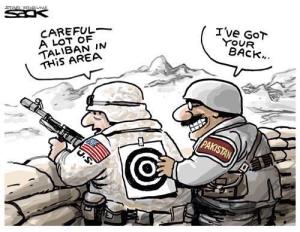
Bzv7KFQCcAAGKKcObama pledged in Cairo in 2009, “We do not want to keep our troops in Afghanistan. We seek no military bases there.” But in a change of heart, Obama now wants bases there for a virtually unlimited period.

The end of the political crisis in Kabul opened the way for the new Afghan government to sign on September 30 the bilateral security agreement that Obama sought as the legal basis to keep U.S. bases, with almost 10,000 American troops. A residual U.S. force, however, will be more vulnerable to Afghan Taliban attacks, thus strengthening Washington’s imperative to mollycoddle Pakistani generals and cut a deal with the “Quetta Shura,” the Taliban leadership ensconced in Pakistan.

As the longest war in its history in Afghanistan attests, the U.S. is better at starting wars than in ending them. In fact, the U.S. invaded Afghanistan to get rid of the Taliban, yet it now seeks a peace deal with that enemy. Indeed, the birth of the Afghan Taliban — fathered by the ISI — was midwifed by the CIA in the early 1990s.

What Obama has started as an offensive to get rid of the Islamic State is likely to broaden into something more geopolitical in nature for U.S. interests. The U.S., for example, is interested in mending the damage to its interests from its decade-long Iraq occupation, which made Iran the real winner. Yet the new involvement in Syria could end up as Obama’s Vietnam.

More broadly, America’s longstanding alliance with the Persian Gulf’s jihad-bankrolling Islamist monarchs does not augur well for its “war on terror,” which has spawned more militants than it has eliminated. With U.S. support, the oil monarchies, even the most tyrannical, have been able to ride out the Arab Spring. Paradoxically, the U.S. practice of propping up malleable Islamist rulers in the Middle East not just spurs strong anti-U.S. sentiment, but also fosters grassroots support for more independent and “authentically” Islamist forces.

A rolling, self-sustaining war targeting terrorist enemies that America’s own policies and interventions continue to spawn is not good news even for the U.S., whose military adventures since 2001 have cost $4.4 trillion, making its rich military contractors richer but destabilizing security in several regions.

At a time when America faces a pressing need for comprehensive domestic renewal to arrest the erosion in its relative global power, it can ill afford self-debilitating wars. Unfortunately for it, one eternal warrior in the White House was succeeded by another serial interventionist.

The writer is a New Delhi-based geostrategist and author.

© The Japan Times, 2014.

America’s Never-Ending War

It is official: US President and Nobel Peace Prize laureate Barack Obama is at war again. After toppling Libyan ruler Muammar el-Qaddafi and bombing targets in Somalia and Yemen, Obama has initiated airstrikes in the Syria-Iraq belt, effectively declaring war on the Islamic State – a decision that will involve infringing on the sovereign, if disintegrating, state of Syria. In his zeal to intervene, Obama is again disregarding US and international law by seeking approval from neither the US Congress nor the United Nations Security Council.

Obama’s predecessor, George W. Bush, launched America’s so-called “war on terror” to defeat groups that he insisted wanted to “establish a radical Islamic empire that spans from Spain to Indonesia.” But Bush’s invasion and occupation of Iraq was so controversial that it fractured the global consensus to fight terror, with the Guantánamo Bay detention center and the rendition and torture of suspects coming to symbolize the war’s excesses.

After Obama took office, he sought to introduce a gentler, subtler tone. Contending in a 2009 interview that “the language we use matters,” he rebranded the war on terror as a “struggle” and a “strategic challenge.” But the rhetorical shift did not translate into a change in strategy, with the Obama administration moving beyond security concerns to use its anti-terrorism activities to advance America’s broader geopolitical interests.

Thus, instead of viewing the elimination of Osama bin Laden in 2011 as the culmination of the anti-terror “struggle” that Bush launched, the Obama administration increased aid to “good” rebels (such as those in Libya), while pursuing “bad” terrorists more vehemently, including through a “targeted killing” program. When it comes to terrorist activity, however, such lines are difficult to draw.

For example, Obama initially placed the Islamic State in the “good” category, as it undermined Syrian President Bashar al-Assad’s rule and Iran’s interests in Syria and Iraq. His position changed only after the Islamic State threatened to overrun Iraq’s Kurdish regional capital, Erbil – home to US military, intelligence, diplomatic, and business facilities. Add to that the beheadings of two American journalists, and suddenly Obama’s team was using Bush’s war rhetoric, declaring that the US is at war with the Islamic State “in the same way that we are at war with Al Qaeda and its affiliates all around the globe.”

America’s war on terror now risks becoming a permanent war against an expanding list of enemies – often inadvertently created by its own policies. Just as covert aid to Afghanistan’s anti-Soviet rebels in the 1980s contributed to Al Qaeda’s emergence – something that Hillary Clinton acknowledged when she was Obama’s secretary of state – the help that the US and its allies provided to Syrian insurgents after they emerged in 2011 contributed to the rise of the Islamic State.

The US returned to Afghanistan in 2001 to wage an as-yet-unfinished war on the jihadists whom its actions had spawned. Likewise, it is now launching a war in Iraq and Syria against the offspring of Bush’s forced regime change in Baghdad and Obama’s ill-conceived plan to topple Assad.

It is time for the US to recognize that since it launched its war on terror, the scourge has only spread. The Afghanistan-Pakistan belt has remained “ground zero” for transnational terrorism, and once-stable countries like Libya, Iraq, and Syria have emerged as new hubs.

Obama’s effort to strike a Faustian bargain with the Afghan Taliban, whose top leaders enjoy sanctuary in Pakistan, indicates that he is more interested in confining terrorism to the Middle East than defeating it – even if it means leaving India to bear the brunt of terrorist activity. (In fact, Pakistan’s ongoing war of terror against India also sprang from America’s anti-Soviet operation in Afghanistan – the largest in the CIA’s history – as the Pakistani Inter-Services Intelligence siphoned off a large share of the billions of dollars in military aid for the Afghan rebels.)

Similarly, Obama’s strategy toward the Islamic State seeks merely to limit the reach of a barbaric medieval order. Moments after declaring his intention to “degrade and destroy” the group, Obama responded to a reporter’s request for clarification by stating that his real goal is to turn the Islamic State into a “manageable problem.”

Making matters worse, Obama plans to use the same tactics to fight the Islamic State that led to its emergence: authorizing the CIA, aided by some of the region’s oil sheikhdoms, to train and arm thousands of Syrian rebels. It is not difficult to see the risks inherent in flooding the Syrian killing fields with even more and better-armed fighters.

The US may have some of the world’s top think tanks and most highly educated minds. But it consistently ignores the lessons of its past blunders – and so repeats them. US-led policies toward the Islamic world have prevented a clash between civilizations only by fueling a clash within a civilization that has fundamentally weakened regional and international security.

An endless war waged on America’s terms against the enemies that it helped to create is unlikely to secure either steady international support or lasting results. Nowhere is this more apparent than in the tepid Arab and Turkish response to America’s effort to assemble an international coalition in support of what the Obama administration admits will be a multiyear military offensive against the Islamic State.

The risk that imperial hubris accelerates, rather than stems, Islamist terror is all too real – yet again.

(c) Project Syndicate, 2014.

Tibet is the real source of Sino-Indian friction

Brahma Chellaney, Nikkie Asian Review

The sprawling, mountainous country of Tibet was annexed by China in the 1950s, eliminating a historical buffer with India. Today, the region remains at the heart of Sino-Indian problems, including territorial disputes, border tensions and water feuds. Beijing lays claim to adjacent Indian territories on the basis of alleged Tibetan ecclesial or tutelary links, rather than an ethnic Chinese connection.

So when Chinese President Xi Jinping traveled in mid-September to India — home to Tibet’s government in exile — Tibet loomed large. The Tibetan plateau, and the military tensions the issue provokes, will also figure prominently in the Sept. 29-30 summit at the White House between Prime Minister Narendra Modi and U.S. President Barack Obama, who has urged Beijing to reopen talks with the Dalai Lama, the exiled religious leader revered as a god-king by Tibetans.

Xi’s visit to New Delhi began with the visitor toasting Modi’s birthday. But, underlining the deep divide regarding Tibet, the visit was overshadowed by a Chinese military incursion across the traditional Indo-Tibetan border. It was as if the incursion — the biggest in terms of troop numbers in many years and the trigger for a military standoff in the Ladakh region — was Xi’s birthday gift for Modi.

An Indian policeman restrains a Tibetan youth at a protest in New Delhi during the visit of Chinese leader Xi Jinping against China’s control of Tibet. © AP

Modi’s government, for its part, allowed Tibetan exiles to stage street protests during the two days that Xi was in New Delhi, including some close to the summit venue. This reversed a pattern that had held since the early 1990s, in which police routinely prevented such protests during the visits of Chinese leaders. During the decade-long reign of Modi’s predecessor, Manmohan Singh, police would impose a lockdown on the Indian capital’s Tibetan quarter and beat up Tibetans who attempted to rally.

Such brutal practices would have befitted a repressive autocracy like China, but not a country that takes pride in being the world’s largest democracy. In any event, the muzzling of protests won India no gratitude from an increasingly assertive China.

It was a welcome change that India permitted members of its large Tibetan community to exercise their legitimate democratic rights. Even the Dalai Lama felt at liberty to speak up during Xi’s visit, reminding Indians: “Tibet’s problem is also India’s problem.” The Tibetan protests, although peaceful, rattled China, which had grown accustomed to Indian authorities doing its bidding.

When Modi took office in May, the prime minister of Tibet’s government in exile, Lobsang Sangay, was invited to the swearing-in event. So Xi sought an assurance that the Modi government regards Tibet as part of China. Modi has yet to speak his mind on this issue in public, but the Chinese foreign ministry, apparently citing private discussions, announced: “Prime Minister Modi said that Tibet is an integral part of China, and India does not allow any separatist activities on its soil.”

Diplomatic fumbles

Tibet — the world’s highest and largest plateau — separated the Chinese and Indian civilizations until relatively recently, limiting their interaction to sporadic cultural and religious contact, with no political relations. It was only after China forcibly occupied Tibet that Chinese military units appeared for the first time on the Himalayan frontiers.

The fall of Tibet represented the most profound and far-reaching geopolitical development in India’s modern history. It led to China’s bloody trans-Himalayan invasion in 1962 and its current claims to vast tracts of additional Indian land.

Yet Prime Minister Jawaharlal Nehru in 1954 surrendered India’s extraterritorial rights in Tibet — inherited from Britain at independence — and accepted the existence of the “Tibet region of China” with no quid pro quo, not even Beijing’s acknowledgement of the then-prevailing Indo-Tibetan border. He did this by signing a pact mockingly named after the Tibetan Buddhist doctrine of Panchsheela, or the five principles of peaceful coexistence. As agreed in the pact, India withdrew its “military escorts” from Tibet and conceded to China, at a “reasonable” price, the postal, telegraph and public telephone services operated by the Indian government in the region.

Years later, another Indian prime minister, Atal Bihari Vajpayee, went further. During Vajpayee’s visit to Beijing in 2003, China wrung from India the concession it always wanted — an unambiguous recognition of Tibet as part of China. Vajpayee went so far as to use the legal term “recognize” in a document signed by the two nations’ heads of government, confirming that what China calls the Tibet Autonomous Region was “part of the territory of the People’s Republic of China.”

This opened the way for China to claim the large northeastern Indian state of Arunachal Pradesh — three times the size of Taiwan — as “South Tibet,” a term it coined in 2006. Since 2010, Beijing has also questioned India’s sovereignty over the Indian portion of the disputed northern region known as Jammu and Kashmir, a former princely state of which China occupies one-fifth and Pakistan more than a third. In response to such increasing belligerence, a pattern reinforced by a rising number of border violations by Chinese troops, India stopped making references to Tibet being part of China in the same year.

Yet, in a significant diplomatic blunder, the joint statement issued by Modi and Xi after their summit referred to India’s appreciation of the help extended by the “local government of Tibet Autonomous Region of the People’s Republic of China” to Indian pilgrims visiting Kailash-Mansarover — a mountain-and-lake area of Tibet that is sacred to Hinduism, Buddhism, Jainism and Bon, the indigenous religion of Tibet. The wording gave Beijing an implicit Indian endorsement that Tibet is indeed part of China.

Widen the focus

The spotlight today is on China’s claim to the state of Arunachal Pradesh, rather than the status of Tibet itself. The blunders of some of Modi’s predecessors served to narrow the focus to what China wants, reinforcing Beijing’s views. Those territorial claims must be negotiable, and can only be settled on the basis of give and take — or, as China puts it, on the basis of “mutual accommodation and mutual understanding.”

India can reclaim leverage by emphasizing that its acceptance of China’s hold on Tibet hinged on a grant of genuine autonomy to the plateau, whose elevation is so high that it is called the “Roof of the World.” Instead of granting autonomy, China has brought Tibet under tight political control and unleashed increasing repression, triggering a wave of self-immolations and grass-roots desperation.

Having ceased to be a political buffer between China and India, Tibet could become a political bridge between the world’s demographic titans if Beijing were willing to initiate a process of reconciliation to ease Tibetans’ feelings of estrangement. Otherwise, Tibet will remain at the core of the China-India divide. The tense military standoff triggered by intruding Chinese troops is a reminder of that.

Brahma Chellaney is a professor of strategic studies at the independent Center for Policy Research in New Delhi and the author of “Water: Asia’s New Battleground,” the winner of the 2012 Bernard Schwartz Award.

Hawkish China, Defensive India

Brahma Chellaney, The Hindustan Times, September 19, 2014

Prime Minister Narendra Modi has bent over backwards to befriend China. Yet Chinese President Xi Jinping’s India visit has been marred by border incursions, including one that ranks, in terms of the number of intruding troops, as the worst in many years. Modi coined his “inch toward miles” slogan to underscore how India-China collaboration could positively transform Asia. But the slogan more aptly describes the salami-slice strategy of the People’s Liberation Army (PLA) to use stealthy incursions to incrementally change facts on the ground.

The more powerful the PLA has become at the expense of the civilian collective leadership, the more China has presented itself as a tiger on the prowl by discarding Deng Xiaoping’s dictum tao guang yang hui (keep a low profile and not bare your capabilities)

The more powerful the PLA has become at the expense of the party leadership, the more China has presented itself as a tiger on the prowl

The PLA is taking advantage of its rising political clout at home to escalate border incursions. It has been undeterred even by Xi’s visit. After all, in the run-up to Premier Li Keqiang’s New Delhi visit last year, the PLA staged a deep, three-week-long intrusion into Indian territory.

Enjoying increasing autonomy and soaring budgets, the PLA of late appears ready to upstage even the Chinese Communist Party. Ideologically adrift, the party is becoming dependent on the PLA for its political legitimacy and to ensure domestic order. The PLA sees itself as the power behind the throne, encouraging it to assert primacy.

China’s expanding “core interests” and its willingness to take on several neighbours simultaneously point to how the PLA is calling the shots. With the PLA gaining political muscle and boasting financial assets and enterprises across the nation, it is seizing opportunities to nibble at neighbouring countries’ territories, besides driving an increasingly muscular foreign policy.

The more powerful the PLA has become at the expense of the civilian collective leadership, the more China has presented itself as a tiger on the prowl by discarding Deng Xiaoping’s dictum tao guang yang hui (keep a low profile and not bare your capabilities). It is as if China has decided that its moment has finally arrived.

This structural transformation parallels the one that occurred in Imperial Japan, which rose dramatically as a world power in one generation after the 1868 Meiji Restoration. Boosted by war victories against Manchu-ruled China and Tsarist Russia, the Japanese military gradually went on to dictate terms to the civilian government, opening the path to aggression and conquest.

The PLA’s increasing clout has led China to resurrect territorial and maritime disputes and assert new sovereignty claims. Such assertiveness also helps the party to turn nationalism into the legitimating credo of its monopoly on power. But as the latest Ladakh intrusions show, the PLA is ready to strike even at the risk of drawing attention to the wrong issues during a Chinese presidential visit.

Whereas the Indian military continues to be shut out from the policymaking loop in a way unmatched in any other established democracy, the PLA has repeatedly blindsided government leaders with military actions, weapon displays and hawkish statements, prompting U.S. Defence Secretary Robert Gates in 2011 to warn of “a disconnect between the military and the civilian leadership” in China. The recent rise of a new Chinese dynasty of “princelings,” or sons of revolutionary heroes who have close contacts in the military, has narrowed that disconnect.

Xi best symbolizes the political ascent of “princelings”. Indeed, what distinguishes Xi, a former military reservist, from China’s other civilian leaders is his strong relationship with the PLA, which regards him as its own man. Xi’s wife carries an honorary rank of army general, while Xi himself is the only civilian figure in the twin Central Military Commissions. It is thus possible that the latest Himalayan incursions were deliberately timed, with Xi’s knowledge, to reinforce his message to India that China will not compromise on territorial disputes and that the onus is on New Delhi to settle Chinese claims.

The PLA’s political power poses an important challenge for India, paralleling the one it faces on Pakistan, where the military and its intelligence agency dictate foreign policy. India also confronts the strengthening nexus between China and Pakistan, both of which have staked claims to substantial swaths of Indian territory and continue to collaborate on weapons of mass destruction. Indian diplomacy faces the dilemma of how to deal with these regional adversaries, given that the Chinese and Pakistani foreign ministries are weak actors.

In fact, China’s foreign ministry is the weakest government branch, often overruled or simply ignored by the PLA. This is a key reason why India’s border talks with the Chinese foreign ministry since 1981 have gone nowhere, dubiously ranking as the world’s longest and most-barren frontier negotiations. The Indians can stay put in this process for another 33 years and the Chinese side will continue to merrily take them round and round the mulberry bush.

Last year’s three-week military standoff in Ladakh indeed highlighted the “information lag” of the Chinese foreign ministry, whose version evolved from expressing ignorance about the intrusion, to dismissing Indian claims as “speculation”, and to finally acknowledging an “incident” and “standoff” with India. A day after India disclosed that the standoff was over, the Chinese foreign office remained utterly ignorant of the development, saying it was awaiting “the latest information”.

With China rising as a praetorian state, India’s fumbling responses to the increasing Chinese incursions do not bode well for its Himalayan security. India still deploys border police to fend off such incursions. But the Indo-Tibetan Border Police, with its defensive training and mindset and under the Home Ministry, is no match to the PLA’s aggressive designs. The Chinese border provocations and India’s meek calls for “flag meetings” to end standoffs highlight the diametrically opposite civil-military equations prevailing in the world’s two demographic titans, underscoring India’s imperative to formulate a concerted strategy to counter China’s posture of aggressive deterrence. The only counter to aggressive deterrence is offensive defence.

Brahma Chellaney is a geostrategist and author.

(c) The Hindustan Times, 2014.

India’s China problem

Brahma Chellaney, The World Post/The Huffington Post

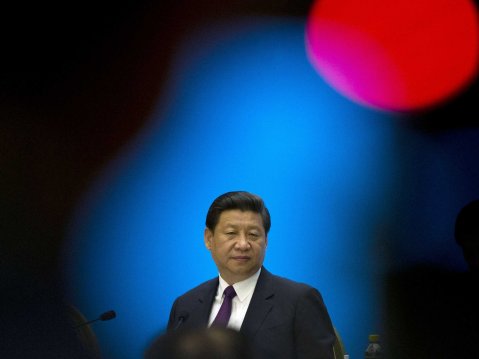
xi-jinping-14Indian Prime Minister Narendra Modi, who swept to power in May with a thumping electoral mandate, faces a major test in diplomacy in the form of bilateral summits this month with three powers central to Indian foreign policy — Japan, China, and the United States. Modi met with Japanese Prime Minister Shinzo Abe in Tokyo on September 1, and will now receive Chinese President Xi Jinping in New Delhi. He will then visit the White House at the end of the month.

China poses the toughest challenge for Modi, although the Indian leader had a good meeting with Xi on the sidelines of the recent summit of BRICS, a grouping of major emerging economies. Their body language at the summit in Brazil indicated the two had formed an easy personal equation.

After assuming office, Modi was quick to reach out to China, negating the assumption of some analysts that his government would be less accommodating toward Beijing than its predecessor. Modi views China, with its massive foreign-exchange reserves, as a potential partner in India’s development. Yet, at a time when the China-India trade relationship is already lopsided, with Beijing exporting three times as much as it imports and treating India as a raw-material appendage of its economy like Africa, Modi must find ways to address this glaring asymmetry while seeking to make a cash-rich China an important partner in India’s developmental priorities.

Another challenge for Modi is to balance such deeper economic engagement with India’s strategic imperatives, including bolstering defenses against China and containing increasing Chinese border provocations. According to figures released by Minister of State for Home Affairs Kiren Rijiju in India’s Parliament recently, Chinese border transgressions this year have exceeded more than one per day, totaling 334 up to August 4.

The often tense relationship between the world’s two most-populous countries holds significant implications for international security and Asian power dynamics. As China and India gain economic heft, they are drawing ever more international attention. However, their underlying strategic dissonance and rivalry over issues extending from land and water to geopolitical influence usually attracts less notice.

The vast Tibetan plateau separated the Indian and Chinese civilizations throughout history, limiting their interaction to sporadic cultural and religious contacts, with political relations absent. It was only after Tibet’s annexation in the early 1950s that Han Chinese military units appeared for the first time on India’s Himalayan frontiers. This was followed by a bloody Himalayan war in 1962.

More than half a century later, their old rifts persist even as new issues have started roiling their relationship, including Beijing’s resurrected claim since 2006 to the sprawling northeastern Indian state of Arunachal Pradesh, almost three times larger than Taiwan. A perceptible hardening of China’s stance toward India is also manifest from other developments, including Chinese strategic projects and military presence in the Pakistan-held portion of Kashmir.

Between 2000 and 2010, China-India trade rose 20-fold, making it the only area where relations have thrived. Yet the booming trade has failed to subdue their rivalry.

At the root of the current Himalayan tensions are China’s persistent efforts to alter the territorial status quo. To be sure, India is not China’s only target: The People’s Liberation Army (PLA) is seeking to also disturb the territorial status quo with several other neighboring countries, including Japan, the Philippines, and Vietnam.

Instead of invading, the PLA has chosen to engage in a steady progression of steps to outwit opponents and create new facts on the ground, whether in the South China Sea or the Indian Himalayas. In this way, it has sought to change the status quo without inviting outright conflict with neighboring countries. While China’s navy and a part of its air force focus on supporting revanchist territorial and maritime claims in the South and East China seas, its army has been active in the mountainous borderlands with India.

To prevent the PLA from further nibbling at its territories, India has been beefing up its military deployments in the two sensitive regions located on the opposite ends of the Himalayas — Ladakh and Arunachal Pradesh. It has also launched a crash program to improve its logistical capabilities through new roads, airstrips, and advanced landing stations along the Himalayas.

More importantly, India is raising a new mountain strike corps to arm itself with quick-reaction ground offensive capabilities against China. This new XVII Corps, with more than 90,000 troops, will cost $10.7 billion and be fully operational within five years. India has already deployed ballistic missile squadrons, spy drones, and Russian-built Sukhoi-30MKI fighterjets in the eastern theater against China.

Still, with the inhospitable Himalayan border difficult to patrol effectively, incursions by PLA troops have increased across the “line of actual control” (LAC) that China itself unilaterally drew when it defeated India in the 1962 Chinese-initiated war. Because the LAC has not been mutually clarified — China reneged on a 2001 promise to exchange maps with India — Beijing disputes each intrusion, claiming its troops are merely on “Chinese land.” To be sure, when challenged by Indian border police, the intruding troops tend to retreat from most points. But the rising pattern of incursions ties down large numbers of Indian border police and army troops along the Himalayas.

Despite China’s belligerence, Modi has gone out of his way to befriend Xi’s government. As prime minister, he received the Chinese foreign minister before welcoming any other foreign dignitary. Modi’s first bilateral meeting with a major state head was with Xi in Brazil. He allowed Xi to advance his India visit to September while postponing his own Japan trip so as to meet with Xi first in Brazil. Xi will be the first leader of a major power to travel to New Delhi for talks with Modi.

Modi sent India’s vice president to the 60th-anniversary celebrations in Beijing of the Panchsheel (Five Principles) treaty of peaceful coexistence, a pact that China used to outfox and outflank India, culminating in the 1962 border war. Modi even agreed to let Shanghai be the headquarters of the new BRICS bank, accepting just a consolation prize for India — an Indian as its first president.

These overtures, however, can barely conceal either India’s anxiety over China’s increasing muscle flexing or Modi’s determination to build close strategic ties with Japan in order to put discreet checks on China’s exercise of its rapidly accumulating power, which risks sliding into arrogance.

China’s strategy of constant outward pressure on its borders not only threatens to destabilize Asia’s status quo but is also pushing countries like India, Japan, and Vietnam to strategically collaborate. Modi’s priority is to ensure stable power equilibrium in Asia.

Brahma Chellaney is a professor of strategic studies at the independent Center for Policy Research in New Delhi and the author, most recently, of “Water, Peace, and War” (Rowman & Littlefield, 2014).

(c) China-United States Exchange Foundation. All rights reserved

Modi’s imprint on foreign policy

Brahma Chellaney, Mint, September 3, 2014

One trademark of Modi’s foreign policy is that it is shorn of ideology, with pragmatism being the hallmark

One trademark of Modi’s foreign policy is that it is shorn of ideology, with pragmatism the hallmark

Narendra Modi has surprised many by investing considerable political capital in high-powered diplomacy in his first 100 days in office, even though he had little foreign-policy experience when he became Indian prime minister. His hosting of leaders from India’s neighbourhood when he was sworn in, his highly effective visits to two of India’s neighbours, Nepal and Bhutan, his diplomatic dexterity at the BRICS summit in Brazil, and his watershed trip to Japan are coming to define his nimble foreign-policy approach. Since his thumping electoral mandate, foreign dignitaries have made a beeline to call on him.

Instead of bumptiously enunciating a Modi doctrine in foreign policy, the Prime Minister is allowing his actions, including diplomatic successes and breaks, to define his approach. From the big bear hug with Japanese Prime Minister Shinzo Abe that symbolized the dawn of an India-Japan alliance to his scrapping of scheduled foreign-secretary-level talks with Pakistan after its high commissioner defiantly met Kashmiri secessionists, Modi has managed to put his stamp on foreign policy faster than any predecessor, other than Jawaharlal Nehru. Indeed, as India’s veto at the WTO talks in Geneva exemplified, Modi will even stand up to a powerful, rich nations’ cabal when national interest is at stake.

Signalling his intent to boost India’s economic and security interests through multidirectional collaboration with likeminded powers, the Prime Minister has embarked on building a democratic axis with Japan — an alliance that can help reshape Asian geopolitics and accelerate India’s development. Modi deliberately made Japan his first foreign port of call beyond the Indian subcontinent so as to spotlight that country’s centrality to Indian interests. In fact, not only is Abe the most India-friendly of any world leader today, but also Japan is ready more than any other power to assist in India’s economic rise through aid, investment and technology transfer. Proof of that is its $35 billion pledge this week.

To be sure, India’s relationship with Japan began blossoming before Modi assumed office. The real architect of this axis is Abe, whose push for closer ties with India dates back to his first stint as PM in 2006-07, when Japan and India unveiled their “strategic and global partnership”. However, Modi — recognizing Japan’s importance to his own goal to boost economic growth and restore national pride — has been quick to seize the opportunity to build an entente with Tokyo.

This mission has not dissuaded him from reaching out to archrival China, despite increasing Himalayan border transgressions by its military. In a tricky act, he has sought to tame China’s belligerence through economic courtship designed to rope in that country — with its $4 trillion foreign-exchange reserves — as an important partner in India’s development, like Japan.

Indeed, Modi has gone out of his way to befriend China, negating the early assumptions that he would be less accommodating toward Beijing than his predecessor. He even delayed his Japan tour by several weeks so as to first meet Chinese President Xi Jinping on the sidelines of the BRICS summit. Their body language at that summit indicated the two had formed an easy personal equation. But getting Xi to make progress on the issues that divide India and China won’t be easy.

China represents Modi’s diplomatic gamble. He has invited Chinese investment in his plan to modernize India’s infrastructure, especially railroads, power stations and industrial parks. China’s foreign direct investment in India, however, remains trifling, with Chinese companies preferring to import primary commodities from India while exporting an avalanche of finished products. China, by strategically expanding such lopsided trade with India, has raked in mounting profits, carving out a $30-billion trade surplus in its favour last year.  By dumping its products, it is undercutting Indian manufacturing. How long will Modi be able to walk the tightrope on a country that poses the most difficult challenge for India?

Make no mistake: The extraordinary warmth and harmony that characterized Modi’s Japan tour is unlikely to be replicated in a summit with any other country. In fact, the Prime Minister’s diplomatic skills are about to face a stiffer test in upcoming bilateral summits with Xi — a former military reservist who symbolizes China’s new militarism — and US President Barack Obama, a lame duck increasingly under political siege.

Still, Modi’s actions thus far suggest he has a clear vision of how to proactively recoup India’s regional losses and to boost its global standing. Even his decision to call off talks with Pakistan has made more sense with each passing day, given the political mayhem there. Can any meaningful talks be held at a time the Pakistani military is busy neutering the elected PM and stepping up border provocations against India? Pakistan’s cocky high commissioner is lucky he was not expelled or put in the doghouse for brazenly going against the Indian Foreign Office’s counsel. But he won’t be lucky twice.

One trademark of Modi’s foreign policy is that it is shorn of ideology, with pragmatism being the hallmark. The policy’s overriding objective appears to be to enhance the country’s economic and military security as rapidly as possible. Of course, it is too early to judge the consistency, strength or effectiveness of the Modi diplomacy. But after a long era of ad hoc, reactive, weak-kneed diplomacy, the new clarity and vision represent a welcome change for India.

(c) Mint, 2014.

Who created the new Frankenstein monster?  

Like al-Qaeda, the Islamic State has been inadvertently spawned by the policies of those now in the lead to combat it. But will anything substantive be learned from this experience?

Brahma Chellaney, The Hindu, August 27, 2014

SavagesU.S. President Barack Obama has labelled the jihadist juggernaut that calls itself the Islamic State a “cancer,” while his Defence Secretary, Chuck Hagel, has called it more dangerous than al-Qaeda ever was, claiming that its threat is “beyond anything we’ve seen.” No monster has ever been born on its own. So the question is: which forces helped create this new Frankenstein?

The Islamic State is a brutal, medieval organisation whose members take pride in carrying out beheadings and flaunting the severed heads of their victims as trophies. This cannot obscure an underlying reality: the Islamic State represents a Sunni Islamist insurrection against non-Sunni rulers in disintegrating Syria and Iraq.

Indeed, the ongoing fragmentation of states along primordial lines in the arc between Israel and India is spawning de facto new entities or blocks, including Shiastan, Wahhabistan, Kurdistan, ISstan and Talibanstan. Other than Iran, Egypt and Turkey, most of the important nations from the Maghreb to Pakistan (an internally torn state that could shrink to Punjabistan or, simply, ISIstan) are modern western concoctions, with no roots in history or pre-existing identity.

The West and agendas

It is beyond dispute that the Islamic State militia — formerly the Islamic State of Iraq and the Levant — emerged from the Syrian civil war, which began indigenously as a localised revolt against state brutality under Syrian President Bashar al-Assad before being fuelled with externally supplied funds and weapons. From Central Intelligence Agency (CIA)-training centres in Turkey and Jordan, the rebels set up a Free Syrian Army (FSA), launching attacks on government forces, as a U.S.-backed information war demonised Mr. Assad and encouraged military officers and soldiers to switch sides.

But the members of the U.S.-led coalition were never on the same page because some allies had dual agendas. While the three spearheads of the anti-Assad crusade — the U.S., Britain and France — focussed on aiding the FSA, the radical Islamist sheikhdoms such as Saudi Arabia, Qatar, Kuwait and the United Arab Emirates as well as the Islamist-leaning government in Turkey channelled their weapons and funds to more overtly Islamist groups. This splintered the Syrian opposition, marginalising the FSA and paving the way for the Islamic State’s rise.

The anti-Assad coalition indeed started off on the wrong foot by trying to speciously distinguish between “moderate” and “radical” jihadists. The line separating the two is just too blurred. Indeed, the term “moderate jihadists” is an oxymoron: Those waging jihad by the gun can never be moderate.

Invoking jihad

The U.S. and its allies made a more fundamental mistake by infusing the spirit of jihad in their campaign against Mr. Assad so as to help trigger a popular uprising in Syria. The decision to instil the spirit of jihad through television and radio broadcasts beamed to Syrians was deliberate — to provoke Syria’s majority Sunni population to rise against their secular government.

This ignored the lesson from Afghanistan (where the CIA in the 1980s ran, via Pakistan, the largest covert operation in its history) — that inciting jihad and arming “holy warriors” creates a deadly cocktail, with far-reaching and long-lasting impacts on international security. The Reagan administration openly used Islam as an ideological tool to spur armed resistance to Soviet forces in Afghanistan.

In 1985, at a White House ceremony in honour of several Afghan mujahideen — the jihadists out of which al-Qaeda evolved — President Ronald Reagan declared, “These gentlemen are the moral equivalent of America’s Founding Fathers.” Earlier in 1982, Reagan dedicated the space shuttle ‘Columbia’ to the Afghan resistance. He declared, “Just as the Columbia, we think, represents man’s finest aspirations in the field of science and technology, so too does the struggle of the Afghan people represent man’s highest aspirations for freedom. I am dedicating, on behalf of the American people, the March 22 launch of the Columbia to the people of Afghanistan.”

The Afghan war veterans came to haunt the security of many countries. Less known is the fact that the Islamic State’s self-declared caliph, Abu Bakr al-Baghdadi — like Libyan militia leader Abdelhakim Belhadj (whom the CIA abducted and subjected to “extraordinary rendition”) and Chechen terrorist leader Airat Vakhitov — become radicalised while under U.S. detention. As torture chambers, U.S. detention centres have served as pressure cookers for extremism.

Mr. Obama’s Syria strategy took a page out of Reagan’s Afghan playbook. Not surprisingly, his strategy backfired. It took just two years for Syria to descend into a Somalia-style failed state under the weight of the international jihad against Mr. Assad. This helped the Islamic State not only to rise but also to use its control over northeastern Syria to stage a surprise blitzkrieg deep into Iraq this summer.

Had the U.S. and its allies refrained from arming jihadists to topple Mr. Assad, would the Islamic State have emerged as a lethal, marauding force? And would large swaths of upstream territory along the Euphrates and Tigris rivers in Syria and Iraq have fallen into this monster’s control? The exigencies of the topple-Assad campaign also prompted the Obama administration to turn a blind eye to the flow of Gulf and Turkish aid to the Islamic State.

A full circle

In fact, the Obama team, until recently, viewed the Islamic State as a “good” terrorist organisation in Syria but a “bad” one in Iraq, especially when it threatened to overrun the Kurdish regional capital, Erbil. In January, Mr. Obama famously dismissed the Islamic State as a local “JV team” trying to imitate al-Qaeda but without the capacity to be a threat to America. It was only after the public outrage in the U.S. over the video-recorded execution of American journalist James Foley and the flight of Iraqi Christians and Yazidis that the White House re-evaluated the threat posed by the Islamic State.

Many had cautioned against the topple-Assad campaign, fearing that extremist forces would gain control in the vacuum. Those still wedded to overthrowing Mr. Assad’s rule, however, contend that Mr. Obama’s failure to provide greater aid, including surface-to-air missiles, to the Syrian rebels created a vacuum that produced the Islamic State. In truth, more CIA arms to the increasingly ineffectual FSA would have meant a stronger and more deadly Islamic State.

As part of his strategic calculus to oust Mr. Assad, Mr. Obama failed to capitalise on the Arab Spring, which was then in full bloom. By seeking to topple a secular autocracy in Syria while simultaneously working to shield jihad-bankrolling monarchies from the Arab Spring, he ended up strengthening Islamist forces — a development reinforced by the U.S.-led overthrow of another secular Arab dictator, Muammar Qadhafi, which has turned Libya into another failed state and created a lawless jihadist citadel at Europe’s southern doorstep.

In fact, no sooner had Qadhafi been killed than Libya’s new rulers established a theocracy, with no opposition from the western powers that brought about the regime change. Indeed, the cloak of Islam helps to protect the credibility of leaders who might otherwise be seen as foreign puppets. For the same reason, the U.S. has condoned the Arab monarchs for their long-standing alliance with Islamists. It has failed to stop these cloistered royals from continuing to fund Muslim extremist groups and madrasas in other countries. The American interest in maintaining pliant regimes in oil-rich countries has trumped all other considerations.

Today, Mr. Obama’s Syria policy is coming full circle. Having portrayed Mr. Assad as a bloodthirsty monster, Washington must now accept Mr. Assad as the lesser of the two evils and work with him to defeat the larger threat of the Islamic State.

The fact that the Islamic State’s heartland remains in northern Syria means that it cannot be stopped unless the U.S. extends air strikes into Syria. As the U.S. mulls that option — for which it would need at least tacit permission from Syria, which still maintains good air defences — it is fearful of being pulled into the middle of the horrendous civil war there. It is thus discreetly urging Mr. Assad to prioritise defeating the Islamic State.

Make no mistake: like al-Qaeda, the Islamic State is a monster inadvertently spawned by the policies of those now in the lead to combat it. The question is whether anything substantive will be learned from this experience, unlike the forgotten lessons of America’s anti-Soviet struggle in Afghanistan. At a time when jihadist groups are gaining ground from Mali to Malaysia, Mr. Obama’s current effort to strike a Faustian bargain with the Afghan Taliban, for example, gives little hope that any lesson will be learned. U.S.-led policies toward the Islamic world have prevented a clash between civilisations by fostering a clash within a civilisation, but at serious cost to regional and international security.

(Brahma Chellaney is a geostrategist and the author, most recently, of Water, Peace, and War, Oxford University Press, 2014.)

(c) The Hindu, 2014.

p9-Chellaney-b-20140827-870x509

Deadly Geopolitical Games

If Libya, Syria and Iraq are coming undone and Ukraine has been gravely destabilized, it is the result of interventions by big powers that claim to be international-law enforcers when, in reality, they are law breakers

By Brahma Chellaney, The Hindu, July 31, 2014

Mideast Syria

A victory march by members of the brutal, medieval organization, the Islamic State of Iraq and the Levant.

Big powers over the years have targeted specific regimes by arming rebel groups with lethal weapons, thereby destabilizing some states and contributing to the rise of dangerous extremists and terrorists. The destabilization of Ukraine, Syria, Iraq and Libya, among other states, is a result of such continuing geopolitical games.

It is the local people who get killed, maimed and uprooted by the interventions of major powers and their regional proxies. Yet those who play such games assume a moral posture to rationalize their interventionist policies and evade responsibility for the consequences of their actions. Indeed, they paint their interference in the affairs of other sovereign states as aimed at fighting the “bad” guys.

Take the blame-game over the downing of flight MH17, which was shot down by a surface-to-air missile (SAM) allegedly fired by eastern Ukraine’s Russian-speaking separatists, a number of whom have clearly been trained and armed by Russia. Russia’s aid to the separatists and Washington’s security assistance to the government in Kiev, including providing vital intelligence and sending American military advisers to Ukraine, is redolent of the pattern that prevailed during the Cold War, when the two opposing blocs waged proxy battles in countries elsewhere.

Today, with the Ukrainian military shelling rebel-held cities and Russia massing heavy weapons and troops along the frontier, the crisis threatens to escalate to a direct U.S.-Russia confrontation, especially if Moscow directly intervenes in eastern Ukraine in response to the worsening humanitarian crisis there. The United Nations says the fighting in eastern Ukraine has uprooted more than 230,000 residents. Over 27,000 of them have taken sanctuary in Russia.

After the MH17 crash, U.S. President Barack Obama was quick to hold Russia and its president, Vladimir Putin, guilty in the global court of opinion over the downing and to spotlight Russian aid to the separatists. Through sanctions and diplomacy, Obama has steadily ratcheted up pressure on Putin to stop assisting the rebels. Yet Obama has had no compunction in gravely destabilizing Syria through continuing covert aid to “moderate” militants there. The aid is being channelled through the Central Intelligence Agency and the jihad-bankrolling oil sheikhdoms.

Obama set out on the mission of regime change in Syria by seizing the opportunity that opened up in 2011, when popular protests broke out in some cities against President Bashar al-Assad’s autocratic rule. The detention and torture of a group of schoolchildren, who had been caught scribbling anti-government graffiti in the city of Deraa, led to protests and demands for political reforms and a series of events that rapidly triggered an armed insurrection with external assistance.

From bases in Turkey and Jordan, the rebels — with the clandestine assistance of the U.S., Britain and France — established a Free Syrian Army, launching attacks on government forces. Washington and its allies simultaneously mounted an intense information war demonizing Assad and encouraging officers and soldiers to desert the Syrian military and join the Free Syrian Army.

It is clear three years later that their regime-change strategy has backfired: Not only has it failed to oust Assad, it has turned Syria into a failed state and led to the rise of the Islamic State of Iraq and the Levant — a brutal, medieval organization seeking to establish a caliphate across the Middle East and beyond. With radical jihadists now dominating the scene, the Free Syrian Army has become a marginal force, despite the CIA continuing to train and arm its members in Jordan.

Had Obama, British Prime Minister David Cameron and French President Francois Hollande not embarked on this strategy — which helped instil the spirit of jihad against the Assad regime and opened the gates to petrodollar-financed weapons to Syrian jihadists — would murderous Islamists be in control of much of northern Syria today? It was this control that served as the staging ground for the rapid advance into Iraq of the Islamic State of Iraq and the Levant. This group now is in a position to potentially use water as a weapon through its control of the upstream areas along the Euphrates and Tigris rivers in Syria and Iraq, including important dams.

By inadvertently turning Syria into another Afghanistan — and a threat to regional and international security — the interveners failed to heed the lessons from the CIA’s funnelling of arms to the Afghan mujahideen (or self-proclaimed “holy warriors” of Islam) in the 1980s. The funnelling of arms — partly financed by Saudi Arabia and some other oil sheikhdoms — was a multibillion-dollar operation against Soviet forces in Afghanistan that gave rise to Al Qaeda and monsters like Osama bin Laden and Mullah Mohammad Omar, the one-eyed chief of the Taliban who remains holed up in Pakistan. It ranked as the largest covert operation in the CIA’s history.

Now consider a different case where a regime-change strategy spearheaded by the U.S., Britain and France succeeded — Libya. The ouster of Col. Muammar el-Gaddafi’s government through U.S.-led aerial bombardment in 2011, however, ended up fomenting endless conflict, bloodletting and chaos in Libya.

The virtual crumbling of the Libyan state, more ominously, has had major international implications — from the cross-border leakage of shoulder-fired SAMs from the Qaddafi-built arsenal, including to Syrian jihadists, to the flow of other Libyan weapons to Al Qaeda-linked groups in the arid lands south of the Sahara desert known as the Sahel region. Nigeria’s Boko Haram extremists have also tapped the Libyan arms bazaar.

The weapons that Qatar and, on a smaller scale, the United Arab Emirates shipped to Libyan rebels with U.S. approval, including machine guns, automatic rifles and ammunition, have not only destabilized Libya but also undermined security in Mali, Niger and Chad. These weapons had been handed out like candy to foment the uprising against Qaddafi.

There cannot be better proof of how the toppling of Qaddafi has boomeranged than the fact that the U.S., whose ambassador was killed in a 2012 militant attack in Benghazi, the supposed capital of the Libyan “revolution,” has now shut its embassy in Tripoli, citing increasing lawlessness. The predawn evacuation of its entire embassy staff to Tunisia, with U.S. warplanes providing air cover, represented a public admission of defeat.

The plain truth is that it is easier for outside forces to topple or undermine a regime than to build stability and security in the targeted country. With neighbourhoods becoming battlefields, Iraq, Syria and Libya are coming undone. Another disintegrating state is Afghanistan, where Obama is seeking to end the longest war in American history.

Such is the United Nations’ marginalization in international relations that it is becoming irrelevant to the raging conflicts. To make matters worse, the UN Security Council’s five permanent members, although tasked by the UN Charter to preserve international peace and security, have helped spark or fuel regional conflicts and aided the rise of insurgent groups through their interventionist and arms-transfer policies. These five powers — all nuclear-armed — account for more than 80 per cent of the world’s official exports of conventional weapons and most of the unofficial transfers. Chinese arms, for example, have proliferated to a number of guerrilla groups active in Africa and Asia, including insurgents in India’s northeast.

The only mechanism to enforce international law is the Security Council. Yet its permanent members have repeatedly demonstrated that great powers use, not respect, international law. They have a long history of ignoring international rules when these conflict with their plans. In other words, the international-law enforcers are the leading law breakers.

Obama, in toppling Qaddafi through the use of air power, and Putin, in annexing Crimea, paradoxically cited the same moral principle that has no force in international law — “responsibility to protect.” Indeed, the transition from the 20th to the 21st centuries heralded the open flouting of international law, as represented by the bombing of Serbia, the separation of Kosovo from Serbia, and the invasions of Afghanistan and Iraq. Against this background, it is scarcely a surprise that, despite the continuing rhetoric of a rules-based international order, the world is witnessing the triumph of brute force in the 21st century.

If the Security Council is to act more responsibly, its permanent members must look honestly at what they are doing to undermine international peace and security. This can happen only if the Council’s permanent membership is enlarged and the veto power abolished to make decision-making in that body truly democratic.

Brahma Chellaney is a geostrategist and the author, most recently, of “Water, Peace, and War” (Oxford University Press, 2014).

(c) The Hindu, 2014.

To prevent another MH17, examine root causes

By Brahma ChellaneyNikkie Asian Review

Despite the international outrage over its tragic fate, Malaysia Airlines’ MH17 is not the first civilian airliner thought to have been shot down by rebels with an anti-aircraft missile. Nor will it be the last, unless urgent steps are taken internationally to avert another such disaster.

A Buk M-23 air defense missile system is seen on display during an international air show outside Moscow. © Reuters

Next to chemical, biological and nuclear weapons, the greatest threat to international security and civilian safety is posed by surface-to-air missiles, including the shoulder-fired types known as man-portable air defense systems, or “manpads.” Yet major powers have supplied such missiles to rebel groups in different parts of the world for decades.

According to the U.S. Government Accountability Office, there are at least 500,000 manpads in state or nonstate hands in more than 100 countries. Estimates of the number of shoulder-fired SAMs in terrorist or rebel hands range up to 150,000. In Afghanistan alone, U.S. forces have secured thousands of such weapons since intervening in 2001.

To be sure, MH17 fell victim to a vicious Russian-U.S. proxy war over Ukraine that has destabilized that country and helped foment a raging civil war there. The MH17 crash, coming on the heels of a new round of American sanctions against Moscow, promises to further escalate this proxy conflict, pitting the U.S. and Russia against each other in a new style of Cold War.

The downing of the passenger plane occurred at a time when the U.S.-backed government in Kiev was waging artillery and air attacks on cities held by pro-Russian separatists. The fighting has created a humanitarian crisis and prompted rebels and the regime to declare rival no-fly zones over parts of eastern Ukraine.

In truth, this was a tragedy waiting to happen. In the absence of direct communication, tracking satellites, air traffic control over rebel-held territory, or the technology to detect a civilian plane’s transponder, it was easy for a ground unit to mistake a civil airliner for a military transport aircraft. A U.S. Federal Aviation Administration notice expressed concern over the potential for misidentification of civilian aircraft over eastern Ukraine, although the institution banned American flights over the area only after the MH17 disaster.

Amid increasingly murky geopolitical issues, the question that needs to be asked is why a number of airlines were still flying over a major battle zone. The rebels had already demonstrated their anti-aircraft capability on July 14, shooting down a Ukrainian military transport plane. That was three days before MH17 went down.

Some carriers, including Korean Airlines, Qantas Airways, Asiana Airlines, and Taiwan’s China Airlines, had stopped using Ukrainian airspace by April. Those that continued to overfly rebel-controlled territory appeared to take their cue from one side in the armed conflict — the Ukrainian government in Kiev — throwing caution to the wind.

There is a much bigger question: Given the proliferation of anti-aircraft weapons in the hands of nonstate actors, how can the world ensure that another commercial jetliner is not shot down? This question assumes greater significance because the MH17 incident shows that the international community has failed to learn from the downing of a number of civilian airliners by rebels in the past.

Today, the focus is rightly on Russia’s alleged role in training and arming separatists in eastern Ukraine with manpads and the more lethal Buk-M2E missile launch platform, which is suspected to have brought down MH17 with a single SA-11 Gadfly missile. The U.S. has taken the lead in holding Russia and its president, Vladimir Putin, guilty in the global court of opinion. But Washington has itself armed rebels elsewhere with anti-aircraft weapons that have brought down passenger planes.

Insurgents battling Soviet military intervention in Afghanistan in the 1980s downed three passenger aircraft with U.S.-supplied missiles. The deadliest incident occurred on Sept. 4, 1985, when rebels shot down a Soviet-built Antonov-26 aircraft of Bakhtar Afghan Airlines near Kandahar city with a SAM, killing 52 people. Another 29 people were killed on April 10, 1988, when a rebel-launched missile downed a second Afghan AN-26 passenger jet.

In the third case, an Ariana Afghan Airlines’ McDonnell Douglas DC-10, with about 300 passengers aboard, was struck by an insurgent-fired missile as it was preparing to land in Kabul on Sept. 21, 1984. Although the plane suffered extensive damage, including to two of its three hydraulic systems, it crash-landed with no fatalities.

Before the MH17 tragedy unfolded, U.S. President Barack Obama was seriously considering transferring manpads to rebels fighting Syrian President Bashar Assad’s regime, according to a report in Time magazine. After arming the “moderate” jihadists in Syria with sophisticated TOW anti-tank missiles, the White House hoped that the manpads would be a “game-changer” there, just as the U.S. supply of Stinger missiles to rebels in the 1980s turned the tide of the war against the Soviet forces in Afghanistan. To moderate the risks from such transfers, the administration was considering “building obsolescence” into the missiles, and setting a remote “kill switch” to render any missile useless if it were captured by a group linked to al-Qaida.

The MH17 episode, however, makes such transfers politically difficult. The more radical Syrian groups, including the Islamic State of Iraq and the Levant, are already armed with a limited number of manpads, which they secured from other sources, including Libyan militias and perhaps the Saudi and Qatari regimes. This is apparent from the videos they have posted online, including one that purports to show a Syrian government aircraft being shot down with a shoulder-fired SAM.

The main difference between heat-seeking manpads and large, radar-guided, vehicle-based systems such as Buk is that the latter can target aircraft at cruising altitude. Shoulder-fired missile systems have a limited strike range of about 6km, but can be transported and hidden easily. Manpads are among terrorism’s most deadly weapons, capable of bringing down an aircraft that has just taken off or is about to land.

They thus pose a potent threat. Guerrillas have used them with stunning effect, reportedly downing two Boeing 737s in Angola in 1983 and 1984 respectively, and a Congo Airlines Boeing 727 in 1998, killing a total of 171 people. In September 1993, rebels shot down two Tupolev planes of Transair Georgia in two straight days near the city of Sukhumi, Abkhazia, leaving 135 people dead.

In November 2003, the left wing of a DHL cargo Airbus A300 was struck by a missile while departing Baghdad. In another attack, two SA-7 missiles were fired at an Arkia Israeli Airlines Boeing 757 on Nov. 28, 2002, when it took off from Mombasa, Kenya. The rockets, however, missed the aircraft.

Against this background, the MH17 crash has ignited a new debate on how to safeguard civil aircraft from SAMs. Technical options are available, such as installing counter attack technology on aircraft. The U.S. is seeking to draw on existing military technology to develop missile-defense systems for commercial aircraft. Missile countermeasure systems, however, carry a high price tag, estimated at $1 million to $3 million per aircraft, according to a Congressional Research Service report. The weight of such systems, moreover, can potentially decrease an aircraft’s fuel efficiency, adding to operating costs.

A more cost-effective approach to countering missile threats to civil aircraft would be political, focusing on better geopolitics, improved regional security, enhanced safety measures in the vicinity of airports, and modified flight operations and air traffic procedures to minimize risks.

Many of the SAMs that have been used against passenger jets by insurgents or are currently in rebel possession have been supplied by big powers as part of a strategy targeting specific regimes.

Some such missiles have also proliferated among nonstate actors because of various countries’ dysfunctions and a flourishing black market. For example, the enduring chaos and conflict in Libya following the 2011 regime change effected by the North Atlantic Treaty Organization has facilitated international trafficking of manpads — including SA-7s, the early Soviet equivalent of American Stingers — from the arsenal built by Moammar Gadhafi’s government.

Currently there is no legal restriction on transferring or trading SAMs between countries or entities, although the Wassenaar Arrangement on export controls for conventional arms and dual-use technologies has strengthened its guidelines on manpads. Clearly, an international treaty is needed to bar states from transferring SAMs to nonstate actors. Such a pact could open the path to concerted international action against the thriving black market in such weapons — and avoid another disaster such as the MH17 tragedy.

Brahma Chellaney, a professor at the independent Center for Policy Research in New Delhi, is a geostrategist and the author, most recently of “Water, Peace, and War” (Rowman & Littlefield, 2013).

Copyright © 2014 Nikkei Inc. All rights reserved.