China’s Imperial Overreach

A column internationally syndicated by Project Syndicate

images

HONG KONG – Chinese President Xi Jinping’s tenure has been marked by high ambition. His vision – the “Chinese dream” – is to make China the world’s leading power by 2049, the centenary of communist rule. But Xi may be biting off more than he can chew.

A critical element of Xi’s strategy to realize the Chinese dream is the “one belt, one road” (OBOR) initiative, whereby China will invest in infrastructure projects abroad, with the goal of bringing countries from Central Asia to Europe firmly into China’s orbit. When Xi calls it “the project of the century,” he may not be exaggerating.

In terms of scale or scope, OBOR has no parallel in modern history. It is more than 12 times the size of the Marshall Plan, America’s post-World War II initiative to aid the reconstruction of Western Europe’s devastated economies. Even if China cannot implement its entire plan, OBOR will have a significant and lasting impact.

Of course, OBOR is not the only challenge Xi has mounted against an aging Western-dominated international order. He has also spearheaded the creation of the Asian Infrastructure Investment Bank, and turned to China’s advantage the two institutions associated with the BRICS grouping of emerging economies (the Shanghai-based New Development Bank and the $100 billion Contingent Reserve Arrangement). At the same time, he has asserted Chinese territorial claims in the South China Sea more aggressively, while seeking to project Chinese power in the western Pacific.

But OBOR takes China’s ambitions a large step further. With it, Xi is attempting to remake globalization on China’s terms, by creating new markets for Chinese firms, which face a growth slowdown and overcapacity at home.

With the recently concluded OBOR summit in Beijing having drawn 29 of the more than 100 invited heads of state or government, Xi is now in a strong position to pursue his vision. But before he does, he will seek to emerge from the National Congress of the Chinese Communist Party later this year as the country’s most powerful leader since Mao Zedong.

Since taking power in 2012, Xi has increasingly centralized power, while tightening censorship and using anti-corruption probes to take down political enemies. Last October, the CCP bestowed on him the title of “core” leader.

Yet Xi has set his sights much higher: he aspires to become modern China’s most transformative leader. Just as Mao helped to create a reunified and independent China, and Deng Xiaoping launched China’s “reform and opening up,” Xi wants to make China the central player in the global economy and the international order.

So, repeating a mantra of connectivity, China dangles low-interest loans in front of countries in urgent need of infrastructure, thereby pulling those countries into its economic and security sphere. China stunned the world by buying the Greek port of Piraeus for $420 million. From there to the Seychelles, Djibouti, and Pakistan, port projects that China insisted were purely commercial have acquired military dimensions.

But Xi’s ambition may be blinding him to the dangers of his approach. Given China’s insistence on government-to-government deals on projects and loans, the risks to lenders and borrowers have continued to grow. Concessionary financing may help China’s state-owned companies bag huge overseas contracts; but, by spawning new asset-quality risks, it also exacerbates the challenges faced by the Chinese banking system.

The risk of non-performing loans at state-owned banks is already clouding China’s future economic prospects. Since reaching a peak of $4 trillion in 2014, the country’s foreign-exchange reserves have fallen by about a quarter. The ratings agency Fitch has warned that many OBOR projects – most of which are being pursued in vulnerable countries with speculative-grade credit ratings – face high execution risks, and could prove unprofitable.

Xi’s approach is not helping China’s international reputation, either. OBOR projects lack transparency and entail no commitment to social or environmental sustainability. They are increasingly viewed as advancing China’s interests – including access to key commodities or strategic maritime and overland passages – at the expense of others.

In a sense, OBOR seems to represent the dawn of a new colonial era – the twenty-first-century equivalent of the East India Company, which paved the way for British imperialism in the East. But, if China is building an empire, it seems already to have succumbed to what the historian Paul Kennedy famously called “imperial overstretch.”

And, indeed, countries are already pushing back. Sri Lanka, despite having slipped into debt servitude to China, recently turned away a Chinese submarine attempting to dock at the Chinese-owned Colombo container terminal. And popular opposition to a 15,000-acre industrial zone in the country has held up China’s move to purchase an 80% stake in the loss-making Hambantota port that it built nearby.

Shi Yinhong, an academic who serves as a counselor to China’s government, the State Council, has warned of the growing risk of Chinese strategic overreach. And he is already being proved right. Xi has gotten so caught up in his aggressive foreign policy that he has undermined his own diplomatic aspirations, failing to recognize that brute force is no substitute for leadership. In the process, he has stretched China’s resources at a time when the economy is already struggling and a shrinking working-age population presages long-term stagnation.

According to a Chinese proverb, “To feed the ambition in your heart is like carrying a tiger under your arm.” The further Xi carries OBOR, the more likely it is to bite him.

p7-chellaney-a-20170527-870x580

Money trumps anti-terror task

Donald Trump’s embrace of a country he long excoriated for its role in sponsoring terrorism reflects the fact that Saudi Arabia is a cash cow for American defense, energy and manufacturing companies.

BY The Japan Times

p8-chellaney-a-20170525-870x778

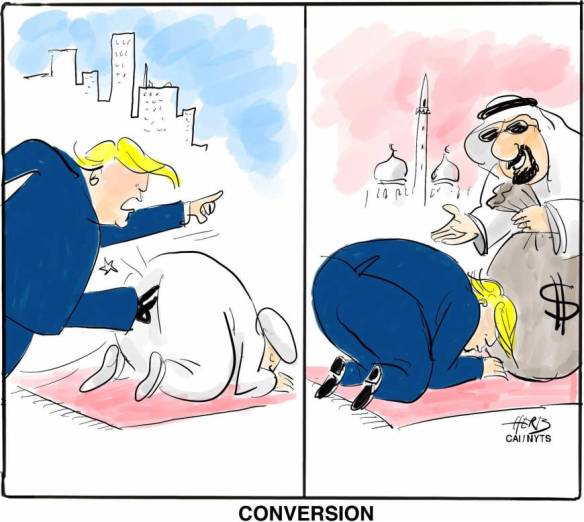
Want evidence that money speaks louder than the international imperative to counter a rapidly metastasizing global jihadi threat, as symbolized by the latest attack in Manchester? Look no further than U.S. President Donald Trump’s recent visit to the world’s chief ideological sponsor of jihadism, Saudi Arabia. The trip yielded business and investment deals for the United States valued at up to almost $400 billion, including a contract to sell $109.7 billion worth of arms to a country that Trump previously accused of being complicit in 9/11.

By exporting Wahhabism — the hyper-conservative strain of Islam that has instilled the spirit of martyrdom and become the source of modern Islamist terror — Saudi Arabia is snuffing out the more liberal Islamic traditions in many countries. Indeed, Saudi Arabia’s Wahhabi fanaticism is the root from which Islamist terrorist organizations ranging from the Islamic State group (which claimed responsibility for the Manchester concert attack) to al-Qaida draw their ideological sustenance.

The Manchester attack, occurring close on the heels of Trump’s Saudi visit, has cast an unflattering light on his choice of a decadent theocracy for his first presidential visit overseas. The previous four U.S. presidents made their first trips to a neighboring ally — either Mexico or Canada, which are flourishing democracies. But Trump, the businessman, always seeks opportunities to strike deals, as underscored by his 100-day trade deal with the world’s largest autocracy, China.

But Trump is not alone. In thrall to Saudi money, British Prime Minister Theresa May traveled to Riyadh six weeks before Trump on her most controversial visit since taking office. As if to signal that a post-Bexit Britain would increasingly cozy up to rich despotic states, May flew to Saudi Arabia shortly after triggering Article 50, an action that started a two-year countdown for her country’s exit from the European Union. She has also stepped up her courting of China and enthusiastically endorsed Beijing’s “One Belt, One Road” program, which many EU states see as lacking in transparency and social and environmental accountability.

Anglo-American support and weapons have aided Saudi war crimes in Yemen, which is now on the brink of famine. Mass starvation would ensue there if the Saudis execute their threat to attack the city of Hodeida, now the main port for entry of Yemen’s food supplies. Britain alone has sold over £3 billion worth of arms to Riyadh since the cloistered Saudi royals began their bombardment and naval blockade of Yemen more than two years ago. While London is planning to sell more weapon systems, Trump’s arms package for the Saudis includes guided munitions that were held up by his predecessor, Barack Obama.

Salvaging the global war on terror demands a sustained information campaign to discredit the ideology of radical Islam. But as long as Saudi Arabia continues to shield its insidious role in aiding and abetting extremism by doling out multibillion-dollar contracts to key powers like the U.S. and Britain, it will be difficult to bring the war on terror back on track.

Trump exemplifies the challenge. In a speech to leaders from across the Muslim world who had gathered in Saudi Arabia, the “Make America Great Again” campaigner championed “Make Islam Great Again.” After earlier saying “Islam hates us” and calling for a “total and complete shutdown” of Muslims entering the U.S., Trump described Islam as “one of the world’s great faiths” and urged “tolerance and respect for each other.”

It was weird, though, that Trump spoke about the growing dangers of Islamic extremism from the stronghold of global jihadism, Saudi Arabia. The new Global Center for Combating Extremist Ideology that he opened in Riyadh promises to stand out as a symbol of U.S. hypocrisy.

The long-standing U.S. alliances with Arab monarchs have persisted despite these royals bankrolling Islamic militant groups and Islamic seminaries in other countries. Trump cannot hope to deliver credible or enduring counterterrorism results without disciplining Saudi Arabia, Qatar and the other oil sheikhdoms that continue to export Islamic radicalism. But he has already discovered that this is no easy task.

For example, the U.S. alliance with Saudi Arabia yields exceptionally huge contracts and investments for the American economy. In short, Saudi Arabia is a cash cow for American defense, energy and manufacturing companies, as the latest mega-deals illustrate.

Against this background, Trump’s embrace of a country that he long excoriated reflects the success of the American “deep state” in taming him. Hyping the threat from Iran, even if it fuels the deep-seated Sunni-Shiite rivalry, helps to bolster U.S. alliances with Arab royals and win lucrative arms contracts.

Ominously, Trump in Saudi Arabia spoke of building a stronger alliance with Sunni countries, with U.S. officials saying the defense arrangements could evolve into an “Arab NATO.” However, the Sunni arc of nations is not only roiled by deep fissures, but also it is the incubator of transnational jihadis who have become a potent threat to secular, democratic states near and far. IS, al-Qaida, the Taliban, Laskar-e-Taiba, Boko Haram and al-Shabaab are all Saudi-inspired Sunni groups that blend hostility toward non-Sunnis and anti-modern romanticism into nihilistic rage.

In this light, Trump’s Sunni-oriented approach could worsen the problems of jihadism and sectarianism, undermining the anti-terror fight.

The murky economic and geopolitical considerations presently at play foreshadow a long and difficult international battle against the forces of terrorism. The key to battling violent Islamism is stemming the spread of the ideology that has fostered “jihad factories.” There can be no success without closing the wellspring of terrorism — Wahhabi fanaticism. But who will have the courage to bell the cat?

A long-standing contributor to The JapanTimes, Brahma Chellaney is a geostrategist and the author of nine books, including “Water, Peace, and War” (Rowman & Littlefield).

© The Japan Times, 2017.

A win comes with a challenge for India

Brahma Chellaney, DNA

Clipboard01Pakistan is an incorrigibly scofflaw state for whom international law matters little. Still, India was left with no option but to haul Pakistan before the International Court of Justice after a secret Pakistani military court sentenced to death a former Indian naval officer, Kulbhushan Jadhav, for being an Indian “spy”. At a time when there was no hope to save Jadhav, the ICJ interim order has come as a shot in the arm for India diplomatically.

However, Pakistan’s response to the provisional but binding order that it does not accept ICJ’s jurisdiction in national security-related matters underscores India’s challenge in dealing with a country that violates canons of civilized conduct and engages in barbaric acts, as exemplified by the recent beheading of two Indian soldiers. The concept of good-neighbourly relations seems alien to Pakistan. For example, in the Kashmir Valley, the Pakistani military establishment is actively promoting civil resistance after its strategy of inciting an armed insurrection against India has yielded limited results.

For years, India has stoically put up with the Pakistani military’s export of terrorism. Even as Pakistan violates the core terms of the Simla peace treaty, India faithfully adheres to the Indus Waters Treaty (IWT).

Significantly, the ICJ’s welcome interim order has followed a string of setbacks suffered by India between 2013 and 2016 in three separate cases before international arbitral tribunals. One case involved a maritime boundary dispute in the Bay of Bengal, with the tribunal awarding Bangladesh almost four-fifths of the disputed territory.

A second case, instituted by Pakistan, related to the IWT and centred on its challenge to India’s tiny 330-megawatt Kishenganga hydropower plant. The third case was filed by Italy over India’s initiation of criminal proceedings against two Italian marines, who were arrested for killing two unarmed Indian fishermen.

Despite apparent flaws in the decisions of the tribunals in all three cases, India abided by them. The ICJ is a higher judicial organ than any tribunal, yet it lacks any practical mechanism to enforce its rulings. If Pakistan does not abide by the ICJ order, it will expose itself thoroughly as a rogue state.

In a world in which power respects power, the international justice system cannot tame a wayward state like Pakistan. In the final analysis, India has to tame Pakistan on its own. The ICJ interim order should not obscure this harsh reality.

© DNA, 2017.

America’s deepening Afghanistan quagmire

Trump needs to break with failed U.S. policies on the Taliban

20170511_Afganistan_USvehicle_article_main_image

A damaged U.S. military vehicle is seen at the site of a suicide bomb attack in Kabul on May 3. © Reuters

Brahma Chellaney, Nikkei Asian Review

The proposed dispatch of several thousand more U.S. troops to war-torn Afghanistan by President Donald Trump’s administration begs the question: If more than 100,000 American troops failed between 2010 and 2012 to bring the Afghan Taliban to the negotiating table, why would adding 3,000 to 5,000 soldiers to the current modest U.S. force of 8,400 make a difference?

For nearly 16 years, the U.S. has been stuck in Afghanistan in the longest and most expensive war in its history. It has tried several policies to wind down the war, including a massive military “surge” under Trump’s predecessor, Barack Obama, to compel the Taliban to sue for peace. Nothing has worked, in large part because the U.S. has continued to fight the war on just one side of the Afghanistan-Pakistan divide and refused to go after the Pakistan-based sanctuaries of the Taliban and its affiliate, the Haqqani network.

As Gen. John Nicholson, the U.S. military commander in Afghanistan, acknowledged earlier this year: “It is very difficult to succeed on the battlefield when your enemy enjoys external support and safe haven.” Worse still, the Taliban is conspicuously missing from the U.S. list of Foreign Terrorist Organizations, while the procreator and sponsor of that medieval militia — Pakistan — has been one of the largest recipients of American aid since 2001, when the U.S. invasion of Afghanistan helped remove the Taliban from power.

The mercurial Trump has revealed no doctrine or strategy relating to the Afghan War. But in keeping with his penchant for surprise, Trump picked Afghanistan for the first-ever battlefield use of GBU-43B, a nearly 10-metric-ton bomb known as the “Mother of All Bombs.” The target, however, was not the U.S. military’s main battlefield enemy — the Taliban — but the so-called Islamic State group, or ISIS, which Gen. Nicholson told the U.S. Senate Armed Services Committee earlier had been largely contained in Afghanistan through raids and airstrikes.

To be sure, Trump has inherited an Afghanistan situation that went from bad to worse under his predecessor. A resurgent Taliban today hold more Afghan territory than ever before, the civilian toll is at a record high, and Afghan military casualties are rising to a level that American commanders warn is unsustainable. In the Taliban’s deadliest assault on Afghan army troops, a handful of militants killed more than 140 soldiers last month at a military base in the northern province of Balkh, prompting the country’s defense minister and chief of army staff to resign.

The enemy’s enemy

Not only is the Taliban militia at its strongest, but also a Russia-organized coalition that includes Iran and China is cozying up to it. Faced with biting U.S.-led sanctions, Russia is aligning with the enemy’s enemy to weigh down the U.S. military in Afghanistan. Indeed, as Russian President Vladimir Putin seeks to expand the geopolitical chessboard on which Moscow can play against the U.S. and the North Atlantic Treaty Organization, a new “Great Game” is unfolding in Afghanistan.

Almost three decades after Moscow ended its own disastrous Afghanistan war, whose economic costs eventually contributed to the collapse of the Soviet Union, Russia has sought to reemerge as an important player in Afghan affairs by embracing a thuggish force that it long viewed as a major terrorist threat — the Taliban. In effect, Russia is trading roles with the U.S. in Afghanistan: In the 1980s, U.S. President Ronald Reagan promoted jihad against the Soviet invasion of Afghanistan, with the Central Intelligence Agency training and arming thousands of Afghan mujahedeen — the violent jihadists from which al-Qaeda and the Taliban evolved.

Today, the growing strains in U.S.-Russia relations — with Trump saying “we’re not getting along with Russia at all, we may be at an all-time low” — threaten to deepen the American military quagmire in Afghanistan. Trump came into office wanting to befriend Russia yet, with the sword of Damocles hanging over his head over alleged election collusion with Moscow, U.S.-Russian ties have only deteriorated. Russia has signaled that it is in a position to destabilize the U.S.-backed government in Kabul in the way Washington has undermined Syrian President Bashar Assad’s Moscow-supported regime by aiding Syrian rebels. Gen. Nicholson has suggested that Russia has started sending weapons to the Taliban.

Against this background, the odds are stacked heavily against the U.S. reversing the worsening Afghanistan situation and “winning again,” as Trump wants, especially if his administration follows in the footsteps of the previous two U.S. governments by not recognizing Pakistan’s centrality in Afghan security. Trump’s renewed mission in Afghanistan will fail if Washington does not add sticks to its carrots-only approach toward the Pakistani military, which continues to aid the Taliban, the Haqqani network and other terrorist groups.

No counterterrorism campaign has ever succeeded when militants have enjoyed cross-border havens. The Taliban are unlikely to be routed or seek peace as long as they can operate from sanctuaries in Pakistan, where their top leaders are ensconced. Their string of battlefield victories indeed gives them little incentive to enter into serious peace negotiations.

Still, the U.S. has been reluctant to go after the Taliban’s command and control base in Pakistan in order to preserve the option of reaching a Faustian bargain with the militia. For eight years, Obama pursued the same failed strategy of using inducements, ranging from billions of dollars in aid to the supply of lethal weapons, to nudge the Pakistani military and its rogue Inter-Services Intelligence agency to target the Haqqani network and get the Taliban to the negotiating table. According to Obama’s special representative for Afghanistan and Pakistan, Richard G. Olson, the U.S. has no “fundamental quarrel” with the Taliban and seeks a deal.

Troop surge

If the recent visit of Trump’s national security adviser, Gen. H.R. McMaster, to Afghanistan and Pakistan is any indication, a fundamental break with the Obama approach is still not on the cards. In fact, the Trump team has proposed reemploying the same tool that Obama utilized in vain — a troop surge, although at a low level.

To compound matters, Trump is showing himself to be a tactical, transactional president whose foreign policy appears guided by the axiom “Speak loudly and carry a big stick.” In dropping America’s largest non-nuclear bomb last month in Afghanistan’s eastern Nangarhar province, Trump was emboldened by the ease of his action days earlier in ordering missile strikes against a Syrian air base while eating dessert — “the most beautiful piece of chocolate cake that you’ve ever seen” — with Chinese President Xi Jinping.

It is easy to drop a massive bomb or do missile strikes and appear “muscular,” but it is difficult to figure out how to fix a broken policy. This is the dilemma Trump faces over Afghanistan. In the same Pakistan-bordering area where the “Mother of All Bombs” was dropped, two U.S. soldiers were killed in fighting just days later.

Unlike Obama, who spent eight years experimenting with various measures, extending from a troop surge to a drawdown, Trump does not have time on his side. Obama, with excessive optimism, declared in late 2014 that “the longest war in American history is coming to a responsible conclusion.” The reverse happened: Security in Afghanistan worsened rapidly. The Taliban rebuffed his peace overtures, despite Washington’s moves to allow the group to establish a de facto diplomatic mission in Qatar and to trade five senior Taliban leaders jailed at Guantanamo Bay for a captured U.S. Army sergeant.

Today, the very survival of Afghan President Ashraf Ghani’s government is at stake. Problems are rapidly mounting for the beleaguered government, which has presided over steadily deteriorating security. Its hold on many districts looks increasingly tenuous even before the approaching summer brings stepped-up Taliban attacks.

The revival of the “Great Game” in Afghanistan, meanwhile, threatens to complicate an already precarious security situation in South, Central and Southwest Asia.

If the U.S. continues to experiment, it will court a perpetual war in Afghanistan, endangering a key base from where it projects power regionally. The central choice Trump must make is between seeking to co-opt the Taliban through a peace deal, as Obama sought, and going all out after its command and control network in Pakistan. An Afghanistan settlement is likely only when the Taliban has been degraded and decapitated.

Brahma Chellaney is a geostrategist and the author of nine books, including “Water, Peace, and War.”

© Nikkei Asian Review, 2017.

Asia’s American Menace

A column internationally syndicated by Project Syndicate.

p8-Chellaney-a-20170501-870x580

US President Donald Trump’s approach to foreign policy – based on tactics and transactions, rather than strategic vision – has produced a series of dazzling flip-flops. Lacking any guiding convictions, much less clear priorities, Trump has confounded America’s allies and strategic partners, particularly in Asia – jeopardizing regional security in the process.

To be sure, some of Trump’s reversals have brought him closer to traditional US positions. In particular, he has declared that NATO is “no longer obsolete,” as it supposedly was during his campaign. That change has eased some of the strain on the US relationship with Europe.

But in Asia – which faces serious security, political, and economic challenges – Trump’s reversals have only exacerbated regional volatility. With so many political flashpoints threatening to trigger violent conflict, the last thing Asia’s leaders need is another strategic wild card.

Yet, in Trump, that is precisely what they have. The US president has shown himself to be more mercurial than the foul-mouthed Philippine President Rodrigo Duterte or the autocratic Chinese President Xi Jinping. Even the famously impulsive North Korean dictator Kim Jong-un seems almost predictable, by comparison.

Perhaps the most consistent feature of Trump’s foreign policy is his obsession with gaining short-term advantage. In one recent tweet, he asked why he should label China a currency manipulator, when the Chinese are working with the US to rein in North Korea. Just days earlier, Trump had called the Chinese the “world champions” of currency manipulation.

That tweet may offer additional insight into Trump’s Asia policy. For starters, it highlights North Korea’s sudden emergence as Trump’s main foreign-policy challenge, suggesting that the strategic patience pursued by former President Barack Obama could well be replaced by a more accident-prone policy of strategic tetchiness.

This reading is reinforced by Vice President Mike Pence’s claims that the recent low-risk, low-reward US military strikes in Syria and Afghanistan demonstrate American “strength” and “resolve” against North Korea. Such claims reflect a lack of understanding that, when it comes to North Korea, the US has no credible military option, because any US attack would result in the immediate devastation of South Korea’s main population centers.

The Trump administration’s current strategy – counting on China to address the North Korea challenge – won’t work, either. After all, North Korea has lately been seeking to escape China’s clutches and pursue direct engagement with the US.

Given the bad blood between Xi and Kim, it seems that Trump’s best bet might be some version of what he proposed during the campaign: meeting with Kim over a hamburger. With the North Korean nuclear genie already out of the bottle, denuclearization may no longer be a plausible option. But a nuclear freeze could still be negotiated.

Trump’s reliance on China to manage North Korea won’t just be ineffective; it could actually prove even more destabilizing for Asia. Trump, who initially seemed eager to challenge China’s hegemonic ambitions, now seems poised to cede more ground to the country, compounding a major foreign-policy mistake on the part of the Obama administration.

Of all of Trump’s reversals, this one has the greatest geostrategic significance, because China will undoubtedly take full advantage of it to advance its own objectives. From its growing repression of political dissidents and ethnic minorities to its efforts to upend the territorial status quo in Asia, China constantly tests how far it can go. Under Obama, it got away with a lot. Under Trump, it could get away with even more.

Trump now calls China a friend and partner of his administration – and seems to have developed a fondness for Xi himself. “We have a great chemistry together,” he says. “We like each other. I like him a lot.”

That fondness extends beyond words: Trump’s actions have already strengthened Xi’s position – and undercut his own – though Trump probably didn’t realize it. First, Trump backed down from his threat not to honor the “one China” policy. More recently, Trump hosted Xi at his Florida resort, without requiring that China dismantle any of the unfair trade and investment practices that he railed against during the campaign.

The summit with Trump boosted Xi’s image at home ahead of the Chinese Communist Party’s 19th National Congress later this year, where Xi may manage to break free from institutionalized collective rule to wield power more autocratically than any Chinese leader since Mao Zedong. It also indicated the Trump administration’s tacit acceptance of China’s territorial grabs in the South China Sea. This will embolden China not just to militarize fully its seven manmade islands there, but also to pursue territorial revisionism in other regions, from the East China Sea to the western Himalayas.

Trump believes that “lots of very potentially bad problems will be going away,” owing to his relationship with the “terrific” Xi. In fact, his promise to “Make America Great Again” is antithetical to Xi’s “Chinese dream” of “rejuvenating the Chinese nation.”

Xi’s idea, which Trump is unwittingly endorsing, is that their countries should band together in a “new model of great power relations.” But it is hard to imagine how two countries with such opposing worldviews – not to mention what Harvard University’s Graham Allison has called “extreme superiority complexes” – can oversee world affairs effectively.

It is conceivable that Trump could flip again on China (or North Korea). Indeed, Trump’s policy reversals may well turn out to be more dangerous than his actual policies. The need for constant adjustment will only stoke greater anxiety among America’s allies and partners, who now run the risk that their core interests will be used as bargaining chips. If those anxieties prompt some countries to build up their militaries, Asia’s strategic landscape will be fundamentally altered.

© 1995-2017 Project Syndicate.

A rogue neighbour’s new rogue act

BRAHMA CHELLANEY | DNA, April 17, 2017

religious-extremism-and-terrorism-in-pakistan-1482784770-3959

Periodically, Pakistan’s Inter-Services Intelligence (ISI) offers fresh evidence that it remains a rogue agency. This includes the year-long saga involving its abduction from Iran of a former Indian naval officer, Kulbhushan Jadhav, who was recently sentenced to death by a secret military court in Pakistan for being an Indian “spy”. The case indeed stands out as a symbol of the thuggish conduct of an irredeemably scofflaw state.

Just because Pakistan alleges that Jadhav was engaged in espionage against it cannot justify the ISI’s kidnapping of him from Iran or his secret, mock trial in a military court. Under the extra-constitutional military court system — established after the late 2014 Peshawar school attack — judicial proceedings are secret, civilian defendants are barred from engaging their own lawyers, and the “judges” (not necessarily possessing law degrees) render verdicts without being required to provide reasons.

The military courts show, if any evidence were needed, that decisive power still rests with the military generals, with the army and ISI immune to civilian oversight. In fact, the announcement that Jadhav had been sentenced to death with the Pakistani army chief’s approval was made by the military, not the government, despite its major implications for Pakistan’s relations with India.

Add to the picture the Pakistani military’s ongoing state-sponsored terrorism against India, Afghanistan and even Bangladesh. Jadhav’s sentencing was a deliberate — but just the latest — provocation against India by the military, which has orchestrated a series of terrorist attacks on Indian security bases since the beginning of last year.  It is clear that Pakistan is in standing violation of every canon of international law.

The right of self-defence is embedded as an “inherent right” in the UN Charter. India is entitled to defend its interests against the terrorism onslaught by imposing deterrent costs on the Pakistani state and its terrorist agents, including the ISI.

Unfortunately, successive Indian governments have failed to pursue a consistent and coherent Pakistan policy. As a result, the Pakistani military feels emboldened to persist with its roguish conduct.

Like his predecessors, Manmohan Singh and Atal Bihari Vajpayee, Prime Minister Narendra Modi has pursued a meandering policy toward the congenitally hostile Pakistan. Modi has played the Pakistan card politically at home but not lived up to his statements on matters ranging from Balochistan to the Indus Waters Treaty. Indeed, there has been visible backsliding on his stated positions. For example, the suspended Permanent Indus Commission has been revived.

The Modi government talks tough in public but, on policy, acts too cautiously. For example, it persuaded Rajeev Chandrasekhar to withdraw his private member’s bill in the Rajya Sabha for India to declare Pakistan as a state sponsor of terrorism. India has shied away from imposing any kind of sanctions on Pakistan or even downgrading the diplomatic relations.

When history is written, Modi’s unannounced Lahore visit on Christmas Day in 2015 will be viewed as a watershed. If the visit was intended to be a peace overture, its effect was counterproductive. Modi’s olive branch helped transform his image in Pakistani military circles from a tough-minded, no-nonsense leader that Pakistan must not mess with to someone whose bark is worse than his bite.

Within days of his return to New Delhi, the ISI scripted twin terrorist attacks on India’s forward air base at Pathankot and the Indian consulate in Mazar-i-Sharif, Afghanistan, as New Year’s gifts to Modi. Worse was India’s response: It shared intelligence with Pakistan about the Pakistani origins of the Pathankot attackers while the four-day siege of the base was still on and then hosted a Pakistani inquiry team — all in the naïve hope of winning Pakistan’s anti-terrorism cooperation. In effect, India shared intelligence with an agency that it should have branded a terrorist entity long ago — the ISI.

An emboldened Pakistani military went on to orchestrate more attacks, with the Indian inaction further damaging Modi’s strongman image. Subsequently, the deadly Uri army-base attack, by claiming the lives of 19 Indian soldiers, became Modi’s defining moment. It was the deadliest assault on an Indian military facility in more than a decade and a half. Sensing the danger of being seen as little more than a paper tiger, Modi responded with a limited but much-hyped cross-border military operation by para commandos against terrorist bases.

The Indian public, whose frustration with Pakistan had reached a tipping point, widely welcomed the surgical strike as a catharsis. The one-off strike, however, did not deter the Pakistani military, which later staged the attack on India’s Nagrota army base. Modi’s response to that attack was conspicuous silence.

Recurrent cross-border terror attacks by ISI have failed to galvanize India into devising a credible counterterrorism strategy. Employing drug traffickers, the ISI is also responsible for the cross-border flow of narcotics, which is destroying public health in India’s Punjab. In fact, the Pathankot killers — like the Gurdaspur attackers — came dressed in Indian army uniforms through a drug-trafficking route.

In reality, the Pakistani military is waging an undeclared war against an India that remains adrift and reluctant to avenge even the killing of its military personnel. There are several things India can do, short of a full-fledged war, to halt the proxy war. But India must first have clear strategic objectives and display political will.

Reforming the Pakistani military’s behaviour holds the key to regional peace. After all, all the critical issues — border peace, trans-boundary infiltration and terrorism, and nuclear stability — are matters over which the civilian government in Islamabad has no real authority because these are preserves of the Pakistani military.

The Jadhav case illustrates that, as long as New Delhi recoils from imposing deterrent costs on Pakistan, the military there will continue to up the ante against India. Indeed, it has turned Jadhav into a bargaining chip to use against India. The battle to reform against Pakistan’s roguish conduct is a fight India has to wage on its own by translating its talk into action.

The author is a strategic thinker and commentator.

© DNA, 2017.

Trump’s foreign policy muddle

p7-Chellaney-a-20170401-870x346

Brahma Chellaney, The Japan Times, April 1, 2017

U.S. President Donald Trump came to office vowing to end what he saw as China’s free ride on trade and security issues that has allowed it to flex its muscles more strongly than ever. But as he prepares to host Chinese President Xi Jinping at Mar-a-Lago, there is little sign that Trump’s China approach thus far is different to that of his predecessor, Barack Obama, on whose watch Beijing initiated coercive actions with impunity in the South and East China seas.

Besieged by allegations of collusion between his campaign associates and Russia, Trump — to Beijing’s relief — has found little space to revamp his predecessor’s policy and take on China.

In contrast to his tough talk during his presidential campaign, when he famously said he would not “allow China to rape our country, and that’s what they’re doing,” Trump is seeking a cooperative relationship with China but grounded in flinty reciprocity. He has abandoned campaign promises to impose a punitive 45% tariff on Chinese goods and brand China a currency manipulator.

EQUAL OPPORTUNITY IN ASIA

In fact, underscoring how the U.S. still seeks to balance its bilateral relationships with important powers in Asia, Trump invited Xi to Mar-a-Lago — his private estate in Palm Beach, Florida, that he calls the “Southern White House” — because he wants to offer the leader of the world’s largest autocracy the same hospitality that he extended to the prime minister of China’s archrival, Japan, Asia’s oldest democracy. In February, Trump brought Prime Minister Shinzo Abe to Mar-a-Lago on Air Force One for a weekend of working lunches and golf.

Balancing U.S. ties with Japan and China was integral to the Obama foreign policy. Even while extending U.S. security assurances to Japan over the disputed Senkaku Islands in 2014, Obama emphasized that his administration was committed to encouraging China’s “peaceful rise” and urged Japan to shun “provocative actions.” Trump, in keeping with the softer line he has taken toward China after his February 9 discussion with Xi by telephone, has sought to forge a personal connection with Abe while also extending a hand of friendship to China’s “core” leader.

Xi-Trump photoThe wily Xi, during his impending two-day visit to Mar-a-Lago, will seek to capitalize on Trump’s penchant to cut deals. Indeed, Trump, the author of The Art of the Deal, appears eager to strike deals with Xi on trade and security issues — back-door deals that could potentially leave America’s allies in Asia out in the cold.

For example, to tackle the little bully, North Korea, Trump (like Obama) is seeking the help of the big bully, China, which has sought to please Washington by banning further imports this year of North Korean coal.

As the White House stated on March 20, it wants China to “step in and play a larger role” in relation to North Korea, which a Trump administration official has exaggeratingly portrayed as the “greatest immediate threat.” But the previous two U.S. administrations also relied on sanctions and Beijing to tame North Korea, only to see that reclusive nation significantly advance its nuclear and missile capabilities.

A greater U.S. reliance on China is unlikely to salvage Washington’s failed North Korea policy, but it will almost certainly result in Beijing exacting a stiff price from the Trump administration, including with respect to the South China Sea.

Beijing, in the initial test of wills, has already savored success in scuttling Trump’s effort to modify America’s longstanding “one China” policy.

Music to Beijing’s ears

Secretary of State Rex Tillerson’s recent visit to Beijing, in fact, suggested that the U.S. is willing to bend over backward to curry favor with China. Instead of delivering a clear message in Beijing, Tillerson transformed into a Chinese parrot, mouthing China’s favorite catchphrases like “mutual respect,” “non-confrontation” and “win-win” cooperation that are code for the U.S. accommodating China’s core interests and accepting a new model of bilateral ties that places the two powers essentially on an equal footing to decide Asia’s future, thus relegating U.S. allies and partners such as Japan and India to a secondary status.

It was music to Chinese ears as Tillerson echoed several Chinese bromides about the U.S.-China relationship, including “win-win” cooperation — a phrase Chinese analysts impishly refer to as entailing a double win for China.

For Beijing, the tag “mutual respect” holds great strategic importance: It is taken to mean that the U.S. and China would band together (in a sort of Group of Two) to manage international problems by respecting each other’s “core interests.” This, in turn, implies that the U.S. would avoid challenging China on the Taiwan and Tibet issues and in Beijing’s new “core-interest” area — the South China Sea.

Tillerson, in effect, compounded the Obama administration’s mistake in embracing Xi’s idea of a “new model of great power relations” between Washington and Beijing in 2013, over four years after Secretary of State Hillary Clinton helped foster the narrative of the U.S. propitiating China by famously declaring that Washington would not let human rights interfere with other issues it had with Beijing.

Worse still, Tillerson articulated the catchphrases by parroting Chinese President Xi Jinping’s words. For example, Xi said in November 2014 during a joint news conference with Obama in Beijing that, “China is ready to work with the United States to make efforts in a number of priority areas and putting into effect such principles as non-confrontation, non-conflict, mutual respect, and win-win cooperation.” Tillerson repeated the exact four principles twice in Beijing.

In his opening remarks at a March 18 news conference with Chinese Foreign Minister Wang Yi, Tillerson said: “Since the historic opening of relations between our two countries more than 40 years ago, the U.S.-China relationship has been guided by an understanding of non-conflict, non-confrontation, mutual respect, and win-win cooperation.” Later that day, at the start of talks with Wang, Tillerson again parroted the same catchphrases: “U.S.-China relationship … has been a very positive relationship built on non-confrontation, no conflict, mutual respect, and always searching for win-win solutions.”

Tillerson’s words were gleefully splashed all over the official Chinese media. For example, the Global Times gloated: “Xi highlighted the significance of the Sino-U.S. relationship and Tillerson expressed the U.S.’s commitment to the principle of non-conflict, non-confrontation, mutual respect and win-win cooperation in terms of developing its ties with China, which is exactly the core content of the China-raised major power relationship between Beijing and Washington.” It pointed out the Obama administration did not use those phrases.

To be sure, U.S. Defense Secretary Jim Mattis struck a different tone subsequently, telling a Senate Appropriations Committee hearing that China pursues a “tribute nation” approach to other states and aspires for “veto power” over their sovereign decisions. Still, the direction of Trump’s China policy appears more uncertain than ever.

Soft South China Sea Stance

This could make a clearer American stance against China’s territorial revisionism in Asia doubtful. Washington elites believe that friendly relations with China are indispensable to American interests. Indeed, there is talk in Washington that the Trump administration has little choice but to accept China’s territorial gains in the South China Sea.

Such acceptance, however tacit, is likely to hold security implications for America’s allies and security partners in Asia, because it will embolden Chinese revisionism in other regions — from the East China Sea to the Himalayas — while allowing China to consolidate its penetration and influence in the South China Sea. After deploying antiaircraft and other short-range weapon systems on all seven of its manmade islands in the South China Sea, Beijing is now building structures on three of them to place longer range surface-to-air missiles.

Under Obama, the U.S. made the most of Asian concerns over China’s increasingly muscular approach by strengthening military ties with U.S. allies in Asia and forging security relationships with new friends like India. However, there was little credible American pushback against China’s violation of international law in changing the status quo or against its strategy to create a Sinosphere of client nations through the geopolitically far-reaching “one belt, one road” initiative.

Tillerson, during his confirmation process, implicitly criticized Obama’s pussyfooting on China by describing Chinese expansion in the South China Sea as “akin to Russia’s taking Crimea” from Ukraine. He said the U.S. should “send China a clear signal” by blocking its access to the artificial islands it has built. But later he retreated, saying the U.S. ought to be “capable” of restricting such access in the event of a contingency.

Trump’s ascension to power was bad news for Beijing, especially because his “Make America Great Again” vision collides with Xi’s “Chinese dream” to make this the “Chinese century.” Yet China thus far has not only escaped any punitive American counteraction on trade and security matters, but also the expected Trump-Xi bonhomie at Mar-a-Lago could advertise that the more things change, the more they stay the same in U.S. foreign policy.

Brahma Chellaney, a longtime contributor to The Japan Times, is a geostrategist and the author of nine books, including “Water, Peace, and War.”

© The Japan Times, 2017.

Putin’s Dance with the Taliban

A column internationally syndicated by Project Syndicate.

p7-Chellaney-a-20170309Russia may be in decline economically and demographically, but, in strategic terms, it is a resurgent power, pursuing a major military rearmament program that will enable it to continue expanding its global influence. One of the Kremlin’s latest geostrategic targets is Afghanistan, where the United States remains embroiled in the longest war in its history.

Almost three decades after the end of the Soviet Union’s own war in Afghanistan – a war that enfeebled the Soviet economy and undermined the communist state – Russia has moved to establish itself as a central actor in Afghan affairs. And the Kremlin has surprised many by embracing the Afghan Taliban. Russia had long viewed the thuggish force created by Pakistan’s rogue Inter-Services Intelligence agency as a major terrorist threat. In 2009-2015, Russia served as a critical supply route for US-led forces fighting the Taliban in Afghanistan; it even contributed military helicopters to the effort.

Russia’s reversal on the Afghan Taliban reflects a larger strategy linked to its clash with the US and its European allies – a clash that has intensified considerably since Russia’s 2014 annexation of Crimea spurred the US and Europe to impose heavy economic sanctions. In fact, in a sense, Russia is exchanging roles with the US in Afghanistan.

In the 1980s, US President Ronald Reagan used Islam as an ideological tool to spur armed resistance to the Soviet occupation. Reasoning that the enemy of their enemy was their friend, the CIA trained and armed thousands of Afghan mujahedeen – the jihadist force from which al-Qaeda and later the Taliban evolved.

Today, Russia is using the same logic to justify its cooperation with the Afghan Taliban, which it wants to keep fighting the unstable US-backed government in Kabul. And the Taliban, which has acknowledged that it shares Russia’s enmity with the US, will take whatever help it can get to expel the Americans.

Russian President Vladimir Putin hopes to impose significant costs on the US for its decision to maintain military bases in Afghanistan to project power in Central and Southwest Asia. As part of its 2014 security agreement with the Afghan government, it has secured long-term access to at least nine bases to keep tabs on nearby countries, including Russia, which, according to Putin’s special envoy on Afghanistan, Zamir Kabulov, “will never tolerate this.”

More broadly, Putin wants to expand the geopolitical chessboard, in the hope that he can gain sufficient leverage over the US and NATO to wrest concessions on stifling economic sanctions. Putin believes that, by becoming a major player in Afghanistan, Russia can ensure that America needs its help to extricate itself from the war there. This strategy aligns seamlessly with Putin’s approach in Syria, where Russia has already made itself a vital partner in any effort to root out the Islamic State (ISIS).

In cozying up to the Taliban, Putin is sending the message that Russia could destabilize the Afghan government in the same way the US, by aiding Syrian rebels, has undermined Bashar al-Assad’s Russian-backed regime. Already, the Kremlin has implicitly warned that supply of Western anti-aircraft weapons to Syrian rebels would compel Russia to arm the Taliban with similar capabilities. That could be a game changer in Afghanistan, where the Taliban now holds more territory than at any time since it was ousted from power in 2001.

Russia is involving more countries in its strategic game. Beyond holding a series of direct meetings with the Afghan Taliban, Russia has hosted three rounds of trilateral Afghanistan-related discussions with Pakistan and China in Moscow. A coalition to help the Afghan Taliban, comprising those three countries and Iran, is emerging.

General John Nicholson, the US military commander in Afghanistan, seeking the deployment of several thousand additional American troops, recently warned of the growing “malign influence” of Russia and other powers in the country. Over the past year, Nicholson told the US Senate Armed Services Committee, Russia has been “overtly lending legitimacy to the Taliban to undermine NATO efforts and bolster belligerents using the false narrative that only the Taliban are fighting [ISIS].”

The reality, Nicholson suggested, is that Russia’s excuse for establishing intelligence-sharing arrangements with the Taliban is somewhat flimsy. US-led raids and airstrikes have helped to contain ISIS fighters within Afghanistan. In any case, those fighters have little connection to the Syria-headquartered group. The Afghan ISIS comprises mainly Pakistani and Uzbek extremists who “rebranded” themselves and seized territory along the Pakistan border.

In some ways, it was the US itself that opened the way for Russia’s Afghan strategy. President Barack Obama, in his attempt to reach a peace deal with the Taliban, allowed it to establish a de facto diplomatic mission in Qatar and then traded five senior Taliban leaders who had been imprisoned at Guantánamo Bay for a captured US Army sergeant. In doing so, he bestowed legitimacy on a terrorist organization that enforces medieval practices in the areas under its control.

The US has also refused to eliminate militarily the Taliban sanctuaries in Pakistan, even though, as Nicholson admitted, “[i]t is very difficult to succeed on the battlefield when your enemy enjoys external support and safe haven.” On the contrary, Pakistan remains one of the world’s largest recipients of US aid. Add to that the Taliban’s conspicuous exclusion from the US list of Foreign Terrorist Organizations, and it is difficult for the US credibly to condemn Russia’s overtures to the Taliban and ties with Pakistan.

The US military’s objective of compelling the Taliban to sue for “reconciliation” was always going to be difficult to achieve. Now that Russia has revived the “Great Game” in Afghanistan, it may be impossible.

© 1995-2017 Project Syndicate.

Averting an accidental war on the Korean Peninsula

p8-chellaney-a-20170321-870x616

BY BRAHMA CHELLANEY, The Japan Times, March 21, 2017

North Korea’s rapid nuclear and missile advances and America’s rushed deployment of a ballistic missile defense system known as the Terminal High Altitude Area Defense (THAAD) in South Korea have increased the risks of a war on the Korean Peninsula by accident or miscalculation.

U.S. President Donald Trump may be battling the “deep state” at home but, in hastening THAAD’s deployment, his administration has acted proactively to present a fait accompli to the next South Korean president. The new president is to be elected in a snap poll in May after South Korea’s Constitutional Court recently upheld the National Assembly’s impeachment of President Park Geun-hye over alleged corruption. It was the conservative Park who agreed last July to the THAAD placement, triggering grassroots protests, especially in the area where the system was to be deployed.

The THAAD issue increasingly has become divisive in South Korean politics, and the liberals’ presidential hopeful, Moon Jae-in, has said the system’s deployment unnecessarily escalates tensions on the peninsula. However, anticipating that the Constitutional Court would oust Park and that Moon could win the presidential election, the Trump administration began THAAD’s placement early this month.

Trump, during his own election campaign, gleefully challenged diplomatic orthodoxy, including American foreign policy’s long-standing principles and shibboleths. Yet by implementing his predecessor’s THAAD decision with enthusiasm to speed up the system’s deployment, Trump has offered an example of how he is embracing key pillars of the previous administration’s foreign policy.

Two fundamental issues raised by the THAAD placement, however, cannot be obscured.

First, the deployment has been necessitated by the abysmal failure of the U.S.-led strategy to squeeze North Korea with ever-increasing international sanctions while shunning any diplomatic engagement with it. The sanctions-only approach, far from stymieing North Korea’s development of weapons of mass destruction, has only encouraged it to single-mindedly advance its nuclear-weapons and missile capabilities.

In the decade since the United States froze all diplomatic contact with North Korea, that reclusive communist nation has gone from possessing rudimentary WMD capabilities to testing advanced systems that pose a regional threat. For example, it tested a nuclear device last September whose yield, as recorded by outside seismic monitoring stations, was twice as powerful as the atomic bomb that the U.S. dropped on Hiroshima in 1945. Since last year, Pyongyang has also tested solid-fueled missile systems, including one that can launched from a submarine.

And second, the THAAD deployment, although arising from a failed American strategy, is no plausible answer to North Korea’s nuclearization. Indeed, this is a case of the supposed remedy being worse than the disease.

The deployment could counterproductively lead to North Korea (and China, which fears that THAAD’s sophisticated X-Band radar could track its missile forces) aiming to defeat the defensive system by developing greater offensive capability. In fact, China and Russia believe that the THAAD placement is part of a larger American plan to establish a fence of antimissile systems around them and thereby undermine their nuclear deterrents.

Let’s be clear: THAAD cannot credibly protect South Korea from the North’s tactical or short-range ballistic missiles. Designed for high-altitude intercepts, THAAD is geared mainly to interdict medium- and intermediate-range ballistic missiles.

Given South Korea’s relatively small land size, an attack by the North may not necessitate the use of medium- or intermediate-range missiles. Metropolitan Seoul, which has almost as many residents as North Korea’s total population of 25 million, is located just 40 km from the Demilitarized Zone dividing the two Koreas.

North Korea has a virtual artillery choke-hold on Seoul that THAAD cannot neutralize. This is why the U.S. lacks a realistic option to militarily degrade the North’s nuclear and missile capabilities without provoking Pyongyang to unleash its artillery power against Seoul or triggering an all-out war. The absence of credible techno-military options against North Korea is also underscored by the reported failure of the U.S. to undermine Pyongyang’s nuclear and missile programs through coordinated cyber and electronic strikes in recent years.

In this light, THAAD’s political symbolism is greater than its military utility. The system, in any case, has never been battle-tested.

But rather than enhance South Korea’s security, including by reassuring its citizens, the THAAD deployment threatens to make South Koreans more insecure through an action-reaction cycle. For example, the Stalinist regime in Pyongyang may now plan, in a combat scenario, to fire many missiles simultaneously so as to defeat THAAD.

Against this background, a new strategy is needed to stem the growing risk that a small mishap could escalate to a full-fledged war. U.S. President Barack Obama employed sanctions with engagement to clinch a nuclear deal with Iran yet, throughout his eight-year tenure, pursued a completely different approach toward North Korea — sanctions without engagement.

Given that the threat posed by North Korea’s weapons of mass destruction has reached a level defying solution through technological or military means, diplomacy must come into play to reduce tensions. For long, North Korea has sought direct talks with Washington. Trump, during his campaign, said that he would be willing to meet with North Korean ruler Kim Jong Un over a hamburger.

If the THAAD placement is not to prove counterproductive, Washington must shift to a policy of sanctions with engagement toward Pyongyang, with the ultimate goal of clinching a WMD deal as part of a comprehensive peace treaty replacing the Korean War armistice. South Korea has even a bigger stake in engagement with the North in order to reduce the costs it will bear if Korean Peninsula reunification were to occur.

Brahma Chellaney, a longtime contributor to The Japan Times, is a geostrategist and the author of nine books, including “Water, Peace, and War.”

© The Japan Times, 2017.

A rising power without allies

p8-chellaney-a-20170307-870x648

BY BRAHMA CHELLANEYThe Japan Times

The more power China has accumulated, the greater has been its difficulty in gaining genuine allies, underscoring that leadership demands more than brute might. Contrast this with the strong network of allies and partners that the United States maintains in the Asia-Pacific region and elsewhere. The withering of China’s special relationship with North Korea, once its vassal, illustrates Beijing’s dilemma.

Last year, Admiral Harry Harris, commander of the U.S. Pacific Command, said “we have allies, friends and partners where China does not,” while U.S. Secretary for Defense Ash Carter asserted that Beijing is “erecting a great wall of self-isolation.”

The rapid deterioration in Beijing’s ties with North Korea — which boasts good reserves of iron ore, coal, magnesite, graphite, copper, zinc and other minerals — is sure to increase China’s sense of being alone.

Indeed, when Pyongyang recently accused China of “mean behavior” and “dancing to America’s tune,” it underscored not only its ruptured relationship with its powerful neighbor but also the fact that Beijing is now left with just one real ally, Pakistan. Quasi-failed Pakistan, although a useful tool for Beijing to contain India, is a dubious ally for China in the larger context.

China’s rift with Pyongyang has followed the considerable weakening of Beijing’s once-tight hold on Myanmar, another country rich in natural resources — from oil and gas to jade and timber. Today, the Beijing-Pyongyang relationship is at its lowest point since the founding of North Korea in 1948.

The reported fatal poisoning of North Korean ruler Kim Jong Un’s estranged half brother, Kim Jong Nam, at Kuala Lumpur International Airport, represents a major setback for China. Beijing valued him — a faded playboy with residences in Macau and Beijing — as a key asset against the North Korean dictator.

To be clear, China’s vaunted “blood relations” with North Korea have been souring since Kim Jong Un came to power after the death of his father, Kim Jong Il, in December 2011.

Since then, Kim Jong Un has been trying to show that North Korea is no client-state of China, including by rekindling the “juche” ideology of self-reliance. He has defied Beijing by repeatedly conducting nuclear and missile tests and signaled that he wants North Korea to escape from China’s clutches through better relations with the United States — an appeal that has gone unheeded in Washington.

Kim Jong Nam’s death, of course, is a blow not just for China but also for South Korea and the U.S., which had milked him for any intelligence he could provide on the inner workings of the Stalinist regime in Pyongyang. These three countries, recognizing the importance of the Kim family bloodline in dynastic North Korea, had indeed cultivated him as a potential replacement for his half brother. The North Korean ruler thus had ample reason to get rid of Kim Jong Nam.

Earlier in 2013, Pyongyang executed China’s most valued friend in the North Korean power hierarchy — Jang Song Thaek, a four-star general who was Kim Jong Un’s uncle by marriage. Jang, a mentor to Kim Jong Nam and Beijing’s main link to Pyongyang, was accused by the regime of abusing his power to favor China, including by underselling resources like coal, land and precious metals.

At the center of the growing China-North Korea tensions, however, is the bad blood between Kim Jong Un, who at 33 remains the world’s youngest head of state, and Chinese President Xi Jinping, nearly twice as old as him.

When Xi paid a state visit to South Korea in mid-2014, he overturned decades of tradition in which Chinese leaders always visited North Korea first. Xi has yet to travel to Pyongyang, just as Kim Jong Un has refused to visit Beijing. Paying obeisance in Beijing, however, was customary for Kim’s grandfather and father: Kim Il Sung, the founder of the state, paid 37 official visits to China, while his son and successor, Kim Jong Il, went nine times.

The young ruler’s effort to chart an independent course has sparked a sustained propaganda campaign against him in recent years by China’s state media, which has accused him of pursuing “de-Sinification” of his country and seeking to unlock ties with the U.S. and Japan.

Despite its exasperation, China’s options against the Kim regime are limited, given the fact that it does not want the North Korean state to unravel — a scenario that will result in a reunified and resurgent Korea allied with the U.S. The prospect of American troops on its border is a nightmare for China, which explains why it intervened in the Korean War when the U.S. Army crossed the 38th parallel and threatened to advance toward the Chinese border.

For centuries, China has seen the Korean Peninsula as its strategic Achilles’ heel — a region that offers foreign powers an attractive invasion route or a beachhead for attacking China.

Today, China has territorial and resource disputes with North Korea that a reunified Korea would inherit and rail against. The territorial disputes center on Chonji, the crater lake on Mount Paektu (where a 33-km stretch of the Sino-Korean boundary has not been settled) and certain islands in the Yalu and Tumen rivers, whose courses broadly define the frontier between the two countries.

Indeed, as if to signal that its present border with North Korea is not final, China has posted a revisionist historical claim that the ancient kingdom of Koguryo — founded in the Tongge River basin of northern Korea — was Chinese, not Korean, as believed by international historians. A 2012 U.S. Senate report warned that China “may be seeking to lay the groundwork for possible future territorial claims on the Korean Peninsula.”

Against this background, China sees status quo on the Korean Peninsula as serving its interest best. It will likely accept Korean reunification only if it leads to a “Finlandized” Korea making permanent strategic concessions to it.

China’s strongest action against North Korea to date — the recently imposed suspension of coal imports — can be ascribed to the “Trump effect.” U.S. President Donald Trump’s less predictable line, reflected in his wavering on the “one-China” policy and his tougher stance on Chinese expansion in the South China Sea, has prompted Beijing to take this action to blunt U.S. criticism that it is not doing enough to implement United Nations sanctions.

But China’s growing tensions with Pyongyang mean that the value of the North Korea card in Beijing’s dealings with the U.S. is likely to erode. For years, the U.S. has outsourced the North Korea issue to Beijing by offering it concessions. Today, far from credibly serving as Washington’s intermediary with North Korea, China is smarting from Pyongyang’s open disdain for it.

Still, China must grapple with the larger question of whether it can be a peer rival to the U.S. without any allies.

Brahma Chellaney, a longtime contributor to The Japan Times, is a geostrategist and the author of nine books, including “Water, Peace, and War.”

© The Japan Times, 2017.