A Global Environmental Threat Made in China

From large-scale dam-building to unbridled resource-exploitation, human activity is causing serious damage to Himalayan ecosystems. While all the countries in the region are culpable to some extent, none is doing as much harm as China.

a476b39b5c95b531412b6baca5fcbaa5.2-1-super.1

BRAHMA CHELLANEY, a column internationally syndicated by Project Syndicate

Asia’s future is inextricably tied to the Himalayas, the world’s tallest mountain range and the source of the water-stressed continent’s major river systems. Yet reckless national projects are straining the region’s fragile ecosystems, resulting in a mounting security threat that extends beyond Asia.

With elevations rising dramatically from less than 500 meters (1,640 feet) to over 8,000 meters, the Himalayas are home to ecosystems ranging from high-altitude alluvial grasslands and subtropical broadleaf forests to conifer forests and alpine meadows. Stretching from Myanmar to the Hindu-Kush watershed of Central Asia, the Himalayas play a central role in driving Asia’s hydrological cycle and weather and climate patterns, including triggering the annual summer monsoons. Its 18,000 high-altitude glaciers store massive amounts of freshwater and serve in winter as the world’s second-largest heat sink after Antarctica, thus helping to moderate the global climate. In summer, however, the Himalayas turn into a heat source that draws the monsoonal currents from the oceans into the Asian hinterland.

The Himalayas are now subject to accelerated glacial thaw, climatic instability, and biodiversity loss. Five rivers originating on the Great Himalayan Massif – the Yangtze, the Indus, the Mekong, the Salween, and the Ganges – rank among the world’s ten most endangered rivers.

From large-scale dam construction to the unbridled exploitation of natural resources, human activity is clearly to blame for these potentially devastating changes to the Himalayan ecosystems. While all the countries in the region are culpable to some extent, none is doing as much harm as China.

Unconstrained by the kinds of grassroots activism seen in, say, democratic India, China has used massive, but often opaque, construction projects to bend nature to its will and trumpet its rise as a great power. This includes a globally unmatched inter-river and inter-basin water-transfer infrastructure with the capacity to move over ten billion cubic meters (13 billion cubic yards) through 16,000 kilometers (9,940 miles) of canals.

China’s reengineering of natural river flows through damming – one-fifth of the country’s rivers now have less water flowing through them each year than is diverted to reservoirs – has already degraded riparian ecosystems and caused 350 large lakes to disappear. With these water-diverting projects increasingly focused on international, rather than internal, rivers – in particular those in the Tibetan Plateau, which covers nearly three-quarters of the Himalayan glacier area – the environmental threat extends far beyond China’s borders.

And dams are just the beginning. The Tibetan Plateau is also the subject of Chinese geo-engineering experiments, which aim to induce rain in its arid north and northwest. (Rain in Tibet is concentrated in its Himalayan region.) Such activities threaten to suck moisture from other regions, potentially affecting Asia’s monsoons. Ominously, such experiments are an extension of the Chinese military’s weather-modification program.

Moreover, as if to substantiate the Chinese name for Tibet, Xizang(“Western Treasure Land”), China is draining mineral resources from this ecologically fragile but resource-rich plateau, without regard for the consequences. Already, copper mine tailings are polluting waters in a Himalayan region sacred to Tibetans, which they call Pemako (“Hidden Lotus Land”), where the world’s highest-altitude major river, the Brahmaputra (Yarlung Tsangpo to Tibetans), curves around the Himalayas before entering India.

Last fall, the once-pristine Siang – the Brahmaputra’s main artery – suddenly turned blackish gray as it entered India, potentially because of China’s upstream tunneling, mining, or damming activity. To be sure, the Chinese government claimed that an earthquake that struck southeastern Tibet in mid-November “might have led to the turbidity” in the river waters. But the water had become unfit for human consumption long before the quake.

In any case, China is not letting up. It has, for example, eagerly launched large-scale operations to mine precious minerals like gold and silver in a disputed area of the eastern Himalayas that it seized from India in a 1959 armed clash.

Meanwhile, China’s bottled-water industry – the world’s largest – is siphoning “premium drinking water” from the Himalayas’ already-stressed glaciers, particularly those in the eastern Himalayas, where accelerated melting of snow and ice fields is already conspicuous. Unsurprisingly, this is causing biodiversity loss and impairment of ecosystem services.

Across the Himalayas, scientists report large-scale deforestation, high rates of loss of genetic variability, and species extinction in the highlands. The Tibetan Plateau, for its part, is warming at almost three times the average global rate. This holds environmental implications that extend far beyond Asia.

The towering Himalayan Highlands, particularly Tibet, influence the Northern Hemisphere’s atmospheric-circulation system, which helps to transport warm air from the equator toward the poles, sustaining a variety of climate zones along the way. In other words, Himalayan ecosystem impairment will likely affect European and North American climatic patterns.

Halting rampant environmental degradation in the Himalayas is now urgent, and it is possible only through cooperation among all members of the Himalayan basin community, from the lower Mekong River region and China to the countries of southern Asia. To bring about such cooperation, however, the entire international community will have to apply pressure to rein in China’s reckless environmental impairment, which is by far the greatest source of risk.

Brahma Chellaney, Professor of Strategic Studies at the New Delhi-based Center for Policy Research and Fellow at the Robert Bosch Academy in Berlin, is the author of nine books, including Asian JuggernautWater: Asia’s New Battleground, and Water, Peace, and War: Confronting the Global Water Crisis.

© Project Syndicate, 2018.

U.S. injects new irritant in ties with India

Brahma Chellaney, Mail Today

Robin-sanctions-américaines-UE

U.S. President Donald Trump’s first round of Iran-related sanctions has come into force this week, with no waiver for India in sight as yet. The U.S. Congress has passed legislation granting India a waiver from its new Russia-centred sanctions, but the waiver is conditional and contingent upon a periodic, six-monthly presidential certification. The Indian media highlighted the passing of the waiver legislation but not the conditions it incorporated.

India, as a longstanding significant buyer of Russian weapons and the second-largest importer of Iranian oil after China, is a major victim of the new U.S. sanctions. By implicitly mounting two-pronged pressure on New Delhi on energy and defence fronts, Washington has injected a major new irritant in the bilateral relationship, as if to underscore the risks for India of pursuing a foreign policy too closely aligned with America.

By slapping a nation with punitive sanctions, the U.S. seeks to block trade and financial activities with that country even by other states. Such extraterritorial sanctions — which it euphemistically labels “secondary” sanctions — run counter to international law. Yet the U.S. uses its unmatched power to turn national actions into global measures.

As the world’s reserve currency that greases the wheels of the global financial system, the U.S. dollar arms America with tremendous leverage, making U.S. sanctions the most powerful in the world. Most international transactions, from banking to oil, are conducted in U.S. dollars.

Today, however, the U.S. faces a major test to effectively enforce its new extraterritorial sanctions relating to Iran, a Trump obsession, and Russia, which still evokes bipartisan hostility in Washington although Russia’s economy has shrunk to one-tenth the size of China’s and its military spending to one-fifth of China’s.

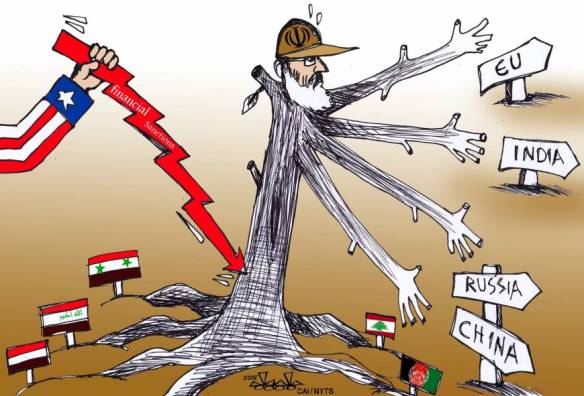
Trump’s sanctions aimed at throttling the Iranian economy after his unilateral withdrawal from the multilateral Iran nuclear deal have prompted calls for defiance even in Europe. The new Russia sanctions, however, were initiated by Congress, which passed a law to compel the Trump administration to act against Moscow. Known as Countering America’s Adversaries Through Sanctions Act, or CAATSA, the law uses the sanctions threat to wean countries off their craving for Russian weapons so as to boost America’s own arms sales.

The U.S. is already the world’s leading exporter of weapons by far. Another paradox is that the U.S. has overtaken Russia as the top arms seller to India. But while Russia has transferred to India offensive weapons, including a nuclear-powered submarine (INS Chakra) and an aircraft carrier (INS Vikramaditya), the U.S. has been selling defensive military systems to India, such as the P-8I maritime surveillance aircraft and the C-17 Globemaster III and C-130J Super Hercules military transport planes. India cannot snap its defence ties with Moscow for another reason: It relies on Russian spare parts for maintenance of its Russian-made hardware, some of Soviet origin.

While the CAATSA waiver will allow India to go ahead with the pending purchase from Russia of the interceptor-based S-400 Triumf air and anti-missile defence system, future Indian imports from Russia are likely to face U.S. scrutiny. In fact, the waiver legislation mandates that India, Vietnam and Indonesia — the three countries granted waivers from the CAATSA sanctions — demonstrate that each is significantly reducing dependence on Russian arms or significantly increasing cooperation with the U.S.

The congressional intent was clearly to leverage the waiver. For example, a presidential certification must specify the active steps each nation is taking or planning to cut its inventory of Russian hardware. Such a reporting requirement, by shining a spotlight on India’s arms inventory, promises to act as an irritant in the bilateral relationship. Washington is also stepping up pressure on India to sign the Communications Compatibility and Security Agreement (COMCASA), which the Indian military fears could compromise its network.

The reason why only India, Indonesia and Vietnam were granted waivers is that the U.S. is trying to sway these three into its orbit. In the case of Turkey, a NATO member that, like India, is buying the S-400, Congress is threatening reprisals against Ankara. U.S. pressure on India, Indonesia and Vietnam, however, is unlikely to fully dissipate because no blanket waivers have been granted.

Meanwhile, through its Iran-related sanctions, the U.S. is likely to influence the energy-import policy of India, which currently imports more than three-fourth of its crude oil requirements. According to the International Energy Agency, India is set to emerge as the fastest-growing crude consumer in the world by 2040. Washington is seeking to sell more oil and gas to India and also encouraging it to switch imports from Iran to Saudi Arabia and other U.S. allies.

Next-door Iran, however, has long been a major oil supplier to India. It will remain important for India’s energy-import diversification strategy. U.S. sanctions, however, threaten to affect even New Delhi’s political cooperation with Tehran, including impeding India’s Pakistan-bypassing transportation corridor to Afghanistan via Iran. India has invested in modernizing the Chabahar Port. As the top U.S. general in Afghanistan acknowledged last year, “Iranian-Indian-Afghan cooperation over the Chabahar Port presents great economic potential” for landlocked Afghanistan, which has had to depend on a hostile Pakistan for access to a port.

By making India a key target of the extraterritorial effects of its sanctions on Iran and Russia, and then dangling concessions as favours, the U.S. is doing a disservice to its goal of making the Indo-U.S. strategic partnership a linchpin of its larger strategy to build a free, open and democratic-led Indo-Pacific region. Its actions compound India’s foreign-policy challenges, including how to balance the relationships with various key players.

Brahma Chellaney is a geostrategist and the author.

© Mail Today, 2018.

Trump’s Grand Strategy

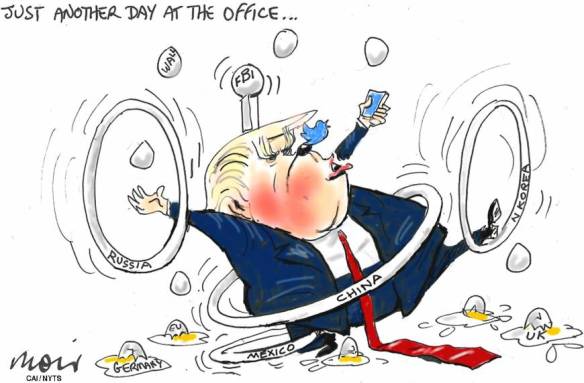
p8-chellaney-a-20180802-870x572

As unpredictable as Trump can be, several of his key foreign-policy decisions suggest that his administration is pursuing a coherent vision aimed at reviving America’s global power.

BRAHMA CHELLANEY, a column internationally syndicated by Project Syndicate

US President Donald Trump’s inability to think strategically is undermining longstanding relationships, upending the global order, and accelerating the decline of his country’s global influence – or so the increasingly popular wisdom goes. But this assessment is not nearly as obvious as its proponents – especially political adversaries and critics in the mainstream US media – claim.

America’s relative decline was a hot topic long before Trump took office. The process began when the United States, emboldened by its emergence from the Cold War as the world’s sole superpower, started to overextend itself significantly by enlarging its military footprint and ramping up its global economic and security commitments.

America’s “imperial overreach” was first identified during President Ronald Reagan’s administration, which oversaw a frenetic expansion of military spending. It reached crisis levels with the 2003 US-led invasion and subsequent occupation of Iraq under President George W. Bush – a watershed moment that caused irreparable damage to America’s international standing.

On President Barack Obama’s watch, China rapidly expanded its global influence, including by forcibly changing the status quo in the South China Sea (without incurring any international costs). By that point, it was unmistakable: the era of US hegemony was over.

It is not just that Trump cannot be blamed for America’s relative decline; he may actually be set to arrest it. As unpredictable as Trump can be, several of his key foreign-policy moves suggest that his administration is pursuing a grand strategy aimed at reviving America’s global power.

For starters, the Trump administration seems eager to roll back America’s imperial overreach, including by avoiding intervention in faraway wars and demanding that allies pay their fair share for defense. The fact is that many NATO members do not fulfill their spending commitments, effectively leaving American taxpayers to subsidize their security.

These are not new ideas. Before Trump even decided to run for office, pundits were arguing that the US needed to pursue a policy of retrenchment, drastically reducing its international commitments and transferring more of its defense burden onto its allies. But it was not until Trump, who views running a country much like running a business, that the US had a leader who was willing to pursue that path, even if it undermined the values that have long underpinned US foreign policy.

Trump’s focus on containing China – which FBI Director Christopher Wray recently labeled a far bigger challenge than Russia, even in the area of espionage – fits nicely into this strategy. Successive US presidents, from Richard Nixon to Obama, aided China’s economic rise. Trump, however, regards China not as America’s economic partner, but as “a foe economically” and even, as the official mouthpiece China Daily recently put it, America’s “main strategic rival.”

In general, Trump’s tariffs aim to put the US back in control of its economic relationships by constraining its ballooning trade deficits, with both friends and foes, and bringing economic activity (and the accompanying jobs) back home. But it is no secret that, above all, Trump’s tariffs target China – a country that has long defied international trade rules and engaged in predatory practices.

Meanwhile, Trump is also working to ensure that China does not catch up with the US technologically. In particular, his administration seeks to thwart China’s “Made in China 2025” program, the blueprint unveiled by the Chinese government in 2015 for securing global dominance over ten strategic high-tech industries, from robotics to alternative-energy vehicles.

Trump’s diplomatic activities seem intended to advance this larger strategic vision of reversing America’s relative decline. He has tried to sweet-talk autocratic leaders, from North Korea’s Kim Jong-un to Russia’s Vladimir Putin, into making concessions – an approach that has garnered its share of criticism. But Trump’s compliments have not translated into kowtowing.

For example, despite all the controversy over Russia’s interference in the 2016 presidential election, the fact is that, since Trump took office, the US has expelled Russian diplomats, closed a Russian consulate, and imposed three rounds of sanctions on the country. His administration is now threatening to apply extraterritorial sanctions to stop other countries from making “significant” defense deals with Russia, a leading arms exporter.

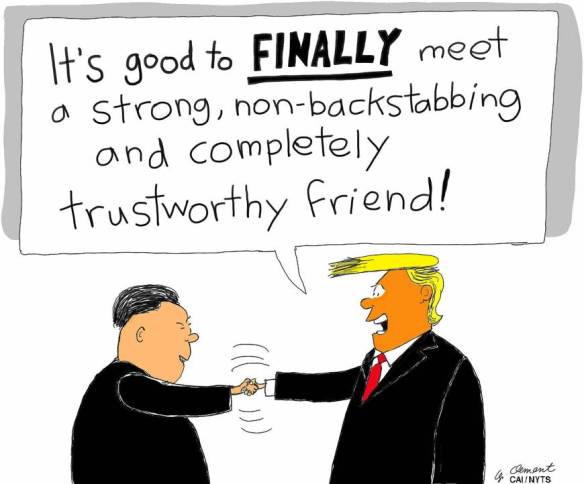
Trump has not flattered any foreign leader more than Chinese President Xi Jinping, whom he called “terrific” and “a great gentleman.” Yet, again, when Xi refused to yield to Trump’s demands, the US president did not hesitate to hit back “using Chinese tactics,” including suddenly changing negotiating positions and unpredictably escalating trade tensions.

Even Trump’s direct approach with North Korea undermines China’s position by bypassing it. Trump is right that transforming the US-North Korea relationship matters more than securing complete denuclearization. If he can co-opt North Korea, China’s only formal military ally, northeast Asian geopolitics will be reshaped and China’s lonely rise will be more apparent than ever.

There are plenty of problems with Trump’s methods. His brassy, theatrical, and unpredictable negotiating style, together with his China-like disregard for international norms, are destabilizing international relations. Domestic troubles like political polarization and legislative gridlock – both of which Trump has actively exacerbated – also weaken America’s hand internationally.

But there is no denying that Trump’s muscular “America First” approach – which includes one of the most significant military buildups since World War II – reflects a strategic vision that is focused squarely on ensuring that the US remains more powerful than any rival in the foreseeable future.

Perhaps more important, the transactional approach to international relations on which Trump’s strategy relies is likely to persist long after he leaves office. Friends and foes alike must get used to a more self-seeking America doing everything in its power, no matter the cost, to forestall its precipitous decline.

Pakistan’s sham election reinforces India’s challenge

599481894682c9ea8ab42e7a68c786a3.2-1-super.1

Why India shouldn’t rush into engaging with the new Imran-led Pakistan

Brahma Chellaney, The Hindustan Times, August 4, 2018

It has taken the Pakistani military a full year to complete the soft coup it launched when it used a pliant judiciary to oust an elected prime minister. The military-engineered election outcome in favour of Imran Khan came virtually on the anniversary of Nawaz Sharif’s removal from office. What happened to Sharif will happen to any PM that seeks to assert civilian control over a praetorian military.

In fact, no PM has been allowed to complete a full five-year term. When a PM falls foul of the deep state, the judiciary, opposition and bureaucracy are used to smear the leader’s reputation and oust him or her. Every PM has been thrown out on charges of corruption and incompetence.

Pakistan’s Supreme Court hanged one elected PM in 1979, ousted another in 2017, and legitimized every military coup. Sharif was ousted without a trial, let alone a conviction. Turning natural justice on its head, the Supreme Court first pronounced him guilty of corrupt practices on the basis of the report of a military intelligence-associated Joint Investigation Team and then ordered his trial post-ouster.

The Sharif removal anniversary last Saturday was a reminder that Prime Minister Narendra Modi’s surprise Lahore visit proved very costly for the now-jailed Sharif and for India, with the Pakistani military responding with a series of daring terrorist attacks on Indian security bases, from Pathankot to Uri and Nagrota. Modi’s visit sealed Sharif’s political fate, with the subsequent Panama Papers leak providing the perfect pretext for ousting him.

For India, this is not just a cautionary tale but also a sobering lesson that policy made on the fly increases the odds of a boomerang effect. So does diplomacy seeking to befriend Pakistan’s civilian government in the hope of both offsetting Pakistani military’s implacable hostility to India and driving a wedge between civilian and military authorities. Such diplomacy has repeatedly recoiled on India. Didn’t Atal Bihari Vajpayee ride a bus to Pakistan and then publicly bewail that his “bus got hijacked and taken to the Kargil battlefield”?

The latest election has changed little in Pakistan, a country still struggling to be at peace with itself. The Pakistani military will remain the puppet master calling the shots from behind the scenes, with Imran as its newest puppet.

The military didn’t just stack the electoral odds in Imran’s favour; it did practically everything to put him in power. It took the general election to literally mean that it was to be run by the generals.

It was the military’s brainchild to bring into the political mainstream the terrorists and militants assisting its belligerent India policy and Afghanistan meddling. In the election, not all the Islamists and militants fared badly. One militant group, Tehreek-i-Labbaik, garnered nearly two million votes. Even in the case of the terrorist-affiliated groups that were routed, the military has largely succeeded in its objective of “mainstreaming” them. The terrorists’ conversion into politicians means not just that they no longer are pariahs; their increasing political footprint in the coming years will likely extend Pakistan’s jihad culture to the polity.

The military has actually scored a double win: The next PM is a supporter of the military-backed jihadists and Islamists. Imran, long ridiculed as “Im the Dim” for his lack of intelligence, has morphed into a religious zealot who plays the blasphemy card and whose party brass includes hardcore extremists like Ijaz Shah, an ex-ISI officer and handler of Hafiz Saeed, Mullah Omar and Daniel Pearl’s murderer. Shah, now in Parliament, also helped hide Osama bin Laden.

Make no mistake: After this contrived election, Pakistan seriously risks slipping deeper into a jihadist dungeon. Its exploding population, resource pressures, a pervasive lack of jobs, high illiteracy and fast-spreading jihadism create a deadly cocktail of internal disarray. Caught in mounting debt to China, it now needs an international bailout.

Successive Indian governments have failed to develop a clear strategy to deal with this Mecca of terrorism. India’s policy pendulum on Pakistan actually swings from one extreme to the other — from vowing a decisive fight to making schmaltzy overtures. While Washington has cut off security assistance to Pakistan and periodically slaps new sanctions on Pakistan-based terrorists, India is loath to back its rhetoric with even modest diplomatic sanctions or by leveraging the Indus Waters Treaty, the world’s most generous water-sharing arrangement. All talk and no action, by undermining Indian deterrence, has invited continuing cross-border terrorism.

Today, instead of rushing to engage Imran, New Delhi should let the new leader establish his bona fide intentions for combating terrorism. Tellingly, in his “victory” speech, he called Kashmir the “core” subject but evaded the central issue for India, Afghanistan, the US and Pakistan’s own future — tackling and terminating the presence of terrorist groups on Pakistani soil.

Brahma Chellaney is a geostrategist and author.

© The Hindustan Times, 2018.

US sanctions policy risks alienating India

https_s3-ap-northeast-1.amazonaws.compsh-ex-ftnikkei-3937bb4images618015040816-1-eng-GBRTR4GK5D

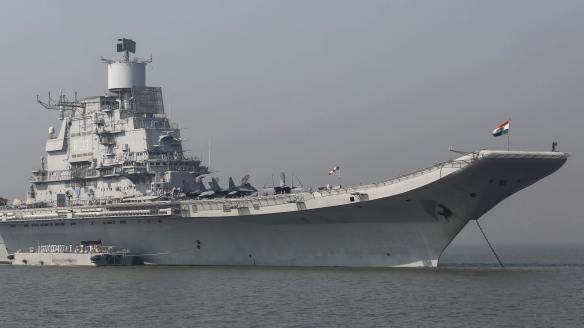
Washington should be mindful of India’s heavy dependence on Iranian oil and Russian arms sales, exemplified by the INS Vikramaditya carrier adopted from Russia.   © Reuters

After hitting New Delhi with Russia and Iran measures, Washington seeks to limit their impact.

When the U.S. slaps a nation with punitive sanctions, it tries to prevent not only American companies from doing business with the target country but also those of other states. Inevitably, these extraterritorial effects hit some countries much harder than others — as India has just found to its cost.

Even though New Delhi has been boosting ties with Washington for over a decade, it is a prime victim of two new sets of U.S. economic sanctions — on Iran and on Russia. These two countries, now at the center of the current American foreign policy debate, are both long-standing economic and political partners for India.

Since New Delhi cannot suddenly wind down the relationships with them without jeopardizing its national security, it must consider carefully how to balance those interests with its growing strategic partnership with the U.S., a top trading and defense partner of India. Washington, for its part, should give maneuvering space to India, a key player in the U.S.’s biggest geopolitical game in the Indo-Pacific region — reining in an increasingly muscular China.

Donald Trump’s unilateral withdrawal from the multilateral Iran nuclear deal, followed by his globally applicable sanctions to choke the Iranian economy, has prompted calls for defiance even from Washington’s close allies in Europe. The U.S. president’s latest offer of direct talks with Iranian leaders may signal a wish to strike a deal but he is a long way off from lifting sanctions.

Extraterritorial sanctions are also at the heart of a new Russia-centered law passed by the U.S. Congress — the Countering America’s Adversaries Through Sanctions Act, or CAASTA. The law hits Russia where it hurts most, its defense and energy businesses.

India, a significant buyer of Russian weapons and the second-largest importer of Iranian oil after China, has been made acutely aware of the risks of aligning itself closer with the U.S.

In actual fact, America has overtaken Russia in recent years as the top arms seller to New Delhi, and also emerged as a source of oil and gas supply to India. But these evolving ties cannot at this stage replace India’s links with Russia and Iran. The U.S. has basically transferred defensive military systems, while Russia has sold India offensive weapons, including a nuclear-powered submarine and an aircraft carrier. India also relies on Russian spare parts for maintenance of its Soviet-origin systems. Meanwhile, in oil, nearby Iran has long been one of India’s top suppliers.

Even before the new Iran sanctions and CAATSA, questions were being asked in India about whether the pro-U.S. foreign policy pursued by successive governments since 2004 had yielded any concrete returns.

One telling point was the tense border standoff between Indian and Chinese troops on the remote Doklam plateau about a year ago, when Washington did not issue a single statement in India’s support but chose to stay neutral, despite a fusillade of Chinese threats to teach India a “lesson.” Many in India have come to believe that New Delhi can rely on an unpredictable and transactional Trump administration only at its peril.

In recent months, Prime Minister Narendra Modi has seemingly attempted to mitigate the risks from his open embrace of the U.S. by seeking to ease tensions with China and reverse a declining relationship with Russia. At his initiative, Modi held separate summit meetings with Chinese President Xi Jinping and Russian President Vladimir Putin in Wuhan and Sochi, respectively. These initiatives were seen in Washington as a subtle attempt to recalibrate ties with the U.S.

Since then, a realization that the new sanctions would be counterproductive to the U.S.’s relations with India and other key partners has led the Trump administration and Congress to separately climb down from their positions that there would be no sanctions exemptions.

Congress this week enacted CAATSA waivers for India and two other countries, while the administration, signaling a readiness to consider granting waivers, has walked back from its pointblank threat to impose sanctions on countries buying Iranian oil beyond its Nov. 4 deadline. The administration has yet to clarify the conditions or duration of any waivers.

However, the Iran-related sanctions, even before entering into force, have already increased the oil import bill of India, the world’s third largest crude importer, by driving up prices.

India, while warning its energy companies of the risk of U.S. sanctions if they do not wind down their trade with Iran by early November, is pressing Washington for sanctions relief. In the previous round of Iran sanctions under Trump’s predecessor, Barack Obama, India secured rolling six-month waivers from U.S. sanctions by showing that it was continuing to reduce its imports of Iranian oil. To sidestep the U.S. financial system, India had to pay Iran in its own currency and accelerate barter trade.

Under CAATSA, Congress deliberately set the bar for any presidential waiver very high so as to tie Trump’s hands on the Russia sanctions. But after Defense Secretary Jim Mattis warned that “the sanctions will only drive strategic partners to buy more Russian hardware and prevent them from buying American in the future,” Congress relented.

Significantly, CAATSA waivers are being granted for the three countries that Washington is trying to bring closer into its orbit — India, Indonesia and Vietnam — but not for Turkey, a NATO member that is, like India, buying the S-400 long-range air and anti-missile defense system from Russia.

U.S. pressure on India, Indonesia and Vietnam, however, is unlikely to fully dissipate because no blanket waivers are being granted. Congress has mandated that each country demonstrate that it is significantly reducing dependence on Russian arms or significantly increasing cooperation with the U.S.

The price the U.S. is seeking to extract from India for a waiver is its signature on two remaining “foundational defense agreements.” After getting India to accept a logistics assistance pact, which includes access to designated Indian military sites, the U.S. is now pushing for India to endorse a secure communications accord (which the Indian military fears could compromise its network) and a geospatial intelligence agreement.

More fundamentally, the U.S. intends to influence the Indian, Indonesian and Vietnamese arms procurement policies. As Mattis told Congress, “we are faced with an once-in-a-lifetime opportunity to decrease Russia’s dominance in key regions.” Indeed, CAATSA was enacted with the intent to shift arms business from Russia — an important weapons seller to China’s potential adversaries, from India to Vietnam and Indonesia — to the U.S., already the world’s top arms exporter.

The Iran sanctions’ impact on India could also impede its loudly touted transportation corridor to Afghanistan via Iran, which includes the Chabahar Port modernization project. This joint India-Iran project, which circumvents any need to cross Pakistani territory, highlights the strategic importance of Tehran for New Delhi.

U.S. foreign policy has long relied on sanctions, despite their uncertain effectiveness and unpredictable consequences. For example, crippling U.S. sanctions prompted Japan’s 1941 Pearl Harbor attack, leading to the Pacific War that ended with the atomic bombing of Hiroshima and Nagasaki.

The newest Iran sanctions, which make China the likely main beneficiary by driving Beijing and Tehran closer together, also underscore the law of unintended consequences.

Ensnaring India in sanctions aimed at punishing Iran and Russia, and then dangling concessions, undermines the U.S. goal of developing a more robust defense relationship with the world’s largest democracy and building a stable power balance in the Indo-Pacific. While the U.S. and India will remain close friends, Washington has gratuitously introduced a major irritant in the relationship that no waivers can fully purge.

Such unilateralism also highlights why the American-led strategy for a free, open and democratic-led Indo-Pacific — aimed at containing China by cooperating with India and other partners — has yet to acquire strategic heft.

Brahma Chellaney is a geostrategist and the author, most recently, of the award-winning “Water, Peace, and War.”

© Nikkei Asian Review, 2018.

Japan’s Pivotal Role in the Emerging Indo-Pacific Order

Brahma Chellaney, Asia-Pacific Review, Volume 25, 2018 – Issue 1

ABSTRACT

The imperative in the Indo-Pacific region is to build a new strategic equilibrium pivoted on a stable balance of power. A constellation of likeminded states linked by interlocking strategic cooperation has become critical to help build such equilibrium. Japanese Prime Minister Shinzo Abe is the author of the “free and open Indo-Pacific” concept that the US is now pushing. But Japan faces important strategic challenges. To secure itself against dangers that did not exist when its current national-security policies and laws were framed, Japan must bolster its security or risk coming under siege. US security interests will be better served by a more confident and secure Japan that assumes greater responsibility for its own defense and for regional security. The US must encourage Japan, which has not fired a single shot against an outside party since World War II, to undertake greater national-security reforms. Peace in Asia demands a proactive Japan.


We live in a rapidly changing world. The past three decades have brought truly revolutionary change. The world has changed fundamentally in a geopolitical sense since the fall of the Berlin Wall. We have seen the most profound geopolitical change in the most compressed timeframe in history. And thanks to the even more rapid pace of technological change, technological forces are now playing a greater role in shaping geopolitics than at any other time in history. Economically, the pace of change has been no less dramatic, leading to global interdependence and lower trade barriers and accelerated growth.

Yet, when we look back over this period of three decades, no analyst foresaw such change coming. For example, no one predicted the collapse of the Soviet Union or the rapid rise of Asia. The Soviet Union collapsed almost like a deck of cards, fundamentally changing global geopolitics. In the economic realm, no analyst foresaw the two processes that have shaped globalization: the denationalization of production and the denationalization of consumption. The denationalization of production has resulted in the stages of production becoming geographically separated, leading to value chains being formed internationally. And the denationalization of consumption has allowed consumers to buy goods and services from places where they are produced more efficiently.

It is safe to say that the next three decades will likely bring changes no less dramatic than what the last three decades witnessed. But no analyst will be able to accurately predict what the next three decades will bring. What we do know is that the Asia-Pacific region holds the key to global security.1 The region is home not only to the world’s fastest-growing economies, but also to the fastest-increasing military expenditures and naval capabilities, the fiercest competition over natural resources, and the most dangerous strategic hot spots.

The increasing use of the term “Indo-Pacific”—which refers to all countries bordering the Indian and Pacific oceans—rather than “Asia-Pacific,” underscores the maritime dimension of today’s tensions. Asia’s oceans have increasingly become an arena of competition for resources and influence. It now seems likely that future regional crises will be triggered and/or settled at sea.

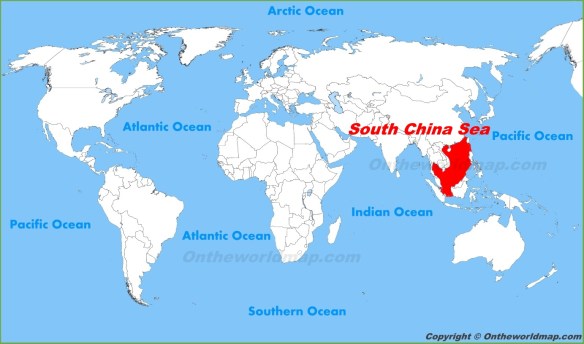
The main driver of this shift has been China. If there is one action by any power that holds the greatest strategic ramifications for global security and the international maritime order, it is China’s alteration of the status quo in the South China Sea in disregard of international norms. Operating in the threshold between peace and war, China, by creating artificial islands in the South China Sea, has pushed its borders far out into international waters in a way no other power has done elsewhere.

Having militarized these outposts and presented this development as a fait accompli to the rest of the world, it is now shifting its focus to the Indian Ocean and the western Pacific. Already, China has established its first overseas military base in Djibouti, located at the northwestern edge of the Indian Ocean region. Moreover, China is planning to open a new naval base next to Pakistan’s Chinese-controlled Gwadar port. And it has leased several islands in the crisis-ridden Maldives, where it is set to build a marine observatory that will provide subsurface data supporting the deployment of nuclear-powered attack submarines (SSNs) and nuclear-powered ballistic missile subs (SSBNs) in the Indian Ocean. In short, China has fundamentally transformed the strategic landscape in the Indo-Pacific, raising new challenges for regional countries like Japan, India, Vietnam, and Australia.

A constellation of likeminded states linked by interlocking strategic cooperation has become critical to help institute power stability. The imperative is to build a new strategic equilibrium, including a stable balance of power. If likeminded states do not step in to counter further challenges to the territorial and maritime status quo, the next five years could firmly entrench China’s strategic advantages. The result could be the ascendancy of a China-led illiberal hegemonic regional order, at the expense of the liberal rules-based order that most countries in the Indo-Pacific support. Given the region’s economic weight, this would create significant risks for global markets and international security.

Japan’s security dilemma

In modern history, Japan, the “Land of the Rising Sun,” has often inspired other Asian states. This is because Japan has had the distinction of mostly staying ahead of the rest of Asia. During the 1868-1912 Meiji era, Japan became Asia’s first modern economic success story. It then went on to become the first Asian country to emerge as a global military power when, between 1895 and 1905, it defeated Manchu-ruled China and Tsarist Russia in separate wars. With much of Asia colonized by Europeans, Russia’s military rout at the hands of the Japanese came as a shot in the arm to Asian independence movements. After Japan’s crushing defeat in World War II, Japan rose from the ashes rapidly to emerge as Asia’s first global economic powerhouse by the 1980s, an industrial dynamo of a kind Asia had never seen.

Specializing in the highest-value links of the global supply chains, Japan today ranks among the world’s richest countries. With its Gini coefficient of 0.25, it boasts the lowest income inequality in Asia, even though income inequality is now rising in this country. Japan’s per capita GDP of about $39,000 means that its citizens are almost five times wealthier than Chinese.

To be sure, Japan’s geopolitical clout has taken a beating due to a quarter-century of sluggish economic growth, a period in which China and the rest of Asia have risen dramatically. But despite the international media depicting Japan’s decline in almost gloomy terms, the truth is that real per-capita income has increased faster in this century in Japan than in the US and Britain, while Japan’s unemployment rate has long remained one of the lowest among the OECD economies. Japan enjoys the highest life expectancy of any large country in the world.

Japan’s trailblazing role in modern history raises the question as to whether its current challenges, including population aging and sluggish economic growth, presage a similar trend across East Asia. Similar problems are now beginning to trouble South Korea, Taiwan, and Hong Kong, while China has been driven to loosen its one-child policy and unveil measures to reverse slowing economic growth.

More fundamentally, Japan—Asia’s oldest liberal democracy—faces pressing security challenges today, at a time of shifting power dynamics in Asia. Japan is an archipelago of almost 7,000 islands, with a population of about 127 million. In terms of land area, Japan is ranked 60th in the world. But Japan’s Exclusive Economic Zone of about 4.5 million square kilometers is the sixth largest in the world; it is larger than China’s. Of the 400 remote islands that serve as markers for determining Japan’s territorial waters, only about 50 are inhabited. No group of islands, of course, poses a bigger challenge for its security than the Senkakus, a clutch of five uninhabited islets and three rocks.

Japan’s challenge is compounded by demographic and military trends. Japan has barely one-tenth the population of China’s. Moreover, its population is not just aging but also shrinking significantly; it declined by nearly a million just between 2010 and 2015. About a decade ago, Japan’s defense budget was larger than China’s. But now China’s military spending surpasses the combined defense expenditures of Japan, Russia, Britain, and France.2 As the power balance in Asia shifts, Japan’s security concerns are accentuating.

Japan’s national-security reforms in recent years are part of its effort to reinvent itself as a more secure and competitive nation. The international spotlight on its prolonged economic woes has helped obscure one of the farthest-reaching but least-noticed developments in Asia in this century—Japan’s quiet political resurgence. Japan has historically punched above its weight—a record punctured only by its crushing World War II defeat. Today, despite achieving a high standard of living, Japan is an increasingly insecure nation. Content for decades to let the United States take care of its security, Japan confronts fast-changing security and power dynamics in Asia, with the rise of a muscular, revisionist China shaking it out of its complacency. It is determined not to accept Chinese regional hegemony.

Still, Japan faces a stark choice: bolster its security or come under siege. It must secure itself against dangers that did not exist when its current national-security policies and laws were framed. This grating reality has prompted Japan to establish the National Security Council and take some long-overdue steps, including easing its longstanding, self-imposed ban on export of arms and asserting the right to exercise “collective self-defense.” The reforms in security policy allow the Japanese military to pursue broader peacekeeping and other combat missions overseas in sync with national interest. More importantly, by removing legal ambiguities on the role Japan can play internationally, the reforms facilitate greater Japanese engagement in multilateral and bilateral arrangements. Earlier, large parts of Japan’s overseas security engagements were open to challenge on constitutionality grounds. By removing ambiguities, the security-policy reforms open the path for Japan to play a more active role multilaterally and bilaterally with friendly countries. For example, the reforms will help facilitate building security collaboration with other countries in ways that reinforce Japan’s own security and shore up an Asian order that is under challenge from Chinese revisionism.

To be clear, the policy moves—designed to “normalize” Japan’s security posture—have thus far been limited in scope and do not open the path to the country becoming a militaristic power. Restrictions on deployment of offensive weapons, for example, remain in place. Yet the moves have proved divisive at home, owing to pacifism remaining deeply embedded in Japanese society, in part because of the painful legacy of Japan’s prewar militarism. The core issue at stake, however, is not whether Japan should remain pacifist (the US-imposed Constitution has made Japan the world’s first constitutionally pacifist nation) but whether it should stay passive in regional and international affairs. Enduring peace in Asia demands a proactive Japan. If the Japanese government is to play a proactive role, it must win over a divided public at home. This is borne out by a Pew Research Center survey: 47% of Americans want Japan to play a more active role in regional security; by contrast, only 23% of Japanese want their country to play a more active role.3

If Japan fails to push further reforms of its postwar institutions and policies to meet the new challenges, it could erode its security. A Japan that is better able to defend itself and to partner with friendly Indo-Pacific countries would be able to forestall the emergence of a destabilizing power imbalance in East Asia. Even US security interests would be better served by a more confident and secure Japan that assumes greater responsibility for its own defense and for regional security. After all, Japan’s policy of pacifism under the US military umbrella seems no longer adequate to shield Japanese interests—or even American interests.

A still-pacifist but proactive Japan would be able to take its rightful place in the world. But to underpin a “proactive contribution to peace”—a term popularized by Prime Minister Shinzo Abe— does Japan need to become a militarily independent power like two of America’s closest allies, Britain or France? Britain and France have built formidable military-deterrent capabilities, rather than entrust their security to the US. Legally, Japan does not have the choice to pursue the nuclear-weapons option. But, even without its abandoning the security treaty with the US, it can build robust conventional-force capabilities, including information-warfare systems, given that the cyber-realm would play an increasingly important role in conflict.

Japan’s domestic constraints

Domestic constraints accentuate Japan’s security dilemma. One example is the difficulty in reforming the Japanese Constitution, which was imposed by the occupying American forces in 1947 after disbanding the Japanese military.4  Being the world’s first constitutionally pacifist nation was something the post-war Japan became proud of. Yet the fact is that no other country in the world is bound by the kind of constitutional restrictions that were imposed on vanquished Japan by an occupying power.

The Constitution prohibits Japan from acquiring the means of war and bars its purely defensive military, called the Self-Defense Forces, from staging rescue missions or other overseas operations even to free Japanese hostages. Indeed, to set up wholly defensive armed forces in the 1950s, Japan had to loosely interpret the Constitution’s force-renouncing Article 9, which says “land, sea, and air forces, as well as other war potential, will never be maintained.” This major reinterpretation was done, paradoxically, at the behest of the US, which, after disbanding the Japanese military, realized the value of building Japan as its loyal vassal on the frontlines of the Cold War.

Yet Japan has clung to that Constitution all these years without so much as carrying out a single amendment or changing even one word. Many other democracies regard their constitutions not as cast in stone but as open to change so that they stay abreast with new social, technological, and economic developments. For example, India—whose Constitution is almost as old as Japan’s—has incorporated 100 amendments thus far. There have been fewer amendments—27—to the U.S. Constitution since its enactment in 1787. No constitution can be perfect. A constitution, like the democratic system it embodies, should be open to improvements.

In this light, Prime Minister Abe has made an impassioned appeal for constitutional reform, suggesting that the time may have come to emulate the same kind of far-reaching change that allowed Japan to rise from the ashes of its World War II defeat. Addressing the Diet, he once asked: “For the future of Japan, shouldn’t we accomplish in this Diet the biggest reform since the end of the war?” Abe’s contention that the Constitution no longer reflects the realities now facing Japan and thus needs to be updated is strengthened by another fact: Germany, also defeated in World War II, has over the years made 59 amendments to its Basic Law, or Constitution, which it adopted when it was under Allied occupation.5

Japan and Germany regained sovereignty from post-World War II military occupation only after embracing constitutional guarantees against any future threats from them to peace. However, West Germany’s new Constitution, while outlawing a war of aggression, authorized military force in self-defense or as part of a collective security agreement. By contrast, Japan’s Article 9 went further, stating that “the Japanese people forever renounce … the threat or use of force as a means of settling international disputes.” By forcing Japan to renounce war as “a sovereign right of the nation,” the Constitution imposed stringent restraints.

One key reason the German Constitution did not contain some of the harsh provisions of the US-imposed Japanese Constitution is that, by the time the German Constitution was drafted in 1949, the Cold War was in full swing, with the US-British-French focus shifting to containing communism. Japan’s constitution was imposed two years earlier. The start of the Cold War with the Soviet Union, coupled with the Communist takeover of China and China’s entry into the Korean War, changed American thinking on the pacifist constitution the US had imposed on Japan. In 1953, while visiting Japan as President Eisenhower’s vice president, Richard Nixon called the US-imposed constitution “a mistake.”

Today, from a legal standpoint, national-security reforms in Japan are linked with constitutional reform. For example, the Japanese armed forces are still called the “Self-Defense Forces.” In the more recent Japanese debate on Japan asserting the right to exercise “collective self-defense,” the focus was on the constitutionality of the move, not on substance or the strategic imperative. In fact, when Abe’s government in July 2014 reinterpreted the Constitution to assert the right to exercise collective self-defense, thus allowing Japan’s military to defend the US and other foreign armed forces even when Japan isn’t under direct attack, critics denounced the reinterpretation as undermining the Constitution. Abe was accused of changing a core element of the Constitution through reinterpretation rather than legislative amendment process. The fact is this reinterpretation was small compared with what the Americans did just years after imposing a Constitution on Japan. Through a major reinterpretation of the Constitution it imposed, the US, following the start of the Cold War, encouraged Japan to rebuild its military as the “Self-Defense Forces” so as to make the country the lynchpin of America’s Asia strategy.

The constitutional-reform push in Japan today faces major domestic obstacles. For one, the Constitution places a high bar to the enactment of any amendment, making it among the hardest in the world to revise. Any amendment must win support of two-thirds majorities in both chambers of Diet and be ratified by more than half of voters in a public referendum. For another, the majority of citizens, including most of the young, today remain comfortable with the present Constitution. After all, pacifism remains deeply ingrained in Japanese society. Indeed, a global poll by the World Values Survey revealed that Japanese rank the lowest in their “willingness to fight for the country,” with only 15.3% of Japanese—compared with 74.2% of Chinese and 57.7% of Americans—expressing readiness to defend their nation.6 Underscoring the youth’s revulsion to war, just 9.5% of Japanese under 30 said they would be willing to fight. In an extension of this attitude, many Japanese regard the Constitution as sacrosanct.

Against this background, if there is one factor that can make a meaningful difference to constitutional reform in Japan, it is American support. US support for such reform will assuage many Japanese that amending the Constitution will not mean repudiating the postwar order that America established in Japan or abandoning Japan’s pacifist policy. The alliance with Japan is central to America’s military role in Asia, including forward US military presence. Japan, for its part, remains a model ally that hosts a large US troop presence, even paying for the upkeep of American forces on its soil—a generous contribution that surpasses the combined host-nation support of America’s 26 other allies, according to a Pentagon report.

US security interests would be better served by a more confident and secure Japan that assumes greater responsibility for its own defense and for regional security. Japan’s national-security and constitutional reforms, in fact, would put its alliance with the US on a sounder footing. If Japan is to take its rightful place in the world, it will have to adapt its post-war institutions and policies to meet the new challenges that confront it. Under Prime Minister Abe’s government, Japan has taken some long-overdue steps to strengthen national security. However, a lot more needs to be done to make Japan more secure, competitive, and internationally engaged.

Japan has an enviable record: It has not fired a single shot against an outside party since World War II. And as a major donor of economic and humanitarian aid, Japan for many decades has been a vital contributor to regional and international peace and security. The US thus must encourage Japan to undertake greater national-security reforms.

China will clearly prefer a Japan that remains dependent on America for its security than a Japan that plays a more independent role. The fact, however, is that the post-1945 system erected by the US is more suited to keep Japan as an American protectorate than to allow Japan to effectively aid the central US objective in the Asia-Pacific—a stable balance of power. A subtle US policy shift that encourages Tokyo to cut its dependence on America and do more for its own security can assist Japan in building a more secure future for itself that helps block the rise of a Sino-centric Asia.

The Senkaku challenge

In 2013, Chinese President Xi Jinping declared much of the East China Sea, including the Senkakus, to be a Chinese air defense zone. Since then, China has stepped up its challenge to Japan’s control over those islands, including through repeated intrusions by its military aircraft and warships. Beijing has hardened its stance by elevating its claim to the Senkakus to a “core interest,” while some in China have gone to the ominous extent of questioning Japan’s sovereignty even over Okinawa.

Against this background, many Japanese have wondered whether the United States would come to Japan’s defense in the event of a Chinese attack on the Senkakus. The 1960 US-Japan Security Treaty states that an armed attack on either country, including the territories under Japan’s administration, would prompt joint action “to meet the common danger.” However, contradictory rhetoric by then US President Barack Obama instilled a sense of skepticism in Japan. Obama publicly affirmed that the US-Japan security treaty covered the Senkakus. But in the same breath he refused to take a position on the islands’ sovereignty and advised Tokyo and Beijing to sort out their dispute peacefully. Obama said the US security treaty with Japan covered the Senkaku Islands because they “are under Japanese jurisdiction,” yet “we also stress that we don’t take a position on the sovereignty of the Senkaku Islands.”

At his April 2014 joint news conference with Abe in Tokyo, Obama, while unveiling his position on the Senkakus, urged Japan to refrain from “provocative actions” and emphasized that his administration was committed to encouraging China’s “peaceful rise.” He stated: “We don’t take a position on final sovereignty determinations with respect to Senkakus, but historically they have been administered by Japan and we do not believe that they should be subject to change unilaterally … In our discussions, I emphasized with Prime Minister Abe the importance of resolving this issue peacefully—not escalating the situation, keeping the rhetoric low, not taking provocative actions, and trying to determine how both Japan and China can work cooperatively together. And I want to make that larger point. We have strong relations with China. They are a critical country not just to the region but to the world. Obviously, with a huge population, a growing economy, we want to continue to encourage the peaceful rise of China.”

How could such doublespeak reassure Japan? In fact, such statements sowed doubt over America’s willingness to go to war with China to back Japan’s territorial rights, in the event of a surprise Chinese invasion of the Senkakus. The Obama administration responded to such doubt by simply saying that “we do not envision that this current tension will rise to that level in any foreseeable scenario.” Add to the picture Obama’s conspicuous inaction and silence on China’s 2012 seizure of the disputed Scarborough Shoal from the Philippines, despite America’s longstanding mutual defense treaty with Manila. That development served as a wakeup call for Japan and other US allies and partners in Asia.

By contrast, the US administration led by President Donald Trump has taken a more clear-cut stance in reassuring Japan that the US would defend it in a confrontation with China over the Senkakus. It has done so without the Obama-style caveat—that Washington does not take sides in the sovereignty dispute and that it calls on China and Japan to resolve their dispute peacefully through dialogue.

In fact, the 2017 Trump-Abe summit at Mar-a-Lago marked the first time that the US commitment to defend Japan’s control over the Senkakus was recorded in a joint statement. The February 12, 2017, Trump-Abe joint statement came out strongly for Senkakus’ defense: “The two leaders affirmed that Article V of the U.S.-Japan Treaty of Mutual Cooperation and Security covers the Senkaku Islands. They oppose any unilateral action that seeks to undermine Japan’s administration of these islands … The United States and Japan oppose any attempt to assert maritime claims through the use of intimidation, coercion or force.” This unambiguous commitment was an important success of Abe’s proactive diplomacy in seeking to build a personal connection with the new US president. Abe was the first foreign leader Trump hosted at Mar-a-Lago, which he calls “The Southern White House.” Earlier, just after Trump’s unexpected election victory, Abe met face-to-face with him by making a special stop in New York en route to the Asia-Pacific Economic Cooperation summit in Peru.

Let us be clear: The Senkaku issue is not just about a seven-square-kilometer real estate or the potential oil and gas reserves that lie around it. The strategically located Senkakus, despite their small size, are critical to maritime security and the larger contest for influence in the East China Sea and the larger Indo-Pacific region.

China is seeking to wage a campaign of attrition against Japan over the Senkakus by gradually increasing the frequency and duration of its intrusions into Japan’s airspace and territorial waters. In doing so, it has made the rest of the world recognize the existence of a dispute and the risks of armed conflict.

To be sure, a focus on changing the territorial status quo is nothing new for Beijing. The People’s Republic of China has been changing the territorial status quo ever since it was founded in 1949. The early forcible absorption of the sprawling Xinjiang and Tibetan Plateau more than doubled China’s landmass. In the 21st century, Chinese expansionism has increasingly relied upon “salami tactics”—a steady progression of small, furtive actions, none of which serves as a casus belli by itself, yet which help to incrementally change facts on the ground in China’s favor. In this manner, China has stealthily occupied much of the remote Himalayan plateau of Doklam, which Bhutan—one of the world’s smallest countries—regards as its integral part. Similarly, China has progressively changed the status quo in the South China Sea in its favor.7

But unlike China’s success in expanding its frontiers in the South China Sea, it has found the going tough in the East China Sea. Indeed, Beijing’s actions have shaken Japan out of its complacency and diffidence and set in motion the strengthening of Japan’s defense capabilities, including arming its far-flung island chain in the East China Sea with a string of anti-ship, anti-aircraft missile batteries. Abe has pledged that Japan will play a “greater role” in East Asian security. It is as if he is responding to Trump’s presidential campaign rhetoric that Japan, which hosts about 54,000 American troops, should do more to defend itself.

One effective way the Trump administration can encourage Japan to do more for its own defense is by lending full support to the Abe-initiated national security and constitutional reform process. Such reforms could help forestall the emergence of a destabilizing power imbalance in East Asia. Japan is already working to constrain China with its own version of Beijing’s “anti-access, area denial” doctrine against the United States. Japan has long been used to practicing passive, checkbook diplomacy. But now it appears intent on influencing Asia’s power balance.

The changing power dynamics in the Indo-Pacific

How rapidly the security situation is changing in the Indo-Pacific region can be gauged from the fact that it was just five years ago that China began building artificial islands in the South China Sea. It has since militarized the newly reclaimed outposts without incurring any significant international costs. The developments in the South China Sea carry far-reaching strategic implications for the Indo-Pacific and for the international maritime order. They also highlight that the biggest threat to maritime peace and security comes from unilateralism, especially altering the territorial or maritime status quo by violating international norms and rules.

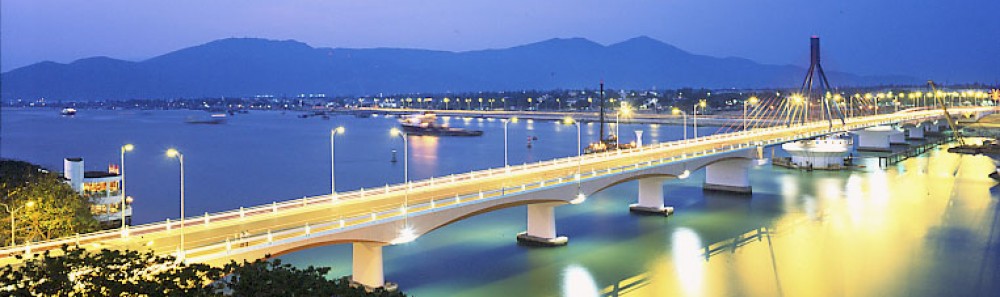
When the US aircraft carrier, Carl Vinson, made a port call at Da Nang, Vietnam, earlier this year, it attracted international attention because this was the first time that a large contingent of US military personnel landed on Vietnamese soil since the last of the American troops withdrew from that country in 1975. The symbolism of this port call, however, failed to obscure the fact that the United States has had no coherent strategy against China’s island-building program. It was on President Obama’s watch that China created and militarized the artificial islands, while his successor, Donald Trump, has focused on North Korea, Iran, and trade; the South China Sea is not even on his radar.

As a result, China, with its expanding diplomatic, economic, and military reach, is incrementally imposing its will on the region. For example, soon after the USS Carl Vinson’s visit, Chinese pressure forced Vietnam to suspend a major oil-drilling project in the South China Sea. The project, located off Vietnam’s southeastern coast, was being led by the Spanish energy firm Repsol, which, along with its partners, had already invested nearly $200 million in it. Now Repsol is asking Vietnam for compensation.

In response to China’s creation of artificial islands, the United States has repeatedly sent warships to sail through nearby waters in “Freedom of Navigation Operations“ (FONOPs).8 Such operations, however, cannot make up for the absence of a coherent US strategy in the South China Sea; they neither deter China nor reassure America’s regional allies. After all, FONOPs do not address the rapidly shifting dynamics in the region brought about by China’s island-building strategy and its militarization of disputed features in international waters. China is asserting increasing control over the South China Sea, including by installing sophisticated weapons on the islands it controls. In doing so, it is gaining de facto control of the region’s hydrocarbon resources, estimated at 190 trillion cubic feet of natural gas and 11 billion barrels of oil in proved and probable reserves.9

In essence, such developments mean that China’s cost-free change of the status quo in the South China Sea has resulted in costs for other countries, especially those in Asia—from Japan and the Philippines to Vietnam and India. Countries bearing the brunt of China’s recidivism have been left with difficult choices, especially as Beijing has made its determination clear to push ahead with its revisionist policies. Japan has reversed a decade of declining military outlays, while India has revived stalled naval modernization. Smaller countries, however, are in no position to challenge China. Instead, the Philippines, for example, has proposed joint oil-and-gas exploration with China in the South China Sea.

Make no mistake: The rapidly changing maritime dynamics in the Indo-Pacific are injecting greater strategic uncertainty and raising geopolitical risks. Today, the fundamental choice in the region is between a liberal, rules-based order and an illiberal, hegemonic order. As America’s National Security Strategy report stated in December 2017, “A geopolitical competition between free and repressive visions of world order is taking place in the Indo-Pacific region.”10 Abe is the author of the “free and open Indo-Pacific” concept that the Trump administration is now pushing.

Few would like to live in an illiberal, hegemonic order. Yet this is exactly what the Indo-Pacific will get if regional states do not get their acts together. There is consensus among all important players other than China for an open, rules-based Indo-Pacific. Playing by international rules is central to peace and security, yet progress has been slow and tentative in promoting wider collaboration to advance regional stability and power equilibrium.

For example, the institutionalization of the Australia-India-Japan-US “Quadrilateral Initiative,” or Quad, has yet to take off. In this light, the idea of a “Quad plus two” to include France and Britain seems overly ambitious at this stage. Once the Quad takes concrete shape, Britain and France could, of course, join. They both have important naval assets in the Indo-Pacific. During French President Emmanuel Macron’s 2018 New Delhi visit, France and India agreed to reciprocal access to each other’s naval facilities. This accord is similar to India’s Logistics Exchange Memorandum of Agreement (LEMOA) with the United States.

Unless the Quad members start coordinating their approaches to effectively create a single regional strategy and build broader collaboration with other important players, Indo-Pacific security could come under greater strain. If Southeast Asia, a region of 600 million people, is coerced into accepting Chinese hegemony in such circumstances, it will have a cascading geopolitical impact in the Indo-Pacific and beyond.

Against this background, what is at stake in the East and South China Seas is not just some tiny islands (or “rocks,” as perceived by some in the US) but a rules-based regional order, freedom of navigation of the seas and skies, access to maritime resources, and balanced power dynamics in Asia. Consequently, America’s allies and partners are stepping up efforts to build credible military capabilities and assume more responsibility for their own defense.

Looking ahead, Japan—with the world’s third largest economy, a world-class navy, and impressive high-technology skills—is likely to stay a strong nation, despite being eclipsed by China’s rapid rise. Japan may not share Beijing’s obsession with measures of national power, yet Japan’s military establishment, despite lacking a nuclear deterrent, is sophisticated. As a status quo power, Japan does not need to match Chinese military prowess; defense is easier than offense. However, a Japan that fails to adapt its postwar national-security policies and laws to the new geopolitical realities of today could create a power vacuum that invites conflict. Peace in Asia demands a proactive Japan. Whatever steps Japan takes to address its security dilemma are likely to carry profound implications for Asian and international security.

About the author

Brahma Chellaney is a geostrategist and author. He is presently a professor of strategic studies at the independent Center for Policy Research in New Delhi; a Richard von Weizsäcker Fellow of the Robert Bosch Academy in Berlin; and an affiliate with the International Centre for the Study of Radicalization at King’s College London. He is the author of nine books, including an international bestseller, Asian Juggernaut, and the award-winning Water, Peace and War. He held appointments at Harvard University, the Brookings Institution, the Paul H. Nitze School of Advanced International Studies at Johns Hopkins University, and the Australian National University. He is also a columnist and commentator. His opinion articles appear in the Nikkei Asian Review, Wall Street Journal, Financial Times, Le Monde, The Guardian, Japan Times, The Globe and Mail, South China Morning Post, and other important newspapers. And he has often appeared on CNN and BBC, among others.

Notes

1 Thomas Mahnken and Dan Blumenthal (eds.), Strategy in Asia: The Past, Present, and Future of Regional Security (Palo Alto, California: Stanford University Press, 2014); Aaron Friedberg, A Contest for Supremacy: China, America, and the Struggle for Mastery in Asia (New York: W.W. Norton, 2012); Robert Kaplan, Monsoon: The Indian Ocean and the Future of American Power (Random House, 2011); and Kishore Mahbubani, The New Asian Hemisphere: The Irresistible Shift of Global Power to the East (New York: Public Affairs, 2009).

2 Stockholm International Peace Research Institute, Trends in World Military Expenditures, 2017 (Stockholm, SIPRI, May 2018).

3 Bruce Stokes, “5 facts to help understand the US-Japan relationship,” Pew Research Center, April 7, 2015, available at: https://goo.gl/qp92NR.

The Constitution of Japan, promulgated on November 3, 1946; came into effect on May 3, 1947. Full text at: https://goo.gl/R1wViX.

5 Deutscher Bundestag, Basic Law for the Federal Republic of Germany, available at: https:// www.btg-bestellservice.de/pdf/80201000.pdf .

6 World Values Survey, http://www.worldvaluessurvey.org/WVSOnline.jsp .

7 See Robert Kaplan, Asia’s Cauldron: The South China Sea and the End of a Stable Pacific (New York: Random House, 2014); and Bill Hayton, The South China Sea: The Struggle for Power in Asia (New Haven, Connecticut: Yale University Press, 2014).

8 Eleanor Freund, “Freedom of Navigation in the South China Sea: A Practical Guide” (Cambridge, Massachusetts: Belfer Center for Science and International Affairs, Harvard Kennedy School, June 2017).

9 US Energy Information Administration, “South China Sea,” February 7, 2013, available at: https://goo.gl/qqAygy.

10 White House, National Security Strategy of the United States of America(Washington, DC: December 2017), available at: https://goo.gl/CWQf1t.

Trump’s North Korea diplomacy aims to contain China

Beijing is at risk of losing its only ally in Northeast Asia.

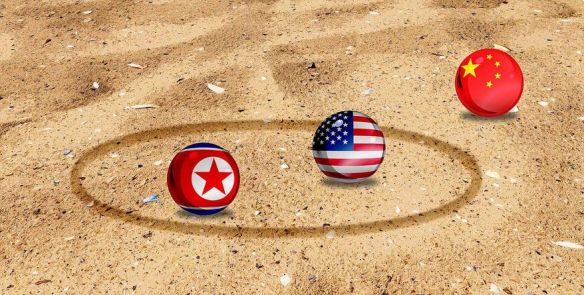
6_242018_b1-chel-in-game-gg8201_s878x445.jpg

Brahma Chellaney, Nikkei Asian Review 

U.S. President Donald Trump, by seeking to clinch a deal directly with Pyongyang, is attempting to effectively cut out the traditional middleman, China. Beijing’s growing anxieties over the engagement between Washington and Pyongyang have prompted it to host North Korean strongman Kim Jong Un for the third time in less than three months.

In fact, the White House has already eroded China’s role as an essential conduit in U.S. diplomacy with Pyongyang by establishing direct connections, including a virtual hotline, to Kim, while Chinese President Xi Jinping has no hotline with him.

Kim has also fueled Beijing’s geopolitical troubles, displaying strategic defiance as he attempts to cut North Korea’s dependence on China, its longtime benefactor. In his search for a grand bargain to end North Korea’s international isolation, Kim effectively sidelined China by deciding to hold separate summits with his nation’s bitterest enemies, South Korea and the U.S.

Instead of both Koreas leaning toward China, as Xi’s strategy seeks, recent developments are consigning Beijing to a peripheral role in the region just when a trade war with the U.S. looms large. China has silently waged a trade war for years, facing no international reprisals. The situation will fundamentally change if the bulk of Trump’s tariffs of 25% on $50 billion of imports from China take effect from July 6.

Kim’s three visits to China in quick succession cannot obscure the serious strains in Beijing-Pyongyang relations, which Mao Zedong famously claimed were as close as lips are to teeth. Distrust of China, the historical rival of Koreans, runs deep in North Korea, which has no monuments honoring the 400,000 Chinese soldiers who died fighting on its behalf during the 1950-1953 Korean War.

Bilateral ties began deteriorating after Kim came to power in late 2011. China’s state media accused him of pursuing the “de-Sinification” of the hermit kingdom. Kim broke with the tradition set by his father and grandfather, who ruled before him, of paying obeisance in Beijing. To counterbalance China’s influence, Kim sent out feelers to U.S. President Barack Obama to improve relations, only to be rebuffed.

Yet Kim’s defiance of China continued. His nuclear and missile tests were often timed to snub Beijing. The tests set in motion developments adverse to Chinese interests — from initiating Japan’s efforts to strengthen its military to prompting the U.S. to deploy the Terminal High Altitude Area Defense, or THAAD, anti-missile system in South Korea. THAAD’s deployment led to China’s heavy-handed and counterproductive economic sanctioning of South Korea.

Xi sought to ease the increasingly fraught relationship with Pyongyang only after Trump began laying the groundwork for a summit with Kim by using the U.S. Central Intelligence Agency to communicate with its North Korean counterpart, the Reconnaissance General Bureau. Despite the past North Korean snubs, Xi sent a senior envoy to Pyongyang to invite Kim to China, his first foreign trip since assuming power.

Kim’s China visits since late March have been primarily aimed at strengthening his own bargaining position with the U.S. By playing one power against the other, he has sought to bolster his leverage. But his action in inviting observers from the U.S. and South Korea, but not China, to the dismantlement of North Korea’s nuclear test site indicated that he is unwilling to forgive Beijing for its linchpin role in imposing United Nations sanctions against his nation.

Consequently, China, which values North Korea as a strategic buffer against the U.S. military presence in South Korea, has become increasingly suspicious of Kim’s overtures to Washington and the Trump administration’s direct dealings with Pyongyang. U.S. Secretary of State Mike Pompeo’s visit to Beijing after the Trump-Xi summit did little to allay Chinese apprehensions.

Beijing fears that, just as it formally turned against the Soviet Union after it developed high-level contacts with the U.S. in the early 1970s, its estranged ally, North Korea, could similarly switch sides now. Kim, however, seems more interested in achieving a limited goal — rebalancing his foreign policy by mending fences with the U.S. to reduce North Korea’s reliance on China, whose neo-imperialist policies are arousing growing concerns in Asia and beyond.

Make no mistake: The path to North Korea’s denuclearization promises to be long and difficult, given its extensive nuclear and missile infrastructure and Kim’s firm belief that the nuclear arsenal serves as insurance against his country becoming China’s colony. Not only does such an arsenal hold greater security implications for China than for the U.S., but also Trump’s diplomacy is making it more difficult for Beijing to keep North Korea in its orbit. Washington’s direct diplomacy with North Korea began in dramatic fashion, with Pompeo, when he was CIA chief, holding unpublicized talks with Kim in Pyongyang.

Yet some analysts have speciously claimed that China, without being at the table, was the clear winner from Trump’s summit with Kim. Critics have accused Trump of making “big concessions” in exchange for securing indefinable commitments from Kim. The only concession Trump made — suspending U.S. war games with South Korea as a gesture of good faith — is easily reversible if negotiations do not yield progress.

To be sure, Beijing last September proposed the suspension of the U.S. military exercises in exchange for a North Korean moratorium on nuclear and missile testing. It was Kim, however, who undermined China’s “freeze for freeze” proposal by unilaterally declaring a test moratorium in April without any reciprocal U.S. concession.

Under Obama, the U.S. helped end Myanmar’s international isolation, with the U.S. president paying a historic visit to that county in 2012. The shift in U.S. policy allowed Myanmar to cut its dependence on China and open its economy to Western investors. Now Trump is encouraging another isolated, China-dependent state, North Korea, to end its international pariah status.

North Korea — with its vast store of iron ore, magnesite, copper and other minerals — is resource-rich like Myanmar, whose natural reserves range from oil and gas to jade and timber. Resource-hungry China has been the dominant importer of natural resources from both of these countries.

North Korea, however, is different from Myanmar in two key aspects. It is armed with potent nuclear and missile capabilities, while it is also a homogenous and regimented society, in contrast to ethnically diverse and troubled Myanmar.

Trump is right that at this stage fundamentally changing the U.S.-North Korea relationship matters more than denuclearization. If the West encourages Kim’s efforts to modernize the North Korean economy, just as it aided China’s economic rise since the late 1970s, it will help to moderate Pyongyang’s behavior. Economic engagement can achieve a lot more than economic sanctions, which counterproductively accelerated North Korea’s nuclear and missile advances.

U.S. policy under Trump’s predecessors, instead of helping Pyongyang to escape from China’s clutches, attempted to push it further into China’s corner. It also helped Beijing to play the North Korea card against the U.S. and its regional allies, Japan and South Korea.

But Beijing’s efforts to string the U.S. along on North Korea came to naught when Washington established direct contact with Pyongyang. Beijing even tried to use its North Korea leverage in the trade dispute with Washington, which explains why Trump waited until after his summit with Kim to announce new planned tariffs against China.

With Washington’s sanctions-only approach encouraging Pyongyang to expand its nuclear and missile programs, a shift in its North Korea policy became imperative even before Trump took office. Trump’s direct diplomacy seeks to address that imperative by seizing on Pyongyang’s desire to unlock frozen ties with the U.S. and by exploiting the China-North Korea rift.

At the core of Trump’s North Korea gambit is the containment of China, a fact many analysts have missed. By seeking to co-opt North Korea, including encouraging closer links with Seoul, Washington aims to foster a major new regional alignment that diminishes China’s relevance.

If Beijing cannot keep North Korea as a client state, China’s lonely rise will become more conspicuous. Its only other strategic ally is Pakistan. The more power China has accumulated, the greater has been its problems in gaining reliable security partners, underscoring that regional leadership demands more than brute might.

Clearing the path to North Korean disarmament will not be easy. Yet Trump’s direct diplomacy promises to positively change northeast Asian geopolitics by crimping China’s leverage and role, even as U.S. troops remain in South Korea. If Washington stays on its current course, China will be the clear loser.

Brahma Chellaney is a geostrategist and the author of nine books, including the award-winning “Water: Asia’s New Battleground.”

© Nikkei Asian Review, 2018.

Who Lost the South China Sea?

BRAHMA CHELLANEY,  a column internationally syndicated by Project Syndicate

The South China Sea is central to the contest for strategic influence in the larger Indo-Pacific region. Unless the US adopts a stronger policy to contain Chinese expansionism there, the widely shared vision of a free, open, and democratic-led Indo-Pacific will give way to an illiberal, repressive regional order.

south-china-sea-location-map

US Defense Secretary Jim Mattis has spoken out against China’s strategy of “intimidation and coercion” in the South China Sea, including the deployment of anti-ship missiles, surface-to-air missiles, and electronic jammers, and, more recently, the landing of nuclear-capable bomber aircraft at Woody Island. There are, Mattis warned, “consequences to China ignoring the international community.”

But what consequences? Two successive US administrations – Barack Obama’s and now Donald Trump’s – have failed to push back credibly against China’s expansionism in the South China Sea, which has accelerated despite a 2016 international arbitral tribunal ruling invalidating its territorial claims there. Instead, the US has relied on rhetoric or symbolic actions.

For example, the United States has disinvited China from this summer’s 26-country Rim of the Pacific (RIMPAC) naval exercise. The move has been played up as a potential indication that the US may finally be adopting a tougher approach toward China. Mattis himself has called the decision an “initial response” to China’s militarization of the South China Sea, which is twice the size of the Gulf of Mexico and 50% bigger than the Mediterranean Sea.

Similarly, the US Navy’s freedom of navigation (FON) operations, which are occurring more regularly under Trump than they did under Obama, have been widely hyped. After the most recent operation, in which a guided-missile cruiser and a destroyer sailed past the disputed Paracel Islands, Mattis declared that the US was the “only country” to stand up to China.

But China, too, has used America’s FON operations to play to the Chinese public, claiming after the latest operation that its navy had “warned and expelled” two US warships. More important, neither FON operations nor China’s exclusion from the RIMPAC exercise addresses the shifts in regional dynamics brought about by China’s island-building and militarization, not to mention its bullying of its neighbors. As a result, they will not credibly deter China or reassure US allies.

The reality is that China’s incremental encroachments have collectively changed the facts in the South China Sea. It has consolidated its control over the strategic corridor between the Indian and Pacific Oceans, through which one-third of global maritime trade – worth $5.3 trillion last year – passes. It is also asserting control over the region’s natural resources, by bullying and coercing other claimants seeking to explore for oil and gas in areas that are theirs under the United Nations Convention on the Law of the Sea. Vietnam, for example, has been forced to scrap a project on its own continental shelf.

Perhaps most ominous, China’s development of forward operating bases on manmade South China Sea islands “appears complete,” as Admiral Philip Davidson told a Senate committee in April before taking over the US Indo-Pacific Command. “China is now capable of controlling the South China Sea in all scenarios short of war with the US,” Davidson confirmed.

Davidson’s characterization is revealing. As China takes a long-term strategic approach to strengthening its hold over the South China Sea (and, increasingly, beyond), the US is focused solely on the prospect of all-out war.

The Pentagon has flaunted its capability to demolish China’s artificial islands, whose creation Chinese President Xi Jinping has cited as one of his key accomplishments. “I would just tell you,” joint staff director Lt. Gen. Kenneth McKenzie recently said, “the US military has had a lot of experience in the western Pacific taking down small islands.”

If open war is China’s only vulnerability in the South China Sea, the US will lose the larger strategic competition. While seeking to protect its military freedom of navigation in the South China Sea, the US has turned a blind eye to China’s stealthy but aggressive assault on the freedom of the seas, including restricting the rights of other countries in the region.

The only viable option is a credible strategy that pushes back against China’s use of coercion to advance its territorial and maritime revisionism. As Admiral Harry Harris cautioned last month while departing as head of the US Indo-Pacific Command, “Without focused involvement and engagement by the US and our allies and partners, China will realize its dream of hegemony in Asia.”

Simply put, China is winning the battle for the South China Sea without firing a shot – or paying any international costs. While Trump is sustaining this trend, it began under Obama, on whose watch China created seven artificial islands and started militarizing them.

Obama’s silence in 2012 when China occupied the disputed Scarborough Shoal – a traditional Philippine fishing ground located within that country’s exclusive economic zone – emboldened China to embark on a broader island-building strategy in the South China Sea the following year. By the time the US realized the scope and scale of China’s land-reclamation program, Russia grabbed its attention by annexing Crimea. Yet the long-term strategic implications of what China has achieved in the South China Sea are far more serious.

Unfortunately, when it comes to constraining China’s expansionism, Trump seems just as clueless as his predecessor. Focused obsessively on three issues – trade, North Korea, and Iran – Trump has watched quietly as China builds up its military assets through frenzied construction of permanent facilities on newly reclaimed land. And now China has begun making strategic inroads in the Indian Ocean and the East China Sea, threatening the interests of more countries, from India to Japan.

The South China Sea has been and will remain central to the contest for influence in the larger Indo-Pacific region. Thanks to US fecklessness, the widely shared vision of a free, open, and democratic-led Indo-Pacific could give way to an illiberal, repressive regional order, with China in full control.

Brahma Chellaney, Professor of Strategic Studies at the New Delhi-based Center for Policy Research and Fellow at the Robert Bosch Academy in Berlin, is the author of nine books, including Asian JuggernautWater: Asia’s New Battleground, and Water, Peace, and War: Confronting the Global Water Crisis.

© Project Syndicate, 2018.

Trump delivers lessons for Japan on North Korea

p8-chellaney-a-20180616-870x722

By BRAHMA CHELLANEY, The Japan Times

Japan was so concerned that its security interests would be overlooked in a U.S. nuclear deal with North Korean ruler Kim Jong Un that Prime Minister Shinzo Abe visited the White House just before President Donald Trump left for Canada and Singapore. Yet Japan’s strategic imperatives and interests were barely on Trump’s mind when he met Kim. Despite Trump saying that he raised with Kim the decades-old North Korean abductions of Japanese citizens, Japan’s interests got short-shrift.

With the Singapore summit yielding only a joint statement, Trump has bet on what he called a “very special bond” and “terrific relationship” with Kim to secure a real deal. It is worth remembering that Trump has said similar things about Abe and several other world leaders, only to ignore their interests or turn on them later. Canadian Prime Minister Justin Trudeau, for example, is still licking his wounds.

As Trump’s announcement to suspend U.S. war games with South Korea underscored, he is seeking to narrowly advance American interests, especially saving money — a factor that he said could eventually lead him to bring back home the 32,000 American troops stationed in South Korea. A dilution of U.S. security commitments in northeast Asia, however, is contrary to Japanese strategic interests.

Trump is only stoking Japanese concerns about America’s long-term commitment to regional security by signaling that a rapprochement with North Korea could possibly lead to a broader U.S. retreat from northeast Asia. Announcing the suspension of the war games without prior notification to South Korea, for example, sent the wrong message to allies, although U.S. and South Korean officials had previously discussed this option.

More fundamentally, Trumps seems unmindful of the fact that the alliance system is essential — and cost-effective — for the United States to pursue its regional objectives, including maintaining a stable balance of power.

Tokyo, in the most generous host-nation support by any of America’s 27 allies, pays billions of dollars yearly for the basing of U.S. troops on Japanese territory. South Korea, in addition to its host-nation support, has generously picked up about 92% of the $10.8 billion cost of the U.S. military’s new base, Camp Humphreys, located south of Seoul. It is much cheaper for the U.S. to keep troops in South Korea (or Japan) than to have them back home.

To Trump’s credit, he has correctly described as “very provocative” the U.S.-led war games, which, with live-fire drills, simulate every spring a full-scale invasion of North Korea. Critics are upset that he has lifted the pretense that these war games are routine “military exercises” and defensive in nature.

Progress toward denuclearization, however, is likely to be slow. The joint statement implicitly links denuclearization to “mutual confidence building.” What has been set in motion is a complex, long process of bargaining, deal making and, if all goes well, denuclearizing.

The joint statement’s reference to the denuclearization of the Korean Peninsula, not just North Korea, means creating a nuclear-weapons-free zone. Such a zone can emerge only if South Korea steps out of the U.S. nuclear umbrella and America, China and Russia formally commit not to introduce, or threaten to use, nuclear weapons on the Korean Peninsula.

For decades, Japan and South Korea have remained under the U.S. nuclear umbrella. But, in reality, the U.S. is unlikely to use nuclear weapons to defend Japan or South Korea; it will rely instead on conventional weapons. The nuclear umbrella serves more as a potent symbol of U.S. commitment and as a nonproliferation tool to prevent either ally from developing its own nuclear weapons.

Still, if South Korea agrees to be outside the American nuclear umbrella, Japan — the world’s only victim of nuclear bombings — will find itself in the odd position of being the sole Asian country inside the umbrella. This will hardly sit well with its diplomatic interests.

But what prompted Abe’s latest White House visit was concern that Washington could tolerate a North Korean sub-regional nuclear arsenal if Kim dismantled his long-range nuclear capability that threatens America. Tokyo’s security nightmare is North Korea retaining the short- and medium-range portion of its nuclear arsenal while China continues to expand its nuclear and conventional military capabilities. If North Korea kept a residual, subregionally confined nuclear capability, it would reinforce Japanese and South Korean reliance on security arrangements with America.

Such a scenario is not improbable, especially with the Trump administration saying goodbye to the “Libya model” and seeking instead to apply the “South Africa model” to North Korea.

The administration’s early brinkmanship almost derailed the Singapore summit when its references to the Libya model provocatively suggested that Kim follow a path that ultimately led to Libyan strongman Muammar Gaddafi’s gruesome end. But, recognizing North Korea’s longstanding resistance to intrusive international inspections, U.S. officials now say their role model is apartheid-era South Africa.

Before transiting to black majority rule, South Africa secretly dismantled its six nuclear weapons, destroying all major documents relating to them but stashing weapons-grade enriched uranium. It then opened its sites to international inspection.

Such voluntary denuclearization outside international monitoring is not an example of complete, verifiable and irreversible dismantlement, which is what Japan wants to see in North Korea. America’s focus, however, is on safeguarding its own security. Trump, after the summit, wrote online that North Korea no longer poses a nuclear threat to the U.S., adding that Americans should “sleep well tonight.”

While his secretary of state, Mike Pompeo, has spoken of “in-depth verification,” North Korea is likely to allow external inspectors only limited access at best. Intrusive international monitoring, with inspectors free to go anywhere, could sound the death knell for Kim’s secretive regime. In the past, the U.S. has sent intelligence agents as international nuclear inspectors, as the Iraq investigations revealed.

A Japan exposed to a potential North Korean nuclear strike would be open to atomic blackmail and coercion. Yet, some U.S. officials and analysts have characterized Japan’s insistence on complete, verifiable and irreversible disarmament as “maximalist,” as if seeking a deal that addresses only U.S. security interests (as the Trump administration is apparently doing) amounts to a reasonable stance.

Another issue also highlights how self-interest drives U.S. policy. The joint statement commits North Korea to repatriate the remains of American military personnel missing from the Korean War. But it contains no reference to a highly emotive subject in Japan — abductions of Japanese citizens by Pyongyang’s agents to train as spies. Trump said he “absolutely” raised that topic but did not indicate what Kim’s response was.

Let’s be clear: Dismantling North Korea’s extensive nuclear infrastructure will entail a long-drawn-out process. Nuclear weapons are the only assets the North can leverage to end its international pariah status. Kim is unlikely to give up his “crown jewels” without U.S. security guarantees that go beyond symbolic steps and a temporary halt of U.S.-led war games. Nor will he unilaterally disarm without reciprocal actions to turn the Korean Peninsula into a nuclear-weapons-free zone.

While Trump is seeking, to quote Pompeo, “major disarmament” in the remainder of his current term, Kim, who is less than half the age of the U.S. president, has a much longer time horizon. Kim is playing a long game to ease his country’s international isolation and build an independent foreign policy that diminishes dependence on China.

A stretched-out denuclearization process, however, suits China too. It will allow Beijing to string the U.S. along on North Korea while it stakes out a key role for itself by leveraging its status as a linchpin to keeping Pyongyang under economic pressure. More ominously, U.S. preoccupation with North Korea will aid China’s territorial and maritime revisionism in the Indo-Pacific region, including consolidating its hold in the South China Sea. To gain dominance in Asia, Beijing is seeking to marginalize Japan and weaken the U.S. alliance with South Korea.

Japan today finds itself thoroughly marginalized on the North Korean issue, despite that subject’s critical importance to its long-term security. Abe’s tireless efforts to cultivate Trump have yielded little on that front.

In this light, Japan has no option but to directly deal with Pyongyang. Indeed, this is the central takeaway for Japan from Trump’s North Korea diplomacy.

To be meaningful, such engagement must be without preconditions. There is no reason why the abductions issue should still hold Japan’s strategic interests hostage. At a time when Kim is seeking to mend fences with different powers, Japanese engagement could help persuade Pyongyang to reopen talks on the abductions topic and come clean.

Abe should seek to meet Kim on the sidelines of the Sept. 11-13 Eastern Economic Forum in Vladivostok, Russia. Kim is likely to accept Russian President Vladimir Putin’s invitation to attend that annual forum.

Make no mistake: The main lesson for Japan is that, instead of relying on Washington, it must directly engage North Korea by leveraging its economic might and soft power and playing to Kim’s rebalancing aspiration.

Brahma Chellaney is a geostrategist.

© The Japan Times, 2018.

The challenge of America’s new extraterritorial sanctions

The United States, by imposing extraterritorial sanctions, seeks to effectively extend its jurisdiction far beyond its borders. However, such sanctions — which it euphemistically labels “secondary” sanctions — run counter to international law.

p9-chellaney-a-20180606-870x591
BY BRAHMA CHELLANEY, Japan Times 

How to navigate America’s new extraterritorial sanctions targeting Iran has become an important diplomatic test for Japan and a number of other important democracies concerned about U.S. President Donald Trump’s pursuit of aggressive unilateralism. Many of these countries have already taken an economic hit, in the form of higher oil-import bills, from Trump’s unilateral pullout from the multilateral nuclear deal with Iran.

The United States has also imposed extraterritorial sanctions to punish the Kremlin for its alleged interference in the 2016 U.S. presidential election. The new Countering America’s Adversaries Through Sanctions Act, or CAASTA, which came into effect on Jan. 29, seeks to stop other countries from making “significant” defense transactions with Russia, a leading arms exporter.

However, with Trump seeking a nuclear deal with North Korea, much of the weight of America’s punitive approach is likely to fall on Iran. Trump, whose main aim is to topple the Iranian regime, said ominously on June 1, “You are going to see how powerful the sanctions are when it comes to Iran.”

The U.S. — armed with not just unmatched military might but also unrivaled financial power from the role of the American dollar as the world’s reserve currency — has the capacity and will to coerce allies and adversaries alike. As the world’s dominant currency that greases the wheels of the global financial system, the dollar equips America with tremendous economic leverage while conferring important advantages to its economy.

By imposing extraterritorial — or, as it likes to euphemistically portray them, “secondary” — sanctions, the U.S. seeks to effectively extend its jurisdiction far beyond its borders. Such sanctions, however, run counter to international law, including the United Nations Charter and the rules of the World Trade Organization.

It is one thing for the U.S. to invoke national security or other grounds as a rationale to impose punitive trade sanctions on a country, including prohibiting American persons and companies from engaging in transactions with the designated state. It is quite another for the U.S. to use extraterritorial sanctions to block trade and financial activities by non-U.S. parties with that country — in other words, to coercively turn national actions into global measures, in breach of the sovereignty of other states.

Through extraterritoriality, the U.S. aims not only to sharpen the impact of its sanctions, but also to advance its own geopolitical and commercial interests. One example is how the U.S. today is ingeniously employing the sanctions threat under CAASTA to wean countries as diverse as India and Turkey off their craving for Russian weapons so as to boost its own arms sales. The U.S. is already the world’s No. 1 exporter of weapons, accounting for 34 percent of all global sales between 2013 and 2017.

In the past, few international players were willing to flout U.S. extraterritorial sanctions for fear of being locked out of the U.S. financial system and barred from doing business with American entities. But Trump’s aggressive unilateralism on matters extending from trade and global warming to Iran and Israel has prompted calls for defiance even by U.S. allies, a number of whom have now been slapped with U.S. steel and aluminum tariffs.

The European Commission has decided to revive its “blocking statute” to prevent European firms from adhering to the new U.S. sanctions against Iran. Originally created in 1996 to counter a U.S. trade embargo on Cuba, the blocking statute bars European Union citizens and companies from complying with the extraterritorial aspects of U.S. sanctions. It also grants EU entities the right to “recover any damages, including legal costs,” from the application of such sanctions and nullifies the effect of any foreign court judgment.

The commission hopes its blocking law will be approved by member-states and take effect before Aug. 6, when the first batch of re-imposed U.S. sanctions against Iran kick in, including on trade in precious metals, coal, aluminum and steel. Trump’s shipping- and petroleum-related sanctions — the second set — are scheduled to enter into force on Nov. 4. But global shipping operators and tanker owners are already pulling back from Iran-related business.

Under Trump’s predecessor, Barack Obama, foreign companies were held hostage by America’s Iran-related extraterritorial sanctions, forcing them to cease or cut oil and other business dealings with Tehran between 2012 and 2015. But the U.S. at that time secured wide support from an international community keen to block Iran from developing nuclear weapons.

This time the U.S. is acting alone. It is seeking to tighten the screws on Iran after having reneged on the Iran deal, despite the International Atomic Energy Agency certifying that Tehran was in compliance with its terms. Indeed, the other signatories to the 2015 Iran deal — France, Germany, Britain, Russia and China — have affirmed their intent to preserve the deal without the U.S.

In this situation, the Trump administration will not find it easy to coerce the rest of the world to comply with its Iran-related sanctions regime. Even Washington’s extraterritorial jurisdictional claim in relation to the Russia-centered CAASTA is being challenged. Turkey, a NATO ally, has threatened reprisals if the U.S. cancels the F-35 fighter-jet deal with it in response to its contract with Moscow to buy the S-400 long-range air and anti-missile defense system. India also appears all set to import the lethal, interceptor-based S-400 system.

On Iran, even if the U.S. succeeds in browbeating some vulnerable countries into abiding by its new sanctions, it will likely find it difficult to secure broad international compliance.

The main buyers of Iranian crude oil and petroleum products are all located in Asia: China, India, Japan and South Korea together account for almost three-quarters of Iran’s oil exports.

China, ever ready to swoop in to exploit opportunities in sanctions-hit countries, will find ways to circumvent the new sanctions, as it did in the previous round, including by boosting imports of Iranian fuel oil. It used the earlier sanctions to deeply penetrate the Iranian economy.

Successive U.S. presidents have helped out China — from aiding its economic rise to making it the key beneficiary of their actions elsewhere. Now it is Trump’s turn: His new sanctions are a diplomatic boon for Beijing, including making a reluctant Iran enter into a tighter Chinese embrace and forcing Russia to pivot to China.

In this light, Japan, India and South Korea, instead of simply succumbing again to America’s Iran sanctions or seeking waivers, should push back with full diplomatic strength, including putting the U.S. on notice that they will challenge its extraterritorial sanctions before the WTO dispute-resolution body.

Seeking deal-related or rolling waivers would be tantamount to adhering to the sanctions. And any waiver will come with conditions that crimp their latitude further.

Past experience indicates that when the U.S. is internationally isolated, it ultimately caves in to the demands of its friends who show resolve to defy its sanctions threat. For example, in 1997, the U.S. reached agreement with the EU to suspend enforcement of the extraterritorial dimensions of its Cuba-related sanctions after the threat of an EU complaint to the WTO.

Today, the U.S. is acting counterproductively to its own interest to safeguard the dollar’s centrality: It is leaving other countries with little choice but to work around its sanctions by using non-dollar currencies so as to avoid the American banking system, besides making alternative arrangements for shipping insurance. This development, and Trump’s other actions, could ensure that the dollar’s days as the world’s reserve currency are numbered.

Make no mistake: International adherence to the new extraterritorial sanctions will only embolden the Trump administration’s defiant unilateralism, which is redolent of China’s unilateralist actions. Broad compliance will not only further weaken the WTO, the U.N. and other international institutions, but also allow Washington to dictate international rules and other countries’ choices. Instead of a rules-based world order, the U.S. and China are seeking to impose a power-based Group of Two order founded on unilateralism.

Brahma Chellaney is a professor of strategic studies at the New Delhi-based Center for Policy Research.

© The Japan Times, 2018.