The international community should call Pakistan’s fiscal bluff: Pakistan has long employed not just nuclear blackmail but also fiscal blackmail — help us financially or face the perils of the country falling apart.
The subcontinent’s military crisis is anything but over. Pakistan’s military generals fear another surprise Indian strike, which explains why much of Pakistan’s airspace is still closed to commercial traffic: Most international overflights remain barred, while domestic flights must stick to a narrow western corridor close to Iran and Afghanistan. Pakistan’s armed forces are on full operational alert, with combat air patrols continuing and the army beefing up deployments along the India frontier.
Yet, emboldened by China’s support, Pakistan is ignoring international calls to take concrete, irrevocable steps against the terrorist groups that operate openly from its territory. Indeed, Pakistan has yet to take the first credible step, which is to declare a policy — embraced by the chief of army staff (COAS) and the chairman joint chiefs of staff committee (CJCSC) — to deny sanctuary and financing to all terrorist groups.
The COAS remains Pakistan’s effective ruler. Imran Khan is not just one of Pakistan’s weakest prime ministers ever but also has shown himself to be the military’s willing puppet. Even while announcing the Indian pilot’s release as a “peace gesture”, Khan denied Pakistan is cultivating terror groups but justified terrorist attacks and suggested Pulwama was an Indian conspiracy.
Against this background, China’s action in again blocking UN action against Jaish-e-Mohammed (JeM) founder Masood Azhar was aimed at thwarting international pressure on Pakistan to take credible, irreversible anti-terror actions. That China still protects a terrorist who reportedly is on his deathbed undergirds the extent to which it shields Pakistan’s proxy war by terror against India.
It also helps highlight China’s own proxy war against India by employing Pakistan as a surrogate for containment. While reaping an ever-increasing trade surplus with India, China is systematically undermining Indian interests. Yet, since the Wuhan summit, India’s China policy has become more feckless than ever.
It is not a question of whether but when an Indian target will be attacked again by a Pakistan-based terrorist group. If war is to be averted, major powers other than China must tighten the screws on Pakistan. A major source of international leverage is Pakistan’s current desperate need for a $12 billion International Monetary Fund bailout. This will be Pakistan’s 22nd IMF bailout in six decades, and the largest ever. The IMF should bail out debt-ridden Pakistan only in return for concrete anti-terror action.
An international financial squeeze can effectively force Pakistan’s hand. The key to this is the US, which has the IMF clout (underscored by a dominant 17.46% voting share) to put off the impending bailout or tie it to specific conditions. India must seek to persuade the US — and other key IMF members like Japan and Germany, with 6.48% and 5.60% voting shares respectively — to not let go the present opportunity to reform a scofflaw Pakistan.
US President Donald Trump’s administration, far from welcoming Khan’s tokenistic anti-terror measures, has insisted Pakistan take “sustained, irreversible action against terrorist groups.” However, Trump’s zeal to finalize a tentative deal that his administration reached with the Pakistan-created Afghan Taliban in late January offers Pakistan’s generals their trump card.
Through their brutal proxies, the Taliban and the Haqqani Network, these generals have compelled the US to negotiate the terms of its exit from Afghanistan and to seek Pakistan’s help to midwife the deal. However, the US will be able to honourably end the longest war in its history, and get the Taliban to keep up its end of the bargain, only if it makes Pakistan’s generals realize that sponsoring cross-border terrorism in Afghanistan carries major costs. If the generals are to take concrete anti-terror steps, there must first be tangible action on America’s part, including stripping Pakistan of its “Major Non-NATO Ally” status, adding it to its list of state sponsors of terrorism, or at least leveraging the IMF bailout.
Pakistan is trapped in a vicious circle, seeking new loans to repay old ones. Despite recently getting $7.5 billion in cash from Saudi, Emirati and Chinese transfers, it cannot do without a large IMF bailout. Pakistan’s cycle of dependency on IMF has paralleled the rise of its military-mullah-jihadist complex. Foreign aid and lending have helped underpin Pakistan’s collusion with terrorist groups.
Today, an IMF bailout will aid Chinese designs by freeing up other resources in Pakistan for debt repayments to Beijing. It will thus implicitly support China’s debt-trap diplomacy with Pakistan, the largest recipient of Belt and Road financing. Such lending has contributed to Pakistan’s dire financial situation, locking it in debt servitude to China.
Pakistan has long employed not just nuclear blackmail but also fiscal blackmail — help us financially or face the perils of the country falling apart. If Pakistan is unwilling to sever its links with state-nurtured terrorists, it is better for the world to let it fail than to continue propping up its military-mullah-jihadist complex with aid and loans — the equivalent of giving more alcohol to an alcoholic, instead of treating the addiction. The treatment now must centre on making Pakistan take verifiable and unalterable anti-terror steps.
Once again, an attack on India by a Pakistan-based terrorist group has raised the specter of a major confrontation on the Indian subcontinent – and fueled international pressure for Pakistan to take concrete action against the 22 United Nations-designated terrorist entities it hosts. But this time, the pressure is compounded by fury over attacks by Pakistan-based terrorists on the country’s other key neighbors, Iran and Afghanistan. Will Pakistan finally respond convincingly?
Over the years, the footprints of many terrorist attacks in the West have been traced to Pakistan. The United States found al-Qaeda leader Osama bin Laden ensconced in the high-security garrison town of Abbottabad, in the shadow of the Pakistan Military Academy. Other terrorist leaders captured since the September 11, 2001, terrorist attacks in the US – including Khalid Sheikh Mohammed, al-Qaeda’s third in command, and Abu Zubeida, the network’s operations chief – were also found living in Pakistan’s heartland.
Such revelations have often fueled calls for Pakistan to tackle its transnational terrorism problem. Last year, US President Donald Trump tweeted that, though Pakistan received more than $33 billion in American aid since 2002, it has returned “nothing but lies and deceit,” including providing “safe haven to the terrorists we hunt in Afghanistan.” The US – which has long had contingency plans to seize Pakistan’s nuclear weapons, if necessary, to prevent terrorists from getting their hands on them – then suspended security aid.
Recent attacks have reinvigorated demands for Pakistan to take action – amid threats of reprisal. On February 14, a suicide bombing claimed by the group Jaish-e-Mohammed killed 41 Indian paramilitary soldiers in India-administered Kashmir. In the same week, another suicide bombing – this one claimed by a group called Jaish ul-Adl – killed 27 Islamic Revolutionary Guard Corps members and injured 13 others in southeastern Iran, and a Taliban strike killed 32 Afghan troops at a remote base.
Since then, India and Pakistan have engaged in tit-for-tat aerial incursions, and Iran has vowed to retaliate. The US has stressed the “urgency” of Pakistan taking meaningful action against terrorist groups. If Pakistan is moved from the “gray” to “black” list of the Paris-based Financial Action Task Force (FATF) – which recently chastised the country for failing to cut off terrorist financing and demanded concrete action by May – Western sanctions will probably follow.
Pakistan’s position as a mecca of terrorism is now raising concerns among even its main patrons – China, which has long stood with it against India, and Saudi Arabia, its bulwark against Iran – which have lent it no support in its present crisis with India. More than ever, Pakistan finds itself internationally isolated, and risks becoming a global pariah.
Beyond the geostrategic repercussions, this outcome poses a grave threat to Pakistan’s economy, which is teetering on the brink of default. Despite having secured emergency loans from China, Saudi Arabia, and the United Arab Emirates, Pakistan desperately needs a large International Monetary Fund bailout. And while a $12 billion IMF deal is in the works, the situation will only deteriorate further if the FATF blacklists Pakistan.
To avoid this, Pakistan’s government is signaling its intent to crack down on terrorist groups. But the international community should not get its hopes up. With the military still dominant, the toothless civilian leadership is offering only tentative, reversible measures, suggesting a likely return to business as usual as soon as external pressure has eased.
Pakistan’s all-powerful military establishment – which includes the rogue Inter-Services Intelligence agency – is loath to sever its cozy alliances with terrorist groups. It would prefer to continue nurturing armed jihadists as a force multiplier in its low-intensity asymmetric wars against neighboring countries. Pakistan’s nuclear weapons enable this approach, because they shield its military and state-nurtured terrorist groups from retaliation.
This constraint is reflected in India’s response to the Pakistani military’s long-term strategy of inflicting on India “death by a thousand cuts.” Pakistan’s protracted terrorism-centered asymmetric warfare has, cumulatively, proved costlier for India than any past full-fledged war on the subcontinent, including the 1971 war that resulted in the creation of Bangladesh. But, as India’s patience wears thin, a limited war that calls the Pakistani generals’ nuclear bluff is no longer inconceivable.
But nuclear weapons are not the only factor protecting Pakistan’s generals. Despite Trump’s complaints, the US has yet to strip Pakistan of its “Major Non-NATO Ally” status or to add the country to its list of state sponsors of terrorism. The reason is simple: Pakistan is now a gatekeeper of America’s geopolitical interests in the region.
Not only does the US supply its Afghanistan-based troops largely via Pakistan; it is depending on Pakistani help in finalizing a peace deal with the Taliban. In other words, Pakistan’s generals are now being rewarded for sponsoring terror in Afghanistan through their brutal proxies – the Taliban and the Haqqani Network – which, according to Afghan President Ashraf Ghani, have killed as many as 45,000 Afghan security personnel since 2014 alone. The message is clear: sponsoring cross-border terrorism pays.
The battle against international terrorism cannot be won unless the nexus between terrorist groups and Pakistan’s military is severed. A good place to start would be to make the IMF bailout contingent on concrete counter-terrorism action. In the longer term, however, civilian-military relations must be rebalanced: the Pakistani generals’ viselike grip on power must be broken, and the military, intelligence, and nuclear establishment must be subordinated to the civilian government.
The international community has enough leverage to force change in debt-ridden and dysfunctional Pakistan. But, to use it, Trump would need to rethink his Faustian bargain with the Taliban. And, unfortunately, that seems unlikely to happen.
Pakistan didn’t wait long to squash India’s Balakot airstrike bravado with its own air incursions. However, the financially strapped country cannot afford a serious escalation of hostilities, not least because India could wreak massive punishment. This explains why Pakistan’s military is at pains to affirm that it is not seeking war.
The mass-murder attack at Pulwama was India’s moment of truth. For too long, India had put up with Pakistan’s cross-border terrorism without imposing any tangible costs. So, when Pulwama happened, it triggered intense anger across the country, not just against Pakistan, but also against the fractious and feckless political class that has reduced India to a soft state.
Peace with Pakistan is a mirage, and the Indian Air Force (IAF) aptly employed its Mirage 2000 aircraft to bomb terrorists there. In a chilling message to Pakistan’s terror masters — the military generals — it demonstrated its ability to deeply penetrate Pakistani air defences and bomb. This represented a major loss of face for the generals. To salvage their image at home, the generals have responded with aerial aggression.
Had the then Prime Minister Atal Bihari Vajpayee quickly responded with punitive airstrikes to the December 2001 Jaish-e-Mohammed attack on Parliament — at a time when much of Pakistan’s F-16 fleet was not airworthy due to a lack of spares — India probably would have been spared the Pakistan-scripted terrorist carnages that have followed. The lost golden opportunity was compounded by nearly 18 years of political dithering on allowing limited uses of air power, such as taking out trans-border terrorist launch pads. India’s belated use of air power to strike a terrorist safe haven has finally sent a clear message — it is not afraid to call Pakistan’s nuclear bluff.
Balakot represents the first time a nuclear power carried out an airstrike inside another nuclear-armed State. The current conventional military face-off, however, promises to bust Western academic theories about the inevitability of tit-for-tat actions rapidly triggering a serious nuclear crisis. Pakistani generals may be roguish but they are not suicidal. Their delusions of security behind a supposed nuclear shield stand exposed.
A more fundamental question is whether the current face-off will mark a turning point for India, generating a newfound determination not to be continually gored. Or did India carry out the Balakot airstrike — like the 2016 ground-launched surgical strike — largely to assuage public anger, with the calculation that Pakistan would again not respond in kind? A one-off airstrike, in any event, would be as ineffective in deterring Pakistan as the one-off surgical strike was.
Whatever the number of terrorists killed at Balakot, the fact is that Pakistan’s generals were made to pay no costs. Now emboldened by their own quick military response, they will seek to bleed India further. Tellingly, the 2016 terrorists-targeting surgical strike, while underscoring India’s refusal to impose any costs on the terror masters, was followed by serial Pakistan-orchestrated terrorist attacks from Nagrota to Pulwama.
India must bring Pakistan under sustained and multipronged pressure. For example, how can India expect the international community to diplomatically isolate Pakistan when New Delhi is unwilling to do that itself? Indeed, India’s refusal to treat Pakistan as a terrorist state in its policy, as opposed to its rhetoric, has come back to haunt it.
India shies away from taking even non-military measures to penalise Pakistan. Nitin Gadkari’s empty statements on the Indus Waters Treaty have only generated bad international publicity. Far from seeking to weaponise water or leverage the treaty, India is adhering to the pact’s finer details, including supplying Pakistan design data of three proposed hydropower facilities on the eve of Pulwama.
Oddly, just as India called its 1974 nuclear test “peaceful”, only to endure almost a quarter-century of sanctions until it went overtly nuclear, it labelled its Balakot strike a “non-military” pre-emptive action. Pakistan’s military riposte has helped shatter that pretence. More significantly, India’s failure to quickly rebut Pakistan’s disinformation in the current face-off suggests it has learned little from China’s psychological warfare during the Doklam standoff.
India must face up to the fact that Pakistan has been at war with it for years. Labelling that aggression simply “terrorism” minimises its larger strategic dimensions and obviates the need to formulate a comprehensive strategy in place of the present ad hoc, reactive approach. It is a grinding, largely one-sided unconventional war since the 1980s whose cumulative costs for India outweigh those imposed by any full-fledged war in the past. Unless India is willing to take the battle to Pakistan’s terror masters, the latter will continue employing their terrorist proxies against it.
History helps shape national perceptions and perspectives and undergirds national security. However, the boundary between historical fact and fiction is more porous than students of history might think. History is not only written by victors but also is used by most nations as a political tool in intrastate or interstate context.
Indeed, many countries create self-serving or sanitized historical narratives. Autocracies have a monopoly on interpreting or rewriting history. China, the fairytale Middle Kingdom, weaves legend with history to foster a chauvinistic Han Chinese culture centered on regaining lost glory.
Democracies are not free from historical revisionism, although their history debates are more nuanced, usually pitting the political right against the left. In Japan, for example, attempts to reform the U.S.-imposed national security, educational and legal systems are portrayed by the left as a potential revival of prewar militarism. South Korea’s historical revisionism, for its part, is still poisoning its relations with Japan.
India, which, like South Korea, fell prey to the ravages of colonialism, has had a static history debate, a reflection of its internal divisions and inefficient, British-style parliamentary democracy. In sharp contrast to South Korea’s or China’s still-continuing tirades against Japan over its colonial rampages in the pre-World War II period, India’s relationship with Britain remains free of historical rancor, in spite of the brutality and impoverishment it suffered under British colonial rule.
Indeed, India embellished or distorted how it won independence in 1947. Indians are still taught in school that their country gained independence by nonviolence.
However, for the first time ever, India’s annual Republic Day parade this year featured veterans of the Japan-supported Indian National Army (INA), which waged an armed struggle against British colonial rule. Four INA veterans in their 90s separately rode a jeep in a parade that, paradoxically, showcased through 22 tableaux the life experiences of the apostle of nonviolence, Mahatma Gandhi.
The juxtaposed roles of the INA and Gandhi at the January 26 parade inadvertently highlighted a central contradiction in India’s historical narrative about independence. The INA veterans’ participation, in fact, helped underscore the Indian republic’s founding myth — that it won independence by nonviolence alone. This belief is deeply etched in the minds of Indians.
To be sure, the Gandhi-led nonviolent independence movement playing a critical role, both in galvanizing grassroots Indian resistance to British rule and in helping to ultimately gain independence. But the decisive factor was the protracted World War II, which reduced to ruins large swaths of Europe and Asia, especially the imperial powers. The war between the Allied and Axis powers killed 80 million, or 4% of the global population.
Despite the U.S.-engineered Allied victory, a devastated Britain was left in no position to hold on to its colonies, including “crown jewel” India. Even colonies where there was no grassroots resistance to British (or other European) rule won independence in the post-World War II period.
The British had dominated India for more than a century through a Machiavellian divide-and-rule strategy. Their exit came only after they had reduced one of the world’s wealthiest economies to one of its poorest. Indeed, they left after they had looted to their heart’s content, siphoning out at least £9.2 trillion (or $44.6 trillion) up to 1938, according to economist Utsa Patnaik’s recent estimate.
Had India, in the immediate aftermath of independence, proactively secured its frontiers, it could have averted both the Kashmir and Himalayan border problems. China was in deep turmoil until October 1949, and India had ample time and space to assert control over the traditional Himalayan borders, including its extraterritorial rights in Tibet. But India’s pernicious founding myth gave rise to a pacifist country that believed it could get peace merely by seeking peace, instead of building the capability to defend peace.
Here’s the paradox: Countless numbers of Indians died due to British colonial excesses. Just in the manmade Bengal famine of 1942-45, six to seven million Indians starved to death (a toll greater than the Holocaust) due to the British war policy under Prime Minister Winston Churchill of diverting resources away from India. Churchill had as much blood on his hands as Adolf Hitler, a fact obscured by the victors’ prevailing narratives.
Moreover, imperial Britain sent Indian soldiers in large numbers to fight its dirty wars elsewhere, including the two world wars, and many died while serving as cannon fodder. The Indian civilian and military fatality toll in World War II was higher than that of Britain, France and the U.S. combined.
Indeed, the present Indian republic was born in blood: As many as a million civilians died in senseless violence and millions more were uprooted in the British-contrived and rushed partition of the subcontinent — the fruition of Britain’s divide-and-rule policy.
Yet the myth of India uniquely charting and securing its independence by nonviolence was propagated by the inheritors of the British Raj, the British-trained “brown sahibs.” Consequently, no objective discourse was encouraged post-1947 on the multiple factors — internal and external — that aided India’s independence.
In truth, the hope of Indian independence was first kindled by Japan’s victory in the 1904-1905 war with Russia — the first time an Asian nation comprehensively defeated a European rival. However, it was the world war that Hitler unleashed through expansionism — with Imperial Japan undertaking military expeditions in the name of freeing Asia from white colonial rule — that acted as the catalyst. An emboldened Gandhi served a “Quit India” notice on the British in 1942.
While the Subhas Chandra Bose-led INA could not mount a formidable threat to a British colonial military overflowing with Indian recruits, the Bombay mutiny and other Indian troop revolts of 1946 triggered by INA prisoners’ trials undermined Britain’s confidence in sustaining the Raj, hastening its exit. Yet, independent India treated INA soldiers shabbily, with many abandoned into penury.
Against this background, the rehabilitation of Bose and the INA has long been overdue in India. Prime Minister Narendra Modi has done well to initiate the process, however low key, to give Bose and the INA their due, including recently renaming one Andaman island after Bose and two other Andaman islands to honor INA’s sacrifices. Modi even wore the INA cap to address a recent public meeting in the Andaman archipelago on the 75th anniversary of Bose’s hoisting of the Indian tricolor flag there — the only territory that the INA managed to liberate from British rule.
Today, a rules-based international order premised on nonviolence remains a worthy aspirational goal. But Indian romancing of nonviolence as a supposedly effective political instrument has crimped national-security policy since independence. The country long hewed to pacifism (with the first prime minister, Jawaharlal Nehru, publicly bewailing in 1962 that China had “returned evil for good” by militarily invading India) and frowned on materialism (even after China surpassed India’s GDP in 1984-85).
Such has been the burden of the quixotic national philosophy centered on nonviolence that India has borne enduring costs, including an absence of a strategic culture, despite the country’s location in the world’s most-troubled neighborhood. As the late American analyst George Tanham pointed out, the lack of a culture to pursue a clear strategic vision and policy hobbles India’s ambition to be a great power.
Recognizing unsung heroes is an essential step that India has initiated, however belatedly, toward rebalancing its historical narrative. As George Orwell famously said, “Who controls the past controls the future. Who controls the present controls the past.”
The just-announced “agreement in principle” between the US and the Taliban should be called what it is: a Faustian bargain that will lead to still more violence in the region, and perhaps in the West. By abandoning Afghanistan, the Trump administration is repeating one of the worst foreign-policy mistakes of the past few decades.
After the attacks of September 11, 2001, the United States invaded Afghanistan and removed the Taliban from power, thereby eliminating a key nexus of international terrorism. But now, a war-weary US, with a president seeking to cut and run, has reached a tentative deal largely on the Taliban’s terms. The extremist militia that once harbored al-Qaeda and now carries out the world’s deadliest terrorist attacks has secured not just the promise of a US military exit within 18 months, but also a pathway to power in Kabul.
History is repeating itself. The US is once again abandoning war-ravaged Afghanistan, just as it did three decades ago following a successful covert operation by the CIA to force the Soviets out of the country. The US, desperate to end its longest-ever war, appears to have forgotten a key lesson of that earlier abandonment: it turned Afghanistan into a citadel of transnational terrorism, leading to civil war and eventually bloodshed in the West.
The accord reached between the Taliban and the US Special Representative for Afghanistan Reconciliation, Zalmay Khalilzad, reads like a wholesale capitulation on the part of the Trump administration. In 2014, the US signed a security pact with the Afghan government that granted the Americans access to nine military bases at least until 2024. But the US has now agreed to withdraw all of its forces in exchange for a mere promise from a terrorist militia that it will deny other terrorist networks a foothold on Afghan territory. Never mind that the Islamic State is already operational in Afghanistan and poses a challenge to the Taliban itself.
Though the agreement has been dubbed a “peace” deal, it will almost certainly lead to even more Islamist violence, not least against Afghanistan’s women. The Taliban are determined to re-impose the medieval practices they enforced during their harsh rule from 1996 to 2001. Whatever gains Afghanistan has made in terms of women’s and civil rights may soon be reversed.
Make no mistake: the Taliban are brutal and indiscriminate in their use of violence, and they refuse even to recognize the country’s legitimate government, which will make fleshing out the new “framework” accord exceedingly difficult. A number of key issues must be spelled out unambiguously, including when the ceasefire between the Taliban and US-backed Afghan forces will take effect. And even then, it is highly doubtful that the Taliban will agree to a power-sharing arrangement with Afghan President Ashraf Ghani’s government.
In fact, having been emboldened by a series of US concessions over the past six years, the Taliban have escalated their terrorist attacks and made significant battlefield gains against Afghan forces. So, if anything, they will see the new agreement as an implicit validation of their impending victory. They know that time is on their side, and that most Americans favor a US exit. That means they will probably play hardball when negotiating the details of a final deal.
In addition to representing a major victory for the Taliban, the accord is also a win for Pakistan, which harbors the militia’s leadership and provides cross-border sanctuaries for its fighters. Just last year, Trump cut US security assistance to Pakistan, tweeting, “they have given us nothing but lies and deceit, thinking of our leaders as fools. They give safe haven to the terrorists we hunt in Afghanistan, with little help.”
It is worth remembering that when Trump took office, he promised to reverse the deteriorating situation in Afghanistan by “winning again.” But just two years later, he has apparently decided that it is the extremists who will be winning again.
Far from breaking with former US President Barack Obama’s failed approach, as he promised, Trump has now fulfilled his predecessor’s quest for a deal with the Taliban. Having also recently announced a military drawdown in Syria, Trump has made it clear that the US will readily throw its Kurdish and Afghan allies under the bus in order to extricate itself from foreign entanglements of its own making.
To be sure, America’s Faustian bargain with the Taliban has been in the making for years, which explains why the group is conspicuously absent from the US Department of State’s annual list of Foreign Terrorist Organizations, despite having killed more civilians in the past year alone than any other outfit. To facilitate talks with the Taliban, Obama allowed the militia to establish a de facto diplomatic mission in Qatar’s capital, Doha, in 2013. And a year later, he traded five senior Taliban leaders for a US Army sergeant (who was later charged with desertion).
Moreover, to lay the groundwork for a deal, the US war planners have long refrained from targeting the Taliban’s command-and-control base in Pakistan, thereby effectively undercutting their own military mission in Afghanistan. As the top US military commander in Afghanistan admitted in 2017, “It is very difficult to succeed on the battlefield when your enemy enjoys external support and safe haven.”
The US has come full circle. The Taliban, like al-Qaeda, evolved from the violent jihadist groups that the CIA trained in Pakistan to wage war against the Soviets in the 1980s. After suffering the worst terrorist attack in modern world history, the US turned against the Taliban, driving their leaders out of Afghanistan.
But now, in search of a face-saving exit from the Afghan quagmire, America is implicitly preparing to hand the country back to the same thuggish group that it removed from power 17 years ago. Sadly, once American troops leave Afghan soil, the ability of the US to influence events there, or to prevent a new terrorist attack on the US homeland, will be severely limited.
Xi Jinping’s word may be law, but faced with difficult choices on China’s new challenges, he now finds himself under pressure
Members of the Chinese People’s Armed Police stand guard in Tiananmen Square in Beijing. Giulia Marchi / Bloomberg
By Brahma Chellaney, The National, January 25, 2019
As the People’s Republic of China prepares to celebrate the 70th anniversary of its founding later this year, the limits of its Communist Party-led model are becoming apparent. And more than ever, the world’s longest-surviving and most-powerful autocracy faces difficult choices at home and abroad.
By China’s own statistics, its economy is registering its most sluggish growth in nearly three decades. The world’s second-largest economy grew by 6.6 per cent in 2018, the lowest rate since 1990, when the fallout from the massacre of as many as 10,000 people in a tank and machine-gun assault on pro-democracy demonstrators in Beijing’s Tiananmen Square a year earlier kept growth to a humble 3.9 per cent.
At a time when China appears to have entered a new era of uncertainty after more than a quarter century of phenomenal growth, it is perhaps fitting that this year marks the 30th anniversary of that massacre.
The uncertainty is evident in a new phenomenon – the flight of capital from a country that, between 1994 and 2014, amassed towering piles of foreign-exchange reserves by enjoying a surplus in its overall balance of payments.
But now, faced with an unstoppable trend of net capital outflows, President Xi Jinping’s government has tightened exchange controls and other capital restrictions to prop up the country’s fragile financial system and sagging currency. The regime has used tens of billions of dollars in recent months alone to bolster the yuan’s international value.
It is not just capital that’s fleeing China, as more and more Chinese choose to live overseas. In an informal vote of no confidence in the Chinese system, more than a third of surveyed millionaires in China said they were “currently considering” migrating to another country. An earlier report found that almost two-thirds of rich Chinese were either emigrating or have plans to do so.
Today, China’s mounting internal challenges are being compounded by new external factors. Chinese belligerence and propaganda, for instance, have spawned a growing image problem for the country internationally, which is apparent even in regions where China has invested heavily, from Africa to Southeast Asia.
More significantly, Beijing has come under international pressure on several fronts – from its trade, investment and lending policies to its human rights record, including its incarceration of more than a million Muslims from Xinjiang, a sprawling territory Mao Zedong annexed in 1949. Perhaps China’s free ride, which helped propel its rise, is coming to an end.
In modern-day “re-education” prisons, China is accused of forcing Uighurs and other Muslim groups to forsake Islamic practices and become secular citizens.
The Soviet Communist Party that ran gulags was consigned to the dustbin of history. But now the Chinese Communist Party has set up its own gulags that are more high-tech and indiscriminate and have Islam as their target. The network of concentration camps is designed to dismantle Muslim identities and change the outlook of entire communities – a grim mission of unparalleled scale.
Yet, even as international criticism has mounted, the West still seems reluctant to hold Beijing accountable for its harsh treatment of ethnic minorities, deciding against, for instance, introducing sanctions.
China, meanwhile, is confronting growing US-led pressure on the trade and geopolitical fronts, accentuating Beijing’s dilemmas and fuelling uncertainty at home. As long as the US-China trade war rages, flight of capital will remain a problem for Beijing, whose foreign-exchange reserves have shrunk by about $1 trillion from their peak of just over $4 trillion in mid-2014.
At a time when China’s imperial project, the Belt and Road Initiative, is running into resistance from a growing number of partner countries, Beijing is also confronting an international pushback against its telecommunications giant Huawei. In fact, the pushback has broadened from opposition to Huawei’s participation in next-generation 5G wireless networks to a broader effort in Europe, North America and Australia to restrict the use of Chinese technology because of concerns that it is being used for espionage.
The arrest of the Huawei founder’s daughter in Canada, at the behest of Washington, rattled China’s elites, making them angry but also fearful that any one of them could meet a similar fate while travelling to the West. With Meng Wanzhou’s detention, the US signalled that it has more powerful non-tariff weapons than China, which has long used such tools to punish countries as diverse as Japan, Mongolia, South Korea and the Philippines.
Ms Meng was held for an alleged violation of America’s Iran-related sanctions, but even Western onlookers saw her arrest as an example of US high-handedness. Instead of galvanising support against the American move, China responded in typical fashion that, as an American analyst put it, is the “mark of a thuggish state” – by jailing two Canadians.
Indeed, it is Beijing’s open disregard for international rules that explains why it can count on few true strategic allies or reliable security partners. Contrast this with the strong network the US maintains, including close collaboration with many of China’s neighbours. Beijing has alienated almost every significant power in the Indo-Pacific and beyond.
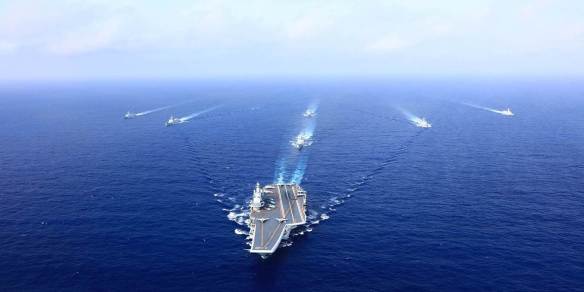
China’s lonely rise could become more pronounced with the newly restructured People’s Liberation Army becoming less of an army and more of a power projection force, the majority of whose troops now are not from the army but from the other services. Indeed, the PLA’s shift away from being a defensive force foreshadows a more aggressive Chinese military approach of the kind already witnessed in the South China Sea, where China has fundamentally changed the status quo in its favour.
The Dalai Lama recently said that, due to Chinese pressure, no Buddhist country, with the sole exception of the nominally Buddhist Japan, is now willing to grant him entry as the exiled leader of Tibetan Buddhism. However, whenever Chinese pressure forces smaller nations to cave in on any issue, it only fuels greater resentment against Beijing.
Against this backdrop, where is China heading? It has come a long way since the Tiananmen Massacre, with its citizens now more prosperous, mobile and digitally connected. Its economy, in purchasing power parity terms, is already the world’s largest.
However, its political system remains as repressive as ever, with Mr Xi centralising power in a way China has not seen since Mao. Under his leadership, the party has set out to systematically quash Muslim, Tibetan and Mongol identities, expand China’s frontiers far out into international waters, and turn the country into a digital totalitarian state.
Yet, one should not overlook what a difference less than a year has made. Few in China dared to criticize Mr Xi when he ended the decades-old, Party-led collective leadership system and abolished a two-term limit on the presidency –actions that theoretically allow him to rule for life.
But, in the new international environment in which China finds itself today, he is facing domestic criticism – however muted — for building a cult of personality around his one-man rule and for inviting an international pushback by overemphasising China’s strength and power.
Mr Xi’s word may be law but, faced with difficult choices on China’s new challenges, he now finds himself under pressure. His primary focus will probably remain ensuring stability at home. Without stability, neither he nor the Party can hope to survive in power.
To calm the economic turbulence, China’s central bank has substantially increased domestic credit to help boost consumption and investment at home. In the medium-term, the US-led tariff pressures are likely to accelerate China’s shift from low-end manufacturing to higher value-added industries like electronics, robotics and artificial intelligence.
The geopolitical pushback, for its part, could force Xi to return to the “hide your capacities, bide your time” strategy of Deng Xiaoping. But such a return can scarcely obscure China’s ambitious goals that Mr Xi has laid bare. Even if Beijing starts soft-pedalling its ambitions, it is likely to adopt a “two steps forward, one step back” strategy to keep progressing toward its goals.
Brahma Chellaney is a geostrategist and the author of nine books, including the award-winning “Water, Peace, and War”.
Brazil’s new President, Jair Bolsonaro – known for his misogynistic, racist, homophobic and anti-environmental comments – has raised questions about the future of the world’s fourth-largest democracy with his support for torture and his unapologetic nostalgia for the country’s 1964-85 military dictatorship. But no part of Brazil’s diverse society has more to dread from Mr. Bolsonaro’s coming to power than the country’s already beleaguered Indigenous groups.
Over the past five centuries, the number of Indigenous people in Brazil has shrunk from as much as five million to about 895,000, less than 0.5 per cent of the country’s population. Since 2006, their territory – the Brazilian part of the Amazon Basin – has lost forest cover over an area greater in size than the Democratic Republic of the Congo, the world’s 11th-largest country, according to satellite data.
Mr. Bolsonaro, perhaps the most right-wing leader of any democracy in the world, has vowed to open up the Amazon rain forest to developers by repealing constitutional safeguards for Indigenous lands, claiming the protected reserves amount to keeping Indigenous people in “zoos.”
As if to signal his intent to permit greater destruction of the world’s biggest rain forest, he has appointed a Foreign Minister who believes climate change is an anti-Christian plot by “cultural Marxists” seeking to criminalize red meat, oil and heterosexual sex. And he has appointed an anti-abortion evangelist to head a new ministry overseeing Indigenous groups, women and human rights.
To be sure, Brazil is not the only country where Indigenous tribes must confront mounting threats to their ways of life – and their lives. From Canada and the Philippines to Japan and Indonesia, Indigenous people face growing threats of discrimination, marginalization and forced assimilation. As a result, the world’s Indigenous communities are rapidly dwindling in numbers owing to encroachment and the exploitation of their natural resources.
With their combined share of the global population shrinking to 4.5 per cent, Indigenous communities are locked in modern-day David-versus-Goliath battles against mining companies, dam builders, oil-palm plantations, loggers, ranchers, hunters, evangelists and military forces. Their rights continue to be violated with impunity despite an international convention obligating governments to protect their lands, identities, penal customs and ways of life.
More fundamentally, at a time when environmental degradation and climate change have emerged as mortal threats to humankind, Indigenous peoples’ ways of life, with their premium on maintaining a balance between human needs and the preservation of ecosystems, serve as examples to the wider world.
Living close to nature, with their survival tied to ecosystem health, Indigenous communities respect nature as their teacher and protector. Consequently, they tend to understand nature better than modern societies, as was illustrated in late 2004, when a devastating tsunami struck in the Indian Ocean, killing more than a quarter million people across 14 Asian countries. On India’s remote Andaman archipelago, however, close to the epicentre of the earthquake that caused the tsunami, two of the world’s most isolated Indigenous tribes escaped harm by relying on traditional warning systems and moving to higher ground in time.
In fact, one of these two groups – the world’s last known pre-Neolithic tribal community, living on coral-fringed North Sentinel Island – made international headlines recently because of a Chinese-American missionary’s covert but fatal expedition to convert its 100 or so members to Christianity. John Allen Chau made repeated forays onto the island over three days, ignoring warnings from the Sentinelese tribe members to leave their community alone.
After the decimation of Indigenous tribes under European colonial rule, countries such as Bolivia, Brazil, Ecuador, India and Peru have pursued “no contact” policies toward isolated tribes. These policies are anchored in laws that protect the rights of Indigenous people to live in seclusion on their ancestral lands. Tribal reserves in India’s Andaman archipelago, for example, are off-limits to all outsiders. Intrusions are punishable with a prison sentence.
A man with the Sentinelese tribe aims his bow and arrow at an Indian Coast Guard helicopter as it flies over North Sentinel Island in the Andaman Islands, Dec. 28, 2004.
Yet, with the support of a Kansas City-based missionary agency that trained him for the arduous undertaking, Mr. Chau dodged Indian laws and coastal security to make repeated incursions into North Sentinel to convert a highly endangered tribe to his religion, according to his own diary accounts. He undertook his mission just before American Thanksgiving, an annual whitewash of the genocide perpetrated against Native Americans.
Contrast the Sentinelese handling of the alien with punishments for unlawful activity or entry in the so-called civilized world: On Mr. Chau’s first intrusion into their peaceful world, the hunter-gatherer Sentinelese did not subject him to Abu Ghraib-style torture or to U.S. President Donald Trump’s “catch and detain” policy, applicable to anyone entering the United States illegally. The Sentinelese, as Mr. Chau acknowledged in his notes, let him go – with a warning not to return.
But an undeterred Mr. Chau, using a fishing boat and a kayak, repeatedly stepped ashore, disparaging the island as “Satan’s last stronghold.” The patience of the Sentinelese wore out, and he was likely shot with a bow and arrow. His body was reportedly buried on the beach, in the way the tribe disposes of its own dead.
Although local police have filed a case of murder against “unknown persons,” the Sentinelese acted in a way permitted by the “stand your ground” laws in states such as Florida. That self-defence law shields a person from both criminal prosecution and a civil lawsuit “if he or she reasonably believes it is necessary” to use deadly force to prevent harm or death.
Mr. Chau – the son of a refugee father who fled China during the Cultural Revolution and converted to Christianity in the United States – described in his notes how he hid from Indian coastal patrols under cover of darkness to make his criminal forays into an island forbidden even to Indians, including military forces. By demonstrating the ease with which one can breach Indian tribal-protection laws and security, he helped highlight the vulnerability of India’s endangered tribes.
More broadly, his mission exemplified the threats to Indigenous people who live in total isolation. Today, most of such tribes live in the Amazon Basin, straddling Brazil’s borders with Peru, Ecuador and Bolivia, or in the jungles of New Guinea and India.
The isolated tribes have rejected contact with the external world usually after experiencing ghastly violence and deadly diseases brought by outsiders from the time of European colonization, which wiped out many Indigenous communities from Australia to North America. To escape genocide, some tribes fled to the deepest and most inaccessible parts of jungles, where they still live.
For example, until 150 years ago, the Andaman archipelago was home to more than two dozen isolated aboriginal communities, whose ancestors left Africa tens of thousands of years ago in a major exodus that provided the earliest inhabitants of Asia and Oceania. Studies have identified a genetic affinity between the Andaman islanders, Malaysia’s tiny Orang Asli Indigenous population and Oceania’s Melanesians.
After British colonial excesses, only four Andaman tribes survive. Two of these groups were forcibly assimilated by the British and have become rootless and dependent on government aid. They are likely to vanish much ahead of the other two groups, which are self-sufficient and continue to live in complete isolation.
Likewise in Brazil, three-quarters of the Indigenous communities that were forced to open up to the outside world became extinct, with the rest suffering catastrophic population declines. Since the late 1980s, however, Brazil’s constitutional protections for Indigenous territories have helped many remaining tribes increase their populations – protections Mr. Bolsonaro has now threatened to repeal.
The examples from the Amazon Basin and the Andaman islands underscore the potent dangers of forced assimilation for isolated aboriginal people. Forced incorporation usually happens in the name of providing access to better technology, education and health care or, as Mr. Bolsonaro wants, to open up Indigenous lands to resource extraction and other development projects.
There are compelling anthropological and epidemiological reasons to prohibit outsiders from establishing contact with remote tribes. For example, the first waves of European colonization caused a calamitous depopulation of Indigenous societies by introducing smallpox, measles and other infectious diseases to which Indigenous people had no immunity.
Modern life is characterized by rampant use of antibiotics, including in meat production, with antibiotic resistance posing a major public-health challenge globally. Secluded people have no antibodies against the outside world’s deadly pathogens.
This helps explain why, even in death, Mr. Chau poses a potential threat to the Sentinelese community because of the pathogens he may have brought.
To be sure, contact may be perilous for isolated Indigenous groups, but leave-them-alone policies are no guarantee that remote-living tribes will survive. Small, highly inbred groups confront the spectre of dying out completely, irrespective of whether they stay in or come out of isolation.
Close rapport with alien culture, however, may be the worst option, speeding up their disappearance. An isolated Indigenous community’s embrace of modern culture usually dooms its existence. This is why remote-living groups choose to stay in isolation and – like the Sentinelese – fire warning arrows at those who seek to encroach on their habitats.
Constitutional or legal safeguards for indigenous lands, cultures and lifestyles, as in Bolivia, Brazil, Ecuador, India and Peru, have allowed some endangered tribes to grow. When authorities look the other way, however, these tribes lose out in battles to defend their lands and cultures from miners, loggers, ranchers, evangelists and others.
The unpalatable fact is that the clearing of more forests and other ecosystems for cropland, mining, pasture and other purposes continues to contribute to the decimation of isolated Indigenous groups living in peace and contentment.
Most such groups are small and very vulnerable. Brazil, in addition to 238 “contacted” Undigenous tribes, has “23 confirmed and 47 potential” Indigenous groups living in complete isolation, according to one study, while Peru has about 15 such “uncontacted” tribes.
For scientists seeking to reconstruct evolutionary and migratory histories, tribes living in complete isolation are an invaluable biological asset. As another study has put it, “Isolated populations living in remote and/or inaccessible parts of the world are regarded as biological treasures from the genetic viewpoint. Many of these isolated human groups have remained relatively unknown until very recent times, so that the information provided by population genetic studies can help the scientists in the partial reconstruction of their demographic and evolutionary histories.”
The future of these highly endangered tribes hinges on policies and laws that adequately safeguard their seclusion and privacy from interlopers and encroachers, who bring violence, disease and rapacious exploitation.
Media labels such as “primitive” and “Stone Age” are racist tags that conjure up false images. Isolated tribe members certainly do not have the luxuries of modern life and use primal tools. But as Indian anthropologist Madhumala Chattopadhyay, who studied the Andaman Indigenous groups, has said, “The tribes might be primitive in their technology but socially they are far ahead of us.”
Let’s be clear: Religion has little meaning for Indigenous societies that revere nature and serve as the world’s environmental sentinels. Where Indigenous communities have been converted to a religion – as on India’s now predominantly Christian Great Nicobar Island – the lifestyle changes have been so profound that the traditional Indigenous cultures have been uprooted.
Today, the world’s Indigenous groups, despite their small and declining share of the global population, manage 80 per cent of Earth’s biodiversity, in part because their ancestral lands make up 22 per cent of the world’s land surface. By preserving forests, lakes, rivers and other ecosystems on their territories, they play an indispensable role in climate-change mitigation and adaptation.
A critical part of the world’s cultural diversity and ecological harmony, Indigenous peoples have much to teach us about how to combat environmental degradation and climate change. In fact, their role as guardians of biodiversity is critical to the search of modern societies for more sustainable lifestyles.
Brahma Chellaney is a geostrategist and author of nine books, including the award-winning Water, Peace, and War.
Over the last five years, China has turned its contrived historical claims to the South China Sea into reality and gained strategic depth far from its shores. China’s leaders did not leave that outcome to chance.
MANILA – It has been just five years since China initiated its major land reclamation in the South China Sea, and the country has already shifted the territorial status quo in its favor – without facing any international pushback. The recent anniversary of the start of its island building underscored the transformed geopolitics in a corridor central to the international maritime order.
In December 2013, the Chinese government pressed the massive Tianjing dredger into service at Johnson South Reef in the Spratly archipelago, far from the Chinese mainland. The Spratlys are to the south of the Paracel Islands, which China seized in 1974, capitalizing on American forces’ departure from South Vietnam. In 1988, the reef was the scene of a Chinese attack that killed 72 Vietnamese sailors and sunk two of their ships.
The dredger’s job is to fragment sediment on the seabed and deposit it on a reef until a low-lying manmade island emerges. The Tianjing – boasting its own propulsion system and a capacity to extract sediment at a rate of 4,530 cubic meters (5,924 cubic yards) per hour – did its job very quickly, creating 11 hectares of new land, including a harbor, in less than four months. All the while, a Chinese warship stood guard.
Since then, China has built six more artificial islands in the South China Sea and steadily expanded its military assets in this highly strategic area, through which one-third of global maritime trade passes. It has constructed port facilities, military buildings, radar and sensor installations, hardened shelters for missiles, vast logistical warehouses for fuel, water, and ammunition, and even airstrips and aircraft hangars on the manmade islands. Reinforcing its position further, China has strong-armed its neighbors into suspending the exploitation of natural resources within their own exclusive economic zones.
Consequently, China has turned its contrived historical claims to the South China Sea into reality and gained strategic depth, despite a 2016 ruling by an international arbitral tribunal invalidating those claims. China’s leaders seem intent on proving the old adage that “possession is nine-tenths of the law.” And the world, it seems, is letting them get away with it.
The Chinese did not leave that outcome to chance. Before they began building their islands in the South China Sea, they spent several months testing possible US reactions through symbolic moves. First, in June 2012, China seized the disputed Scarborough Shoal from the Philippines, without eliciting a tangible international response.
Almost immediately, the China State Shipbuilding Industry Corporation – which is currently building the country’s third aircraft carrier – published on its website draft blueprints for manmade islands atop reefs, including drawings of structures that have come to define China’s Spratly construction program. But the sketches received little international notice, and were soon removed from the website, though they later circulated on some Chinese news websites.
In September 2013, China launched its next test: it sent the Tianjing dredger to Cuarteron Reef, where it stayed for three weeks without initiating any land reclamation. Commercially available satellite images later showed the dredger at another reef, Fiery Cross, again doing little. Again, the United States, under President Barack Obama, did not push back, emboldening China to start its first island-building project, at Johnson South Reef.
In short, as China has continued to build and militarize islands, it has taken a calibrated approach, gradually ramping up its activities, while keeping an eye on the US reaction. The final two years of the Obama presidency were marked by frenzied construction.
All of this has taken a serious toll on the region’s marine life. The coral reefs China has destroyed to use as the foundation for its islands provided food and shelter for many marine species, as well as supplying larvae for Asia’s all-important fisheries. Add to that chemically laced runoff from the new artificial islands, and China’s activities are devastating the South China Sea ecosystems.
Obama’s last defense secretary, Ash Carter, has criticized his former boss’s soft approach toward China. In a recent essay, Carter wrote that Obama, “misled” by his own analysis, viewed as suspect “recommendations from me and others to more aggressively challenge China’s excessive maritime claims and other counterproductive behaviors.” For a while, Carter says, Obama even bought into China’s vision of a G2-style arrangement with the US.
Now, President Donald Trump’s administration is grappling with the consequences of Obama’s approach. Trump wants to implement a vision of a “free and open Indo-Pacific.” The “free and open Indo-Pacific” strategy is the successor to Obama’s unhinged “pivot” to Asia.
But, from its newly built perches in the South China Sea, China is better positioned not only to sustain air and sea patrols in the region, but also to advance its strategy of projecting power across the Indian Ocean and the Western Pacific. How can there be any hope of a free and open Indo-Pacific, when the critical corridor linking the Indian and Pacific oceans is increasingly dominated by the world’s largest autocracy?
China’s territorial grab, a triumph of brute power over rules, exposes the vulnerability of the current liberal world order. The geopolitical and environmental toll is likely to rise, imposing major costs on the region’s states and reshaping international maritime relations.
On 70th anniversary of PRC’s founding, the limits of its Party-led model are showing
Four decades ago, the Chinese Communist Party, under its new paramount leader Deng Xiaoping, decided to subordinate ideology to wealth creation, spawning a new aphorism, “To get rich is glorious.” The party’s central committee, disavowing Mao Zedong’s thought as dogma, embraced a principle that became Mr. Deng’s oft-quoted dictum, “Seek truth from facts.”
Mr. Mao’s death earlier in 1976 had triggered a vicious and protracted power struggle. When the diminutive Mr. Deng – once described by Mr. Mao as a “needle inside a ball of cotton” – finally emerged victorious at the age of 74, he hardly looked like an agent of reform.
But having been purged twice from the party during the Mao years – including once for proclaiming during the 1960s that “it doesn’t matter whether a cat is black or white, as long as it catches mice” – Mr. Deng seized the opportunity to usher in transformative change.
The Four Modernizations program under Mr. Deng remarkably transformed China, including spurring its phenomenal economic rise. China’s economy today is 30 times larger than it was three decades ago. Indeed, in terms of purchasing power parity, China’s economy is already larger than America’s.
Yet, four decades after it initiated reform, China finds itself at the crossroads, with its future trajectory anything but certain.
To be sure, when it celebrates in 2019 the 70th anniversary of its communist “revolution,” China can truly be proud of its remarkable achievements. An impoverished, backward country in 1949, it has risen dramatically and now commands respect and awe in the world.
China is today the world’s largest, strongest and longest-surviving autocracy. This is a country increasingly oriented to the primacy of the Communist Party. But here’s the paradox: The more it globalizes while seeking to simultaneously insulate itself from liberalizing influences, the more vulnerable it is becoming to unforeseen political “shocks” at home.
Its overriding focus on domestic order explains one unusual but ominous fact: China’s budget for internal security – now officially at US$196-billion – is larger than even its official military budget, which has grown rapidly to eclipse the defence spending of all other powers except the United States.
China’s increasingly repressive internal machinery, aided by a creeping Orwellian surveillance system, has fostered an overt state strategy to culturally smother ethnic minorities in their traditional homelands. This, in turn, has led to the detention of a million or more Muslims from Xinjiang in internment camps for “re-education.”
Untrammelled repression, even if effective in achieving short-term objectives, could sow the seeds of violent insurgencies and upheavals.
More broadly, China’s rulers, by showing little regard for the rights of smaller countries as they do for their own citizens’ rights, are driving instability in the vast Indo-Pacific region.
Nothing better illustrates China’s muscular foreign policy riding roughshod over international norms and rules than its South China Sea grab. It was exactly five years ago that Beijing began pushing its borders far out into international waters by pressing its first dredger into service for building artificial islands. The islands, rapidly created on top of shallow reefs, have now been turned into forward military bases.
The island-building anniversary is as important as the 40th economic-reform anniversary, because it is reminder that China never abandoned its heavy reliance since the Mao era on raw power.
In fact, no sooner had Mr. Deng embarked on reshaping China’s economic trajectory than he set out to “teach a lesson” to Vietnam, in the style of Mr. Mao’s 1962 military attack on India. The February-March 1979 invasion of Vietnam occurred just days after Mr. Deng – the “nasty little man,” as Henry Kissinger once called him – became the first Chinese communist leader to visit Washington.
A decade later, Mr. Deng brutally crushed a student-led, pro-democracy movement at home. He ordered the tank and machine-gun assault that came to be known as the Tiananmen massacre. According to a British government estimate, at least 10,000 demonstrators and bystanders perished.
Yet, the United States continued to aid China’s economic modernization, as it had done since 1979, when president Jimmy Carter sent a memo to various U.S. government departments instructing them to help in China’s economic rise.
Today, a fundamental shift in America’s China policy, with its broad bipartisan support, is set to outlast Donald Trump’s presidency. This underscores new challenges for China, at a time when its economy is already slowing and it has imposed tighter capital controls to prop up its fragile financial system and the yuan’s international value.
The international factors that aided China’s rise are eroding. The changing international environment also holds important implications for China domestically, including the Communist Party’s monopoly on power. Xi Jinping, who, in October 2017, ended the decades-old collective leadership system to crown himself China’s new emperor, now no longer looks invincible.
The juxtaposing of the twin anniversaries helps shine a spotlight on a fact obscured by China’s economic success: Mr. Deng’s refusal to truly liberalize China has imposed enduring costs on the country, which increasingly bends reality to the illusions that it propagates. The price being exacted for the failure to liberalize clouds China’s future, heightening uncertainty in the Asia-Pacific.
After the American missionary John Allen Chau ignored successive warnings, the isolated Sentinelese people killed him. But the threat the world’s isolated tribes face is far from neutralized, as some have taken Chau’s death as an opportunity to argue that policies protecting them should be reversed.
The remote, coral-fringed North Sentinel Island made headlines late last year, after an American Christian missionary’s covert expedition to convert its residents – the world’s last known pre-Neolithic tribal group – ended in his death. The episode has cast a spotlight on the threats faced by the world’s remote indigenous groups, which are already on the brink of disappearance.
The Sentinelese people targeted by the slain evangelist John Allen Chau are probably the most isolated of the world’s remaining remote tribes, and they are keen to stay that way. They shoot arrows to warn off anyone who approaches their island, and attack those, like Chau, who ignore their warnings.
It was not always this way. When Europeans first made contact with the Sentinelese, the British naval commander Maurice Vidal Portman described them in 1899 as “painfully timid.” But the profound shift is not hard to explain. Tribes like the Sentinelese have learned to associate outsiders with the ghastly violence and deadly diseases brought by European colonization.
British colonial excesses whittled down the aboriginal population of the Andaman Islands, which includes North Sentinel Island, from more than two dozen tribes 150 years ago to just four today. The tribes that escaped genocide at the hands of the colonizers did so largely by fleeing to the deepest and most inaccessible parts of jungles.
That was the story in North Sentinel, which Portman and his forces raided, abducting the few children and elderly who failed to flee into the dense rainforest in time. As a 2009 book by Satadru Sen notes, Portman used members of Andaman tribes as subjects in his supposed anthropometry research, forcibly measuring and photographing their bodies. The research, according to Sen, reflected a perverted “fascination” with “male genitalia.”
After the decimation of indigenous peoples under colonial rule, the countries where isolated tribes remain – including Bolivia, Brazil, Ecuador, India, and Peru – have pursued a “no contact” policy toward these groups. This policy is anchored in laws that protect indigenous people’s rights to ancestral lands and to live in seclusion, and reinforced by an international convention obligating governments to protect these communities’ lands, identities, penal customs, and ways of life.
It is illegal – and punishable by a prison sentence – for outsiders to enter India’s tribal reserves. Yet Chau dodged Indian laws and coastal security, according to his own diary accounts, to make repeated forays into North Sentinel over three days – an arduous effort that was facilitated by a Kansas City-based missionary agency, which trained him for his journey. The Sentinelese killed him only after he ignored repeated warnings to stop trespassing.
But the threat to the Sentinelese people – and, indeed, all isolated tribes – is far from neutralized, as some have taken Chau’s death as an opportunity to argue that we should reverse the policies protecting isolated tribes. And while some have good intentions – to provide access to modern technology, education, and health care – others do not. For example, Brazil’s new far-right president, Jair Bolsonaro, has threatened to repeal constitutional safeguards for aboriginal lands in order to expand developers’ access to the Amazon, the world’s largest rainforest.
Whatever the motivation, connecting with remote tribes would amount to a death sentence for them. The first waves of European colonization caused a calamitous depopulation of indigenous societies through violence and the introduction of infectious diseases like smallpox and measles, to which the natives had no immunity.
In Brazil, three-quarters of the indigenous societies that opened up to the outside world have become extinct, with the rest suffering catastrophic population declines. Over the last five centuries, Brazil’s total indigenous population has plummeted from up to five million to fewer than 900,000 people, with the introduction of constitutional protections for indigenous territories in the late 1980s aimed at arresting the decline.
In the Andaman chain, of the four tribes that survive, the two that were forcibly assimilated by the British have become dependent on government aid and are close to vanishing. Indigenous communities’ combined share of the world population now stands at just 4.5%.
To be sure, leaving secluded tribes alone is no guarantee that they will survive. These highly inbred groups are already seeing their numbers dwindle, and face the specter of dying out completely. But they will probably die a lot faster if we suddenly contact them, bringing with us modern pathogens against which they have no antibodies.
These tribes might be isolated, but their demise will have serious consequences. With their reverence for – and understanding of – nature, such groups serve as the world’s environmental sentinels, safeguarding 80% of global diversity and playing a critical role in climate change mitigation and adaptation. When the devastating 2004 Indian Ocean tsunami struck, more than a quarter-million people died across 14 countries, but the two isolated Andaman tribes, which rely on traditional warning systems, suffered no known casualties.
But, as Bolsonaro’s promises underscore, indigenous societies have been pitted directly against loggers, miners, crop planters, ranchers, oil drillers, hunters, and other interlopers. In the last 12 years alone, according to satellite data, Brazil’s Amazon Basin has lost forest cover equivalent in size to the entire Democratic Republic of Congo, the world’s eleventh-largest country.
Indigenous people are an essential element of cultural diversity and ecological harmony, not to mention a biological treasure for scientists seeking to reconstruct evolutionary and migratory histories. The least the world can do is to let them live in peace in the ancestral lands that they have honored and preserved for centuries.



 Pakistan didn’t wait long to squash India’s Balakot airstrike bravado with its own air incursions. However, the financially strapped country cannot afford a serious escalation of hostilities, not least because India could wreak massive punishment. This explains why Pakistan’s military is at pains to affirm that it is not seeking war.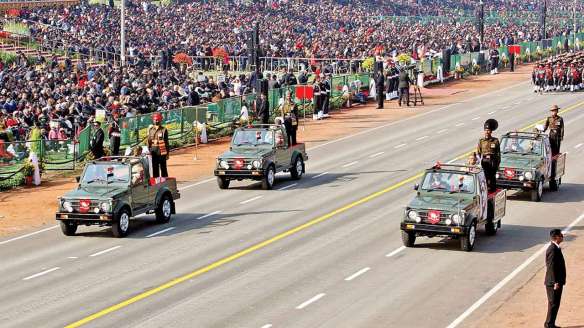
 After the attacks of September 11, 2001, the United States invaded Afghanistan and removed the Taliban from power, thereby eliminating a key nexus of international terrorism. But now, a war-weary US, with a president seeking to cut and run, has reached a tentative deal largely on the Taliban’s terms. The extremist militia that once harbored al-Qaeda and now carries out the world’s deadliest terrorist attacks has secured not just the promise of a US military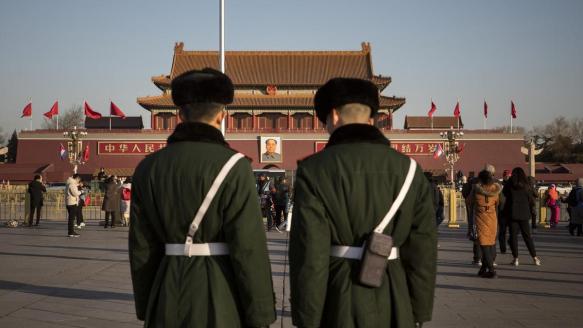
/arc-anglerfish-tgam-prod-tgam.s3.amazonaws.com/public/RHTN2OGVHBH7XDD6BSRYFN3LHA.jpg)
/arc-anglerfish-tgam-prod-tgam.s3.amazonaws.com/public/5RQFIFD4T5CM5HG4HGORADCYLU.jpg)
 Stagecraft and Statecraft
You must be logged in to post a comment.