The Afghan Abyss

The Taliban regime is behaving as expected, turning the country into a breeding ground for international terrorism, narcotics trafficking, and mass migration. There is no justification for attempts by US President Joe Biden’s administration to engage with it.

By Brahma Chellaney, Project Syndicate

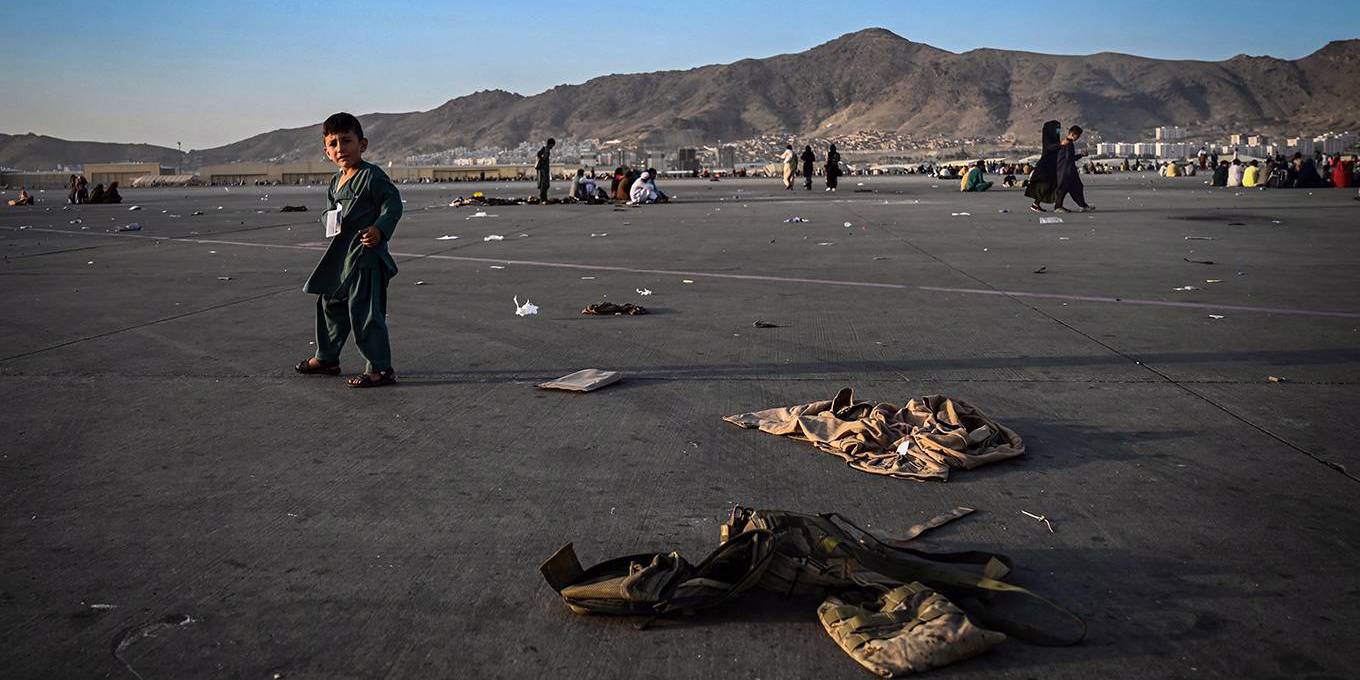
In the year since the United States’ disgraceful abandonment of Afghanistan to the Taliban, the country has gone down precisely the path any logical observer would have predicted: a medieval, jihadist, terrorist-sheltering emirate has been established. The US will incur costs for betraying its Afghan allies for a long time to come. But nobody will pay a higher price than Afghans.

The geopolitical fallout of America’s humiliating retreat from Afghanistan – after President Joe Biden followed through on the withdrawal commitment of his predecessor, Donald Trump – is still growing. By exposing the US as a power in decline, the withdrawal gave a huge boost to militant Islamists everywhere, while emboldening Russia and China. It is no coincidence that, not long after the fall of Kabul, Russia began massing forces along Ukraine’s borders, and China sent a record number of warplanes into Taiwan’s self-declared air defense identification zone.

But things are much worse in Afghanistan. Women and girls have lost their rights to employment and education, with many girls subjected to sexual slavery through forced marriages to Taliban fighters. Taliban death squads have been systematically identifying and murdering those who cooperated with US forces. Torture and execution have become commonplace. Afghanistan’s Hindus and Sikhs – descendants of those who withstood the medieval-era conversions to Sunni Islam by the country’s Arab conquerors – have been fleeing to India to avoid slaughter.

The regime’s cabinet is a veritable who’s who of international terrorists and narcotics kingpins. Sirajuddin Haqqani, who is responsible for Afghanistan’s internal security and preventing the country from becoming a safe haven for international terrorists, is the leader of the ruthless Haqqani network. The US has designated him a “global terrorist” and placed a $10 million bounty on his head.

Not surprisingly, the Taliban continues to shelter known terrorists, as the recent Biden-ordered assassination of al-Qaeda leader Ayman al-Zawahiri in central Kabul showed. While Biden was quick to take a victory lap after al-Zawahiri’s killing, the assassination hardly reflects well on him. A year ago, when ordering US troops to beat a hasty retreat, he claimed that the US no longer had any interest in Afghanistan, because al-Qaeda was already “gone.” (No matter that, just weeks earlier, a United Nations Security Council report had shown that al-Qaeda militants were fighting alongside their Taliban associates.)

Compounding the danger to Afghanistan and its neighbors, the US left behind $7.1 billion worth of weapons in its chaotic withdrawal from the country. According to a recent Pentagon report, the US has no plans to retrieve or destroy the equipment, despite recognizing that the Taliban has already “repaired some damaged Afghan Air Force aircraft and made incremental gains in its capability to employ these aircraft in operations.”

In short, Biden’s decision to overrule his generals and withdraw from Afghanistan – a month before his own target date of September 11 – has created a security and humanitarian nightmare. And Biden is nowhere near finished making foreign-policy blunders in Afghanistan.

After Kabul’s fall, US Secretary of State Antony Blinken declared that the US would judge its future engagement with the Taliban-led government based on “one simple proposition”: whether it helps the US advance its interests, including “seeing that women’s rights are upheld,” delivering humanitarian assistance, and pursuing counterterrorism. But even though the Taliban has failed on all three counts, the Biden administration is gradually easing sanctions on the regime.

At the UN, the US spearheaded a resolution providing for a humanitarian exemption to the sanctions imposed on Afghanistan. The US Treasury Department’s General Licenses, aimed at facilitating the provision of humanitarian relief, now allow financial transactions involving the Taliban and the Haqqani network. And the US is currently negotiating with the Taliban over the release of $3.5 billion of Afghan central-bank reserves.

Meanwhile, the US refuses to target Haqqani or other leading terrorists in Kabul. Yes, al-Zawahiri was assassinated, but, contrary to the Biden administration’s narrative, he was not all that influential. He was largely retired, living with members of his extended family in a Kabul house under Haqqani’s protection.

What’s next? Will the US now reward Pakistan – one of America’s 18 “major non-NATO allies” – for opening its airspace to the drone that killed al-Zawahiri? True, Pakistan reared the Taliban and engineered the US defeat in Afghanistan, but now it wants an early International Monetary Fund loan dispersal to help it avert a debt default.

Likewise, will the US now continue to pursue the release of Afghanistan’s central-bank reserves to the Taliban, despite its indisputable harboring of terrorists and establishment of an oppressive and violent Islamic state? The Biden administration defends its engagement with the Taliban by speciously contending that the top terrorist threat in Afghanistan is the Islamic State-Khorasan. But ISIS-K has relatively few members, no state sponsor or Afghan allies, and controls no territory.

The Biden administration seems committed to striking a kind of Faustian bargain with the Taliban. But to what end? The Taliban’s political power and Islamist ideology make it a critical link in the international jihadist movement. And its rule is threatening to turn Afghanistan into a breeding ground for international terrorism, narcotics trafficking, and mass migration. There is no justification for engaging with it.

Through its precipitous and bungling withdrawal from Afghanistan, the Biden administration handed Islamists worldwide their greatest victory. But the war in Afghanistan is hardly over. As the Taliban’s self-styled emir, Mullah Haibatullah Akhundzada, recently declared, “This war never ends, and it will continue till judgment day.”

Brahma Chellaney

Brahma Chellaney, Professor of Strategic Studies at the New Delhi-based Center for Policy Research and Fellow at the Robert Bosch Academy in Berlin, is the author of nine books, including Asian Juggernaut; Water: Asia’s New Battleground; and Water, Peace, and War: Confronting the Global Water Crisis.
© Project Syndicate, 2022.

Will US-China Tensions Boil Over?

BRAHMA CHELLANEYProject Syndicate

China’s strategy has been to advance its foreign-policy objectives largely through bluff, bluster, and bullying. Without sparking direct armed conflict, China’s leaders have sought to intimidate and coerce neighboring countries into yielding to their demands.

In contrast to Russia’s frontal assaults on Ukraine, China’s expansionism in Asia – from the South China Sea to the Himalayas – has been pursued incrementally. For example, China’s ongoing military standoff with India along the two countries’ disputed Himalayan border was triggered by its stealthy land grabs in Indian Ladakh in April 2020.

The last thing China wants is to get into an armed conflict with the United States, a superior military power, because this would expose chinks in its armor.

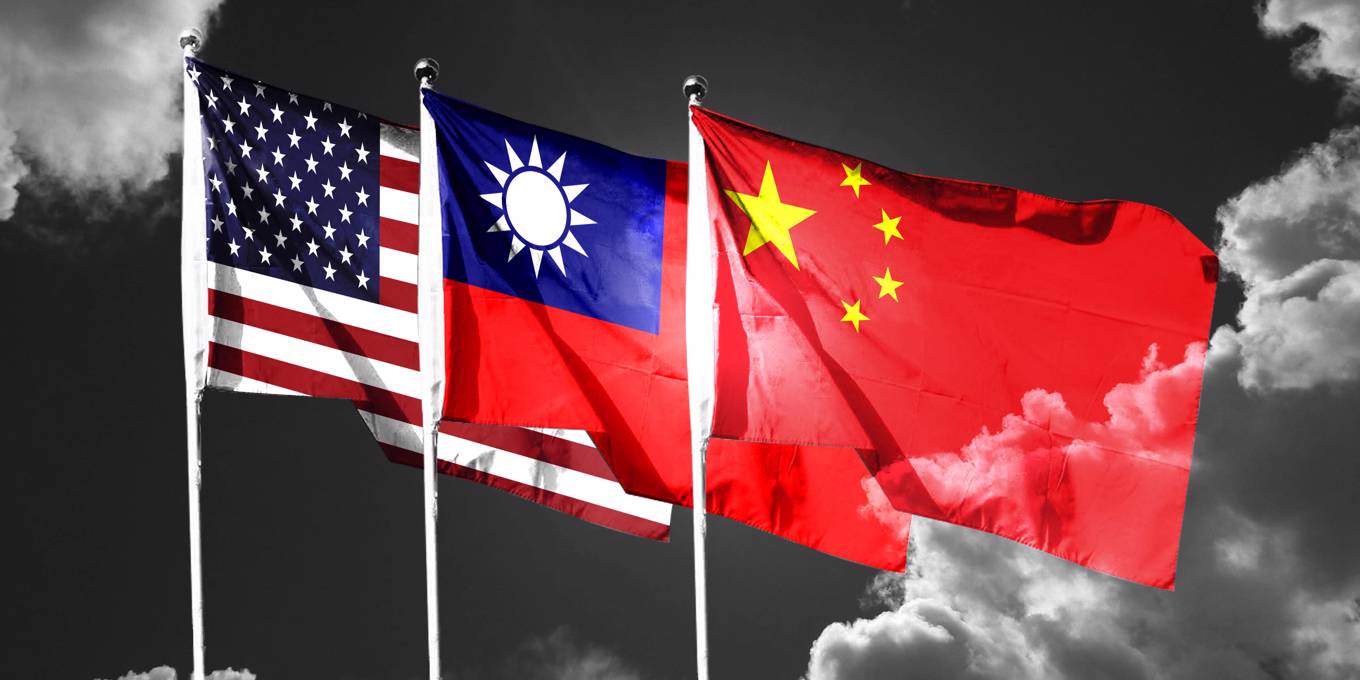
By going to Taipei recently, US Speaker of the House Nancy Pelosi called China’s bluff. But her visit also served as a pretext for Chinese President Xi Jinping’s regime to step up coercive pressure on Taiwan by carrying out provocative military drills in a dress rehearsal for a blockade. Long before Pelosi considered visiting Taipei, China had been ramping up its campaign of intimidation, with its warplanes regularly crossing the median line in the Taiwan Strait.

Xi’s increasing troubles at home, including economic growth slowing almost to a halt, amplify the risk that he will resort to nationalist brinkmanship as a distraction. The odds are increasing that he will move against Taiwan in the two-year period between securing a norm-breaking third term as Communist Party chairman this November and the 2024 US presidential election.

But, rather than order a full-scale invasion, Xi is more likely to throttle Taiwan slowly. That will leave US President Joe Biden with difficult choices, with inaction likely to prove fatal for the island. A Taiwan fiasco on Biden’s watch, after his Afghanistan debacle and failure to deter Russia’s invasion of Ukraine, would gravely undermine America’s global power.

Brahma Chellaney

Brahma Chellaney, Professor of Strategic Studies at the New Delhi-based Center for Policy Research and Fellow at the Robert Bosch Academy in Berlin, is the author of nine books, including Asian Juggernaut; Water: Asia’s New Battleground; and Water, Peace, and War: Confronting the Global Water Crisis.
© Project Syndicate, 2022.

Will Taiwan be the next Ukraine on Biden’s watch?

Brahma Chellaney, The Hill

President Biden has still to grasp that Taiwan is far more important than Ukraine to the future of American power in the world. Yet the likelihood is growing that, on Biden’s watch, Chinese President Xi Jinping would move on Taiwan, just as Russian President Vladimir Putin invaded Ukraine.

In a forewarning of that, China has recently started claiming that it owns the critical international waterway, the Taiwan Strait. Just as it did earlier in the South China Sea — the strategic corridor between the Pacific and Indian Oceans, through which one-third of global maritime trade passes — Xi’s regime is seeking to advance its expansionism by laying an expansive claim to the Taiwan Strait, which, by connecting the South and East China Seas, serves as an important passage for commercial shipping as well as foreign naval vessels. 

The new claim signals that Xi is preparing to move on Taiwan at an opportune time — an action that would involve exercising maritime domain control.

By forcibly absorbing Taiwan, China would drive the final nail in the coffin of America’s global preeminence. A takeover of Taiwan would also give China a prized strategic and economic asset.

The defense of Taiwan has assumed greater significance for international security because three successive U.S. administrations have failed to credibly push back against China’s expansionism in the South China Sea, relying instead on rhetoric or symbolic actions.

Biden, rather than working to deter and thwart a possible Chinese attack on Taiwan, is seeking to shield his tentative rapprochement with China, which has been forged through a series of virtual meetings with Xi and by offering Beijing important concessions. This explains why Biden publicly pushed back against a Taiwan visit by House Speaker Nancy Pelosi.

It is important to remember that, much before Russia invaded Ukraine, Biden had begun to ease pressure on China. He effectively let Xi’s regime off the hook for both covering up COVID-19’s origins and failing to meet its commitments under the 2020 “phase one” trade deal with Washington. Biden also dropped fraud charges against the daughter of the founder of the military-linked Chinese tech giant Huawei. U.S. sanctions over China’s Muslim gulag remain essentially symbolic.

And now Biden is planning to roll back tariffs on Chinese goods, which will further fuel China’s spiraling trade surplus with America. After swelling by more than 25% last year to $396.6 billion, the trade surplus with the U.S. now makes up almost three-quarters of China’s total global surplus. 

The mammoth surplus is helping to keep the Chinese economy afloat at a time when growth has slowed almost to a halt, triggering rising unemployment and mortgage and debt crises. The situation has been made worse by Xi’s lockdown-centered, zero-tolerance approach to COVID-19, which is breeding anger and resistance amid a property implosion.

Xi’s growing domestic troubles at a critical time when he is seeking a norm-breaking third term as Communist Party chairman heighten the risk of the Chinese leader resorting to nationalist brinkmanship as a distraction. After all, initiating a foreign intervention or crisis to divert attention from domestic challenges is a tried-and-true technique of leaders of major powers.

In his latest virtual meeting with Biden on July 28, Xi sharply warned against U.S. interference in the Taiwan issue, saying that those who “play with fire will perish by it.” Biden, by contrast, struck a defensive tone, reaffirming the U.S. commitment to a one-China policy and reassuring Xi that American “policy has not changed and that the United States strongly opposes anyone who will change the status quo or undermine peace and stability across the Taiwan Strait.”

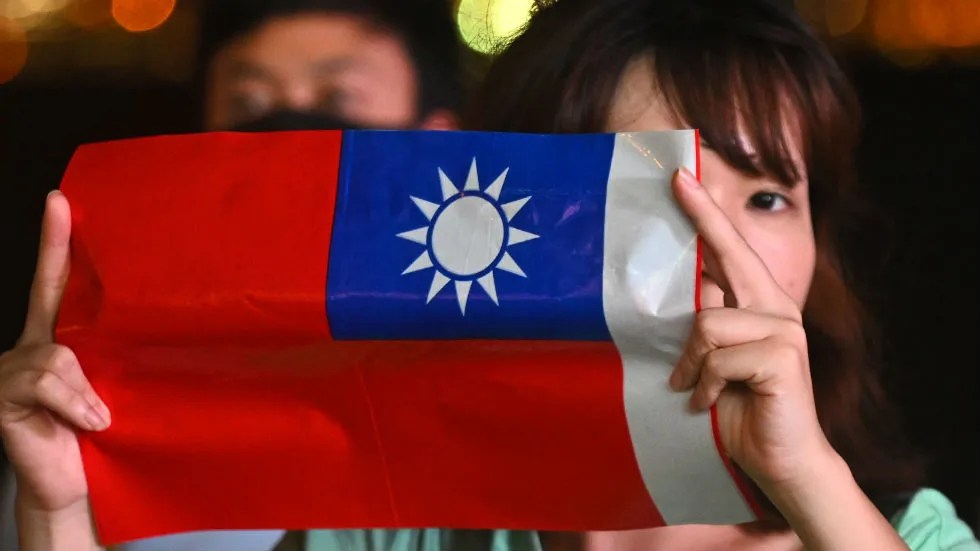
Having swallowed Hong Kong, the Chinese Communist Party seems itching to move on Taiwan, a technological powerhouse that plays a central role in the international semiconductor business. Annexing Taiwan will make China a more formidable rival to America and advance its goal of achieving global preeminence by the 100th anniversary of communist rule in 2049. 

Against this background, Biden’s conciliatory approach toward China threatens to embolden Xi’s designs against Taiwan.

Taiwan’s imperative is to expand its global footprint in order to help safeguard its autonomous status. Instead of aiding that effort, Biden inexplicably excluded that island democracy from his recently unveiled Indo-Pacific Economic Framework — an economic platform that seeks to promote cooperation among its member-states.

Biden’s pursuit of a rapprochement with China also explains his administration’s proposal to roll back tariffs on Chinese products, an action that would break his promise not to unilaterally lift tariffs unless Beijing’s behavior improved.

Not once, not twice, but at least three times Biden has said in recent months that he is willing to get militarily involved to defend Taiwan, only to have his senior officials walk back his comments on every occasion. The last time when he sowed international confusion afresh, Biden himself walked back his Taiwan comments, telling reporters a day later, “My policy has not changed at all.”

In seeking to placate China, Biden is sending out contradictory signals, leaving Taiwan vexed and confused.

Instead of privately advising Pelosi against visiting Taiwan, Biden gratuitously told a reporter that “the military” thinks a Pelosi visit to Taiwan is “not a good idea right now.” Pelosi then told the media, “I think what the president is saying is that maybe the military was afraid our plane would get shot down or something like that by the Chinese.”

The president’s unusual remark conveyed American weakness by implying that the U.S. military was not capable of securing the flight path of the Pelosi-carrying military aircraft to Taiwan or effectively responding to any Chinese provocation. The comment also encouraged Xi’s regime to escalate its bullying threats to stymie a Taiwan visit by the person second in line to the U.S. presidency.

More fundamentally, if Biden fears a Pelosi visit to Taipei would set back his nascent rapprochement with China and ignite new tensions, it raises serious doubts whether he will have the political will to help defeat a Chinese attack on Taiwan.

Xi is also likely encouraged by Biden’s failure to force Russian forces to retreat from Ukraine, despite Washington spearheading unprecedented Western actions against Russia, including weaponizing finance, slapping wide-ranging sanctions and arming Ukraine with a plethora of sophisticated weapons.

With Biden’s poll numbers already in the tank, the president is likely to emerge further weakened from the approaching midterm election. By contrast, a strengthened Xi securing a precedent-defying third term is likely to be bolder and more assertive in pursuing his geopolitical ambitions.

Instead of ordering a full-scale invasion, Xi may begin to slowly throttle Taiwan so as to force it to merge with China. A strangulation strategy would likely include blockading the Taiwan Strait (which will close off Taiwan’s main port, Kaohsiung) and seeking to cut off Taiwan’s undersea cables, internet connections and energy imports.

Make no mistake: Xi perceives an advantageous window of opportunity to accomplish what he has called a “historic mission” to incorporate Taiwan. And, in the style recommended by ancient Chinese military strategist Sun Tzu, Xi’s aggression will likely begin with stealth, deception, surprise and innovative methods.

For Xi, taking Taiwan is essential to achieving larger strategic goals, including making China a world power second to none by displacing America from regional and global order.

Brahma Chellaney is a geostrategist and the author of nine books, including the award-winning “Water: Asia’s New Battleground” (Georgetown University Press). Follow him on Twitter @Chellaney.

Ukraine war hastens Sri Lanka’s economic meltdown

Internal factors alone cannot explain Sri Lanka’s economic collapse. In a forewarning of wider international instability, Sri Lanka slid from a serious balance-of-payments crisis to bankruptcy due to the spiraling global fuel and food prices triggered by the Western sanctions against Russia.

Brahma Chellaney, Nikkei Asia

Auto rickshaw drivers line up to buy gas near a fuel station in Colombo on April 13: A forewarning that more vulnerable countries could go bust. © AP

Sri Lanka’s economic collapse exemplifies how poorer countries are paying the price of Western sanctions on Russia following its invasion of Ukraine.

Instead of focusing on how the sanctions are fueling a global energy and food crisis, much of the international attention is on the new Cold War between the West and Moscow. Unable to pay for basic imports and crippled by domestic shortages of fuel, food and medicine, Sri Lanka is facing its worst financial crisis since independence in 1948.

After hundreds of thousands of protesters marched on Colombo over the weekend, and the risk of violent unrest intensified, Sri Lanka’s President Gotabaya Rajapaksa and interim Prime Minister Ranil Wickremesinghe separately announced they were stepping down. Gotabaya, however, fled the country on a military jet without handing in his resignation.

Rooted in fiscal imbalances, external debt and government mismanagement, Sri Lanka’s economic crisis predates the Western imposition of unparalleled sanctions on Russia over its attack on Ukraine.

But, thanks to spiraling international fuel and food prices in recent months, Sri Lanka has slid from a serious balance-of-payments crisis to bankruptcy, with Wickremesinghe declaring that the national economy had “completely collapsed.”

By taking out a crucial chunk of the global energy supply, the sanctions against Russia have triggered a surge in inflation in Western nations, which now confront cost-of-living crises. But in poorer countries, the sanctions are compounding national debt woes and threatening livelihoods and social stability.

Russia, the world’s largest exporter of oil and gas before the war, has been critical to stability in international energy markets, while its fertilizer exports remain vital for global food production, in which energy accounts for up to 30% of the cost.

Financial sanctions have made it so difficult to make payments to Russia that supplies of even sanctions-exempt commodities such as fertilizers and wheat — of which Russia is also the world’s biggest exporter — have been disrupted. Russia, for its part, has blocked shipments of Ukraine’s leading exports: sunflower oil, corn and wheat.

It is these unintended consequences that have hastened Sri Lanka’s economic meltdown. The rapid depletion of foreign exchange reserves has left its citizens without basic necessities. Rolling electricity outages and queues for fuel that run for miles have forced authorities to temporarily shut schools and offices.

Sri Lanka’s debt crisis first caught international attention in 2017 when, unable to repay Chinese loans, the nation handed a strategic port complex at Hambantota to China on a 99-year lease. Despite slipping into a debt trap, Sri Lanka went ahead with other grandiose Chinese projects, including a massive development project across the bay from Colombo on reclaimed land.

Other factors also contributed to making Sri Lanka’s debt unsustainable. A terrorist bombing spree on Easter Sunday in 2019 that killed nearly 300 people and led to a near cessation of foreign tourist arrivals, followed by the COVID pandemic, devastated the resource-poor nation’s revenue stream.

The Rajapaksa family, which has long dominated Sri Lanka’s political landscape and was instrumental in opening the door to China, racked up debt on a grand scale by committing to an array of ambitious infrastructure projects, several of which continue to bleed money. Worse still, drastic tax cuts in 2019 wiped out about a third of the government’s revenues.

More recently, after violent protests toppled Prime Minister Mahinda Rajapaksa’s government in May, his brother, President Gotabaya Rajapaksa, appointed an old political rival, former Prime Minister Wickremesinghe, to head an interim government and help rescue the nation from the economic death spiral.

Wickremesinghe, whose private home was set on fire by arsonists on Saturday, earlier described the national situation as unprecedented. “We’ve had difficult times [before]… But not like this. I have not seen… people without fuel, without food.”

Sri Lanka has confronted multiple economic crises in the past — since 1965 the country has secured 16 International Monetary Fund loans — but its current talks with the IMF for a bailout package are difficult because, in Wickremesinghe’s words, “we are participating in the negotiations as a bankrupt country.” An IMF approval appears months away.

China, now the world’s biggest official creditor, has balked at paring Sri Lanka’s debt, saying it would set a precedent for other borrowing countries to demand similar relief. With China’s typical loan contract compelling a borrowing country to keep confidential even the loan’s existence, Sri Lanka is reeling under a hidden debt problem, with its actual debt to Beijing perhaps making up as much as 20% of its total external debt.

To stay afloat in recent months, Sri Lanka has largely relied on help from India, which has provided over $4 billion in credit lines and other aid. But Wickremesinghe says Sri Lanka urgently needs more assistance, especially from India, Japan, the U.S. and China.

Sri Lanka’s economic meltdown, which has forced it to seek Russian oil, wheat and fertilizers on credit, may be an extreme example of the global fallout from the U.S.-led sanctions on Moscow.

But violent demonstrations from Latin America to Africa over the dizzying spiral in fuel and food prices are a forewarning that more vulnerable countries could go bust. “I think by the end of the year, you could see the impact in other countries” as well, Wickremesinghe said.

Brahma Chellaney is a geostrategist and author of nine books, including “Asian Juggernaut: The Rise of China, India and Japan.”

Have Western sanctions against Russia boomeranged?

BY BRAHMA CHELLANEY, The Hill

With the Russian invasion of Ukraine now in its fifth month, Western leaders are beginning to recognize, if not openly acknowledge, that their unprecedented sanctions against Moscow are hurting their own countries’ economies without significantly crimping the Kremlin’s war machine. As the recent back-to-back Group of Seven and NATO summits underscored, Western leaders are straining to find new ways to deter Russian President Vladimir Putin.

In fact, the fallout from the U.S.-led sanctions on Russia has ended the era of cheap oil and gas and contributed to surging inflation, supply-chain disruptions and a looming recession in the West. In poorer countries, by sending fuel and food prices higher, the sanctions are threatening livelihoods and political stability.

Sanctions historically have produced unintended and undesirable consequences, yet they have become the policy tool of choice for the United States.

U.S.-led sanctions on relatively small and economically vulnerable nations like Cuba, Iran, North Korea, Syria and Venezuela have essentially failed to change their behavior. But that reality did little to temper Western leaders’ strategic expectations when they launched a comprehensive, sanctions-centered hybrid war against Russia, a commodities powerhouse with the world’s largest nuclear-weapons arsenal

The greater the size and capability of the target country, the lesser is usually the deterrent effect of sanctions. As the West is now discovering, sanctions against a large, powerful state not only entail significant costs for the countries imposing them, but they also reward nations that refuse to enforce them. Indeed, the sanctions have delivered Russia a windfall from high-price energy exports that no Western-sponsored price cap can significantly roll back.

Today, the increasingly apparent limits of the sanctions approach against Russia are highlighting the limits of Western power. With economic power moving east, the West needs a broad range of international partners more than ever to make a difference. But much of the non-Western world has not joined the West’s sanctions campaign, with all the major democracies in the Global South, Israel and the Gulf Arab states declining to take sides in the NATO-Russia conflict.

The principal lesson from the Russian aggression is that President Biden’s threats to inflict severe economic punishment failed to deter Putin from launching an all-out invasion. And that the Western imposition of sanctions has had little effect on Russia’s war effort.

Yet, ignoring that lesson, the clamor for more and more punitive actions has led to a steadily increasing number of sanctions against Russia and a greater flow of lethal aid to Ukraine, as if there is no threshold that would satiate the Western urge for reprisals or military involvement in the conflict.

Russia already occupies one-fifth of Ukraine, the largest country located entirely within Europe, as Avril D. Haines, the director of national intelligence, acknowledged last week. What Haines didn’t disclose is that Russia now controls Ukraine’s mineral-rich industrial heartland, more than 90% of its energy resources (including all offshore oil), and much of its port and shipping infrastructure. Russia has also created a strategically important land bridge to Crimea and turned the Sea of Azov into its inland waters.

Biden boasted too soon in March that sanctions were “crushing the Russian economy” and that “the ruble is reduced to rubble.” The sanctions campaign against Russia has scarcely been effective, with Putin’s war machine showing no sign of easing up.

One key reason is that Russia’s finances remain strong. Despite Western governments freezing about $400 billion in Russian central bank assets and at least $240 billion in private wealth, Moscow has roughly $300 billion in foreign currency and gold reserves. The ruble has now hit a seven-year high against the dollar.

The Western discourse is finally beginning to face up to the unpalatable realities. Claims that “Russia is losing” and that “Putin is running out of options to avoid defeat” have given way to open concern that, despite the unparalleled sanctions on Moscow and the frenzied arming of Ukraine, Russia will end up gaining permanent control over sizable Ukrainian territories, thereby unambiguously demonstrating that aggression works.

This, in turn, is likely to encourage China to move on Taiwan, potentially embroiling the U.S. and its ally Japan in a conflict whose geopolitical fallout and economic and human toll could be greater than that from the Ukraine war. Just as Putin was clear about his plans for invading Ukraine, so has Chinese President Xi Jinping been clear about forcibly absorbing Taiwan — a development that would drive the final nail in the coffin of America’s global preeminence.

That the Western sanctions campaign against Russia has largely been ineffective will only embolden Xi’s expansionist agenda. Xi just took a victory lap in Hong Kong after rapidly turning one of Asia’s freest cities into a repressive police state. Like his expansionism in the South China Sea and the Himalayas, Xi brought Hong Kong to heel without incurring any international costs.

When sanctions have proved ineffectual in changing Russia’s behavior, any similar sanctions would fare even worse against China, whose economy is about 10 times larger than Russia’s. Indeed, the damage to Western economies from Russia-type sanctions against China would likely dwarf the current economic pain that the West is bearing from its sanctions on Moscow.

The West’s economic pain from sanctions that are doing little to hurt Russia’s war effort or push Putin to the negotiating table represents a classic example of cutting off one’s nose to spite one’s face. Western leaders clearly overestimated their capacity to undermine the Russian economy and Putin’s hold on power, while underestimating the resilience of a country that historically has endured extraordinary economic and human toll (including in World War II) to pursue strategic objectives.

Some of the West’s economic pain is self-inflicted. At a time when global supplies are already tight, Europe’s decision to switch from cheap Russian energy to alternative supplies has led to stratospheric international prices and a scramble to find new sources of supply, besides stoking a costly competition with the thriving economies of Asia, the world’s largest energy consumer.

The European Union (EU) has agreed on a time frame to wean itself off Russian oil and gas. But Moscow is intent on not letting the EU dictate the timetable for phasing out Russian supplies. With European gas prices already six times higher than a year ago, a possible Russian cutoff of gas supplies to punish the EU for sanctions will compound the already-grim European economic situation.

In the U.S., the soaring prices of gasoline, diesel and natural gas, which have fueled runaway inflation, are due to rising energy exports, with American energy producers seeking to profit from the skyrocketing global prices by selling their products to the highest bidders in international markets. The profits bonanza for the U.S. exporters of crude oil, gas and refined petroleum products is proving costly for American consumers.

Meanwhile, spiraling international food prices are contributing to an alarming hunger problem in poor countries. The Russian invasion has blocked shipment of Ukraine’s leading exports — sunflower oil, corn and wheat. But worse in global impact is the sanctions-linked disruption in supplies of fertilizers and wheat from the world’s No. 1 exporter of both, Russia.

In the face of the global food and energy crises, the West risks losing the international battle of narratives.

This may explain why the Biden administration, despite a wholly punitive approach toward Russia, is now offering to write “comfort letters” for international companies reassuring them that they won’t face penalties for importing Russian fertilizers and grains. But, given the sweeping sanctions against Moscow, such an offer may provide little comfort for Western importers, many of whom have reduced their exposure to Russian commodities because of the sanctions-related difficulty of making payments into Russia.

Having played all his major economic cards, Biden’s sanctions drive has run into a dead-end, even as U.S. and European economic woes worsen.

This is redolent of how America’s 1930 Smoot-Hawley Tariff Act, by substantially raising import duties and prompting other countries to retaliate, deepened the Great Depression and contributed to the rise of political extremism, which then enabled Adolf Hitler to gain power. The risk now is that, instead of the wished-for economic collapse and regime change in Russia, the Western sanctions campaign could transform global geopolitics by provoking a Russian nationalist backlash and cementing the Sino-Russian axis.

Brahma Chellaney is a geostrategist and the author of nine books, including the award-winning “Water: Asia’s New Battleground” (Georgetown University Press). Follow him on Twitter @Chellaney.

The Global Dam Frenzy

There is no question that the world must cut its reliance on fossil fuels. But building more hydroelectric dams – especially in highly biodiverse river basins, such as the Amazon, the Brahmaputra, the Congo, and the Mekong – is not the way to do it.

BRAHMA CHELLANEY, Project Syndicate

The era of cheap oil and gas is over. Russia’s war in Ukraine – or, more specifically, Europe’s ambitious effort to wean itself off Russian fossil fuels at a time when international supplies are already tight – is driving up global energy prices and raising the specter of a global energy crisis. Alternative sources of energy are looking more appealing by the day, as they should. But the embrace of hydropower, in particular, carries its own risks.

Hydropower is currently the most widely used renewable, accounting for almost half of all low-carbon electricity generation worldwide. Its appeal is rooted in several factors. For decades, it was the most cost-competitive renewable, and many hydropower plants can increase or decrease their electricity generation much faster than nuclear, coal, and natural-gas plants. And whereas wind and solar output can fluctuate significantly, hydropower can be dependably produced using reservoirs, making it a good complement to these more variable sources.

But there is a hitch. The most common type of hydropower plant entails the damming of rivers and streams. And hydroelectric dams have a large and lasting ecological footprint.

For starters, while hydroelectric generation itself emits no greenhouse gases, dams and reservoirs emit significant amounts of methane, carbon dioxide, and nitrous oxide. Under some circumstances – such as in tropical zones – they can generate more greenhouse gases than fossil-fuel power plants. One study found that methane – a greenhouse gas that is at least 34 times more potent than CO2 – can make up some 80% of emissions from artificial reservoirs, though a wide variety of geographical, climatic, seasonal, and vegetational factors affect reservoir emissions.

Moreover, while hydroelectric dams are often touted for delivering clean drinking water, controlling floods, and supporting irrigation, they also change river temperatures and water quality and impede the flow of nutrient-rich sediment. Such sediment is essential to help re-fertilize degraded soils in downstream plains, prevent the erosion of the river channel, and preserve biodiversity.

When dams trap the sediment flowing in from the mountains, deltas shrink and sink. This allows salt water to intrude inland, thereby disturbing the delicate balance between fresh water and salt water that is essential for the survival of critical species in coastal estuaries and lagoons. It also exposes deltas to the full force of storms and hurricanes. In Asia, heavily populated deltas – home to megacities like Tianjin, Shanghai, Guangzhou, Bangkok, and Dhaka – are already retreating fast.

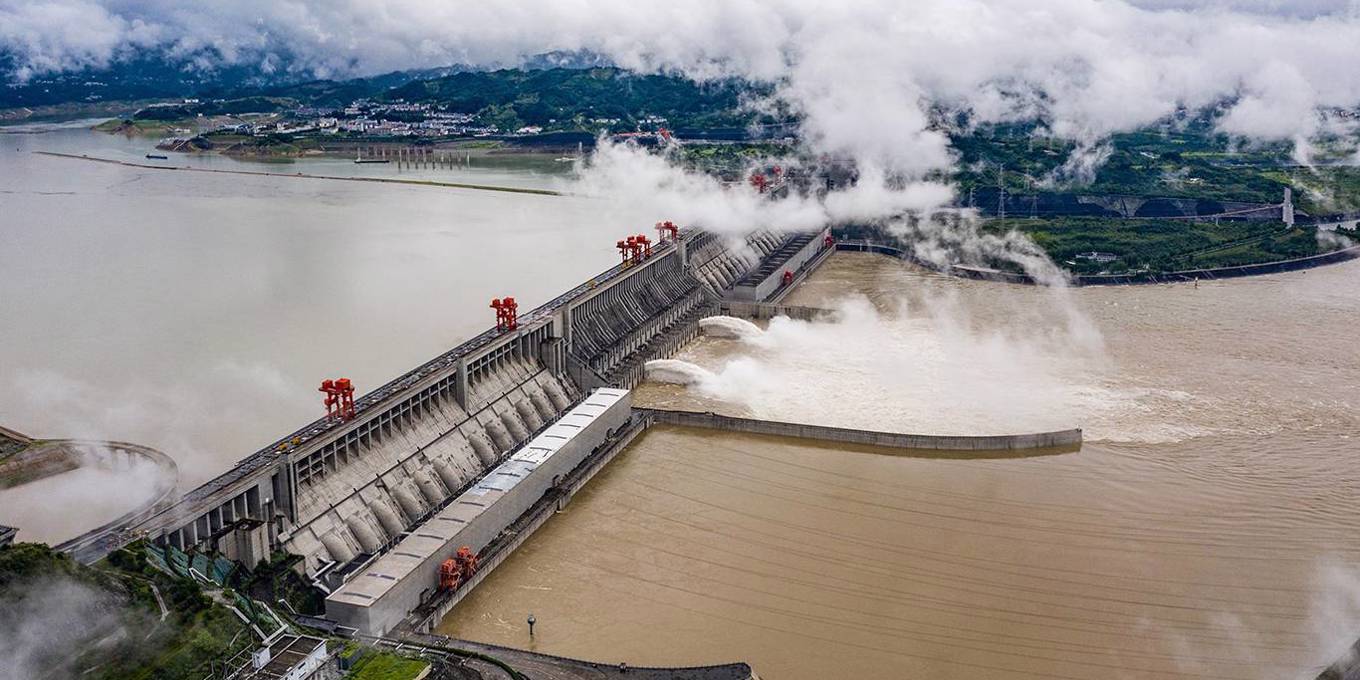
Dams also carry high social costs. In 2007, then-Chinese Prime Minister Wen Jiabao revealed that China had relocated 22.9 million people to make way for water projects – a figure larger than the populations of more than 100 countries. The Three Gorges Dam, the world’s largest hydropower station, which became fully operational in 2012, displaced more than 1.4 million people.

To top it all off, there is good reason to doubt hydropower’s reliability. If mitigation measures prove unable to slow global warming adequately – an increasingly likely scenario – the frequency and intensity of droughts will continue to rise. As water levels in rivers and reservoirs drop – exacerbated by evaporation from open reservoirs – so will the water pressure needed to spin turbines, resulting in less electricity. And this is to say nothing of giant dams’ ability to compound downstream droughts, as has been seen in the Mekong River Basin.

Given that dams are expensive, years-long undertakings, the wisdom of investing in building more of them is questionable, to say the least. But the world’s love affair with dams continues. Almost two-thirds of the Earth’s long rivers have already been modified by humans, with most of the world’s almost 60,000 large dams having been built over the last seven decades. And, global dam construction continues at a breakneck pace. In 2014, at least 3,700 significant dams were under construction or planned. Since then, the dam boom has become more apparent, with the developing world now a global hotspot of such construction.

While dam-building activity can be seen from the Balkans to South America, China leads the way as both the world’s most-dammed country and its largest exporter of dams. From 2001 to 2020, China lent over $44 billion for the Chinese construction of hydropower projects totaling over 27 gigawatts in 38 countries.

China is not hesitating to build dams even in seismically active areas, despite the risk of triggering a devastating earthquake. And China really should know better: its own scientists linked the 2008 Wenchuan earthquake, which killed more than 87,000 people in the Tibetan Plateau’s eastern rim, to the new Zipingpu Dam, located near the quake’s epicenter.

There is no question that the world must cut its reliance on fossil fuels. But building more hydroelectric dams – especially in the Earth’s most biodiverse river basins, such as the Amazon, the Brahmaputra, the Congo, and the Mekong – is not the way to do it. On the contrary, the global dam frenzy amounts to a kind of a Faustian bargain, in which we trade our planet’s long-term health for a fleeting sense of energy security.

Brahma Chellaney

Brahma Chellaney, Professor of Strategic Studies at the New Delhi-based Center for Policy Research and Fellow at the Robert Bosch Academy in Berlin, is the author of nine books, including Asian Juggernaut; Water: Asia’s New Battleground; and Water, Peace, and War: Confronting the Global Water Crisis.

© Project Syndicate, 2022.

India’s front-line battle against autocracy more important than ever

Chinese troops dismantling their bunkers at Pangong Tso region in Ladakh in February 2021: China has turned other captured areas into permanent all-weather military encampments. © AP

The risk of renewed skirmishes with China is growing

Brahma Chellaney, Nikkei Asia

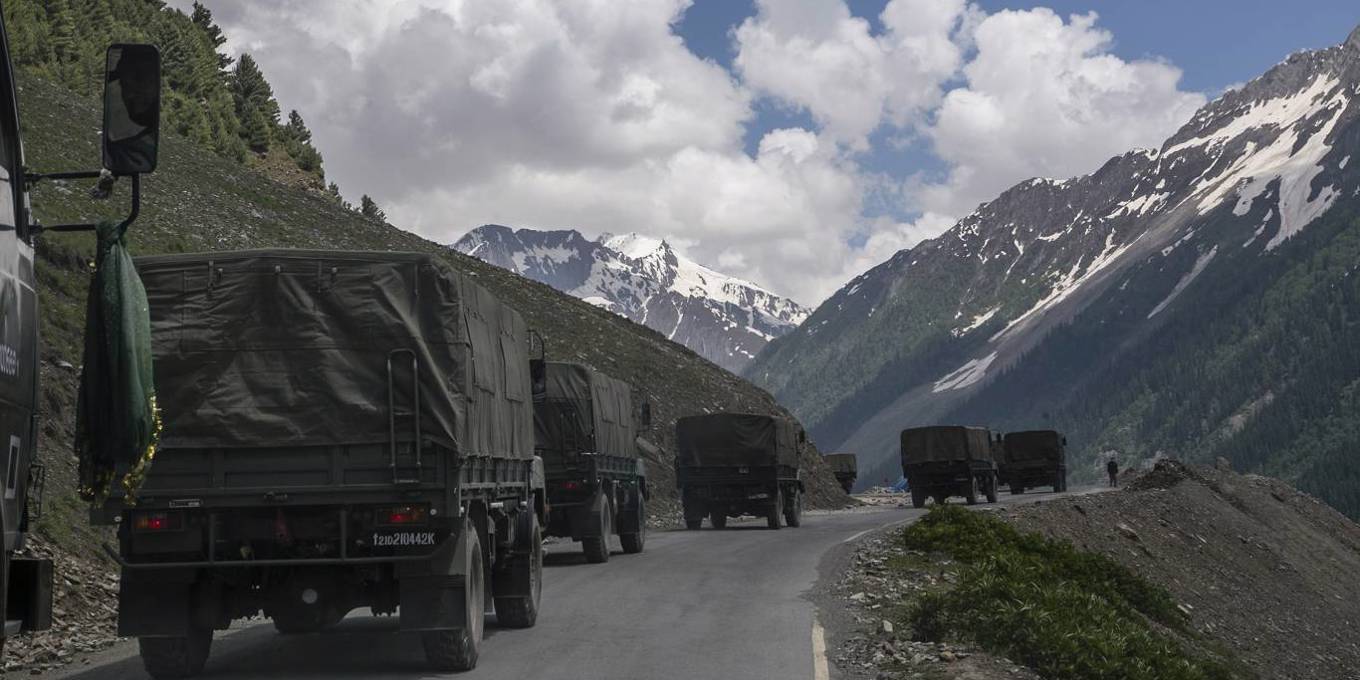
Two years after nighttime hand-to-hand combat with Indian troops resulted in China’s first combat deaths since its 1979 Vietnam invasion, the Chinese and Indian militaries remain locked in multiple standoffs over some of the most inhospitable terrains on Earth.

The war in Ukraine may be obscuring China’s border conflict with India, including the largest Himalayan buildup of rival forces in history. But as U.S. Defense Secretary Lloyd Austin reminded the annual Shangri-La Dialogue in Singapore last weekend, “we see Beijing continue to harden its position along the border that it shares with India.”

With tens of thousands of Chinese and Indian troops facing off against each other, the risks of renewed skirmishing, if not outright war, are significant.

The clashes of June 15, 2020, were the bloodiest of a series of skirmishes or scuffles that began more than six weeks earlier after China, taking advantage of India’s preoccupation with enforcing the world’s strictest coronavirus lockdown, stealthily infiltrated key border areas in the high-altitude Indian region of Ladakh and established heavily fortified bases there.

The surprise encroachments were not nearly as clever a plan as Chinese President Xi Jinping probably thought when he gave his go-ahead. Far from handing China an easy win, they have plunged Sino-Indian relations to a nadir, kept the border crisis simmering and made the fact of a major Indian military buildup inevitable.

The June 15, 2020, clashes not just marked a watershed in India-China relations; they also stood out for their savagery. With a 1996 bilateral agreement prohibiting the two countries’ soldiers from using guns at the border in peacetime, encroaching Chinese soldiers employed metal fence posts and clubs wrapped in barbed wire in a post-sunset ambush attack on an Indian army patrol.

Some Indian soldiers were beaten to death, others were thrown from the soaring cliffs into the fast-flowing Galwan River before Indian reinforcements arrived and fought pitched hand-to-hand battles with the intruders under a moonlit sky.

After the hours-long fighting, India quickly honored its 20 fallen soldiers as martyrs and then established a war memorial to commemorate their sacrifices. But China has still not disclosed its death toll, which U.S. intelligence reportedly placed at 35 and Russia’s government-owned Tass news agency estimated at 45. More than eight months after the clashes, Beijing announced posthumous awards for four Chinese soldiers without revealing the full death toll.

This should not be a surprise, as the Chinese Communist Party rarely reveals the full truth: it disclosed the Chinese death toll from the 1962 war with India more than three decades later in 1994 after significantly lowering the figure.

With the world’s most powerful propaganda machine, the CCP seeks to manufacture reality. While releasing a propaganda video of the clashes, it jailed at least six Chinese bloggers for criticizing its death toll cover-up, with one blogger who had 2.5 million followers on Weibo sentenced to eight months in prison. More recently, it picked the military commander who led the ambush attack as a torchbearer of the Beijing Winter Olympics, provocatively feting him as a hero.

The border crisis has also cast an unflattering light on India, which has instituted no inquiry into why its army was taken unawares by the multiple Chinese intrusions, some of them deep into Indian territory.

India is the world’s third-largest defense spender after the U.S. and China, with the army continuing to appropriate the lion’s share of the defense budget. Yet over the years, the Indian army has repeatedly been caught napping by the cross-border actions of China and Pakistan.

Indeed, it has become somewhat of a tradition in India that, whenever an adversary springs a military surprise, the army generals take cover behind the political leaders, and the ruling politicians hide behind the generals, allowing accountability to go unenforced.

Chinese forces braved harsh weather to intrude into forbidding landscapes, just before thawing ice reopened access routes. But the Indian army ignored warning signs from China’s heightened military activities near the frontier, including an unusually large, wintertime troop exercise that became the launchpad for the aggression.

Yet not a single Indian army commander was relieved of his command for the fiasco. Worse still, Prime Minister Narendra Modi has maintained a conspicuous silence on the military crisis for the past two years.

Instead, Modi has put faith in negotiations, with Beijing using endless talks to string India along while frenetically building new warfare infrastructure that General Charles A. Flynn, head of the U.S. Army Pacific, recently called “eye-opening” and “alarming.”

While withdrawing from some positions it seized, China has turned other captured areas into permanent all-weather military encampments, with large combat-ready forces and newly built roads and heliports that allow front-line positions to be quickly reinforced with fresh troop inductions.

Xi’s aim against India, as in the East and South China Seas, is for China to ultimately win without fighting by employing coercion under the shadow of its deployed military might. To Modi’s credit, India appears determined to frustrate that goal, vowing to sustain the military standoffs, despite the risk of a full-scale war, until China rolls back its encroachments.

India, the world’s largest democracy, is on the front-lines of the battle between democracy and autocracy. If China is able to coerce India into submission, it will open the path for the world’s biggest autocracy to gain supremacy in Asia and reshape the international order in its favor. No wonder Secretary Austin said in Singapore that India’s “growing military capability and technological prowess can be a stabilizing force in the region.”

Brahma Chellaney is a geostrategist and author of nine books, including “Asian Juggernaut: The Rise of China, India and Japan.”

Why is Biden appeasing China?

BRAHMA CHELLANEY, The Hill

President Biden is yet to make his long-anticipated China strategy speech to define his approach to a country that has emerged as the greatest rival that the United States has ever faced. Instead, Secretary of State Antony Blinken laid out the administration’s approach in a speech that acknowledged that China poses “the most serious long-term challenge to the international order.”

In Blinken’s words, “China is the only country with both the intent to reshape the international order and, increasingly, the economic, diplomatic, military and technological power to do it.” 

The president, however, has been fixated since taking office on the weaker of America’s two main foes, Russia, while letting China escape scot-free for covering up the COVID-19 virus’s origins and for detaining more than a million Muslims in internment camps. Indeed, the Biden administration labels only Russia as an adversary, while calling China merely a competitor.

A careful examination of Blinken’s speech, the White House’s “Indo-Pacific Strategy” released in February and Biden’s own actions since last year confirms that a conciliatory approach toward China is taking root, despite occasional tough-sounding rhetoric.

Under President Trump’s administration, a fundamental shift in China policy occurred with the aim of reining in a country that, with U.S. help, became America’s main rival. The paradigm shift formally ended America’s “China fantasy,” which lasted over 45 years — a period in which successive presidents, from Richard Nixon to Barack Obama, aided China’s rise in the naive hope that, as China became increasingly prosperous, it would naturally pursue economic and even political liberalization.

Backed by a broadly bipartisan consensus in favor of ending China’s free ride, this policy change promised to reshape global geopolitics and trade.

Biden, however, has unobtrusively undertaken a course correction, with Blinken’s speech offering more evidence of the administration’s efforts to “coexist and cooperate” with the world’s largest autocracy.

Blinken’s soothing message for Beijing was that the U.S. does not seek to block China’s “role as a major power,” or hinder its economic growth or “transform” its totalitarian system. “We are not looking for conflict or a new Cold War. To the contrary, we’re determined to avoid both,” he declared.

In contrast to the Trump administration’s launch of an ideological offensive against China as a predatory communist state without political legitimacy or the rule of law, Team Biden has repeatedly forsworn any intention to transform that country’s political system in any way.

Biden himself assured Chinese President Xi Jinping in a virtual summit meeting last November that the U.S. will not seek to change China’s political system or direct its alliances against it. And when he telephoned Xi last September, Biden, according to a U.S. background briefer, sought to explain American actions toward China “in a way that [is] not misinterpreted as … somehow trying to sort of undermine Beijing in particular ways.”

Similar reassurances are embedded in the Biden Indo-Pacific strategy document, which declares that, “Our objective is not to change the PRC [People’s Republic of China] but to shape the strategic environment in which it operates…” Contrast that with the administration’s publicly declared goal to “see Russia weakened,” including triggering its economic collapse and degrading its military capabilities.  

With Biden willing to give China a pass on its expansionist policies, the risk is growing that Xi will make Taiwan his next target after his regime’s success in swallowing Hong Kong, redrawing the geopolitical map of the South China Sea and changing the territorial status quo in the Himalayas.

Not once, not twice, but three times in recent months Biden has said that the U.S. will militarily defend Taiwan, only to have his senior officials on each occasion walk back his comments. While creating international confusion afresh on that issue during his Tokyo visit, Biden played down the possibility of China invading Taiwan, saying, “My expectation is that it will not happen.”

But by appeasing China, Biden may invite such aggression. Indeed, Biden’s deepening of U.S. involvement in the Ukraine conflict offers Xi an opening to move on Taiwan at an opportune time when a distracted America is taken by complete surprise. Through rising bullying, Xi is already normalizing China’s hostile pressure on Taiwan.

Nothing better illustrates Biden’s efforts to appease China than Taiwan’s exclusion from his newly unveiled Indo-Pacific Economic Framework for Prosperity. The White House has offered no credible explanation for omitting this economic powerhouse, which is a hub of global semiconductor production.

Taiwan’s exclusion shows how Biden, by bending over backwards not to antagonize Beijing, is sending mixed messages about U.S. commitment to that island democracy. Prioritizing Ukraine’s defense over Taiwan’s, Washington has informed Taipei that the 2022 scheduled delivery of an important U.S. artillery system would be delayed until 2026 at the earliest. Commerce Secretary Gina Raimondo, meanwhile, referred to Taiwan by the demeaning name of “Chinese Taipei” while listing it as one of the founding members of the newly established Cross-Border Privacy Rules Forum.

Make no mistake: Xi is unlikely to be deterred by the harsh U.S.-led sanctions against Russia. The Chinese economy is 10 times larger than the Russian economy, and enforcing sanctions against China would cause serious economic disruptions in the West and upend global supply chains.

In this light, the mixed messages from Washington could lead Xi to believe that Biden lacks the strategic vision and political will to defend Taiwan against a Chinese attack.

More fundamentally, Biden is quietly dismantling, brick by brick, the Trump administration’s China policy without drawing attention to it. U.S. pressure on Xi’s regime is gradually being eased. Examples include letting it off the hook over its great COVID-19 stonewall and dropping fraud charges against the daughter of the founder of China’s military-linked Huawei Technologies.

Despite the FBI director publicly warning that Chinese spying in the U.S. has reached unparalleled levels, Biden has effectively disbanded the “China Initiative,” which was intended to empower the Justice Department to combat Beijing’s vast espionage campaign.

Biden may now target the Trump-era trade tariffs on $370 billion worth of Chinese goods, telling reporters in Tokyo that he was considering rolling them back. As a first step in that direction, his administration has initiated a legally required review of the tariffs, which were slapped on as part of a strategy to use economic levers to weaken China — a kind of death from a thousand cuts.

Rolling the tariffs back would break Biden’s promise not to unilaterally lift them unless China improved its behavior on issues of U.S. concern — from its unfair trade practices to its theft of intellectual property. Team Biden has already condoned Beijing’s failure to meet commitments in the so-called Phase One trade deal with Washington. It also has reinstated exemptions from Trump-era tariffs on 352 products imported from China.

America’s trade deficit with China, meanwhile, continues to swell, jumping over 25 percent in 2021 to $396.6 billion. It now makes up nearly 60 percent of China’s total global trade surplus, which has become the main engine of its economy, besides financing its warfare machine.

Continuing to underwrite China’s economic and geopolitical power not only means that the U.S. has yet to learn from how it aided the rise of a hostile giant; it also is likely to accelerate America’s relative decline.

Brahma Chellaney is a geostrategist and the author of nine books, including the award-winning “Water: Asia’s New Battleground” (Georgetown University Press). Follow him on Twitter @Chellaney.

The Clash of Asia’s Titans

Chinese President Xi Jinping has picked a border fight that he cannot win, and transformed a previously conciliatory India into a long-term foe. This amounts to an even bigger miscalculation than Indian Prime Minister Narendra Modi’s failure to see it coming.

BRAHMA CHELLANEYProject Syndicate

With global attention focused on Russia’s war in Ukraine, China’s territorial expansionism in Asia – especially its expanding border conflict with India – has largely fallen off the international community’s radar. Yet, in the vast glaciated heights of the Himalayas, the world’s demographic titans have been on a war footing for over two years, and the chances of violent clashes rise almost by the day.

The confrontation began in May 2020. When thawing ice reopened access routes after a brutal winter, India was shocked to discover that the People’s Liberation Army (PLA) had stealthily occupied hundreds of square miles of the borderlands in its Ladakh region. This triggered a series of military clashes, which resulted in China’s first combat deaths in over four decades, and triggered the fastest-ever rival troop buildup in the Himalayan region.

India’s counterattacks eventually drove the PLA back from some areas, and the two sides agreed to transform two battlegrounds into buffer zones. But, over the last 15 months, little progress has been made to defuse tensions in other areas. With tens of thousands of Chinese and Indian troops standing virtually at attention along the long-disputed border, a military stalemate has emerged.

But stalemate is not stagnation. China has continued to alter the Himalayan landscape rapidly and profoundly in its favor, including by establishing 624 militarized border villages – mirroring its strategy of creating artificial militarized islands in the South China Sea – and constructing new warfare infrastructure near the frontier.

As part of this effort, China recently completed a bridge over Pangong Lake – the site of past military clashes – that promises to strengthen its position in a disputed area of India’s Ladakh region. It has also built roads and security installations on territory that belongs to Bhutan, in order to gain access to a particularly vulnerable section of India’s border overlooking a narrow corridor known as the “Chicken Neck,” which connects its far northeast to the heartland.

All of this, China hopes, will enable it to dictate terms to India: accept the new status quo, with China keeping the territory it has grabbed, or risk a full-scale war in which China has maximized its advantage. China’s expansionism relies on deception, stealth, and surprise, and on apparent indifference to the risks of military escalation. The aim of its brinkmanship is to confound the other side’s deterrence strategy and leave it with no real options.

China learned from its strategic folly of invading Vietnam in 1979 and has become adept at waging asymmetric or hybrid warfare, usually below the threshold of overt armed conflict. This enables it to advance its strategic objectives, including land grabs, incrementally. Coercive bargaining and overt intimidation also help to overcome resistance.

This salami-slicing strategy has already enabled Chinese President Xi Jinping to redraw the geopolitical map in the South China Sea. And the terrestrial application of this approach being deployed against India, Bhutan, and Nepal is proving just as difficult to counter. As India is learning firsthand, countries have virtually no options other than the use of force.

One thing is certain: simply hoping that China will stop encroaching on Indian territory will do India little good. After all, India got into this situation precisely because its political and military leadership failed to take heed of China’s military activities near the frontier. On the contrary, while China was laying the groundwork for its territorial grabs, Indian Prime Minister Narendra Modi was bending over backwards to befriend Xi. In the five years before the first clashes flared in May 2020, Modi met with his Chinese counterpart 18 times. Even a 2017 standoff on a remote Himalayan plateau did not dissuade Modi from pursuing his appeasement policy.

Seeking to protect his image as a strong leader, Modi has not acknowledged the loss of Indian territories. India’s media enables this evasion by amplifying government-coined euphemisms: China’s aggression is a “unilateral change of status quo,” and the PLA-seized areas are “friction points.” Meanwhile, Modi has allowed China’s trade surplus with India to rise so rapidly – it now exceeds India’s total defense budget (the world’s third largest) – that his government is, in a sense, underwriting China’s aggression.

But none of this should be mistaken for unwillingness to fight. India is committed to restoring the status quo ante and is at its “highest level” of military readiness. This is no empty declaration. If Xi seeks to break the current stalemate by waging war, both sides will suffer heavy losses, with no victor emerging.

In other words, Xi has picked a border fight that he cannot win, and transformed a conciliatory India into a long-term foe. This amounts to an even bigger miscalculation than Modi’s policy incoherence. The price China will pay for Xi’s mistake will far outweigh the perceived benefits of some stealthy land grabs.

In a sense, China’s territorial expansionism represents a shrewder, broader, and slower version of Russia’s conventional war on Ukraine – and could provoke a similar international backlash against Xi’s neo-imperial agenda. Already, China’s aggression has prompted Indo-Pacific powers to strengthen their military capabilities and cooperation, including with the United States. All of this will undercut Xi’s effort to fashion a Sino-centric Asia and, ultimately, achieve China’s goal of global preeminence.

Xi might recognize that he has made a strategic blunder in the Himalayas. But, at a time when he is preparing to secure a precedent-defying third term as leader of the Communist Party of China, he has little room to change course, and the costs will continue to mount.

Brahma Chellaney

Brahma Chellaney, Professor of Strategic Studies at the New Delhi-based Center for Policy Research and Fellow at the Robert Bosch Academy in Berlin, is the author of nine books, including Asian Juggernaut; Water: Asia’s New Battleground; and Water, Peace, and War: Confronting the Global Water Crisis.

© Project Syndicate, 2022.

The Quad’s moment of truth has arrived

Biden’s empty Taiwan rhetoric reveals Quad’s core weakness

Brahma Chellaney, Nikkei Asia

Anthony Albanese, Joe Biden, Fumio Kishida and Narendra Modi at the Prime Minister’s Office of Japan in Tokyo on May 24: The Quad’s moment of truth has arrived.   © Reuters

Nearly five years after it was resurrected from a decadelong dormancy, and then integrated as a strategic coalition of the Indo-Pacific’s leading democracies, the Quad is struggling to make a difference in a region whose rising economic and geopolitical heft promises to reshape the international order.

Amid the deepening global fallout from the Ukraine war and the NATO-Russia proxy coflict, this week’s Quad summit in Tokyo showed that the group comprising the U.S., India, Japan and Australia has its work cut out if it is to make a meaningful impact, which will be measured in terms of deliverables, rather than the number of times its leaders get together and make promises.

While the Quad is trying to get its act together, the geostrategic dynamics are changing rapidly in the Indo-Pacific, where the world’s fastest economic growth is incongruously juxtaposed with fast-rising naval capabilities and the most dangerous strategic hot spots.

Intended to serve as a bulwark against Chinese expansionism, from the South and East China Seas to the Himalayas, the Quad has done little to rein in China’s unilateral moves to alter the regional status quo, with Beijing’s wide-ranging security accord with the Solomon Islands just the latest example.

In Tokyo, U.S. President Joe Biden stole the summit’s thunder with various pre-summit announcements or assertions, including unveiling his administration’s Indo-Pacific Economic Framework — an economic platform that seeks to promote cooperation among its 13 member-states on global issues such as supply chains, clean energy and digital rules, but without reducing trade barriers or tariffs.

Biden’s indication that the U.S. would use force to defend Taiwan grabbed global headlines, yet, paradoxically, Biden has gradually been easing pressure on China. Examples include letting China off the hook over the COVID-19 origins, dropping U.S. fraud charges against the daughter of the founder of China’s Huawei Technologies, and allowing Beijing to escape scot-free over its failure to meet commitments in the so-called Phase One trade deal with Washington.

Further, Biden revealed in Tokyo that he was considering rolling back trade tariffs on Chinese products, an action that would break his promise not to unilaterally lift tariffs unless Beijing’s behavior improved.

Not once, not twice, but three times Biden has said in recent months that the U.S. will militarily defend Taiwan, only to have his senior officials walk back his comments on every occasion. A day after sowing international confusion afresh, Biden himself walked back his Taiwan comments, telling reporters, “My policy has not changed at all.”

Lost was the exclusion of Taiwan from Biden’s Indo-Pacific Economic Framework, with the White House offering no explanation for omitting the global semiconductor hub.

The defense of Taiwan has assumed greater significance for Indo-Pacific security, given that three successive U.S. administrations have failed to credibly push back against China’s expansionism in the South China Sea, relying instead on rhetoric or symbolic actions. Beijing’s swallowing of Hong Kong also has essentially been cost-free.

All of this has renewed questions about the Quad’s strategic direction and mission. While it remains integral to the U.S. strategy of a free and open Indo-Pacific, Biden’s September 2021 launch of the AUKUS alliance with Australia and Britain signaled the Anglosphere is back and confirmed a shift in the Quad’s focus under him to everlasting universal challenges, from climate change and cybersecurity to global health and resilient supply chains.

Biden, after taking office in January last year, initiated the practice of Quad leaders holding summit meetings, with the Tokyo meeting representing the fourth such summit in just 14 months. But under Biden’s leadership, the group has also taken on an expansive agenda.

Given its small size, the Quad is in no position to deal with larger international challenges. Yet the first Quad summit in March 2021, held virtually, launched working groups on climate change, vaccines and critical and emerging technologies.

When the Quad leaders met in person at the White House last September, three more working groups were established on cybersecurity, infrastructure and space. With the Quad unable to meet its own target of delivering one billion Indian-manufactured doses of COVID-19 vaccines to the developing world by the end of this year, this raises the danger that the group will underdeliver on other core promises.

This week’s summit in Tokyo was a reminder that a very broad and ambitious agenda not only dilutes the Quad’s Indo-Pacific focus but also makes it more difficult to produce results.

The leaders’ joint statement was heavy with pious declarations about cooperating on issues extending from peace and security to climate, space, global health security and cybersecurity, but light on concrete plans, including on combating what it acknowledged were “coercive, provocative or unilateral actions that seek to change the status quo” in the region.

The Quad’s moment of truth has arrived. The group today faces a clear choice: start translating its rhetoric into action by leveraging its members’ strengths, or risk becoming a mere talking shop. Given that the Quad is now more integrated than ever, it ought to focus on deliverables to help underscore its strategic value.

Unless the Quad gets cracking, an illiberal hegemonic order in Asia could emerge, creating significant risks for international security and global markets.

Brahma Chellaney is a geostrategist and author of nine books, including “Asian Juggernaut: The Rise of China, India and Japan.”