The latest border clash between Chinese and Indian troops on Dec. 9 took place nearly 2,000 kilometers from the sites of previous skirmishes. This underscores the enduring costs of Beijing’s stealthy land grabs along India’s borderlands and how much those encroachments have spurred military buildups and tensions along the two nations’ entire long Himalayan frontier.
When asked to comment on the fighting four days after this month’s clash, a Chinese Foreign Ministry spokesman said: “As far as we know, the China-India border areas are generally stable. The two sides have maintained smooth communication on boundary-related issues through diplomatic and military channels.”
This is in keeping with a strategy described in the U.S. Department of Defense’s annual China military report, which stated that Beijing has “sought to downplay the severity of the crisis … to prevent the standoff from harming other areas of its bilateral relationship with India.”
Through its aggressive revisionism, however, China has set in motion forces that are likely to come back to haunt its own long-term interests.
Its increasingly muscular approach and border provocations are beginning to shake India out of its complacency and trigger much-needed modernizations of the country’s military, including major investments in counterintervention capabilities, greater missile power and formation of additional mountain-warfare forces.
Yet in the short term, China’s efforts to silo the border crisis are showing some signs of success.
For example, China’s large trade surplus with India has continued to surge since the military confrontation began in May 2020 when Indian troops discovered the incursions by the Chinese military.
Indeed, India’s trade deficit with China is now the world’s third-largest such imbalance and has even overtaken New Delhi’s 5.25 trillion rupee ($63.45 billion) defense budget in size. After reaching $77 billion in the Indian financial year that ended in March, the bilateral deficit is projected to cross $88 billion this fiscal year.
In effect, India is underwriting Beijing’s economic and military power even as its forces seek to contain creeping Chinese expansionism.
The latest clashes were sparked by a Chinese attempt to seize mountaintop positions in Tawang, the birthplace of a previous Dalai Lama and a district of the state of Arunachal Pradesh, which Beijing has been calling “South Tibet” since 2006. Tawang controls access to Bhutan’s Sakteng Wildlife Sanctuary, which China has claimed since mid-2020.
By playing down the military confrontation, Beijing has been able to maintain the veneer of stable diplomatic relations with India. This was underscored by smiling pictures of Chinese President Xi Jinping interacting with Prime Minister Narendra Modi during the recent Group of 20 summit in Bali, although the two did not hold a private meeting, as each did with other leaders.
Xi’s larger objective is to avoid driving New Delhi closer to Washington and making a U.S.-India strategic alliance a reality.
Yet Beijing’s aggression has prodded New Delhi into concluding the last of four foundational defense-related agreements that Washington regularly puts in place with military allies and has also breathed new life into the Quad arrangement with Washington, Canberra and Tokyo, with India’s annual Malabar war games now including all three partners.
For New Delhi, soft-pedaling Chinese border aggression is a way to save face. Modi, while openly challenging China’s capability and power by resolutely sustaining the military standoff, does not want to draw public attention to Beijing’s territorial grabs, as they took his government by complete surprise.
Indeed, Modi has made no comment on the land grabs. His government last week thwarted a discussion in parliament on the latest border clash, telling lawmakers to be content with a brief statement from the defense minister.
India failed to foresee the territorial losses largely because Modi had been focused on befriending Beijing to chip away at the China-Pakistan axis. As part of that effort, Modi met with Xi 18 times over the five years before the 2020 encroachments and missed warning signs, including Chinese combat exercises and frenzied military-infrastructure construction along the two nations’ frontier.
As an old adage goes, those who fail to learn from history are doomed to repeat it. The dogged courtship of Mao Zedong by Jawaharlal Nehru, India’s first post-independence prime minister, helped create New Delhi’s China problem. On Nehru’s watch, China annexed buffer state Tibet to impose itself as India’s neighbor and then began encroaching on Indian territories before launching a border war in the Himalayas in 1962.
Today, China may have reason to gloat over what it calls “recovery momentum” in ties with India. Far from launching a diplomatic offensive to spotlight Chinese aggression, New Delhi remains reticent about naming and shaming Beijing even as its rival has spotlighted issues involving Kashmir at the U.N. Security Council.
The Modi administration, in fact, still uses euphemisms to describe the Himalayan crisis, or what it calls a “unilateral change of status quo” involving “friction points” that should be resolved by the “full restoration of peace and tranquility.”
New Delhi has also shied away from imposing meaningful costs on Beijing, including by exercising its trade leverage. While New Delhi has banned numerous Chinese mobile phone apps, restricted Chinese companies’ access to Indian government contracts and launched tax and customs probes against Chinese phone makers, this has been no more than an annoyance for Beijing.
Deterrence, to be effective, must extend beyond military strength to the use of all available tools.
More fundamentally, why should salami-slicing be the prerogative of only the Chinese side? Why does India not pay China back in the same coin?
India’s overly defensive, risk-averse approach, including a reluctance to impose costs, is aiding China’s strategy of having its cake and eating it too.
India’s shortcomings, however, cannot obscure China’s glaring shortsightedness. Xi’s aggression against India promises to prove costly for China in the long run.
Xi has picked a border fight with India that China cannot win. While the Chinese military relies heavily on conscripts, India, with an all-volunteer force, has the world’s most-experienced troops for hybrid mountain warfare. A war between these two nuclear-armed giants would likely end in a bloody stalemate.
Worse still, Xi’s strategic miscalculation promises to turn a once-conciliatory neighbor into a long-term foe determined to forestall a Sinocentric Asia.
Brahma Chellaney is professor emeritus of strategic studies at the Center for Policy Research in New Delhi and a former adviser to India’s National Security Council. He is the author of nine books, including “Water: Asia’s New Battleground.”
While Russia has suffered as a result of Western sanctions, nearly one-fifth of Ukrainian territory remains under Russian occupation. If the European Union is enduring severe economic pain while Russia’s aggression proceeds apace, sanctions become tantamount to self-flagellation.
With its rapid shift away from Russian energy, Europe has done more damage to its own economy than to Russia’s war effort.
BERLIN: It seems obvious that sanctions – an increasingly important tool of Western foreign policy – should inflict significant pain on the target without exacting unsustainably high costs from the country imposing them. But the European Union’s sanctions on Russia – intended to punish the country for its brutal war of aggression against Ukraine – do not meet this condition.
At the center of the EU’s plan to punish Russia is an effort to eliminate its dependence on the cheap Russian energy that long powered its growth, including by increasing its reliance on liquefied natural gas imported from the United States and elsewhere. But LNG has long been an overpriced (and carbon-intensive) alternative to piped gas: before Russia invaded Ukraine, it was 4-5 times more expensive than natural gas. Now, it is even more exorbitantly priced: since the war began, the cost of LNG has more than doubled.
But with the Kremlin slashing gas flows to Europe, in order to ensure that it – not the EU – dictates the timetable for phasing out Russian supplies, European countries have had little choice but to rely increasingly on LNG imports. This is creating serious challenges for Europe’s manufacturing base, to the point that some European firms are now considering shifting production to the US, which offers not only cheaper fuel, but also massive subsidies and tax credits under its new Inflation Reduction Act (IRA).
Already, Europe’s decision to turn its back on Russian gas has increased the likelihood of a deep recession. Skyrocketing gas prices – which are a staggering 14 times higher than two years ago – have fueled inflation and destabilized eurozone financial markets. So, just when Europe’s economies are on the brink of contraction, the cost of living is spiking – and the threat of rolling power outages looms.
European policymakers’ adoption of desperate measures like price caps and regulated tariffs could well exacerbate the situation. To conserve gas, some European governments have even turned to coal. Moreover, European leaders like French President Emmanuel Macron have pleaded with US President Joe Biden to ease pressure on their economies by adjusting some controversial IRA provisions. Months after an agreement to strengthen and expand NATO, transatlantic relations are beginning to fray.
The one thing the EU appears unwilling to consider is changing course on sanctions. This month alone, it has imposed an embargo on imports of Russian crude and joined its G7 partners in introducing a $60-per-barrel price cap.
Europe’s sanctions recall America’s 1930 Smoot-Hawley Tariff Act, which substantially raised import duties on more than 20,000 goods. Far from protecting US industry, the tariffs prompted other countries to retaliate, deepening the Great Depression and contributing to the rise of political extremism, especially in Europe.
Today, too, many European countries’ politics are lurching rightward. Italy’s current governing party traces its roots to Benito Mussolini’s Fascist movement; likewise, the Sweden Democrats has neo-Nazi roots. In Poland and Hungary, right-wing governments show increasing authoritarian tendencies. If soaring energy prices and runaway inflation worsen economic conditions – a likely scenario in the short term – far-right forces could gain further ground across the continent.
One might be able to argue that the sanctions’ large costs were worth shouldering if they were significantly hampering Russia’s war effort. But while Russia has certainly suffered, and Ukraine has achieved some high-profile military victories, nearly one-fifth of Ukrainian territory remains under Russian occupation. If the EU is enduring so much pain, while Russia’s aggression proceeds apace, sanctions become tantamount to self-flagellation. This is why moral outrage, however justified, should never drive policy.
To be sure, the EU’s international image has long rested on its reputation as a force for democracy, human rights, and a rules-based order, which strengthens the case for a bold, if costly, response to Russian aggression. But, had cooler heads prevailed, it would have been obvious that a rapid transition away from Russian energy supplies would undermine the EU’s global standing by denting its sustainability credentials – the turn to coal is a case in point – and causing a global energy crisis, which is hurting poorer countries.
As a result, when the EU rejected Russian energy, the world suddenly faced energy scarcity, with countries in Asia, Latin America, and elsewhere losing access to some supplies on which they had previously depended. In fact, soaring European gas prices have encouraged some shippers to divert LNG cargoes from Asia to Europe.
For far too long, the EU believed that economic and trade relations could be managed without regard for foreign-policy and security considerations. The Ukraine war made this approach untenable. But this should have prompted a more considered debate about what should come next, rather than an abrupt transition away from Russian energy supplies. This was a huge decision directly bearing on Europe’s socioeconomic security; by making it rashly, the EU committed a major strategic blunder.
Russia’s actions in Ukraine are clearly both unjustified and unconscionable. But it makes little sense for Europe to respond by damaging its own competitiveness and global standing. It will take years for Europe to recover from the unprecedented energy crisis that it has helped to create.
The details of China’s loan contracts with developing countries are only beginning to come to light. But it is already clear that China’s creditor imperialism holds far-reaching risks, both for the debtors themselves and for the future of the international order.
Recently released details of Kenya’s 2014 loan agreement with China to finance a controversial railway project have once again highlighted the predatory nature of Chinese lending in developing countries. The contract not only imposed virtually all risk on the borrower (including requiring binding arbitration in China to settle any dispute), but also raised those risks to unmanageable levels (such as by setting an unusually high interest rate). With terms like that, it is no wonder that multiple countries around the world have become ensnared in sovereignty-eroding Chinese debt traps.
Over the last decade, China has become the world’s largest single creditor, with loans to lower- and middle-income countries tripling in this period, to $170 billion at the end of 2020. Its outstanding foreign loans now exceed 6% of global GDP, making China competitive with the International Monetary Fund as a global creditor. And through loans extended under its $838-billion Belt and Road Initiative (BRI), China has overtaken the World Bank as the world’s largest funder of infrastructure projects.
To be sure, since the start of the made-in-China COVID-19 pandemic, China’s overseas lending for infrastructure projects has been on the decline (until 2019, it was rising sharply). This is partly because the pandemic left partner countries in dire economic straits, though growing international criticism of China’s predatory lending has likely also contributed.
One might hope that this downward trend augurs the end of colonial-style lending by China. But the decline has been offset by an increase in bailout lending, mostly to BRI partner countries – including Kenya – which were already weighed down by debts owed to China.
The scale of the bailout lending is massive. The top three borrowers alone – Argentina, Pakistan, and Sri Lanka – have received $32.8 billion in rescue lending from China since 2017. Pakistan has been the biggest borrower by far, receiving a staggering $21.9 billion in Chinese emergency lending since 2018.
This highlights the self-reinforcing debt spiral into which China thrusts countries. Because China, unlike the IMF, does not attach stringent conditions to its loans, countries simply borrow more to service outstanding debts, thus sinking ever deeper into debt.
Crucially, China’s loan contracts are typically shrouded in secrecy; Kenya’s revelations, for example, were technically in violation of its agreement’s sweeping confidentiality clause. In many cases, the loans are hidden from taxpayers, undermining government accountability. China also increasingly directs its lending not to governments directly, but to state-owned companies, state-owned banks, special purpose vehicles, and private-sector institutions in recipient countries. The result is crushing levels of “hidden debt.”
Consider Laos, where hidden debts to China eclipse official debts. To stave off default following the pandemic shock, the small, landlocked country was forced to hand China majority control of its national electricity grid. And it may find itself with little choice but to barter away land and natural resources.
There is ample precedent for this. Already, several of China’s debtors have been forced to cede strategic assets to their creditor. Tajikistan has surrendered 1,158 square kilometers (447 square miles) of the Pamir mountains to China, granted Chinese companies rights to mine gold, silver, and other mineral ores in its territory, and approved the Chinese-funded construction of a military base near its border with Afghanistan.
Sri Lanka’s debt crisis first attracted international attention in 2017. Unable to repay Chinese loans, the country signed away the Indian Ocean region’s most strategically important port, Hambantota, and more than 6,000 hectares of land around it, by granting a 99-year lease to China. In Sri Lanka, the port transfer was likened to a heavily indebted farmer giving his daughter to an unyielding money lender. Despite this sacrifice, Sri Lanka defaulted on its debts earlier this year.
Similarly, Pakistan has given China exclusive rights to run its strategically located Gwadar port for four decades. During that time, China will pocket a whopping 91% of the port’s revenues. Moreover, the China Overseas Ports Holding Company will enjoy a 23-year tax holiday to facilitate its installation of equipment and machinery at the site.
Near Gwadar, China plans to build an outpost for its navy – a move that follows a well-established pattern. Debt entrapment enabled China to gain its first overseas naval base in Djibouti, strategically situated at the entrance to the Red Sea. China is also now seeking a naval base on the West African coastline, where it has made the most progress in Equatorial Guinea, a heavily indebted low-income country.
This is the result of a lending strategy that is focused squarely on maximizing leverage over borrowers. As one international study showed, “cancellation, acceleration, and stabilization clauses in Chinese contracts potentially allow the lenders to influence debtors’ domestic and foreign policies.” China often exercises this policy leverage by reserving the right to recall loans arbitrarily or demand immediate repayment.
In this way, China can use its overseas lending to advance its economic and diplomatic interests. If China can dim the lights in Laos, for example, it has a certain ally in multilateral forums. If it can drive a country to debt default, it can secure all the trade and construction contracts it wants. And if it can control a country’s ports, it can strengthen its strategic position.
The details of China’s loan contracts with developing countries have not yet come fully to light. But it is already clear that China’s creditor imperialism carries far-reaching risks, both for the debtors themselves and for the future of the international order.
Biden claims U.S. leverage over China is lacking. But he thinks the U.S. has leverage to cause economic collapse and regime change in Russia, an approach clearly based on hope. His focus on the wrong foe while seeking to appease China threatens to accelerate America’s relative decline.
The new export curbs U.S. President Joe Biden recently imposed on the Chinese chip industry to help slow Beijing’s technological and military advances have obscured his administration’s relatively conciliatory stance since taking office.
Even the export curbs have been undercut by exemptions granted to major Taiwanese and South Korean companies for their chipmaking facilities in China.
Chinese President Xi Jinping, meanwhile, wants Biden to live up to “Five Nos” which Beijing claims the U.S. president has committed to: No to changing China’s authoritarian system; no to containing China; no to seeking U.S. economic decoupling from China; no to a policy of “one China, one Taiwan;” and no to conflict or a new Cold War with China.
According to the official Chinese readout of the two leaders’ recent meeting in Bali, “President Xi said he takes very seriously President Biden’s ‘Five Nos’ statement.”
The White House may not have directly corroborated such commitments, but similar formulations can be found in Biden’s comments and his administration’s public declarations and documents.
For example, in sharp contrast to predecessor Donald Trump’s ideological offensive against China as a predatory communist state without political legitimacy or the rule of law, Biden and his national security team have repeatedly disclaimed any intention to transform the country’s political system.
Biden himself assured Xi in a virtual summit a year ago that the U.S. would not seek to change China’s political system or direct alliances against it. On a call with Xi in September 2021, Biden sought to explain American actions toward China “in a way that [is] not misinterpreted as … somehow trying to sort of undermine Beijing in particular ways,” a senior administration official told reporters.
Similar reassurances have been embedded in Biden’s Indo-Pacific strategy, which declares that, “Our objective is not to change the [People’s Republic of China] but to shape the strategic environment in which it operates.” In Bali, Biden went a step further by telling Xi that the U.S. “respects China’s system,” according to Beijing’s account of the meeting.
China is not just the world’s largest autocracy. It is a technology-driven Orwellian surveillance state that is seeking to stamp out the cultural and linguistic identities of ethnic minorities whose sprawling homelands the Communist Party seized after coming to power in 1949. In the largest mass incarceration on religious grounds since the Nazi period, more than 1 million Muslims have been detained in Xi’s Xinjiang gulag.
Contrast Biden’s reassurances to China despite the country’s totalitarianism with his narrative that the Western conflict with Russia symbolizes a “battle between democracy and autocracy, between liberty and repression, between a rules-based order and one governed by brute force.”
While publicly seeking economic collapse and regime change in Russia, the Biden administration declared in May that it is seeking neither to block China’s “role as a major power” nor to “sever China’s economy from ours or from the global economy.” It added that it remains committed to its “One China” policy.
More recently, Biden assured Xi in Bali that the U.S. is “not looking for conflict” with China. “I absolutely believe there need not be a new Cold War,” the American president said.
Indeed, the Biden administration is seeking to “coexist and cooperate” with China, resisting labeling it as an outright enemy, despite Beijing covering up the origins of COVID-19, its oppression in Hong Kong and other territories, its redrawing of the geopolitical map of the South China Sea, and its forcibly changing the territorial status quo in the Himalayas.
The Biden-Xi agreement in Bali to empower senior officials to engage in a sustained effort to manage bilateral differences is scarcely going to stabilize U.S.-China relations, given that Beijing is a revisionist power. Indeed, Biden’s conciliatory approach may only embolden Xi.
Sensing weakness on the U.S. side, Xi has upped the ante on several fronts, from his frenzied buildup of nuclear weapons to hypersonic missile testing. Biden, who just turned 80, claims U.S. leverage on China is lacking, so he wants to work with U.S. allies to shape Beijing’s behavior.
Deterrence of further Chinese expansionism must start with Taiwan, whose Chinese takeover would upend the world order. Yet in Bali, Xi warned Biden that Taiwan is Beijing’s “first red line that must not be crossed in China-U.S. relations.”
More broadly, Biden’s emphasis on “outcompeting China and restraining Russia” runs counter to the statement in his 48-page national security strategy last month that China is “the only country with both the intent to reshape the international order and increasingly, the economic, diplomatic, military and technological power to advance that objective.”
While Russia is trying to mitigate a perceived security threat in its neighborhood, China is seeking to supplant the U.S. as the preeminent global power.
China’s population and economy are each about 10 times the size of Russia’s, and its military expenditures are more than four times greater. Yet the U.S. proxy war with Russia, which has led Washington to commit a total of $91 billion for Ukraine and ask Congress for more than $37 billion in additional emergency aid, is deepening Biden’s conciliatory approach toward China while simultaneously pushing Moscow closer to Beijing.
The U.S. is in no position to meaningfully take on China and Russia simultaneously. The Biden administration’s goal to “see Russia weakened” and allow the U.S. to single-mindedly focus on the threat of China is based on hope, not reality.
The worst outcome for the U.S. from the present international crisis would be the creation of a pan-Eurasian, China-Russia axis which would compound America’s strategic overreach and accelerate its relative decline. In fact, with the blowback from the economic war on Russia exacting an increasing toll on the West, China is likely to emerge as the only winner from the conflict over Ukraine’s future.
Brahma Chellaney is professor emeritus of strategic studies at the Centre for Policy Research in New Delhi and a former adviser to India’s National Security Council. He is the author of nine books, including “Water: Asia’s New Battleground.”
Chinese President Xi Jinping’s tenure has already been marked by high ambition and aggression, including territorial and maritime expansionism. Xi’s vision, the “Chinese dream,” is to make China the world’s leading power by 2049, the centenary of communist rule.
But Xi—who has just crowned himself China’s new emperor and elevated his favourite “yes” men to the Politburo Standing Committee, the Communist Party’s highest decision-making body—may be biting off more than he can chew. His third term is likely to take a toll on China’s economy and international standing while leading the country to a major war over Taiwan.
Xi’s decade-long reign has already turned China into a wrathful, expansionist power that pursues “wolf warrior” tactics and debt-trap diplomacy and flouts international law at will. Two successive US administrations have described as genocide and crimes against humanity Xi’s Xinjiang gulag, the largest mass incarceration of people on religious grounds since the Nazi period. About a million Muslims continue to languish in Xi’s gulag, without Xi or China facing tangible Western sanctions.
The international costs of Xi’s increasing authoritarianism are apparent from the devastating consequences of the China-originating Covij-19 pandemic, which officially has killed more than 6.5 million people worldwide. Nearly three years on, the world still does not know whether Covid-19 began as a natural spillover from wildlife or was triggered by the accidental leak of a lab-enhanced virus in Wuhan city. What is apparent, though, is that Xi’s regime lied about the initial spread of the disease, hid evidence of human-to-human transmission, and silenced doctors who sought to warn about the emergence of a novel coronavirus.
More ominously, a massive cover-up in China to obscure the genesis of the virus suggests the world may never know the truth. Beijing has refused to cooperate with international investigations, characterising them as “origin-tracing terrorism,” and instead peddled conspiracy theories.
Xi, meanwhile, has accelerated national production of nuclear warheads so rapidly that the Pentagon, in just one year, revised up its estimate of the number of such weapons China will deploy by 2030 from 400 to more than 1,000. China has already fielded its first operational hypersonic-weapons system and “intends to increase the peacetime readiness of its nuclear forces by moving to a launch-on-warning (LOW) posture with an expanded silo-based force,” according to a Pentagon report. The unprecedented speed and scale of the nuclear build-up is linked to Xi’s international expansionism, including seeking China’s global primacy by 2049.
But thanks to Xi’s actions, China’s global image has been badly dented, forcing the country to increasingly rely on its coercive power. A 2021 global survey found that unfavourable views of China were at or near historic highs in most advanced economies.
Yet, instead of undertaking a course correction, Xi is doubling down on his scofflaw actions, as underscored by China’s stepped-up bullying of Taiwan. After Beijing’s success in swallowing Hong Kong, redrawing the geopolitical map of the South China Sea and changing the territorial status quo in the Himalayan borderlands with India, Nepal and Bhutan, Taiwan is likely to be Xi’s next target.
Xi’s unbridled authority, however, does not augur well for international security and China’s own future. In fact, in a forewarning that Xi could lead China into a war, the customary phrase ‘peace and development remains the theme of the era’ was absent from his speech as well as report to the party Congress
It speaks for itself that, even before Xi secured a precedent-defying third term as the country’s leader at the recent party congress, his record in power was drawing comparisons to the past century’s most brutal rulers.
For example, Robert O’Brien, national security adviser to then-US President Donald Trump, last year equated Xi to Soviet dictator Joseph Stalin. Some others have compared Xi to Adolf Hitler, even coining the nickname “Xitler.”
Xi, for his part, has cultivated a Mao Zedong-style personality cult and embarked on completing the expansionist agenda that the communist China’s founder left unfinished. Indeed, Xi has sought to model himself on Mao, the 20th century’s top butcher.
Like Mao Zedong Thought, Xi Jinping Thought has been enshrined in China’s constitution and made the central doctrine guiding the Communist Party. Also like Mao, Xi is now reverently referred to as renminlingxiu, or “people’s leader.”
China’s new Mao, while ideologically committed to classical Marxism-Leninism, as his speech at the opening of the party congress underscored, is apparently seeking to build fascism with Chinese characteristics.
A critical element of Xi’s strategy to realise the Chinese dream has been the “One Belt, One Road” project, renamed as the Belt and Road Initiative, or BRI, under which China has considerably invested in infrastructure projects abroad, with the goal of bringing countries firmly into China’s orbit. What Xi has called “the project of the century” has no parallel in modern history. The BRI is more than 12 times the size of the Marshall Plan, America’s post-World War II initiative to aid the reconstruction of Western Europe’s devastated economies.
Although the BRI has of late faced increasingly strong headwinds over partner countries’ debt-trap concerns, compelling Beijing to scale back the initiative, its significant and lasting impact should not be underestimated. The BRI, however, also remains a symbol of China’s imperial overreach, with Xi stretching the country’s resources to help advance his aggressive foreign policy.
Xi’s strategic overreach in international relations actually mirrors his domestic overreach, including imposing mass lockdowns and quarantines as part of a zero-Covid policy that has exacted major economic and social costs. Xi’s domestic overreach has extended to tightening the reins on the private sector, including the tech industry, as China increasingly becomes a state-driven economy that prioritises politics and national security over growth. Although China’s economic rise was driven by its embrace of a free market, Xi’s speech at the party congress emphasised Marxism more than markets.
According to a Chinese proverb, “To feed the ambition in your heart is like carrying a tiger under your arm.” The further Xi pushes his neo-imperial agenda, the more likely it is to bite him.
What Xi’s third term could bring
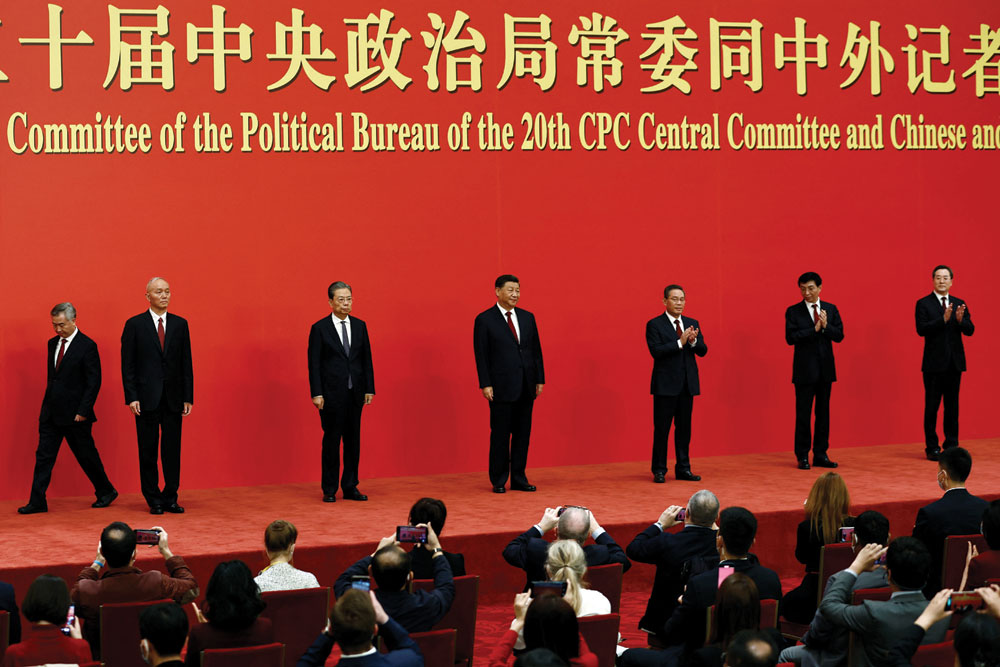
It is scarcely a surprise that Xi has tightened his grip on power by securing a ground-breaking third term as the country’s president following the week-long party congress. If there was any surprise at the party congress, it was the ease with which Xi has stacked the powerful Politburo Standing Committee with his acolytes and brought other loyalists or protégés to leadership positions, effectively creating a one-man rule under the Communist Party flag.
Surrounded by a closed circle of “yes” men who will be competing among themselves to show how loyal they are, the president will likely be told only what he would like to hear. As the American writer Walter Lippmann once warned, “Where all think alike, no one thinks very much.”
Xi’s centralisation of authority means he will have a freer hand to speed up China’s rise as a military and technological superpower, while crushing all dissent at home and accelerating the Sinicisation of ethnic minorities, especially Tibetans and Uighurs. With his unchecked power, Xi can now do whatever he wants.
Xi Jinping with the members of the Chinese Communist Party’s new Politburo Standing Committee in Beijing on October 23, 2022
So, unlike in the past when he could blame others for mistakes, Xi will find it more difficult to palm off responsibility for problems. After all, Xi reigns supreme and unchallenged, without any heir apparent.
In his speech to the party congress, Xi left little doubt that he wants China to become a world power second to none, including by reducing its reliance on Western know-how and emerging as a leading technology power in its own right. Citing a host of perceived dangers, he also vowed to continue expanding the country’s already formidable national-security apparatus.
Xi’s unbridled authority, however, does not augur well for international security and China’s own future. In fact, in a forewarning that Xi could lead China into a war, the customary phrase “peace and development remains the theme of the era” was absent from his speech as well as report to the party congress. Instead, Xi darkly warned of “dangerous storms” on the horizon.
Domestic politics in any country, including in a leading democracy like the US, has a bearing on its foreign policy. This is especially so in the case of the world’s largest autocracy, China. Under Xi, China has discarded Deng Xiaoping’s dictum, “Hide your strength, bide your time.” Instead, China has increasingly taken pride in baring its claws. This trend is likely to become even more pronounced in Xi’s third term.
Surrounded by a closed circle of ‘yes’ men who will be competing among themselves to show how loyal they are, the president will likely be told only what he would like to hear. As the American writer Walter Lippmann once warned, ‘where all think alike, no one thinks very much’
At home, Xi’s surveillance state will likely grow by leaps and bounds. Already, China’s unrivalled surveillance, censorship and propaganda systems can control or construct a narrative. But Xi is set to further expand his Orwellian surveillance state while cultivating a climate of fear.
In fact, to stamp out dissent, Xi’s regime has been whipping up ultra-nationalism by blending the digital tools of surveillance with the political tactics of the Cultural Revolution, which claimed more than a million lives. No less ominously, China’s repression and surveillance at home is a corollary of its aggressive revisionism abroad, which is largely concentrated against its neighbours.
More repression and more heavy-handedness at home are likely to be accompanied by a more aggressive military posture and a more forceful international agenda. Xi seems to believe that Chinese money can buy international acquiescence to China’s playing by its own rules, including aggressively pursuing an expansionist agenda.
With its “two steps forward, one step back” strategy, the Xi-led China will keep progressing toward its ambitious goals. Its territorial and maritime expansionism also mirrors that strategy. In this light, one can expect China to remain defiant in the face of international criticism of its renegade behaviour and actions.
Neighbouring countries will bear the brunt
The Chinese Communist Party has since its power grab in 1949 shown that it is intrinsically totalitarian, belligerent, arbitrary, expansionist and contemptuous of international law. But under Xi, the party and its rule have become more despotic, coercive, punitive and racist.
With its “tribute nation” approach to weak, vulnerable states, China seeks to influence their sovereign decisions through economic and political coercion. Indeed, Xi believes China has accumulated sufficient power to begin remaking the global order in its image, thereby reinventing itself as the mythical Middle Kingdom.
China’s territorial assertiveness and expansionism, meanwhile, have become intertwined with its national renewal. China has sought to extend its control to strategic territories and resources as part of a shrewd, high-stakes strategy to achieve political, economic, and military pre-eminence in Asia. It sees dominance in Asia as a stepping stone to supplanting the US as the world’s preeminent power.
Against this background, China’s muscular foreign policy is set to become even more assertive, with important implications for its neighbours. China will also exploit its status as the world’s unmatched hydro-hegemon to gain strategic leverage over its downstream neighbours, as the Mekong River Basin already exemplifies.
To stamp out dissent, Xi’s regime has been whipping up ultra-nationalism by blending the digital tools of surveillance with the political tactics of the cultural revolution, which claimed more than a million lives. No less ominously, China’s repression and surveillance at home is a corollary of its aggressive revisionism abroad, which is largely concentrated against its neighbours
The plain fact is that the rise of Xi’s neo-Maoist dictatorship will likely spell trouble for the democratic world but especially for neighbouring countries, which already are bearing the brunt of China’s recidivist policies. Indeed, Xi has shown an increasing appetite for taking major risks, as the South China Sea, the Himalayas and Hong Kong show.
Xi will continue expanding China’s influence and territorial and maritime control by stepping up pressure on other countries, a strategy that has already resulted in a fundamental change of the status quo in the South China Sea, without Beijing incurring any international costs.
Xi is now working to replicate his South China Sea strategy in the Himalayas by unilaterally changing facts on the ground, with little regard for the diplomatic and geopolitical fallout. He has not spared even Bhutan, one of the world’s smallest countries, by nibbling away at Bhutanese borderlands, one valley or pasture at a time.
China’s encroachments on several Ladakh borderlands in April-May 2020, for their part, have served as a reminder that, unlike Russia’s frontal, full-force attack on Ukraine, the Chinese Communist Party prefers a stealthy, salami-slicing approach to expand the country’s frontiers. Its tactics normally fall short of armed conflict, as a Pentagon report has noted.
The incremental, salami-slicing approach below the threshold of armed conflict explains why China’s often bulletless aggression draws little international costs. For example, without inviting any concrete Western sanctions, China has changed the status in the South China Sea and Hong Kong. What was one of Asia’s freest and most open cities, Hong Kong, has rapidly been turned into a repressive police state.
China’s salami-slicing strategy, however, did not develop under Xi. The party honed salami-slicing in the 1950s, when China sliced off the Switzerland-sized Aksai Chin plateau, which was part of the original princely state of Jammu and Kashmir. But under Xi’s leadership, the salami-slicing strategy has progressed to a “cabbage” approach to contested or claimed borderlands, with the People’s Liberation Army stealthily cutting off access to a neighbour’s previously controlled territory and surrounding it with multiple security layers.
Looking ahead, deception, stealth and surprise will remain integral to China’s expansion of its maritime and land borders. And China will likely rely more and more on coercive bargaining, including intimidating smaller nations from defending their interests.
It is important to note that China’s military drills are rarely empty shows of force. In 2020, China’s unusually large, wintertime troop exercise near the India border became the launchpad for its stealthy land grabs in Ladakh, triggering still continuing military standoffs between the two Asian giants at multiple sites along their long and inhospitable Himalayan frontier.
The more recent live-fire Chinese military drills around Taiwan in August, by simulating an air and sea blockade, demonstrated China’s combat capability to accomplish what Xi has called a “historic mission” to absorb that island democracy. The drills allowed Chinese troops to practice enforcing a gradual economic strangulation or quarantine of Taiwan.
Taiwan could well become the next Ukraine. Xi will wait for an opportune moment before moving on Taiwan, taking by complete surprise a distracted US, which is increasingly embroiled in the Ukraine war including through transfers of sophisticated weapons and battlefield intelligence. Xi’s aggression, however, is likely to take the form of a calibrated, gradually intensifying squeeze of Taiwan, rather than a full-fledged invasion.
The White House acknowledged in August that China is pursuing a “boiling the frog” strategy against Taiwan by regularising crossings of the median line in the Taiwan Strait, stepping up coercive pressures and slowly altering the status quo.
The parable of the frog is about sensory adaptation to small changes over time: If a frog is put into a pot of boiling water, it will instantly jump out, but if it is placed in a pot of cool water that is then very slowly brought to a boil, the frog will not notice, cooking to death. Likewise, Xi pursues his expansionism incrementally, conditioning international power elites to China’s expanding footprint and preventing a concerted Western response until it becomes too late.
Yet US President Joe Biden, asked recently whether American forces would defend Taiwan if China attacked, replied, “Yes, if in fact there was an unprecedented attack.” But China, instead of launching an unprecedented attack, is more likely to slowly throttle Taiwan.
Meanwhile, Xi, far from seeking to hide China’s frenzied nuclear weapons build-up, is virtually flaunting it, as if to underline that the country’s rapidly growing nuclear arsenal is driven more by political than military considerations. China’s neighbours need to pay close attention to this build-up, even though it may be primarily aimed at dissuading the US from challenging the Xi regime’s actions at home and abroad.
Just as Xi’s muscular revisionism has largely centred on Asia—from the East and South China Seas to the Himalayas—the security-related impacts (as opposed to the geopolitical implications) of the fast-growing Chinese nuclear armoury are likely to be felt principally by Asian states. With a larger nuclear arsenal, Xi could be further emboldened to step up his conventional-military tactics and hybrid warfare from behind China’s highly protective nuclear shield.
Questions are already being raised in the US about the strategic wisdom of defending Taiwan against a potential Chinese invasion, with some analysts contending that any US plan to come to Taiwan’s rescue is far too risky and that Taipei ought to do more for its self-defence. A China armed to its teeth with nuclear weapons would cast further doubt on whether the US would come to Taiwan’s defence, given the greater risks involved.
More fundamentally, if China cannot be at peace with itself, it will not be at peace with others. Xi’s lurch toward totalitarianism will foster greater discontent among the Chinese people, spawning a pressure cooker syndrome.
History is replete with examples of dictators blinded by hubris and overreach leading their countries down a disastrous path. With the last checks and balances gone, Xi’s overweening ambition, absolute power and reliance on “yes” men are likely to spell trouble for China. Under Xi, China has already damaged its international reputation and left itself with only one real lever of power: brute force. But if Xi stays on his present course, he is likely to lead China into a war.
Brahma Chellaney is a geostrategist and the author of two award-winning books on water: Water, Peace, and War and Water: Asia’s New Battleground.
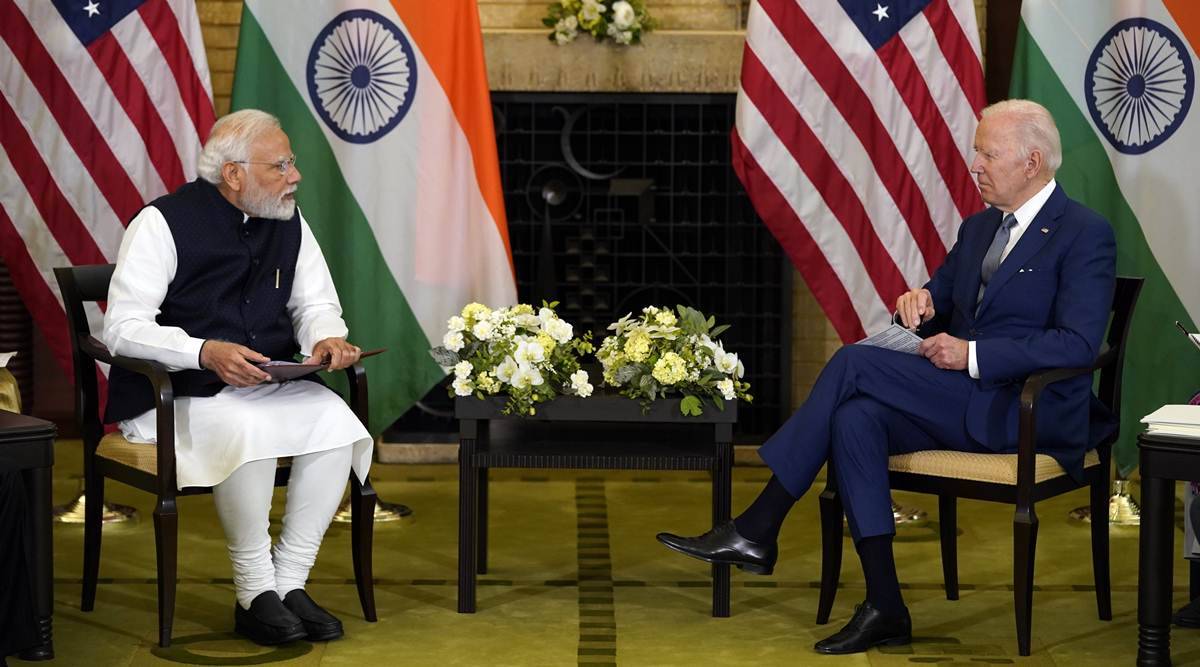
Tensions stemming from the war in Ukraine and the American withdrawal from Afghanistan have strained the strategic partnership between the US and India. But President Joe Biden cannot afford to alienate America’s most important partner in countering China’s rise.
The strategic partnership between the United States and India is pivotal to maintaining the balance of power in the vast Indo-Pacific region and counterbalancing China’s hegemonic ambitions. The US is India’s second-largest trading partner, and deepening the ties between the two countries is one of the rare bipartisan foreign policies that exists in Washington today.
The upcoming October 18-31 joint military exercise known as Yudh Abhyas (War Practice), in a high-altitude area less than 100 kilometers (62 miles) from India’s border with China, highlights the partnership’s growing strategic importance. India holds more annual military exercises with the US than any other country, as the two powers seek to improve their forces’ interoperability. As Admiral Michael M. Gilday, the US Navy’s Chief of Naval Operations, put it recently, India is a “crucial partner” in countering China’s rise.
But President Joe Biden’s decision to withdraw US forces from Afghanistan and effectively surrender the country to a Pakistan-reared terrorist militia, in addition to tensions related to Russia’s invasion of Ukraine, have strained the relationship between the world’s most powerful and most populous democracies.
Like many other countries, including US allies such as Israel and Turkey, India has taken a neutral stance on the war in Ukraine. Much to the chagrin of the US and Europe, the country has continued to purchase discounted oil from Russia, rebuffing the Biden administration’s offer to replace Russian oil with US supplies. Instead, India has increased its imports of Russian crude.
At the heart of India’s decision is fear of losing out to China. Since 2019, the US has used the sanctions on Iran’s oil exports to deprive India of cheaper Iranian oil, thereby turning it into the largest market for US energy exporters. The main beneficiary of the sanctions is China, which has increased its purchases of Iranian oil at a discount and developed a security partnership with the Islamic Republic without facing US reprisal.
While the US has already surpassed Russia as India’s largest weapons supplier, the American defense sector views the war in Ukraine as a “great opportunity” for arms sales to India to “surge.” Moreover, US Defense Secretary Lloyd Austin has urged Indian officials to avoid buying Russian equipment and purchase US-made weapons from now on.
Yet Biden’s overriding focus on punishing Russia could exacerbate India’s security challenges, especially if the international efforts to pressure Russian President Vladimir Putin inadvertently empower an expansionist China. The US-led sanctions and Europe’s shift away from Russian energy effectively put Russia – the world’s most resource-rich country – in the pocket of the resource-hungry Chinese. Its alliance with Russia has allowed China to build an energy safety net through an increase in land-based imports, which, unlike sea-borne deliveries, cannot be blockaded if Chinese President Xi Jinping decides to invade Taiwan.
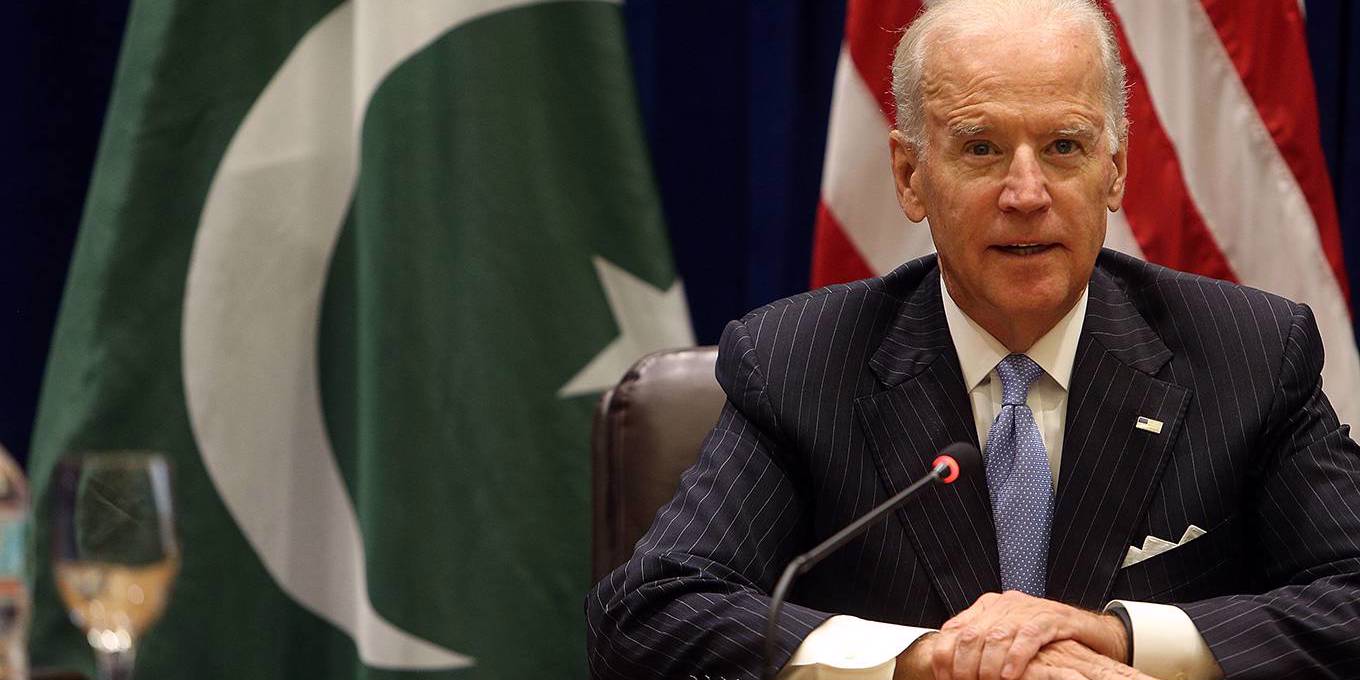
Meanwhile, America’s recent $450 million deal to modernize Pakistan’s F-16 fleet – unveiled days after the US helped the country stave off an imminent debt default through an International Monetary Fund bailout – has evoked bitter memories of the US arming Pakistan against India and supporting the initial development of the Pakistani nuclear-weapons program during the Cold War.
The Biden administration’s disingenuous claim that upgrading Pakistan’s US-supplied F-16 fleet would advance counterterrorism has prompted a sharp response from India. During a recent visit to Washington, Indian Foreign Minister Subrahmanyam Jaishankar publicly condemned the deal, saying that the American explanation “is not fooling anyone”: Pakistan would undoubtedly deploy the upgraded fighter jets against India.
Against this backdrop, some observers have revived the old theory that US-India ties fare better under Republican administrations. Bilateral relations thrived during President Donald Trump’s administration, which relied heavily on India in developing its Indo-Pacific strategy. Trump instituted new US policies on China and Pakistan, whose increasingly close partnership has raised the prospect of India fighting a two-front war. In a major policy shift, Trump ended the 45-year US policy of aiding China’s rise. He also cut off security aid to Pakistan for not severing its ties with terrorist groups.
Biden, on the other hand, has resumed America’s coddling of Pakistan, made outreach to Beijing a high priority, and said nothing about China’s encroachments on Indian territory in the Himalayas. But by locking horns with China in a 30-month military standoff, India has openly challenged Chinese power in a way no other world power has done in this century.
Nothing better illustrates Biden’s neglect of the relationship with India than the fact that, since he took office, there has been no US ambassador in New Delhi. Meanwhile, the US ambassador to Pakistan, Donald Blome, caused an uproar during a visit to the Pakistani-held part of Kashmir, which he called by its Pakistani name – “Azad [Liberated] Jammu and Kashmir” – instead of “Pakistan-administered Kashmir,” as the United Nations calls it.
Moreover, the Biden administration has been trying to leverage human-rights issues against India. In April, US Secretary of State Antony Blinken alleged a “rise in human-rights abuses” in the country, prompting Jaishankar to counter that India is similarly concerned about the state of human rights in the US. Likewise, prominent members of the US Democratic Party can barely conceal their hostility to Indian Prime Minister Narendra Modi and his brand of Hindu nationalism.
Given that the US and India are both bitterly polarized democracies, officials should avoid statements that could inflame domestic tensions. If the US wishes to shift strategic focus to the Indo-Pacific, it must improve relations with its most important strategic ally in Asia. To that end, Biden must not squander the historic opportunity to forge a “soft” alliance with India. If the US is to prevail in its escalating rivalry with China and Russia and avoid strategic overreach, it needs India more than ever. But without mutual respect, the bilateral partnership is doomed.
China’s relentless expansionism in the frigid high Himalayas through furtive territorial encroachments has fostered a nearly 30-month military standoff with India.
The confrontation, and the wider faceoff between the world’s two most populous nations, persists even as both militaries have pulled back recently from some front line areas to establish buffer zones so as to reduce the risk of inadvertent clashes.
China’s Himalayan encroachments are a reminder that in contrast to Russia’s full-force attack on Ukraine, Beijing prefers to act gradually with stealth, deception and surprise to expand the country’s frontiers.
This incremental, salami-slicing approach of bulletless aggression comes at little international cost. Most prominently, China has redrawn the geopolitical map of the South China Sea and maritime Southeast Asia without inviting any concrete Western sanctions.
In the Himalayas, Beijing is seeking to replicate its South China Sea strategy by unilaterally changing facts on the ground, assuming there will be little diplomatic or geopolitical fallout. It has not spared even tiny Bhutan, nibbling away at its borderlands one valley at a time.
China honed its salami-slicing strategy in the 1950s when it carved off the Aksai Chin plateau, a Switzerland-sized area originally part of the princely Himalayan state of Jammu and Kashmir.
Under President Xi Jinping, this strategy has evolved into a “cabbage” approach with the People’s Liberation Army stealthily cutting off neighboring states’ access to contested territory they previously controlled and surrounding the acquired areas with multiple layers of security forces.
China’s current military standoff with India involves some of the most inhospitable terrain on Earth. But no sooner had New Delhi declared a nationwide lockdown in response to the COVID-19 pandemic that emerged from China in early 2020 than the PLA clandestinely invaded the borderlands of India’s northernmost region of Ladakh, enveloping hundreds of square kilometers of territory with layers of defense lines.
Although India has responded with heavy military deployments, leading to the largest Himalayan buildup of rival forces in history, the PLA remains in control of the larger areas it grabbed in April 2020. Through lengthy negotiations, India has managed only to get China to convert its smaller encroachments into buffer zones — largely on Beijing’s terms.
The daunting challenge for a traditionally defensive India is to regain lost territory in the same way China took it — without resort to open combat. The scale of the challenge may explain why Prime Minister Narendra Modi’s government has agreed to the establishment of four separate buffer zones, with the latest established in September in the Hot Springs area of eastern Ladakh.
Under these deals, the rival forces have pulled back by equal distances from specified confrontation sites to create no man’s lands between them. The buffers in effect advance China’s “10 miles forward, eight miles back” strategy, forcing Indian forces to retreat further back into their own territory while illustrating what Beijing calls “meeting each other halfway.”
In the more strategically valuable areas it has seized, China has fortified front line positions by establishing permanent military bases and deploying large, combat-ready forces with tanks, artillery and cold-weather troop shelters to preclude any Indian attempt to regain lost territory through counterforce operations.
Indeed, since the faceoff began, China has expanded its frenzied buildup of military infrastructure and capabilities along its entire disputed frontier with India. New heliports and expanded air bases near the border have strengthened China’s vertical lift capability.
Modi, while seeking to befriend China after taking office in 2014, coined the phrase “inch toward miles” as a motto for bilateral cooperation. Beijing has cynically translated that slogan to incrementally advance its territorial aggrandizement in the Himalayas.
Simply put, China’s strategy is proving just as effective on land as it has been at sea. In fact, its terrestrial aggression has attracted even less international attention than its blue-water expansionism.
China’s actions in muscling into its neighbors’ territory reflect the Communist Party’s goal of achieving Asian hegemony as a stepping stone toward supplanting the U.S. as the world’s preeminent power. Advancing that ambition means asserting the country’s economic and strategic interests and territorial claims, including by rewriting history and disregarding international law.
Should Beijing next target Taiwan, its aggression is likely to take the form of a slow squeeze of the island democracy rather than a full-fledged invasion. China’s live-fire exercises around Taiwan in August simulated the steps it might take to slowly throttle the island, including by imposing a blockade.
The White House acknowledged in August that China is pursuing a “boiling the frog” strategy against Taiwan by regularizing crossings of the median line that previously restricted military activities in the Taiwan Strait, stepping up coercive pressure and slowly altering the status quo.
The parable of the frog is about sensory adaptation to small changes over time: If a frog is put into a pot of boiling water, it will instantly jump out, but if it is placed in a pot of cool water that is then only slowly brought to a boil, the frog will not notice before it is killed by the heat.
China likewise pursues its expansionism incrementally, conditioning international power elites to its expanding footprint and thwarting a concerted Western response until it is too late.
Asked recently whether American forces would defend Taiwan if China attacks, U.S. President Joe Biden replied, “Yes, if in fact there was an unprecedented attack.”
China is more likely to slowly throttle Taiwan than directly attack, however. Would Biden put up with a gradual squeeze of Taiwan?
The singular focus of the U.S. and Europe on isolating and punishing Russia for its invasion of Ukraine has deflected attention away from China’s creeping, covert warfare. But while Russia’s strategic ambitions are essentially limited to its near abroad, China is seeking to fundamentally alter global power dynamics.
Brahma Chellaney is professor emeritus of strategic studies at the Centre for Policy Research in New Delhi and a former adviser to India’s National Security Council. He is the author of nine books, including “Water: Asia’s New Battleground.”
The Biden administration could have used Pakistan’s economic crisis to compel the country to sever its longstanding ties to terrorist groups. Instead, the US continues to protect and reward it, putting short-term geopolitical considerations ahead of long-term interests.
The United States rarely learns from its mistakes, because it suffers from what the late political scientist Hans Morgenthau called “strategic narcissism.” Each US president seems to believe the world is waiting for American direction and devises policies based on this flawed assumption.
For example, President Joe Biden seems determined to repeat past blunders by resuming America’s coddling of Pakistan. Successive US presidents have failed to appreciate that America’s longstanding partnership with Pakistan’s rogue Inter-Services Intelligence agency has allowed Pakistan to institutionalize terrorism by employing armed jihadists in low-intensity asymmetric warfare against neighboring countries. For example, Pakistan has always sought to colonize Afghanistan by installing a regime that would do its bidding, so the ISI created the Taliban in the early 1990s. With the Taliban back in control after the ISI engineered America’s humiliating defeat in Afghanistan, Pakistan has gotten its wish.
Pakistan itself has become an extremist mecca that hosts multiple United Nations-designated terrorist entities. The US found al-Qaeda founder Osama bin Laden – the mastermind behind the worst terrorist attack in American history – living next to the Pakistan Military Academy. Other 9/11 plotters – including Khalid Sheikh Mohammed, al-Qaeda’s third in command, and Abu Zubeida, the network’s operations chief – were also captured in Pakistan. And yet, despite its terrorist ties, Pakistan’s politically powerful military, including its ISI, has managed to get off scot-free.
On the recent 21st anniversary of the 9/11 attacks, Biden pledged to continue monitoring and disrupting terrorist activities “wherever we find them, wherever they exist,” while noting that it took “ten years to hunt down and kill Osama bin Laden.” Yet, disturbingly, Biden has reversed the policy of his predecessor, Donald Trump, to keep Pakistan at arm’s length until it ended its unholy alliance with terrorist organizations.
Biden could have taken advantage of Pakistan’s desperate need for an International Monetary Fund bailout to compel it to sever its links with state-backed terrorist groups. Instead, his administration recently helped the country stave off an imminent debt default by securing the IMF board’s approval for the immediate disbursement of a $1.1 billion aid package.
This is not the only leverage over Pakistan that the Biden administration has been reluctant to use. With American and Chinese support, Pakistan is close to exiting the “gray list” of the Paris-based Financial Action Task Force (FATF), the Paris-based inter-governmental agency combating terrorist financing and money laundering. The fact that Pakistani authorities have not addressed the reason their country was placed on that list in 2018 – tolerating terrorist financing – appears to matter little. In fact, Pakistan should have been placed on the FATF’s most punitive “black” list, a status that usually invites Western sanctions. But American troops were fighting the Taliban at the time, and the US, seeking to moderate Pakistan’s approach to Afghanistan, successfully lobbied against it.
Nothing better illustrates Biden’s embrace of Pakistan than the $450-million deal unveiled this month to modernize the cash-strapped country’s US-supplied F-16 fleet, despite the risk that it might harm America’s close strategic relationship with India. For decades, the US had armed Pakistan to the teeth, a role subsequently taken over by China as a maneuver against India. The F-16s were given to Pakistan as a reward for its serving as the staging ground for the covert US war against the Soviet forces occupying Afghanistan in the 1980s, when Pakistan also launched its nuclear-weapons program clandestinely. Pakistan’s four active F-16 squadrons remain central to its air-warfare plans against India; in fact, some were involved in a February 2019 skirmish across the Line of Control in Kashmir.
The US justified the deal by disingenuously claiming that equipping Pakistan’s F-16s with cutting-edge avionics would advance counterterrorism. But the move – announced without warning India, which was hosting senior US officials at the time – will likely renew skepticism toward the US among Indian officials. Biden has said nothing about China’s 28-month-long frontier aggression against India, and his State Department chose to remain neutral by urging the two powers to find “a peaceful resolution.” By strengthening Pakistan – China’s client state – the F-16 deal further imperils US-India relations.
Biden’s enthusiastic re-engagement with Pakistan dismisses those who called on the US to punish Pakistan for its pivotal role in the Afghanistan debacle. Far from imposing sanctions or adding Pakistan to the State Department’s list of state sponsors of terrorism, his administration has championed the country as a “major non-NATO ally,” a status conferred on 17 other countries as well – but not India.
This approach should not come as a surprise. The US did not impose sanctions on Pakistan even after it aided and abetted the Taliban’s killing of American soldiers. Instead, the US treated Pakistan as a gatekeeper of its geopolitical interests in the region. America’s weakened position following its Afghan fiasco has only increased its dependence on the ISI, which continues to facilitate the Biden administration’s outreach to the Taliban.
The recent assassination of al-Qaeda leader Ayman al-Zawahiri in Kabul by an American drone strike would not have been possible without US access to Pakistani airspace, which explains Secretary of State Antony Blinken’s commitment to “expanding the US-Pakistan partnership.” But at the heart of this partnership is a Faustian bargain whereby the Biden administration condones Pakistan’s harboring of known terrorists and eases sanctions on the brutal Taliban regime, despite its close ties with al-Qaeda.
The Biden administration’s reluctance to learn from previous US failures ensures that short-term geopolitical considerations will continue to drive American foreign policy, despite the long-term strategic damage to America’s interests. Biden’s approach will nurture a major hub of international terrorism and jihadism, allowing Pakistan to set regional fires while pretending to be a firefighter.
Can the Indo-Pacific region be America’s top priority if U.S. President Joe Biden is deepening commitments and resources for Europe and the Middle East?
This question is central to the future of the Quad, the strategic coalition of leading Indo-Pacific democracies comprising India, Australia, Japan and the U.S.
High-level Quad meetings, like last week’s senior officials’ gathering in New Delhi, are becoming more frequent. The group’s four national leaders alone have held four summit meetings since Biden took office in January 2021.
The accelerating tempo of meetings, though, can obscure the fact that the Quad faces important challenges, including establishing a clear strategic mission in the Indo-Pacific region, a sprawling area shaping up as the world’s economic and geopolitical hub. The Quad may have been designed to serve as a bulwark against Chinese expansionism, but Biden has coaxed the group into adopting an expansive agenda.
To be sure, the Quad has steadily gained strength since it was resurrected in 2017 from a decadelong dormancy. Chinese Foreign Minister Wang Yi famously mocked the Quad in 2018 as a “headline-grabbing idea” that will dissipate “like the sea foam in the Pacific or Indian Oceans.” But China’s increasingly muscular policies have helped the Quad to build momentum.
The waters of the Indo-Pacific have become an arena of competition for resources and geopolitical influence, which explains the Quad’s emphasis on the maritime domain. Indeed, as underscored by current concerns over Taiwan and the East and South China Seas, future Indo-Pacific crises are likely to be triggered at sea.
The Quad has also been catalyzed by the threat of an illiberal hegemonic regional order, which would pose significant risks to international security and global markets. The free and open Indo-Pacific vision driving the Quad was originally set out by Shinzo Abe, the late Japanese prime minister, and has since become shorthand for a rules-based, liberal order.
The Quad’s future, however, is fundamentally tied to American policies. U.S. Defense Secretary Lloyd Austin in June called America’s commitment to the Indo-Pacific region “the core organizing principle of American national-security policy.”
It is “our priority theater of operations,” “the heart of American grand strategy” and “our center of strategic gravity,” Austin declared.
However, Russia’s invasion of Ukraine and the ensuing hybrid war effort led by the U.S. against Moscow are distracting America from growing Indo-Pacific challenges. America’s new strategic focus on Europe and force deployments there — along with the rise of a more robust NATO, which has named Russia as its primary adversary and China as just a “challenge” — make it harder for the U.S. to genuinely pivot to the Indo-Pacific.
In fact, as the U.S. gets more deeply involved in a proxy conflict with Russia, including supplying offensive weapons and battlefield intelligence to Ukraine, the Quad faces new uncertainties. Biden is the third straight president to commit to shifting America’s primary strategic focus to Asia and the wider Indo-Pacific. But Biden’s expressed belief that the Ukraine “war could continue for a long time” suggests that he too could fail, as Donald Trump and Barack Obama did.
The new cold war with Moscow, meanwhile, is constraining Biden from taking a tough line toward Beijing, lest it help cement the nascent China-Russia axis. China, with an economy 10 times larger than Russia’s, has the capacity to seriously undercut Western sanctions against Moscow and bail out the Russian economy. All this is reinforcing the more conciliatory approach toward Beijing that Biden has pursued since taking office.
Against this backdrop, it is scarcely a surprise that the Quad’s security agenda has begun to take a back seat.
In fact, Biden has saddled the Quad with an increasingly global agenda that dilutes its Indo-Pacific strategic focus. Biden’s Indo-Pacific strategy, as unveiled in February, confirmed the Quad’s shift toward universal challenges, from global health security and climate change to cybersecurity, resilient supply chains and green shipping.
As a small group, the Quad is in no position to deal with global challenges. Yet having launched six separate working groups on climate change, COVID-19 vaccines, critical and emerging technologies, cybersecurity, infrastructure and space, the Quad is getting weighed down by an overly ambitious agenda, crimping its ability to produce results.
The danger of overcommitting and underdelivering has been highlighted by the difficulties encountered by the Quad in supplying 1 billion Indian-manufactured COVID-19 vaccine doses to the developing world by year-end as promised. Even with the support of all four members, the Quad is set to fall far short of its vaccine pledge.
Meanwhile, as the U.S. pours military resources into Europe and the Middle East, the geostrategic dynamics are changing rapidly in the Indo-Pacific, where China is working quietly to eclipse America militarily and economically. The bulk of U.S. economic and military assistance still goes to the Middle East, even as the U.S. prioritizes NATO in order to dominate European security.
The paradox in this situation is that the Quad is becoming stronger through greater engagement among its leaders and senior officials, yet the group appears in danger of losing its strategic vision and purpose. Unless its member states imbue the Quad with a clear strategic direction and meaning, it could become a showpiece or a mere U.S. tool of leverage with Beijing.
Before critics pummel the Quad for being all bark and no bite, the group must refocus its attention on the strategic challenges in the Indo-Pacific region.
Brahma Chellaney is professor emeritus of strategic studies at the Centre for Policy Research in New Delhi and a former adviser to India’s National Security Council. He is the author of nine books, including “Water: Asia’s New Battleground.”
Guard towers stand on the perimeter wall of the Urumqi No. 3 Detention Center in Dabancheng in western China’s Xinjiang Uyghur Autonomous Region on April 23, 2021. China’s discriminatory detention of Uyghurs and other Muslims in the western region of Xinjiang may constitute crimes against humanity, the U.N. human rights office said in a long-awaited report released on Aug. 31, 2022. (AP Photo/Mark Schiefelbein, File)
China’s prolonged detention of more than 1 million Muslims in Xinjiang represents the largest mass incarceration of people on religious grounds since the Nazi era. Yet, disturbingly, China has incurred no international costs.
Chinese President Xi Jinping, the brain behind the scheme, and his inner circle have faced no consequences for sustaining the Muslim gulag since at least March 2017. Despite two successive U.S. administrations describing the unparalleled repression in Xinjiang as “genocide” and “crimes against humanity,” Western actions against China have largely been symbolic.
The just-released report on Xinjiang by the United Nations’ human rights office cites serious human-rights violations there and recommends that Beijing take “prompt steps to release all individuals arbitrarily deprived of their liberty” in that sprawling ethnic-minority homeland.
Yet this report, paradoxically, is a fresh reminder that China has escaped scot-free, with little prospect that it will be held to account for its mass internment of Muslim minorities, including expanding detention sites in Xinjiang since 2019. The Xinjiang repression also includes forced sterilization and abortion, torture of detainees, slave labor and draconian curbs on freedom of religion and movement.
The report’s release came after nearly a yearlong delay and just minutes before the four-year term of Michelle Bachelet, the U.N. high commissioner for human rights, ended. U.N. investigators had compiled the Xinjiang report almost a year ago, but Bachelet kept stalling its release, despite growing pressure from Western countries.
In May, after lengthy discussions with Beijing on arrangements, Bachelet undertook a controversial official visit to China, the first by a U.N. high commissioner for human rights since 2005. During her tenure, Bachelet – a former Chilean president and political detainee under dictator Augusto Pinochet – stayed mum on the Chinese repression in Xinjiang (and Tibet). She said nothing on the crackdown in Xinjiang even when she briefly visited that region during her restrictive China tour, which glossed over abuses by Xi’s regime.
Bachelet had earlier acknowledged that she was under “tremendous pressure” over the report, with China asking her to bury it. The eventual release of the report, minutes before Bachelet’s retirement at midnight on Aug. 31, indicated that she did not want her successor or temporary replacement to take credit for publishing it. Failing to release the report would have left a glaring black mark on her tenure.
Days before her retirement, Bachelet sent a copy of the report to Beijing because, as she explained in a Sept. 1 statement, she “wanted to take the greatest care to deal with the responses and inputs received from the (Chinese) government last week.” In response to the 48-page U.N. assessment, China wrote a 131-page rebuttal, with its foreign ministry calling the report a “farce.”
China has been emboldened by the international community’s indifference and indulgence. It successfully hosted the 2022 Winter Olympics, probably the most divisive games since the 1936 Berlin Summer Olympics, which helped strengthen the hands of Germany’s Adolf Hitler.
Underscoring China’s growing economic power and geopolitical clout, even Muslim countries, by and large, have remained shockingly silent on the Xinjiang repression. As if that weren’t bad enough, the 57-nation Organization of Islamic Cooperation in March honored Chinese Foreign Minister Wang Yi as a speaker at its foreign ministers’ forum in Pakistan.
Xi’s Muslim gulag has made a mockery of the 1948 Genocide Convention, to which China acceded in 1983 (with the rider that it does not consider itself bound by Article IX, the clause allowing any party in a dispute to lodge a complaint with the International Court of Justice). The Genocide Convention requires its parties, which include the United States, to “prevent and punish” acts of genocide.
Chinese authorities have subjected Uyghur and other Muslim groups in Xinjiang, including ethnic Kazakhs and Kyrgyz, to Orwellian levels of surveillance and control over many details of life. As Secretary of Commerce Gina M. Raimondo warned, China is weaponizing biotechnology to “pursue control over its people and its repression of members of ethnic and religious minority groups.”
The Xinjiang repression is aimed at indoctrinating not just political dissidents and religious zealots but entire Muslim communities by imposing large-scale deprogramming of Islamic identities. A gulag archipelago of 380 internment camps (or “reeducation hospitals,” as Beijing calls them) has become integral to this larger assault on Islam.
It is against this background that the carefully worded U.N. report warns that, “The extent of arbitrary and discriminatory detention of members of Uyghur and other predominantly Muslim groups … and deprivation more generally of fundamental rights enjoyed individually and collectively, may constitute international crimes, in particular crimes against humanity.” The report cited “patterns of torture or other forms of cruel, inhuman or degrading treatment or punishment” in the detention centers, including “credible” allegations of sexual violence.
The U.N. report may carry the imprimatur of the world’s only truly universal organization and its member states, yet China was quick to pour scorn on it. Just as it rubbished a 2016 international arbitral tribunal ruling that invalidated its territorial claims in the South China Sea, China ridiculed the U.N. report, calling it a pack of “disinformation and lies.”Could long COVID finally make us take chronic pain seriously?It’s crucial to reintegrate Taiwan into the ICAO
The 1945-46 Nuremberg Military Tribunal, set up after Germany’s surrender in World War II, prosecuted those involved in crimes against humanity, the same crimes now being perpetrated in Xinjiang. Yet, with China a rising power, there seems little prospect that Chinese officials behind the Muslim gulag will face similar justice.
Indeed, just as China responded to the tribunal’s ruling by accelerating its expansionism in the South China Sea, including militarizing the region, it could step up its repression in Xinjiang until it manages to fully Sinicize and tame Muslim groups.
Brahma Chellaney is a geostrategist and the author of nine books, including the award-winning “Water: Asia’s New Battleground” (Georgetown University Press). Follow him on Twitter @Chellaney.


 Mao Zedong and Jawaharlal Nehru talk over a cup of tea in Beijing in October 1954: The dogged courtship of Mao by Nehru helped create New Delhi’s China problem. © Gamma-Rapho/Getty Images





 Stagecraft and Statecraft
You must be logged in to post a comment.