Asia’s Resource Scramble

A Project Syndicate column

Competition for strategic natural resources – including water, mineral ores, and fossil fuels – has always played a significant role in shaping the terms of the international economic and political order. But now that competition has intensified, as it encompasses virtually all of Asia, where growing populations and rapid economic development over the last three decades have generated an insatiable appetite for severely limited supplies of key commodities.

Asia is the world’s most resource-poor continent, and overexploitation of the natural resources that it does possess has created an environmental crisis that is contributing to regional climate change. For example, the Tibetan Plateau, which contains the world’s third-largest store of ice, is warming at almost twice the average global rate, owing to the rare convergence of high altitudes and low latitudes – with potentially serious consequences for Asia’s freshwater supply.

In other words, three interconnected crises – a resource crisis, an environmental crisis, and a climate crisis – are threatening Asia’s economic, social, and ecological future. Population growth, urbanization, and industrialization are exacerbating resource-related stresses, with some cities experiencing severe water shortages, and degrading the environment (as anyone who has experienced Beijing’s smog can attest). Fossil-fuel and water subsidies have contributed to both problems.

Faced with severe supply constraints, Asian economies are increasingly tapping other continents’ fossil fuels, mineral ores, and timber. But water is extremely difficult – and prohibitively expensive – to import. And Asia has less fresh water per person than any continent other than Antarctica, and some of the world’s worst water pollution.

Likewise, food scarcity is a growing problem for Asian countries, with crop yields and overall food production growing more slowly than demand. At the same time, rising incomes are altering people’s diets, which now include more animal-based proteins, further compounding Asia’s food challenges.

The intensifying competition over natural resources among Asian countries is shaping resource geopolitics, including the construction of oil and gas pipelines. China has managed to secure new hydrocarbon supplies through pipelines from Kazakhstan and Russia. But this option is not available to Asia’s other leading economies – Japan, India, and South Korea – which are not contiguous with suppliers in Central Asia, Iran, or Russia. These countries will remain dependent on oil imports from an increasingly unstable Persian Gulf.

Furthermore, China’s fears that hostile naval forces could hold its economy hostage by interdicting its oil imports have prompted it to build a massive oil reserve, and to plan two strategic energy corridors in southern Asia. The corridors will provide a more direct transport route for oil and liquefied gas from Africa and the Persian Gulf, while minimizing exposure to sea-lanes policed by the United States Navy.

One such corridor extends 800 kilometers from the Bay of Bengal across Burma to southern China. In addition to gas pipelines – the first is scheduled to be completed this year – it will include a high-speed railroad and a highway from the Burmese coast to China’s Yunnan province, offering China’s remote interior provinces an outlet to the sea for the first time.

The other corridor – work on which has been delayed, owing to an insurrection in Pakistan’s Baluchistan province – will stretch from the Chinese-operated port at Gwadar, near Pakistan’s border with Iran, through the Karakoram mountains to the landlocked, energy-producing Xinjiang province. Notably, in giving China control of its strategic Gwadar port in February, Pakistan has permitted the Chinese government to build a naval base there.

Given the significant role that natural resources have historically played in global strategic relations – including driving armed interventions and full-scale wars – increasingly murky resource geopolitics threatens to exacerbate existing tensions among Asian countries. Rising dependence on energy imports has already been used to rationalize an increased emphasis on maritime power, raising new concerns about sea-lane safety and vulnerability to supply disruptions.

This partly explains the current tensions between China and Japan over their conflicting territorial claims to islands in the East China Sea, which occupy an area of only seven square kilometers, but are surrounded by rich hydrocarbon reserves. Disputes in the South China Sea involving China and five of its neighbors, and in southern Asia, are equally resource-driven.

While strategic competition for resources will continue to shape Asia’s security dynamics, the associated risks can be moderated if Asia’s leaders establish norms and institutions aimed at building rule-based cooperation. Unfortunately, little progress has been made in this area. For example, 53 of Asia’s 57 transnational river basins lack any water-sharing or cooperative arrangement.

Indeed, Asia is one of only two continents, along with Africa, where regional integration has yet to take hold, largely because political and cultural diversity, together with historical animosities, have hindered institution-building. Strained political relations among most of Asia’s sub-regions make a region-wide security structure or more effective resource cooperation difficult to achieve.

This could have significant implications for Asia’s ostensibly unstoppable rise – and thus for the West’s supposedly inevitable decline. After all, Asian economies cannot sustain their impressive economic growth without addressing their resource, environmental, and security challenges – and no single country can do it alone.

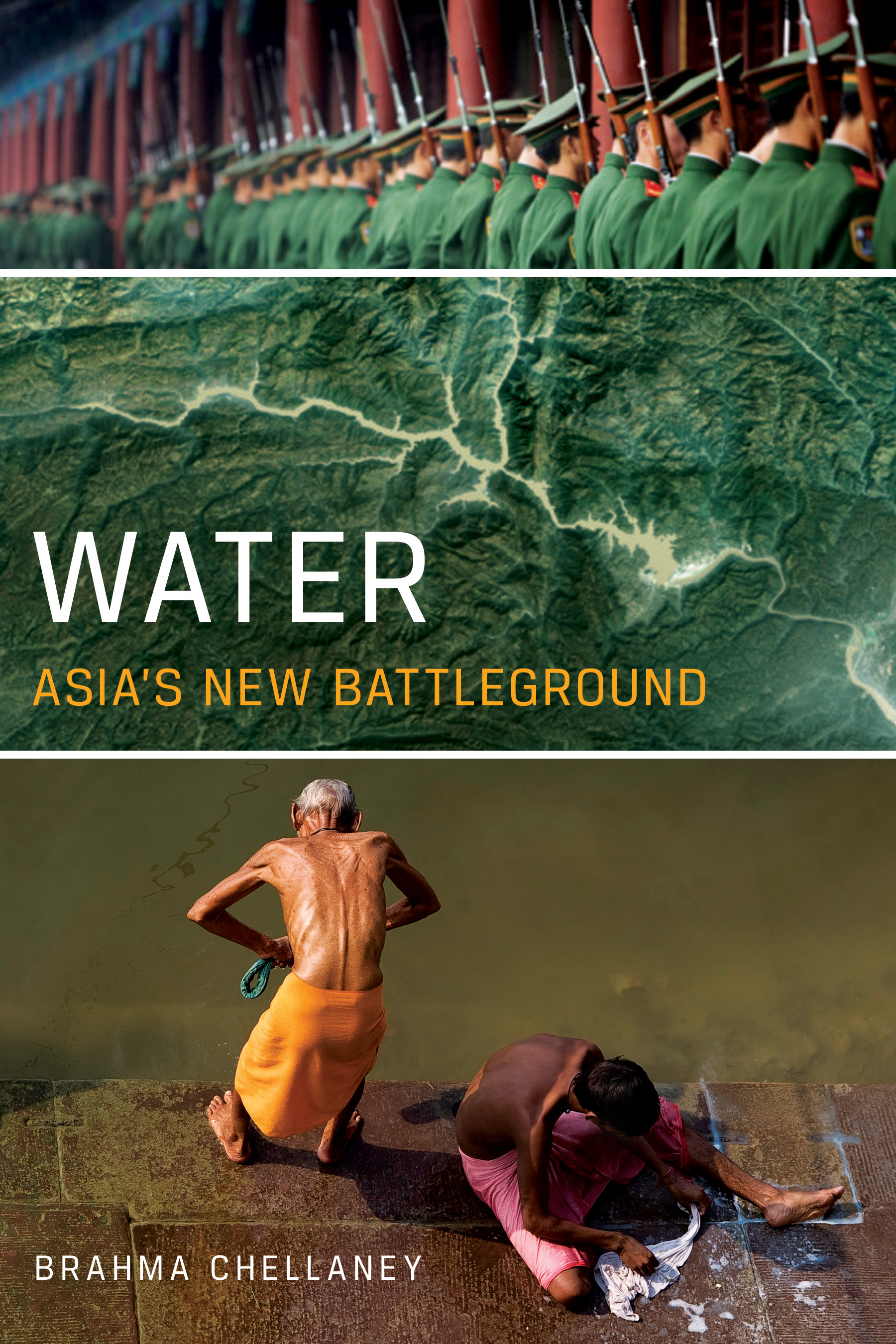
Brahma Chellaney, Professor of Strategic Studies at the New Delhi-based Center for Policy Research, is the author of Asian JuggernautWater: Asia’s New Battleground, and the forthcoming Water, Peace, and War: Confronting the Global Water Crisis.

(c) Project Syndicate, 2013.

Asia’s Dammed Water Hegemon

A Project Syndicate column internationally syndicated. This column also in ArabicChinese, Russian, and Spanish.

As if to highlight that Asia’s biggest challenge is managing the rise of an increasingly assertive China, the Chinese government has unveiled plans to build large new dams on major rivers flowing to other countries. The decision by China’s State Council to ride roughshod over downstream countries’ concerns and proceed unilaterally shows that the main issue facing Asia is not readiness to accommodate China’s rise, but the need to persuade China’s leaders to institutionalize cooperation with neighboring countries.

China is at the geographical hub of Asia, sharing land or sea frontiers with 20 countries; so, in the absence of Chinese participation, it will be impossible to establish a rules-based regional order. How, then, can China be brought on board?

This challenge is most striking on trans-boundary rivers in Asia, where China has established a hydro-supremacy unparalleled on any continent by annexing the starting places of major international rivers — the Tibetan plateau and Xinjiang — and working to reengineer cross-border flows through dams, reservoirs, barrages, irrigation networks, and other structures. China — the source of trans-boundary river flows to more countries than any other hydro-hegemon — has shifted the focus of its dam-building program from dam-saturated internal rivers to international rivers after having already built more large dams than the rest of the world combined.

Most of China’s dams serve multiple functions, including generating electric power and meeting manufacturing, mining, irrigation, and municipal-supply water needs. By ramping up the size of its dams, China now not only boasts the world’s largest number of mega-dams, but is also the biggest global producer of hydropower, with an installed generating capacity of 230 gigawatts.

The State Council, seeking to boost the country’s already-large hydropower capacity by 120 gigawatts, has identified 54 new dams — in addition to the ones currently under construction — as “key construction projects” in the revised energy-sector plan up to 2015. Most of the new dams are planned for the biodiversity-rich southwest, where natural ecosystems and indigenous cultures are increasingly threatened.

After slowing its dam-building program in response to the serious environmental consequences of completion in 2006 of the Three Gorges Dam — the world’s largest — China is now rushing to build a new generation of giant dams. At a time when dam building has largely petered out in the West — and run into growing grassroots opposition in other democracies like Japan and India — China will remain the nucleus of the world’s mega-dam projects.

Such projects underscore the zero-sum mentality that seemingly characterizes China’s water-policy calculations. By embarking on a series of mega-dams in its ethnic-minority-populated borderlands, China is seeking to appropriate river waters before they cross its frontiers.

Asia, the world’s driest continent in terms of per capita freshwater availability, needs a rules-based system to manage water stress, maintain rapid economic growth, and ensure environmental sustainability. Yet China remains the stumbling block, refusing to enter into a water-sharing treaty with any neighbor — much less support a regional regulatory framework — because it wants to maintain its strategic grip on trans-boundary river flows.

Among the slew of newly approved dam projects are five on the Salween and three each on the Brahmaputra and the Mekong. China has already built six mega-dams on the Mekong — the lifeblood for continental Southeast Asia — with its latest addition being the 254-meter-high Nuozhadu Dam, whose gargantuan reservoir is designed to hold nearly 22 billion cubic meters of water.

The current dam-building plans threaten the Salween River’s Grand Canyon — a UNESCO World Heritage site — and the pristine, environmentally sensitive areas through which the Brahmaputra and the Mekong flow.

These three international rivers originate on the Tibetan plateau, whose bounteous water resources have become a magnet for Chinese planners. The Salween, which runs from Tibet through Yunnan Province into Burma and Thailand, will cease to be Asia’s last largely free-flowing river, with work on the first project — the giant, 4,200-megawatt Songta Dam in Tibet — to begin shortly.

The State Council’s decision reverses the suspension of dam building on the Salween announced by Premier Wen Jiabao in 2004, after an international uproar over the start of multiple megaprojects in the National Nature Reserves, adjacent to the world heritage area – a stunning canyon region through which the Salween, the Mekong, and the Jinsha flow in parallel. This reversal is consistent with the pattern established elsewhere, including on the Yangtze: China temporarily suspends a controversial plan after major protests in order to buy time while public passions cool, before resurrecting the same plan.

Meanwhile, China’s announcement of three new dam projects on the Brahmaputra, the main river running through northeastern India and Bangladesh, has prompted the Indian government to advise China to “ensure that the interests of downstream states are not harmed” by the upstream works. Water has emerged as a new divide in Sino-Indian relations.

China’s new focus on building dams in the southwest of the country also carries larger safety concerns. Indeed, Chinese scientists blamed the massive 2008 earthquake that struck the Tibetan plateau’s eastern rim, killing 87,000 people, on the newly constructed Zipingpu Dam, located next to a seismic fault. The weight of the water impounded in the dam’s massive reservoir was said to have triggered severe tectonic stresses, or what scientists call reservoir-triggered seismicity.

China’s rush to build more dams promises to roil relations across Asia, fostering greater competition for water and impeding the already slow progress toward institutionalizing regional cooperation and integration. If China continues on its current, heedless course, prospects for a rules-based order in Asia could perish forever.

Brahma Chellaney, Professor of Strategic Studies at the New Delhi-based Center for Policy Research, is the author of Asian JuggernautWater: Asia’s New Battleground, and the forthcoming Water, Peace, and War: Confronting the Global Water Crisis.

(c) Project Syndicate, 2013.

China’s hydrological clout

BY BRAHMA CHELLANEYThe Japan Times
China's control

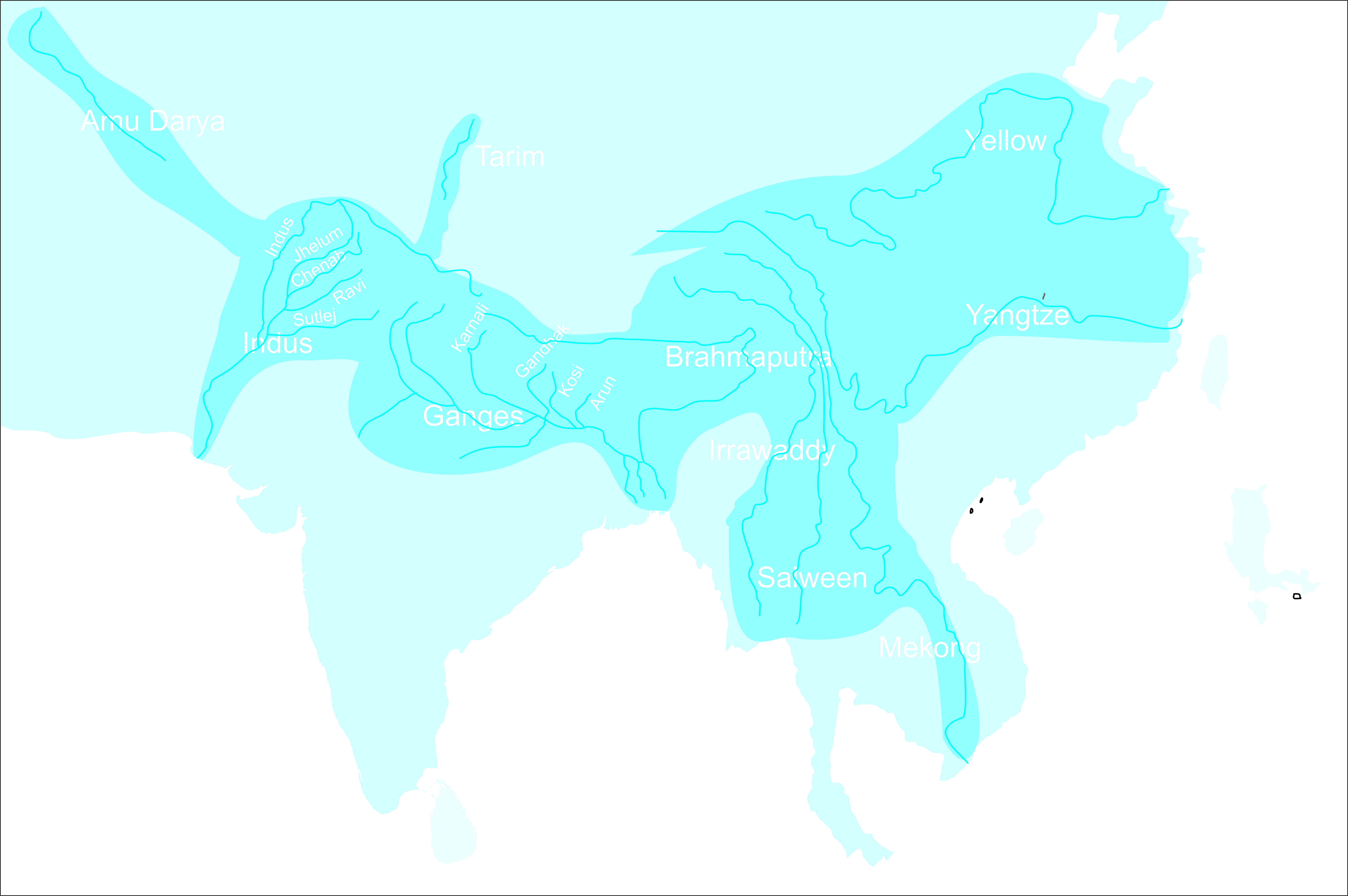
The world’s largest and most-vulnerable watershed, the Great Himalayan-cum-Tibetan Watershed, is the source of water flows to more than two-fifths of the global population.
Map: © Brahma Chellaney, Controlling the Taps (CLSA, 2012).

The Chinese government’s recent decision to build an array of new dams on rivers flowing to other countries is set to roil inter-riparian relations in Asia and make it more difficult to establish rules-based water cooperation and sharing.

Asia, not Africa, is the world’s driest continent. China, which already boasts more large dams than the rest of the world combined, has emerged as the key impediment to building institutionalized collaboration on shared water resources. In contrast to the bilateral water treaties between many of its neighbors, China rejects the concept of a water-sharing arrangement or joint, rules-based management of common resources.

The long-term implications of China’s dam program for India are particularly stark because several major rivers flow south from the Tibetan plateau. Just the Brahmaputra River’s annual cross-border runoff volume, according to United Nations data, is greater than the combined flow of three rivers that run from Tibet into Southeast Asia — the Mekong, the Salween, and the Irrawaddy.

India has water-sharing treaties with both the countries located downstream to it: the Indus pact with Pakistan guarantees the world’s largest cross-border flows of any treaty regime, while the Ganges accord has set a new principle in international water law by assuring Bangladesh an equal share of downriver flows in the dry season.

China, by contrast, does not have a single water-sharing treaty with any neighbor.

Yet most of Asia’s international rivers originate in territories that China annexed after the 1949 communist takeover there. The sprawling Tibetan plateau, for example, is the world’s largest freshwater repository and the source of Asia’s greatest rivers, including those that are the lifeblood of mainland China and South and Southeast Asia. Other Chinese-held homelands of ethnic minorities contain the headwaters of rivers such as the Irtysh, Illy and Amur, which flow to Russia and Central Asia.

China’s dam program is following a well-established pattern on international rivers, such as the Mekong, the Salween, and the Brahmaputra: build modest-size dams on a river’s difficult uppermost reaches, and then construct larger dams in the upper-middle sections as the river picks up greater water and momentum, before embarking on megadams in the border area facing another country.

The cascade of megadams on the Mekong, for example, is located in the area just before the river enters continental Southeast Asia. Chinese engineers already have built six giant dams on the Mekong, including the 4,200-megawatt Xiaowan, which dwarfs Paris’s Eiffel Tower in height, and the 5,850-megawatt Nuozhadu, whose first generator began producing electricity last autumn. At least four more dams are planned in this frontier region.

Most of the new dam projects announced recently by China’s state council, or cabinet, are concentrated in the seismically active southwest, covering parts of the Tibetan plateau. The restart of dam building on the Salween River after an eight-year moratorium is in keeping with a precedent set on other river systems — Beijing temporarily suspends a controversial plan after major protests flare so as to buy time, before resurrecting the same plan.

In fact, according to a 2008 report in Time magazine, work on laying the foundation of four Salween dams continued during the moratorium by reclassifying them as transportation projects.

The Salween — Asia’s last largely free-flowing river — runs through deep, spectacular gorges, glaciated peaks, and karst on its way into Myanmar and along the Thai border before emptying into the Andaman Sea. Its upstream basin is inhabited by 16 ethnic groups including some, like the Derung tribe, with tiny populations numbering in the thousands. As one of the world’s most biologically diverse regions, it boasts more than 5,000 plant species and nearly half of China’s animal species.

The decision to formally lift the moratorium and construct five dams — with work to start without delay on the Songta dam, the farthest upriver structure located in Tibet — threatens the region’s biodiversity and could uproot endangered aboriginal tribes. There is also the risk that the weight of huge new dam reservoirs could accentuate seismic instability in a region prone to recurrent earthquakes.

No country is more vulnerable to China’s reengineering of transboundary flows than India. The reason is that India alone receives nearly half of the river waters that leave Chinese-held territory. According to UN figures, a total of 718 billion cubic meters of surface water flows out of Chinese territory yearly, of which 347.02 billion cubic meters (or 48.33 percent of the total) runs directly into India.

China already has a dozen dams in the Brahmaputra basin and one each on the Indus and the Sutlej. On the Brahmaputra, it is currently close to completing one dam and has just cleared work on three others. Two more are planned in this cascade before the dam building moves to the water-rich border segment as the river makes a U-turn to enter India.

Whereas the newly unveiled projects on the Salween and the Mekong are mega-dams with big reservoirs, China claims that its dam building on the Brahmaputra involves only run-of-river plants — a type that generates hydropower without reservoir storage by using a river’s natural flow and elevation drop. However, unlike India vis-à-vis Pakistan or Bangladesh, Beijing is neither willing to share with New Delhi the technical designs nor permit on-site scrutiny.

The relatively large Chinese projects at the Dagu, Jiexu and Zangmu sites on the Brahmaputra indeed raise the possibility that they might impound water in reservoir. Indeed, such is the lack of Chinese transparency that the flashfloods between 2000 and 2005 that ravaged India’s Himachal Pradesh and Arunachal Pradesh states — located on opposite ends of the Himalayas — were linked to unannounced releases from Chinese dams.

Asia awaits a future made hotter and drier by climate and environmental change and resource depletion. The continent’s water challenges have been exacerbated by consumption growth, unsustainable irrigation practices, rapid industrialization, pollution, environmental degradation, and geopolitical shifts.

If Asia is to prevent water wars, it must build institutionalized cooperation in transboundary basins that co-opts all riparian neighbors. If a dominant riparian state refuses to join, such institutional arrangements — as in the Mekong basin — will be ineffective.

The arrangements must be centered on transparency, unhindered information flow, equitable sharing, dispute settlement, pollution control and a commitment to refrain from any projects that could materially diminish transboundary flows. International dispute-settlement mechanisms, as in the Indus treaty, help stem the risk that water wrangles could escalate to open conflict.

China — with its hold over Asia’s transnational water resources and boasting over half of the world’s 50,000 large dams — has made the control and manipulation of river flows a pivot of its power and economic progress. Unless it is willing to play a leadership role to develop a rules-based system, the economic and security risks arising from the Asian water competition can scarcely be mitigated.

Brahma Chellaney is the author of Water: Asia’s New Battleground (Georgetown University Press, 2011).

(c) Japan Times, 2013.

Neighbours leave India high and dry for its water supply

Brahma Chellaney

The National, February 1, 2013

Of all the natural resources on which the world depends, the supply and demand situation is most critical for water. There are replacements for oil, but no substitute for water, which is essential to produce virtually all the goods in the marketplace.

Asia, not Africa, is the world’s driest continent. The gap between demand and supply is growing in China, India, South Korea, Japan, Vietnam and elsewhere in Asia.

This raises a question: can Asia remain the locomotive of the global economy if it cannot mitigate its water crisis?

India faces greater water distress than China. China’s population is not even 10 per cent larger than India’s, but its internally renewable water resources (estimated at 2,813 billion cubic metres per year) are almost twice as large as India’s. In aggregate water availability, including inflows (which are sizeable in India’s case), China has virtually 50 per cent more resources than India.

In 1960, India signed a treaty setting aside 80 per cent of the Indus-system waters for downstream Pakistan, in the most generous water-sharing pact in modern history. And its 1996 Ganges treaty with Bangladesh guarantees minimum cross-border flows in the dry season – a new principle in international water law. That treaty divides the flows of the Ganges almost equally between the two countries. And now India is under pressure to reserve about half of the Teesta River’s water for Bangladesh.

But India is downriver from China. About a dozen important rivers flow into India from the Tibetan Himalayas. Indeed, one third of India’s yearly water supply comes from Tibet, according to United Nations’ data. Nations from Afghanistan to Vietnam receive water from the Tibetan Plateau, but India’s direct dependency on Tibetan water is greater than any other country’s.

But Beijing, far from emulating India’s water munificence, rejects the very concept of water sharing and is building large dams on rivers flowing to other nations, with little regard for downriver interests. An extensive Chinese water infrastructure in Tibet will have a serious effect on India.

So India faces difficult choices. Its ambitious plan to link up its major rivers has remained on paper for more than a decade. The idea was to connect 37 Himalayan and peninsular rivers in a pan-Indian water grid, to fight shortages.

Although the grid was ridiculed by the ruling party’s heir-apparent Rahul Gandhi as a “disastrous idea”, the Supreme Court ordered last year that it be implemented in “a time-bound manner”. Will that really happen?

The experience of the Supreme Court-overseen Narmada dam project in Gujarat doesn’t leave much room for optimism. India has struggled for decades to complete Narmada, and yet it is designed to produce less than 7 per cent as much hydropower as China’s Three Gorges Dam, completed last year.

With water increasingly at the centre of inter-provincial feuds in India, the Supreme Court has struggled for years with water cases, but the parties keep returning to litigate again on new grounds.

Plans for large water projects in India usually run into stiff opposition from influential non-government organisations, so that it has become virtually impossible to build a large dam, blighting the promise of hydropower.

Proof of this was New Delhi’s 2010 decision to abandon three dam projects on the Bhagirathi River, a source stream of the Ganges in the Himalayas. One of these was already half-built; hundreds of millions of dollars were wasted.

The largest dam India has built since independence is the 2,000 megawatt Tehri on the Bhagirathi. Compare that with China’s 18,300 megawatt Three Gorges. China’s proposed Metog Dam, almost on the disputed border with India, is to produce nearly twice as much power as Three Gorges Dam. China is also building on the Mekong River.

Meanwhile India’s proposed river-linking plan seems like a dream: a colossal network to handle 178 billion cubic metres of water transfers a year in12,500km of new canals, generating 34 gigawatts of hydropower, creating 35 million hectares of irrigated land and expanding inland navigation. This is the kind of programme that only an autocracy like China can implement.

Government agencies say that by 2050 India must nearly double grain production, to over 450 million tons a year, to meet the demands of prosperity and population growth. Unless it has more irrigated land and adopts new plant varieties and farming techniques, India is likely to become a net food importer before long – a change that will roil world food markets.

More fundamentally, growing water shortages threaten to slow Indian economic growth and fuel social tensions. The government must fix its disjointed policy approach and develop a long-term vision for water resources.

India must treat water as a strategic issue and focus on three key areas. One is achieving greater water efficiency and productivity gains. Another is using clean-water technologies to open up new supply sources, including ocean and brackish waters and recycled wastewater. The third is expanding and enhancing water infrastructure to correct regional and seasonal imbalances in water availability, and to harvest rainwater, which can be a new supply source to ease shortages.

Boosting water supplies demands tapping unconventional sources and adopting non-traditional approaches, as well as improving the old ways of water-supply management.

Brahma Chellaney is a professor of strategic studies at the Center for Policy Research in New Delhi and the author of Water: Asia’s New Battleground.

On Twitter: @Chellaney

(c) The National, 2013

Interview: Schwartz Book Award Winner Brahma Chellaney on Asia’s Water Future

Asia Society, November 9, 2012, by Suzanne DiMaggio


Future site of the Xayaburi Dam in Laos. (International Rivers/Flickr)

Brahma Chellaney, a professor at the Centre for Policy Research in New Delhi and one of India’s leading strategic thinkers and analysts, was awarded Asia Society’s 2012 Bernard Schwartz Book Award for Water: Asia’s New Battleground (Georgetown University Press), in which he describes water stress as Asia’s defining crisis of the 21st century. Chellaney will be honored and presented with a $20,000 prize at a special event to be held at Asia Society New York on January 23, 2013.

After being named the 2012 Award winner, Chellaney spoke to Asia Society Vice President of Global Policy Programs Suzanne DiMaggio about Asia’s water security challenges.

As compared to other regions in the world, what makes Asia particularly susceptible to conflict over water resources?

Water has emerged as a critical issue that will determine if Asia is headed toward greater cooperation or greater competition. Asia, with the lowest per capita freshwater availability among all continents, is at the center of global water challenges. In an ever-deeper search for water, millions of pump-operated wells threaten to suck Asia’s groundwater reserves dry, even as the continent confronts river depletion.

Few seem to know that the driest continent in the world is not Africa but Asia, where availability of freshwater is not even half the global average. Asia has less than one-tenth of the water of South America, Australia, and New Zealand, less than one-fourth of the water of North America, almost one-third of the water of Europe, and 25% less water than Africa per inhabitant. Yet it has the world’s fastest-growing demand for water for food and industrial production and municipal supply. To compound matters, Asia already has the world’s largest number of people without basic or adequate access to water, in addition to very high water-distribution losses, a lack of 24/7 supply in many cities, and drinking-water contamination due to unregulated industrial and agricultural practices.

Where in Asia is the potential for interstate water conflict greatest? What priority measures are needed to prevent “water wars?”

Water — the most essential of all natural resources — is vital to produce virtually all the goods in the marketplace, to generate electricity, to mine energy resources, and to refine oil and gas. Most states in Asia, other than China and archipelagos like Japan and Indonesia, have a high national dependency on waters from transnational rivers or aquifers. Often, securing a larger portion of the shared water resources has become a flashpoint in inter-country relationships.

Water indeed is a new arena in the Asian Great Game. Water shortages were relatively unknown in Asia — other than in arid regions — before the era of rapid economic growth began in earnest about three decades ago. Thanks to Asia’s dramatic economic rise, water resources have come under increasing pressure in almost all of the important Asian economies. As a result, the risk of water becoming a trigger for conflict or diplomatic strong-arming is high across large parts of the continent.

Brahma Chellaney

The security risks are underlined by the fact that only four of the 57 transnational river basins in continental Asia have treaties covering water sharing or other institutionalized cooperation. These four are the Mekong, where the non-participation of upper-riparian China has stunted the development of a genuine basin community; the Ganges, where there is a treaty between Bangladesh and India; the Indus, which boasts the world’s greatest water-sharing treaty in terms of the quantum of cross-border flows; and the Jordan, a four-nation basin whose resources are the subject of a peace-treaty-related arrangement between Israel and Jordan. The exact number of transnational groundwater basins in Asia is unknown because there has been no scientific assessment. But a number of the transnational river basins in Asia have emerged as potential flashpoints for serious water conflict — a specter reinforced by the strained inter-riparian relations in several basins and the broader absence of an Asian security architecture. In fact, Asia is the only continent other than Africa where regional integration has yet to take hold, largely because Asian political and cultural diversity has hindered institution building. Managing the water competition in Asia is thus becoming increasingly challenging.

You note that water disputes are also fueling conflict within countries. Where are the potential “hot spots” for instability? What solutions can governments in the region implement in order to reduce internal tensions?

Intra-country water disputes are rife across much of Asia — from Southeast Asia and the Indian subcontinent to Central Asia and China. In fact, intrastate water conflicts tend to be more frequent and violent than interstate conflicts. Yet intrastate conflicts rarely get the kind of international attention that interstate discords do. This is partly because inter-country water disputes carry greater security and economic risks.

As Asia illustrates, water conflict within multi-ethnic nations often assumes ethnic or sectarian dimensions, thereby accentuating internal-security challenges. One frequent source of intrastate water conflict is a government or corporate decision to set up a water-intensive plant in an already water-stressed area, or a national supply-side project. When water availability is already low, new plants or projects tend to spur greater competition over scarce water resources. Yet the lopsided availability of water within some Asian nations (abundant in some areas but deficient in others) has given rise to megaprojects or grand diversion plans. The building of large dams and other diversion structures has run into grassroots opposition in a number of Asian nations, especially those that are democratic, due to displacement and submergence issues.

You make the case that viewing water scarcity issues through an environmental lens is insufficient and call for a more comprehensive approach framed within the context of peace and security. Do you see any evidence that policymakers in Asia or other parts of the globe are moving in this direction?

In Asia, water has gone from being just an environmental issue to becoming a strategic issue. Governments have been slower than public opinion in recognizing this shift. Yet the rise of nontraditional security issues has promoted the quiet “securitization” of water.

What is needed is a holistic, long-term approach so that national policies on water, energy, and food are harmonized to help achieve greater water efficiency. Whereas Asia’s population growth has slowed, its consumption growth has taken off due to rising prosperity. An average Asian is consuming more resources, including water, food, and energy. What were luxuries earlier have become necessities today, bringing the availability of water and other natural resources under strain. To protect Asia’s economic growth and development goals, private-public partnerships are necessary to create synergy in the water, energy, and food sectors, to improve water productivity, and to optimize water availability. A comprehensive framework is also required to help advance internal and external security, including through inter-riparian cooperation.

Another issue that must be addressed is the increasingly apparent environmental impact of the Asian economic-growth story, including on watersheds, riparian ecology, and water quality. Rising prosperity in Asia, by aggravating the environmental impacts of human activities, is deepening the water crisis.

State policies have unwittingly contributed to the environmental degradation. State subsidies, for example, have helped weaken price signals, encouraging farmers to over-pump groundwater. Provision of subsidized electricity and diesel fuel to farmers in several Asian countries has promoted the uncontrolled exploitation of groundwater.

Water abstraction in excess of the natural hydrological cycle’s renewable capacity is affecting ecosystems and degrading water quality in large parts of Asia. The overexploitation of groundwater, for example, results not only in the depletion of a vital resource, but also leads to the drying up of wetlands, lakes, and streams that depend on the same source. The human alteration of ecosystems, in fact, invites accelerated global warming.

In the interstate context, a dam-building race is now on. The countries likely to bear the brunt of such water diversion are those located farthest downstream on rivers like the Brahmaputra, Mekong, and Tigris-Euphrates: Bangladesh, whose very future is threatened by climate and environmental change; Vietnam, a rice bowl of Asia; and Iraq, still internally torn. China’s water appropriations from the Illy River threaten to turn Kazakhstan’s Lake Balkhash into another Aral Sea.

The book recommends a cooperative, rule-based approach to addressing water resource concerns in Asia. How realistic is it to expect regional cooperation on water when countries are so focused on pursuing their own national interests?

This is a good question. There is little incentive to conserve or protect supplies for users beyond national borders, unless, of course, specific water-sharing arrangements are in place. The focus on narrowly defined national interests is the main reason why most transnational basins lack any cooperative regime. Often, commercial contracts, joint research, flood-control projects, and non-binding memorandums of understanding masquerade as water agreements. Yet there are just a handful of water treaties in Asia that actually incorporate a sharing formula on transboundary basin resources or provide for institutionalized cooperation.

Inter-country water institutions facilitate constructive dialogue and structured cooperation and thereby help moderate the risk of disputes flaring into overt confrontation or armed conflict. The way to avert or manage water disputes in Asia is to build basin-level arrangements involving all important riparian neighbors. The arrangements must be centered on transparency, information sharing, equitable distribution of benefits, dispute settlement, pollution control, joint projects, and a mutual commitment to refrain from building projects that would materially diminish transboundary flows. If a dominant riparian refuses to join or the common rules are breached, an institutional arrangement can hardly be effective.

Admittedly, it is not easy to build water institutions because of the complex physical, geopolitical, and economic factors usually at play. Still, to contain the security risks, Asian states have little choice but to invest more in institutionalized cooperation. Only such collaboration can help underpin peace and security, protect continued economic growth, and promote environmental sustainability.

You argue that “the big issue in Asia, apart from climate change, is whether China will exploit its control of the Tibetan Plateau to increasingly siphon off for its own use the waters of the international rivers that are the lifeblood of the countries located in a contiguous arc from Vietnam to Afghanistan.” What is required of China for these policies to change?

Brahma Chellaney

Asia clearly is on the frontlines of climate change. In the nearer term, however, China looms large as a common factor in more than a dozen crucial river basins in Asia that lack any kind of institutionalized cooperation among all key co-riparian states. China does not have a single water-sharing treaty with any co-riparian country, and is currently involved in water disputes with multiple neighbors, including Kazakhstan, Russia, India, Nepal, Myanmar, and Vietnam.

Asia’s water map fundamentally changed after the 1949 Communist victory in China. Most of Asia’s important international rivers originate in territories that were forcibly absorbed by the People’s Republic of China. The Tibetan Plateau is the world’s largest freshwater repository and the source of Asia’s greatest rivers, including those that are the lifeblood for mainland China. Although China is now the source of cross-border water flows to the largest number of countries in the world, it rejects the very notion of water sharing or institutionalized cooperation with downriver countries.

With several nations jockeying to control transnational water resources, the political obstacles in Asia go beyond China. Still, given China’s unique riparian position and its assertion of absolute territorial sovereignty over the upstream waters, it will not be possible to transform the Asian competition into cooperation without China’s participation in water institutions. Persuading China to halt further unilateral appropriation of shared waters has emerged as a central challenge.

How is the United States affected by water resource concerns in Asia? What policies can the U.S. adopt or support to help address these concerns?

U.S. officials have spotlighted Asia’s water challenges, and the State Department announced in 2010 that it was upgrading water scarcity to “a central U.S. foreign policy concern.” A 2012 report reflecting the joint judgment of U.S. intelligence agencies pointed to the water-related security risks in several Asian basins.

Water discord impinges on U.S. interests, including by impeding collaboration between U.S. allies and friends in the region. For example, dam building is creating new inter-country tensions and challenges in Asia and complicating U.S. diplomacy.

The United States, although relatively well-endowed with water resources, is itself facing increasing water stress, especially in the southwest. But it has old, functioning water institutions with Canada and Mexico. The Canada-U.S. International Joint Commission (IJC) has successfully managed the world’s largest water resources governed by a bilateral mechanism. U.S. policy could seek to promote institutionalized water cooperation in Asia that draws on the ICJ’s productive features. At a time when new upstream Chinese dams have helped stir popular passions in Vietnam, Laos, Cambodia, and Thailand, the United States has sought to diplomatically cash in on downstream concerns by launching the Lower Mekong Initiative, or LMI. Seeking to promote integrated cooperation among Cambodia, Laos, Thailand, and Vietnam in the areas of environment, education, health, and infrastructure, LMI emphasizes sustainable hydropower development and natural-resource management, including improving institutional capacity to address connected transnational issues.
Brahma Chellaney’s “Water: Asia’s New Battleground” wins the 2012 Bernard Schwartz Award

Announcement by the Asia Society, New York:

Water: Asia’s New Battleground (Georgetown University Press) by Brahma Chellaney has won the 2012 Asia Society Bernard Schwartz Book Award. Dr. Chellaney will be honored and presented with a $20,000 prize at a special event to be held at Asia Society’s headquarters in New York City on January 23, 2013.

The Asia Society Bernard Schwartz Book Award is the only award that recognizes nonfiction books for their outstanding contributions to the understanding of contemporary Asia or U.S.-Asia relations, as well as potential policy impacts relating to the region.Water: Asia’s New Battleground was selected from nearly 90 nominations submitted by U.S. and Asia-based publishers for books published in 2011.

A jury co-chaired by Tommy T. B. Koh, Singapore’s Ambassador-at-Large, and Carol Gluck, George Sansom Professor of History at Columbia University, and composed of leading experts and figures from policy, academia, and journalism from India, Indonesia, Japan, Singapore, Thailand, and the United States selected the winner and honorable mentions.

According to Ambassador Koh, “This timely, comprehensive, and forward-looking book makes the compelling case that water will likely emerge as one of Asia’s biggest security challenges in the 21st century. The equitable and sustainable management of Asia’s great river systems should be a priority on the global agenda.”

Dr. Gluck added, “Conflicts over water are an increasingly pressing problem in many places. In his important book, Brahma Chellaney alerts us to the challenges facing Asia in assuring adequate water supplies across the region.”

Water: Asia’s New Battleground underscores the importance of water as a means of security at multiple levels in Asia,” said Suzanne DiMaggio, Vice President of Asia Society’s Global Policy Programs. “Policymakers need to look at this vital resource in a way that takes into account the complex national security and development issues countries and communities will face as water scarcity in the region intensifies.”

Two honorable mentions were also chosen: Deng Xiaoping and the Transformation of China, by Ezra Vogel (Belknap Press of Harvard University Press) and Cambodia’s Curse: The Modern History of a Troubled Land by Joel Brinkley (PublicAffairs). Each will receive a $2,000 prize.

Previous winners of the Book Award include Richard McGregor for The Party: The Secret World of China’s Communist Rulers (2011), James C. Scott for The Art of Not Being Governed: An Anarchist History of Upland Southeast Asia (2010), and Duncan McCargo forTearing Apart the Land: Islam and Legitimacy in Southern Thailand (2009).

— 2012 Asia Society Bernard Schwartz Book Award Jury Members —

Carol Gluck (Co-Chair), George Sansom Professor of History, Columbia University

Tommy T.B. Koh (Co-Chair), Singapore’s Ambassador-At-Large; Chairman, Centre for International Law; Rector, Tembusu College at the National University of Singapore

Ashok Advani, Chairman, Publisher, and Founder of Business India Group of Publications

James Fallows, National Correspondent, The Atlantic

Susan Glasser, Editor-in-Chief, Foreign Policy

Kazuo Ogoura, Secretary General, Council of Tokyo 2020 Bid Committee

Thitinan Pongsudhirak, Associate Professor, International Relations at Chulalongkorn University, Thailand; Director, Institute of Security and International Studies, Bangkok

Susan Shirk, Director, Institute on Global Conflict and Cooperation, and Ho Miu Lam professor of China and Pacific Relations, University of California, San Diego

Rizal Sukma, Executive Director, Centre for Strategic and International Studies, Jakarta, Indonesia

Asia Society is the leading educational organization dedicated to promoting mutual understanding and strengthening partnerships among peoples, leaders, and institutions of Asia and the United States in a global context. Across the fields of arts, business, culture, education, and policy, the Society provides insight, generates ideas, and promotes collaboration to address present challenges and create a shared future.

Founded in 1956 by John D. Rockefeller 3rd, Asia Society is a nonpartisan, nonprofit institution with headquarters in New York, centers in Hong Kong and Houston, and affiliated offices in Los Angeles, Manila, Mumbai, San Francisco, Seoul, Shanghai, Sydney, and Washington, DC.

Asia’s Water Crisis Needs Urgent Fixing

Brahma Chellaney

The Straits Times | September 17, 2012

Asia’s water crisis is at the heart of the world’s water challenges, with  the degradation of surface and subterranean water resources threatening the natural ecosystems. Asia has the world’s lowest per capita access to freshwater. The continent’s ever-deeper search for water is sucking groundwater reserves dry with millions of pump-operated wells even as it confronts river depletion.

Groundwater is recklessly exploited because it is not visible to the human eye. What is out of sight tends to be out of mind, as people drill  deeper into the receding water table.

At least seven factors have contributed to the rising economic and security risks linked with the Asian water crisis.

One is Asia’s dramatic economic rise. With economic activity such as industry and food production consuming 92 percent of the world’s annual water use, Asia’s rapid economic growth has been the key driver of its growing water stress.

Asia already has the world’s largest number of people without basic or adequate access to water. Asian states are experiencing very high water-distribution losses, a lack of 24/7 supply in many cities, and drinking water contamination due to unregulated industrial and agricultural practices.

A second factor is consumption growth from rising prosperity. While Asia’s population growth has slowed, its consumption growth has taken off as Asians consume more resources like water, food and energy. A growing Asian middle class, for example, uses water-guzzling, energy-hogging comforts such as washing machines and dishwashers. What were once luxuries have become necessities today. In China, daily household water use increased two-and-a-half times between 1980 and 2000 alone.

The broader consumption growth is best illustrated by changing Asian diets, especially the greater intake of meat, which is notoriously water-intensive to produce. Asia actually accounts for the world’s fastest growth in meat consumption. China, Vietnam and Thailand almost doubled their production of pigs and poultry during the 1990s alone.

Growing biomass to feed animals takes far more water, energy and land than growing biomass for direct human consumption. Much of the world’s corn and soya bean production and a growing share of wheat now go to feed cattle, pigs and chickens.

Third is the role of irrigation. Irrigation has proven both a boon and a curse in Asia. Once a continent of serious food shortages and recurrent famines, Asia’s dramatic economic rise as a net food exporter came on the back of an unparalleled irrigation expansion. Between 1961 and 2003, Asia doubled its total irrigated acreage.

Extending agriculture to semi-arid and arid areas that stretch from northern China to Uzbekistan and beyond has required intensive irrigation. But this has created serious water-logging and soil salinity problems, and undercut crop-yield growth.

Even in Asia’s fertile valleys drained by major rivers, irrigation is often necessary in the dry season because the rains are usually restricted to the three- or four-month monsoon season. This is in stark contrast to Europe’s rain-fed crops producing most of its food.

With its vast irrigation systems, Asia now boasts much of the world’s land under irrigation. It has 70.2 percent of the world’s 301 million hectares of irrigated acreage.

Asia’s channelling of 82 percent of its water for food production is not the only startling statistic. Consider another astonishing figure: almost 74 per cent of the total global freshwater used for agriculture is in Asia alone. With so much water diverted to agriculture, water literally is food in Asia. Yet in the long term, such water use by Asia’s agricultural sector is simply unsustainable.

A fourth factor is the fast-rising water demand from Asian industry and urban households, as this continent becomes the world’s fastest industrialization and urbanization region.

With the international shift of manufacturing to Asia continuing, this continent’s industrial water usage is merely 9 percent of the total, with another 9 percent used for municipal supply. However, in East Asia — where Asia’s heavy manufacturing is concentrated — industrial water use already accounts for 22 percent of total supply, with municipal supply making up another 14 percent.

Greater water shortages are looming as industrial activities rapidly expand. The fast pace of urbanization has left many cities struggling to meet the household water demands.

A fifth factor behind Asia’s water crisis is the large-scale sequestration of river resources through dams, barrages, reservoirs and other human-made structures. This has been done without factoring in long-term environmental considerations and, in a number of cases, even the interests of countries located downstream.

Projects designed to offer structural solutions in the form of dams, reservoirs, irrigation canals and levees are often at the root of intrastate and interstate water disputes.

Asia is the world’s most dam-dotted continent, yet such over-damming has only compounded its water challenges. China alone boasts slightly more than half of the approximately 50,000 large dams on the planet.

Yet another factor is the environmental impact of Asia’s economic-growth story, including on watersheds, riparian ecology and water quality. Rising prosperity in Asia, by aggravating the environmental impacts of human activities, is deepening the water crisis.

State policies have unwittingly contributed to environmental degradation. State subsidies, for example, have helped weaken price signals, encouraging farmers to over-pump groundwater. Provision of subsidized electricity and diesel fuel to farmers in several Asian countries has promoted the uncontrolled exploitation of groundwater.

Water abstraction in excess of the natural hydrological cycle’s renewable capacity is affecting ecosystems and degrading water quality in large parts of Asia. The over-exploitation of groundwater, for example, results not only in the depletion of a vital resource, but also leads to the drying up of wetlands, lakes and streams that depend on the same source. The human alteration of ecosystems is an invitation to accelerated global warming.

A final factor is the lack of institutionalized cooperation over most of Asia’s transnational river basins. This reality has to be seen in the context of strained relations between states sharing river basins and the broader absence of an Asian security architecture.

Asia is the only continent other than Africa where regional integration has yet to take hold, largely because Asian political and cultural diversity has hindered institution building. As a result, managing the water competition in Asia has become increasingly challenging.

The writer is the author of “Water: Asia’s New Battlegroud.”

(c) The Straits Times, 2012.

The Uneasy U.S.-India-Iran Triangle

India’s American Friends and Iranian Partners

By Brahma Chellaney

A column internationally syndicated by Project Syndicate

The United States recently took the Iran-sanctions monkey off India’s back: it granted India an exemption from Iran-related financial sanctions in exchange for significant cuts in Indian purchases of Iranian oil. Nevertheless, Iran continues to cast a pall over an otherwise brightening U.S.-India relationship.

From India’s perspective, Iran is an important neighbor with which it can ill afford to rupture its relationship. Indeed, India already seems locked geographically in an arc of failing or dysfunctional states, confronting it with external threats from virtually all directions.

If India joined the U.S. containment strategy against Iran, it would have to bear serious strategic costs. For starters, it would lose access to Afghanistan via Iran, which has served as a conduit for the substantial flow of Indian aid to Kabul. Moreover, containment would undermine India’s energy interests.

Few countries are as dependent on the Persian Gulf region’s hydrocarbons as is India, which imports almost 80% of its consumption. Iran is the world’s third-largest net oil exporter (with the world’s second-largest natural-gas reserves as well), and it is a strategically located gateway to other energy suppliers in Central Asia and the Middle East.

Iraq and Iran used to be India’s principal oil suppliers. But the first fell prey to a long U.S. occupation, and the second currently faces a U.S.-led oil-export embargo designed to throttle it financially. As a result, America’s efforts to give international effect to its new Iran Sanctions Act constitute a double whammy for India.

First, it threatens to sabotage India’s energy-import diversification strategy by making it overly dependent on the Islamist-bankrolling oil monarchies — including Saudi Arabia, the United Arab Emirates, and Qatar — which have managed to ride out the Arab Spring. Second, further isolation of Iran will make it very difficult for India to play a more active role in Afghanistan at a time when the U.S. is hastening its military disengagement there and seeking to cut a deal with the Taliban.

India, one of the largest aid donors to Afghanistan, has no contiguous corridor to that country and must rely on Iran for access. Both countries share a common goal in Afghanistan — to ensure that the Pakistan-backed Taliban does not return to power. If the already-unstable situation there deteriorates after the end of U.S.-led combat operations, India and Iran may be compelled to revive their strategic cooperation of the 1990’s. It was the Northern Alliance, backed by India, Iran, and Russia, that overthrew the Taliban regime in Kabul in late 2001 with the help of America’s air war.

For the U.S. today, containment of Iran is dictated by several geopolitical considerations. One consideration is the need to neutralize the strategic advantage that Iran gained from the U.S. overthrow of Saddam Hussein in neighboring Iraq — a development that helped to empower Iraq’s Shia majority. President George W. Bush called Iran part of an “axis of evil,” yet his decision to invade and occupy Iraq benefited Shia-dominated Iran above all.

Moreover, regional geopolitics pits the powerful “Sunni Crescent,” led by Turkey, Saudi Arabia, Qatar, and the UAE, against the beleaguered “Shia Crescent” states — Iran, Iraq, Syria, and Lebanon. The U.S. has profited from a longstanding alliance with the Sunni bloc. In addition to the strategic advantages, America’s close ties with the oil sheikhdoms — which are among the world’s leading holders of foreign-exchange reserves — contribute to propping up the dollar.

It is against this background that the Iranian nuclear program has come to symbolize the larger geopolitical tensions underlying the confrontation between the U.S. and Iran. Indeed, the nuclear issue has served to rationalize the face-off, with Iran’s leaders playing to their domestic audience by whipping up nuclear nationalism and the U.S. playing to the international audience by harping on the proliferation threat.

India should seek to play the role of honest broker to defuse the threat of military hostilities, which would most likely shut down the world’s most important oil-export route, the Strait of Hormuz (a danger that Iran has said is also implicit in an oil-export embargo against it). But, far from being able to play the role of bridge-builder between the U.S. and Iran, India is being forced to walk a policy tightrope, and its desire to chart a neutral course has annoyed both sides.

Every time a senior Indian delegation visits Iran, or vice versa, the U.S. warns India that its cozying up to Iran “raises obstacles” to building a closer strategic partnership. Yet, by voting against Iran at the International Atomic Energy Agency’s governing board meetings in 2005 and 2006, India invited Iranian reprisal in the form of cancellation of a highly favorable 25-year, $22-billion liquefied-natural-gas deal.

The Iran issue, in effect, has turned into a diplomatic litmus test: Will India stand up for its strategic and energy interests in the region, or will it be co-opted to serve the short-term interests of its friend, the U.S.? The U.S., for its part, must reconcile its Iran-related pressure on India, which is likely to continue despite the 180-day sanctions waiver, with the imperative to build deeper defense ties with India, thereby giving strategic heft to its declared “pivot” to Asia.

Brahma Chellaney is Professor of Strategic Studies at the Center for Policy Research in New Delhi and the author of “Asian Juggernaut” (HarperCollins) and “Water: Asia’s New Battleground” (Georgetown University Press).

(C) Project Syndicate, 2012.

Parched and Thirsty, yet Most Generous in Water Diplomacy

Brahma Chellaney, The Times of India, July 3, 2012

Reciprocity is the first principle of diplomacy. But not for India, if one goes by its record. India has walked the extra mile to befriend neighbours, yet today it lives in the world’s most-troubled neighbourhood.

India’s generosity on land issues has been well documented, including its surrender of British-inherited extraterritorial rights in Tibet in 1954, the giving back of strategic Haji Pir to Pakistan after the 1965 war, and the similar return of territorial gains plus 93,000 prisoners after 1971 — all without securing any tangible reciprocity. Despite that record, there are still calls within India today for it to unilaterally cede control over the Siachin Glacier.

Even though India is reeling under a growing water crisis — with hospitals in its capital postponing surgeries because of lack of water and much of the country parched and thirsty — few seem to know that India’s generosity has extended not just to land but also to river waters.

The world’s most generous water-sharing pact is the 1960 Indus Waters Treaty, under which India agreed to set aside 80.52% of the waters of the six-river Indus system for Pakistan, keeping for itself just the remaining 19.48% share. Both in terms of the sharing ratio as well as the total quantum of waters reserved for a downstream state, this treaty’s munificence is unsurpassed in scale in the annals of international water treaties. Indeed, the volume of water earmarked for Pakistan is more than 90 times greater than the 1.85 billion cubic metres the US is required to release for Mexico under the 1944 US-Mexico Water Treaty.

The unparalleled water generosity has only invited trouble for India. Within five years of the Indus treaty, Pakistan launched its second war against India to grab the rest of Kashmir when India had still not recovered from its humiliating rout in 1962 at the hands of the Chinese.

Today, Pakistan expects eternal Indian munificence on water even as its military establishment (with blood of innocent Indians on its hands) continues to export terror. Yet, with all the water flowing downstream under the treaty, the same question must haunt the Pakistani generals as Lady Macbeth in William Shakespeare’s Macbeth: “Will all great Neptune’s ocean wash this blood clean from my hand?” Meanwhile, India’s own Indus basin, according to the 2030 Water Resources Group, confronts a massive 52% deficit between water supply and demand.

India’s 1996 Ganges treaty with Bangladesh guarantees minimum cross-border flows in the dry season — a new principle in international water law. In fact, the treaty almost equally divides the downstream Ganges flows between the two countries. Because of that precedent, India seems now ready to reserve almost half of the Teesta River waters for Bangladesh in what will be the world’s first water-sharing treaty of the 21st century.

Water is a state issue, not a federal matter, in the Indian Constitution, yet Prime Minister Manmohan Singh has sought to strong-arm West Bengal into accepting a Teesta River treaty on terms dictated by New Delhi. Existing water-sharing treaties elsewhere in the world, by contrast, do not come anywhere close to allocating half of all basin waters to the downstream state. Another key fact is that unlike Bangladesh, India is already a seriously water-stressed country. Whereas the annual per-capita water availability in Bangladesh averages 8,252 cubic metres, it has fallen to a paltry 1,560 cubic metres in India.

Lost in such big-hearted diplomacy is the fact that India is downriver to China, which, far from wanting to emulate India’s Indus or Ganges style water munificence, rejects the very concept of water sharing. Instead, the construction of upstream dams on international rivers such as the Mekong, Salween, Brahmaputra, Arun, Sutlej, Indus, Irtysh, Illy and Amur shows China is increasingly bent on unilateral actions, impervious to the concerns of downstream nations. Over the next decade, as if to underscore the strategic importance it gives to controlling water resources, China plans to build more large dams than the US or India has managed in its entire history.

By seeking to have its hand on Asia’s water tap through an extensive upstream infrastructure, China challenges India’s interests more than any other country’s. Although a number of nations stretching from Afghanistan to Vietnam receive waters from the Tibetan Plateau, India’s direct dependency on Tibetan waters is greater than of any other country. With about a dozen important rivers flowing in from the Tibetan Himalayan region, India gets almost one-third of all its yearly water supplies of 1,911 cubic kilometres from Tibet, according to the latest UN data.

In this light, it is fair to ask: Is India condemned to perpetual generosity toward its neighbours? This question has assumed added urgency because India has started throwing money around as part of its newly unveiled aid diplomacy — $1 billion in aid to Bangladesh, one-fifth as grant; $500 million to Myanmar; $300 million to Sri Lanka; $140 million to the Maldives; and generous new aid to Afghanistan and Nepal. If pursued with wishful thinking, such aid generosity is likely to meet the same fate as water munificence.

Generosity in diplomacy can yield rich dividends if it is part of a strategically geared outreach designed to ameliorate the regional-security situation so that India can play a larger global role. But if it is not anchored in the fundamentals of international relations — including reciprocity and leverage building — India risks accentuating its tyranny of geography, even as it is left holding the bag.

The writer is a geostrategist.

(c) The Times of India, 2012.

Water Diplomacy: Skating on Thin Ice

Brahma Chellaney, The Economic Times, May 10, 2012

The Teesta River flowing through the northern part of India’s West Bengal state

With power in India shifting to the states due to an increasingly weak central government, Secretary of State Hillary Clinton chose Calcutta as the first stop of her India tour to advance U.S. foreign-policy interests. In a televised interview before meeting with West Bengal Chief Minister Mamta Banerjee, Ms. Clinton pushed for India permitting foreign direct investment in multi-brand retail and for an “amicable” water-sharing arrangement with Bangladesh on the Teesta River — issues stalled by Ms. Banerjee’s opposition.

The art of persuasion and co-option is central to leadership — a capability Prime Minister Manmohan Singh has failed to demonstrate, even as his politically precarious government lurches from one crisis to another. The result has been a series of delays on critical decisions as well as policy reversals — all conveniently blamed on allies, including powerful regional satraps. This tendency to pass the buck has prompted foreign leaders to directly woo key chief ministers.

Take the water issue. The Indian Constitution has left water as a state-level subject, rather than making it a federal issue. Yet Singh’s government has sought to dictate the terms of a Teesta water-sharing treaty with Bangladesh to West Bengal, although that state’s interests are directly at stake. Indeed, New Delhi first negotiated the terms of the pact with Dhaka — generously loaded in Bangladesh’s favour — and then sought to present West Bengal with a fait accompli.

Respect for states and their interests is the essence of federalism.  Yet this inclination to ride roughshod over states harks back to the days when the central government was exceptionally strong.

Jawaharlal Nehru ignored the interests of Jammu and Kashmir and, to a lesser extent, Punjab when he signed the 1960 Indus Waters Treaty, under which India bigheartedly agreed to the exclusive reservation of the largest three of the six Indus-system rivers for downstream Pakistan. In effect, India signed an extraordinary treaty indefinitely setting aside 80.52 percent of the Indus-system waters for Pakistan — the most generous water-sharing pact thus far in modern world history.

In fact, the volume of waters earmarked for Pakistan from India under the Indus treaty is more than 90 times greater that what the U.S. is required to release for Mexico under the 1944 U.S.-Mexico Water Treaty, which stipulates a minimum transboundary delivery of 1.85 billion cubic meters of the Colorado River waters yearly. While Ms. Clinton’s advocacy of a Teesta treaty is understandable, the U.S. hasn’t set a good example in the Colorado Basin. The  waters of the once-mighty Colorado River are siphoned by seven American states, leaving only a trickle for Mexico.

The Indus treaty was negotiated in a period when water shortages were relatively unknown in most parts of India. Nehru did not envisage that water resources would come under serious strain due to developmental and population pressures. Today, as the bulk of the Indus system’s waters continue to flow to an adversarial Pakistan waging a war by terror, India’s own Indus basin, according to the 2030 Water Resources Group, is reeling under a massive 52 percent deficit between water supply and demand.

Worse still, the Indus treaty has deprived Jammu and Kashmir of the only resource it has — water. The state’s three main rivers — the Chenab and the Jhelum (which boast the largest cross-border discharge of all the six Indus-system rivers) and the main Indus stream — have been reserved for Pakistan’s use, thereby promoting alienation and resentment in the Indian state.

This led the Jammu and Kashmir state legislature to pass a bipartisan resolution in 2002 calling for a review and annulment of the Indus treaty. To help allay popular resentment in the state over the major electricity shortages that are hampering its development, the central government subsequently embarked on hydropower projects like Baglihar and Kishenganga. But Pakistan — as if seeking to perpetuate the popular alienation in the Indian state — took the Baglihar project to a World Bank-appointed international neutral expert and Kishenganga to the International Court of Arbitration, which last year stayed all further work on the project.

The proposed Teesta pact suggests that India has learned no lesson from its experience over the Indus treaty. The Teesta originates in Sikkim state and meets the Brahmaputra in Bangladesh. The long-term interests of northern West Bengal, for which the Teesta is a lifeline, must be protected.

Water, as an indispensable resource that is increasingly in short supply, tends to raise emotive and politically surcharged issues. Singh’s government has unwisely brought India under pressure by portraying Ms. Banerjee as the sole holdout on the Teesta treaty. It has also fed the media attacks on Ms. Banerjee over that issue. Meanwhile, seeking to up the ante by latching on Ms. Clinton’s comments, Bangladesh Foreign Minister Dipu Moni has warned that Indo-Bangladesh ties “will take a huge hit” if India does not deliver on the Teesta issue.

India, which has just announced a decision to magnanimously write off $200 million of its $1 billion new loan to Dhaka, must continue to generously help Bangladesh — but on the basis of concrete reciprocity. India is already a party to a water-sharing treaty with Bangladesh involving a bigger river, the Ganges.

Its 1996 Ganges treaty guarantees Bangladesh minimum cross-border flows in the dry season — a new principle in international water relations. In fact, the treaty almost equally divides the downstream Ganges flows between the two countries. In concluding the treaty, India climbed down from its long-stated position that it needed a minimum of 40,000 cubic feet of water per second of time (“cusecs”) to flush silt from the Calcutta port. India settled for each side getting 35,000 cusecs of water in alternative ten-day periods during the driest period from March to May.

The treaty helped bury the hatchet over India’s diversion of water through the Farakka Barrage to a Ganges tributary, the Bhagirathi-Hooghly, to help flush silt and keep the Calcutta Harbour operational during the dry season. The treaty’s complex water-sharing arrangement is pivoted on joint oversight of flows to help build mutual trust. And unlike the Indus treaty, which was brokered by the U.S. and the World Bank, the Ganges treaty emerged without the involvement of a third party, despite a U.S. offer of mediation.

Bangladesh and India are also likely to sign — without any third-party role — a Teesta treaty in what will be the world’s first water-sharing pact of the 21st century. Bangladesh insists it get half of the Teesta waters, although most of the river’s waters are generated in India. Existing water-sharing treaties elsewhere in the world do not come anywhere close to allocating half of all waters to the downstream state. India has the dubious distinction of signing the most generous water-sharing pacts with downstream states, even as it has failed to get upstream China to  accept the very concept of water sharing.

India faces difficult choices on water. Unlike Bangladesh, it is already a water-stressed country. Whereas the per-capita water availability in Bangladesh is 8,252 cubic meters per year, according to United Nations data, it has fallen to a paltry 1,560 cubic meters in India.

(c) The Economic Times, 2012.