Last time Donald Trump was president, ties between the United States and India flourished. But the bilateral relationship began to fray during Joe Biden’s presidency, owing not least to divisions over the Ukraine war. Will Indian Prime Minister Narendra Modi’s latest meeting with Trump at the White House mark the first step toward restoring this critical relationship?
Trump has made no secret of his conviction that personal bonds between leaders can underpin stronger bilateral relationships. And he and Modi certainly share an affinity: both are nationalist politicians who love little more than to please a roaring crowd with elaborate theatrics. In September 2019, the two came together for a public rally in Houston, attended by 50,000 Indian-Americans and several US legislators. The following February, Trump addressed more than 100,000 people in Ahmedabad. “America loves India,” he declared. “America respects India, and America will always be faithful and loyal friends [sic] to the Indian people.”
US-India relations took a turn for the worse after Russia’s full-scale invasion of Ukraine in 2022. The Biden administration mobilized America’s allies and partners to join its campaign to punish Russia – and, ideally, compel it to change its behavior. But far from joining this effort, India stayed neutral and seized the opportunity to secure cheap Russian oil.
There were other points of contention, as well. The Biden administration sought to weaken Myanmar’s military junta by imposing stringent sanctions on the country and sending “non-lethal aid” to rebel groups – a policy that has contributed to instability in India’s border state of Manipur. Biden also coddled Pakistan’s military-backed regime, including by approving a $450 million deal in 2022 to upgrade the country’s fleet of F-16 fighter jets.
Similarly, Biden welcomed the interim government that Bangladesh’s military installed following the overthrow of the country’s India-friendly government last August. Bangladesh’s rapid descent into lawlessness and Islamist violence since then has raised serious security risks for India, which is already home to millions of illegally settled Bangladeshis.
America’s approach to Sikh separatist leaders on its soil has also raised India’s hackles. Under the Biden administration, the US carried out a criminal investigation into India’s alleged involvement in supposed assassination plots against Sikh militants in the US and Canada. Last September, just days before Biden met with Modi in Delaware, senior White House and US intelligence officials met with Sikh separatists to assure them that they would be protected from “transnational repression.” The following month, the US charged a former Indian intelligence officer in an alleged failed plot to kill a New York-based Sikh militant, who is on India’s most-wanted list.
Against this backdrop, it is easy to see why Trump’s victory in last November’s presidential election raised hopes in India for a reset in bilateral relations. It helps that Trump has repeatedly pledged to negotiate a quick conclusion to the Ukraine war, meaning that India’s choice not to pick a side in that conflict would no longer matter.
A few weeks into Trump’s second presidency, however, there are reasons to doubt this rosy scenario. So far, Trump has done nothing to spare India from his frenetic push to implement his campaign promises, from raising tariffs to deporting undocumented immigrants. When the Trump administration sent more than 100 Indian nationals back to India on a military aircraft – a 40-hour ordeal – their hands and feet were shackled. Modi said nothing.
In fact, far from standing up to Trump, Modi has preemptively slashed tariffs on US imports, hoping that this would keep India out of “Tariff Man’s” sights. But a dissatisfied Trump, who has called India a “very big abuser” of tariffs, has not spared India from his steel and aluminum levies. He wants India to wipe out its $35 billion bilateral trade surplus, by buying more oil and petroleum products, and more weapons, from the US.
India is the world’s third-largest primary energy consumer, after China and the US, and the largest source of oil demand growth. That makes the country a highly attractive market for a US administration that is committed to increasing domestic oil and gas production. It also means that Trump’s commitment to pushing down oil prices, including by applying pressure on OPEC leader Saudi Arabia, would benefit India’s economy.
But Trump has never been particularly concerned about ensuring that his trade agreements are mutually beneficial. Regarding India, his plan may well be to use the threat of tariffs to compel Modi’s government to accept the trade deal of his choosing. That is what he did to Japan during his first presidency. He also tried to do it to India, but failed, so he stripped India of its special trade status instead, prompting India to impose retaliatory tariffs on some US products.
If Trump ends up slapping more tariffs on India, the Indian economy could slow, at least marginally. More broadly, Trump’s “America First” trade agenda – which clashes with Modi’s “Make in India” initiative – threatens to undermine India’s status as the world’s “back office,” providing extensive IT and business services to US companies.
Where trade is concerned, Trump treats friends and foes alike. But it matters that India is a friend – and Trump should want to keep it that way. The US-India strategic partnership helps advance the two countries’ shared interests in the Indo-Pacific region, the world’s emerging economic and geopolitical hub, including strengthening maritime security and supporting a stable balance of power. Already, the two countries are working to deepen military interoperability, and the US has overtaken Russia as India’s leading weapons supplier, as new contracts show.
As Trump and Modi build on their rapport, both should recognize that India is America’s most important partner in countering China’s hegemonic ambitions. It is thus in both countries’ interest to restore and deepen the bilateral relationship, including by strengthening collaboration on critical and emerging technologies, from artificial intelligence to biotechnology. Warm personal relations are an added bonus.
Brahma Chellaney, Professor of Strategic Studies at the New Delhi-based Center for Policy Research and Fellow at the Robert Bosch Academy in Berlin, is the author of nine books, including Water: Asia’s New Battleground (Georgetown University Press, 2011), for which he won the 2012 Asia Society Bernard Schwartz Book Award.
President Trump speaks to reporters on Jan. 23, 2025, in the Oval Office of the White House in Washington (Ben Curtis, Associated Press).
International relations theory gives weight to impersonal factors such as the cold calculations of national interest by different states and their cooperation, competition and conflict. But the return of Donald Trump as president, whose actions on trade, technology and security threaten to shake up global affairs, is a reminder that history is also shaped by the agendas and personalities of leaders, including their personal strengths and weaknesses, their idiosyncrasies and their hobbyhorses.
Decisions and actions of national leaders guide international relations. As the UNESCO constitution states, “since wars begin in the minds of men, it is in the minds of men that the defenses of peace must be constructed.”
In high-level diplomacy, personal bonds between leaders can make a significant difference. And Trump is a great believer in the notion that relationships between leaders can positively mold ties between nations.
In his first term, Trump pursued a personalized approach to diplomacy to help shape U.S. relationships with key countries. In 2019, he became the first sitting American president to set foot in North Korea, crossing the Demilitarized Zone for a brief meeting with dictator Kim Jong Un. And the volatile Middle East moved toward stability as Trump, far from starting a new war, brokered the Abraham Accords.
But Trump’s use of diplomacy to steer relationships from confrontation to cooperation and to end wars (like in Afghanistan) came under withering criticism from commentators and opponents, who wanted him to wield American power assertively.
Many world leaders pursue personalized diplomacy. They give diplomatic moves their imprimatur through social media posts under their names.
Understanding the role of personal factors is important in the study of interstate relations. The power of interpersonal relations in statecraft also extends to the knowledge gained about counterparts’ personalities through private interactions, which can strengthen one’s hand in negotiations.
Trump is first and foremost a dealmaker who views diplomacy through the prism of potential transactions. This makes personalized diplomacy — and personal outreach to other countries’ leaders — critical to his efforts to advance American interests. In fact, he often employs the tactics he outlined in his 1987 book, “Trump: The Art of the Deal.” “A little hyperbole never hurts,” Trump wrote of his deal-making, which he said could also be advanced through some flattery, cajoling and hardball tactics, including seeking to pummel the other side.
In his search for deals, Trump has not hesitated to flatter foreign leaders, including dictators, even as his threats remain barely disguised. For example, Trump has called Chinese President Xi Jinping “a brilliant man” and “a very good friend,” and said “nobody in Hollywood could play the role of President Xi.” And he has said that Russian President Vladimir Putin, like Xi, is “smart” and “tough.”
Trump has praised Turkish President Recep Tayyip Erdogan for getting “very high marks” for governing “very, very strongly.” And after meeting Kim, Trump said, tongue-in-cheek, “We fell in love.”
Trump has reportedly expressed interest in making an early visit to Beijing. While the Chinese Communist Party finds Trump’s unpredictability somewhat perturbing, it must love his transactional approach to foreign policy, as the ruling party also likes to cut deals. In fact, assertive mercantilism is a central leitmotif of China’s foreign policy.
More fundamentally, Trump has upended traditional ideas about leadership and diplomacy through his complex personality, which blends refreshing candor with deliberate combativeness, braggadocio and grandiosity. And unlike former President Joe Biden, Trump isn’t scripted, as his freewheeling speeches and news conferences underscore.
Trump is known to talk tough. But his tough talk does not often translate into action. His Iran policy in the first term included withdrawing from the 2015 nuclear deal with Tehran, reimposing sanctions and assassinating in Baghdad by drone strike Iranian Gen. Qassem Soleimani. Yet Trump was reluctant to take on Iran directly lest it embroil the U.S. in another war.
In 2017, Trump threatened “fire and fury” unless North Korea halted its nuclear-weapons program. But just months later, Trump embraced Kim in Singapore in the first-ever U.S.-North Korean summit.
When Trump’s threats center on more realistic action, such as slapping trade tariffs or stepping up or putting on hold military support to an ally, he is able to win through intimidation. Recently, Trump helped secure a Gaza ceasefire deal by warning that there would be “all hell to pay” if the hostages were not freed by his inauguration day — a threat aimed at not only Hamas but also Israel.
And through his pre-inauguration threat to impose a 25 percent tariff on all Canadian exports to the U.S., Trump precipitated a crisis in Canada’s governing Liberal Party that proved the last straw for the deeply unpopular Prime Minister Justin Trudeau, who decided to resign. Indeed, Canada has announced a slew of border-security measures to address Trump’s main concerns — illegal border crossings by migrants and the smuggling of illegal firearms and drugs into the U.S.
Trump basically is a pragmatist. Despite his thunderous criticism of China as an economic predator, Trump did not impose any sweeping trade sanctions against China in his first term, choosing instead to employ the tariff card, while sprinkling some flattery on Xi.
Railing against “endless wars,” Trump finished his first term as the first American president since Jimmy Carter not to start a new war. And he wishes to have a similar record in his second term, saying he wants to be a “peacemaker” who builds the world’s strongest-ever military whose success would be measured “not only by the battles we win but also by the wars that we end — and perhaps, most importantly, the wars we never get into.”
But that has not restrained Trump’s expansionist itch, including taking back the Panama Canal and buying Greenland from Denmark. He has invoked the notion of “manifest destiny,” which drove 19th‑century U.S. territorial expansion.
Real political power comes not from the office a politician holds but from the way a leader is able to change people’s thinking. That power lasts beyond the leader’s term in office. The international power of Trump’s conservative populism will extend beyond his lifetime.
(AP Photo/Ben Curtis) President Joe Biden boards Air Force One at Amilcar Cabral international airport on Sal island, Cape Verde Monday, Dec. 2, 2024.
President Biden wanted his foreign policy to be grounded in both realism and moral values, even as he came to define competition between democracies and autocracies as the central geopolitical struggle of today. Given his lifetime of foreign policy experience in Washington, did Biden manage to build a distinct legacy for which he will be remembered?
“America is back” was Biden’s refrain when he took office. But, with the balance of power shifting as the world becomes multipolar, translating that slogan into practice proved increasingly challenging.
In fact, thanks to Biden’s actions (or inaction), the incoming Trump administration faces difficult policy choices on the Ukraine war and China’s aggressive expansionism in Asia, as well as containing the Middle East conflicts.
With Biden’s foreign policy having driven Russia and China into an “unholy alliance” against the U.S., the new administration must also find ways to shove a wedge between these two nuclear powers, lest their growing collaboration unravel America’s global preeminence.
America’s eroding global primacy already signifies that Washington must work not just with its traditional allies but also with new partners to meaningfully exercise power and influence.
However, the Biden White House’s Cold War-style “us-vs.-them” rhetoric, while bracing for some Americans, undercut the U.S. imperative to forge new partnerships, including to isolate Russia over its invasion of Ukraine. The non-Western world largely chose to remain neutral on the Ukraine conflict, including even U.S. allies such as Israel, Turkey and the Gulf Arab states.
A less rigid, more adaptive approach would likely have served American diplomacy better. After all, in the eyes of countless non-American observers, Biden’s foreign policy generally did not square with his claim that the U.S. was leading a global battle for democracy against autocracy.
Zelensky has effectively snuffed out the country’s nascent democracy by outlawing opposition parties and independent media outlets and cracking down on dissent. In fact, Zelensky, who remains in office despite his five-year term having ended in May, has essentially followed in the footsteps of his nemesis, Russian President Vladimir Putin.
Biden’s foreign policy used democracy and human rights promotion as a geopolitical tool to selectively target some nations while turning a blind eye to abuses in nondemocratic states whose leadership is friendly to America’s regional interests.
But nothing proved more damaging to the credibility of Biden’s diplomacy than the president’s backing of Israel’s devastating military operations in Gaza, puncturing his claim of pursuing a values-based foreign policy.
While standing by America’s longtime ally Israel was understandable given the existential crisis that country faces from hostile regional forces, Biden’s policy, by stepping up supply of weapons and other aid to Israel as it staged its military assaults, effectively condoned the large-scale destruction and human suffering in Gaza.
Worse still, this approach has left the U.S. internationally isolated and in a defensive crouch for almost a year. There is no better illustration of this than last month’s American veto of a U.N. Security Council resolution — supported by the other 14 members — calling for “immediate and unconditional release of all hostages” as well as “immediate access [to] humanitarian assistance” in Gaza. It was the fourth time the U.S. blocked a Security Council resolution demanding a ceasefire.
This all puts the incoming administration in a challenging situation that demands forward-looking and innovative approaches to international diplomacy to advance American interests.
Trump could use his personal rapport with Israeli Prime Minister Benjamin Netanyahu to convince him that his drive for permanent victory, instead of tangibly advancing Israel’s security, may be making the country’s situation more tenuous. Israel needs a more stable, not a more troubled, neighborhood.
More broadly, American interests demand a more pragmatic and balanced approach to human rights and democracy promotion, given that China and, to a lesser extent, Russia are gaining greater influence in the non-Western world. Democracy and human rights promotion may have a legitimate role in American foreign policy, but if pursued selectively or disproportionately, the U.S. will have few countries outside the Western bloc to partner with.
But, more fundamentally, the incoming administration’s biggest foreign policy challenge is to disentangle the U.S. from the wars in Ukraine and the Middle East so that it can focus attention and resources on revitalizing America’s economic security and arresting its relative decline.
The only real winner from the Ukraine war, which Biden has escalated in his final days in office, is China, America’s main challenger at the global level, which dwarfs Russia in terms of economic output, military spending and other material measures.
China has more than doubled its nuclear-weapons arsenal since 2020 and is expanding its conventional forces faster than any other country has since World War II. It is using its growing might to supplant the U.S. as the dominant power in the Indo-Pacific, a region that will shape the next world order.
Biden’s troubled legacy has also contributed to an increasing line of countries seeking to join the BRICS grouping, the world’s first major non-U.S. international initiative that represents a search for a post-American world.
The Nobel Prize season ended last month when winners of the six different awards were announced for their outstanding accomplishments in fields ranging from medicine to literature. But over the years, no award has generated more controversy than the Nobel Peace Prize.
This year’s Peace Prize to the Japanese atomic bomb survivors’ group Nihon Hidankyo came as a surprise, signifying a welcome respite from the award’s increasing politicization.
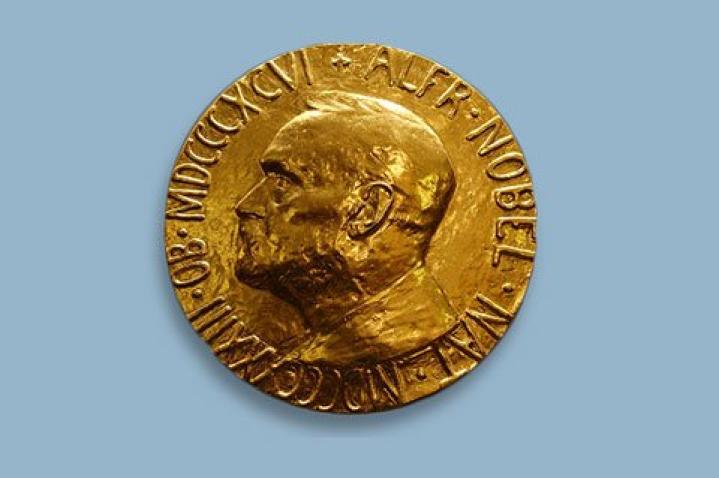
The six prizes, each worth 10 million Swedish kronor ($917,000), are named after Alfred Nobel, a wealthy Swedish industrialist who made his fortune selling cannons and munitions, including the explosives he invented — dynamite and gelignite. The prizes are handed out on Dec. 10, the anniversary of Nobel’s 1896 death. While the Peace Prize winner is selected and honored in Norway, the other Nobel awardees are chosen by the Nobel Foundation in Stockholm, where the prizes are handed out.
Alfred Nobel’s will stipulated that the Peace Prize should go to “the person who shall have done the most or the best work for fraternity between nations, for the abolition or reduction of standing armies, and for the holding and promotion of peace congresses.”
But an examination of the 104 Peace Prizes awarded since 1901 shows that this prize has not developed in line with what Nobel laid down. As the official Peace Prize website acknowledges, the parameters for selecting a winner have expanded over the decades to include humanitarian work, democracy and human rights, climate and environmental change and other issues.
Worse still, the Peace Prize committee in Oslo has increasingly allowed geopolitical considerations to guide the selection of an awardee. In fact, the Nobel Peace Prize has become more about geopolitics than about peace. Consequently, the prize over the years has gone to a number of undeserving recipients. The prize runs the risk of losing its legitimacy.
President Barack Obama had been in office for less than one year when the Norwegian Nobel Committee decided in 2009 to award him the Peace Prize for “his extraordinary efforts to strengthen international diplomacy and cooperation between peoples” and “his work for a world without nuclear weapons.”
The stunning decision was met with criticism in the U.S., including from some Obama supporters. He received the prize not for his accomplishments but merely for succeeding President George W. Bush, whose invasion of Iraq on false pretenses made him deeply unpopular internationally.
Far from being a peacemaker, Obama in office relied, like Bush, on hard power, even as he deplored the ethos of “might makes right.” Obama waged serial military campaigns from Somalia and Yemen to Iraq and Syria. His 2011 U.S.-led military campaign removing Libya’s Moammar Gadhafi from power created an enduring failed state, while his effort to overthrow Syrian President Bashar Assad helped spawn the terrorist Islamic State organization.
And while championing “a nuclear-free world,” Obama led an extensive modernization of the American nuclear arsenal, stoking a new arms race.
Another Nobel Prize recipient, Muhammad Yunus, today presides over rampant human rights abuses in Bangladesh. In August, the 84-year-old Yunus was installed as head of an interim regime by the country’s powerful military, which, capitalizing on deadly violent protests, packed Prime Minister Sheikh Hasina off to neighboring India before she could formally resign.
Yunus pioneered microcredit, or giving small loans to rural families, for which he and the Grameen Bank that he headed jointly received a Nobel Prize in 2006 — not in economics but for peace, after former President Bill Clinton lobbied for him. While presenting Yunus with the Peace Prize, the head of the Norwegian Nobel Committee said, “In 2002, Bill Clinton put it this way: ‘Dr. Yunus is a man who long ago should have won the Nobel Prize and I’ll keep saying that until they finally give it to him.’ Now Clinton will no longer need to remind us.”
Underscoring the award’s geopolitical agenda, the committee chairman hoped that “this peace prize will represent a possible approach to the Muslim part of the world” given the post-9/11 tendency to “demonize Islam.” He added, “It is an important task for the Nobel Committee to try to narrow the gap between the West and Islam.”
Bangladesh, with Yunus as the regime’s nominal head, is today effectively under military-clerical rule and faces a growing risk of sliding into chaos. The country is wracked by Islamist attacks, including on religious and ethnic minorities; extrajudicial killings; and arbitrary arrests, with the regime jailing thousands just last month.
The Peace Prize has even gone to people who did more to scuttle peace than to promote it. One such awardee was Henry Kissinger, whose disastrous decisions while serving under President Richard Nixon resulted in immense death and destruction across vast regions, including the U.S. carpet-bombing of Cambodia and Laos. North Vietnamese leader Le Duc Tho, who was jointly awarded the prize with Kissinger, declined his half of the spoils, as he did not want to share the award with a war hawk.
The Peace Prize Committee has often demonstrated its geopolitical activism by awarding the prize to Western-backed anti-regime activists in the developing world, from Aung San Suu Kyi to Liu Xiaobo, or by seeking to promote the bridging of regional divides. For example, the 2014 prize was given jointly to a Pakistani Muslim and an Indian Hindu.
Against this background, the Peace Prize has become not only increasingly controversial but also, as one author put it, “the world’s most reviled award.” This year’s uncontroversial award to the Japanese organization of survivors of the U.S. atomic bombings of Hiroshima and Nagasaki may be an effort to restore international faith in the prize.
But for such an effort to succeed, the Peace Prize Committee must no longer give the award to make a geopolitical point. It should stick to Alfred Nobel’s mandate that the prize be given for international peace and disarmament — not for human rights promotion, civil rights work, environmental protection, economic opportunities for the poor or antigovernment activism.
Indian Prime Minister Narendra Modi and President Biden are seen during an arrival ceremony on the South Lawn of the White House in Washington, D.C., on June 22, 2023.
History will likely remember President Joe Biden for his disastrous military withdrawal from Afghanistan, which helped make the Taliban great again, and for involving the U.S. deeply in the Ukraine war, only to see Russia incrementally expand its territorial gains.
But his most troubling legacy, which threatens to unravel America’s global preeminence, has been to drive China and Russia, historical rivals, into a de facto strategic alliance. This unholy partnership is the result of Biden’s failure to play China against Russia, despite investing in personal diplomacy with Chinese President Xi Jinping.
Driving a wedge between Moscow and Beijing had long been at the heart of American grand strategy. It helped the U.S. win the Cold War, not militarily, but geopolitically. By co-opting China from the 1970s onward in an informal alliance geared toward containing and rolling back Soviet influence and power, the U.S. established a two-against-one competition that contributed to the Soviet Union’s imperial overstretch and, ultimately, to the West’s triumph in the Cold War without direct armed conflict.
But now the U.S. has become the bridge that unites China and Russia. Xi and Russian President Vladimir Putin portray America as an aggressive hegemon with a Cold War mindset. They share a vision to reshape the world by ending the era of Western dominance. Putin and Xi also seem to be providing cover to each other’s expansionism.
Simply put, a two-against-one geopolitical contest is returning, but with America on the receiving end. Consequently, an overextended U.S. seriously risks accelerating its relative decline through strategic overreach.
The Sino-Russian entente has raised the strategic imperative for America to forge an informal alliance with another nuclear-armed giant: India.
India’s decades-old rivalry with Beijing goes back to China’s 1951 annexation of the buffer Tibet and the resultant Sino-Indian border war of 1962. In more recent years, China and India have been locked in a tense military standoff along their long Himalayan frontier.
This explains why there is bipartisan support in Washington for closer ties with India. Indeed, successive presidents since Bill Clinton cultivated closer ties with New Delhi, with every administration leaving the relationship in stronger shape than what it inherited.
However, under Biden, the relationship between the world’s two most populous democracies has come under increasing strain, leading to Indian Prime Minister Narendra Modi’s recent meeting with Xi. The meeting, coinciding with an India-China agreement on border patrolling to ease their military standoff, has signaled a thaw in the icy hostility marking relations between the Asian giants.
The U.S.-India strategic partnership holds the key to counterbalancing China’s hegemonic ambitions and maintaining the balance of power in the Indo-Pacific region, the world’s emerging economic and geopolitical hub. So, by impelling India to seek a thaw with Beijing as a hedge against American unpredictability, Biden has compounded his blunder in helping to build a Sino-Russian axis.
Tensions with New Delhi have arisen over a series of issues, starting with Biden’s surrender of Afghanistan to a Pakistan-reared terrorist militia. Tensions grew with India’s neutral stance on the Ukraine war. In an ungainly attempt to bully New Delhi into submission, the White House in 2022 threatened that “the costs and consequences” for India would be “significant and long-term” if it refused to take sides in Ukraine.
The Biden administration’s hectoring tone has struck a raw nerve in India, including when it recently demanded that it “won’t be fully satisfied until there is meaningful accountability” from New Delhi over what the U.S. alleges was a failed 2023 plot to assassinate Gurpatwant Singh Pannun, a New York-based Sikh separatist who is on India’s most wanted list. But the U.S. has taken no action against Pannun for making terrorist threats against India, including warning passengers not to fly Air India between Nov. 1 and 19 — a notice that has coincided with a spate of hoax bomb threats against Indian carriers that have disrupted air travel.
In fact, the increasing role of terrorism-glorifying Sikh separatists based in the U.S. and Canada is reopening old Indian wounds from the 1985 bombing of an Air India flight that two separate Canadian inquiries found was the handiwork of Canadian Sikh terrorists. The mid-Atlantic bombing killed all 329 people on board.
But at the root of U.S.-India tensions are American policies in South Asia that New Delhi sees as detrimental to its core interests. The Biden administration has been coddling military-backed governments in Pakistan and Bangladesh (where a recent U.S.-supported regime change was seen by many in India as a “color revolution”), while seeking to overthrow Myanmar’s military junta, including through stringent sanctions and “nonlethal” military aid to rebels, despite the spillover effects on Indian border regions.
Restoring mutual respect and trust in the relationship with India, which Biden has acknowledged is “among the most consequential in the world,” should be a priority for the next American administration. Fortuitously, there will be an India connection either way — whether the U.S. elects its first Indian American president in Kamala Harris or its first Indian American second lady in Usha Vance, wife of Sen. JD Vance (R-Ohio).
No less pressing is the imperative for the next president to forestall a formal China-Russia alliance, including by taking advantage of the historical Sino-Russian mistrust to play one against the other. If Beijing and Moscow cement a military and strategic alliance against America, Washington’s worst geopolitical nightmare would come true.
The BRICS have so far struggled to become a united, effective global force with defined and realistic political and economic objectives. Nonetheless, one should not underestimate their potential to catalyze the shift to a multipolar global order.
A new age of international relations is dawning. With the West accounting for a declining share of global GDP, and the world becoming increasingly multipolar, countries are jostling to establish their positions in the emerging order. This includes both the emerging economies – represented by the recently expanded BRICS grouping – that seek a leading role in writing the rules of the new order, and the smaller countries attempting to cultivate relationships that can safeguard their interests.
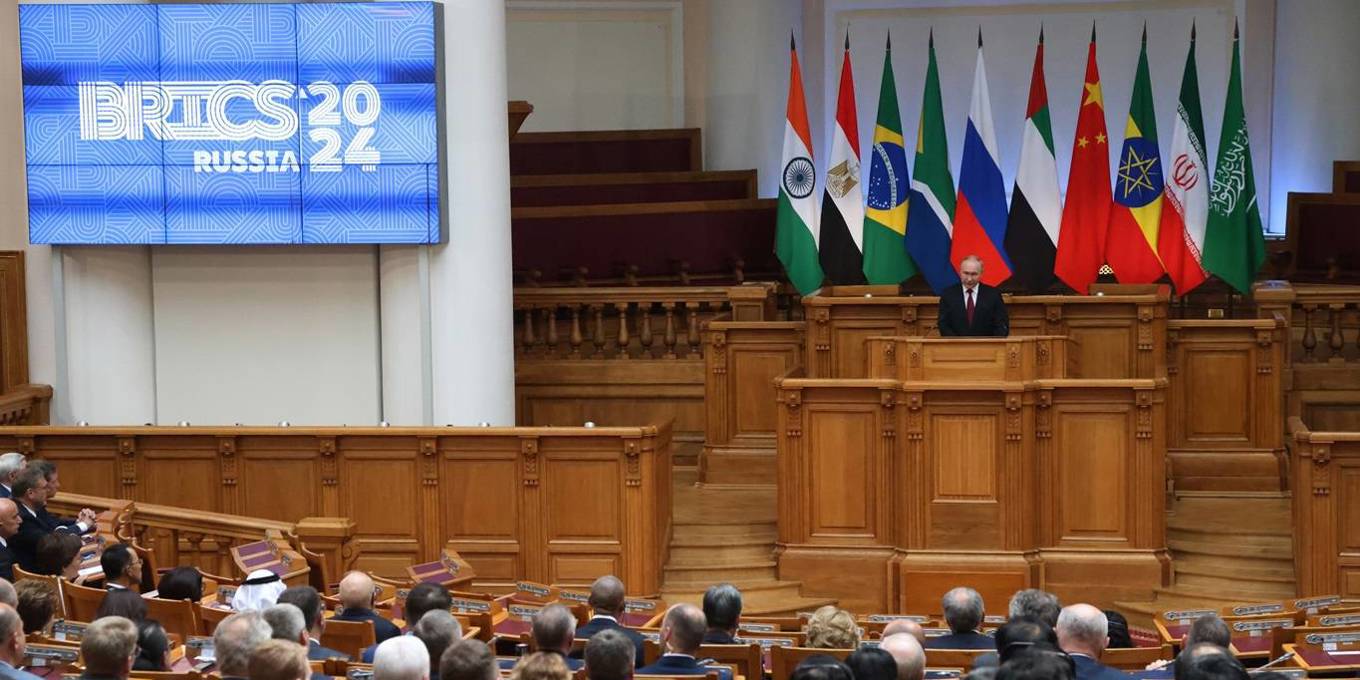
With the BRICS, what began as an asset class has become a symbol of the yearning for a more broadly representative global order, a hedge against Western-led institutions, and a means of navigating growing geopolitical uncertainty. All this has proved highly attractive. Earlier this year, the BRICS expanded from five countries (Brazil, China, India, Russia, and South Africa) to nine (adding Egypt, Ethiopia, Iran, and the United Arab Emirates). And almost three dozen more countries – including NATO member Turkey, close US partners Thailand and Mexico, and Indonesia, the world’s largest Muslim country – have applied to join.
While the diversity of the grouping’s members (and applicants) highlights the broad appeal of the BRICS+, it also creates challenges. These are countries with very different political systems, economies, and national goals. Some are even at odds with each other: China and India have been locked in a military standoff in the Himalayas for over four years, following China’s stealth encroachments on Indian territory.
Translating shared interests into a common plan of action, and becoming a unified force on the global stage, was difficult even when the BRICS had just five members. With nine – and possibly more – member countries, establishing a common identity and agenda will require sustained effort. But other multilateral groupings that are not formal, charter-based institutions with permanent secretariats – such as the Shanghai Cooperation Organization, the G20, and even the G7 – also struggle with internal divisions.
Moreover, the BRICS have demonstrated considerable resilience. Western analysts have been predicting from the start that the grouping would unravel or drift into irrelevance. Yet this month’s BRICS+ summit in Kazan, Russia – the first since the expansion – may well bring movement toward further enlargement, as it underscores the West’s failure to isolate Russia following its 2022 invasion of Ukraine.
This is not to underestimate the challenge of cohesion. The grouping’s founding members do not even agree about its fundamental objectives: whereas China and Russia want to spearhead a direct challenge to the United States-led world order, Brazil and India seek reforms of existing international institutions and appear uneasy about any anti-Western orientation.
In this disagreement, however, the enlargement might tip the scales. Six of the group’s nine members, including all four of the new additions, are formally part of the nonaligned movement, and two (Brazil and China) are observers. This suggests that there will be considerable internal pressure for the BRICS+ to chart a middle ground, focusing on democratizing the global order, rather than challenging the West.
That said, when it comes to fostering mutual trust with developing countries, the West has not been doing itself any favors lately. On the contrary, its weaponization of finance and seizure of the interest earned on frozen Russian central-bank assets have caused deepening disquiet in the non-Western world. As a result, a growing number of countries seem interested in exploring alternative arrangements, including new cross-border payment mechanisms, with some also reassessing their reliance on the US dollar in international transactions and reserve holdings.
All of this could aid the larger designs of Russia and China, two natural competitors that have become close strategic partners partly in response to US policy. China, in particular, stands to gain, such as from increased international use of the renminbi. Russia now generates much of its international export earnings in renminbi and stores them mostly in Chinese banks, thereby effectively giving China a share of the returns. China’s ultimate goal – which Western financial warfare is inadvertently aiding – is to establish an alternative renminbi-based financial system.
The BRICS are already engaged in institution-building, having established the New Development Bank – conceived by India and headquartered in Shanghai – in 2015. The NDB is not only the world’s first multilateral development bank created and led by emerging economies; it is also the only one whose founding members remain equal shareholders with equal voice, even as more countries join. By contrast, the US is the dominant shareholder and holds veto power in the World Bank.
The expanded BRICS+ boast formidable global clout. The grouping dwarfs the G7, both demographically (with nearly 46% of the world’s population, compared to the G7’s 8.8%) and economically (accounting for 35% of global GDP, compared to the G7’s 30%). Its economies are also likely to be the most important source of future global growth. Furthermore, with Iran and the UAE having joined their oil-producing counterparts Brazil and Russia as members, the BRICS+ now account for about 40% of crude-oil production and exports.
Yes, the group faces significant challenges, not least uniting to become a meaningful global force with defined (and realistic) political and economic objectives. But they also have the potential to serve as a catalyst for a long-overdue revamping of global governance so that it better reflects twenty-first-century realities.
Brahma Chellaney, Professor of Strategic Studies at the New Delhi-based Center for Policy Research and Fellow at the Robert Bosch Academy in Berlin, is the author of nine books, including Water: Asia’s New Battleground (Georgetown University Press, 2011), for which he won the 2012 Asia Society Bernard Schwartz Book Award.
(AP Photo/Mukhtar Khan, File) Indian army vehicles move in a convoy in the cold desert region of Ladakh, India, Sept. 18, 2022.
With the Oct. 22 BRICS summit meeting approaching, China and India have stepped up discussions about defusing their tense military standoff along the long Himalayan frontier. But although the 10-nation summit in the Russian city of Kazan is catalyzing efforts to resolve the confrontation — which has sparked rival force buildups and intermittent clashes — it is far from certain that any deal will be reached.
The standoff between the two Asian giants is not grabbing international headlines, thanks in part to the wars raging in Ukraine and the Middle East. But the threat of the confrontation escalating to a border war of the kind fought in 1962 cannot be discounted. Both sides have significantly ramped up border deployments of troops and weapons, with India acknowledging the situation is “very tense and dangerous.”
The Sino-Indian faceoff, as well as the Russian invasion of Ukraine, are detracting from the international appeal of BRICS, the world’s first major non-Western initiative. Founded 15 years ago by Brazil, Russia, India and China as BRIC, the group, with the addition of South Africa in 2011, became BRICS. And with this year’s entry of five additional countries, it has become BRICS-plus, accounting for nearly half the world’s population and 40 percent of global trade.
As many as 40 more countries have lined up to join BRICS, which seeks to shape a multipolar global order in place of the fading era of Western dominance. An easing of military tensions between nuclear-armed titans China and India could help build consensus to further enlarge BRICS.
The Sino-Indian border faceoff was triggered by China’s stealth encroachments on some Indian borderlands in April 2020. India failed to foresee the Chinese aggression largely because Prime Minister Narendra Modi had focused on appeasing Beijing in a bid to chip away at the China-Pakistan strategic axis. Between 2014 and 2019, Modi met with Chinese President Xi Jinping 18 times, building a close personal rapport. The Xi-ordered encroachments were thus widely seen in India as a stab in the back.
Xi seriously miscalculated that China would be able to present the land grabs to India as a fait accompli, like the Chinese “salami-slicing” expansionism elsewhere in Asia. In contrast to Russia’s full-scale invasion of Ukraine, China prefers incremental expansionism, enabled by stealth and deception.
India’s robust military response to China’s encroachments, including more than matching Chinese force deployments, took Beijing by surprise, helping to spotlight not just the Sino-Indian territorial disputes but also India’s challenge to Chinese power and capability. No other nation, not even the U.S., has locked horns with the Chinese military in this century the way India has since 2020.
Xi, by transforming the Sino-Indian frontier into a “hot” border patrolled by tens of thousands of rival troops, has crimped the further pursuit of his own “salami-slicing” strategy on the Himalayan massif. China will find it more challenging from now on to nibble away at Indian territories.
With the U.S.-China rivalry deepening, the last thing Xi should be doing is turning India into an enduring enemy. Yet as the world’s fastest-growing major economy, India is moving closer to America, with Modi’s foreign policy showing a distinct pro-Western tilt.
With an eye on China, India has ramped up its military buildup and modernization. A stronger India aligned with Western powers and Japan is likely to stymie China’s plan to gain strategic preeminence in Asia.
A war with India could expose China’s weaknesses. Whereas the Chinese military relies largely on conscripts, India, with an all-volunteer force, has the world’s most-experienced troops in mountain warfare. The Chinese military, though, has a technological edge over Indian forces.
Against this backdrop, China’s recent charm offensive in India, including initiating renewed efforts to defuse the military standoff, suggests that Xi wants to salvage Beijing’s relationship with New Delhi — but without losing face at home.
For four-and-a-half years, tens of thousands of Chinese troops have remained deployed along the inhospitable Himalayan frontier, which has some of the harshest terrain on Earth. Oxygen levels are so low that soldiers take weeks to acclimatize before being deployed on the front lines. If Xi were to reach a deal with India centered on a pullback of rival forces, it would raise questions in China about why he ever launched this provocation in the first place.
This may well explain why, in the bilateral negotiations up to now, the Chinese side has sought a deal largely on its own terms, dimming the prospect of reaching an agreement by the time Xi and Modi could meet on the sidelines of the BRICS summit.
But even if Xi climbed down to some extent, leading to a deal to implement a sequential process of disengagement, de-escalation and removal of rival forces, the new warfare-related infrastructure China has built along the India frontier will remain in place. India thus would not be able to lower its guard.
China has bored tunnels and shafts into mountainsides to set up an elaborate underground military infrastructure, as if preparing for war. In addition, it has planted settlers in new militarized border villages, the equivalent of the artificial islands it created in the South China Sea to serve as forward military bases.
China and India, which represent more than one-third of the global population, became neighbors only after the Chinese Communist Party annexed Tibet in 1951. Today, China and India need to find ways to peacefully coexist. Yet, despite the latest efforts to mend fences, their strategic rivalry seems likely to endure.
What can a Quad summit hosted by a lame-duck American president achieve? Will the summit essentially mark the swan song of President Joe Biden?
The odd timing of the Sept. 21 summit has also been underscored by the fact Japanese Prime Minister Fumio Kishida will leave office just days after returning from his U.S. visit.
It was India’s turn to host the Quad summit. But Biden, eager to hold the event in his Delaware hometown of Wilmington, persuaded India to defer its hosting until next year. The summit date was also dictated by Kishida’s decision in August to resign just before the Sept. 27 leadership contest in Japan’s governing Liberal Democratic Party.
The Quad coalition (the U.S., Japan, India and Australia) is essential to realize the vision of a “free and open Indo-Pacific region” introduced by late Japanese Prime Minister Shinzo Abe in 2016 and affirmed by the U.S. in 2017 as a shorthand for a rules-based, liberal order. But with wars in Ukraine and the Middle East distracting the U.S. from security challenges in the Indo-Pacific, the U.S. has yet to genuinely pivot to this critical region that will shape the next global order.
Biden’s overriding focus on weakening Russia is sapping the Quad’s main strategic purpose, which is to act as a bulwark against Chinese expansionism and ensure a stable balance of power in the Indo-Pacific. The deepening proxy war with Russia has made America increasingly wary of taking on China simultaneously, which may explain why Biden prioritizes diplomacy over deterrence with Beijing.
The Quad leaders, in fact, will meet amid rising U.S.-Russia tensions over Anglo-French-American moves to allow Ukraine to use long-range cruise missiles to strike targets deep inside Russia — an action Russian President Vladimir Putin has warned would mean direct Western involvement in the war, placing his country and NATO “at war.” Such missiles would rely on U.S. navigational data and other technology, including satellite reconnaissance, giving NATO, according to Putin, effective control over targeting.
Jarringly, the specter of escalation has emerged just when Indian Prime Minister Narendra Modi has stepped up efforts to broker a cease-fire in the war. After his visits to Moscow and Kyiv, Modi, on the sidelines of the Quad summit, will brief Biden on his peacemaking effort and then meet with Putin again next month during a BRICS leaders’ meeting in Kazan, Russia. Modi’s initiative can make little headway without full support from the U.S.
The Biden administration backed Modi’s Kyiv visit, but at the same time it has deepened U.S. involvement in the war. This has not only stymied U.S. efforts to position the Indo-Pacific at the “heart” of its grand strategy but also crimped America’s strategic options against its main challenger at the global level, China, which is seeking to supplant the U.S. as the world’s preeminent power.
In an effort to dissuade Beijing from directly aiding the Kremlin’s war machine or cementing an anti-U.S. strategic axis with Moscow, Biden has pursued a more conciliatory approach toward China. But his overtures have yielded few positive results.
China and Russia today appear closely aligned, with Beijing providing substantial support for the Russian military-industrial complex. In Asia, China has upped the ante, including intensifying coercive pressures on Taiwan, stepping up provocations in the South China Sea and staying locked in a border military standoff with India.
Yet, after the Quad summit, Biden plans to speak with Chinese President Xi Jinping over the phone and then possibly meet him in person before the year-end. Biden wants to steady the U.S.-China relationship by smoothing over bilateral tensions. “I don’t want to contain China,” Biden said last September while visiting Vietnam. “We’re not trying to hurt China.”
Placating China and strengthening the Quad seem basically incompatible. Today, in the absence of a clear strategic mission, the Quad seems adrift.
Under Biden’s leadership, the Quad’s agenda has shifted from a strategic focus on the Indo-Pacific to global challenges. But the Quad, as a grouping of just four democracies, is in no position to deal with universal challenges. It is thus scarcely a surprise that little concrete progress has been made in the six Quad working groups covering critical and emerging technologies, climate change, cybersecurity, infrastructure, vaccines and outer space.
While saddling the Quad with an overly ambitious global agenda, the Biden administration has flaunted a new quadrilateral grouping, the so-called Squad, made up of America, Australia, Japan and the Philippines. It has also showcased the new AUKUS (Australia-U.K.-U.S.) alliance, although that initiative will be able to play an important role in the Indo-Pacific only in the next decade after the transfer of nuclear-powered submarines to Canberra.
To safeguard Indo-Pacific security, there is no substitute for a Quad with clear strategic direction and resolve.
The Quad leaders’ joint statement at their last summit in Hiroshima in May 2023 said the group would be “a global force for good” through a “positive, practical agenda,” identifying their top priorities as climate security, clean energy supply chains, health security and resilient infrastructure. The Wilmington summit statement could also emphasize the global agenda while making passing references to the Taiwan Strait and the East and South China seas.
But if the Quad is to play a meaningful role, its attention must be refocused squarely on the pressing Indo-Pacific challenges. It is not too late to ensure the Quad realizes its strategic promise, rather than gradually drifting into irrelevance or being reduced to a mere instrument of leverage for the U.S. in its fraught relationship with China.
Brahma Chellaney is professor of strategic studies at the Centre for Policy Research in New Delhi and the author of nine books, including “Water: Asia’s New Battleground.”
(Ukrainian Presidential Press Office via AP) Flames rise and debris is scattered on the ground after a Russian aerial bomb struck a multi-story residential building in Kharkiv, Ukraine, Sunday Sept. 15, 2024.
The second apparent assassination attempt against former President Donald Trump in just over two months involved a gunman who had previously said he was willing to fight and die in Ukraine. This underscores how that war is not just influencing American politics and foreign policy but also having an impact on the nation’s social fabric.
As one issue that divides Americans along party lines, the war has helped harden political polarization in American society.
According to one survey, 66 percent of Republicans would like the U.S. to encourage Kyiv to negotiate with Moscow, whereas the bulk of Democrats (62 percent) favor supporting Ukraine for as long as it takes. The partisan divide in foreign policy extends even to perceptions of which country represents America’s main adversary: Republicans are most concerned about China, whereas Democrats worry about Russia above all.
As part of President Joe Biden’s strategy to bleed Russia in Ukraine, the U.S. has played a critical role in bankrolling the Ukrainian fight against the invading Russian forces, with Congress approving almost $175 billion in military and nondefense assistance. But American assistance has been unable to turn the tide in the war, with Russia still making slow but steady territorial gains in eastern Ukraine.
One key reason is that, more than weapons and funds, Ukraine needs new recruits to replenish the ranks of its exhausted and depleted forces. But even draconian conscription practices have not been able to offset its mounting troop shortfall.
The war also carries hidden costs, including inflation at home. A survey found that 49 percent of Americans support negotiations between Ukraine and Russia so that costs for U.S. households do not increase further.
The U.S. dollar, which was facing “stealth erosion” before the Ukraine war, now confronts a more open but nascent challenge to its global dominance in response to the West’s weaponization of finance and seizure of Russia’s earnings on its central-bank assets frozen by Western governments. As countries explore alternatives to the dollar, the greenback is beginning to lose some of its global influence, especially in oil markets.
Meanwhile, as a hedging strategy, central banks in many countries — especially China, Turkey, India, Kazakhstan and in Eastern Europe — have increasingly been buying gold. Such hoarding, coupled with greater geopolitical uncertainty, has helped drive gold prices to a record high.
The Ukraine war’s hidden costs also extend to the geopolitical realm, especially by hindering the ability of the U.S. to respond to the greater challenge it faces from China.
China poses a far greater threat than Russia to Western interests and the U.S.-led world order. Whereas Russia’s designs are largely confined to its neighborhood, China is seeking to supplant the U.S. as the world’s foremost power. It also has the means: China’s economy, like its population, is about 10 times larger than Russia’s, and China spends four times as much as Russia on its military.
Furthermore, China is currently engaged in the largest peacetime military buildup in history. It has more than doubled its nuclear-weapons arsenal since 2020 and is expanding its conventional forces faster than any other country since World War II.
The last thing Chinese President Xi Jinping wants is an end to the Ukraine war, because that would leave the U.S. free to focus on the Indo-Pacific, a critical region that will shape the next global order. China’s expansionism is centered in the Indo-Pacific, from the East and South China Seas, to the Taiwan Strait, to the Himalayas.
The U.S. is dedicating insufficient attention and resources to countering Chinese expansionism and also continues to inadvertently bolster China’s global influence, not least through its overuse of sanctions against a host of countries.
With its military resources already stretched thin by its involvement in the wars in Ukraine and the Middle East, the U.S. needs a more realistic balancing of its key geopolitical objectives at a time when a majority of Americans believe that the nation’s power is declining on the world stage. Without such rebalancing, the U.S. may well fail to deter China from attacking Taiwan or cementing a strategic axis with Russia, just as Biden failed to deter Russia from invading Ukraine.
The U.S. must face up to the reality that, despite substantial Western military assistance, Kyiv is in no position to oust Russia from the territories it has occupied in Ukraine’s east and south. Letting Ukraine use long-range Western cruise missiles to strike targets deep inside Russia with U.S. navigational data and other technology would only risk a direct NATO-Russia conflict.
More fundamentally, a protracted Ukraine war is not in America’s interest. But bringing an end to the war demands dialogue and diplomacy, which Biden has shunned with Moscow.
Amid heightened U.S.-Russia tensions, Indian Prime Minister Narendra Modi has sought to broker a cease-fire. After his visits to Moscow and Kyiv, Modi will brief Biden on his peacemaking effort when they meet at the Sept. 21 Quad summit in Wilmington, Del. Without full support from the U.S., Modi — who is scheduled to meet with Russian President Vladimir Putin again next month at a BRICS leaders’ summit — can achieve little.
A possible American policy shift in favor of a cease-fire may have to await the outcome of the November election. Given that a negotiated deal is the only way to halt the war, it is better to seek it sooner rather than after months or years of more bloodshed and devastation.
THE DRAMATIC OVERTHROW of Bangladesh Prime Minister Sheikh Hasina’s government on August 5 represents the biggest regional setback for India in more than a decade. The swift toppling, just six weeks after Hasina’s state visit to New Delhi, not only caught India by complete surprise but also carries adverse implications for Indian security. The development could weigh India down regionally at a time when New Delhi is seeking to play a greater role on the world stage.
Whereas New Delhi has reacted to the Bangladesh turmoil with deep concern and even alarm, India’s close strategic partner, America, has greeted Hasina’s fall with a sense of contentment. Washington’s smug satisfaction of Hasina’s exit extends, according to one analyst, to “gloating” by a section of the US establishment over the failure of the Indian project in Bangladesh.
US President Joe Biden’s administration had openly gunned for Hasina’s government, despite the fact that her secular regime kept the military and Islamists in check. Located thousands of miles away from the subcontinent, the US, in the name of democracy promotion, can afford to play geopolitical games without affecting its interests. But India, with vital security interests at stake, has no such luxury.
Democracy promotion has long served as a valuable geopolitical tool for the US. After greeting with glee the regime change in Bangladesh, the world’s eighth-most populous country, the Biden administration is now working on a new regime-change project by offering Venezuelan President Nicolás Maduro “amnesty” if he ceded power.
In fact, the US targeting of Hasina’s government served as a reminder for New Delhi of the wider divergence of American and Indian interests in India’s own neighbourhood, including in relation to Myanmar, Pakistan, Afghanistan and Iran.
After Myanmar—which is racked by an internal war that has been fuelled by stringent US-led sanctions and “non-lethal aid” to insurgents—Bangladesh could become the second immediate neighbour of India to be destabilised by short-sighted policies of the Biden administration. Greater turmoil in the region would seriously crimp Indian interests.
A destabilised Bangladesh would be India’s geopolitical nightmare. It would impose sustained costs on Indian interests, including potentially subverting the security of India’s vulnerable Northeast. It could also open the floodgates to the flow of Bangladeshi refugees to India, which is already home to countless millions of illegal immigrants from Bangladesh, the most densely populated country on Earth, if one excludes micro-states and mini-states.
The rise of violent Islamism in Bangladesh, including scores of incidents of Islamist terrorism in this century, has been a growing Indian concern. Extremists linked with ISIS (Islamic State), Al Qaeda and the Bangladeshi, Pakistan-backed Jamaat-e-Islami have a long record of assaulting religious and ethnic minorities as well as secular, liberal activists. In a destabilised Bangladesh, such forces would proliferate and pose cross-border challenges to India’s security.
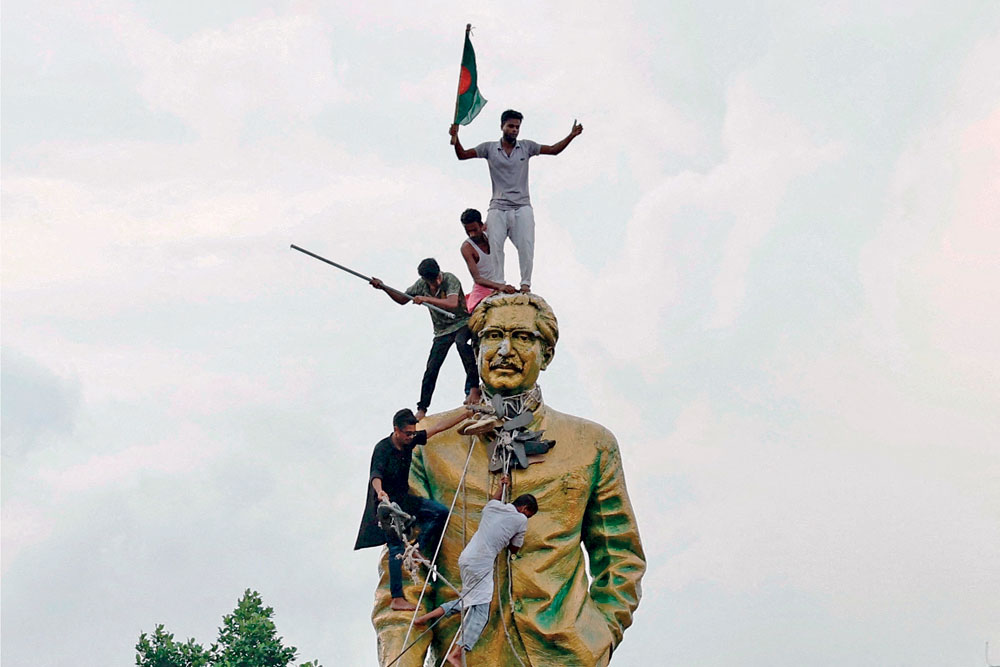
No sooner had the army chief announced Hasina’s fall than rioters systematically sought to erase symbols of Bangladesh’s independence struggle and statehood, including burning down the Bangabandhu Memorial Museum in Dhaka and toppling or defacing the statues and portraits of the father of the nation, Sheikh Mujibur Rahman
Meanwhile, New Delhi’s ‘Act East’ policy, already reeling from the growing turmoil in Myanmar, has suffered another blow from the regime change in Bangladesh, which has put at risk connectivity and transit links with India.
HAVING PLAYED A CENTRAL role in forcing Hasina to flee the country, the army has re-emerged as the final arbiter in Bangladesh politics. The interim government, made up of ‘advisers’ with little experience in handling national matters, is just the civilian façade for military rule.
The army chief, General Waker-uz-Zaman, despite being related to Hasina by marriage, was instrumental in her downfall. Like her late father, Sheikh Mujibur Rahman, the country’s charismatic founding leader who ignored warnings in 1975 that army officers in Dhaka were plotting to stage a coup and kill him, Hasina disregarded advice that appointing the ambitious, Islamist-leaning Zaman as army chief could invite an army takeover. Hasina took comfort in the fact that Zaman was married to her cousin.
But just six weeks after Zaman became the army chief, Hasina fell from power. As street protests intensified, it became apparent that Zaman was wavering in his support for the Hasina government.
Through deliberate inaction, Zaman allowed the situation to deteriorate to the point that the police and paramilitary forces could no longer contain widespread looting, vandalism and arson, including attacks on public infrastructure and the Hindu minority. The army chief then used the violent upheaval to force the prime minister to leave the country on August 5. The night before, he bluntly conveyed to Hasina the army’s refusal to enforce the lockdown she had ordered, telling her that his soldiers would not fire on protesters, many of whom by then were rampaging through the streets of Dhaka.
But with “mission accomplished”, Zaman ordered his soldiers to fire on Awami League activists protesting against Hasina’s forced departure from the country. In Gopalganj, Hasina’s home district with a sizeable Hindu minority, the military action left several people killed or wounded.
The army brass saw forcing Hasina to flee to India as a better choice than killing or imprisoning her. Bumping off Hasina in the way her father was murdered would have made her a martyr in the eyes of the millions who still support her, while jailing the sitting prime minister would have created a constitutional crisis impeding the army’s appointment of a successor administration.
Hasina’s forced departure, however, triggered greater lawlessness, extending from widespread looting and revenge killings to atrocities against the long-persecuted Hindu minority, which had faced Islamist attacks periodically even under the Awami League government. In the recent protests, armed rioters, according to the official count, killed 42 policemen and looted 7.62mm rifles from law enforcement personnel. Only members of Bangladesh’s Rapid Action Battalion and police carry this type of rifle. After the bloody mayhem, Bangladesh is struggling to fully restore order.
The total collapse of government authority in Bangladesh was redolent of the 2022 chaos in Sri Lanka when the Rajapaksa brothers’ dynastic regime fell apart. Just as Sri Lankan President Gotabaya Rajapaksa fled the country on a military jet without resigning, Hasina arrived in India suddenly aboard a Bangladesh Air Force C-130J Super Hercules military transport plane without formally tendering her resignation to the president. And just as protesters in Colombo occupied the presidential palace, mobs in Dhaka ransacked the prime minister’s sprawling official residence, looting each and every article that could be carried away.
But, unlike in Sri Lanka, the army played a key role in the regime change in Bangladesh, including handpicking members of the new interim administration.
There is also one ominous parallel between the upheaval in Bangladesh and the 2012 political turmoil in the Maldives, in terms of what the rioters sought to accomplish.
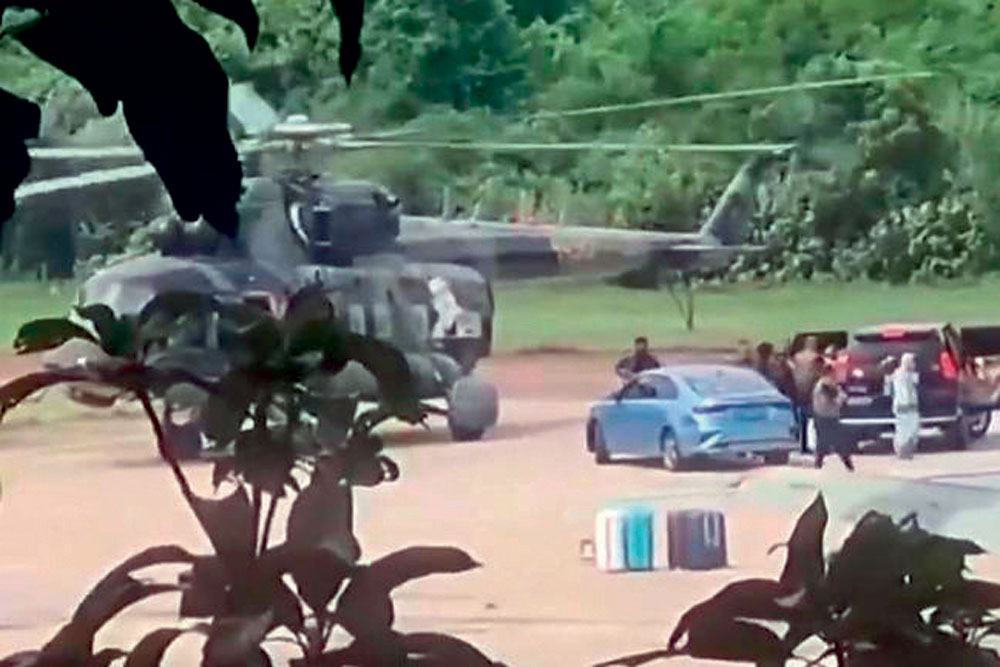
Sheikh Hasina leaves Dhaka on a military helicopter, August 5, 2024
The total collapse of government authority in Bangladesh was redolent of the 2022 chaos in Sri Lanka when the Rajapaksa brothers’ dynastic regime fell apart. Hasina arrived in India aboard a Bangladesh Air Force C-130J super hercules military transport plane without formally tendering her resignation to the president
When the Maldives’ first democratically elected president, Mohamed Nasheed, was forced to resign at gunpoint, Islamists ransacked the country’s main museum in Malé, the capital, smashing priceless Buddhist and Hindu statues made of coral and limestone, virtually erasing all evidence of the Maldives’ pre-Islamic past before Maldivians converted to Islam in the 12th century. “The whole pre-Islamic history is gone,” the museum’s director then lamented.
Similarly, no sooner had the army chief announced Hasina’s fall than rioters systematically sought to erase symbols of Bangladesh’s independence struggle and statehood, including burning down the Bangabandhu Memorial Museum in Dhaka and toppling or defacing the statues and portraits of the Father of the Nation, Sheikh Mujibur Rahman. The museum was central to the history of how Bangladesh was created—a violent birth that occurred after up to 3 million Bangladeshi civilians (mainly Hindus singled out by Pakistan’s army) were slaughtered, some 200,000 women were coerced into rape camps, and about 10 million people fled to India.
The August 5 vandalism against national symbols was an attack on Bangladesh’s identity, its history and its statehood. It showed that, more than half-a-century after the country’s birth, there are still elements within Bangladesh that have not reconciled to its secession from Pakistan.
Since 1975, Bangladesh has experienced more than two dozen army coups or coup attempts. By assassinating the father of the nation, the army became the most powerful political player, ruling Bangladesh directly or indirectly for extended periods. It was the ‘iron lady’ Hasina who kept the military (and Islamists) in check—until the recent violent uprising against her rule led the army chief to compel her to leave the country.
Today, General Zaman is the power behind the throne. When decisive power rests with an extra-constitutional authority, democratisation can hardly gain traction.
The interim government has no constitutional mandate. The Bangladesh constitution calls for elections to be held within 90 days of the dissolution of parliament, yet the duration (or the scope of powers) of the interim government has not been defined. Political discontent will grow if the constitutional deadline passes without the holding of elections.
The country’s president holds a largely ceremonial position. And the interim government consists only of advisers. Advisers are not the same as decision-makers. Despite a US-friendly chief adviser, Muhammad Yunus, nominally heading the interim government, Hasina’s overthrow has left a major power vacuum in the country that is being filled by the military—and Islamists.
The army is puppet-mastering the moves and decisions of the interim government advisers, who, in any case, owe their positions to General Zaman.
Against this backdrop, purges are in full swing, spurring greater uncertainty and fear in Bangladesh. The country’s chief justice and the next five senior-most justices of the Supreme Court were made to resign virtually at gunpoint. The purges have extended to all institutions, from the military, intelligence agencies and police to the central bank and universities.
One can expect more purges and crackdowns, some silent ones and some possibly violent ones. The aim is to stifle all support for Hasina and demolish her family’s political legacy. The Awami League has already been directed to “reorganise” itself (that is, rid itself of Hasina’s influence) in order to participate in the next election.
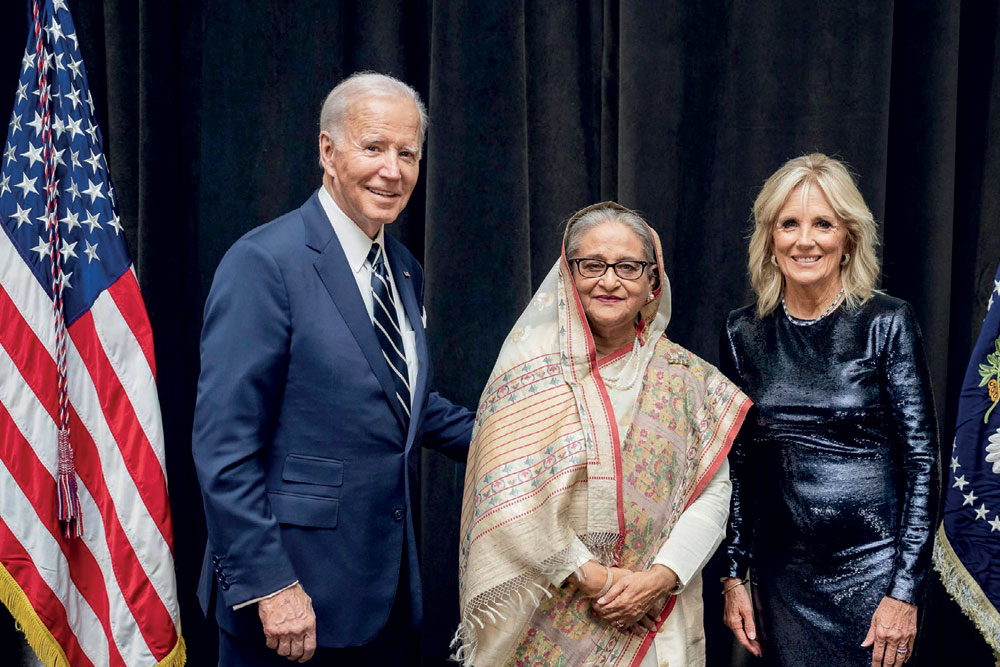
US President Joe Biden, Sheikh Hasina and First Lady Jill Biden in New York, September 21, 2022
The Biden administration’s hard line toward Hasina began with its December 10, 2021 imposition of sanctions on its Rapid Action Battalion (RAB) on grounds that RAB committed alleged human rights abuses as part of its war on drugs
RUDYARD KIPLING’S PORTRAYAL of strategic skulduggery in his 1901 novel Kim popularised the “Great Game” of the time between the British Empire and Tsarist Russia for control over Afghanistan and Central Asia. Since then, several other Great Games have been played out or continue to be at play.
The de facto coup d’état in Bangladesh and the externally fuelled internal war in Myanmar hint at a new Great Game at play in southern Asia, despite the risks that the machinations could extend Myanmar’s destabilisation to Bangladesh and Northeast India, thereby spurring greater regional tensions and an upsurge of radical Islamism. This Great Game is being played on several levels, including diplomatic, espionage and economic, as well as through political manoeuvrings.
The US and China have separately sought to enhance their interests in southern Asia in ways that are generating acute security and economic risks for India, the regional power. But while China sees India as an adversary, the US and India are friends, yet on regional issues of core Indian interest, Washington and New Delhi are not on the same page.
The US-India strategic divergence over Bangladesh began in 1971 when US President Richard Nixon turned a blind eye to the Pakistani genocide in East Pakistan and sought to prevent the birth of Bangladesh, including by urging China to open a military front against India. The US grudgingly recognised Bangladesh as an independent nation in April 1972 after a majority of countries had already done so.
In the subsequent years, even as India-US relations improved, the strategic dissonance between the two powers over Bangladesh never disappeared. US interests, after all, never aligned with Indian interests. Indeed, the dissonance became more pronounced when the Biden administration started gunning for Hasina, ignoring Indian concerns about the growing Islamist menace and political volatility in India’s neighbourhood.
In the name of seeking to restore democratic governance, the US has maintained cosy ties with every military or military-backed regime in Bangladesh since 1975.
Now, after the ouster of Hasina, Washington has said its approach to the military-chosen interim government would be based on “Bangladeshi people’s democratic aspirations and … a path to democratic governance”. It has welcomed the new interim government in Dhaka, saying it will work with it “as it charts a democratic future for the people of Bangladesh”.
But the new administration, with a radical Islamist leader as one of its advisers, is just a civilian setup for army rule. In a nod to the growing power of Islamic fundamentalists and extremists in Bangladesh, the army chief included in the interim administration a leader of the Hefazat-e-Islam, a coalition of Islamist organisations that seeks a system based on Sharia (Islamic law). The Hefazat-e-Islam has been linked to attacks on the Hindu minority and to last year’s killing of a young blogger.
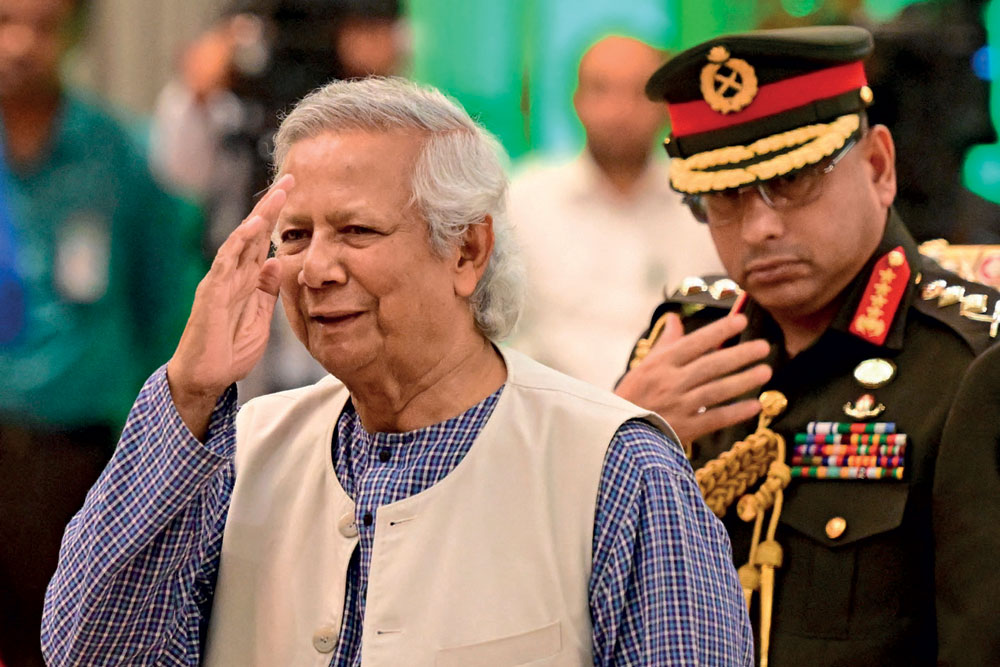
Muhammad Yunus being sworn in as head of Bangladesh’s interim government in Dhaka, August 8, 2024 (Photo: AFP)
The interim government consists only of advisers. Despite a US-friendly chief adviser, Muhammad Yunus, nominally heading the interim government, Hasina’s overthrow has left a major power vacuum in the country that is being filled by the military
The Biden administration’s hard line toward the Hasina government began with its December 10, 2021 imposition of sanctions on Bangladesh’s Rapid Action Battalion (RAB) on grounds that RAB committed alleged human rights abuses as part of its war on drugs. Bangladesh was excluded from the Summits for Democracy convened by Biden in December 2021 and March 2023, while military-dominated Pakistan was invited both times though it did not attend either.
Bangladesh’s impressive economic growth trajectory under Hasina stood in stark contrast to the chronic political and economic turmoil in Pakistan. But, while continuing to reward Pakistan by prioritising short-term geopolitical considerations, the Biden administration sharply stepped up its criticism of democratic backsliding in Bangladesh.
It also started wielding the visa-sanctions stick against the Hasina government. Secretary of State Antony Blinken unveiled a new US policy on May 24, 2023 to restrict the issuance of visa for any Bangladeshi individual believed to be involved in undermining the democratic election process in Bangladesh. Washington’s increasing hard line approach emboldened anti- Hasina political forces in Bangladesh, including Islamists and the largest opposition party, the Bangladesh Nationalist Party (BNP), which had allied itself with the Jamaat-e-Islami.
Now Hasina, alleging a US role in her overthrow, has reportedly claimed that, “I could have remained in power if I had surrendered the sovereignty of Saint Martin’s Island and allowed America to hold sway over the Bay of Bengal.” Hasina’s son, Sajeeb Wazed, who holds an American green card, apparently came under immediate pressure to recant her mother’s allegations. Hours after confirming to WION television channel Hasina’s remarks about the US and St Martin’s, Wazed posted on X denying that she made any such statement.
The White House, asked about Hasina’s allegation that she was overthrown because of her refusal to lease St Martin’s to the US, stated flatly that “we have had no involvement at all” in the events in Bangladesh.
It was on June 21, 2023 that Hasina openly raised the St Martin’s issue, telling a news conference at her official residence in Dhaka that if she were to “lease the island of St Martin’s to someone, then there would be no problem” with her staying ensconced in power. But, she added, such a lease “won’t happen” on her watch.
The US sought to build close defence ties with Bangladesh by urging the Hasina government unsuccessfully to sign the General Security of Military Information Agreement (or GSOMIA) and the Acquisition and Cross-Servicing Agreement (or ACSA). But the US has never acknowledged wanting to lease St Martin’s, a small island that is closer to Myanmar than to Bangladesh’s coast.
There are already around 750 American military bases spread across at least 80 countries. The US may be seeking to expand its strategic foothold to new areas where its presence is non-existent or weak, including the Bay of Bengal.
St Martin’s, with its vantage location just eight kilometres from the Myanmar coast, could serve as a US listening post. Such a listening post, however, would be more useful for electronic surveillance of sanctions-battered Myanmar and friendly India than America’s sole challenger at the global level, China.
The new Great Game, of course, also includes Russia and China. The Hasina foreign policy embraced the concept of “equidistant diplomacy” in relation to China and India to help underscore Bangladesh’s neutrality in the Sino-Indian geopolitical rivalry. Beijing, however, saw a pro-India tilt in Hasina’s foreign policy, a perception reinforced by her more recent announcement that Dhaka would chose India over China for the multibillion-dollar Teesta River development project, which is to come up on Bangladeshi territory close to India’s narrow Siliguri Corridor known as the ‘chicken neck’.
Yet, like Russia, China sees a likely American hand in the regime change in Bangladesh, with Chinese state media stating that if any foreign power deserves blame for Hasina’s overthrow, it is the US. Three weeks before the January 7, 2024 Bangladesh election, the Russian foreign ministry spokeswoman had warned that, if Hasina were re-elected to a third term in office, the US would create an Arab Spring-type of upheaval to bring about regime change in Dhaka.
Strategic skulduggery rarely leaves any political fingerprints. The truth may never be known, including whether, as some suggest, the CIA worked through its longstanding partner, Pakistan’s rogue Inter-Services Intelligence (ISI) agency, to foment an uprising against Hasina’s rule. In Pakistan, Imran Khan has blamed the US for helping to topple his own government in 2022 in league with the Pakistani military and his political opponents.
In the post-Hasina era, Bangladesh is likely to bolster its ties with China and Pakistan, which could come largely at India’s expense, including the security of the northeastern Indian states. At stake also are India’s transit rights through Bangladesh, Indian security and counterterrorism cooperation with Bangladesh, Indian investments in Bangladesh, and cooperation with Dhaka to control illegal migration to India, including by the Rohingya
What is clear, though, is that, despite Washington and New Delhi pledging in a joint statement last year to become “among the closest partners in the world”, American interests do not align with India’s core interests in the arc extending from Myanmar to Iran. Bangladesh is just the latest wake-up call for New Delhi.
Dealing with this unpalatable reality puts India on the horns of a dilemma, with no easy choices. Although India will continue to cultivate deeper ties with the US, the Indo-US strategic dissonance in India’s own neighbourhood is already quite jarring, given that Narendra Modi is widely seen as the country’s most pro-US prime minister since Indian independence.
As for Bangladesh, its recovery from the political turmoil is likely to be an extended and difficult process. This is apparent from the retribution campaign extending to expanded purges and crackdowns.
Political upheaval or prolonged instability imposes major economic costs. Consider the case of Pakistan, which has repeatedly sought International Monetary Fund bailouts in recent years.
In Bangladesh, the political upheaval, by stalling economic activity and creating unrest in the banking sector, is likely to usher in hard times, with inflation already spiralling and foreign-exchange reserves dwindling fast. It will not be easy to restore the confidence of foreign investors after the large-scale looting, vandalism and arson, including attacks on public infrastructure and setting ablaze hotels, hospitals and homes.
In the post-Hasina era, Bangladesh is likely to bolster its ties with China and Pakistan, which could come largely at India’s expense, including the security of the northeastern Indian states. At stake also are India’s transit rights through Bangladesh, Indian security and counterterrorism cooperation with Bangladesh, Indian investments in Bangladesh, and cooperation with Dhaka to control illegal migration to India, including by the Rohingya.
India’s longest land border is with Bangladesh, not with Tibet or Pakistan. And this is a porous border. India has no choice but to make major investments in strengthening the security of its borders, including with Bangladesh and Myanmar. India’s open border with Nepal poses a different set of challenges, which also need to be addressed.





 Stagecraft and Statecraft
You must be logged in to post a comment.