Trump’s hidden goal in Alaska was to break the China-Russia axis

Featured

By Brahma Chellaney, The Hill

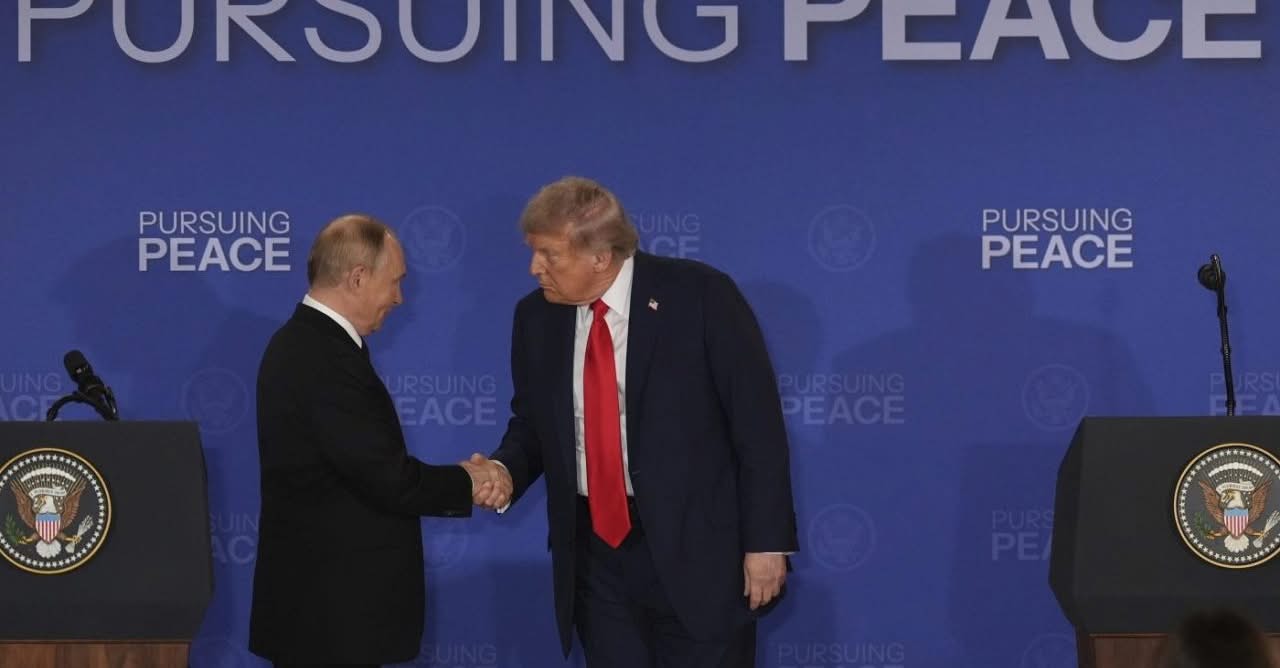
The Alaska summit between President Trump and his Russian counterpart, Vladimir Putin, was more than a high-stakes encounter over the Ukraine war. It signaled America’s recognition that its own missteps have helped drive Russia closer to China, fueling a de facto alliance that poses the gravest threat to U.S. global preeminence since the Cold War.

Washington’s miscalculations helped build the China-Russia partnership it now fears most.

In a world where the U.S., China and Russia are the three leading powers, the Alaska summit underscored Trump’s bid to redraw the great-power triangle before it hardens against America.

The president’s Alaska reset seeks to undo a policy that turned two natural rivals into close strategic collaborators, by prioritizing improved U.S.-Russia ties.

Trump’s signaling was unmistakable. In a Fox News interview immediately after the summit, he blasted his predecessor. “He [Biden] did something that was unthinkable,” Trump said. “He drove China and Russia together. That’s not good. If you are just a minor student of history, it’s the one thing you didn’t want to do.”

The remark captured the essence of America’s dilemma. Two powers that are historic rivals — one vast in land and resources, the other populous and expansionist — have been pushed into each other’s arms by Washington’s own punitive strategies.

For decades, the bedrock of U.S. grand strategy was to keep Moscow and Beijing apart. President Richard Nixon’s 1972 opening to Beijing was not about cozying up to Mao Zedong’s brutal regime, but about exploiting the Sino-Soviet split by coopting China in an informal alliance geared toward containing and rolling back Soviet influence and power.

That strategy helped the West win the Cold War, not militarily but geopolitically.

Since 2022, however, Washington has inverted that logic. In response to Putin’s invasion of Ukraine, the U.S. unleashed unprecedented sanctions designed to cripple Russia economically. Instead, the sanctions drove the Kremlin toward Beijing while tightening Putin’s grip on power. What had been an uneasy partnership has become strategic collaboration against a common adversary — the U.S.

Rather than playing one against the other, America finds itself confronting a two-against-one dynamic, with China as the primary gainer. Western sanctions have effectively handed resource-rich Russia to resource-hungry China. Beijing has also chipped away at Russian influence in Central Asia, bringing former Soviet republics into its orbit.

Meanwhile, despite the grinding war in Ukraine, Russia remains a formidable power. Its global reach, military capacity and resilience under sanctions have belied Western hopes that it could be isolated into irrelevance.

On the battlefield, Russia holds the strategic initiative, strengthening Putin’s bargaining hand and reducing his incentive to accept any ceasefire not largely on his own terms. The uncomfortable truth for Washington is that it risks losing a proxy war into which it has poured vast resources.

The legacy-conscious Trump recognizes this. His push for a negotiated end to the war is not a retreat but an attempt to cut losses and refocus U.S. strategy on the larger contest with China that will shape the emerging new global order.

Among the great powers, only China has both the ambition and material base to supplant the U.S. Its economy, military spending and technological capabilities dwarf that of Russia. Yet Beijing remains the main beneficiary of America’s hard line against Moscow.

In fact, sanctions and Western weaponization of international finance have turned China into Russia’s financial lifeline. Russia’s export earnings are now largely parked in Chinese banks, in effect giving Beijing a share of the returns. China has also locked in discounted, long-term energy supplies from Russia. These secure overland flows, which cannot be interdicted by hostile forces, bolster China’s energy security in ways maritime trade never could — a crucial hedge as it eyes Taiwan. Far from weakening Beijing, U.S. policy has made it stronger.

A formal China-Russia alliance would unite Eurasia’s vast resources and power — America’s ultimate nightmare, as it would accelerate its relative decline. The Ukraine war has drained U.S. focus even as China expands influence in the Indo-Pacific, the true theater of 21st-century geopolitics.

This is why the Alaska summit mattered. Trump and Putin seemed to recognize that improved ties could reshape the global balance of power. For Trump, the goal is clear: Reverse America’s blunder, separate Moscow from Beijing and refocus power on the systemic challenge posed by China.

Critics call this appeasement, but it echoes Nixon’s outreach to Mao: exploiting geopolitical rivalries to keep the U.S. globally preeminent.

Washington needs similar clarity today, not doubling down on a failing proxy war, but easing tensions with Russia while strengthening deterrence in the Indo-Pacific, where the stakes are truly global.

Trump’s tariff-first approach, evident in his punitive approach toward India, has already hurt important partnerships. Yet his instinct on the U.S.-China-Russia triangle could be transformative. If he can begin to pry Moscow away from Beijing — or even sow just enough mistrust to prevent a durable Sino-Russian alliance — he will have altered the trajectory of world politics.

America need not befriend Russia — it need only prevent Russia from becoming China’s junior partner in an anti-U.S. coalition. That requires ending the Ukraine war and creating space for a geopolitical reset.

The Alaska summit was only a first step. But it acknowledged what U.S. policymakers resist admitting: continuing the current course will further strengthen China and entrench America’s disadvantages. A shift in strategy is not weakness. It is the essence of grand strategy — recognizing when old approaches have outlived their usefulness.

If Trump can reengineer the strategic geometry of the great-power triangle, he will have preserved America’s place at the apex of the global order.

Brahma Chellaney is the author of nine books, including the award-winning “Water: Asia’s New Battleground.”

Trump’s economic war on India is a gift to China

Featured

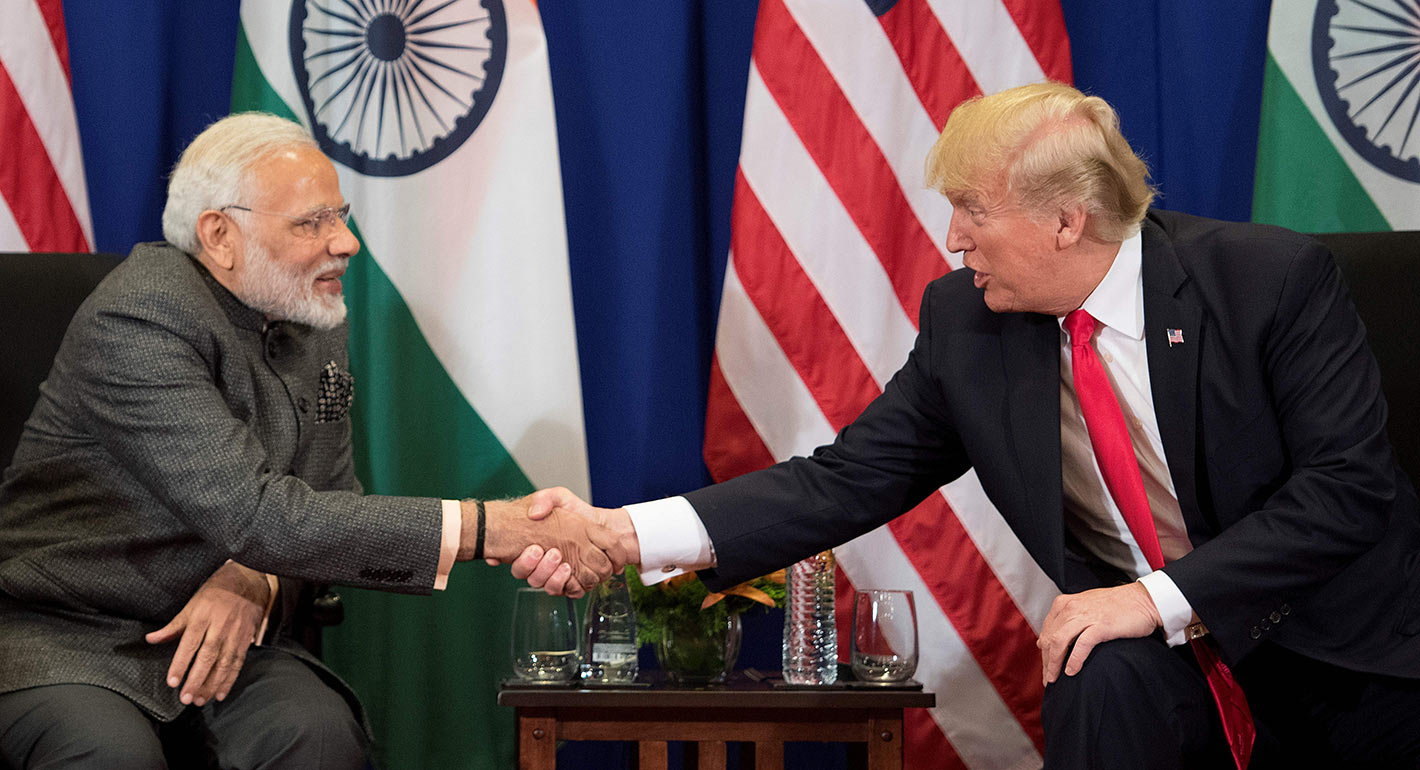
US President Donald Trump shakes hands with Indian Prime Minister Narendra Modi during a bilateral meeting on the sideline of the 2017 Association of Southeast Asian Nations (ASEAN) Summit in Manila.

Brahma Chellaney, The Hill

President Trump’s decision to slap secondary sanctions on India over its imports of Russian oil, while also unleashing a tariff barrage on Indian exports, is more than a trade dispute. It is a self-inflicted wound to America’s most vital strategic partnership in Asia at a time when China is flexing its military muscle throughout the region.

Washington has long courted India as a bulwark against an expansionist China and as a critical pillar of its “free and open Indo-Pacific” strategy. Yet Trump’s punitive steps against India are eroding the very trust on which strategic alignment rests — to Beijing’s delight.

The mutual trust painstakingly built over years underpins bilateral cooperation. Once lost, it will be hard to rebuild. Even if the administration eventually reaches a trade deal with India, it may not be able to repair the damage.

Targeting India over Russian oil purchases smacks of selective enforcement. The European Union’s large imports of Russian energy products, especially liquefied natural gas, have been left untouched. Such European imports not only contribute more to Russia’s coffers than India’s purchases, but Europe spends more on Russian energy than on assisting Ukraine.

Trump has also spared the world’s largest buyer of Russian oil and gas: China. But India, the very country Washington has spent years courting as an Asian counterweight, has become the first victim of his secondary sanctions. This suggests Trump’s tactics are less about punishing Moscow than about pressuring New Delhi.

Russian oil is a pretext to strong-arm India into accepting a Trump-dictated trade agreement, much as he foisted a largely one-sided deal on the European Union. That his tariffs on India have little to do with Russian oil is evident from one telling fact: Indian exports to the U.S. of refined fuels such as gasoline, diesel and jet fuel — increasingly made from Russian crude — remain exempt from his tariffs.

Such is the Trumpian logic. He has hit Indian non-energy exports with steep tariffs, but spared booming exports of refined fuels made largely from Russian crude. Trump seems to have no problem with Russian oil — as long as it is refined in India and then pumped into American planes, trucks and cars.

Furthermore, given continued U.S. imports of Russian enriched uranium, fertilizers and chemicals, Trump does not seem troubled that his own administration is helping fund Russia’s war in Ukraine while still locked in a proxy war with Moscow.

In truth, Trump is using New Delhi’s Russian oil purchases as a crude bargaining tactic to secure a bilateral trade deal on his terms. India illustrates how the Trump administration has weaponized tariffs not merely to extract trade concessions but also to bind other countries more closely to American strategic and security interests. In seeking to bend India to its will, it has targeted that country’s traditionally independent approach to global affairs, including neutrality on conflicts.

Indian exports to the U.S. now face a steep 50 percent tariff, signaling the end of Trump’s bromance with Prime Minister Narendra Modi. His moves against strategic-partner India are harsher than against China. This marks a dramatic U-turn from his first term, when bilateral relations thrived to the extent that Trump declared at a huge February 2020 rally in Modi’s home state of Gujarat, “America loves India, America respects India, and America will always be faithful and loyal friends to the Indian people.”

In Trump’s second term, Modi was among the first world leaders to visit the White House, agreeing to fast-track trade negotiations. In July, the Indians believed they had reached an interim deal, awaiting only Trump’s approval. But in characteristic fashion, Trump abruptly rejected the accord and embarked on punishing India.

New Delhi has publicly criticized the Trump administration’s double standards. But it is more concerned about a deeper question: If Washington can so easily turn its coercive tools on a supposed ally, what is to stop it from doing so again?

U.S.-India relations have probably plunged to their lowest point in the 21st century, thanks to Trump’s economic war and his singling out of India for secondary sanctions.

The fallout will extend beyond lost trade. India could respond by doubling down on strategic autonomy — hedging between the U.S., Russia and others — and diversifying its economic and security partnerships. Trump’s gamble may wring out trade concessions in the short term, but it risks undermining the security architecture in the Indo-Pacific, where unity among key democracies is the only real check on China’s expansionism. America is effectively handing China an opening to court a disillusioned India.

New Delhi is already signaling that it has other geopolitical options. Russian President Vladimir Putin is expected to visit India in the coming weeks. In less than three weeks, Modi is scheduled to meet Chinese President Xi Jinping on the sidelines of the Shanghai Cooperation Organization summit, which Putin will also attend. Moscow is pushing for a revived Russia-India-China grouping.

A stable Indo-Pacific order demands more than joint military exercises and communiqués; it requires political will to accommodate each other’s core interests. Punishing India in ways that ignore its legitimate security and energy needs sends the opposite message.

Ironically, Trump’s sanctions-and-tariffs blitz may have done India a favor by exposing the strategic reality of America’s unreliability. By presenting the U.S. as a fickle, transactional power, Trump has signaled that Washington cannot be counted on to separate short-term commercial considerations from long-term strategic imperatives.

Trump’s economic coercion risks alienating a vast, still-growing market that U.S. firms see as central to their future growth. India remains the world’s fastest-growing major economy, and as many other economies stagnate and populations shrink, it stands out as a rising giant.

Sacrificing a linchpin of Indo-Pacific stability for a fleeting win in a tariff war is not tough bargaining. It is strategic recklessness — and a gift to China.

Brahma Chellaney is a geostrategist and the author of nine books, including the award-winning “Water: Asia’s New Battleground.”

Trump’s 50-day Ukraine ultimatum is doomed to fail

Featured

By Brahma Chellaney, The Hill

President Trump campaigned on a promise to end the Ukraine war within 24 hours of returning to the White House. Now back in the White House, he finds himself hemmed in by the realities of great-power politics.

Trump’s self-confidence has collided with the entrenched dynamics of a grinding conflict. Frustrated, he has turned to familiar tools of coercion: threats, pressure tactics and a new flow of advanced weapons to Kyiv.

Trump’s latest initiative gives Moscow a 50-day deadline to end its war in Ukraine. He has threatened secondary sanctions on Russia’s key trading partners and opened a fresh weapons pipeline to Kyiv, hoping this twin-pronged approach will force Russian President Vladimir Putin’s hand. But like Trump’s earlier attempts to employ brute pressure as a substitute for diplomacy, this initiative reflects impatience more than strategic clarity.

Trump once believed that his personal rapport with Putin, coupled with a dealmaker’s instinct, could bring about a ceasefire. But six months into his new term, his peace push lies in tatters. Russia continues to press its territorial ambitions, while Ukraine, bolstered by Western military support, shows little interest in making major concessions. Instead of a breakthrough, Trump faces a deepening quagmire.

The irony is unmistakable — the president who pledged to end America’s entanglements in “forever wars” is now escalating U.S. involvement in one that is deflecting American attention away from more-pressing strategic challenges, including from China, which is seeking to supplant the U.S. as the world’s foremost power.

Trump’s new Ukraine strategy bears an eerie resemblance to his Iran policy, when he tried to bomb Tehran into submission, only to end up entrenching animosities further and weakening U.S. leverage.

There is no doubt that ending the war in Ukraine is in America’s strategic interest. The conflict has absorbed vast U.S. resources, diverted diplomatic bandwidth and strained transatlantic cohesion.

More importantly, the war has delayed Washington’s ability to focus on the key Indo-Pacific region — the world’s emerging economic and geopolitical nerve center.

The pivot to the Indo-Pacific is not merely aspirational. A leaked memorandum titled “Interim National Defense Strategic Guidance,” signed by Secretary of Defense Pete Hegseth, identifies China as the Pentagon’s “sole pacing threat.” The Trump administration is seeking to reorient the U.S. military posture to prepare for a potential showdown in Asia over Chinese aggression against democratic Taiwan.

The war in Ukraine, by draining American attention, resources and capabilities, undermines this rebalancing.

Seen from this angle, Trump is right to seek an end to the conflict. But his approach — escalating arms transfers while threatening punitive sanctions on countries that do business with Russia — is unlikely to yield peace. If anything, it risks prolonging the war by reinforcing the belief in Kyiv that Washington remains committed to a military solution.

In fact, Trump’s threat to impose harsh penalties on Russia’s trading partners lacks credibility. Such sanctions would trigger a U.S. showdown with China, which trades nearly $250 billion annually with Russia, including major oil and gas imports. Sanctioning India could upend America’s Indo-Pacific strategy aimed at maintaining a stable balance of power.

History offers little support for the notion that coercion alone can deliver durable peace. Military pressure may bring parties to the table, but diplomacy is what cements outcomes. The Dayton Accords, which ended the Bosnian war, and the Camp David Accords, which brought peace between Egypt and Israel, were both products of tough negotiations rather than deadlines and threats.

Trump’s maximalist tactics risk backfiring on multiple fronts. Sanctioning Russia’s trading partners could alienate crucial “swing” nations in the global contest with China. These states are already wary of U.S. unilateralism, and some of them could be pushed into Beijing’s orbit. Moreover, punitive economic measures often fail to change state behavior, especially when national security interests are at stake, as is the case for Russia in Ukraine.

Meanwhile, a flood of advanced new U.S. weapons to Ukraine may boost short-term battlefield performance but will do little to bridge the wider diplomatic impasse. Putin, faced with increased Western backing for Kyiv, is unlikely to scale back his goals. Instead, he may double down, calculating that time and attrition are on his side.

The real path to peace in Ukraine lies not in deadlines or ultimatums, but in a forward-looking diplomatic initiative that recognizes the legitimate interests of all parties while seeking to uphold Ukraine’s sovereignty. The Biden administration made limited overtures in this direction, but Trump, who claims to be a great dealmaker, has an opportunity to go further.

Instead of trying to impose peace through pressure alone, he must find ways to bring both sides to the table — with credible inducements and face-saving compromises.

This will require working with international partners — not just NATO allies, but also influential neutral states like India and the United Arab Emirates that can serve as mediators. It will also require a nuanced understanding of Russia’s domestic political constraints and Ukraine’s security concerns. None of this is easy, but it is more likely to succeed than a strategy built on coercion and deadlines.

Despite promising to end the war quickly, Trump now finds himself caught in the same bind as his predecessor. His failure to secure a ceasefire has deepened America’s involvement in the war — the very entanglement he vowed to end.

Unless he pivots toward a more diplomatic course, his 50-day ultimatum to Moscow will go the way of his 24-hour pledge: unmet and quietly shelved.

Deadlines don’t make peace. Diplomacy does.

Brahma Chellaney is a geostrategist and the author of nine books, including the award-winning “Water: Asia’s New Battleground.”

Copyright 2025 Nexstar Media, Inc. All rights reserved. This material may not be published, broadcast, rewritten, or redistributed.

US foreign policy is now a one-man reality show

Featured

By Brahma Chellaney, The Hill

In his second term, President Trump’s excessive personalization of foreign policy has been on full display. But far from being the deft strategist he portrays, Trump has turned American diplomacy into an impulsive, self-serving spectacle.

The most recent example is telling: Trump’s announcement of a ceasefire between Israel and Iran blindsided even his own top officials. That a decision of such geopolitical magnitude was made without the knowledge of his senior advisors speaks volumes about his go-it-alone governing style.

From suspending foreign aid to saying the U.S. should “take over and redevelop Gaza,” Trump’s uncoordinated, impulsive approach stands in sharp contrast to traditional U.S. diplomacy, which relies on strategic planning, inter-agency consensus and durable alliances. Trump’s method instead favors drama, unpredictability and personal branding — often at the expense of the national interest.

Trump has long treated foreign policy as theatrical performance, designed more to generate headlines than to achieve lasting outcomes. His habit of bypassing expert advice and established channels consistently undermines U.S. credibility — not just at home, but also among allies and adversaries.

His approach has sown confusion within his administration and distrust abroad. Allies are left wondering whether Trump’s statements reflect official policy or personal whim, and even his own Cabinet is often in the dark. Trump’s foreign policy is less a coherent strategy than a string of dramatic set-pieces crafted for maximum personal visibility.

Take the paradox of his recent Middle East gambit. Trump greenlit Israel’s preemptive war on Iran, then ordered U.S. airstrikes on Iranian nuclear sites — facilities that are subject to International Atomic Energy Agency safeguards and are monitored under Iran’s Nuclear Non-Proliferation Treaty commitments. After declaring victory, he touted a U.S.-brokered ceasefire as vindication of his strategy. Yet he conspicuously failed to acknowledge the crucial mediating role played by Qatar’s emir, Sheikh Tamim bin Hamad Al Thani.

It was, in fact, the Qatari ruler who negotiated the truce that ended what Trump dubbed the “12-Day War.” But for Trump, who never misses a chance to claim center stage, downplaying others’ key roles is par for the course.

Trump claimed that he arranged the ceasefire between India and Pakistan following their military hostilities in early May. The confrontation was triggered by an cross-border terrorist attack in Indian Kashmir on April 22 in which Islamist gunmen targeted non-Muslims, killing 26 people.

India maintains that the ceasefire came about through direct bilateral talks after Pakistan requested a truce via the military hotline. But that hasn’t stopped Trump from repeatedly claiming credit and lobbying for a Nobel Peace Prize. “They should give me the Nobel Prize for Rwanda, or the Congo, or Serbia, Kosovo … The big one is India and Pakistan,” he recently declared.

Ironically, Trump may believe that bombing Iran helps his case for the Nobel — a prize that, over the years, has gone to a surprising roster of militaristsTheodore Roosevelt (the champion of “Big Stick” diplomacy), Henry Kissinger (the mastermind of the carpet-bombing of Laos and Cambodia) and Barack Obama (the serial interventionist who helped turn Libya into a failed state) all won it.

Yet Trump’s personalization of diplomacy brings risks that go beyond ego-driven showmanship. Major decisions made on impulse, for optics or without consulting national security professionals erode the foundations of U.S. foreign policy. They also increase the danger of strategic miscalculation.

Foreign governments cannot know whether Trump’s declarations reflect actual American policy or are merely the mood of the moment. By sidelining intelligence assessments and undercutting his own officials — as he did by floating regime change in Iran after his team publicly denied such intentions — Trump breeds internal disarray and external uncertainty.

This policy chaos is amplified by Trump’s compulsive communication style. No world leader talks more or posts more on social media. American officials are often left scrambling to explain statements they didn’t anticipate, while global actors are forced to decipher whether the next move will be announced from the Situation Room or on Truth Social.

The blurring of lines between national interest and personal gain further complicates matters. Increasingly, foreign policy appears to double as a mechanism for advancing private interests. In the past six months, Trump’s personal wealth surged thanks to a string of cryptocurrency ventures and deals, and there is mounting evidence that the Trump family’s crypto empire is influencing presidential decision-making.

Consider Trump’s handling of Pakistan in the wake of the Kashmir terror attack. Between the massacre and India’s retaliation, Pakistan hurriedly signed a major investment deal with World Liberty Financial, a crypto firm founded by Trump and his sons before last November’s election. Days later, Trump helped shield Pakistan from further Indian reprisals. Now he declares, “I love Pakistan” — a country that harbored Osama bin Laden for years and still shelters global terrorists.

In the end, Trump has reduced U.S. statecraft to spectacle. American foreign policy today looks less like the work of a global superpower and more like a one-man reality show — replete with cliffhangers, reversals, business deals and applause lines.

Such theatrics may serve Trump’s political ambitions, but they leave America’s strategic credibility — and the international order it helped build — increasingly vulnerable.

Brahma Chellaney is a geostrategist and the author of nine books, including the award-winning “Water: Asia’s New Battleground.”

Trump’s wake-up call for India’s foreign policy

Featured

Trump may have done India a favor by opening its eyes to strategic realities. India’s foreign policy should be defined by interests, not illusions. New Delhi must now pivot to strategic self-reliance.

Indian Prime Minister Narendra Modi meets with U.S. President Donald Trump at the White House on Feb. 13. Trump’s coercive use of trade threats against India during the Pakistan military crisis has undermined trust in the U.S.-India partnership and exposed Washington as an unreliable security ally.

By Brahma Chellaney
Contributing Writer, The Japan Times

U.S. President Donald Trump appears to be treating America’s allies more harshly than its rivals — a pattern underscored by his rollback of punitive tariffs on China while continuing to employ trade leverage against allies like Japan and India.

Even as Japan’s auto sector is reeling from the U.S. tariffs that the White House refuses to lift, Trump has boasted about using trade threats to compel India to halt its military reprisals against Pakistan following a transborder terrorist attack that killed 26 civilians in the Indian-administered part of divided Kashmir.

In a matter of days, Trump has undermined the U.S.-India strategic partnership — a relationship carefully cultivated by successive American administrations since Bill Clinton. His self-congratulatory remarks about coercing India during a military crisis not only belittle New Delhi’s security concerns but also damage the credibility of U.S. commitments in the Indo-Pacific region, a fast-emerging economic and geopolitical hub.

Trump’s assertion that he used trade as a lever to stop India’s brief military campaign raises troubling implications. If Washington can threaten bilateral trade to halt India’s calibrated response to terrorism, it could just as easily disrupt the supply of weapons, spare parts and critical technologies during a full-scale conflict.

This realization risks chilling India’s fast-growing defense trade with the United States, potentially costing American firms billions in future sales.

Speaking at a White House news conference, Trump crowed, “If you don’t stop, we are not going to do any trade.” Later, while in Saudi Arabia, he repeated, “I used trade to a large extent to do it.” If taken at face value, this was not diplomacy — it was strategic coercion, aiding Pakistan and undermining India’s fight against terrorism.

India’s three-day military operation from May 7 to 10 — one of the shortest campaigns in modern times — was a limited and measured response to Pakistani terrorism. It was U.S. special forces who in 2011 exposed Pakistan’s nexus with international terrorism by killing al-Qaida chief Osama bin Laden in his hideout located in the shadow of the top Pakistani military academy.

Yet, through his interventionist role this month, Trump gave Pakistan a reprieve. Compounding the damage, the International Monetary Fund, backed by the U.S., approved a $2.4 billion bailout for Pakistan on May 9, two days into India’s military campaign.

This sent a dangerous message: As long as you are a “major non-NATO ally” of the U.S., terrorism may carry no real cost. Pakistan has remained America’s “major non-NATO ally” since George W. Bush’s presidency.

Like Japan, India refrained from retaliating after Trump’s tariffs, choosing instead to negotiate a trade deal and commit to buying more American goods. But Trump has repaid this conciliatory posture with hostility.

During his recent Middle East tour, he derided India as a “tariff king” and wrongly claimed the U.S. isn’t among the top 30 countries exporting to India. (The U.S. is the fourth largest exporter to India.) Trump also mischaracterized the Indian position in the ongoing negotiations for a bilateral trade deal, claiming that India is going from high tariffs to offering “zero tariffs” to America — a claim New Delhi denied.

This wasn’t mere rhetoric. On May 15, just one day after India signed a major manufacturing deal with Foxconn to ramp up production of iPhones domestically, Trump publicly rebuked Apple CEO Tim Cook, saying, “I don’t want you building in India.”

This stunning intervention contradicts the stated goals of “the Quad,” which seeks to build resilient and diversified supply chains by shifting production away from China. If Trump opposes American firms investing in India, what does that say about U.S. strategic intent? Or how do Trump’s actions square with Washington’s assertion that U.S.-India ties are the defining relationship of the 21st century?

Meanwhile, Trump has shown little concern for the cross-border terrorism that prompted India’s military action. While remaining conspicuously silent on the transborder terrorism challenge that India confronts, he has turned his gaze to Kashmir, offering to mediate that dispute and pushing a narrative that downplays the core issue of Pakistani terrorism. New Delhi has firmly rejected his offer.

Trump calls Indian Prime Minister Narendra Modi a “great friend of mine” with whom, according to him, he shares “a wonderful relationship.” Trump’s actions, however, have sparked domestic criticism of Modi’s handling of the crisis. Trump’s claim to have “brokered a historic ceasefire” feeds that perception, portraying Modi as yielding to external pressure.

Successive U.S. administrations have viewed India as a vital counterweight to China. Helping India deter Pakistan’s use of terrorists in proxy warfare would have strengthened that role. Instead, Trump’s interventions have emboldened Pakistan — a setback for the shared Indo-Pacific objectives of both Washington and New Delhi.

Ironically, Trump may have done India a favor. His actions have exposed an uncomfortable truth: Under his leadership, the U.S. is not a dependable partner in matters of security and counterterrorism. Recognizing this reality is a strategic imperative for India.

New Delhi must now pivot to strategic self-reliance. Warm rhetoric cannot substitute for real trust. India’s foreign policy should be defined by interests, not illusions.

Brahma Chellaney is a geostrategist and the author of nine books, including “Water: Asia’s New Battleground.”

Testing the limits of India’s water diplomacy

Featured

2025-03-17 Indus

Avatar

Brahma Chellaney, Nikkei Asia

The Indus Waters Treaty (IWT) between India and Pakistan has long been hailed as a rare success in transboundary water sharing. It has stood as a beacon of cooperation between two hostile neighbors.

Under the treaty, upstream India reserved for Pakistan more than 80% of the Indus Basin waters — a remarkable act of generosity, driven by the hope of promoting subcontinental peace. Sixty-five years on, the IWT remains the world’s most munificent water-sharing arrangement.

Yet over the decades, the geopolitical reality has changed. Pakistan’s powerful military establishment — including its Inter-Services Intelligence (ISI) agency — has continued to nurture jihadist groups for use in low-intensity asymmetric warfare against India and other neighbors.

Another grim reminder came on April 22, when Pakistan-backed Islamist terrorists singled out and killed 26 civilians at a Kashmir resort — the deadliest attack on Indians since the 2008 Mumbai carnage. The outrage triggered by the massacre led Prime Minister Narendra Modi to announce India would place the IWT “in abeyance” until Pakistan credibly and irreversibly ends its support for cross-border terrorism.

The message is clear: India’s water generosity has been repaid not with gratitude but with blood.

The killings followed a provocative Islamist speech by Pakistan’s army chief, Gen. Asim Munir, who declared that Muslims are “different from Hindus in every possible way.” His rhetoric outraged India’s secular polity, which includes a 200-million-strong Muslim population.

Pakistan’s nuclear weapons have emboldened its reliance on terrorism, shielding its military and its proxies from full retaliation. But when Pakistan harbors and facilitates terrorists striking across its borders, it flagrantly violates the principle of peaceful coexistence — the very basis on which the IWT was built.

Treaties are created not on paper alone but on trust. And trust is precisely what Pakistan has shattered, time and again, through its unwavering commitment to transborder terrorism.

International law is unequivocal: When a treaty’s fundamental conditions collapse, or one party persistently violates it, the other party has the right to suspend or withdraw. The Vienna Convention on the Law of Treaties, which codifies customary international law, permits suspension or withdrawal in cases of material breach or fundamental change of circumstances. Pakistan’s conduct meets both tests.

Yet India has not formally suspended or withdrawn from the IWT. By placing it “in abeyance” — a term neither defined in international law nor spelled out by India — New Delhi is signaling frustration without yet burning diplomatic bridges. It amounts to a strategic warning: Change your behavior or risk the treaty’s collapse.

India’s patience has been extraordinary. Despite enduring repeated Pakistan-backed terror attacks — including on Modi’s watch — India continued to honor the treaty. Modi, once an advocate of peace, even made an unannounced 2015 visit to Pakistan to court reconciliation. That overture was met with cross-border terrorist strikes orchestrated by Pakistan’s military.

After a major terrorist attack in 2016, Modi warned Pakistan that “blood and water cannot flow together.” Since then, India has signaled its growing exasperation by, among other steps, suspending some meetings of the Permanent Indus Commission and formally seeking negotiations to amend the IWT.

In Asia, India stands virtually alone in its commitment to water-sharing treaties. China, despite controlling the water-rich Tibetan Plateau — the source of most of Asia’s major rivers — refuses to negotiate a water-sharing treaty with any downstream neighbor. By contrast, India has water-sharing treaties with both its downriver neighbors, Pakistan and Bangladesh.

Despite Bangladesh’s descent into jihadist violence after last year’s regime change, India recently agreed to negotiate a renewal of the 1996 Ganges water-sharing treaty, which guarantees Bangladesh quantified dry-season flows — a first in international water law. But, in contrast to the 30-year Ganges treaty, the IWT is of indefinite duration.

Clearly, the open-ended framework of the IWT — based on unconditional trust — has failed. What was once a symbol of cooperation has been weaponized for hostility, with India left to bear the burdens of the treaty, without getting any tangible benefits in return.

Importantly, India’s latest legal move does not threaten disruption of river flows to Pakistan. India lacks the hydrological infrastructure to curb downstream flows. Its storage capacity on the Indus system’s three largest rivers, reserved for Pakistan, is a mere 0.3 million acre-feet (0.37 megaliters) — negligible compared to Pakistan’s annual receipt of 168 million acre-feet of water.

Unlike Pakistan, which has used terrorism as a weapon against Indian civilians, India has committed to ensuring that any actions it takes will be responsible and measured, with full consideration of the downstream impact on water availability for Pakistan’s population.

Looking ahead, India should push for a new, conditional water-sharing framework — one that links cooperation to peace and verifiable good behavior. Any future treaty must respect the sovereignty, security and well-being of both sides.

This will be a necessary recalibration — a recognition that the old framework is no longer tenable. Peace cannot flow from terrorism and hate.

As the Indus-system rivers flow from the Himalayas into the plains, so too must diplomacy flow from the reality on the ground. The reality is that there can be no cooperation without credibility, and no treaty without trust.

Brahma Chellaney, a professor of strategic studies at the independent New Delhi-based Centre for Policy Research and fellow at the Robert Bosch Academy in Berlin, is the author of nine books, including “Water: Asia’s New Battleground” (Georgetown University Press), which won the Bernard Schwartz Book Award.

Blood for water? Why India is within its rights to withdraw from the Indus Waters Treaty

Featured

Brahma Chellaney, The Times of India

When the Indus Waters Treaty (IWT) was signed in 1960, it was an act of extraordinary generosity on India’s part. Despite being the upper riparian state, India reserved for Pakistan over 80% of the Indus Basin waters. Almost 65 years later, IWT remains the world’s most generous water-sharing treaty.

The treaty was a bet on peace — on the hope that India’s water largesse would help usher in subcontinental stability and collaboration. Pakistan, however, has repaid India’s generosity not with gratitude, but with grenades and guns.

From the 2001 attack on Parliament to the 2008 horrific Mumbai massacre, and from the 2016 Uri raid to the 2019 Pulwama bombing — the pattern of Pakistan-scripted terrorism has been unmistakable. The pattern underscores a strategic doctrine of asymmetric warfare, relying on terrorist proxies. And yet, even as Pakistan kept on repaying water munificence with blood, India continued to honour the treaty.

But now the national anger over the latest terrorist massacre in Pahalgam, where Hindu tourists were singled out and slaughtered, has compelled Prime Minister Narendra Modi to take a legal step — putting the IWT “in abeyance”. This is not about water alone. It is about principle, sovereignty and the right to protect one’s people. International law is clear: when a treaty’s foundational conditions collapse — or when one party persistently breaches it — the other party has the right to suspend or withdraw.

A country that repeatedly enables attacks on innocent civilians should forfeit the benefits of a legal arrangement designed for peaceful cooperation. The IWT is not a river-sharing agreement in isolation; it is a mechanism of trust, and trust has been systemically dismantled.

Moreover, the world is not unfamiliar with treaty withdrawals. The US unilaterally exited the Anti-Ballistic Missile (ABM) treaty in 2002 and the Intermediate-Range Nuclear Forces (INF) treaty in 2019 — citing national security threats both times. Sovereign states are entitled to defend themselves when cooperation becomes a cover for aggression. Why should India be any different?

Even within the bounds of the IWT, Pakistan has not acted in good faith. In fact, it has weaponized the IWT itself, abusing the treaty’s mechanisms to delay or sabotage Indian infrastructure projects and prevent India from utilising its legitimate share of the waters by repeatedly escalating minor engineering issues to international arbitration or adjudication. And still, India waited.

Now, India is signalling that endless patience should not be mistaken for weakness. Article 60 of the Vienna Convention on the Law of Treaties (VCLT) permits a state to suspend or withdraw from a treaty in the event of a material breach by the other party. International law also provides for a fundamental change in circumstances as a valid reason for treaty withdrawal, as laid out in Article 62 of the VCLT. India is not a party but the VCLT is reflective of customary international law.

However, India, despite citing both a fundamental change of circumstances and Pakistan’s material breach, has chosen neither to suspend nor withdraw from the IWT, deciding instead to place the treaty “in abeyance”, a term not formally defined in international law. The tentative step may suggest that the govt is seeking to deliver a strategic warning to compel behaviour change without burning diplomatic bridges just yet.

India has neither the intent nor the hydro-infrastructure to disrupt downstream flows. Its adversary is the Pakistani deep state, not the Pakistani people. India has thus made clear it will act responsibly, ensuring no humanitarian crisis is triggered.

Contrast India’s restraint and caution with China’s aggressive unilateralism. China has refused to negotiate a water-sharing treaty with any of its downstream neighbours. On the Brahmaputra, it is building a super-dam, the largest ever conceived, near the seismically active border with India, potentially creating a ticking water bomb.

Although India dwarfs Pakistan in terms of economic output, military spending and other material measures, successive Indian governments have allowed Pakistan to gore India with impunity by not pursuing a consistent Pakistan policy. Even today, after the Pakistani army chief’s recent call for civilizational war with India implied mortal combat, some policy-makers believe that India can compel a neighbour consumed by hatred to change behaviour. It is thus no wonder that — the latest horrific massacre notwithstanding — India appears loath to exit a treaty that hangs like the proverbial albatross from its neck.

India should offer an alternative water-sharing framework that is conditional on peace and verifiable conduct. The IWT model, based on unconditional trust, with India left to bear the burdens without any benefits, has failed.

More fundamentally, without India mustering the political will to impose sustained and multifaceted costs, Pakistan will remain Ground Zero for the international terrorist threat. India’s restraint has been historic. Now, history demands resolve.

The writer is a geostrategist.

Trump is taking the Monroe Doctrine global

Featured

A succession of U.S. presidents pursued global expansion, resulting in about 750 American military bases today in at least 80 countries. Even Biden reportedly sought to acquire a Bangladeshi island in the Bay of Bengal. But Trump is unique in articulating his expansionist goals openly.

Painting by Clyde De Land of the birth of the Monroe Doctrine

By Brahma Chellaney, The Hill

President Trump’s second term is proving even more disruptive than his first, especially for the world order.

In under 100 days, he has upended international norms, challenged key alliances and reasserted American power with blunt confidence. The emerging pattern reveals something deeper: a revival and global extension of the 19th-century Monroe Doctrine.

First declared in 1823 by President James Monroe, the Monroe Doctrine sought to prevent European powers from meddling in the Americas. Its premise was simple: The Western Hemisphere was a U.S. sphere of influence.

Under Trump, this idea is being reinterpreted, expanded and aggressively enforced — not just in the Americas but across the broader Western world.

Trump first cited the Monroe Doctrine in a 2018 speech at the United Nations, calling it “the formal policy of our country.” Now in his second term, he has moved from rhetoric to implementation. His administration has not only reasserted U.S. dominance in Latin America but is also reshaping relations with Europe, Africa, Asia, Australia, Canada and Arctic territories in ways that suggest a new, hemispherically-unbound version of American primacy.

Nowhere is this shift more evident than in Trump’s trade policy. He has weaponized tariffs — not just as bargaining tools, but as permanent instruments of economic nationalism. The Trump administration views protectionism not as a temporary phase but as a structural pillar of American renewal. Tariffs, in this framework, are both revenue generators and geopolitical levers, including against allies.

Trump’s ambitions extend well beyond trade. He has flirted openly with territorial expansion, expressing interest in acquiring Greenland, taking over the Panama Canal and even calling the U.S.-Canada border “an artificial line of separation.” He has also floated the idea of permanently resettling the entire population of Gaza, some 2 million people, in nearby Muslim countries so that the U.S. could take over the Strip and develop it into “the Riviera of the Middle East.”

Such proposals echo the Manifest Destiny ethos of the 19th century — a belief in America’s God-given right to expand its control and reach across land and sea.

In his inaugural address, Trump explicitly evoked Manifest Destiny, framing American expansion as a natural and noble pursuit. “The U.S. will once again consider itself a growing nation — one that increases our wealth, expands our territory, builds our cities, raises our expectations, and carries our flag into new and beautiful horizons,” Trump declared. He cited President William McKinley, who annexed the Philippines and Puerto Rico, as a model for coupling tariffs with U.S. expansion.

The message is clear: Trump sees America not just as a global power, but as an entitled hegemon.

To be sure, Trump is not the first post-World War II U.S. president pursuing American expansion. It was because of his predecessors’ global expansion that there are about 750 U.S. military bases today in at least 80 countries. Even the Biden administration reportedly sought to acquire from Bangladesh a strategic island in the Bay of Bengal — an effort that then-Prime Minister Sheikh Hasina claimed contributed to her overthrow last August.

But Trump is unique in his openness. He articulates his expansionist goals without diplomatic euphemism, often with provocative bluntness that shocks allies and adversaries alike.

One of the starkest expressions of this worldview is Trump’s treatment of America’s traditional alliances. He sees allies free-riding on American security and exploiting U.S. generosity, regarding them as leeches on the American economy. He views NATO not as a mutual defense pact but as a burdensome arrangement whereby the U.S. foots the bill for ungrateful allies.

Nowhere is the transatlantic divergence more visible than in the Ukraine war. While Europe remains fixated on the Russian threat, Trump wants to end what he calls the “savage conflict” and reset relations with Moscow. China is significantly stronger than Russia in economic output, military spending and other strategic metrics, and the Trump administration’s leaked defense guidance calls China “the sole pacing threat.”

Trump’s pivot from Europe to the Indo-Pacific region will represent a major reallocation of American attention and resources. The goal is to free up bandwidth for countering China’s aggressive rise — even if that means leaving Europe to manage Russia largely on its own. This marks the first time since 1945 that the U.S. has considered pulling back from its European security commitments to focus elsewhere.

But perhaps most revealing is how Trump’s foreign policy now resembles an updated Monroe Doctrine extended to the entire Western world. His bid to buy Greenland, a NATO territory under Danish control, symbolizes this shift. Greenland is far from the Americas, but its Arctic position makes it a strategic asset — and a candidate, in Trump’s eyes, for U.S. acquisition.

In this reimagined doctrine, the West is no longer a community of shared values, but a zone of expected compliance under American leadership.

This ideological shift reframes the Monroe Doctrine from a hemispheric defense policy to a global framework of dominance. Trump is not merely reviving an old doctrine — he is globalizing it. Under “Monroe 2.0,” the Western world is to be managed, not merely defended, by Washington. This is set to transform all of America’s long-standing alliances.

As the “Trump Revolution” unfolds, allies and rivals alike are being forced to recalibrate. If this new doctrine persists, the world could face not just a reassertion of American power but a redefinition of the West itself, with the U.S. as both guardian and gatekeeper.

Brahma Chellaney is a geostrategist and the author of nine books, including the award-winning “Water: Asia’s New Battleground.”

Behold the Trump Revolution

Featured

The US president has forced America’s friends and foes alike to reassess their strategic and economic options

US President Donald Trump holds up the executive order he signed imposing tariffs on imported goods at the Rose Garden of the White House, April 2, 2025

 Brahma Chellaney  | Open magazine

Since his return to the White House, US President Donald Trump has unleashed a blitz of policy actions that has shocked the Washington establishment and roiled international relations, including sending stock markets swinging sharply worldwide. Trump is playing tariff roulette and threatening to take control of the Panama Canal, Greenland, Gaza and even Canada, whose border with the US, he says, constitutes an “artificial line of separation.”

At home, the ‘deep state’ hobbled Trump’s first presidency and then concealed the cognitive impairment of his successor Joe Biden until it burst into public view with a ruinous debate performance. Trump’s second-term barrage of domestic policy actions has targeted ‘deep state’ institutions, including the Federal Bureau of Investigation (FBI), Central Intelligence Agency (CIA), Department of Justice, USAID, and the National Intelligence Program.

More fundamentally, Trump is seeking a seismic shift in American governance, including by downsizing the federal bureaucracy to cut waste and fraud. And by introducing significant shifts in US trade policies and foreign relations, he has sought to revitalise America’s economic and military security and arrest its relative decline. As part of that effort, he is seeking to end American entanglement in the armed conflicts in Ukraine and the Middle East.

The speed and scale of the changes introduced by Trump—from freezing foreign aid to imposing tariffs on US allies after calling them leeches on the US economy—is unprecedented in American modern history.

In less than 100 days in office, Trump has upended international rules and the post-World War II, US-led global system, as he seeks to remake patterns of international trade and cooperation, as well as rejigger the world order. He has left the world reeling from his actions, often referred to as the “Trump Revolution”.

Trump’s approach to the world is vividly different from the one he pursued in the first term. His new administration is more nationalistic, more protectionist and more clear-headed about what it seeks to achieve in its second term.

For example, tariffs are front and centre on Trump’s agenda as he seeks to revamp the global trading regime in an effort to secure American advantage.

To be sure, Trump is not the first American president to deploy tariffs as a weapon against trading partners. His predecessors, including Biden, also employed tariffs as a handy tool. Indeed, in the 19th century and the first decades of the 20th century, high tariffs were an American norm with trading partners.

Trump is seeking a seismic shift in American governance, including by downsizing the federal bureaucracy to cut waste and fraud. And by introducing shifts in US trade policies and foreign relations, he has sought to revitalise America’s economic and military security and arrest its relative decline

Through tariffs, Trump is seeking to reverse US deindustrialisation, which resulted from outsourcing manufacturing to China and other countries, devastating America’s industrial heartland. Today, China continues to rapidly accumulate economic and military power as an industrial powerhouse.

Trump’s tariffs seek to beat back the flood of imports and force American companies to invest in domestic production capacity and bring supply chains back to the US. Also, he is deploying tariffs as a negotiating instrument to extract concessions from trading partners. And some of the trading partners have already wilted under his pressure or threats.

Trump’s tariff-related actions are in keeping with what he promised in his inaugural speech. “I will immediately begin the overhaul of our trade system… we will tariff and tax foreign countries to enrich our citizens. For this purpose, we are establishing the External Revenue Service to collect all tariffs, duties and revenues,” he declared, adding that “nothing will stand in our way.”

While some of his tariffs are designed to be a negotiating tool, other tariffs are expected to stay in place as a regular source of revenue for the US—to help cut the trade deficit and balance the budget.

REMAKING THE WORLD

With its profound international impacts, Trump’s second term is reshaping global dynamics. A new world is being ushered in, with little prospect of a return to the world we had before. The policy shifts in Washington are compelling other countries to make necessary adjustments.​

A key component of Trump’s agenda is to reshape global trade patterns by punitively employing the tariff instrument. The aim is to reduce reliance on foreign goods and bring manufacturing back to the US. While his administration asserts that the tariffs and other economic measures will encourage domestic investment, American households face potential price increases and income reductions.

While some countries, from India to Britain, have sought to cut trade deals with Washington, other affected nations are responding with retaliatory measures. All this indicates that global economic uncertainty will likely linger.

The fact is that the Trump administration’s focus on what it calls “fair trade” and “reciprocity” has resulted in several developments. One is increased trade tensions and potential tariff wars, threatening to disrupt global supply chains. There is also some movement away from free trade agreements (FTAs) by embracing more protectionist policies. As part of readjustment, some countries are seeking alternative trade partnerships or to strengthen regional trade blocs.

Canadian Prime Minister Mark Carney
Canadian Prime Minister Mark Carney (Photo: AFP)

Tensions between the US and Canada following Trump’s threats to annex Canada have altered the Canadian political landscape, including reviving the fortunes of the Liberal Party and helping Mark Carney to succeed Justin Trudeau as Prime Minister

Britain and the European Union (EU), for example, have stepped up efforts to clinch FTAs with India, one of the world’s largest markets and fast-growing economies. The outreach to India explains how Europe is attempting to establish stronger trade ties with the non-Western regions of the world.

The significant impacts from Trump’s policies are forcing Europe to make economic and defence readjustments.

US Vice President JD Vance shocked European leaders by questioning European values and then warning that Europe was at risk of “civilizational suicide”. Europe also received a jarring wake-up call in February from US Defense Secretary Pete Hegseth, who warned that “the US will no longer tolerate an imbalanced relationship which encourages dependency” and that Europe must take “responsibility for its own security” by leading “from the front” so that America prioritises “deterring war with China” in the Indo-Pacific region.

Alluding to the paradox that Europe today confronts, Polish Prime Minister Donald Tusk said recently, “500 million Europeans [are] begging 300 million Americans to defend them against 140 million Russians,” adding that Europe today lacks not economic power but the conviction to be truly a global force.

However, the blunt warning from Washington to cut reliance on the US for European security is forcing Europe’s hand. The EU is encouraging member states to increase their military budgets and issue debt for defence purposes. This shift towards stepped-up militarisation is likely to stimulate European economies, with European defence stocks already surging. For example, two German armament companies, Rheinmetall AG and Thyssenkrupp AG, have seen their share prices double in the first quarter of this year.

Meanwhile, tensions between the US and Canada following Trump’s veiled threats to annex Canada as America’s “51st state” have altered the Canadian political landscape, including reviving the sagging fortunes of the Liberal Party and helping Mark Carney to succeed Justin Trudeau as prime minister. The economic woes from Trump’s protectionist policies, including the new tariffs, have pushed Canada towards political and economic recalibration, underscoring the broader impacts of the “Trump Revolution”.

Trump has also upended US energy policies and international environmental agreements.

Just hours after he was inaugurated, Trump signed an executive order—titled ‘Putting America First in International Environmental Agreements’—that directed immediate US withdrawal from the Paris Agreement and other international climate commitments. And Trump’s new mantra of “drill, baby, drill” demands that more oil and gas be extracted in the US, thus keeping the world hooked on planet-warming fossil fuels. The US withdrawal from combating climate change has heightened concerns about the future among low-lying developing countries that are vulnerable to climate-related disasters.

Defense Secretary Pete Hegseth and Vice President JD Vance after Hegseth took his oath of office, January 25, 2025
Defense Secretary Pete Hegseth and Vice President JD Vance after Hegseth took his oath of office, January 25, 2025 (Photo: AP)

US Vice President JD Vance said Europe was at risk of ‘civilizational suicide’. Europe received a wake-up call in February from us Defense Secretary Pete Hegseth, who warned that ‘the US will no longer tolerate an imbalanced relationship which encourages dependency’

Meanwhile, the Trump administration’s scepticism towards multilateralism, by impinging on the ability of nations to work together on global issues, could affect efforts to address transnational challenges, provide humanitarian aid and enforce international norms.

Trump’s unilateralism also risks weakening American soft power and diminishing the attractiveness of the US as a global leader. The perception of the US as a reliable partner and defender of international norms has already eroded.

It is apparent that Trump and his team are reviving the interventionist Monroe Doctrine in US relations with the Western Hemisphere. The 19th-century Monroe Doctrine, unveiled by then-President James Monroe, declared the Western Hemisphere a US sphere of influence to the exclusion of other powers. In a first-term speech at the United Nations in 2018, Trump had called the Monroe Doctrine “the formal policy of our country”.

Trump’s ‘Monroe Doctrine 2.0’ today may explain his expansionist itch, including taking back the Panama Canal and buying Greenland from Denmark or just seizing that resource-rich, semi-autonomous territory, located strategically near Arctic waters used by Russia and China.

Asked days before his inauguration whether he would rule out employing coercion to achieve his expansionist goals in Greenland or Canada, Trump had said, “I’m not going to commit to that,” adding, “You might have to do something.” Trudeau, before leaving office, said that Trump was seeking “a total collapse of the Canadian economy because that will make it easier to annex us.”

In his inaugural speech, Trump invoked the notion of “Manifest Destiny” which drove America’s 19th‑century territorial expansion as a God-given right. “The US will once again consider itself a growing nation—one that increases our wealth, expands our territory, builds our cities, raises our expectations, and carries our flag into new and beautiful horizons,” Trump declared in the speech. Trump also praised William McKinley, the president who grabbed the Philippines in the Spanish-American War, saying “McKinley made our country very rich through tariffs and through talent.”

To be sure, Trump is not the first post-World War II US president to pursue American expansion. Almost a quarter million American troops are presently stationed in at least 172 countries and territories because of the global expansion undertaken by his predecessors since the second half of the 1940s. The Biden administration, seeking a military base in the Bay of Bengal, reportedly sought to acquire St Martin’s Island from Bangladesh, a factor that Sheikh Hasina claims contributed to her ouster from power.

CDU leader and Germany's incoming chancellor Friedrich Merz at the Bundestag, Berlin, March 18, 2025
CDU leader and Germany’s incoming chancellor Friedrich Merz at the Bundestag, Berlin, March 18, 2025 (Photo: AFP)

The erosion of trust between the US and its allies has been dramatic. For example, Carney, Canada’s new Prime Minister, has declared that ‘the old relationship we had with the United States’ is now ‘over’, while Friedrich Merz, the incoming German Chancellor, has said that his government would seek ‘independence from the USA’

The difference is that, unlike his predecessors, Trump has publicly outlined his expansionist agenda. Trump isn’t scripted, as his freewheeling speeches and news conferences underscore, with his complex personality blending refreshing candour with deliberate combativeness and braggadocio.

Today, the Trump administration is clearly reviving the “spheres of influence” concept, at least in relation to America’s dominance in the Western Hemisphere.

More fundamentally, Trump’s preoccupation with the problem of allies free-riding on American security and exploiting US generosity is having wide-ranging impacts. It is transforming the Transatlantic, Trans-Pacific and US-Canadian Alliances, which have been built on trade interdependencies and close security ties, including American nuclear umbrella protection.

The erosion of trust between the US and its allies has been dramatic. For example, Carney, Canada’s new prime minister, has declared that “the old relationship we had with the United States” is now “over”, while Friedrich Merz, the incoming German chancellor, has said that his government would seek “independence from the USA.” French President Emmanuel Macron, meanwhile, has signalled that France could extend its small nuclear umbrella over Europe because the US may no longer be relied upon. Trump, for his part, has said that the EU was formed “to screw” the US.

The split in the Western camp has been reinforced by fundamental differences between the Trump administration and many European states over the Ukraine war, especially Washington’s efforts to normalise relations with Russia in an effort to end the US-Russian proxy war in Ukraine.

The present divergence in the official US and European perspectives on the war is rooted partly in the fact that, for America, China is the main threat while much of Europe views adjacent Russia, not distant China, as its primary threat. Seen through the European lens, the Chinese threat is somewhat alleviated by Russia’s location between Europe and China. (The majority of Russians actually live in the European part of Russia that makes up almost one-quarter of the country’s total area.)

Biden, while deepening US involvement in the Ukraine war, acknowledged in his national security strategy that China, with its resolve and capability to surpass the US as the foremost world power, is America’s primary challenger. Trump, meanwhile, has portrayed his effort to end “the savage conflict in Ukraine” in altruistic terms—for the good of the world—but, in reality, he is seeking to cut America’s losses and prioritise the China challenge.

CHINA IS THE MAIN TARGET

Trump’s administration is seeking to shift US strategic focus from Europe to the Indo-Pacific, the world’s economic and geopolitical hub where America’s global pre-eminence is at stake. Ending the Ukraine war would free US military resources for the Indo-Pacific, particularly from Europe, where over 100,000 American troops remain stationed. The war, far from advancing the US objective to degrade Russia’s military power and derail its economy through unprecedented sanctions and military aid to Ukraine, is distracting Washington from more pressing challenges and promoting an unholy Sino-Russian alliance against America.

America’s status as the world’s preeminent power is under increasing challenge not from Russia, whose revanchist ambitions are largely confined to what it calls its “near abroad” (or the former Soviet space), but from a globally ascendant China. In this light, extricating the US from the Ukraine war and prioritising deterrence against Beijing makes strategic sense.

Today, the Trump administration is working to reorient the US military architecture towards the Indo-Pacific to prepare for and win a potential war with China, including deterring a Chinese attack on Taiwan, according to the leaked ‘Interim National Defense Strategic Guidance’ signed by Hegseth.

“China is the [Defense] Department’s sole pacing threat, and denial of a Chinese <fait accompli> seizure of Taiwan—while simultaneously defending the U.S. homeland is the Department’s sole pacing scenario,” Hegseth wrote in the guidance. In planning contingencies for a major power war, the US, according to the guidance, will consider conflict only with China, while leaving the Russia threat largely to European allies to address.

Russian President Vladimir Putin and Chinese President Xi Jinping, Beijing, May 16, 2024
Russian President Vladimir Putin and Chinese President Xi Jinping, Beijing, May 16, 2024 (Photo: Reuters)

America’s status as the world’s preeminent power is under increasing challenge not from Russia, whose revanchist ambitions are largely confined to what it calls its ‘near abroad’, but from a globally ascendant China. In this light, extricating the US from the Ukraine war and prioritising deterrence against Beijing makes strategic sense

Trump, in his first term, reversed the 45-year US rapprochement with Beijing by identifying China in his national security strategy as an adversary and initiating a trade war with it by imposing tariffs on Chinese goods. This marked a significant shift towards a more confrontational approach.

Now, in his second term, Trump’s policies are increasingly focused on countering China. The new rounds of tariffs imposed since February reflect this shift, as does his emphasis on ending the Ukraine war in order for the US to pivot to the Indo-Pacific.

A recent Trump-signed memorandum on America’s investment policy was more about the China threat than about anything else. Singling out the People’s Republic of China (PRC) as a foreign adversary directing investments in American companies to obtain cutting-edge technologies, it said that “PRC-affiliated investors are targeting the crown jewels of US technology, food supplies, farmland, minerals, natural resources, ports and shipping terminals.” The memorandum has proposed imposing several economic restrictions—from stopping US companies and investors from investing in industries that advance Beijing’s military-civil fusion strategy to preventing “PRC-affiliated persons from buying up critical American businesses and assets.”

Trump has repeatedly described himself as a dealmaker, and he appears open to cutting deals with Beijing that would help reduce China’s huge trade surplus with America. His approach to China will be very different from Biden’s Cold War-style Russia policy. Trump is likely to seek to limit the influence and power of China without resorting to open hostility.

Instead of broad sanctions, Trump will likely deploy targeted economic restrictions, thus permitting continued engagement with Beijing in less sensitive areas while still applying pressure where needed.

Leveraging tariffs and trade policies to disrupt China’s export-driven economy could compel Beijing to negotiate on fairer terms or risk shrinking market access. Trump could also incentivise American companies to reshore manufacturing through tax breaks or subsidies, further weakening China’s role as the world’s factory.

The Trump administration has begun tightening controls on technology and capital flows to China. Such curbs could hinder Beijing’s ability to innovate in key industries. Washington has also proposed greater scrutiny of Chinese investments in US technology sectors to limit China’s access to American intellectual property.

The American military posture in the Indo-Pacific, for its part, is likely to be defined by deterrence, not provocation. Strengthening US alliances in the Indo-Pacific, especially with India, Japan and Australia, would create a formidable counterbalance to Chinese expansion through geopolitical encirclement.

In conclusion, the consequences of the ‘Trump Revolution’ are still unfolding, but many countries are beginning to reassess their strategic and economic positions.

Trump’s dramatic reorientation of US foreign policy, with its maelstrom of actions and responses, including recriminations and alienation, is having significant international impacts. This is apparent from the emerging shifts in global trade, geopolitical alignments, defence strategies, and environmental commitments. The impacts are being accentuated by Trump’s rejection of both the logic of multilateralism and any self-restraints on the exercise of American power.

Nations worldwide today are navigating the developments unleashed by the ‘Trump Revolution’, seeking to readjust their policies and strategies in response to the changing geopolitical and geo-economic landscape.

Brahma Chellaney is a geostrategist and the author of two award-winning books.

American policies have unintentionally fueled China’s rise

Featured

By Brahma Chellaney, The Hill

Chinese President Xi Jinping, bottom left, stands to applause as he attends the closing ceremony of the Chinese People’s Political Consultative Conference held at the Great Hall of the People in Beijing, Monday, March 10, 2025. (AP Photo/Ng Han Guan)

A succession of American presidents since Richard Nixon aided China’s rise, inadvertently spawning the greatest strategic adversary the U.S. has ever faced.

It was President Trump who, in his first term, reversed the 45-year U.S. rapprochement with Beijing by identifying China in his national security strategy as an adversary and initiating a trade war with it by imposing tariffs on Chinese goods. This marked a significant shift towards a more confrontational approach.

But does Trump now risk playing into China’s hands by freezing much of U.S. foreign aid and upending decades-old alliances?

Trump’s critics argue that his assertive unilateralism on trade and foreign policy erodes American influence while potentially opening the door for Beijing to strengthen ties with nations traditionally in Washington’s orbit. The White House’s tariff plans against key trading partners, possibly raising duties to levels unseen in decades, could also weaken crucial alliances. Additionally, Trump’s freeze on foreign aid creates a vacuum for China to expand its international footprint, particularly in Africa.

At the same time, Trump’s policies are increasingly focused on countering China. The new rounds of tariffs imposed since February reflect this shift, as does the president’s emphasis on ending the Ukraine war to shift U.S. strategic focus from Europe to the Indo-Pacific.

Over the years, various U.S. policies that aided China’s rise were initially driven by strategic interests but ultimately produced unintended consequences. By coopting China in an informal anti-Soviet alliance during the latter half of the Cold War, Washington created a two-against-one competition that contributed to Soviet imperial overstretch and ultimately to the USSR’s collapse.

But in breaking China’s isolation and granting it access to Western markets and technology, often by outsourcing manufacturing, Washington also facilitated China’s rise as an economic and military powerhouse.

Instead of spurring political liberalization, as many American policymakers had hoped, China’s integration into the global economy spawned a more repressive state system. The Chinese Communist Party used economic growth to tighten political control and expand its military capabilities, turning economic strength into strategic leverage.

Since the 1990s, U.S. sanctions against other countries have frequently played into China’s hands, as Beijing has adeptly exploited opportunities arising from the isolation of sanctioned states. American-led sanctions, for instance, have pushed resource-rich Myanmar and Iran into China’s arms. China has become the almost exclusive buyer of Iranian oil at steep discounts, while also emerging as Iran’s top investor and security partner, and U.S. sanctions are compelling Myanmar to deepen ties with Beijing.

The Biden presidency illustrated how overuse of sanctions can accelerate China’s global expansion. Unprecedented American-led Western sanctions against Moscow after the invasion of Ukraine, including the weaponization of international finance, have turned Beijing into Russia’s de facto banker. China has capitalized on this shift by expanding the international use of the yuan, with Russia generating much of its export earnings in Chinese currency and keeping the proceeds largely within China.

By forcing Russia to pivot to China, Biden’s sanctions inadvertently helped solidify a strategic Sino-Russian alliance against America. Trade between China and Russia surged from $108 billion in 2020 to $245 billion last year. In return for giving Russia an economic lifeline, Beijing has gained access to some of Moscow’s most advanced military technologies, previously sold only to India.

American policymakers now face the urgent task of driving a wedge between China and Russia, whose historically complex relationship has oscillated between cooperation and conflict.

More broadly, the global order is undergoing a profound transition, shifting away from the post-World War II, U.S.-led system toward an uncertain new reality. Japanese Foreign Minister Takeshi Iwaya recently described the current period as a “turning point in history” while hosting trilateral discussions with his Chinese and South Korean counterparts. The very fact that two close U.S. allies — Japan and South Korea — are engaging in strategic dialogues with China underscores how nations are adopting hedging strategies amid geopolitical uncertainty.

Against this backdrop, the unintended consequences of the Trump administration’s policies — particularly its war on multilateralism — risk strengthening China’s hand. China’s ability to act as the world’s largest and most unforgiving government lender, combined with its aggressive “carrots and sticks” diplomacy, continues to expand its global influence.

To counter China’s accumulation of power, the Trump administration must adopt a multifaceted approach that blends economic, diplomatic, military and technological strategies.

Leveraging tariffs and trade policies to disrupt China’s export-driven economy could compel Beijing to negotiate on fairer terms or risk shrinking market access. The administration could also incentivize American companies to reshore manufacturing through tax breaks or subsidies, further weakening China’s role as the world’s factory.

Tightening controls on technology and capital flows to China could hinder Beijing’s ability to innovate in key industries. Increased scrutiny of Chinese investments in U.S. technology sectors would limit its access to American intellectual property.

Strengthening alliances in the Indo-Pacific — particularly through closer ties with democracies such as Japan, India and Australia (key players in “the Quad”) — would create a formidable counterbalance to Chinese expansion through geopolitical encirclement.

Furthermore, expanded deployment of U.S. troops and advanced weaponry in the Indo-Pacific would strengthen deterrence against China. The recent American deployment of the 1,200-mile, land-based Typhon missile system in the northern Philippines exemplifies this approach by putting key Chinese military and commercial centers within striking range.

The administration must ensure that short-term dealmaking does not undermine long-term American objectives. A coherent, sustained strategy — rather than erratic policy shifts — is critical to slowing China’s rise without triggering a major conflict. Trump must resist transactional diplomacy and instead prioritize long-term strategic goals so that the U.S. can more effectively counterbalance China’s growing influence while reinforcing its own global preeminence.

Brahma Chellaney is a geostrategist and the author of nine books, including the award-winning “Water: Asia’s New Battleground.”