A Concert of Indo-Pacific Democracies

8f1f3fb6-dda2-11e8-bb7b-3484094c71b9_1320x770_223539

The deepening relationship between Japan and India serves the goal of forestalling the emergence of a China-centric Asia. If they can leverage their relationship to generate progress toward broader cooperation among the region’s democracies, the vision of a free and open Indo-Pacific may be achievable.

BRAHMA CHELLANEY, a column internationally syndicated by Project Syndicate

On his week-long tour of Asia, US Vice President Mike Pence has been promoting a vision of a “free and open” Indo-Pacific region, characterized by unimpeded trade flows, freedom of navigation, and respect for the rule of law, national sovereignty, and existing frontiers. The question is whether this vision of an Indo-Pacific free of “authoritarianism and aggression” is achievable.

One country that seems willing to contribute to realizing this vision is Japan. In fact, Japanese Prime Minister Shinzo Abe is the originator of the “free and open Indo-Pacific” concept that lies at the heart of President Donald Trump’s new strategy, the successor to Barack Obama’s  “pivot” to Asia.

Having historically punched above its weight internationally, Japan is responding to China’s muscular rise by strengthening its own position in the region. Taking advantage of its considerable assets – the world’s third-largest economy, substantial high-tech skills, and a military that has recently been freed of some legal and constitutional constraints – Japan is boosting its geopolitical clout.

Japan’s world-class navy has already begun operating far beyond the country’s waters in order to establish its position in the region. For example, in order to challenge China’s claims in the South China Sea, a Japanese submarine and three destroyers carried out naval drills there in September. “Japan’s willingness to participate in Asian security,” former US Defense Secretary Ash Carter recently said, “makes it an increasingly important player in the region.”

But creating a free and open Indo-Pacific is not the job of one country alone. Establishing the stable balance of power needed to realize Pence’s vision will require all of the region’s major democracies – from Japan and India to Indonesia and Australia – to come together.

The good news is that Abe seems to recognize the importance of cooperation among Asia’s democratic powers. For example, in discussing the natural alliance between the region’s richest democracy and its largest one, he declared: “A strong India benefits Japan, and a strong Japan benefits India.”

With that in mind, Abe and his Indian counterpart, Narendra Modi, recently held a summit that opened the way for a military logistics pact that would give each country’s armed forces access to the other’s bases. Beyond instituting a joint “two plus two” dialogue among the countries’ foreign and defense ministers, Abe and Modi agreed to deepen naval and maritime-security cooperation and collaborate on projects in third countries, including Myanmar, Bangladesh, and Sri Lanka, to enhance strategic connectivity in the Indo-Pacific.

At the summit, Japan and India devised a new motto for the bilateral relationship: “Shared security, shared prosperity, and shared destiny.” The comfort and camaraderie shown by Abe and Modi during their meeting, held at Abe’s private vacation home near Mount Fuji, stood in stark contrast to the stony expressions and somber handshakes on display when, just two days earlier, Abe had met Chinese President Xi Jinping in Beijing.

Cooperation between India and Japan builds on, among other things, the trilateral India-Japan-US “Malabar” naval exercises. Malabar has become an important component of the effort to defend freedom of navigation and overflight in the Indo-Pacific region, through which two-thirds of global trade travels. If India signed a military logistics agreement with Japan, as it has with the US, the Indian navy would be better able to expand its footprint to the western Pacific, while enabling Japan to project its naval power in the Indian Ocean.

Fortunately, relations among the Indo-Pacific’s four key maritime democracies – Australia, India, Japan, and the US – are stronger than ever, characterized by high-level linkages and intelligence-sharing. These countries should institutionalize their “quad” initiative, with the India-Japan dyad forming the cornerstone of efforts to pursue wider collaboration in the region.

But such collaboration will face considerable obstacles. For starters, the relationship between Japan and America’s other closest East Asian ally, South Korea, continues to be  by history.

The issue of “comfort women,” Korean women who were coerced into providing sexual services to Japanese troops during World War II, has long been particularly contentious. A 2015 agreement, endorsed by Abe and former South Korean President Park Geun-hye, claimed to resolve the issue “irreversibly”: Japan offered its apology and one billion yen ($8.8 million) for a fund created to help the victims.

But, earlier this year, Park’s successor, Moon Jae-in, rejected the deal, arguing that it did not adequately serve the victims or the public. More recently, South Korea’s Supreme Court ordered a major Japanese steelmaker to compensate the “victims of forced labor” during Japan’s colonial rule of Korea, even though a 1965 bilateral agreement was supposed to have settled “completely and finally” all such claims.

The rancorous relationship between Japan and South Korea plays directly into China’s hands. While South Korea obviously should not disregard its history, it should find a way to move past its colonial subjugation and form new, mutually beneficial relationships with Japan, much as India, Taiwan, the Philippines, and Indonesia have done with their former colonizers.

Another potential impediment to a concert of Indo-Pacific democracies is domestic instability in key countries. In strategically located Sri Lanka, for example, President Maithripala Sirisena has ousted Prime Minister Ranil Wickremesinghe (despite the latter’s parliamentary majority) and called a snap election, even though the constitution does not give him the power to do either. A weakening of the country’s democracy could have strategic ramifications for an economically integrated but politically divided Indo-Pacific.

Nonetheless, the deepening relationship between Japan and India serves the goal of forestalling the emergence of a China-centric Asia. If Japan and India – after China, the region’s most influential countries – can leverage their relationship to generate progress toward a broader concert of democracies in the region, the vision of a free and open Indo-Pacific may be achievable after all.

© Project Syndicate, 2018.

Belt and Roadblocks

India’s stance vindicated as China’s grandiose BRI plans run into resistance

Brahma Chellaney, The Times of India

345a

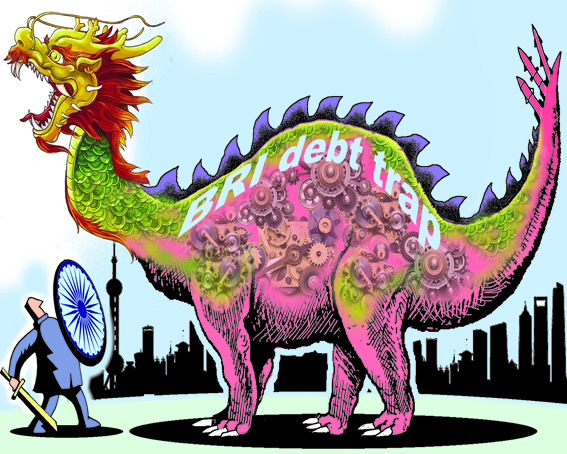
Sierra Leone has become the latest country to scrap a Belt and Road (BRI) project, cancelling a $318-million airport deal with China. After smooth sailing, the BRI is now encountering strong headwinds, as partner-nations worry about sovereignty-eroding debt traps. In multiple countries, BRI projects are being scrapped or scaled back.

India was the first country to come out against the opaque BRI, Chinese President Xi Jinping’s marquee initiative. India boycotted Xi’s much-hyped BRI summit, held to drum up global support for his initiative. The May 2017 summit in Beijing attracted 29 heads of state or government, including Russia’s Vladimir Putin and Turkey’s Recep Tayyip Erdoğan. But, while the US sent a joint secretary-equivalent official to the summit, India sent no one.

Indeed, India publicly portrayed BRI as a non-transparent, neocolonial enterprise aimed at ensnaring smaller, cash-strapped states in a debt trap to help advance China’s geopolitical agenda. An official Indian statement before the BRI summit declared that “connectivity initiatives must be based on universally recognized international norms, good governance, the rule of law, openness, transparency and equality” and that they must also “follow principles of financial responsibility to avoid projects that would create unsustainable debt burden”.

Some commentators in India were quick to claim that, through its summit boycott, India had isolated itself. They also predicted that India would come out a loser by turning its back on what they saw as a promising infrastructure-building initiative that New Delhi too should have tapped.

But at the BRI summit itself, India received implicit support. The European Union openly echoed India’s concerns by saying the BRI did not include commitments to transparency and social and environmental sustainability. The EU’s refusal to back Xi’s BRI-related trade statement marred the summit.

Before long, the US began depicting the BRI as the dawn of a new colonial era. Then US Secretary of State Rex Tillerson called China a “new imperialist power” whose practices are “reminiscent of European colonialism”.

The word “predatory” is now being used internationally about China’s practices. The International Monetary Fund has warned that Chinese loans are promoting unsustainable debt burdens. The price such burdens exact can extend to national sovereignty and self-respect. The handover of Hambantota port on a 99-year lease to China was seen in Sri Lanka as the equivalent of a heavily indebted farmer giving away his daughter to the cruel money lender.

Beijing has leveraged big credits to gain even military presence, as its first overseas naval base at Djibouti illustrates. Trapped in a debt crisis after borrowing billions of dollars, Djibouti was left with no choice but to lease land for the base to China for $20 million in annual rent. China is similarly seeking to employ its leverage over cash-strapped Pakistan to build a naval base next to Gwadar port.

In the Maldives, China has acquired several islets in that heavily indebted Indian Ocean archipelago. While the terms of the various lease agreements have not been disclosed, the acquisitions have come cheap; for example, China paid just $4 million for Feydhoo Finolhu, an island that previously served as a police training centre.

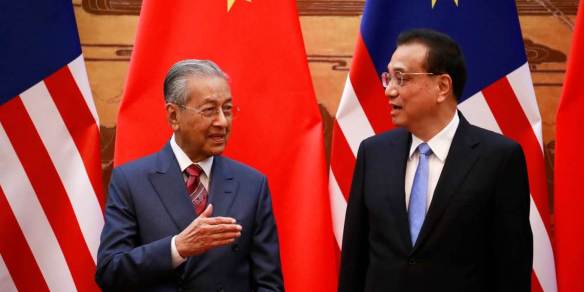
However, China’s grandiose BRI plans are running into broader resistance. Malaysian Prime Minister Mahathir Mohamad, with Chinese Premier Li Keqiang by his side in Beijing’s Great Hall of the People, recently criticized China’s use of infrastructure projects to spread its influence. By warning China against “a new version of colonialism”, Mahathir highlighted international concerns over Beijing’s use of geo-economic tools to achieve geopolitical objectives.

Sri Lanka’s experience has been a wake-up call for other countries with outsize debts to China. A number of BRI partner-states have begun trying to renegotiate their deals with Beijing. Some have decided to cancel or scale back projects. Mahathir, during his Beijing visit, announced the cancellation of Chinese projects worth nearly $23 billion. And China’s close ally, Pakistan, has downsized its main BRI railroad project by $2 billion.

The BRI seeks to export China’s model of top-down, debt-driven development through government-to-government deals clinched without competitive bidding. But, increasingly, the BRI is being seen internationally as an attempt to remake global commerce on China’s terms and project Chinese power far and wide.

Vulnerable countries are awakening to the risks of accepting loans that are too good to be true and then slipping into debt entrapment. China is even replicating some of the practices that were used against it during the European-colonial period, such as the concept of a 99-year lease. The BRI, by creating a mountain of debt, risks undermining China’s international standing, including engendering hidden hostility. A broader pushback against China’s mercantilist practices is already emerging.

Against this background, India’s brave, principled stand against the BRI stands fully vindicated. India can pride itself as the intellectual leader that helped shine a spotlight on the BRI’s financial and security risks and thereby moulded the international debate. The larger international pushback against China’s predatory practices is likely to intensify in the coming years, putting greater pressure on the BRI.

The writer is a geostrategist.

© The Times of India, 2018.

The End of America’s China Fantasy

Over the last couple of years, the China-policy debate in the US has begun to reflect more realism, with a growing number of voices recognizing China’s ambition to supplant its American benefactor as the leading global superpower. But is it too late to rein in America’s main geopolitical rival?

283f0c5841fac1940b45021cadf003d1.2-1-super.1

BRAHMA CHELLANEY, a column internationally syndicated by Project Syndicate

A long-overdue shift in America’s China policy is underway. After decades of “constructive engagement” – an approach that has facilitated China’s rise, even as the country has violated international rules and norms – the United States is now seeking active and concrete counter-measures. But is it too late to rein in a country that has emerged, with US help, as America’s main geopolitical rival?

From Richard Nixon to Barack Obama, successive US presidents regarded aiding China’s economic rise as a matter of national interest; indeed, Jimmy Carter once issued a presidential memo declaring as much. Even as China defied world trade rules, forced companies to share their intellectual property, and flexed its military muscles, the US held onto the naive hope that, as China became increasingly prosperous, it would naturally pursue economic and even political liberalization.

America’s “China fantasy,” as James Mann calls it, was exemplified by Bill Clinton’s argument in favor of allowing China’s admission to the World Trade Organization. Citing Woodrow Wilson’s vision of “free markets, free elections, and free peoples,” Clinton declared that China’s WTO entry would herald “a future of greater openness and freedom for the people of China.”

That is not what happened. Instead, China established itself at the center of global manufacturing value chains, as countless companies moved their production to the country – including from the US – while keeping its markets, politics, and people under tight control. In fact, China’s dictatorship has become even more entrenched in recent years, as the Communist Party of China has used digital technologies to build a surveillance state. Meanwhile, the US has run up trillions of dollars in bilateral trade deficits.

Nonetheless, America’s China fantasy endured, leading Obama to look on as the country created and militarized artificial islands in the South China Sea. At the height of the Chinese government’s island-building, Obama argued that “we have more to fear from a weakened, threatened China than a successful, rising China.” As a result, China seized de facto control of a highly strategic sea corridor through which one-third of global maritime trade passes – all without incurring any international costs.

Over the last couple of years, however, the China-policy debate in the US has begun to reflect more realism, with a growing number of voices recognizing China’s ambition to supplant its American benefactor as the leading global superpower. The US finally called China what it is: a “revisionist power” and “strategic competitor.” And, just this month, Vice President Mike Pence bluntly accused China of “using political, economic, and military tools, as well as propaganda, to advance its influence and benefit its interests” in the US.

This rhetorical shift is being translated into action. President Donald Trump’s trade war, in particular, has grabbed headlines, though many observers have failed to discern the strategy behind the tariffs.

Whereas Trump has used tariffs against allies as leverage to secure concessions and clinch new trade deals, US tariffs targeting China – which could endure for years – are intended to bring about more fundamental and far-reaching change. Even the revised deals with US allies are intended partly to isolate China, thereby forcing it to abandon its mercantilist trade practices, such as forced technology transfer.

But what the Trump administration has initiated goes beyond tariffs; it amounts to a structural change in America’s China policy that promises to reshape global geopolitics and trade. Because this change aligns with an incipient US bipartisan consensus in favor of more assertive action to constrain China, it is likely to outlast Trump’s presidency.

To be sure, this does not mean that the US is going to adopt an overtly confrontational China policy. Nor does it necessarily mean that, as many , a new cold war is in the offing. For example, China still gets a free pass on human-rights abuses, from holding up to a million Muslims from Xinjiang province in internment camps to effectively kidnapping Interpol President Meng Hongwei. And, despite his assertions that the Obama administration’s response to China’s activities in the South China Sea was “impotent,” Trump has done little to counter Chinese expansionism.

Instead, the US seems to hope that it can use primarily economic levers to weaken China – a kind of death from a thousand cuts. But will it be enough? Or is the US effectively shutting the stable door after the horse has bolted?

China is already challenging the US for technological and geopolitical primacy, and flaunting its authoritarian capitalism as an alternative to democracy. Communism couldn’t pose a credible challenge to liberal democracy, but authoritarian capitalism might. In that sense, China’s model represents the first major challenge to liberal democracy since the rise of Nazism.

Thanks to its great strides in strengthening its technological prowess and geopolitical clout, China is in a strong position to withstand US pressure to change its ways. It will have to sacrifice some economic growth. But for President Xi Jinping, such a sacrifice would be worth it, if it meant protecting not only his own position, but also his “Chinese dream” of global preeminence. Even if US pressure escalates significantly, China will likely adopt a “two steps forward, one step back” strategy to keep progressing toward its ambitious goals.

This is not to say that US efforts are for naught. On the contrary, its policy shift amounts to its last chance to stop China before it secures the critical technologies it needs to gain the upper hand geopolitically in Asia and beyond. Even if it is too late to force China to respect international rules and human rights, it is never too soon to end China’s damaging free ride.

© Project Syndicate, 2018.

Why Mike Pence is playing bad cop against China

As the trade war escalates, Donald Trump is seeking to preserve space for a possible deal and leaving his deputy to tackle the tough questions.

SPACE-FORCE

Brahma Chellaney, The National

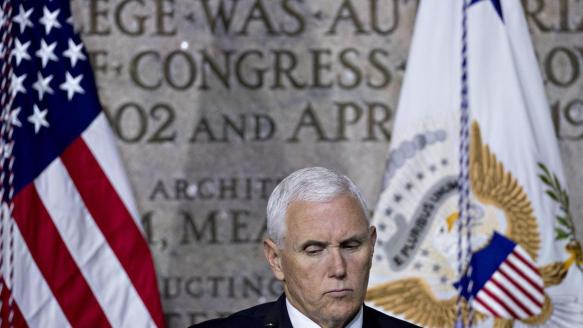
After a landmark speech this month at the Hudson Institute, which signalled a fundamental shift in America’s China policy, Vice President Mike Pence will lead a US delegation to three important multilateral summits in November. While President Donald Trump has lavished praise on China’s President Xi Jinping despite their escalating trade war, Pence is leading the administration’s charge against China.

Mr Trump and Mr Pence might, in fact, be playing a deliberate game of good cop, bad cop.

Mr Trump’s handling of China reflects his reluctance to antagonize Mr Xi or impose sanctions on China even in response to egregious human-rights abuses, including its internment of up to one million Muslims from Xinjiang. Had Russia set up such camps, the US response would likely have been swift and resolute.

The US president is a great believer in the idea that a good rapport between heads of government can significantly shape the relationship between the countries they lead. He also prides himself on being a great negotiator and deal-maker.

While letting his vice president forthrightly articulate America’s concerns over China, Mr Trump is seeking to preserve space to cut a possible deal with Mr Xi on trade. Mr Trump and Mr Xi, in their first face-to-face interaction in nearly a year, are likely to meet on November 29 in Buenos Aires, a day before the G20 summit opens there.

In his recent speech, Mr Pence highlighted how China is blending economic aggression, territorial and maritime revisionism, military adventurism, influence operations and Orwellian repression at home to advance its ambitions.

More importantly, Mr Pence declared that “the US has adopted a new approach to China”, saying that “previous administrations all but ignored China’s actions. And in many cases, they abetted them. But those days are over.”

The speech laid out why the Trump administration is making a course correction in the China policy that successive American presidents have pursued since the early 1970s, when the US managed the diplomatic coup of splitting its two main enemies – the Soviet Union and China. With the US winning over China to its side, it became two against one. This proved a critical factor in the eventual US victory in the Cold War and the Soviet Union’s collapse.

In return, the US actively aided China’s rise. After Deng Xiaoping emerged as China’s paramount leader in 1978, following a fierce power struggle, and embarked on economic modernisation, the US lent full support to his mission.

The US policy of assisting China’s economic ascent did not change even in response to the 1989 Tiananmen Square massacre. There, Chinese authorities used tanks to ruthlessly crush student-led protests in the heart of Beijing – an action that left hundreds, possibly thousands, dead.

But now the Trump administration has unveiled a new strategy to shift the US relationship with China from co-operation to competition, including confronting Chinese mercantilism and Beijing’s campaign of influence operations on American soil.

As Mr Pence put it, the US miscalculated that after the fall of the Soviet Union, “a free China was inevitable”. Today, according to him, an increasingly authoritarian and aggressive China has “mobilised covert actors, front groups, and propaganda outlets to shift Americans’ perception of Chinese policy … what the Russians are doing pales in comparison to what China is doing across this country”.

Against this backdrop, it might seem appropriate that Mr Trump is sending the blunt-speaking Mr Pence in his place to the forthcoming multilateral summits in the Indo-Pacific region − the East Asia Summit (EAS) and the US-Asean summit, both to be held in Singapore in mid-November, followed by the Asia Pacific Economic Cooperation (APEC) group summit at Port Moresby, Papua New Guinea, on November 17-18.

APEC summits, instituted in 1993, have become largely symbolic, and Mr Trump’s absence at Port Moresby will not be unusual. Bill Clinton missed two summits and Barack Obama skipped one. As APEC’s membership has expanded, the grouping’s cohesiveness and mission have weakened.

The promise of the 18-nation EAS has also faded. Like the 21-nation APEC, the EAS includes America’s main geopolitical rivals, China and Russia.

In this light, to counter the rise of an increasingly muscular China that refuses to play by international rules, substance matters more for US policy than group photographs at multilateral summits.

It is significant that, in an otherwise polarised and divided Washington, a bipartisan consensus is emerging that the failed US policy of “constructive engagement” with China must be replaced with concrete counteraction.

For example, in a Harvard University essay this month, Obama’s defence secretary, Ashton Carter, writes: “Washington since the end of the Cold War has often backed down in the face of Chinese bullying. From aggressive territorial claims to human-rights abuses and brazen theft on a trillion-dollar scale, China has violated core international norms time and again with little repercussions beyond scolding American speeches”.

Mr Carter recommends that, “when China behaves inappropriately on the international stage, the US must firmly push back and stand up for the principles of international order”. Mr Pence has signalled that this is precisely what the Trump administration intends to do.

Brahma Chellaney is a geostrategist and the author, most recently, of the award-winning Water, Peace, and War.

Maldives: India should not rest on its oars

maldives-india

Brahma Chellaney, The Hindustan Times

Following President Abdulla Yameen’s surprise defeat in the Maldivian election, the air of self-congratulation that pervades in New Delhi risks obscuring the challenges. India ought to learn from its experience with Sri Lanka, where China has retained its influence and leverage even after authoritarian President Mahinda Rajapaksa was thrown out by voters in early 2015. In the Maldives, China may be down, but it’s not out and could, as in Sri Lanka, re-establish its clout through debt-trap diplomacy.

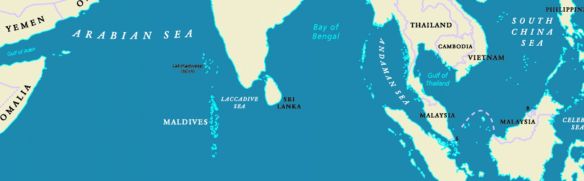
The Maldivian archipelago, despite its tiny population, is of key importance to Indian security, given that it sits astride critical sea lanes through which much of India’s shipping passes. From the Indian naval station on the Lakshadweep island of Minicoy, the Maldives’ northernmost Thuraakunu Island is just 100 kilometers away.

The election victory of opposition candidate Ibrahim Mohamed Solih against an increasingly autocratic Yameen cannot by itself roll back the deep strategic inroads China made during the incumbent president’s rule. To be sure, the outcome represents a triumph of Indian patience. Had India militarily intervened in the Maldives, it could have provoked a nationalistic backlash and strengthened Islamist forces in a country that has supplied the world’s highest per-capita number of foreign fighters to terrorist groups in Syria and Iraq.

After Yameen in February declared a state of emergency and jailed Supreme Court justices and political opponents, India came under pressure, including from the Maldivian opposition, to intervene militarily, as it did once before — in 1988 when it foiled an attempted coup. But unlike in 1988, no legitimate authority was inviting India to send in forces. By erring on the side of caution, and by holding out an intervention threat if the voting were not free and fair, India aided the electoral outcome.

Contrast this with Indian missteps in Nepal, where India woke up belatedly to the political machinations in Kathmandu that led to a flawed new Constitution being promulgated. India then backed the Madhesi movement for constitutional amendments — an agitation that triggered a five-month border blockade of essential supplies to Nepal. The resulting Nepalese grassroots backlash against India eventually contributed to the China-aided communists sweeping Nepal’s 2017 elections.

The restoration of full democracy in the Maldives after, hopefully, a smooth transfer of power on November 17 will be a diplomatic boost for India. However, in India’s larger strategic backyard, China continues to systematically erode Indian clout. Indeed, the Maldivian election result coincided with a major development underscoring Nepal’s pro-China tilt. After implementing a transit transport agreement with China to cut dependence on India, communist-ruled Nepal — under Chinese pressure — has reversed its previous government’s cancellation of the $2.5 billion Budhi-Gandaki Dam project. China bagged the project without competitive bidding. It massively inflated the project cost, which will leave Nepal struggling to repay the Chinese debt.

Yameen, who signed major financing and investment deals with Beijing, will be departing after pushing the Maldives to the brink of a Chinese debt trap. Can the Maldives still escape debt entrapment by emulating the example set by Malaysia’s Mahathir Mohamad, who recently cancelled Chinese projects worth almost $23 billion? Or is the Maldives, like Sri Lanka, already so indebted that it will remain under China’s sway? Nearly 80% of the Maldives’ external debt — equivalent to about one-quarter of its GDP — is owed to China.

Even without any new contracts, the Maldivian debt to China will rise because of the Chinese projects already completed or initiated, thus allowing Beijing to retain its favourite source of leverage. Indeed, Beijing will seek to court Yameen’s successor just as it has in Sri Lanka wooed Rajapaksa’s successor, who has disclosed that China has “gifted” him $300 million “for any project of my wish,” besides constructing South Asia’s largest kidney hospital in his electoral district.

In this light, the post-Yameen Maldives — like Nepal, Bangladesh and Sri Lanka — would likely seek to balance relations with India and China, thus reinforcing how Beijing has fundamentally altered geopolitics in a subregion New Delhi long considered its natural sphere of influence. As Maldives’ closest partner, a proactive India must leverage its ties. India should assist in infrastructure development and be willing to refinance Maldives’ Chinese debt so as to achieve lower costs and a longer-term maturity profile.

India will have to closely watch China’s activities in the unpopulated Maldivian islands it managed to lease during Yameen’s reign. China is muscling its way into India’s maritime backyard, including sending warships to the Maldives and signing an accord for an ocean observatory there that could provide critical data for deploying Chinese nuclear submarines. The new Maldivian government should be left in no doubt about India’s “red lines”.

Brahma Chellaney is a geostrategist and author.

© The Hindustan Times, 2018.

The China Backlash

US President Donald Trump’s headline-grabbing trade war with China should not obscure a broader pushback against the country’s mercantilist trade, investment, and lending practices. In fact, China’s free ride could be coming to an end.

712d438997986267461f01784924b61d.2-1-super.1

On a recent official visit to China, Malaysian Prime Minister Mahathir Mohamad criticized his host country’s use of major infrastructure projects – and difficult-to-repay loans – to assert its influence over smaller countries. While Mahathir’s warnings in Beijing against “a new version of colonialism” stood out for their boldness, they reflect a broader pushback against China’s mercantilist trade, investment, and lending practices.

Since 2013, under the umbrella of its “Belt and Road Initiative,” China has been funding and implementing large infrastructure projects in countries around the world, in order to help align their interests with its own, gain a political foothold in strategic locations, and export its industrial surpluses. By keeping bidding on BRI projects closed and opaque, China often massively inflates their value, leaving countries struggling to repay their debts.

Once countries become ensnared in China’s debt traps, they can end up being forced into even worse deals to compensate their creditor for lack of repayment. Most notably, last December, Sri Lanka was compelled to transfer the Chinese-built strategic port of Hambantota to China on a 99-year, colonial-style lease, because it could longer afford its debt payments.

Sri Lanka’s experience was a wake-up call for other countries with outsize debts to China. Fearing that they, too, could lose strategic assets, they are now attempting to scrap, scale back, or renegotiate their deals. Mahathir, who previously cleared the way for Chinese investment in Malaysia, ended his trip to Beijing by canceling Chinese projects worth almost $23 billion.

Countries as diverse as Bangladesh, Hungary, and Tanzania have also canceled or scaled back BRI projects. Myanmar, hoping to secure needed infrastructure without becoming caught up in a Chinese debt trap, has used the threat of cancellation to negotiate a reduction in the cost of its planned Kyaukpyu port from $7.3 billion to $1.3 billion.

Even China’s closest partners are now wary of the BRI. In Pakistan, which has long worked with China to contain India and is the largest recipient of BRI financing, the new military-backed government has sought to review or renegotiate projects in response to a worsening debt crisis. In Cambodia, another leading recipient of Chinese loans, fears of effectively becoming a Chinese colony are on the rise.

The backlash against China can be seen elsewhere, too. The recent annual Pacific Islands Forum meeting was one of the most contentious in its history. Chinese policies in the region, together with the Chinese delegation leader’s behavior at the event itself, drove the president of Nauru – the world’s smallest republic, with just 11,000 inhabitants – to condemn China’s “arrogant” presence in the South Pacific. China cannot, he declared, “dictate things to us.”

When it comes to trade, US President Donald Trump’s escalating trade war with China is grabbing headlines, but Trump is far from alone in criticizing China. With policies ranging from export subsidies and nontariff barriers to intellectual-property piracy and tilting the domestic market in favor of Chinese companies, China represents, in the words of Harvard’s Graham Allison, the “most protectionist, mercantilist, and predatory major economy in the world.”

As the largest merchandise exporter in the world, China is many countries’ biggest trading partner. Beijing has leveraged this role by employing trade to punish those that refuse to toe its line, including by imposing import bans on specific products, halting strategic exports (such as rare-earth minerals), cutting off tourism from China, and encouraging domestic consumer boycotts or protests against foreign businesses.

The fact is that China has grown strong and rich by flouting international trade rules. But now its chickens are coming home to roost, with a growing number of countries imposing antidumping or punitive duties on Chinese goods. And as countries worry about China bending them to its will by luring them into debt traps, it is no longer smooth sailing for the BRI.

Beyond Trump’s tariffs, the European Union has filed a complaint with the World Trade Organization about China’s practices of forcing technology transfer as a condition of market access. China’s export subsidies and other trade-distorting practices are set to encounter greater international resistance. Under WTO rules, countries may impose tariffs on subsidized goods from overseas that harm domestic industries.

Now, Chinese President Xi Jinping finds himself not only defending the BRI, his signature foreign-policy initiative, but also confronting domestic criticism, however muted, for flaunting China’s global ambitions and thereby inviting a US-led international backlash. Xi has discarded one of former Chinese strongman Deng Xiaoping’s most famous dicta: “Hide your strength, bide your time.” Instead, Xi has chosen to pursue an unabashedly aggressive strategy that has many asking whether China is emerging as a new kind of imperialist power.

International trade has afforded China enormous benefits, enabling the country to become the world’s second-largest economy, while lifting hundreds of millions of people out of poverty. The country cannot afford to lose those benefits to an international backlash against its unfair trade and investment practices.

China’s reliance on large trade surpluses and foreign-exchange reserves to fund the expansion of its global footprint makes it all the more vulnerable to the current pushback. In fact, even if China shifts its strategy and adheres to international rules, its trade surplus and foreign-currency reserves will be affected. In short, whichever path it chooses, China’s free ride could be coming to an end.

© Project Syndicate, 2018.

Beijing loses a battle in the Maldives — but the fight for influence goes on

China may be down in the Maldives, but it’s not out

https_s3-ap-northeast-1.amazonaws.compsh-ex-ftnikkei-3937bb4images181015880181-1-eng-GB20180925 India China Img

India must challenge China to help the Maldives retain strategic autonomy. (Source photo by Reuters)

Brahma ChellaneyNikkei Asian Review

The Indian Ocean nation of the Maldives, comprising 1,190 coral atolls, has been roiled by a deepening national crisis since its first democratically-elected president was forced to resign at gunpoint in 2012.

This week’s surprise defeat of authoritarian President Abdulla Yameen in a national election opens the path to stability and reconciliation under the leadership of the winning opposition candidate Ibrahim Mohamed Solih.

Yameen’s defeat, despite the jailing of opponents and Supreme Court justices and efforts to manipulate the election, shows how autocrats can be swept out of office by a voters’ backlash. And that even in a country with weak democratic traditions.

The Maldives follows Malaysia, where, in May, Prime Minister Najib Razak was voted out and now faces corruption charges under his 93-year-old successor, Mahathir Mohamad. Sri Lanka’s voters in 2015 similarly ended the quasi-dictatorship of President Mahinda Rajapaksa, who curtailed media freedom.

In all three states, China’s shadow loomed large. Yameen signed major financing and investment deals with China and, like Najib and Rajapaksa, is alleged by his opponents to have received Chinese funds for his reelection bid.

While Malaysian investigators are probing whether China helped bankroll Najib’s reelection bid, The New York Times reported in June that the state-run China Harbor Engineering Company allegedly gave $7.6 million for Rajapaksa’s campaign. Rajapaksa and CHEC have denied the claim, but new president Maithripala Sirisena’s government has called for an investigation.

China, Yameen’s main defender, capitalized on its support to expand its influence in the strategic Maldivian archipelago. Yameen, for his part, felt emboldened by Chinese support to crack down on the opposition and undermine national institutions, including the judiciary and the election commission.

With barely 450,000 citizens, the Maldives is tiny but sits astride critical shipping lanes, making it vital to security in the Indian Ocean. Yameen’s rout thus is a setback to China’s maritime ambitions and political influence, and a victory for grass roots democratic forces.

At a time when Beijing is beginning to encounter a wider pushback against its Belt and Road Initiative — an influence-building infrastructure program that can ensnare vulnerable countries in debt traps — the Maldives represents the latest case of a democratic election upending China’s plans. BRI could face speed bumps even in China’s close ally, Pakistan, where the new, cash-strapped government has instituted a review of Chinese projects.

China, however, can take comfort from the formation of a friendly, democratically elected communist government in the Himalayan state of Nepal. In a demonstration of autocratic China’s ability to exploit the openness of a democracy, it helped unite warring communist factions in Nepal and funded their election campaign.

In the Maldives, pressure from democratic powers, including the specter of an Indian military intervention, played a role in the outcome. The U.S. had warned of “appropriate measures” and the European Union had threatened sanctions if the vote was not free and fair. And when Yameen hesitated to concede defeat, Washington demanded he “respect the will of the people,” while India sought to present a fait accompli by being first to congratulate his opponent, Solih. (In the previous election in 2013, Yameen got the Supreme Court to annul the result after he trailed his opponent, forcing fresh polls which he dubiously won.)

India has traditionally viewed the Maldives as in its sphere of influence. So as China began eroding Indian influence by backing Yameen from 2013, concern grew in New Delhi that Beijing could turn one of the unpopulated Maldivian islands it had leased into a naval base, completing a strategic encirclement of India.

Among the islands China has acquired is Feydhoo Finolhu, for which it paid $4 million, less than the cost of a luxury apartment in Hong Kong; another island, the 7km-long Kalhufahalufushi, came even cheaper. China has revealed its strategic intentions by sending frigates to the Maldives.

After Yameen in February declared a state of emergency and jailed Supreme Court justices for quashing convictions against nine jailed or exiled opposition figures, India came under pressure, including from the Maldivian opposition, to intervene militarily, as it did once before – in 1988 when it foiled an attempted coup. The Indian intervention helped President Maumoon Abdul Gayoom to perpetuate his soft autocracy for another two decades.

An intervention this year, however, would have been dicey, not least because no legitimate authority had invited India to send in forces. The intervention could have provoked a nationalistic backlash and strengthened Islamist forces in the Maldives, which has supplied the world’s highest per capita number of foreign fighters to terrorist groups in Syria and Iraq. By correctly erring on the side of caution, India aided this week’s electoral outcome.

The restoration of full democracy in the Maldives, like in Malaysia, bucks an international trend: The global spread of democracy has largely stalled, with liberal forces unable to gain ground in the face of both tightly centralized political systems (as in China) and a revival of authoritarianism (as in Russia). While democracy has become the norm in large parts of Europe, very few Asian states are true democracies.

The return of democracy to the Maldives is especially remarkable as the country has been under authoritarianism for 50 of the 53 years since gaining independence from Britain in 1965. Yameen’s five-year rule marked a shift to hard authoritarianism, with that lurch being accompanied by the rising power of Islamists.

In the latest election, Yameen chose as his running mate a Muslim preacher with close ties to Saudi groups and got support from Jamiyyath Salaf. This extremist organization was one of the Islamist groups behind the 2012 museum attack that erased evidence of the country’s pre-Islamic past by destroying priceless Buddhist and Hindu statues.

The triumph of democratic forces, however, cannot mask the tough challenges that await Yameen’s successor, Solih, including on how to deal with Islamist power and service Chinese debt (which currently equals more than a quarter of the country’s gross domestic product). One key question is whether the Maldives will be able to pull back from the brink of a Chinese debt trap (by emulating the example set by Mahathir, who has canceled Chinese projects) or whether it is so indebted – as Sri Lanka is — that it will remain under Beijing’s sway.

China invested heavily in Sri Lanka during the rule of Rajapaksa, whom it shielded at the United Nations from allegations of war crimes. Sirisena sought to extricate Sri Lanka from the Chinese debt trap, including suspending work on major projects. But it was too late: Saddled with debts his government could not repay, Sirisena was forced to accept Chinese demands, including restarting suspended projects and handing the strategic Hambantota port to China on a 99-year lease.

Under Solih, even without new contracts, the Maldives’ debt to China will rise because of the Chinese projects already initiated. Beijing will court Solih — to be sworn in on Nov. 17 — just as it has wooed Sirisena, who has disclosed that China has “gifted” him $300 million “for any project of my wish,” besides constructing South Asia’s largest kidney hospital in his home district.

To reclaim its influence in the Maldives, India will have to do more than help strengthen the restored democracy; it must assist the new government in infrastructure development and meeting its foreign debt obligations, including by extending low-interest loans to pay off Chinese credits. Escaping debt entrapment is vital for the Maldives to retain strategic autonomy.

Brahma Chellaney is a geostrategist and the author, most recently, of the award-winning “Water, Peace, and War.”

© Nikkei Asian Review, 2018.

India’s Indus leverage

India must assert its full rights under the Indus Waters Treaty to leverage the pact and halt Pakistan’s undeclared war against it through terrorist proxies.

Indus-system rivers

Brahma Chellaney, The Hindustan Times

In foreign policy, it is important for national leadership to choose its rhetoric carefully and back its words with at least modest action. Words not backed by any action can undermine a country’s credibility and perhaps even its deterrence.

When Prime Minister Narendra Modi raised the Balochistan issue in his Independence Day speech in 2016, he seemed to signal an important Indian policy shift. At least that is how his reference to Balochistan was widely interpreted. But since then, India has been totally silent on the issue, although Balochistan — Pakistan’s Achilles heel — threatens to become the new East Pakistan because of military killings and mass graves. India has even denied visas to some exiled Baloch activists.

Take another key issue: the Indus Waters Treaty (IWT). In 1960, in the naïve hope that water largesse would yield peace, India gifted the bulk of the Indus system’s waters — and the largest three of its six rivers — to Pakistan under the IWT. The Indus treaty remains a colossus on the world stage: It is by far the world’s most generous water pact, both in terms of the downstream country’s share of the waters (80.52%) and the aggregate volume of average yearly flows reserved for it (167.2 billion cubic metres). Still, an ungrateful Pakistan has waged covert or overt aggression almost continuously and is now using the IWT itself as a stick to beat India with, including by contriving water disputes and internationalizing them as part of a “water war” strategy.

Against this background, Modi raised the hope that India would finally revisit the IWT, by seizing on the Pakistan Senate’s unanimous March 2016 resolution calling for the treaty’s re-evaluation. Indeed, while chairing a September 2016 internal meeting on the IWT, Modi warned that, “Blood and water cannot flow together”. Setting in motion the treaty’s reappraisal, an inter-ministerial committee of secretaries was established, and officials said that India would now assert all its rights under the IWT, including fully utilizing its share of the allotted waters and expediting its long-delayed hydropower projects.

But two years later, India, alas, appears to have returned to the former state of affairs. The committee of secretaries, headed by the PM’s principal secretary, has fallen by the wayside. Apart from completing the small, 330-megawatt Kishenganga project after 11 years, India has shown little urgency on Indus Basin water projects. Even as Punjab and other states bitterly feud over water, India’s failure to adequately harness the resources of the three smaller rivers reserved for it results in Pakistan receiving substantial bonus waters. Just these extra outflows to Pakistan are many times greater yearly than the total volumes under the Israeli-Jordanian water arrangement.

India’s zigzag policy is most apparent from the recent meeting of the Permanent Indus Commission (PIC). The IWT calls for the PIC to meet at least once a year. The previous PIC meeting, like the one before it, was convened after almost 12 months — on March 29-30 this year. The next meeting was not due until 2019, yet India held a fresh PIC meeting just five months later.

The recent August 29-30 meeting, held in Lahore, marked the first bilateral engagement since the new military-backed Imran Khan government took office in Pakistan. With Pakistan’s international isolation deepening and its economy in dire straits, the military there is tactically seeking “peace” talks with India while still employing terrorists in a proxy war. Through such talks, it also hopes to legitimize the government it helped install through a manipulated election. But with India’s own elections approaching, talks with Pakistan will be politically risky for the ruling BJP.

The PIC discussions — and a prospective foreign ministers’ meeting in New York — illustrate how Modi’s government is seeking to engage Islamabad in other ways. In fact, India has given permission to Pakistan’s Indus commissioner and two other officials to shortly begin a tour of inspection of Indian projects in Jammu and Kashmir and elsewhere. In the past, such a tour has been used to collect new information so as to mount objections to Indian projects. In keeping with its broader strategy to foment discontent and violence in J&K, Pakistan seeks to deny J&K people the limited water benefits permissible under the IWT.

While the US has dumped international pacts at will (from the Anti-Ballistic Missile Treaty to the Kyoto and Paris accords), India still clings to the world’s most-lopsided water treaty, adhering to its finer details, even as Pakistan refuses to honour the terms of the central treaty governing bilateral relations — the 1972 Simla peace pact. Pakistan also flouts its commitment to prevent its territory from being used for cross-border terrorism. The Indus may be Pakistan’s jugular vein, yet a visionless and water-stressed India has let the IWT hang from its neck like the proverbial albatross. Make no mistake: Only by asserting its Indus leverage can India hope to end Pakistan’s unconventional war.

Brahma Chellaney is a geostrategist and author.

© The Hindustan Times, 2018.

Nepal’s communist challenge to India

Communist-ruled Nepal’s troubling tilt toward China — as exemplified by latest developments — is a reminder of the costs India is incurring for its blunder in engineering the ouster of Nepal’s constitutional monarchy and inadvertently paving the path to communist domination.

Brahma Chellaney, DailyO

nepal-1_091018085735

Nepal is a state symbiotically tied to India. Yet today it has an openly pro-China communist government that is hostile to India. The number of communist-ruled countries in the world increased by one to six earlier this year when landlocked Nepal joined China, Cuba, Laos, North Korea and Vietnam.

Despite Prime Minister Narendra Modi’s efforts to woo him, Nepal’s new prime minister, Khadga Prasad Oli, persists with his troubling tilt toward China.

Consider the latest two reminders of Oli’s approach: His government has pulled out of the first ever anti-terror military exercises being held from September 10 in Pune under the auspices of the grouping known as the Bay of Bengal Initiative for Multi-Sectoral Technical and Economic Cooperation, or BIMSTEC; and it has implemented a transit transport agreement with China mainly to undercut India’s leverage.

Nepal, a member of BIMSTEC along with India, Thailand, Myanmar, Bangladesh, Bhutan and Sri Lanka, had initially agreed to send a platoon-size army contingent to participate in the “Milex 2018” exercises, which were mentioned by Modi in his address to the recent BIMSTEC summit in Kathmandu. Nepal also had agreed to send its army chief, General Purna Chandra Thapa, to the Milex 2018 closing ceremony.

But it reversed its decisions after a backlash from the increasingly powerful pro-China lobby, largely represented by the ruling Nepal Communist Party (NCP). Instead, in a symbolic gesture, Nepal has sent three observers to the week-long exercises.

The Oli government, in effect, delivered a diplomatic snub to India. This is reinforced by the fact that Nepal, while shunning participation in Milex 2018, is joining China in military exercises also focused on counter-terror operations. The China-sponsored September 17-28 exercises will commence in Chengdu (capital of Sichuan province) a day after the Pune drill concludes.

The BIMSTEC summit represented Modi’s fourth visit to Nepal in four years. No other Indian prime minister has lavished such attention on Nepal. In fact, Modi was the first Indian PM to visit Nepal in 17 years.

But no sooner had Modi returned home from his latest Nepal visit than Oli’s government signed a protocol implementing the Nepal-China Transit Transport Agreement (TTA). Under the TTA, Nepal can trade with third countries through China’s Shenzen, Lianyungang, Zhanjiang and Tianjin seaports. It will also have access to the Shigatse, Lhasa and Lanzhou land ports.

The TTA looks good only on paper. Nepal’s dependency on Indian ports arises from geography. While Kolkata is 933 kilometres away, the nearest Chinese seaport for Nepal is at a distance of 3,300 kilometres.

In implementing the TTA, Nepal is not seeking to replace India with China for transit transport. Rather, the intent of the Oli government is to try and blunt India’s natural-geographic advantage and undermine its transit clout. Through this accord, it hopes to preclude another crippling Indo-Nepalese border blockade by Nepal’s Indian-supported Madhesi (plains people) activists.

In May this year, after Nepal’s communist government took office, Modi paid an official visit to that Himalayan nation. In contrast to China’s efforts to muscle its way into Nepal, Modi’s well-received visit sought to emphasize India’s historically close cultural, religious and people-to-people relations with that nation.

From starting his visit at Janakpur — where, according to the Ramayana, Lord Rama wed Sita — to offering prayers at Kathmandu’s Pashupatinath Temple (the oldest and holiest Shiva temple in Nepal) and at the iconic Muktinath Temple (sacred to both Hindus and Buddhists), Modi sought to project India’s soft power to counter China’s hard power. The launch of an Indo-Nepal bus service from Janakpur (Sita’s hometown) to Ayodhya (her abode after marriage) underscored the historically strong cultural ties between the two countries.

But just five days after Modi returned home, a new unified communist party, the Nepal Communist Party (NCP), was launched with China’s support through the merger of Oli’s Marxist-Leninist Party and the Maoist group. The merger of the two main communist groups into one party came about three months after they jointly came to power. Beijing first midwifed the birth of the unified communist party and then applauded the development, saying that, “China supports the country in choosing the social system and development path that suits its national realities”.

In fact, the peaceful victory of the Nepali communists has helped to obscure their violent past. Oli spent years in jail in the 1970s and 1980s, as a communist guerrilla, for waging war against the state. Nepal’s establishment of multiparty democracy within the framework of a constitutional monarchy in 1990 opened up political space for Maoists and Oli’s party. The Maoists launched a bloody insurrection in 1996 with the aim of overthrowing the monarchy through a “people’s revolution”.

A decade later, India brokered a peace accord that ended the protracted war between Maoists and government forces in Nepal. But to meet the Maoists’ main demand, Indian Prime Minister Manmohan Singh’s government — dependent on the support of communists who had links with the Nepali communists — engineered the abolition of the constitutional monarchy.

This blunder, which paved the way for the communists to eventually gain political ascendancy, will continue to impose serious costs on India for years to come. The Nepali Maoists secured the monarchy’s overthrow not through their violent “revolution” but with the direct help of their supposed ideological foe, India, which to this day remains haunted, paradoxically, by its own Maoist scourge.

India helped turn Nepal from a Hindu kingdom to a communist-ruled, China-leaning state, seriously undercutting its own traditional influence there.

Today, with the new unified communist party dominating all state institutions, Beijing is actively working to bring Nepal within its orbit. In fact, before Nepal’s elections, Beijing reportedly persuaded the divided communists to form a coalition and helped fund their campaign.

Most communist parties, including the Chinese Communist Party, gained power by violent means. Of the six communist-ruled countries currently in the world, Nepal boasts the only democratically elected communist government.

Yet the key question is whether Nepal’s communist government will sustain democracy or gradually smother democracy. Will it follow the example of Czechoslovakia, which came under communist sway following national elections in 1946? By 1948, the Czechoslovak communists gained full control of the government and set out to stifle democracy.

Nepal’s PM, dubbed “Oily Oli” by his critics, has already started undermining the independence of his country’s institutions and stacking them with his own loyalists. The communists have almost two-thirds majority in Parliament and governments in six of the country’s seven provinces. Card-holding communists now hold all the constitutional and other key positions, with efforts under way to emasculate institutions — from the judiciary to the election commission.

If this assault continues, Nepal will be emulating the trajectory of how Czechoslovakia became a single-party state. In fact, a weak opposition, a pliant judiciary and an overbearing executive are already creating conditions in Nepal for creeping authoritarianism to set in.

Nepal’s internal developments directly impinge on Indian security. India and Nepal, after all, share one of the world’s most-open borders that permits passport-free passage. China’s increasing penetration of Nepal also carries major implications for India’s security.

India must end its kid-glove treatment of the communists in power in Nepal and consider them as a force inimical to its interests. New Delhi must disabuse the Nepali communists of their notion that they can sustain their hostility toward India without incurring any costs.

Brahma Chellaney is a geostrategist and the author of nine books, including the award-winning “Water: Asia’s New Battleground.”

A shadow over the ‘two-plus-two’ meeting

1_cIVpptHi4yCTOJaBjZCPdQ

Brahma Chellaney, The Hindustan Times, September 4, 2018

The US has emerged as India’s most important partner. The inaugural India-US “two-plus-two” ministerial dialogue will help highlight the growing convergence of their interests in the Indo-Pacific region. However, in India’s neighbourhood, Washington and New Delhi are still not on the same page.

For example, after gratuitously assassinating the third consecutive chief of the Pakistani Taliban this summer to please Pakistan’s military generals, the US held face-to-face talks with the Pakistan-backed Afghan Taliban in Qatar. While the Pakistani Taliban is the Pakistan military’s nemesis, the Afghan Taliban is America’s main battlefield foe in Afghanistan, yet the group is still missing from the US list of foreign terrorist organizations.

More broadly, the US and India have become key partners in seeking to create a free, open and democratic-led Indo-Pacific. The critical missing link in this strategy, however, is the South China Sea, which connects the Indian and Pacific oceans. US reluctance to impose tangible costs on China’s continued expansionism in the South China Sea has emboldened Chinese inroads in the Indian Ocean.

One issue likely to figure prominently in the two-plus-two meeting is how India has emerged as a prime victim of two new sets of US economic sanctions — on Iran and on Russia. The new sanctions directly impinge on India, a longstanding significant buyer of Russian weapons and the second-largest importer of Iranian oil after China.

The twin US pressures on energy and defence fronts have made India acutely aware of the risks of aligning itself closer with Washington. After ensnaring India in its Iran and Russia sanctions, Washington has sought to save the promising Indo-US strategic partnership by throwing in concessions. In reality, the concessions are intended as tools of leverage.

For example, the Pentagon’s top Asia official, characterizing Indian media reports as “misleading”, has made it clear that India can expect no waiver from Russia-related sanctions if it signs major new defence deals with Moscow. The congressional waiver crimps India’s leeway with its stringent conditions, including a six-monthly presidential certification specifying the other side’s active steps to cut its inventory of Russian military hardware.

On the Iran-related sanctions, no waiver for India is still in sight. With global shipping operators already pulling back from Iran business and oil prices rising, India’s energy-import bill is increasing. US sanctions threaten to affect even India’s Pakistan-bypassing transportation corridor to Afghanistan via Iran, including the Chabahar port project.

The Trump administration is clearly seeking to influence India’s arms-procurement and energy-import policies. This is in keeping with its increasing unilateralism, including dictating terms to allies and friends. Canada, for example, has been warned to accept US’s terms or face exclusion from the new NAFTA. Japan is buying a $2.1 billion US missile-defence system, not because it can effectively protect it from missile attacks, but because of US pressure to buy more American military hardware.

Washington is similarly pressuring New Delhi to buy more American weapons, although the US has already emerged as the largest arms seller to India. But, while the US basically sells defensive military systems, Russia has armed India with offensive weapons, including a nuclear-powered submarine and an aircraft carrier. Washington is also seeking to sell more oil and gas to India, besides pressing it to switch imports from Iran to Saudi Arabia and other US allies. However, next-door Iran, offering discounted pricing, will remain critical to India’s energy- diversification strategy.

Meanwhile, the US — after its success in getting India to accept a logistics assistance pact, which includes access to designated Indian military sites — has pushed for India to endorse the Communications Compatibility and Security Agreement (COMCASA), which the Indian armed forces initially feared could compromise their network. India, instead of leveraging its ties with Washington, appears set to announce at least an in-principle agreement on a modified COMCASA during the two-plus-two meeting, if not sign it.

Why is it that, in the run-up to any important summit or high-level meeting, India agrees to make a key concession to the other side? And why is that the other side doesn’t feel similarly pressured to make a concession to India? Isn’t reciprocity the first principle of diplomacy? Before finalizing COMCASA, India should clinch some major defence deals with Russia, including for the S-400 system, so as to test the US response. Instead, it is concluding new defence deals with the US.

The US and India will remain close friends. Washington, however, must fully address Indian concerns over the extraterritorial effects of its new Iran and Russia sanctions. Make no mistake: Washington has introduced a major irritant in the bilateral relationship that the twice-postponed two-plus-two dialogue cannot purge.

Brahma Chellaney is a geostrategist and author.

© The Hindustan Times, 2018.