China’s furtive wars of acquisition

BY BRAHMA CHELLANEY
In the way China made land-grabs across the mighty Himalayas in the 1950s by launching surreptitious encroachments, it is now waging furtive wars — without firing a single shot — to change the status quo in the South and East China seas, on the long line of control with India, and on international-river flows.

Although China has risen from a poor state to a global economic powerhouse, the key elements in its statecraft and strategic doctrine have not changed.

Since the Mao Zedong era, China has adhered to ancient theorist Sun Tzu’s advice: “The ability to subdue the enemy without any battle is the ultimate reflection of the most supreme strategy.”

This approach involves taking an adversary by surprise by exploiting its weaknesses and seizing an opportunistic timing, as well as camouflaging offense as defense. As Sun Tzu said, “All warfare is based on deception.” Only when a war by stealth cannot achieve the sought objectives should an overt war be unleashed.

China did stage overt military interventions even when it was poor and internally troubled. A Pentagon report has cited Chinese military preemption in 1950, 1962, 1969 and 1979 as examples of offense as defense. There was also China’s seizure of the Paracel Islands in 1974, the Johnson Reef in 1988, the Mischief Reef in 1995, and the Scarborough Shoal last year.

However, for a generation after Deng Xiaoping consolidated power, China actively promoted good-neighborly ties with other Asian states so as to concentrate on rapid economic growth. This strategy allowed Beijing to accumulate considerable economic and strategic heft while permitting its neighbors to spur their own economic growth by plugging into China’s dramatic economic rise.

The good-neighborly approach began changing from the past decade as the Chinese leadership started believing China’s moment in the sun had finally come.

One of the first signs was China’s 2006 revival of its long-dormant claim to the large northeastern Indian state of Arunachal Pradesh. Other evidence of a shift to a muscle-flexing approach followed, with China picking territorial fights with multiple neighbors and broadening its “core interests.” And last year, China formally staked a claim under the United Nations Convention on the Law of the Sea to more than 80 percent of the South China Sea.

From employing its trade muscle to inflict commercial pain on a rival to exploiting its monopoly on the global production of a vital resource like rare-earth minerals, China has staked out a more muscular role, heightening Asian and wider concerns. In fact, the more openly China has embraced market capitalism, the more indigenized its political ideology has become. The country’s elites — by turning their back on Marxist dogma, imported from the West — have put Chinese nationalism at the center of their political legitimacy. As a result, China’s new assertiveness has become more and more linked with national renewal.

Against this background, China’s increasing resort to furtive war to accomplish political and military objectives is turning into a principle source of strategic instability in Asia. The instruments employed are diverse, ranging from waging economic warfare to creating a new class of stealth warriors under the aegis of paramilitary agencies, such as the Maritime Safety Administration, the Fisheries Law Enforcement Command, and the State Oceanic Administration.

These agencies, with the support of the Chinese navy, have been in the vanguard to change the status quo in China’s favor in the South and East China seas. China has already scored some successes, encouraging it to pursue multidirectional assertiveness against more than one neighbor at the same time.

For example, after a months-long standoff with the Philippines, China took effective control of the Scarborough Shoal since last year by deploying ships around it and denying its adversary any access. Philippine fishermen can no longer enter a lagoon that served as their traditional fishing preserve.

With the Chinese ships staying put, the Philippines has been faced with a strategic Hobson’s choice: accept the new Chinese-dictated reality or risk open war.

Even as China has effectively changed the status quo on the ground, the U.S. has done little to come to the aid of its ally, the Philippines. The U.S. kept urging restraint and caution on both sides after a Philippine warship squared off with Chinese vessels near the shoal a year ago, prompting China to embark on economic warfare.

Beijing sought to bankrupt many banana growers in the Philippines and hammer the tourism industry there by curbing banana imports and issuing an advisory against travel to that country. The shoal lies more than 800 kilometers from the Chinese mainland but is well within the Philippines’ “exclusive economic zone,” as defined under the Law of the Sea Convention.

In China’s furtive offensive to contest the decades-old Japanese control over the Senkaku Islands, Beijing has already succeeded in its opening gambit — to make the international community recognize the existence of a dispute. In that sense, the new war of attrition China has launched against Japan over the Senkakus has helped shake the status quo.

By sending patrol ships frequently to the waters around the islands since last fall — and by violating the airspace over them — Beijing has ignored the risk that an incident could spiral out of control, with dire consequences. Indeed, it engaged in a recklessly provocative act early this year when a Chinese vessel locked its weapon-targeting radar on a Japanese ship — an action equivalent to a sniper locking the little red dot of his laser sight onto the forehead of a chosen target.

The campaign against Japan has also spawned economic warfare, with an informal Chinese boycott of Japanese goods leading to a fall in Japan’s exports to China and a decline in sales of Japanese products made in China.

What has been the U.S. response to all this? It has urged both its ally Japan and economic-partner China to tone down their political crisis over the uninhabited islands. Defense Secretary Leon E. Panetta told reporters while traveling to Japan in September 2012 that, “I am concerned that when these countries engage in provocations of one kind or another over these various islands that it raises the possibility that a misjudgment on one side or the other could result in violence and could result in conflict.”

China, in addition to seeking hegemony over the South China Sea and much of the East China Sea, has stepped up strategic pressure on India on multiple flanks, including by ratcheting up territorial disputes. Unlike Japan, the Philippines and some other Asian states that are separated from China by an ocean, India shares with that country the world’s longest contested land border. It is, therefore, more vulnerable to direct Chinese military pressure.

The largest real estate China seeks is not in the South or East China seas; it is not even Taiwan. It is in India — Arunachal Pradesh, which is three times as large as Taiwan and twice bigger than Switzerland. The tensions over China’s territorial disputes with India arise for the same reason as in the South and East China seas — moves to disturb the status quo.

Although the Indian government chooses to underplay Chinese actions so as not to provoke greater aggressiveness, its figures reveal that — in keeping with a pattern witnessed since 2007 — the number of surreptitious Chinese forays into Indian territory again increased last year. With the Himalayan frontier vast and inhospitable and thus difficult to effectively patrol in full, Chinese troops repeatedly attempt to sneak in, both to needle India and to possibly push the line of control southward.

In the latest aggression that has cast a pall over the China-India relationship, a platoon of Chinese troops quietly intruded 19 kilometers across the line of control into disputed land in the Ladakh sector of Kashmir on the night of April 15, setting up a camp. The brazen intrusion into a highly strategic area controlling key access routes has triggered a dangerous military faceoff with India rushing troops to that area. How has the U.S. State Department responded? By urging India and China to work “together to settle their boundary disputes bilaterally and peacefully.”

As in the case of the territorial and maritime disputes, China is seeking to disturb the status quo on international-river flows to its neighbors. Just as it has furtively encroached on disputed land in the past to present a fait accompli, China is seeking to reengineer cross-border river flows by starting dam projects almost by stealth.

China values controlling transboundary water flows to gain greater economic and political leverage over neighboring countries. Power, control and leverage are central elements in Chinese statecraft. Once its planned dam cascades on transnational rivers are completed, it will acquire implicit leverage over neighbors’ behavior.

In this light, China’s increasingly fractious relations with its neighbors and the U.S. — characterized by a security deficit and a norms deficit — are set to face new challenges. Persuading China to accept the status quo has become pivotal to Asian peace and stability.

Brahma Chellaney, a geostrategist, is the author of “Asian Juggernaut” (HarperCollins) and “Water, Peace, and War” (Rowman & Littlefield).

(c) The Japan Times, 2013.

Counter the ‘String of Pearls’ with a ‘String of Rapiers’

Brahma Chellaney, The Economic Times, April 28, 2013

With China’s “peaceful rise” giving way to a more muscular approach, Beijing has broadened its “core interests” and exhibited a growing readiness to take risks. As if to highlight its new multidirectional assertiveness, China’s occupation of a 19-kilometer-deep Indian border area close to the strategic Karakoram Pass has coincided with its escalating challenge to Japan’s decades-old control of the Senkaku Islands. China is aggressively conducting regular patrols to solidify its sovereignty claims in the South and East China seas and to furtively enlarge its footprint in the Himalayan borderlands.

In this light, it will be a mistake to view the Chinese intrusion in Ladakh in isolation of the larger pattern of increasing Chinese assertiveness that began when Beijing revived its long-dormant claim to Arunachal Pradesh just before the 2006 India visit by its president, Hu Jintao. The resurrection of that claim, which was followed by its provoking territorial spats with several other neighbours, was the first pointer to China staking out a more domineering role in Asia. It was as if China had decided that its moment has finally arrived.

Playing a game of chicken, China has been posing major new challenges to India, ratcheting up strategic pressure on multiple flanks, including stepping up cross-border military forays and shortening the length of the Sino-Indian border so as to question India’s territorial sovereignty in the eastern and western sectors. It has repeatedly attempted to breach the Himalayan border through surreptitious incursions by taking advantage of the fact that the frontier is vast and forbidding and thus difficult to effectively patrol by Indian forces, who are located in many sections on the lower heights. When an incursion is discovered, Beijing’s refrain — as in the present episode — is that its troops are on “Chinese land.”

Still, the intrusion into a highly strategic area shows India’s political and army leadership in poor light and exposes the country’s floundering China policy. Along with the subsequent violation of Indian airspace by Chinese helicopters in Ladakh, it brings out how China is seeking to alter the realities on the ground by exploiting India’s leadership deficit and political disarray, which have crimped military modernization and undermined national security. The question the Indian army leadership must answer is how it was caught napping in a militarily critical area where, in the recent past, China repeatedly had made attempts to encroach on Indian land.

Instead of regular Indian army troops patrolling the line of control, border police have been deployed. The Indo-Tibetan Border Police personnel, with their defensive training and mindset, are no match to the aggressive designs of the People’s Liberation Army and thus continue to be outwitted by them. Even in response to the incursion, the government has sent largely ITBP troops to pitch tents at a safe distance from the intruders’ camp.

Worse yet, India remains focused on the process than on the substance of diplomacy, even as China steps up its belligerence. Process is important but only if it buys you time to build countervailing leverage. Unfortunately, a rudderless India has made little effort to craft such leverage. Rather, New Delhi is playing right into Chinese hands by merely flaunting the process of engagement and thereby aiding Beijing’s strategy to use this process as cover to further change the status quo on the ground.

India’s defensive and diffident mindset has been on full display in the latest episode. Not only has it publicly downplayed an act of naked aggression — the worst Chinese intrusion since the 1986 Sumdurong Chu incursion brought the two countries to the brink of war — but India also insists on going with an outstretched hand to an adversary still engaged in hostile actions, unconcerned that it could get the short end of the stick yet again.

India should be under no illusion that diplomacy alone will persuade China to withdraw its camped soldiers. One way to force China’s hand would be for the Indian army to intrude and occupy a highly strategic area elsewhere across the line of control and use that gain as a trade-off.

More fundamentally, India can maintain border peace only by leaving China in no doubt that it has the capability and political will to defend peace. If the Chinese see an opportunity to nibble at Indian land, they will seize it. It is for India to ensure that such opportunities do not arise. In other words, the Himalayan peace ball is very much in India’s court.

India thus must have a clear counter-strategy to tame Chinese aggressiveness. Significantly, Tibet remains at the core of the Sino-Indian divide, with India’s growing strategic ties with the U.S. increasingly rankling China. Even as old rifts persist, new issues are roiling the relationship.

Booming bilateral trade, including a widening trade surplus in China’s favour, has failed to subdue Chinese belligerence. Although in 1962 China set out, in the words of Premier Zhou Enlai, to “teach India a lesson,” it has frittered away the political gains it made by decisively defeating India on the battleground. Indeed, as military tensions rise and border incidents increase, the relationship risks coming full circle.

To build countervailing leverage, India has little choice but to slowly reopen the central issue of Tibet — a card New Delhi wholly surrendered at the altar of diplomacy during the time Atal Bihari Vajpayee was prime minister. Of course, the process of surrendering the card began under Jawaharlal Nehru when India in 1954 recognized the “Tibet region of China” without any quid pro quo — not even Beijing’s acceptance of the then prevailing Indo-Tibetan border.

Vajpayee’s recognition of full Chinese sovereignty over Tibet was based on Beijing’s acknowledgment that Tibet is an “autonomous region” in China. The fact that China has squashed Tibet’s autonomy creates an opening for India to take a more nuanced position.

More broadly, China’s “string of pearls” strategy can be countered by forming a “string of rapiers” with likeminded Asian-Pacific countries. At the root of the growing tensions and insecurity in Asia is China’s ongoing strategy to subvert the status quo. Only mutually beneficial cooperation can shield Asian peace and economic renaissance, not muscle-flexing and furtive moves.

Brahma Chellaney is a geostrategist and author. His book, Water: Asia’s New Battleground, won the 2012 Bernard Schwartz Book Award.

(c) The Economic Times, 2013.

(Reprinting material from this Web site without written consent is a violation of international copyright law.)

China’s great water wall

Damming downstream flow to neighbors could trigger water wars

By Brahma Chellaney, Washington Times, Monday, April 8, 2013

The Chinese government’s recent decision to build an array of new dams on rivers flowing to other countries seems set to roil inter-riparian relations in Asia and make it more difficult to establish rules-based water cooperation and sharing.

Asia, not Africa, is the world’s driest continent. China, which already boasts more large dams than the rest of the world combined, has emerged as the key impediment to building institutionalized collaboration on shared water resources. In contrast to the bilateral water treaties between many of its neighbors, China rejects the concept of a water-sharing arrangement or joint, rules-based management of common resources.

The long-term implications of China’s dam program for India are particularly stark because several major rivers flow south from the Tibetan plateau. India has water-sharing treaties with both the countries located downstream from it: the Indus pact with Pakistan guarantees the world’s largest cross-border flows of any treaty regime, while the Ganges accord has set a new principle in international water law by assuring Bangladesh an equal share of downriver flows in the dry season. China, by contrast, does not have a single water-sharing treaty with any neighbor.

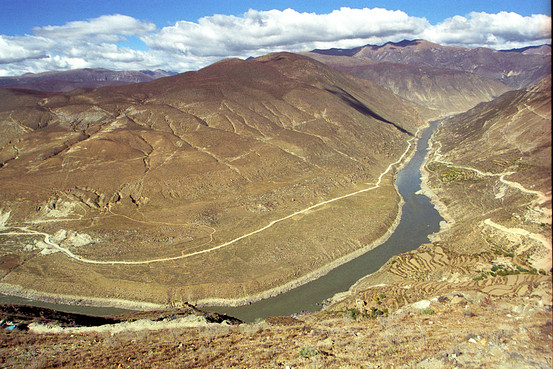
Yet most of Asia’s international rivers originate in territories that China annexed after its 1949 communist “revolution.” The sprawling Tibetan plateau, for example, is the world’s largest freshwater repository and the source of Asia’s greatest rivers, including those that are the lifeblood of mainland China, South Asia and Southeast Asia. Other Chinese-held homelands of ethnic minorities contain the headwaters of rivers such as the Irtysh, Illy and Amur, which flow to Russia and Central Asia.

China’s dam program on international rivers is following a well-established pattern: Build modest-size dams on a river’s difficult uppermost reaches, and then construct larger dams in the upper-middle sections as the river picks up greater water volume and momentum, then embarking on megadams in the border area facing another country. The cascade of megadams on the Mekong River, for example, is located in the area just before the river enters continental Southeast Asia.

Most of the new dam projects announced recently by China’s state council, or Cabinet, are concentrated in the seismically active southwest, covering parts of the Tibetan plateau. The restart of dam building on the Salween River after an eight-year moratorium is in keeping with a precedent set on other river systems: Beijing temporarily suspends a controversial plan after major protests flare so as to buy time — before resurrecting the same plan.

The Salween — Asia’s last largely free-flowing river — runs through deep, spectacular gorges, glaciated peaks and karst on its way into Burma and along the Thai border before emptying into the Andaman Sea. Its upstream basin is inhabited by 16 ethnic groups, including some, like the Derung tribe, with tiny populations numbering in the thousands. As one of the world’s most biologically diverse regions, the upper basin boasts more than 5,000 plant species and nearly half of China’s animal species.

The decision to formally lift the moratorium and construct five dams — with work to start immediately on the Songta dam, the farthest upriver structure in Tibet — threatens the region’s biodiversity and could uproot endangered aboriginal tribes. There is also the risk that the weight of huge, new dam reservoirs could accentuate seismic instability in a region prone to recurrent earthquakes.

No country is more vulnerable to China’s re-engineering of transboundary flows than India. The reason is that India alone receives nearly half of the river waters that leave Chinese-held territory. According to United Nations figures, a total of 718 billion cubic meters of surface water flows out of Chinese territory yearly, of which 347 billion cubic meters (or 48.3 percent of the total) runs directly into India.

China already has a dozen dams in the Brahmaputra River basin and one each on the Indus and the Sutlej rivers. On the Brahmaputra, it is currently close to completing one dam and has just cleared work on three others. Two more are planned in this cascade before the dam-building moves to the water-rich border segment as the river makes a U-turn to enter India.

Asia awaits a future made hotter and drier by climate and environmental change, and resource depletion. The continent’s water challenges have been exacerbated by consumption growth, unsustainable irrigation practices, rapid industrialization, pollution, environmental degradation and geopolitical shifts.

If Asia is to prevent water wars, it must build institutionalized cooperation in transboundary basins that co-opts all riparian neighbors. If a dominant riparian state refuses to join, such institutional arrangements — as in the Mekong basin — will be ineffective. The arrangements must be centered on transparency, unhindered information flow, equitable sharing, dispute settlement, pollution control and a commitment to refrain from any projects that could materially diminish transboundary flows. International dispute-settlement mechanisms, as in the Indus treaty, help stem the risk that water wrangles could escalate to open conflict.

China — with its hold over Asia’s transnational water resources and boasting more than half of the world’s 50,000 large dams — has made the control and manipulation of river flows a pivot of its power and economic progress. Unless it is willing to play a leadership role in developing a rules-based system, the economic and security risks arising from the Asian water competition can scarcely be mitigated.

Brahma Chellaney is the author of “Water, Peace, and War: Confronting the Global Water Crisis” (Rowman & Littlefield, 2013).

(c) Washington Times, 2013.

Asia’s Resource Scramble

A Project Syndicate column

Competition for strategic natural resources – including water, mineral ores, and fossil fuels – has always played a significant role in shaping the terms of the international economic and political order. But now that competition has intensified, as it encompasses virtually all of Asia, where growing populations and rapid economic development over the last three decades have generated an insatiable appetite for severely limited supplies of key commodities.

Asia is the world’s most resource-poor continent, and overexploitation of the natural resources that it does possess has created an environmental crisis that is contributing to regional climate change. For example, the Tibetan Plateau, which contains the world’s third-largest store of ice, is warming at almost twice the average global rate, owing to the rare convergence of high altitudes and low latitudes – with potentially serious consequences for Asia’s freshwater supply.

In other words, three interconnected crises – a resource crisis, an environmental crisis, and a climate crisis – are threatening Asia’s economic, social, and ecological future. Population growth, urbanization, and industrialization are exacerbating resource-related stresses, with some cities experiencing severe water shortages, and degrading the environment (as anyone who has experienced Beijing’s smog can attest). Fossil-fuel and water subsidies have contributed to both problems.

Faced with severe supply constraints, Asian economies are increasingly tapping other continents’ fossil fuels, mineral ores, and timber. But water is extremely difficult – and prohibitively expensive – to import. And Asia has less fresh water per person than any continent other than Antarctica, and some of the world’s worst water pollution.

Likewise, food scarcity is a growing problem for Asian countries, with crop yields and overall food production growing more slowly than demand. At the same time, rising incomes are altering people’s diets, which now include more animal-based proteins, further compounding Asia’s food challenges.

The intensifying competition over natural resources among Asian countries is shaping resource geopolitics, including the construction of oil and gas pipelines. China has managed to secure new hydrocarbon supplies through pipelines from Kazakhstan and Russia. But this option is not available to Asia’s other leading economies – Japan, India, and South Korea – which are not contiguous with suppliers in Central Asia, Iran, or Russia. These countries will remain dependent on oil imports from an increasingly unstable Persian Gulf.

Furthermore, China’s fears that hostile naval forces could hold its economy hostage by interdicting its oil imports have prompted it to build a massive oil reserve, and to plan two strategic energy corridors in southern Asia. The corridors will provide a more direct transport route for oil and liquefied gas from Africa and the Persian Gulf, while minimizing exposure to sea-lanes policed by the United States Navy.

One such corridor extends 800 kilometers from the Bay of Bengal across Burma to southern China. In addition to gas pipelines – the first is scheduled to be completed this year – it will include a high-speed railroad and a highway from the Burmese coast to China’s Yunnan province, offering China’s remote interior provinces an outlet to the sea for the first time.

The other corridor – work on which has been delayed, owing to an insurrection in Pakistan’s Baluchistan province – will stretch from the Chinese-operated port at Gwadar, near Pakistan’s border with Iran, through the Karakoram mountains to the landlocked, energy-producing Xinjiang province. Notably, in giving China control of its strategic Gwadar port in February, Pakistan has permitted the Chinese government to build a naval base there.

Given the significant role that natural resources have historically played in global strategic relations – including driving armed interventions and full-scale wars – increasingly murky resource geopolitics threatens to exacerbate existing tensions among Asian countries. Rising dependence on energy imports has already been used to rationalize an increased emphasis on maritime power, raising new concerns about sea-lane safety and vulnerability to supply disruptions.

This partly explains the current tensions between China and Japan over their conflicting territorial claims to islands in the East China Sea, which occupy an area of only seven square kilometers, but are surrounded by rich hydrocarbon reserves. Disputes in the South China Sea involving China and five of its neighbors, and in southern Asia, are equally resource-driven.

While strategic competition for resources will continue to shape Asia’s security dynamics, the associated risks can be moderated if Asia’s leaders establish norms and institutions aimed at building rule-based cooperation. Unfortunately, little progress has been made in this area. For example, 53 of Asia’s 57 transnational river basins lack any water-sharing or cooperative arrangement.

Indeed, Asia is one of only two continents, along with Africa, where regional integration has yet to take hold, largely because political and cultural diversity, together with historical animosities, have hindered institution-building. Strained political relations among most of Asia’s sub-regions make a region-wide security structure or more effective resource cooperation difficult to achieve.

This could have significant implications for Asia’s ostensibly unstoppable rise – and thus for the West’s supposedly inevitable decline. After all, Asian economies cannot sustain their impressive economic growth without addressing their resource, environmental, and security challenges – and no single country can do it alone.

Brahma Chellaney, Professor of Strategic Studies at the New Delhi-based Center for Policy Research, is the author of Asian JuggernautWater: Asia’s New Battleground, and the forthcoming Water, Peace, and War: Confronting the Global Water Crisis.

(c) Project Syndicate, 2013.

Asia’s Dammed Water Hegemon

A Project Syndicate column internationally syndicated. This column also in ArabicChinese, Russian, and Spanish.

As if to highlight that Asia’s biggest challenge is managing the rise of an increasingly assertive China, the Chinese government has unveiled plans to build large new dams on major rivers flowing to other countries. The decision by China’s State Council to ride roughshod over downstream countries’ concerns and proceed unilaterally shows that the main issue facing Asia is not readiness to accommodate China’s rise, but the need to persuade China’s leaders to institutionalize cooperation with neighboring countries.

China is at the geographical hub of Asia, sharing land or sea frontiers with 20 countries; so, in the absence of Chinese participation, it will be impossible to establish a rules-based regional order. How, then, can China be brought on board?

This challenge is most striking on trans-boundary rivers in Asia, where China has established a hydro-supremacy unparalleled on any continent by annexing the starting places of major international rivers — the Tibetan plateau and Xinjiang — and working to reengineer cross-border flows through dams, reservoirs, barrages, irrigation networks, and other structures. China — the source of trans-boundary river flows to more countries than any other hydro-hegemon — has shifted the focus of its dam-building program from dam-saturated internal rivers to international rivers after having already built more large dams than the rest of the world combined.

Most of China’s dams serve multiple functions, including generating electric power and meeting manufacturing, mining, irrigation, and municipal-supply water needs. By ramping up the size of its dams, China now not only boasts the world’s largest number of mega-dams, but is also the biggest global producer of hydropower, with an installed generating capacity of 230 gigawatts.

The State Council, seeking to boost the country’s already-large hydropower capacity by 120 gigawatts, has identified 54 new dams — in addition to the ones currently under construction — as “key construction projects” in the revised energy-sector plan up to 2015. Most of the new dams are planned for the biodiversity-rich southwest, where natural ecosystems and indigenous cultures are increasingly threatened.

After slowing its dam-building program in response to the serious environmental consequences of completion in 2006 of the Three Gorges Dam — the world’s largest — China is now rushing to build a new generation of giant dams. At a time when dam building has largely petered out in the West — and run into growing grassroots opposition in other democracies like Japan and India — China will remain the nucleus of the world’s mega-dam projects.

Such projects underscore the zero-sum mentality that seemingly characterizes China’s water-policy calculations. By embarking on a series of mega-dams in its ethnic-minority-populated borderlands, China is seeking to appropriate river waters before they cross its frontiers.

Asia, the world’s driest continent in terms of per capita freshwater availability, needs a rules-based system to manage water stress, maintain rapid economic growth, and ensure environmental sustainability. Yet China remains the stumbling block, refusing to enter into a water-sharing treaty with any neighbor — much less support a regional regulatory framework — because it wants to maintain its strategic grip on trans-boundary river flows.

Among the slew of newly approved dam projects are five on the Salween and three each on the Brahmaputra and the Mekong. China has already built six mega-dams on the Mekong — the lifeblood for continental Southeast Asia — with its latest addition being the 254-meter-high Nuozhadu Dam, whose gargantuan reservoir is designed to hold nearly 22 billion cubic meters of water.

The current dam-building plans threaten the Salween River’s Grand Canyon — a UNESCO World Heritage site — and the pristine, environmentally sensitive areas through which the Brahmaputra and the Mekong flow.

These three international rivers originate on the Tibetan plateau, whose bounteous water resources have become a magnet for Chinese planners. The Salween, which runs from Tibet through Yunnan Province into Burma and Thailand, will cease to be Asia’s last largely free-flowing river, with work on the first project — the giant, 4,200-megawatt Songta Dam in Tibet — to begin shortly.

The State Council’s decision reverses the suspension of dam building on the Salween announced by Premier Wen Jiabao in 2004, after an international uproar over the start of multiple megaprojects in the National Nature Reserves, adjacent to the world heritage area – a stunning canyon region through which the Salween, the Mekong, and the Jinsha flow in parallel. This reversal is consistent with the pattern established elsewhere, including on the Yangtze: China temporarily suspends a controversial plan after major protests in order to buy time while public passions cool, before resurrecting the same plan.

Meanwhile, China’s announcement of three new dam projects on the Brahmaputra, the main river running through northeastern India and Bangladesh, has prompted the Indian government to advise China to “ensure that the interests of downstream states are not harmed” by the upstream works. Water has emerged as a new divide in Sino-Indian relations.

China’s new focus on building dams in the southwest of the country also carries larger safety concerns. Indeed, Chinese scientists blamed the massive 2008 earthquake that struck the Tibetan plateau’s eastern rim, killing 87,000 people, on the newly constructed Zipingpu Dam, located next to a seismic fault. The weight of the water impounded in the dam’s massive reservoir was said to have triggered severe tectonic stresses, or what scientists call reservoir-triggered seismicity.

China’s rush to build more dams promises to roil relations across Asia, fostering greater competition for water and impeding the already slow progress toward institutionalizing regional cooperation and integration. If China continues on its current, heedless course, prospects for a rules-based order in Asia could perish forever.

Brahma Chellaney, Professor of Strategic Studies at the New Delhi-based Center for Policy Research, is the author of Asian JuggernautWater: Asia’s New Battleground, and the forthcoming Water, Peace, and War: Confronting the Global Water Crisis.

(c) Project Syndicate, 2013.

China’s hydrological clout

BY BRAHMA CHELLANEYThe Japan Times
China's control

The world’s largest and most-vulnerable watershed, the Great Himalayan-cum-Tibetan Watershed, is the source of water flows to more than two-fifths of the global population.
Map: © Brahma Chellaney, Controlling the Taps (CLSA, 2012).

The Chinese government’s recent decision to build an array of new dams on rivers flowing to other countries is set to roil inter-riparian relations in Asia and make it more difficult to establish rules-based water cooperation and sharing.

Asia, not Africa, is the world’s driest continent. China, which already boasts more large dams than the rest of the world combined, has emerged as the key impediment to building institutionalized collaboration on shared water resources. In contrast to the bilateral water treaties between many of its neighbors, China rejects the concept of a water-sharing arrangement or joint, rules-based management of common resources.

The long-term implications of China’s dam program for India are particularly stark because several major rivers flow south from the Tibetan plateau. Just the Brahmaputra River’s annual cross-border runoff volume, according to United Nations data, is greater than the combined flow of three rivers that run from Tibet into Southeast Asia — the Mekong, the Salween, and the Irrawaddy.

India has water-sharing treaties with both the countries located downstream to it: the Indus pact with Pakistan guarantees the world’s largest cross-border flows of any treaty regime, while the Ganges accord has set a new principle in international water law by assuring Bangladesh an equal share of downriver flows in the dry season.

China, by contrast, does not have a single water-sharing treaty with any neighbor.

Yet most of Asia’s international rivers originate in territories that China annexed after the 1949 communist takeover there. The sprawling Tibetan plateau, for example, is the world’s largest freshwater repository and the source of Asia’s greatest rivers, including those that are the lifeblood of mainland China and South and Southeast Asia. Other Chinese-held homelands of ethnic minorities contain the headwaters of rivers such as the Irtysh, Illy and Amur, which flow to Russia and Central Asia.

China’s dam program is following a well-established pattern on international rivers, such as the Mekong, the Salween, and the Brahmaputra: build modest-size dams on a river’s difficult uppermost reaches, and then construct larger dams in the upper-middle sections as the river picks up greater water and momentum, before embarking on megadams in the border area facing another country.

The cascade of megadams on the Mekong, for example, is located in the area just before the river enters continental Southeast Asia. Chinese engineers already have built six giant dams on the Mekong, including the 4,200-megawatt Xiaowan, which dwarfs Paris’s Eiffel Tower in height, and the 5,850-megawatt Nuozhadu, whose first generator began producing electricity last autumn. At least four more dams are planned in this frontier region.

Most of the new dam projects announced recently by China’s state council, or cabinet, are concentrated in the seismically active southwest, covering parts of the Tibetan plateau. The restart of dam building on the Salween River after an eight-year moratorium is in keeping with a precedent set on other river systems — Beijing temporarily suspends a controversial plan after major protests flare so as to buy time, before resurrecting the same plan.

In fact, according to a 2008 report in Time magazine, work on laying the foundation of four Salween dams continued during the moratorium by reclassifying them as transportation projects.

The Salween — Asia’s last largely free-flowing river — runs through deep, spectacular gorges, glaciated peaks, and karst on its way into Myanmar and along the Thai border before emptying into the Andaman Sea. Its upstream basin is inhabited by 16 ethnic groups including some, like the Derung tribe, with tiny populations numbering in the thousands. As one of the world’s most biologically diverse regions, it boasts more than 5,000 plant species and nearly half of China’s animal species.

The decision to formally lift the moratorium and construct five dams — with work to start without delay on the Songta dam, the farthest upriver structure located in Tibet — threatens the region’s biodiversity and could uproot endangered aboriginal tribes. There is also the risk that the weight of huge new dam reservoirs could accentuate seismic instability in a region prone to recurrent earthquakes.

No country is more vulnerable to China’s reengineering of transboundary flows than India. The reason is that India alone receives nearly half of the river waters that leave Chinese-held territory. According to UN figures, a total of 718 billion cubic meters of surface water flows out of Chinese territory yearly, of which 347.02 billion cubic meters (or 48.33 percent of the total) runs directly into India.

China already has a dozen dams in the Brahmaputra basin and one each on the Indus and the Sutlej. On the Brahmaputra, it is currently close to completing one dam and has just cleared work on three others. Two more are planned in this cascade before the dam building moves to the water-rich border segment as the river makes a U-turn to enter India.

Whereas the newly unveiled projects on the Salween and the Mekong are mega-dams with big reservoirs, China claims that its dam building on the Brahmaputra involves only run-of-river plants — a type that generates hydropower without reservoir storage by using a river’s natural flow and elevation drop. However, unlike India vis-à-vis Pakistan or Bangladesh, Beijing is neither willing to share with New Delhi the technical designs nor permit on-site scrutiny.

The relatively large Chinese projects at the Dagu, Jiexu and Zangmu sites on the Brahmaputra indeed raise the possibility that they might impound water in reservoir. Indeed, such is the lack of Chinese transparency that the flashfloods between 2000 and 2005 that ravaged India’s Himachal Pradesh and Arunachal Pradesh states — located on opposite ends of the Himalayas — were linked to unannounced releases from Chinese dams.

Asia awaits a future made hotter and drier by climate and environmental change and resource depletion. The continent’s water challenges have been exacerbated by consumption growth, unsustainable irrigation practices, rapid industrialization, pollution, environmental degradation, and geopolitical shifts.

If Asia is to prevent water wars, it must build institutionalized cooperation in transboundary basins that co-opts all riparian neighbors. If a dominant riparian state refuses to join, such institutional arrangements — as in the Mekong basin — will be ineffective.

The arrangements must be centered on transparency, unhindered information flow, equitable sharing, dispute settlement, pollution control and a commitment to refrain from any projects that could materially diminish transboundary flows. International dispute-settlement mechanisms, as in the Indus treaty, help stem the risk that water wrangles could escalate to open conflict.

China — with its hold over Asia’s transnational water resources and boasting over half of the world’s 50,000 large dams — has made the control and manipulation of river flows a pivot of its power and economic progress. Unless it is willing to play a leadership role to develop a rules-based system, the economic and security risks arising from the Asian water competition can scarcely be mitigated.

Brahma Chellaney is the author of Water: Asia’s New Battleground (Georgetown University Press, 2011).

(c) Japan Times, 2013.

Dependency Breeds Corruption

Brahma Chellaney

India Today, February 25, 2013, page 8

AW139The gap between the rulers and the ruled in still-poor India has widened to such an extent that few were surprised that the nation signed a contract to buy for its leadership a dozen British-built special helicopters whose exorbitant price tag had led even the president of the wealthy United States to reject them.  Nor is there any surprise about some other facts — that what helped clinch the deal were the generous kickbacks the Italian seller proffered; that the bribes paid were eventually uncovered by foreign, not Indian, investigators; and that while Italian prosecutors were quick to make arrests, an embarrassed Indian government, true to form, has launched a wild-goose chase of bribe-takers that actually reside in its own bosom.

This scandal is just the tip of the iceberg on what goes on in defence deals and why India remains highly reliant on imports — an acute dependency that makes it vulnerable to varied external pressures, both in peacetime and war. Can there be a bigger shame for a country of 1.2 billion people than to be dependent for its basic defence needs on countries that are just a fraction of its size? For example, India has been buying arms worth nearly $2 billion dollars yearly from Israel, whose population is less than half of Delhi’s. Yet there is no evidence of discomfiture in India that it imports even rifles.

India’s real defence spending has fallen since the late 1980s, yet the government has significantly boosted spendthrift weapon imports without any strategic blueprint or direction. The result is that India has the dubious distinction of becoming the world’s largest arms importer since 2006. No less troubling is the lack of transparency and accountability in defence deals. An examination of the contracts signed in the past decade shows that most of them involved no competitive bidding, with the still-incomplete fighter-jet deal being one exception. In this light, is it any surprise that the stepped-up but unsystematic imports have failed to plug the glaring gaps in Indian defences?

Let’s be clear: The defence of India, with its self-perpetuating cycle of mega-corruption, has become the mother of all scandals — an endless golden opportunity for India’s new political aristocracy and its hangers-on to make hay while the nation bleeds. In fact, political corruption is the single biggest contributor to making the country increasingly insecure and pusillanimous in its foreign and defence policies.

The pervasive misuse of public office for private gain is eating into the vitals of the Indian republic, undercutting security, enfeebling foreign policy, and promoting corruption even in the armed forces. A country in which the corrupt and the compromised lead the governing and opposition parties can only be a soft state. In the U.S., millionaires spend their own funds to run for office, but in India, politicians seek power to become millionaires.

Make no mistake: The biggest threat India faces is not terrorism or China; it is institutionalized corruption, which undermines national security and threatens to eviscerate the republic. Those who take or engineer bribes on defence deals, in effect, are waging war on the country. They are worse than the Afzal Gurus because of the wider and corrosive impact of their actions. Yet, as the history of scams attests, they customarily go scot-free.

One way to start cleaning up the Augean stables is to impose at least a three-year moratorium on new defence contracts. This will put out of business the proliferating arms agents and cut off the kickbacks fattening India’s political nobility, the new rajas and ranis. Such a moratorium, far from having an adverse impact on national security, will actually save the taxpayers billions of dollars annually while facilitating the overhaul of defence procurement, initiation of a domestic arms-production base, and expansion of nonconventional deterrent capabilities.

Yet entrenched interests have such a huge stake in the present system that the prospect of stanching India’s bleeding without drastic reforms seems bleak. A reminder of how a corrupt India formulates a policy, only to undermine its objectives, was the 2008 move to help build a domestic arms base by requiring foreign arms sellers to plough about 30% of deal value into Indian military firms. It took just three years for the government to overturn the intent of that policy by issuing revised guidelines.

No country in history has ever become a great power by being dependent on others for basic defence needs. In fact, the capacity to defend oneself with one’s own resources is the first test a nation must pass on the way to becoming a great power. The current Indian defence policy is a recipe to continue subsidizing the military-industrial complexes of the exporting countries while keeping India perpetually insecure, timid and poor.

Brahma Chellaney is a geostrategist and author.

(c) India Today, 2013.

Neighbours leave India high and dry for its water supply

Brahma Chellaney

The National, February 1, 2013

Of all the natural resources on which the world depends, the supply and demand situation is most critical for water. There are replacements for oil, but no substitute for water, which is essential to produce virtually all the goods in the marketplace.

Asia, not Africa, is the world’s driest continent. The gap between demand and supply is growing in China, India, South Korea, Japan, Vietnam and elsewhere in Asia.

This raises a question: can Asia remain the locomotive of the global economy if it cannot mitigate its water crisis?

India faces greater water distress than China. China’s population is not even 10 per cent larger than India’s, but its internally renewable water resources (estimated at 2,813 billion cubic metres per year) are almost twice as large as India’s. In aggregate water availability, including inflows (which are sizeable in India’s case), China has virtually 50 per cent more resources than India.

In 1960, India signed a treaty setting aside 80 per cent of the Indus-system waters for downstream Pakistan, in the most generous water-sharing pact in modern history. And its 1996 Ganges treaty with Bangladesh guarantees minimum cross-border flows in the dry season – a new principle in international water law. That treaty divides the flows of the Ganges almost equally between the two countries. And now India is under pressure to reserve about half of the Teesta River’s water for Bangladesh.

But India is downriver from China. About a dozen important rivers flow into India from the Tibetan Himalayas. Indeed, one third of India’s yearly water supply comes from Tibet, according to United Nations’ data. Nations from Afghanistan to Vietnam receive water from the Tibetan Plateau, but India’s direct dependency on Tibetan water is greater than any other country’s.

But Beijing, far from emulating India’s water munificence, rejects the very concept of water sharing and is building large dams on rivers flowing to other nations, with little regard for downriver interests. An extensive Chinese water infrastructure in Tibet will have a serious effect on India.

So India faces difficult choices. Its ambitious plan to link up its major rivers has remained on paper for more than a decade. The idea was to connect 37 Himalayan and peninsular rivers in a pan-Indian water grid, to fight shortages.

Although the grid was ridiculed by the ruling party’s heir-apparent Rahul Gandhi as a “disastrous idea”, the Supreme Court ordered last year that it be implemented in “a time-bound manner”. Will that really happen?

The experience of the Supreme Court-overseen Narmada dam project in Gujarat doesn’t leave much room for optimism. India has struggled for decades to complete Narmada, and yet it is designed to produce less than 7 per cent as much hydropower as China’s Three Gorges Dam, completed last year.

With water increasingly at the centre of inter-provincial feuds in India, the Supreme Court has struggled for years with water cases, but the parties keep returning to litigate again on new grounds.

Plans for large water projects in India usually run into stiff opposition from influential non-government organisations, so that it has become virtually impossible to build a large dam, blighting the promise of hydropower.

Proof of this was New Delhi’s 2010 decision to abandon three dam projects on the Bhagirathi River, a source stream of the Ganges in the Himalayas. One of these was already half-built; hundreds of millions of dollars were wasted.

The largest dam India has built since independence is the 2,000 megawatt Tehri on the Bhagirathi. Compare that with China’s 18,300 megawatt Three Gorges. China’s proposed Metog Dam, almost on the disputed border with India, is to produce nearly twice as much power as Three Gorges Dam. China is also building on the Mekong River.

Meanwhile India’s proposed river-linking plan seems like a dream: a colossal network to handle 178 billion cubic metres of water transfers a year in12,500km of new canals, generating 34 gigawatts of hydropower, creating 35 million hectares of irrigated land and expanding inland navigation. This is the kind of programme that only an autocracy like China can implement.

Government agencies say that by 2050 India must nearly double grain production, to over 450 million tons a year, to meet the demands of prosperity and population growth. Unless it has more irrigated land and adopts new plant varieties and farming techniques, India is likely to become a net food importer before long – a change that will roil world food markets.

More fundamentally, growing water shortages threaten to slow Indian economic growth and fuel social tensions. The government must fix its disjointed policy approach and develop a long-term vision for water resources.

India must treat water as a strategic issue and focus on three key areas. One is achieving greater water efficiency and productivity gains. Another is using clean-water technologies to open up new supply sources, including ocean and brackish waters and recycled wastewater. The third is expanding and enhancing water infrastructure to correct regional and seasonal imbalances in water availability, and to harvest rainwater, which can be a new supply source to ease shortages.

Boosting water supplies demands tapping unconventional sources and adopting non-traditional approaches, as well as improving the old ways of water-supply management.

Brahma Chellaney is a professor of strategic studies at the Center for Policy Research in New Delhi and the author of Water: Asia’s New Battleground.

On Twitter: @Chellaney

(c) The National, 2013

South Korea as bridge-builder

By Brahma Chellaney, JoongAng Ilbo, January 21, 2013, page 6

Park Geun-hye broke through South Korea’s glass ceiling to win the presidency. But having overcome the gender barrier, she now faces important domestic and foreign-policy challenges. How she handles those challenges, including slowing economic growth and sharpening geopolitical competition in Northeast Asia, will determine if South Korea’s international clout will continue to rise.

Coincidentally, she is taking over as president at a time when Japan has elected a new government led by Prime Minister Shinzo Abe and Xi Jinping is assuming the presidency in China. The overlapping power transitions in East Asia’s three main economies promise to mark a defining moment in the region’s harsh geopolitics.

Xi is regarded by the People’s Liberation Army (PLA) as its own man, while Abe is a vocal nationalist. The political transitions, coupled with the brewing territorial spats between China and Japan and South Korea and Japan as well as the underlying tensions between the two Koreas, create new risks to regional peace, stability, and prosperity. In this setting, Ms. Park will need to tread cautiously, seeking to expand mutually beneficial ties with Beijing, Tokyo, and Washington while addressing domestic challenges, including the growing income disparity and a generational divide, as reflected in the presidential election’s voting patterns.

Asia’s other major economy, India, is expecting Ms. Park’s election to accelerate cooperation and trade between Seoul and New Delhi. Her election has received wide coverage in India, a country that has a long tradition of powerful women figures in politics.

Washington, for its part, is delighted that voters in South Korea and Japan have elected conservative, pro-American leaders, raising hope that America will be able to work with its two closest allies in East Asia to ease the security issues that are troubling this economically dynamic region. The Obama administration, however, recognizes that the emotionally charged relations between Tokyo and Seoul can prove a serious impediment. A reminder of that was the decision of departing President Lee Myung-bak last summer to cancel the scheduled signing of a military intelligence-sharing agreement with Japan and scrap a bilateral plan to finalize a military-related Acquisition and Cross-Servicing Agreement.

If Ms. Park is to build a historically positive legacy in her five-year term as president, she will need to be different than Lee Myung-bak in both style and substance, even though he is her colleague from the Saenuri Party. She will need to have a more consensual style than Lee, nicknamed “the Bulldozer” from his career as a construction industry executive. And in terms of substance, she must seek to build more cooperative ties with North Korea and Japan.

Lee pointlessly roiled the relationship with Japan in his last year in year, while his policy approach toward North Korea right from 2008 onward only encouraged greater belligerence and defiance on the part of Pyongyang. Not only did inter-Korean contact and cooperation suffer, but the North carried out provocative actions, including missile tests, and ratcheted up bellicose rhetoric. Relations between the two Koreas sunk to a low. Pyongyang’s recent space launch served as a fresh reminder of its determination to defy even United Nations Security Council resolutions.

Fortunately, Ms. Park has already signaled that she will pursue a more pragmatic and balanced foreign policy than her predecessor. For example, she has vowed to tread the middle path on North Korea between unconditional engagement and uncompromising chastisement. She has even indicated that she would try to hold talks with the North’s young leader Kim Jong-un.

Ms. Park’s more moderate approach could undercut the Obama administration’s sanctions-only North Korean policy just when Pyongyang has signaled open defiance of U.S. and UN pressure. But it is in South Korea’s own long-term interest to build economic cooperation and other contact with the North so that when the regime in Pyongyang eventually collapses, the costs of Korean reunification will not be terribly high.

More broadly, the central challenge in Northeast Asia is to get rid of the baggage of history that weighs down the relationships between all the actors. The rise of nationalism in the region with growing prosperity has only compounded the historical issues.

Booming trade in the region has failed to mute or moderate territorial and other disputes; on the contrary, it has only sharpened regional geopolitics and unleashed high-stakes brinkmanship. Economic interdependence cannot deliver regional stability unless rival states undertake genuine efforts to mend their political relations.

China, for example, has launched a new campaign of attrition against Japan over the Senkaku/ Diaoyu Islands. By sending patrol ships frequently to the waters around the islands since September — and by violating the airspace over them recently — Beijing has sought to challenge Japan’s decades-old control over them, despite the risk that an incident at sea or in the air between the two sides could spiral out of control.  Meanwhile, a continuing informal Chinese boycott of Japanese goods has led to a fall in Japan’s exports to China.

China’s new assertiveness has fueled a nationalist backlash in Japan. But that is only fanning nationalism in China, where the Communist Party has already turned nationalism as the legitimating credo of its monopoly on power to compensate for the decline of the state ideology. Consequently, the two countries find themselves in a vicious circle from which they are finding it difficult to escape.

The risks posed by increasing nationalism and militarism to peace in East Asia have already been highlighted by the rise of a new Chinese dynasty of “princelings,” or sons of revolutionary heroes who have widespread contacts in the military. In fact, what distinguishes Xi, a former military reservist, from China’s other civilian leaders is his strong relationship with the PLA, whose rising clout has underpinned China’s increasingly muscular foreign policy.

Against this background, Ms. Park’s test is to prove a visionary, dynamic leader who has the foresight and courage to chart a more stable and prosperous future for her country and region. Her lasting legacy could be to boost South Korea’s economic and foreign-policy influence and turn it into a bridge-builder between Japan and China, between China and the United States, and between Russia and Japan.

Brahma Chellaney, professor of strategic studies at the Center for Policy Research in New Delhi, is the author of “Asian Juggernaut” (Harper, 2010) and “Water: Asia’s New Battleground” (Georgetown University Press, 2011), which won the 2012 Bernard Schwartz Award.

(Translated and published in Korean. © JoongAng Ilbo, 2013.)

Peace overtures to Pakistan: India reaps a bitter harvest

Brahma Chellaney

The Economic Times, January 10, 2013

Words like “brutal,” “heinous” and “savage” aptly describe the way a Pakistani army unit raided Indian territory and chopped two soldiers, taking away one severed head as a “trophy.” The Indian outrage, however, must not blind us to the unpalatable truth: India is reaping what it sowed. New Delhi is staring at the bitter harvest of a decade-long policy seeking to appease a recalcitrant neighbour with unilateral concessions and gestures.

The “peace-at-any-price diplomacy” was started by Prime Minister Atal Bihari Vajpayee in an abrupt policy U-turn in 2003, and has been pursued with greater vigour by his successor, Manmohan Singh — interrupted only by the Pakistan-orchestrated Mumbai terrorist rampage of 2008. Regrettably, no policy lessons were drawn by New Delhi from the Mumbai terrorist siege, which occurred because India presented itself as weak and a tempting target.

The latest episode — one of the worst acts of Pakistani savagery in peacetime ever — has followed a dozen Pakistani violations of the line of control in the past one month. The question to ask is what has prompted the Pakistani military establishment to adopt an overtly aggressive posture vis-à-vis India of late.

The Pakistani military is drawing encouragement from two factors. The first factor is that the US-Pakistan relationship, after being on the boil for more than a year, has gradually returned to normalcy. That the US-Pakistan rift has healed is apparent from Washington’s resumption of large-scale military aid and its coddling of the Pakistan army and ISI. US aid to Pakistan is now at a historic high — at more than 3 billion dollars a year.

US policy — because of the exigencies of an exit strategy from Afghanistan — has permitted political expediency to trump long-term interests vis-à-vis Pakistan. The US has allowed even a key issue to fade away: how was Osama bin Laden able to hide deep inside Pakistan? The reason for that is the same as to why the US didn’t pursue the A.Q. Khan case.

The second factor is the series of unilateral political concessions by India, including delinking dialogue from terrorism, and recognizing Pakistan, the sponsor of terror, as a victim of terror. Whereas US policy has increased the Pakistani military’s room for manoeuvre against India, Indian policy has both solidified Pakistani reluctance to bring the Mumbai-attack masterminds to justice and emboldened the Pakistani military to commit yet another act of aggression.

India has considerably eased pressure on Pakistan, both on the Mumbai-attack issue and on Hafiz Saeed, the militant leader who still preaches terrorism against India. India has also pursued a host of goodwill gestures, including resuming high-level political exchanges and cricketing ties and introducing a less-restricted visa regime for Pakistanis. All these moves, unfortunately, have sent the wrong message to Islamabad.

Being nice with a determined adversary in the hope that this will change its behaviour is not strategy. With Singh dreaming of open borders with terror-exporting Pakistan, India’s Pakistan policy remains driven by hopes and gushy expectations, not statecraft.

In fact, some of the public statements Singh has made in recent years have not only been insensitive in relation to those slain by Pakistan-trained terrorists but may also have inadvertently encouraged Pakistani intransigence and aggression. Consider the following examples:

  • “We both [Pakistani Prime Minister Gilani and myself] recognize that if there is another attack like Mumbai, it will be a setback to the normalization of relations.” In other words, if there were another Mumbai-style terrorist attack, it will merely be a “setback” to ties — that too, as past experience shows, a temporary setback followed by Indian concessions.
  • “India-Pakistan relations are prone to accidents.” Were the attacks on the Indian Parliament and Red Fort, the Mumbai terrorist strikes, and the myriad other Pakistan-scripted outrages just “accidents”? Will the latest savagery also be treated as another “accident” after the current public indignation fades?
  • “We cannot wish away the fact that Pakistan is our neighbour.” And therefore “a stable, peaceful and prosperous Pakistan” is in India’s “own interest.” But the breaking away of South Sudan, East Timor, and Eritrea and the disintegration of the Soviet Union and Yugoslavia since the 1990s have shown that political maps are not carved in stone. In fact, the most profound global events in recent history have been the fragmentation of several countries. Didn’t Indira Gandhi change political geography in 1971?
  • India and Pakistan are locked by a “shared destiny,” and thus “our objective must be a permanent peace with Pakistan, where we are bound together by a shared future and a common prosperity.” How can a plural, inclusive and democratic India share a common destiny with a theocratic, militarized, fundamentalist and failing Pakistan?
  • “It is in our vital interest to make sincere efforts to live in peace with Pakistan … Unless we want to go to war with Pakistan, dialogue is the only way out.” This reflects the classically flawed argument that the only alternative to one extreme (appeasement) is another extreme — war. The simple truth is that any country must avoid either extreme. After all, between bending backwards to please Pakistan and waging war lie a hundred different practical options for India.

For more than two decades now, every Pakistani aggression against India — covert or overt — has been greeted with Indian inaction. India has shied away from employing even non-military options to discipline a wayward Pakistan. Will the latest strike also evoke mere Indian condemnation and no reprisal?

Any right-minded citizen would want peace between India and Pakistan. India indeed has tried everything possible to build peace with Pakistan, but the Pakistani military establishment in particular has construed India’s overtures as signs of the Indian republic’s weakness.

Today, India’s Pakistan policy is adrift because it is not backed by any goal-oriented strategy. It is past time for India to inject greater realism into its Pakistan policy.

(c) The Economic Times, 2013.