Alarm Bells in Asia

BRAHMA CHELLANEY, A Project Syndicate column internationally syndicated

Photo of Brahma ChellaneyThe deteriorating situation in Ukraine and rising tensions between Russia and the United States threaten to bury US President Barack Obama’s floundering “pivot” toward Asia – the world’s most vibrant (but also possibly its most combustible) continent. Obama’s tour of Japan, South Korea, Malaysia, and the Philippines will do little to rescue the pivot or put his regional foreign policy on a sound footing.

In fact, Russia’s aggression in Ukraine is just the latest reason that the pivot – which has been rebranded as a “rebalancing” – has failed to gain traction. A slew of other factors – including America’s foreign-policy preoccupation with the Muslim world, Obama’s reluctance to challenge an increasingly assertive China, declining US defense outlays, and diminished US leadership on the world stage – were already working against it.

The reality is that rising anxiety among Asian countries about China’s increasingly muscular foreign policy has presented the US with an important opportunity to recapture its central role in the region by strengthening old alliances and building new partnerships. But the US has largely squandered its chance, allowing China to continue to broaden its territorial claims.

Indeed, over the last two years, America’s Asian allies and partners have received three jarring wake-up calls, all of which have delivered the same clear message: the US cannot be relied upon to manage China’s rise effectively.

0020ee8c19dde118eb74caa7b7874fa5.landscapeThe first such signal came in the form of Obama’s silence when China seized the disputed Scarborough Shoal from the Philippines in July 2012. The move – which established a model for China to annex other disputed territories – occurred despite a US-brokered deal for a mutual withdrawal of Chinese and Philippine vessels from the area. Obama’s apparent indifference to America’s commitment to the Philippines under the 1951 mutual-defense treaty, which it reaffirmed in 2011, encouraged China to seize the Second Thomas Shoal, which is also claimed by the Philippines.

America’s Asian allies received a second wake-up call when China unilaterally established an air defense identification zone (ADIZ) covering territories that it claims (but does not control) in the East China Sea – a dangerous new precedent in international relations. China then demanded that all aircraft transiting the zone – whether headed for Chinese airspace or not – submit flight plans in advance.

Instead of demonstrating its disapproval by postponing Vice President Joe Biden’s trip to Beijing, the US government advised commercial airlines to respect China’s self-declared ADIZ. Japan, by contrast, told its carriers to disregard China’s demand – an indication of the growing disconnect in US-Japanese relations.

The third wake-up call comes from Ukraine. The US has responded to Russia’s illegal annexation of Crimea by distancing itself from the “Budapest Memorandum,” the pact that US President Bill Clinton signed in 1994 committing the US to safeguard Ukraine’s territorial integrity in exchange for relinquishing its nuclear arsenal.

The first two wake-up calls highlighted the Obama administration’s unwillingness to do anything that could disrupt its close engagement with China, a country that is now central to US interests. The third was even more ominous: America’s own vital interests must be directly at stake for it to do what is necessary to uphold another country’s territorial integrity – even a country that it has pledged to protect.

The world is witnessing the triumph of brute power in the twenty-first century. Obama was quick to rule out any US military response to Russia’s Crimea takeover. Likewise, as China has stepped up efforts to upend the regional status quo – both territorial and riparian – the US has dithered, doing little to reassure its jittery Asian allies.

Instead, the US has pursued a neutral course, which it hopes will enable it to avoid being dragged into a military confrontation over countries’ conflicting territorial claims. To this end, the US has addressed its calls for restraint not only to China, but also to its own allies.

But America’s own restraint – whether in response to Russia’s forcible absorption of Crimea or to China’s creeping, covert warfare – has brought no benefits to its allies. In fact, its efforts to avoid confrontation at all costs could inadvertently spur game-changing – and potentially destabilizing – geopolitical developments.

Most important, America’s sanctions-driven policy toward Russia is likely to force the Kremlin to initiate its own pivot toward Asia – particularly toward energy-hungry, cash-rich China. At the same time, a showdown with Russia will compel the US to court China more actively. In a new Cold War scenario, China would thus be the big winner, gaining a wide diplomatic berth to pursue its territorial ambitions.

While the US propitiates China, countries like Japan, India, the Philippines, and Vietnam are being forced to accept that they will have to contend with Chinese military incursions on their own. That is why they are stepping up efforts to build credible military capabilities.

This trend could lead to the resurgence of militarily independent Asian powers that remain close strategic friends of the US. In this sense, they would be following in the footsteps of two of America’s closest allies – the United Kingdom and France – which have built formidable deterrent capacities, rather than entrust their security to the US. This would be a game-changing development for Asia, the US, and the entire world.

Brahma Chellaney, Professor of Strategic Studies at the New Delhi-based Center for Policy Research, is the author of Asian Juggernaut; Water: Asia’s New Battleground; and Water, Peace, and War: Confronting the Global Water Crisis.

Read more from “Cold War II?”

Asia’s Fault Lines Stoke Tensions

By Brahma ChellaneyThe Transatlantic Academy

Asia’s Fault Lines Stoke Tensions

Asia’s dramatic economic rise led some analysts to hastily conclude that the relative decline of the West is inevitable. Developments since 2013 highlight that dangerous new fault lines have emerged in Asia, posing a major risk to peace, stability and prosperity in the world’s largest and most populous continent. The developments create a diplomatic opening for the transatlantic alliance to play a more active role in shaping Asia’s trajectory positively.

Asia today is at a defining moment in its history. Yet the international spotlight on its rapid economic ascent has obscured the serious challenges it confronts. These challenges range from recrudescence of territorial and maritime disputes and increasingly fervent nationalism to sharpening competition over natural resources and toxic historical legacies that weigh down its major interstate relationships.

Two fault lines in particular are putting Asia’s sustained rise at risk, with the adverse geopolitical trends carrying significant ramifications for global markets. With Asia’s political integration badly lagging behind its economic integration, one fault line is represented by the widening gap between politics and economics. Asia is the only continent other than Africa where political integration has failed to take off.

The other fault line is represented by the so-called history problem — or how the past threatens to imperil Asia’s present and future. Historical distortions and a failure to come to terms with the past have spurred competing and mutually reinforcing nationalisms.

Asian disputes over territories, war memorials, fishing rights, natural resource reserves, and textbooks are linked with history. Yet historical narratives are never free of bias or embellishment. Objective history, after all, is an oxymoron, with historical narratives often embodying cherished national myths. Historians who dare to probe such myths through factbased interrogation can face backlash or even persecution, especially in autocratic states.

Respect for boundaries is a prerequisite to peace and stability on any continent. Europe has built its peace on that principle, with a number of European states learning to live with boundaries that they don’t like. But in Asia, renewed attempts to disturb the territorial status quo are stirring geopolitical tensions and fueling rivalries.

In particular, an increasingly muscular China harps on historical grievances — real or imaginary — to justify its claims to territories and fishing areas long held by others. Whether it is strategic islands in the South and East China Seas or the resource-rich Himalayan Indian state of Arunachal Pradesh, China is dangling the threat of force to assert its claims.

The transatlantic relationship, through diplomatic outreach, can help underscore the imperative for Asia to get rid of its baggage of history in order to chart a more stable and prosperous future. After all, the slowing of Asian economic growth only increases the risks from the new fault lines. The risks are also heightened by Asia’s lack of a security framework, with even its regional consultation mechanisms remaining weak.

Unlike Europe’s bloody wars of the first half of the twentieth century, which have made war there unthinkable today, the wars in Asia in the second half of the twentieth century only sharpened rivalries, fostering a bitter legacy. Several interstate wars have been fought in Asia since 1950 — when the Korean War and the annexation of Tibet started — without resolving the underlying disputes.

As we commemorate the hundredth anniversary of the beginning of World War I, it is important to remember that Europe was at the time even more integrated by trade and investment than Asia is today, with its royal families interrelated by marriage. Yet Europe’s disparate economic and political paths led to World War I. Asia thus must realize that economic interdependence, amid rising political tensions between its major countries, cannot guarantee peace by itself.

Several Asian sub-regions currently are in flux. Although the U.S. and European role in Asia is viewed by a majority of Asian states as a stabilizing influence, the U.S. remains primarily focused on the Islamic world. President Barack Obama, in his State of the Union address in January, did not even mention Asia.

Obama’s supposed policy shift toward Asia — once known as a pivot but now rebranded as a rebalance — has always seemed more rhetorical than real. To make the promise of his “pivot” real, Obama has still to convince Congress at home — and America’s Asian allies and partners — that he means to devote more military, diplomatic and economic attention to Asia as well as stand up to China’s territorial creep.

China’s rift with fellow communist state North Korea — increasingly an estranged and embittered ally — opens diplomatic space for the U.S. and Europe to help transform Northeast Asia’s fraught geopolitics. After all, Beijing today risks “losing” North Korea, the way its once-tight hold on Myanmar has slipped dramatically. China’s increasing territorial assertiveness has also strained itsrelations with several other neighbors, stretching from Japan to the Philippines and Vietnam to India.

A growing chasm between China’s assertive, nationalistic president, Xi Jinping, and North Korea’s defiant young dictator, Kim Jong-Un, has thrown the bilateral relationship into a tailspin. The 31-year-old Kim, the world’s youngest head of state, has presented himself as a tough leader who will not allow China to treat North Korea as a vassal state.

Unlike the U.S. opening with Myanmar, which led to Obama’s historic visit to that country in 2012, any American engagement with North Korea would have to center on a deal to denuclearize it. But such a deal will remain elusive as long as Washington depends on Beijing to “soften” Pyongyang. Washington’s reliance on Beijing as a diplomatic intermediary indeed is a sore point with yongyang, which has sought direct engagement with the United States to counteract China’s leverage over it.

More broadly, the resurgent territorial, maritime and history disputes in Asia highlight that securing Asian peace and stability hinges fundamentally on respect for existing borders. Unless that happens, it is far from certain that Asia will be able to spearhead global growth or shape a new world order. America’s neutrality on sovereignty disputes between China and its neighbors, however, could weaken its bilateral security alliances.

This article was originally published in “the State of the Transatlantic World.”
Theme

India Risks Losing Out in a “Contest of Ideas”  

By Brahma Chellaney

The National Bureau of Asian Research

India has watched with unease the Ukraine-related developments that have triggered Europe’s most serious geopolitical crisis since the end of the Cold War. These events threaten to unleash a new Cold War, or at least a renewed East-West ideological struggle. U.S. President Barack Obama’s new sanctions-based approach toward Russia in response to its annexation of Crimea sets the stage for a potential clash between Western democracy and what some U.S. ideologues have described as “Putinism.” Obama himself calls the crisis a “contest of ideas.” The question many are asking is whether this portends the advent of an ominous new era.

Russia has gained little from the annexation of Crimea, which was already under its de facto control. But it has displayed contempt for international law and lost a government in Kiev that had been friendly to Russian interests. Russia also faces sanctions-related costs at a time when its economy is already fragile and its borders remain precarious.

Yet the “contest of ideas” threatens to unhinge Obama’s rebalance toward Asia. Even before the Ukraine crisis began, many wondered whether this policy would acquire concrete strategic content or remain largely a rhetorical repackaging of policies begun under Obama’s predecessor. Now the United States could be forced to focus its attention on the states on Russia’s periphery, increasing the likelihood of a new Cold War. Thus far, Washington’s rebalance to Asia has remained more rhetorical than real, in part because of U.S. foreign policy’s preoccupation with the Middle East. Furthermore, the Obama administration has been reluctant to say or do anything that might raise Beijing’s hackles.

Asian states that rely on the United States as their security guarantor were jolted by Obama’s inaction on the 2012 Chinese capture of Scarborough Shoal, located within the Philippines’ exclusive economic zone. This development occurred despite a U.S.-brokered deal under which both Beijing and Manila agreed to withdraw their vessels from the area. Obama’s silence on the capture, coupled with his administration’s apathetic attitude to the U.S. commitment to the Philippines under the Mutual Defence Treaty, emboldened China to effectively seize a second Philippine-claimed shoal, the Second Thomas/Ayungin Shoal, without attempting to evict the eight Filipino sailors living there.

Another jolt came when China established an air defense identification zone that usurped international airspace over the East China Sea and extended to Japanese- and South Korean-controlled islands or rocks. Washington refrained from postponing Vice President Joe Biden’s previously scheduled trip to Beijing or otherwise demonstrating its disapproval of the Chinese action beyond verbal statements but advised U.S. commercial airlines to respect the zone. This response conflicted with Japan’s advice to its commercial airlines to ignore China’s demand that they file their flight plans through the zone in advance.

These two events showed that the Obama administration, despite its rebalance toward Asia, will not act in ways detrimental to the United States’ close engagement with China. Washington indeed has declined to take sides in the bilateral disputes between China and its neighbors—unless, of course, U.S. interests are directly at stake, such as in freedom of navigation in the South China Sea. The Obama administration has also charted a course of neutrality on the recrudescence of Sino-Indian and Sino-Japanese territorial disputes.

Against this background, a protracted showdown with Russia over Ukraine would leave even less space for the United States to rebalance toward Asia. However, it will create greater space for China to disturb the territorial status quo in Asia. In a new Cold War setting, it will not be the United States but Russia that would likely pivot toward Asia. A sanctions-centered U.S. policy of selective containment of Russia could compel Moscow to cozy up with China, including to escape containment and to promote energy outflows and capital inflows. This may be particularly true if U.S. sanctions seek to bar Western investments in the Russian energy sector—a move that could prompt Moscow to reverse course and accept Chinese investments in “strategic” fields. Western sanctions against Russia could thus enable Beijing to gain important benefits, including more favorable terms for Russian energy resources and greater access to the Russian market for Chinese goods. Put simply, the only power likely to gain geopolitically from the recent turn of events in Ukraine is China, which remains a revolutionary power bent on upending the status quo in Asia. Its growing geopolitical heft has emboldened its muscle-flexing and territorial nibbling.

In order to isolate Russian president Vladimir Putin, Obama could be tempted to cede more space to Beijing in Asia. China’s geopolitical gains would be further solidified if the U.S. jettisons its post–Cold War policy of seeking to influence Russia’s conduct through engagement and integration. The United States is closing the door to Russian accession to the Organisation for Economic Co-operation and Development (OECD) and effectively ousting Russia from the group of eight (G-8) by making it the group of seven again—an action that can only accelerate that institution’s growing irrelevance in international relations.

India, by contrast, could be a loser in a second Cold War that redivides states along a bipolar axis. India lost out in the first Cold War because of its reluctance to take sides. Although India has progressed from doctrinaire nonalignment to geopolitical pragmatism, it sees itself as a bridge between the East and the West, not as a partisan. In the Ukraine crisis, New Delhi has treaded cautiously, supporting Ukraine’s territorial integrity but opposing sanctions on Russia. If a new Cold War is to be averted, a diplomatic solution must both protect Ukraine’s territorial integrity and respect Russia’s legitimate security interests. Ukraine should remain neutral between the East and the West—a sovereign buffer between NATO and Russia. India could help broker such a solution, which, while ensuring European peace, would also contribute to Asian security.

Brahma Chellaney is Professor of Strategic Studies at the independent Centre for Policy Research in New Delhi. His latest book is Water, Peace, and War: Confronting the Global Water Crisis (2013).

This is one of five essays in the roundtable “Asia-Pacific Perspectives on the Ukraine Crisis.” Download all five essays in PDF format or access them online below.

1. Crimea: A Silver Lining for the United States’ Asian Allies? By Rory Medcalf

2. India Risks Losing Out in a “Contest of Ideas” By Brahma Chellaney

3. Taiwan Is No Crimea, But… By Alexander Chieh-cheng Huang

4. Japan’s “Proactive Contribution to Peace” and the Annexation of Crimea By Tetsuo Kotani

5. The Korean Angle on Crimean Fallout: America’s Perception Gap By Seong-hyon Lee

© 2014 The National Bureau of Asian Research

How China gains from a U.S.-Russia face-off

BY BRAHMA CHELLANEY
Japan Times, March 8, 2014

us-russiaThe U.S.-backed putsch that deposed Ukraine’s constitutional order and triggered the Russian military intervention in the Crimean Peninsula has shifted the international spotlight from Asia’s festering fault lines and territorial feuds to the new threat to European peace. The crisis over Ukraine cannot obscure Asia’s growing geopolitical risks for long.

In fact, the clear geopolitical winner from the U.S.-Russian face-off over Ukraine will be an increasingly muscular China, which harps on historical grievances — real or imaginary — to justify its claims to territories and fishing areas long held by other Asian states. Whether it is strategic islands in the East and South China Seas or the resource-rich Himalayan Indian state of Arunachal Pradesh, China is dangling the threat of force to assert its claims.

China will gain significantly from a new U.S.-Russian cold war, just as it became a major beneficiary from America’s Cold War-era “ping-pong diplomacy,” which led to President Richard Nixon’s historic handshake with Mao Zedong in 1972 in an “opening” designed to employ a newly assertive, nuclear-armed China to countervail Soviet power in the Asia-Pacific region. Since the 1970s, the U.S. has followed a conscious policy to aid China’s rise — an approach that remains intact today, even as America seeks to hedge against the risk of Chinese power sliding into arrogance.

A new U.S.-Russian cold war will leave greater space for China to advance its territorial creep in Asia.

Asia’s geopolitical risks were highlighted recently by the comments of both Prime Minister Shinzo Abe — who noted that Britain and Germany went to war in 1914 despite being economically interdependent in the same way Japan and China now are — and Philippine President Benigno S. Aquino III, who compared China’s territorial creep with Nazi Germany’s expansionism.

Two fault lines in particular are putting Asia’s sustained rise at risk, with the adverse geopolitical trends carrying significant ramifications for global markets.

With Asia’s political integration badly lagging behind its economic integration, one fault line is represented by the widening gap between politics and economics. Asia is the only continent other than Africa where political integration has failed to take off.

The other fault line is represented by the so-called history problem — or how the past threatens to imperil Asia’s present and future. Historical distortions and a failure to come to terms with the past have spurred competing and mutually reinforcing nationalisms. Asia must find ways to get rid of its baggage of history so as to chart a more stable and prosperous future.

Respect for boundaries is a prerequisite to peace and stability on any continent. Just as Russia’s Crimean intervention challenges that principle, renewed attempts in Asia to disturb the territorial status quo are stirring geopolitical tensions and fueling rivalries.

Aquino, drawing an analogy between China’s territorial assertiveness and the failure of other powers to support Czechoslovakia against Hitler’s territorial demands in 1938, pointedly asked in a New York Times interview last month: “At what point do you say, ‘Enough is enough’?”

At the root of the rising Asian geopolitical tensions is the fact that Asia is coming together economically but not politically. Indeed, it is becoming more divided politically. Even as the region’s economic horse seeks to take it toward greater prosperity, its political horse is attempting to steer it in a dangerous direction.

This dichotomy is a reminder that economic interdependence and booming trade by itself is no guarantee of moderation or restraint between states. Unless estranged neighbors fix their political relations, economics alone will not be enough to stabilize their relationship.

The slowing of Asian economic growth underscores the risks arising from this fault line. The risks are heightened by Asia’s lack of a security framework, with even its regional consultation mechanisms remaining weak.

That the risks posed by Asia’s new fault lines are serious can be seen from the situation that prevailed in Europe 100 years ago. Europe then was even more integrated by trade and investment than Asia is today, with its royal families interrelated by marriage. Yet Europe’s disparate economic and political paths led to World War I.

Abe, speaking at the World Economic Forum in Davos, was thus right to warn that economic interdependence cannot by itself prevent war. But by implicitly comparing China with pre-1914 Imperial Germany, Abe sought to gain the moral high ground by depicting Japan as a democratic state that, like Britain a century ago, is seeking to checkmate the expansionist ambitions of a rapidly rising authoritarian power.

The paradox is that China, with its aggressive modernization strategy, appears to be on the same path that made Japan a militaristic state a century ago, with tragic consequences for the region and Japan itself.

Japan’s Meiji Restoration (1868 to 1912) created a powerful military under the national slogan “Enrich the Country and Strengthen the Military.”

The military eventually became so strong as to dictate terms to the civilian government. The same could unfold in China, where the generals are becoming increasingly powerful as the Communist Party becomes beholden to the military for retaining its monopoly on power.

China only highlights the futility of political negotiations by overtly refusing to accept Asia’s territorial status quo. After all, frontiers are significantly redrawn not at the negotiating table but through the use of force, as China has itself demonstrated since 1949.

Yet, U.S. President Barack Obama’s repeated warnings to Moscow over Crimea, including holding out the threat to isolate Russia politically, diplomatically and economically, contrasts starkly with his silence on China’s aggression, including its seizure of the Scarborough Shoal and the Second Thomas Shoal, and its establishment of an air-defense zone extending to territories it covets but does not control.

Obama has not said a word on these Chinese actions, even though they targeted U.S. allies, the Philippines and Japan. Unlike Ukraine, these are countries with which the United States has mutual defense treaties.

Obama’s “pivot” to Asia —rebranded as “rebalancing” — remains more rhetorical than real.

Make no mistake: Asia’s resurgent territorial and maritime disputes underscore that securing Asian peace and stability — like in Europe — hinges fundamentally on respect for existing borders. Unless that happens, it is far from certain that Asia will be able to spearhead global growth or shape a new world order.

Brahma Chellaney is a geostrategist and the author of “Asian Juggernaut.”

New Fault Lines Fester in Asia

Brahma Chellaney, The Times of India

New fault lines have emerged in Asia — the world’s economic locomotive and largest creditor — that signal increasing geopolitical risks, including for global markets.

The risks have been highlighted by the recent comments of both Japanese Prime Minister Shinzo Abe — who noted that Britain and Germany went to war in 1914 despite being economically interdependent in the same way Japan and China now are — and Philippine President Benigno S. Aquino III, who compared China’s territorial creep with Nazi Germany’s expansionism.

The fact is that Asia today is at a defining moment in its history. Yet the international spotlight on its dramatic economic rise has obscured the serious challenges it confronts.

These challenges range from recrudescence of territorial and maritime disputes and increasingly fervent nationalism to sharpening competition over natural resources and toxic historical legacies that weigh down its major interstate relationships.

The future will not belong to Asia merely because it is the world’s most-populous and fastest-developing continent, where GDP continues to grow by more than 5% each year. Asia’s deepening challenges actually call into question the assumption of some analysts that its continued rise is unstoppable and the West’s decline inevitable.

Two fault lines in particular are putting Asia’s sustained rise at risk, with the adverse geopolitical trends carrying significant ramifications for global markets.

With Asia’s political integration badly lagging behind its economic integration, one fault line is represented by the widening gap between politics and economics. Asia is the only continent other than Africa where political integration has failed to take off.

The other fault line is represented by the so-called history problem — or how the past threatens to imperil Asia’s present and future. Historical distortions and a failure to come to terms with the past have spurred competing and mutually reinforcing nationalisms. Asia must find ways to get rid of its baggage of history so as to chart a more stable and prosperous future.

Respect for boundaries is a prerequisite to peace and stability on any continent. Europe has built its peace on that principle, with a number of European states learning to live with boundaries that they don’t like. But in Asia, renewed attempts to disturb the territorial status quo are stirring geopolitical tensions and fueling rivalries.

In particular, an increasingly muscular China harps on historical grievances — real or imaginary — to justify its claims to territories and fishing areas long held by others. Whether it is strategic islands in the South and East China Seas or the resource-rich Himalayan Indian state of Arunachal Pradesh, China is dangling the threat of force to assert its claims.

Aquino, drawing an analogy between China’s territorial assertiveness and the failure of other powers to support Czechoslovakia against Hitler’s territorial demands in 1938, pointedly asked in a New York Times interview this month: “At what point do you say, ‘Enough is enough’?”

At the root of the rising geopolitical tensions is the fact that Asia is coming together economically but not politically. Indeed, it is becoming more divided politically.  Even as the region’s economic horse seeks to take it toward greater prosperity, its political horse is attempting to steer it in a dangerous direction.

This dichotomy is a reminder that economic interdependence and booming trade by itself is no guarantee of moderation or restraint between states. Unless estranged neighbors fix their political relations, economics alone will not be enough to stabilize their relationship.

The slowing of Asian economic growth underscores the risks arising from this fault line. The risks are heightened by Asia’s lack of a security framework, with even its regional consultation mechanisms remaining weak.

Unlike Europe’s bloody wars of the first half of the twentieth century, which have made war there unthinkable today, the wars in Asia in the second half of the twentieth century only sharpened rivalries, fostering a bitter legacy. Several interstate wars have been fought in Asia since 1950, such as the Korean War, without resolving the underlying disputes.

That the risks posed by the new fault lines are serious can be seen from the situation that prevailed in Europe 100 years ago. Europe then was even more integrated by trade and investment than Asia is today, with its royal families interrelated by marriage. Yet Europe’s disparate economic and political paths led to World War I.

Abe, speaking at the World Economic Forum in Davos, was thus right to warn that economic interdependence cannot by itself prevent war. But by implicitly comparing China with pre-1914 Imperial Germany, Abe sought to gain the moral high ground by depicting Japan as a democratic state that, like Britain a century ago, is seeking to checkmate the expansionist ambitions of a rapidly rising authoritarian power.

The paradox is that China, with its aggressive modernization strategy, appears to be on the same path that made Japan a militaristic state a century ago, with tragic consequences for the region and Japan itself.

Japan’s Meiji Restoration (1868 to 1912) created a powerful military under the national slogan “Enrich the Country and Strengthen the Military.” The military eventually become so strong as to dictate terms to the civilian government. The same could unfold in China, where the generals are becoming increasingly powerful as the Communist Party becomes beholden to the military for retaining its monopoly on power. 

China only highlights the futility of political negotiations byovertly refusing to accept Asia’s territorial status quo. After all, frontiers are significantly redrawn not at the negotiating table but through the use of force, as China has itself demonstrated since 1949.

Make no mistake: The risks inherent in the present Asian trends can be contained only by bridging the gulf between politics and economics. The resurgent territorial and maritime disputes underscore that securing Asian peace and stability hinges fundamentally on respect for existing borders.

Unless that happens, it is far from certain that Asia will be able to spearhead global growth or shape a new world order.

Brahma Chellaney is a geostrategist and author.

(c) The Times of India, 2014.

Energy challenges test water-stressed Asia

BRAHMA CHELLANEY
Nikkie Asian Review, February 27, 2014
 

Asia is attracting more attention than ever before, in large part because of its re-emergence after a two-century decline. Amid the world’s ever-growing energy focus, Asia’s serious energy challenges have driven sharpening oil-and-gas competition there, spurring maritime tensions, territorial disputes, and resource and environmental stresses. There has been, however, insufficient discussion of such challenges in Asia.

In coming years, energy demand is likely to accelerate because the continent’s per capita energy consumption levels remain low by Western standards. The largest increase in global energy demand is in Asia. This demand is likely to only accelerate.

Over the next 20 years, Asia’s share of global energy consumption is projected to almost double, to about 54% for oil and 22% for natural gas. The densely populated subregions of Asia — East, Southeast and South — with their heavy dependence on oil and gas imports, will remain particularly vulnerable to sudden supply shortages or disruptions.

Asia’s growing energy consumption — much of it from fossil fuels, especially coal — militates against the gathering international push to combat global warming. Coal use, for example, has helped China lift hundreds of millions of people out of poverty, with the rising coal demand there not expected to plateau until at least 2025.

Yet the environmental and public-health costs of China’s coal use (it burns nearly as much coal as the rest of the world combined) are already high. Smog and soot periodically force citywide shutdowns, while the life expectancy of the people living in the northern parts of the country, according to a recent scientific study, has declined by more than five years on average.

Stress nexus

The energy-water-food nexus is at the core of Asia’s sustainable-development challenges. This stress nexus is behind the continent’s three interlinked crises: A resource crisis has spurred an environmental crisis, which in turn is contributing to regional climate change.

The reason for such stresses is that food production is reliant on water and energy, and energy and water are directly connected with each other. Energy is vital to extract, treat, distribute and supply water. Water is essential for energy extraction, processing and production. It takes, on average, up to 10 calories of fossil fuel energy to produce one calorie of food.

Groundwater extraction is particularly energy-intensive, and sinking water tables across much of Asia have significantly increased the energy needed to bring the same quantity of water to the surface. The expanding output of biofuels from irrigated crops has emerged as another important source of growing energy-related water consumption.

In an increasingly water-stressed Asia, the struggle for water is not only escalating political tensions and intensifying the impact on ecosystems, but it is also crimping rapid expansion of the region’s energy infrastructure. In many Asian countries, decisions about where to place new energy plants are increasingly constrained due to inadequate availability of local water.

Compounding the challenge is the fact that energy shortages in the heavily populated Asian subregions are usually the most severe in water-scarce areas. Yet, copious amounts of water are needed to generate electricity from coal, nuclear energy, natural gas, oil, biomass, concentrated solar energy and geothermal energy. In India, water stress is exacerbating an energy crisis, with its largest power generator, the National Thermal Power Corp., being forced to abandon plans for new coal-fired plants in water-scarce areas.

     One key reason why China has failed to develop its shale hydrocarbon industry is water paucity. To initially stimulate a shale well, millions of gallons of water must be shot into it to crack the shale rock and get crude oil, natural gas or natural-gaslike liquids flowing.

About 56,150 cu. feet (1,590 cu. meters) of water is used for every 1 million cu. feet of gas that comes from shale. Shale oil development is typically several times more water intensive than shale gas. China has impressive shale-hydrocarbon deposits, but these are largely located in areas where water resources are already scarce or under pressure.

Water constraints are increasingly shaping Asian decisions about energy facilities, cooling technologies and plant sites. For example, all new nuclear plants in Asia — the center of global nuclear power construction — are located along coastlines so that these water-guzzling facilities can draw more on seawater. Yet, seaside reactors face major risks from global-warming-induced natural disasters, as highlighted by Japan’s Fukushima disaster in 2011, which though tsunami-induced, showed the risks of sudden sea changes. Southeast Asia, with 3.3% of global landmass but more than 11% of the world’s coastline, is particularly vulnerable to water-related disasters.

Moreover, with Asia’s economic boom zones located along coastlines, finding suitable seaside sites for new nuclear plants is no longer easy. Coastal areas are often not only heavily populated but also constitute prime real estate. For example, India, despite having a 6,000km coastline, has seen its plans for a huge expansion of nuclear power through seaside plants run into stiff grass-roots objections.

Maritime disputes in play

Another concern in Asia is the growing linkage of territorial and maritime disputes with energy resources. Such linkage is hardly conducive to Asian peace and stability.

Access to resources has historically been a critical factor in war and peace. According to a recently published study, between one-quarter and one-half of interstate wars since the advent of the modern oil age in 1973 have been connected to oil geopolitics, including access concerns, producer politics, control and market structure.

Asia’s sharpening energy competition has contributed to aggravating territorial disputes in the South China and East China seas. The disputed Spratly and Senkaku islands occupy an area of barely 11 sq. km but are surrounded by rich hydrocarbon reserves.

China did not lay a formal claim to the Japanese-controlled Senkaku Islands until international studies in the late 1960s pointed to potentially vast hydrocarbon reserves beneath the seabed. Its newly declared air defense identification zone (ADIZ) covers territories that China claims but does not control, setting a dangerous precedent in international relations.

      Meanwhile, pipeline geopolitics have also intensified in Asia, even as Europe has sought to route additional Caspian Sea and Central Asian energy supplies to European markets at the cost of Asian markets.

China has managed to secure new hydrocarbon supplies through pipelines from Kazakhstan and Russia. But this option is not available to Asia’s other leading economies — Japan, India, and South Korea — which are not contiguous with suppliers in Central Asia, Iran or Russia. These countries will remain dependent on oil imports from an increasingly unstable Persian Gulf.

Furthermore, China’s fears that hostile naval forces could hold its economy hostage by interdicting its oil imports have prompted it to build a massive oil reserve, and to plan two strategic energy corridors in southern Asia. The corridors will provide a more direct transport route for oil and liquefied gas from Africa and the Persian Gulf, while minimizing exposure to sea lanes policed by the U.S. Navy.

One such corridor extends 800km from the Bay of Bengal across Myanmar to southern China. In addition to gas pipelines — the first was completed last year — it will include a high-speed railway and a highway from Myanmar’s west coast to China’s Yunnan Province, offering China’s remote interior provinces a link to the sea for the first time.

The other corridor — work on which has been delayed due to a separatist insurrection in Pakistan’s Baluchistan Province — will stretch from the Chinese-operated port at Gwadar, near Pakistan’s border with Iran, through the Karakoram mountains to the landlocked, energy-producing Xinjiang Uighur Autonomous Region of China. Notably, with Pakistan giving China control of its strategic Gwadar Port in early 2013, the path has been opened for the Chinese government to build a naval base there.

     Given the significant role that energy resources play in global strategic relations, Asia’s increasingly murky resource geopolitics threatens to exacerbate interstate tensions. Rising dependence on energy imports has already been used to rationalize an increased emphasis on maritime power, raising new concerns about sea lane safety and vulnerability to supply disruptions.

Asia is one of only two continents, along with Africa, where regional integration has yet to take hold, largely because political and cultural diversity — together with historical animosities — has hindered institution-building. Strained political relations among most of Asia’s subregions are also obstacles.

Strategic competition over energy resources will continue to shape Asia’s security dynamics. The associated risks can be moderated only if Asia’s leaders seek to break from the present insecurity by establishing norms and institutions aimed at building rules-based cooperation.

Energy and water shortages keep the poor chained to poverty. Asia needs an energy-technology revolution that can deliver cheap, reliable power to those mired in energy poverty and help clean up polluted waters, treat and recycle wastewater and make ocean water potable. Such a revolution is also critical for Asia to sustain its economic “miracle.”

Brahma Chellaney, a geostrategist and professor at the New Delhi-based Center for Policy Research, is the author, most recently, of “Water, Peace, and War” (Rowman & Littlefield, 2013).

Friendless China

BRAHMA CHELLANEY

A Project Syndicate column internationally syndicated

2621018,h=425,pd=1,w=620HONG KONG – At a time when China’s territorial assertiveness has strained its ties with many countries in the region, and its once-tight hold on Myanmar has weakened, its deteriorating relationship with North Korea, once its vassal, renders it a power with no real allies. The question now is whether the United States and other powers can use this development to create a diplomatic opening to North Korea that could help transform northeast Asia’s fraught geopolitics.

China’s ties with Myanmar began to deteriorate in late 2011, when Myanmar decided to suspend work on its largest and most controversial Chinese-aided project: the $3.6 billion Myitsone Dam, located at the headwaters of the Irrawaddy River. The decision shocked China, which had been treating Myanmar as a client state – one where it retains significant interests, despite today’s rift.

The bold decision to halt the dam project may have hurt Myanmar’s relationship with China, but it was a positive step for its relations with the rest of the world. Indeed, a major political shift followed, bringing about the easing of longstanding Western sanctions and ending decades of international isolation.

By distancing himself from China, North Korea’s young dictator, Kim Jong-un, could well be signaling a desire to move in a similar direction. Of course, if he is seeking a thaw in relations with the US, he has a long way to go. His welcoming of former American basketball star Dennis Rodman has generated only controversy in the US, and his apparent execution by machine-gun of a former girlfriend (as reported by a South Korean paper, citing unnamed sources in China) is no way to endear oneself to the American heartland.

For most observers, the episode that triggered the deterioration in China’s relationship with North Korea – the execution of Kim’s uncle by marriage, Jang Song-thaek – simply reflected North Korea’s erratic and obscure politics. For China, however, it was personal. The treason charges leveled against Jang – China’s most valued friend in North Korea’s regime – included underselling resources like coal, land, and precious metals to China.

But China’s carefully nurtured “blood relations” with North Korea have been souring almost since Kim succeeded his father, Kim Jong-il, in late 2011. In an early show of defiance, North Korea seized three Chinese fishing boats, detained a reported 29 people on board for 13 days (during which they were allegedly abused), and then demanded $190,000 in compensation for illegal fishing in North Korean waters. Kim went on to rile China further by carrying out his country’s third nuclear test.

Unsurprisingly, China’s state-run media have responded to Kim’s attempts to chart an independent course by accusing him of pursuing the “de-Sinification” of the hermit kingdom. But, beyond an anti-Kim propaganda campaign, China’s options are limited, not least because it has a strong interest in retaining access to North Korea’s vast reserves of iron ore, magnesite, copper, and other minerals – just as it retains access to Myanmar’s massive and undeveloped reserves.

More important, any Chinese attempt to squeeze North Korea, including by cutting off energy and food supplies, would risk triggering a mass influx of refugees. Worse, from China’s perspective, it could bring about the collapse of the Kim family’s rule, which could unravel the North Korean state and lead to a reunified and resurgent Korea allied with the US. The prospect of US troops on its border is a nightmare scenario for China.

Moreover, a reunified Korea would inherit ongoing territorial and resource disputes with China (concerning, for example, Chonji, the crater lake on Mount Paektu, and islands in the Yalu and Tumen rivers). China would likely accept reunification only if it led to a “Finlandized” Korea that offers permanent strategic concessions to the superpower next door.

Like North Korea today, Myanmar was, until recently, an isolated, militaristic country suffering under prolonged and escalating international sanctions. In fact, reflecting its growing frustration with Kim, China co-sponsored the most recent round of United Nations sanctions against North Korea last year.

But, whereas Myanmar is a diverse society that has long been ravaged by internal conflicts pitting ethnic-Burmese governing elites against many of the country’s minority groups, North Korea is a homogenous, regimented, and nuclear-armed society. In other words, North Korea is a far more potent threat to the rest of the world.

Still, the China-North Korea rift marks a potential turning point in northeast Asian geopolitics. If the US is to seize the diplomatic opening, it must shed its reliance on the Chinese to serve as its intermediary with North Korea – a sore point with the Kim regime, given its desire to reduce its dependence on China.

Unlike the US opening with Myanmar, which led to US President Barack Obama’s historic visit in 2012, any American engagement with North Korea would have to be based on reaching a denuclearization agreement. The question is whether Obama – who is weighed down not only by domestic woes, but also by efforts to reach an agreement on Syria and an interim nuclear deal with Iran – has the political room or personal inclination to enter into risky negotiations with North Korea.

(c) Project Syndicate, 2014.

Asia’s emerging democratic axis

By BRAHMA CHELLANEYThe Japan Times

The nascent entente between Asia’s richest democracy and its largest was powerfully showcased by Japanese Prime Minister Shinzo Abe’s presence as the chief guest at India’s Jan. 26 Republic Day, just weeks after the historic Indian tour of Emperor Akihito and Empress Michiko. Abe returned home with an invitation for Japan to join Indian-sponsored naval exercises with the United States and to invest in infrastructure development in India’s sensitive northeast, a sizable slice of which China claims.

The ascent of an increasingly assertive and revanchist China is beginning to trigger geopolitical realignments in Asia, in keeping with balance-of-power theory. The new bonds between a politically resurgent Japan and a strategically transforming India are an important example of this trend.

A Japan-India democratic axis, with U.S. support, can potentially reshape the Asian strategic landscape and block the rise of a Sino-centric Asia.

Deepening the strategic collaboration between Asia’s second- and third-biggest economies, however, must await the outcome of India’s national election by May. Like Japan before Abe’s return to power in late 2012, India currently is weighed down by its domestic politics. A rudderless India indeed is in search of its own Abe — a clearheaded, determined and dynamic leader to head its next government.

abeAbe, an admirer of India, has been the main driver of the Indo-Japanese entente, investing substantial political capital in forging closer ties on the recently articulated premise that these relations hold “the greatest potential of any bilateral relationship anywhere in the world.” In his 2007 book “Toward a Beautiful Country: My Vision for Japan,” Abe said it would not surprise him if “in another decade, Japan-India relations overtake Japan-U.S. and Japan-China ties.”

In fact, it was during Abe’s first stint as prime minister in 2006-07 that Japan and India unveiled their “strategic and global partnership” — a significant milestone that set in motion the rapid expansion of bilateral cooperation. In a 2011 speech in New Delhi, Abe said: “A strong India is in the best interest of Japan, and a strong Japan is in the best interest of India.”

Today no other leader of a major power underlines the centrality of building strategic bonds with India as Abe does.

The fact is that Japan has gone from aiding China’s economic rise through technology transfers and generous Official Development Assistance (ODA) to trying to balance China’s emergence as a military threat. Japan has emerged as India’s critical source of capital and commercial technology. India overtook China a decade ago as the largest recipient of ODA, which is currently funding more than 60 Indian projects.

China has absorbed much of Japan’s emerging-market investments, but Japanese investors are now beginning to increasingly view China’s rising labor costs and political muscle-flexing as significant risks. After years of focusing on China, Japanese firms are seeking to moderate the risks by tapping the markets in India and Southeast Asia. In this context, India — with its vast domestic market and large, young and cheap labor force — is seeking to position itself as Japan’s investment partner of choice.

An ongoing shift in Japanese foreign direct investment has turned Japan into India’s largest source of FDI among major industrialized nations.

The number of Japanese companies operating in India has almost doubled over the past five years. Bilateral trade could reach $25 billion this year, roughly double the level four years ago, thanks to a 2011 comprehensive trade pact that aims to remove duties on most goods.

India’s human capital and Japan’s financial and technological power can be a good match to propel India’s infrastructure development and great-power aspirations, as well as catalyze Japan’s revival as a world power. There is clear potential for strong synergies.

At a time when China barely disguises its ambition to carve out an Asian dominion, the logic for Indo-Japanese strategic collaboration is no less compelling. Referring to “changes in the strategic environment” — an allusion to the rise of China as a muscular, authoritarian great power — Japan and India pledged in their common statement to work for “freedom, democracy and rule of law” and “contribute jointly to peace, stability and prosperity.”

Abe’s push for closer strategic bonds with India is part of his broader strategy of “proactive pacifism” to put discreet checks on any unbridled exercise of Chinese power. He, however, has had to deal with a tottering government in India.

Discussions on Japan’s offer to sell its ShinMaywa US-2i amphibious search-and-rescue aircraft, for example, have made little headway, although further talks are scheduled for March. Similarly, despite the two countries forging an alliance to develop rare earths so as to reduce their dependence on China for these vital minerals, the planned joint production in India has still to begin. Toyota Tsusho completed building a rare-earths processing plant in India’s Odisha state last year but remains locked in a price dispute with the state-owned Indian Rare Earths Limited.

New Delhi has eagerly sought a civilian nuclear deal with Japan, similar to the one it clinched with the U.S. in 2008. At a time when public sentiment in Japan against nuclear power is growing, the Abe administration has little incentive to conclude such an accord with a lame-duck Indian government facing an almost-certain election rout. Consequently, three rounds of talks in the past seven months have failed to produce even a draft accord.

Still, the level and frequency of bilateral engagement has become extraordinary in recent years. Every year, the two countries hold a summit, several ministerial-level meetings, and a 2-plus-2 dialogue involving senior officials from their foreign and defense ministries. India holds a 2-plus-2 dialogue with no other nation and an annual summit with only one other country — Russia.

The fact is that Japan and India have moved from emphasizing shared values to seeking to protect shared interests, including through joint naval exercises. Their emphasis is on holding high-quality military exercises involving plausible scenarios. Japan is to join this year’s Indo-U.S. “Malabar” naval maneuvers in the Pacific. The last such trilateral naval exercises occurred in 2009. In extending the invitation to Japan for this year’s exercises, Abe’s Indian counterpart, Manmohan Singh, declared that, “Japan is at the heart of India’s Look East policy.”

In the next phase, Japan-India collaboration will likely extend to missions in space. Both India and Japan have formidable space capabilities. While Japan has sophisticated rocket and satellite capabilities for both civilian and military use, India has developed and placed in orbit Asia’s largest fleet of satellites for remote sensing and communication purposes. After its unmanned lunar mission, India, with a new Mars mission, has overtaken China’s efforts in space, with an Indian spacecraft currently on its way to the red planet.

New institutional mechanisms for collaboration indicate that the role of personalities as drivers of the partnership will gradually become less important. However, if the entente is to ensure a pluralistic, stable Asian order and help transform Asian geopolitics, India and Japan need to add greater strategic and economic bulk to their ties.

A Tokyo-New Delhi duet must lead the effort to build Asian power equilibrium and safeguard vital sea lanes in the wider Indo-Pacific region.

Brahma Chellaney, a geostrategist, is the author, most recently, of “Water, Peace, and War” (Oxford University Press, 2014).

How the Japan-India alliance could redraw Asia’s geopolitical map

Brahma Chellaney

The National, February 2, 2014

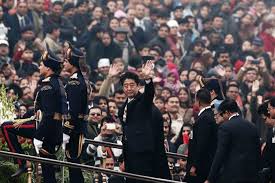
Abe visitHighlighting the strengthening ties between Asia’s second- and third-largest economies, Shinzo Abe, prime minister of Japan, was the guest of honour at India’s January 26 Republic Day celebrations, just weeks after the landmark tour of India by the Japanese emperor and his wife.

Mr Abe’s presence at India’s national day parade, which included a display of the nuclear-armed country’s military might, symbolised the emerging Japan-India strategic alliance. This partnership holds the potential to shape Asian geopolitics in much the same way as China’s rise or America’s Asian “pivot”.

Since Japan and India unveiled a “strategic and global partnership” during Mr Abe’s first stint as prime minister in 2006-2007, their engagement has deepened at pace. The driving force behind their growing collaboration is China’s increasing assertiveness in Asia.

Through persistent nibbling and other strong-arm tactics, a resurgent China is seeking to disturb the territorial status quo. While most international attention has focused on Chinese incursions in the South and East China Seas, China has also been active along its long Himalayan border with India and in the waters of the Indian Ocean.

Asia’s balance of power will be shaped largely by events in East Asia and the Indian Ocean. By linking these two regions, the Indo-Japanese entente – underpinned by close maritime cooperation – can ensure Asian power equilibrium and help safeguard vital sea lanes.

Japan and India value, according to their joint statement last weekend, “freedom, democracy and rule of law” and seek “to contribute jointly to the peace, stability and prosperity of the region and the world, taking into account changes in the strategic environment” – an allusion to the ascent of a muscular China.

India and Japan, natural allies strategically located on opposite flanks of Asia, are energy-poor countries heavily reliant on oil and gas imports from the Arabian Gulf region. The two maritime democracies are seriously concerned by mercantilist efforts to assert control over energy supplies and the transport routes for them. So, the maintenance of a peaceful and lawful maritime domain, including unimpeded freedom of navigation, is critical to their security and economic well-being.

This is why they have held joint naval exercises since 2012. These are just one sign of a shift from emphasising shared values to seeking to protect common interests. During Mr Abe’s visit, India also invited Japan to join this year’s US-Indian naval manoeuvres, known by their Indian name “Malabar”.

The Indo-Japanese relationship, remarkably free of any strategic dissonance or bilateral dispute, traces its roots to the introduction of Buddhism in Japan in the sixth century. The Todaiji Temple in the ancient capital city of Nara is home to Japan’s most famous statue – a gilt bronze image of Lord Buddha.

The statue’s allegorical eyes-opening ceremony in the year 752 was conducted by a priest from India in the presence of Emperor Shomu, who declared himself a servant of the “Three Treasures” – the Buddha, Buddhist law and the monastic order. Japan’s cultural heritage from India extends to Sanskrit influence on the Japanese language.

The Japanese imperial couple’s Indian tour in early December was a watershed moment in Japan-India relations. In the more than 2,600-year history of the Japanese monarchy, no emperor had previously been to India, although India has traditionally been respected in Japan as Tenjiku, or the heavenly country of Buddhism.

Today, Japan is a critical source of capital and commercial technology for India. Indeed, there cannot be a better partner for India’s development than the country that was Asia’s first modern economic-success story, inspiring other Asian states.

Japan, spearheading Asia’s industrial and technology advances since the nineteenth century, was also the first country in the non-Western world to emerge as a world power in modern history – a success that opened the path to its imperial conquests.

Since 2011, Japan has emerged as India’s largest source of foreign direct investment from a major industrialised nation. India overtook China a decade ago as the largest recipient of Japan’s official development assistance, which includes loans, grants and technical assistance.

For Japan, India is central to both its economic-revival and security-building strategies.

Mr Abe’s dynamic leadership and control of both houses of parliament is aiding his moves to return Japan to the right track. “Abenomics”, for example, has succeeded in weakening the yen, making exports more competitive and boosting corporate profits.

As part of his broader strategy of “proactive pacifism” to create a web of interlocking partnerships with countries in China’s periphery, Mr Abe has pushed for close, enduring collaboration with New Delhi. His Indian counterpart, Manmohan Singh, has said that Indians “see Japan as a natural and indispensable partner in our quest for stability and peace in the vast” Indo-Pacific region, marked by the confluence of the Indian and Pacific Oceans.

A growing congruence of strategic interests led India and Japan to sign a Joint Declaration on Security Cooperation in 2008, a significant milestone in building a stable balance of power in Asia. This joint declaration was modelled on Japan’s 2007 defence cooperation accord with Australia – the only other country with whom Japan, a US military ally, has a security-cooperation arrangement. The India-Japan security declaration, in turn, spawned a similar Indian-Australian accord in 2009.

The budding alliance between Japan and India holds the potential to redraw the Asian geopolitical map. Through close collaboration with each other and with other like-minded Asian states, Asia’s two main democracies must lead the effort to build freedom, prosperity and stability in Asia.

Brahma Chellaney, a geostrategist, is the author of Asian Juggernaut

(c) The National, 2014.

Japan and India: A Transformative Entente

BRAHMA CHELLANEY, Nikkie Asian Review, January 23, 2014

download

Asia’s future rests on the strategic triangle of China, India, and Japan — countries that have never before been strong at the same time. In the coming years, Asian geopolitics will be greatly influenced by an inexorable tightening of the bonds between Japan and India, which hope to fend off China’s growing assertiveness and territorial creep.

On the heels of the landmark Indian tour of Japan’s Emperor Akihito and Empress Michiko last month, Prime Minister Shinzo Abe will be the guest of honor at India’s Republic Day parade Jan. 26. This underscores the fast-developing partnership between Asia’s second- and third-largest economies. The two countries are also ramping up defense cooperation, as agreed during a recent visit by Japanese Defense Minister Itsunori Onodera.

Asia’s balance of power will be determined principally by events in East Asia and the Indian Ocean. By linking these two regions, the emerging Indo-Japanese entente holds virtually the same potential to shape the future as China’s ascent or America’s “pivot to Asia.”

Japan and India, natural allies strategically located on opposite flanks of the continent, have a pivotal role to play in ensuring a regional power equilibrium and safeguarding vital sea lanes in the wider Indo-Pacific region — an essential hub for global trade and energy supply.

Complementary partners

The visit of Japan’s Imperial couple in early December was a watershed moment in Japan-India relations. In the more than 2,600-year history of the Japanese monarchy — the world’s oldest continuous hereditary royalty — no emperor had previously been to India, although India has traditionally been respected in Japan as Tenjiku, or the heavenly country of Buddhism.

New Delhi invited the emperor and empress a decade ago. But it was Abe, an admirer of India, who keenly supported their visit as a way to signal his government’s commitment to forging closer ties with New Delhi. Now, Abe’s chief-guest role at India’s national day celebration adds meaning to his talk of a new “arc of freedom and prosperity” connecting Asia’s two main democracies. If there is any potential pitfall to the partnership, it is their messy domestic politics, including a dysfunctional party system that weighs them down.

The fact is that Japan has gone from aiding China’s economic rise through technology transfers and generous official development assistance to trying to balance China’s emergence as a military power. India overtook China a decade ago as the largest recipient of Japanese ODA, which includes loans, grants and technical assistance. Through its ODA, Japan is helping India improve its poor infrastructure, among other programs.

China’s rising labor costs and political muscle-flexing are seen as risks for foreign investors. Meanwhile, India — with its vast domestic market and large, young and cheap labor force — is seeking to position itself as Japan’s investment partner of choice. Japanese companies are themselves aiming for a more regionally balanced approach after years of focusing on China, which has absorbed much of Japan’s emerging-market investments.

The resulting shift in foreign direct investment has turned Japan into India’s largest source of FDI among major industrialized nations. A weakening yen is set to spur only greater Japanese capital outflows, allowing India to attract more Japanese investment to help fund its large current-account deficit.

The contrast between disciplined Japan and tumultuous India is striking. India has the world’s largest youthful population, while Japan is aging more rapidly than any other developed country. Whereas India has always valued strategic autonomy, Japan remains a model U.S. ally that hosts not only a large U.S. troop presence but also pays generously for the upkeep of American forces on its soil. Japan’s contribution surpasses the combined host-nation support of America’s 26 other allies.

Yet the dissimilarities between Japan and India have much to do with the prospects for close collaboration. Japan’s heavy-manufacturing base and India’s services-led growth — as well as their contrasting age structures — make their economies complementary. India’s human capital and Japan’s financial and technological strength can be a good match to propel India’s infrastructure development and great-power aspirations, as well as catalyze Japan’s revival as a world power. There is clear potential for strong synergies.

The logic for strategic collaboration is no less compelling. If China, India and Japan constitute Asia’s scalene triangle — with China representing the longest Side A, India Side B, and Japan Side C — the sum of B and C will always be greater than A. It is thus little surprise that Japan and India are seeking to add strategic bulk to their quickly deepening relationship.

Indeed, the world’s most stable economic partnerships, such as the Atlantic community and the Japan-U.S. partnership, have been built on the bedrock of security collaboration. Economic ties lacking that strategic underpinning tend to be less stable and even volatile, as is apparent from China’s economic relations with Japan, India, and the U.S.

The transformative India-Japan entente promises to positively shape Asia’s power dynamics.

Brahma Chellaney, a geostrategist and author, is a professor at the Center for Policy Research, New Delhi.

© Nikkie Asian Review, 2014.