Democracy in danger in yet another Asian nation

President Sirisena’s bloodless coup in Sri Lanka is backfiring. By bringing governance to a standstill, it is undermining the president. And by seeking to install Rajapaksa as prime minister, Sirisena sends a chilling message to the minorities and human-rights activists.

https_s3-ap-northeast-1.amazonaws.compsh-ex-ftnikkei-3937bb4images159416624951-5-eng-GBRTR4G76V

Once allies and now enemies: President Maithripala Sirisena, right, with Ranil Wickremesinghe, whom he has sought to oust as prime minister.   © Reuters

Brahma Chellaney, Nikkei Asian Review

Democracy worldwide today “finds itself battered and weakened,” says the U.S.-based Freedom House think tank. Nowhere is this truer than in Asia, where only a small number of states are genuine democracies.

Political freedom is already losing ground from Bangladesh to Hong Kong. The latest developments in Sri Lanka put the future of one of Asia’s oldest democracies at serious risk.

The island’s strategic location close to the world’s busiest sea lanes has helped intensify international concern over President Maithripala Sirisena’s recent unconstitutional actions that smack of the kind of authoritarianism that his predecessor, Mahinda Rajapaksa, had mastered. Sri Lanka’s vantage location has made it a “swing state” in the regional tussle for maritime ascendancy between China and democratic allies headed by India, the U.S., Japan and Australia.

Rajapaksa, who ended Sri Lanka’s 26-year-old civil war by brutally crushing rebels from the minority Tamil community, led the island-nation with an iron fist for a decade. In a stunning upset in early 2015, the strongman lost the presidential election to Sirisena, a minister in his cabinet who defected before the vote to become the common opposition candidate. Sirisena won in partnership with Ranil Wickremesinghe, who became prime minister.

The duo came to power on the promise of resolving Sri Lanka’s crisis of accountability and democratic governance and saving the country from a Chinese debt trap. China, in return for shielding Rajapaksa at the United Nations from allegations of war crimes, had won major infrastructure contracts during his rule and became the leading lender to a country it saw as vital to the completion of President Xi Jinping’s Maritime Silk Road.

Sirisena and Wickremesinghe, however, never jelled as partners. Their bickering turned into an open feud this year as Sirisena reneged on his promise not to seek a second term and began undercutting Wickremesinghe, who wanted to be the next president.

In recent days shockingly undemocratic steps have plunged Sri Lanka into political crisis. Sirisena joined forces with Rajapaksa to stage a political coup d’etat: Rajapaksa was hurriedly sworn in at night as prime minister after the president dismissed Wickremesinghe.

A 2015 constitutional amendment had expressly removed the president’s power to summarily fire the prime minister.

Amid outrage at home and abroad, Sirisena suspended Parliament to prevent Wickremesinghe — who has refused to accept his dismissal — from proving that he commanded a majority. In the meantime, with the United States, India and the European Union mounting pressure for a swift vote in Parliament even as China plowed a lonely furrow in recognizing the new prime minister, Sirisena sought to engineer a majority for Rajapaksa through political horse-trading, with lawmakers reportedly offered bribes to defect to his side.

On November 9, after Sirisena’s own party admitted failure to contrive majority support for Rajapaksa, the president dismissed Parliament and called parliamentary elections on January 5, about 20 months ahead of schedule. This action — which faces a challenge in the Supreme Court — was unlawful because, under Sri Lanka’s constitution, Parliament can be dissolved only when less than six months of its five-year term is left or when two-thirds of the lawmakers assent.

Sirisena’s power grab underscores the corrosive legacy of Rajapaksa’s family-centered quasi-dictatorship, which was marked by accusations of brazen nepotism, steady expansion of presidential powers, muzzling of civil liberties, and growth of Chinese influence.

The current crisis, however, should not obscure the country’s fundamental challenges in relation to ethnic reconciliation, human rights, justice and economic stability.

For example, postwar policies since the 2009 defeat of the Tamil Tiger rebels, far from promoting reconciliation, have engendered dangerous new ethnic and religious divides. The spread of anti-Muslim violence prompted the government in March to declare a state of emergency.

Despite the horrific human cost of the war, Rajapaksa emerged as a hero among the ethnic-Sinhalese majority, who are mainly Buddhist. An emboldened Rajapaksa stepped up efforts to fashion a mono-ethnic identity for a multiethnic Sri Lanka.

Rajapaksa’s bid to return to power sends a chilling message to the predominantly Hindu Tamils and to the Muslims, who together make up about a quarter of the country’s 22 million population.

Today, thousands of mainly Tamil families are still seeking information about loved ones who were forcibly taken away, pleading for return of land seized by the army or calling for the release of prisoners the government acknowledges it is holding.

Meanwhile, with the country slipping into debt entrapment, Sri Lanka’s China dilemma has only deepened. Unable to pay the accumulated Chinese debt, Sri Lanka was forced to hand over its strategically located Hambantota port to China last December under a 99-year lease valued at $1.12 billion. China, thanks to its leverage, has even secured new projects.

In a landmark speech last month that signaled a shift in America’s China policy, U.S. Vice President Mike Pence cited Sri Lanka as a victim of Beijing’s debt-trap diplomacy and warned that Hambantota could “soon become a forward military base for China’s growing blue-water navy.”

Today, the choice for Sri Lanka is between shaping its own destiny through political stability and getting sucked into great-power games through internal disarray.

By engineering a national crisis that has resulted in dueling prime ministers, with Rajapaksa pitted against Wickremesinghe, the wily Sirisena has sought to clear the way for another term for himself as president.

Whatever trajectory the present crisis takes, the damage to the country’s democratic institutions will not be easy to repair. This is especially so because of the broken promises and retrograde measures.

The president who was elected to prevent abuses and excesses of power again through constitutional change has himself abused the power of his office. In fact, he has reached a Faustian bargain with the man whose 2005-2015 presidency brought democracy under siege.

More fundamentally, Sri Lanka illustrates that free and fair elections, by themselves, do not guarantee genuine democratic empowerment at the grassroots level or adherence to constitutional rules by those in power. In fact, Sri Lanka is a reminder that democratic progress is reversible unless the rule of law is firmly established and the old, entrenched forces are held to account for their rapacious past.

Brahma Chellaney, a geostrategist and author of nine books, is professor of strategic studies at the independent Center for Policy Research in New Delhi and a Fellow at the Robert Bosch Academy in Berlin. © Nikkei Asian Review, 2018.

Insecurity in India’s maritime backyard

maldives pic

Maldives’ former president Mohamed Nasheed (left) with President-elect Ibrahim Mohamed Solih after returning from exile. (Photo: AP)

The centenary of the World War I armistice is a reminder that the war was triggered by European power struggle for territories, resources and client-states — the very pursuits of China today.

Brahma Chellaney, The Hindustan Times

While India watches with concern Sri Lanka’s deepening political crisis, Prime Minister Narendra Modi is boldly visiting the Maldives on the day its autocratic president, Abdullah Yameen, is to cede power after a surprise election defeat. Modi’s visit for the new president’s inauguration effectively ensures that Yameen will peacefully transfer power to the victor, Ibrahim Mohamed Solih. Indeed, the mere announcement of Modi’s visit signalled to Yameen that he had no choice but to accept the fait accompli.

Coordinated pressure from democratic powers, including the spectre of an Indian military intervention, is helping to restore Maldivian democracy. The US had warned of “appropriate measures” and the EU had threatened sanctions if the vote was not free and fair. And when the graft-tainted Yameen hesitated to concede defeat despite the election outcome, Washington demanded he “respect the will of the people.”

Yameen had stacked the electoral odds in his favour by jailing or forcing into exile all important opposition leaders and working to neuter the Supreme Court, including by imprisoning justices. But such was the grassroots backlash against his dictatorial rule that he lost the election to the little-known Solih, the common opposition candidate. Unless autocrats wholly manipulate elections, they cannot control voters’ backlash, which is why Malaysia’s Najib Razak was swept out of office in May and Sri Lanka’s Mahinda Rajapaksa was booted out in early 2015.

It is ironical that Sri Lanka has now been plunged into political crisis by President Maithripala Sirisena’s unconstitutional actions, which smack of the kind of authoritarianism displayed by his predecessor, Rajapaksa. Sirisena, who was elected to prevent abuses and excesses of power again through constitutional change, has himself abused the power of his office. Ominously, Sirisena has reached a Faustian bargain with Rajapaksa, whose decade-long presidency brought democracy under siege.

The collapse of the Sri Lankan partnership between Sirisena and Ranil Wickremesinghe is indeed an early warning to the Maldivian unity coalition that the restoration of full democracy is reversible unless those elected to high office respect constitutional rules and show consideration for their partners. Solih’s victory was made possible by opposition unity. But the only thing that united opposition leaders was the imperative to end Yameen’s tyrannical rule.

Those who helped fashion Solih’s victory include former presidents Maumoon Abdul Gayoom and Mohamed Nasheed. Earlier jailed by Gayoom, Nasheed took office in 2008 by defeating Gayoom in the country’s first multi-party election. But in 2012, Nasheed was ousted at gunpoint after pro-Islamist groups, including forces loyal to Gayoom, laid siege to the presidential office. In this light, political stability and democratic progress in post-Yameen Maldives will hinge on rival leaders staying united behind Solih.

There is much in common between the Maldives and Sri Lanka, including their islander cultures and shifting political alliances and the fact that Maldives’ official language, Dhivehi, is a dialect of Sinhala. The murky turn of events in Sri Lanka casts an unwelcome shadow over Maldives’ new democratic beginning.

In fact, the biggest threat to democratic institutions in India’s maritime neighbourhood — after internal crisis — comes from the growing role and leverage of the world’s largest autocracy, China. From bribing politicians to shielding pliant leaders and governments from UN actions, China has encouraged anti-democratic developments. Before Sirisena recently stunned a cabinet meeting by claiming he was the target of a RAW assassination plot (his office later denied he named RAW), he publicly boasted that Chinese President Xi Jinping “gifted” him almost $300 million “for any project of my wish.” China has also built South Asia’s largest kidney hospital in Sirisena’s home district.

A central challenge for the Solih-led Maldives will be to escape China’s debt entrapment, given how Beijing has sought to further its geostrategic goals by attempting to hold Sri Lanka financially hostage. Throttling democracy allowed Yameen to take the Maldives down the slippery slope of increasing indebtedness to his protector, China. The accumulated debt to China is now more than two times greater than Maldives’ yearly revenues. In steering his archipelago country firmly into China’s orbit, Yameen also leased several unpopulated islands opaquely to Beijing.

More broadly, the centenary this week of the World War I armistice is a reminder that the war was triggered by European power struggle for territories, resources and client-states — the very pursuits of China today. China’s increasing encroachments into India’s maritime neighbourhood will likely keep this region insecure and heighten uncertainty. By muscling its way into India’s backyard, Beijing has prompted an Indian focus on the maritime domain, including seeking to turn four key projects into “pearls” — Sabang (Indonesia); Chabahar (Iran); Duqm (Oman); and Agaléga (Mauritius).

Brahma Chellaney is a geostrategist.

© The Hindustan Times, 2018.

The linchpins for a rules-based Indo-Pacific

p7-Chellaney-a-20181026-870x581

Brahma Chellaney, The Japan Times

The spotlight on the Beijing summit between Shinzo Abe and Chinese President Xi Jinping cannot obscure the more substantive discussions starting Sunday between the Japanese prime minister and his Indian counterpart, Narendra Modi, in Tokyo. Whereas Japan-China ties are unlikely to easily return to normal, the Abe-Modi summit will cement the Japan-India relationship as Asia’s fastest growing and open the path to a military logistics pact to allow access to each other’s bases.

The entente between Asia’s richest democracy and its largest is a central pillar of the “free and open Indo-Pacific” strategy that U.S. President Donald Trump’s administration is assertively pushing. Indeed, Abe is the architect of the “free and open Indo-Pacific” concept, which he formally unveiled more than two years ago while addressing African leaders in Nairobi.

Today, Japan and India serve as the linchpins for establishing an Indo-Pacific order based on the principles of the rule of law, free trade, freedom of navigation and peaceful resolution of disputes. The Trump administration openly acknowledges the critical importance of the Japan-India relationship to achieving a “free and open” Indo-Pacific.

Trump’s Indo-Pacific strategy is really the successor to the “pivot” to Asia, which was announced by President Barack Obama’s administration in 2011 and became subsequently known as the “rebalance” to Asia. Like the “pivot,” the Indo-Pacific strategy is founded on the realization that the United States needs to correct its disproportionate focus on the Middle East by reorienting its policy to reflect Asia’s central importance to long-term American interests.

Asian security competition is occurring largely in the maritime context, which explains the increasing use of the term “Indo-Pacific” — representing the fusion of two oceans, the Indian and the Pacific. The geo-economic competition is also gaining traction in this region, which boasts the world’s fastest-growing economies, the fastest-increasing military expenditures and naval capabilities, the fiercest competition over natural resources, and the most dangerous hot spots. The Indo-Pacific thus holds the key to global security and a new world order.

The broadening of America’s “pivot” to a wider region that includes the Indian Ocean is also a riposte to China’s “Belt and Road” initiative, whose largest investments in infrastructure projects are concentrated in the Indian Ocean Rim. And as China’s first overseas naval base at Djibouti and its acquisition of several unpopulated islets in the Maldives illustrate, the Indian Ocean is also becoming Beijing’s geostrategic focus after its success in creating and militarizing artificial islands in the South China Sea.

Against this background, Abe and Modi, besides signing an accord Monday to build maritime domain awareness through partnership, will set in motion the process for the Japanese and Indian militaries to clinch a logistics-sharing agreement, formally known as the Acquisition and Cross Servicing Agreement (ACSA). A logistics-sharing accord has become imperative for the two militaries, given the number of joint maneuvers they hold, including three-way exercises involving the U.S. Navy in the Indian Ocean and the Pacific.

An ACSA with India will help Japan to project its rising naval power in the Indian Ocean, including allowing Japanese ships to get fuel and servicing at Indian naval bases. The Maritime Self-Defense Force will also be able to secure access to Indian naval facilities in the Andaman and Nicobar islands, located close to the western entrance to the Malacca Straits through which sizable shares of Japan’s and China’s trade and fuel imports pass.

With the loosening of the legal and constitutional constraints on the military under Abe, the MSDF, instead of focusing merely on territorial defense of the homeland, is now able to operate far beyond Japanese shores. Indeed, Japan’s new readiness to participate in regional security, including through joint military exercises and training, is making it a critical player in the changing geostrategic dynamics in the Indo-Pacific.

India has signed military logistics pacts with the U.S. and France, both of which have strategically located bases in the Indian Ocean and the Pacific. A logistics-sharing agreement with Japan, along with greater bilateral maritime cooperation, will help the Indian Navy expand its footprint to the western Pacific.

The plain fact is that Japan and India, in the absence of any historical baggage or major strategic disagreement, are natural allies that share largely complementary interests. In fact, Japan has the distinction of being the only country that has been allowed to undertake infrastructure and other projects in India’s sensitive northeast (bordering Myanmar, Tibet, Bhutan and Bangladesh), as well as in the Andaman and Nicobar islands.

If Japan and India add concrete security content to their relationship, their strategic partnership could potentially be a game changer in Asia. The emphasis on boosting trade and investment must be balanced with greater strategic collaboration. As Japanese Ambassador to India Kenji Hiramatsu put it, “Defense and security ties now need to catch up.”

Abe’s summit with Xi — and Modi’s earlier summit with the Chinese president in Wuhan in April — cannot hide the fact that Japan and India face a serious challenge from a revisionist and muscular China. In fact, it is the Trump administration’s pressure on Beijing on trade, technology and other fronts that has prompted Xi to reach out to Abe and Modi.

Xi is probably hoping that Japan, like it did after the 1989 Tiananmen Square massacre of student-led protesters, will help to bail out his country at a time when America’s China policy is undergoing a fundamental shift. Japan was one of the first countries to lift post-Tiananmen economic sanctions, an action that paved the way for Emperor Akihito’s 1992 historic visit to China.

But Japan, like the U.S., has now shed its China blinkers and embraced a more realistic, clear-eyed approach to relations with Beijing. India too is under no illusion that a Xi-led China is going to discard its bullying and rule-breaking, and become a good neighbor.

In this light, the Abe-Modi summit offers an opportunity to discuss how the Tokyo-New Delhi duet can contribute to the larger U.S.-initiated effort to build strategic equilibrium, power stability and maritime security in the Indo-Pacific. As for Washington, it needs to evolve a clear strategy to deal with the changing status quo in the South China Sea, a highly strategic corridor that is central to a truly “free and open” Indo-Pacific.

Longtime Japan Times contributor Brahma Chellaney is a geostrategist.

© The Japan Times, 2018.

Maldives: India should not rest on its oars

maldives-india

Brahma Chellaney, The Hindustan Times

Following President Abdulla Yameen’s surprise defeat in the Maldivian election, the air of self-congratulation that pervades in New Delhi risks obscuring the challenges. India ought to learn from its experience with Sri Lanka, where China has retained its influence and leverage even after authoritarian President Mahinda Rajapaksa was thrown out by voters in early 2015. In the Maldives, China may be down, but it’s not out and could, as in Sri Lanka, re-establish its clout through debt-trap diplomacy.

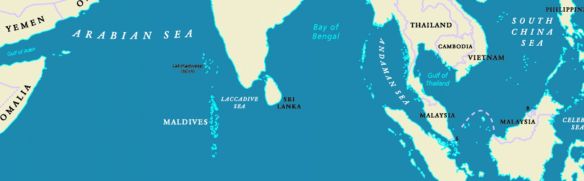
The Maldivian archipelago, despite its tiny population, is of key importance to Indian security, given that it sits astride critical sea lanes through which much of India’s shipping passes. From the Indian naval station on the Lakshadweep island of Minicoy, the Maldives’ northernmost Thuraakunu Island is just 100 kilometers away.

The election victory of opposition candidate Ibrahim Mohamed Solih against an increasingly autocratic Yameen cannot by itself roll back the deep strategic inroads China made during the incumbent president’s rule. To be sure, the outcome represents a triumph of Indian patience. Had India militarily intervened in the Maldives, it could have provoked a nationalistic backlash and strengthened Islamist forces in a country that has supplied the world’s highest per-capita number of foreign fighters to terrorist groups in Syria and Iraq.

After Yameen in February declared a state of emergency and jailed Supreme Court justices and political opponents, India came under pressure, including from the Maldivian opposition, to intervene militarily, as it did once before — in 1988 when it foiled an attempted coup. But unlike in 1988, no legitimate authority was inviting India to send in forces. By erring on the side of caution, and by holding out an intervention threat if the voting were not free and fair, India aided the electoral outcome.

Contrast this with Indian missteps in Nepal, where India woke up belatedly to the political machinations in Kathmandu that led to a flawed new Constitution being promulgated. India then backed the Madhesi movement for constitutional amendments — an agitation that triggered a five-month border blockade of essential supplies to Nepal. The resulting Nepalese grassroots backlash against India eventually contributed to the China-aided communists sweeping Nepal’s 2017 elections.

The restoration of full democracy in the Maldives after, hopefully, a smooth transfer of power on November 17 will be a diplomatic boost for India. However, in India’s larger strategic backyard, China continues to systematically erode Indian clout. Indeed, the Maldivian election result coincided with a major development underscoring Nepal’s pro-China tilt. After implementing a transit transport agreement with China to cut dependence on India, communist-ruled Nepal — under Chinese pressure — has reversed its previous government’s cancellation of the $2.5 billion Budhi-Gandaki Dam project. China bagged the project without competitive bidding. It massively inflated the project cost, which will leave Nepal struggling to repay the Chinese debt.

Yameen, who signed major financing and investment deals with Beijing, will be departing after pushing the Maldives to the brink of a Chinese debt trap. Can the Maldives still escape debt entrapment by emulating the example set by Malaysia’s Mahathir Mohamad, who recently cancelled Chinese projects worth almost $23 billion? Or is the Maldives, like Sri Lanka, already so indebted that it will remain under China’s sway? Nearly 80% of the Maldives’ external debt — equivalent to about one-quarter of its GDP — is owed to China.

Even without any new contracts, the Maldivian debt to China will rise because of the Chinese projects already completed or initiated, thus allowing Beijing to retain its favourite source of leverage. Indeed, Beijing will seek to court Yameen’s successor just as it has in Sri Lanka wooed Rajapaksa’s successor, who has disclosed that China has “gifted” him $300 million “for any project of my wish,” besides constructing South Asia’s largest kidney hospital in his electoral district.

In this light, the post-Yameen Maldives — like Nepal, Bangladesh and Sri Lanka — would likely seek to balance relations with India and China, thus reinforcing how Beijing has fundamentally altered geopolitics in a subregion New Delhi long considered its natural sphere of influence. As Maldives’ closest partner, a proactive India must leverage its ties. India should assist in infrastructure development and be willing to refinance Maldives’ Chinese debt so as to achieve lower costs and a longer-term maturity profile.

India will have to closely watch China’s activities in the unpopulated Maldivian islands it managed to lease during Yameen’s reign. China is muscling its way into India’s maritime backyard, including sending warships to the Maldives and signing an accord for an ocean observatory there that could provide critical data for deploying Chinese nuclear submarines. The new Maldivian government should be left in no doubt about India’s “red lines”.

Brahma Chellaney is a geostrategist and author.

© The Hindustan Times, 2018.

China’s Imperial Project Runs into Resistance

Washington Times
101_2018_b1chellanylgchina8201_c0-59-2200-1341_s885x516

Grand on ambition but short on transparency, Chinese President Xi Jinping’s marquee project, the Belt and Road Initiative (BRI), seeks to refashion the global economic and political order by luring nations desperate for infrastructure investments into China’s strategic orbit. The BRI is essentially an imperial project aiming to make real the mythical Middle Kingdom.

The BRI, rolled out in 2013, attracted many countries, as China offered to finance and build major infrastructure projects, including ports, highways, energy plants and railroads. But after a smooth sailing, the BRI is now encountering strong headwinds, as partner-countries worry about China ensnaring them in sovereignty-eroding debt traps.

China has extended huge loans to financially weak states, only to strengthen its leverage through debt entrapment Indeed, Beijing has converted big credits not just into political influence but also a military presence, as its first overseas naval base at Djibouti illustrates.

Malaysian Prime Minister Mahathir Mohamad, with Chinese Premier Li Keqiang by his side in Beijing’s Great Hall of the People, recently criticized China’s use of infrastructure projects to spread its influence. By warning China against “a new version of colonialism,” Mr. Mahathir highlighted international concerns over Beijing’s use of geo-economic tools to achieve geopolitical objectives.

A number of countries have now begun trying to renegotiate their deals with Beijing. Some have also decided to scrap or scale back BRI projects. Mr. Mahathir, during his Beijing visit, announced cancellation of Chinese projects worth nearly $23 billion.

BRI seeks to export China’s model of top-down, debt-driven development through government-to-government deals. Vulnerable countries are now awakening to the risks of accepting loans that could financially shackle them to Beijing.

Last December, China acquired the strategic Indian Ocean port of Hambantota on a 99-year lease after the small island nation of Sri Lanka could no longer keep up with debt repayments.

In fact, China is even replicating some of the practices that were used against it during the European-colonial period. For example, the concept of a 99-year lease emerged from the flurry of European-colonial expansion in China in the 19th century.

While rates for Japan’s infrastructure loans usually run below half a percent, China offers BRI loans at rates as high as 7 percent, which can place unsustainable financial strain on small countries. For example, China’s renegotiated Hambantota port loan to Sri Lanka carries a 6.3 percent fixed rate. In China’s client state, Pakistan, Chinese state companies have secured energy contracts that guarantee 16 percent or more yearly returns, in dollar terms.

China has faced accusations in multiple countries of illegally funneling money to authoritarian presidents.

In the Maldives, China has managed to acquire several islets in that heavily indebted Indian Ocean archipelago. Mohamed Nasheed, the nation’s first democratically elected president who was ousted at gunpoint in 2012, said, “Without firing a single shot, China has grabbed more land in the Maldives than what [Britain’s] East India Company did at the height of the 19th century.”

Against this background, the BRI is beginning to encounter a push-back in a number of countries. A growing number of governments are seeking transparency in Chinese lending, investment and trade practices.

However, the BRI is still bagging new contracts in some other countries. One example is the Himalayan nation of Nepal, which became the world’s sixth Communist-ruled country in February. China helped unite warring Communist factions in Nepal and funded the election campaign. Now Beijing is reaping the rewards.

The new Communist government in Nepal in September reinstated a deal with China for a $2.5 billion dam project that was scrapped by the previous government. China won the contract without an open-bidding process. In fact, it has massively inflated the project cost, which will leave Nepal struggling to repay the Chinese loan.

Laos, another Communist-ruled nation, is also seeking more BRI financing and investment. In continental Southeast Asia, while Myanmar, Thailand and Vietnam are wary of getting too close to China, Laos and Cambodia see BRI as critical to boosting their economic growth.

Yet the international reality is that, after a heady first phase, the pace of new contracts under the BRI has slowed, as concerns spread about China’s debt-trap diplomacy and as heavily indebted nations recoil from accepting more Chinese financing in the form of market-rate loans. This trend is likely to intensify in the next few years.

Even within China, the BRI is facing criticism from those who question the wisdom of plowing hundreds of billions of dollars into overseas projects when the government is still grappling with poverty and underdevelopment in a number of provinces. Critics are concerned that Mr. Xi’s aggressive quest for Chinese dominance is inviting an international backlash. The BRI — the world’s biggest building program, which Mr. Xi has hailed as “the project of the century” — exemplifies how China is flaunting its global ambitions.

Meanwhile, the financial and security risks of Chinese projects in failing or dysfunctional states are becoming more apparent. Take Pakistan, the largest recipient of BRI financing. The Pakistani military has raised a special 15,000-strong force to protect Chinese projects. In addition, thousands of police have been deployed in some provinces to protect Chinese workers. Yet sporadic attacks on Chinese in Pakistan have underscored the rising security costs.

The larger push-back against China’s neocolonial practices is likely to intensify in the coming years, putting greater pressure on the BRI. The initiative, however, will continue to benefit from a U.S.-led sanctions approach that seeks to punish countries in the name of human rights or nuclear nonproliferation. Thanks to this approach, the BRI is still bagging major lucrative contracts in countries as diverse as Iran, Sudan and Cambodia.

• Brahma Chellaney is a geostrategist and the author of nine books, including “Water: Asia’s New Battleground.”

Copyright © 2018 The Washington Times, LLC. Click here for reprint permission.

Beijing loses a battle in the Maldives — but the fight for influence goes on

China may be down in the Maldives, but it’s not out

https_s3-ap-northeast-1.amazonaws.compsh-ex-ftnikkei-3937bb4images181015880181-1-eng-GB20180925 India China Img

India must challenge China to help the Maldives retain strategic autonomy. (Source photo by Reuters)

Brahma ChellaneyNikkei Asian Review

The Indian Ocean nation of the Maldives, comprising 1,190 coral atolls, has been roiled by a deepening national crisis since its first democratically-elected president was forced to resign at gunpoint in 2012.

This week’s surprise defeat of authoritarian President Abdulla Yameen in a national election opens the path to stability and reconciliation under the leadership of the winning opposition candidate Ibrahim Mohamed Solih.

Yameen’s defeat, despite the jailing of opponents and Supreme Court justices and efforts to manipulate the election, shows how autocrats can be swept out of office by a voters’ backlash. And that even in a country with weak democratic traditions.

The Maldives follows Malaysia, where, in May, Prime Minister Najib Razak was voted out and now faces corruption charges under his 93-year-old successor, Mahathir Mohamad. Sri Lanka’s voters in 2015 similarly ended the quasi-dictatorship of President Mahinda Rajapaksa, who curtailed media freedom.

In all three states, China’s shadow loomed large. Yameen signed major financing and investment deals with China and, like Najib and Rajapaksa, is alleged by his opponents to have received Chinese funds for his reelection bid.

While Malaysian investigators are probing whether China helped bankroll Najib’s reelection bid, The New York Times reported in June that the state-run China Harbor Engineering Company allegedly gave $7.6 million for Rajapaksa’s campaign. Rajapaksa and CHEC have denied the claim, but new president Maithripala Sirisena’s government has called for an investigation.

China, Yameen’s main defender, capitalized on its support to expand its influence in the strategic Maldivian archipelago. Yameen, for his part, felt emboldened by Chinese support to crack down on the opposition and undermine national institutions, including the judiciary and the election commission.

With barely 450,000 citizens, the Maldives is tiny but sits astride critical shipping lanes, making it vital to security in the Indian Ocean. Yameen’s rout thus is a setback to China’s maritime ambitions and political influence, and a victory for grass roots democratic forces.

At a time when Beijing is beginning to encounter a wider pushback against its Belt and Road Initiative — an influence-building infrastructure program that can ensnare vulnerable countries in debt traps — the Maldives represents the latest case of a democratic election upending China’s plans. BRI could face speed bumps even in China’s close ally, Pakistan, where the new, cash-strapped government has instituted a review of Chinese projects.

China, however, can take comfort from the formation of a friendly, democratically elected communist government in the Himalayan state of Nepal. In a demonstration of autocratic China’s ability to exploit the openness of a democracy, it helped unite warring communist factions in Nepal and funded their election campaign.

In the Maldives, pressure from democratic powers, including the specter of an Indian military intervention, played a role in the outcome. The U.S. had warned of “appropriate measures” and the European Union had threatened sanctions if the vote was not free and fair. And when Yameen hesitated to concede defeat, Washington demanded he “respect the will of the people,” while India sought to present a fait accompli by being first to congratulate his opponent, Solih. (In the previous election in 2013, Yameen got the Supreme Court to annul the result after he trailed his opponent, forcing fresh polls which he dubiously won.)

India has traditionally viewed the Maldives as in its sphere of influence. So as China began eroding Indian influence by backing Yameen from 2013, concern grew in New Delhi that Beijing could turn one of the unpopulated Maldivian islands it had leased into a naval base, completing a strategic encirclement of India.

Among the islands China has acquired is Feydhoo Finolhu, for which it paid $4 million, less than the cost of a luxury apartment in Hong Kong; another island, the 7km-long Kalhufahalufushi, came even cheaper. China has revealed its strategic intentions by sending frigates to the Maldives.

After Yameen in February declared a state of emergency and jailed Supreme Court justices for quashing convictions against nine jailed or exiled opposition figures, India came under pressure, including from the Maldivian opposition, to intervene militarily, as it did once before – in 1988 when it foiled an attempted coup. The Indian intervention helped President Maumoon Abdul Gayoom to perpetuate his soft autocracy for another two decades.

An intervention this year, however, would have been dicey, not least because no legitimate authority had invited India to send in forces. The intervention could have provoked a nationalistic backlash and strengthened Islamist forces in the Maldives, which has supplied the world’s highest per capita number of foreign fighters to terrorist groups in Syria and Iraq. By correctly erring on the side of caution, India aided this week’s electoral outcome.

The restoration of full democracy in the Maldives, like in Malaysia, bucks an international trend: The global spread of democracy has largely stalled, with liberal forces unable to gain ground in the face of both tightly centralized political systems (as in China) and a revival of authoritarianism (as in Russia). While democracy has become the norm in large parts of Europe, very few Asian states are true democracies.

The return of democracy to the Maldives is especially remarkable as the country has been under authoritarianism for 50 of the 53 years since gaining independence from Britain in 1965. Yameen’s five-year rule marked a shift to hard authoritarianism, with that lurch being accompanied by the rising power of Islamists.

In the latest election, Yameen chose as his running mate a Muslim preacher with close ties to Saudi groups and got support from Jamiyyath Salaf. This extremist organization was one of the Islamist groups behind the 2012 museum attack that erased evidence of the country’s pre-Islamic past by destroying priceless Buddhist and Hindu statues.

The triumph of democratic forces, however, cannot mask the tough challenges that await Yameen’s successor, Solih, including on how to deal with Islamist power and service Chinese debt (which currently equals more than a quarter of the country’s gross domestic product). One key question is whether the Maldives will be able to pull back from the brink of a Chinese debt trap (by emulating the example set by Mahathir, who has canceled Chinese projects) or whether it is so indebted – as Sri Lanka is — that it will remain under Beijing’s sway.

China invested heavily in Sri Lanka during the rule of Rajapaksa, whom it shielded at the United Nations from allegations of war crimes. Sirisena sought to extricate Sri Lanka from the Chinese debt trap, including suspending work on major projects. But it was too late: Saddled with debts his government could not repay, Sirisena was forced to accept Chinese demands, including restarting suspended projects and handing the strategic Hambantota port to China on a 99-year lease.

Under Solih, even without new contracts, the Maldives’ debt to China will rise because of the Chinese projects already initiated. Beijing will court Solih — to be sworn in on Nov. 17 — just as it has wooed Sirisena, who has disclosed that China has “gifted” him $300 million “for any project of my wish,” besides constructing South Asia’s largest kidney hospital in his home district.

To reclaim its influence in the Maldives, India will have to do more than help strengthen the restored democracy; it must assist the new government in infrastructure development and meeting its foreign debt obligations, including by extending low-interest loans to pay off Chinese credits. Escaping debt entrapment is vital for the Maldives to retain strategic autonomy.

Brahma Chellaney is a geostrategist and the author, most recently, of the award-winning “Water, Peace, and War.”

© Nikkei Asian Review, 2018.

China expands its control in South China Sea

SCS

Filipino activists rally outside the Chinese Consulate in Manila in February to protest Beijing’s continued reclamation activities in the South China Sea. © Reuters

BY BRAHMA CHELLANEY, The Japan Times, September 18, 2018

As China consolidates its hold in South China Sea and wields its military, economic and diplomatic leverage, smaller countries see no credible option but to work with Beijing, even if that means furthering Chinese objectives. Manila, for example, seems willing to accede to Beijing’s demand for joint development of hydrocarbon resources in the Philippines’ own exclusive economic zone.

The plain fact is that U.S. inaction under successive administrations has allowed China to gain effective control over a strategic sea that is more than twice the size of the Gulf of Mexico and 50 percent bigger than the Mediterranean Sea. Australia’s Kevin Rudd, who is still fending off accusations that he was “a slavish pro-China prime minister,” has acknowledged that “Chinese policy has not yet been challenged in the South China Sea by the United States to any significant extent.”

The U.S., even at the risk of fostering Philippine helplessness against Chinese expansionism, has refused to clarify whether its 1951 Mutual Defense Treaty with Manila would apply to an attack on Philippine troops or vessels in the South China Sea. This refusal stands in contrast to Washington’s commitment to the defense of the Japanese-administered but Chinese-claimed Senkaku Islands in the East China Sea. U.S. President Donald Trump, in his joint statement with Prime Minister Shinzo Abe in April, said that “Article 5 of the U.S.-Japan Treaty of Mutual Cooperation and Security covers the Senkaku Islands.”

In the South China Sea, China has astounded the world with the speed and scale of its creation of artificial islands and military infrastructure. The first Chinese dredger arrived in the region in December 2013. Less than five years later, China has largely completed building most of its forward military bases. It is now ramping up its military assets in the South China Sea.

Yet China has incurred no international costs for pushing its borders far out into international waters. In fact, China stepped up the expansion of its frontiers after an international arbitration tribunal invalidated its expansive claims in the South China Sea through a 2016 ruling in a case instituted by the Philippines.

U.S. Defense Secretary Jim Mattis recently called out China for its “intimidation and coercion” of smaller nations in the region. His criticism of the Chinese strategy in the South China Sea followed American action to disinvite China from this summer’s Rim of the Pacific maritime exercise, known as RIMPAC.

This might suggest that the U.S. is taking a tough line. In reality, America’s response to China’s expansionism in the South China Sea has remained muted. The U.S. has focused its concern merely on safeguarding freedom of navigation through the South China Sea.

In fact, the U.S. has refused to take sides in the territorial disputes between China and the other claimant-states in the South China Sea. The Trump administration stayed silent even when Chinese military threats forced Vietnam in March, for the second time in less than nine months, to halt oil and gas drilling on its own continental shelf.

The U.S. has similarly stayed neutral on disputes elsewhere between China and its neighbors. For example, President Barack Obama publicly said that “we don’t take a position on the sovereignty of the Senkaku Islands” and advised Tokyo and Beijing to sort out their dispute peacefully. This line has not changed under Trump, despite his reassurance that the Japan-U.S. security treaty covers the Senkakus.

Growing Asian anxieties over China have helped the U.S. to return to Asia’s center-stage by strengthening old alliances, such as with Japan, South Korea and Singapore, and building new strategic partnerships with India, Vietnam and Indonesia. It has also befriended the former pariah state of Myanmar.

Yet, despite this diplomatic windfall, the U.S. has been reluctant to draw a line on Beijing’s salami-style actions to change facts on the ground.

To be sure, the Trump-led U.S. has stepped up the so-called freedom of navigation operations in the South China Sea. But these operations neither reassure the smaller states nor deter China, whose actions continue to violate the United Nations Convention on the Law of the Sea, or UNCLOS.

In the East China Sea, China established an air-defense identification zone (ADIZ) in 2013 covering territories, like the Senkakus, that it claims but does not control. This action set a dangerous precedent in international relations.

In the South China Sea, rather than openly declare an ADIZ, China will likely seek to enforce one by gradually establishing concentric circles of air control — but only after it has deployed sufficient military assets there and further consolidated its hold.

It has already set up an interconnected array of radar, electronic-attack facilities, missile batteries and airfields on the disputed Spratly Islands. And by turning artificial islands into military bases, it has virtually established permanent aircraft carriers whose role extends to the Indian Ocean and the western Pacific.

China’s strategy poses a serious challenge to its neighbors, which face a deepening dilemma over how to deal with its creeping aggression.

The U.S., while seeking to protect its military freedom of navigation in the South China Sea, has effectively turned a blind eye to the broader Chinese assault on the freedom of the seas, including restricting the rights of other states to natural resources on their own continental shelves.

Unless the U.S. shifts its focus from freedom of navigation to freedom of the seas, China will have its way, including forcing its smaller neighbors to share their legitimate resources with it.

The Philippines, for example, is at serious risk of wilting under Chinese pressure. Prevented by Chinese military threats from tapping energy resources in an area of seabed known as Reed Bank, which is located close the Philippine coast, Manila seems willing to enter into a deal with Beijing to equally share the output from a joint gas project there.

Under the international arbitration ruling, the Philippines have exclusive rights to Reed Bank. But with China trashing the ruling in the absence of an international enforcement mechanism, the message to Manila is that might makes right.

Left with no other option, Manila appears ready to offer Beijing half of the gas production, but no sovereign rights. The logic behind such a prospective offer is that any Western oil giant, if it developed Reed Bank, would take about 50 percent of the output as its share. So the choice is between a Western oil company like Exxon Mobil and a Chinese state-run giant, such as the China National Offshore Oil Corp.

But such a Philippine deal would encourage China to seek similar concessions with other claimant-states, effectively blocking out Western oil firms from the South China Sea.

Make no mistake: Chinese territorial and maritime revisionism has made the South China Sea the world’s most critical hot spot. In fact, the South China Sea has become central to the wider geopolitics, balance of power and maritime order.

Brahma Chellaney is a geostrategist and the author of nine books, including the award-winning “Water: Asia’s New Battleground.”

© The Japan Times, 2018.

A shadow over the ‘two-plus-two’ meeting

1_cIVpptHi4yCTOJaBjZCPdQ

Brahma Chellaney, The Hindustan Times, September 4, 2018

The US has emerged as India’s most important partner. The inaugural India-US “two-plus-two” ministerial dialogue will help highlight the growing convergence of their interests in the Indo-Pacific region. However, in India’s neighbourhood, Washington and New Delhi are still not on the same page.

For example, after gratuitously assassinating the third consecutive chief of the Pakistani Taliban this summer to please Pakistan’s military generals, the US held face-to-face talks with the Pakistan-backed Afghan Taliban in Qatar. While the Pakistani Taliban is the Pakistan military’s nemesis, the Afghan Taliban is America’s main battlefield foe in Afghanistan, yet the group is still missing from the US list of foreign terrorist organizations.

More broadly, the US and India have become key partners in seeking to create a free, open and democratic-led Indo-Pacific. The critical missing link in this strategy, however, is the South China Sea, which connects the Indian and Pacific oceans. US reluctance to impose tangible costs on China’s continued expansionism in the South China Sea has emboldened Chinese inroads in the Indian Ocean.

One issue likely to figure prominently in the two-plus-two meeting is how India has emerged as a prime victim of two new sets of US economic sanctions — on Iran and on Russia. The new sanctions directly impinge on India, a longstanding significant buyer of Russian weapons and the second-largest importer of Iranian oil after China.

The twin US pressures on energy and defence fronts have made India acutely aware of the risks of aligning itself closer with Washington. After ensnaring India in its Iran and Russia sanctions, Washington has sought to save the promising Indo-US strategic partnership by throwing in concessions. In reality, the concessions are intended as tools of leverage.

For example, the Pentagon’s top Asia official, characterizing Indian media reports as “misleading”, has made it clear that India can expect no waiver from Russia-related sanctions if it signs major new defence deals with Moscow. The congressional waiver crimps India’s leeway with its stringent conditions, including a six-monthly presidential certification specifying the other side’s active steps to cut its inventory of Russian military hardware.

On the Iran-related sanctions, no waiver for India is still in sight. With global shipping operators already pulling back from Iran business and oil prices rising, India’s energy-import bill is increasing. US sanctions threaten to affect even India’s Pakistan-bypassing transportation corridor to Afghanistan via Iran, including the Chabahar port project.

The Trump administration is clearly seeking to influence India’s arms-procurement and energy-import policies. This is in keeping with its increasing unilateralism, including dictating terms to allies and friends. Canada, for example, has been warned to accept US’s terms or face exclusion from the new NAFTA. Japan is buying a $2.1 billion US missile-defence system, not because it can effectively protect it from missile attacks, but because of US pressure to buy more American military hardware.

Washington is similarly pressuring New Delhi to buy more American weapons, although the US has already emerged as the largest arms seller to India. But, while the US basically sells defensive military systems, Russia has armed India with offensive weapons, including a nuclear-powered submarine and an aircraft carrier. Washington is also seeking to sell more oil and gas to India, besides pressing it to switch imports from Iran to Saudi Arabia and other US allies. However, next-door Iran, offering discounted pricing, will remain critical to India’s energy- diversification strategy.

Meanwhile, the US — after its success in getting India to accept a logistics assistance pact, which includes access to designated Indian military sites — has pushed for India to endorse the Communications Compatibility and Security Agreement (COMCASA), which the Indian armed forces initially feared could compromise their network. India, instead of leveraging its ties with Washington, appears set to announce at least an in-principle agreement on a modified COMCASA during the two-plus-two meeting, if not sign it.

Why is it that, in the run-up to any important summit or high-level meeting, India agrees to make a key concession to the other side? And why is that the other side doesn’t feel similarly pressured to make a concession to India? Isn’t reciprocity the first principle of diplomacy? Before finalizing COMCASA, India should clinch some major defence deals with Russia, including for the S-400 system, so as to test the US response. Instead, it is concluding new defence deals with the US.

The US and India will remain close friends. Washington, however, must fully address Indian concerns over the extraterritorial effects of its new Iran and Russia sanctions. Make no mistake: Washington has introduced a major irritant in the bilateral relationship that the twice-postponed two-plus-two dialogue cannot purge.

Brahma Chellaney is a geostrategist and author.

© The Hindustan Times, 2018.

Divided Asean spins its wheels as great powers become back-seat drivers

Brahma Chellaney says recent multilateral discussions in Singapore did little to advance preventive diplomacy or conflict resolution.

9

Brahma Chellaney, South China Morning Post

Despite its lack of cohesiveness and geopolitical heft, the 10-member Association of Southeast Asian Nations likes to be in the driver’s seat even on initiatives that extend beyond its region. But having placed itself at the wheel, Asean usually needs instructions from back-seat drivers on how to proceed and where to go.

One such example is the Asean Regional Forum, which provides a setting for annual ministerial discussions on peace and security issues across the Asia-Pacific. Established in 1994, it draws together 27 member-states, including key players such as the United States, China, India, Japan, Russia, Australia and the two Koreas.

The forum’s latest discussions were held this month along with three other meetings – the 18-nation East Asia Summit (whose membership extends from the US and New Zealand to India and Russia), the Asean Plus Three (China, Japan and South Korea) and Asean’s own annual ministerial discussions. These meetings, all at foreign minister level and held in rapid succession in Singapore, advertised the vaunted “centrality” of Asean, which represents a strategic region connecting the Pacific and Indian oceans.

But as Asean increasingly seeks to play an extra-regional role, its project to build a robust Southeast Asian community appears to have lost momentum. Indeed, its internal challenges are mounting.

The association has not been able to moderate great-power competition in its own region. Rival Chinese and US pressures on Asean have actually crimped its room to manoeuvre.

More fundamentally, the Asean-centred extra-regional initiatives, characterised by consensual decision making and minimal institutionalisation, serve mainly as “talk shops” for confidence building and improved cooperation. Like in Asean itself, the politics of lowest common denominator tends to prevail.

Consequently, these forums have not moved to preventive diplomacy or conflict resolution. They have also not been able to tangibly contribute to building a rules-based order or rein in aggressive unilateralism by their own members like China, the US and Russia.

Despite their limitations, the forums are seen by members as offering good value for promoting their foreign policy objectives and for making progress towards an Asia-Pacific security, political and economic architecture.

The latest spate of multilateral discussions in Singapore focused on issues ranging from North Korea’s denuclearisation – with US Secretary of State Mike Pompeo urging all states to “strictly enforce all sanctions” on Pyongyang – to the impending Regional Comprehensive Economic Partnership agreement, which would create the world’s largest trading bloc.

The discussions helped underscore the competing geopolitical interests at play. China, which views the US-led strategy for a “free and open Indo-Pacific” region as directed at it, mocked Pompeo’s separate announcements of US$113 million and US$300 million in funding for economic and security cooperation in the Indo-Pacific, respectively.

China’s state media compared these “paltry” US commitments with Beijing’s planned investment of US$900 billion in its “Belt and Road Initiative”, and Chinese Foreign Minister Wang Yi took a dig at Pompeo, saying: “The US is the sole superpower in today’s world, with a GDP totalling US$16 trillion. So when I first heard this figure of US$113 million I thought I heard wrong.”

The highlight of the Singapore meetings, however, was the announcement by China and Asean that they had agreed on a draft document that will serve as a basis for further negotiations for a code of conduct in the South China Sea, one of the world’s busiest waterways.

A code was mandated by the 2002 Declaration on the Conduct of Parties in the South China Sea, which exhorted all parties “to exercise self-restraint” with regard to “activities that would complicate or escalate disputes”. But that appeal was essentially ignored by China, which in recent years has fundamentally changed the status quo in the South China Sea in its favour, without incurring any international costs.

Sixteen years after that declaration, just a draft to negotiate a code of conduct has been announced. By the time the actual code emerges, China would have fully consolidated its control in the South China Sea, with the code only serving to reinforce the new reality. This explains why Beijing has delayed a code of conduct while it presses ahead in the South China Sea with frenzied construction and militarisation.

Today, the South China Sea has emerged as Asean’s Achilles’ heel, with the association’s failure to take a unified stance serving to aid Beijing’s divide-and-rule strategy. China has used inducement and coercion to split Asean and try to dictate terms to it.

The rift between pro-China Asean members and the rest has now become difficult to set right. By conveying disunity and weakness, Asean has emboldened China’s territorial and maritime revisionism, which, in turn, has made the South China Sea the world’s most critical hotspot.

Against this background, the much-hyped announcement of a single draft document for future negotiations, with Singaporean Foreign Minister Vivian Balakrishnan hailing it as “yet another milestone in the code of conduct process”, was just the latest example of how Asean has been playing right into China’s hands.

In fact, that announcement came soon after the second anniversary of the landmark ruling of an international arbitral tribunal, which knocked the bottom out of China’s grandiose territorial claims in the South China Sea. Since that ruling, which is now part of international law, China has only accelerated its expansionism, as if it is working to make the verdict totally meaningless.

This is a reminder that international law by itself is no answer to China’s expansionism. There needs to be a concerted international campaign to pressure and shame China. If Southeast Asia, a region of nearly 640 million people, is coerced into accepting Chinese hegemony, it will have a cascading geopolitical impact across the Indo-Pacific.

Yet, as if to advertise Asean’s inherent weakness, a meeting of its foreign ministers held just after the international tribunal’s ruling failed to issue even an agreed statement.

Asean was established in 1967 during the height of the cold war as a five-nation political organisation to help combat the potential threat of communist insurgencies in the region. At the time, the authoritarian-leaning, pro-capitalist governments of its founding members – Indonesia, Malaysia, Philippines, Singapore and Thailand – were facing internal and external threats. After the cold war ended, Asean expanded to cover much of Southeast Asia, from Myanmar to its former foe Vietnam.

Since then, the triumphs of an expanded Asean have largely been in the economic area. Politically, of course, Asean has been able to build greater interstate cooperation and stability in Southeast Asia, while collectively turning its members into a force to reckon with in international relations. This is no mean achievement.

Today, however, Asean’s challenges are being compounded by the widening gap between economics and politics in Southeast Asia. The region is integrating economically, with its economic vibrancy on open display. But its political diversity and divisions have exacerbated in the absence of common political norms.

This has raised questions about Asean’s capacity to safeguard peace and security in its own region. Such concerns have been heightened by the lack of an effective response to Myanmar’s Rohingya crisis, despite its transnational effects. Asean is also struggling to cope with other pressing regional problems – from human rights abuses in some member-states and transnational human trafficking to the degradation of coastal and other marine ecosystems.

In fact, Asean has left itself little room for reflection and reform by elaborately staging its summits and foreign-minister meetings in conjunction with the extra-regional initiatives that bring leaders of outside powers. This not only allows outsiders to press their own objectives but also keeps the focus on larger international issues, with Asean notionally in the driver’s seat.

As Asean seeks to enlarge its extra-regional profile, its “centrality” in broader initiatives is exacting an increasing price internally and laying bare its limitations. Its internal stasis underscores the imperative for it to reform and become a more cohesive, dynamic and result-oriented institution that helps underpin a stable rules-based order in Southeast Asia.

Brahma Chellaney is a geostrategist and the author of nine books, including the award-winning “Water: Asia’s New Battleground”.

© South China Morning Post, 2018.

The Modi Phenomenon and the Remaking of India

Brahma Chellaney, Panorama Journal, Vol. 01/2018

In the four years that he has been in office, Prime Minister Narendra Modi has animated domestic politics in India and the country’s foreign policy by departing often from conventional methods and shibboleths. A key question is whether the Modi era will mark a defining moment for India, just as the 1990s were for China and Prime Minister Shinzo Abe’s return as prime minister has been for Japan. The answer to that question is still not clear. What is clear, however, is that Modi’s ascension to power has clearly changed Indian politics and diplomacy.

Even before Modi’s Bharatiya Janata (Indian People’s) Party, or BJP, won the May 2014 national election, India’s fast-growing economy and rising geopolitical weight had significantly increased the country’s international profile. India was widely perceived to be a key “swing state” in the emerging geopolitical order. Since the start of this century, India’s relationship with the United States (US) has gradually but dramatically transformed. India and the US are now increasingly close partners. The US holds more military exercises with India every year than with any other country, including Britain. In the last decade, the US has also emerged as the largest seller of weapons to India, leaving the traditional supplier, Russia, far behind.

Modi’s pro-market economic policies, tax reforms, defence modernisation and foreign-policy dynamism have not only helped to further increase India’s international profile, but also augur well for the country’s economic-growth trajectory and rising strength. However, India’s troubled neighbourhood, along with its spillover effects, has posed a growing challenge for the Modi government. The combustible neighbourhood has underscored the imperative for India to evolve more dynamic and innovative approaches to diplomacy and national defence. For example, with its vulnerability to terrorist attacks linked to its location next to the Pakistan-Afghanistan belt, India has little choice but to prepare for a long-term battle against the forces of Islamic extremism and terrorism. Similarly, India’s ability to secure its maritime backyard, including its main trade arteries in the Indian Ocean region, will be an important test of its maritime strategy and foreign policy, especially at a time when an increasingly powerful and revisionist China is encroaching in India’s maritime space.

Modi’s Impact on Domestic Politics

Modi went quickly from being a provincial leader to becoming the prime minister of the world’s largest democracy. In fact, he rode to power in a landslide national-election victory that gave India the first government since the 1980s to be led by a party enjoying an absolute majority on its own in Parliament. The period since the late 1980s saw a series of successive coalition governments in New Delhi. Coalition governments became such a norm in India that the BJP’s success in securing an absolute majority in 2014 surprised even political analysts.

What factors explain the sudden rise of Modi? One factor clearly was the major corruption scandals that marred the decade-long rule of the preceding Congress Party-led coalition government headed by Prime Minister Manmohan Singh. The national treasury lost tens of billions of dollars in various corruption scandals. What stood out was not just the tardy prosecution process to bring to justice those responsible for the colossal losses but also the lack of sincere efforts to recoup the losses. The pervasive misuse of public office for private gain was seen by the voters as sapping India’s strength.

Modi, as the long-serving top elected official of the western Indian state of Gujarat, had provided a relatively clean administration free of any major corruption scandal. That stood out in contrast to Singh’s graft-tainted federal government. However, Hindu-Muslim riots in 2002 in Gujarat turned Modi into a controversial figure, with his opponents alleging that his state administration looked the other way as Hindu rioters attacked Muslims in reprisal for a Muslim mob setting a passenger train on fire. The political controversy actually prompted the US government in 2005 to revoke Modi’s visa over the unproven allegations that he connived in the Hindu-Muslim riots. Even after India’s Supreme Court found no evidence to link Modi to the violence, the US continued to ostracise him, reaching out to him only on the eve of the 2014 national election when he appeared set to become the next prime minister.

Modi’s political career at the provincial level was actually built on his success in coordinating relief work in his home state of Gujarat in response to a major 2001 earthquake there. Months after his relief work, Modi became the state’s chief minister, or the top elected official.

His party, the BJP, has tacitly espoused the cause of the country’s Hindu majority for long while claiming to represent all religious communities. The BJP sees itself as being no different than the Christian parties that emerged in Western Europe in the post-World War II era. The Christian parties in Western Europe, such as Germany’s long-dominant Christian Democratic Union (CDU), played a key role in Western Europe’s post-war recovery and economic and political integration.[1] Modi himself has subtly played the Hindu card to advance his political ambitions at the national level.

One can also draw a parallel between the prolonged period of political drift and paralysis in India that led to the national rise of Modi in 2014 and Japan’s six years of political instability that paved the way for Japanese Prime Minister Shinzo Abe’s return to power in 2012. Just as Abe’s return to power reflected Japan’s determination to reinvent itself as a more competitive and confident country, Modi’s election victory reflected the desire of Indians for a dynamic, assertive leader to help revitalise their country’s economy and security.

In fact, both Modi and Abe have focused on reviving their country’s economic fortunes, while simultaneously bolstering its defences and strengthening its strategic partnerships with likeminded states in order to promote regional stability and block the emergence of a Sino-centric Asia. Modi’s policies mirror Abe’s soft nationalism, market-oriented economics, and new “Asianism”, including seeking closer ties with Asian democracies to create a web of interlocking strategic partnerships. Until Modi became the first prime minister born after India gained independence in 1947, the wide gap between the average age of Indian political leaders and Indian citizens was conspicuous. That constitutes another parallel with Abe, who is Japan’s first prime minister born after World War II.

To be sure, there is an important difference in terms of the two leaders’ upbringing. Modi rose from humble beginnings to lead the world’s most-populous democracy.[2] Abe, on the other hand, boasts a distinguished political lineage as the grandson and grandnephew of two former Japanese prime ministers and the son of a former foreign minister. In fact, Modi rode to victory by crushing Rahul Gandhi’s dynastic aspirations.

Since he became prime minister, Modi has led the BJP to a string of victories in elections in a number of states, making the party the largest political force in the country without doubt. Under his leadership, the traditionally urban-focused BJP has significantly expanded its base in rural areas and among the socially disadvantaged classes. His skills as a political tactician steeped in cold-eyed pragmatism have held him in good stead. Modi, however, has become increasingly polarising. Indian democracy today is probably as divided and polarised as US democracy.

Politically, Modi has blended strong leadership, soft nationalism, and an appeal to the Hindu majority into an election-winning strategy. Playing the Hindu card, for example, helped the BJP to sweep the northern Hindi-speaking heartland in the 2014 national election and ride to victory in the subsequent state election in Uttar Pradesh, the country’s largest state. But use of that card, not surprisingly, has fostered greater divisiveness. Despite playing that card, the BJP, however, has done little for the Hindu majority specifically, thus reinforcing criticism that it cleverly uses the card to achieve electoral gains.

The BJP’s electoral successes, meanwhile, have prompted the opposition leader, Rahul Gandhi, to take a leaf out of Modi’s playbook by seeking to similarly boost his popularity among the Hindu majority. While campaigning in the December 2017 Gujarat state election, for example, Rahul Gandhi visited many Hindu temples. This new strategy resulted in his Congress Party, which has traditionally banked on the Muslim vote, significantly improving its strength in the Gujarat state legislature, although the BJP managed to hold on to power in a close election contest.

More fundamentally, Modi’s political rise had much to do with the Indian electorate’s yearning for an era of decisive government. Before becoming prime minister, Modi – a darling of business leaders at home and abroad – promised to restore rapid economic growth, saying there should be “no red tape, only red carpet” for investors.[3] He also pledged a qualitative change in governance and assured that the corrupt would face the full force of law. But, in office, has Modi really lived up to his promises?

Although he came to office with a popular mandate to usher in major changes, his record in power has been restorative rather than transformative. The transformative moment usually comes once in a generation. Modi failed to seize that moment. He seems to believe in incrementalism, not transformative change. His sheen has clearly dulled, yet his mass appeal remains unmatched in the country.

New Dynamism but also New Challenges in Foreign Policy

India faces major foreign-policy challenges, which by and large predate Modi’s ascension to power. India is home to more than one-sixth of the world’s population, yet it punches far below its weight. A year before Modi assumed office, an essay in the journal Foreign Affairs, titled “India’s Feeble Foreign Policy,” focused on how the country is resisting its own rise, as if the political miasma in New Delhi had turned the country into its own worst enemy.[4]

When Modi became prime minister, many Indians hoped that he would give a new direction to foreign relations at a time when the gap between India and China in terms of international power and stature was growing significantly. In fact, India’s influence in its own strategic backyard – including Nepal, Sri Lanka, Bangladesh and the Maldives – has shrunk. Indeed, Bhutan remains India’s sole pocket of strategic clout in South Asia.

India also confronts the strengthening nexus between its two nuclear-armed regional adversaries, China and Pakistan, both of which have staked claims to substantial swaths of Indian territory and continue to collaborate on weapons of mass destruction. In dealing with these countries, Modi has faced the same dilemma that has haunted previous Indian governments: the Chinese and Pakistani foreign ministries are weak actors. The Communist Party and the military shape Chinese foreign policy, while Pakistan is effectively controlled by its army and intelligence services, which still use terror groups as proxies. Under Modi, India has faced several daring terrorist attacks staged from Pakistan, including on Indian military facilities.

One Modi priority after assuming office was restoring momentum to the relationship with the United States, which, to some extent, had been damaged by grating diplomatic tensions and trade disputes while his predecessor was in office. While Modi has been unable to contain cross-border terrorist attacks from Pakistan or stem Chinese military incursions across the disputed Himalayan frontier, he has managed to lift the bilateral relationship with the US to a new level of engagement. He has enjoyed a good personal relationship with US President Donald Trump, like he had with Trump’s predecessor, Barack Obama.

Modi considers close ties with the US as essential to the advancement of India’s economic and security interests. The US, for its part, sees India as central to its Indo-Pacific strategy. As the White House’s national security strategy report in December 2017 put it, “A geopolitical competition between free and repressive visions of world order is taking place in the Indo-Pacific region. ­The region, which stretches from the west coast of India to the western shores of the United States, represents the most populous and economically dynamic part of the world […] We welcome India’s emergence as a leading global power and stronger strategic and defence partner.”[5]

More broadly, Modi’s various steps and policy moves have helped highlight the trademarks of his foreign policy – from pragmatism and lucidity to zeal and showmanship. They have also exemplified his penchant for springing diplomatic surprises. One example was his announcement during a China visit to grant Chinese tourists e-visas on arrival, an announcement that caught by surprise even his foreign secretary, who had just said at a media briefing that there was “no decision” on the issue. Another example was in Paris, where Modi announced a surprise decision to buy 36 French Rafale fighter-jets.

Modi is a realist who loves to play on the grand chessboard of geopolitics. He is seeking to steer foreign policy in a direction that helps to significantly aid his strategy to revitalise the country’s economic and military security. At least five things stand out about his foreign policy.

First, Modi has invested considerable political capital – and time – in high-powered diplomacy. No other prime minister since the country’s independence participated in so many bilateral and multilateral summit meetings in his first years in office. Critics contend that Modi’s busy foreign policy schedule leaves him restricted time to focus on his most-critical responsibility – domestic issues, which will define his legacy.

Second, pragmatism is the hallmark of the Modi foreign policy. Nothing better illustrates this than the priority he accorded, soon after coming to office, to adding momentum to the relationship with America, despite the US having heaped visa-denial humiliation on him over nine years. In his first year in office, he also went out of his way to befriend India’s strategic rival, China, negating the early assumptions that he would be less accommodating toward Beijing than his predecessor. With China increasingly assertive and unaccommodating, Modi’s gamble failed to pay off. Yet, in April 2018, Modi made a fresh effort to “reset” relations with China and held an informal summit meeting with Chinese President Xi Jinping in the central Chinese city of Wuhan.

Third, Modi has sought to shape a non-doctrinaire foreign-policy approach powered by ideas. He has taken some of his domestic policy ideas (such as “Make in India” and “Digital India”) to foreign policy, as if to underscore that his priority is to revitalise India economically. By simultaneously courting different major powers, Modi has also sought to demonstrate his ability to forge partnerships with rival powers and broker cooperative international approaches in a rapidly changing world.

In fact, Modi’s foreign policy is implicitly attempting to move India from its long-held nonalignment to a contemporary, globalised practicality. In essence, this means that India – a founding leader of the nonaligned movement – could become more multi-aligned and less nonaligned. Building close partnerships with major powers to pursue a variety of interests in diverse settings will not only enable India to advance its core priorities but also will help it to preserve strategic autonomy, in keeping with the country’s longstanding preference for policy independence.

Nonalignment suggests a passive approach, including staying on the sidelines. Being multi-aligned, on the other hand, permits a proactive approach. Being pragmatically multi-aligned seems a better option for India than remaining passively non-aligned. A multi-aligned India is already tilting more toward the major democracies of the world, as the resurrected Australia-India-Japan-US quadrilateral (or “quad”) grouping underscores. Still, India’s insistence on charting an independent course is reflected in its refusal to join American-led financial sanctions against Russia.

Meanwhile, a Modi-led India has not shied away from building strategic partnerships with countries around China’s periphery to counter that country’s creeping strategic encirclement of India. New Delhi’s resolve was apparent when Modi tacitly criticised China’s military buildup and encroachments in the South China Sea as evidence of an “18th-century expansionist mindset.” India’s “Look East” policy, for its part, has graduated to an “Act East” policy, with the original economic logic of “Look East” giving way to a geopolitical logic. The thrust of the new “Act East” policy – unveiled with US blessings – is to re-establish historically close ties with countries to India’s east so as to contribute to building a stable balance of power in the Indo-Pacific region. As Modi said in an op-ed published in 27 ASEAN newspapers on 26 January 2018 (the day, in a remarkable diplomatic feat, India hosted the leaders of all 10 ASEAN states as chief guests at its Republic Day parade), “Indians have always looked East to see the nurturing sunrise and the light of opportunities. Now, as before, the East, or the Indo-Pacific region, will be indispensable to India’s future and our common destiny.”[6]

Fourth, Modi has a penchant for diplomatic showmanship, reflected not only in the surprises he has sprung but also in the kinds of big-ticket speeches he has given abroad, often to chants of “Modi, Modi” from the audience. Like a rock star, he unleashed Modi-mania among Indian-diaspora audiences by taking the stage at New York’s storied Madison Square Garden, at Sydney’s sprawling Allphones Arena, and at Ricoh Coliseum, a hockey arena in downtown Toronto. When permission was sought for a similar speech event in Shanghai during Modi’s 2015 China visit, an apprehensive Chinese government, which bars any public rally, relented only on the condition that the event would be staged in an indoor stadium.

To help propel Indian foreign policy, Modi has also injected a personal touch. Indeed, Modi has used his personal touch with great effect, addressing leaders ranging from Obama to Abe by their first name and building an easy relationship with multiple world leaders. In keeping with his personalised stamp on diplomacy, Modi has relied on bilateral summits to open new avenues for cooperation and collaboration. At the same time, underscoring his nimble approach to diplomacy, he has shown he can think on his feet. The speed with which he rushed aid and rescue teams to an earthquake-battered Nepal, as well as dispatched Indian forces to evacuate Indian and foreign nationals from Nepal and conflict-torn Yemen, helped to raise India’s international profile, highlighting its capacity to respond swiftly to natural and human-induced disasters.

Fifth, it is scarcely a surprise that, given this background, Modi has put his own stamp on Indian foreign policy. The paradox is that Modi came to office with little foreign policy experience, yet he has demonstrated impressive diplomatic acumen, including taking bold steps and charting a vision for building a greater international role for India.

The former US secretary of state Madeleine Albright famously said, “The purpose of foreign policy is to persuade other countries to do what we want or, better yet, to want what we want.”[7] How has Modi’s foreign policy done when measured against such a standard of success? One must concede that, in terms of concrete results, Modi’s record thus far isn’t all that impressive. His supporters, however, would say that dividends from a new direction in foreign policy flow slowly and that he has been in office for just four years.

To be sure, a long period of strategic drift under coalition governments undermined India’s strength in its own backyard. Modi, however, has not yet been able to recoup the country’s losses in its neighbourhood. The erosion of India’s influence in its backyard holds far-reaching implications for its security, underscoring the imperative for a more dynamic, forward-looking foreign policy and a greater focus on its immediate neighbourhood. China’s strategic clout, for example, is increasingly on display even in countries symbiotically tied to India, such as Nepal, Sri Lanka and the Maldives. If China established a Djibouti-type naval base in the Maldives or Pakistan, it would effectively open an Indian Ocean front against India in the same quiet way that it opened the trans-Himalayan threat under Mao Zedong by gobbling up Tibet, the historical buffer. China has already leased several tiny islands in the Maldives and is reportedly working on a naval base adjacent to Pakistan’s Chinese-built Gwadar port.

To be sure, Modi has injected dynamism and motivation in diplomacy.[8] But he has also highlighted what has long blighted the country’s foreign policy – ad hoc and personality-driven actions that confound tactics with strategy. Institutionalised and integrated policymaking is essential for a robust diplomacy that takes a long view. Without healthy institutionalised processes, policy will tend to be ad hoc and shifting, with personalities at the helm having an excessive role in shaping thinking, priorities and objectives. If foreign policy is shaped by the whims and fancies of personalities who hold the reins of power, there will be a propensity to act in haste and repent at leisure, as has happened in India repeatedly since the time of Prime Minister Jawaharlal Nehru, who was in office for 17 years.

Today, India confronts a “tyranny of geography” – that is, serious external threats from virtually all directions. To some extent, it is a self-inflicted tyranny. India’s concerns over China, Pakistan, Nepal, Bangladesh, Sri Lanka and the Maldives stem from the failures of its past policies. An increasingly unstable neighbourhood also makes it more difficult to promote regional cooperation and integration. With its tyranny of geography putting greater pressure on its external and internal security, India needs to develop more innovative approaches to diplomacy. The erosion of its influence in its own backyard should serve as a wake-up call. Only through forward thinking can India hope to ameliorate its regional-security situation and play a larger global role. Otherwise, it will continue to be weighed down by its region.

While India undoubtedly is injecting greater realism in its foreign policy, it remains intrinsically cautious and reactive, rather than forward-looking and proactive. India has not fully abandoned its quixotic traditions. India’s tradition of realist strategic thought is probably the oldest in the world.[9] The realist doctrine was propounded by the strategist Kautilya, also known as Chanakya, who wrote the Arthashastra before Christ; this ancient manual on great-power diplomacy and international statecraft remains a must-read classic. Yet India, ironically, appears to have forgotten its own realist strategic thought.

Concluding Observations

India is more culturally diverse than the entire European Union – but with twice as many people. It is remarkable that India’s democracy has thrived despite such diversity. Yet, like the US, India has become politically polarised. And like Trump, Modi draws strong reactions – in support of him or against him. When Modi won the 2014 national election, critics said they feared his strongman tendencies – a fear they still profess. But in office, Modi has been anything but strong or aggressive in his policies. For example, his foreign policy and his domestic policies, especially economic policy, have been cautious and tactful. However, the “strongman” tag that critics have given Modi helps to obscure his failure to improve governance in India. On his watch, for example, India’s trade deficit with China has doubled to almost $5 billion a month.

Prudent gradualism, however, remains the hallmark of Modi’s approach in diplomacy and domestic policy. For example, to underpin India’s position as the world’s fastest-growing developing economy, Modi has preferred slow but steady progress on reforms, an approach that Arvind Subramanian, the government’s chief economic adviser, dubbed “creative incrementalism.” Many in India, of course, would prefer a bolder approach. But as a raucous democracy, India has to pay a “democracy tax” in the form of slower decision-making and pandering to powerful electoral constituencies. For example, under Modi, India’s bill for state subsidies has risen sharply.

A dynamic foreign policy can be built only on the foundation of a strong domestic policy, a realm where Modi must overcome political obstacles to shape a transformative legacy. If India is to emerge as a global economic powerhouse, Modi must make economic growth his first priority. Another imperative is for India to reduce its spiralling arms imports by developing an indigenous defence industry. However, Modi’s “Make in India” initiative has yet to take off, with manufacturing’s share of India’s GDP actually contracting.

As a shrewd politician, Modi has shown an ability to deftly recover from a setback. For example, he came under withering criticism when, while meeting Obama in early 2015 in New Delhi, he wore a navy suit with his name monogrammed in golden stripes all over it. Critics accused him of being narcissistic, while one politician went to the extent of calling him a “megalomaniac.” But by auctioning off the suit, Modi quickly cauterised a political liability. The designer suit was auctioned for charity, fetching INR 43.1 million ($693,234).

To many, Modi seems politically invincible at home, floating above the laws of political gravity. But, as happens in any democracy, any leader’s time eventually runs out. Modi suddenly appeared vulnerable in last December’s state elections in his native state of Gujarat but his party managed to retain power, although with a reduced majority. Until his political stock starts to irreversibly diminish, Modi will continue to dominate the Indian political scene, playing an outsize role. At present, though, there is no apparent successor to Modi.


Professor Brahma Chellaney is a professor of strategic studies at the independent Centre for Policy Research in New Delhi and an affiliate with the International Centre for the Study of Radicalisation at King’s College London. As a specialist on international strategic issues, he held appointments at Harvard University, the Brookings Institution, the Paul H. Nitze School of Advanced International Studies at Johns Hopkins University, and the Australian National University. He is the author of nine books, including an international bestseller, Asian Juggernaut (New York: Harper Paperbacks, 2010). His last book was Water, Peace, and War: Confronting the Global Water Crisis (Rowman & Littlefield, 2014).

[1] John Murray, “Christian Parties in Western Europe,” Studies, Vol. 50, No. 198 (Summer 1961).

[2] Andy Marino, Narendra Modi: A political Biography (New Delhi: HarperCollins, 2014).

[3] Economic Times, “Red carpet, not red tape for investors is the way out of economic crisis,” Interview with Narendra Modi, June 7, 2012.

[4] Manjari Chatterjee Miller, “India’s Feeble Foreign Policy: A Would-Be Great Power Resists Its Own Rise,” Foreign Affairs (May/June 2013).

[5] White House, National Security Strategy of the United States of America (Washington, DC: December 2017), available at: https://goo.gl/CWQf1t.

[6] Narendra Modi, “Shared values, common destiny,” The Straits Times, January 26, 2018, available at: http://www.straitstimes.com/opinion/shared-values-common-destiny.

[7] Madeleine Albright, The Mighty and the Almighty (New York: Harper Perennial, 2007).

[8] Alyssa Ayres, Our Time Has Come: How India is Making Its Place in the World (New York: Oxford University Press, 2018).

[9] Aparna Pande, From Chanakya to Modi: Evolution of India’s Foreign Policy (New Delhi: HarperCollins, 2017).