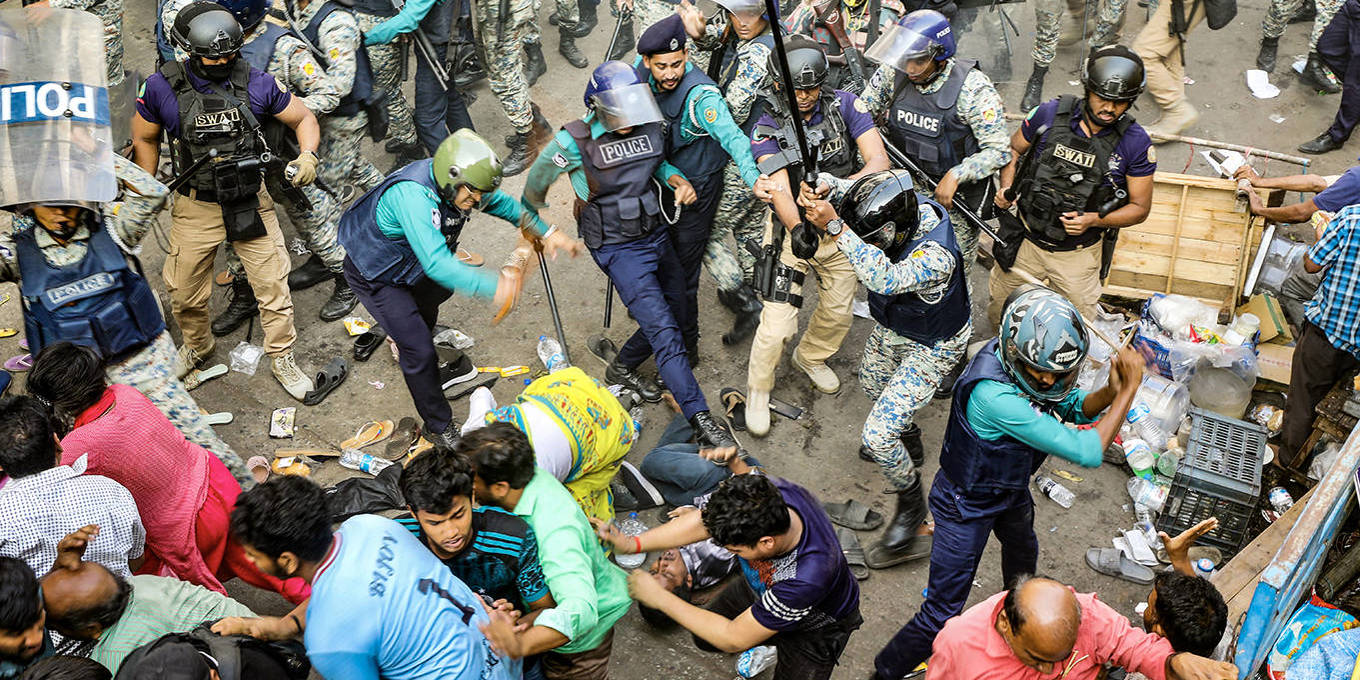
Many media accounts have credited the toppling of Bangladesh Prime Minister Sheikh Hasina’s government almost entirely to a student-led uprising. Unmentioned are either the army’s role in the overthrow, including packing the “Iron Lady” off to India, or the military’s return as the final arbiter in Bangladeshi national politics.
In reality, the regime change in the world’s eighth most-populous country amounts to a quiet military coup behind a civilian facade.
By installing an interim civilian government made up of only “advisers,” the coup leaders have not only forestalled U.S.-led sanctions but also helped foster a romanticized Western media narrative of a student-led “revolution” in the country.
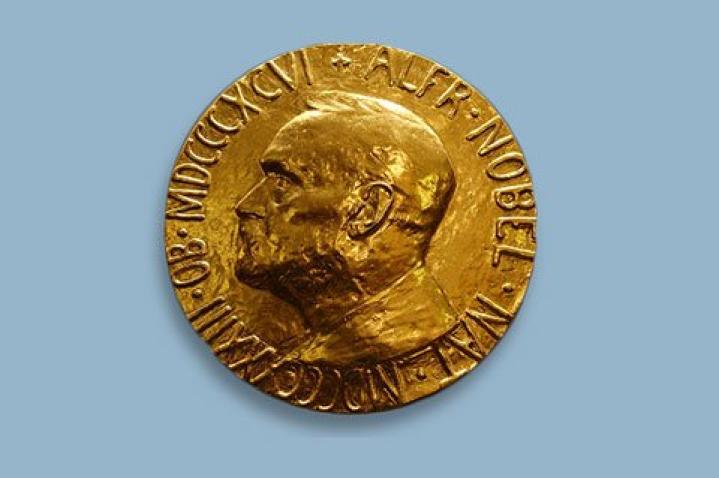
The appointment of Muhammad Yunus as the “chief adviser,” or the head of the interim administration, has only helped mask military rule. The 84-year-old Yunus, a longtime friend of Bill and Hillary Clinton, received the 2006 Nobel Peace Prize for pioneering microcredit, or giving small loans to rural families to help alleviate poverty.
With the duration and scope of powers of the interim administration undefined, its advisers work essentially at the direction of the military brass, especially the army chief, Gen. Waker-uz-Zaman, the power behind the throne. The advisers include two students who led the protests, a hardline Islamist leader and two retired army generals, one of them tasked with restoring law and order in the country.
To be clear, violent student-led, Islamist-backed protests against Hasina’s 15-year secular but increasingly undemocratic reign helped force her out of office. But the decisive factor that ended her rule was loss of support from the country’s powerful army. With protesters rampaging through the streets of the capital of Dhaka, the army’s refusal to enforce a government-ordered lockdown put Hasina’s own personal safety at risk, allowing the military to prevail upon her to flee the country.
No sooner had the 76-year-old Hasina departed for India aboard a military transport plane than mobs ransacked the prime minister’s sprawling official residence, looting every item that could be carried away, from paintings and furniture to fish from the pond.
Driving Hasina into exile appears not to have been a spur-of-the-moment military decision, but rather central to a well-thought-out plan for an indirect army takeover of the country. The international costs of killing a sitting prime minister in a coup, or putting her in prison without due process, were considered too high, making her forced banishment a better choice for the military brass.
Bangladesh’s decades-old cycle of political violence, after all, began with the predawn murder of Hasina’s father, the country’s charismatic founding leader, Sheikh Mujibur Rahman, in a 1975 army coup. President Rahman was killed by army officers in cold blood — along with his wife, three sons and their wives — while they were asleep at Rahman’s residence. Hasina, just 28 years old then, survived because she was abroad at that time.
What followed was prolonged political turmoil that prevented democracy from taking root. Coups and countercoups resulted in extended periods of military rule in the world’s most densely populated large country.
Bangladesh has no regional adversary, yet it has maintained a relatively large military with more than 200,000 personnel. Since external defense is not a major responsibility, the military has long pursued political machinations. When not ruling directly, it has sought to wield political power through pliant civilian-led governments.
Hasina kept the military and Islamist militancy in check, until the army chief used the student-led uprising to engineer her ouster by letting mob violence go beyond the control of police and paramilitary forces. Hasina had appointed Zaman as the army chief just weeks before her downfall, taking comfort in the fact that the general was married to her cousin.
Hasina’s fall, however, triggered a near-total collapse of the state, leading to widespread looting, vandalism, revenge killings and systematic attacks on the country’s small and long-persecuted Hindu minority. But with the mission accomplished by Hasina’s departure, the army chief finally pressed his troops into action to control the situation, including letting them fire on rioting protesters.
With its focus on profit and power, the military has a long history of abuses, as well as a nexus with radical Islamists. And like the military in Pakistan, from which Bangladesh seceded in 1971 after up to three million Bengalis died in a Pakistani genocide, the Bangladeshi armed forces maintain extensive commercial business interests, extending from real estate and hotels to banking, manufacturing and shipbuilding.
After this month’s silent coup, not only will democratization become more difficult, but already-weak civilian oversight over the military could evaporate.
Yet, with a U.S.-friendly interim administration having replaced the Hasina government, which the Biden administration openly targeted over democratic backsliding, Washington has little reason to impose coup-related aid restrictions on Bangladesh.
More than two dozen coups have occurred across the world since 2009, but the U.S. failed to formally condemn about half of those military takeovers because it saw them as favorable to American interests. Washington usually calls out a coup — an action legally necessitating a cutoff of U.S. foreign assistance — when the takeover is detrimental to American power and influence in the region.
Over the years, the U.S. has maintained cozy ties with military or military-backed regimes in Bangladesh. And it views the latest regime change as a positive development. But the White House and the State Department have denied Hasina’s allegation of U.S. involvement in her overthrow.
Still, with purges and crackdowns in full swing even as the nation remains in disarray, Bangladesh faces the daunting task of restoring the rule of law and reviving an economy battered by large-scale mob violence and destruction.
THE DRAMATIC OVERTHROW of Bangladesh Prime Minister Sheikh Hasina’s government on August 5 represents the biggest regional setback for India in more than a decade. The swift toppling, just six weeks after Hasina’s state visit to New Delhi, not only caught India by complete surprise but also carries adverse implications for Indian security. The development could weigh India down regionally at a time when New Delhi is seeking to play a greater role on the world stage.
Whereas New Delhi has reacted to the Bangladesh turmoil with deep concern and even alarm, India’s close strategic partner, America, has greeted Hasina’s fall with a sense of contentment. Washington’s smug satisfaction of Hasina’s exit extends, according to one analyst, to “gloating” by a section of the US establishment over the failure of the Indian project in Bangladesh.
US President Joe Biden’s administration had openly gunned for Hasina’s government, despite the fact that her secular regime kept the military and Islamists in check. Located thousands of miles away from the subcontinent, the US, in the name of democracy promotion, can afford to play geopolitical games without affecting its interests. But India, with vital security interests at stake, has no such luxury.
Democracy promotion has long served as a valuable geopolitical tool for the US. After greeting with glee the regime change in Bangladesh, the world’s eighth-most populous country, the Biden administration is now working on a new regime-change project by offering Venezuelan President Nicolás Maduro “amnesty” if he ceded power.
In fact, the US targeting of Hasina’s government served as a reminder for New Delhi of the wider divergence of American and Indian interests in India’s own neighbourhood, including in relation to Myanmar, Pakistan, Afghanistan and Iran.
After Myanmar—which is racked by an internal war that has been fuelled by stringent US-led sanctions and “non-lethal aid” to insurgents—Bangladesh could become the second immediate neighbour of India to be destabilised by short-sighted policies of the Biden administration. Greater turmoil in the region would seriously crimp Indian interests.
A destabilised Bangladesh would be India’s geopolitical nightmare. It would impose sustained costs on Indian interests, including potentially subverting the security of India’s vulnerable Northeast. It could also open the floodgates to the flow of Bangladeshi refugees to India, which is already home to countless millions of illegal immigrants from Bangladesh, the most densely populated country on Earth, if one excludes micro-states and mini-states.
The rise of violent Islamism in Bangladesh, including scores of incidents of Islamist terrorism in this century, has been a growing Indian concern. Extremists linked with ISIS (Islamic State), Al Qaeda and the Bangladeshi, Pakistan-backed Jamaat-e-Islami have a long record of assaulting religious and ethnic minorities as well as secular, liberal activists. In a destabilised Bangladesh, such forces would proliferate and pose cross-border challenges to India’s security.
No sooner had the army chief announced Hasina’s fall than rioters systematically sought to erase symbols of Bangladesh’s independence struggle and statehood, including burning down the Bangabandhu Memorial Museum in Dhaka and toppling or defacing the statues and portraits of the father of the nation, Sheikh Mujibur Rahman
Meanwhile, New Delhi’s ‘Act East’ policy, already reeling from the growing turmoil in Myanmar, has suffered another blow from the regime change in Bangladesh, which has put at risk connectivity and transit links with India.
HAVING PLAYED A CENTRAL role in forcing Hasina to flee the country, the army has re-emerged as the final arbiter in Bangladesh politics. The interim government, made up of ‘advisers’ with little experience in handling national matters, is just the civilian façade for military rule.
The army chief, General Waker-uz-Zaman, despite being related to Hasina by marriage, was instrumental in her downfall. Like her late father, Sheikh Mujibur Rahman, the country’s charismatic founding leader who ignored warnings in 1975 that army officers in Dhaka were plotting to stage a coup and kill him, Hasina disregarded advice that appointing the ambitious, Islamist-leaning Zaman as army chief could invite an army takeover. Hasina took comfort in the fact that Zaman was married to her cousin.
But just six weeks after Zaman became the army chief, Hasina fell from power. As street protests intensified, it became apparent that Zaman was wavering in his support for the Hasina government.
Through deliberate inaction, Zaman allowed the situation to deteriorate to the point that the police and paramilitary forces could no longer contain widespread looting, vandalism and arson, including attacks on public infrastructure and the Hindu minority. The army chief then used the violent upheaval to force the prime minister to leave the country on August 5. The night before, he bluntly conveyed to Hasina the army’s refusal to enforce the lockdown she had ordered, telling her that his soldiers would not fire on protesters, many of whom by then were rampaging through the streets of Dhaka.
But with “mission accomplished”, Zaman ordered his soldiers to fire on Awami League activists protesting against Hasina’s forced departure from the country. In Gopalganj, Hasina’s home district with a sizeable Hindu minority, the military action left several people killed or wounded.
The army brass saw forcing Hasina to flee to India as a better choice than killing or imprisoning her. Bumping off Hasina in the way her father was murdered would have made her a martyr in the eyes of the millions who still support her, while jailing the sitting prime minister would have created a constitutional crisis impeding the army’s appointment of a successor administration.
Hasina’s forced departure, however, triggered greater lawlessness, extending from widespread looting and revenge killings to atrocities against the long-persecuted Hindu minority, which had faced Islamist attacks periodically even under the Awami League government. In the recent protests, armed rioters, according to the official count, killed 42 policemen and looted 7.62mm rifles from law enforcement personnel. Only members of Bangladesh’s Rapid Action Battalion and police carry this type of rifle. After the bloody mayhem, Bangladesh is struggling to fully restore order.
The total collapse of government authority in Bangladesh was redolent of the 2022 chaos in Sri Lanka when the Rajapaksa brothers’ dynastic regime fell apart. Just as Sri Lankan President Gotabaya Rajapaksa fled the country on a military jet without resigning, Hasina arrived in India suddenly aboard a Bangladesh Air Force C-130J Super Hercules military transport plane without formally tendering her resignation to the president. And just as protesters in Colombo occupied the presidential palace, mobs in Dhaka ransacked the prime minister’s sprawling official residence, looting each and every article that could be carried away.
But, unlike in Sri Lanka, the army played a key role in the regime change in Bangladesh, including handpicking members of the new interim administration.
There is also one ominous parallel between the upheaval in Bangladesh and the 2012 political turmoil in the Maldives, in terms of what the rioters sought to accomplish.
Sheikh Hasina leaves Dhaka on a military helicopter, August 5, 2024
The total collapse of government authority in Bangladesh was redolent of the 2022 chaos in Sri Lanka when the Rajapaksa brothers’ dynastic regime fell apart. Hasina arrived in India aboard a Bangladesh Air Force C-130J super hercules military transport plane without formally tendering her resignation to the president
When the Maldives’ first democratically elected president, Mohamed Nasheed, was forced to resign at gunpoint, Islamists ransacked the country’s main museum in Malé, the capital, smashing priceless Buddhist and Hindu statues made of coral and limestone, virtually erasing all evidence of the Maldives’ pre-Islamic past before Maldivians converted to Islam in the 12th century. “The whole pre-Islamic history is gone,” the museum’s director then lamented.
Similarly, no sooner had the army chief announced Hasina’s fall than rioters systematically sought to erase symbols of Bangladesh’s independence struggle and statehood, including burning down the Bangabandhu Memorial Museum in Dhaka and toppling or defacing the statues and portraits of the Father of the Nation, Sheikh Mujibur Rahman. The museum was central to the history of how Bangladesh was created—a violent birth that occurred after up to 3 million Bangladeshi civilians (mainly Hindus singled out by Pakistan’s army) were slaughtered, some 200,000 women were coerced into rape camps, and about 10 million people fled to India.
The August 5 vandalism against national symbols was an attack on Bangladesh’s identity, its history and its statehood. It showed that, more than half-a-century after the country’s birth, there are still elements within Bangladesh that have not reconciled to its secession from Pakistan.
Since 1975, Bangladesh has experienced more than two dozen army coups or coup attempts. By assassinating the father of the nation, the army became the most powerful political player, ruling Bangladesh directly or indirectly for extended periods. It was the ‘iron lady’ Hasina who kept the military (and Islamists) in check—until the recent violent uprising against her rule led the army chief to compel her to leave the country.
Today, General Zaman is the power behind the throne. When decisive power rests with an extra-constitutional authority, democratisation can hardly gain traction.
The interim government has no constitutional mandate. The Bangladesh constitution calls for elections to be held within 90 days of the dissolution of parliament, yet the duration (or the scope of powers) of the interim government has not been defined. Political discontent will grow if the constitutional deadline passes without the holding of elections.
The country’s president holds a largely ceremonial position. And the interim government consists only of advisers. Advisers are not the same as decision-makers. Despite a US-friendly chief adviser, Muhammad Yunus, nominally heading the interim government, Hasina’s overthrow has left a major power vacuum in the country that is being filled by the military—and Islamists.
The army is puppet-mastering the moves and decisions of the interim government advisers, who, in any case, owe their positions to General Zaman.
Against this backdrop, purges are in full swing, spurring greater uncertainty and fear in Bangladesh. The country’s chief justice and the next five senior-most justices of the Supreme Court were made to resign virtually at gunpoint. The purges have extended to all institutions, from the military, intelligence agencies and police to the central bank and universities.
One can expect more purges and crackdowns, some silent ones and some possibly violent ones. The aim is to stifle all support for Hasina and demolish her family’s political legacy. The Awami League has already been directed to “reorganise” itself (that is, rid itself of Hasina’s influence) in order to participate in the next election.
US President Joe Biden, Sheikh Hasina and First Lady Jill Biden in New York, September 21, 2022
The Biden administration’s hard line toward Hasina began with its December 10, 2021 imposition of sanctions on its Rapid Action Battalion (RAB) on grounds that RAB committed alleged human rights abuses as part of its war on drugs
RUDYARD KIPLING’S PORTRAYAL of strategic skulduggery in his 1901 novel Kim popularised the “Great Game” of the time between the British Empire and Tsarist Russia for control over Afghanistan and Central Asia. Since then, several other Great Games have been played out or continue to be at play.
The de facto coup d’état in Bangladesh and the externally fuelled internal war in Myanmar hint at a new Great Game at play in southern Asia, despite the risks that the machinations could extend Myanmar’s destabilisation to Bangladesh and Northeast India, thereby spurring greater regional tensions and an upsurge of radical Islamism. This Great Game is being played on several levels, including diplomatic, espionage and economic, as well as through political manoeuvrings.
The US and China have separately sought to enhance their interests in southern Asia in ways that are generating acute security and economic risks for India, the regional power. But while China sees India as an adversary, the US and India are friends, yet on regional issues of core Indian interest, Washington and New Delhi are not on the same page.
The US-India strategic divergence over Bangladesh began in 1971 when US President Richard Nixon turned a blind eye to the Pakistani genocide in East Pakistan and sought to prevent the birth of Bangladesh, including by urging China to open a military front against India. The US grudgingly recognised Bangladesh as an independent nation in April 1972 after a majority of countries had already done so.
In the subsequent years, even as India-US relations improved, the strategic dissonance between the two powers over Bangladesh never disappeared. US interests, after all, never aligned with Indian interests. Indeed, the dissonance became more pronounced when the Biden administration started gunning for Hasina, ignoring Indian concerns about the growing Islamist menace and political volatility in India’s neighbourhood.
In the name of seeking to restore democratic governance, the US has maintained cosy ties with every military or military-backed regime in Bangladesh since 1975.
Now, after the ouster of Hasina, Washington has said its approach to the military-chosen interim government would be based on “Bangladeshi people’s democratic aspirations and … a path to democratic governance”. It has welcomed the new interim government in Dhaka, saying it will work with it “as it charts a democratic future for the people of Bangladesh”.
But the new administration, with a radical Islamist leader as one of its advisers, is just a civilian setup for army rule. In a nod to the growing power of Islamic fundamentalists and extremists in Bangladesh, the army chief included in the interim administration a leader of the Hefazat-e-Islam, a coalition of Islamist organisations that seeks a system based on Sharia (Islamic law). The Hefazat-e-Islam has been linked to attacks on the Hindu minority and to last year’s killing of a young blogger.
Muhammad Yunus being sworn in as head of Bangladesh’s interim government in Dhaka, August 8, 2024 (Photo: AFP)
The interim government consists only of advisers. Despite a US-friendly chief adviser, Muhammad Yunus, nominally heading the interim government, Hasina’s overthrow has left a major power vacuum in the country that is being filled by the military
The Biden administration’s hard line toward the Hasina government began with its December 10, 2021 imposition of sanctions on Bangladesh’s Rapid Action Battalion (RAB) on grounds that RAB committed alleged human rights abuses as part of its war on drugs. Bangladesh was excluded from the Summits for Democracy convened by Biden in December 2021 and March 2023, while military-dominated Pakistan was invited both times though it did not attend either.
Bangladesh’s impressive economic growth trajectory under Hasina stood in stark contrast to the chronic political and economic turmoil in Pakistan. But, while continuing to reward Pakistan by prioritising short-term geopolitical considerations, the Biden administration sharply stepped up its criticism of democratic backsliding in Bangladesh.
It also started wielding the visa-sanctions stick against the Hasina government. Secretary of State Antony Blinken unveiled a new US policy on May 24, 2023 to restrict the issuance of visa for any Bangladeshi individual believed to be involved in undermining the democratic election process in Bangladesh. Washington’s increasing hard line approach emboldened anti- Hasina political forces in Bangladesh, including Islamists and the largest opposition party, the Bangladesh Nationalist Party (BNP), which had allied itself with the Jamaat-e-Islami.
Now Hasina, alleging a US role in her overthrow, has reportedly claimed that, “I could have remained in power if I had surrendered the sovereignty of Saint Martin’s Island and allowed America to hold sway over the Bay of Bengal.” Hasina’s son, Sajeeb Wazed, who holds an American green card, apparently came under immediate pressure to recant her mother’s allegations. Hours after confirming to WION television channel Hasina’s remarks about the US and St Martin’s, Wazed posted on X denying that she made any such statement.
The White House, asked about Hasina’s allegation that she was overthrown because of her refusal to lease St Martin’s to the US, stated flatly that “we have had no involvement at all” in the events in Bangladesh.
It was on June 21, 2023 that Hasina openly raised the St Martin’s issue, telling a news conference at her official residence in Dhaka that if she were to “lease the island of St Martin’s to someone, then there would be no problem” with her staying ensconced in power. But, she added, such a lease “won’t happen” on her watch.
The US sought to build close defence ties with Bangladesh by urging the Hasina government unsuccessfully to sign the General Security of Military Information Agreement (or GSOMIA) and the Acquisition and Cross-Servicing Agreement (or ACSA). But the US has never acknowledged wanting to lease St Martin’s, a small island that is closer to Myanmar than to Bangladesh’s coast.
There are already around 750 American military bases spread across at least 80 countries. The US may be seeking to expand its strategic foothold to new areas where its presence is non-existent or weak, including the Bay of Bengal.
St Martin’s, with its vantage location just eight kilometres from the Myanmar coast, could serve as a US listening post. Such a listening post, however, would be more useful for electronic surveillance of sanctions-battered Myanmar and friendly India than America’s sole challenger at the global level, China.
The new Great Game, of course, also includes Russia and China. The Hasina foreign policy embraced the concept of “equidistant diplomacy” in relation to China and India to help underscore Bangladesh’s neutrality in the Sino-Indian geopolitical rivalry. Beijing, however, saw a pro-India tilt in Hasina’s foreign policy, a perception reinforced by her more recent announcement that Dhaka would chose India over China for the multibillion-dollar Teesta River development project, which is to come up on Bangladeshi territory close to India’s narrow Siliguri Corridor known as the ‘chicken neck’.
Yet, like Russia, China sees a likely American hand in the regime change in Bangladesh, with Chinese state media stating that if any foreign power deserves blame for Hasina’s overthrow, it is the US. Three weeks before the January 7, 2024 Bangladesh election, the Russian foreign ministry spokeswoman had warned that, if Hasina were re-elected to a third term in office, the US would create an Arab Spring-type of upheaval to bring about regime change in Dhaka.
Strategic skulduggery rarely leaves any political fingerprints. The truth may never be known, including whether, as some suggest, the CIA worked through its longstanding partner, Pakistan’s rogue Inter-Services Intelligence (ISI) agency, to foment an uprising against Hasina’s rule. In Pakistan, Imran Khan has blamed the US for helping to topple his own government in 2022 in league with the Pakistani military and his political opponents.
In the post-Hasina era, Bangladesh is likely to bolster its ties with China and Pakistan, which could come largely at India’s expense, including the security of the northeastern Indian states. At stake also are India’s transit rights through Bangladesh, Indian security and counterterrorism cooperation with Bangladesh, Indian investments in Bangladesh, and cooperation with Dhaka to control illegal migration to India, including by the Rohingya
What is clear, though, is that, despite Washington and New Delhi pledging in a joint statement last year to become “among the closest partners in the world”, American interests do not align with India’s core interests in the arc extending from Myanmar to Iran. Bangladesh is just the latest wake-up call for New Delhi.
Dealing with this unpalatable reality puts India on the horns of a dilemma, with no easy choices. Although India will continue to cultivate deeper ties with the US, the Indo-US strategic dissonance in India’s own neighbourhood is already quite jarring, given that Narendra Modi is widely seen as the country’s most pro-US prime minister since Indian independence.
As for Bangladesh, its recovery from the political turmoil is likely to be an extended and difficult process. This is apparent from the retribution campaign extending to expanded purges and crackdowns.
Political upheaval or prolonged instability imposes major economic costs. Consider the case of Pakistan, which has repeatedly sought International Monetary Fund bailouts in recent years.
In Bangladesh, the political upheaval, by stalling economic activity and creating unrest in the banking sector, is likely to usher in hard times, with inflation already spiralling and foreign-exchange reserves dwindling fast. It will not be easy to restore the confidence of foreign investors after the large-scale looting, vandalism and arson, including attacks on public infrastructure and setting ablaze hotels, hospitals and homes.
In the post-Hasina era, Bangladesh is likely to bolster its ties with China and Pakistan, which could come largely at India’s expense, including the security of the northeastern Indian states. At stake also are India’s transit rights through Bangladesh, Indian security and counterterrorism cooperation with Bangladesh, Indian investments in Bangladesh, and cooperation with Dhaka to control illegal migration to India, including by the Rohingya.
India’s longest land border is with Bangladesh, not with Tibet or Pakistan. And this is a porous border. India has no choice but to make major investments in strengthening the security of its borders, including with Bangladesh and Myanmar. India’s open border with Nepal poses a different set of challenges, which also need to be addressed.
With polls in as many as 76 countries, 2024 is the biggest election year in history. This year’s raft of elections has already produced a left-leaning government in Britain, political gridlock in France, Indian Prime Minister Narendra Modi’s return to office for a third term, and the elevation of the pro-sovereignty William Lai (賴清德) as Taiwan’s president, but with his Democratic Progressive Party losing its majority in the legislature.
But no election will have a greater global impact than the one in the US. Whether American voters elect Kamala Harris or Donald Trump as the next president, and whether the Republicans or Democrats gain control of the US Congress, will reverberate across the world, including in Taiwan, which confronts increasing Chinese coercive pressure.
At a time when a major geopolitical reconfiguration is underway, with America’s global preeminence at stake, the US is heading to its most consequential presidential election in a generation.
US domestic politics has a bearing on international issues of peace and war. In fact, hardened polarization in the US has created a partisan divide on some key foreign policy issues. For example, according to one poll, Democrats worry about Russia above all while Republicans are most concerned about China.
Outgoing President Joe Biden’s national security team largely comprises “liberal interventionists” — essentially, hawks on the left — whereas many on the right, including Trump, can be considered non-interventionists (or, as their critics call them, “isolationists”).
If Harris, who has a biracial Black and Indian American identity, becomes the first female president of the US, she is likely to sustain the Biden approach to the Ukraine war, thereby precluding American support for any ceasefire effort. The US, without putting its own soldiers in harm’s way, is deeply involved in the war that has increasingly devastated Ukraine.
By contrast, if Trump returns to the White House, he is unlikely to prolong the US involvement in the war or support sending tens of billions of dollars in additional military aid to Ukraine. Tellingly, he has chosen as his running mate J.D. Vance, who led the opposition in the Senate to this year’s fresh US$61 billion Ukrainian assistance package.
Indeed, Trump’s record as president between 2017 and 2021 underlined his aversion to America funding wars or getting entangled in conflicts around the world, instead of focusing on rebuilding its power capabilities.
In 2020, he famously said at a White House news conference that the “top people in the Pentagon” want to “do nothing but fight wars so that all of those wonderful companies that make the bombs and make the planes and make everything else stay happy. But we’re getting out of the endless wars.” This statement echoed then-President Dwight D. Eisenhower’s 1961 warning about America’s “military-industrial complex.”
Last month, Trump reiterated a promise that, as president, he would end “the horrible war with Russia and Ukraine.”
But Trump has also made controversial comments about Taiwan recently, implying that he might be willing to leave Taiwan to its fate. “Taiwan should pay us for defense. You know, we’re no different than an insurance company. Taiwan doesn’t give us anything,” Trump said in a newsmagazine interview, while suggesting that the US would have difficulty defending the island because of its distance, stating “Taiwan is 9,500 miles away (from the US). It’s 68 miles away from China.”
By tacitly asking for a “protection fee,” those remarks underscore Trump’s long-held transactional approach to foreign affairs. In practice, though, a new Trump administration, if it assumes office, is likely to be tougher on China than Team Biden.
It should not be forgotten that it was the Trump administration that in 2017 reversed a 45-year US policy of aiding China’s economic rise. That policy, initiated by then-President Richard Nixon, helped spawn not only a more aggressive and expansionist China but also the greatest strategic adversary the US has ever faced.
Today, Trump has China in his sights again, which may well explain why he wants the US to stop squandering resources on the war in Ukraine, a country he sees as not being vital to American national interests. If Trump returns to the White House, the last thing Chinese President Xi Jinping (習近平) may want to do is to order a Chinese invasion of Taiwan on the new US president’s watch.
But even if Harris defeats Trump in November, Biden’s conciliatory approach toward China may not survive. Biden could go down in history as the last American president with a softer approach toward Beijing.
Much before Russia invaded Ukraine, Biden began easing Trump-era pressure on China. He effectively let China off the hook for both obscuring COVID-19’s origins and failing to meet its commitments under the 2020 “phase one” trade deal with the US. He also dropped fraud charges against the daughter of the founder of the military-linked Chinese tech giant Huawei.
But since the start of the Ukraine war, Biden has sought to focus on containing Russia by stabilizing US ties with China. This has allowed Xi’s unrelenting expansionism — from the South and East China Seas to Hong Kong and the Himalayas — to remain cost-free. US sanctions over China’s Muslim gulag have essentially been symbolic, despite the Biden administration acknowledging that the mass incarceration constitutes “genocide” and “crimes against humanity.”
To advance its long-term interests, the US needs to focus more on a globally ascendant and aggressive China, which is seeking to supplant America as the world’s foremost power, than on a sanctions-battered Russia whose ambitions remain regionally confined.
At a time when the risk of Chinese aggression against Taiwan looms ever larger, the next US administration will have to redouble efforts on a priority basis to deter China from using force against that island democracy. With Xi’s appetite for risk having grown, a greater US stress on deterrence than on diplomacy has become imperative to forestall a military confrontation in the Taiwan Strait.
Brahma Chellaney, professor of strategic studies at the independent Center for Policy Research in New Delhi, is the author of nine books, including the award-winning Water: Asia’s New Battleground (Georgetown University Press).
Iranians take part in a funeral procession for late Hamas leader Ismail Haniyeh, in Tehran, on August 1, 2024, ahead of his burial in Qatar. (Photo by AFP via Getty Images)
The recent assassinations in Beirut and Tehran of two of Israel’s foes — Fuad Shukr, a top Hezbollah commander, and Ismail Haniyeh, Hamas’s political chief — have put the Middle East on edge. The assassinations illustrate the shadow war waged for decades by Israel against Iran and its proxies. With the two nations locked in a dangerous cycle, the threat of a direct military confrontation looms ever larger.
Taking out senior figures does not destroy militant groups. Rather, it rather helps breathe new life into these groups by helping them win greater grassroots support. Yet extraterritorial assassinations have long been a favored tool of policy for Israel, just as they have been for the U.S. under successive administrations.
There has been a never-ending debate since then about the tenuous relationship of this practice with international law. The central issue, however, relates not to international law but rather to the political and military utility of a self-asserted license to kill.
Israel has a long history of assassinating its adversaries, a campaign that over the years has caused the death of several hundred militants, and at times of innocent civilians. Yet, far from tangibly advancing its security, Israel today confronts a more troubled neighborhood, including threats from virtually all directions.
If targeted assassinations could eliminate threats, Israel would not be fighting wars on several different fronts today — against Hamas in Gaza, Hezbollah in Lebanon, the Houthis in Yemen and Palestinians in the West Bank. In Gaza, despite wreaking large-scale devastation and assassinating several Hamas commanders, Israeli forces are still confronting organized Hamas resistance 10 months since the overt war began, with the group even recruiting new fighters.
Israel, of course, faces an existential crisis. It may be justified to use all means at its disposal against those that threaten its existence, including the so-called “axis of resistance” made up of Iran, Hezbollah and Hamas. But Israeli decisionmakers over the years have often confused short-term tactical gains with long-term strategic success.
The focus on speedy victory over long-term success has made targeted killings central to Israeli defense, with the appetite for risk growing, despite assassinations not tangibly advancing Israel’s security.
Assassinated leaders are easily replaced with new leaders who are often more radicalized leaders from militant ranks. For example, Hamas took just a few days after Haniyeh’s July 31 assassination in Tehran to name Yahya Sinwar as its new political chief.
Extraterritorial assassinations, by and large, bring only transitory or near-term success. But they foster longer-term threats by stoking grassroots anger and unifying rival factions. The collateral damage from a major assassination often tends to be greater than the assassinating state bargained for. And instead of weakening a regime or a movement, major assassinations tend to strengthen it.
This is also largely true of America’s extraterritorial assassinations, which have continued apace under President Joe Biden. Indeed, the U.S. has developed a weapon that employs six long blades to “shred” a targeted person. The U.S. used this weapon, known as the “flying Ginsu,” in assassinating an Iraqi militia leader and his colleague in Baghdad in February.
When President Donald Trump’s administration assassinated Iranian General Qasem Soleimani, the chief of the Islamic Revolutionary Guard Corps’s elite Quds Force, in early 2020, it was portrayed as a significant blow for the Iranian government. But the Iranian regime, faced with rising public discontent, turned the tactical blow into a strategic boon, using the attack to unify the nation. Paradoxically, it was calls for Soleimani’s killing in the U.S. and Israel that over a period of time helped lift him from relative obscurity in Iran to the status of a national icon.
Every Israeli or American assassination of an important Iranian figure helps Iran’s clerics reinvigorate their hold on power.
To be sure, some extraterritorial assassinations have been driven not by any strategic objectives but by the imperative to put to death, even if extrajudicially, international fugitives involved in horrific acts of terrorism, such as 9/11. Examples include al Qaeda leader Osama bin Laden, who was shot and killed in 2010 in his Pakistani hideout by Navy SEALs, and the 2022 assassination of al Qaeda’s Ayman al-Zawahiri in Kabul by an American drone strike.
Likewise, Israel’s covert campaign to avenge the murder of 11 of its athletes at the 1972 Munich Olympics — dubbed “Operation Wrath of God” — came to symbolize Israeli willingness to hunt down its foes no matter how hard they may seek to hide in different countries. The 20-year campaign, which became the subject of Steven Spielberg’s movie “Munich,” killed Palestinian militants in Italy, France, Lebanon, Greece and Cyprus.
But when Israel has carried out assassinations to achieve concrete security objectives, it has rarely achieved lasting success. For example, its suspected role in the killing of top Iranian nuclear scientists has only spurred Iran to speed up nuclear and missile advances.
And despite Israel assassinating several Hamas leaders since the Oct. 7 terrorist atrocities, the Israeli military now acknowledges that eliminating Hamas is not a feasible military goal. Nor does Israel have any real military solution against Hezbollah, a more powerful militia than Hamas. Instead, with divisions in society widening, Israel faces a war within, as symbolized by the lawlessness of right-wing protesters storming military facilities.
More broadly, extraterritorial assassinations, by inflicting blows from which militants often not only recover but also get a major political boost, lead to negative consequences, from rising regional tensions to new escalatory spirals. This means that, even in death, a slain target could exact his own final act of revenge against the assassinating state.
A new surge of COVID-19 in the United States — highlighted by President Joe Biden and his health secretary, Xavier Becerra, both testing positive — serves as a fresh reminder that there is still no accountability for a pandemic originating in China that killed more people than World War I. In his speech accepting the Republican presidential nomination, Donald Trump referred to the “China virus.”
But, paradoxically, it is the U.S. under Biden that has effectively let Beijing off the hook for obscuring the origins of the COVID virus, including stonewalling international investigations into the credible possibility that the pathogen was functionally enhanced at China’s military-linked Wuhan Institute of Virology. Evidence has grown that the virus escaped from the Chinese lab due to inadequate safeguards.
The U.S. role in aiding China’s coverup is all the more ironic because America has led the world in total COVID case counts and number of deaths since the first year of the pandemic. Biden, despite being vaccinated and boosted, is battling his third bout with COVID.
Almost 1.2 million Americans, according to U.S. federal data, have died from COVID; worldwide, according to the WHO, around 7 million people died from this disease. Excess mortality studies, however, suggest that the American total is vastly undercounted. For example, one important study this year concluded that that many excess deaths attributed to natural causes in the U.S. were likely “unrecognized COVID deaths.”
Had the COVID virus originated in Russia, especially in a military-linked lab similar to the one in Wuhan, would the Biden administration have been as forgiving as it has been toward China?
To be sure, the key reason why the U.S. government seems uninterested in getting to the bottom of how the COVID virus originated is that the coronavirus research at the Wuhan lab was part of a collaborative U.S.-China scientific program funded by the American government. Washington has up to now offered no explanation why U.S. government agencies, either directly or through the New York-based EcoHealth Alliance, were funneling money to the Wuhan lab that they knew was linked to the Chinese military.
More fundamentally, the most important lesson from the pandemic is that “gain of function” research (of the type U.S. government agencies funded in Wuhan) is the greatest existential threat to humankind ever produced by science — a threat bigger than nuclear weapons. Such research, aimed at studying pathogens by altering their genetic make-up to enhance their virulence or infectiousness, is still continuing in some labs in the West, China and Russia. These experiments represent a mortal threat to humanity.
Viruses leaking from laboratories are not uncommon. In 1979, anthrax escaped from a Soviet laboratory in Yekaterinburg, killing 64 people. The 2004 SARS outbreak in Beijing also resulted from a lab leak. COVID originated in the city that is the center of Chinese research on super-viruses.
Unfortunately, the role of American government agencies in the Wuhan coronavirus research led to a concerted effort, extending to U.S. scientific and bureaucratic institutions, to obscure the truth on how the pandemic began. Beijing’s own efforts to conceal the virus’s origins received unexpected help from Western governments, American mainstream media, Silicon Valley social media giants and some prominent American scientists who hid their conflicts of interest, including their ties with Chinese scientists.
Until Biden in May 2021 publicly called the Wuhan lab-leak theory one of “two likely scenarios” on how the pandemic originated, major American media outlets treated that hypothesis as a crazy idea or fringe theory. Social media companies aggressively censored references to a possible lab leak, and even suspended accounts for supporting that hypothesis.
The long suppression of an open debate on the COVID origins was intended to obscure America’s probable culpability. But the prolonged silencing of free discussion likely aided China’s efforts to destroy any incriminating evidence of its negligence or complicity in the worst disaster of our time.
Simply put, the world’s most powerful autocracy and most powerful democracy were effective partners in covering up the likely genesis of a severely disruptive pandemic after their research collaboration backfired, imposing global costs. While China conducted dangerous experiments on coronaviruses with poor safeguards, U.S. funding from 2014 to 2020 enabled that reckless lack of responsibility.
Understanding what caused COVID is essential to prevent the next pandemic, yet the truth may remain hidden forever.
Against this backdrop, is it any surprise that public trust in scientists has declined sharply in the U.S., according to a Pew Research Center survey? COVID-related policy excesses, from stringent lockdowns to vaccination mandates, have also contributed to the eroding trust.
There was some hope that the widespread death and suffering from COVID would force governments to ban lab experiments that, by genetically enhancing the pathogenic power of viruses, could trigger another pandemic. A U.S. panel early last year recommended stricter rules on lab experiments that could cause a pandemic.
But, with dangerous lab research still continuing in several countries, that hope has dissipated. This is reminiscent of how the horrors of the U.S. atomic bombings of Hiroshima and Nagasaki led not to a ban on nuclear weapons but to a major nuclear arms race.
Brahma Chellaney is a geostrategist and the author of nine books, including the award-winning “Water: Asia’s New Battleground” (Georgetown University Press).
The alliance of convenience between Russia and China threatens not only to accelerate an increasingly overstretched America’s relative decline, but also to erode Indian security. India now must take advantage of its relationship with Russia to mediate an end to the Ukraine war and drive a wedge between Russia and China.
Indian Prime Minister Narendra Modi’s first visit to Russia in five years underscored the strategic importance India attaches to its relationship with Moscow. Indian leaders view that relationship as essential to a balanced foreign policy – especially at a time when India seems, at least to some, to be subtly tilting toward the West – and to provide strategic leverage against China.
Russia and India started holding annual summits in 2000. After Russian President Vladimir Putin’s 2021 trip to New Delhi, it was Modi’s turn to visit Moscow in 2022. But in the wake of Russia’s full-scale invasion of Ukraine – which spurred the United States and its partners to impose unprecedented sanctions on the country – Modi kept deferring his visit. (He did meet Putin in 2022 on the sidelines of a regional summit in Uzbekistan, where he told the Russian leader that it was no time for war.)
Today it is apparent that Russia has neither been isolated internationally nor hobbled economically, despite the West’s best efforts. So, after narrowly winning a third term last month, Modi announced that he would take his long-delayed trip to Moscow. The objective is not to take Russia’s side; on the contrary, at last month’s G7 meeting in Italy, Modi embraced Ukrainian President Volodymyr Zelensky and engaged in bilateral discussions with him. Rather, Modi seeks to affirm India’s enduring foreign-policy independence, while reaping the strategic benefits of closer ties with Russia.
India’s relationship with Russia dates back to 1971, when India was at its most vulnerable. The Pakistani military was attempting to crush the independence movement in then-East Pakistan – now Bangladesh – by any means necessary. Up to three million Bangladeshi civilians (mainly Hindus singled out by Pakistan’s Muslim army) were slaughtered, some 200,000 women were coerced into rape camps, and about ten million people fled to India.
The US was more than complicit in the carnage. Far from pushing back against Pakistan’s military dictator, General Yahya Khan, US President Richard Nixon’s administration maintained friendly relations with him, in order to advance US interests in Asia. While Khan’s army carried out the genocide in East Pakistan, Nixon sent his national security adviser, Henry Kissinger, from Pakistan to Beijing on his now-famous secret trip, which led to Nixon’s own visit to China in February 1972.
At a White House meeting, Kissinger credited Khan for the success of his “cloak and dagger” diplomacy with China, joking coldheartedly, “Yahya hasn’t had such fun since the last Hindu massacre!” On a memorandum from Kissinger regarding the crisis, Nixon wrote, “To all hands: Don’t squeeze Yahya at this time.”
But that was not all. In an effort to prevent Bangladesh from achieving independence, Nixon pressed China to open a military front against India. It was Kissinger’s job to goad the Chinese into initiating troop movements toward the Indian border, according to declassified White House tapes and documents. Nixon went so far as to tell Kissinger that India needed a “mass famine.”
Faced with such hostility, India’s then-Prime Minister Indira Gandhi concluded a friendship treaty with the Kremlin. The pact’s security provisions helped to deter China from opening a front against India when Indian forces eventually intervened to help Bangladesh gain independence in a swift, 13-day operation.
Nixon’s dissatisfaction was obvious: in a show of force aimed at coercing India into limiting its involvement, the US deployed a nuclear-capable naval task force off the southern tip of India. This gunboat diplomacy led India to conduct its first underground nuclear test in 1974; the US responded by imposing technology sanctions on India that remained in place for almost three decades. Meanwhile, the US and China helped Pakistan to build its own nuclear bomb.
Today, India maintains deeper and broader ties with the US than with Russia, but Nixon’s China opening still haunts the bilateral relationship. With its decades-long policy of aiding China’s economic rise, the US not only created the greatest strategic adversary it has ever faced, but also saddled India with a formidable military foe that is aggressively striving for regional hegemony. One manifestation of this is the Sino-Indian military standoff in the Himalayas, which is now in its fifth year.
This is a key motivation behind India’s efforts to strengthen its relationship with Russia, which India believes can counterbalance China. After all, Russia extends across 11 time zones and possesses huge reserves of natural resources, an enormous nuclear arsenal, increasing space prowess, and veto power at the United Nations Security Council. Moreover, Russia and China are natural competitors, with sharply diverging interests in Central Asia, Northeast Asia, and the Arctic, which each country regards as part of its strategic backyard.
Even so, Russia and China have been growing progressively closer in recent years – and it is largely America’s fault. This alliance of convenience – which Putin and Chinese President Xi Jinping have termed a “no-limits partnership” – threatens not only to accelerate an overstretched America’s relative decline, but also to erode Indian security. Already, China has leveraged its position as an economic lifeline for Russia to gain access to advanced Russian military technologies, which were previously sold only to India. In fact, no country is profiting more from the Ukraine war than China.
Someone must drive a wedge between Russia and China. With the US unwilling to take the lead, it is up to India to convince Russia not to align itself too closely with the People’s Republic. Fortunately, this is hardly an unrealistic proposition: though Russia’s promise to provide North Korea with immediate military assistance in the case of war is not good news, its new defense pact with China’s estranged client does suggest that Putin is willing to chart his own course.
The first step for India must be to try to mediate an end to the Ukraine war. This would allow the US to focus on bolstering security in the Indo-Pacific, thereby improving Taiwan’s chances of survival.
Brahma Chellaney, Professor of Strategic Studies at the New Delhi-based Center for Policy Research and Fellow at the Robert Bosch Academy in Berlin, is the author of nine books, including Water: Asia’s New Battleground (Georgetown University Press, 2011), for which he won the 2012 Asia Society Bernard Schwartz Book Award.
The perceptible decline of political ethics in many democracies, coupled with hyperpartisanship, is fostering incivility in discourse and greater discord. This, in turn, is hardening political polarization and stoking incendiary rhetoric, despite risks of it breeding extremism and violence.
The spotlight on the attempted assassination of former U.S. President Donald Trump, who has gone from being an alleged promoter of political violence to a victim of it, should not obscure the fact that toxic discourse has become a central challenge for democracies from Europe and North America to Asia.
In polarized times, the national discourse often reeks of partisanship and pettifoggery. Fake news, conspiracy theories and fear-mongering, meanwhile, have become common, thanks to the reach of social media and the eroding objectivity of the mainstream media.
Worse still, tolerance for opposing political views is now increasingly in short supply. In fact, rival political forces have self-segregated themselves into their own ideological silos, unwilling to have dialogue across the deep divide. Distrust, contempt and anger define such broken politics.
Without the inflammatory political rhetoric giving way to civil discourse, democratic challenges will likely intensify, possibly tipping into violence.
The crisis of democracies has come ominously at a time when authoritarians are on the march, resulting in a decline in global freedoms. An estimated 72% of the world’s population now lives in autocracies.
The coarsening of public discourse and the strengthening of divisive politics in democracies are rooted in increasing polarization, with rival political parties or leaders peddling disinformation and denouncing each other as “extremist” or a “threat” to democracy. Political opponents are targeted by whatever means possible, as they are seen not as rivals but as enemies.
The fever of polarizing politics also persists because the quality of political leadership has declined across the democratic world. Instead of advancing political compromise and national unity, many leaders have fanned the embers of divisive politics.
The larger threat from bitterly polarized politics was laid bare in May when Prime Minister Robert Fico of Slovakia was shot multiple times at close range by a gunman. Fico’s allies accused his liberal opponents of creating the atmosphere for the assassination bid, just as Republicans in the U.S. have blamed what they say is inflammatory rhetoric from President Joe Biden’s reelection campaign for the attempt to kill Trump.
The attempt on Trump’s life occurred in the context of a poisonous U.S. political environment, which is accelerating the decline of political and legal norms and even degrading institutions. An earlier poll found that more than two-thirds of Americans believe U.S. democracy is broken.
The left’s surge in the recent British and French elections may have bucked the rightward trend in European politics but it has underscored the intensifying polarization in Europe, whose widening political divides threaten to resurrect the violent ghosts of its past. Internal divisions have produced political gridlock in France, which is looking nearly ungovernable at present.
Extreme polarization is also blighting a number of non-Western democracies, ranging from Brazil and South Africa to Israel and South Korea.
In India, for example, hyperpartisan politics have been plumbing new depths, poisoning national discourse, widening internal fault lines and threatening to tear it apart.
The narrow victory that Prime Minister Narendra Modi’s Bharatiya Janata Party secured in the recent election is fueling greater polarization by emboldening a reenergized opposition. This is redolent of how the U.S. emerged more divided and polarized from the 2016 and 2020 presidential elections. The BJP, in fact, has accused the opposition of inciting violence against Modi by using rhetoric similar to that which it says led to the attack on Trump.
By weighing down the world’s largest democracy, India’s debilitating polarization has made it virtually impossible to build consensus on tackling national challenges. By fanning hate and fear, divisive politics in India has even triggered riots in recent years, including over farm reform bills and passage of a legal amendment to grant citizenship to refugees who fled religious persecution from neighboring Islamic countries.
With the Indian discourse no longer about contending ideas, political parties openly pander to class, caste, ethnic and sectarian interests, thereby deepening the divides in society.
Against this backdrop, dealing with the broader crisis of democracies has become imperative. The crisis is fostering low public trust in governments.
The choice for democracies is to stay mired in polarized politics, with venomous discourse stoking hate and violence, or move toward national healing and unity. Today, every important democracy needs to be led by a unifier and not by a divider.
By keeping partisan warfare in check, divided democracies will be able to embrace traditions of pragmatic accommodation. But if little is done to transcend hardened polarization and heal the deep splits in democracies, national institutions could begin to decay, raising the specter of civil unrest.
The essence of democracy is that political battles are settled at the ballot box, not on the streets. It is time to move past the politics of polarization and vituperation.
Uncivil discourse must cease to help extinguish uncivil war. A little respect for political opponents would go a long way in lowering the temperature on partisan conflicts and helping to begin the process of reconciliation and healing.
Brahma Chellaney, a professor of strategic studies at the independent, New Delhi-based Centre for Policy Research and fellow at the Robert Bosch Academy in Berlin, is the author of nine books, including “Water: Asia’s New Battleground” (Georgetown University Press), which won the Bernard Schwartz Award.
Political malaise at home, by exposing chinks in the US armor, is fraying America’s global image and contributing to the decline of US global leadership. Alas, the attempt to assassinate Trump will likely widen domestic divisions and make political discourse more toxic.
The United States, which believes it is the leader of the ‘free world’ and the guardian of the ‘rules-based order’, faces a deepening political crisis at home that has engulfed its leadership and democracy. Lawfare (or using the legal system as a weapon against political opponents) and the politicisation of American courts are seen as posing a threat to due process and the rule of law.
It is telling that more than two-thirds of Americans, according to a Quinnipiac University poll, think US democracy is broken. One international study has even designated America a “backsliding” democracy.
Meanwhile, with the shifts in global economic and political power, America’s relative decline is accelerating. The US has only one challenger at the global level, China, which does not hide its ambition to emerge as the world’s foremost power. But through short-sighted policies, including a sanctions-centred approach, the US is inadvertently helping China to accumulate greater economic and military power.
Domestic maladies, for their part, are directly contributing to the decline of US global leadership. Hyper-partisan politics and debilitating polarisation, for example, impede the pursuit of long-term American objectives. In foreign policy, the partisan divide can be seen in divergent perceptions of international challengers to the US: Republicans are most concerned about China, while Democrats worry about Russia above all.
Political malaise at home, by exposing chinks in the US armour, is also fraying America’s global image. As former Australian Prime Minister Tony Abbott has put it, “a palpable loss of domestic confidence in the US is corroding America’s external projection and potency.”
Lawfare, by laying bare the manipulation of the judicial system by the Justice Department and district attorneys, is backfiring on the ruling Democratic Party by helping to make former President Donald Trump a stronger candidate for the November presidential election. By citing the principle that no one is above the law, Democrats have waged an unprecedented legal offensive against Trump in an effort to derail his candidacy, hoping that the legal system would box him in.
Instead, the different cases against him not only helped Trump cruise to an easy victory in the Republican Party primaries but also have boosted his bid to win the November election. The day Trump was convicted in Manhattan of falsifying records to cover up hush-money payment to a porn star, small donors contributed a record-shattering $34.8 million to his campaign.
The politicisation of the judicial system has raised the spectre of retaliatory Republican lawfare in future. But, fortunately, the recent US Supreme Court decision effectively shielding Trump from prosecution for actions he took as president blocks a future Republican administration from seeking retribution against President Joe Biden. By ruling that a president enjoys immunity from criminal prosecution for actions within his core constitutional duties, and presumptive immunity for other official acts, the judgment protects every president from partisan prosecutors.
However, hardened polarisation and partisan attacks on institutions are contributing to a systemic loss of faith. Consider the Democratic Party’s vitriol against the Supreme Court over its recent judgments on several key issues, including presidential immunity. Or take the alarming poll finding that about one-third of Americans still believe that Biden did not legitimately win in 2020 because the election was rigged.
With India gaining greater salience in American policy, the general trajectory towards closer Indo-US strategic cooperation is unlikely to be altered after Biden is out of office. There is strong bipartisan support in Washington for deepening the US engagement with India. Indeed, the US-India relationship serves as the fulcrum of America’s Indo-Pacific strategy
Even public trust in scientists has declined sharply in the US, thanks to Covid-era excesses, according to a Pew Research Center survey. Nearly 40 per cent of Republicans or Republican-leaning independents have little or no confidence in scientists.
As if all that were not bad enough, the US has finally woken up to the unpalatable reality that its sitting president, Joe Biden, may not be up to the task due to cognitive decline.
But contrary to how the US mainstream media is portraying it, America’s Biden problem did not arise all of a sudden. In fact, the mainstream media was more than complicit in ignoring or obscuring over several years the president’s cognitive decline.
To be sure, Biden performed poorly in his first debate with his political opponent, Trump. Biden repeatedly appeared to lose his train of thought during the June 27 debate. He frequently paused and stumbled over words, struggling to present a coherent and cogent narrative.
Biden’s cognitive issues have been apparent since at least 2020. But the increasingly partisan US mainstream media chose not to report on the state of Biden’s mental health until the decline progressed to such an extent that the president virtually crashed in the debate with Trump. The major media outlets then reacted with shock, as if they had been unaware of Biden’s diminishing physical and mental capacities.
THE LEADERSHIP CRISIS
The American ‘deep state’ has a long record of concealing, with the help of a pliable media, the significant physical or mental disability of a sitting president or a favoured presidential nominee.
Take the example of two icons of the modern Democratic Party, Woodrow Wilson and Franklin D Roosevelt, both of whom are still placed in the ranks of America’s greatest presidents.
After President Wilson suffered a paralysing stroke in October 1919 that left him incapacitated until the end of his presidency in March 1921, his wife, despite little formal education, ran the government for the remainder of his term, without the public knowing about it. The wife, Edith Wilson, effectively became America’s first woman president months before women officially won the right to vote in the US.
Roosevelt, a polio survivor, won the presidency by a landslide in 1932 with most Americans unaware that their president had to spend much of his time in a self-designed wheelchair. According to the 2003 book, <FDR’s Body Politics: The Rhetoric of Disability> by academics Davis W Houck and Amos Kiewe, “Roosevelt’s disability was carefully concealed not only from the media, and thus the public, but also from some members of his own family.” The Secret Service was tasked to prevent the press from taking a photograph of FDR in a “disabled or weak” state. Still, FDR won the presidency four times—twice during the Great Depression and twice more during World War II. As Allied forces were nearing victory in World War II, Roosevelt’s health deteriorated steadily before he died of a stroke.
Biden stumbles and falls at the United States Air Force Academy Graduation Ceremony in Colorado Springs, June 1, 2023 (Photo: AP)
Less than two months after he took office, Biden, while climbing up to board Air Force One, tripped three times on the stairs. But the fall, like other subsequent incidents, was obscured or played down by the mainstream media. In the three-and-a-half years that Biden has been in office, he has grown increasingly frail and forgetful
Against this backdrop, the American mainstream media, in one of the worst journalistic cover-ups in decades, hid from the public Biden’s increasing cognitive decline. Right through his presidency, Biden’s cognitive issues have largely confined him to carefully scripted public appearances.
Without relying on teleprompters and pre-written scripts, Biden not only has had difficulty in publicly articulating his ideas or thoughts or making policy-related comments, but he also has tended to stumble over words and speak incoherently.
The major media outlets turned on Biden only when their cover-up became impossible to sustain. As if acting on cue, the entire mainstream media, after his halting debate performance, began suddenly calling on the president to exit the presidential race.
But more than the poor debate performance, it was polls since May showing that Biden is losing to Trump that set off alarm bells in the ‘deep state’, which is determined to stop the former president from returning to the White House by whatever means possible. This then led to the media just turning on Biden. Now the mounting crisis threatens to topple Biden’s presidency.
The truth is that concerns about Biden’s mental acuity and physical fitness first surfaced during his 2020 presidential campaign, when he limited his campaigning and used teleprompters even for basic stump speeches to small audiences. Those concerns amplified after he entered the White House in January 2021.
Less than two months after he took office, Biden, while climbing up to board Air Force One, tripped three times on the stairs, falling to his knees the third time, despite having his hand on the railing for support. But the fall, like other subsequent incidents, was obscured or played down by the mainstream media. Instead, the major US media outlets ran speculative and baseless stories about Russian President Vladimir Putin being “seriously ill”.
In the three-and-a-half years that Biden has been in office, he has grown increasingly frail and forgetful. Biden’s history of two brain aneurysms, high cholesterol and the heart condition atrial fibrillation are all risk factors for cognitive decline.
Biden’s unscripted public events have been rare. But even at scripted events, Biden has often appeared confused in the past one year about where to exit a podium after having finished delivering prepared remarks. This has led his staff to provide him detailed visual instructions on how to enter and exit a podium.
Meanwhile, Biden’s gaffes have increasingly drawn attention to his declining memory. Earlier this year, for example, he mixed up French President Emmanuel Macron with ex-President François Mitterrand, who died in 1996. Answering a question about the Israel-Hamas negotiations over hostages, Biden appeared confused and disoriented, unable to recall even Hamas’ name. And at a South Carolina rally, he called Trump the “sitting president”.
Yet, scoffing at Republican Party efforts to keep questions about Biden’s mental health front and centre, the US mainstream media insisted since 2021 that there was virtually no evidence to indicate the president was in cognitive decline.
Even Special Counsel Robert Hur’s report that depicted the president as suffering from mental decline was dismissed as a partisan job. The report, released in February, described Biden’s memory as “hazy”, “fuzzy”, “faulty”, “poor”, and having “significant limitations” and said the 81-year-old president displayed “diminished faculties”.
US Vice President Kamala Harris in New Orleans, July 6, 2024 (Photo: Getty Images)
A campaign has begun to replace Biden with vice president Kamala Harris as the presidential nominee. Democratic party strategists are already working to build up Harris, with a leaked ‘case for Kamala’ document stating that the ‘most important priority above all others is defeating Donald Trump’
Despite the media cover-up, ordinary Americans understood the risk to the nation posed by Biden’s diminished physical and mental capacities. Almost a year ago, an important poll found that three-quarters of American adults believed that Biden was too old to effectively serve another four-year term as president. And according to another poll, which was released in May 2023, 62 per cent of respondents said that Biden’s mental competence was a concern.
Yet, to stop Trump, Democrats and the media continued to shield Biden so as to help re-elect him, despite growing evidence that he would not be capable of serving four more years in office. With no real challenger in the primaries, Biden unofficially clinched the Democratic Party nomination as early as March in a process that was much shorter than the one in 2020.
But now the pendulum has swung to the other extreme, with major media outlets going after Biden harshly. They are spearheading a campaign—in breach of media ethics—to force him out.
The New York Times, which claims to strive to maintain the highest standards of journalistic ethics, published a supposedly investigative story on July 2 that said several people who had encountered Biden behind closed doors noticed “he increasingly appeared confused or listless, or would lose the thread of conversations”—the very evidence the newspaper ignored for over four years despite its open availability.
The US media narrative for four years until recently was that America’s big problem is not Biden but the menace to US democracy posed by Trump. Biden himself has hawked the narrative that American democracy hangs in the balance, even declaring that “democracy is on the ballot in the 2024 election”.
Yet, ironically, a Washington Post-Schar School poll released last month showed that over half of American voters in six key battleground states view Biden as a threat to US democracy and not its saviour. Indeed, 44 per cent of the respondents said that Trump would do a better job in protecting American democracy, while only 33 per cent believed Biden would be better. “Those most sympathetic to an authoritarian form of government,” according to the <Washington Post> analysis of the poll, “include demographic groups that have traditionally voted heavily Democratic.”
This is an international reminder that those loudest in claiming that their political rivals pose significant threats to democracy are often perceived by a majority of voters as the real threats to democracy because of their actions. In India, for example, those who oppose even parliamentary references to the draconian 1975-77 Emergency rule claim that the present government, despite recently being elected to a third term, poses a unique threat to Indian democracy.
Today, US Democrats and their media allies, by stepping up pressure on Biden to withdraw, are openly rejecting the result of the primaries. They want to effectively invalidate the 14 million votes Biden received (87 per cent of the total) in a democratic nominating process.
Until Biden’s cognitive impairment started becoming a political liability, the ‘deep state’ was pretty happy with him, as he largely delivered on its demands, including in the Ukraine war. But in the weeks before the debate, Biden’s approval rating began slipping sharply and polls showed that he would lose to Trump. To the ‘deep state’, nothing on Earth is more important than defeating Trump.
Against this backdrop, Biden appears to have outlived his utility for the ‘deep state’ as his impairment makes him a weak candidate against Trump. In keeping with the Anglo-American saying, “Never let a good crisis go to waste,” Biden’s debate performance became a convenient handle to launch a campaign of sustained pressure to make him end his 2024 candidacy.
There is now even quiet discussion on Capitol Hill about whether the constitution’s 25th Amendment could be invoked to remove Biden from office. The amendment permits a president who is “unable to discharge the powers and duties of his office” to step aside or be removed and have the vice president “immediately assume the powers and duties of the office as Acting President.”
Donald Trump, Melania Trump, and Prime Minister Narendra Modi at the ‘Namaste Trump’ event in Ahmedabad, February 24, 2020 (Photo: AP)Biden and Modi at the G20 Summit in New Delhi, September 9, 2023 (Photo: AFP)
Trump built a personal rapport with Prime Minister Modi. During his February 2020 visit to India, Trump spoke at the largest rally any American president has ever addressed. Those were the Halcyon days of the Us-India relationship. The Biden administration has sustained the momentum with India. Biden’s personal interactions with Modi have been characterised by ease and warmth
But invoking the 25th Amendment is clearly a long shot. More practically, a campaign has begun to replace Biden with Vice President Kamala Harris as the presidential nominee. Democratic Party strategists are already working to build up Harris, with a leaked ‘Case for Kamala’ document stating that the “most important priority above all others is defeating Donald Trump.”
Until recently, as one prominent American newspaper put it, Harris was “an afterthought and a punchline in the party.” Harris has had a low favourability rating all along. A poll last month showed her to be as risky for the Democrats as the president: Biden at 43 per cent favourable and 54 per cent unfavourable; Harris at 42 per cent favourable and 52 per cent unfavourable.
In this light, what explains the fact that Democrats are starting to coalesce behind Harris as the best option to replace Biden? It is all about money.
The party has contenders whose favourability ratings may be better than Harris, including California Governor Gavin Newsom, Michigan Governor Gretchen Whitmer and Pennsylvania Governor Josh Shapiro. But only Harris, as the president’s running mate, would lawfully be able to use the huge funds already raised by Biden’s campaign committee. At the beginning of this month, Biden had $240 million in cash on hand.
If stepped-up pressure eventually forces Biden to exit the presidential contest, it would deny Republicans their weakest opponent, upending Trump’s re-election prospects.
THE POST-BIDEN ERA
With India gaining greater salience in American policy, the general trajectory towards closer Indo-US strategic cooperation is unlikely to be altered after Biden is out of office. There is strong bipartisan support in Washington for deepening the US engagement with India. Indeed, the US-India relationship serves as the fulcrum of America’s Indo-Pacific strategy.
Booming American exports to India, the world’s fastest-growing major economy, reinforce such bipartisan support. The US has already become an important source of crude oil and petroleum products for India, the world’s third-largest oil consumer after America and China. And American arms exports to India now run into billions of dollars yearly.
No American administration can ignore the fact that India’s international profile and geopolitical weight are on an upward trajectory. The world’s largest democracy is now the world’s fifth-biggest economy, after surpassing Britain in 2023. By next year, India is set to become the third-largest economy by overtaking both Japan, which is straining to avert recession, and former economic powerhouse Germany, currently the worst-performing developed economy.
Russian President Vladimir Putin and Chinese President Xi Jinping in Beijing, May 16, 2024 (Photo: Getty Images)
Today, with its global supremacy eroding, the US’ principal adversaries, China and Russia, deepen their entente. Instead of driving a wedge between these two natural competitors, US policy has helped turn China and Russia into close strategic partners
India’s incredible economic growth has made it a crucial pillar of the global economy. India is projected to account for 12.9 per cent of all global growth between 2023 and 2028, more than America’s share of 11.3 per cent.
When Biden unveiled his administration’s “free and open Indo-Pacific strategy” in 2022, it largely mirrored the strategy of his predecessor, Trump. The Trump administration’s Indo-Pacific strategy was declassified in early 2021 just before the Biden administration took office. That declassified document gave India pride of place in American strategy, saying a “strong India” will serve as a “counterbalance to China”. It also committed to “accelerate India’s rise and capacity to serve as a net provider of security.”
Today, with its global supremacy eroding, the US needs India, especially as its principal adversaries, China and Russia, deepen their entente. Instead of driving a wedge between these two natural competitors, US policy has helped turn China and Russia into close strategic partners. If the US is not to accelerate its relative decline through strategic overreach, it has to build closer collaboration with India.
Indo-US relations thrived during the Trump presidency. The Trump administration instituted fundamental shifts in US policies towards China and Pakistan, India’s regional foes, whose strengthening strategic axis imposes high security costs on India, including raising the spectre of a two-front war. In his most lasting legacy, Trump, by instituting a paradigm policy shift, reversed the US policy since the Nixon era of aiding China’s rise. His administration also cut off security aid to Pakistan for not severing its ties with terrorist groups.
Moreover, Trump built a personal rapport with Prime Minister Narendra Modi, with whom he shared a love for big audiences and theatrics. Trump joined Modi’s September 2019 public rally in Houston, attended by 59,000 Indian-Americans and a number of US Congressmen and Senators. Then, during his February 2020 standalone visit to India, Trump spoke at the largest rally any American president has ever addressed—at home or abroad.
More than 100,000 people packed the world’s largest cricket stadium in Ahmedabad as Trump declared, “America loves India, America respects India, and America will always be faithful and loyal friends to the Indian people.” After returning home, Trump called India an “incredible country”, saying, “Our relationship with India is extraordinary right now.” Those were the halcyon days of the US-India relationship.
To be sure, the Biden administration has sustained the momentum in the relationship with India. This has little to do with Vice President Harris’ Indian heritage. The fact is that the Biden administration has recognised India’s centrality in an Asian balance of power. Biden’s personal interactions with Modi have been characterised by ease and warmth.
But the Biden administration has also struck some discordant notes. For example, after the Russian invasion of Ukraine, it tried in vain to force New Delhi to choose between Washington and Moscow. Biden’s top economic adviser, Brian Deese, crassly threatened that “the costs and consequences” for India would be “significant and long-term” if it refused to take sides. And Biden’s Secretary of State, Antony Blinken, has repeatedly taken a swipe at India over alleged human rights abuses.
It has also become increasingly apparent that America under the Biden administration has no intent to forego the Sikh militancy card that it holds as potential leverage against India. US security agencies continue to shelter and shield Khalistani extremists, despite some of these US-based militants making terrorist threats against India from American soil.
For example, the New York-based militant Gurpatwant Singh Pannun warned Air India passengers last November that their lives were at risk while threatening not to let the flag carrier operate anywhere in the world. Pannun had previously threatened to also disrupt Indian Railways and thermal power plants, according to India’s National Investigation Agency.
Still, the strategic partnership between the US and India is likely to continue strengthening over the long term because it serves both countries’ interests and is pivotal to building power equilibrium in the Indo-Pacific region. The post-Biden era will come with its own opportunities and challenges for India.
India appears to be having second thoughts about its involvement in the Shanghai Cooperation Organization as the group’s anti-Western orientation is increasingly at odds with the subtle pro-Western tilt of Prime Minister Narendra Modi’s foreign policy.
New Delhi’s creeping doubts about the SCO were first evident last year when as rotating host of the group’s annual leaders’ summit, Modi chose to convene the meeting online rather than in person. And this month the prime minister skipped the latest summit held in Astana.
India’s growing discomfort stems in part from the fact that rival China is increasingly in the driver’s seat at the SCO. In fact, except for India, the other members of the SCO are all participants in China’s Belt and Road Initiative, which New Delhi has opposed since its launch as a neocolonial enterprise. India can also be said to be the only full democracy among the SCO’s nine member states.
The SCO was launched in Shanghai in 2001 by the leaders of China, Russia, Kazakhstan, Kyrgyzstan, Tajikistan and Uzbekistan. China has spearheaded the subsequent evolution and expansion of the group, while calling on other members to uphold shared values that it labels as the “Shanghai Spirit.”
Much as China has blocked India from joining the 48-nation Nuclear Suppliers Group pending agreement that its strategic ally Pakistan be simultaneously admitted, Beijing also made sure Islamabad was brought into the SCO alongside New Delhi in 2017.
The Sino-Pakistan strategic alliance against India is just one example of the disparate interests at play in the SCO, hindering its transformation into a more powerful and cohesive bloc like the Group of Seven.
Against this backdrop, why did the Modi government agree to join the SCO in the first place?
The decision related in part to India’s known proclivity to hedge its bets. In an era of sharpening geopolitical competition, New Delhi has remained loath to be associated with any power bloc, preferring to be seen as the world’s ultimate “swing state” amid the transition from the post-World War II U.S.-led international structure to a new global order whose contours are still not clearly visible.
In this way, India likely believed SCO membership could help balance its international relationships, including the perception that it was tilting toward the West. The SCO was also viewed as the only multilateral forum that could link India with the countries of Central Asia.
In line with the ancient saying, “Keep your friends close and your enemies closer,” advocates of India’s entry argued that the presence of China and Pakistan in the SCO should not be a reason to hold back from participating.
Seven years later, however, it is becoming apparent that the SCO carries diminishing value for Indian foreign policy.
To be sure, the participation of India, the world’s largest democracy and now the fastest-growing major economy, has helped confer a new level of international legitimacy on the SCO, which can otherwise be branded as an anti-Western club of autocracies, especially following Iran’s admission last year.
For Beijing and Moscow, the SCO is a symbol of their deepening cooperation, which has included holding joint military exercises with other bloc members, including drills with Iran in the Gulf of Oman in March.
Indeed, China and Russia see the SCO as constituting an Eurasian alliance to counter Western domination. It serves as their response to U.S. President Joe Biden’s narrative that the world is witnessing a “battle between democracy and autocracy, between liberty and repression, between a rules-based order and one governed by brute force.”
India’s presence in the SCO not only undermines the framing of global tensions as pitting democracy against autocracy, but also helps to blunt the tagging of the SCO as an anti-Western grouping.
But what does New Delhi get in return? In truth, India secures little tangible strategic benefit. At best, the SCO holds just symbolic value for India by underscoring the independence of its foreign policy and its commitment to multialignment.
In the new global divide between the Western bloc and the emerging China-Russia strategic axis, India wants to serve as a bridge. But India, Russia and China are also members of the BRICS bloc, launched in 2009, so New Delhi does not need to be in the SCO to act as a bridge between world powers.
Furthermore, India’s membership of the SCO, originally established as a regional security bloc, appears incongruent with its close ties with the West and its support for a free, open and democratic-led Indo-Pacific region. Notably, China and Russia reject the very term “Indo-Pacific,” insisting that the region still be called the Asia-Pacific.
In fact, China’s championing of the Shanghai Spirit, which it says is anchored in mutual trust, mutual benefit, equality and consultation, seems hollow, given how its furtive encroachments on Indian borderlands have triggered a tense military standoff for more than four years.
In this light, Modi has made a good call by deciding to give the Astana summit a miss. Government officials are offering the excuse that he will be tied up with parliamentary proceedings. But Modi has previously traveled overseas even when Parliament has been in session.
India increasingly appears to be a misfit in a grouping whose aims and objectives it does not fully share. Even as it hews to its independent approach to international affairs, Modi has come to be seen as the country’s most pro-U.S. prime minister ever.
India has now ratified the four “foundational” agreements that all close U.S. defense partners are expected to sign. Under Modi, India has also become more closely integrated into the Quad, including hosting its fellow members in drills wrapped into its annual Malabar naval exercises.
Modi’s withdrawal from the Astana summit does not mean of course that India intends to opt out of the SCO. Rather, it signals that India recognizes not only the SCO’s limitations but also the grouping’s declining salience for its foreign policy.
Brahma Chellaney is professor emeritus of strategic studies at the Centre for Policy Research in New Delhi and a former adviser to India’s National Security Council. He is the author of nine books, including “Water: Asia’s New Battleground.”
The alliance of convenience between Russia and China threatens not only to accelerate an increasingly overstretched America’s relative decline, but also to erode Indian security. India now must take advantage of its relationship with Russia to mediate an end to the Ukraine war and drive a wedge between Russia and China.
Indian Prime Minister Narendra Modi’s first visit to Russia in five years underscored the strategic importance India attaches to its relationship with Moscow. Indian leaders view that relationship as essential to a balanced foreign policy – especially at a time when India seems, at least to some, to be subtly tilting toward the West – and to provide strategic leverage against China.
Russia and India started holding annual summits in 2000. After Russian President Vladimir Putin’s 2021 trip to New Delhi, it was Modi’s turn to visit Moscow in 2022. But in the wake of Russia’s full-scale invasion of Ukraine – which spurred the United States and its partners to impose unprecedented sanctions on the country – Modi kept deferring his visit. (He did meet Putin in 2022 on the sidelines of a regional summit in Uzbekistan, where he told the Russian leader that it was no time for war.)
Today it is apparent that Russia has neither been isolated internationally nor hobbled economically, despite the West’s best efforts. So, after narrowly winning a third term last month, Modi announced that he would take his long-delayed trip to Moscow. The objective is not to take Russia’s side; on the contrary, at last month’s G7 meeting in Italy, Modi embraced Ukrainian President Volodymyr Zelensky and engaged in bilateral discussions with him. Rather, Modi seeks to affirm India’s enduring foreign-policy independence, while reaping the strategic benefits of closer ties with Russia.
India’s relationship with Russia dates back to 1971, when India was at its most vulnerable. The Pakistani military was attempting to crush the independence movement in then-East Pakistan – now Bangladesh – by any means necessary. Up to three million Bangladeshi civilians (mainly Hindus singled out by Pakistan’s Muslim army) were slaughtered, some 200,000 women were coerced into rape camps, and about ten million people fled to India.
The US was more than complicit in the carnage. Far from pushing back against Pakistan’s military dictator, General Yahya Khan, US President Richard Nixon’s administration maintained friendly relations with him, in order to advance US interests in Asia. While Khan’s army carried out the genocide in East Pakistan, Nixon sent his national security adviser, Henry Kissinger, from Pakistan to Beijing on his now-famous secret trip, which led to Nixon’s own visit to China in February 1972.
At a White House meeting, Kissinger credited Khan for the success of his “cloak and dagger” diplomacy with China, joking coldheartedly, “Yahya hasn’t had such fun since the last Hindu massacre!” On a memorandum from Kissinger regarding the crisis, Nixon wrote, “To all hands: Don’t squeeze Yahya at this time.”
But that was not all. In an effort to prevent Bangladesh from achieving independence, Nixon pressed China to open a military front against India. It was Kissinger’s job to goad the Chinese into initiating troop movements toward the Indian border, according to declassified White House tapes and documents. Nixon went so far as to tell Kissinger that India needed a “mass famine.”
Faced with such hostility, India’s then-Prime Minister Indira Gandhi concluded a friendship treaty with the Kremlin. The pact’s security provisions helped to deter China from opening a front against India when Indian forces eventually intervened to help Bangladesh gain independence in a swift, 13-day operation.
Nixon’s dissatisfaction was obvious: in a show of force aimed at coercing India into limiting its involvement, the US deployed a nuclear-capable naval task force off the southern tip of India. This gunboat diplomacy led India to conduct its first underground nuclear test in 1974; the US responded by imposing technology sanctions on India that remained in place for almost three decades. Meanwhile, the US and China helped Pakistan to build its own nuclear bomb.
Today, India maintains deeper and broader ties with the US than with Russia, but Nixon’s China opening still haunts the bilateral relationship. With its decades-long policy of aiding China’s economic rise, the US not only created the greatest strategic adversary it has ever faced, but also saddled India with a formidable military foe that is aggressively striving for regional hegemony. One manifestation of this is the Sino-Indian military standoff in the Himalayas, which is now in its fifth year.
This is a key motivation behind India’s efforts to strengthen its relationship with Russia, which India believes can counterbalance China. After all, Russia extends across 11 time zones and possesses huge reserves of natural resources, an enormous nuclear arsenal, increasing space prowess, and veto power at the United Nations Security Council. Moreover, Russia and China are natural competitors, with sharply diverging interests in Central Asia, Northeast Asia, and the Arctic, which each country regards as part of its strategic backyard.
Even so, Russia and China have been growing progressively closer in recent years – and it is largely America’s fault. This alliance of convenience – which Putin and Chinese President Xi Jinping have termed a “no-limits partnership” – threatens not only to accelerate an overstretched America’s relative decline, but also to erode Indian security. Already, China has leveraged its position as an economic lifeline for Russia to gain access to advanced Russian military technologies, which were previously sold only to India. In fact, no country is profiting more from the Ukraine war than China.
Someone must drive a wedge between Russia and China. With the US unwilling to take the lead, it is up to India to convince Russia not to align itself too closely with the People’s Republic. Fortunately, this is hardly an unrealistic proposition: though Russia’s promise to provide North Korea with immediate military assistance in the case of war is not good news, its new defense pact with China’s estranged client does suggest that Putin is willing to chart his own course.
The first step for India must be to try to mediate an end to the Ukraine war. This would allow the US to focus on bolstering security in the Indo-Pacific, thereby improving Taiwan’s chances of survival.
Brahma Chellaney, Professor of Strategic Studies at the New Delhi-based Center for Policy Research and Fellow at the Robert Bosch Academy in Berlin, is the author of nine books, including Water: Asia’s New Battleground (Georgetown University Press, 2011), for which he won the 2012 Asia Society Bernard Schwartz Book Award.
You must be logged in to post a comment.