The BRICS have so far struggled to become a united, effective global force with defined and realistic political and economic objectives. Nonetheless, one should not underestimate their potential to catalyze the shift to a multipolar global order.
A new age of international relations is dawning. With the West accounting for a declining share of global GDP, and the world becoming increasingly multipolar, countries are jostling to establish their positions in the emerging order. This includes both the emerging economies – represented by the recently expanded BRICS grouping – that seek a leading role in writing the rules of the new order, and the smaller countries attempting to cultivate relationships that can safeguard their interests.
With the BRICS, what began as an asset class has become a symbol of the yearning for a more broadly representative global order, a hedge against Western-led institutions, and a means of navigating growing geopolitical uncertainty. All this has proved highly attractive. Earlier this year, the BRICS expanded from five countries (Brazil, China, India, Russia, and South Africa) to nine (adding Egypt, Ethiopia, Iran, and the United Arab Emirates). And almost three dozen more countries – including NATO member Turkey, close US partners Thailand and Mexico, and Indonesia, the world’s largest Muslim country – have applied to join.
While the diversity of the grouping’s members (and applicants) highlights the broad appeal of the BRICS+, it also creates challenges. These are countries with very different political systems, economies, and national goals. Some are even at odds with each other: China and India have been locked in a military standoff in the Himalayas for over four years, following China’s stealth encroachments on Indian territory.
Translating shared interests into a common plan of action, and becoming a unified force on the global stage, was difficult even when the BRICS had just five members. With nine – and possibly more – member countries, establishing a common identity and agenda will require sustained effort. But other multilateral groupings that are not formal, charter-based institutions with permanent secretariats – such as the Shanghai Cooperation Organization, the G20, and even the G7 – also struggle with internal divisions.
Moreover, the BRICS have demonstrated considerable resilience. Western analysts have been predicting from the start that the grouping would unravel or drift into irrelevance. Yet this month’s BRICS+ summit in Kazan, Russia – the first since the expansion – may well bring movement toward further enlargement, as it underscores the West’s failure to isolate Russia following its 2022 invasion of Ukraine.
This is not to underestimate the challenge of cohesion. The grouping’s founding members do not even agree about its fundamental objectives: whereas China and Russia want to spearhead a direct challenge to the United States-led world order, Brazil and India seek reforms of existing international institutions and appear uneasy about any anti-Western orientation.
In this disagreement, however, the enlargement might tip the scales. Six of the group’s nine members, including all four of the new additions, are formally part of the nonaligned movement, and two (Brazil and China) are observers. This suggests that there will be considerable internal pressure for the BRICS+ to chart a middle ground, focusing on democratizing the global order, rather than challenging the West.
That said, when it comes to fostering mutual trust with developing countries, the West has not been doing itself any favors lately. On the contrary, its weaponization of finance and seizure of the interest earned on frozen Russian central-bank assets have caused deepening disquiet in the non-Western world. As a result, a growing number of countries seem interested in exploring alternative arrangements, including new cross-border payment mechanisms, with some also reassessing their reliance on the US dollar in international transactions and reserve holdings.
All of this could aid the larger designs of Russia and China, two natural competitors that have become close strategic partners partly in response to US policy. China, in particular, stands to gain, such as from increased international use of the renminbi. Russia now generates much of its international export earnings in renminbi and stores them mostly in Chinese banks, thereby effectively giving China a share of the returns. China’s ultimate goal – which Western financial warfare is inadvertently aiding – is to establish an alternative renminbi-based financial system.
The BRICS are already engaged in institution-building, having established the New Development Bank – conceived by India and headquartered in Shanghai – in 2015. The NDB is not only the world’s first multilateral development bank created and led by emerging economies; it is also the only one whose founding members remain equal shareholders with equal voice, even as more countries join. By contrast, the US is the dominant shareholder and holds veto power in the World Bank.
The expanded BRICS+ boast formidable global clout. The grouping dwarfs the G7, both demographically (with nearly 46% of the world’s population, compared to the G7’s 8.8%) and economically (accounting for 35% of global GDP, compared to the G7’s 30%). Its economies are also likely to be the most important source of future global growth. Furthermore, with Iran and the UAE having joined their oil-producing counterparts Brazil and Russia as members, the BRICS+ now account for about 40% of crude-oil production and exports.
Yes, the group faces significant challenges, not least uniting to become a meaningful global force with defined (and realistic) political and economic objectives. But they also have the potential to serve as a catalyst for a long-overdue revamping of global governance so that it better reflects twenty-first-century realities.
Brahma Chellaney, Professor of Strategic Studies at the New Delhi-based Center for Policy Research and Fellow at the Robert Bosch Academy in Berlin, is the author of nine books, including Water: Asia’s New Battleground (Georgetown University Press, 2011), for which he won the 2012 Asia Society Bernard Schwartz Book Award.
(AP Photo/Mukhtar Khan, File) Indian army vehicles move in a convoy in the cold desert region of Ladakh, India, Sept. 18, 2022.
With the Oct. 22 BRICS summit meeting approaching, China and India have stepped up discussions about defusing their tense military standoff along the long Himalayan frontier. But although the 10-nation summit in the Russian city of Kazan is catalyzing efforts to resolve the confrontation — which has sparked rival force buildups and intermittent clashes — it is far from certain that any deal will be reached.
The standoff between the two Asian giants is not grabbing international headlines, thanks in part to the wars raging in Ukraine and the Middle East. But the threat of the confrontation escalating to a border war of the kind fought in 1962 cannot be discounted. Both sides have significantly ramped up border deployments of troops and weapons, with India acknowledging the situation is “very tense and dangerous.”
The Sino-Indian faceoff, as well as the Russian invasion of Ukraine, are detracting from the international appeal of BRICS, the world’s first major non-Western initiative. Founded 15 years ago by Brazil, Russia, India and China as BRIC, the group, with the addition of South Africa in 2011, became BRICS. And with this year’s entry of five additional countries, it has become BRICS-plus, accounting for nearly half the world’s population and 40 percent of global trade.
As many as 40 more countries have lined up to join BRICS, which seeks to shape a multipolar global order in place of the fading era of Western dominance. An easing of military tensions between nuclear-armed titans China and India could help build consensus to further enlarge BRICS.
The Sino-Indian border faceoff was triggered by China’s stealth encroachments on some Indian borderlands in April 2020. India failed to foresee the Chinese aggression largely because Prime Minister Narendra Modi had focused on appeasing Beijing in a bid to chip away at the China-Pakistan strategic axis. Between 2014 and 2019, Modi met with Chinese President Xi Jinping 18 times, building a close personal rapport. The Xi-ordered encroachments were thus widely seen in India as a stab in the back.
Xi seriously miscalculated that China would be able to present the land grabs to India as a fait accompli, like the Chinese “salami-slicing” expansionism elsewhere in Asia. In contrast to Russia’s full-scale invasion of Ukraine, China prefers incremental expansionism, enabled by stealth and deception.
India’s robust military response to China’s encroachments, including more than matching Chinese force deployments, took Beijing by surprise, helping to spotlight not just the Sino-Indian territorial disputes but also India’s challenge to Chinese power and capability. No other nation, not even the U.S., has locked horns with the Chinese military in this century the way India has since 2020.
Xi, by transforming the Sino-Indian frontier into a “hot” border patrolled by tens of thousands of rival troops, has crimped the further pursuit of his own “salami-slicing” strategy on the Himalayan massif. China will find it more challenging from now on to nibble away at Indian territories.
With the U.S.-China rivalry deepening, the last thing Xi should be doing is turning India into an enduring enemy. Yet as the world’s fastest-growing major economy, India is moving closer to America, with Modi’s foreign policy showing a distinct pro-Western tilt.
With an eye on China, India has ramped up its military buildup and modernization. A stronger India aligned with Western powers and Japan is likely to stymie China’s plan to gain strategic preeminence in Asia.
A war with India could expose China’s weaknesses. Whereas the Chinese military relies largely on conscripts, India, with an all-volunteer force, has the world’s most-experienced troops in mountain warfare. The Chinese military, though, has a technological edge over Indian forces.
Against this backdrop, China’s recent charm offensive in India, including initiating renewed efforts to defuse the military standoff, suggests that Xi wants to salvage Beijing’s relationship with New Delhi — but without losing face at home.
For four-and-a-half years, tens of thousands of Chinese troops have remained deployed along the inhospitable Himalayan frontier, which has some of the harshest terrain on Earth. Oxygen levels are so low that soldiers take weeks to acclimatize before being deployed on the front lines. If Xi were to reach a deal with India centered on a pullback of rival forces, it would raise questions in China about why he ever launched this provocation in the first place.
This may well explain why, in the bilateral negotiations up to now, the Chinese side has sought a deal largely on its own terms, dimming the prospect of reaching an agreement by the time Xi and Modi could meet on the sidelines of the BRICS summit.
But even if Xi climbed down to some extent, leading to a deal to implement a sequential process of disengagement, de-escalation and removal of rival forces, the new warfare-related infrastructure China has built along the India frontier will remain in place. India thus would not be able to lower its guard.
China has bored tunnels and shafts into mountainsides to set up an elaborate underground military infrastructure, as if preparing for war. In addition, it has planted settlers in new militarized border villages, the equivalent of the artificial islands it created in the South China Sea to serve as forward military bases.
China and India, which represent more than one-third of the global population, became neighbors only after the Chinese Communist Party annexed Tibet in 1951. Today, China and India need to find ways to peacefully coexist. Yet, despite the latest efforts to mend fences, their strategic rivalry seems likely to endure.
As China steps up a campaign to diplomatically isolate and squeeze Taiwan, it has become more imperative than ever that Taipei play a greater role internationally with the support of the democratic world.
To help safeguard its autonomous status, Taiwan needs to go beyond bolstering its defenses with weapons like anti-ship and anti-aircraft missiles. With the help of its international backers, it must also expand its diplomatic footprint globally.
But are Taiwan’s foreign friends willing to translate their rhetoric into action by helping Taipei carve out more international space for itself? Beating back China’s effort to turn Taiwan into an international pariah demands sustained external support for Taipei.
The recent Quad summit of America, Australia, India and Japan, which was hosted by US President Joe Biden is his Delaware hometown of Wilmington, made no mention of Taiwan or the Taiwan Strait issue while identifying in its joint statement the challenges in the Indo-Pacific region.
Of late, though, several Western countries have criticized China for deliberately misinterpreting United Nations Resolution 2758 to claim that it enshrined Beijing’s “one China principle.” Beijing has used that 1971 resolution to exclude Taiwan from most international organizations.
By falsely conflating the 1971 resolution with its one China principle and speciously claiming that it reflects an international consensus in favor of that principle, Beijing has been vetoing Taipei’s participation even in international forums where Taiwan was present earlier, such as the World Health Organization’s decision-making World Health Assembly.
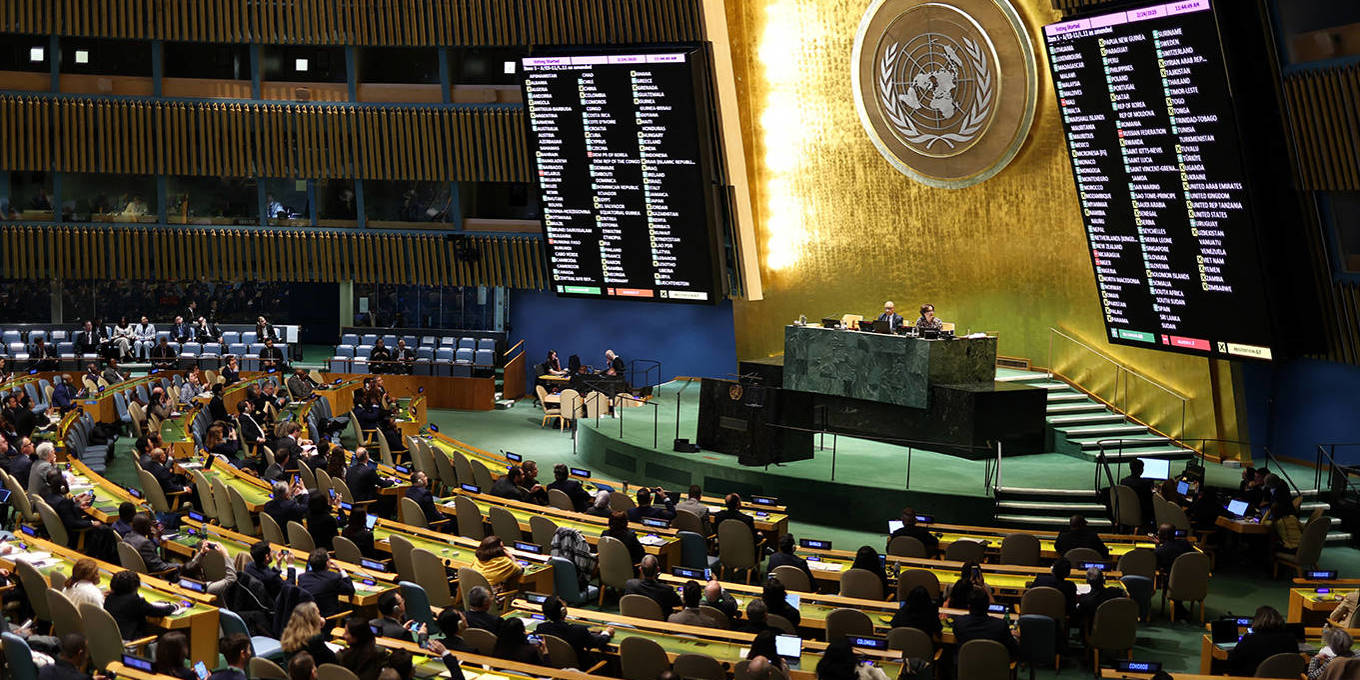
The fact is that the UN General Assembly adopted Resolution 2758 with a vote of 76 yes to 35 no, with 17 abstentions, “recognizing that the representatives of the Government of the People’s Republic of China are the only lawful representatives of China to the United Nations and that the People’s Republic of China is one of the five permanent members of the Security Council.” While disposing of the question of who had China’s seat in the UN, the resolution made no mention of Taiwan or China’s territorial or population scope.
Simply put, the resolution does not preclude Taiwan’s meaningful participation in the UN system and other multilateral forums.
Yet, for decades, the West did not credibly push back against Beijing’s deliberate misconstruction of the 1971 resolution or its blocking of Taiwan’s participation in international organizations, thereby inadvertently strengthening China’s diplomatic hand against Taipei. Even today, China continues to misuse that resolution in an effort to chip away at Taiwan’s autonomous status.
Take the Biden administration, which says that America’s one-China policy differs from Beijing’s one-China principle. US Secretary of State Antony Blinken has contended that US support for Taiwan’s meaningful participation in international forums aligns with the US reading of the 1971 resolution, as well as with America’s Taiwan Relations Act and bilateral communiques with China.
Still, Biden excluded Taiwan from his Indo-Pacific Economic Framework, a US-led multilateral partnership that covers everything from infrastructure to the digital economy.
The White House offered no explanation for omitting Taiwan, a technological powerhouse with the world’s 22nd-largest economy by gross domestic product that is a hub of global semiconductor production.
Biden’s geopolitical imperative to ensure that China did not undermine the unprecedented, US-led sanctions against Russia may have prompted Taiwan’s exclusion from the Indo-Pacific Economic Framework. Biden’s more conciliatory approach to Beijing, however, has yielded few positive results, with China quietly providing significant support to Russia’s military-industrial complex and effectively becoming Moscow’s banker.
Taiwan, a vibrant democracy, has all the attributes of a robust independent state, and most Taiwanese want it to stay that way.
What Taiwan needs from its international friends is tangible support against the designs of the Chinese Communist Party (CCP), which is totalitarian, expansionist and contemptuous of international law. In fact, under Xi Jinping (習近平), the CCP has become more despotic, coercive and punitive.
As part of a strategy to annex Taiwan, the CCP is working methodically to wipe out that island democracy’s international identity by persuading countries to break off diplomatic ties with Taipei. With its “tribute nation” approach to vulnerable states, Beijing has sought to influence their foreign policy through inducements, extending from loans to bribery.
China has already poached a number of Taiwan’s diplomatic allies, including in Central America where Taipei had strong relationships. From 2016 to 2024, Beijing poached 10 of Taiwan’s 22 allies across the world, with Nauru being the latest. This has left only 11 nations and the Vatican still recognizing Taiwan as a sovereign nation.
In one positive development, the small nation of Lithuania defied Chinese threats and allowed Taiwan in 2021 to open “The Taiwanese Representative Office” in Vilnius, the Lithuanian capital. This was followed by the opening of the Lithuanian Trade Representative Office in Taipei.
A “Taiwanese” representative office stands out in comparison to “Chinese Taipei” (used by a number of nations and the International Olympic Committee) or “Taipei Economic and Cultural Office” (as in Canada and the US, for example). A number of nations, from Britain to Singapore, host a “Taipei Representative Office.”
More broadly, most countries support keeping the status quo in the Taiwan Strait. So, radical ideas are unlikely to gain traction, including former US Secretary of State Mike Pompeo’s proposal that America recognize Taiwan as an independent nation, separate from communist China.
If Taiwan gains greater presence on the international stage, it will be able to shore up its status as a de facto nation, making it more difficult for China to seize the self-governing island in the way it occupied Tibet soon after coming under communist rule in 1949.
The then-independent Tibet should have applied for United Nations membership shortly after that international body came into existence in 1945, but it never did.
If Taiwan is not to go Tibet’s way, major democracies must strengthen and broaden their ties with Taipei and assist it in enlarging its diplomatic footprint. Major democracies must act before it becomes too late.
Brahma Chellaney, professor of strategic studies at the independent Center for Policy Research in New Delhi, is the author of nine books, including the award-winning Water: Asia’s New Battleground (Georgetown University Press).
What can a Quad summit hosted by a lame-duck American president achieve? Will the summit essentially mark the swan song of President Joe Biden?
The odd timing of the Sept. 21 summit has also been underscored by the fact Japanese Prime Minister Fumio Kishida will leave office just days after returning from his U.S. visit.
It was India’s turn to host the Quad summit. But Biden, eager to hold the event in his Delaware hometown of Wilmington, persuaded India to defer its hosting until next year. The summit date was also dictated by Kishida’s decision in August to resign just before the Sept. 27 leadership contest in Japan’s governing Liberal Democratic Party.
The Quad coalition (the U.S., Japan, India and Australia) is essential to realize the vision of a “free and open Indo-Pacific region” introduced by late Japanese Prime Minister Shinzo Abe in 2016 and affirmed by the U.S. in 2017 as a shorthand for a rules-based, liberal order. But with wars in Ukraine and the Middle East distracting the U.S. from security challenges in the Indo-Pacific, the U.S. has yet to genuinely pivot to this critical region that will shape the next global order.
Biden’s overriding focus on weakening Russia is sapping the Quad’s main strategic purpose, which is to act as a bulwark against Chinese expansionism and ensure a stable balance of power in the Indo-Pacific. The deepening proxy war with Russia has made America increasingly wary of taking on China simultaneously, which may explain why Biden prioritizes diplomacy over deterrence with Beijing.
The Quad leaders, in fact, will meet amid rising U.S.-Russia tensions over Anglo-French-American moves to allow Ukraine to use long-range cruise missiles to strike targets deep inside Russia — an action Russian President Vladimir Putin has warned would mean direct Western involvement in the war, placing his country and NATO “at war.” Such missiles would rely on U.S. navigational data and other technology, including satellite reconnaissance, giving NATO, according to Putin, effective control over targeting.
Jarringly, the specter of escalation has emerged just when Indian Prime Minister Narendra Modi has stepped up efforts to broker a cease-fire in the war. After his visits to Moscow and Kyiv, Modi, on the sidelines of the Quad summit, will brief Biden on his peacemaking effort and then meet with Putin again next month during a BRICS leaders’ meeting in Kazan, Russia. Modi’s initiative can make little headway without full support from the U.S.
The Biden administration backed Modi’s Kyiv visit, but at the same time it has deepened U.S. involvement in the war. This has not only stymied U.S. efforts to position the Indo-Pacific at the “heart” of its grand strategy but also crimped America’s strategic options against its main challenger at the global level, China, which is seeking to supplant the U.S. as the world’s preeminent power.
In an effort to dissuade Beijing from directly aiding the Kremlin’s war machine or cementing an anti-U.S. strategic axis with Moscow, Biden has pursued a more conciliatory approach toward China. But his overtures have yielded few positive results.
China and Russia today appear closely aligned, with Beijing providing substantial support for the Russian military-industrial complex. In Asia, China has upped the ante, including intensifying coercive pressures on Taiwan, stepping up provocations in the South China Sea and staying locked in a border military standoff with India.
Yet, after the Quad summit, Biden plans to speak with Chinese President Xi Jinping over the phone and then possibly meet him in person before the year-end. Biden wants to steady the U.S.-China relationship by smoothing over bilateral tensions. “I don’t want to contain China,” Biden said last September while visiting Vietnam. “We’re not trying to hurt China.”
Placating China and strengthening the Quad seem basically incompatible. Today, in the absence of a clear strategic mission, the Quad seems adrift.
Under Biden’s leadership, the Quad’s agenda has shifted from a strategic focus on the Indo-Pacific to global challenges. But the Quad, as a grouping of just four democracies, is in no position to deal with universal challenges. It is thus scarcely a surprise that little concrete progress has been made in the six Quad working groups covering critical and emerging technologies, climate change, cybersecurity, infrastructure, vaccines and outer space.
While saddling the Quad with an overly ambitious global agenda, the Biden administration has flaunted a new quadrilateral grouping, the so-called Squad, made up of America, Australia, Japan and the Philippines. It has also showcased the new AUKUS (Australia-U.K.-U.S.) alliance, although that initiative will be able to play an important role in the Indo-Pacific only in the next decade after the transfer of nuclear-powered submarines to Canberra.
To safeguard Indo-Pacific security, there is no substitute for a Quad with clear strategic direction and resolve.
The Quad leaders’ joint statement at their last summit in Hiroshima in May 2023 said the group would be “a global force for good” through a “positive, practical agenda,” identifying their top priorities as climate security, clean energy supply chains, health security and resilient infrastructure. The Wilmington summit statement could also emphasize the global agenda while making passing references to the Taiwan Strait and the East and South China seas.
But if the Quad is to play a meaningful role, its attention must be refocused squarely on the pressing Indo-Pacific challenges. It is not too late to ensure the Quad realizes its strategic promise, rather than gradually drifting into irrelevance or being reduced to a mere instrument of leverage for the U.S. in its fraught relationship with China.
Brahma Chellaney is professor of strategic studies at the Centre for Policy Research in New Delhi and the author of nine books, including “Water: Asia’s New Battleground.”
(Ukrainian Presidential Press Office via AP) Flames rise and debris is scattered on the ground after a Russian aerial bomb struck a multi-story residential building in Kharkiv, Ukraine, Sunday Sept. 15, 2024.
The second apparent assassination attempt against former President Donald Trump in just over two months involved a gunman who had previously said he was willing to fight and die in Ukraine. This underscores how that war is not just influencing American politics and foreign policy but also having an impact on the nation’s social fabric.
As one issue that divides Americans along party lines, the war has helped harden political polarization in American society.
According to one survey, 66 percent of Republicans would like the U.S. to encourage Kyiv to negotiate with Moscow, whereas the bulk of Democrats (62 percent) favor supporting Ukraine for as long as it takes. The partisan divide in foreign policy extends even to perceptions of which country represents America’s main adversary: Republicans are most concerned about China, whereas Democrats worry about Russia above all.
As part of President Joe Biden’s strategy to bleed Russia in Ukraine, the U.S. has played a critical role in bankrolling the Ukrainian fight against the invading Russian forces, with Congress approving almost $175 billion in military and nondefense assistance. But American assistance has been unable to turn the tide in the war, with Russia still making slow but steady territorial gains in eastern Ukraine.
One key reason is that, more than weapons and funds, Ukraine needs new recruits to replenish the ranks of its exhausted and depleted forces. But even draconian conscription practices have not been able to offset its mounting troop shortfall.
The war also carries hidden costs, including inflation at home. A survey found that 49 percent of Americans support negotiations between Ukraine and Russia so that costs for U.S. households do not increase further.
The U.S. dollar, which was facing “stealth erosion” before the Ukraine war, now confronts a more open but nascent challenge to its global dominance in response to the West’s weaponization of finance and seizure of Russia’s earnings on its central-bank assets frozen by Western governments. As countries explore alternatives to the dollar, the greenback is beginning to lose some of its global influence, especially in oil markets.
Meanwhile, as a hedging strategy, central banks in many countries — especially China, Turkey, India, Kazakhstan and in Eastern Europe — have increasingly been buying gold. Such hoarding, coupled with greater geopolitical uncertainty, has helped drive gold prices to a record high.
The Ukraine war’s hidden costs also extend to the geopolitical realm, especially by hindering the ability of the U.S. to respond to the greater challenge it faces from China.
China poses a far greater threat than Russia to Western interests and the U.S.-led world order. Whereas Russia’s designs are largely confined to its neighborhood, China is seeking to supplant the U.S. as the world’s foremost power. It also has the means: China’s economy, like its population, is about 10 times larger than Russia’s, and China spends four times as much as Russia on its military.
Furthermore, China is currently engaged in the largest peacetime military buildup in history. It has more than doubled its nuclear-weapons arsenal since 2020 and is expanding its conventional forces faster than any other country since World War II.
The last thing Chinese President Xi Jinping wants is an end to the Ukraine war, because that would leave the U.S. free to focus on the Indo-Pacific, a critical region that will shape the next global order. China’s expansionism is centered in the Indo-Pacific, from the East and South China Seas, to the Taiwan Strait, to the Himalayas.
The U.S. is dedicating insufficient attention and resources to countering Chinese expansionism and also continues to inadvertently bolster China’s global influence, not least through its overuse of sanctions against a host of countries.
With its military resources already stretched thin by its involvement in the wars in Ukraine and the Middle East, the U.S. needs a more realistic balancing of its key geopolitical objectives at a time when a majority of Americans believe that the nation’s power is declining on the world stage. Without such rebalancing, the U.S. may well fail to deter China from attacking Taiwan or cementing a strategic axis with Russia, just as Biden failed to deter Russia from invading Ukraine.
The U.S. must face up to the reality that, despite substantial Western military assistance, Kyiv is in no position to oust Russia from the territories it has occupied in Ukraine’s east and south. Letting Ukraine use long-range Western cruise missiles to strike targets deep inside Russia with U.S. navigational data and other technology would only risk a direct NATO-Russia conflict.
More fundamentally, a protracted Ukraine war is not in America’s interest. But bringing an end to the war demands dialogue and diplomacy, which Biden has shunned with Moscow.
Amid heightened U.S.-Russia tensions, Indian Prime Minister Narendra Modi has sought to broker a cease-fire. After his visits to Moscow and Kyiv, Modi will brief Biden on his peacemaking effort when they meet at the Sept. 21 Quad summit in Wilmington, Del. Without full support from the U.S., Modi — who is scheduled to meet with Russian President Vladimir Putin again next month at a BRICS leaders’ summit — can achieve little.
A possible American policy shift in favor of a cease-fire may have to await the outcome of the November election. Given that a negotiated deal is the only way to halt the war, it is better to seek it sooner rather than after months or years of more bloodshed and devastation.
Regime change brought about by popular uprisings rarely leads to democratic breakthroughs. Yet Western powers have often supported coups and takeovers – regardless of the new regime’s democratic credentials – in order to advance their own geopolitical and economic interests.
With great-power rivalries again at the center of international relations, democratic governments have been relying on secret statecraft to shape or sway regimes in weaker states, including by supporting or aiding regime change. Far from advancing democracy globally, these efforts are exacerbating its vulnerabilities at a time when authoritarianism is on the rise.
To be sure, local militaries – with or without external backing – remain the leading drivers of regime change. In Pakistan, for example, the military reasserted its traditional dominance over government in 2022, when it engineered the ouster of Prime Minister Imran Khan. In Bangladesh, the military recently took advantage of a violent student-led uprising to compel Prime Minister Sheikh Hasina to flee the country, before installing an interim civilian-led administration headed by Nobel laureate Muhammad Yunus.
But external powers also often play a key role in driving regime change. Yes, the mechanisms remain murky. Since strategic skullduggery rarely leaves any political fingerprints, intervening powers can plausibly deny involvement, leaving independent analysts struggling to distinguish fact from fiction.
Nonetheless, it is usually fairly easy to see where an external power gets its leverage. China, for example, is the world’s largest trading economy and official creditor for developing countries. While the details of China’s loan agreements are far from transparent, there is no doubt that it attaches many strings to its funding, which increase its leverage over borrowers, possibly even driving them into sovereignty-eroding debt traps.
The United States, for its part, dominates the international financial architecture, enjoys considerable leverage over traditional lenders like the World Bank and the International Monetary Fund, and issues the world’s main reserve currency. With these levers, it has significant power to reward or punish countries, including by imposing painful economic sanctions.
The US has long been accused of – and sometimes admitted to – helping to topple or prop up foreign regimes, including by meddling in elections or aiding uprisings, such as the “color revolutions” in some post-Soviet states. Some have even alleged that the US played a role in the recent overthrow of Khan in Pakistan and Hasina in Bangladesh, though US officials have denied any involvement.
The question is what a democracy like the US hopes to achieve by contributing to regime change. The answer cannot be lasting democratic breakthroughs, which rarely arrive in the wake of popular uprisings. Instead, countries are likely to face political instability, social disorder, and economic disruption. That is certainly the case in Bangladesh, which is now facing chaos and violence, with mobs burning down factories, hospitals, hotels, and homes.
A more likely explanation – for which there is ample evidence – is that Western powers are seeking to advance their own geopolitical and economic interests by supporting “friendly” regimes and driving out “unfriendly” ones. The regimes’ democratic credentials (or lack thereof) seem to matter little here, though Western powers do prefer that there is a pretense of democracy.
This helps to explain why military takeovers are often followed by elections or the installation, as in Bangladesh, of a government with a civilian face: military leaders hope to bolster the new government’s international legitimacy and, in many cases, retain access to Western financial assistance. After all, the US is legally required to cut off aid to a country after a coup. After the military junta returned to power in Myanmar in 2021, US President Joe Biden’s administration imposed stringent sanctions on the country and, later, began providing non-lethal aid to anti-junta forces.
But US leaders take great care in deciding which military takeovers to label as “coups.” Of the more than two dozen military coups or indirect takeovers that have taken place in the last 15 years, the US refrained from condemning about half, because it considered the regime change favorable to its regional interests. In this sense, the US has often sacrificed democracy at the altar of geopolitics.
Elections alone – even if competitive – do not guarantee popular empowerment or adherence to constitutional rules, especially when the military holds decisive power. While the international community might view a civilian-led government positively – even if it is merely a façade for continued military control – domestic legitimacy may well be lacking, even when the coup-makers shed their uniforms and rebrand themselves “civilian” leaders, as the Thai army chief did after seizing power in 2014. (He remained in office as the country’s “civilian” prime minister for nine years.)
Democracy is in retreat globally. Many populations are facing the erosion of their political rights and civil liberties. Even the world’s leading democracies are suffering from low public trust in governments and bitterly polarized politics. And closed autocracies now outnumber liberal democracies. By accepting or tolerating military rule – even behind a civilian façade – Western powers will only accelerate this trend.
Brahma Chellaney, Professor of Strategic Studies at the New Delhi-based Center for Policy Research and Fellow at the Robert Bosch Academy in Berlin, is the author of nine books, including Water: Asia’s New Battleground (Georgetown University Press, 2011), for which he won the 2012 Asia Society Bernard Schwartz Book Award.
Chinese President Xi Jinping seems to be betting that America’s entanglement in conflicts in Ukraine and the Middle East is sapping its military capacity and political resolve to credibly push back against his aggressive expansionism in Asia — including in the South China Sea, through which one-third of global shipping passes.
Yet, in dealing with China, the Biden administration still prioritizes diplomacy over deterrence. Indeed, as part of its effort to smooth over tensions with Beijing and stabilize the bilateral relationship, the White House said that Biden plans to speak with Xi over the phone in “coming weeks.” That statement followed the China visit last month of National Security Adviser Jake Sullivan, who says Biden and Xi may also meet in person before the year end.
China, meanwhile, has stepped up aggressive actions against the Philippines, which has a longstanding mutual defense treaty with the U.S. The 1951 treaty incorporates America’s “ironclad commitment,” as Sullivan acknowledged, to defend the Philippines.
But that commitment has not deterred China from stepping up its provocations in the South China Sea, including ramming Philippine coast guard ships and using flares and water cannons against them, as well as blocking resupply missions and making unsafe intercepts within the Philippines’ exclusive economic zone. Newer Chinese coast guard ships have specially designed features to enable “shouldering,” or deliberate ramming.
Chinese expansionism has stoked rising tensions with several other states. China’s furtive territorial encroachments on some Indian borderlands have resulted in a tense military standoff with India for more than four years, with both sides building up forces along their long Himalayan frontier as if preparing for possible war.
In the East China Sea, China’s increasing challenge to Japanese control of the Senkaku Islands is spurring Japan toward rearmament, as it nearly doubles its defense budget. A day before Sullivan reached Beijing, a Chinese military spy plane intruded into Japanese airspace near the Danjo Islands. Tokyo called it “not only a serious violation of Japan’s sovereignty but also…utterly unacceptable.”
As for Taiwan, which has a near-monopoly on the global output of advanced semiconductors, China seems determined to annex that thriving democracy and gain a stranglehold over the international supply of cutting-edge chips. When Sullivan met with China’s most senior uniformed military official, Zhang Youxia, he was bluntly told that Taiwan is at “the heart of China’s core interests” and that promoting “reunification” is “the mission and duty” of the Chinese military.
In the South China Sea — which is 50 percent bigger than the Mediterranean Sea — China’s aggressive sea tactics pose a pressing challenge for the U.S. Chinese expansionism, after changing the geopolitical map of this corridor between the Pacific and Indian Oceans, is now seeking to cement China’s ascendancy there.
This is triggering dangerous incidents. Chinese brinkmanship risks triggering a major South China Sea crisis, especially as China seeks to enforce its will by employing increasingly perilous maneuvers to intimidate and coerce the Philippines, Vietnam, Malaysia and other claimant states.
More fundamentally, China is working to create a sphere of influence, extending from Japan to India, detrimental to the interests of America and its allies and strategic partners. Such a sphere would not only threaten freedom of navigation in the South China Sea but also allow China to effectively supplant the U.S. as the dominant force in Asia.
Yet the Biden administration seems concerned not so much with the long-term strategic implications of Beijing’s drive for domination, but rather with the possibility that U.S.-China relations could move in a more adversarial direction due to maritime incidents. This may explain why it remains wary of going beyond mere statements in support of the Philippines.
Indeed, Sullivan has called for “de-escalation,” saying the administration will continue to discuss ways to ease tensions with Chinese and Filipino officials and adding, “we will do our best to try to contribute to managing this issue in a responsible way so that de-escalation is the order of the day.”
But de-escalation in the South China Sea (or, for that matter, in the Taiwan Strait) is the last thing Xi has on his mind.
Policy choices to counter China’s drive to dominate the South China Sea have become increasingly challenging, largely because three successive American administrations have failed to mount a sustained pushback. Instead, the U.S. has essentially relied on rhetoric and symbolic actions.
Xi began incrementally changing the facts in the South China Sea right after becoming the Communist Party boss in 2012. On former President Barack Obama’s watch, the U.S. did little as China seized control of the Scarborough Shoal — a traditional Philippine fishing ground — and then launched a major land reclamation program in the South China Sea, building seven artificial islands that it later turned into forward operating bases.
After a 2016 international tribunal ruling invalidated China’s territorial claims in the South China Sea, Chinese expansionism only accelerated, underscoring its open contempt for international law.
More recently, China has intensified its bullying of smaller neighbors. But, after the November 2023 Biden-Xi summit in California, China’s aggressive interference with U.S. and allied air and maritime transits has eased.
Biden keeps saying that the U.S. wants “competition with China but not conflict.” Yet Xi’s expansionist strategy is intrinsically conflictual. Although Taiwan remains the most likely cause of a major conventional war, the risk that a crisis in the South China Sea could escalate to an armed conflict involving the U.S. can hardly be discounted.
The South China Sea challenge is not just about disputes over small islets, rocks and reefs but about one power’s drive to gain hegemony in a critical corridor and impose a Sino-centric system upon the Indo-Pacific, a region that will shape the next global order.
China and India make up more than one-third of the global population, and enduring enmity between these giants serves neither their national interests nor the cause of Asian stability and security.
The India-China military standoff along the traditional Indo-Tibetan frontier may not be grabbing international headlines, especially with two wars raging elsewhere in the world. But, as External Affairs Minister S Jaishankar said earlier this year, the situation along the border remains “very tense and dangerous”.
Now in its fifth year, the standoff, which has brought potential dark clouds on the horizon, was triggered by furtive Chinese encroachments on some key Ladakh borderlands in April 2020, just before thawing ice normally reopens Himalayan access routes after a brutal winter.
The standoff, however, extends beyond the westernmost Ladakh sector of the border. It encompasses sections of the middle sector, as well as the eastern sector along Tibet’s long border with Arunachal Pradesh. One confrontation location is opposite the narrow, 22km-wide corridor known as “the chicken-neck” that connects India’s Northeast to the rest of the country. The corridor’s vulnerability has been increased by Chinese encroachments on Bhutan’s southwestern borderlands.
While both sides have significantly ramped up deployments of troops and weapons, as if preparing for a possible war, China has frenetically been building new warfare-related infrastructure along the inhospitable frontier. Its focus has been on building underground military facilities that can survive aerial attacks in war. So, it has been boring tunnels and shafts in mountainsides to set up command positions, reinforced troop shelters and weapons-storage facilities.
In addition, China has been systematically planting settlers in new militarised border villages along the India frontier. These artificial villages are becoming the equivalent of the artificial islands Beijing created in the South China Sea to serve as its forward military bases.
China, meanwhile, has stepped up other provocations against India, including Sinicising the names of places in Arunachal Pradesh to help strengthen its territorial claim to that sprawling state, which is almost three times larger in area than Taiwan. Indeed, Beijing has been calling Arunachal Pradesh “South Tibet”, contending it was once part of Tibet—a claim the Dalai Lama says has no historical basis.
Against this backdrop, talks to de-escalate tensions and end the standoff have made little headway after the two sides agreed long ago to turn three specific confrontation sites into buffer zones. The fact that those buffers have come up largely in territories that were within India’s patrolling jurisdiction has underscored China’s negotiating leverage.
Still, it makes strategic sense for both China and India to try and find common ground to defuse their border confrontation. Some signals, even if exploratory, suggest that Chinese President Xi Jinping’s regime may now be seeking to smooth over tensions with India.
As in 1962, when China triggered a war by invading India, the Ladakh encroachments are counterproductive to long-term Chinese interests. The 1962 war shattered Indian illusions about China and set in motion India’s shift away from pacifism. In 1967, while still recovering from the 1962 war and another war with Pakistan in 1965, India gave China a bloody nose in military clashes along the Tibet-Sikkim border.
In terms of territory gained, China’s 2020 Ladakh aggression may have been a success. But, politically, it has proved self-damaging, driving India closer to the US and setting in motion a major Indian military buildup, including in the missile and nuclear realms. Relations between Beijing and New Delhi are at a nadir.
This seems a replay of 1962, when China set out, in the words of then-Premier Zhou Enlai, to “teach India a lesson”. China won that war but lost the peace. The difference now is that, without defusing the border crisis, China risks making a permanent enemy of its largest neighbour.
Even militarily, it does not make sense for China to prolong the standoff at a time when its expansionist strategy is targeting Taiwan and seeking to transform the South China Sea into a “Chinese lake”. Referring to the Indian military’s ongoing confrontation with Chinese forces, Admiral Mike Gilday, the chief of US naval operations, said in August 2022 that India presents China a two-front problem: “They [Indians] now force China to not only look east, toward the South China Sea and the Taiwan Strait, but they now have to be looking over their shoulder at India.”
President Xi Jinping‘S dilemma is how to resolve the Himalayan military crisis without losing face. The longer the standoff persists, the greater would be the risk for Beijing of turning India into an enduring enemy. Prime Minister Narendra Modi, despite taking some flak at home over China’s Ladakh encroachments, has continued to search for a settlement through quiet diplomacy
Today, Xi’s self-made dilemma is how to resolve the Himalayan military crisis without losing face. But the longer the standoff persists, the greater would be the risk for Beijing of turning India into an enduring enemy, a development that could weigh down China’s global and regional ambitions, including Xi’s self-described “historic mission” to absorb Taiwan.
Without the elements of stealth, deception and surprise, which characterised its encroachments, China would be hard put to get the better of the Indian armed forces in a war. While the Chinese military relies heavily on conscripts, India has an all-volunteer force that is considered the world’s most experienced in mountain warfare.
For his part, Prime Minister Narendra Modi, despite taking some flak at home over China’s Ladakh encroachments, has continued to search for a settlement through quiet diplomacy.
In stark contrast to US President Joe Biden shutting the door to diplomacy with Moscow following the Russian invasion of Ukraine, Modi has kept diplomatic space for finding a negotiated end to the border crisis, including by refraining from imposing any tangible sanctions against China. While his government has banned numerous Chinese mobile apps and blocked certain Chinese investments, it has shied away from substantive punitive action.
This has led to a strange paradox: Amid the border confrontation, China’s trade surplus with India has continued to surge. Its trade surplus has already surpassed India’s total defence budget, the world’s third largest.
One incentive for India to mend fences with China is that, despite the military standoff creating room for a US-India strategic nexus, American policies and actions continue to add to India’s regional security challenges. The US and India may agree on some broader strategic issues internationally, but in India’s own neighbourhood extending from Myanmar to the Pakistan-Afghanistan belt, it is becoming clearer that American policies do not align with core Indian interests. Bangladesh is just the latest wake-up call for New Delhi.
Jaishankar said in March that India remains “committed to finding a fair, reasonable” agreement with China. In fact, Modi briefly discussed ways to defuse the border crisis with Xi on the sidelines of multilateral summits in Bali and Johannesburg in November 2022 and August 2023, respectively.
The forthcoming BRICS and G20 summits will offer opportunities for Modi and Xi to meet on the margins, creating an impetus for both sides to work out a possible deal through quiet diplomacy. The BRICS summit (the first after the group’s major expansion) will be held in Kazan, Russia, from October 22 to 24, to be followed by the G20 summit in Rio de Janeiro, Brazil, on November 18-19.
With Russia taking an active interest in a potential end to the Sino-Indian border confrontation, the BRICS summit (to which Russian President Vladimir Putin has also invited some non-BRICS leaders, including the presidents of Iran and Azerbaijan) could potentially serve as a catalyst for reaching some sort of a ‘peace’ deal between Beijing and New Delhi. This may well explain renewed back-channel discussions, as well as Jaishankar’s meetings with Chinese Foreign Minister Wang Yi, who is also a Communist Party of China (CPC) Politburo member.
External Affairs Minister S Jaishankar and Chinese Foreign Minister Wang Yi (Photo: Alamy)
The BRICS Summit could potentially serve as a catalyst for reaching some sort of a ‘peace’ deal between Beijing and New Delhi. This may well explain renewed back-channel discussions, as well as Jaishankar’s meetings with Chinese foreign minister Wang Yi, who is also a CPC politburo member
To be sure, New Delhi has all along been open to patching things up with China. At the same time, it has displayed an unflinching resolve to stand up to China: it has not only matched China’s Himalayan military deployments, but also made clear that the standoff cannot end as long as Beijing continues to violate bilateral border-management agreements and engage in intimidation and coercion.
Xi’s failure, while green-lighting the 2020 encroachments, to anticipate a robust Indian military response openly challenging Chinese power and capability was a serious strategic miscalculation.
Since the standoff began, India has tested several leading-edge missile systems, and recently boosted its nuclear deterrent by commissioning a second nuclear-powered ballistic missile submarine (SSBN). Powered by an 82.5MW pressurised light water reactor (LWR), <INS Arighat> is armed with 12 K-15 submarine-launched ballistic missiles (SLBMs). A third SSBN with the longer-range K-4 SLBMs to deter China is nearing completion.
However, India has done little to build bargaining leverage against China, which is why the buffer zones at Galwan Valley, Pangong Lake and Gogra-Hot Springs were established largely on Indian territories.
India should have responded to the 2020 Chinese encroachments by sending troops into strategic Chinese-held areas in Tibet. This would have raised the costs for Chinese border violations, thereby boosting deterrence.
Ukraine’s recent incursion into Russian territory sought to seize territory that could serve as a bargaining chip in future negotiations. A counter territorial grab has always made strategic and military sense. It is inexplicable why India, in response to the Chinese encroachments, has chosen to stay locked in a military standoff without seeking to gain counter-leverage by seizing some Chinese-held territory in Tibet.
To make matters worse, India even vacated the strategic Kailash Range as part of the 2021 Pangong Lake deal, which, like the buffer zones elsewhere, has worked to China’s military advantage.
In the Pangong region, the entire buffer zone was set up on territory that India had patrolled until China made its stealth encroachments in April 2020. The buffer, in fact, also includes a swath of Indian area that China had never disputed or claimed. This is the area from Finger 4 to the Indian base (between Fingers 2 and 3). All this has encouraged China to construct a division-level headquarters at the edge of the lake, along with two bridges across the lake and underground warfare-related facilities, placing it in an ascendant position in the Pangong region.
More broadly, the standoff persists despite more than four years of military and diplomatic negotiations because China has used those talks to take India round and round the mulberry bush, while it has been quietly consolidating its encroachments and building new warfare-related infrastructure along the entire Indo-Tibetan frontier.
Its frenzied construction has fundamentally changed the Himalayan military landscape. And the three buffer zones it foisted on India have formalised a changed status quo.
Today, there are still no answers to two key questions. First, why was India taken unawares by China’s stealth encroachments of April 2020, whose costs have increased with the passage of time? And second, why did India subsequently, as part of bilateral accords to set up some buffer zones, withdraw from its historically claimed areas in the Galwan, Pangong and Gogra-Hot Springs regions?
If a ‘peace’ deal were to be concluded in whatever shape, a few things will not change, though. With China having forcibly changed the territorial status quo in eastern Ladakh, a return to status quo ante is most unlikely. In January, then Indian Army Chief General Manoj Pande said the standoff would continue until China pulled back from its Ladakh encroachments, calling restoration of the previous frontier line “our first aim to achieve”. That aim is clearly unrealistic.
Chinese troops dismantling their bunkers at Pangong Tso, Ladakh, February 2021 (Photo: AP)
In the Pangong region, the entire buffer zone was set up on territory that India had patrolled until China made its stealth encroachments in April 2020. The buffer also includes a swath of Indian area that China had never disputed or claimed
Xi risks being hoisted by his own petard if he pulls back his forces from encroached areas. He would face questions at home as to why, in the first place, he embarked on the aggression against India. Indeed, China’s Ladakh encroachments appeared to be part of Xi’s larger strategy to use coercion and territorial grabs to compel neighbouring countries to acquiesce to China’s claims.
Even if a deal to end the standoff materialises, China’s warfare-related infrastructure along the Himalayan frontier will remain in place. Any agreement, even if it seeks to implement a sequential process of disengagement, de-escalation and de-induction of rival forces, will not alter the new military realities that China has created.
As the 2017 Doklam disengagement deal showed, China withdraws only temporarily. Within weeks of the deal, it sent in large numbers of troops and effectively captured the Doklam Plateau.
Let us be clear: It does make eminent sense for China and India, as two of the world’s most ancient civilisations, to find ways to peacefully coexist as neighbours and cooperate on shared objectives. But the CPC’s record since it came to power in 1949 indicates that it operates on very different logic.
New Delhi is still struggling to understand why Xi—despite meeting Modi 18 times over nearly six years and despite the two countries’ commitment to the “Wuhan spirit” and to open “a new era of cooperation” through the “Chennai connect”—betrayed India’s trust by stealthily encroaching on Ladakh borderlands. If Xi wanted peaceful, mutually beneficial cooperation with India, such aggression would have been the last thing on his mind.
In this light, any ‘peace’ deal that China concludes with India will not be about peace but about formalising its strategic advantages.
Even if the Modi government were to try and market such a deal as a political win, India, militarily, would not be able to lower its guard. The Indo-Tibetan frontier is likely to remain a ‘hot’ border, underscoring both the enduring nature of the military threat posed by China and the lasting costs of India’s failure to prevent the 2020 encroachments, which have led to China significantly changing the Himalayan military landscape.
Brahma Chellaney is a geostrategist and the author of two award-winning books: Water, Peace, and War; and Water: Asia’s New Battleground.
The recent violent upheaval that led to a military-backed regime change in Bangladesh, followed by the country’s pleas for $6.5 billion in international bailouts, raise concerns about the future direction of the world’s eighth most-populous country.
The toppling of Prime Minister Sheikh Hasina’s government has also triggered an ominous resurgence of radical Islamism, including systematic attacks on religious minorities.
As recently as 2022, Bangladesh was seen internationally as headed toward rapid economic development. But today, nothing better illustrates the unraveling of Bangladesh’s economic success story than its urgent requests for a new $3 billion International Monetary Fund bailout, as well as $1.5 billion from the World Bank and $1 billion each from the Asian Development Bank and the Japan International Cooperation Agency.
Hasina, while becoming increasingly undemocratic during her over 15-year reign, gave Bangladesh political stability and impressive economic growth, before the global economic fallout from the Ukraine war began weighing on Bangladeshi finances. In fact, the country’s stability and remarkable-growth trajectory stood in stark contrast to the chronic political and economic turmoil in Pakistan, from which Bangladesh seceded in 1971 following a bloody war of liberation that left up to 3 million civilians dead in a genocide perpetrated by the Pakistani army and other pro-Pakistan forces.
Today, the military-picked interim civilian-led regime is struggling to restore the rule of law and revive an economy pummeled by large-scale mob violence and destruction that both preceded and followed Hasina’s overthrow in a youth-led uprising, with her loss of support from the powerful military proving decisive. The military has traditionally been a key player in Bangladeshi politics.
Several hundred people were killed in the violence, many in police firings but also in shootings by Islamists and other rioters, some of whom, according to the new regime, looted rifles from law-enforcement officers and others. Mobs also captured some policemen, beating them to death. At least 44 policemen were killed by mobs, with bodies of some hung from bridges in Dhaka, the nation’s capital.
With the overthrow of the 76-year-old “Iron Lady,” the Islamists have returned with a vengeance, resulting in widespread attacks on the country’s long-persecuted and dwindling Hindu minority.
To make matters worse, political vendettas have gained momentum, as the new regime has engaged in or condoned human rights abuses, including purges, arbitrary arrests, physical assaults on political detainees in courts and curtailment of the rights to liberty and freedom of expression. Academics, journalists, former justices, local officials, lawyers, political opponents and other dissidents have also been jailed on trumped-up murder charges.
In a case last weekend, an ailing, 75-year-old retired Supreme Court justice, after being arrested in a dehumanizing manner, was so badly beaten up in a magistrate’s court, including repeatedly kicked in the groin, that he needed emergency surgery.
All this raises the question whether Bangladesh could go the way of Pakistan, whose broken economy and dysfunctional politics have engendered unending violence, including Islamist extremism and cross-border terrorism. Elections in Pakistan have failed to weaken the vise-like grip of its military on national politics.
Like in Pakistan, the military in Bangladesh has now returned as the final arbiter in national politics, with the army chief becoming the power behind the throne. As if to let the cat out of the bag, M. Sakhawat Hussain, a retired military general holding a minister-level position in the interim regime, warned those pursuing political extortion that he had “requested the army chief to break your legs.” The interim administration, led by an 84-year-old Nobel Peace Prize winner, Muhammad Yunus, lacks constitutional legitimacy.
The Bangladeshi military holds substantial commercial assets in multiple economic sectors, like Pakistan’s armed forces.
Just as Pakistan continues to teeter on the brink of default, the Bangladesh economy is in dire straits, with foreign reserves dwindling rapidly, inflation spiraling, the banking sector in turmoil and economic activity largely at a standstill. It will not be easy to restore the confidence of foreign investors after the large-scale looting, vandalism and arson since July. Many countries’ advisories against travel to Bangladesh remain in effect.
Today, the Islamist resurgence poses a serious law-and-order challenge in Bangladesh, as it has long done in Pakistan. In fact, just as Pakistan’s military maintains cozy alliances with militant groups, the Bangladesh military has had a nexus with radical Islamists.
Hasina’s secular government had cracked down on such violent religious groups. But amid the protests, mobs broke into prisons and freed hundreds of radical Islamists and terrorists, including those wanted in India for terror activity. The attacks on prisons began more than two weeks before the government’s toppling, but gathered pace in the aftermath of Hasina’s forced departure to India. The Hizb ut-Tahrir extremist group, which was proscribed by Hasina and some Western governments, is now operating freely in Bangladesh, holding big rallies.
It was Bangladesh’s chief of the army, Gen. Waker-uz-Zaman, who told the nation in a televised address on Aug. 5 that Hasina had quit and left the country, saying he was “taking full responsibility” and would help to “form an interim government.”
But, instead of a broad-based government of national unity, a partisan administration is now in office that includes two student protest leaders, a hard-line Islamist preacher and three retired military generals. This has contributed to continuing purges, as well as revenge attacks and killings.
Bangladesh is a highly polarized country with a poisonous political culture that, over the decades, has fostered a cycle of frenzied violence and deadly retributions. The recent brutal violence is the latest example.
Without sincere efforts to initiate national reconciliation and healing, the deep splits in Bangladesh will likely stoke greater hate, vengeance and economic disruption, with the risk that the nation could become a mirror image of its old nemesis, Pakistan.
Brahma Chellaney is a geostrategist and the author of nine books, including “Water: Asia’s New Battleground.”
The ouster of Bangladeshi Prime Minister Sheikh Hasina’s government is just the latest example of political volatility in South Asia – a region that has struggled to achieve stability, let alone democratization. This is generating acute security and economic risks for the region’s main power, India.
Street clashes in Dhaka, Bangladesh. (Rajib Dhar / Associated Press)
Violent student-led, Islamist-backed protests in Bangladesh have toppled Prime Minister Sheikh Hasina’s government, and mob attacks targeting those viewed as supporters of her secular Awami League party – in particular, the country’s dwindling Hindu minority – are proliferating. At a time when neighboring Myanmar is engulfed in violence and the Pakistan-Afghanistan belt remains fertile ground for cross-border terrorism, political upheaval in Bangladesh, two years after the overthrow of Sri Lanka’s government, is the last thing India, the regional power, needs.
Achieving lasting political stability in South Asia would require entrenching democracy. But this is no easy feat. India notwithstanding, the region remains in thrall to longstanding autocratic traditions and centralization of power. Hasina, for example, had become autocratic during her more than 15 years in office. In this context, popular demands for democracy are far more likely to lead to violence and political chaos than to smooth political transitions.
As Hasina has shown, autocratic leaders do not necessarily survive popular challenges to their rule. Consider the chaos that engulfed Sri Lanka in 2022, when a severe economic crisis triggered mass protests against the Rajapaksa brothers’ dynastic, un-democratic regime. Though President Gotabaya Rajapaksa, like Hasina, initially unleashed a violent crackdown, his opponents proved too powerful. Like Hasina, he gave up and fled the country, without even formally resigning. Sri Lankan protesters then occupied the presidential palace, much as Bangladeshi mobs have ransacked Hasina’s sprawling official residence.
But when an autocrat is toppled, it is often the military – not a democratic government – that takes over, even if behind a civilian facade. Bangladesh is no exception. The military has attempted at least two dozen coups since the country’s violent birth in 1971, and ruled for a number of extended periods since its 1975 assassination of Bangladesh’s charismatic founding leader, Sheikh Mujibur Rahman.
Hasina, who is Rahman’s daughter, stood out for her success at keeping the military (and Islamists) in check, at least until last week, when the army chief refused to continue supporting her crackdown on rampaging protesters. The military then facilitated her escape to India and established an interim government of civilian “advisers” who have little experience with national issues.
To be sure, some South Asian countries have made some progress toward democracy. In particular, Bhutan’s democratic transition is proceeding apace, thanks to a benevolent king who has supported the transition from a traditional monarchy to a parliamentary system. Earlier this year, the country’s fourth national election brought an opposition party to power.
But elections alone – even if competitive – do not guarantee popular empowerment or adherence to constitutional rules, especially when the military holds decisive power. Consider Pakistan, which held elections earlier this year. The military’s preferred candidate, Shehbaz Sharif, returned as prime minister, but his government will survive only at the pleasure of the country’s effective ruler, the army chief. Until the rule of law is firmly entrenched and those wielding extra-constitutional power are unequivocally reined in, democratic progress will remain limited and reversible.
Myanmar learned this the hard way. Though the military had called the shots in the country since independence in 1948, it began ceding power to a nascent civilian government in 2015, filling the country with hope for a democratic future. But in February 2021 – barely six years later – it staged a coup. This time, however, resistance has proved intense, and heavily armed insurgent groups – some receiving “non-lethal aid” from the United States – are managing to expand their territorial control. In response, the military junta has stepped up punitive air strikes and artillery barrages.
The violence and deepening humanitarian crisis are fueling instability beyond Myanmar’s borders. Already, more than 32,000 ethnic Chin have sought refuge in India’s Mizoram state, and thousands more have fled to the state of Manipur, where their arrival has stoked violent ethnic conflict. And it is not just the Chin: India is also home to millions of illegal immigrants from Bangladesh, whose ranks are set to grow as desperate Hindus flee Islamist attacks against them.
When it comes to security risks, immigration is just the beginning. Political turbulence in the Maldives – which began in 2012, when Islamist radicals forced the country’s democratically elected president to resign at gunpoint – has enabled China to gain a foothold in India’s maritime backyard. This year, China signed a military pact with the Maldives and docked a giant marine research ship in a Maldivian port. Meanwhile, Islamist radicals are expanding their grassroots base, establishing ISIS and al-Qaeda cells on the archipelago.
Mounting economic pressures compound the security risks. Pakistan has repeatedly sought International Monetary Fund bailouts in recent years. And Hasina’s overthrow could usher in hard times for the once-booming Bangladeshi economy, as the country’s foreign reserves dwindle rapidly. None of this is conducive to regional prosperity. As long as South Asian countries remain plagued by political instability, strong and sustainable economic growth will remain elusive.
The difficulty of maintaining political stability and advancing democratization can also be seen in Nepal – a country with which India has close cultural and historical ties. Last month, the country swore in its 14th government in just 16 years, led by four-time prime minister, K.P. Sharma Oli, of the pro-China Marxist-Leninist Party. Oli, who spent years in jail in the 1970s and 1980s for waging war against the state, is Nepal’s fifth head of government in five years, having replaced another former communist guerrilla, Pushpa Kamal Dahal.
All of this puts India, the world’s largest democracy and South Asia’s geographical hub, in a difficult situation. It must minimize the spillover effects of political and economic instability in its neighborhood, even as it continues to seek economic and strategic partnerships far beyond its troubled region.
Brahma Chellaney, Professor of Strategic Studies at the New Delhi-based Center for Policy Research and Fellow at the Robert Bosch Academy in Berlin, is the author of nine books, including Water: Asia’s New Battleground (Georgetown University Press, 2011), for which he won the 2012 Asia Society Bernard Schwartz Book Award.
You must be logged in to post a comment.