Unknown's avatar

About Chellaney

Professor, strategic thinker, author and commentator

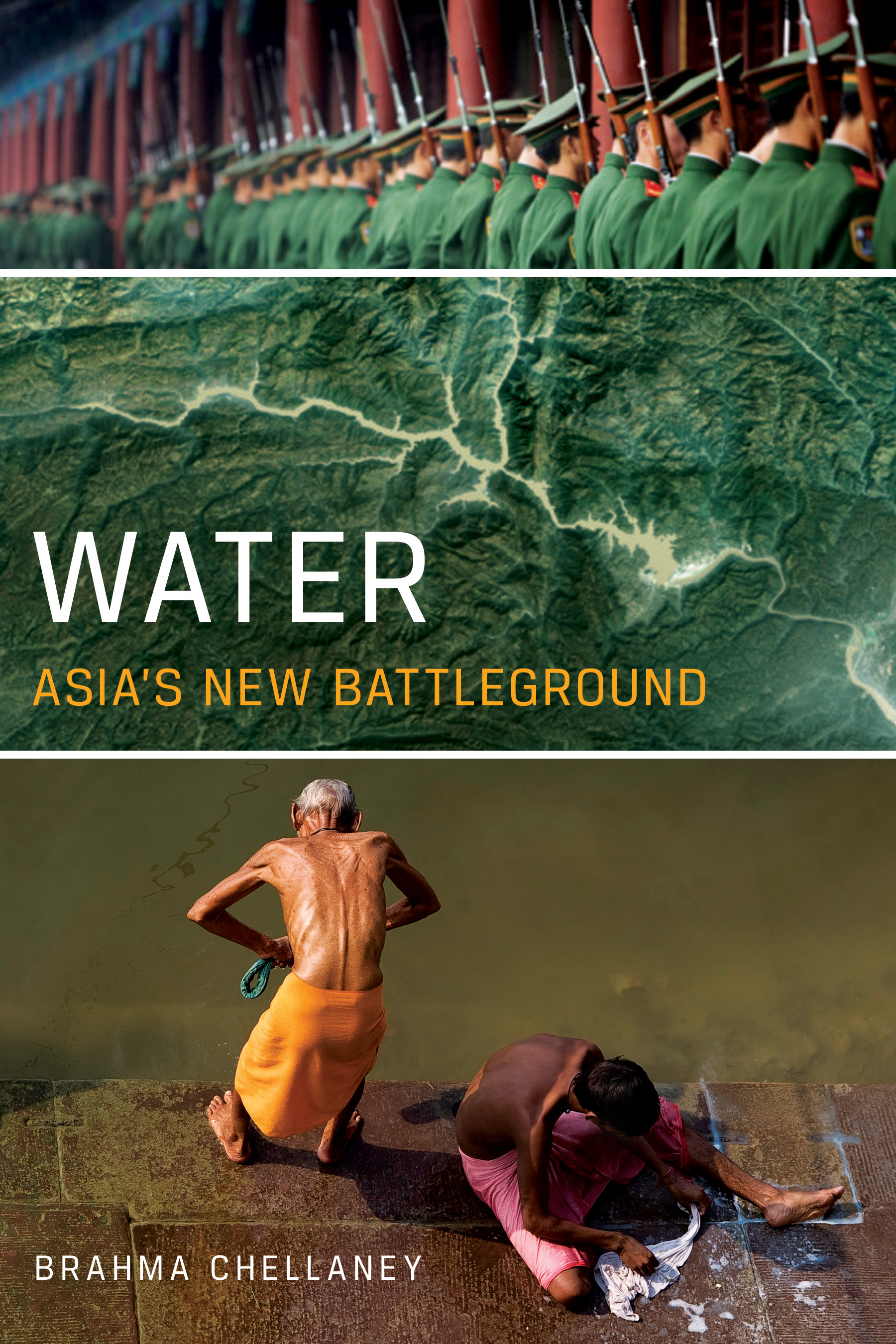
Brahma Chellaney’s “Water: Asia’s New Battleground” wins the 2012 Bernard Schwartz Award

Announcement by the Asia Society, New York:

Water: Asia’s New Battleground (Georgetown University Press) by Brahma Chellaney has won the 2012 Asia Society Bernard Schwartz Book Award. Dr. Chellaney will be honored and presented with a $20,000 prize at a special event to be held at Asia Society’s headquarters in New York City on January 23, 2013.

The Asia Society Bernard Schwartz Book Award is the only award that recognizes nonfiction books for their outstanding contributions to the understanding of contemporary Asia or U.S.-Asia relations, as well as potential policy impacts relating to the region.Water: Asia’s New Battleground was selected from nearly 90 nominations submitted by U.S. and Asia-based publishers for books published in 2011.

A jury co-chaired by Tommy T. B. Koh, Singapore’s Ambassador-at-Large, and Carol Gluck, George Sansom Professor of History at Columbia University, and composed of leading experts and figures from policy, academia, and journalism from India, Indonesia, Japan, Singapore, Thailand, and the United States selected the winner and honorable mentions.

According to Ambassador Koh, “This timely, comprehensive, and forward-looking book makes the compelling case that water will likely emerge as one of Asia’s biggest security challenges in the 21st century. The equitable and sustainable management of Asia’s great river systems should be a priority on the global agenda.”

Dr. Gluck added, “Conflicts over water are an increasingly pressing problem in many places. In his important book, Brahma Chellaney alerts us to the challenges facing Asia in assuring adequate water supplies across the region.”

Water: Asia’s New Battleground underscores the importance of water as a means of security at multiple levels in Asia,” said Suzanne DiMaggio, Vice President of Asia Society’s Global Policy Programs. “Policymakers need to look at this vital resource in a way that takes into account the complex national security and development issues countries and communities will face as water scarcity in the region intensifies.”

Two honorable mentions were also chosen: Deng Xiaoping and the Transformation of China, by Ezra Vogel (Belknap Press of Harvard University Press) and Cambodia’s Curse: The Modern History of a Troubled Land by Joel Brinkley (PublicAffairs). Each will receive a $2,000 prize.

Previous winners of the Book Award include Richard McGregor for The Party: The Secret World of China’s Communist Rulers (2011), James C. Scott for The Art of Not Being Governed: An Anarchist History of Upland Southeast Asia (2010), and Duncan McCargo forTearing Apart the Land: Islam and Legitimacy in Southern Thailand (2009).

— 2012 Asia Society Bernard Schwartz Book Award Jury Members —

Carol Gluck (Co-Chair), George Sansom Professor of History, Columbia University

Tommy T.B. Koh (Co-Chair), Singapore’s Ambassador-At-Large; Chairman, Centre for International Law; Rector, Tembusu College at the National University of Singapore

Ashok Advani, Chairman, Publisher, and Founder of Business India Group of Publications

James Fallows, National Correspondent, The Atlantic

Susan Glasser, Editor-in-Chief, Foreign Policy

Kazuo Ogoura, Secretary General, Council of Tokyo 2020 Bid Committee

Thitinan Pongsudhirak, Associate Professor, International Relations at Chulalongkorn University, Thailand; Director, Institute of Security and International Studies, Bangkok

Susan Shirk, Director, Institute on Global Conflict and Cooperation, and Ho Miu Lam professor of China and Pacific Relations, University of California, San Diego

Rizal Sukma, Executive Director, Centre for Strategic and International Studies, Jakarta, Indonesia

Asia Society is the leading educational organization dedicated to promoting mutual understanding and strengthening partnerships among peoples, leaders, and institutions of Asia and the United States in a global context. Across the fields of arts, business, culture, education, and policy, the Society provides insight, generates ideas, and promotes collaboration to address present challenges and create a shared future.

Founded in 1956 by John D. Rockefeller 3rd, Asia Society is a nonpartisan, nonprofit institution with headquarters in New York, centers in Hong Kong and Houston, and affiliated offices in Los Angeles, Manila, Mumbai, San Francisco, Seoul, Shanghai, Sydney, and Washington, DC.

The Lessons of the China-India War

Column internationally distributed by Project Syndicate.

This month marks the 50th anniversary of China’s military attack on India, the only foreign war that communist-ruled China has won. Yet that war failed to resolve the disputes between the world’s two most populous countries, and its legacy continues to weigh down the bilateral relationship. While their economic heft is drawing increasing international attention, their underlying strategic rivalry over issues ranging from land and water to geopolitical influence in other regions usually attracts less notice.

The international importance of the China-India relationship reflects the fact that together they account for 37% of humanity. Although they represent markedly different cultures and competing models of development, they share a historical similarity that helps shape both countries’ diplomacy: each freed itself from colonial powers around the same time.

Throughout their histories, the Indian and Chinese civilizations were separated by the vast Tibetan plateau, limiting their interaction to sporadic cultural and religious contacts; political relations were absent. It was only after China’s annexation of Tibet in 1950-1951 that Han Chinese troops appeared for the first time on India’s Himalayan frontiers.

Just over a decade later, China surprised India’s ill-prepared army by launching a multi-pronged attack across the Himalayas on October 20, 1962. Chinese Premier Zhou Enlai publicly said that the war was intended “to teach India a lesson.”

Taking an enemy by surprise confers a significant tactical advantage in war, and the invasion inflicted an immense psychological and political shock on India that greatly magnified the initial military advances that China achieved. China’s blitzkrieg created a defeatist mindset in India, forcing its army to retreat to defensive positions. India, fearing unknown consequences, even shied away from employing its air power, although the Chinese military lacked effective air cover for its advancing forces.

After more than a month of fighting, China declared a unilateral ceasefire from a position of strength, having seized Indian territory. The Chinese simultaneously announced that they would begin withdrawing their forces on December 1, 1962, vacating their territorial gains in the eastern sector (where the borders of India, Myanmar, Tibet, and Bhutan converge) but retaining the areas seized in the western sector (in the original princely state of Jammu and Kashmir). These withdrawal parameters meshed with China’s pre-war aims.

Just as Mao Zedong started his invasion of Tibet while the world was preoccupied with the Korean War, so he chose a perfect time to invade India, as recommended by the ancient strategist Sun Tzu. The attack coincided with a major international crisis that brought the United States and the Soviet Union within a whisker of nuclear war over the stealthy deployment of Soviet missiles in Cuba. China’s unilateral ceasefire coincided with America’s formal termination of its naval blockade of Cuba, marking the end of the missile crisis.

Mao’s shrewd timing ensured India’s isolation from sources of international support. Throughout the invasion, the international spotlight was on the potential US-Soviet nuclear showdown, not on the bloody war raging in the Himalayan foothills.

India’s humiliating rout hastened the death of its prime minister, Jawaharlal Nehru; but it also set in motion the country’s military modernization and political rise.

Fifty years later, tensions between India and China are rising again amid an intense geopolitical rivalry. Their entire 4,057-kilometer border — one of the longest in the world — remains in dispute, without a clearly defined line of control in the Himalayas.

This situation has persisted despite regular Chinese-Indian talks since 1981. In fact, these talks constitute the longest and most futile negotiating process between any two countries in modern history. During a 2010 visit to New Delhi, Chinese Premier Wen Jiabao stated bluntly that sorting out the border disputes “will take a fairly long period of time.” If so, what does China (or India) gain by continuing the negotiations?

As old wounds fester, new issues have begun roiling bilateral relations. For example, since 2006 China has initiated a new territorial dispute by claiming the eastern sector (the Austria-size Arunachal Pradesh state), from which its forces withdrew in 1962, describing it as “Southern Tibet.”

A perceptible hardening of China’s stance toward India since then is also reflected in other developments, including Chinese strategic projects and the country’s military presence in the Pakistani-held portion of Kashmir, a region where the disputed borders of India, China, and Pakistan converge.

Indian defense officials have reported increased military incursions by Chinese troops in recent years. In response, India has been beefing up its military deployments along the border to prevent any Chinese land grab. It has also launched a crash program to improve its logistical capabilities by constructing new roads, airstrips, and advanced landing stations along the Himalayas.

The larger strategic rivalry between the world’s largest autocracy and its biggest democracy has also sharpened, despite their fast-rising trade. In the past decade, bilateral trade has risen more than 20-fold, to $73.9 billion, making it the only area in which bilateral relations have thrived.

Far from helping to turn the page on old disputes, this commerce has been accompanied by greater Sino-Indian geopolitical rivalry and military tension. Booming bilateral trade is no guarantee of moderation between countries.

Although China set out to teach India a “lesson,” the 1962 war failed to achieve any lasting political objectives and only embittered bilateral relations. The same lesson is applicable to the Sino-Vietnamese context: In 1979, China replicated the 1962 model by launching a surprise blitzkrieg against Vietnam that Chinese leader Deng Xiaoping admitted was designed to “teach a lesson.” After 29 days, China ended its invasion, claiming that Vietnam had been sufficiently chastised.  But the lesson that Deng seems to have drawn from the PLA’s poor performance against Vietnam is that China, like India, needed to modernize every aspect of its society.

Brahma Chellaney, Professor of Strategic Studies at the New Delhi-based Center for Policy Research, is the author of Asian Juggernaut and Water: Asia’s New Battleground.

(c) Project Syndicate, 2012.

Asia’s Water Crisis Needs Urgent Fixing

Brahma Chellaney

The Straits Times | September 17, 2012

Asia’s water crisis is at the heart of the world’s water challenges, with  the degradation of surface and subterranean water resources threatening the natural ecosystems. Asia has the world’s lowest per capita access to freshwater. The continent’s ever-deeper search for water is sucking groundwater reserves dry with millions of pump-operated wells even as it confronts river depletion.

Groundwater is recklessly exploited because it is not visible to the human eye. What is out of sight tends to be out of mind, as people drill  deeper into the receding water table.

At least seven factors have contributed to the rising economic and security risks linked with the Asian water crisis.

One is Asia’s dramatic economic rise. With economic activity such as industry and food production consuming 92 percent of the world’s annual water use, Asia’s rapid economic growth has been the key driver of its growing water stress.

Asia already has the world’s largest number of people without basic or adequate access to water. Asian states are experiencing very high water-distribution losses, a lack of 24/7 supply in many cities, and drinking water contamination due to unregulated industrial and agricultural practices.

A second factor is consumption growth from rising prosperity. While Asia’s population growth has slowed, its consumption growth has taken off as Asians consume more resources like water, food and energy. A growing Asian middle class, for example, uses water-guzzling, energy-hogging comforts such as washing machines and dishwashers. What were once luxuries have become necessities today. In China, daily household water use increased two-and-a-half times between 1980 and 2000 alone.

The broader consumption growth is best illustrated by changing Asian diets, especially the greater intake of meat, which is notoriously water-intensive to produce. Asia actually accounts for the world’s fastest growth in meat consumption. China, Vietnam and Thailand almost doubled their production of pigs and poultry during the 1990s alone.

Growing biomass to feed animals takes far more water, energy and land than growing biomass for direct human consumption. Much of the world’s corn and soya bean production and a growing share of wheat now go to feed cattle, pigs and chickens.

Third is the role of irrigation. Irrigation has proven both a boon and a curse in Asia. Once a continent of serious food shortages and recurrent famines, Asia’s dramatic economic rise as a net food exporter came on the back of an unparalleled irrigation expansion. Between 1961 and 2003, Asia doubled its total irrigated acreage.

Extending agriculture to semi-arid and arid areas that stretch from northern China to Uzbekistan and beyond has required intensive irrigation. But this has created serious water-logging and soil salinity problems, and undercut crop-yield growth.

Even in Asia’s fertile valleys drained by major rivers, irrigation is often necessary in the dry season because the rains are usually restricted to the three- or four-month monsoon season. This is in stark contrast to Europe’s rain-fed crops producing most of its food.

With its vast irrigation systems, Asia now boasts much of the world’s land under irrigation. It has 70.2 percent of the world’s 301 million hectares of irrigated acreage.

Asia’s channelling of 82 percent of its water for food production is not the only startling statistic. Consider another astonishing figure: almost 74 per cent of the total global freshwater used for agriculture is in Asia alone. With so much water diverted to agriculture, water literally is food in Asia. Yet in the long term, such water use by Asia’s agricultural sector is simply unsustainable.

A fourth factor is the fast-rising water demand from Asian industry and urban households, as this continent becomes the world’s fastest industrialization and urbanization region.

With the international shift of manufacturing to Asia continuing, this continent’s industrial water usage is merely 9 percent of the total, with another 9 percent used for municipal supply. However, in East Asia — where Asia’s heavy manufacturing is concentrated — industrial water use already accounts for 22 percent of total supply, with municipal supply making up another 14 percent.

Greater water shortages are looming as industrial activities rapidly expand. The fast pace of urbanization has left many cities struggling to meet the household water demands.

A fifth factor behind Asia’s water crisis is the large-scale sequestration of river resources through dams, barrages, reservoirs and other human-made structures. This has been done without factoring in long-term environmental considerations and, in a number of cases, even the interests of countries located downstream.

Projects designed to offer structural solutions in the form of dams, reservoirs, irrigation canals and levees are often at the root of intrastate and interstate water disputes.

Asia is the world’s most dam-dotted continent, yet such over-damming has only compounded its water challenges. China alone boasts slightly more than half of the approximately 50,000 large dams on the planet.

Yet another factor is the environmental impact of Asia’s economic-growth story, including on watersheds, riparian ecology and water quality. Rising prosperity in Asia, by aggravating the environmental impacts of human activities, is deepening the water crisis.

State policies have unwittingly contributed to environmental degradation. State subsidies, for example, have helped weaken price signals, encouraging farmers to over-pump groundwater. Provision of subsidized electricity and diesel fuel to farmers in several Asian countries has promoted the uncontrolled exploitation of groundwater.

Water abstraction in excess of the natural hydrological cycle’s renewable capacity is affecting ecosystems and degrading water quality in large parts of Asia. The over-exploitation of groundwater, for example, results not only in the depletion of a vital resource, but also leads to the drying up of wetlands, lakes and streams that depend on the same source. The human alteration of ecosystems is an invitation to accelerated global warming.

A final factor is the lack of institutionalized cooperation over most of Asia’s transnational river basins. This reality has to be seen in the context of strained relations between states sharing river basins and the broader absence of an Asian security architecture.

Asia is the only continent other than Africa where regional integration has yet to take hold, largely because Asian political and cultural diversity has hindered institution building. As a result, managing the water competition in Asia has become increasingly challenging.

The writer is the author of “Water: Asia’s New Battlegroud.”

(c) The Straits Times, 2012.

China’s Made-in-America Success Story

Column internationally distributed by Project Syndicate. September 2012

America’s strategy in Asia for more than a century has sought a stable balance of power to prevent the rise of any hegemon. Yet the United States, according to its official National Security Strategy, is also committed to accommodating “the emergence of a China that is peaceful and prosperous and that cooperates with us to address common challenges and mutual interests.” So America’s Asia policy has in some ways been at war with itself.

In fact, the US has played a key role in China’s rise. For example, rather than sustain trade sanctions against China after the Tiananmen Square massacre in 1989, the US decided instead to integrate the country into global institutions. But US foreign policy had been notable for a China-friendly approach long before that.

In 1905, President Theodore Roosevelt, who hosted the peace conference in Portsmouth, New Hampshire, after the Russo-Japanese War, argued for the return of Manchuria to Manchu-ruled China and for a balance of power in East Asia. The war ended up making the US an active participant in China’s affairs.

After the Communists seized power in China in 1949, the US openly viewed Chinese Communism as benign, and thus distinct from Soviet Communism. And it was after the Communists crushed the pro-democracy movement in 1989 that the US helped to turn China into an export juggernaut that has accumulated massive trade surpluses and become the principal source of capital flows to the US.

America’s policy toward Communist China has traversed three stages. In the first phase, America courted Mao Zedong’s regime, despite its 1950-1951 annexation of Tibet and domestic witch hunts, such as the Hundred Flowers Campaign, the brief liberalization that many Western observers believe was a ploy designed to flush out opponents. Courtship gave way to estrangement during the second phase, as US policy for much of the 1960’s sought to isolate China.

The third phase began immediately after the 1969 Sino-Soviet military clashes, with the US actively seeking to exploit the rift in the Communist world by aligning China with its anti-Soviet strategy. Although China clearly instigated the bloody border clashes, America sided with Mao’s regime. That helped to lay the groundwork for the China “opening” of 1970-1971, engineered by US National Security Adviser Henry Kissinger, who until then had no knowledge of the country.

Since then, the US has pursued a conscious policy of aiding China’s rise. Indeed, President Jimmy Carter sent a memo to various US government departments instructing them to help in China’s rise — an approach that remains in effect today, even as America seeks to hedge against the risk that Chinese power gives rise to arrogance. Indeed, even China’s firing of missiles into the Taiwan Strait in 1996 did not change US policy. If anything, the US has been gradually loosening its close links with Taiwan, with no US cabinet member visiting the island since those missile maneuvers.

Seen in this light, China’s spectacular economic success — including the world’s largest trade surplus and foreign-currency reserves — owes much to US policy from the 1970’s on. Without the significant expansion in US-Chinese trade and financial relations, China’s growth would have been much slower and more difficult to sustain.

Allies of convenience during the second half of the Cold War, the US and China emerged from it as partners tied by interdependence. America depends on China’s trade surplus and savings to finance its outsize budget deficits, while China relies on its huge exports to the US to sustain its economic growth and finance its military modernization. By plowing more than two-thirds of its mammoth foreign-currency reserves into US dollar-denominated assets, China has gained significant political leverage.

China is thus very different from previous US adversaries. America’s interests are now so closely intertwined with China that a policy to isolate or confront it is not feasible. Even on the issue of democracy, the US prefers to lecture other dictatorships rather than the world’s largest autocracy.

Yet it is also true that the US is uneasy about China’s not-too-hidden aim to dominate Asia — an objective that runs counter to US security and commercial interests and to the larger goal of securing a balance in power in Asia. To avert Chinese dominance, the US has already started to build countervailing influences and partnerships, without making any attempt to contain China.

For the US, China’s growing power actually helps to validate its forward military deployments in Asia, maintain existing allies in the region, and win new strategic partners. Indeed, an increasingly assertive China has proven a diplomatic boon for the US in strengthening and expanding its Asian security relationships.

The lesson is clear: The muscle-flexing rise of a world power can strengthen the strategic relevance and role of a power in relative decline. Barely a decade ago, the US was beginning to feel marginalized in Asia, owing to several developments, including China’s “charm offensive.” But now America has returned firmly to center stage. South Korea has beefed up its military alliance with the US; Japan has backed away from an effort to persuade the US to move its Marine base out of Okinawa; Singapore has allowed the US Navy to station ships; Australia is hosting US Marine and other deployments; and India, Vietnam, Indonesia, and the Philippines, among others, have drawn closer to the US as well.

But no one should have any illusions about US policy. Despite America’s “pivot” to Asia, it intends to stick to its two-pronged approach: seek to maintain a balance of power with the help of strategic allies and partners, while continuing to accommodate a rising China.

Brahma Chellaney, Professor of Strategic Studies at the New Delhi-based Center for Policy Research, is the author of Asian Juggernaut and Water: Asia’s New Battleground.

(c) Project Syndicate, 2012.

Reprinting material without written consent from Project Syndicate is a violation of international copyright law. To secure permission, please contact us.

Munificently treading water

The Japan Times, August 10, 2012

Reciprocity is the first principle of diplomacy, and India has walked the extra mile to befriend neighbors, as underscored by its record on land and water disputes. Yet today, India lives in the world’s most-troubled neighborhood.

India’s generosity on land issues has been well documented. It includes its acceptance of Burmese sovereignty over the Kabaw Valley in 1953, its surrender of British-inherited extraterritorial rights in Tibet in 1954, its giving back of the strategic Haji Pir Pass to Pakistan after the 1965 war, and its similar return of territorial gains plus 93,000 prisoners after the 1971 war that led to East Pakistan’s secession as Bangladesh.

Less well known is India’s generosity on shared river waters, although it is now reeling under a growing water crisis.

The world’s most generous water-sharing pact is the 1960 Indus Waters Treaty, under which India agreed to set aside 80.52 percent of the waters of the six-river Indus system for Pakistan, keeping for itself just the remaining 19.48 percent share. Both in terms of the sharing ratio as well as the total quantum of waters reserved for a downstream state, this treaty’s munificence is unsurpassed in scale in the annals of international water treaties.

Indeed, the volume of water earmarked for Pakistan is more than 90 times greater than the 1.85 billion cubic meters the U.S. is required to release for Mexico under the 1944 U.S.-Mexico Water Treaty.

This unparalleled water generosity, however, only invited trouble for India. Within five years of the Indus treaty, Pakistan launched its second war against India to grab the rest of the disputed territory of Jammu and Kashmir before India had recovered from its humiliating rout in 1962 at the hands of the Chinese. In the first war soon after its creation in 1947, Pakistan seized more than one-third of the original princely state of Jammu and Kashmir.

India’s 1996 Ganges river treaty with Bangladesh guarantees minimum cross-border flows in the dry season — a new principle in international water law. In fact, the treaty equally divides the dry-season downstream Ganges flows between the two countries, while in other seasons when the total Ganges flows average more than 71.48 billion cubic meters per year, Bangladesh’s share is larger than India’s.

Today, Pakistan expects eternal Indian munificence on water even as its military establishment continues to export terror. Yet, with all the water flowing downstream under the treaty, the same question must haunt the Pakistani generals as Lady Macbeth in William Shakespeare’s Macbeth: “Will all great Neptune’s ocean wash this blood clean from my hand?”

In 2010, Pakistan filed a case with the International Court of Arbitration to halt India’s construction of a modest-size, 330-megawatt Kishenganga hydropower plant. Even as India last fall suspended work on the project in response to the arbitration proceedings, Pakistan has fast-tracked its own three-times-larger, Chinese-aided hydropower project at a nearby border site on the same stream, apparently to gain priority right on river-water use under the doctrine of prior appropriation.

Meanwhile, India’s portion of the Indus basin — according to the 2030 Water Resources Group, an international consortium of private-sector companies and institutions — confronts a massive 52 percent deficit between water supply and demand.

The Ganges treaty’s allocations to Bangladesh, while not comparable to the cross-border flows under the Indus treaty, are much larger than the combined allocations set out in the world’s other inter-country water accords signed since the 1990s, including the Jordan-Israel water arrangements, the Komati River sharing between South Africa and Swaziland, and the Lebanese-Syrian agreements over the Orontes and El-Kabir rivers.

Because of the Ganges precedent, Bangladesh now is pressing India to similarly reserve by treaty half of the flows of another but smaller river — the Teesta. And New Delhi seems ready to oblige.

Under the Indian Constitution, water is a provincial issue, not a federal matter. Yet Prime Minister Manmohan Singh has sought to strong-arm a reluctant West Bengal state into accepting a Teesta River treaty on terms dictated by New Delhi.

The fact is that unlike Bangladesh, India is already a seriously water-stressed country. Whereas the annual per-capita water availability in Bangladesh averages 8,252 cubic meters, it has fallen to a paltry 1,560 cubic meters in India.

Lost in such big-hearted diplomacy is the fact that a parched and thirsty India is downriver from China, which, far from wanting to emulate India’s Indus- or Ganges-style water munificence, rejects the very concept of water sharing.

Instead, the Chinese construction of upstream dams on international rivers such as the Mekong, Salween, Brahmaputra, Arun, Sutlej, Indus, Irtysh, Illy and Amur shows that Beijing is increasingly bent on unilateral actions, impervious to the concerns of downstream nations.

Over the next decade, as if to underscore the strategic importance it gives to controlling water resources, China plans to build more large dams than the U.S. or India has managed in its entire history.

By seeking to have its hand on Asia’s water tap through an extensive upstream infrastructure, China challenges India’s interests more than any other country’s.

Although a number of nations stretching from Afghanistan to Vietnam receive waters from the Tibetan Plateau, India’s direct dependency on Tibetan waters is greater than that of any other country. With about a dozen important rivers flowing in from the Tibetan Himalayan region, India gets almost one-third of all its yearly water supplies of 1,911 billion cubic meters from Tibet, according to the latest U.N. data.

Against this background, it is fair to ask: Is India condemned to perpetual generosity toward its neighbors?

This question has assumed added urgency because India has started throwing money around as part of its newly unveiled aid diplomacy — $1 billion in aid to Bangladesh, one-fifth as grant; $500 million to Myanmar; $300 million to Sri Lanka; $140 million to the Maldives; and hundreds of millions of dollars in new aid to Afghanistan and Nepal. If pursued with wishful thinking, such aid generosity is likely to meet the same fate as water munificence.

Generosity in diplomacy can yield rich dividends if it is part of a strategically geared outreach designed to ameliorate the regional-security situation so that India can play a larger global role. But if it is not anchored in the fundamentals of international relations — including reciprocity and leverage building — India risks accentuating its tyranny of geography, even as it is left holding the bag.

Brahma Chellaney’s most recent book is “Water: Asia’s New Battleground” (Georgetown University Press).
The Japan Times: Friday, Aug. 10, 2012

New Political Geography with Old Power Geometry

Power shifts but international institutional reforms stall

The international institutional structure has remained largely static since the mid-20th century rather than evolving with the changing power realities and challenges. Reforming and restructuring the international system poses the single biggest challenge to preserving global peace, stability and continued economic growth. A 21st-century world cannot remain indefinitely saddled with 20th-century institutions and rules.

Power shifts are an ongoing phenomenon in history. The global power structure continually evolves. Although the focus currently is on the post-Cold War power changes, the Cold War era itself witnessed important shifts.

For example, it was only after the Cold War began that the Soviet Union rose as a global military power, although it failed to become a true economic power. By the second half of the Cold War, Japan and Germany emerged from the ruins of World War II as formidable economic giants. And in keeping with the profound technological and geopolitical changes since the late 1980s, power shifts have become even more pronounced, as underscored by the gradual rise of the East since the 1990s.

The United States emerged as the sole superpower due to a quirk of history — the sudden, unexpected collapse of the Soviet Union. Indeed, when viewed against history, the existence of a single superpower is highly unusual. Even at its pinnacle, the British Empire did not parallel the American Empire in global ascendancy.

Britain was not the hegemon in Europe, so it could not be the global hegemon. In fact, Britain’s failure to gain preeminence in Europe, where it faced Russia, Germany and France, motivated it to concentrate on distant lands. That is how Pax Britannica was established.

The fact is that there has never been a global hegemon on the lines of America. The normal pattern in history is one of uneasy coexistence among several great powers. So, the emergence of a single superpower post-1991 was an anomalous development.

If the international institutional structure is to be recast, the U.S. must begin to adjust to the ongoing shift in its own status from being a global hegemon to turning into less than a global hegemon, yet remaining the world’s leading power. The world is gradually moving toward the normal condition in history — coexistence among quite a few great powers.

A liberal, rules-based international order for the 21st century can be developed if sincere efforts begin toward that goal. That task demands making the international institutional structure more relevant to the newly emerging challenges and power realities.

In essence, this will be possible if the U.S. is willing to take the lead to reform the international institutions before events overwhelm the present system. The choice is to either restructure the international order while international peace prevails or allow developments to take us back to the pattern of past history — namely, decisive change has come only after a major bloody war involving great powers, with the victors of that war shaping the new international system. That is what happened in 1945, 1919, 1815, and 1713. The choice today is to either break free from that historical pattern or remain a prisoner of history.

The world presently is in transition, although we still do not know what the new order would look like. Until recent years, a handful of powers made all the international decisions on global trade, economy, peace, and security. But the emergence of new players in the geopolitical marketplace is fundamentally changing the global power dynamics. With the “new kids on the block” extending their influence beyond their immediate region, the list of players shaping international relations is growing.

The new powers legitimately seek greater participation in international institutions and their decision-making. The power shifts and new global challenges actually symbolize the birth-pangs of a new world order, making far-reaching institutional reforms inescapable.

Changes indeed are already beginning to occur, but rather modestly. For example, the G-20, composed of both wealthy and emerging economies, has replaced the G-8 as the main forum for discussions concerning the global economy. The G-20’s formation, however, was an improvisation designed to defer genuine reforms in the Bretton Woods system. The slow pace of quota and governance reforms in the International Monetary Fund and the reluctance to restructure the World Bank to create a more dynamic institution that breaks free from its donor-recipient straitjacket only highlight the need for a reformed international financial architecture.

Meanwhile, the risks to global economic growth have grown due to several factors, including the large, capricious cross-border capital flows, the Eurozone crisis, and the excessive volatility in commodity prices.

More broadly, the challenge is to accommodate not only the new powers that have been emerging since the Cold War’s end but also the new powers that emerged before the Cold War ended. Indeed, the powers that emerged before the Cold War’s end do not pose any of the special challenges that China does, in the sense that they are liberal democracies promoting rules-based international governance and eschewing muscle-flexing.

Geoeconomics is not dictating geopolitics, as some pundits had romantically visualized when the Cold War came to an end. In fact, politics today drives economics, with political risk dominating the financial markets. But not to accommodate the powers that emerged by the 1980s would only signal that a country counts as a power only when it begins to flex its muscles.

Take Germany, the only booming economy in the eurozone today. Should it not be accommodated as a rule-maker, rather than remaining a rule-taker?

China’s dramatic rise parallels Japan’s phenomenal rise as a major power during the Meiji Era (1867-1912). The difference is that Japan, after having re-emerged as an economic powerhouse from the ashes of World War II, has run into economic stagnation since the 1990s. However, one of the least-noticed developments in Asia in this century has been Japan’s political resurgence. With its pride and assertiveness rising, the nationalist impulse has become conspicuous. Tokyo is intent on influencing Asia’s power balance.

China is beginning to exercise influence far beyond its shores. The larger discussion on accommodating China in the international system, however, misses one key fact: China is already heavily accommodated in the present international order, to an extent that no new power of the past half a century has been. Yet, this cosseted insider has turned into a key obstacle to accommodating other new powers.

China’s accommodation occurred not because of its rising power. China was still backward, poor and internally torn when it was made an integral member of the “hard core” of global geopolitics — the system that deals with international peace and security issues: the United Nations Security Council. In that sense, China is the luckiest of all the new powers.

In fact, Indian Prime Minister Jawaharlal Nehru rejected a U.S. suggestion in the 1950s that India take China’s place in the Security Council. The officially blessed selected works of Nehru quote him as stating on record: “Informally, suggestions have been made by the U.S. that China should be taken into the U.N. but not in the Security Council and that India should take her place in the Council. We cannot, of course, accept this as it means falling out with China and it would be very unfair for a great country like China not to be in the Council.” The selected works also cite Nehru as telling Soviet Premier Marshal Nikolai Bulganin in 1955 why India wasn’t interested in joining the Security Council in place of China: “I feel we should first concentrate on getting China admitted.”

It is thus no accident that China today is a status quo power with regard to the United Nations system, seeking to remain Asia’s sole permanent member in the Security Council and opposing its enlargement, but is a revisionist power on the global financial architecture, seeking an overhaul of the Bretton Woods system.

Today, the world is at a defining moment in its history. Some of the challenges it confronts are unique, ranging from accelerated global warming to cybercrime and the spreading international reach of terrorism.

Healthy, effective international institutions have become critical to building genuine cooperation and power stability. The most pressing challenges are global in nature and demand effective international intervention. Yet the “democratic deficit” of existing international institutions and their inadequacy to play a forward-looking approach has become glaring. This must be addressed for the sake of international security and stability.

Brahma Chellaney is a fellow at the Nobel Institute in Oslo and the author of “Asian Juggernaut” (HarperCollins) and “Water: Asia’s New Battleground” (Georgetown University Press).
The Uneasy U.S.-India-Iran Triangle

India’s American Friends and Iranian Partners

By Brahma Chellaney

A column internationally syndicated by Project Syndicate

The United States recently took the Iran-sanctions monkey off India’s back: it granted India an exemption from Iran-related financial sanctions in exchange for significant cuts in Indian purchases of Iranian oil. Nevertheless, Iran continues to cast a pall over an otherwise brightening U.S.-India relationship.

From India’s perspective, Iran is an important neighbor with which it can ill afford to rupture its relationship. Indeed, India already seems locked geographically in an arc of failing or dysfunctional states, confronting it with external threats from virtually all directions.

If India joined the U.S. containment strategy against Iran, it would have to bear serious strategic costs. For starters, it would lose access to Afghanistan via Iran, which has served as a conduit for the substantial flow of Indian aid to Kabul. Moreover, containment would undermine India’s energy interests.

Few countries are as dependent on the Persian Gulf region’s hydrocarbons as is India, which imports almost 80% of its consumption. Iran is the world’s third-largest net oil exporter (with the world’s second-largest natural-gas reserves as well), and it is a strategically located gateway to other energy suppliers in Central Asia and the Middle East.

Iraq and Iran used to be India’s principal oil suppliers. But the first fell prey to a long U.S. occupation, and the second currently faces a U.S.-led oil-export embargo designed to throttle it financially. As a result, America’s efforts to give international effect to its new Iran Sanctions Act constitute a double whammy for India.

First, it threatens to sabotage India’s energy-import diversification strategy by making it overly dependent on the Islamist-bankrolling oil monarchies — including Saudi Arabia, the United Arab Emirates, and Qatar — which have managed to ride out the Arab Spring. Second, further isolation of Iran will make it very difficult for India to play a more active role in Afghanistan at a time when the U.S. is hastening its military disengagement there and seeking to cut a deal with the Taliban.

India, one of the largest aid donors to Afghanistan, has no contiguous corridor to that country and must rely on Iran for access. Both countries share a common goal in Afghanistan — to ensure that the Pakistan-backed Taliban does not return to power. If the already-unstable situation there deteriorates after the end of U.S.-led combat operations, India and Iran may be compelled to revive their strategic cooperation of the 1990’s. It was the Northern Alliance, backed by India, Iran, and Russia, that overthrew the Taliban regime in Kabul in late 2001 with the help of America’s air war.

For the U.S. today, containment of Iran is dictated by several geopolitical considerations. One consideration is the need to neutralize the strategic advantage that Iran gained from the U.S. overthrow of Saddam Hussein in neighboring Iraq — a development that helped to empower Iraq’s Shia majority. President George W. Bush called Iran part of an “axis of evil,” yet his decision to invade and occupy Iraq benefited Shia-dominated Iran above all.

Moreover, regional geopolitics pits the powerful “Sunni Crescent,” led by Turkey, Saudi Arabia, Qatar, and the UAE, against the beleaguered “Shia Crescent” states — Iran, Iraq, Syria, and Lebanon. The U.S. has profited from a longstanding alliance with the Sunni bloc. In addition to the strategic advantages, America’s close ties with the oil sheikhdoms — which are among the world’s leading holders of foreign-exchange reserves — contribute to propping up the dollar.

It is against this background that the Iranian nuclear program has come to symbolize the larger geopolitical tensions underlying the confrontation between the U.S. and Iran. Indeed, the nuclear issue has served to rationalize the face-off, with Iran’s leaders playing to their domestic audience by whipping up nuclear nationalism and the U.S. playing to the international audience by harping on the proliferation threat.

India should seek to play the role of honest broker to defuse the threat of military hostilities, which would most likely shut down the world’s most important oil-export route, the Strait of Hormuz (a danger that Iran has said is also implicit in an oil-export embargo against it). But, far from being able to play the role of bridge-builder between the U.S. and Iran, India is being forced to walk a policy tightrope, and its desire to chart a neutral course has annoyed both sides.

Every time a senior Indian delegation visits Iran, or vice versa, the U.S. warns India that its cozying up to Iran “raises obstacles” to building a closer strategic partnership. Yet, by voting against Iran at the International Atomic Energy Agency’s governing board meetings in 2005 and 2006, India invited Iranian reprisal in the form of cancellation of a highly favorable 25-year, $22-billion liquefied-natural-gas deal.

The Iran issue, in effect, has turned into a diplomatic litmus test: Will India stand up for its strategic and energy interests in the region, or will it be co-opted to serve the short-term interests of its friend, the U.S.? The U.S., for its part, must reconcile its Iran-related pressure on India, which is likely to continue despite the 180-day sanctions waiver, with the imperative to build deeper defense ties with India, thereby giving strategic heft to its declared “pivot” to Asia.

Brahma Chellaney is Professor of Strategic Studies at the Center for Policy Research in New Delhi and the author of “Asian Juggernaut” (HarperCollins) and “Water: Asia’s New Battleground” (Georgetown University Press).
(C) Project Syndicate, 2012.

Parched and Thirsty, yet Most Generous in Water Diplomacy

Brahma Chellaney, The Times of India, July 3, 2012

Reciprocity is the first principle of diplomacy. But not for India, if one goes by its record. India has walked the extra mile to befriend neighbours, yet today it lives in the world’s most-troubled neighbourhood.

India’s generosity on land issues has been well documented, including its surrender of British-inherited extraterritorial rights in Tibet in 1954, the giving back of strategic Haji Pir to Pakistan after the 1965 war, and the similar return of territorial gains plus 93,000 prisoners after 1971 — all without securing any tangible reciprocity. Despite that record, there are still calls within India today for it to unilaterally cede control over the Siachin Glacier.

Even though India is reeling under a growing water crisis — with hospitals in its capital postponing surgeries because of lack of water and much of the country parched and thirsty — few seem to know that India’s generosity has extended not just to land but also to river waters.

The world’s most generous water-sharing pact is the 1960 Indus Waters Treaty, under which India agreed to set aside 80.52% of the waters of the six-river Indus system for Pakistan, keeping for itself just the remaining 19.48% share. Both in terms of the sharing ratio as well as the total quantum of waters reserved for a downstream state, this treaty’s munificence is unsurpassed in scale in the annals of international water treaties. Indeed, the volume of water earmarked for Pakistan is more than 90 times greater than the 1.85 billion cubic metres the US is required to release for Mexico under the 1944 US-Mexico Water Treaty.

The unparalleled water generosity has only invited trouble for India. Within five years of the Indus treaty, Pakistan launched its second war against India to grab the rest of Kashmir when India had still not recovered from its humiliating rout in 1962 at the hands of the Chinese.

Today, Pakistan expects eternal Indian munificence on water even as its military establishment (with blood of innocent Indians on its hands) continues to export terror. Yet, with all the water flowing downstream under the treaty, the same question must haunt the Pakistani generals as Lady Macbeth in William Shakespeare’s Macbeth: “Will all great Neptune’s ocean wash this blood clean from my hand?” Meanwhile, India’s own Indus basin, according to the 2030 Water Resources Group, confronts a massive 52% deficit between water supply and demand.

India’s 1996 Ganges treaty with Bangladesh guarantees minimum cross-border flows in the dry season — a new principle in international water law. In fact, the treaty almost equally divides the downstream Ganges flows between the two countries. Because of that precedent, India seems now ready to reserve almost half of the Teesta River waters for Bangladesh in what will be the world’s first water-sharing treaty of the 21st century.

Water is a state issue, not a federal matter, in the Indian Constitution, yet Prime Minister Manmohan Singh has sought to strong-arm West Bengal into accepting a Teesta River treaty on terms dictated by New Delhi. Existing water-sharing treaties elsewhere in the world, by contrast, do not come anywhere close to allocating half of all basin waters to the downstream state. Another key fact is that unlike Bangladesh, India is already a seriously water-stressed country. Whereas the annual per-capita water availability in Bangladesh averages 8,252 cubic metres, it has fallen to a paltry 1,560 cubic metres in India.

Lost in such big-hearted diplomacy is the fact that India is downriver to China, which, far from wanting to emulate India’s Indus or Ganges style water munificence, rejects the very concept of water sharing. Instead, the construction of upstream dams on international rivers such as the Mekong, Salween, Brahmaputra, Arun, Sutlej, Indus, Irtysh, Illy and Amur shows China is increasingly bent on unilateral actions, impervious to the concerns of downstream nations. Over the next decade, as if to underscore the strategic importance it gives to controlling water resources, China plans to build more large dams than the US or India has managed in its entire history.

By seeking to have its hand on Asia’s water tap through an extensive upstream infrastructure, China challenges India’s interests more than any other country’s. Although a number of nations stretching from Afghanistan to Vietnam receive waters from the Tibetan Plateau, India’s direct dependency on Tibetan waters is greater than of any other country. With about a dozen important rivers flowing in from the Tibetan Himalayan region, India gets almost one-third of all its yearly water supplies of 1,911 cubic kilometres from Tibet, according to the latest UN data.

In this light, it is fair to ask: Is India condemned to perpetual generosity toward its neighbours? This question has assumed added urgency because India has started throwing money around as part of its newly unveiled aid diplomacy — $1 billion in aid to Bangladesh, one-fifth as grant; $500 million to Myanmar; $300 million to Sri Lanka; $140 million to the Maldives; and generous new aid to Afghanistan and Nepal. If pursued with wishful thinking, such aid generosity is likely to meet the same fate as water munificence.

Generosity in diplomacy can yield rich dividends if it is part of a strategically geared outreach designed to ameliorate the regional-security situation so that India can play a larger global role. But if it is not anchored in the fundamentals of international relations — including reciprocity and leverage building — India risks accentuating its tyranny of geography, even as it is left holding the bag.

The writer is a geostrategist.

(c) The Times of India, 2012.

China’s Political Storm

Project Syndicate column internationally distributed.

As senior leaders are purged and retired provincial officials publicly call for Politburo members to be removed, it has become clear that China is at a crossroads. China’s future no longer looks to be determined by its hugely successful economy, which has turned the country into a world power in a single generation. Instead, the country’s murky and increasingly fractured politics are now driving its fate.
One need look no further than the ongoing power struggle in the run-up to this autumn’s planned leadership changes, or official figures showing that rural protests have been increasing at the same rate as China’s GDP. The sudden downfall of Bo Xilai — and the call from Yunnan Province for the removal of the two Politburo members closest to him — is just one example of the no-holds-barred infighting now taking place in Zhongnanhai, the closed leadership compound in Beijing. Indeed, the internecine squabbles are said to be so vicious that there have been rumors, denied by the regime, that the Communist Party’s congress at which a new president and prime minister are to be anointed this autumn, might be postponed.

The Party’s abrupt vilification of Bo after lauding him for his leadership in Chongqing has fueled public cynicism over his orchestrated downfall and laid bare the leadership’s thin ideological core. If China is to preserve its gains in global stature, it must avoid a political hard landing. For the time being, at least five different scenarios are conceivable.

Re-equilibration: The Party protects its legitimacy, keeps the military subordinate, and manages to put a lid on popular dissent. In other words, the status quo prevails for the foreseeable future. This is the least likely scenario, owing to deepening internal Party disagreements and rising popular discontent.

Implosion: This likelihood of political disintegration, economic collapse, and social disorder may be no higher than that of re-equilibration. The government’s fixation on weiwen, or stability maintenance, has resulted in China becoming the world’s only important country whose official internal-security budget is larger than its official national-defense budget.

This underscores the extent to which authorities have to carry out internal repression to perpetuate one-party rule and maintain control over the restive ethnic-minority homelands that make up more than 60% of China’s landmass. But it may also explain why one self-immolation in Tunisia helped to kindle the Arab Spring, whereas some three dozen self-immolations by Tibetan monks and nuns have failed to ignite a similar popular movement against the Chinese state.

The Soviet Union imploded because the party was the state, and vice versa. China, by contrast, has established strong institutional capacity, a multi-tiered federal structure, a tradition of civilian leadership turnover every ten years, and a well-oiled, sophisticated security apparatus that has kept pace with technological advances. Thus, China’s government can pursue a policy of wai song nei jin — relaxed on the outside, vigilant internally.

Guided reform: A process of gradual political change begins, in keeping with outgoing Premier Wen Jiabao’s warning that without “urgent” reforms, China risks turmoil and disruption of economic growth. Can China emulate the recent example of neighboring Myanmar (Burma), which has initiated significant, if still tenuous, political reforms?

As the political heirs of the country’s Communist revolutionaries, the third-generation leaders that are taking over the reins of power in China may possess a strong pedigree, but they are also scarred and limited by it. These so-called princelings are trapped in the same political culture that led to the death of millions of Chinese and the continuing repression of opponents (real or imagined). They do not look like political reformers in the slightest.

Great leap backward: A new “Cultural Revolution” erupts, as the clique in power ruthlessly seeks to suppress dissent within and outside the establishment. As the Dalai Lama recently warned, there are still plenty of “worshippers of the gun” in power in China. Indeed, such is China’s political system that only the strongest advance. One fallen princeling, Bo, has been accused of cruelty and corruption — traits that are endemic in China’s cloistered but fragmented oligarchy, which values family lineage and relies on networks of allies.

Praetorian takeover: The People’s Liberation Army rules from behind a civilian mask, increasingly calling the shots with government officials, who are beholden to it. While the civilian leadership has become diffuse (every Chinese leader since Mao Zedong has been weaker than his predecessor), the military has enjoyed greater autonomy and soaring budgets since 1990. Indeed, the Party, having ceased to be a rigid monolith obedient to a single leader, has become dependent on the military for its political legitimacy and to ensure domestic order.

The PLA’s growing political clout has been manifest in the sharpening power struggle within the Party. In recent weeks, an unusual number of senior military officers have published articles in official newspapers calling for Party discipline and unity, and alluding to the military’s role in containing the infighting.

Another development is the increasing tendency of military generals to speak out of turn on strategic issues and undercut diplomatic strategy. The simple truth is that the foreign ministry is the Chinese government’s weakest branch, often overruled or simply ignored by the security establishment, which is ever ready to upstage even the Party.

China’s internal politics has a bearing on its external policy. The weaker the civilian leadership has become, the more China has been inclined to discard Deng Xiaoping’s dictum tao guang yang hui (hide brightness, nourish obscurity). China has lately taken more to the spotlight than to the shadows. Under any plausible scenario, a restrained and stable Chinese foreign policy may become more difficult.

Brahma Chellaney, Professor of Strategic Studies at the New Delhi-based Center for Policy Research, is the author of Asian Juggernaut and Water: Asia’s New Battleground.

(c) Project Syndicate, 2012.

Is the U.S.-India relationship losing steam?

Brahma Chellaney, Japan Times, June 7, 2012

WASHINGTON — Was the U.S.-India strategic partnership oversold to the extent that it has failed to yield tangible benefits for the United States? Even as Secretary of State Hillary Clinton has just held detailed discussions in New Delhi, an increasing number of analysts in Washington have already concluded that the overhyped relationship is losing momentum.

The skeptics cite two high-visibility issues in particular: India’s rejection of separate bids by Lockheed Martin Corp. and Boeing Co. to sell 126 fighter-jets, and New Delhi’s reluctance to snap energy ties with Iran. The discussion over these issues, however, obscures key facts.

Take the aircraft deal.  Despite that setback, U.S. firms have clinched several other multibillion-dollar arms deals in recent years. These contracts have been secured on a government-to-government basis, without any competitive bidding.  But in the one case where India invited bids, American firms failed to make it beyond the competition’s first round because they did not match the price and other terms offered by the French manufacturer of the Rafale aircraft and the European consortium that makes the Eurofighter Typhoon.

The most-startling yet little-publicized fact is America’s quiet emergence as the largest arms seller to India. In the decade since President George W. Bush launched the vaunted U.S.-Indian strategic partnership, India has fundamentally reoriented its defense procurement, moving away from its traditional reliance on Russia. Indeed, nearly half of all Indian defense deals by value in recent years have been bagged by the U.S. alone, with Israel a distant second and Russia relegated to the third slot.

Given that India has become the world’s largest arms importer and the United States remains the biggest exporter, U.S. firms are set to secure more contracts in India, which plans to spend more than $100 billion over the next four years to upgrade its military capabilities, including by buying submarines, heavy lift and attack helicopters, howitzers, and tanks.

Now consider the Iran issue. Just as the Indian rejection of the Boeing’s F/A 18 and Lockheed-Martin’s F-16 bids has made big news but the U.S. landing of multiple arms contracts has received little notice, India’s reluctance to publicly support U.S. energy sanctions on Iran has been in the spotlight but not the quiet Indian strategy since the late 1990s to let the share of Iranian oil in India’s energy imports gradually decline — a trend that has seen the importance of Iranian oil supplies for India considerably weaken.

Few in India consider Iran a friend. But given India’s troubled neighborhood, with the country wedged in an arc of problematic states, New Delhi is reluctant to rupture its ties with Iran, its gateway to Afghanistan — the top recipient of Indian aid. India already has paid a heavy price for taking America’s side on some critical issues in its long-running battle against Iran, even though Washington doesn’t take India’s side in its disputes with China or Pakistan.

The Bush administration persuaded India not to conclude any new long-term energy contracts with Iran, and — in return for a civil nuclear deal with the U.S. — abandon its plan to build a gas pipeline from Iran. New Delhi, by voting against Iran at the International Atomic Energy Agency’s governing board in 2005 and 2006, invited Iranian reprisal in the form of cancellation of a 25-year, $22-billion liquefied natural gas deal which had terms highly favorable to India. That deal’s scrapping alone left India poorer by several billion dollars.

Now the U.S. energy embargo against Iran has pushed international oil prices higher, significantly increasing India’s oil bill. The embargo also threatens to undercut India’s import-diversification strategy by making it place most of its eggs in the basket of the Islamist-bankrolling, Saudi Arabia-led oil monarchies that continue to play a role in South Asia detrimental to Indian interests. In fact, thanks to the U.S. embargo against Iran, the swelling coffers of the iron-fisted oil sheikhdoms are set to overflow, increasing their leverage in the region and beyond.

Lost in the U.S. public discussion is an important fact — the declining share of Iranian crude in India’s total oil imports as part of a conscious Indian effort to reduce supply-disruption risks linked with the lurking potential for Iran-related conflict. Since 2008 alone, Iranian oil imports have swiftly fallen from 16.4 percent to 10.3 percent. Given India’s soaring oil imports and search for new sources of supply, the Iranian share is set to decline further, even without India’s participation in the U.S. embargo.

Make no mistake: India shares U.S. objectives on Iran but the exigencies of its regional situation compel it to toe a more cautious line.

The repositioning of the U.S.-India relationship was never intended to be transactional. Rather it was designed as an important geostrategic move to underpin Asian security and serve the long-term U.S. and Indian interests. But even if the relationship were viewed in transactional terms, the U.S. has reaped handsome dividends.

On Iran, the right course for U.S. policy would be to encourage India to continue reducing Iranian oil imports by granting it a waiver from American sanctions law — as Washington has to Japan and nine other countries — and by helping to finance the retrofitting of Indian refineries that presently have a technical capacity to process only Iranian oil.

More fundamentally, just as the Bush administration exaggerated the importance of a single deal with India, contending that the nuclear deal would be fundamentally transformative, it is an overstatement that the U.S.-India relationship today is losing momentum. The geostrategic direction of the relationship is irreversibly set — toward closer collaboration. Even trade between the countries has continued to grow impressively, from $9 billion in 1995 to $100 billion in 2011. While it is too much to expect a congruence of U.S. and Indian national-security objectives in all spheres, the two countries are likely to deepen their cooperation in areas where their interests converge, such as ensuring Asian power equilibrium.

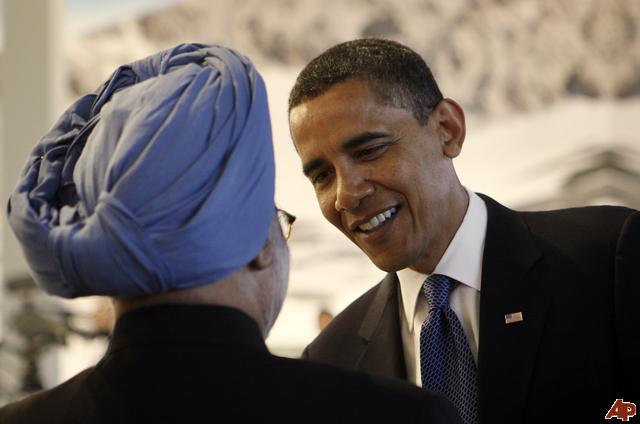
Barack Obama had stroked India’s collective ego by inviting Indian Prime Minister Manmohan Singh for his presidency’s first state dinner, leading to the joke that while China gets a deferential America and Pakistan secures billions of dollars in U.S. aid periodically, India is easily won over with a sumptuous dinner and nice compliments.

The mutual optimism and excitement that characterized the blooming U.S.-Indian ties during the Bush years, admittedly, has given way to more realistic assessments as the relationship has matured. Geostrategic and economic forces, however, continue to drive the two countries closer. Indeed, Obama’s recent pivot to Asia has made closer U.S. strategic collaboration with India critical.

(c) The Japan Times, 2012.