Unknown's avatar

About Chellaney

Professor, strategic thinker, author and commentator

East Asia’s Historical Shackles

A column internationally syndicated by Project Syndicate.

flagsTOKYO – Diplomatic relationships in East Asia have long been held hostage by history. But the region’s “history problem” has been intensifying lately, with growing nationalism among major actors like China, Japan, and South Korea fueling disputes over everything from territory and natural resources to war memorials and textbooks. Can East Asian countries overcome their legacy of conflict to forge a common future that benefits all?

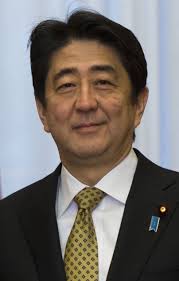
Consider the relationship between America’s closest East Asian allies, Japan and South Korea. Though historical disagreements have long hampered bilateral ties, the increasingly nationalistic stance of Japanese Prime Minister Shinzo Abe and South Korean President Park Geun-hye has aggravated festering tensions. If they fail to work together to stem the revival of bitter historical disputes, their relationship will remain frozen, playing into China’s hands.

And nobody plays the history card with quite as much relish as China, where President Xi Jinping is also relying on nationalism to legitimize his rule. Last year, China introduced two new national memorial days to commemorate China’s long battle against Japanese aggression in World War II: “War against Japanese Aggression Victory Day” on September 3 and “Nanjing Massacre Day” on December 13. What would happen if countries like Vietnam and India dedicated days to remembering China’s aggression toward them since 1949?

By reinforcing negative stereotypes of rival countries, such squabbles over history and remembrance sow fragmentation and instability, and have certainly fueled the region’s recent territorial disputes. Indeed, the politicization of history remains the principal obstacle to reconciliation in East Asia. Repeated attempts to rewrite history – sometimes literally, through textbook revisions – along nationalist lines make it nearly impossible to establish regional institutions.

This should not be the case. Japan and South Korea, for example, are vibrant democracies and export-oriented economic powerhouses, with traditionally close cultural ties and many shared values. In other words, they are ideal candidates for collaboration.

US President Barack Obama recognizes this potential, and has promoted increased strategic cooperation between South Korea and Japan in order to underpin a stronger trilateral security alliance with the US that can balance a rising China. But Japan and South Korea refuse to let go of history.

To be sure, there is some truth to South Korea’s accusation that Japan is denying some of its past behavior. But it is also true that Park – who has refused to meet formally with Abe until he addresses lingering issues over Japan’s annexation of Korea – has used history to pander to domestic nationalist sentiment. Indeed, adopting a hardline stance has enabled her to whitewash some inconvenient family history: Her father, the dictator Park Chung-hee, collaborated with the Japanese military while Korea was under colonial rule.

Abe, too, has stoked tensions, particularly by visiting Tokyo’s Yasukuni Shrine – a controversial memorial that honors, among others, Class A war criminals from World War II. Though Abe visited the shrine only once – in December 2013 – he felt compelled to do so in response to China’s unilateral declaration of an air-defense identification zone, covering territories that it claims but does not control.

Of course, the divergences between Japanese and South Korean historical narratives go back further than WWII. More than a century ago, the Korean activist Ahn Jung-geun assassinated Japan’s first prime minister, Hirobumi Ito, at the railway station in the Chinese city of Harbin, cementing Ahn’s status as a hero in Korea and a terrorist in Japan. Ito’s image can be seen on Japan’s 1,000-yen note; Ahn has appeared on a 200-won postage stamp in South Korea.

A visitor looking at exhibits at the Chinese memorial to the Korean assassin who killed Japan's first PM. © AFP

A visitor looking at exhibits at the Chinese memorial to the Korean assassin who killed Japan’s first PM. © AFP

Last year, Park asked Xi to honor Ahn. Xi seized the opportunity to drive a wedge between America’s two main Asian allies, and built a memorial to Ahn. Japan responded by blasting China for glorifying a terrorist and propagating a “one-sided” view of history – a move that, Japan asserted, was “not conducive to building peace and stability.”

Such conflicts have a clear catalyst: Asia’s rising prosperity. As their economies have expanded, Asian countries have gained the confidence to construct and exalt a new past, in which they either downplay their own aggressions or highlight their steadfastness in the face of brutal victimization.

All countries’ legitimizing narratives blend historical fact and myth. But, in some cases, historical legacies can gain excessive influence, overwhelming leaders’ capacity to make rational policy choices. That explains why Park has sought closer ties with China, even though South Korea’s natural regional partner is democratic Japan. One source of hope stems from Abe’s landslide victory in the recent snap general election, which gives him the political capital to reach out to Park with a grand bargain: If Japan expresses remorse more clearly for its militaristic past, South Korea will agree to leave historical grievances out of official policy.

Japan and South Korea cannot change the past. But they can strive to shape a more cooperative future. As a Russian proverb succinctly puts it, “Forget the past and lose an eye; dwell on the past and lose both eyes.”

© Project Syndicate, 2015.

Reshaping India’s diplomacy

BY BRAHMA CHELLANEY

January 18, 2015, The Japan Times

Building closer ties with important democracies has become the leitmotif of his foreign policy. For example, his much-photographed bear hug with Abe in Kyoto has come to symbolize the dawn of an alliance between the world’s largest democracy and Asia’s oldest (and richest) democracy. Likewise, Modi is enhancing defense and economic cooperation with Israel, with India ordering more Israeli arms in the past six months than in the previous three years.

When Modi won the election, his critics claimed the nationalist would pursue a doctrinaire approach in office. However, one trademark of Modi’s diplomacy is that it is shorn of ideology, with pragmatism being the hallmark.

Nothing better illustrates his pragmatism than the priority he has accorded to restoring momentum to India’s relationship with America.

There was concern in Washington that Modi might nurse a grudge against the United States and keep American officials at arm’s length. After all, the U.S. continued to deny Modi a visa over his alleged involvement in the 2002 anti-Muslim riots in his home state of Gujarat even after he had been cleared of any wrongdoing by an inquiry appointed by India’s Supreme Court. Yet, when he won the election, Obama was quick to telephone him and invite him to the White House — an invitation Modi gladly accepted, given the critical importance of America to India.

Modi’s White House visit last September helped him to establish a personal rapport with Obama. Obama’s impending India visit represents both a thank you to Modi for rising above personal umbrage and an effort to lift the U.S.-India relationship to a higher level of engagement through the major new opportunities being opened up for American businesses by Modi’s commitment to pro-market economic policies and defense modernization.

The U.S. already conducts more military exercises with India than with any other country. And in recent years, it has quietly overtaken Russia as the largest arms supplier to India.

Another example of Modi’s pragmatism is his effort to befriend China. He has invited Chinese investment in his plan to modernize India’s infrastructure, especially railroads, power stations and industrial parks. China’s foreign direct investment in India, however, remains trifling, with Chinese companies preferring to import primary commodities from India while exporting an avalanche of finished products.

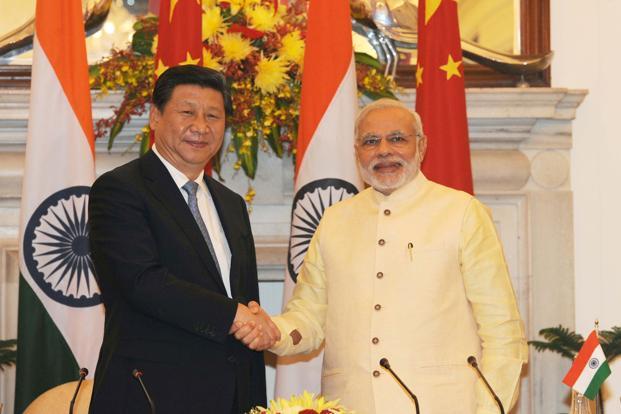
China represents Modi’s diplomatic gamble, as was highlighted when Xi’s visit to India four months ago coincided with Chinese military incursions into India’s Ladakh region and a Chinese submarine’s visit to Sri Lanka. The submarine visit underscored an emerging new threat to Indian security from the Indian Ocean, a region where China has been building ports and other infrastructure projects to extend its strategic clout and build naval presence.

Another regional adversary, Pakistan, poses a different set of challenges for Modi, given the Pakistani military’s use of terrorist proxies. More than six years after the horrific Mumbai terrorist attacks, Pakistan has yet to begin the trial of the seven Pakistani perpetrators in its custody. Adding insult to injury, Pakistani authorities recently helped United Nations-designated terrorist Hafiz Saeed — the architect of the Mumbai attacks — to stage a large public rally in Lahore city, including by running special trains to ferry in participants.

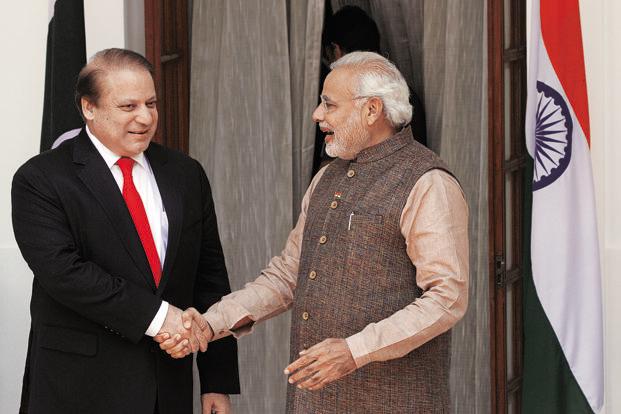
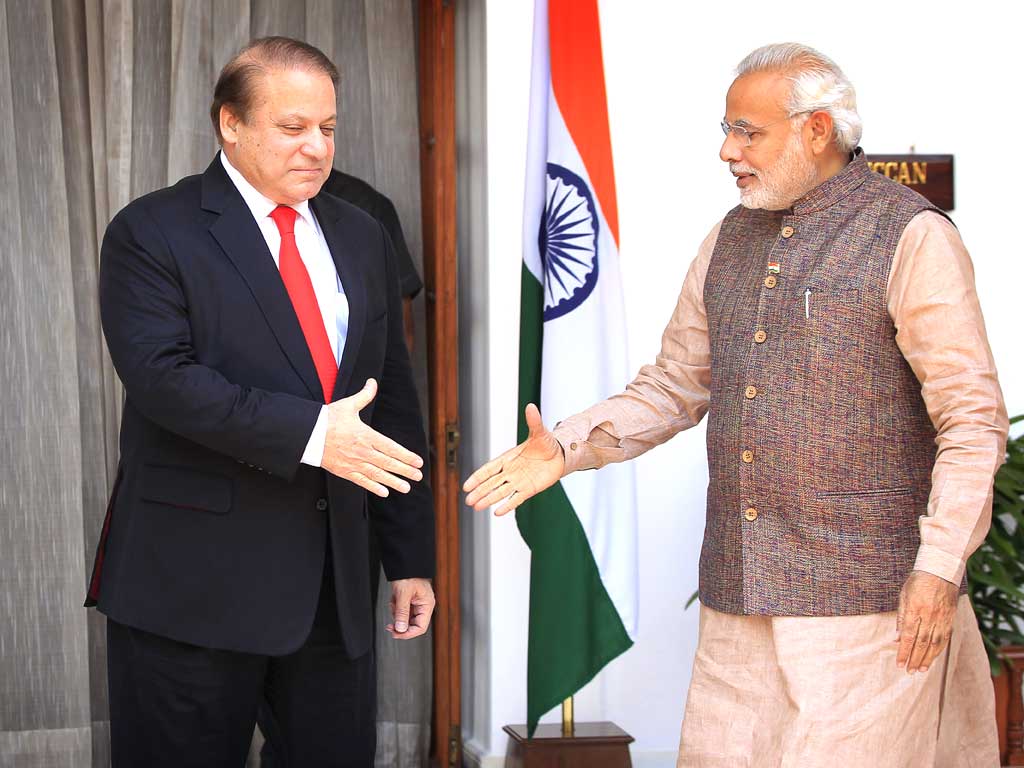
Modi’s Pakistan policy blends a firm response to border provocations with friendly signals. For example, he invited his Pakistani counterpart, Nawaz Sharif, to his inauguration and asked Indian schools to honor the victims of the recent Peshawar attack in Pakistan with a two-minute silence.

At home, Modi has shaken up the diffident foreign-policy establishment with his proactive approach and readiness to break with conventional methods and shibboleths. By taking bold new tacks, Modi is charting a course to boost India’s strategic influence both in its neighborhood and the wider world.

Indeed, Modi has put his stamp on foreign policy faster than any predecessor, other than the country’s first post-independence prime minister, Jawaharlal Nehru. Yet Modi appears to have no intent of enunciating a Modi doctrine in foreign policy. He wants his actions to define his policy trademarks.

His actions have already started speaking for themselves — from his moves to engineer stronger partnerships with Japan and Israel (countries critical to Indian interests but which also courted him even as the U.S. targeted him) to his mortars-for-bullet response to Pakistan’s ceasefire violations. His firm stand at the World Trade Organization on food stockpiling, central to India’s food security, demonstrated that he will stand up even to a powerful, rich nations’ cabal.

More significantly, Modi’s policy appears geared to move India from its long-held nonalignment to a contemporary, globalized practicality. This means from being nonaligned, India is likely to become multialigned, even as it tilts more toward the U.S. and other democracies in Asia and Europe. Yet, importantly, India will continue to chart its own independent course. For example, unlike Japan, it has refused to join American-led financial sanctions against Russia.

After a long era of ad hoc and reactive Indian diplomacy, the new clarity and vision Modi represents is widely seen as a welcome change for India.

Brahma Chellaney is a geostrategist and the author, most recently, of “Water, Peace, and War” (Rowman & Littlefield).

Pakistan’s New Leaf?

Brahma Chellaney

A column internationally syndicated by Project Syndicate.

As U.S. Secretary of State, Hillary Clinton bluntly told Pakistan in 2011 that “you can’t keep snakes in your backyard and expect them only to bite your neighbors.” But her warning (“eventually those snakes are going to turn on” their keeper), like those of other American officials over the years, including presidents and CIA chiefs, went unheeded.

17pakistan-hp-slide-03-articleLarge-v2The snake-keeper’s deepening troubles were exemplified by the recent massacre of 132 schoolchildren in Peshawar by militants no longer under the control of Pakistan’s generals. Such horror is the direct result of the systematic manner in which the Pakistani military establishment has reared jihadist militants since the 1980s as an instrument of state policy against India and Afghanistan. By continuing to nurture terrorist proxies, the Pakistani military has enabled other militants to become entrenched in the country, making the culture of jihad pervasive.

The Peshawar massacre was not the first time that the world’s leading state sponsor of terrorism became a terror victim. But the attack has underscored how the contradiction between battling one set of terror groups while shielding others for cross-border undertakings has hobbled the Pakistani state.

As a result, the question many are asking is whether, in the wake of the Peshawar killings, the Pakistani military, including its rogue Inter-Services Intelligence (ISI) agency, will be willing to break its ties with militant groups and dismantle the state-run terrorist infrastructure. Unfortunately, developments in recent months, including in the aftermath of the Peshawar attack, offer little hope.

On the contrary, with the military back in de facto control, the civilian government led by Prime Minister Nawaz Sharif is in no position to shape developments. And, despite the increasing blowback from state-aided militancy, the generals remain too wedded to sponsoring terrorist groups that are under United Nations sanctions – including Lashkar-e-Tayyiba (LeT) and the Haqqani network – to reverse course.

Reliance on jihadist terror has become part of the generals’ DNA. Who can forget their repeated denial that they knew the whereabouts of Osama bin Laden before he was killed by US naval commandos in a 2011 raid on his safe house in the Pakistani garrison city of Abbottabad? Recently, in an apparent slip, a senior civilian official – Sharif’s national security adviser, Sartaj Aziz – said that Pakistan should do nothing to stop militants who do not intend to harm Pakistan.

The nexus among military officers, jihadists, and hardline nationalists has created a nuclear-armed “Terroristan” that will most likely continue to threaten regional and global security. State-reared terror groups and their splinter cells, some now operating autonomously, have morphed into a hydra. Indeed, as the country’s civilian political institutions corrode, its nuclear arsenal, ominously, is becoming increasingly unsafe.

Pakistan is already a quasi-failed state. Its anti-India identity is no longer sufficient to stem its mounting contradictions, which are most apparent in the two incarnations of the Taliban: the Afghan Taliban, which is the Pakistani military’s surrogate, and the Pakistani Taliban – formally known as Tehreek-e-Taliban Pakistan (TTP) – which is the military’s nemesis. Pakistan also provides sanctuary to the Afghan Taliban’s chief, Mullah Mohammad Omar (and also harbors a well-known international fugitive, the Indian organized crime boss Dawood Ibrahim).

Meanwhile, Hafiz Saeed, the founder of the ISI’s largest surrogate terror organization, LeT, remains the generals’ darling, leading a public life that mocks America’s $10 million bounty on his head and the UN’s inclusion of him on a terrorist list. Earlier this month, Pakistani authorities aided a large public rally by Saeed in Lahore, including by running special trains to ferry in participants, so that the architect of the November 2008 Mumbai terrorist attack (among many others) could project himself as some sort of messiah of the Pakistani people.

Yet none of that stopped Pakistan’s Chief of Army Staff, Raheel Sharif, and ISI Director-General Rizwan Akhter from rushing to Kabul after the Peshawar attack to demand that President Ashraf Ghani and the U.S.-led military coalition extradite TTP chief Mullah Fazlullah or allow Pakistani forces to go in after him. In other words, they seek the help of Afghanistan and the U.S. to fight the Pakistani Taliban while unflinchingly aiding the Afghan Taliban, which has been killing Afghan and NATO troops.

Such is the generals’ Janus-faced approach to terrorism that six years after the Mumbai attacks, Pakistan has yet to try the seven Pakistani perpetrators in its custody. Indeed, under the cover of indignation over the Peshawar attack, the leading suspect in the case – UN-designated terrorist Zaki-ur-Rehman Lakhvi, who served as LeT’s operations chief – secured bail. International outrage soon forced Pakistan to place him in preventive detention for up to three months.

Those who believe that the Peshawar massacre might serve as a wakeup call to the Pakistani military should ask why the generals have ignored hundreds of earlier wakeup calls. Despite the blowback imperiling Pakistan’s future, the generals show no sign that they have tired of running with the hare and hunting with the hounds.

The international community should stop placing its hope in some abrupt change of heart on the generals’ part. Creating a moderate Pakistan at peace with itself can only be a long-term project, because it hinges on empowering a feeble civil society and, ultimately, reining in the military’s role in politics. As long as the military, intelligence, and nuclear establishments remain unaccountable to the civilian government, Pakistan, the region, and the world will continue to be at risk from the jihadist snake pit that the country has become.

© Project Syndicate, 2014.

From a nonaligned to multialigned India?

Brahma Chellaney, Nikkie Asian Review

When a country hosts Chinese President Xi Jinping, Russian President Vladimir Putin and U.S. President Barack Obama in rapid succession for bilateral meetings, it demonstrates its ability to forge partnerships with rival powers and broker cooperative international approaches in a changing world. This is exactly what India is doing under Prime Minister Narendra Modi in a display of diplomatic footwork that recently prompted the Russian ambassador to India, Alexander Kadakin, to publicly remark: “India is a rich fiancee with many bridegrooms.”

Indian Prime Minister Narendra Modi, right, shakes hands with Russian President Vladimir Putin ahead of their meeting in New Delhi on Dec. 11. Modi will receive U.S. President Barack Obama in January. © Reuters

At a time when a new U.S.-Russia Cold War appears to be brewing, Modi — just after hosting Putin — will receive Obama in January, marking the first time an American president will have the honor of being the chief guest at India’s Jan. 26 Republic Day parade. The charismatic Modi, who won Time magazine’s recent reader poll for “Person of the Year” with his rock star-like following, has also sought to strengthen bilateral partnerships with other key players, including Japan, Australia and Israel. For example, his much-photographed bear hug with Japanese Prime Minister Shinzo Abe has come to symbolize the dawn of an alliance between the world’s largest democracy and Asia’s oldest (and richest) democracy.

Since sweeping to power in May in India’s biggest election victory in a generation, Modi has shaken up the country’s reactive and diffident foreign-policy establishment with his proactive approach and readiness to break with conventional methods and shibboleths. The Modi foreign policy appears geared to move India from its long-held nonalignment to a contemporary, globalized practicality.

In essence, this means that India — a founding leader of the nonaligned movement — is likely to become multialigned. Building close partnerships with major powers to pursue a variety of interests in diverse settings will not only enable India to advance its core priorities but will also help to preserve strategic autonomy, in keeping with its longstanding preference for policy independence.

In the last quarter century, the world witnessed the most profound technological, economic and geopolitical changes in the most compressed timeframe in modern history. But much of India’s last 25 years was characterized by political weakness and drift, resulting in erosion of its regional and extra-regional clout. For example, the gap in power and stature between China and India widened significantly in this period. A 2013 essay in the journal Foreign Affairs, entitled “India’s Feeble Foreign Policy,” focused on how India is resisting its own rise, as if political drift had turned the country into its own worst enemy.

Against this background, Modi — widely known for his decisiveness — has made revitalizing the country’s economic and military security his main priority. So far he has made more impact in diplomacy than in domestic policy, a realm where he must prove he can help transform India. Nevertheless, Modi’s focus on the grand chessboard of geopolitics to underpin national interests suggests a strategic bent of mind.

Modi indeed has surprised many by investing considerable political capital in high-powered diplomacy so early in his term, even though he came to office with little foreign-policy experience. He has succeeded in putting his stamp on foreign policy faster than any predecessor, other than the country’s first post-independence prime minister, Jawaharlal Nehru.

Foreign policy pragmatist

Modi’s actions thus far suggest a clear intent to recoup India’s regional losses and to boost its global standing. One trademark of Modi’s foreign policy is that it is shorn of ideology, with pragmatism being the hallmark. In fact, India’s new leader has demonstrated a knack to employ levelheaded ideas in both domestic and foreign policies to lay out a nondoctrinaire vision and to win public support. For example, he has launched a “Make in India” mission to turn the country into an export-driven powerhouse like China and Japan and to transform it from being the world’s largest importer of weapons to becoming an important arms exporter. Modi’s clarity and vision, coming after a long era of ad hoc, reactive Indian diplomacy, is seen as a welcome change for India.

To be sure, the Modi foreign policy faces major regional challenges, exemplified by an arc of failing, revanchist or scofflaw states around India. India’s neighborhood is so chronically troubled that the country faces serious threats from virtually all directions. This tyranny of geography demands that India evolve more dynamic and innovative approaches to diplomacy and national defense. India must actively involve itself regionally to help influence developments, which is what Modi is attempting to do.

A broader and more fundamental challenge for him is to carefully balance closer cooperation with major players in a way that advances India’s economic and security interests, without New Delhi being forced to choose one power over another. One balancing act, for example, is to restore momentum to a flagging relationship with Moscow while boosting ties with the U.S., which has quietly overtaken Russia as the largest arms supplier to India.

Even though Modi told Putin during a summit of BRICS countries — Brazil, Russia, India, China and South Africa — in Brazil in July that “every person, every child” in India knows Russia is the country’s “biggest friend,” the reality is that the India-Russia camaraderie of the Cold War era has been replaced by India-U.S. bonhomie. Modi must stem the new risks as Russia moves closer to India’s strategic rivals — selling top-of-the-line weapon systems to China and signing a military-cooperation agreement with Pakistan in November.

Despite the challenges confronting Modi, India seems set to become multialigned, while tilting more toward the U.S. and other democracies in Europe and Asia. Yet, importantly, India will also continue to chart its own independent course. For example, it has rebuffed U.S. pressure to join American-led financial sanctions against Russia and instead has publicly emphasized “the need to defuse Cold War-like tensions that are increasingly manifesting themselves in global relations.” A multialigned India pursuing omnidirectional cooperation for mutual benefit with key players will be better positioned to expand its strategic influence and promote peace and cooperation in international relations.

Because of its geographical location, India is the natural bridge between the West and the East, and between Europe and Asia. Through forward thinking and a dynamic foreign policy, India can truly play the role of a facilitator and soother between the East and the West, including serving as a link between the competing demands of the developed and developing worlds. At a time of heightened geopolitical tensions, the world needs such a bridge-builder.

Brahma Chellaney is a professor of strategic studies at the independent Center for Policy Research in New Delhi and the author of “Water: Asia’s New Battleground,” the winner of the 2012 Bernard Schwartz Award.

Chickens of terror come home to roost

Brahma Chellaney, Mint, December 23, 2014

Kids firing heavy weaponry at terror-training camp in Pakistan

Kids firing heavy weaponry at terror-training camp in Pakistan

For the world’s leading state sponsor of terrorism — Pakistan — the chickens are coming home to roost with a vengeance, as the Peshawar massacre has shown. Then US Secretary of State Hillary Clinton had publicly warned Pakistan three years ago that keeping “snakes in your backyard” was dangerous as “those snakes are going to turn on” it. Pakistani generals dismissed her warning with disdain. With its Inter-Services Intelligence (ISI) agency in the vanguard, the Pakistani military has continued to blithely nurture “good” terrorists for cross-border undertakings while battling “bad” militants that fail to toe its line. Its dual-track approach has now become so deeply entrenched that Pakistan risks approaching the point of no return.

Ironically, Pakistani military officers learned how to rear and employ snakes from the US Central Intelligence Agency (CIA). CIA and ISI partnered in the 1980s Afghan jihad by creating mujahedeen — the militants out of which Al Qaeda and the Taliban evolved. “We helped to create the problem that we are now fighting”, Hillary Clinton candidly told Fox News in 2010, referring to how the US equipped mujahedeen with “Stinger missiles and everything else”.

The problem so spawned undermined the security of India more than any other country. ISI, as the conduit, siphoned off large portions of the US multibillion-dollar military aid for the mujahedeen to trigger an insurgency in India’s Punjab and then Jammu and Kashmir (J&K) in the 1980s. The US did not penalize Pakistan.

Rather, narrow geopolitical interests after 9/11 prompted America to shower Pakistan with renewed military and economic aid, with that country still a top recipient of US assistance, which has aggregated to more than $30 billion since 2001. Such generous aid — by propping up Pakistan, including with weapon transfers—has given Pakistani generals little incentive to hunt down the snakes in their backyard or stop unleashing them on India and Afghanistan. Even as American aid continues to fatten the Pakistani military, a “Pakistan fatigue” — accelerated by the new US wars in Syria and Iraq — has left little motivation in Washington to salvage a crumbling Pakistan policy.

India thus is on its own to deal with the scourge of infiltrating snakes, with Pakistan’s jihad-inspired war on it showing no sign of abating. Indeed, with Pakistan’s ceasefire violations triggering a fierce Indian response, Pakistani generals are now using terrorist proxies to attack security camps in J&K, as highlighted by the cross-border raid in Uri that left 11 troops dead. The way Pakistani authorities recently helped UN-designated terrorist Hafiz Saeed — the architect of the Mumbai attacks — to stage a large Lahore rally added insult to injury for India.

It was unrealistic to believe Pakistan would bring the Mumbai perpetrators to justice after having reared them. Manmohan Singh’s commitment to “uninterruptible dialogue” with Pakistan as part of his peace-at-any-price approach only brought serial outrages against India. Narendra Modi has done well to craft a clearer policy on Pakistan that blends a firm response to provocations (best illustrated by India’s mortar-for-bullet retort to Pakistani ceasefire violations since September) with friendly signals (for example, inviting Sharif to his inauguration and asking schools nationally to honour the victims of the Peshawar attack with a two-minute silence).

To focus on his broader regional and global agenda without being weighed down by a venomous issue, Modi has effectively sidelined Pakistan in his policy priorities. After all, no nation gets peace by merely seeking peace or staying put in talks with a recalcitrant neighbour. Securing peace demands that a nation must be able to defend peace, including by imposing deterrent costs when peace is violated.

Important countries go to extraordinary lengths to shun and squeeze scofflaw or renegade states. It has taken America 53 years to agree to establish normal diplomatic relations with tiny Cuba but without lifting its trade embargo. It took the US almost a quarter century to resume full diplomatic ties with Myanmar. And after 61 years, the chill in America’s relations with North Korea persists. New Delhi has always maintained full diplomatic relations with Islamabad, even though Pakistan is effectively a rogue or terrorist state waging a “war of a thousand cuts” against India.

Not just that, India continues to unilaterally extend Most Favoured Nation (MFN) trade benefits to Pakistan and adhere to the 1960 Indus Waters Treaty — the world’s most generous water-sharing pact that reserves over 80% of the six-river Indus system’s waters for Pakistan. With Pakistan expecting eternal Indian water munificence even as it bleeds India, the same question must haunt Pakistani generals as Lady Macbeth in William Shakespeare’s Macbeth: “Will all great Neptune’s ocean wash this blood clean from my hand?”

As long as Pakistan persists with its unconventional war, New Delhi must not reward it with talks or any new generosity. In any case, with the Pakistani military back in the driving seat without staging an overt coup, the politically castrated Nawaz Sharif is in no position to deliver on any deal with India. India, while shining an intense spotlight on officially sponsored Pakistani terrorism, should shun Pakistan until it adheres to well-established international norms.

How can Pakistan be a normal state when an abnormal situation prevails there? A moderate, stable Pakistan can emerge only if ISI is cut down to size and the military establishment brought under civilian oversight — steps still distant.

Until then, India must heed a German proverb: “Look before you leap, for snakes among sweet flowers do creep”.

Brahma Chellaney is professor of strategic studies at the Centre for Policy Research in New Delhi.

(c) Mint, 2014.

Asia on the frontlines of natural disasters

Brahma Chellaney, Nikkie Asian Review 

No continent is more vulnerable to natural disasters than Asia, the world’s largest and most populous region. It has the dubious distinction of being home to some of the world’s leading natural disaster-related hot spots.

One fact confirms Asia’s status as a high humanitarian risk area: It accounts for the majority of all people killed, injured or uprooted by natural disasters globally in the past four decades. In the first half of 2014, 820 people were killed and 31 million affected in 56 disasters in Asia, according to the United Nations Office for the Coordination of Humanitarian Affairs. Looking a little further back and including the humanitarian impact of Typhoon Haiyan, which hit the Philippine island of Leyte last November, the estimated death toll exceeds 10,000.

Asia’s vulnerability to disasters arises from five factors: geography, geology, natural climate extremes, human-induced changes to the environment and global warming.

The most common and potent hazards in Asia are water-related: floods, cyclones and droughts, for example. Geological hazards, such as earthquakes, landslides and volcanic eruptions, also claim lives and displace residents regularly, wreaking serious economic damage at the same time. Asia’s poor bear the brunt of the recurrent cataclysms.

People stand among debris and ruins of houses after Typhoon Haiyan pulverized the city of Tacloban.

People stand among debris and ruins of houses after Typhoon Haiyan pulverized the city of Tacloban.

The region’s geographical vulnerability — Asia has suffered 40% of the world’s disasters in the past decade and 80% of the disaster-related fatalities — is compounded by two factors. The continent’s high population density in low-lying areas and its vast stretches of coastline, the world’s longest, lead to increased risk. Southeast Asia, in particular, stands out for its coastline-related vulnerability: It has 3.3% of the global landmass, but more than 11% of the world’s coastline. The majority of the 600 million people in the world living in areas less than 10 meters above sea level are Asian, residing mainly in Southeast and South Asia.

Moreover, the areas of Asia experiencing high economic growth are located along coastlines, which tend to be heavily populated and constitute prime real estate. Indeed, many of Asia’s major cities, energy plants and industries are located along the coasts. The vulnerability of coastal infrastructure has emerged as an important concern.

Nuclear-power plants, for example, guzzle water. All new nuclear plants in Asia — the center of global atomic energy construction — are located along coastlines, allowing them to draw on seawater for cooling. Seaside reactors face big risks from the global-warming-induced increase in natural disasters, as was highlighted by Japan’s 2011 Fukushima disaster, in part caused by a tsunami.

Cursed land

Geologically, Asia is one of the world’s most complex and vulnerable zones, as the interaction of the region’s tectonic plates shows. Its vulnerability extends from where the Indian plate meets the Eurasian plate in the Himalayas to the northern margins of the Australian plate. The edges of the plates meet along Pacific’s Ring of Fire.

Tectonic plate interactions make Asia vulnerable to earthquakes and tsunamis. Two of the world’s biggest ever combined earthquake and tsunami disasters have occurred in Asia in the past decade: in the Indian Ocean in late 2004 and in Japan in March 2011. The 2004 disaster led to more than 230,000 deaths, while Japan’s cost more than 15,000 lives.

Asia’s climate extremes are shaped by water: There can be too little, or too much, of it; it can be too dirty, becoming unsafe to drink; when it rains, it often pours; dry periods can go on too long; and weak monsoons can trigger serious droughts.

Much of Asia receives most of its yearly rainfall during monsoon periods, which can last from three to four months. Flooding in this season is endemic, exacting heavy economic and human costs. But drought — a slow-onset hazard with crippling effects — often tends to be a bigger problem, as this year has shown. Indeed, global drought risks, in terms of the number of people exposed, are concentrated in Asia.

Human-induced changes to the landscape — which are distinct from global warming, though they can be a stepping stone to it — are also contributing to extreme weather events and aggravating their impacts. Environmental change arises from human actions such as reckless land use, contamination of surface-water resources, groundwater depletion, environmentally unsustainable irrigation, degradation of coastal ecosystems, waste mismanagement, and the destruction of forests, mangroves and other natural habitats.

Coastal erosion, for example, has become a serious problem in certain zones, in part because of the clearing of coastal forests. The over-exploitation of coastal aquifer systems is accelerating seawater intrusion. When freshwater reserves are depleted in coastal aquifers, seawater seeps in to supplant the lost freshwater. This factor is beginning to affect drinking-water supplies in coastal cities such as Manila, Jakarta, Bangkok and Dhaka.

Consider another example: The rivers originating on the Tibetan plateau form 11 Asian mega-deltas, which are home to cities such as Tianjin, Shanghai, Guangzhou, Bangkok, Dhaka, Kolkata and Karachi. But these megadeltas, according to the Intergovernmental Panel on Climate Change, have become “much more vulnerable” to the effects of global warming and sea-level rise because of deforestation in Tibet’s upstream catchment areas and the over-damming of the rivers.

Global warming is a fifth factor. There are some gaps in our scientific understanding of this phenomenon. Climate science, after all, is still young. Yet what we know should be a cause for concern for Asia, which must cope with new challenges, such as greater variability in the movement, distribution and quality of water. Natural climate events, such as the intermittent El Nino and La Nina ocean currents that cause secondary disasters in tropical regions, including forest fires with trans-boundary haze, further complicate the problem.

Two water-related implications of global warming for Asia are beyond dispute. First, water stress will intensify and spread to new areas. Asia already has the lowest per-capita water availability among all continents, with large parts of the region now facing water crises. Second, shifts in precipitation and runoff patterns will mean greater variability in water availability, potentially affecting Asian food security.

To deal with their disaster vulnerability, Asian states must do two things: develop greater institutional and organizational capacity to manage environmental stresses and increasing susceptibility to natural hazards; and build resilience. As underscored by the Indian Ocean tsunami and the more recent typhoons that hit the Philippines, building resilience is at the heart of the challenge.

Warning not enough

Resilience is the capacity to absorb shocks and disturbances in such a way as to be able to reorganize fairly quickly. But to be able to reorganize rapidly, a state must have the necessary institutional and organizational means, including implementing forward-looking measures.

Along with developing early-warning systems and preparedness, states must establish smart water-resource management, adapt to water stress by adopting innovative practices and technologies, and develop new crop varieties more tolerant of drought and flooding. Not just governments but also communities and companies need to become more resilient by going beyond traditional risk management to prepare for systemic changes and unforeseen events.

When a disaster strikes a country, the crucial first response cannot come from outside. It must come from within. When nuclear meltdowns occurred at Fukushima, even the International Atomic Energy Agency, a specialized agency, was not initially in a position to offer any concrete assistance to Japan. In the early phase, the IAEA offered criticism but little else.

Yet it is in this critical early phase that a country’s institutional and organizational capacity can make an important difference in saving lives and rescuing people. Rapid-response capability, including local emergency action and providing clean water, food and shelter to survivors, can significantly limit fatalities.

More fundamentally, risk-reduction measures, including protecting or restoring ecosystems that buffer the impact of natural disasters, can help limit both fatalities and economic losses from cataclysms. But the ability of states to adopt best-available practices and technologies to mitigate their disaster-related vulnerabilities very much depends on their political and economic capabilities.

Simple preventive actions, such as the mass evacuation of residents on the basis of early warning systems, can save countless lives. For example, the evacuation of half a million residents from the southeastern Indian coast in October in advance of Typhoon Hudhud — one of the fiercest cyclones to hit the region in years — kept the death toll to fewer than 50. When a typhoon struck the same area in 1999, 10,000 were killed. In contrast to India’s improvement, the failure to evacuate residents caused an estimated 84,500 deaths in Myanmar’s 2008 Typhoon Nargis, according to the International Committee of the Red Cross.

In Asia as elsewhere, countries must develop institutional, organizational and financial capacity as a bulwark against disasters. States with good governance and adequate financial resources will deal with their vulnerabilities in a much better way than cash-strapped nations wracked by internal turmoil and corroding governance.

Brahma Chellaney is a professor of strategic studies at the independent Center for Policy Research in New Delhi and the author of “Water: Asia’s New Battleground,” the winner of the 2012 Bernard Schwartz Award.

© Nikkie Asian Review, 2014. 

Tibet core to Sino-Indian ties

BY BRAHMA CHELLANEYThe Japan Times

Despite booming two-way trade, strategic discord and rivalry between China and India is sharpening. At the core of their divide is Tibet, an issue that fuels territorial disputes, border tensions and water feuds.

The Tibetan plateau is Asia’s “water tower.” © Brahma Chellaney, “Water: Asia’s New Battleground” (Washington, DC: Georgetown University Press, 2013).

The Tibetan plateau is Asia’s “water tower.”          © Brahma Chellaney, Water: Asia’s New Battleground (Washington, DC: Georgetown University Press, 2013).

Beijing says Tibet is a core issue for China. In truth, Tibet is the core issue in Beijing’s relations with countries like India, Nepal and Bhutan that traditionally did not have a common border with China. These countries became China’s neighbors after it annexed Tibet, a sprawling, high-altitude plateau where, after waves of genocide since the 1950s, ecocide now looms large.

Take China’s relations with India: Beijing itself highlights Tibet as the core issue with that country by laying claim to large chunks of Indian land on the basis of purported Tibetan ecclesial or tutelary links, rather than any professed Han Chinese connection. Indeed, since 2006, Beijing has a new name — “South Tibet” — for the northeastern Indian state of Arunachal Pradesh, which is three times the size of Taiwan and twice as large as Switzerland.

Tibet historically was the buffer that separated the Chinese and Indian civilizations. Ever since Communist China, in one of its first acts, gobbled up that buffer with India, Tibet has remained the core matter with India.

In the latest reminder of this reality, President Xi Jinping brought Chinese military incursions across the Indo-Tibetan border on his India visit in September. Indian Prime Minister Narendra Modi’s government responded to the border provocations by permitting Tibetan exiles to stage protests during Xi’s New Delhi stay.

In response to China’s increasing belligerence — reflected in a rising number of Chinese border incursions and Beijing’s new assertiveness on the two Indian states of Arunachal Pradesh and Jammu and Kashmir — India since 2010 has stopped making any reference to Tibet being part of China in a joint statement with China. It has also linked any endorsement of “one China” to a reciprocal Chinese commitment to a “one India.”

Yet the Chinese side managed to bring in Tibet via the back door in the Modi-Xi joint statement, which recorded India’s appreciation of the help extended by the “local government of Tibet Autonomous Region of the People’s Republic of China” to Indian pilgrims visiting Tibet’s Kailash-Mansarover, a mountain-and-lake duo sacred to four faiths: Hinduism, Buddhism, Jainism and Tibet’s indigenous religion, Bon. Several major rivers, including the Indus and the Brahmaputra, originate around this holy place.

Actually, a succession of Indian prime ministers has blundered on Tibet. Jawaharlal Nehru in 1954 ceded India’s British-inherited extraterritorial rights in Tibet and implicitly accepted the plateau’s annexation by China without any quid pro quo. Under the terms of the 1954 accord, India withdrew its “military escorts” from Tibet and handed over to China the postal, telegraph and telephone services it operated there.

But in 2003, Atal Bihari Vajpayee went further than any predecessor and formally surrendered India’s Tibet card. In a statement he signed with the Chinese premier, Vajpayee used the legal term “recognize” to accept what China deceptively calls the Tibet Autonomous Region as “part of the territory of the People’s Republic of China.”

Vajpayee’s blunder opened the way for China to claim Arunachal Pradesh as “South Tibet,” a term it coined to legitimize its attempt at rolling annexation. In fact, since 2010, Beijing has also questioned India’s sovereignty over the state of Jammu and Kashmir, one-fifth of which is under Chinese occupation and another one-third under Pakistani control.

During Xi’s visit, it was by agreeing to open a circuitous alternative route for pilgrims via the Himalayan Indian state of Sikkim that Beijing extracted the appreciation from India to China’s Tibet government. Given that the sacred Kailash-Mansarovar site is located toward the western side of the Tibet-India border, the new route entails a long, arduous detour — pilgrims must first cross eastern Himalayas and then head toward western Himalayas through a frigid, high-altitude terrain.

One obvious reason China chose the roundabout route via Sikkim is that the only section of the Indo-Tibetan border it does not dispute is the Sikkim-Tibet frontier. Beijing recognizes the 1890 Anglo-Sikkim Convention, which demarcated the 206-km Sikkim-Tibet frontier, yet it paradoxically rejects as a colonial relic Tibet’s 1914 McMahon Line with India, though not with Myanmar.

The more important reason is that China is seeking to advance its strategic interests in the Sikkim-Bhutan-Tibet tri-junction, which overlooks the narrow neck of land that connects India’s northeast with the rest of the country. Should the “chicken’s neck” ever be blocked, the northeast would be cut off from the Indian mainland. In the event of a war, China could seek to do just that.

Two developments underscore China’s strategic designs. Beijing is offering Bhutan a territorial settlement in which it would cede most of its other claims in return for being given the strategic area that directly overlooks India’s chokepoint. At the same time, Beijing is working to insidiously build influence in Sikkim, including by shaping a Sino-friendly Kagyu sect of Tibetan Buddhism.

This sect controls important Indian monasteries along the Tibetan border and is headed by the China-anointed but now India-based Karmapa, Ogyen Trinley. The Indian government has barred Ogyen Trinley — who raised suspicion in 1999 by escaping from Tibet with astonishing ease — from visiting the sect’s headquarters in Sikkim. Indian police in 2011 seized large sums of Chinese currency from his office.

India, however, has permitted the Mandarin-speaking Ogyen Trinley to receive envoys sent by Beijing. In recent years, he has met Han Buddhist figures as well as Xiao Wunan, the effective head of the Asia-Pacific Exchange and Cooperation Foundation. This dubious foundation, created to project China’s soft power, has unveiled plans with questionable motives to invest $3 billion at Lord Buddha’s birthplace in Nepal — Lumbini, located just 22 km from the open border with India.

Since coming up to power six months ago, Modi has pursued a nimble foreign policy. One key challenge he faces is how to build leverage against China, which largely sets the bilateral agenda, yet savors a galloping, $36-plus billion trade surplus with India.

Moreover, past Indian blunders on Tibet have helped narrow the focus of Himalayan disputes to what China claims. The spotlight now is on China’s Tibet-linked claim to Arunachal, rather than on Tibet’s status itself.

To correct that, Modi must find ways to add elasticity and nuance to India’s Tibet stance.

One way for India to gradually reclaim its leverage over the Tibet issue is to start emphasizing that its acceptance of China’s claim over Tibet hinged on a grant of genuine autonomy to that region. But instead of granting autonomy, China has make Tibet autonomous in name only, bringing the region under its tight political control and unleashing increasing repression.

India must not shy away from urging China to begin a process of reconciliation and healing in Tibet in its own interest and in the interest of stable Sino-Indian relations. China’s dam-building frenzy is another reminder that Tibet is at the heart of the India-China divide.

That a settlement of the Tibet issue is imperative for regional stability and for improved Sino-Indian relations should become India’s consistent diplomatic refrain. India must also call on Beijing to help build harmonious bilateral relations by renouncing its claims to Indian-administered territories.

Through such calls, and by using expressions like the “Indo-Tibetan border” and by identifying the plateau to the north of its Himalayas as Tibet (not China) in its official maps, India can subtly reopen Tibet as an outstanding issue, without having to formally renounce any of its previously stated positions.

Tibet ceased to be a political buffer when China occupied it in 1950-51. But Tibet can still turn into a political bridge between China and India. For that to happen, China must start a process of political reconciliation in Tibet, repudiate claims to Indian territories on the basis of their alleged Tibetan links, and turn water into a source of cooperation, not conflict.

Brahma Chellaney, a regular contributor to The Japan Times, is the author of “Water, Peace, and War” (Rowman & Littlefield).

© The Japan Times, 2014.

Deconstructing the Modi foreign policy

BRAHMA CHELLANEYThe Hindu, December 4, 2014

India — home to more than a sixth of the human race — punches far below its weight. Internationally, it is a rule-taker, not a rule-maker. A 2013 essay in the journal Foreign Affairs, titled “India’s Feeble Foreign Policy,” focused on how India is resisting its own rise, as if political drift had turned the country into its own worst enemy.

Since the Berlin Wall fell 25 years ago, the world has witnessed the most-profound technological, economic and geopolitical change in the most-compressed time frame in history. Unfortunately for India, despite its impressive economic growth overall, much of its last 25 years has been characterized by political weakness and drift. For example, between 1989 and 1998, India had a succession of six weak governments. It is not an exaggeration to call Prime Minister Manmohan Singh’s two terms “the lost decade” for India strategically.

Waning regional influence

The result of the prolonged leadership crisis has been a sharp erosion in India’s regional and extra-regional clout. The gap in power and stature between China and India has widened significantly. After all, this was the quarter-century in which China took off.

More troubling has been India’s shrinking space in its own strategic backyard. Even tiny Maldives had the gall to kick India in the chin and get away with it. It kicked out its Indian airport operator from the capital Male and publicly dressed down the Indian Ambassador without fear of consequences. In Nepal, India found itself competing with China. And in Sri Lanka, India became content to play second fiddle to China.

The paradox is that India’s economy continued to grow even as India’s regional influence waned. This shows that GDP growth by itself cannot translate into stronger foreign policy in the absence of a dynamic, forward-looking leadership and cogent, strategic goals. In fact, when India was economically weak under Indira Gandhi, it had a fairly robust foreign policy, with no neighbour daring to mess with it.

Job_9086Against this background, the political rise of Narendra Modi — known for his decisiveness — could be a potential game-changer. It is too early to define, let alone judge, his foreign policy, given that Mr. Modi has been in office for just six months. Yet, as he focuses on revitalizing the country’s economic and military security, five things stand out.

First, Mr. Modi continues to invest considerable political capital in high-powered diplomacy so early in his term. Critics may contend that his exceptionally busy foreign-policy schedule, coupled with campaign meetings in serial state elections, leaves him restricted time to focus on his most critical responsibility — domestic issues, which will define his legacy.

Powered by ideas

No previous Indian Prime Minister participated in so many high-powered multilateral and bilateral summits in his or her first months in office as Mr. Modi. U.S. President Barack Obama’s high-profile visit in January will keep national attention on diplomacy. To be sure, Mr. Modi’s focus on the grand chessboard of geopolitics to underpin national interests suggests a strategic bent of mind that only one previous Prime Minister credibly demonstrated — Indira Gandhi.

Second, the Modi foreign policy is powered by ideas, not by any ideology. Indeed, Mr. Modi has demonstrated a knack to skilfully employ level-headed ideas to shape a non-doctrinaire vision and galvanize public opinion. On domestic policy, too, he is using the power of ideas, such as “Swachh Bharat” (or Clean India). In the strategic domain, he is taking his “Make in India” mission to the heavily-import-dependent defence sector. The real test ultimately will be Mr. Modi’s ability to translate his ideas into transformative accomplishments.

Third, he has projected a nimble foreign policy with pragmatism as its hallmark. Nothing better illustrates this than the priority he has accorded — by shaking off U.S. visa-denial humiliation heaped on him over nine years — to restoring momentum to the relationship with America. Mr. Obama’s scheduled visit as chief guest at Republic Day represents both a thank you to Mr. Modi for rising above personal umbrage and an effort to lift the India-U.S. relationship to a higher level of engagement through the major new opportunities being opened up for American businesses by Mr. Modi’s commitment to pro-market economic policies and defence modernization.

The U.S. already conducts more military exercises with India than with any other country. And in recent years, it has quietly overtaken Russia as the largest arms supplier to India.

Food security issue

Fourth, Mr. Modi has put his stamp on foreign policy faster than any predecessor, other than Jawaharlal Nehru. Yet, he appears to have no intent to enunciate a Modi doctrine in foreign policy. In contrast to the meretricious “Gujral Doctrine,” which delivered little more than words, Mr. Modi wants his actions to define his policy trademarks.

In fact, his actions have started speaking for themselves — from his moves to engineer stronger partnerships with Japan and Israel (countries critical to Indian interests but which also courted him even as the U.S. targeted him) to his mortars-for-bullet response to Pakistani ceasefire violations. His firm stand at the World Trade Organization (WTO) on the food-stockpiling issue, central to India’s food security, stood out.

After vetoing the WTO’s Trade Facilitation Agreement in Geneva, Mr. Modi made the U.S. climbdown on the food-stockpiling issue, yet earned praise from Mr. Obama for helping to break the impasse. Even the head of the U.N.’s International Fund for Agricultural Development backed the veto, saying the real choice for India in Geneva was between “feeding” its citizens and “creating jobs” for wealthy economies. After all, the main providers of agricultural subsidies are the rich countries plus China.

For monsoon-dependent, drought-prone India, stockpiling food through a minimum support price to farmers serves as an insurance policy against a 1960s-style mortifying situation that saw New Delhi beseeching foreign food aid, including under U.S.’s PL-480 programme. At Bali, however, the Singh government meekly delinked the Trade Facilitation Agreement from a deal on food stockpiling. By agreeing to kick the can on the stockpiling issue to 2017, it put India’s food security at risk in case no deal was reached by that deadline — a probable scenario. Mr. Modi has succeeded in undoing Dr. Singh’s egregious concession by clinching a deal under which the developing countries’ food-stockholding programmes will face no WTO challenge until a permanent solution is found, thus shielding them from pressures indefinitely.

Looking East

Fifth, Mr. Modi — unlike the leaders who preceded him — attaches major significance to diplomatic symbolism. For example, with the opening of the South Asian Association for Regional Cooperation (SAARC) Summit coinciding with the sombre anniversary of the Mumbai terror attacks, he gave the cold shoulder to his Pakistani counterpart, Nawaz Sharif, for refusing to prosecute the masterminds of that Pakistani scripted and executed operation. Mr. Modi publicly shook hands with Mr. Sharif only the following day at the Dhulikhel retreat. In fact, to concentrate on his broader regional and global agenda, Mr. Modi has done well to sideline Pakistan, a noxious issue that weighed down Mr. Atal Bihari Vajpayee’s foreign policy. Mr. Modi, in any event, faces an important dilemma on Pakistan: With whom to engage there? After being politically cut to size by the military establishment, Mr. Sharif is like a parrot perched on the generals’ shoulders, trying to echo their lines on India, even if stutteringly.

To be sure, Mr. Modi faces major regional challenges, exemplified by the arc of failing, revanchist or scofflaw states around India. This tyranny of geography demands that India evolve more dynamic and innovative approaches to diplomacy and national defence. India must actively involve itself regionally to help influence developments, which is what Mr. Modi is seeking to do. Indeed, his priority — apparent from the time he invited regional leaders to his inauguration — is to retrieve India’s lost ground in its strategic backyard.

As Pakistan’s obstructionism at Kathmandu to greater intra-regional cooperation highlighted, SAARC is likely to remain a stunted organisation. India, while building stronger bilateral linkages with other neighbours, must strengthen its “Look East” policy. India indeed has little choice but to look east because when it looks west, it sees only trouble. The entire belt to India’s west from Pakistan to Syria is a contiguous arc of instability and extremism. Looking east allows India to join the economic dynamism that characterizes the region to its east.

For a politician who came to office with virtually no foreign-policy experience, Mr. Modi has demonstrated impressive diplomatic acumen, including in taking bold new directions, charting a vision to reclaim India’s lost strategic clout, holding his ground in talks with world leaders, and responding to provocations by regional foes. Mr. Modi has shaken India’s foreign-policy establishment with his proactive approach and readiness to break with conventional methods and shibboleths.

All in all, the Modi foreign policy appears geared to reinvent India as a more competitive, confident and secure country claiming its rightful place in the world. A robust foreign policy, however, can sustain itself only on the foundation of a strong domestic policy, a realm where Mr. Modi must prove he can help transform India.

(Brahma Chellaney is a geostrategist and author.)

© The Hindu, 2014.

Nuclear power’s dark future  

Brahma Chellaney, The Japan Times, November 26, 2014

Hamaoka Nuclear Power Plant in Japan.

Hamaoka Nuclear Power Plant in Japan.

Nuclear power constitutes the world’s most-subsidy-fattened energy industry, yet it faces an increasingly uncertain future. The global nuclear-power industry has enjoyed growing state subsidies over the years, even as it generates the most dangerous wastes whose safe disposal saddles future generations. Despite the fat subsidies, new developments are highlighting the nuclear-power industry’s growing travails. For example, France — the “poster child” of atomic power — is rethinking its love affair with nuclear energy. Its Parliament voted last month to cut the country’s nuclear-generating capacity by a third by 2025 and focus instead on renewable sources by emulating neighboring countries like Germany and Spain.

As nuclear power becomes increasingly uneconomical at home because of skyrocketing costs, the U.S. and France are aggressively pushing exports, not just to India and China, but also to “nuclear newcomers,” such as the cash-laden petroleum sheikhdoms in the Persian Gulf. Such exports raise new challenges related to freshwater resources, nuclear safety and nuclear-weapons proliferation.

Still, the bulk of the reactors under construction or planned worldwide are in just four countries — China, Russia, South Korea and India.

Six decades after Lewis Strauss, the chairman of the U.S. Atomic Energy Commission, claimed that nuclear energy would become “too cheap to meter,” nuclear power confronts an increasingly uncertain future, largely because of unfavorable economics.

The just-released International Energy Agency’s World Energy Outlook 2014 report states: “Uncertainties continue to cloud the future for nuclear — government policy, public confidence, financing in liberalized markets, competitiveness versus other sources of generation, and the looming retirement of a large fleet of older plants.” The stock of the state-owned French nuclear technology giant Areva recently tumbled after it cited major delays in its reactor projects and a “lackluster” global atomic-energy market to warn of an uncertain outlook for its business.

For example, the Areva-designed plant in Finland, on Olkiluoto Island, in running at least nine years behind schedule, with its cost expected to rise from €3.2 billion to almost €8.5 billion. Even in Areva’s home market, the Flamanville 3 reactor project in northern France is facing serious delays and cost overruns.

In Japan, the last of its 48 commercial reactors went offline in September 2013. Repeated polls have shown that the Japanese public remains opposed to nuclear restarts by a 2-to-1 margin, despite toughened safety regulations after the March 2011 disaster at the Fukushima No. 1 nuclear power plant. Yet the southern city of Satsuma Sendai in Kagoshima Prefecture recently gave its consent to restarting, as soon as early next year, two reactors operated by Kyushu Electric Power Company.

Nuclear power has the energy sector’s highest capital and water intensity and longest plant-construction time frame, making it hardly attractive for private investors. Plant-construction time frame, with licensing approval, still averages about a decade, as underscored by the new reactors commissioned in the past decade. In fact, the World Nuclear Industry Status Report 2014 acknowledges that 49 of the 66 reactors currently under construction are plagued with delays and cost overruns.

Commercial reactors have been in operation for more than half a century, yet the industry still cannot stand on its own feet without major state support. Instead of the cost of nuclear power declining with the technology’s maturation — as is the case with other sources of energy — the costs have escalated multiple times. Just in the past decade, average costs jumped from $1,000 per installed kilowatt to almost $8,000/kW.

In this light, nuclear power has inexorably been on a downward trajectory. The nuclear share of the world’s total electricity production reached its peak of 17% in the late 1980s. Since then, it has been falling, and is currently estimated at about 13%, even as new uranium discoveries have swelled global reserves. With proven reserves having grown by 12.5% since just 2008, there is enough uranium to meet current demand for more than 100 years.

Yet the worldwide aggregate installed capacity of just three renewables — wind power, solar power and biomass — has surpassed installed nuclear-generating capacity. In India and China, wind power output alone exceeds nuclear-generated electricity.

Before the Fukushima disaster, the global nuclear power industry — a powerful cartel of less than a dozen major state-owned or state-guided firms — had been trumpeting a global “nuclear renaissance.” This spiel was largely anchored in hope.

However, the triple meltdown at Fukushima not only reopened old safety concerns but also has set in motion the renaissance of nuclear power in reverse. The dual imperative for costly upgrades post-Fukushima and for making the industry competitive, including by cutting back on the munificent government subsidies it enjoys, underscores nuclear power’s dimming future.

New nuclear plants in most countries are located in coastal regions so that these water-guzzling facilities can largely draw on seawater for their operations and not bring freshwater resources under strain.

But coastal areas are often not only heavily populated but also constitute prime real estate. Moreover, the projected greater frequency of natural disasters like storms, hurricanes, and tsunamis due to climate change, along with the rise of ocean levels, makes seaside reactors particularly vulnerable.

The risks that seaside reactors face from global-warming-induced natural disasters became evident more than six years before Fukushima, when the 2004 Indian Ocean tsunami inundated the Madras Atomic Power Station. But the reactor core could be kept in a safe shutdown mode because the electrical systems had been installed on higher ground than the plant level.

In 1992, Hurricane Andrew caused significant damage at the Turkey Point nuclear power plant in Florida, but fortunately not to any critical system. And in a 2012 incident, an alert was declared at the New Jersey Oyster Creek nuclear power plant — the oldest operating commercial reactor in the U.S. — after water rose in its water intake structure during Hurricane Sandy, potentially affecting the pumps that circulate cooling water through the plant.

All of Britain’s nuclear power plants are located along the coast, and a government assessment has identified as many as 12 of the country’s 19 civil nuclear sites as being at risk due to rising sea levels. Several nuclear plants in Britain, as in a number of other countries, are just a few meters above sea level.

Yet even as Germany steps out of the nuclear power business, Britain is pressing ahead with a costly new nuclear power station at Hinkley Point, underscoring the divisions among European countries over nuclear power. Britain indeed intends to build several more plants to replace its aging nuclear stations. The Hinkley Point project, however, is running years behind schedule, with the costs mounting.

Globally, nuclear power is set to face increasing challenges due to its inability to compete with other energy sources in pricing. Another factor is how to manage the rising volumes of spent nuclear fuel in the absence of permanent disposal facilities.

More fundamentally, without a breakthrough in fusion energy or greater commercial advances in the area that the U.S. has strived to block — breeder (and thorium) reactors — nuclear power is in no position to lead the world out of the fossil-fuel age.

Brahma Chellaney, a regular contributor to The Japan Times, is a geostrategist and the author, most recently, of “Water, Peace, and War” (Rowman & Littlefield).

© The Japan Times, 2014.

The Centrality of Nuclear Weapons

Brahma Chellaney

Paper presented to the Valdai Discussion Group, November 2014

downloadPower shifts are an inexorable phenomenon in history. The global power structure is not static but continually evolves. The international institutional structure, however, has remained largely static since the mid-twentieth century rather than evolving with the changing power realities and challenges. Reforming and restructuring the international system poses the single biggest challenge to preserving global peace, stability, and continued economic growth. A twenty-first world cannot remain indefinitely saddled with twentieth-century institutions and rules.

Although the world has changed fundamentally since the end of the World War II, one factor remains the same — nuclear weapons still represent power and force in international relations. Despite major military innovations and the deployment of an array of new weapon systems, nuclear weapons’ relevance or role has not changed. Indeed, five key points stand out:

1. Nuclear weapons have strategic and political utility. Think of Britain and France without nuclear weapons. They would become irrelevant, if not in international relations, then at least at the United Nations. Britain and France value nuclear weapons for their political utility. Russia must take comfort in the strategic utility of these weapons; without them, the United States would have assembled a “coalition of the willing” to take on Russia in response to the developments in Crimea and Ukraine.

Such is the strategic utility of nuclear weapons that U.S. President Barack Obama was quick to rule out the military option against Russia after the referendum in Crimea. He even distanced the U.S. from the “Budapest Memorandum,” the pact that was signed in 1994 to provide Ukraine security assurances about its territorial integrity in exchange for its relinquishing of the nuclear arsenal. After all, Russia remains a nuclear superpower.

2. Nuclear proliferation and the utility of nuclear weapons are linked. It is the very utility of nuclear weapons that serves as the main proliferation incentive. This means that the proliferation incentive will remain strong as long as nuclear weapons exist.

To be sure, the international nuclear nonproliferation regime has progressively become very stringent since the 1970s. International Atomic Energy Agency (IAEA) safeguards in non-nuclear-weapons states, for example, have gone from being site-specific to becoming “full-scope” (comprehensive) in nature. The IAEA’s Additional Protocol empowers its inspectors to check even a non-nuclear facility in a non-nuclear-weapons state. There isn’t much room to further tighten the nonproliferation regime.

Still, the stringent nonproliferation regime has made proliferation very difficult or driven it underground. There are limits to what underground proliferation can accomplish. But there are also limits to what coercive enforcement of nonproliferation norms can achieve.

The Nuclear Non-Proliferation Treaty (NPT), which came into force in 1970, was originally intended to prevent countries like Japan, West Germany and Italy from acquiring nuclear weapons. Japan, for example, did not ratify the treaty until 1976 — eight years after the NPT was concluded, and six years after the pact took effect. West Germany and Italy deposited their instruments of ratification only in 1975. After France conducted its first nuclear test in 1960 in the Sahara, West Germany was considered the most likely candidate to follow suit. West Germany first tried to block the conclusion of the NPT before seeking to influence the outcome of the negotiations.

The NPT also became the foundation for a number of regional nuclear-weapon-free zone (NWFZ) agreements, which include the Treaty of Tlatelolco (1969), establishing a NWFZ in Latin America’ the Treaty of Rarotonga (1986) in South Pacific; the Treaty of Bangkok (1997) signed by ASEAN members; the Treaty of Pelindaba (2009); and the Central Asian NWFZ (2009), which has all post-Soviet republics in Central Asia as its members. Regional NWFZ agreements were designed to strengthen the nonproliferation regime. Today, the NWFZs cover almost half of the world and include 115 states plus Mongolia, whose status as a one-state nuclear-weapon-free zone is recognized by UN General Assembly Resolution 3261. The effectiveness of the NWFZs depends on the NPT as the core foundation of the nonproliferation regime.

The challenges to the NPT, however, have been coming from outside the list of its original targets. NPT’s first test, in fact, came early — in May 1974 when India carried out a “peaceful nuclear explosion” (PNE). As India was a non-signatory and indeed had vowed to stay out of the NPT when the treaty was concluded, the test involved no breach of legal obligations. However, after the Indian test, PNEs quickly fell out of international favor, although the U.S. and the Soviet Union both had large PNE programs.

Looking back, the NPT has been a remarkably successful treaty, limiting nuclear-weapons states to a small number. Yet the NPT’s long-term challenge comes from the dichotomy it creates — that it is morally and legally reprehensible for most countries to pursue nuclear ambitions but morally and legally alright for a few states to rely on (and modernize their) nuclear weapons for security.

Today, the spotlight is on the nuclear programs in two states — Iran and North Korea and Iran — as well as on the potential nexus between terrorism and WMD.

North Korean strongman Kim Jong-un won’t give up the nuclear option because he understands the utility of nukes. After all, the United States used aerial bombardment to overthrow ruler Muammar el-Qaddafi in 2011, eight years after he surrendered Libya’s nuclear option in 2003. The big question today is whether Iran, as part of a rapprochement with the United States, would agree to at least freeze its nuclear program, if not give up its nuclear option.

3. Nuclear disarmament has fallen by the wayside. It has become little more than a pious slogan. The United Nations’ Conference on Disarmament (CD), for example, has been without real work for 18 years now.

It is significant that nuclear disarmament fell off the global agenda after the NPT was indefinitely extended in 1995. The NPT was originally conceived as a 25-year bargain between nuclear-weapons states and non-nuclear-weapons states. But as a result of the 1995 action, the treaty has become permanent. This action eliminated international pressure on the nuclear-weapons states in regard to their arsenals.

Not only has nuclear disarmament fallen by the wayside since, there is also little international attention on the nuclear-modernization programs currently underway. This means the five NPT nuclear powers and the three non-NPT nuclear-weapons states of India, Israel and Pakistan can pursue nuclear modernization with no real constraints.

Take Obama, who, having championed “a nuclear-free world,” has quietly pursued plans for an extensive expansion of the U.S. nuclear arsenal, already the world’s most-expensive and most-sophisticated nuclear deterrent. As the New York Times reported on September 22, 2014, the United States plans to spend about $355 billion on nuclear weapons over the next 10 years, and up to $1 trillion over 30 years. Spending so much more money on nuclear weapons is simply not justified, given the changing nature of security threats. In fact, in mid-2014, an independent, bipartisan U.S. federal commission co-chaired by former Secretary of Defense William Perry and retired Gen. John Abizaid called the Obama administration’s plans to expand the nuclear arsenal “unaffordable” and a threat to “needed improvements in conventional forces.” By pursuing a slightly less ambitious nuclear-modernization program, the United States can easily save billions of dollars and still keep the “triad” of delivery systems armed with the same number of nuclear warheads planned under the 2010 New START Treaty.

The real “success” of the NPT has been in reinforcing the system of extended deterrence by enabling countries such as those in NATO and others like Australia, Japan and South Korea to continue to rely on the U.S. for nuclear-umbrella protection. Minus the NPT, these countries would have been the most-likely candidates to go nuclear because they also happen to be the most-capable states technologically. So, the effect of the NPT has to strengthen extended deterrence.

Today, a key question that arises is whether any of the countries ensconced under the U.S. nuclear umbrella would be willing to forgo the benefits of extended deterrence in order to help lower the utility of nuclear weapons and give a boost to the cause of nuclear disarmament. After all, the security imperatives that prompted such countries more than half a century ago to seek nuclear-umbrella protection no longer are valid in a post-Cold War world.

To be sure, some of these states, especially Japan, have seen their regional security environment deteriorate and thus can ill-afford to renounce reliance on U.S. nuclear-umbrella protection. However, the majority of states basking under the U.S. nuclear umbrella find themselves today in relatively benign security environment. They extend from Canada and Norway to Portugal and Australia. Such states could take the lead to gradually wean themselves away from relying on extended nuclear deterrence.

4. Nuclear might provides the cover to some powers for engaging in acts that contravene global norms and international law. There are several examples of this.

For example, Israel’s nuclear monopoly in the Middle East, reinforced by its conventional-military superiority, emboldens it to act preemptively at times, or to employ disproportionate force, as was seen recently in Israel’s Gaza war, which was triggered by the Hamas’s firing of crude, home-made rockets with no guidance.

Consider another example: Pakistan’s military generals export terror by playing nuclear poker. They export terrorism from behind the nuclear shield so as to prevent retaliation against their roguish actions.

One can argue that nuclear might also drives America’s interventionist impulse. America’s Nobel Peace Prize laureate president, Barack Obama, has been more at ease waging wars than in waging peace, as underlined by the launch of his presidency’s seventh military campaign in a Muslim country. His new war in Syria — which he initiated by bypassing the United Nations — is just the latest action of the United States that mocks international law. Other such actions in the past 15 years include the bombing of Serbia, the separation of Kosovo from Serbia, the invasions of Afghanistan and Iraq without UN Security Council authority, Gaddafi’s overthrow, the aiding of an insurrection in Syria, CIA renditions of terror suspects, and National Security Agency’s Orwellian surveillance program. Yet, paradoxically, Obama has escalated a sanctions campaign against Russia in the name of upholding international law.

5. In our rapidly changing world, most technologies tend to become obsolescent in a decade or two. But more than seven decades after they were invented, nuclear weapons still remain the preeminent mass-destruction technology.

Nuclear arsenals may have no deterrent effect on the pressing conflicts we face today. Yet, for the foreseeable future, nuclear weapons, with their unparalleled destructive capacity, will remain at the center of international power and force. Nuclear weapons, as the 2002 U.S. Nuclear Posture Review stated, will continue to play a “critical role” because they possess “unique properties.”

However — a century after chemical arms were introduced in World War I and nearly seven decades following the nuclear bombing of Hiroshima and Nagasaki — the world is at the threshold of new lethal and precision weapons, as underlined by the advent of information weapons, anti-satellite weapons, and the extension of arms race to outer space and cyberspace.

The aforementioned points indicate that nuclear weapons will remain at the core of international power for the foreseeable future. Still, there is a widely held international misperception about the number of countries that rely on nuclear weapons for security. Their number is not just nine (the five NPT nuclear powers, the three non-NPT nuclear-weapons states of India, Israel and Pakistan, plus North Korea). A sizable number of additional countries rely on nuclear-umbrella protection — a fact often obscured.

Actually, the states that are currently ensconced under the U.S. nuclear umbrella number 30. Their number has been growing as part of the eastward expansion of the North Atlantic Treaty Organization (NATO) following the disintegration of the Soviet Union. In fact, the taproot of the ongoing U.S.-Russian tensions has been NATO’s aggressive expansion, including to the Baltics and the Balkans. Russia, however, drew a line in the sand when NATO announced in 2008 that Ukraine and Georgia “will become members of NATO.”

The nuclear-umbrella protection provided by the U.S. extends to all members of NATO, a military alliance that has expanded from its original 12 members in 1949 to 28 states now. In1997, three former Warsaw Pact members, Hungary, the Czech Republic, and Poland, were invited to join NATO. Then, in 2004, seven more countries joined, including the Baltic states of Estonia, Latvia and Lithuania. And in 2009, Albania and Croatia became the latest entrants to NATO.

NATO’s nuclear umbrella primarily relies on American nuclear weapons. However, in a contingency, British and French nuclear arsenals are also expected to play a role.

In addition to NATO members, the U.S. provides nuclear-umbrella protection to Japan (as part of the bilateral Treaty of Mutual Cooperation and Security of 1960), to South Korea (a commitment from 1958 that was reaffirmed by America after North Korea tested a nuclear device in 2006), and to Australia under the terms of ANZUS (Australia, New Zealand, United States Security Treaty of 1951).

The U.S. nuclear umbrella, however, no longer covers New Zealand, whose accession to the South Pacific Nuclear Weapons Free Zone (Treaty of Rarotonga, 1985) and subsequent enactment of domestic measures to comply with the imperatives of the zone triggered a bitter diplomatic row with the United States. By contrast, another ANZUS member, Australia, remains under the American nuclear umbrella despite being a party to the Rarotonga Treaty.

The security alliances of the Soviet Union (which broke up into 15 separate countries) and those of today’s Russia also are believed to have incorporated nuclear-umbrella protection, although Moscow has never acknowledged that publicly. However, after the disbanding of the Warsaw Pact and the breakup of the Soviet Union, half of the ex-Soviet allies and breakaway states have been absorbed by NATO as members. Russia currently has a military alliance — known as the Collective Security Treaty Organization (CSTO) — with Armenia, Belarus, Kazakhstan, Kyrgyzstan and Tajikistan. The creation of the Central Asian Nuclear Weapon Free Zone in 2009 has only strengthened the dependence of Kazakhstan, Kyrgyzstan, and Tajikistan (which are CSTO members) as well as of Uzbekistan and Turkmenistan on the Russian nuclear umbrella.

Against this background, the number of states that rely directly or indirectly on nuclear weapons for their security is substantial. From an international-law standpoint, however, extending nuclear deterrence to non-nuclear-weapons states violates the spirit, if not the text, of the Nuclear Non-Proliferation Treaty (NPT). Some, of course, have argued that it actually breaches the text of the NPT. After all, NATO’s nuclear doctrine is pivoted on nuclear sharing, and the United States has deployed nuclear weapons for decades on the territory of non-nuclear NATO members, often without their knowledge during the Cold War years. Now, the U.S. is believed to have approximately 500 tactical nuclear warheads in five NATO states — Belgium, Germany, Italy, the Netherlands, and Turkey. Until 1991, American tactical nukes were deployed in South Korea. The North Korean nuclear threat makes redeployment of U.S. nuclear capabilities in South Korea theoretically conceivable.

Nuclear proliferation in the future will hinge largely on the credibility of U.S. security guarantees as perceived by America’s key, technologically advanced allies. The future of the NPT regime, despite its tremendous success thus far, looks anything but certain. The treaty’s main challenges now come from within, not from its non-parties — India, Israel and Pakistan, which never signed the NPT and have developed nuclear weapons.

Significantly, technological forces are now playing a greater role in shaping international geopolitics and power equations than at any other time in history. The growing tide of new innovations has not only shrunk the shelf-life of most technologies, but also accelerated the weaponization of science. Such are the challenges from the accelerated weaponization of science that instead of disarmament, rearmament today looms large on the horizon, with the arms race being extended to outer space and cyberspace.

Grand speeches about a world without nuclear weapons are crowd-pleasers at the United Nations. But in truth, pursuing disarmament is like chasing butterflies — enjoyable for some retired old men but never-ending. Until nuclear weapons remain the premier mass-destruction technology, disarmament will stay a mirage. The Chemical Weapons Convention became possible only when chemical weapons ceased to be militarily relevant for the major powers and instead threatened to become the poor state’s weapons of mass destruction (WMD). If the rapid pace of technological change creates a new class of surgical-strike WMD that makes nuclear weapons less relevant, nuclear disarmament would likely take center-stage.

Nevertheless, it has become difficult to palm off nonproliferation as disarmament. What many members of the international community want to see are genuine efforts to substantially reduce nuclear arsenals and to erode the utility of WMD in national military strategies. Today, the world has a treaty (although not in force) that bans all nuclear testing — the Comprehensive Test Ban Treaty (CTBT) — but no treaty to outlaw the use of nuclear weapons. In other words, those that are party to the Comprehensive Test Ban Treaty (CTBT) are prohibited from testing a nuclear weapon at home but are legally unencumbered to test the weapon by dropping it over some other state. This anomaly must be rectified.

Brahma Chellaney is a professor of strategic studies at the independent Center for Policy Research in New Delhi; a fellow of the Robert Bosch Stiftung in Berlin; and an affiliate with the International Centre for the Study of Radicalization at King’s College London. He is the author of nine books, including an international bestseller, Asian Juggernaut (Harper, New York, 2010).