Brahma Chellaney, Asia-Pacific Review, Volume 25, 2018 – Issue 1
ABSTRACT
The imperative in the Indo-Pacific region is to build a new strategic equilibrium pivoted on a stable balance of power. A constellation of likeminded states linked by interlocking strategic cooperation has become critical to help build such equilibrium. Japanese Prime Minister Shinzo Abe is the author of the “free and open Indo-Pacific” concept that the US is now pushing. But Japan faces important strategic challenges. To secure itself against dangers that did not exist when its current national-security policies and laws were framed, Japan must bolster its security or risk coming under siege. US security interests will be better served by a more confident and secure Japan that assumes greater responsibility for its own defense and for regional security. The US must encourage Japan, which has not fired a single shot against an outside party since World War II, to undertake greater national-security reforms. Peace in Asia demands a proactive Japan.
We live in a rapidly changing world. The past three decades have brought truly revolutionary change. The world has changed fundamentally in a geopolitical sense since the fall of the Berlin Wall. We have seen the most profound geopolitical change in the most compressed timeframe in history. And thanks to the even more rapid pace of technological change, technological forces are now playing a greater role in shaping geopolitics than at any other time in history. Economically, the pace of change has been no less dramatic, leading to global interdependence and lower trade barriers and accelerated growth.
Yet, when we look back over this period of three decades, no analyst foresaw such change coming. For example, no one predicted the collapse of the Soviet Union or the rapid rise of Asia. The Soviet Union collapsed almost like a deck of cards, fundamentally changing global geopolitics. In the economic realm, no analyst foresaw the two processes that have shaped globalization: the denationalization of production and the denationalization of consumption. The denationalization of production has resulted in the stages of production becoming geographically separated, leading to value chains being formed internationally. And the denationalization of consumption has allowed consumers to buy goods and services from places where they are produced more efficiently.
It is safe to say that the next three decades will likely bring changes no less dramatic than what the last three decades witnessed. But no analyst will be able to accurately predict what the next three decades will bring. What we do know is that the Asia-Pacific region holds the key to global security.1 The region is home not only to the world’s fastest-growing economies, but also to the fastest-increasing military expenditures and naval capabilities, the fiercest competition over natural resources, and the most dangerous strategic hot spots.
The increasing use of the term “Indo-Pacific”—which refers to all countries bordering the Indian and Pacific oceans—rather than “Asia-Pacific,” underscores the maritime dimension of today’s tensions. Asia’s oceans have increasingly become an arena of competition for resources and influence. It now seems likely that future regional crises will be triggered and/or settled at sea.
The main driver of this shift has been China. If there is one action by any power that holds the greatest strategic ramifications for global security and the international maritime order, it is China’s alteration of the status quo in the South China Sea in disregard of international norms. Operating in the threshold between peace and war, China, by creating artificial islands in the South China Sea, has pushed its borders far out into international waters in a way no other power has done elsewhere.
Having militarized these outposts and presented this development as a fait accompli to the rest of the world, it is now shifting its focus to the Indian Ocean and the western Pacific. Already, China has established its first overseas military base in Djibouti, located at the northwestern edge of the Indian Ocean region. Moreover, China is planning to open a new naval base next to Pakistan’s Chinese-controlled Gwadar port. And it has leased several islands in the crisis-ridden Maldives, where it is set to build a marine observatory that will provide subsurface data supporting the deployment of nuclear-powered attack submarines (SSNs) and nuclear-powered ballistic missile subs (SSBNs) in the Indian Ocean. In short, China has fundamentally transformed the strategic landscape in the Indo-Pacific, raising new challenges for regional countries like Japan, India, Vietnam, and Australia.
A constellation of likeminded states linked by interlocking strategic cooperation has become critical to help institute power stability. The imperative is to build a new strategic equilibrium, including a stable balance of power. If likeminded states do not step in to counter further challenges to the territorial and maritime status quo, the next five years could firmly entrench China’s strategic advantages. The result could be the ascendancy of a China-led illiberal hegemonic regional order, at the expense of the liberal rules-based order that most countries in the Indo-Pacific support. Given the region’s economic weight, this would create significant risks for global markets and international security.
Japan’s security dilemma
In modern history, Japan, the “Land of the Rising Sun,” has often inspired other Asian states. This is because Japan has had the distinction of mostly staying ahead of the rest of Asia. During the 1868-1912 Meiji era, Japan became Asia’s first modern economic success story. It then went on to become the first Asian country to emerge as a global military power when, between 1895 and 1905, it defeated Manchu-ruled China and Tsarist Russia in separate wars. With much of Asia colonized by Europeans, Russia’s military rout at the hands of the Japanese came as a shot in the arm to Asian independence movements. After Japan’s crushing defeat in World War II, Japan rose from the ashes rapidly to emerge as Asia’s first global economic powerhouse by the 1980s, an industrial dynamo of a kind Asia had never seen.
Specializing in the highest-value links of the global supply chains, Japan today ranks among the world’s richest countries. With its Gini coefficient of 0.25, it boasts the lowest income inequality in Asia, even though income inequality is now rising in this country. Japan’s per capita GDP of about $39,000 means that its citizens are almost five times wealthier than Chinese.
To be sure, Japan’s geopolitical clout has taken a beating due to a quarter-century of sluggish economic growth, a period in which China and the rest of Asia have risen dramatically. But despite the international media depicting Japan’s decline in almost gloomy terms, the truth is that real per-capita income has increased faster in this century in Japan than in the US and Britain, while Japan’s unemployment rate has long remained one of the lowest among the OECD economies. Japan enjoys the highest life expectancy of any large country in the world.
Japan’s trailblazing role in modern history raises the question as to whether its current challenges, including population aging and sluggish economic growth, presage a similar trend across East Asia. Similar problems are now beginning to trouble South Korea, Taiwan, and Hong Kong, while China has been driven to loosen its one-child policy and unveil measures to reverse slowing economic growth.
More fundamentally, Japan—Asia’s oldest liberal democracy—faces pressing security challenges today, at a time of shifting power dynamics in Asia. Japan is an archipelago of almost 7,000 islands, with a population of about 127 million. In terms of land area, Japan is ranked 60th in the world. But Japan’s Exclusive Economic Zone of about 4.5 million square kilometers is the sixth largest in the world; it is larger than China’s. Of the 400 remote islands that serve as markers for determining Japan’s territorial waters, only about 50 are inhabited. No group of islands, of course, poses a bigger challenge for its security than the Senkakus, a clutch of five uninhabited islets and three rocks.
Japan’s challenge is compounded by demographic and military trends. Japan has barely one-tenth the population of China’s. Moreover, its population is not just aging but also shrinking significantly; it declined by nearly a million just between 2010 and 2015. About a decade ago, Japan’s defense budget was larger than China’s. But now China’s military spending surpasses the combined defense expenditures of Japan, Russia, Britain, and France.2 As the power balance in Asia shifts, Japan’s security concerns are accentuating.
Japan’s national-security reforms in recent years are part of its effort to reinvent itself as a more secure and competitive nation. The international spotlight on its prolonged economic woes has helped obscure one of the farthest-reaching but least-noticed developments in Asia in this century—Japan’s quiet political resurgence. Japan has historically punched above its weight—a record punctured only by its crushing World War II defeat. Today, despite achieving a high standard of living, Japan is an increasingly insecure nation. Content for decades to let the United States take care of its security, Japan confronts fast-changing security and power dynamics in Asia, with the rise of a muscular, revisionist China shaking it out of its complacency. It is determined not to accept Chinese regional hegemony.
Still, Japan faces a stark choice: bolster its security or come under siege. It must secure itself against dangers that did not exist when its current national-security policies and laws were framed. This grating reality has prompted Japan to establish the National Security Council and take some long-overdue steps, including easing its longstanding, self-imposed ban on export of arms and asserting the right to exercise “collective self-defense.” The reforms in security policy allow the Japanese military to pursue broader peacekeeping and other combat missions overseas in sync with national interest. More importantly, by removing legal ambiguities on the role Japan can play internationally, the reforms facilitate greater Japanese engagement in multilateral and bilateral arrangements. Earlier, large parts of Japan’s overseas security engagements were open to challenge on constitutionality grounds. By removing ambiguities, the security-policy reforms open the path for Japan to play a more active role multilaterally and bilaterally with friendly countries. For example, the reforms will help facilitate building security collaboration with other countries in ways that reinforce Japan’s own security and shore up an Asian order that is under challenge from Chinese revisionism.
To be clear, the policy moves—designed to “normalize” Japan’s security posture—have thus far been limited in scope and do not open the path to the country becoming a militaristic power. Restrictions on deployment of offensive weapons, for example, remain in place. Yet the moves have proved divisive at home, owing to pacifism remaining deeply embedded in Japanese society, in part because of the painful legacy of Japan’s prewar militarism. The core issue at stake, however, is not whether Japan should remain pacifist (the US-imposed Constitution has made Japan the world’s first constitutionally pacifist nation) but whether it should stay passive in regional and international affairs. Enduring peace in Asia demands a proactive Japan. If the Japanese government is to play a proactive role, it must win over a divided public at home. This is borne out by a Pew Research Center survey: 47% of Americans want Japan to play a more active role in regional security; by contrast, only 23% of Japanese want their country to play a more active role.3
If Japan fails to push further reforms of its postwar institutions and policies to meet the new challenges, it could erode its security. A Japan that is better able to defend itself and to partner with friendly Indo-Pacific countries would be able to forestall the emergence of a destabilizing power imbalance in East Asia. Even US security interests would be better served by a more confident and secure Japan that assumes greater responsibility for its own defense and for regional security. After all, Japan’s policy of pacifism under the US military umbrella seems no longer adequate to shield Japanese interests—or even American interests.
A still-pacifist but proactive Japan would be able to take its rightful place in the world. But to underpin a “proactive contribution to peace”—a term popularized by Prime Minister Shinzo Abe— does Japan need to become a militarily independent power like two of America’s closest allies, Britain or France? Britain and France have built formidable military-deterrent capabilities, rather than entrust their security to the US. Legally, Japan does not have the choice to pursue the nuclear-weapons option. But, even without its abandoning the security treaty with the US, it can build robust conventional-force capabilities, including information-warfare systems, given that the cyber-realm would play an increasingly important role in conflict.
Japan’s domestic constraints
Domestic constraints accentuate Japan’s security dilemma. One example is the difficulty in reforming the Japanese Constitution, which was imposed by the occupying American forces in 1947 after disbanding the Japanese military.4 Being the world’s first constitutionally pacifist nation was something the post-war Japan became proud of. Yet the fact is that no other country in the world is bound by the kind of constitutional restrictions that were imposed on vanquished Japan by an occupying power.
The Constitution prohibits Japan from acquiring the means of war and bars its purely defensive military, called the Self-Defense Forces, from staging rescue missions or other overseas operations even to free Japanese hostages. Indeed, to set up wholly defensive armed forces in the 1950s, Japan had to loosely interpret the Constitution’s force-renouncing Article 9, which says “land, sea, and air forces, as well as other war potential, will never be maintained.” This major reinterpretation was done, paradoxically, at the behest of the US, which, after disbanding the Japanese military, realized the value of building Japan as its loyal vassal on the frontlines of the Cold War.
Yet Japan has clung to that Constitution all these years without so much as carrying out a single amendment or changing even one word. Many other democracies regard their constitutions not as cast in stone but as open to change so that they stay abreast with new social, technological, and economic developments. For example, India—whose Constitution is almost as old as Japan’s—has incorporated 100 amendments thus far. There have been fewer amendments—27—to the U.S. Constitution since its enactment in 1787. No constitution can be perfect. A constitution, like the democratic system it embodies, should be open to improvements.
In this light, Prime Minister Abe has made an impassioned appeal for constitutional reform, suggesting that the time may have come to emulate the same kind of far-reaching change that allowed Japan to rise from the ashes of its World War II defeat. Addressing the Diet, he once asked: “For the future of Japan, shouldn’t we accomplish in this Diet the biggest reform since the end of the war?” Abe’s contention that the Constitution no longer reflects the realities now facing Japan and thus needs to be updated is strengthened by another fact: Germany, also defeated in World War II, has over the years made 59 amendments to its Basic Law, or Constitution, which it adopted when it was under Allied occupation.5
Japan and Germany regained sovereignty from post-World War II military occupation only after embracing constitutional guarantees against any future threats from them to peace. However, West Germany’s new Constitution, while outlawing a war of aggression, authorized military force in self-defense or as part of a collective security agreement. By contrast, Japan’s Article 9 went further, stating that “the Japanese people forever renounce … the threat or use of force as a means of settling international disputes.” By forcing Japan to renounce war as “a sovereign right of the nation,” the Constitution imposed stringent restraints.
One key reason the German Constitution did not contain some of the harsh provisions of the US-imposed Japanese Constitution is that, by the time the German Constitution was drafted in 1949, the Cold War was in full swing, with the US-British-French focus shifting to containing communism. Japan’s constitution was imposed two years earlier. The start of the Cold War with the Soviet Union, coupled with the Communist takeover of China and China’s entry into the Korean War, changed American thinking on the pacifist constitution the US had imposed on Japan. In 1953, while visiting Japan as President Eisenhower’s vice president, Richard Nixon called the US-imposed constitution “a mistake.”
Today, from a legal standpoint, national-security reforms in Japan are linked with constitutional reform. For example, the Japanese armed forces are still called the “Self-Defense Forces.” In the more recent Japanese debate on Japan asserting the right to exercise “collective self-defense,” the focus was on the constitutionality of the move, not on substance or the strategic imperative. In fact, when Abe’s government in July 2014 reinterpreted the Constitution to assert the right to exercise collective self-defense, thus allowing Japan’s military to defend the US and other foreign armed forces even when Japan isn’t under direct attack, critics denounced the reinterpretation as undermining the Constitution. Abe was accused of changing a core element of the Constitution through reinterpretation rather than legislative amendment process. The fact is this reinterpretation was small compared with what the Americans did just years after imposing a Constitution on Japan. Through a major reinterpretation of the Constitution it imposed, the US, following the start of the Cold War, encouraged Japan to rebuild its military as the “Self-Defense Forces” so as to make the country the lynchpin of America’s Asia strategy.
The constitutional-reform push in Japan today faces major domestic obstacles. For one, the Constitution places a high bar to the enactment of any amendment, making it among the hardest in the world to revise. Any amendment must win support of two-thirds majorities in both chambers of Diet and be ratified by more than half of voters in a public referendum. For another, the majority of citizens, including most of the young, today remain comfortable with the present Constitution. After all, pacifism remains deeply ingrained in Japanese society. Indeed, a global poll by the World Values Survey revealed that Japanese rank the lowest in their “willingness to fight for the country,” with only 15.3% of Japanese—compared with 74.2% of Chinese and 57.7% of Americans—expressing readiness to defend their nation.6 Underscoring the youth’s revulsion to war, just 9.5% of Japanese under 30 said they would be willing to fight. In an extension of this attitude, many Japanese regard the Constitution as sacrosanct.
Against this background, if there is one factor that can make a meaningful difference to constitutional reform in Japan, it is American support. US support for such reform will assuage many Japanese that amending the Constitution will not mean repudiating the postwar order that America established in Japan or abandoning Japan’s pacifist policy. The alliance with Japan is central to America’s military role in Asia, including forward US military presence. Japan, for its part, remains a model ally that hosts a large US troop presence, even paying for the upkeep of American forces on its soil—a generous contribution that surpasses the combined host-nation support of America’s 26 other allies, according to a Pentagon report.
US security interests would be better served by a more confident and secure Japan that assumes greater responsibility for its own defense and for regional security. Japan’s national-security and constitutional reforms, in fact, would put its alliance with the US on a sounder footing. If Japan is to take its rightful place in the world, it will have to adapt its post-war institutions and policies to meet the new challenges that confront it. Under Prime Minister Abe’s government, Japan has taken some long-overdue steps to strengthen national security. However, a lot more needs to be done to make Japan more secure, competitive, and internationally engaged.
Japan has an enviable record: It has not fired a single shot against an outside party since World War II. And as a major donor of economic and humanitarian aid, Japan for many decades has been a vital contributor to regional and international peace and security. The US thus must encourage Japan to undertake greater national-security reforms.
China will clearly prefer a Japan that remains dependent on America for its security than a Japan that plays a more independent role. The fact, however, is that the post-1945 system erected by the US is more suited to keep Japan as an American protectorate than to allow Japan to effectively aid the central US objective in the Asia-Pacific—a stable balance of power. A subtle US policy shift that encourages Tokyo to cut its dependence on America and do more for its own security can assist Japan in building a more secure future for itself that helps block the rise of a Sino-centric Asia.
The Senkaku challenge
In 2013, Chinese President Xi Jinping declared much of the East China Sea, including the Senkakus, to be a Chinese air defense zone. Since then, China has stepped up its challenge to Japan’s control over those islands, including through repeated intrusions by its military aircraft and warships. Beijing has hardened its stance by elevating its claim to the Senkakus to a “core interest,” while some in China have gone to the ominous extent of questioning Japan’s sovereignty even over Okinawa.
Against this background, many Japanese have wondered whether the United States would come to Japan’s defense in the event of a Chinese attack on the Senkakus. The 1960 US-Japan Security Treaty states that an armed attack on either country, including the territories under Japan’s administration, would prompt joint action “to meet the common danger.” However, contradictory rhetoric by then US President Barack Obama instilled a sense of skepticism in Japan. Obama publicly affirmed that the US-Japan security treaty covered the Senkakus. But in the same breath he refused to take a position on the islands’ sovereignty and advised Tokyo and Beijing to sort out their dispute peacefully. Obama said the US security treaty with Japan covered the Senkaku Islands because they “are under Japanese jurisdiction,” yet “we also stress that we don’t take a position on the sovereignty of the Senkaku Islands.”
At his April 2014 joint news conference with Abe in Tokyo, Obama, while unveiling his position on the Senkakus, urged Japan to refrain from “provocative actions” and emphasized that his administration was committed to encouraging China’s “peaceful rise.” He stated: “We don’t take a position on final sovereignty determinations with respect to Senkakus, but historically they have been administered by Japan and we do not believe that they should be subject to change unilaterally … In our discussions, I emphasized with Prime Minister Abe the importance of resolving this issue peacefully—not escalating the situation, keeping the rhetoric low, not taking provocative actions, and trying to determine how both Japan and China can work cooperatively together. And I want to make that larger point. We have strong relations with China. They are a critical country not just to the region but to the world. Obviously, with a huge population, a growing economy, we want to continue to encourage the peaceful rise of China.”
How could such doublespeak reassure Japan? In fact, such statements sowed doubt over America’s willingness to go to war with China to back Japan’s territorial rights, in the event of a surprise Chinese invasion of the Senkakus. The Obama administration responded to such doubt by simply saying that “we do not envision that this current tension will rise to that level in any foreseeable scenario.” Add to the picture Obama’s conspicuous inaction and silence on China’s 2012 seizure of the disputed Scarborough Shoal from the Philippines, despite America’s longstanding mutual defense treaty with Manila. That development served as a wakeup call for Japan and other US allies and partners in Asia.
By contrast, the US administration led by President Donald Trump has taken a more clear-cut stance in reassuring Japan that the US would defend it in a confrontation with China over the Senkakus. It has done so without the Obama-style caveat—that Washington does not take sides in the sovereignty dispute and that it calls on China and Japan to resolve their dispute peacefully through dialogue.
In fact, the 2017 Trump-Abe summit at Mar-a-Lago marked the first time that the US commitment to defend Japan’s control over the Senkakus was recorded in a joint statement. The February 12, 2017, Trump-Abe joint statement came out strongly for Senkakus’ defense: “The two leaders affirmed that Article V of the U.S.-Japan Treaty of Mutual Cooperation and Security covers the Senkaku Islands. They oppose any unilateral action that seeks to undermine Japan’s administration of these islands … The United States and Japan oppose any attempt to assert maritime claims through the use of intimidation, coercion or force.” This unambiguous commitment was an important success of Abe’s proactive diplomacy in seeking to build a personal connection with the new US president. Abe was the first foreign leader Trump hosted at Mar-a-Lago, which he calls “The Southern White House.” Earlier, just after Trump’s unexpected election victory, Abe met face-to-face with him by making a special stop in New York en route to the Asia-Pacific Economic Cooperation summit in Peru.
Let us be clear: The Senkaku issue is not just about a seven-square-kilometer real estate or the potential oil and gas reserves that lie around it. The strategically located Senkakus, despite their small size, are critical to maritime security and the larger contest for influence in the East China Sea and the larger Indo-Pacific region.
China is seeking to wage a campaign of attrition against Japan over the Senkakus by gradually increasing the frequency and duration of its intrusions into Japan’s airspace and territorial waters. In doing so, it has made the rest of the world recognize the existence of a dispute and the risks of armed conflict.
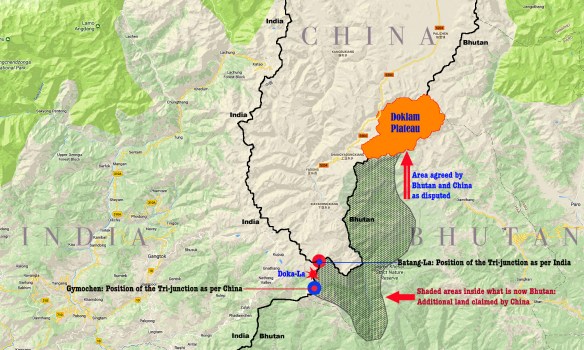
To be sure, a focus on changing the territorial status quo is nothing new for Beijing. The People’s Republic of China has been changing the territorial status quo ever since it was founded in 1949. The early forcible absorption of the sprawling Xinjiang and Tibetan Plateau more than doubled China’s landmass. In the 21st century, Chinese expansionism has increasingly relied upon “salami tactics”—a steady progression of small, furtive actions, none of which serves as a casus belli by itself, yet which help to incrementally change facts on the ground in China’s favor. In this manner, China has stealthily occupied much of the remote Himalayan plateau of Doklam, which Bhutan—one of the world’s smallest countries—regards as its integral part. Similarly, China has progressively changed the status quo in the South China Sea in its favor.7
But unlike China’s success in expanding its frontiers in the South China Sea, it has found the going tough in the East China Sea. Indeed, Beijing’s actions have shaken Japan out of its complacency and diffidence and set in motion the strengthening of Japan’s defense capabilities, including arming its far-flung island chain in the East China Sea with a string of anti-ship, anti-aircraft missile batteries. Abe has pledged that Japan will play a “greater role” in East Asian security. It is as if he is responding to Trump’s presidential campaign rhetoric that Japan, which hosts about 54,000 American troops, should do more to defend itself.
One effective way the Trump administration can encourage Japan to do more for its own defense is by lending full support to the Abe-initiated national security and constitutional reform process. Such reforms could help forestall the emergence of a destabilizing power imbalance in East Asia. Japan is already working to constrain China with its own version of Beijing’s “anti-access, area denial” doctrine against the United States. Japan has long been used to practicing passive, checkbook diplomacy. But now it appears intent on influencing Asia’s power balance.
The changing power dynamics in the Indo-Pacific
How rapidly the security situation is changing in the Indo-Pacific region can be gauged from the fact that it was just five years ago that China began building artificial islands in the South China Sea. It has since militarized the newly reclaimed outposts without incurring any significant international costs. The developments in the South China Sea carry far-reaching strategic implications for the Indo-Pacific and for the international maritime order. They also highlight that the biggest threat to maritime peace and security comes from unilateralism, especially altering the territorial or maritime status quo by violating international norms and rules.
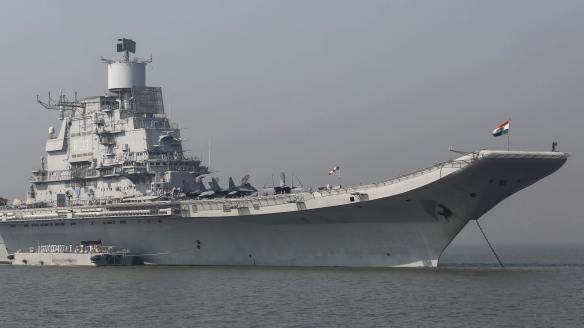
When the US aircraft carrier, Carl Vinson, made a port call at Da Nang, Vietnam, earlier this year, it attracted international attention because this was the first time that a large contingent of US military personnel landed on Vietnamese soil since the last of the American troops withdrew from that country in 1975. The symbolism of this port call, however, failed to obscure the fact that the United States has had no coherent strategy against China’s island-building program. It was on President Obama’s watch that China created and militarized the artificial islands, while his successor, Donald Trump, has focused on North Korea, Iran, and trade; the South China Sea is not even on his radar.
As a result, China, with its expanding diplomatic, economic, and military reach, is incrementally imposing its will on the region. For example, soon after the USS Carl Vinson’s visit, Chinese pressure forced Vietnam to suspend a major oil-drilling project in the South China Sea. The project, located off Vietnam’s southeastern coast, was being led by the Spanish energy firm Repsol, which, along with its partners, had already invested nearly $200 million in it. Now Repsol is asking Vietnam for compensation.
In response to China’s creation of artificial islands, the United States has repeatedly sent warships to sail through nearby waters in “Freedom of Navigation Operations“ (FONOPs).8 Such operations, however, cannot make up for the absence of a coherent US strategy in the South China Sea; they neither deter China nor reassure America’s regional allies. After all, FONOPs do not address the rapidly shifting dynamics in the region brought about by China’s island-building strategy and its militarization of disputed features in international waters. China is asserting increasing control over the South China Sea, including by installing sophisticated weapons on the islands it controls. In doing so, it is gaining de facto control of the region’s hydrocarbon resources, estimated at 190 trillion cubic feet of natural gas and 11 billion barrels of oil in proved and probable reserves.9
In essence, such developments mean that China’s cost-free change of the status quo in the South China Sea has resulted in costs for other countries, especially those in Asia—from Japan and the Philippines to Vietnam and India. Countries bearing the brunt of China’s recidivism have been left with difficult choices, especially as Beijing has made its determination clear to push ahead with its revisionist policies. Japan has reversed a decade of declining military outlays, while India has revived stalled naval modernization. Smaller countries, however, are in no position to challenge China. Instead, the Philippines, for example, has proposed joint oil-and-gas exploration with China in the South China Sea.
Make no mistake: The rapidly changing maritime dynamics in the Indo-Pacific are injecting greater strategic uncertainty and raising geopolitical risks. Today, the fundamental choice in the region is between a liberal, rules-based order and an illiberal, hegemonic order. As America’s National Security Strategy report stated in December 2017, “A geopolitical competition between free and repressive visions of world order is taking place in the Indo-Pacific region.”10 Abe is the author of the “free and open Indo-Pacific” concept that the Trump administration is now pushing.
Few would like to live in an illiberal, hegemonic order. Yet this is exactly what the Indo-Pacific will get if regional states do not get their acts together. There is consensus among all important players other than China for an open, rules-based Indo-Pacific. Playing by international rules is central to peace and security, yet progress has been slow and tentative in promoting wider collaboration to advance regional stability and power equilibrium.
For example, the institutionalization of the Australia-India-Japan-US “Quadrilateral Initiative,” or Quad, has yet to take off. In this light, the idea of a “Quad plus two” to include France and Britain seems overly ambitious at this stage. Once the Quad takes concrete shape, Britain and France could, of course, join. They both have important naval assets in the Indo-Pacific. During French President Emmanuel Macron’s 2018 New Delhi visit, France and India agreed to reciprocal access to each other’s naval facilities. This accord is similar to India’s Logistics Exchange Memorandum of Agreement (LEMOA) with the United States.
Unless the Quad members start coordinating their approaches to effectively create a single regional strategy and build broader collaboration with other important players, Indo-Pacific security could come under greater strain. If Southeast Asia, a region of 600 million people, is coerced into accepting Chinese hegemony in such circumstances, it will have a cascading geopolitical impact in the Indo-Pacific and beyond.
Against this background, what is at stake in the East and South China Seas is not just some tiny islands (or “rocks,” as perceived by some in the US) but a rules-based regional order, freedom of navigation of the seas and skies, access to maritime resources, and balanced power dynamics in Asia. Consequently, America’s allies and partners are stepping up efforts to build credible military capabilities and assume more responsibility for their own defense.
Looking ahead, Japan—with the world’s third largest economy, a world-class navy, and impressive high-technology skills—is likely to stay a strong nation, despite being eclipsed by China’s rapid rise. Japan may not share Beijing’s obsession with measures of national power, yet Japan’s military establishment, despite lacking a nuclear deterrent, is sophisticated. As a status quo power, Japan does not need to match Chinese military prowess; defense is easier than offense. However, a Japan that fails to adapt its postwar national-security policies and laws to the new geopolitical realities of today could create a power vacuum that invites conflict. Peace in Asia demands a proactive Japan. Whatever steps Japan takes to address its security dilemma are likely to carry profound implications for Asian and international security.
About the author
Brahma Chellaney is a geostrategist and author. He is presently a professor of strategic studies at the independent Center for Policy Research in New Delhi; a Richard von Weizsäcker Fellow of the Robert Bosch Academy in Berlin; and an affiliate with the International Centre for the Study of Radicalization at King’s College London. He is the author of nine books, including an international bestseller, Asian Juggernaut, and the award-winning Water, Peace and War. He held appointments at Harvard University, the Brookings Institution, the Paul H. Nitze School of Advanced International Studies at Johns Hopkins University, and the Australian National University. He is also a columnist and commentator. His opinion articles appear in the Nikkei Asian Review, Wall Street Journal, Financial Times, Le Monde, The Guardian, Japan Times, The Globe and Mail, South China Morning Post, and other important newspapers. And he has often appeared on CNN and BBC, among others.
Notes
1 Thomas Mahnken and Dan Blumenthal (eds.), Strategy in Asia: The Past, Present, and Future of Regional Security (Palo Alto, California: Stanford University Press, 2014); Aaron Friedberg, A Contest for Supremacy: China, America, and the Struggle for Mastery in Asia (New York: W.W. Norton, 2012); Robert Kaplan, Monsoon: The Indian Ocean and the Future of American Power (Random House, 2011); and Kishore Mahbubani, The New Asian Hemisphere: The Irresistible Shift of Global Power to the East (New York: Public Affairs, 2009).
2 Stockholm International Peace Research Institute, Trends in World Military Expenditures, 2017 (Stockholm, SIPRI, May 2018).
3 Bruce Stokes, “5 facts to help understand the US-Japan relationship,” Pew Research Center, April 7, 2015, available at: https://goo.gl/qp92NR.
4 The Constitution of Japan, promulgated on November 3, 1946; came into effect on May 3, 1947. Full text at: https://goo.gl/R1wViX.
5 Deutscher Bundestag, Basic Law for the Federal Republic of Germany, available at: https:// www.btg-bestellservice.de/pdf/80201000.pdf .
6 World Values Survey, http://www.worldvaluessurvey.org/WVSOnline.jsp .
7 See Robert Kaplan, Asia’s Cauldron: The South China Sea and the End of a Stable Pacific (New York: Random House, 2014); and Bill Hayton, The South China Sea: The Struggle for Power in Asia (New Haven, Connecticut: Yale University Press, 2014).
8 Eleanor Freund, “Freedom of Navigation in the South China Sea: A Practical Guide” (Cambridge, Massachusetts: Belfer Center for Science and International Affairs, Harvard Kennedy School, June 2017).
9 US Energy Information Administration, “South China Sea,” February 7, 2013, available at: https://goo.gl/qqAygy.
10 White House, National Security Strategy of the United States of America(Washington, DC: December 2017), available at: https://goo.gl/CWQf1t.




 Stagecraft and Statecraft
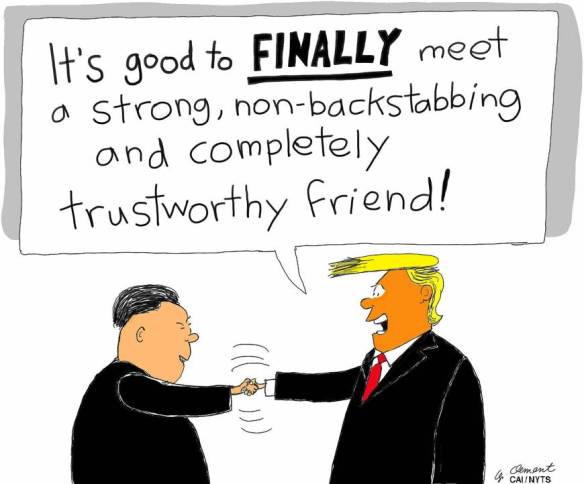
The world’s leading democracy, the United States, is looking increasingly like the world’s biggest and oldest surviving autocracy, China. By pursuing aggressively unilateral policies that flout broad global consensus, President Donald Trump effectively justifies his Chinese counterpart Xi Jinping’s longtime defiance of international law, exacerbating already serious risks to the rules-based world order.
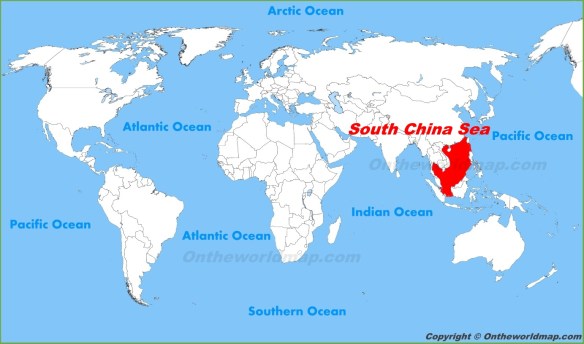
China is aggressively pursuing its territorial claims in the South China Sea – including by militarizing disputed areas and pushing its borders far out into international waters – despite an international arbitral ruling invalidating them. Moreover, the country has weaponized transborder river flows and used trade as an instrument of geo-economic coercion against countries that refuse to toe its line.
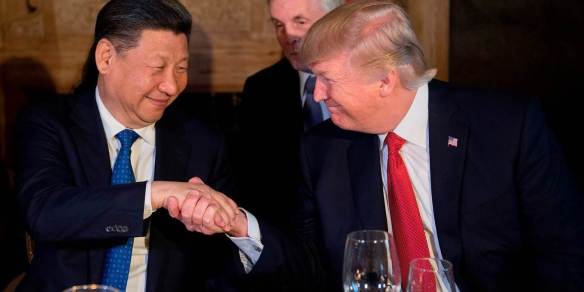
The US has often condemned these actions. But, under Trump, those condemnations have lost credibility, and not just because they are interspersed with praise for Xi, whom Trump has called “terrific” and “a great gentleman.” In fact, Trump’s behavior has heightened the sense of US hypocrisy, emboldening China further in its territorial and maritime revisionism in the Indo-Pacific region.
To be sure, the US has long pursued a unilateralist foreign policy, exemplified by George W. Bush’s 2003 invasion of Iraq and Barack Obama’s 2011 overthrow of Muammar el-Qaddafi’s regime in Libya. Although Trump has not (yet) toppled a regime, he has taken the approach of assertive unilateralism several steps further, waging a multi-pronged assault on the international order.
Almost immediately upon entering the White House, Trump withdrew the US from the Trans-Pacific Partnership (TPP), an ambitious 12-country trade and investment agreement brokered by Obama. Soon after, Trump rejected the Paris climate agreement, with its aim to keep global temperatures “well below” 2°C above pre-industrial levels, making the US the only country not participating in that endeavor.
More recently, Trump moved the US embassy in Israel from Tel Aviv to Jerusalem, despite a broad international consensus to determine the contested city’s status within the context of broader negotiations on a settlement of the Israeli-Palestinian conflict. As the embassy was opened, Palestinian residents of Gaza escalated their protests demanding that Palestinian refugees be allowed to return to what is now Israel, prompting Israeli soldiers to kill at least 62 demonstrators and wound more than 1,500 others at the Gaza boundary fence.
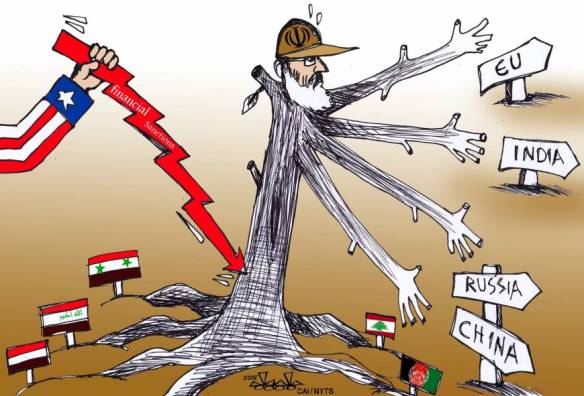
Trump shoulders no small share of the blame for these casualties, not to mention the destruction of America’s traditional role as a mediator of the Israeli-Palestinian conflict. The same will go for whatever conflict and instability arises from Trump’s withdrawal from the 2015 Iran nuclear deal despite Iran’s full compliance with its terms.
Trump’s assault on the rules-based order extends also – and ominously – to trade. While Trump has blinked on China by putting on hold his promised sweeping tariffs on Chinese imports to the US, he has attempted to coerce and shame US allies like Japan, India, and South Korea, even though their combined trade surplus with the US – $95.6 billion in 2017 – amounts to about a quarter of China’s.
Trump has forced South Korea to accept a new trade deal, and has sought to squeeze India’s important information technology industry – which generates output worth $150 billion per year – by imposing a restrictive visa policy. As for Japan, last month Trump forced a reluctant Japanese Prime Minister Shinzo Abe to accept a new trade framework that the US views as a precursor to negotiations on a bilateral free-trade agreement.
Japan would prefer the US to rejoin the now-Japan-led TPP, which would ensure greater overall trade liberalization and a more level playing field than a bilateral deal, which the US would try to tilt in its own favor. But Trump – who has also refused to exclude permanently Japan, the European Union, and Canada from his administration’s steel and aluminum tariffs – pays no mind to his allies’ preferences.
Abe, for one, has “endured repeated surprises and slaps” from Trump. And he is not alone. As European Council President Donald Tusk recently put it, “with friends like [Trump], who needs enemies.”
Trump’s trade tactics, aimed at stemming America’s relative economic decline, reflect the same muscular mercantilism that China has used to become rich and powerful. Both countries are now not only actively undermining the rules-based trading system; they seem to be proving that, as long as a country is powerful enough, it can flout shared rules and norms with impunity. In today’s world, it seems, strength respects only strength.
This dynamic can be seen in the way Trump and Xi respond to each other’s unilateralism. When the US deployed its Terminal High Altitude Area Defense system in South Korea, China used its economic leverage to retaliate against South Korea, but not against America.
Likewise, after Trump signed the Taiwan Travel Act, which encourages official visits between the US and the island, China staged war games against Taiwan and bribed the Dominican Republic to break diplomatic ties with the Taiwanese government. The US, however, faced no consequences from China.
As for Trump, while he has pressed China to change its trade policies, he has given Xi a pass on the South China Sea, taking only symbolic steps – such as freedom of navigation operations – against Chinese expansionism. He also stayed silent in March, when Chinese military threats forced Vietnam to halt oil drilling within its own exclusive economic zone. And he chose to remain neutral last summer, when China’s road-building on the disputed Doklam plateau triggered a military standoff with India.
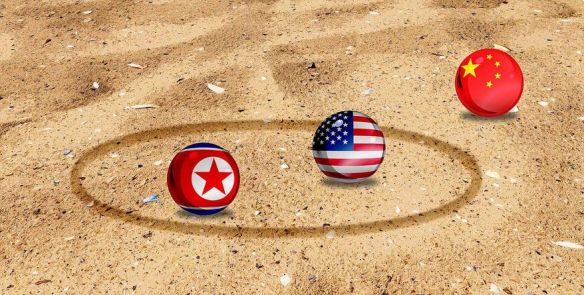
Trump’s “America First” strategy and Xi’s “Chinese dream” are founded on a common premise: that the world’s two biggest powers have complete latitude to act in their own interest. The G2 world order that they are creating is thus hardly an order at all. It is a trap, in which countries are forced to choose between an unpredictable and transactional Trump-led US and an ambitious and predatory China.