
As the trade war escalates, Donald Trump is seeking to preserve space for a possible deal and leaving his deputy to tackle the tough questions.
Brahma Chellaney, The National
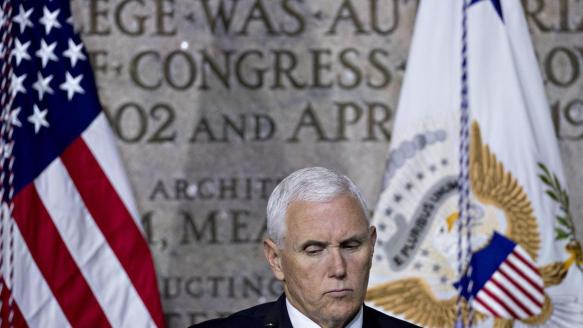
After a landmark speech this month at the Hudson Institute, which signalled a fundamental shift in America’s China policy, Vice President Mike Pence will lead a US delegation to three important multilateral summits in November. While President Donald Trump has lavished praise on China’s President Xi Jinping despite their escalating trade war, Pence is leading the administration’s charge against China.
Mr Trump and Mr Pence might, in fact, be playing a deliberate game of good cop, bad cop.
Mr Trump’s handling of China reflects his reluctance to antagonize Mr Xi or impose sanctions on China even in response to egregious human-rights abuses, including its internment of up to one million Muslims from Xinjiang. Had Russia set up such camps, the US response would likely have been swift and resolute.
The US president is a great believer in the idea that a good rapport between heads of government can significantly shape the relationship between the countries they lead. He also prides himself on being a great negotiator and deal-maker.
While letting his vice president forthrightly articulate America’s concerns over China, Mr Trump is seeking to preserve space to cut a possible deal with Mr Xi on trade. Mr Trump and Mr Xi, in their first face-to-face interaction in nearly a year, are likely to meet on November 29 in Buenos Aires, a day before the G20 summit opens there.
In his recent speech, Mr Pence highlighted how China is blending economic aggression, territorial and maritime revisionism, military adventurism, influence operations and Orwellian repression at home to advance its ambitions.
More importantly, Mr Pence declared that “the US has adopted a new approach to China”, saying that “previous administrations all but ignored China’s actions. And in many cases, they abetted them. But those days are over.”
The speech laid out why the Trump administration is making a course correction in the China policy that successive American presidents have pursued since the early 1970s, when the US managed the diplomatic coup of splitting its two main enemies – the Soviet Union and China. With the US winning over China to its side, it became two against one. This proved a critical factor in the eventual US victory in the Cold War and the Soviet Union’s collapse.
In return, the US actively aided China’s rise. After Deng Xiaoping emerged as China’s paramount leader in 1978, following a fierce power struggle, and embarked on economic modernisation, the US lent full support to his mission.
The US policy of assisting China’s economic ascent did not change even in response to the 1989 Tiananmen Square massacre. There, Chinese authorities used tanks to ruthlessly crush student-led protests in the heart of Beijing – an action that left hundreds, possibly thousands, dead.
But now the Trump administration has unveiled a new strategy to shift the US relationship with China from co-operation to competition, including confronting Chinese mercantilism and Beijing’s campaign of influence operations on American soil.
As Mr Pence put it, the US miscalculated that after the fall of the Soviet Union, “a free China was inevitable”. Today, according to him, an increasingly authoritarian and aggressive China has “mobilised covert actors, front groups, and propaganda outlets to shift Americans’ perception of Chinese policy … what the Russians are doing pales in comparison to what China is doing across this country”.
Against this backdrop, it might seem appropriate that Mr Trump is sending the blunt-speaking Mr Pence in his place to the forthcoming multilateral summits in the Indo-Pacific region − the East Asia Summit (EAS) and the US-Asean summit, both to be held in Singapore in mid-November, followed by the Asia Pacific Economic Cooperation (APEC) group summit at Port Moresby, Papua New Guinea, on November 17-18.
APEC summits, instituted in 1993, have become largely symbolic, and Mr Trump’s absence at Port Moresby will not be unusual. Bill Clinton missed two summits and Barack Obama skipped one. As APEC’s membership has expanded, the grouping’s cohesiveness and mission have weakened.
The promise of the 18-nation EAS has also faded. Like the 21-nation APEC, the EAS includes America’s main geopolitical rivals, China and Russia.
In this light, to counter the rise of an increasingly muscular China that refuses to play by international rules, substance matters more for US policy than group photographs at multilateral summits.
It is significant that, in an otherwise polarised and divided Washington, a bipartisan consensus is emerging that the failed US policy of “constructive engagement” with China must be replaced with concrete counteraction.
For example, in a Harvard University essay this month, Obama’s defence secretary, Ashton Carter, writes: “Washington since the end of the Cold War has often backed down in the face of Chinese bullying. From aggressive territorial claims to human-rights abuses and brazen theft on a trillion-dollar scale, China has violated core international norms time and again with little repercussions beyond scolding American speeches”.
Mr Carter recommends that, “when China behaves inappropriately on the international stage, the US must firmly push back and stand up for the principles of international order”. Mr Pence has signalled that this is precisely what the Trump administration intends to do.
Brahma Chellaney is a geostrategist and the author, most recently, of the award-winning Water, Peace, and War.
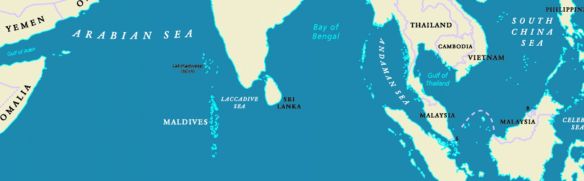


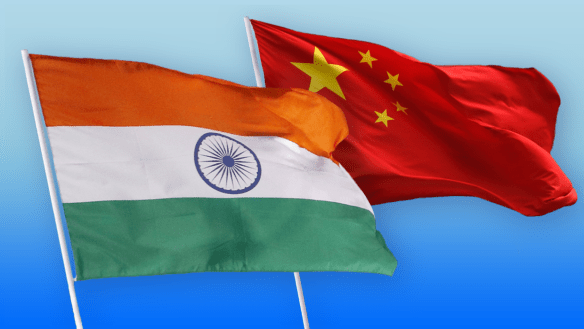
 Pakistan has turned into the Mecca of international terrorism even as its new prime minister, Imran “Taliban” Khan, has promised to make his country a Medina-like welfare state. Pakistan, however, is battling a deepening financial crisis, largely exacerbated by its “all-weather” ally, China. Beijing has imposed unfair deals on, and stepped up capital-goods exports to, Pakistan under its so-called Belt and Road Initiative.


 Stagecraft and Statecraft
The backlash against China can be seen elsewhere, too. The recent annual Pacific Islands Forum meeting was one of the most contentious in its history. Chinese policies in the region, together with the Chinese delegation leader’s behavior at the event itself, drove the president of Nauru – the world’s smallest republic, with just 11,000 inhabitants – to condemn China’s “arrogant” presence in the South Pacific. China cannot, he declared, “dictate things to us.”
When it comes to trade, US President Donald Trump’s escalating trade war with China is grabbing headlines, but Trump is far from alone in criticizing China. With policies ranging from export subsidies and nontariff barriers to intellectual-property piracy and tilting the domestic market in favor of Chinese companies, China represents, in the words of Harvard’s Graham Allison, the “most protectionist, mercantilist, and predatory major economy in the world.”
As the largest merchandise exporter in the world, China is many countries’ biggest trading partner. Beijing has leveraged this role by employing trade to punish those that refuse to toe its line, including by imposing import bans on specific products, halting strategic exports (such as rare-earth minerals), cutting off tourism from China, and encouraging domestic consumer boycotts or protests against foreign businesses.
The fact is that China has grown strong and rich by flouting international trade rules. But now its chickens are coming home to roost, with a growing number of countries imposing antidumping or punitive duties on Chinese goods. And as countries worry about China bending them to its will by luring them into debt traps, it is no longer smooth sailing for the BRI.
Beyond Trump’s tariffs, the European Union has filed a complaint with the World Trade Organization about China’s practices of forcing technology transfer as a condition of market access. China’s export subsidies and other trade-distorting practices are set to encounter greater international resistance. Under WTO rules, countries may impose tariffs on subsidized goods from overseas that harm domestic industries.
Now, Chinese President Xi Jinping finds himself not only defending the BRI, his signature foreign-policy initiative, but also confronting domestic criticism, however muted, for flaunting China’s global ambitions and thereby inviting a US-led international backlash. Xi has discarded one of former Chinese strongman Deng Xiaoping’s most famous dicta: “Hide your strength, bide your time.” Instead, Xi has chosen to pursue an unabashedly aggressive strategy that has many asking whether China is emerging as a new kind of imperialist power.
International trade has afforded China enormous benefits, enabling the country to become the world’s second-largest economy, while lifting hundreds of millions of people out of poverty. The country cannot afford to lose those benefits to an international backlash against its unfair trade and investment practices.
China’s reliance on large trade surpluses and foreign-exchange reserves to fund the expansion of its global footprint makes it all the more vulnerable to the current pushback. In fact, even if China shifts its strategy and adheres to international rules, its trade surplus and foreign-currency reserves will be affected. In short, whichever path it chooses, China’s free ride could be coming to an end.
© Project Syndicate, 2018.