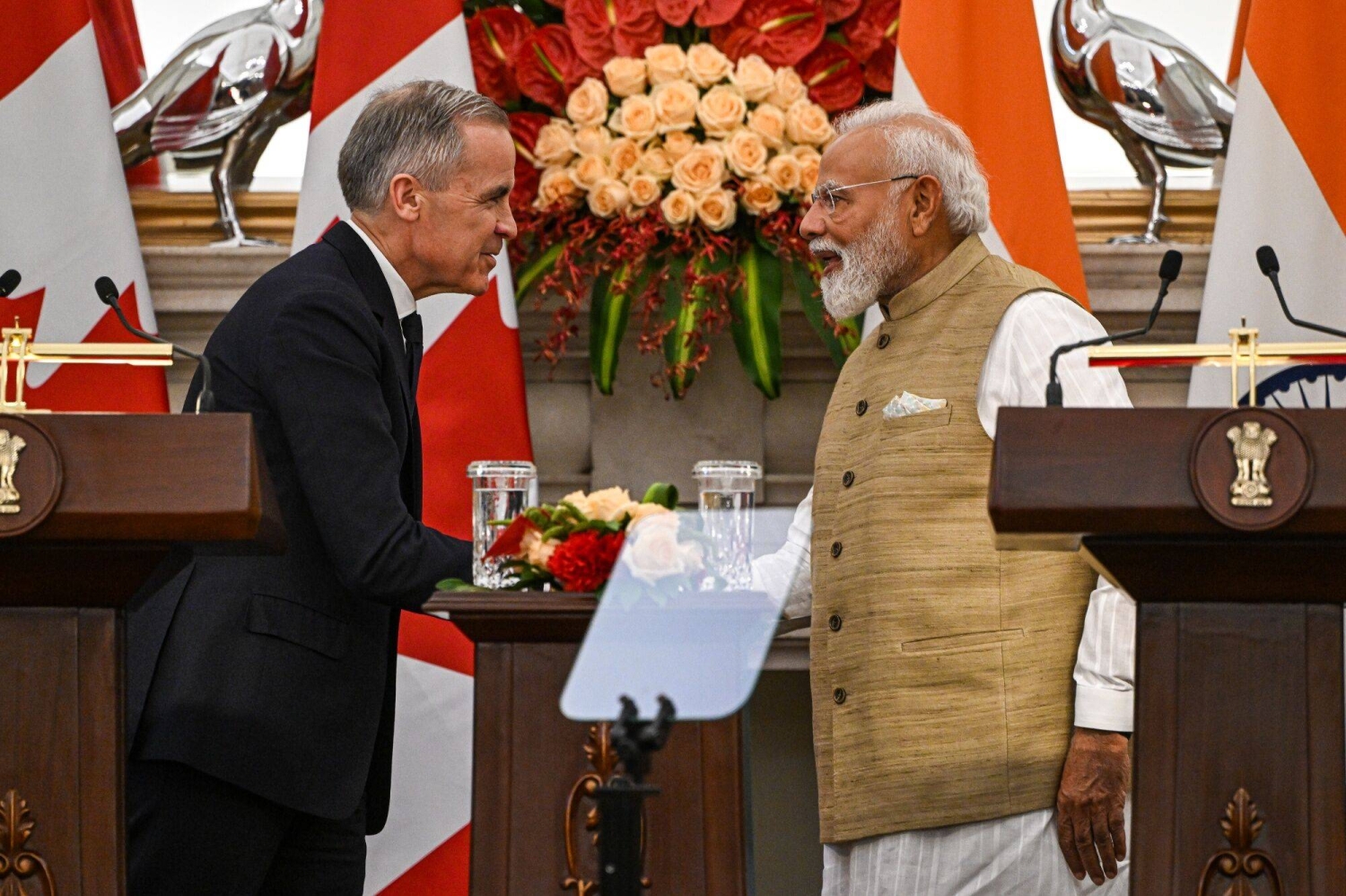
Narendra Modi, India’s prime minister, right, shakes hands with Mark Carney, Canada’s prime minister, during a news conference at Hyderabad House in New Delhi, India, on March 2, 2026. Photo: Bloomberg
Prime Minister Mark Carney’s visit to India is intended to close one of the most acrimonious diplomatic chapters between two major democracies in recent memory and inaugurate a more pragmatic, interest-driven partnership for an age of geopolitical uncertainty.
Rarely have Canada and India found themselves so publicly at odds as they did in 2023-24, when the relationship sank to its lowest point ever. Then-prime minister Justin Trudeau’s allegation of a potential link between the Indian government and the killing of a Sikh-Canadian on Canadian soil triggered a spiral of recriminations, expulsions, visa suspensions and nationalist outrage.
The dispute also exposed a deeper structural fault line: Canada’s permissive approach toward Sikh separatist activism versus India’s zero-tolerance view of Khalistan militancy. For New Delhi, the issue has not been merely diaspora politics but national security, shaped by the memory of the deadly 1985 Air India bombing by Canada-based Sikh terrorists. For Ottawa, the challenge has been to balance civil liberties with public safety in a diverse democracy.
Mr. Carney’s visit signals that both governments have decided the costs of continued estrangement are too high.
The visit’s strategic logic is rooted in a shared reassessment of the global order. Both Canada and India are hedging against the volatility of great-power rivalry. Mr. Carney’s emerging “middle-power” doctrine emphasizes building networks of trusted relationships beyond Washington’s orbit. India, for its part, has long sought diversified partnerships to avoid overdependence on any single pole.
In this sense, the visit is not just a bilateral reset but part of a broader pattern: a quiet consolidation among middle powers seeking resilience in a fragmenting world. Both Canada and India, though, are walking a tightrope. They want to diversify away from an unpredictable U.S. without triggering further retaliation from Washington.
At the heart of the visit lies a concrete economic agenda. The most eye-catching initiative is a 10-year, US$2.8-billion uranium supply agreement, which could be signed during Mr. Carney’s visit. For India, Canadian fuel offers a pathway to reduce reliance on both Russian imports and coal. For Canada, it secures a long-term market at a moment when Western demand is uncertain.
Canada, which sees more than 90per cent of its energy exports go to the U.S., is seeking to become a major oil and liquefied natural gas supplier to India, the world’s fastest-growing major energy consumer, with demand expected to double by 2045. India is already the world’s third-largestenergy consumer.
Alongside energy, the two sides are accelerating negotiations on a Comprehensive Economic Partnership Agreement (CEPA), with a target of doubling bilateral trade to $70-billion in four years. The scope extends well beyond tariffs: services trade, digital commerce, labour mobility, agriculture and critical minerals are all on the table. A CEPA would anchor a supply-chain corridor linking Canada’s resource base with India’s manufacturing and technological capacity.
This economic agenda reflects a shared desire to “derisk” from China-centric supply chains without embracing full decoupling, and to hedge against shifting currents of U.S. policy.
Yet the economic reset cannot stand without a parallel security understanding. Both governments recognize that another crisis over extremism or sovereignty could derail the entire project.
In Canada, Bill C-9, the Combatting Hate Act, would, if passed, criminalize the public display of terrorist symbols. It could signal to New Delhi that Canada is taking more seriously the issue of Sikh militancy.
At the same time, both countries are expected to revive and upgrade their Joint Working Group on Counter-Terrorism, shifting toward real-time intelligence sharing and more streamlined extradition processes. India, for its part, is reaffirming respect for Canadian sovereignty after the controversies of 2023-24.
The aim is to create institutional “guardrails”: mechanisms that allow co-operation to continue even when sensitive issues arise.
Mr. Carney’s challenge, however, is as much domestic as diplomatic. Bill C-9 faces strong resistance from civil-liberties advocates, and parliamentary delays have already stalled its progress. Mr. Carney thus faces a delicate balancing act – demonstrating to India that Ottawa will act against extremist activity, while convincing Canadians he will not dilute constitutional freedoms or bow to external pressure.
More fundamentally, Mr. Carney’s India visit marks a transition from an emotionally charged relationship to a transactional one. The bitterness of the Trudeau era is being set aside in favour of a sober recognition of mutual interests.
If the uranium and hydrocarbon deals advance and CEPA negotiations stay on track, February, 2026, may be remembered as the moment Canada-India ties matured into a modern strategic partnership. For two pluralistic democracies navigating an uncertain century, this may prove to be the most sustainable foundation of all.
Brahma Chellaney is a geostrategist and the author of nine books, including the award-winning Water: Asia’s New Battleground.
The election marks the arrival of a Japan that will be more assertive, more strategically self-confident and less inclined to subordinate its interests to shifting currents of U.S. policy.
Japan’s Feb. 8 election was not merely an electoral landslide. It was a geopolitical turning point.
Prime Minister Sanae Takaichi’s Liberal Democratic Party secured a two-thirds supermajority — an outcome that finally gives Tokyo something it has lacked for decades: a political mandate to redefine its postwar identity and act as a proactive security power.
For Washington, this is both a gift and a challenge. The U.S. can now deepen collaboration with its most important and capable ally in Asia. Japan hosts the largest concentration of U.S. forces anywhere in the world. Its geographic position is uniquely strategic, and its naval and air capabilities are the most sophisticated among U.S. allies in the Indo-Pacific, with interoperability unmatched by any regional partner.
But the election also signals Japan’s strategic reawakening. It marks the arrival of a Japan that will be more assertive, more strategically self-confident and less inclined to subordinate its interests to shifting currents of U.S. policy. Tokyo is no longer content to be a U.S.-protected power. It intends to be a shaping power.
For almost eight decades, Japan operated within self-imposed limits — constitutional pacifism, restrained defense budgets and a preference for economic statecraft over hard power. Takaichi’s mandate alters that trajectory. With a supermajority, she can pursue constitutional revision, formalize the status of the Self-Defense Forces and accelerate defense spending to 2 percent of gross domestic product.
Japan is set to shift from merely reacting to Chinese military pressure to imposing costs for it. Nowhere is this clearer than in the southwestern island chain stretching toward Taiwan. Tokyo is building the capacity to deny access, complicate Chinese planning and ensure that no “fait accompli” seizure of territory or coercive maritime gambit goes unanswered.
For American strategists concerned about U.S. overreach, this is a structural upgrade to the regional balance. A Japan capable of defending its southwestern approaches will reduce the burden on U.S. forces while disrupting Chinese war-planning.
Beijing’s pressure campaign was meant to deter Japan’s rightward drift. Instead, it helped bring about Takaichi’s landslide. Chinese economic restrictions, maritime incursions and thinly veiled threats did not fracture Japanese politics; they consolidated it. Voters concluded that dependence invites coercion and that resilience requires strength.
Japan’s push to rewire supply chains toward India, Southeast Asia and trusted partners is not just industrial policy — it is counter-coercion doctrine.
Takaichi has described a Taiwan contingency as an “existential threat” to Japan. That language would once have been politically radioactive. Now it carries electoral legitimacy and, if sustained, will alter the military geometry of the Taiwan Strait. In a crisis, Japanese bases, surveillance networks and maritime forces would become integral to a U.S. response.
For the U.S., this reinforces a broader trend: Chinese pressure is accelerating, not halting, the formation of balancing coalitions. A stronger Japan becomes the anchor of that process in East Asia.
Takaichi’s strategy also involves alliance diversification. She is building stronger economic and defense links with Australia, South Korea, Vietnam, the Philippines and especially India, alongside the U.S. treaty alliance — insurance against volatility in American politics.
Japanese policymakers have drawn a sober conclusion: that resilience requires options. Fluctuating U.S. trade policy, tariff threats, periodic talk of retrenchment and transactional approaches to alliances have convinced many in Tokyo that Japan must insure itself against strategic volatility in Washington.
For the U.S., this is not a loss of influence but a redistribution of responsibility. A Japan that leads within the Quad, shapes regional trade architecture and invests in defense industrial cooperation strengthens a stable Indo-Pacific order — provided Washington treats Tokyo as a strategic partner rather than a junior ally.
Takaichi’s economic program — “Sanaenomics” — fuses industrial policy with national defense. Supply-chain resilience, semiconductor co-development, critical-mineral stockpiles and shipyard revitalization are designed to reduce Japan’s vulnerability to “weaponized interdependence.”
This aligns with Washington’s emphasis on economic security but also introduces potential friction. A more nationalist “Japan First” posture could collide with U.S. tariff policies or technology controls if not coordinated. The opportunity lies in building a shared defense-industrial ecosystem.
For years, American policymakers urged Japan to do more for its own defense. Takaichi’s victory answers that call.
But greater capability brings greater autonomy. Tokyo will expect a more important voice in alliance strategy — from Taiwan contingencies to regional trade architecture — and will not accept policies that expose it to coercion without consultation.
Alliances endure not because one side dominates, but because both sides see them as vehicles for advancing national strategy. A stronger Japan will strengthen the alliance if Washington treats Tokyo as a co-architect rather than a subordinate.
The most consequential implication of Japan’s election is regional. Across the Indo-Pacific, middle powers increasingly see a stronger Japan as a stabilizing “strategic ballast” amid uncertainty about both China’s trajectory and America’s staying power. Japan is reentering history as a security actor, not merely an economic one.
Washington should recognize what just happened. Japan did not simply elect a new government. It chose strategic normalization — deterrence over hesitation — and signaled that the era of passive alliance management is over.
For Washington, the message is clear: The most important geopolitical shift in Asia is not China’s rise alone, but Japan’s return. The alliance must evolve accordingly.
After 18 months of turmoil, lawlessness and Islamist violence, Bangladesh’s national election has produced a government with a commanding parliamentary supermajority. On paper, that should be a recipe for stability. In practice, it may instead entrench a new and potentially more dangerous form of instability.
The central question is no longer who holds power in Bangladesh, but whether the world’s most densely-populated large country can still function as an inclusive, rules-based state at all.
Bangladesh stands today at a perilous crossroads. Without political reconciliation and economic revival, it risks sliding toward the kind of Islamist dysfunction that has long plagued Pakistan, the country from which it seceded in a bloody war of liberation in 1971.
For half a century, Bangladesh’s politics has been dominated by two dynastic forces: the Awami League, established by Sheikh Mujibur Rahman, the country’s charismatic founding leader who was killed in a 1975 army coup, and the Bangladesh Nationalist Party (BNP), launched in 1978 by military ruler Ziaur Rahman, whose son Tarique Rahman now heads the new government. These parties have alternated between power and persecution, each using the state against the other.
Sheikh Hasina, Mujibur Rahman’s daughter, once symbolized democratic resilience and kept both the military and Islamist militancy in check. But her increasingly undemocratic rule triggered a violent, student-led, Islamist-backed uprising in 2024 that forced her into exile after she lost the military’s support. What followed was not a democratic transition but a dangerous vacuum.
The interim regime led by Nobel Peace Prize winner Muhammad Yunus presided over widespread repression, institutional purges and a resurgence of Islamist vigilantism. Armed mobs attacked minorities with impunity, journalists were silenced and thousands were imprisoned. Even more alarmingly, the regime rehabilitated extremist groups previously linked to terrorism, including releasing convicted terrorists, and allowed radical Islamists to enter the political mainstream.
The result is that Bangladesh now risks shifting from a secular-authoritarian order to an Islamist-majoritarian one.
Against that backdrop, this month’s election was less a democratic reset than a managed transition. The secular Awami League, historically the country’s largest political force, was arbitrarily outlawed last year and thousands of its members remain in jail without trial. As much as 30% to 40% of the electorate was effectively excluded from the election.
In that vacuum, the BNP emerged as the dominant electoral force. But it faced a new challenger in its former ally Jamaat-e-Islami, a hardline Islamist party. The election thus pitted an Islamist-leaning bloc against a coalition led by a hardline Islamist group, rather than offering a pluralistic national choice. Unsurprisingly, many Awami League supporters boycotted the vote and turnout fell sharply in minority-heavy constituencies, where intimidation and violence created a climate of fear.
The result is a 300-member parliament that may be numerically stable but socially brittle. It includes just seven women and only four members from religious and ethnic minority communities, though these groups make up about 10% of the population.
Even before the new government settles in, its legitimacy is already under challenge.
For years, the BNP and Jamaat-e-Islami accused the Awami League of rigging elections. Now, with the banned Awami League gone, the accusers have turned on each other. Jamaat — once the BNP’s indispensable ally, providing street muscle — has charged the BNP with rigging the the latest election, alleging widespread ballot fraud and irregularities.
This rupture reflects a deeper contest over who represents the spirit of the 2024 uprising, which Islamist groups helped organize and sustain. If the Islamist-led opposition believes it has been cheated of its “revolution,” Bangladesh may soon see renewed unrest.
Compounding this fragility is the near collapse of judicial credibility. Bangladesh’s Supreme Court has repeatedly reinterpreted the constitution to suit those in power, legitimizing coups, overturning its own precedents and even invoking a “revolutionary mandate” to justify continuance of an unelected interim regime.
In such a system, law becomes an instrument of power rather than a constraint on it. This is hardly a foundation for stability or investor confidence.
The new government, in fact, inherits an economy in distress. Growth has slowed sharply, inflation has surged, investor confidence has collapsed and foreign debt has risen. The BNP has indicated it will continue with the IMF bailout package negotiated by the interim regime, but austerity, subsidy cuts and banking reforms will impose real social costs, especially on a restless youth population.
The government must restore macroeconomic stability while delivering visible improvements in jobs and governance. Failure on either front could quickly translate into renewed street anger.
Bangladesh’s trajectory will have consequences beyond its borders. For India, instability raises immediate security concerns, including the risk of militant infiltration across a porous border. Bangladesh’s direction will also shape the regional balance between China, a major infrastructure investor, and Western partners seeking greater market access.
A parliamentary supermajority gives the BNP-led government enormous formal power. But political dominance is not legitimacy. Bangladesh’s cycles of instability have historically been driven not by weak governments but by exclusive ones — regimes that rule for one party while suppressing rival political forces. This election risks reproducing that pattern in a new ideological form.
True stability will require something Bangladesh has rarely sustained: national reconciliation. Countries emerging from deep trauma, from Rwanda to South Africa, recognized that durable peace depends on bringing former adversaries into a shared political framework. Bangladesh will need to do the same, to create a pathway for the Awami League and its supporters to reenter politics, protect minorities and dissenting voices, restore judicial independence and revive civil society.
Otherwise, the country risks replacing one form of autocracy with another: trading secular illiberalism for majoritarian Islamism, and stability for a cycle of confrontation and lawlessness.
The election has produced a government, but not a political settlement. Unless the new leadership uses its supermajority to widen inclusion, rebuild institutions and rein in extremist forces, the promise of stability and economic revival will remain elusive. The real test of this election will not be whether it delivered power, but whether it can deliver peace.
Brahma Chellaney, a professor of strategic studies at the independent New Delhi-based Centre for Policy Research and fellow at the Robert Bosch Academy in Berlin, is the author of nine books, including “Water: Asia’s New Battleground,” which won the Bernard Schwartz Book Award.
Trump might have done India a favor. By exposing the raw transactionalism at the core of his foreign policy, he has left no doubt that, under his leadership, the US is not a reliable strategic partner.
For over two decades, the United States has regarded India as a “natural partner” – a rising power whose geography, military capabilities, and democratic credentials made it indispensable to America’s strategy in the Indo-Pacific. Five successive US administrations, Republican and Democratic alike, invested heavily in strengthening that partnership, treating India not just as a market, but as a long-term strategic bet.
But the goodwill that the US built up with India over that period has been rapidly eroded since Donald Trump’s return to the presidency last year. Trump’s second presidency has brought repeated public insults and a bruising trade war, with the US using tariffs as tools of geopolitical coercion. The interim trade deal announced on February 2 may have halted the economic confrontation, but trust – the essential currency of any strategic partnership – is unlikely to be restored any time soon.
By reducing the effective US tariff burden on Indian goods from 50% to 18%, the newly announced deal will deliver short-term relief for India. But it comes with plenty of strings attached, including the requirement that India move toward near-zero tariffs on US industrial products and a wide range of agricultural goods. India’s decision to open its sensitive agricultural sector – the country’s largest employer – to a flood of imports from the US is already sparking a domestic backlash.
But that is not all. India has also agreed to purchase a whopping $500 billion worth of American goods over the next five years, and to replace discounted Russian oil with US energy at market prices, which also implies additional transport costs. Meanwhile, the US offered no binding commitments to India. This lopsided bargain looks nothing like a stable, reciprocal, rules-based trade partnership, and underscores how far US trade policy has drifted from World Trade Organization norms. It is probably best understood as a tactical de-escalation, not a strategic reconciliation.
The way the deal was announced reinforces this interpretation. Typically, bilateral agreements or joint statements are announced simultaneously in both capitals to signal equal partnership. The free-trade agreement India recently concluded with the European Union, which created a trade corridor encompassing roughly 25% of global GDP and one-third of world trade, was touted by both sides as the “mother of all deals.”
The US-India agreement, by contrast, was announced first by Trump, who portrayed it on his social-media platform as a favor to Prime Minister Narendra Modi, whose “request” for an agreement Trump had granted “out of friendship and respect.” Days later, the White House released a “joint statement” outlining the terms of the agreement at 5:00 a.m. Indian Standard Time.
The Trump administration then added injury to insult, announcing a presidential executive order authorizing reimposition of punitive tariffs if the US deems India to have violated its commitment to halt all direct and indirect imports of Russian oil. By framing Indian energy imports as a US national-security issue, the administration has turned economic engagement into a compliance test. The message to India is unmistakable: autonomy will be tolerated only within US-approved limits.
India’s leaders have framed the agreement as a win, noting that India now faces lower tariffs than China or Vietnam. But this is a low bar for a relationship that successive US administrations described as “defining.” And they are probably well aware that Trump could still pull the rug out from under them. The arrangement’s details have not yet been finalized, and Trump has a long history of changing his mind, scrapping deals, and layering on new demands.
Whatever happens next, India will not quickly forget Trump’s past betrayals. Nor will it overlook his slights, such as branding India, whose GDP growth outpaces all other major economies, as a “dead economy” last July.
In a sense, Trump might have done India a favor. By exposing the raw transactionalism at the core of his foreign policy, he has left no doubt that, under his leadership, the US is not a reliable strategic partner. As a result, India’s government is committed to diversifying India’s economic relationships away from the US, as underscored by its FTAs with the EU and the United Kingdom – an effort that will likely continue, regardless of the new trade agreement with the US.
Markets, too, are unlikely to put too much faith in the US. News of the trade deal did trigger a stock-market rally in India, but the gains are likely to be short-lived.
Strategic partnerships are sustained not by tariffs and threats, but by predictability, mutual respect, and restraint – qualities that have been conspicuously absent from Trump’s presidency. The US should beware. Whatever short-term concessions Trump secures through bullying and coercion will be dwarfed by the long-term costs of destabilizing a partnership that, as previous administrations recognized, is vital to American interests in the Indo-Pacific and beyond.
Brahma Chellaney, Professor of Strategic Studies at the New Delhi-based Center for Policy Research and Fellow at the Robert Bosch Academy in Berlin, is the author of nine books, including Water: Asia’s New Battleground (Georgetown University Press, 2011), for which he won the 2012 Asia Society Bernard Schwartz Book Award.
The “rules-based international order” was never a set of neutral rules. It was a story the U.S. told — about itself, its power and its right to bend norms when convenient.
In January, that story finally collapsed when Canadian Prime Minister Mark Carney called that order what many governments have long known it to be: a useful “fiction,” sustained less by universal law than by American power and selective enforcement.
For decades, when U.S. officials invoked a “rules-based international order,” they were not describing universal principles, but defending a flexible set of rules largely devised in Washington and adjusted whenever American interests required it. Now, as President Trump openly revives territorial expansion and economic coercion as tools of U.S. statecraft, that phrase no longer commands belief, even among America’s closest allies.
Carney, speaking in Davos, did what no major Western leader had previously dared to do: He called the bluff. The “rules-based order,” Carney said, was a convenient illusion — one the West itself knew was only partially true, tolerated for as long as U.S. hegemony delivered enough public goods to make the hypocrisy worthwhile. That bargain, he concluded, no longer works.
Carney’s candor marks a watershed. By naming the fiction out loud, he validated a critique long voiced by the Global South and quietly acknowledged across Western capitals. More importantly, he signaled that the era of polite silence surrounding American exceptionalism has ended.
Any international order must, by definition, rest on rules. Modern global life — trade, finance, aviation, maritime navigation — cannot function without shared norms and procedures. The real question has never been whether rules matter, but which rules matter most, and to whom they apply.
For many Western governments, the core norm underpinning the international order is the prohibition on territorial conquest. That is why Russia’s invasion of Ukraine was framed as a civilizational rupture. As then-Secretary of State Antony Blinken put it, the war challenged the principle that borders cannot be changed by force.
International law is indeed clear on this point: the U.N. Charter prohibits the use of force against the territorial integrity of states, and the Geneva Conventions forbid the demographic transformation of occupied territories.
Yet the selective invocation of this norm has gradually eroded its credibility. The U.S. has repeatedly violated the territorial integrity of other states — not by annexing land, but by overthrowing governments and installing new ones that remain formally sovereign while substantively dependent on Washington. This maneuver allows Washington to deny conquest while achieving many of its effects.
Nor is Ukraine’s defense best understood as a pure defense of the norm against conquest. Great powers rarely act primarily to uphold norms. They intervene to prevent adverse shifts in the balance of power. The rallying of NATO behind Ukraine may have aligned with international law, but it was driven at least as much by strategic calculation as by legal fidelity.
The fiction of moral clarity was further strained by the rhetoric that cast the conflict as a battle between democracy and autocracy. Under Volodymyr Zelensky, Ukraine has lurched toward authoritarianism. As in past U.S. interventions, “fighting for freedom” has remained a narrative convenience rather than a consistent standard.
If the Biden administration strained the fiction, Trump has shattered it. Trump has openly re-embraced territorial expansion as a legitimate tool of statecraft. His second term has featured military intervention in Venezuela, renewed demands for U.S. control over Greenland and the Panama Canal, and an unapologetic revival of “Manifest Destiny.” Unlike his predecessors, Trump does not bother cloaking ambition in the language of universalism. He says the quiet part out loud.
Trump is not unique in expanding American power; because of his predecessors’ global expansion, there are about 750 U.S. military bases today in at least 80 countries. What is new is the abandonment of euphemism. By openly praising 19th-century imperial precedents and refusing to rule out coercion even against allies, Trump has made it impossible to pretend that the U.S. is merely the custodian of a rules-based order.
Norms survive not on consistency alone but on credibility. When enforcement is asymmetric, rules become tools rather than constraints. The same applies to the norm of non-interference, which has never prevented cyber operations, sanctions, covert actions or targeted killings. No major power — whether the U.S., Russia or China — fully abides by it. What differs is how honestly that reality is acknowledged.
Carney’s comments matter precisely because they strip away the last vestiges of moral theater. By admitting that Western allies knowingly participated in a ritualized fiction, he reframed the present moment not as a transition, but as a “rupture.” The old bargain — accept U.S. primacy in exchange for stability and public goods — is unraveling. What replaces it will be messier and more transactional.
The “rules-based order” endured not because it was universally respected, but because it was useful — and because American power made it impolite to ask questions. With that politeness gone, what remains is not the collapse of order, but the collapse of pretense. This may allow for a more honest reckoning with power, interest and responsibility.
The upcoming election is shaping up to be one of the most consequential political contests Japan has faced in decades, largely because it will determine whether Japan decisively locks in a new strategic orientation at home and abroad. The vote will effectively function as a referendum on whether Prime Minister Sanae Takaichi’s more assertive approach to economic security, global engagement and China receives a democratic mandate or stalls amid political fragmentation.
The election outcome will also signal whether China’s model of economic coercion is effective against a major U.S. ally. Beijing has deployed a full-spectrum pressure campaign against Takaichi’s four-month administration — punitive measures designed to hurt Japanese business interests and undermine domestic support for her government.
A Takaichi victory would represent a significant setback for China, signaling that Japanese voters are prepared to absorb real economic pain in exchange for greater strategic autonomy. Reducing exposure to Chinese economic pressure is also essential for navigating a more coercive global order, one in which U.S. President Donald Trump has shown little hesitation in pressuring even close allies.
Equally important is how the election intersects with Japan’s international role, especially in the Global South. Under Takaichi, engagement with key developing countries has become a core pillar of economic resilience. The campaign has elevated “Sanaenomics,” a strategy that emphasizes supply-chain diversification, technological co-creation and reduced dependence on China. Countries such as India, Vietnam and the Philippines are positioned not only as alternative manufacturing hubs under a “China-plus-one” strategy, but also as long-term partners in energy, AI governance and critical infrastructure.
The election thus has implications far beyond Japan. A clear mandate would accelerate Japan’s shift toward a more forward-leaning, technology-driven diplomacy, aimed at out-competing — rather than accommodating — Chinese influence. Conversely, a weaker or divided outcome would slow this transition, as Japan enters an era of fragmented, coalition-based bargaining.
In short, the vote will help determine whether Japan emerges as a more autonomous strategic actor or remains vulnerable to external pressure in an era of weaponized interdependence.
Brahma Chellaney is a professor of strategic studies at the independent New Delhi-based Centre for Policy Research and fellow at the Robert Bosch Academy in Berlin.
New disclosures reveal that China’s planned super-dam on the Yarlung Tsangpo — the world’s highest-altitude major river, better known as the Brahmaputra — is not a single structure. Rather, it is a a vast, tunnel-linked hydropower and water-diversion complex, spanning roughly 150 kilometers through the Himalayas.
The project would transform an internationally shared river, originating in water-rich Tibet, into a strategic instrument of state power.
For years, China’s super-dam was discussed as a single, if colossal, piece of infrastructure. That description is now obsolete. What Beijing is constructing on the so-called “Everest of Rivers,” near Tibet’s border with India, is not just the largest dam ever attempted. It is an extensive subterranean network designed to give China effective command over the river before it reaches any downstream country.
A cascade of barrages, reservoirs and power stations — linked by giant tunnels bored through the world’s highest mountain range — will together form a titanic, integrated hydropower system.
It remains unclear whether some of the impounded water will be diverted into what Beijing calls the Great South-North Water Diversion Project. While the eastern and central routes — already operational — transfer water from China’s southern rivers to its arid north, including Beijing, the controversial western line aims to reroute waters from Tibet-originating international rivers that sustain hundreds of millions of people across South and Southeast Asia.
The new project is centered near the Great Bend of the Brahmaputra, where the river makes a dramatic U-turn around a Himalayan peak before plunging toward India. Over a stretch of just 30 miles, the river drops some 6,500 feet — one of the steepest descents of any major river on Earth.
China plans to exploit this extraordinary gradient not with a single concrete wall, but by diverting the river through multiple tunnels, some extending more than 12 miles, to feed a cascade of five power stations. Their combined generating capacity is estimated at over 60 gigawatts — almost three times that of the Three Gorges Dam, currently the world’s largest.
This design fundamentally alters the risk calculus for downstream states. Beijing has described the project as “run-of-the-river,” a term meant to reassure neighboring countries that water storage — and therefore Chinese control — will be limited. But the scale of tunneling and the interlinked reservoirs undermines that claim. Even without massive surface reservoirs, the ability to divert, withhold or abruptly release enormous volumes of water through subterranean channels gives China de facto control over the river’s flow just before it leaves Tibet, which Beijingannexed in 1951.
By occupying Tibet, China effectively redrew the water map of much of Asia. The Tibetan Plateau is the source of ten major river systems that together sustain nearly one-fifth of the world’s population. China’s intensive dam-building and resource extraction across the plateau since the 1990s thus poses a growing risk to Asian water security, ecological stability and regional peace. Control over the headwaters of key transboundary rivers confers immense leverage, turning water into a potential geopolitical tool and raising the specter of environmental disaster and conflict.
Nothing illustrates these dangers more starkly than the current gargantuan project, which officially began in 2025, although evidence suggests preparatory work started much earlier. What is taking shape is, in strategic terms, a hydrological weapon system. It is capable of degrading fragile ecosystems while giving China unprecedented coercive leverage over South Asia — especially India.
There is also a profound seismic gamble. The project lies in one of the world’s most active earthquake zones, where the Indian and Eurasian tectonic plates collide.
Geologists warn of reservoir-triggered seismicity, in which the immense weight of stored water increases stress along fault lines, even if the statistical probability of a major quake remains uncertain. A partial failure, caused by an earthquake or a massive landslide into a reservoir, could unleash a cascading flood racing toward India’s densely populated Assam Valley, with catastrophic consequences for downstream communities, cities and infrastructure.
What makes this project uniquely destabilizing is not only its scale but its opacity. China has released no meaningful technical details, including information on design parameters or water-storage capacity. The project has proceeded without environmental impact assessments open to international scrutiny and without consultation with downstream states that stand to bear the greatest risks.
This is a textbook case of hydrological hegemony: unilateral control over a shared lifeline exercised by an upstream power.
The international response has been strikingly muted. Governments that rightly scrutinize Chinese ports, telecommunications networks and supply chains have largely treated this mega-project as a regional matter rather than a global concern. That is a mistake. Water insecurity is a well-documented accelerator of conflict, forced migration and state fragility. A project capable of degrading ecosystems and affecting tens of millions of people downstream implicates not only Asian stability but the international order itself.
China’s Brahmaputra mega-system should therefore be understood for what it is: an unprecedented experiment in high-altitude engineering, ecological transformation and geopolitical leverage rolled into one. It is a strategic instrument whose consequences will flow far beyond the Himalayas.
When Donald Trump returned to the White House, many foreign governments assumed his second term would simply mirror the first—more noise, more tariffs, more brash moves, but no fundamental break. They misjudged him. In its first year itself, Trump’s second presidency has redefined the norms, institutions and expectations that have governed international politics since the end of the Cold War.
What once looked like impulsive theatre has hardened into a governing philosophy. Unpredictability is no longer a quirk of Trump’s personality; it is a strategic tool he deploys openly. Norm violations are no longer tactical deviations; they have become a defining feature of American policy.
The result is a more transactional, coercive and personalized global order. In this order, power is asserted directly, institutions are circumvented or stripped of authority, and stability is offered only in exchange for submission.
More fundamentally, Trump is not simply eroding the international order. He is attempting to construct an alternative in its place.
From disruption to doctrine
During Trump’s first term, allies and adversaries alike learned to discount much of what he said. Tweets contradicted policy. Threats were issued and withdrawn. In his second term, however, the pattern has changed. Disruption itself has become US doctrine. His administration now treats uncertainty not as a risk to be managed, but as leverage to be exploited.
This shift is visible across domains. Trade policy is no longer governed primarily by economic logic but wielded as an instrument of political coercion. Diplomacy is no longer mediated through institutions but centralized in the president himself—his whims and fancies, and his efforts to expand an already-sprawling personal business empire. Military power is no longer restrained by concerns of legitimacy but openly deployed to assert control over other states’ resources and territory. Soft power—the quiet, accumulative influence of norms, culture and credibility—has been dismissed as weakness.
The pattern is unmistakable. Trump no longer seeks to lead the international system; he seeks to dominate it, transaction by transaction, deal by deal.
Nowhere is this shift clearer than in trade. By weaponizing tariffs, Trump has ushered in an era of what Western executives now call “tariff roulette.”
Tariffs have been moved from the margins of economic policy to the centre of American statecraft. On April 2, 2025—branded by the White House as “Liberation Day”—he invoked America’s International Emergency Economic Powers Act to impose a universal 10% tariff on all imports. This was not a negotiating tactic aimed at reforming rules; it was a unilateral assertion of power.
Targeted tariffs have gone even further. These measures are not calibrated responses to unfair trade practices but punitive tools meant to force capitulation. Worse still, they are unpredictable. Announcements are frequently made with little warning, often through social media, leaving governments and firms scrambling to respond.
Months after concluding a trade agreement with South Korea, Trump abruptly raised US tariffs on South Korean goods from 15% to 25%. His tariffs on India now exceed even those imposed on China, America’s principal strategic rival. Agreements offer no insulation; strategic partnerships provide no security.
The economic effects are already evident in the US. Business confidence has been shaken by the inability to plan investment or supply chains amid sudden policy reversals. Inflationary pressures have intensified, with US personal consumption expenditures projected to rise by more than three per cent. Confronted with policy-driven volatility, the Federal Reserve has kept interest rates on hold to avoid amplifying uncertainty.
The deeper damage, however, is systemic. The global trading system depends less on low tariffs than on credible commitments. Trump has shattered the expectation that the US will adhere to predictable, norms-based processes. In its place, he has delivered a stark message: stability is available only through direct, bilateral concessions to Washington. Multilateral rules no longer protect; they merely delay punishment.
Rules give way to raw power
If weaponized trade represents the economic pillar of Trump’s new order, the creation of the “Board for Peace” is its institutional centrepiece. Launched at the World Economic Forum in Davos in January, the Board is presented as a bold alternative to what Trump calls the United Nations’ “permanent failure” to resolve modern conflicts.
The contrast could not be sharper. The UN, for all its flaws, derives legitimacy from process: universal membership, formal rules and a (sometimes paralyzing) commitment to sovereignty and law. The Board for Peace rejects this model entirely. Membership is selective, reportedly contingent on substantial financial contributions. Decision-making authority is centralized. Trump himself holds absolute veto power over its agenda, decisions and membership—and even the designation of his successor. In other words, the Board is effectively a one-man show.
What is being set up is privatized global governance. Conflict resolution becomes a pay-to-play enterprise, overseen by personal authority. Trump has said the Board will “work with” the UN. Yet he has also openly suggested that it could replace it. In practice, the Board is already a mechanism to bypass international law rather than enforce it.
Actions speak louder than words.When Trump arbitrarily rescinded Canada’s invitation to join the Board soon after its launch, he revealed its true nature: not a forum governed by rules, but a court governed by favour. The message to the world is that peace is no longer a collective good. It is a commodity, dispensed at the discretion of Washington.
Another dramatic shift in Trump’s second term has occurred in the Western Hemisphere. Long portrayed as an isolationist, Trump has in fact embraced a form of aggressive expansionism. The US is no longer merely asserting influence in the Americas; it is asserting ownership.
On January 3, American forces abducted Venezuelan President Nicolás Maduro by carrying out the first bombing of a South American capital in modern history. Trump subsequently declared that the US would “run the country and take its oil.” The statement was not a gaffe. It was a declaration of intent that is now being implemented. Proceeds from selling stolen oil are being deposited in a US bank account in Qatar, to be spent without US congressional approval. Venezuelan oil worth $500 million has already been sold, according to the White House.
The military action against Venezuela followed America’s large-scale naval deployments in the Caribbean, its unilateral renaming of the Gulf of Mexico as the “Gulf of America,” and renewed discussions about annexing Greenland and reasserting direct control over the Panama Canal. These moves reflect a coherent worldview of the Trump administration: North and South Americas constitute a privileged zone of US control.
Trump has revived the Monroe Doctrine not as a warning to external powers, but as a license for military intervention or political interference in other nations’ domestic affairs. Sovereignty, in this framework, belongs not to states but to those strong enough to enforce it. The language of partnership has been replaced by the language of possession.
As hard power has been elevated, US soft power has been systematically dismantled. Funding for USAID has been slashed. Voice of America has been effectively shuttered. Cultural diplomacy has withered.
Soft power does not coerce, but it shapes preferences. It reduces the cost of leadership by making influence appear legitimate. The Trump administration, however, does not regard soft power as an asset.
The US withdrawal from the World Health Organization in January is emblematic. For decades, global health was one domain in which US leadership was uncontested. That leadership is now gone, surrendered not after debate, but by presidential decree.
America’s relations with Europe have also deteriorated sharply. The 2025 US National Security Strategy describes Europe as a victim of “civilizational erasure” and calls for alignment with “patriotic” movements there rather than mainstream governments. Such ideological interference signals that, even in the Western bloc, shared values no longer bind. What matters is ideological affinity and transactional utility.
A world remade
Taken together, these shifts amount to more than a change in tone. They represent a transformation in how power is exercised and justified. Trump’s second term has accelerated the erosion of an international system built on norms, institutions and predictability. In fact, he has stepped up efforts to replace it with one organized around coercion, personal authority and short-term gain.
In effect, Trump has not merely taken the world by storm; he is reshaping the environment in which global politics operates. And unlike the social-media posts that signal these changes, the consequences of his reshaping of international relations will endure.
It is against this backdrop that Canadian Prime Minister Mark Carney became the star at this year’s World Economic Forum at Davos with his remarkable candour in exposing longstanding Western hypocrisy and describing what a Trump-reshaped world meant.
Delivering a prepared speech, Carney declared, “We knew the story of the international rules-based order was partially false. That the strongest would exempt themselves when convenient. That trade rules were enforced asymmetrically. And we knew that international law applied with varying rigor depending on the identity of the accused or the victim. This fiction was useful. And American hegemony, in particular, helped provide public goods: open sea lanes, a stable financial system, collective security and support for frameworks for resolving disputes. So, we placed the sign in the window. We participated in the rituals. And we largely avoided calling out the gaps between rhetoric and reality. This bargain no longer works. Let me be direct: We are in the midst of a rupture, not a transition.”
The plain fact is that the new, Trump-driven order is not stable. It invites emulation by other strongmen. It encourages pre-emptive defiance by smaller states. It fragments global cooperation into spheres of influence governed by fear rather than trust. Yet it is coherent. And that coherence is precisely what makes it dangerous.
The most consequential legacy of Trump’s second term may not be the policies he enacts, but the precedents he sets. Even if a future US administration seeks to restore the old order, it will confront a world that has already adapted to its absence. Once credibility is lost, it cannot simply be reclaimed by presidential proclamation.
India as the pivotal swing state
No country is more exposed to—or more consequential for—the world Trump is remaking than India. As the world’s largest democracy, its fastest-growing major economy, and a central node in Indo-Pacific strategy, India now finds itself cast not as a partner in a US-led order, but as a swing state in a coercive, transactional system.
Trump’s second term presents India with a paradox. On one hand, Washington sees New Delhi as indispensable to balancing China. On the other, it treats India less as a strategic partner than as a negotiable asset—subject to tariffs, pressures and episodic favours. The result is a relationship marked by simultaneous courtship and coercion.
Trade policy illustrates the dilemma starkly. India has sought deeper economic integration with the US but instead it has faced some of the steepest tariffs imposed by the Trump administration—higher even than those levied on China. Market access is dangled not through long-term accords, but through ad hoc bargaining. Stability in the bilateral relationship is conditional.
Strategically, India is being pulled into a vision of order that sits uneasily with its own traditions. Trump’s disdain for multilateral institutions and his open embrace of unilateral force clash with India’s longstanding emphasis on strategic autonomy and international law. The creation of new international bodies such as the “Board for Peace,” governed by personal veto rather than collective legitimacy, places India in an awkward position: participation may offer influence, but at the cost of endorsing a precedent that weakens the very norms India has relied upon as a post-colonial power.
There is also a deeper reputational risk. As Trump reframes global politics as a contest among civilizational strongmen, democracies are valued less for their institutions than for their utility. India is courted not as a democracy, but as a counterweight. This instrumentalization erodes the moral capital that once distinguished democratic alignment from mere alliance.
Trump’s second term is also reshaping the triangular dynamic among China, India and the US—a strategic triangle that is central to Indian interests. Washington now frames its India policy almost exclusively through the prism of countering Beijing, while simultaneously undermining the norms and institutions that once sought to constrain Chinese power. The contradiction is stark: the US asks India to assist American strategy in Asia even as it legitimizes unilateral pressures on New Delhi to compel shifts in trade, energy and strategic policies.
For China, Trump’s unilateralism is an opportunity to step up its own coercive and expansionist policies, especially against its neighbours, including India. It is also an opportunity for China to quietly expand its influence in institutions the US has vacated.
For India, the triangle is more perilous. It faces sustained pressures from China along the Himalayas and via surrogate Pakistan, yet it is being asked by Washington to align with an American strategy that normalizes spheres of influence and transactional dominance. In such a world, today’s partner can become tomorrow’s pressure point.
The erosion of a norms-based order challenges all middle powers like India that rely on predictability to balance asymmetry. As China’s immediate neighbour, India’s challenge is also to navigate this triangle without becoming locked into a logic where raw power becomes the only currency that matters.
India is not without agency. Precisely because Trump’s world is transactional, India’s choices carry outsized weight. Accommodation would signal that even the world’s largest democracy and most-populous country sees no alternative to coercive bilateralism. Resistance—through diversification of partnerships, renewed investment in multilateral forums, and strategic patience—would suggest that the erosion of the old order is not yet complete.
More broadly, Trump has made one reality unmistakably clear: the post-World War II international order is no longer being quietly eroded; it is being openly displaced. Norms are giving way to deals. Institutions are yielding to personalities. Predictability is being replaced by leverage. This is a structural shift, which could gain permanence.
In this emerging order, the world’s future direction will not be determined solely by Washington or Beijing. It will also be shaped by the choices of key states that still retain strategic autonomy. Among them, none matters more than India.
India’s response to Trump’s world will signal whether the country that is home to 18% of the global population believes that power without restraint is inevitable—or whether it still sees value in preserving norms that protect the weak from the strong. Alignment driven purely by fear or expediency would accelerate the very transformation that leaves all democracies more vulnerable. Strategic patience, diversification and selective resistance are likely to slow it.
Whether the 21st century tilts decisively toward coercion or retains space for constraint and norms may well depend on middle powers like India. India is no longer merely rising. It is deciding—by its economic and strategic partnerships and policy choices alike—what kind of world will rise with it.
Brahma Chellaney is a geostrategist and the author of two award-winning books.
China badly misread Japan. It sought to intimidate Tokyo into silence on Taiwan. Instead, it has achieved the opposite by hardening Japanese resolve.
By trying to bludgeon a major power like Japan into accepting its “red lines” — above all on Taiwan — China laid bare the raw coercive logic of compellence now driving its foreign policy toward Asian states. From the Taiwan Strait and the East and South China Seas to the Himalayan frontier, Beijing has increasingly relied on economic warfare, diplomatic intimidation and military pressure to bend neighbors to its will.
Confident in its growing power, China appeared to believe that even Japan — the world’s third-largest economy and a US treaty ally — could be cowed into compliance.
In unleashing an unusually ferocious campaign of diplomatic, economic and military pressure against Tokyo, Beijing pointedly targeted Japanese Prime Minister Sanae Takaichi. Chinese President Xi Jinping (習近平) telephoned US President Donald Trump to vent his fury at Takaichi. And, by seeking to inflict pain on Japan through undeclared economic warfare, Xi’s regime sought to marshal Japanese business lobbies against the country’s first female prime minister, who heads a narrow conservative coalition.
The catalyst was Takaichi’s warning in parliament that a Chinese attack on Taiwan could constitute a “survival-threatening situation” for Japan, triggering Tokyo’s right to collective self-defense under its 2015 security legislation. That language was not rhetorical; it carried real legal and strategic consequences. That legislation allows Tokyo to exercise the right of collective self-defense if an ally is attacked in circumstances that endanger Japan’s own survival.
In clarifying what geography has long dictated, Takaichi made explicit what Beijing hoped to keep ambiguous: Japan cannot remain a bystander in a Taiwan contingency.
Taiwan, once ruled by Imperial Japan, is not a distant flashpoint for Tokyo. It lies along the same island chain as Japan — a geographic extension of the Japanese archipelago that underpins Japan’s own security.
This reality has been highlighted by China’s live-fire drills around Taiwan that effectively rehearsed an air and sea blockade. During the drills, Chinese missiles sent over Taiwan landed inside Japan’s exclusive economic zone, a stark reminder that a Taiwan crisis would not remain confined to the Taiwan Strait.
It is against this background that China’s fierce, full-spectrum campaign against Japan must be seen. Chinese officials issued furious denunciations. Military pressure intensified around Japan’s southwestern islands. Economic coercion followed, including restrictions on Japanese exports and Chinese tourism to Japan, as well as threats against supply chains. The message was unmistakable: cross China’s Taiwan red lines and pay a hefty price.
It is now apparent that China made a fundamental miscalculation. Rather than intimidating Takaichi into retracting her statement, China’s bullying is pushing Japan toward greater strategic clarity — and closer operational alignment with the US, as well as more explicit contingency planning involving Taiwan.
The Japanese statement on Taiwan matters because it raises the potential costs of aggression for Beijing.
In recent years, China has used ambiguity — about US resolve, allied involvement and escalation thresholds — to preserve freedom of action in the Taiwan Strait and step up coercive pressure on Taiwan. Now, Tokyo’s linkage between Japan’s survival and Taiwan’s security narrows that ambiguity.
Any Chinese use of force would clearly risk drawing in not just Washington but also a militarily advanced Japan positioned astride China’s maritime access routes.
Japan hosts more American troops than any other US ally in the world. American forces based in Okinawa would be indispensable in any Taiwan contingency, making Japan an unavoidable participant regardless of political preferences.
In this light, China’s coercive pressure only reinforces the logic of deeper contingency planning and interoperability among the US, Japan and Taiwan. Beijing’s campaign is accelerating the very security integration it seeks to prevent.
The irony is stark. China claims its pressure is meant to deter “external interference” in what it claims is an “internal matter.” In practice, Beijing is internationalizing the Taiwan issue further — and transforming Japan from a cautious stakeholder into a more determined deterrent actor in the Taiwan Strait.
Far from reinforcing Beijing’s red lines, the Chinese campaign against Tokyo has narrowed strategic ambiguity, deepened regional alignment and raised the potential costs of any use of force against Taiwan.
Beijing has also exposed a broader pattern in its Asian strategy. By targeting Japan — a historic great power — China is signaling how it intends to deal with others in Asia: through intimidation, economic punishment and calibrated nationalist wrath. This is likely to stiffen resistance among those with the capacity to push back.
Indeed, China’s coercion is already accelerating Japan’s military modernization. Tokyo has pledged to double defense spending, acquire long-range strike capabilities, and harden supply chains against economic blackmail. Collectively, these steps enhance deterrence around Taiwan, even if Taiwan is not named explicitly.
At the same time, tensions are rising in adjacent theaters. Increased Chinese military activity near the Japanese-administered Senkaku Islands — known to Taiwan and China as the Diaoyutais (釣魚台) — heightens the risk of accidents and miscalculation. By widening the geographic scope of confrontation, China is multiplying escalation pathways. This is a dangerous strategy for a power that claims to value stability.
For Taiwan, the implications, paradoxically, appear reassuring. China’s effort to isolate the self-governing democracy diplomatically is instead clarifying the stakes for regional actors. Japan’s shift from studied ambiguity toward conditional clarity strengthens deterrence by signaling that a Taiwan conflict would not remain confined. That signal, more than any single weapons system, raises the threshold for war.
Simply put, China’s coercion of Japan is strategically counterproductive for Beijing and, ironically, stabilizing for Taiwan.
To be sure, all this does not guarantee stability. A more crowded and militarized environment carries its own risks. But if China’s objective is to keep Japan neutral and Taiwan isolated, its bullying campaign is a strategic own goal.
By trying to tame Japan, Beijing is compelling Tokyo to prepare more seriously. And far from weakening the emerging deterrent architecture around Taiwan, China is helping to build it.
Brahma Chellaney, professor of strategic studies at the independent Center for Policy Research in New Delhi, is the author of nine books, including the award-winning Water: Asia’s New Battleground (Georgetown University Press).
Trump’s presidency has been animated by a relentless urge to pry loose the resources of other nations. Yet in a telling contradiction, he has preserved a Biden-era policy of isolating Myanmar—now China’s largest external source of heavy rare earth elements. The result has been perverse but predictable: by constricting alternative supplies, Washington has only deepened Beijing’s near-monopoly over rare-earth supply chains, strengthening the leverage that has repeatedly forced Trump to tread carefully around China
Myanmar’s generals have begun staging their long-promised national elections — the first since they seized power in 2021. Their aim is not to restore democracy, but to entrench military rule through civilian proxies. Conducted in three stages and devoid of credible opposition, the vote is merely designed to launder the junta’s legitimacy at home and abroad.
For Washington, these sham elections should prompt more than ritual moral condemnation. They highlight how the U.S., by working to isolate Myanmar through stringent sanctions, has forfeited strategic leverage in a resource-rich country where China’s influence is steadily expanding.
In a country of mounting strategic importance,, U.S. policy should aim to shape outcomes, not to remain a bystander as Beijing steadily consolidates its foothold in Myanmar and greedily exploits its resources.
China is the primary beneficiary of Myanmar’s rare-earth minerals and is deeply involved in the extraction of other resources, including jade, natural gas, oil, and timber. Most consequentially, Beijing relies on Myanmar as its largest external source of heavy rare earth elements, using these imports to underpin its dominance over global rare-earth supply chains.
As Beijing increasingly weaponizes its control over rare-earth supplies, President Trump has sought to cut deals with other countries, to loosen China’s chokehold on the American economy. That objective alone should prompt a review of U.S. policy toward Myanmar, largely shaped under former President Joe Biden, of isolating one of the world’s largest suppliers of rare earths. For it only keeps strengthening China’s hand.
The U.S. has lost ground in Myanmar largely because Biden-era policy toward that geopolitically pivotal country followed a well-worn script: sweeping sanctions, diplomatic isolation and “nonlethal” aid for rebel groups fighting the junta. The aim was to coerce the military to relinquish power and restore democratic rule.
As the fifth anniversary of the coup approaches in February, the failure of this policy is unmistakable. The generals remain firmly in control. The humanitarian toll of the internal conflict has mounted, and China has emerged as the main strategic beneficiary.
As the Trump administration charts its foreign-policy course, it should resist the temptation to double down on this failed approach. Instead, it should pursue calibrated, interest-based engagement with Myanmar — a country whose strategic value will only grow amid intensifying U.S.-China rivalry, global supply-chain realignment and the race for critical minerals.
The reality on the ground has shifted in ways that U.S. policymakers often are slow to comprehend. Myanmar’s rebel forces, which made dramatic gains in 2023 and early 2024, are now largely on the defensive. Their reversal owes less to battlefield weakness than to geopolitics. China, alarmed by the prospect of state collapse along its southern periphery, executed a sharp pivot — pressuring rebels (some trained and armed by Beijing itself) into ceasefires and reasserting its role as the ultimate power broker. Beijing’s objective is clear: stability on its own terms.
Yet Washington’s response remains frozen in time. By treating Myanmar solely as a human-rights problem rather than a strategic arena, the U.S. has ceded influence by default. Broad sanctions have weakened Myanmar’s economy but not its rulers, pushing the generals closer to Beijing — even though the country’s fiercely nationalistic military has long harbored deep suspicion of China. Meanwhile, U.S. allies in Asia have opted for pragmatic engagement with the junta to contain instability, refugee flows and illicit cross-border activity.
Engagement need not mean endorsement. The U.S. not only engages with China — the world’s largest, strongest and longest-surviving autocracy — but cooperates with it where interests converge.
The contrast with U.S. policy toward Myanmar’s neighbors is striking. Washington props up or works pragmatically with military-linked governments in Bangladesh and Pakistan, yet pursues a regime-change strategy in Myanmar that fuels proxy warfare and regional spillover. Such inconsistency undermines U.S. credibility and complicates relations with Asian partners that prioritize stability over ideology.
At a time when the U.S. is scrambling to diversify supply chains away from China, why should it exclude itself from Myanmar?
A calibrated strategy would replace blanket isolation with selective pressure and conditional cooperation. Sanctions should target individuals and entities directly responsible for abuses, while easing restrictions that impede humanitarian relief, economic stabilization and diplomatic access. Dialogue — bilateral or via regional intermediaries — would give Washington a seat at the table China currently dominates.
History indicates that sanctions without engagement rarely deliver political breakthroughs. More often, punitive isolation empowers external patrons willing to ignore norms altogether.
Myanmar today is not merely a domestic tragedy; it is a geopolitical battleground. Continued U.S. disengagement leaves China free to shape outcomes, lock in infrastructure corridors, secure mineral access and entrench itself as the indispensable external actor. Strategic space, once lost, will be difficult to recover.
The election will not legitimize Myanmar’s rulers. But it should legitimize a long-overdue rethink in Washington. The Trump administration has an opportunity to reshape policy in a way that advances U.S. interests, constrains China’s influence and reclaims leverage in a country that will matter more and more in the years ahead.








 Stagecraft and Statecraft
You must be logged in to post a comment.