Strategy of aiding China’s rise has come back to bite Washington and its allies
Chinese President Xi Jinping, right, with Henry Kissinger in Beijing in 2018: A lingering Kissingerian mindset still crimps U.S. policy toward an increasingly muscular China. (Pool via Reuters)
Henry Kissinger’s biggest diplomatic achievement — orchestrating America’s opening to China — led to a 45-year U.S. policy of aiding Beijing’s economic rise which, in turn, created the greatest strategic adversary Washington has ever faced.
The costs of this approach included empowering a more aggressive and expansionist China and perpetuating Communist Party rule.
When strongman Deng Xiaoping brutally crushed a student-led, pro-democracy movement in Beijing in 1989 through the military assault that came to be known as the Tiananmen Square massacre, Kissinger opposed imposing sanctions on China.
“China remains too important to U.S. national security to risk the relationship on emotions of the moment,” the former secretary of state wrote in a Washington Post op-ed. “The U.S. needs China as a possible counterweight to Soviet aspirations in Asia, and needs China to remain relevant in Japanese eyes as a key shaper of Asian events.” He added a prediction: “China will exercise a moderating influence in Asia and not challenge America in other areas of the world.”
By that point, Kissinger had accumulated not just influence with the Chinese leadership but also personal financial interests.
Shortly before the fateful events of June 4, 1989, he had established a $75 million investment fund together with Chinese state-owned group CITIC. In addition, his private advisory company, Kissinger Associates, had already then been working in China on behalf of American businesses for seven years.
More fundamentally, the flawed policy initiated by Kissinger led the U.S. to continue strengthening China even after the Cold War had ended with the Soviet Union’s disintegration in 1991. By the time the U.S. began reversing course during the presidency of Donald Trump, its relative decline had already set in.
Kissinger’s foreign policy was based on the rampant exercise of American power but was devoid of concern for human lives. Across large sections of Asia, Kissinger’s legacy still rankles because of disastrous decisions that resulted in the deaths of countless numbers of people and destruction across vast regions.
As national security adviser to then-President Richard Nixon, Kissinger extended the Vietnam War by derailing a planned peace conference and ordered the carpet-bombing of Cambodia and Laos. The U.S. dropped more than7.5 million tons of bombs on Vietnam, Laos and Cambodia, twice the amount dropped around Europe and Asia during World War II.
Under the following administration of President Gerald Ford, Kissinger aided Indonesia’s bloody invasion and occupation of East Timor as secretary of state.
The corrosive legacy of this modern Machiavelli has long weighed on U.S. policy in Asia. Nowhere is this truer than in America’s relations with India, the world’s largest democracy.
Developments during 1971 had a profound impact on the bilateral relationship and India’s strategic calculus. That year, the Pakistani military brutally resisted Bangladeshi efforts to seek independence, slaughtering up to 3 million people, holding 200,000 women in rape camps and forcing 10 million to flee to India.
Kissinger and Nixon were more than complicit in the Pakistani military’s rampage. They provided political cover for then-military dictator Gen. Yahya Khan to continue the massacres. With the help of Khan’s regime, Kissinger then made a secret trip from Pakistan to China in July 1971, paving the way for a Sino-U.S. rapprochement.
The opening to China thus came at a fatal cost to untold numbers of Bengalis while others were forced to flee to India. But that was not all. To try to prevent Bangladesh from breaking away from Pakistan, Nixon and Kissinger even urged China to take military action against India.
In December 1971, after the massive refugee influx led India to intervene in the final stage of the nine-month independence conflict, the U.S. deployed a nuclear-capable naval task force led by the aircraft carrier USS Enterprise off the southern tip of India in a show of force.
Anticipating Sino-U.S. collusion, India’s then-Prime Minister Indira Gandhi had concluded a friendship treaty with the Soviet Union barely four months before Indian forces midwifed the birth of Bangladesh. The friendship treaty signed with Moscow in August 1971 helped deter China from military action against India.
The developments of that year cast a long shadow over U.S.-India ties. The U.S. tilt toward Pakistan and its opening to China not only spawned Indo-Soviet strategic cooperation, but America’s gunboat diplomacy also spurred India into conducting its first underground nuclear test just two and a half years later. This, in turn, led the U.S. and China to help Pakistan build its own nuclear bomb.
For the following quarter century, India remained under U.S.-led technology sanctions, as America cozied up to China and Pakistan, New Delhi’s regional adversaries.
The U.S.-India relationship has been dramatically transformed in this century. But Kissinger’s legacy has not been fully purged from the relationship.
In India’s neighborhood, U.S. strategic objectives continue to diverge from core Indian interests, especially in regard to Pakistan, Bangladesh, Myanmar and counterterrorism.
The U.S. maintains close ties with Pakistan’s domineering military, condoning its current indirect rule over the country. Under a $450 million deal, it is modernizing the cash-strapped country’s fleet of Lockheed Martin F-16 fighter jets, which will make the aircraft more lethal to India.
There may be a greater convergence now of U.S. and Indian interests on China. Yet Kissinger’s China fantasies, to some extent, persist in U.S. policy, complicating the pursuit of a clear-eyed strategy to deter Chinese President Xi Jinping from moving against Taiwan.
For over 42 months, Indian and Chinese troops have been locked in a standoff along the two countries’ Himalayan frontier, but U.S. President Joe Biden has yet to utter a word about the confrontation, despite fatal clashes. This is a reminder that a lingering Kissingerian mindset still crimps U.S. policy toward an increasingly muscular China.
With the Kissinger-initiated rapprochement with Beijing having paved the way for China’s rise to dominance over parts of Asia, only India and Japan are today in a position to forestall Beijing’s hegemony across the continent. It did not have to be this way.
Brahma Chellaney is professor emeritus of strategic studies at the Centre for Policy Research in New Delhi and a former adviser to India’s National Security Council. He is the author of nine books, including “Water: Asia’s New Battleground.”
It was America’s abandonment of a failed sanctions policy in favor of calibrated engagement that helped bring about the formal end of Myanmar’s military dictatorship in 2015. Today, US President Joe Biden’s administration must adopt a similar strategy – or risk allowing Myanmar to become a failed state.
As the Israel-Hamas war rages, the dire humanitarian situation in Gaza is grabbing headlines – as well it should. But another armed conflict, in Myanmar, is also causing mass suffering, with more than two million people internally displaced and over a million more streaming into neighboring Bangladesh, India, and Thailand. And it is attracting far less international attention.
This is not to say that outside forces are not engaged in the conflict in Myanmar. On the contrary, the United States seems to view supporting the rebel and pro-democracy groups attempting to overthrow the military junta – which returned to power in a February 2021 coup – as a kind of moral test. But its approach is doing Myanmar little good.
After the military overthrew Myanmar’s nascent civilian government – to which it had begun ceding power barely six years earlier – US President Joe Biden’s administration re-imposed wide-ranging sanctions, which it has since ratcheted up. But, so far, the sanctions have left Myanmar’s military elites relatively unscathed, even as they have unraveled the economic progress made over the last decade and inflicted misery on ordinary citizens.
The Biden administration has also deepened engagement with the so-called National Unity Government that was formed as an alternative to the junta. Though the US, like the rest of the world, has refrained from formally recognizing the shadow government, this has not stopped the Biden administration from providing “non-lethal aid” to its notional army, the People’s Defense Force, as well as to ethnic insurgent organizations and pro-democracy groups, under the BURMA Act. And the US has a history of interpreting “non-lethal” rather loosely. Non-lethal support for Syrian rebels, for example, included enhancing their operational capabilities on the battlefield.
The groups the Biden administration supports in Myanmar do not share a common cause, let alone a single political strategy. The shadow government has failed to win the support of all major ethnic groups, and its armed wing lacks a unified military command. The ethnic insurgent groups – some of which have records of brutality – are often more interested in securing autonomy for their communities than in building an inclusive federal democratic system, and some are willing to collaborate with the junta to get it. Complicating matters further, these groups’ territorial claims sometimes overlap.
It is impossible to say for certain whether growing US aid flows have fueled more violence in Myanmar. But there is no doubt that rebel attacks have lately intensified, with serious consequences not only for civilians, who often are caught in the crossfire, but also for neighboring states. Just last month, a major offensive – which enabled the rebels to gain control of several border towns and dozens of military outposts – drove at least 72 government soldiers to flee to India in just one week. The junta responded by intensifying its own lethal force, including punitive air strikes and artillery barrages.
Meanwhile, more than 32,000 ethnic Chin from Myanmar have taken refuge in India’s Chin-majority Mizoram state, where they live mostly in refugee camps. Thousands more have fled to another Indian border state, Manipur, fueling an increasingly violent conflict between the local population’s two main ethnic groups.
US aid to armed groups around the world has often fueled disorder and suffering, undercutting the quest for democracy. Judging by Myanmar’s deteriorating humanitarian situation, it seems that this may well be happening again. And Myanmar’s neighbors are being affected in much the same way the US would be affected if faraway powers sought to punish Mexico and aid rebel groups there. Yet, far from letting the neighboring countries take the lead in setting policy toward Myanmar, the Biden administration has insisted they toe the US line.
America’s uncompromisingly punitive approach to Myanmar’s military junta has hopelessly divided the ten-country Association of Southeast Asian Nations, preventing it from playing a constructive role in the conflict. Paradoxically, the US has sought to co-opt ASEAN to promote democracy in Myanmar, even though the majority of the group’s members remain under authoritarian rule.
India, the world’s most populous democracy, is increasingly concerned that the US approach is pushing resource-rich Myanmar into China’s arms. India not only shares long land and sea borders with Myanmar, but also views the country as a strategic corridor to Southeast Asia. Given the cross-border movement of people and guerrillas – some trained and armed by China – close counterinsurgency cooperation with Myanmar is vital for India’s security.
Biden’s misguided Myanmar policy seems to align with his public rhetoric about a “global battle between democracy and autocracy.” But elsewhere, his administration has adopted a more pragmatic foreign-policy approach, deepening strategic relations with non-democracies in order to counter China’s growing influence. For example, during the G20 summit in New Delhi this past September, Biden sought to mend ties with Saudi Arabia. He then visited Vietnam, calling it a “critical Indo-Pacific partner.”
Such realism should be welcomed: if the promotion of democracy and human rights overrode all other considerations, US diplomacy would have very few partners outside the West. But this approach needs to be extended to Myanmar. The US would stand a better chance of helping to end direct military rule there by opening up lines of communication with the junta and offering it incentives to reverse course.
It was the abandonment of a failed sanctions policy in favor of calibrated US engagement that helped bring about the formal end of Myanmar’s military dictatorship in 2015. If Myanmar is to avoid becoming a failed state, the Biden administration must adopt a similar strategy today.
Brahma Chellaney, Professor of Strategic Studies at the New Delhi-based Center for Policy Research and Fellow at the Robert Bosch Academy in Berlin, is the author of nine books, including Water: Asia’s New Battleground (Georgetown University Press, 2011), for which he won the 2012 Asia Society Bernard Schwartz Book Award.
Israel, which withdrew from Gaza in 2005, has come full circle with its invasion of that territory in response to the atrocities perpetrated by the Hamas militants.
But, just as the United States invaded Afghanistan in 2001 to oust from power a terrorist militia whose rise it had facilitated via its Pakistani intelligence connections for Afghanistan’s stability sake, Israel is tasting the bitter fruits of a divide-and-rule policy that helped midwife the birth of the Hamas “Frankenstein monster” that it is now seeking to subdue.
Treating the Hamas slaughter of innocent civilians as a kind of Pearl Harbor moment, Israel has vowed to “wipe out” the Gaza-based militia group through a military offensive that is one of the most intense of the 21st century, according to the New York Times. The terrorism-glorifying ideology of Hamas, however, cannot be crushed by military means alone, raising the question whether Israeli forces could get bogged down in Gaza the way America’s Afghanistan invasion turned into a costly quagmire.
The international focus on the war in Gaza has helped obscure the fact that Israel in the 1980s aided the rise of the Islamist Hamas as a rival to the secular Palestinian Liberation Organization and its dominant faction, Yasser Arafat’s Fatah. Israel’s policy was clearly influenced by the U.S. training and arming of mujahideen (or Islamic holy warriors) in Pakistan from multiple countries to wage jihad against Soviet forces in Afghanistan.
The multibillion-dollar American program from 1980 to create anti-Soviet jihadis represented what still remains the largest covert operation in the Central Intelligence Agency’s history. In 1985, at a White House ceremony attended by several mujahideen, then-U.S. President Ronald Reagan gestured toward his guests and declared, “These gentlemen are the moral equivalent of America’s Founding Fathers.”
Out of the mujahideen evolved the Taliban and al-Qaida. As then-U.S. Secretary of State Hillary Clinton openly admitted in 2010, “We trained them, we equipped them, we funded them, including somebody named Osama bin Laden … And it didn’t work out so well for us.”
Hamas, for its part, is alleged to have emerged out of the Israeli-financed Islamist movement in Gaza, with Israel’s then-military governor in that territory, Brig. Gen. Yitzhak Segev, disclosing in 1981 that he had been given a budget for funding Palestinian Islamists to counter the rising power of Palestinian secularists. Hamas, a spin-off of the Palestinian branch of the Muslim Brotherhood, was formally established with Israel’s support soon after the first Intifada flared in 1987 as an uprising against the Israeli occupation of Palestinian lands.
Israel’s objective was twofold: to split the nationalist Palestinian movement led by Arafat and, more fundamentally, to thwart the implementation of the two-state solution for resolving the protracted Israeli-Palestinian conflict. By aiding the rise of an Islamist group whose charter rejected recognizing the Israeli state, Israel sought to undermine the idea of a two-state solution, including curbing Western support for an independent Palestinian homeland.
Israel’s spy agency Mossad played a role in this divide-and-rule game in the occupied territories. In a 1994 book, “The Other Side of Deception,” Mossad whistleblower Victor Ostrovsky contended that aiding Hamas meshed with “Mossad’s general plan” for an Arab world “run by fundamentalists” that would reject “any negotiations with the West,” thereby leaving Israel as “the only democratic, rational country in the region.” Avner Cohen, a former Israeli religious affairs official involved in Gaza for over two decades, told a newspaper interviewer in 2009 that, “Hamas, to my great regret, is Israel’s creation.”
To be sure, some others, including the U.S. intelligence establishment, have not endorsed the Israeli connection to the rise of Hamas, portraying it simply as an offshoot of the Muslim Brotherhood.
About seven years before U.S. special forces killed bin Laden in a helicopter assault on his hideout near Pakistan’s capital, an Israeli missile strike in 2004 assassinated Hamas founder Sheikh Ahmed Yassin, a quadriplegic and partially blind cleric. By drawing specious distinctions between “good” and “bad” terrorists, Israel and the U.S., however, continued to maintain ties with jihadis.
While Barack Obama was in the White House, the U.S. and its allies toppled Libyan leader Moammar Gadhafi, creating a still-lawless jihadi citadel at Europe’s southern doorstep. They then moved to overthrow another secular dictator, Syria’s Bashar Assad, fueling a civil war that helped enabled the rise of the Islamic State, a brutal and medieval militia, some of whose foot soldiers were CIA-trained. And apparently shocked by the brutality of some of those U.S.-backed militants, and amid questions over the effectiveness of the policy, then-American President Donald Trump in 2017 is reported to have decided to shut down the covert Syrian regime-change program.
Israel, by contrast, persisted with its covert nexus with Hamas. With the consent of Israel, Qatar, a longtime sponsor of jihadi groups, funneled $1.8 billion to Hamas just between 2012 and 2021, according to the Haaretz newspaper.
Israeli Prime Minister Benjamin Netanyahu, who has been in power for much of the past decade and a half, told a meeting of his Likud Party’s Knesset members in 2019 that, “Anyone who wants to thwart the establishment of a Palestinian state has to support bolstering Hamas and transferring money to Hamas,” adding, “This is part of our strategy — to isolate the Palestinians in Gaza from the Palestinians in the West Bank.”
Israel, like the U.S., may have been guided by the proverb, “the enemy of my enemy is my friend.” But, as history attests, “the enemy of my enemy,” far from being a friend, has often openly turned into a foe.
America’s longest war ended with the Taliban’s return to power. The reconstitution of a medieval, ultraconservative, jihad-extolling emirate in Afghanistan has no direct bearing on a distant America. But Israel’s war against the monster it helped spawn will greatly shape Israeli security.
Brahma Chellaney is a geostrategist and the author of nine books, including “Water: Asia’s New Battleground.”
American fantasies about China helped create the biggest strategic adversary the US has ever faced. For over 45 years, from Richard Nixon to Barack Obama, successive American presidents aided China’s economic rise as a matter of policy. Even as Beijing cheated on trade rules, stole technology, and flexed its military muscle, including against Taiwan, the US looked the other way, in the naive hope that a more prosperous China would liberalize economically and politically.
Despite the fundamental shift in America’s China policy introduced by then-US president Donald Trump’s administration, US fantasies, to some extent, still persist, complicating the pursuit of a cleareyed strategy to deter Chinese President Xi Jinping (習近平) from moving against Taiwan.
Consider, for example, President Joe Biden’s greater emphasis on placating Beijing than on strengthening deterrence, including by taking the possibility of a Chinese blockade of Taiwan seriously. The US needs to urgently help bolster Taiwan’s defenses by stepping up arms sales and military training. But with Biden continuing to prioritize weapons deliveries to Ukraine despite its failed counteroffensive against Russian forces, US arms transfers to Taipei are lagging years behind orders.
This year has stood out for Biden’s conciliatory moves toward China — from sending a string of cabinet officials to Beijing and holding a summit meeting with Xi in California to emphasizing that the US-led effort is to “de-risk” the relationship with China but not to “decouple” from it.
While keeping the door to diplomacy with Russia shut, Biden has beseeched China to stabilize bilateral ties. By presenting the US, the stronger power, as more zealous than China to improve relations, Biden could embolden Xi’s risk-taking.
In dealing with China, Biden has a weaker hand that he would like. The deepening US involvement in the Ukraine and Israel wars is sapping America’s diplomatic and military resources. This could tempt Xi to move on Taiwan, especially because he knows the US would struggle to deal with a third war simultaneously. In fact, the longer the Ukraine and Gaza wars rage, the greater would be the likelihood of Beijing launching aggression against Taiwan.
Yet, while letting hope drive his overtures to China, Biden has not only doubled down on his Ukraine strategy but also is raising the specter of “American troops fighting Russian troops” if the US Congress does not approve US$61 billion in additional assistance for Kyiv. A US mired in a protracted Ukraine war would open greater opportunity for Beijing to move on Taiwan.
Despite the China-policy debate in the US reflecting more realism in recent years, illusions continue to guide Biden’s approach. One illusion is to believe, as Biden apparently does, that China would cooperate with the US on major global issues. Another illusion is that risks of aggression against Taiwan or miscommunication can be mitigated through regular dialogue, including military-to-military contact.
Such thinking misses the fact that China’s strategy centers on stealth, deception and surprise. These three elements have characterized China’s expansionism from the South China Sea to the Himalayas. Xi’s unpredictability demands greater US attention to shoring up deterrence in the Indo-Pacific region.
Unfortunately, the China fantasies extend to some American scholars. For example, three China specialists argued in a recent essay that averting Chinese aggression against Taiwan demands that the US “reassure, not just threaten, China.” Their thesis effectively calls for rewarding China for steadily regularizing its coercion of Taiwan.
This is redolent of how the US looked the other way as China created and militarized artificial islands in the South China Sea. Indeed, at the height of Xi’s island-building drive, Obama argued in his final year in the White House that “we have more to fear from a weakened, threatened China than a successful, rising China.” Such appeasement helped turn China’s contrived historical claims to the South China Sea into reality without Beijing incurring any international costs.
Success in the South China Sea has made Xi more determined to annex Taiwan on his watch, especially as China erodes America’s military’s edge in the Indo-Pacific. Worse still, America’s entanglement in the Ukraine war has made Taiwan more vulnerable to Chinese aggression. Ukraine has secured key war materiel that could have gone to Taipei.
Yet, some Americans still argue that the US must first defeat Russia in Ukraine before pivoting to deter China. It is as if Xi would wait on Taiwan until the US has humiliated Russia on the battlefield and turned its attention to containing China!
Taiwan’s continued autonomous status is central to America’s safeguarding of its global preeminence. Yet, at a time when more than two-thirds of American voters worry about the 81-year-old Biden’s mental and physical health, the lack of US strategic clarity on how to deter or respond to a Chinese attack on Taiwan is striking.
If Xi perceives that China has a window of opportunity to act during the Biden presidency, he will likely move on Taiwan. If that were to happen, China would likely emerge as a pressing military threat to the US itself.
Brahma Chellaney, a professor of strategic studies at the New Delhi-based Center for Policy Research, is the author of nine books, including the award-winning Water: Asia’s New Battleground (Georgetown University Press).
Recent trends and developments – from the wars in Gaza and Ukraine to the US-China competition – may well herald a fundamental global geopolitical reckoning. The specter of a sustained clash between the West and its rivals – especially China, Russia, and the Islamic world – looms large.
The crises, conflicts, and wars that are currently raging highlight just how profoundly the geopolitical landscape has changed in recent years, as great-power rivalries have again become central to international relations. With the wars in Gaza and Ukraine exacerbating global divisions, an even more profound geopolitical reconfiguration – including a shift to a new world order – may well be in the works.
These two wars heighten the risk of a third, over Taiwan. No one – least of all Chinese President Xi Jinping – can watch the United States transfer huge amounts of American artillery munitions, smart bombs, missiles, and other weaponry to Ukraine and Israel without recognizing that American stockpiles are being depleted. For Xi, who has called Taiwan’s incorporation into the People’s Republic a “historic mission,” the longer these wars continue, the better.
US President Joe Biden understands the stakes and is now seeking to defuse tensions with China. Notably, after sending a string of cabinet officials to Beijing, Biden’s planned summit talks with Xi on the sidelines at the November 15-17 Asia-Pacific Economic Cooperation forum in San Francisco is set to steal the spotlight. And he and his G7 partners have stressed that they are seeking to “de-risk” their relationship with China, not “decouple” from the world’s second-largest economy.
Whatever one calls it, this process is set to reshape the global financial order, as well as investment and trade patterns. Already, trade and investment flows are changing in ways that suggest that the global economy may be split into two blocs; for example, China now trades more with the Global South than with the West. Despite the high costs of economic fragmentation, China, seeking to reduce its vulnerability to future pressure, has been quietly decoupling large sections of its economy from the West.
In no small part, the US has itself to blame for the current situation. By actively facilitating China’s economic rise for four decades, it helped to create the greatest rival it has ever faced. Today, China boasts the world’s largest navy and coast guard, and is overtly challenging Western dominance over the global financial system and in international institutions. In fact, China is working hard to build an alternative world order, with itself at the center.
Though the current system is often referred to in neutral-sounding terms such as the “rules-based global order,” it is undoubtedly centered on the US. Not only did the US largely make the rules on which that order is based; it also seems to believe itself exempt from key rules and norms, such as those prohibiting interference in other countries’ internal affairs. International law is powerful against the powerless, but powerless against the powerful.
When it comes to creating an alternative world order, the current conflict-ridden global environment may well work in China’s favor. After all, it was war that gave rise to the US-led global order, including the institutions that underpin it, such as the International Monetary Fund, the World Bank, and the United Nations. Even reforming these institutions meaningfully has proved very difficult during peacetime.
This is certainly true for the UN, which appears to be in irreversible decline and increasingly marginalized in international affairs. The hardening gridlock at the UN Security Council has caused more responsibility to be shifted to the UN General Assembly, which was forced, notably, to adopt a resolution on the war in Gaza calling for a “humanitarian truce” and an end to Israel’s siege. But the General Assembly is fundamentally weak, and, in contrast to the Security Council, its resolutions are not legally binding.
As US-led institutions deteriorate, so, too, does America’s authority beyond its borders. Even Israel and Ukraine – which depend on the US as their largest military, political, and economic backer – have at times spurned US advice. Israel rebuffed America’s counsel to scale back its military attacks and do more to minimize civilian casualties in an already dire humanitarian situation in Gaza. US officials have blamed Ukraine’s wide dispersal of forces for its stalled counteroffensive.
Beyond the global reordering that the Sino-American rivalry appears to be causing, important regional shifts are possible. A protracted conflict in Gaza could set in motion a geopolitical reorganization in the Greater Middle East, where nearly every major power – except Egypt, Iran, and Turkey – is a twentieth-century construct created by the West (especially the British and the French). Already, Israel’s war is strengthening the geopolitical role of gas-rich Qatar, a regional gadfly that has become an international rogue elephant by funding violent jihadists, including Hamas.
If the conflict spreads beyond Gaza, the geopolitical implications would be even farther-reaching. Whatever comes next, Ukraine may well be among the biggest losers. As Ukrainian President Volodymyr Zelensky has acknowledged, the war in Gaza already “takes away the focus” from his country’s fight against Russia at a time when Ukraine can ill afford a slowdown in Western aid.
Yet more forces and trends – including Russia’s increasingly militarized economy, China’s stalling growth, and the growing economic weight of the Global South – are making fundamental changes to the international order more likely. Meanwhile, the world is grappling with widening inequality, rising authoritarianism, the rapid development of transformative technologies like artificial intelligence, environmental degradation, and climate change.
Though the details are impossible to know, a fundamental global geopolitical rebalancing now appears all but inevitable. The specter of a sustained clash between the West and its rivals – especially China, Russia, and the Islamic world – looms large.
Brahma Chellaney, Professor of Strategic Studies at the New Delhi-based Center for Policy Research and Fellow at the Robert Bosch Academy in Berlin, is the author of nine books, including Water: Asia’s New Battleground (Georgetown University Press, 2011), for which he won the 2012 Asia Society Bernard Schwartz Book Award.
BY BRAHMA CHELLANEY, OPINION CONTRIBUTOR, The Hill
The global horror at Hamas’s barbarism against children, women and the elderly, followed by the harrowing images of death and destruction from the Israeli military’s pummeling of Gaza, have obscured an ugly truth: Israel aided the birth of the Frankenstein monster it is now seeking to crush.
In the 1980s, influenced by the CIA’s training and arming of mujahideen (Islamic holy warriors) in Pakistan from multiple countries to fight against Soviet forces in Afghanistan, Israel aided the rise of the Islamist Hamas as a rival to the secular Palestinian Liberation Organization (PLO) and its dominant faction, Yasser Arafat’s Fatah.
The first Intifada that flared in 1987 as a spontaneous protest movement against the Israeli occupation of Palestinian lands was a wake-up call for Israel. To divide and undermine the nationalist Palestinian movement led by Arafat, Israel lent support to the anti-PLO Hamas, which was formed in the early days of the Intifada under the leadership of Sheikh Ahmed Yassin, a quadriplegic and partially blind cleric.
Israel’s fundamental objective was to thwart the implementation of the two-state solution for resolving the Israeli-Palestinian conflict. By aiding the rise of an Islamist terrorist group whose charter rejected recognizing the Israeli state, Israel sought to undermine the idea of a two-state solution, including curbing Western support for an independent Palestinian homeland.
Hamas actually emerged out of the Israeli-financed Islamist movement in the Gaza Strip. Israel’s military governor of Gaza, Brig. Gen. Yitzhak Segev, disclosed in 1981 that he had been given a budget for funding the Palestinian Islamist movement to help counter the support and power of Palestinian secularists.
U.S. ambassador to Israel Daniel Kurtzer said in late 2001 that, “Israel perceived it to be better to have people [Palestinians] turning toward religion rather than toward a nationalistic cause,” resulting in the growth of the Islamist movement in the Palestinian territories “with the tacit support of Israel.” And a former American ambassador to Saudi Arabia, Charles Freeman, argued that, “Israel started Hamas,” adding, “It was a project of Shin Bet [the Israeli domestic intelligence agency], which had a feeling that they could use it to hem in the PLO.”
Arafat, for his part, called Hamas “a creature of Israel,” telling the Italian newsmagazine L’Espresso in late 2001 that “Hamas was constituted with the support of Israel. The aim was to create an organization antagonistic to the PLO. They received financing and training from Israel.” Avner Cohen, a former Israeli religious affairs official who was involved in Gaza for more than two decades, echoed Arafat’s words in 2009, saying, “Hamas, to my great regret, is Israel’s creation.”
Israel’s spy agency Mossad was long involved in a divide-and-rule strategy in the occupied territories. In a 1994 book, “The Other Side of Deception,” a Mossad whistleblower explained the rationale behind aiding Hamas: “An Arab world run by fundamentalists would not be a party to any negotiations with the West, thus leaving Israel again as the only democratic, rational country in the region.”
About seven years before the killing of Osama bin Laden by U.S. special forces in Pakistan, Israel assassinated Hamas founder Sheikh Yassin via missile strike in 2004. But by then Hamas — the first Islamic group to embrace the use of suicide bombers — had become an uncontrollable terrorist monster.
Israel’s tacit ties with Islamists paralleled America’s use of jihadists against the Soviet Union. The CIA-trained mujahideen became Al Qaeda and the Taliban. As then–Secretary of State Hillary Clinton admitted in 2010, “We trained them, we equipped them, we funded them, including somebody named Osama bin Laden … And it didn’t work out so well for us.”
America’s troubling ties with Islamist rulers, groups and warriors were cemented when President Ronald Reagan’s administration employed Islam as an ideological tool to spur jihad against the Soviet forces that invaded Afghanistan. In 1985, at a White House ceremony attended by several mujahideen from Afghanistan, Reagan declared, “These gentlemen are the moral equivalent of America’s Founding Fathers.”
Israel, like the U.S., may have been guided by the proverb, “the enemy of my enemy is my friend.” But, as history attests, “the enemy of my enemy,” far from being a friend, often openly turns into a foe.
Yet Israel and the U.S. have both been reluctant to draw appropriate lessons from the Western roots of international jihadist terrorism. Under President Obama, America and its allies toppled Libyan leader Muammar Qaddafi, creating a still-lawless jihadist citadel at Europe’s southern doorstep. They then moved to overthrow Syrian President Bashar al-Assad, fueling a civil war that enabled the rise of the Islamic State (or ISIS), many of whose foot soldiers were CIA-trained, anti-Assad jihadists.
Israel likewise maintained its covert nexus with Hamas even after the 1993 Oslo I Accords and its 2005 military withdrawal from the Gaza Strip. In fact, Qatar, a longtime sponsor of jihadist groups, funneled $1.8 billion to Hamas just between 2012 and 2021 with the consent of Israel, which thought that a regular flow of funding would discourage Hamas from challenging the status quo.
Former President Jimmy Carter said in a 2013 CNN interview that he met with Hamas leaders several times and they appeared willing to accept the existence of Israel, but that Netanyahu’s determination to impose a “one-state solution” precluded any meaningful negotiations.
Netanyahu reportedly told a Likud party’s meeting in 2019, “Anyone who wants to thwart the establishment of a Palestinian state has to support bolstering Hamas and transferring money to Hamas,” adding, “This is part of our strategy — to isolate the Palestinians in Gaza from the Palestinians in the West Bank.”
Israel’s current military operations cannot crush Palestinian aspirations for statehood. But Hamas’s capability can be sufficiently degraded in the current war so that it no longer poses a potent threat to Israel.
The bigger challenge comes from the terrorism-glorifying ideology of Hamas and other Islamists. Western and Israeli funding of Islamists since the 1980s, including the help of oil sheikhdoms, has fomented militant Islamic fundamentalism that, paradoxically, targets the West and Israel as its enemies.
After the Gaza war ends, the West and Israel need to join hands to discredit the ideology of radical Islam through a long and sustained campaign of persuasion, not bombs and bullets.
Brahma Chellaney is a geostrategist and the author of nine books, including the award-winning “Water: Asia’s New Battleground.”
The latest round of talks between China and Bhutan over their unsettled border concluded last week with an agreement about the responsibilities and functions of a new joint technical team set up to demarcate the frontier.
The team was formed as the result of an agreement the two governments reached in August. That in turn followed a 2021 memorandum of understanding to expedite the border talks, which have been going on since 1984.
Despite these recent outward signs of accord, however, China and Bhutan in fact remain far apart and a resolution to the border talks is not imminent.
For China, the talks are a way to deflect attention from its incremental encroachments into Bhutanese territory, one pasture and one valley at a time. Beijing has linked fundamental resolution of its border claims to the establishment of bilateral diplomatic relations and securing permission to open an embassy in Thimphu.
That is a sensitive point. Under a 1949 treaty of friendship, Bhutan pledged “to be guided by the advice of the government of India in regard to its external relations.” In a revised 2007 treaty, this promise was reframed as a commitment by both countries to “cooperate closely with each other on the issues relating to their national interests.”
India, however, remains the de facto security guarantor of Bhutan, which is a diplomatic minnow. It has no official diplomatic relations with any of the five permanent members of the U.N. Security Council and only India, Bangladesh and Kuwait have embassies in the Bhutanese capital.
To be sure, China has also dragged out the border settlement talks it launched with India in 1981. Seeking to replicate in the Himalayas its expansionism in the South China Sea, Beijing has made stealth encroachments on Indian borderlands. China’s ongoing military standoff with India at multiple points along their frontier was triggered by Chinese incursions into the northernmost Indian territory of Ladakh in April 2020.
In Bhutan, Beijing is seeking to carve out a strategic footprint in the way it has done in nearby Nepal, which also has close ties to India. China’s influence has been on the rise in recent years in Nepal, as it has poured money into loans and infrastructure projects despite concerns from observers about the sustainability of the debt Kathmandu is taking on.
It was Mao Zedong’s 1951 annexation of Tibet, whose religion and culture have shaped Bhutanese society, that made China the neighbor of Bhutan as well as of Nepal and India.
Mao considered Tibet to be the palm of China’s right hand. In turn, he saw the “fingers” of that hand, “to be liberated” in due course, as Bhutan, Nepal, and what are now the Indian territories of Ladakh, Sikkim and Arunachal Pradesh. Chinese incursions into the borderlands of the five fingers in recent years suggest that President Xi Jinping may be seeking to complete Mao’s expansionist vision.
Beijing has previously signaled a willingness to withdraw from areas it has occupied in northern Bhutan, including the sacred, monastery-rich valley of Beyul Khenpajong, if Thimphu were to give up some of its western borderlands. Since 2017, China has been encroaching on Bhutan’s western regions as well, including the Doklam Plateau, a Sino-Indian strategic flashpoint, despite a 1998 commitment “not to resort to unilateral action to alter the status quo of the border.”
By building military roads through Bhutanese territory and planting settlers on encroached land, China has effectively opened a new front on India’s most vulnerable point, the Siliguri Corridor that connects the country’s remote northeast to its heartland. The corridor, sandwiched between Tibet, Nepal, Bhutan and Bangladesh, is barely 22 kilometers wide at its narrowest point.
The settlements, roads and military facilities China has constructed on occupied land suggest that the encroachments may not be rolled back, even if Beijing eventually reached a border settlement with Bhutan.
If anything, Beijing has continued to up the ante against Bhutan. In 2020, it laid claim to the Sakteng Wildlife Sanctuary, home to some of the world’s most-endangered mammals, in the east of Bhutan. The fact that this sanctuary can be accessed only through the Indian state of Arunachal Pradesh suggests that the move was directed against both Bhutan and India. Chinese maps already show Arunachal Pradesh — more than twice the size of Bhutan — as part of China.
Against this backdrop, it is scarcely a surprise that a Sino-Bhutanese border settlement is still not on the cards. Indeed, Bhutanese Prime Minister Lotay Tshering said in March that demarcation of the frontiers of Bhutan, China and India where they converge at the Doklam Plateau can be done only trilaterally.
“It is not up to Bhutan alone to solve the problem,” he told an interviewer. “We are three.”
Bhutan remains treaty-bound to respect Indian interests. India remains opposed to the cession of Bhutanese territory to China, particularly around the Doklam Plateau. So while Bhutan and China may reach more incremental agreements on how to take forward their talks, the end still appears nowhere in sight.
Brahma Chellaney is professor emeritus of strategic studies at the Centre for Policy Research in New Delhi and a former adviser to India’s National Security Council. He is the author of nine books, including “Water: Asia’s New Battleground.”
When on October 7 more than 1,000 Hamas militants entered Israel and carried out terrorist atrocities against largely civilians and took more than 200 hostages back to the Gaza Strip, they not only exposed perhaps the worst security and intelligence failure in the country’s 75-year history but also set in motion developments beyond their own control.
In stark contrast to the restraint India exercised in response to the 2008 horrific Mumbai terrorist attacks that were devised by the Pakistani military intelligence, Israel has treated the Hamas slaughter as a kind of Pearl Harbor moment. While India under then-Prime Minister Manmohan Singh chose to impose no costs on Pakistan, thereby emboldening the Pakistani military establishment to stage further major cross-border terrorist attacks, Israel wasted no time in planning and launching a massive military operation to “wipe out” Hamas and thereby help deter others in the neighbourhood from launching daring terror strikes against Israeli targets.
Today, as Israel pummels Gaza, its military offensive is deepening a humanitarian crisis in the Gaza Strip while raising the prospects of a geopolitical reordering in the Middle East. Yet, despite satellite imagery indicating that a quarter of all buildings in northern Gaza have already been wrecked by Israeli strikes, Prime Minister Benjamin Netanyahu has rejected global appeals for a ceasefire, including from allies like France and Australia, describing them as calls for Israel to “surrender to terrorism”.
Israel has gone to war with Hamas several times before, including in 2009, 2012, 2014, 2018 and 2021. The scale of the present war is unprecedented, as underlined by Israel’s mobilisation of 360,000 reservists and the evacuation of 250,000 Israelis from their homes. With Israeli airstrikes flattening entire neighbourhoods in Gaza and killing thousands, the global horror at the barbarism of Hamas’ actions against children, women and the elderly is in danger of giving way to international revulsion over the growing human toll of the Israeli bombing campaign, which has become one of the most intense of the 21st century.
Hamas, though, has long used human shields in conflicts with Israel, and its armed militants remain embedded among Gazan civilians.
More ominously, with the Israeli military currently engaged in low-level fighting on three additional fronts—Lebanon, Syria and the West Bank—the risks of a widening war cannot be discounted. It is to avert a wider conflict that US President Joe Biden has deployed additional American naval and air assets in the Middle East. A wider war would undermine US interests, including by increasing the strategic space for China and Russia.
Biden’s new military deployments in the Middle East are in keeping with the interventionist foreign policy that he has pursued since taking office. Biden’s first military action (in Syria) came barely five weeks after he entered the White House.
Israeli Prime Minister Benjamin Netanyahu and US President Joe Biden in Tel Aviv, October 18, 2023 (Photo: Reuters)
Most members of Biden’s national security team are considered “liberal interventionists”, or hawks on the left who cheered America’s past wars and who have helped deepen US involvement in the current war in Ukraine. It was the liberal interventionists who, under President Barack Obama, engineered the disastrous US-led interventions in Libya and Syria. Today, the ruling alliance of liberal interventionists and neoconservatives (neocons) in Washington is pushing Russia into an alliance with China.
It did not take long for the neocons and liberal interventionists in Washington to define the Hamas atrocities against Israel as an attack on American interests and call for a larger war to take on Iran. On Biden’s orders, the US military on October 26 carried out strikes on purported “Iranian proxies” in Syria. US Defence Secretary Lloyd Austin described them as “precision self-defence strikes” against two facilities in eastern Syria used by Iran’s Islamic Revolutionary Guard Corps and its affiliates.
Biden’s new military deployments in the Middle East are in keeping with the interventionist foreign policy that he has pursued since taking office. It did not take long for the neocons and liberal interventionists in Washington to define the Hamas atrocities against Israel as an attack on American interests and call for a larger war to take on Iran
Meanwhile, unlike many wartime leaders, the increasingly unpopular Netanyahu is struggling to rally Israelis to his side, given the scant public trust in his leadership. Netanyahu’s effort to pin the blame for the Hamas surprise attack on the heads of Israeli military intelligence and Shin Bet, the domestic intelligence service, triggered a political backlash, forcing him to delete his post on X. “Under no circumstances and at no stage was Prime Minister Netanyahu warned of war intentions on the part of Hamas”, his post had read. “On the contrary, the assessment of the entire security echelon, including the head of military intelligence and the head of Shin Bet, was that Hamas was deterred and was seeking an arrangement”.
To be sure, the Hamas attack took even the US by surprise. US National Security Advisor Jake Sullivan, in an essay published in the Foreign Affairs journal just before the October 7 attack, boasted that “we have de-escalated crises in Gaza and restored direct diplomacy between the parties after years of its absence”. After the Hamas atrocities, the journal allowed Sullivan to remove such lines from the online version of the essay.
Whatever the outcome of the Gaza war, the political career of Netanyahu, who has been in power for 14 of the past 16 years, seems doomed. Biden’s re-election prospects also have dimmed.
Biden’s approval rating, even before the conflict flared in the Middle East, had sunk to the lowest level since he took office. But Biden’s “unwavering support” for Netanyahu’s Gaza war has split the Democratic Party at home, antagonised America’s allies and partners in the Islamic world and, by alienating many young Americans and progressives, seriously set back his re-election chances. If he faces voters with the US still involved in two separate wars, he would likely lose.
THE ROOTS OF THE CONFLICT
Almost everything about the Israel-Palestine conflict is contentious, including its roots. Some experts trace the origins of the conflict to Britain’s 1917 Balfour Declaration during World War I in support of the establishment of “a national home for the Jewish people” in Palestine, then an Ottoman region with a minority Jewish population. Named after the then British foreign secretary, the declaration fostered Jewish-Palestinian enmity. Other experts, however, trace the roots of the conflict to the late 19th century, when the rise of Zionism encouraged Jewish migration to the Holy Land.
Aftermath of an Israeli airstrike that hit the Al-Shati refugee camp in Gaza City, October 24, 2023 (Photo: Getty Images)
The Israel-Palestine problem, like continuing conflicts elsewhere, including in the Indian subcontinent and Africa, is the direct legacy of British colonialism. The “divide and rule” policies of the world’s biggest colonial power, Britain, extended even to its exit strategy. For example, Britain ensured that not only would a united, strong India not be possible but also that an independent India would be perpetually weighed down by serious challenges.
Hundreds of millions in the world still suffer from the lingering consequences of British colonialism. As then-South African President Thabo Mbeki put it in 2005, colonialism left a “common and terrible legacy of countries deeply divided on the basis of race, colour, culture and religion.”
British Prime Minister David Cameron acknowledged in 2011 that the legacy of British colonialism was responsible for many of the world’s enduring problems. “As with so many of the problems of the world, we are responsible for their creation in the first place,” Cameron said in Pakistan, a British-created state that still defines itself by what it is against—India—rather than by what it is for.
There may be no direct link between the two raging wars, yet each could impinge on the other. After the start of hostilities in the Middle East, ‘Ukraine fatigue’ in the West has become more apparent. Just as the Ukraine war led to soaring international food and fuel prices and hyper-inflation, the Gaza war, if it widens, could disrupt oil supplies
British colonialists liked redrawing political frontiers, as they did in the Middle East after World War I. Indeed, it was British colonialism that laid the foundation of the State of Israel in the period between December 1917 (when the British army occupied Jerusalem) and May 14, 1948, the date on which David Ben-Gurion, the head of the Jewish Agency, proclaimed the birth of Israel with US support. In that period, while mollifying Palestinian élites by offering the prospect of an independent Palestine, Britain quietly encouraged Jewish migration to Palestine and subsidised Jewish settlements and defences against native Palestinians.
Ever since the establishment of the State of Israel, Israelis and Palestinians have been at war. Israel’s creation sparked the first Israeli-Arab War, which ended in 1949 with 750,000 Palestinians displaced and the sub-region divided into three entities: the State of Israel, the West Bank (of the Jordan River), and the Gaza Strip.
The biggest turning point came in June 1967 when Israel pre-emptively attacked Egypt and Syria and dramatically changed the political and water map of its sub-region. In just a six-day war, Israeli forces captured vast swaths of territory, seizing the Sinai Peninsula and Gaza Strip from Egypt; the West Bank and East Jerusalem from Jordan; and the Golan Heights from Syria. As a result, Israel more than tripled the size of the area under its control—from 21,000 square kilometres to 67,000 square kilometres.
The Six-Day War, as it is known, still stands out for the successful Israeli grab of the sub-region’s water resources. By seizing control of the water-rich Golan Heights and the aquifer-controlling West Bank, Israel reaped tremendous water spoils: the war left it in control of sizeable groundwater resources and all of the Jordan River’s headwaters.
The clash of the two coalitions increases the significance of the Global South as a ‘swing’ factor in geopolitics. The weight of the Global South is growing while the power of the West is weakening. The Middle East and Northern Africa (MENA) region is a key front in the struggle between the two coalitions for influence in the Global South
Groundwater is a larger source of supply than surface water in this sub-region. And the West Bank sits on substantial groundwater in the form of a multi-aquifer system, with the groundwater outflow to Israel estimated at a sizeable 325 million cubic metres a year. In 1981, Israel formally annexed the strategic Golan Heights, which not only serves as the headwaters of the Jordan River but also controls Israel’s major water sources, including those that feed its main freshwater lake, Tiberias (also known as Lake Kinneret, or the Sea of Galilee).
Simply put, Palestinians have been living under Israeli occupation since 1967, with Israel usurping Palestinian natural resources and tightly regulating any expansion of the water infrastructure in Palestinian areas.
Israel has made peace with some of its Arab neighbours, including Egypt, with which it signed the 1978-79 Camp David Accords and returned the Sinai Peninsula. Israel also signed a peace treaty with Jordan in 1994 but without returning the West Bank and East Jerusalem. After Egypt and Jordan, the United Arab Emirates and Bahrain agreed in 2020 under the US-brokered Abraham Accords to become the third and fourth Arab countries to normalise relations with Israel.
Israel’s conflict with Palestinians, however, has persisted, despite the 1993 Oslo I Accords and the 1995 Oslo II Accords. The Fatah party led by Mahmoud Abbas controls the Palestinian Authority from the West Bank, while Hamas, until Israel recently declared war on it, was de facto governing the Gaza Strip after winning parliamentary elections in 2006.
Over the years, Palestinian frustration and anger have triggered a recurring cycle of violent protests and Israeli crackdown. In 1987, Palestinians in the West Bank and Gaza Strip rose up against the Israeli occupation in what is known as the first Intifada, which lasted until 1993. Then in 2000, after then-Israeli Prime Minister Ariel Sharon’s visit to the al-Aqsa mosque—the third holiest site in Islam—the second Intifada began, lasting until 2005. During the height of that uprising in 2002, Israel began constructing a concrete, 712-kilometre barrier wall around the West Bank that the International Court of Justice (ICJ) ruled in 2004 was violative of international law. Israel, however, ignored the ICJ’s call for dismantling the wall.
Israeli police on the Temple Mount after incidents of violence near the Al-Aqsa mosque, May 10, 2021 (Photo: Getty Images)
More fundamentally, Israel has gradually consolidated its regional pre-eminence, with the outcome of past wars precluding any real challenger. Its peace agreements with Jordan and Egypt have helped reinforce the message to others in the Arab world that it is too powerful to be taken on militarily, thus leaving only diplomatic options. Before the latest war began, even Saudi Arabia was discussing with the US a deal that would normalise its relations with Israel.
Today, Israel, despite a small population of 9.4 million, surpasses the combined military strength of its Arab neighbours—Egypt, Jordan, Syria and Lebanon. It has one of the world’s most powerful militaries, with vast air power. And Israel enjoys a nuclear-weapons monopoly in the Middle East that only Iran is seeking to clandestinely challenge. Another key fact is that Israel’s $564 billion economy is larger than that of all of its immediate neighbours combined.
Hamas emerged out of an Israeli-financed Islamist movement in the Gaza Strip. Arafat called Hamas ‘a creature of Israel’. Israel, like the US, may have been guided by the proverb ‘the enemy of my enemy is my friend’. This is not an Arab but a Sanskrit proverb. But, as history attests, ‘the enemy of my enemy’, far from being a friend, has often openly turned into a foe sooner or later
HOW THE CHICKENS CAME HOME TO ROOST
The outrage over the atrocities against Israeli civilians by Hamas has helped obscure Israel’s role in the rise of that terrorist militia. In the 1980s when the CIA trained and armed “mujahideen” (or Islamic holy warriors) in Pakistan from multiple countries to wage jihad against Soviet forces in Afghanistan, thereby spawning Al Qaeda and international terrorists like Osama bin Laden, Israel aided the rise of the Islamist Hamas as a rival to the secular Palestinian Liberation Organization (PLO) and its dominant faction, Yasser Arafat’s Fatah.
The first Intifada that flared in 1987 as a spontaneous protest movement against the Israeli occupation of Palestinian lands shook Israel. To divide and undermine the nationalist Palestinian movement led by Arafat, Israel lent support to the anti-PLO Hamas that was formed under the leadership of Sheikh Ahmed Yassin, a quadriplegic and partially blind cleric, in the early days of the Intifada uprising.
The fundamental Israeli objective was to thwart the implementation of a two-state solution centred on the establishment of an independent Palestinian state. By aiding the rise of a terrorist group whose charter rejected recognising the Israeli state, Israel sought to undermine the idea of a two-state solution, including curbing Western support for a Palestinian homeland.
In fact, Hamas emerged out of an Israeli-financed Islamist movement in the Gaza Strip. Brigadier General Yitzhak Segev disclosed that, as Israel’s military governor in Gaza during 1981-86, he routed Israeli government funds to the Palestinian Islamist movement as a “counterweight” to the dominant Palestinian secularists.
US Ambassador to Israel Daniel Kurtzer said in late 2001 that, “Israel perceived it to be better to have people [Palestinians] turning toward religion rather than toward a nationalistic cause,” resulting in the growth of the Islamist movement in the Palestinian territories “with the tacit support of Israel”. And a former US ambassador to Saudi Arabia, Charles Freeman, said, “Israel started Hamas,” adding, “It was a project of Shin Bet [the Israeli domestic intelligence agency], which had a feeling that they could use it to hem in the PLO”.
Ever since the establishment of the State of Israel, Israelis and Palestinians have been at war. Israel’s creation sparked the first Israeli-Arab War, which ended in 1949 with 750,000 Palestinians displaced and the sub-region divided into three entities: the State of Israel, the West Bank and the Gaza Strip
Arafat, for his part, called Hamas “a creature of Israel”, telling the Italian newspaper L’Espresso in late 2001 that “Hamas was constituted with the support of Israel. The aim was to create an organization antagonistic to the PLO. They received financing and training from Israel”. A former Israeli religious affairs official who was involved in Gaza for more than two decades, Avner Cohen, echoed Arafat’s words in 2009, saying, “Hamas, to my great regret, is Israel’s creation”.
The spy agency, Mossad, was also involved in Israel’s divide-and-rule game in the occupied territories. In a 1994 book, The Other Side of Deception, Mossad whistleblower Victor Ostrovsky explained the rationale for aiding Hamas: “Supporting the radical elements of Muslim fundamentalism sat well with the Mossad’s general plan for the region. An Arab world run by fundamentalists would not be a party to any negotiations with the West, thus leaving Israel again as the only democratic, rational country in the region”.
About seven years before the killing of bin Laden by US special forces in a helicopter assault on his hideout near Islamabad, Israel assassinated Hamas founder Yassin by a missile strike in 2004. But by then Hamas had emerged as a major terrorist menace after becoming the first Islamic group to embrace the use of suicide bombers.
The plain fact is that Israel’s tacit ties with Islamists paralleled America’s use of jihadists against communism and Soviet influence. As then-US Secretary of State Hillary Clinton admitted in 2010, “We trained them, we equipped them, we funded them, including somebody named Osama bin Laden… And it didn’t work out so well for us”.
Defence Minister Moshe Dayan (centre), Chief of Staff Yitzhak Rabin and General Uzi Narkiss (left) in the Old City of Jerusalem after its capture by Israeli forces in the Six-Day War of 1967 (Photo: Getty Images)
America’s troubling ties with Islamist rulers and groups were cemented when President Ronald Reagan’s administration employed Islam as an ideological tool to spur jihad against the Soviet forces in Afghanistan. In 1985, at a White House ceremony attended by several mujahideen from Afghanistan, Reagan gestured toward his guests and declared, “These gentlemen are the moral equivalent of America’s Founding Fathers.”
The Six-Day War still stands out for the successful Israeli grab of the sub-region’s water resources. By seizing control of the water-rich Golan Heights and the aquifer-controlling West Bank, Israel reaped tremendous water spoils. Palestinians have been living under Israeli occupation since 1967
Israel, like the US, may have been guided by the proverb “the enemy of my enemy is my friend”. This is not an Arab but a Sanskrit proverb that gained currency some 1,000 years before Prophet Muhammad. But, as history attests, “the enemy of my enemy”, far from being a friend, has often openly turned into a foe sooner or later.
Yet, Israel and the US have both declined to draw appropriate lessons from the Western roots of international jihadist terrorism. While Obama was in office, the US and its allies toppled Libyan leader Muammar al-Gaddafi, effectively creating a jihadist citadel at Europe’s southern doorstep. They then moved to overthrow Syrian President Bashar al-Assad, fuelling a civil war that enabled the rise of the Islamic State (ISIS), many of whose foot soldiers were CIA-trained, anti-Assad jihadists.
Israel likewise persisted with its dalliance with Hamas even after the 1993 Oslo Accords and its military withdrawal from the Gaza Strip in 2005. In fact, Qatar, a long-time sponsor of violent jihadists, funnelled some $1.8 billion to Hamas between 2012 and 2023 with the consent of Israel, which naïvely believed that such regular flow of funding would discourage Hamas from challenging the status quo.
Violence in Nablus during the First Intifada, January 29, 1988 (Photo: AFP)
Former US President Jimmy Carter told an interviewer in 2013 that he met Hamas leaders several times and they appeared willing to accept the existence of Israel but that Netanyahu’s determination to impose a “one-state solution” precluded any meaningful negotiations.
Netanyahu, for his part, reportedly told a meeting of his Likud party’s Knesset members in 2019 that “Anyone who wants to thwart the establishment of a Palestinian state has to support bolstering Hamas and transferring money to Hamas,” adding, “This is part of our strategy—to isolate the Palestinians in Gaza from the Palestinians in the West Bank”.
The Hamas surprise attack on Israel holds lessons for other countries on the frontlines against international terrorism, including India. The first lesson is to never rest on one’s oars as terrorists will innovate by crafting new means for launching surprise attacks. Another lesson is to impose sustained costs on state sponsors of terror. Israel, unfortunately, allowed Qatar to keep funding Hamas
By doing whatever it could to undermine the Palestinian Authority, Israel continued to empower Hamas until the chickens came home to roost recently.
Israel’s current military operations cannot crush Palestinians’ aspirations for statehood or destroy Hamas’ terrorism-glorifying ideology. Hamas’ capability, however, can be sufficiently degraded in the current war so that it no longer poses a potent threat to Israel.
A GEOPOLITICAL REORDERING?
The present confluence of international crises, conflicts and wars poses a growing global danger and highlights geopolitical churning at a time when the world is at a crossroads, with the United Nations (UN) in irreversible decline. The war in Gaza, like the war in Ukraine, is making the world more divided, including accentuating the North-South and East-West divides.
This trend portends greater international divisiveness in the coming years. The hardening gridlock at the UN Security Council, ironically, may increase the role of the traditionally weak UN General Assembly, which on October 27 adopted a resolution calling for a “humanitarian truce” and an end to Israel’s Gaza siege, which has largely prevented food, medicine, fuel and other essential goods from entering that enclave. While the US and Israel voted against it, the resolution was adopted with the support of 120 countries, including some of Israel’s Western allies like France and Spain.
In modern history, wars, not peace, have shaped the international order and international institutions. The present US-led global order, including the monetary order as symbolised by the Bretton Woods institutions, emerged from World War II. And so did the UN. This explains why meaningfully reforming the UN in peacetime has proved virtually impossible.
US President Bill Clinton with Israeli Prime Minister Yitzhak Rabin and Palestinian leader Yasser Arafat at the White House after the signing of the Oslo Accords, September 13, 1993 (Photo: AFP)
The present wars in the Middle East and Europe could lead to major shifts in the international order, especially if Israel’s war drags on or triggers a wider conflict.
There may be no direct link between the two raging wars, yet each could impinge on the other. For example, after the start of hostilities in the Middle East, ‘Ukraine fatigue’ in the West has become more apparent, signalling that Western support for Kyiv seems set to erode. Just as the Ukraine war led to soaring international food and fuel prices and hyper-inflation, the Gaza war, if it widens, could disrupt oil supplies.
What is clear is that the world is on the cusp of major geopolitical change. Such change could also potentially reshape the global financial order and trade patterns.
After all, the wars in Ukraine and Gaza essentially are great-power conflicts, pitting two major coalitions against each other. On one side are the US and its allies that are supporting both Israel and Ukraine. And on the other side are China, Russia, Iran and North Korea. The deployment in Israel of US military officers with vast experience in urban combat, including a Marine Corps general, shows how deeply the Biden administration is involved in Israel’s Gaza war.
The clash of the two coalitions increases the significance of the Global South as a ‘swing’ factor in the global geopolitical competition. Countries in the Global South reject a return to the with-us or against-us approach of the Cold War era. For example, they have generally declined to participate in Western sanctions or otherwise isolate Russia.
The weight of the Global South is growing at a time when the power of the West is weakening. The world’s fastest-growing economies are largely in the Global South, which has long been frustrated by the sidelining of its interests in global discussions. The Middle East and Northern Africa (MENA) region is a key front in the struggle between the two coalitions for influence in the Global South. But America’s support for Israel’s Gaza war has set back US diplomatic interests in the largely Islamic MENA.
Israel has made peace with some of its Arab neighbours, including Egypt, with which it signed the 1978-79 Camp David Accords. Israel also signed a peace treaty with Jordan in 1994. The UAE and Bahrain agreed in 2020 under the Abraham Accords to normalise relations with Israel. Israel’s conflict with Palestinians, however, has persisted, despite the 1993 Oslo I Accords and the 1995 Oslo II Accords
Israel’s war would likely have a significant impact in MENA, a region long blighted by Western military interventions. With the exceptions of Iran, Egypt and Turkey, every major power in the Greater Middle East is a modern construct created largely by the British and the French. Today, failed states like Libya and Yemen epitomise the enduring costs of foreign military interventions.
Make no mistake: The outcome of what Israel calls a “self-defence war” is likely to shape its own future. Without prudent and limited military objectives achievable without continuing mass civilian casualties in Gaza, Israel risks worsening its regional security environment. Directly occupying densely populated Gaza would impose major military and economic costs on Israel at a time when its armed forces are already overstretched and its economic growth is taking a beating.
More broadly, the Hamas surprise attack on Israel holds lessons for other countries on the frontlines against international terrorism, including India. The first lesson is to never rest on one’s oars as terrorists will innovate by crafting new means for launching surprise attacks. Too often, counterterrorism strategies seek to prevent a repeat of past types of attacks without looking ahead at innovative new techniques that may be applied by terrorists. Another lesson is to impose sustained costs on state sponsors of terror. Israel, unfortunately, allowed Qatar to keep funding Hamas.
Meanwhile, with the US now involved in two separate wars and its stocks of munitions already running critically low, Biden is working to mend ties with China, in the hope of averting a third war—over Taiwan. After sending a string of cabinet officials to Beijing since May, the White House effectively suspended the 2022 US controls on exports of semiconductors and chip-making equipment to Beijing by granting South Korea’s Samsung and SK Hynix in October an indefinite waiver to export such technology to China.
Even before the Gaza war began, the US sought to partly address its dwindling reserves of munitions by shipping cluster bombs to Ukraine, as Biden acknowledged in a CNN interview. But now US munitions transfers to Israel are further depleting American stockpiles, even as a war over Taiwan can scarcely be ruled out. So, seeking desperately to stabilise Sino-US relations, Biden will hold a summit with Chinese President Xi Jinping on the sidelines of the Asia-Pacific Economic Cooperation (APEC) leaders meeting, which will be held in San Francisco during November 12-18.
Before moving against Taiwan, Xi would like the Israel and Ukraine wars to last as long as possible so that US military stocks are furthered drained. If and when he moves on Taiwan, he could goad China’s ally, North Korea, to open another front. A two-war scenario in Asia, with simultaneous conflicts in the Taiwan Strait and the Korean Peninsula, would be a geopolitical and military nightmare for the US.
Israel’s war, meanwhile, is increasing the salience of Qatar, the gas-rich speck of a country that has transformed itself from a regional gadfly into an international rogue elephant by funding violent jihadists across the MENA region—from the Muslim Brotherhood to Hamas. Qatar hosts two major American military bases. And the US last year rewarded Qatar by designating it as its ‘Major Non-NATO Ally’ (MNNA), a status enjoyed by 17 other countries, including Pakistan but not India. Qatar played a key role in the US-Taliban accord that eventually returned that terrorist militia to power in Afghanistan.
Today, Qatar is leveraging its ties with Hamas to serve as a go-between for Israeli-Hamas negotiations, including over the hostages. As an Israeli official put it on October 25, “Qatar is becoming an essential party and stakeholder in the facilitation of humanitarian solutions. Qatar’s diplomatic efforts are crucial at this time.”
The US and Israel may have cosy ties with Qatar but that has not stopped Qatar from jailing eight Indian former navy men for allegedly spying on the Qatari submarine programme for Israel. After a secret trial, the eight were recently awarded the death penalty. The reported charges against the eight seem bizarre as Qatar’s naval expansion is taking shape in foreign shipyards, mainly in Italy and Turkey. Without being tamed, this rogue elephant could become a bigger threat to regional and international security.
Israel’s war, meanwhile, has sparked a debate over a key question: “Is it a war crime to kill civilians?” Experts are citing the laws of war, which consist of four 1949 Geneva Conventions, their two Additional Protocols of 1977, the Hague Conventions of 1899 and 1907, as well as various weapons conventions. Lost in the debate is a harsh truth: International law is powerful against the powerless but powerless against the powerful.
Brahma Chellaney is a geostrategist and the author of two award-winning books on water: Water, Peace, and War; and Water: Asia’s New Battleground.
Taiwan is on the front line of international defense against expansionist authoritarianism. Yet, US President Joe Biden’s proposed new aid package includes US$61.4 billion for the war in Ukraine, US$14.3 billion to help Israel fight its war against Hamas, and just US$2 billion for security assistance for allies and partners in the Indo-Pacific region.
The wars Ukraine and Israel are fighting should not obscure Taiwan’s vulnerability to a Chinese attack.
Indeed, the defense of Taiwan must assume greater significance for international security, given that three successive US administrations have failed to credibly push back against China’s expansionism in the South China Sea, whose geopolitical map Beijing has fundamentally altered. Having already swallowed Hong Kong, China may be itching to move on Taiwan, whose incorporation Chinese President Xi Jinping (習近平) has called a “historic mission.” By rehearsing amphibious and air attacks, China has displayed a willingness to seize Taiwan by force.
With the US attention now focused on the wars that Ukraine and Israel are fighting, Xi could be tempted to move against Taiwan at an opportune time. Xi must be observing how Biden’s transfers of critical munitions to Israel are depleting US stockpiles, which were already running low because the US sent Ukraine more than two million artillery shells and other ammunition. Xi could choose to wait until US arsenals deplete further.
In a Taiwan war scenario, the US would likely come to Taipei’s defense not singlehandedly but as part of a coalition, by seeking to rope in its two main allies in East Asia, Japan and South Korea. From Iraq, Afghanistan and Libya to Ukraine, the US has led “coalitions of the willing” in wars.
In fact, any Chinese operation to cut off access to Taiwan would likely intrude into Japanese airspace and likely pull Japan into the conflict. This was apparent when five Chinese missiles landed in Japan’s exclusive economic zone last year during China’s live-fire military drills around Taiwan that effectively simulated an air and sea blockade.
South Korea, however, may find it difficult to directly assist US-led operations to help Taiwan repulse a Chinese attack. This writer’s recent discussions in Seoul indicated that, given its overriding priority to deter a North Korean attack, South Korea would likely be reluctant to get drawn into a Taiwan Strait conflict for fear that that this could create an opening for North Korea to launch aggression — or at least military provocations — against it.
South Korea’s military strength, in any case, centers on its ground forces, not on naval and air forces that would be central to Taiwan’s defense against a Chinese attack.
In fact, a South Korea that directly aided Taiwan’s defense against a Chinese attack would likely face serious punishment from China, which could even push North Korea to open a front against South Korea.
To make matters worse, Russia also appears to be fashioning a North Korea card against South Korea. South Korea’s indirect supply of critical munitions to Ukraine via the US was a likely factor in Russia’s hosting of North Korean leader Kim Jong-un last month. Russian President Vladimir Putin had warned that Seoul would face consequences if it supplied weapons to Ukraine.
Since late last year, South Korea has shipped at least hundreds of thousands of artillery shells to the US, thereby allowing America to continue supplying such munitions to Ukraine for use in fighting Russia. More broadly, the war in Ukraine has helped turn South Korea into a major arms exporter, including of tanks, missiles, howitzers, armored vehicles and warplanes.
Against this backdrop, Russia now seems willing to play the North Korea card against South Korea, including by dangling the threat of transferring sensitive technologies to Pyongyang. North Korea, whose second attempt to launch a spy satellite into orbit failed in August, is seeking access to Russian technologies in return for possibly aiding Russia’s war effort in Ukraine by supplying artillery shells and rockets.
In relation to China, the risk for Seoul would be that, even if it refrained from coming to Taiwan’s aid in a war scenario, Beijing would view South Korea as providing indirect assistance to US-led operations, including logistic and weapons support. Beijing thus could possibly egg on North Korea to rein in South Korea.
A two-war scenario in Asia, with simultaneous conflicts in the Taiwan Strait and the Korean Peninsula, would be a geopolitical and military nightmare for the US, which is currently struggling to meet its weapons commitments to Ukraine and Israel in the wars they face.
In this light, deterring a Chinese attack on Taiwan ought to assume greater priority in US policy. Taiwan cannot be allowed to become the next Ukraine or Hong Kong.
Taiwan’s subjugation would significantly advance China’s hegemonic ambitions in Asia and upend the balance of power in the Indo-Pacific, not least by enabling China to break out of the so-called first island chain.
America’s role is central to Taiwan’s autonomous future. A US that fails to prevent Taiwan’s subjugation would be widely seen as unable or unwilling to defend any other ally, including Japan, which hosts more American troops than any other foreign nation. This, in turn, could unravel US alliances in Asia.
Brahma Chellaney, a professor of strategic studies at the New Delhi-based Center for Policy Research, is the author of nine books, including the award-winning Water: Asia’s New Battleground (Georgetown University Press).
Canadian Prime Minister Justin Trudeau’s recent claim that India’s government might be linked to the fatal shooting of a Sikh separatist on Canadian soil has sent bilateral relations into a tailspin. Even if the current diplomatic ruckus eases, Canada’s refusal to rein in violent Sikh separatism will continue to fuel bilateral tension with India.
Rarely have two major democracies descended into as ugly a diplomatic spat as the one now unfolding between Canada and India. With the traditionally friendly relationship already at its lowest point ever, both sides are now engaging in quiet diplomacy to arrest the downward spiral, using the United States, a Canadian ally and Indian partner, as the intermediary. But even if the current diplomatic ruckus eases, Canada’s tolerance of Sikh separatist activity on its territory will continue to bedevil bilateral ties.
The current dispute began when Canadian Prime Minister Justin Trudeau sensationally claimed that there were “credible allegations” about a “potential link” between India’s government and the fatal shooting in June of Hardeep Singh Nijjar, a Sikh separatist and Canadian citizen, on Canadian soil. India’s government fired back by demanding that Canada reduce its diplomatic staff in India, suspending new visas for Canadians, and accusing Canada of making “absurd” accusations to divert attention from its status as “a safe haven for terrorists.”
Nijjar was hardly the only Sikh separatist living in Canada. In fact, the country has emerged as the global hub of the militant movement for “Khalistan,” or an independent Sikh homeland. The separatists constitute a small minority of the Sikh diaspora, concentrated in the Anglosphere, especially Canada. Sikhs living in India – who overwhelmingly report that they are proud to be Indian – do not support the separatist cause.
With British Columbia as their operational base, the separatists are waging a strident campaign glorifying political violence. For example, they have erected billboards advocating the killing of Indian diplomats (with photos), honored jailed or killed terrorists as “martyrs,” built a parade float on which the assassination of former Indian Prime Minister Indira Gandhi was re-enacted, and staged attacks on Indian diplomatic missions in Canada. They have also held referenda on independence for Khalistan in Canada.
But, much to India’s frustration, Canada has been reluctant to take strong action to rein in Sikh separatism. Trudeau’s first official visit to India in 2018 turned into a disaster after it was revealed that a convicted Sikh terrorist who had spent years in a Canadian prison following the attempted assassination of a visiting Indian state cabinet minister had made it onto the Canadian guest list. At last month’s G20 summit in New Delhi, Indian Prime Minister Narendra Modi gave Trudeau a dressing-down for being soft on violent extremists.
It was against this tense backdrop that Trudeau made his allegations about Nijjar’s murder. When countries have linked foreign agents to a domestic death – for example, in 2010, when the Dubai police chief accused Mossad, Israel’s intelligence service, of killing a Hamas commander in a local luxury hotel – they have typically presented video, audio, or forensic evidence. And they have mostly avoided blaming the government that the foreign agents represent.
Trudeau, by contrast, cast blame directly on the Indian government without presenting a scintilla of evidence. He says the allegations are based on credible intelligence, apparently from a “Five Eyes” partner country (Australia, New Zealand, the United Kingdom, or the United States), but refuses to declassify the information or share it with Indian authorities.
Trudeau apparently has not provided “any facts” even to Canadian opposition leader Pierre Poilievre, a member of the Privy Council. And, according to the premier of British Columbia, the province where the killing occurred, the intelligence briefing he received on the matter included only information “available to the public doing an internet search.”
Meanwhile, Canadian investigators have not made a single arrest in the case. This has left many wondering to what extent Canada’s powerful but unaccountable intelligence establishment controls its foreign policy.
In any case, there is no doubt that Sikh radicals wield real political influence in Canada, including as funders. Trudeau keeps his minority government afloat with the help of Jagmeet Singh, the New Democratic Party’s Sikh leader and a Khalistan sympathizer. According to a former foreign policy adviser to Trudeau’s government, action was not taken to choke off financing for the Khalistani militants because “Trudeau did not want to lose the Sikh vote” to Singh.
Canada must wake up to the threat posed by its Sikh militants. Rising drug-trade profitability and easy gun availability in British Columbia have contributed to internecine infighting among Khalistan radicals in the province. The volatile combination of Sikh militancy, the drug trade, and gangland killings has serious implications for Canadian security, but it is not only Canadians who are in danger.
Under Trudeau’s father, then-Prime Minister Pierre Trudeau, Canada’s reluctance to rein in or extradite Sikh extremists wanted in India for terrorism led to the 1985 twin bombings targeting Air India flights. One attack killed all 329 passengers, most of whom were of Indian origin, on a flight from Toronto; the other misfired, killing two baggage handlers at Tokyo’s Narita Airport. With Khalistani militants continuing to idolize Talwinder Singh Parmar – the terrorist that twoseparate Canadian inquiries identified as the mastermind behind the bombings – history is in danger of repeating itself.
By reopening old wounds, not least those created by the Air India attacks, Trudeau’s accusations have created a rare national consensus in fractious and highly polarized India, with many calling for the government to put sustained pressure on Canada to start cleaning up its act. But more bitterness and recriminations will not restore the bilateral relationship. For that, both sides must use effective, cooperative diplomacy to address each other’s concerns.
Brahma Chellaney, Professor of Strategic Studies at the New Delhi-based Center for Policy Research and Fellow at the Robert Bosch Academy in Berlin, is the author of nine books, including Water: Asia’s New Battleground (Georgetown University Press, 2011), for which he won the 2012 Asia Society Bernard Schwartz Book Award.



 Indian Prime Minister Narendra Modi, right, and U.S. President Joe Biden in June: Despite an improved relationship, U.S. strategic objectives still diverge from core Indian interests. © Reuters


 A banner erected by the Indian army near Pangong Tso lake along the country’s frontier with China. © AP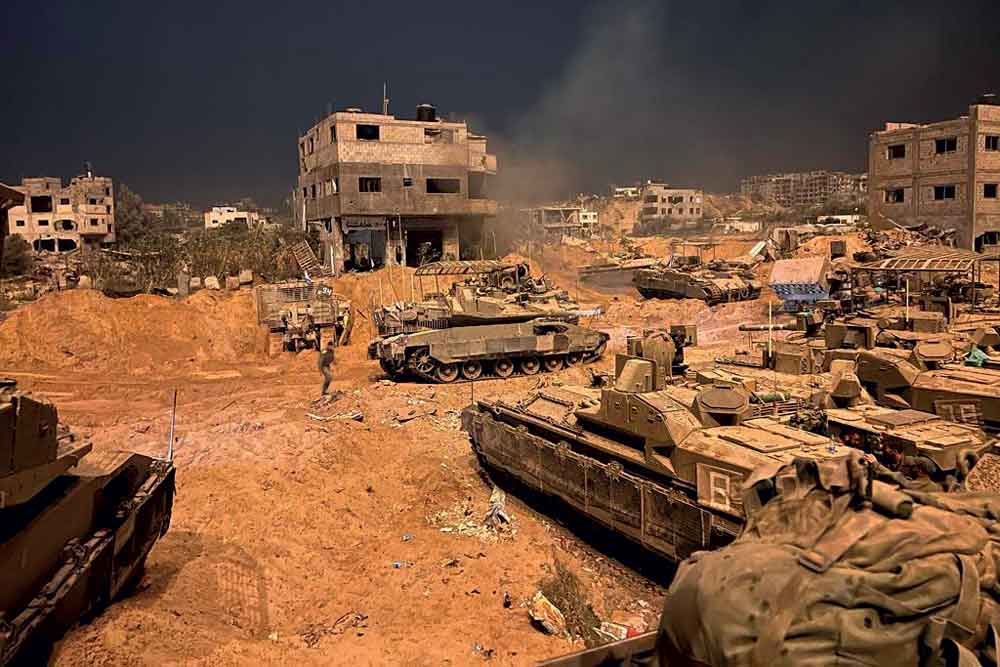
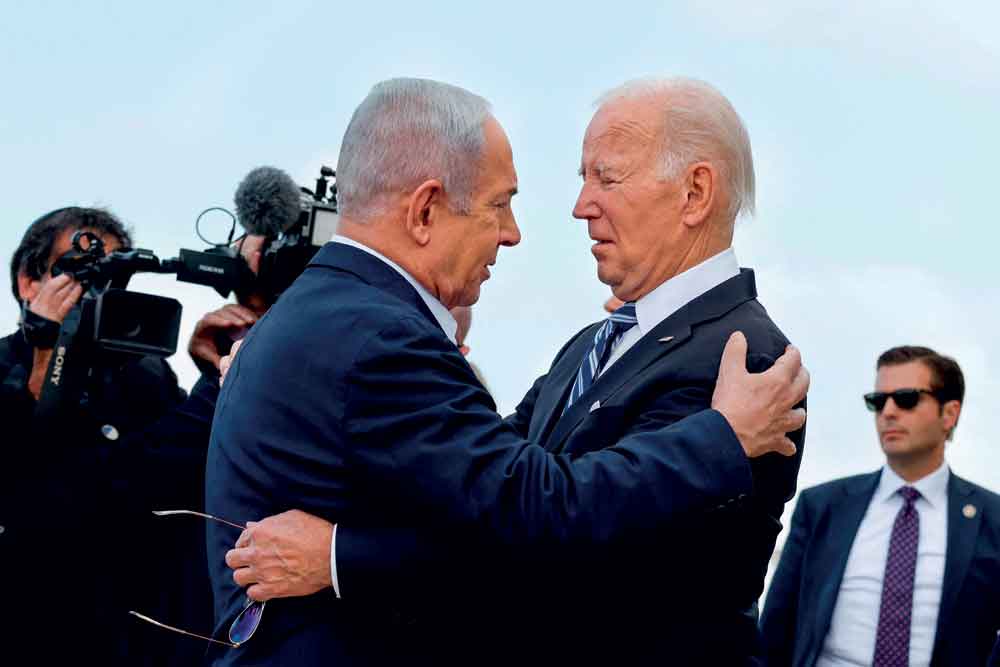
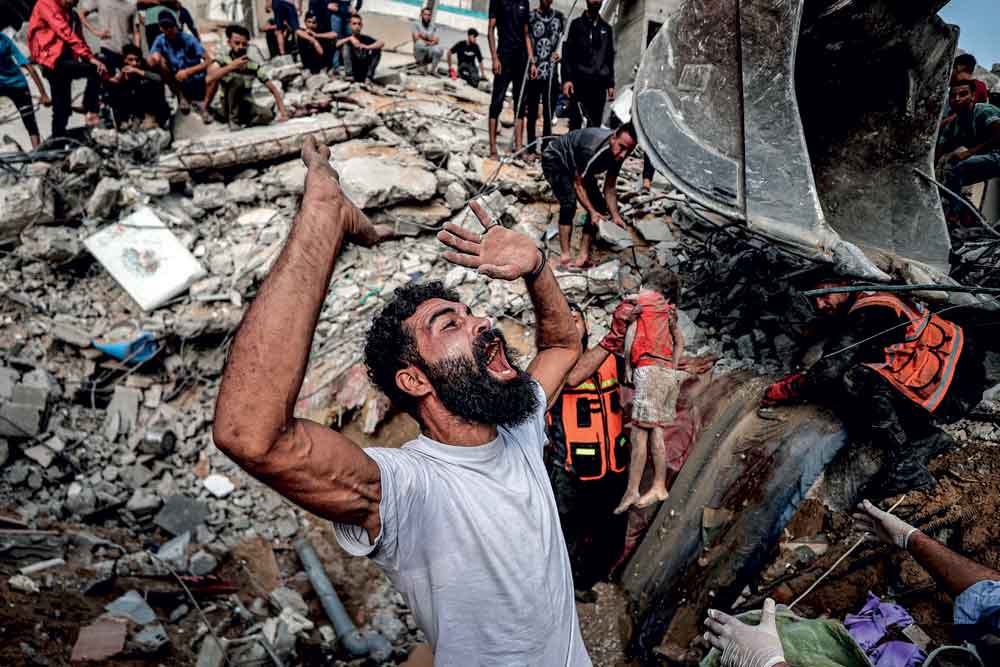
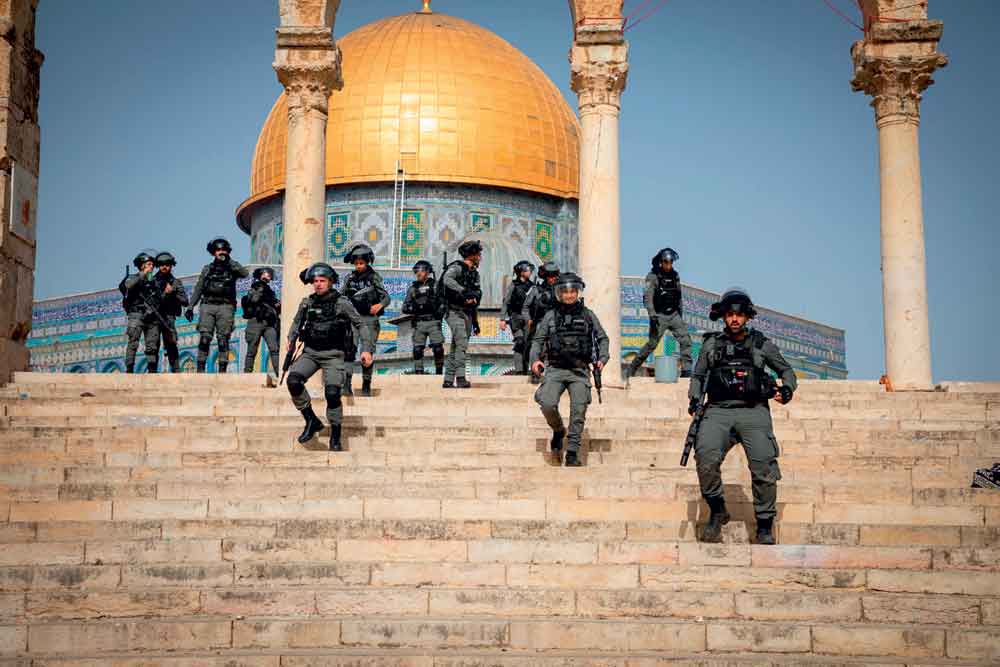
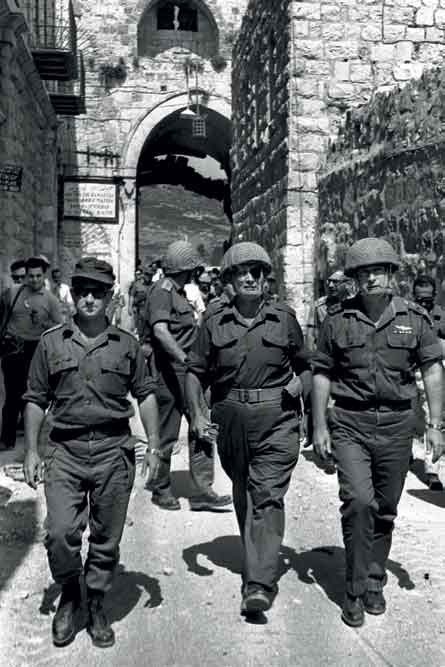
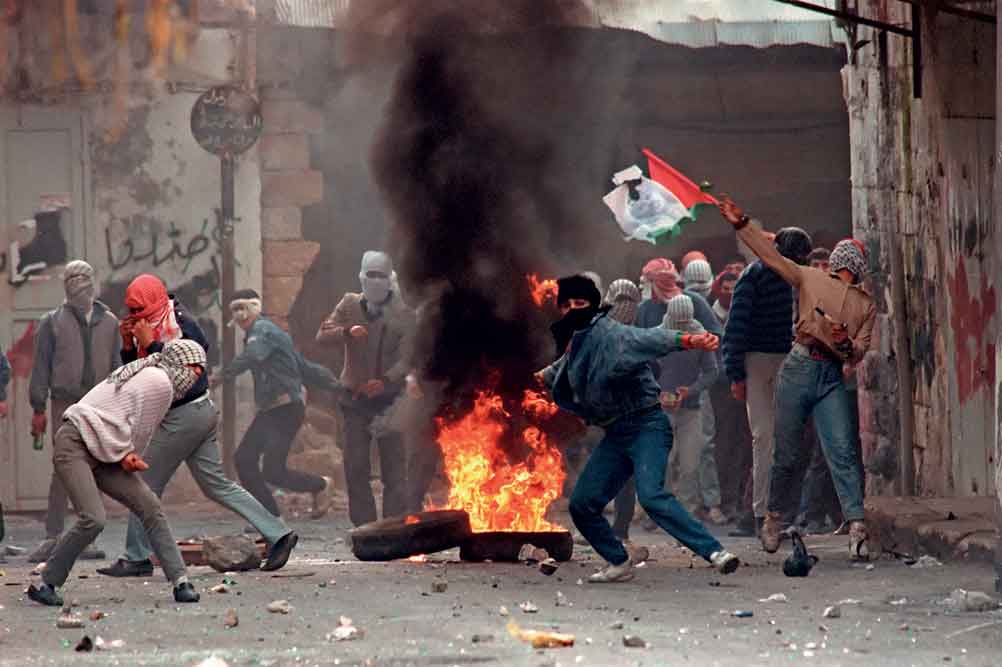
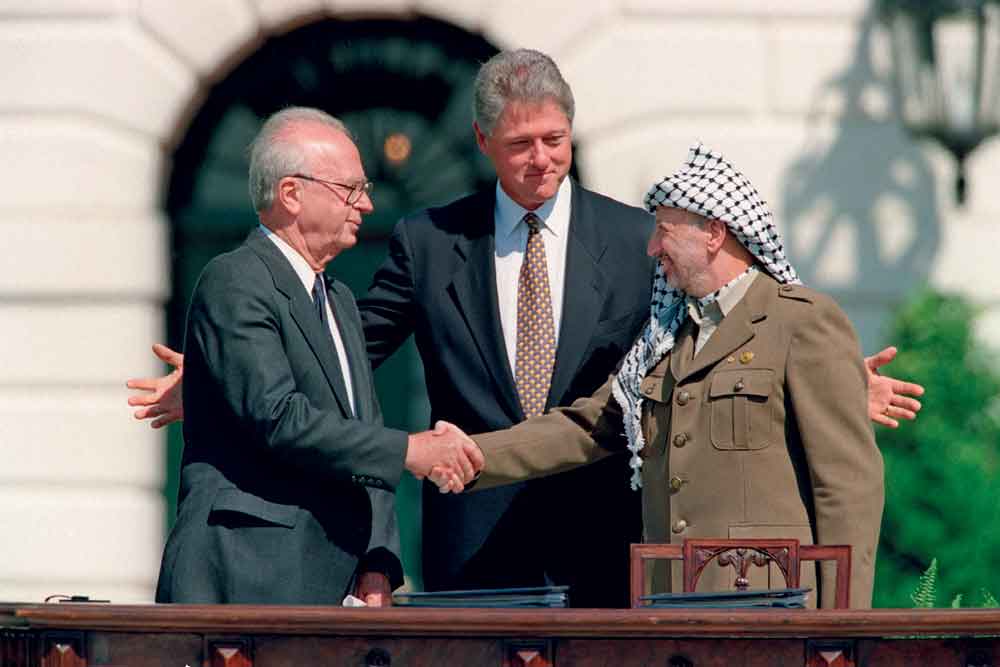


 Stagecraft and Statecraft
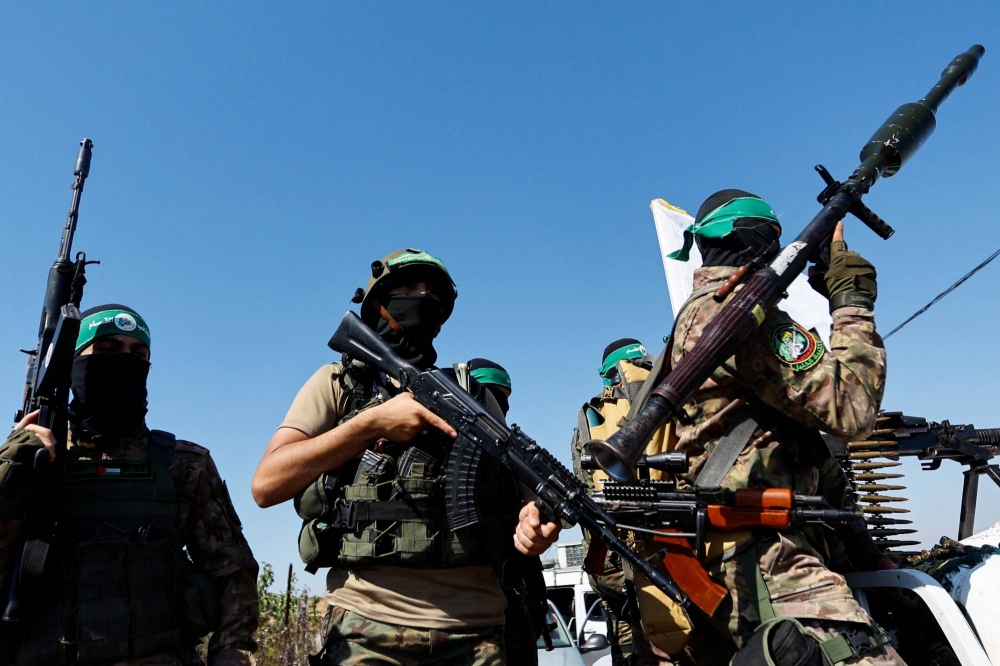
You must be logged in to post a comment.