With the wars in Ukraine and Gaza stretching its military resources thin, a direct confrontation with China is the last thing the US needs. But America’s refusal to rein in China’s aggressive expansionism, not least in the South China Sea, may well make a clash more likely – and more destructive.
HANOI – For over a decade now, China has been working stealthily to alter the territorial and maritime status quo in the Indo-Pacific – an effort that has increasingly stoked tensions with regional neighbors like Australia, India, Japan, Taiwan, and several Southeast Asian countries, as well as the United States. And with US attention and resources focused on conflicts in Europe and the Middle East, China has lately become even more aggressive in its expansionism. Chinese regional hegemony is closer than ever.
Almost daily, China finds a new way to bully Taiwan, which Chinese President Xi Jinping has repeatedly pledged to “reunify” with the mainland (though that objective has no basis in international law or history). As China takes steps like encroaching on Taiwan’s air-defense zone and encircling the island with warships, it raises the risk of a war that would transform global geopolitics.
There are war clouds also gathering over the Himalayas, where a military standoff triggered by China’s repeated furtive encroachments on India’s borderlands has dragged on for nearly four years. And in the East China Sea, China’s intrusions into the territorial waters and airspace of the Japanese-controlled Senkaku Islands, which China claims as its own, are fueling Japan’s drive toward rearmament.
But the biggest risks of escalation may well lie in the South China Sea, where China’s aggressive efforts to entrench its dominance have regularly led to dangerous near-confrontations, including with US warships and aircraft. For years, China has been working relentlessly to cement its dominance over the South China Sea and exploit that region’s vast resources and strategic position as a critical corridor through which one-third of global shipping passes.
To this end, China has constructed artificial islands atop remote reefs and atolls and transformed them into forward military bases. Though these activities constitute a blatant violation of international law, including a 2016 ruling by an arbitral tribunal at The Hague that invalidated Chinese claims in the South China Sea, there has been little pushback from three successive US administrations. As a result, China has managed to expand its maritime borders unilaterally without firing a single shot.
Now, China’s navy and air force routinely patrol its neighbors’ exclusive economic zones (EEZs), and its coast guard – the world’s largest and most militarized – has conducted “intrusive patrols” of others’ offshore oil and gas fields. Chinese coast-guard vessels, including megaships, wantonly employ “non-lethal” weapons like high-pressure water cannons and long-range acoustic devices.
Moreover, China has been sending its navy and coast guard to shadow, hound, and harass vessels belonging to the US, as well as to smaller neighbors, such as the Philippines and Vietnam, with territorial claims in the area. Even fishing boats have been targeted and destroyed. With Chinese ships now being deliberately designed for “ramming” and “shouldering” other vessels, it seems clear that China will become more aggressive in asserting its territorial claims – and the associated fishing and energy-exploration rights – in the South China Sea.
China’s militarization of the South China Sea poses the greatest threat to the Philippines and Vietnam. But whereas Vietnam pursues an independent foreign policy, which its prime minister calls a historical imperative, the Philippines is a longstanding US ally, with a mutual defense treaty in place since 1951.
And yet, when it comes to China’s expansionism in the South China Sea, the US has largely left the Philippines to fend for itself. In 2012, when China occupied the Scarborough Shoal, a traditional Philippine fishing ground located within the country’s EEZ, US President Barack Obama’s administration stayed silent. Since then, China has steadily eroded the Philippines’ control of other areas within its EEZ, but the US has offered its ally little beyond statements of support.
This is unlikely to change any time soon. With the wars in Ukraine and Gaza stretching American military resources thin, a direct confrontation with China is the last thing the US needs. But refusing to stand up to China may well make a clash more likely – and more destructive.
Already, the US has allowed China to gain such a strong footing in the South China Sea that restoring the status quo of just a decade ago would be all but impossible without a full-scale war. And, as the recent increase in provocations in the South China Sea indicate, Xi is bolder than ever, despite the rising risk of escalation, accidental or otherwise. In the meantime, America’s failure to rein in China’s aggressive expansionism is undermining its own security and trade interests.
US President Joe Bideninsists that the US wants “competition with China, not conflict.” But China wants strategic dominance – beginning with the South China Sea – and it is willing to risk conflict to get it. The South China Sea has become a test of American resolve, which Xi is expecting Biden to fail. The world, especially the countries on the front lines of Chinese expansionism, can only hope that Xi is wrong, and that the US finds ways to rein in China without armed conflict.
Brahma Chellaney, Professor of Strategic Studies at the New Delhi-based Center for Policy Research and Fellow at the Robert Bosch Academy in Berlin, is the author of nine books, including Water: Asia’s New Battleground (Georgetown University Press, 2011), for which he won the 2012 Asia Society Bernard Schwartz Book Award.
The military standoff along the long Himalayan frontier between China and India may not be grabbing international headlines these days given the open warfare raging elsewhere in the world, but the threat of the confrontation returning to armed conflict cannot be discounted.
Last week, Indian Foreign Minister S. Jaishankar called the Chinese border situation “very tense and dangerous.” Both sides have been significantly ramping up deployments of troops and weapons, girding for the possibility of war.
Soon to enter its fifth year, the current standoff was triggered by furtive Chinese encroachments into India’s northernmost territory of Ladakh in April 2020, just before thawing ice would normally reopen Himalayan access routes after the brutal winter.
Ahead of this year’s spring thaw and possible new Chinese provocations, India moved an additional 10,000 troops to the frontier. “The possibility that we may face a similar situation that we faced in 2020 is keeping us active all the time,” Indian Defense Secretary Giridhar Aramane said last month.
China has also been expanding its troop presence and frenetically building warfare-related infrastructure along the inhospitable frontier. This has includedboring tunnels and shafts in mountainsides to set up command positions, reinforced troop shelters and weapons-storage facilities.
In addition, it has planted settlers in new militarized border villages that are becoming the equivalent of the artificial islands it created in the South China Sea to serve as forward military bases.
About 100,000 troops remain locked in a faceoff along the border’s westernmost Ladakh sector. Another key sector is the vulnerable area where the borders of Tibet, Bhutan and India’s Sikkim state meet, a 22-kilometer-wide corridor known as “the chicken neck” due to the crooked way it connects India’s northeast to the country’s heartland.
There are also troop faceoffs in the eastern Himalayas along Tibet’s long border with India’s Arunachal Pradesh state. This has long been a heavily militarized area, largely because China claims the Indian state is part of Tibet, although the Dalai Lama, the exiled Tibetan leader, says this has no historical basis.
Talks to de-escalate tensions along the frontier have made little progress. In January, Indian Army chief Gen. Manoj Pande said the standoff would continue until China rolled back from its Ladakh encroachments, calling restoration of the previous frontier line “our first aim to achieve.”
Despite taking some flak at home for losing border areas to Chinese encroachment, Indian Prime Minister Narendra Modi continues to seek a negotiated end to the crisis.
While his government has banned numerous Chinese apps, blocked investments by certain Chinese companies and launched enforcement actions against others over alleged tax and foreign exchange violations, it has not imposed broad sanctions against its northern neighbor.
Consequently, despite the border confrontation, China’s annual trade surplus with India has continued to rise; it is now larger than India’s annual defense spending.
Modi discussed the crisis in brief with Chinese President Xi Jinping on the sidelines of multilateral summits in November 2022 and August 2023. Jaishankar reiterated earlier this month that New Delhi remains “committed to finding a fair, reasonable” agreement.
Now Xi is faced with the challenge of resolving the Himalayan military crisis without losing face.
For four years, tens of thousands of Chinese troops have remained deployed in extremely harsh conditions along the Himalayan frontier. If Xi somehow came to an agreement with Modi about undoing China’s territorial encroachments, he would face questions about why he embarked on the aggression in the first place.
The longer the standoff persists, though, the greater the risk that Beijing turns India into an enduring enemy, a development that would weigh down China’s global and regional ambitions.
Xi has already been confronted by his failure to anticipate India’s robust military and strategic response, with the standoff driving New Delhi closer to Washington. It also set in motion a major military buildup and modernization drive, as illustrated by a flight test last week to demonstrate that India now can put multiple independently targetable nuclear warheads on a single intercontinental ballistic missile.
Since the standoff began, India has tested several other leading-edge missile systems, including a hypersonic cruise missile, a hybrid missile-torpedo for use against submarines and aircraft carriers, an anti-radiation missile for destroying radar-equipped air defense systems and a new generation, intermediate-range ballistic missile capable of carrying nuclear or conventional warheads.
India has also been importing major weapon systems from the U.S. as well as France and other sources. In November, Defense Minister Rajnath Singh told his U.S. counterpart that their two governments are “in agreement on strategic issues, including countering China’s aggression.” India’s growing alignment with the U.S. undoubtedly worries Xi.
Without the elements of stealth, deception and surprise that characterized China’s 2020 encroachments, the People’s Liberation Army would be hard put to get the better of India’s armed forces in a Himalayan war. While the PLA relies heavily on conscripts, India has an all-volunteer force that is considered the world’s most experienced in mountain warfare.
As two of the world’s most ancient civilizations, China and India need to find ways to peacefully coexist as neighbors and to cooperate on shared objectives. But it is far from certain that reconciliation between the two most populous nations will be possible while Xi and the Chinese Communist Party remain in power.
Brahma Chellaney is professor emeritus of strategic studies at the Centre for Policy Research in New Delhi and a former adviser to India’s National Security Council. He is the author of nine books, including “Water: Asia’s New Battleground.”
When Beijing says “Taiwan has always been an inalienable part of China” and calls this “an indisputable legal and historical fact,” it promotes a claim that has absolutely no basis in international law or history.
But by aggressively stating that claim time and again over the years, it has made many in the world believe that fiction, especially when the dominant Western media outlets are reluctant to challenge the Chinese narrative.
Indeed, some international publications now use the phrase “reunify” without quotation marks while referring to Beijing’s Taiwan goal.
The truth is that Taiwan, for most of its history, had no relationship with China and has remained fully outside Chinese control for the last 129 years since 1895 when, following defeat in the First Sino-Japanese War, China’s Manchu-run Qing government signed the Treaty of Shimonoseki that ceded Taiwan to Japan.
In international law, a territorial claim must be based on lasting and peaceful exercise of sovereignty over the entire territory concerned.
But Taiwan has never been an integral part of China in history. And the only outside power that secured control over all of Taiwan was Japan.
While Taiwan remained under Japanese colonial rule until 1945, Japan officially renounced its sovereignty over it only in the 1951 San Francisco Peace Treaty, but without the transferee being identified.
The communist-led People’s Republic of China, having exercised no territorial sovereignty over Taiwan, lacks the legal standing to lay claim to the island democracy.
In fact, the Chinese Communist Party (CCP), founded in 1921, long regarded Taiwan as a foreign territory and articulated for the first time its goal of “liberating” the island just months before it seized power in Beijing in 1949.
Beijing, likewise, dubiously claims that the Japanese-administered Senkaku Islands have always been part of China. There is unquestionably no concrete evidence that China ever had effective control over those islands.
In fact, China began claiming the Senkakus only after a United Nations agency’s report in 1969 referred to the possible existence of oil reserves in the East China Sea.
It was not until the early 1970s that Chinese documents began applying the name “Diaoyu” (釣魚) to the Senkakus and claiming they were part of China.
Sinicizing the names of the territories it claims is a standard tactic of the CCP, which it is also applying to the Himalayan borderlands of India, Bhutan and Nepal.
This tactic is designed to lend credence to its assertion that the areas it covets have always been part of China.
For example, in three separate batches between 2017 and 2023, Beijing renamed a number of places in India’s sprawling Himalayan state of Arunachal Pradesh, which is almost three times larger than Taiwan.
When India protested, Beijing doubled down, contending that Arunachal Pradesh is its own “territory” and Sinicizing names of places there is “China’s sovereign right.”
Such aggressive tactics, including claiming that a region controlled by another country has been part of China since ancient times, help over time to gain wide international recognition that the territory concerned is disputed.
This then encourages China to disturb the territorial status quo through stealthy maneuvers or encroachments.
China’s nearly four-year-long Himalayan military standoff with India has its origins in the April 2020 furtive Chinese encroachments on key borderlands in the northernmost Indian territory of Ladakh, which is located 2,000 kilometers from Arunachal Pradesh.
India, challenging Chinese power and capability, has more than matched China’s Himalayan military deployments and made clear that the standoff would continue until Beijing agrees to restore status quo ante.
More broadly, China, under President Xi Jinping (習近平), has been pushing expansive territorial claims in Asia on the basis of an ingenious principle — “what is ours is ours and what is yours is negotiable.”
It is telling that these territorial claims, from the East and South China Seas to the Taiwan Strait and the Himalayas, are based not on international law but on revisionist history. China’s weak legal case was highlighted by the 2016 Hague ruling, when an international arbitral tribunal invalidated Chinese claims in the South China Sea.
Yet, such is Beijing’s unmitigated scorn for international law that, in defiance of the Hague ruling, it has accelerated its expansionism in the South China Sea, turning its seven human-made islands into forward military bases and gradually securing greater and greater control of this critical corridor between the Pacific and Indian Oceans.
China’s “nine-dash line” encompassing much of the South China Sea exemplifies how it uses alleged history to pursue aggressive expansionism.
But Beijing’s manipulation of history extends beyond advancing extravagant territorial claims.
It also uses history to instill among the Chinese an abiding sense of grievance over the 110 years of national humiliation that China suffered up to the communist takeover in Beijing.
While Beijing misses no opportunity to shame Japan with the history card, its selective historical memory is highlighted by Chinese school textbooks, which black out the Chinese invasion and annexation of Tibet in the early 1950s and the wars it unleashed against India (1962) and Vietnam (1979).
In fact, as the mythical Middle Kingdom, China claims to be the mother of all civilizations, weaving legend with history to claim a dual historical entitlement — to recover “lost” lands and become a world power second to none. This helps to rationalize its muscular foreign policy, which seeks to make real the legend that drives the CCP’s revisionist history — China’s centrality in the world.
In the name of “reunification,” Xi seems determined to annex Taiwan, just as Mao Zedong (毛澤東) occupied the then-autonomous and resource-rich Tibet.
Chinese aggression against Taiwan would constitute the biggest threat to world peace in a generation.
It has thus become imperative to contest Beijing’s strange fairy tale that Taiwan was part of China since time immemorial.
Taiwan has all the attributes of a robust independent state, and most Taiwanese want it to stay that way.
After all, why would the Taiwanese be willing to give up their freedoms and be absorbed by the world’s largest autocracy, which is also a technology-driven Orwellian surveillance state?
People in Taiwan, in fact, have developed an identity that is distinct from that of Chinese citizens.
Brahma Chellaney, a professor of strategic studies at the independent Center for Policy Research in New Delhi, is the author of nine books, including the award-winning Water: Asia’s New Battleground (Georgetown University Press).
Few would doubt that India’s international profile and geopolitical weight have been rising, making it a key ‘swing’ state in the current transition from the US-led, post-World War II order to a new global order. Despite growing international turbulence, as underlined by crises, conflicts, wars and new threats, Indian foreign policy displays dynamism and confidence.
This is apparent from the close strategic partnerships India has built or reinforced with rival major powers, including the US and Russia. In fact, India is being courted by all the great powers.
Because India confronts what might be called the “tyranny of geography” in its own region—that is, serious external threats from virtually all directions—it must pursue extra-regional options to advance its economic and security interests. India, the region’s geographical hub, may be the world’s largest democracy but authoritarian structures have not been fully dismantled in neighbouring countries.
An unstable neighbourhood, to be sure, heightens the danger of spill-over effects for India, which would threaten its internal security. For example, the ethnic violence in Manipur state has been accentuated by the illegal influx of thousands of ethnic Chin from violence-torn Myanmar, which risks turning into a failed state because of crippling US-led sanctions and escalating armed attacks by insurgents attempting to overthrow the military junta.
Against this backdrop, India has little choice but to reach out beyond its immediate neighbourhood to help surmount the “tyranny of geography”. This explains the priority it attaches to expanding diplomatic and economic relations with other regions.
In the Middle East, for example, India’s expanding footprint owes a lot to the close relations Prime Minister Narendra Modi has forged with Israel and important Arab states. Modi, although accused by his critics of promoting Hindu nationalism, has built a strong personal rapport with the rulers of the Persian Gulf sheikhdoms, which are the citadels of Wahhabi Islam, the source of modern Islamic fundamentalism.
Modi, who on his seventh visit to the United Arab Emirates (UAE) recently inaugurated the first stone-built Hindu temple in the entire Middle East, refers to the Emirati president, Sheikh Mohamed bin Zayed Al Nahyan, as his “brother”. The UAE, the most liberal and forward-looking of the Gulf states, has rapidly emerged as one of the largest investors in, and a close trade and security partner of, India.
India, the world’s third-biggest importer of oil, sources 65 per cent of its crude imports from the Gulf states, which are also supplying fast-increasing quantities of liquefied natural gas (LNG) to the country. The nearly 9 million Indian expats in the Gulf region, including the world’s largest Indian diaspora of 3.4 million in the UAE, account for about 30 per cent of the $90 billion global remittance flowing to India yearly. Known to be disciplined, dedicated, hard-working and peaceable, the Indian expats in the Middle East are one of India’s most distinct soft power assets.
With size comes geopolitical, economic and cultural power. And with power comes respect. With its cherished foreign-policy autonomy and willingness to break with conventional methods and shibboleths, India is well placed to serve as a go-between in the Ukraine war and as a mediator in the Israeli-Palestinian conflict
Consider another region, East Asia, where India has bolstered trade and strategic ties with historic rivals Japan and South Korea. India has virtual free trade agreements (FTA) with these two countries, which today are seeking to overcome the historical baggage that still weighs down their bilateral relationship. India-Japan military exercises now extend to all three domains—air, maritime and land—and cover strategic, operational and tactical levels.
The neighbourhood constraints make it imperative for India to build stronger ties not just with the other major powers but also with important countries located in different regions.
KEY FACTORS
Several factors are central to a country’s international position, including its political and economic trajectory. Without political stability at home, economic growth will likely suffer.
Despite the plethora of political parties in India that largely team up in coalitions, especially before elections, the country has been fortunate to have enjoyed political stability under three successive prime ministers—Atal Bihari Vajpayee, Manmohan Singh (more so in his first term than his scandals-filled second tenure), and Narendra Modi.
Contrast that with the unending political crisis in military-dominated, China-indebted Pakistan, with that nation now confronting the worst economic crisis in its history. Indeed, the phrase “international basket case” might better apply to Pakistan today than it did to Bangladesh in 1971 when it won independence despite the Pakistani military’s genocide, in which three million people were killed, 200,000 women were confined in rape camps, and 10 million more people were forced to flee to India.
Under Sheikh Hasina, who has led a secular government since 2009 that Bangladeshi Islamists detest, Bangladesh has had political stability and rapid economic growth. Bangladesh’s impressive-growth trajectory stands in stark contrast to the chronic political and economic turmoil in Pakistan, which is still teetering on the brink of default.
Against this background, India’s continued rise hinges on sustained political stability at home. A stable, forward-thinking government can frame and pursue long-term strategic goals, including further accelerating economic growth, advancing development of critical and emerging technologies (including semiconductors, which have grown into a key international geopolitical battleground), underpinning military prowess with an expanded weapons-manufacturing base at home, strengthening nuclear-weapon, missile and drone capabilities, and bolstering internal security and social cohesion.
The 1998 nuclear weapons’ tests proved to be a watershed moment for India, raising its international profile and setting in motion the process for the US to gradually lift most of its technology sanctions against New Delhi. For more than a quarter of a century, the US had kept the world’s largest democracy under sanctions, while it actively aided communist China’s rise and armed Pakistan against India. And, as the <New York Times> reported in 1998, the US and China covertly helped Pakistan to build its nuclear bomb.
It was fortunate for India’s security and upward trajectory that the nuclear weapons’ tests were carried out six weeks after Vajpayee took office. Had Vajpayee waited six months, there probably would have been no such tests, given how the heady allure of power and its corrupting effects can easily weaken political resolve.
The five underground nuclear tests in 1998 exposed the utter failure of US policy to keep India from going overtly nuclear by employing technology sanctions and diplomatic pressure. Predicting test yields accurately holds the key to manufacturing sophisticated nuclear weapons. And, as underscored by post-shot radiochemical analyses, the yields from the five tests were in line with what the Indian scientists had aimed for.
Left to lick its wounds, the US began quietly reversing its policy towards India through diplomatic outreach, including closed-door talks. In mid-1999, Bill Clinton became the first American president to openly side with India against Pakistan in wartime when he successfully pressured then-Pakistani Prime Minister Nawaz Sharif to pull back his forces from the areas that they had furtively encroached upon in Ladakh’s Kargil region. And about eight months later, Clinton heralded a new beginning in Washington’s relationship with New Delhi by paying a five-day visit to India, the first by a US president in almost a quarter-century.
Since then, America’s embrace of India has persisted (and strengthened) under four succeeding presidents—George W Bush, Barack Obama, Donald Trump, and Joe Biden.
India’s rapid economic growth, with the Indian economy now the fastest growing among major countries, has reinforced bipartisan support in Washington for a closer partnership with New Delhi. US exports to India have boomed. Indeed, the US has become an important source of even crude oil and petroleum products for India, which is the world’s third-largest oil consumer after America and China.
UAE President Sheikh Mohamed bin Zayed Al Nahyan and Prime Minister Narendra Modi in Abu Dhabi, February 13, 2024 (Photo: PIB)
Meanwhile, the profound development that helped transform India’s global position—its going overtly nuclear—now figures little in the Indian or American discourse.
Yet India now faces an ongoing build-up of nuclear and missile forces in its neighbourhood, especially by China. The unprecedented speed and scale of the Chinese nuclear build-up appears to be linked to President Xi Jinping’s international expansionism as China seeks global primacy by 2049, the centenary of communist rule.
Modi refers to the Emirati President, Sheikh Mohamed bin Zayed Al Nahyan, as his ‘brother’. The UAE, the most liberal and forward-looking of the Gulf states, has rapidly emerged as one of the largest investors in, and a close trade and security partner of, India
The huge nuclear-weapons build-up is set to lengthen China’s shadow over Asia while heightening military tensions with its main Asian rivals—India and Japan. India, alas, has remained smugly content with the outcome of its 1998 tests, instead of seeking to enhance the credibility of its nuclear deterrent through a stockpile-stewardship programme that includes subcritical and other hydronuclear experiments. Today, India needs to pay close attention to Xi’s nuclear frenzy.
India’s global standing, in more recent years, has also benefited from two other factors, both China-related.
The first is the West’s belated recognition of Xi’s imperialist ambitions, which have spawned China’s aggressive expansionism almost since he came to power in 2012. Xi seems to believe that China has a narrow window of strategic opportunity to modify the international order in its favour before it confronts a deepening demographic crisis, stalled economic growth, and an unfavourable global environment. Accordingly, Xi has shown an increasing appetite for taking major risks.
President Biden, in his 48-page national security strategy released in October 2022, made clear that over the long term the US was more worried about China’s moves to “layer authoritarian governance with a revisionist foreign policy” than it was about a sanctions-battered Russia, whose strategic ambitions are regionally confined. China “is the only country with both the intent to reshape the international order and, increasingly, the economic, diplomatic, military and technological power to advance that objective,” the strategy report said.
It has become clear to many Americans that China is not a friend or a partner but rather an adversary bent on global dominance by supplanting the US. Multiple opinion surveys have shown that the number of Americans who view China as their country’s “greatest enemy” or “greatest threat” has more than doubled since 2020, increasing to over half of US adults. As an adversary in American eyes, Russia is now a distant second to China.
History will record 2020 as a watershed year for Beijing when international attitudes visibly changed and many economies learned hard lessons about China-dependent supply chains. The tide began to turn when the Chinese Communist Party (CCP) hid crucial information from the world about the Wuhan-originating Covid-19, even as it attempted to capitalise on the pandemic, first by hoarding medical products (a market China dominates) and then by stepping up aggressive expansionism. The April 2020 Chinese encroachments on key borderlands in Ladakh occurred while India was enforcing perhaps the world’s strictest pandemic-related national lockdown.
Today, Western companies’ growing interest in shifting production away from China so as to reduce risk through diversification opens opportunities for India to address its manufacturing deficit. The US, after all, confronts a troubling reality: Its biggest source of imported goods has emerged as its biggest strategic adversary.
More fundamentally, until the US began regarding China as a threat to its core interests and looking at India as a potential counter-balancer to Beijing, Americans tended to think about India as if it were linked by a hyphen to Pakistan.
The US now recognises the larger geopolitical importance of India, which has long been locked in a strategic rivalry with China. India may never formally align itself with Western powers but it will remain an independent, rising power whose strategic interests mesh more with the West.
The People’s Liberation Army Rocket Force’s DF-41 ICBM launchers at a parade in Beijing (Photo: AP)
The second factor is the end of China’s US-assisted, four-decade-long economic boom. Economic growth has stalled to the point where China is being called a “drag” on world output by the International Monetary Fund (IMF) and others. In fact, China’s long-term economic prospects are dimming, with the country experiencing demographic decline and high youth unemployment. The property market that long fuelled its growth is now mired in a prolonged downturn.
Economists have compared China’s demographic crisis, which has resulted in its labour force already peaking, to the one that brought Japan’s economic boom to a standstill in the 1990s.
India, by contrast, has demographics on its side. With a median age of 28.4, India is one of the world’s youngest countries, with the promise of reaping a significant demographic dividend.
India faces an ongoing build-up of nuclear and missile forces by China. The speed and scale of the Chinese nuclear build-up appears to be linked to Xi Jinping’s international expansionism as China seeks global primacy by 2049
The Modi government, to help turn India into a global manufacturing hub, has invested enormously in infrastructure, while cutting red tape, relaxing rules and opening the way for more foreign direct investment. Leveraging India’s geopolitical clout, the government is inviting multinationals, which are looking to diversify manufacturing and supply chains, to set up their manufacturing base in India.
The push to turn India into a global manufacturing hub has included luring international chipmakers to the country with generous state subsidies. India is to bear half the cost of any semiconductor projects it approves.
Chinese President Xi Jinping (Photo: AFP)
This push also extends to local manufacturing of military equipment and munitions, given that India’s heavy dependence on imports for defence requirements constrains both the country’s economic potential and its strategic autonomy. For example, drawing on the lessons of the Ukraine war about the critical importance of munitions, two private-sector defence facilities built at a cost of $362 million outside Kanpur have just started producing small, medium and large calibre ammunition for the armed forces.
LEARNING ON THE JOB Indian foreign policy, with pragmatism as its hallmark, may be geared towards reinventing India as a more competitive, confident and secure country claiming its rightful place in the world. Indeed, a non-doctrinaire foreign-policy approach powered by ideas, not ideology, has long defined Indian diplomacy.
However, this does not mean that India has had a distinct foreign-policy doctrine or vision. The fundamental weakness under successive prime ministers has been the excessive personalisation of foreign policy.
Charles-Maurice de Talleyrand, Napoleon’s famous foreign minister, prescribed a basic rule for foreign policy: “by no means show too much zeal”. In India’s case, oozing zealousness and gushy expectations have undermined realism recurrently. In this century alone, zeal has been to Indian prime ministers—from Vajpayee and Manmohan Singh to Modi—what grand strategy is to great powers.
Ill-served by obsequious bureaucrats, Indian leaders have rushed to believe what they wanted to believe. Consequently, India has repeatedly and jarringly cried betrayal, not by friends but by adversaries in whom it chose to repose trust. Instead of acknowledging their own naïveté, Indian leaders, when taken for a ride, have cast the entire blame on the opponents’ duplicity.
A key reason why India, to its chagrin, has repeatedly found history repeating itself is that virtually every prime minister, although unschooled in national security at the time of assuming office, has sought to reinvent the foreign-policy wheel, rather than learning from the blunders of the preceding prime ministers. To make matters worse, intellectuals and the media usually shrink from closely scrutinising foreign policy moves.
Consider Vajpayee’s record: In just five years, between 1999 and 2004, several major policy U-turns were executed. Under Vajpayee—who formally surrendered India’s Tibet card during a 2003 Beijing visit—personal rather than professional characteristics came to define India’s foreign policy.
Vajpayee’s roller-coaster policy on Pakistan exposed India’s glaring inadequacy to set and unwaveringly pursue clear goals. His Pakistan policy traversed multiple U-turns—from his bus ride to Lahore, the war in Kargil, the hijacking to Kandahar of an Indian jetliner, and the summit in Agra to the Pakistan-scripted attack on the Indian Parliament. It then culminated in his second trip to Pakistan as prime minister. It was Vajpayee’s 2001 Agra summit invitation that helped dictator Pervez Musharraf to come out of the international doghouse for staging a military coup.
The Modi government, to help turn India into a global manufacturing hub, has invested enormously in infrastructure, while cutting red tape, relaxing rules and opening the way for more foreign direct investment
In an operation with no parallel in modern world history, the Indian Army, under <Operation Parakram>, was kept in a war-ready position against Pakistan through forward deployments for 10 months, avowedly to force Pakistan to dismantle its state-built terrorist infrastructure. Yet, without accomplishing any objective, Vajpayee called off the costly, self-debilitating operation, which the then Navy chief later labelled the “most punishing mistake”. Worse still, Vajpayee during his 2004 Islamabad visit hailed as a big gain Pakistan’s commitment on paper to not let its territory be used for cross-border terrorism—the very empty assurance General Musharraf had given before Vajpayee initiated <Operation Parakram>.
Vajpayee’s swinging policy pendulum emboldened his successor, Manmohan Singh—a foreign-policy greenhorn—to pursue a blinkered approach that blended his unvarnished naivety with open appeasement, thereby inviting greater acts of aggression against India. Mistaking tactics for strategy, Singh treated the process of engagement with the country’s regional adversaries as an end in itself, losing sight of the purpose—putting an end to acts of aggression.
Singh’s fixation on quasi-failed Pakistan paralleled Vajpayee’s quest to make peace with that implacable enemy. Singh, however, took appeasement to unmatched levels.
For example, at Havana in 2006, he equated the state sponsor of terrorism (Pakistan) with the victim of its terrorism (India), agreeing infamously to set up a joint anti-terror mechanism. Then, three years later at Sharm El-Sheikh, Singh permitted Pakistan to include Balochistan in the bilateral agenda. This blunder—which immediately became grist for the Pakistani propaganda mill—allowed Pakistan to try and externalise the Baloch problem by turning its terrorism target, India, into the principal accused, by claiming that India was behind the separatist insurrection in Balochistan.
Even the savagery of intruding Pakistani troops, who chopped two Indian soldiers and took away one severed head as a ‘trophy’, failed to stop Singh from returning to business-as-usual with Pakistan. The result was that Singh’s policy of engagement with Pakistan yielded increasingly daring and brutal acts of cross-border terrorism.
Then came Modi at the helm. In seeking to befriend the country’s regional adversaries, did Modi draw any lessons from India’s bitter (and costly) experiences under the leadership of Manmohan Singh and Vajpayee? Absolutely not.
Like his predecessors, while learning on the job at the expense of the nation, Modi indeed set out to reinvent the foreign-policy wheel.
For example, Modi’s unannounced visit to Lahore in late 2015, as part of his personal outreach to then-Prime Minister Nawaz Sharif, resulted in the Pakistani military’s orchestration of a series of terrorist attacks on Indian military bases and camps in Jammu & Kashmir and Punjab. Today, the India-Pakistan relationship is virtually frozen.
Furthermore, Modi did not see the Chinese incursions into Ladakh coming because his vision seemed to have been clouded by the hope that, by appeasing China and its leader, Xi Jinping, he could reset the bilateral relationship and weaken China’s ties with Pakistan.
Modi met Xi 18 times over five years, with the hype over the meetings helping to lull India into a false sense of complacency. In the run-up to the April 2020 Chinese encroachments, India ignored various warning signs, including China’s unusual combat exercises in wintertime with new types of tanks and howitzers designed for high-altitude warfare, as well as its frenzied construction of new military installations along the Himalayan frontier.
External Affairs Minister S Jaishankar and US Secretary of State Antony Blinken at the Munich Security Conference, February 17, 2024 (Photo: Getty Images)
Although deception, concealment and surprise have often accompanied Chinese aggression in Asia, the Modi government ignored the lesson from its own bitter experience over the Doklam Plateau in 2017. After the India-China troop standoff at Doklam ended with the August 2017 disengagement accord, China built permanent military structures and seized control of most of the Bhutan-claimed Doklam in ways that had echoes of its expansionism in the South China Sea. It then sought to apply the same model of expansionism against India, which is what led to its Ladakh land grabs.
The result is that India now confronts the worst border crisis with China since the 1962 war, with the major military standoff between the two Asian giants about to enter the fourth year. The standoff is imposing major costs on India and China while raising the spectre of armed conflict.
India’s rapid economic growth, with the Indian economy now the fastest growing among major countries, has reinforced bipartisan support in Washington for a closer partnership with New Delhi. US exports to India have boomed
External Affairs Minister S Jaishankar recently contended that the Modi government follows Sardar Patel’s “realism”, not Jawaharlal Nehru’s “romanticism”. But Modi’s “realism” has come the hard way—after his own “romanticism” backfired.
This background underscores why India needs to shift from excessive personalisation of policy to institutionalised policy-making. Such a shift will ensure a more clearheaded and goal-oriented foreign policy that is focused on an assertive promotion of national interests and on long-term objectives.
INDIA’S SIZE MATTERS
India’s geopolitical importance is likely to only grow, despite Modi’s critics at home and abroad claiming democratic backsliding under his leadership. India is a raucous democracy that confronts intensifying partisanship and polarisation. In this hyper-partisan setting, Modi has become a lightning rod for critics that accuse him of being a strongman pursuing divisive policies and favouring populism over constitutionalism. Such criticisms mirror the attacks on Donald Trump when he was in the White House.
But while opinion surveys show that most Indians hold their democracy in high regard, more than two-thirds of Americans think their country’s democracy is broken, despite Biden being in the White House. Indeed, a study by an international think-tank has designated the US as a “backsliding” democracy.
The plain fact is that India, a country the size of a continent, will remain an important factor in the global balance of power.
Who can ignore India’s massive population (now the world’s largest), its nuclear weapons and growing military might, its expanding and relatively young labour force (even as those in most industrialised countries are ageing and, in some cases, shrinking), its tradition of a strong elite education, its culture of entrepreneurialism, and its ties to the big and influential Indian diaspora that extends from Southeast Asia and the Middle East to North America?
With size comes geopolitical, economic and cultural power. And with power comes respect.
The upward trajectory of the world’s largest democracy will continue, unless it slips into serious political instability that leads to internal disarray.
India has long been a powerful voice for the Global South. But, in an increasingly divided world, India can be the bridge-builder between the East and the West, and between the North and the South. With its cherished foreign-policy autonomy and willingness to break with conventional methods and shibboleths, India is well placed to serve as a go-between in the Ukraine war and as a mediator in the Israeli-Palestinian conflict.
China’s economic and geopolitical rise since the 1990s helped reshape the world. Now India, if it can get its act together, has an opening to change the world again with its own economic and geopolitical rise.
Brahma Chellaney is a geostrategist and the author of two award-winning books.
Quad leaders meet on the sidelines of the G7 summit in Hiroshima in May 2023: Another summit is unlikely to happen until early 2025. (Pool via Reuters)
When U.S. President Joe Biden took office in 2021, he ardently embraced the Quad initiative that had been revived by his predecessor, Donald Trump, elevating discussions in the four-nation grouping with Australia, India and Japan to the level of summits of national leaders instead of just meetings of foreign ministers.
Biden first brought his counterparts together in March 2021 online, due to the COVID-19 pandemic. The White House then hosted the first in-person Quad summit six months later.
Yet after a flurry of similar meetings, including an informal gathering in Hiroshima, Japan last May on the sidelines of a Group of Seven summit at which the four leaders committed to jointly “meet the challenges” facing the Indo-Pacific region, there is no tangible plan in place now for another summit.
Indeed, U.S. Ambassador to India Eric Garcetti has suggested that the next summit will likely have to wait until after November’s presidential election.
This in effect probably rules out any fresh summit before early 2025 even as regional security challenges mount, with China applying increasing coercive pressure on Taiwan in the wake of the presidential election victory of the Democratic Progressive Party’s Lai Ching-te and further tensions building along China’s frontiers with India and Bhutan, and with the Philippines in the South China Sea.
If that was not discouraging enough, it must be noted also that little concrete progress has been made in the six Quad working groups established over the last three years, covering critical and emerging technologies, climate change, cybersecurity, infrastructure, space and COVID-19 vaccines.
To be sure, an overly ambitious agenda, as underscored by the working groups’ focus on diverse global issues, has constrained the Quad’s ability to produce tangible results.
The Quad, as a grouping of just four democracies, is in little position to manage universal challenges. Yet this is the course Biden has taken the Quad on, with the result that the group’s Indo-Pacific security objectives have sometimes taken a back seat to discussion of global challenges.
The Quad’s core agenda, as affirmed by the U.S. in 2019, is supposed to center on realizing members’ vision of a free and open Indo-Pacific region. This should mean effectively acting as a bulwark against Chinese expansionism and ensuring a stable balance of power in a region that brings together the Indian and Pacific Oceans.
But Biden’s policy of engagement with China may explain why, despite a changing geostrategic landscape in the Indo-Pacific region, the Quad now lacks clear strategic direction and resolve.
With the wars in Ukraine and the Middle East claiming America’s attention and resources, and draining stocks of critical munitions and air defense systems, the last thing Biden wants is conflict or even greater tensions with China.
This likely explains his moves to ease Chinese concerns.
“I don’t want to contain China,” Biden declared while visiting Hanoi last September. “We’re not trying to hurt China.”
The goal, he said, is “getting the relationship right” between the world’s two leading powers. Biden earlier assured Chinese President Xi Jinping that the U.S. would not seek to change China’s political system nor direct alliances against it.
After sending a string of cabinet officials to Beijing for discussions, Biden made a promise to “responsibly manage the relationship” during talks with Xi in San Francisco on the sidelines of the Asia-Pacific Economic Cooperation summit last November.
The stepped-up effort to steady the fraught Sino-U.S. relationship thus may have contributed to U.S. soft-pedaling of the Quad. Indeed, the four Quad leaders pointedly did not convene when they were all together at the Group of 20 summit in New Delhi last September as they did in Hiroshima four months before.
The question then is whether Biden’s policy of coexistence and cooperation with China is paying dividends.
It would not seem so. Xi, seeing America distracted with Europe and the Middle East, has upped the ante by stepping up coercion of Taiwan. There have also been more frequent Chinese provocations and maritime incidents in the South China Sea, including with U.S. aircraft and ships.
Xi may even see a window of opportunity for more dramatic action over Taiwan. At the same time, the new U.S. cold war with Russia has pushed Moscow closer to Beijing and turned China into its banker and most important trade partner, risking the creation of a pan-Eurasian axis that could further overstretch America and accelerate its relative decline.
While Xi is still willing to talk to the U.S., his actions suggest that, despite a slowing economy, he believes China, with a ramped-up nuclear arsenal, is in a position of strategic strength that it must leverage.
Against this backdrop, it would be a mistake to relegate the Quad to the periphery or turn it into a mere showpiece.
If anything, it is time to refocus the Quad’s attention on the strategic challenges in the Indo-Pacific region, as it remains critical to the global balance of power and world peace. This means reaffirming the Quad’s strategic mission of preserving the present regional order. Without that, the goal of a free and open Indo-Pacific could become illusory.
Brahma Chellaney is professor emeritus of strategic studies at the Centre for Policy Research in New Delhi and a former adviser to India’s National Security Council. He is the author of nine books, including “Water: Asia’s New Battleground.”
President Joe Biden meets Saudi Arabian Crown Prince Mohammed bin Salman at Alsalam Royal Palace in Jeddah, Saudi Arabia on July 15, 2022. (Photo by Royal Court of Saudi Arabia/Anadolu Agency via Getty Images)
President Joe Biden has made democracy promotion a key element of his foreign policy, declaring from the outset that the United States would stand up for human rights and freedoms wherever they are under attack. Biden faced his first test shortly after he entered the White House, when a coup brought the military back to power in Myanmar. Biden promptly reimposed heavy sanctions on that country.
But as Biden nears the end of his term, his record on promoting or defending human rights and democracy globally is patchy at best. Still, in his reelection campaign, he has retained protecting the forces of human dignity and freedom as a core theme.
Unfortunately for Biden, nothing has been more damaging to that theme than his political and military support for Israel’s devastating war in Gaza, including his repeated refusal to push for a cease-fire. Such strong backing, while allowing the most right-wing and religiously conservative government in Israel’s history to expand its military assault across Gaza, is bleeding support from Biden’s base at home. More significantly, it has left the U.S. as diplomatically isolated as Russia was when it first invaded Ukraine.
Long before Hamas’s Oct. 7 terrorist atrocities led Israel to unleash war, Biden had been using promotion of democratic rights selectively — to target America’s adversaries and weak, strategically unimportant states, while condoning authoritarian practices in countries that matter to American interests. The pursuit of moral legitimacy in support of democracy promotion, meanwhile, has contributed to making sanctions the tool of choice for U.S. policymakers, despite being a blunt instrument to bring about political change.
Biden, for example, has been silent on Ukrainian President Volodymyr Zelensky’s lurch toward authoritarianism, because acknowledging that reality would run counter to the American president’s narrative that the war in Ukraine symbolizes a “battle between democracy and autocracy, between liberty and repression, between a rules-based order and one governed by brute force.”
The truth is that Zelensky has effectively choked Ukraine’s nascent democracy by banning opposition parties, jailing political opponents, shutting independent media outlets and deferring elections indefinitely under martial law. Zelensky has essentially followed in the footsteps of his nemesis, Russian President Vladimir Putin.
Consider another example: While ratcheting up sanctions on military-ruled Myanmar — now reeling under a deepening humanitarian crisis — the Biden administration is mollycoddling Pakistan’s domineering military, which has long blocked a genuine democratic transition in the country. With the U.S. implicitly endorsing the Pakistani military’s viselike grip on national politics, Secretary of Defense Lloyd J. Austin in December hosted Pakistan’s army chief at the Pentagon, while Secretary of State Anthony Blinken invited the visiting general to his office.
Meanwhile, confounding those who believe in Biden’s rhetoric, the president, in practice, does not hew to his own narrative of a “global battle between democracy and autocracy,” thereby implicitly conceding that such a simplistic or rigid approach would crimp the wider pursuit of U.S. diplomatic interests. This is apparent from Biden’s strategic outreach to autocracies at a time when America’s sharpening competition with China is increasingly shaping its diplomacy.
One example stands out in particular. On the campaign trail in 2019, Joe Biden vowed to punish Saudi Arabia for its murder of journalist Jamal Khashoggi and Saudi crimes in Yemen, saying he intended to make the Saudis “pay the price, and make them in fact the pariah that they are.” He also asserted that there is “very little social redeeming value in the present government in Saudi Arabia.”
Yet, even at the risk of exposing the hollowness of his moralizing, Biden traveled to Saudi Arabia in July 2022 in order to mend frayed ties with the kingdom. And, despite the backlash he faced at home for fist-bumping Crown Prince Mohammed bin Salman during that visit, Biden gave the de facto Saudi leader a hearty handshake during the G-20 summit in New Delhi in September 2023.
In fact, after the summit, Biden directly flew from India, the world’s largest democracy, to Vietnam, one of the more authoritarian countries in the world, to upgrade strategic ties, despite Vietnam’s widening crackdown on dissent and peaceful protests.
To be sure, Biden’s outreach to non-democracies is advancing American interests. His embrace of the Saudi Crown Prince helped produce a multinational agreement in New Delhi on an ambitious, U.S.-promoted rail and shipping corridor that would extend from India to Europe via the Middle East. In Vietnam, Biden signed a “comprehensive strategic partnership,” a status that the U.S. had long wanted.
Few would question Biden’s effort to pursue a more balanced and pragmatic approach to the overseas promotion of democratic rights, given that more than two-thirds of Americans think that U.S. democracy itself is broken. Building new or closer partnerships with other states, even if they are non-democracies, has become imperative for the U.S. to help counter China’s global influence game. So it is scarcely a surprise that America today maintains close cooperation with a wide array of undemocratic or democratically-backsliding governments.
The problem lies in the Biden administration’s open use of human rights promotion as a geopolitical tool to bring pressure on the countries it targets, including through U.S. government-funded organizations. On occasion, human rights concerns are raised as leverage even against a friendly state like India. This approach blunts the effects of rights promotion by undermining American credibility.
Blending promotion of democratic rights with the application of sanctions, meanwhile, often only reinforces the authoritarian conduct of the targeted regimes. Examples extend from Myanmar, Iran and Syria to Cuba, Venezuela and North Korea.
Worse still, sanctions against non-democracies almost invariably advance the commercial and strategic interests of America’s main rival, China. This means that the U.S. continues to aid China’s accumulation of economic and military power, while letting Beijing escape scot-free over abuses such as Muslim gulag in Xinjiang, the largest mass incarceration of people on religious grounds since the Nazi era.
Simply put, the geopolitics of human rights and democracy promotion contribute to America’s strategic overreach, which, in turn, accelerates the relative decline of U.S. wealth and power.
Brahma Chellaney is a geostrategist and the author of nine books, including the award-winning “Water: Asia’s New Battleground” (Georgetown University Press).
When US President Joe Biden was asked last September whether American forces would defend Taiwan from a Chinese attack, he replied in the affirmative, but included a caveat: “if, in fact, there was an unprecedented attack.” But an “unprecedented attack” is precisely what Chinese President Xi Jinping is likely to avoid.
The more US President Joe Biden’s administration has sought to ease tensions with China through high-level dialogue, the more brazenly Chinese President Xi Jinping has applied coercive pressure to Taiwan. Never was this pattern more obvious than late last month, when China sent 33 warplanes and seven combat ships toward Taiwan, just as Chinese Foreign Minister Wang Yi and US National Security Adviser Jake Sullivan were holding talks in Bangkok. Fears that Xi will soon launch an even more overt push for “reunification” with Taiwan are rising.
Taiwan was never part of the People’s Republic of China. It is a self-governing island that, for most of its history, had no relationship with China and has remained fully outside Chinese control for the last 129 years. Even so, Xi has made no secret of his intention to enforce China’s claim to the island. In fact, Xi has called “reunification” with Taiwan his “historic mission.”
Xi reportedly reaffirmed his intentions to Biden at their recent summit in San Francisco, noting that the only matter left to be decided is when to take over the island. And there are good reasons to believe that the time might be near. With the wars in Ukraine and Gaza claiming America’s attention and resources, and the world undergoing a broader geopolitical reconfiguration, Xi might see a window of opportunity. And Taiwanese voters’ delivery of a third consecutive presidential term to the pro-sovereignty Democratic Progressive Party has likely bolstered Xi’s motivation to assert control over the island.
Already, Xi has been stepping up intrusions into Taiwan’s air-defense zone and encircling the island with warships. China has also fired missiles into the waters around the island and carried out large-scale war gamessimulating attacks on it. According to a recent survey by the Center for Strategic and International Studies, two-thirds of US experts now believe that a Taiwan Strait crisis is likely this year. In November, the bipartisan US-China Economic and Security Review Commission warned that China is preparing to wage war over Taiwan – and position itself to launch cyberattacks against the United States that would “wreak havoc” during such a conflict.
One might expect the Biden administration to respond to such developments by strengthening deterrence, by both bolstering Taiwan’s defenses and stating unambiguously that the US has the strategic intent and political will to defend the island against a Chinese attack. Yet there is a $14 billion backlog in US military sales to Taiwan, with weapons deals announced as long ago as 2017 still unfulfilled. And Biden has repeatedly declared that the US is “not looking for conflict” with China.
Although Biden’s policy of engagement with China – including two face-to-face meetings and five virtual talks or phone calls with Xi since 2021 – has so far yielded no dividends, his administration apparently is unwilling to change course. The result is a paradox: the stronger established power, in attempting to preserve the status quo, is seeking to appease the revisionist power, which continues to expand its frontiers. In the South China Sea, China has turned its contrived historical claims into reality without incurring any international costs.
The ineffectiveness of US-led sanctions against Russia has probably emboldened Xi yet further. If unprecedented Western sanctions cannot bring down Russia’s economy, they certainly cannot destroy China’s, especially given Chinese countermeasures. Even if the West could crush China economically, doing so would amount to shooting itself in the foot. China’s central position in the global economy may well explain why the country has faced no meaningful Western sanctions for maintaining its Xinjiang gulag, where it is holding more than one million Muslim detainees, or for snuffing out Hong Kong’s autonomy.
To be sure, when Biden was asked last September whether US forces would defend Taiwan from a Chinese attack, he replied in the affirmative. But he added a caveat: “if, in fact, there was an unprecedented attack.” And an “unprecedented attack” is precisely what Xi is likely to avoid. Not only does China probably lack the amphibious-assault capability to seize all of Taiwan; a full-scale attack, akin to Russia’s invasion of Ukraine, would also be out of character for the country, which has typically preferred quieter, more gradual aggression anchored in stealth, deception, and surprise.
Just as China has made great strides in the South China Sea and the Himalayas with this strategy of incremental expansionism, it will probably use hybrid warfare to squeeze Taiwan. The Chinese military has already simulated the imposition of a quarantine or blockade on the island. China could also announce the “lawful” closure of the Taiwan Strait to foreign vessels or periodically block shipping routes to choke the Taiwanese economy.
As former US Defense Secretary Robert Gates has warned, such measures could, over time, “bring Taiwan to its knees and create huge incentives for Taiwan to have a very different attitude toward China.” But the measures are also subtle enough that they are unlikely to elicit a concerted US-led response until it is too late.
A majority of Taiwanese believe that, in the face of a Chinese invasion, the US would abandon them, just as it did in 1979, when it terminated bilateral diplomatic relations and a mutual defense treaty with the island, in order to restore ties with China. If the US were to forsake Taiwan again, the international credibility of US security assurances would lie in tatters, effectively ending America’s global preeminence.
Brahma Chellaney, Professor of Strategic Studies at the New Delhi-based Center for Policy Research and Fellow at the Robert Bosch Academy in Berlin, is the author of nine books, including Water: Asia’s New Battleground (Georgetown University Press, 2011), for which he won the 2012 Asia Society Bernard Schwartz Book Award.
The contrast between the elections held earlier this month in the mountain kingdom of Bhutan and that held in populous Bangladesh — the former peaceful and the latter marred by violence and an opposition boycott — underscore the challenges involved with consolidating democratic transitions in South Asia, a region with long autocratic traditions.
India, the region’s geographical hub, is considered the world’s largest democracy. But authoritarian structures have not been fully dismantled in neighboring countries ranging from Nepal to the Maldives.
The region, in fact, illustrates that elections alone cannot ensure genuine democratic transitions. Even if competitive, elections do not guarantee genuine democratic empowerment at the grassroots level or adherence to constitutional rules by those wielding power.
Pakistan and Myanmar, for example, are to hold parliamentary elections this year that are unlikely to weaken the viselike grip of their militaries on domestic politics.
Myanmar’s generals derailed their nation’s democratic transition in February 2021 by ousting Aung San Suu Kyi’s elected government, leading the U.S. and its allies to impose wide-ranging sanctions.
Military ruler Min Aung Hlaing said earlier this month that “free and fair multiparty democratic elections” will be held once the current state of emergency is lifted, with “state responsibilities” then to pass to the duly elected government.
Few, however, put much credence in talk of the army going back to its barracks. Directly or indirectly, the military has called the shots in Myanmar since the country’s independence in 1948.
More ominously, escalating armed attacks by insurgents and pro-democracy groups attempting to overthrow the military junta, coupled with crippling U.S.-led sanctions, are threatening to turn Myanmar into a failed state.
The U.N. warned last month that Myanmar is slipping into a deepening humanitarian crisis, with more than 2 million people internally displaced and one-third of the country’s 54 million population requiring humanitarian aid.
The military has also been the most powerful political player traditionally in Pakistan. The generals there today wield power indirectly through a caretaker civilian-led government that remains in office even after failing to meet a constitutional mandate to hold elections within 90 days of the dissolution last August of the National Assembly.
The election is now scheduled for Feb. 8 but could be further postponed. The military-friendly Senate passed a resolution on Jan. 6 calling for a delay due to “prevailing security conditions” and harsh seasonal weather in certain parts of the country.
The head of Pakistan’s army has long acted as the country’s effective ruler. The military, intelligence agencies and the nuclear establishment have never been answerable to civilian-led governments.
When decisive power rests with generals, democratization can scarcely gain traction. In contrast, Bhutan and Nepal have each been transitioning from traditional monarchy to parliamentary government.
Bhutan’s recent fourth national election has brought an opposition party to power amid an economic crisis. A benevolent king has helped facilitate the country’s democratic transition.
Nepal’s tenuous democracy, however, has come under the shadow of former communist guerrillas who waged war against the state, notably Prime Minister Pushpa Kamal Dahal as well as opposition leader K.P. Sharma Oli.
Ahead of parliamentary elections to be held Jan. 25, the communists’ ascendance has raised questions about whether their ideology is compatible with democracy. After all, communism has traditionally eroded individual rights and freedoms that democracies enshrine. While democracy is pluralistic, communism in practice has tended to be monopolistic, as in neighboring China.
Democracy is struggling in Bangladesh, too, in part due to the growth of radical Islamist forces. Prime Minister Sheikh Hasina, who has led a secular government that has given Bangladesh political stability and rapid economic growth, on Jan. 7 secured a fourth straight term in office, with her party winning nearly three-quarters of the parliamentary seats as the main opposition party sat out the vote.
Excluding Singapore, the Maldives and other small nations, Bangladesh is the world’s most densely populated country. Given its porous borders, its continued stability is pivotal to regional security.
The Maldives offers a lesson on how democratic progress can be easily reversed if the entrenched forces of the old order are not cut down to size and the rule of law firmly established.
After an election in 2008 swept away decades of autocratic rule, it took barely four years for authoritarianism to rear its ugly head again. President Mohamed Nasheed was forced to resign at gunpoint, as Islamists stormed the national museum and smashed priceless Buddhist and Hindu statues, erasing evidence of the country’s pre-Islamic past.
Since then, Islamic radicals have significantly expanded their grassroots base in the strategically important Indian Ocean archipelago, resulting in Mohamed Muizzu winning election to the presidency two months ago. Despite a population of barely 550,000, the tropical islands are home to cells of Islamic State and al-Qaida.
Around South Asia, past authoritarian regimes in effect promoted extremist forces by establishing opportunistic political alliances with them. The combination of dire economic conditions and a powerful national protest movement can often help topple such a regime.
In Sri Lanka, an economic meltdown in 2022 led to mass protests and chaos that caused the Rajapaksa brothers’ dynastic government to fall apart. With the support of their party, Ranil Wickremesinghe has since served as president, but the country is due to hold fresh presidential and parliamentary polls later this year.
India will also be going to the polls in the coming months to elect a new parliament in the world’s largest election exercise, stretching over several weeks.
India is a raucous democracy that confronts intensifying partisanship and polarization. In its hyperpartisan environment, Prime Minister Narendra Modi has become a lightning rod for allegations that he is acting as a strongman pursuing divisive policies, and that he favors populism over constitutionalism. These complaints mirror criticisms of Donald Trump when he was in the White House, but Modi and his party are likely to fare better in their reelection campaign.
But the sputtering democratic transitions around India, and the specter of spillover effects from an unstable neighborhood, pose important challenges for New Delhi. They also impede regional cooperation and free trade. Whether or not elections are held, democratic development still has a distance to go in most South Asian states.
Brahma Chellaney is professor emeritus of strategic studies at the Centre for Policy Research in New Delhi and a former adviser to India’s National Security Council. He is the author of nine books, including “Water: Asia’s New Battleground.”
The crises, conflicts and wars that are currently raging underscore that we are living in fraught times. Indeed, 2024 could bring greater turbulence that intensely impacts the geopolitical landscape.
The wars that Ukraine and Israel are fighting should not obscure Taiwan’s vulnerability to a Chinese attack. The two wars actually increase the risk of a third. If Chinese President Xi Jinping perceives that China has a window of opportunity to act during the US presidency of Joe Biden, he will likely move on Taiwan.
Between the new war in the Middle East, Russia’s invasion of Ukraine, and China’s aggressive expansionism from the Himalayas to the South and East China Seas, the global order since the end of World War II appears not only finished; we are seeing the advent of a world without order.
Few, however, are going to mourn the demise of the “rules-based international order”, other than the Western power elites. This order was neither centred on rules nor was it truly international. It was a power-based order that was established by the US with the help of its Western allies. Those states that dared to defy the order were punished by the West, including by slapping sanctions on them and staging regime-change military interventions, as happened in Iraq and Libya.
The US not only largely made the rules on which that order was based; it also seemed to believe itself exempt from key rules and norms, such as those prohibiting interference in other countries’ internal affairs. Its interference extended to military invasions. The “rules-based” order, if anything, underscored that international law is powerful against the powerless, but powerless against the powerful.
The withering away of the “rules-based” order, however, is bringing greater instability in international relations, with 2024 likely to highlight growing global dangers and a changing geopolitical landscape, including a return to great-power rivalries. Amid greater international divisiveness, the North-South and East-West divides are set to widen.
The possibility of sustained conflicts between the long-dominant West and China, Russia and the Islamic world cannot be discounted. The competition between the US and China is already shaping up as the main geopolitical axis of the new era. And new alliances and coalitions are increasingly challenging the West’s hold on international institutions, including the financial architecture.
KEY ELECTIONS THAT COULD RESHAPE OUR WORLD
The outcome of a series of major elections in 2024 would likely reverberate across the world. Countries that are home to more than half the global population will hold elections in 2024. They include eight of the 10 most populous countries in the world—Bangladesh, Brazil, India, Indonesia, Mexico, Pakistan, Russia, and the US. Key democracies in the Global South—from South Africa and Mexico to India and Indonesia—will go to polls in 2024.
Taiwan’s vote on January 13 will have an important bearing on cross-strait relations. China-Taiwan relations are already very tense because Beijing has regularised coercive pressure on Taipei. Taiwan, with almost as many people as much-larger Australia, is a technological powerhouse that plays a central role in the international semiconductor business. A Chinese annexation of Taiwan will not only make China a more formidable economic power but also threaten global peace and accelerate the global chip shortage. China could ratchet up pressure on Taiwan if the ruling Democratic Progressive Party (DPP) candidate Lai Ching-te wins. Lai is committed to defending Taiwan’s sovereignty.
Some of the 2024 elections are unlikely to spring a surprise. In Bangladesh, Prime Minister Sheikh Hasina’s Awami League party is expected to retain power in the January 7 national election, especially as the main opposition Bangladesh Nationalist Party (BNP) is boycotting the polls. Leading a secular government since 2009 that Bangladesh’s Islamists detest, Hasina has given the country political stability and rapid economic growth, although the global economic fallout from the Ukraine war is now weighing on the country’s finances.
The US rightly wants Bangladesh’s election to be free and fair. But ramped-up US pressure on Hasina’s government has had the effect of emboldening opposition activists and Islamists, as the largescale political violence in Dhaka on October 28 showed. Even the residence of the country’s chief justice came under attack. The violence flared when BNP and the country’s largest Islamist party, Jamaat-e-Islami, staged “grand rallies” in the capital to demand that Hasina cede power to a caretaker administration to manage the polls.
The Biden administration has made Bangladesh a focus of its democracy promotion efforts by dangling the threat of visa sanctions against officials who undermine free elections. Yet, at the same time, Washington has condoned the military’s indirect rule in Pakistan, where mass arrests, disappearances and torture have become political weapons. Indeed, Washington has done little to ensure that Pakistan’s forthcoming elections in February would be free and fair.
While continuing to reward Pakistan by prioritising short-term geopolitical considerations, the Biden administration has been criticising democratic backsliding in Bangladesh. In 2021, citing “widespread allegations” of human-rights abuse in the Bangladeshi war on drugs, Washington slapped sanctions on Bangladesh’s elite Rapid Action Battalion and six of its current and former leaders. Bangladesh was excluded from Biden’s Summits for Democracy but military-dominated Pakistan was invited.
Whatever the outcome of Pakistan’s February 8 election, one reality will not change: The country’s domineering military will remain the ultimate hand wielding political power behind a civilian-led government. Pakistan essentially is a one-party state: The only party that has ruled the country directly or indirectly since the first coup in 1958 is the military.
The February 14 general elections in the world’s most populous Muslim nation, Indonesia, are set to help tighten the hold of dynasties on politics. With his term coming to an end, President Joko ‘Jokowi’ Widodo has chosen dynasty over party loyalty: He is supporting not his own party’s presidential candidate but Minister of Defense Prabowo Subianto, his rival in the previous two presidential elections who was linked to the 1967-98 Suharto dictatorship. Indonesia’s Constitution Court, headed by Widodo’s brother-in-law, ruled controversially that Widodo’s son was eligible to run as Prabowo’s running mate, despite not meeting the minimum age requirement of 40 for presidential and vice-presidential candidates.
Turning to Russia, its March 17 presidential election will further cement Vladimir Putin’s grip on power. Under President Putin, Russia is a resurgent power that has been able to ride out unparalleled Western sanctions against it. With the US and its allies deeply involved in the war in Ukraine, even if indirectly, Russia has remade its economy to focus on defence production.
Given his high approval ratings at home, Putin is likely to easily win a fresh term in office, allowing him to pass Soviet leader Joseph Stalin as the longest-serving Russian ruler since Catherine the Great. But, given the West’s gradually escalating proxy war with Russia, the risks of a direct NATO-Russia conflict are growing.
Several countries in Africa with a combined population of more than 340 million, from South Africa and Mozambique to Ghana and Algeria, are scheduled to hold elections in 2024. The general election in South Africa, due between May and August, could possibly spring a surprise, given the corruption scandals and divisions roiling the ruling African National Congress (ANC). ANC risks losing its parliamentary majority for the first time since it took power in 1994. But the fact that the opposition is weak and split could help bail out ANC.
Turning to Europe, there will be multiple parliamentary or presidential elections in 2024 across the continent—from Finland and Belgium to Belarus and Lithuania. The right seems poised to make major gains in several of these elections, especially in Portugal and Austria. An important shift to the right is also likely to emerge from the European Parliament elections from June 6 to 9, which will be the first polls since Britain’s withdrawal from the European Union (EU).
Ukrainian President Volodymyr Zelensky’s term ends in March, yet he has said that it would be “irresponsible” to hold elections while the war is raging. Zelensky (the West’s poster boy for democracy) has banned opposition parties, jailed political opponents, shut down independent media outlets, and clamped down on the Ukrainian Orthodox Church because it is canonically linked to the Moscow Patriarchate. He governs by martial law.
Yet Zelensky is more vulnerable than ever. After the failed Ukrainian counteroffensive against Russia, the long-simmering rift between him and the country’s military leadership has become public, with Zelensky criticising the overall commander of Ukrainian forces, General Valerii Zaluzhnyi, for aptly describing the war as deadlocked. By undermining his political legitimacy through refusal to hold elections, Zelensky is inviting the risk of being ousted by the military. For Zelensky, 2023 was a tough year but 2024 is likely to be even tougher.
Looking at Latin America, Mexico is set to elect its first woman president, with both major political sides fielding women candidates for the June elections. In Venezuela, which is locked in a bitter border feud with Guyana over oil rights, President Nicolás Maduro will seek a fresh term after the US broadly eased sanctions on the country on the back of assurances that the 2024 election would be competitive.
But no 2024 election will have a greater impact on the world than the one in the US on November 5, when voters elect the country’s next president, as well as the entire House of Representatives and a third of the Senate. Biden’s poll numbers are already dismal, even as questions swirl over his mental acuity and physical health. A second term for Biden seems increasingly unlikely. If the weak poll numbers prompt the 81-year-old Biden to drop out of the race, it would not only spark a messy intra-Democratic Party battle over the replacement nominee, but also throw the election into unfamiliar territory.
Biden, like his predecessors, has aggressively promoted democracy in countries that are strategically inconsequential to Washington, such as Myanmar and Bangladesh, while building closer strategic ties with important autocracies, from Saudi Arabia to Vietnam. Such selective promotion of democracy, paradoxically, has come even as more than two-thirds of Americans think US democracy is broken. Indeed, America has been designated by the Stockholm-based International Institute for Democracy and Electoral Assistance (International IDEA) as a “backsliding” democracy.
India’s General Election, for its part, will be critical for the continued upward trajectory of the world’s largest democracy, including its accelerated economic growth, rising international profile and growing clout. India’s economy, the world’s fifth largest, is today the fastest growing among major countries. India has emerged as a powerful voice for the Global South. But without political stability, India cannot hope to sustain its political and economic rise.
More broadly, the elections of 2024 will be spread across all the continents. The outcome of these elections could have a profound impact on our world.
WILL 2024 BE A GLOBE-CHANGING YEAR?
The two raging wars in Ukraine and Gaza, by pitting rival coalitions against each other, have essentially shaped up as great-power conflicts. On one side are the US and its allies that are supporting both Ukraine and Israel, and on the other side are China, Russia, Iran and their partner states.
The two wars actually increase the risk of a Chinese attack on Taiwan. To help contain that danger, Biden is seeking to mend fences with China, as was underlined by his November bilateral summit with Xi in California on the sidelines of the Asia-Pacific Economic Cooperation (APEC) forum meeting. Biden’s conciliatory moves have included sending a string of cabinet officials to Beijing and emphasising that the US-led effort is to “de-risk” the relationship with China but not to “decouple” from it.
But with America’s attention focused on Europe and the Middle East, Xi must be observing how Biden’s transfers of artillery munitions, smart bombs, missiles and other weapons to Ukraine and Israel are depleting American stockpiles. Xi would prefer the Ukraine and Israel wars to last as long as possible so that US military stocks are furthered drained and China is better positioned to forcibly incorporate Taiwan.
Make no mistake: Taiwan is on the frontline of international defence against expansionist authoritarianism. The defence of Taiwan must assume greater significance for international security, given that three successive US administrations have failed to credibly push back against China’s expansionism in the South China Sea, whose geopolitical map Beijing has fundamentally altered. Having already swallowed Hong Kong, China may be itching to move on Taiwan, whose incorporation Xi has called a “historic mission”. By rehearsing amphibious and air attacks, China has displayed a willingness to seize Taiwan by force.
Deterring a Chinese attack on Taiwan ought to assume greater priority in US policy. Taiwan cannot be allowed to become the next Ukraine or Hong Kong. Taiwan’s subjugation would significantly advance China’s hegemonic ambitions in Asia and upend the balance of power in the Indo-Pacific region, not least by enabling China to break out of the so-called first island chain.
A US that fails to prevent Taiwan’s subjugation would be widely seen as unable or unwilling to defend any other ally, including Japan, which hosts more American troops than any other foreign nation. Such failure, in turn, would likely unravel American alliances in Asia.
Still, Biden places greater emphasis on placating Beijing than on strengthening deterrence, including by taking the possibility of a Chinese blockade of Taiwan seriously. The US needs to urgently bolster Taiwan’s defences by stepping up arms sales and military training. But with Biden continuing to prioritise weapons deliveries to Ukraine, US arms transfers to Taipei are lagging years behind orders.
One illusion in Washington is that the risks of Chinese aggression against Taiwan can be mitigated through regular US-China dialogue, including military-to-military contact. Such thinking misses the fact that China’s strategy centres on stealth, deception and surprise. These three elements have characterised China’s expansionism from the South China Sea to the Himalayas.
Success in the South China Sea, in fact, has made Xi more determined to annex Taiwan on his watch, especially as China erodes America’s military edge in the Indo-Pacific. Worse still, America’s entanglement in the Ukraine war is making Taiwan more vulnerable to Chinese aggression.
Xi could impose war on Taiwan in 2024, knowing that the next American president would be tougher than Biden, who already seems a lame duck president. Biden’s declining health, in fact, symbolises America’s own declining power and influence.
More fundamentally, what is clear is that the world is on the cusp of major geopolitical change, which could also reshape the global financial order as well as investment and energy-trade patterns. Trade and investment flows are already changing in ways that suggest the global economy may split into two major blocs. Growing trade restrictions are one indicator of a de-globalisation trend. Economic fragmentation will hold profound implications for the world economy.
Lest we forget, the US has yet to absorb the lessons of how it undermined its own long-term interests by aiding China’s economic rise over more than four decades. Today, China not only fields the world’s largest navy and coast guard but also is challenging the Western domination of financial and economic organisations. As part of its push for an alternative Sino-led order, China is quietly decoupling large sections of its economy from the West. It now trades more with the Global South than the West.
In modern history, wars, not peace, have helped shape the international order and international institutions. The present US-led global order, including the monetary order as symbolised by the Bretton Woods institutions, emerged from World War II. The United Nations (UN), too, come out from that war. This explains why meaningfully reforming the UN in peacetime has proved problematic.
The UN today appears in irreversible decline, with its role in international affairs marginalised. The hardening gridlock at the UN Security Council, paradoxically, is increasing the role of the structurally weak UN General Assembly, which can make only recommendations as it lacks the power to pass legally binding resolutions on international issues. For example, with the Security Council deadlocked, the General Assembly adopted a resolution on the Gaza war that called for a “humanitarian truce” and an end to Israel’s siege.
The geopolitical churning is happening at a time when the world is at a crossroads, with its future direction uncertain. The challenges we face range from the lack of global leadership and widening inequality and growing authoritarianism across much of the world to the use and misuse of artificial intelligence and the global impacts of environmental degradation and climate change.
More ominously, too often those that cite international law are the ones breaching international law or rules, including the norms against territorial conquest, targeted assassination of foreign officials, and non-intervention and non-interference in other nations’ domestic affairs. The oft-mentioned imperative to uphold a “rules-based order” refers to the rules that even the rule-makers don’t observe when they come in the way of their perceived interests.
Meanwhile, America’s own close allies may be underscoring its waning power and influence. For example, in spite of America being their largest military, political and economic backer, Israel and Ukraine have spurned US advice. US officials have blamed Ukraine’s wide dispersal of forces for its stalled counteroffensive, which has resulted in a deadlocked war with Russia.
Israel rebuffed American counsel to scale back its counterattack and limit the mounting civilian death toll and devastation in Gaza, where the situation—in the words of Philippe Lazzarini, commissioner-general of the UN Relief and Works Agency for Palestine Refugees in the Near East—resembles “hell on Earth”. In its bid to destroy Hamas, Israel has already destroyed vast swathes of the Gaza Strip. By failing to restrain Israel, the US and its Western allies, in the eyes of much of the world’s population, have exposed the hollowness of their commitment to upholding basic human rights.
There may be no direct link between the Ukraine and Gaza wars, yet each is impinging on the other. For example, after the start of hostilities in the Middle East, scepticism about Ukraine aid has increased in the West, with Zelensky acknowledging that the new “conflict takes away the focus” from his country’s war. This is apparent from the stalemate in the US Congress over Biden’s request for $64 billion more in support for Ukraine. Even an EU decision on a $54 billion, multi-year financial assistance package for Ukraine has been delayed. As for the war in Gaza, the longer it continues, the greater will be the risk of a wider Middle East war, which would carry major global impacts just like the war in Ukraine has done.
Even without a wider war, a protracted conflict in Gaza could set in motion a geopolitical reordering in the Greater Middle East, where, with the exceptions of Iran, Egypt, and Turkey, every major power is a modern construct created largely by the British and the French. Israel’s war, for example, is already increasing the geopolitical role of gas-rich Qatar, a regional gadfly that has become an international rogue elephant by funding violent jihadists, including Hamas. Today, Qatar has become central to Israel-Hamas negotiations, including over the hostages.
Other developments, too, portend major shifts in the international order, including the West’s weakening power, Russia’s increasingly militarised economy, China’s stalling growth, and the growing weight of the Global South, where most of the world’s fastest-growing economies are located. Geopolitical risk has never been higher.
In this light, 2024 could be a pivotal year in charting the future direction of our world. The present turbulent times could bring about profound geopolitical reconfiguration, especially as the erosion in America’s leadership role accelerates. The growing weaponisation of trade and the use of sanctions, meanwhile, are undermining the multilateral system.
A new global order, however, is unlikely to emerge anytime soon. What the world is likely to witness is greater instability, including “might makes right” policies.
Brahma Chellaney is a geostrategist and the author of two award-winning books: Water, Peace, and War; and Water: Asia’s New Battleground.
President Joe Biden, Indian Prime Minister Narendra Modi and First Lady Jill Biden wave during an arrival ceremony at the White House on June 22, 2023 in Washington, DC. (Photo by Anna Moneymaker/Getty Images)
Sikh militancy may be practically dead in India, but it’s gaining traction among sections of the Sikh diaspora in America and in Canada. With California and British Columbia serving as their operational base, Sikh radicals glorify political violence, including honoring convicted or slain terrorists as “martyrs,” as they campaign for an independent Sikh homeland of “Khalistan.”
Sikh extremists have in recent months erected billboards advocating the killing of Indian diplomats (identified with photos), threatened attacks on the Indian Parliament and New Delhi Airport, staged a parade float on which the 1984 assassination of then–Indian Prime Minister Indira Gandhi was reenacted, and mounted attacks on Indian diplomatic missions in Canada and California.
Cash rewards have been offered for providing home addresses of Canada- and U.S.-based Indian diplomats, who have been labeled “killers.” The militants have also held referenda in Canada on the secession of India’s Sikh-majority Punjab state.
Bands of Sikh radicals staged two separate attacks on the Indian consulate in San Francisco last March and July. The FBI says it is still probing the attacks, which included arson, but it has made no arrests so far. India’s National Investigation Agency, meanwhile, has released pictures of 10 militants it has linked to the first attack on the consulate.
Largely because the anti-India Sikh militants pose no direct threat to American or Canadian security, local law enforcement authorities have treated them leniently. But this approach is only emboldening the extremists, as underscored by the December 22 vandalism in Newark, California, of a Hindu temple, whose walls were defaced with pro-Khalistan graffiti.
Against this background, recent U.S. allegations about an Indian murder-for-hire plot that have buffeted Washington and Ottawa’s relations with India obscure the deep roots of a problem that burst into shocking view in 1985 when Canadian Sikh bombers targeted two separate Air India flights, killing 331 people.
While one bombing misfired, taking the lives of two baggage handlers at Tokyo’s Narita Airport, the other killed all 329 people, mostly of Indian origin, on a flight from Toronto. It was the deadliest act of aviation terrorism until 9/11. Twoseparate Canadian inquiries found that the bombings were carried out by Canada-based Sikh extremists led by Talwinder Parmar, whose extradition to India on terrorism-related charges Prime Minister Gandhi had earlier sought unsuccessfully.
Eight months before the twin Air India bombings, Gandhi was assassinated by two Sikh sentries at her New Delhi residence, almost five months after Indian forces stormed the Sikhs’ Golden Temple to flush out armed militants. But before her assassination, she accused the CIA of seeking to destabilize India by aiding Sikh militancy. In that Cold War era, the U.S. was allied with Pakistan’s military regime, while nonaligned India was viewed in Washington as tilted toward the Soviet bloc.
The dramatic improvement in U.S.-India ties in the 21st century was underlined by President Joe Biden in June when he called the partnership with New Delhi “among the most consequential in the world, that is stronger, closer and more dynamic than any time in history.”
Yet the issue of Sikh militancy is again bedeviling U.S.-India relations today.
Unlike in the 1980s, when they waged a bloody insurgency in Punjab that was eventually crushed, Sikh militants now draw little support in India and are largely based in the Anglosphere, principally the U.S., Canada and Britain. According to data from the Pew Research Center, Sikhs in India are nearly universally opposed to secessionism, with 95 percent saying they are “very proud to be Indian.”
Simply put, Khalistan is almost entirely a demand in the Sikh diaspora. The separatists constitute a small minority of the Sikh diaspora, but wage a strident campaign that seeks to sanctify violence.
In September, Prime Minister Justin Trudeau of Canada — home to the world’s largest Sikh diaspora, numbering 770,000 — said in Parliament that were “credible allegations” about the Indian government’s “potential link” to the June killing on Canadian soil of Hardeep Singh Nijjar, a prominent Sikh separatist who had been designated a terrorist by India. Trudeau’s bombshell accusation has strained Canada’s traditionally friendly ties with India, which categorically denied any involvement and forced out 41 Canadian diplomats on grounds that there must be parity in the two countries’ diplomatic staff strength. New Delhi also called Canada “a safe haven for terrorists.”
Then, in November, a potential rift opened in the U.S.-India relationship following an indictment that alleged an unnamed Indian official’s involvement in a failed plot to murder a New York–based Sikh separatist wanted in India on terrorism charges. The larger plot, according to the indictment in Manhattan, was linked to the June killing in Canada. The indictment alleged a murder-for-hire scheme that was remarkably amateurish: an Indian operative, at the Indian official’s direction, tried to arrange the killing on U.S. soil, but the hitman he hired long distance from India turned out to be an undercover law enforcement officer.
Despite the indictment, the White House declared that “we’re going to continue to work to improve and strengthen that strategic partnership with India.” India has set up a high-level committee to probe the alleged plot. But in an interview, Indian Prime Minister Narendra Modi criticized the lack of action against Anglosphere-based Khalistan militants who, “under the guise of freedom of expression, have engaged in intimidation and incited violence.”
The episode may just be a wrinkle in the U.S.-India relationship, yet the fact remains that the growing anti-India militant activities of Sikh separatists in America and Canada are starting to cast a shadow over Washington and Ottawa’s ties with New Delhi. They are also reopening old Indian wounds, not least those created by the Air India bombings.
The New York target of the alleged Indian murder plot, Gurpatwant Singh Pannun, warned Air India passengers in November that their lives were at risk while threatening not to let the flag carrier operate anywhere in the world. Pannun had previously threatened to also disrupt Indian railways and thermal power plants, according to India’s National Investigation Agency.
How would the U.S. react if an India-based militant designated by Washington as a terrorist were to make such terrorist threats without India seeking to prosecute him? Ominously, mass-murderers, including the mastermind of the Air India bombings, have become the poster boys for Khalistan radicals operating out of North America.
If the U.S. wishes to deepen strategic ties with India — a country central to a stable balance of power in Asia — it must not ignore New Delhi’s growing concerns over the activities of American Sikh militants. By locking horns with China through a border military standoff for over 43 months, India is openly challenging Chinese capability and power in a way no other power has done in this century. India is indispensable to America’s Asia strategy.
Brahma Chellaney is a geostrategist and the author of nine books, including the award-winning “Water: Asia’s New Battleground” (Georgetown University Press).


 Indian Prime Minister Narendra Modi, right, has discussed the Himalayan crisis with Chinese President Xi Jinping at two separate multilateral summits. © Reuters
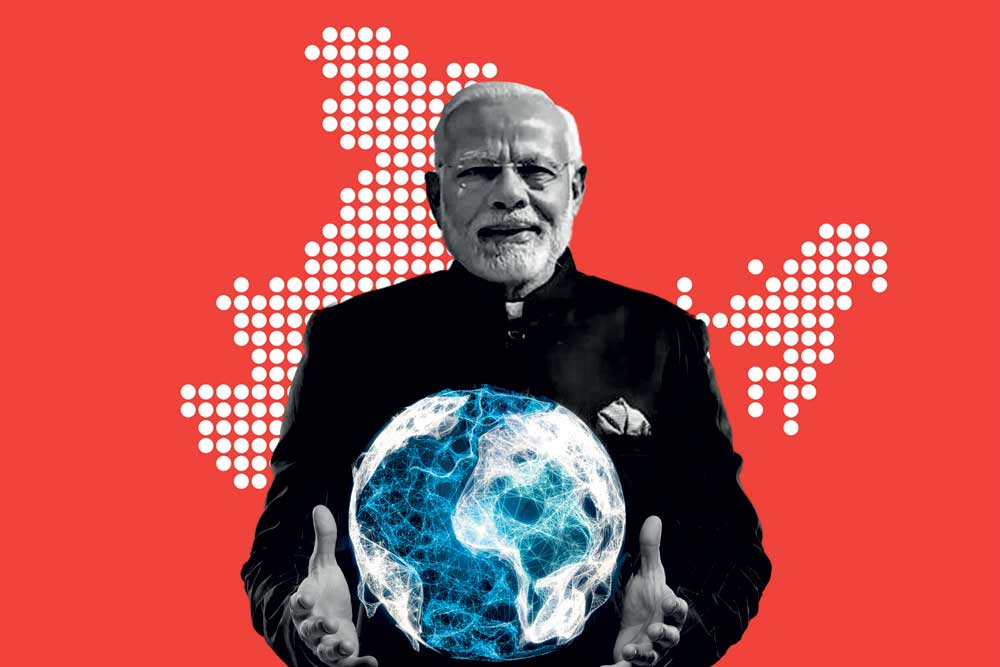
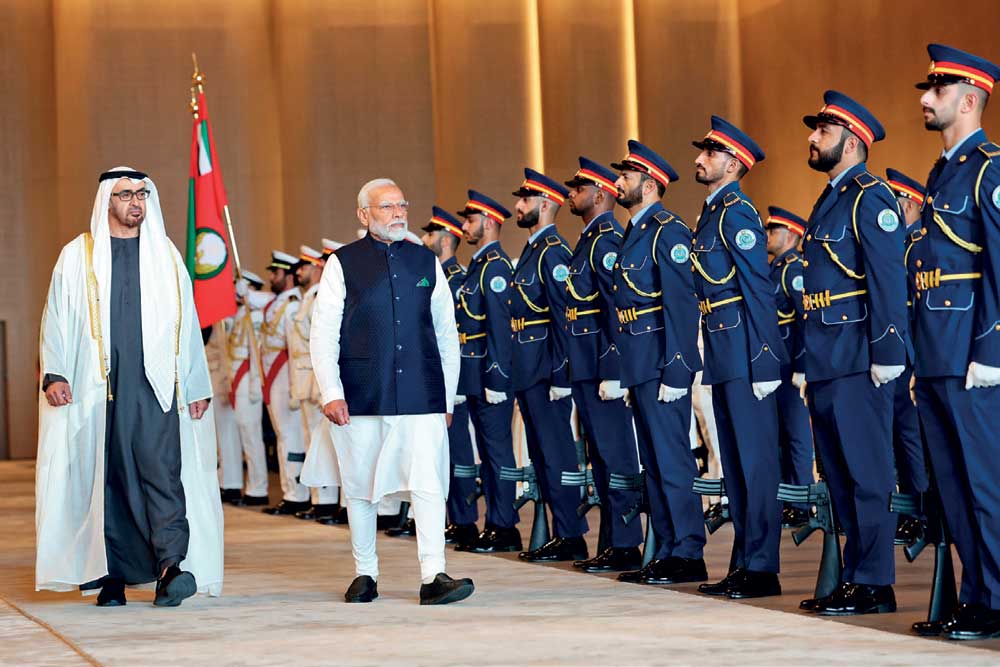
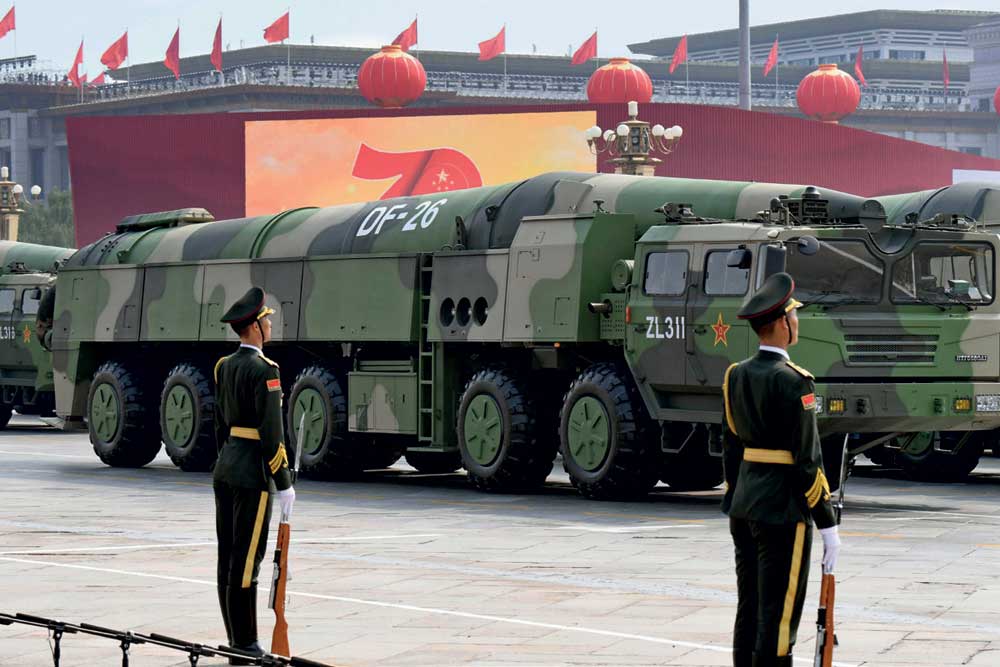
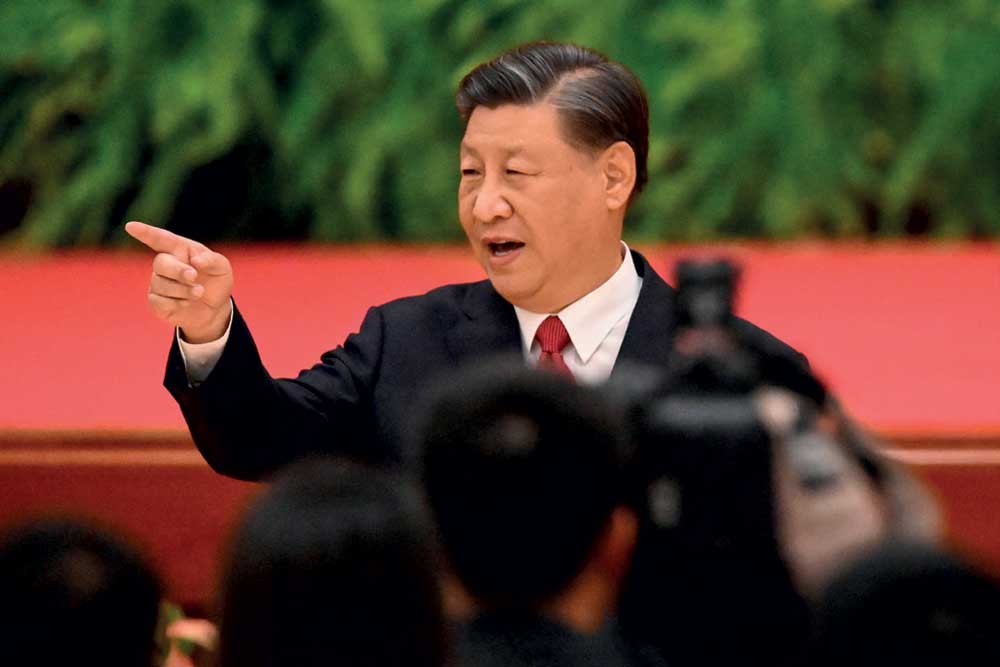
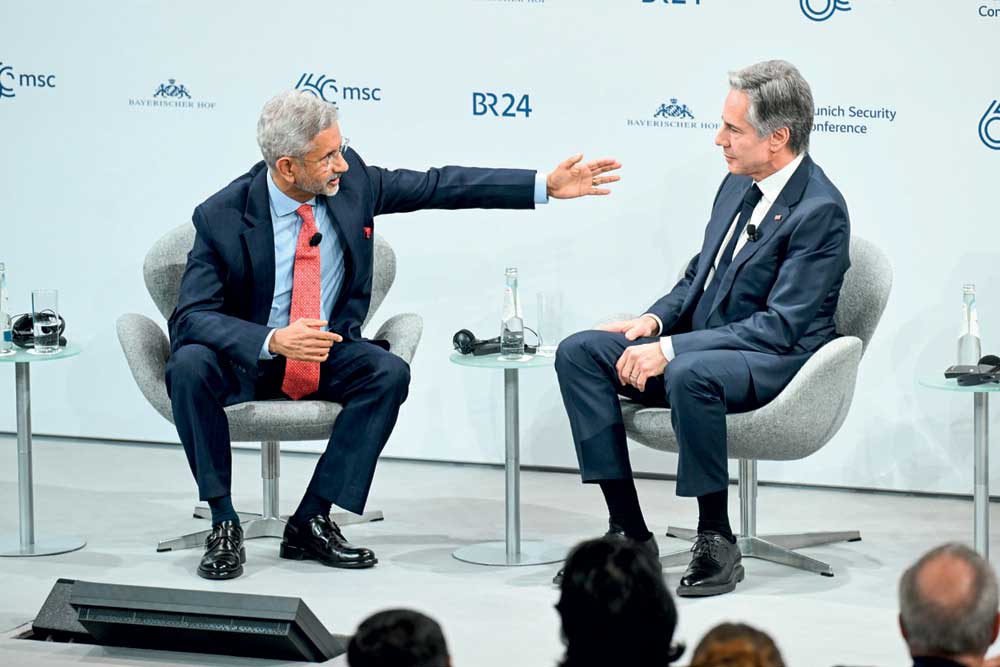


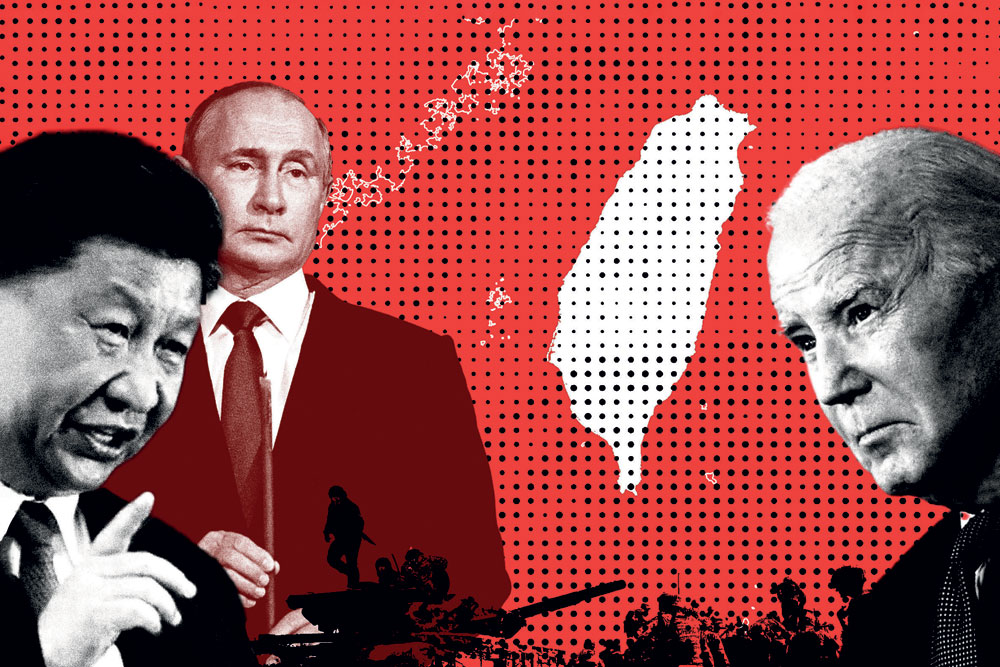 A profound geopolitical reconfiguration is in the making, especially as the erosion in America’s leadership role accelerates.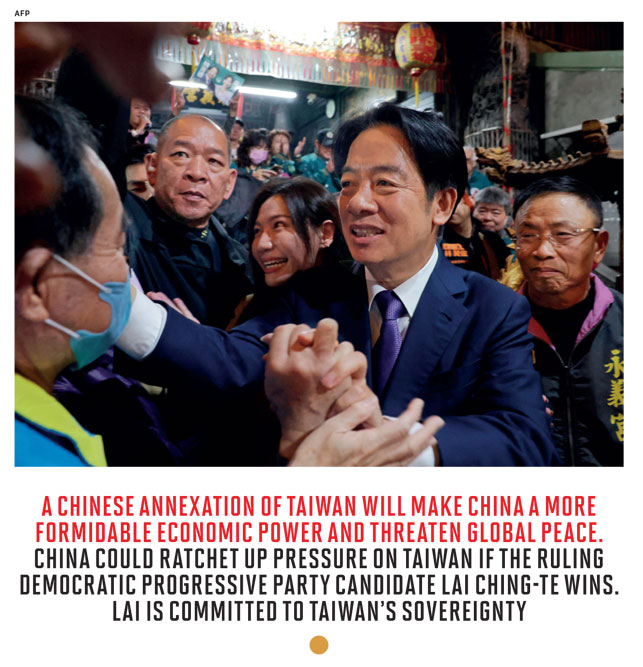
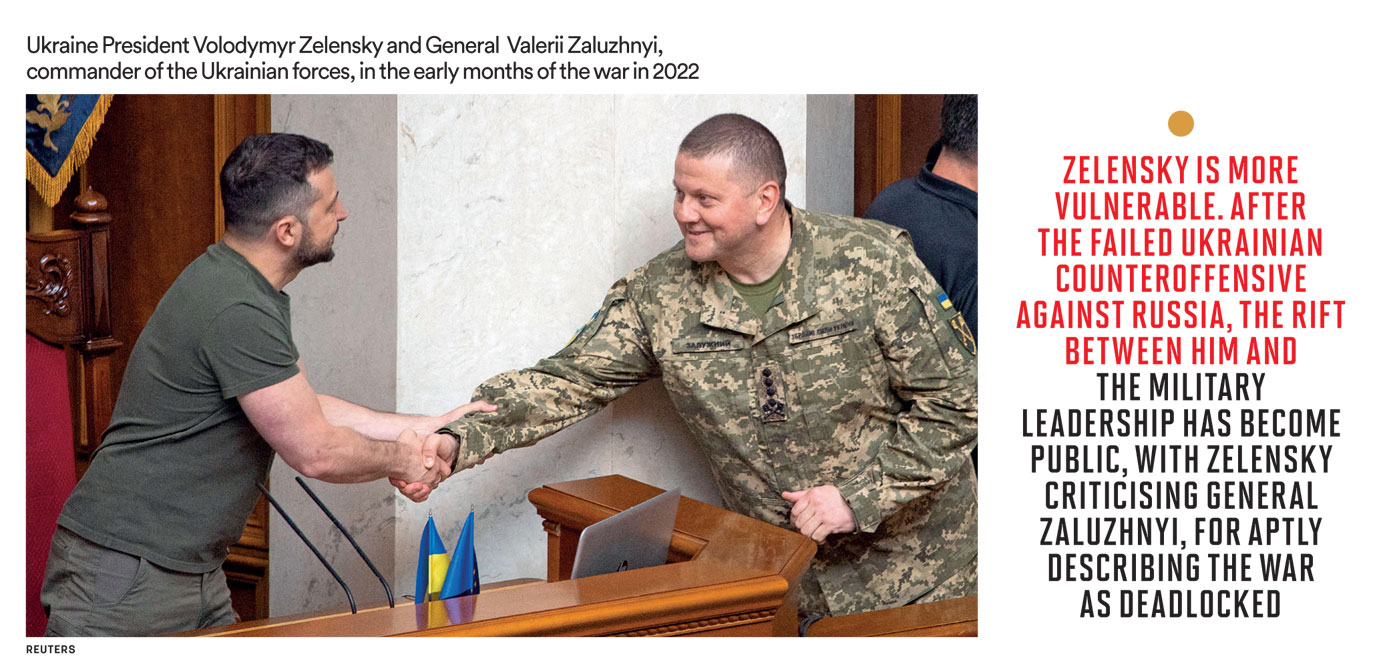
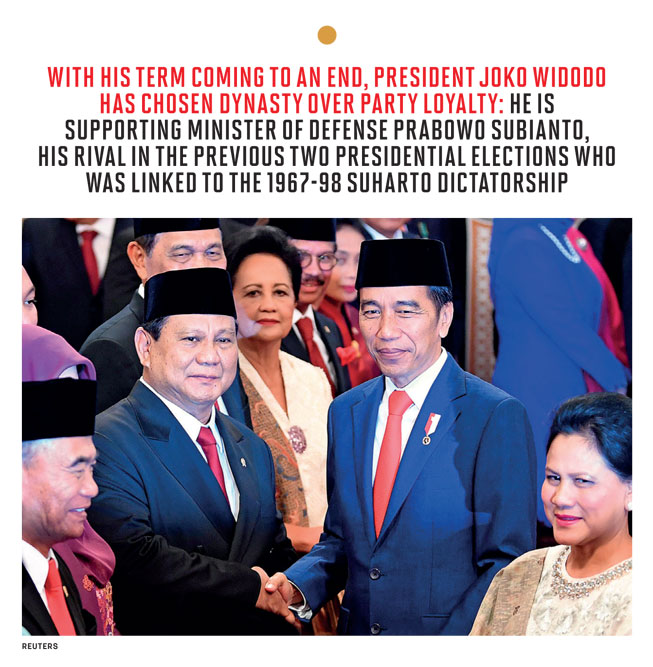
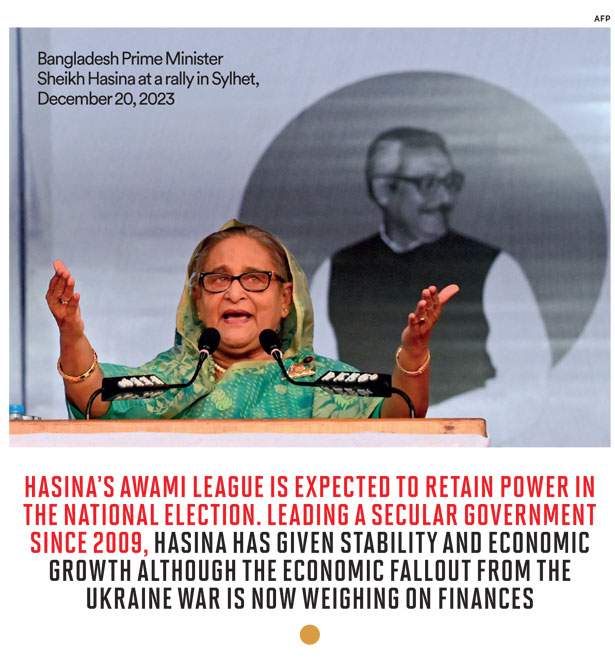

 Stagecraft and Statecraft
You must be logged in to post a comment.