The perceptible decline of political ethics in many democracies, coupled with hyperpartisanship, is fostering incivility in discourse and greater discord. This, in turn, is hardening political polarization and stoking incendiary rhetoric, despite risks of it breeding extremism and violence.
The spotlight on the attempted assassination of former U.S. President Donald Trump, who has gone from being an alleged promoter of political violence to a victim of it, should not obscure the fact that toxic discourse has become a central challenge for democracies from Europe and North America to Asia.
In polarized times, the national discourse often reeks of partisanship and pettifoggery. Fake news, conspiracy theories and fear-mongering, meanwhile, have become common, thanks to the reach of social media and the eroding objectivity of the mainstream media.
Worse still, tolerance for opposing political views is now increasingly in short supply. In fact, rival political forces have self-segregated themselves into their own ideological silos, unwilling to have dialogue across the deep divide. Distrust, contempt and anger define such broken politics.
Without the inflammatory political rhetoric giving way to civil discourse, democratic challenges will likely intensify, possibly tipping into violence.
The crisis of democracies has come ominously at a time when authoritarians are on the march, resulting in a decline in global freedoms. An estimated 72% of the world’s population now lives in autocracies.
The coarsening of public discourse and the strengthening of divisive politics in democracies are rooted in increasing polarization, with rival political parties or leaders peddling disinformation and denouncing each other as “extremist” or a “threat” to democracy. Political opponents are targeted by whatever means possible, as they are seen not as rivals but as enemies.
The fever of polarizing politics also persists because the quality of political leadership has declined across the democratic world. Instead of advancing political compromise and national unity, many leaders have fanned the embers of divisive politics.
The larger threat from bitterly polarized politics was laid bare in May when Prime Minister Robert Fico of Slovakia was shot multiple times at close range by a gunman. Fico’s allies accused his liberal opponents of creating the atmosphere for the assassination bid, just as Republicans in the U.S. have blamed what they say is inflammatory rhetoric from President Joe Biden’s reelection campaign for the attempt to kill Trump.
The attempt on Trump’s life occurred in the context of a poisonous U.S. political environment, which is accelerating the decline of political and legal norms and even degrading institutions. An earlier poll found that more than two-thirds of Americans believe U.S. democracy is broken.
The left’s surge in the recent British and French elections may have bucked the rightward trend in European politics but it has underscored the intensifying polarization in Europe, whose widening political divides threaten to resurrect the violent ghosts of its past. Internal divisions have produced political gridlock in France, which is looking nearly ungovernable at present.
Extreme polarization is also blighting a number of non-Western democracies, ranging from Brazil and South Africa to Israel and South Korea.
In India, for example, hyperpartisan politics have been plumbing new depths, poisoning national discourse, widening internal fault lines and threatening to tear it apart.
The narrow victory that Prime Minister Narendra Modi’s Bharatiya Janata Party secured in the recent election is fueling greater polarization by emboldening a reenergized opposition. This is redolent of how the U.S. emerged more divided and polarized from the 2016 and 2020 presidential elections. The BJP, in fact, has accused the opposition of inciting violence against Modi by using rhetoric similar to that which it says led to the attack on Trump.
By weighing down the world’s largest democracy, India’s debilitating polarization has made it virtually impossible to build consensus on tackling national challenges. By fanning hate and fear, divisive politics in India has even triggered riots in recent years, including over farm reform bills and passage of a legal amendment to grant citizenship to refugees who fled religious persecution from neighboring Islamic countries.
With the Indian discourse no longer about contending ideas, political parties openly pander to class, caste, ethnic and sectarian interests, thereby deepening the divides in society.
Against this backdrop, dealing with the broader crisis of democracies has become imperative. The crisis is fostering low public trust in governments.
The choice for democracies is to stay mired in polarized politics, with venomous discourse stoking hate and violence, or move toward national healing and unity. Today, every important democracy needs to be led by a unifier and not by a divider.
By keeping partisan warfare in check, divided democracies will be able to embrace traditions of pragmatic accommodation. But if little is done to transcend hardened polarization and heal the deep splits in democracies, national institutions could begin to decay, raising the specter of civil unrest.
The essence of democracy is that political battles are settled at the ballot box, not on the streets. It is time to move past the politics of polarization and vituperation.
Uncivil discourse must cease to help extinguish uncivil war. A little respect for political opponents would go a long way in lowering the temperature on partisan conflicts and helping to begin the process of reconciliation and healing.
Brahma Chellaney, a professor of strategic studies at the independent, New Delhi-based Centre for Policy Research and fellow at the Robert Bosch Academy in Berlin, is the author of nine books, including “Water: Asia’s New Battleground” (Georgetown University Press), which won the Bernard Schwartz Award.
Political malaise at home, by exposing chinks in the US armor, is fraying America’s global image and contributing to the decline of US global leadership. Alas, the attempt to assassinate Trump will likely widen domestic divisions and make political discourse more toxic.
The United States, which believes it is the leader of the ‘free world’ and the guardian of the ‘rules-based order’, faces a deepening political crisis at home that has engulfed its leadership and democracy. Lawfare (or using the legal system as a weapon against political opponents) and the politicisation of American courts are seen as posing a threat to due process and the rule of law.
It is telling that more than two-thirds of Americans, according to a Quinnipiac University poll, think US democracy is broken. One international study has even designated America a “backsliding” democracy.
Meanwhile, with the shifts in global economic and political power, America’s relative decline is accelerating. The US has only one challenger at the global level, China, which does not hide its ambition to emerge as the world’s foremost power. But through short-sighted policies, including a sanctions-centred approach, the US is inadvertently helping China to accumulate greater economic and military power.
Domestic maladies, for their part, are directly contributing to the decline of US global leadership. Hyper-partisan politics and debilitating polarisation, for example, impede the pursuit of long-term American objectives. In foreign policy, the partisan divide can be seen in divergent perceptions of international challengers to the US: Republicans are most concerned about China, while Democrats worry about Russia above all.
Political malaise at home, by exposing chinks in the US armour, is also fraying America’s global image. As former Australian Prime Minister Tony Abbott has put it, “a palpable loss of domestic confidence in the US is corroding America’s external projection and potency.”
Lawfare, by laying bare the manipulation of the judicial system by the Justice Department and district attorneys, is backfiring on the ruling Democratic Party by helping to make former President Donald Trump a stronger candidate for the November presidential election. By citing the principle that no one is above the law, Democrats have waged an unprecedented legal offensive against Trump in an effort to derail his candidacy, hoping that the legal system would box him in.
Instead, the different cases against him not only helped Trump cruise to an easy victory in the Republican Party primaries but also have boosted his bid to win the November election. The day Trump was convicted in Manhattan of falsifying records to cover up hush-money payment to a porn star, small donors contributed a record-shattering $34.8 million to his campaign.
The politicisation of the judicial system has raised the spectre of retaliatory Republican lawfare in future. But, fortunately, the recent US Supreme Court decision effectively shielding Trump from prosecution for actions he took as president blocks a future Republican administration from seeking retribution against President Joe Biden. By ruling that a president enjoys immunity from criminal prosecution for actions within his core constitutional duties, and presumptive immunity for other official acts, the judgment protects every president from partisan prosecutors.
However, hardened polarisation and partisan attacks on institutions are contributing to a systemic loss of faith. Consider the Democratic Party’s vitriol against the Supreme Court over its recent judgments on several key issues, including presidential immunity. Or take the alarming poll finding that about one-third of Americans still believe that Biden did not legitimately win in 2020 because the election was rigged.
With India gaining greater salience in American policy, the general trajectory towards closer Indo-US strategic cooperation is unlikely to be altered after Biden is out of office. There is strong bipartisan support in Washington for deepening the US engagement with India. Indeed, the US-India relationship serves as the fulcrum of America’s Indo-Pacific strategy
Even public trust in scientists has declined sharply in the US, thanks to Covid-era excesses, according to a Pew Research Center survey. Nearly 40 per cent of Republicans or Republican-leaning independents have little or no confidence in scientists.
As if all that were not bad enough, the US has finally woken up to the unpalatable reality that its sitting president, Joe Biden, may not be up to the task due to cognitive decline.
But contrary to how the US mainstream media is portraying it, America’s Biden problem did not arise all of a sudden. In fact, the mainstream media was more than complicit in ignoring or obscuring over several years the president’s cognitive decline.
To be sure, Biden performed poorly in his first debate with his political opponent, Trump. Biden repeatedly appeared to lose his train of thought during the June 27 debate. He frequently paused and stumbled over words, struggling to present a coherent and cogent narrative.
Biden’s cognitive issues have been apparent since at least 2020. But the increasingly partisan US mainstream media chose not to report on the state of Biden’s mental health until the decline progressed to such an extent that the president virtually crashed in the debate with Trump. The major media outlets then reacted with shock, as if they had been unaware of Biden’s diminishing physical and mental capacities.
THE LEADERSHIP CRISIS
The American ‘deep state’ has a long record of concealing, with the help of a pliable media, the significant physical or mental disability of a sitting president or a favoured presidential nominee.
Take the example of two icons of the modern Democratic Party, Woodrow Wilson and Franklin D Roosevelt, both of whom are still placed in the ranks of America’s greatest presidents.
After President Wilson suffered a paralysing stroke in October 1919 that left him incapacitated until the end of his presidency in March 1921, his wife, despite little formal education, ran the government for the remainder of his term, without the public knowing about it. The wife, Edith Wilson, effectively became America’s first woman president months before women officially won the right to vote in the US.
Roosevelt, a polio survivor, won the presidency by a landslide in 1932 with most Americans unaware that their president had to spend much of his time in a self-designed wheelchair. According to the 2003 book, <FDR’s Body Politics: The Rhetoric of Disability> by academics Davis W Houck and Amos Kiewe, “Roosevelt’s disability was carefully concealed not only from the media, and thus the public, but also from some members of his own family.” The Secret Service was tasked to prevent the press from taking a photograph of FDR in a “disabled or weak” state. Still, FDR won the presidency four times—twice during the Great Depression and twice more during World War II. As Allied forces were nearing victory in World War II, Roosevelt’s health deteriorated steadily before he died of a stroke.
Biden stumbles and falls at the United States Air Force Academy Graduation Ceremony in Colorado Springs, June 1, 2023 (Photo: AP)
Less than two months after he took office, Biden, while climbing up to board Air Force One, tripped three times on the stairs. But the fall, like other subsequent incidents, was obscured or played down by the mainstream media. In the three-and-a-half years that Biden has been in office, he has grown increasingly frail and forgetful
Against this backdrop, the American mainstream media, in one of the worst journalistic cover-ups in decades, hid from the public Biden’s increasing cognitive decline. Right through his presidency, Biden’s cognitive issues have largely confined him to carefully scripted public appearances.
Without relying on teleprompters and pre-written scripts, Biden not only has had difficulty in publicly articulating his ideas or thoughts or making policy-related comments, but he also has tended to stumble over words and speak incoherently.
The major media outlets turned on Biden only when their cover-up became impossible to sustain. As if acting on cue, the entire mainstream media, after his halting debate performance, began suddenly calling on the president to exit the presidential race.
But more than the poor debate performance, it was polls since May showing that Biden is losing to Trump that set off alarm bells in the ‘deep state’, which is determined to stop the former president from returning to the White House by whatever means possible. This then led to the media just turning on Biden. Now the mounting crisis threatens to topple Biden’s presidency.
The truth is that concerns about Biden’s mental acuity and physical fitness first surfaced during his 2020 presidential campaign, when he limited his campaigning and used teleprompters even for basic stump speeches to small audiences. Those concerns amplified after he entered the White House in January 2021.
Less than two months after he took office, Biden, while climbing up to board Air Force One, tripped three times on the stairs, falling to his knees the third time, despite having his hand on the railing for support. But the fall, like other subsequent incidents, was obscured or played down by the mainstream media. Instead, the major US media outlets ran speculative and baseless stories about Russian President Vladimir Putin being “seriously ill”.
In the three-and-a-half years that Biden has been in office, he has grown increasingly frail and forgetful. Biden’s history of two brain aneurysms, high cholesterol and the heart condition atrial fibrillation are all risk factors for cognitive decline.
Biden’s unscripted public events have been rare. But even at scripted events, Biden has often appeared confused in the past one year about where to exit a podium after having finished delivering prepared remarks. This has led his staff to provide him detailed visual instructions on how to enter and exit a podium.
Meanwhile, Biden’s gaffes have increasingly drawn attention to his declining memory. Earlier this year, for example, he mixed up French President Emmanuel Macron with ex-President François Mitterrand, who died in 1996. Answering a question about the Israel-Hamas negotiations over hostages, Biden appeared confused and disoriented, unable to recall even Hamas’ name. And at a South Carolina rally, he called Trump the “sitting president”.
Yet, scoffing at Republican Party efforts to keep questions about Biden’s mental health front and centre, the US mainstream media insisted since 2021 that there was virtually no evidence to indicate the president was in cognitive decline.
Even Special Counsel Robert Hur’s report that depicted the president as suffering from mental decline was dismissed as a partisan job. The report, released in February, described Biden’s memory as “hazy”, “fuzzy”, “faulty”, “poor”, and having “significant limitations” and said the 81-year-old president displayed “diminished faculties”.
US Vice President Kamala Harris in New Orleans, July 6, 2024 (Photo: Getty Images)
A campaign has begun to replace Biden with vice president Kamala Harris as the presidential nominee. Democratic party strategists are already working to build up Harris, with a leaked ‘case for Kamala’ document stating that the ‘most important priority above all others is defeating Donald Trump’
Despite the media cover-up, ordinary Americans understood the risk to the nation posed by Biden’s diminished physical and mental capacities. Almost a year ago, an important poll found that three-quarters of American adults believed that Biden was too old to effectively serve another four-year term as president. And according to another poll, which was released in May 2023, 62 per cent of respondents said that Biden’s mental competence was a concern.
Yet, to stop Trump, Democrats and the media continued to shield Biden so as to help re-elect him, despite growing evidence that he would not be capable of serving four more years in office. With no real challenger in the primaries, Biden unofficially clinched the Democratic Party nomination as early as March in a process that was much shorter than the one in 2020.
But now the pendulum has swung to the other extreme, with major media outlets going after Biden harshly. They are spearheading a campaign—in breach of media ethics—to force him out.
The New York Times, which claims to strive to maintain the highest standards of journalistic ethics, published a supposedly investigative story on July 2 that said several people who had encountered Biden behind closed doors noticed “he increasingly appeared confused or listless, or would lose the thread of conversations”—the very evidence the newspaper ignored for over four years despite its open availability.
The US media narrative for four years until recently was that America’s big problem is not Biden but the menace to US democracy posed by Trump. Biden himself has hawked the narrative that American democracy hangs in the balance, even declaring that “democracy is on the ballot in the 2024 election”.
Yet, ironically, a Washington Post-Schar School poll released last month showed that over half of American voters in six key battleground states view Biden as a threat to US democracy and not its saviour. Indeed, 44 per cent of the respondents said that Trump would do a better job in protecting American democracy, while only 33 per cent believed Biden would be better. “Those most sympathetic to an authoritarian form of government,” according to the <Washington Post> analysis of the poll, “include demographic groups that have traditionally voted heavily Democratic.”
This is an international reminder that those loudest in claiming that their political rivals pose significant threats to democracy are often perceived by a majority of voters as the real threats to democracy because of their actions. In India, for example, those who oppose even parliamentary references to the draconian 1975-77 Emergency rule claim that the present government, despite recently being elected to a third term, poses a unique threat to Indian democracy.
Today, US Democrats and their media allies, by stepping up pressure on Biden to withdraw, are openly rejecting the result of the primaries. They want to effectively invalidate the 14 million votes Biden received (87 per cent of the total) in a democratic nominating process.
Until Biden’s cognitive impairment started becoming a political liability, the ‘deep state’ was pretty happy with him, as he largely delivered on its demands, including in the Ukraine war. But in the weeks before the debate, Biden’s approval rating began slipping sharply and polls showed that he would lose to Trump. To the ‘deep state’, nothing on Earth is more important than defeating Trump.
Against this backdrop, Biden appears to have outlived his utility for the ‘deep state’ as his impairment makes him a weak candidate against Trump. In keeping with the Anglo-American saying, “Never let a good crisis go to waste,” Biden’s debate performance became a convenient handle to launch a campaign of sustained pressure to make him end his 2024 candidacy.
There is now even quiet discussion on Capitol Hill about whether the constitution’s 25th Amendment could be invoked to remove Biden from office. The amendment permits a president who is “unable to discharge the powers and duties of his office” to step aside or be removed and have the vice president “immediately assume the powers and duties of the office as Acting President.”
Donald Trump, Melania Trump, and Prime Minister Narendra Modi at the ‘Namaste Trump’ event in Ahmedabad, February 24, 2020 (Photo: AP)Biden and Modi at the G20 Summit in New Delhi, September 9, 2023 (Photo: AFP)
Trump built a personal rapport with Prime Minister Modi. During his February 2020 visit to India, Trump spoke at the largest rally any American president has ever addressed. Those were the Halcyon days of the Us-India relationship. The Biden administration has sustained the momentum with India. Biden’s personal interactions with Modi have been characterised by ease and warmth
But invoking the 25th Amendment is clearly a long shot. More practically, a campaign has begun to replace Biden with Vice President Kamala Harris as the presidential nominee. Democratic Party strategists are already working to build up Harris, with a leaked ‘Case for Kamala’ document stating that the “most important priority above all others is defeating Donald Trump.”
Until recently, as one prominent American newspaper put it, Harris was “an afterthought and a punchline in the party.” Harris has had a low favourability rating all along. A poll last month showed her to be as risky for the Democrats as the president: Biden at 43 per cent favourable and 54 per cent unfavourable; Harris at 42 per cent favourable and 52 per cent unfavourable.
In this light, what explains the fact that Democrats are starting to coalesce behind Harris as the best option to replace Biden? It is all about money.
The party has contenders whose favourability ratings may be better than Harris, including California Governor Gavin Newsom, Michigan Governor Gretchen Whitmer and Pennsylvania Governor Josh Shapiro. But only Harris, as the president’s running mate, would lawfully be able to use the huge funds already raised by Biden’s campaign committee. At the beginning of this month, Biden had $240 million in cash on hand.
If stepped-up pressure eventually forces Biden to exit the presidential contest, it would deny Republicans their weakest opponent, upending Trump’s re-election prospects.
THE POST-BIDEN ERA
With India gaining greater salience in American policy, the general trajectory towards closer Indo-US strategic cooperation is unlikely to be altered after Biden is out of office. There is strong bipartisan support in Washington for deepening the US engagement with India. Indeed, the US-India relationship serves as the fulcrum of America’s Indo-Pacific strategy.
Booming American exports to India, the world’s fastest-growing major economy, reinforce such bipartisan support. The US has already become an important source of crude oil and petroleum products for India, the world’s third-largest oil consumer after America and China. And American arms exports to India now run into billions of dollars yearly.
No American administration can ignore the fact that India’s international profile and geopolitical weight are on an upward trajectory. The world’s largest democracy is now the world’s fifth-biggest economy, after surpassing Britain in 2023. By next year, India is set to become the third-largest economy by overtaking both Japan, which is straining to avert recession, and former economic powerhouse Germany, currently the worst-performing developed economy.
Russian President Vladimir Putin and Chinese President Xi Jinping in Beijing, May 16, 2024 (Photo: Getty Images)
Today, with its global supremacy eroding, the US’ principal adversaries, China and Russia, deepen their entente. Instead of driving a wedge between these two natural competitors, US policy has helped turn China and Russia into close strategic partners
India’s incredible economic growth has made it a crucial pillar of the global economy. India is projected to account for 12.9 per cent of all global growth between 2023 and 2028, more than America’s share of 11.3 per cent.
When Biden unveiled his administration’s “free and open Indo-Pacific strategy” in 2022, it largely mirrored the strategy of his predecessor, Trump. The Trump administration’s Indo-Pacific strategy was declassified in early 2021 just before the Biden administration took office. That declassified document gave India pride of place in American strategy, saying a “strong India” will serve as a “counterbalance to China”. It also committed to “accelerate India’s rise and capacity to serve as a net provider of security.”
Today, with its global supremacy eroding, the US needs India, especially as its principal adversaries, China and Russia, deepen their entente. Instead of driving a wedge between these two natural competitors, US policy has helped turn China and Russia into close strategic partners. If the US is not to accelerate its relative decline through strategic overreach, it has to build closer collaboration with India.
Indo-US relations thrived during the Trump presidency. The Trump administration instituted fundamental shifts in US policies towards China and Pakistan, India’s regional foes, whose strengthening strategic axis imposes high security costs on India, including raising the spectre of a two-front war. In his most lasting legacy, Trump, by instituting a paradigm policy shift, reversed the US policy since the Nixon era of aiding China’s rise. His administration also cut off security aid to Pakistan for not severing its ties with terrorist groups.
Moreover, Trump built a personal rapport with Prime Minister Narendra Modi, with whom he shared a love for big audiences and theatrics. Trump joined Modi’s September 2019 public rally in Houston, attended by 59,000 Indian-Americans and a number of US Congressmen and Senators. Then, during his February 2020 standalone visit to India, Trump spoke at the largest rally any American president has ever addressed—at home or abroad.
More than 100,000 people packed the world’s largest cricket stadium in Ahmedabad as Trump declared, “America loves India, America respects India, and America will always be faithful and loyal friends to the Indian people.” After returning home, Trump called India an “incredible country”, saying, “Our relationship with India is extraordinary right now.” Those were the halcyon days of the US-India relationship.
To be sure, the Biden administration has sustained the momentum in the relationship with India. This has little to do with Vice President Harris’ Indian heritage. The fact is that the Biden administration has recognised India’s centrality in an Asian balance of power. Biden’s personal interactions with Modi have been characterised by ease and warmth.
But the Biden administration has also struck some discordant notes. For example, after the Russian invasion of Ukraine, it tried in vain to force New Delhi to choose between Washington and Moscow. Biden’s top economic adviser, Brian Deese, crassly threatened that “the costs and consequences” for India would be “significant and long-term” if it refused to take sides. And Biden’s Secretary of State, Antony Blinken, has repeatedly taken a swipe at India over alleged human rights abuses.
It has also become increasingly apparent that America under the Biden administration has no intent to forego the Sikh militancy card that it holds as potential leverage against India. US security agencies continue to shelter and shield Khalistani extremists, despite some of these US-based militants making terrorist threats against India from American soil.
For example, the New York-based militant Gurpatwant Singh Pannun warned Air India passengers last November that their lives were at risk while threatening not to let the flag carrier operate anywhere in the world. Pannun had previously threatened to also disrupt Indian Railways and thermal power plants, according to India’s National Investigation Agency.
Still, the strategic partnership between the US and India is likely to continue strengthening over the long term because it serves both countries’ interests and is pivotal to building power equilibrium in the Indo-Pacific region. The post-Biden era will come with its own opportunities and challenges for India.
India appears to be having second thoughts about its involvement in the Shanghai Cooperation Organization as the group’s anti-Western orientation is increasingly at odds with the subtle pro-Western tilt of Prime Minister Narendra Modi’s foreign policy.
New Delhi’s creeping doubts about the SCO were first evident last year when as rotating host of the group’s annual leaders’ summit, Modi chose to convene the meeting online rather than in person. And this month the prime minister skipped the latest summit held in Astana.
India’s growing discomfort stems in part from the fact that rival China is increasingly in the driver’s seat at the SCO. In fact, except for India, the other members of the SCO are all participants in China’s Belt and Road Initiative, which New Delhi has opposed since its launch as a neocolonial enterprise. India can also be said to be the only full democracy among the SCO’s nine member states.
The SCO was launched in Shanghai in 2001 by the leaders of China, Russia, Kazakhstan, Kyrgyzstan, Tajikistan and Uzbekistan. China has spearheaded the subsequent evolution and expansion of the group, while calling on other members to uphold shared values that it labels as the “Shanghai Spirit.”
Much as China has blocked India from joining the 48-nation Nuclear Suppliers Group pending agreement that its strategic ally Pakistan be simultaneously admitted, Beijing also made sure Islamabad was brought into the SCO alongside New Delhi in 2017.
The Sino-Pakistan strategic alliance against India is just one example of the disparate interests at play in the SCO, hindering its transformation into a more powerful and cohesive bloc like the Group of Seven.
Against this backdrop, why did the Modi government agree to join the SCO in the first place?
The decision related in part to India’s known proclivity to hedge its bets. In an era of sharpening geopolitical competition, New Delhi has remained loath to be associated with any power bloc, preferring to be seen as the world’s ultimate “swing state” amid the transition from the post-World War II U.S.-led international structure to a new global order whose contours are still not clearly visible.
In this way, India likely believed SCO membership could help balance its international relationships, including the perception that it was tilting toward the West. The SCO was also viewed as the only multilateral forum that could link India with the countries of Central Asia.
In line with the ancient saying, “Keep your friends close and your enemies closer,” advocates of India’s entry argued that the presence of China and Pakistan in the SCO should not be a reason to hold back from participating.
Seven years later, however, it is becoming apparent that the SCO carries diminishing value for Indian foreign policy.
To be sure, the participation of India, the world’s largest democracy and now the fastest-growing major economy, has helped confer a new level of international legitimacy on the SCO, which can otherwise be branded as an anti-Western club of autocracies, especially following Iran’s admission last year.
For Beijing and Moscow, the SCO is a symbol of their deepening cooperation, which has included holding joint military exercises with other bloc members, including drills with Iran in the Gulf of Oman in March.
Indeed, China and Russia see the SCO as constituting an Eurasian alliance to counter Western domination. It serves as their response to U.S. President Joe Biden’s narrative that the world is witnessing a “battle between democracy and autocracy, between liberty and repression, between a rules-based order and one governed by brute force.”
India’s presence in the SCO not only undermines the framing of global tensions as pitting democracy against autocracy, but also helps to blunt the tagging of the SCO as an anti-Western grouping.
But what does New Delhi get in return? In truth, India secures little tangible strategic benefit. At best, the SCO holds just symbolic value for India by underscoring the independence of its foreign policy and its commitment to multialignment.
In the new global divide between the Western bloc and the emerging China-Russia strategic axis, India wants to serve as a bridge. But India, Russia and China are also members of the BRICS bloc, launched in 2009, so New Delhi does not need to be in the SCO to act as a bridge between world powers.
Furthermore, India’s membership of the SCO, originally established as a regional security bloc, appears incongruent with its close ties with the West and its support for a free, open and democratic-led Indo-Pacific region. Notably, China and Russia reject the very term “Indo-Pacific,” insisting that the region still be called the Asia-Pacific.
In fact, China’s championing of the Shanghai Spirit, which it says is anchored in mutual trust, mutual benefit, equality and consultation, seems hollow, given how its furtive encroachments on Indian borderlands have triggered a tense military standoff for more than four years.
In this light, Modi has made a good call by deciding to give the Astana summit a miss. Government officials are offering the excuse that he will be tied up with parliamentary proceedings. But Modi has previously traveled overseas even when Parliament has been in session.
India increasingly appears to be a misfit in a grouping whose aims and objectives it does not fully share. Even as it hews to its independent approach to international affairs, Modi has come to be seen as the country’s most pro-U.S. prime minister ever.
India has now ratified the four “foundational” agreements that all close U.S. defense partners are expected to sign. Under Modi, India has also become more closely integrated into the Quad, including hosting its fellow members in drills wrapped into its annual Malabar naval exercises.
Modi’s withdrawal from the Astana summit does not mean of course that India intends to opt out of the SCO. Rather, it signals that India recognizes not only the SCO’s limitations but also the grouping’s declining salience for its foreign policy.
Brahma Chellaney is professor emeritus of strategic studies at the Centre for Policy Research in New Delhi and a former adviser to India’s National Security Council. He is the author of nine books, including “Water: Asia’s New Battleground.”
The alliance of convenience between Russia and China threatens not only to accelerate an increasingly overstretched America’s relative decline, but also to erode Indian security. India now must take advantage of its relationship with Russia to mediate an end to the Ukraine war and drive a wedge between Russia and China.
Indian Prime Minister Narendra Modi’s first visit to Russia in five years underscored the strategic importance India attaches to its relationship with Moscow. Indian leaders view that relationship as essential to a balanced foreign policy – especially at a time when India seems, at least to some, to be subtly tilting toward the West – and to provide strategic leverage against China.
Russia and India started holding annual summits in 2000. After Russian President Vladimir Putin’s 2021 trip to New Delhi, it was Modi’s turn to visit Moscow in 2022. But in the wake of Russia’s full-scale invasion of Ukraine – which spurred the United States and its partners to impose unprecedented sanctions on the country – Modi kept deferring his visit. (He did meet Putin in 2022 on the sidelines of a regional summit in Uzbekistan, where he told the Russian leader that it was no time for war.)
Today it is apparent that Russia has neither been isolated internationally nor hobbled economically, despite the West’s best efforts. So, after narrowly winning a third term last month, Modi announced that he would take his long-delayed trip to Moscow. The objective is not to take Russia’s side; on the contrary, at last month’s G7 meeting in Italy, Modi embraced Ukrainian President Volodymyr Zelensky and engaged in bilateral discussions with him. Rather, Modi seeks to affirm India’s enduring foreign-policy independence, while reaping the strategic benefits of closer ties with Russia.
India’s relationship with Russia dates back to 1971, when India was at its most vulnerable. The Pakistani military was attempting to crush the independence movement in then-East Pakistan – now Bangladesh – by any means necessary. Up to three million Bangladeshi civilians (mainly Hindus singled out by Pakistan’s Muslim army) were slaughtered, some 200,000 women were coerced into rape camps, and about ten million people fled to India.
The US was more than complicit in the carnage. Far from pushing back against Pakistan’s military dictator, General Yahya Khan, US President Richard Nixon’s administration maintained friendly relations with him, in order to advance US interests in Asia. While Khan’s army carried out the genocide in East Pakistan, Nixon sent his national security adviser, Henry Kissinger, from Pakistan to Beijing on his now-famous secret trip, which led to Nixon’s own visit to China in February 1972.
At a White House meeting, Kissinger credited Khan for the success of his “cloak and dagger” diplomacy with China, joking coldheartedly, “Yahya hasn’t had such fun since the last Hindu massacre!” On a memorandum from Kissinger regarding the crisis, Nixon wrote, “To all hands: Don’t squeeze Yahya at this time.”
But that was not all. In an effort to prevent Bangladesh from achieving independence, Nixon pressed China to open a military front against India. It was Kissinger’s job to goad the Chinese into initiating troop movements toward the Indian border, according to declassified White House tapes and documents. Nixon went so far as to tell Kissinger that India needed a “mass famine.”
Faced with such hostility, India’s then-Prime Minister Indira Gandhi concluded a friendship treaty with the Kremlin. The pact’s security provisions helped to deter China from opening a front against India when Indian forces eventually intervened to help Bangladesh gain independence in a swift, 13-day operation.
Nixon’s dissatisfaction was obvious: in a show of force aimed at coercing India into limiting its involvement, the US deployed a nuclear-capable naval task force off the southern tip of India. This gunboat diplomacy led India to conduct its first underground nuclear test in 1974; the US responded by imposing technology sanctions on India that remained in place for almost three decades. Meanwhile, the US and China helped Pakistan to build its own nuclear bomb.
Today, India maintains deeper and broader ties with the US than with Russia, but Nixon’s China opening still haunts the bilateral relationship. With its decades-long policy of aiding China’s economic rise, the US not only created the greatest strategic adversary it has ever faced, but also saddled India with a formidable military foe that is aggressively striving for regional hegemony. One manifestation of this is the Sino-Indian military standoff in the Himalayas, which is now in its fifth year.
This is a key motivation behind India’s efforts to strengthen its relationship with Russia, which India believes can counterbalance China. After all, Russia extends across 11 time zones and possesses huge reserves of natural resources, an enormous nuclear arsenal, increasing space prowess, and veto power at the United Nations Security Council. Moreover, Russia and China are natural competitors, with sharply diverging interests in Central Asia, Northeast Asia, and the Arctic, which each country regards as part of its strategic backyard.
Even so, Russia and China have been growing progressively closer in recent years – and it is largely America’s fault. This alliance of convenience – which Putin and Chinese President Xi Jinping have termed a “no-limits partnership” – threatens not only to accelerate an overstretched America’s relative decline, but also to erode Indian security. Already, China has leveraged its position as an economic lifeline for Russia to gain access to advanced Russian military technologies, which were previously sold only to India. In fact, no country is profiting more from the Ukraine war than China.
Someone must drive a wedge between Russia and China. With the US unwilling to take the lead, it is up to India to convince Russia not to align itself too closely with the People’s Republic. Fortunately, this is hardly an unrealistic proposition: though Russia’s promise to provide North Korea with immediate military assistance in the case of war is not good news, its new defense pact with China’s estranged client does suggest that Putin is willing to chart his own course.
The first step for India must be to try to mediate an end to the Ukraine war. This would allow the US to focus on bolstering security in the Indo-Pacific, thereby improving Taiwan’s chances of survival.
Brahma Chellaney, Professor of Strategic Studies at the New Delhi-based Center for Policy Research and Fellow at the Robert Bosch Academy in Berlin, is the author of nine books, including Water: Asia’s New Battleground (Georgetown University Press, 2011), for which he won the 2012 Asia Society Bernard Schwartz Book Award.
For over three years, all signs of President Biden’s cognitive decline have been ignored or obscured by his allies and the mainstream media. Even Special Counsel Robert Hur’s report just months ago highlighting Biden’s “poor memory” was dismissed as partisan hackery. Now America faces a leadership crisis at home when it is at a crossroads in a rapidly changing and increasingly volatile world.
Just when its principal adversaries, China and Russia, are more firmly aligned than at any time since the 1950s, and the dangers of an accidental NATO-Russia nuclear war cannot be discounted, the U.S. is looking overextended, with its military resources stretched thin due to its involvement in the wars in Europe and the Middle East.
The crisis in American leadership, and the fact that Russian President Vladimir Putin’s aggression in Ukraine has largely tied down the U.S. in Europe, might make Chinese President Xi Jinping believe that China has a window of opportunity to achieve the “historic mission” of forcibly incorporating Taiwan into the mainland Chinese state. Xi recently made his Taiwan goal clearer by declaring that the “essence” of his national rejuvenation drive is “the unification of the motherland.”
Putin, for his part, seems determined to get back at the West for its recent actions against Russia, including seizing Russian money to arm Ukraine.
Despite Putin’s warning of “serious consequences,” Biden has let Ukraine use American-provided weapons to strike deep inside Russia. Biden’s action to take the war inside Russia came after the U.S. followed Britain and France in sending long-range missiles to Ukraine for use far beyond Russian front lines.
Biden’s memory issues, including doing things that he had earlier pledged not to do, may well explain why his risk appetite has grown.
With the flow of sophisticated Western weapons to Ukraine failing to stem Russian advances or force Russia to retreat from the areas it has occupied, Biden has progressively escalated American involvement in the war by embracing ideas that he had earlier said were taboo. For example, he had categorically declared earlier that any Ukrainian attack on Russian territory with U.S.-supplied missiles would go against his mandate to “avoid World War III.”
To launch strikes deep inside Russia with U.S., British or French long-range weapons supplied to Ukraine, satellite reconnaissance data is needed, which Kyiv lacks. So, in effect, the supplier states have control over target selection and transmission of coordinates to Ukraine for striking Russian positions beyond Ukrainian borders.
Biden’s punitive focus on Russia has come at the expense of effectively countering the threat from America’s bigger challenger — China.
China has more than doubled its nuclear-weapons arsenal since 2020. It is also expanding its conventional forces faster than any other country has since World War II.
China already dwarfs Russia in terms of economic output, military spending and other material measures. As Biden acknowledged in his 2022 national security strategy, China is “the only country with both the intent to reshape the international order and, increasingly, the economic, diplomatic, military and technological power to advance that objective.”
Yet China has been the main beneficiary of Biden’s efforts to punish Russia for its invasion of Ukraine. Unprecedented sanctions, which have included weaponization of international finance, have been a boon for Beijing, turning it into Russia’s banker and expanding international use of the Chinese yuan. Russia now generates much of its international export earnings in the Chinese currency and keeps these proceeds mostly in Chinese banks, in effect giving Beijing a share of the returns.
For China, the longer the U.S. battles political malaise at home and stays distracted by conflicts elsewhere in the world, the better.
In fact, the likely defining moment that formally brings the era of America’s global preeminence to an end would be surprise Chinese aggression aimed at subjugating Taiwan. Such aggression could come sooner than many in Washington expect, given ominous signs that Xi is preparing his country for this war.
China’s recent military drills that encircled Taiwan seemed to be a rehearsal for implementing at least a blockade with the aim of slowly throttling the island democracy. Indeed, this was the third Chinese dress rehearsal in less than two years for an assault on Taiwan, with the latest drills more sophisticated, elaborate and geographically expansive than the previous exercises.
If Xi perceives a strategic opening to move against Taiwan without triggering a full-fledged war with the U.S., he will likely employ military force. Is the U.S. prepared for a Taiwan contingency?
America today is at a vulnerable moment. Political tumult and uncertainty at home could make it even more vulnerable to international geopolitical shocks.
Even if pressure from fellow Democrats and donors compels Biden to drop his bid for a second term, he would stay president for another six months. And he will still be dogged by doubts about his mental acuity and fitness to lead America in an increasingly turbulent and dangerous world. By advertising weakness, such a situation could embolden America’s adversaries to test U.S. resolve.
Much of the democratic world would like the U.S. to remain the preeminent global power. But, with hyper-partisan politics and profound polarization already weighing down American democracy, the U.S. confronts a leadership crisis at a critical juncture — when its adversaries are intent on reshaping the world by ending the era of American primacy.
Unfortunately, at home and abroad, the U.S. has become its own worst enemy. And it seriously risks accelerating its relative decline through strategic overreach under shortsighted leadership.
Brahma Chellaney is a geostrategist and the author of nine books, including the award-winning “Water: Asia’s New Battleground.”
With his relentless espousal of non-violence, the Dalai Lama embodies Tibetan resistance to Chinese occupation. This helps to explain why China is so intent on choosing his successor, and why the US and India must make sure that it does not.
As the Dalai Lama – the spiritual leader of Tibet – visits the United States to receive medical treatment on his knees, concerns over who will succeed him have become acute. While Tibetans around the world pray that the 88-year-old Tenzin Gyatso, the 14th Dalai Lama, still has plenty of life ahead of him, China is eagerly awaiting his demise, so that it can install a puppet successor.
Tibetans regard the Dalai Lama as the living incarnation of Buddha. Since 1391, the Dalai Lama has been reincarnated 13 times. When one Dalai Lama dies, the search for the next one begins, with a council of senior disciples taking responsibility for identifying him, based on signs and visions. But in recent years, the Chinese government has insisted that only it has the right to identify the next Dalai Lama.
This would not be the first time China selected a leader of Tibetan Buddhism. In 1995, it anointed its own Panchen Lama, whose spiritual authority is second only to that of the Dalai Lama, after abducting the actual Panchen Lama – a six-year-old boy who had already been confirmed by the Dalai Lama. Almost three decades later, the real Panchen Lama is among the world’s longest-serving political prisoners.
China also appointed the Karmapa, Tibetan Buddhism’s third most important spiritual leader and the head of the Karma Kagyu sect. But in 1999, its appointee, Ogyen Trinley Dorje, fled to India. The ease with which the 14-year-old Karmapa escaped China raised suspicions among Indians about his loyalties. After imposing travel restrictions on him, India decided in 2018 no longer to recognize the China-anointed Karmapa as the legitimate head of his sect. Now, he and his rival Karmapa, Trinley Thaye Dorje, have issued a joint statement pledging to cooperatively resolve the leadership split in the Karma Kagyu sect.
But the Dalai Lama is China’s “white whale.” The incumbent – who was identified as the Dalai Lama in 1937, at age two – has been a thorn in the side of the Communist Party of China (CPC) since China’s 1951 annexation of Tibet. With his relentless espousal of non-violence, the Dalai Lama, who won the Nobel Peace Prize in 1989, embodies Tibetan resistance to the Chinese occupation. (Had Tibet remained self-governing like Taiwan, it would be the world’s tenth-largest country by area.)
In his past incarnations, the Dalai Lama was not only Tibet’s spiritual leader, but also its political leader, making him a kind of cross between a pope and a president. But the Dalai Lama ceded his political role in 2011 to a Tibetan government-in-exile, which is democratically elected every five years by Tibetan refugees living in India and elsewhere.
Moreover, the Dalai Lama has declared that he might choose not to be reborn – a decision that would undermine the legitimacy of any Chinese-anointed successor. He knows that, for China, a Dalai Lama devoted to the CPC is much more useful than no Dalai Lama at all. He also knows that, while he has retained his mental acuity, his body is weakening. In 2016, he underwent radiation therapy for prostate cancer. He says he was “completely cured,” but he continues to struggle with his knees. Given his advanced age, more health problems are to be expected.
The Dalai Lama’s frailty is one reason why his travel schedule has slowed considerably. But it is not the only one: bowing to Chinese pressure, most countries – including European democracies and Asia’s Buddhist states (except Japan) – are unwilling to grant him entry. Fortunately, some countries have retained their backbones. The US is hosting the Dalai Lama for knee treatment, and India has proudly been his home for more than 65 years. India has officially designated the Dalai Lama its “most esteemed and honored guest,” while the Tibetan leader describes himself as a “son of India.”
In fact, India is home to the vast majority of Tibetan exiles, and has played a central role in helping to preserve the Tibetan culture, including by supporting Tibetan-language schools. By contrast, China has been working actively to destroy Tibetan culture and identity, especially since Chinese President Xi Jinping has been in charge.
Meanwhile, China’s appropriation of Tibetan natural resources has gone into overdrive, with consequences that extend far beyond the Tibetan Plateau. Resource-rich Tibet is a source of fresh water for more than one-fifth of the world’s population and a global biodiversity hotspot. The plateau influences Asia’s weather and monsoonal patterns, as well as the Northern Hemisphere’s “atmospheric general circulation” – the system of winds that helps transport warm air from the equator toward higher latitudes, creating different climate zones.
It is imperative that the US and India work together to foil China’s plan to handpick the next Dalai Lama. Already, America’s Tibetan Policy and Support Act, which took effect in 2020, says that “the wishes of the 14th Dalai Lama, including any written instructions, should play a determinative role in the selection, education, and veneration of a future 15th Dalai Lama.” And it calls for sanctions on Chinese officials who interfere with Tibetan Buddhist succession practices.
But more must be done. For starters, US President Joe Biden should take the opportunity presented by the Dalai Lama’s knee treatment to fulfill a 2020 campaign promise to meet with the Dalai Lama. More broadly, the US should work with India to devise a multilateral strategy to counter Xi’s plan to capture the more than 600-year-old institution of the Dalai Lama. This must include efforts to persuade the Dalai Lama to spell out, once and for all, the rules that must be followed to identify his successor.
Brahma Chellaney, Professor of Strategic Studies at the New Delhi-based Center for Policy Research and Fellow at the Robert Bosch Academy in Berlin, is the author of nine books, including Water: Asia’s New Battleground (Georgetown University Press, 2011), for which he won the 2012 Asia Society Bernard Schwartz Book Award.
Preserving its global dominance appears to have driven the West’s expanding involvement in the Ukraine conflict, with former British Prime Minister Boris Johnson recently arguing in a column that a Russian victory would be “a turning point in history, the moment when the West finally loses its post-war hegemony.” Such a decisive outcome, however, seems doubtful, given the attritional character of the Ukraine war and the progressively escalating Western involvement in the conflict.
The defining moment that formally brings the era of Western preeminence to an end is more likely to be a surprise Chinese aggression aimed at subjugating Taiwan.
With the wars in Ukraine and the Middle East testing U.S.-led alliances and with America already looking overextended, Chinese aggression against Taiwan could come sooner than many in U.S. policy circles expect.
There are ominous signs that Chinese President Xi Jinping is preparing his country for a war over Taiwan. But whether the U.S. is prepared to respond to such a contingency is becoming a vexed question, especially as international concerns grow that Xi might view America’s preoccupation with extended conflicts in Europe and the Middle East as a window of opportunity to act, without triggering a full-fledged war with the U.S.
The defense of Taiwan is assuming greater significance for international security for two other reasons. The first is the possibility that Xi might seek to replicate in the Taiwan Strait the techniques of incremental expansionism that his regime has successfully honed in the South China Sea without drawing a concerted U.S. response.
Tellingly, three successive U.S. administrations have failed to credibly push back against China’s intensifying expansionism in the South China Sea, relying instead on rhetoric or symbolic actions. As a result, the American debate now largely centers on how the South China Sea was effectively lost and what can be done now to respond to China’s increasingly aggressive sea tactics aimed at tightening its grip on this strategic corridor between the Pacific and Indian Oceans.
These tactics are triggering a number of incidents with other claimant states, particularly the Philippines and Vietnam, even as China seeks to interfere with U.S. and allied air and maritime transits.
China’s recent menacing military drills that encircled Taiwan seemed to be a rehearsal for implementing at least a blockade with the aim of slowly throttling the island democracy. In fact, this was the third Chinese dress rehearsal in less than two years for an assault on Taiwan.
Compared to the first large-scale Chinese military exercise in August 2022, when then-U.S. House Speaker Nancy Pelosi visited Taipei, the latest drills were more sophisticated, elaborate and geographically expansive.
The second reason is the U.S. failure to genuinely pivot to Asia and the wider Indo-Pacific, despite U.S. Defense Secretary Lloyd Austin claiming that this region is “our priority theater of operations” and “the heart of American grand strategy.”
A just-released book, “Lost Decade: The U.S. Pivot to Asia and the Rise of Chinese Power,” by two former American policymakers, Robert Blackwill and Richard Fontaine, bemoans that America’s “pivot to Asia” strategy (first unveiled in 2011) has failed thus far because a coherent approach to the Indo-Pacific remains largely absent. Consequently, the U.S. has been unable to respond adequately to China’s aggressive rise, in what the authors call one of the greatest mistakes in American foreign policy in the post-World War II period.
The plain fact is that, as long as conflicts elsewhere distract the U.S. from the pressing Asian security challenges, the Indo-Pacific is unlikely to become the hub of its grand strategy.
The latest American foreign assistance package that provides $60.8 billion for Ukraine and a meager $8.1 billion for Indo-Pacific security, including Taiwan, has dimmed the prospects of a correction in skewed strategic priorities. In fact, U.S. President Joe Biden recently plunged the U.S. deeper into the Ukraine war by permitting Kyiv to use American-donated weapons to strike inside Russia.
More fundamentally, the drawn-out Ukraine war is crimping America’s China policy and weakening its deterrent posture in the Indo-Pacific, thereby making a Taiwan Strait crisis more likely.
In an effort to forestall the U.S. from realizing its worst geopolitical nightmare, a formal Sino-Russian alliance, and to dissuade China from directly aiding the Kremlin’s war machine, Biden has been compelled to adopt a more conciliatory approach to Beijing.
This approach, in turn, is emboldening China vis-à-vis Taiwan. While stepping up coercive pressures on Taiwan, Beijing is making its ultimate goal clearer. Xi recently declared that the “essence” of his national rejuvenation drive is “the unification of the motherland.” And his new defense minister, Dong Jun, while accusing the U.S. of “malign intentions [that] are drawing Taiwan to the dangers of war,” told the annual Shangri-La Dialogue in Singapore that, “Anyone who dares split Taiwan from China will be smashed to pieces and court their own destruction.”
Yet some in the West insist that the U.S. must first rout Russia on the Ukrainian battlefield before turning to deter China. As if Xi would wait to move against Taiwan until the U.S. has humiliated Russia in Ukraine in a long war and then turned its attention to containing China. Indeed, the last thing Xi wants is an end to the Ukraine war because that would leave the U.S. free to pivot to Asia.
Make no mistake: With China’s lengthening shadow belligerently darkening Taiwan’s doorstep, the risks of failing to deter Chinese aggression against the self-governing island are increasing. Consequently, calls are growing in the U.S. that Washington must embrace strategic clarity in relation to Taiwan’s defense by abandoning its outdated strategic ambiguity policy, which was formulated when China was still backward and in no position to annex Taiwan.
America’s deepening involvement in the Ukraine war at a time it seems ill-prepared for armed conflict over Taiwan is a strategic mistake that could eventually come to haunt its long-term security.
Brahma Chellaney, professor of strategic studies at the independent Center for Policy Research in New Delhi, is the author of nine books, including the award-winning Water: Asia’s New Battleground (Georgetown University Press).
Photo by AFP: Supporters of Narendra Modi, India’s Prime Minister and leader of Bharatiya Janata Party (BJP), celebrate vote counting results for India’s general election, at BJP headquarters in New Delhi on June 4, 2024.
India’s election, the world’s largest democratic exercise, may have delivered a stunning surprise by denying Prime Minister Narendra Modi’s party an outright majority in parliament, but this setback is unlikely to affect the stability or direction of his third-term government.
The primary reason is that the ruling Bharatiya Janata Party, or BJP, contested the election in alliance with several small political groups, with the coalition winning a majority of seats in parliament’s ruling lower house.
Still, the BJP’s loss of its commanding majority in the lower house represents a blow to Modi’s political standing, including puncturing his air of invincibility. After stacking up political win after win, an overconfident Modi had predicted even before the campaign formally began that the BJP would secure more than two-thirds of the seats in the lower house.
The BJP’s failure to win a simple majority on its own, however, is unlikely to have a direct bearing on Modi’s national agenda or foreign policy. The allied parties Modi will depend on are provincial groups with no national vision or ideas.
Moreover, while the fragmented opposition may have unified to stop Modi’s juggernaut in the election, it lacks a common agenda or leader, which raises the question of whether its unity will endure. In fact, the combined number of seats won by the multiple parties in the opposition coalition is slightly less than what the BJP secured on its own.
Modi, 73, is entering a second decade as prime minister, despite a strong anti-incumbency sentiment in Indian society. Only one other Indian leader, Jawaharlal Nehru, secured a third term decades ago.
Modi’s leadership has given India political stability, robust economic growth and accelerated military modernization. India’s international profile and geopolitical weight are rising, partly because the end of China’s economic boom has thrown into relief the emergence of Asia’s other demographic giant as a geopolitical and economic force. India is now the world’s fastest-growing major economy.
After the election results, Modi declared that his third term would represent a “new chapter of big decisions.” But, given India’s fractious politics, big decisions often tend to fuel division and polarization, especially when they challenge entrenched interests. In his second term, Modi, for example, was compelled to repeal farm reform laws after a year of opposition-backed grassroots protests.
With his pro-growth and pro-market agenda, Modi is aiming to transform India into a global manufacturing hub at a time when Western companies are interested in shifting production away from China. Consequently, his new term is likely to see greater government spending not just in manufacturing and infrastructure but also on human capital, particularly in education and training.
The new government will have to urgently consider the nation’s foreign policy challenges, above all the military standoff with China, which recently entered its fifth year. The tense standoff, triggered by furtive Chinese encroachments on some Indian borderlands, may not be grabbing international headlines, but China persists with a frenzied buildup of force deployments along the Himalayan border, as if it is preparing for war. China recently deployed its most advanced J-20 stealth fighter jets near the India frontier.
India’s most-pressing foreign policy challenges relate to its troubled neighborhood, not least a strengthening strategic axis between China and Pakistan, with both these nuclear-armed allies staking claims to swaths of Indian territory. India is already the world’s third-largest defense spender, behind the U.S. and China.
More fundamentally, Modi has helped shape a pragmatic foreign policy vision. Shorn of ideology, Indian foreign policy has sought to revitalize the country’s economic and military security, while avoiding having to overtly choose one power over another as a dominant partner.
In practice, however, closer cooperation with the U.S. has remained Modi’s signature foreign policy initiative, despite some new irritants in the bilateral relationship, including the role of U.S.- and Canada-based Sikh militants.
While tilting toward the West, India remains loath to enter into a formal military alliance with the Western bloc. President Joe Biden’s reluctance to say anything on the Sino-Indian military standoff, let alone side with New Delhi, reminds India that it must defend itself all on its own.
India’s independent approach to international affairs is unlikely to change given that New Delhi believes in friendship without dependence. This makes India the world’s ultimate “swing state” in the current transition from the post–World War II American-led order to a new global order whose contours are still not clearly visible.
In contending with China, its sole challenger at the global level, the U.S. needs a degree of adaptability in forging partnerships, instead of hewing to the Cold War–style “us versus them” approach. A country as large as India cannot become just another Japan or Britain to America. Yet no anti-China alliance can play a strategically meaningful role without India, which has locked horns with the Chinese military in a way no other power has done in this century.
To be sure, India’s size and diversity pose enormous challenges. It is now the world’s most populous nation and is demographically and culturally very heterogeneous.
Still, as the latest election highlights, India’s democratic framework serves as a pillar of inclusion, stability and strength. By empowering people at the grassroots level through participatory processes and open dialogue, the Indian political system has enabled members of historically marginalized classes and castes to gradually gain prominence in politics and bureaucracy. Modi’s own humble beginnings illustrate this.
India today is an ascendant global player, and Modi’s focus in the third term will likely be on enabling India to play a bigger role on the world stage. India’s accelerated rise will not only increase its salience in the global balance of power but also help advance American goals in the Indo-Pacific region, the world’s new economic and geopolitical hub.
Brahma Chellaney is a geostrategist and the author of nine books, including the award-winning “Water: Asia’s New Battleground” (Georgetown University Press).
U.S. has pushed natural competitors into becoming strategic collaborators
Russian President Vladimir Putin, right, and Chinese President Xi Jinping in Beijing on May 16: Their countries are more firmly aligned now than at any time since the 1950s. (Pool via Reuters)
The strategy of driving a wedge between China and Russia helped the West win the Cold War, not militarily, but geopolitically.
Richard Nixon’s most lasting achievement as U.S. president was orchestrating a diplomatic opening to China two years after Beijing had engaged in seven months of bloody border clashes with the Soviet Union.
Nixon’s co-optation of China, crowned by his February 1972 visit to Beijing, resulted in an informal alliance geared toward containing and rolling back Soviet influence and power. This two-against-one tag-teaming contributed to the Soviet Union’s imperial overstretch and ultimately to the West’s triumph in the Cold War without global combat.
Today, however, the U.S., instead of playing China off against Russia, is becoming the glue that holds the pair together. As a result, an already overextended U.S. seriously risks accelerating its relative decline through strategic overreach.
Alas, it is U.S. President Joe Biden’s foreign policy that has helped turn two natural competitors into strategic collaborators.
A forward-looking approach would have avoided confronting Russia and China simultaneously, lest it drive the two nuclear-armed powers into an unholy alliance. But Biden has managed to lock horns with both Moscow and Beijing simultaneously, though it should be noted that his China policy is comparatively softer and more conciliatory.
It is striking that China and Russia today are more firmly aligned than at any time since the 1950s. Chinese President Xi Jinping and Russian counterpart Vladimir Putin openly share a vision of reshaping the world by ending the era of Western dominance.
The outcome of the recent Xi-Putin meeting marked a defining moment in the two leaders’ commitment to bringing about a “new era.” Their joint statement cast the U.S. as an aggressive hegemon with a Cold War mindset that fosters global insecurity and divisions. “The U.S. must abandon this behavior,” the statement demanded.
China and Russia seem to be providing cover to each other’s expansionism, with Putin extending support to Beijing over Taiwan and Xi endorsing Russia’s efforts to ensure its “sovereignty and territorial integrity” in oblique reference to Putin’s war on Ukraine.
Meanwhile, the rapid advance of Chinese and Russian space capabilities has prompted the Pentagon to quietly embark on a new “Star Wars” plan.
At the global level, the U.S. has only one real challenger — China, which dwarfs Russia in terms of economic output, military spending and other material measures. It is Beijing that seeks to supplant America as the world’s foremost power.
Yet China has been the main beneficiary of Biden’s forceful response to Russia’s invasion of Ukraine. Unprecedented sanctions, which have included the weaponization of international finance, have been a boon for Beijing, turning it into Russia’s banker and expanding international use of the yuan. Russia now generates much of its international export earnings in the Chinese currency and keeps these proceeds mostly in Chinese banks, in effect giving Beijing a share of the returns.
The sanctions, and America’s deepening involvement in the Ukraine war, have left Russia with little choice but to move closer to China, with which it has had a checkered history marked by periods of both cooperation and bloodstained rivalry.
Bilateral trade reached $240 billion last year, a jump from 2020’s $108 billion level. In return for providing a lifeline to the sanctions-stricken Russian economy, China has gained access to some of Russia’s most advanced military technologies.
China has racked up strategic win after win. Nixon’s rapprochement with Beijing led to a 45-year U.S. policy of aiding China’s economic rise, which resulted in the creation of the greatest strategic adversary America has ever faced.
Biden’s punitive approach toward Russia is now effectively further strengthening an aggressive and expansionist China by helping it to accumulate greater economic and military power.
With Russia’s Ukraine aggression tying the U.S. down in Europe, Xi might believe that China has a window of opportunity to achieve the “historic mission” of forcibly annexing Taiwan. Xi recently made his Taiwan goal clearer by declaring that the essence of his national rejuvenation drive is “the unification of the motherland.”
Still, there are limits to how far Beijing is likely to go to cement its “no limits” partnership with Moscow, given the underlying competitive dynamics between the two neighboring powers, including in regions like Central Asia, Northeast Asia and the Artic which each side regards as part of its strategic backyard.
America’s sanctions on Moscow might have spurred China to strengthen its energy security through greater overland imports from Russia that could not be interrupted even if Xi invaded Taiwan. Yet China is wary of overreliance on Russia, which is why it continues to look to other sources of energy supply, in the Middle East and even the U.S.
Russia, for its part, is doing what it can to avoid being seen as China’s junior partner. To Xi’s chagrin, Putin has openly co-opted North Korea as a strategic partner.
Yet the perceived strategic imperative to join forces against their common American enemy, is tying Beijing and Moscow closer together.
Biden’s personal diplomacy with Xi has achieved little in terms of stemming Beijing’s growing alignment with Moscow, which threatens to unravel America’s global preeminence and undermine its national security.
A formal strategic and military alliance between China and Russia, by effectively spawning a pan-Eurasian colossus, would be America’s worst geopolitical nightmare come true.
To forestall that scenario, the U.S. must recalibrate its foreign policy by focusing its attention less on regionally revanchist Russia and more on globally ascendant China. This should include shoring up its deterrent posture in the Indo-Pacific region. If it puts its mind to it, Washington can find a strategy to exploit the historical strategic mistrust between Moscow and Beijing.
Brahma Chellaney is professor emeritus of strategic studies at the Centre for Policy Research in New Delhi and a former adviser to India’s National Security Council. He is the author of nine books, including “Water: Asia’s New Battleground.”
The U.S. should use diplomacy to achieve a cease-fire in Ukraine as a prolonged conflict could reshape global power dynamics and strengthen China. | RIA NOVOSTI / VIA REUTERS
U.S. President Joe Biden has steadily deepened America’s involvement in what is now a war of attrition with Russia in Ukraine. The U.S. congressional approval, after months of wrenching debate, of a $95.3 billion foreign assistance package came after CIA Director Bill Burns warned that, without additional American aid, Ukraine could lose the war to Russia by this year-end.
The assistance package reflects the Biden administration’s skewed strategic priorities: It provides $60.8 billion to help sustain Ukraine’s war effort (with much of the funding going to U.S. defense contractors and the Pentagon), $26.4 billion for Israel and America’s supporting military operations in the Middle East and a stepmotherly $8.1 billion for Taiwan and other security challenges in the Indo-Pacific region, the world’s center of gravity.
Strategic challenges in the Indo-Pacific are mounting, with China stepping up coercive pressures on Taiwan and pursuing aggressive tactics in the South and East China Seas. Meanwhile, the tense military standoff along the long Himalayan frontier between China and India — triggered by furtive Chinese encroachments — is entering its fifth year.
Chinese President Xi Jinping, after snuffing out Hong Kong’s autonomy and redrawing the geopolitical map of the South China Sea, appears to be preparing his country to unify Taiwan by force, although that self-governing island, for most of its history, had no relationship with China and has remained fully outside Chinese control for the last almost 130 years.
Under Xi, China has invested heavily in building up amphibious-assault and other sea power and missile capabilities to overwhelm Taiwan’s defenses and deter the U.S. from coming to its aid. Xi bluntly told Biden at their summit meeting last November that his regime will absorb Taiwan and that the only matter left to be decided is when to take over the island. And recently, Xi cautioned Biden during a phone conversation that Taiwan is “the first red line that must not be crossed in China-U.S. relations.”
One would expect the Biden administration to respond to the looming threat by strengthening deterrence, including urgently bolstering Taiwan’s defenses. Yet, there is a huge backlog in U.S. military sales to Taiwan, with weapons deals announced as long ago as 2017 still unfulfilled.
In fact, Biden is the third straight U.S. president to commit to shifting America’s primary strategic focus to Asia and the wider Indo-Pacific, a region central to the global balance of power and peace. Yet, as he nears the end of his term, Biden, too, has been unable to make that pivot, with U.S. attention and resources now focused squarely on the conflicts in Europe and the Middle East.
The congressional breakthrough on the security assistance package, after a monthslong logjam, will help to shore up Biden’s credibility when his leadership has been questioned on the global stage. But this likely will be a short-lived boost unless Biden uses his new political capital to persuade Europe to take a leadership role on Ukraine and get Israel to end its devastating war in Gaza, whose staggering human toll is also affecting America’s moral standing in the world.
The new Ukraine-related funding can become a significant political asset for Biden in his reelection campaign if he leverages it to push Moscow toward a peace deal, thereby yielding a cease-fire before November. If not, Biden could open himself to political attack at home for sinking tens of billions of additional tax dollars in an endless war that, by deflecting America’s attention away from the pressing Indo-Pacific challenges, is making Taiwan more vulnerable to Chinese aggression.
Indeed, without a peacemaking component, Washington’s new funding for Kyiv could take the pressure off European governments to step up and take primary responsibility for Ukraine.
Without a cease-fire effort, there is also the risk — given how Russia’s military-industrial complex is churning out new missiles and munitions at a frenetic pace — that Russian forces could triumph over Ukraine in a longer war of attrition, despite the fresh U.S. assistance package.
The Biden administration has already provided Ukraine more than $44 billion worth of weapons, maintenance, training and spare parts since the 2022 Russian invasion. Ukraine has also been receiving battlefield targeting data from Western powers.
German Chancellor Olaf Scholz has faced some flak for inadvertently exposing the role of Britain, France and possibly the U.S. in militarily helping direct attacks on Russian targets from Ukraine through “target control.” Scholz said that if Germany followed Britain and France in supplying Ukraine long-range missiles, it would make it a “participant in the war,” too.
Ukraine, however, is losing hope of regaining the 20% of its territory already occupied by Russia. The additional massive U.S. assistance of $60.8 billion may help Ukraine to stave off defeat but it is unlikely to dramatically reverse its fortunes. Indeed, the longer the war extends, the greater the devastation in Ukraine, making reconstruction very costly and onerous.
It would be in America’s own interest to encourage quiet, back-channel diplomacy to explore ways to bring about a cease-fire in a war that continues to have an adverse global impact, including through higher energy and food prices.
A long war could profoundly reshape America’s position in the world, especially by further emboldening its main rival, China, which, despite U.S. threats of punitive action, has become the principal contributor to strengthening the Russian military-industrial complex.
An extended Ukraine war could even formalize a Sino-Russian strategic axis while opening greater space for Xi to accomplish his “historic mission” of incorporating Taiwan.
The plain fact is that the more the U.S. has deepened its involvement in the proxy war against Russia, the more it has hamstrung its China policy, compelling the White House to pursue an approach that is now clearly more carrot than stick.
Faced with difficult choices, leveraging the latest $60.8 billion U.S. funding for Ukraine to bring Russia to the negotiating table is the least bad option for Biden. A cease-fire will create a frozen Ukraine conflict that will keep Moscow preoccupied while letting the U.S. focus less on Russia, the world’s most-sanctioned country, and more on a globally expansionist China.
Brahma Chellaney, a longtime contributor to The Japan Times, is a geostrategist and the author of nine books, including the award-winning “Water: Asia’s New Battleground.”


 Police officers stand next to police vehicles outside the hospital where Slovak Prime Minister Robert Fico was taken after a shooting incident in Handlova, Slovakia on May 17. © Reuters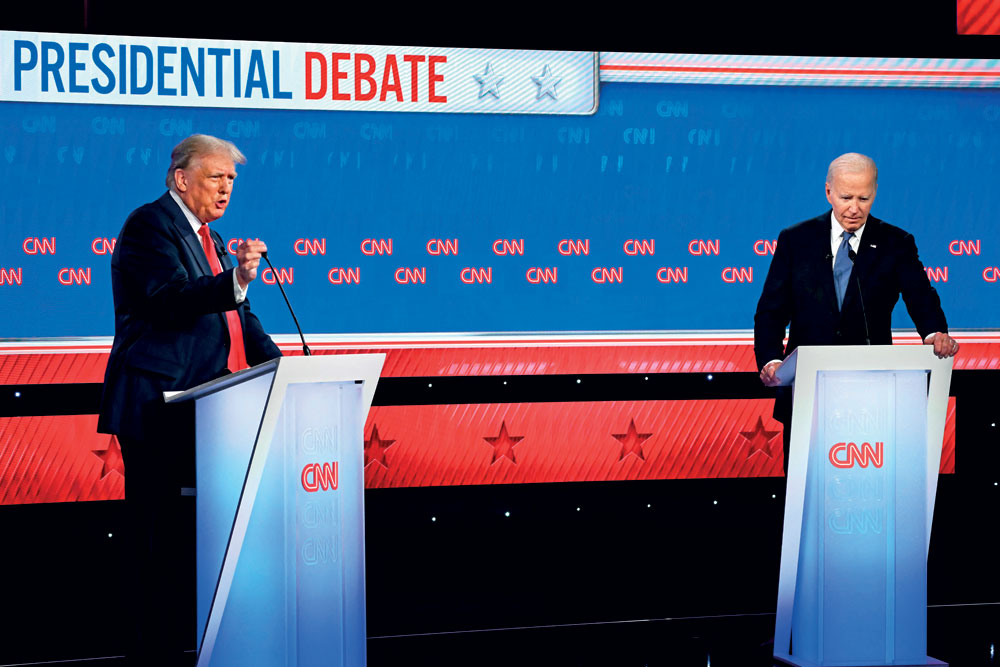
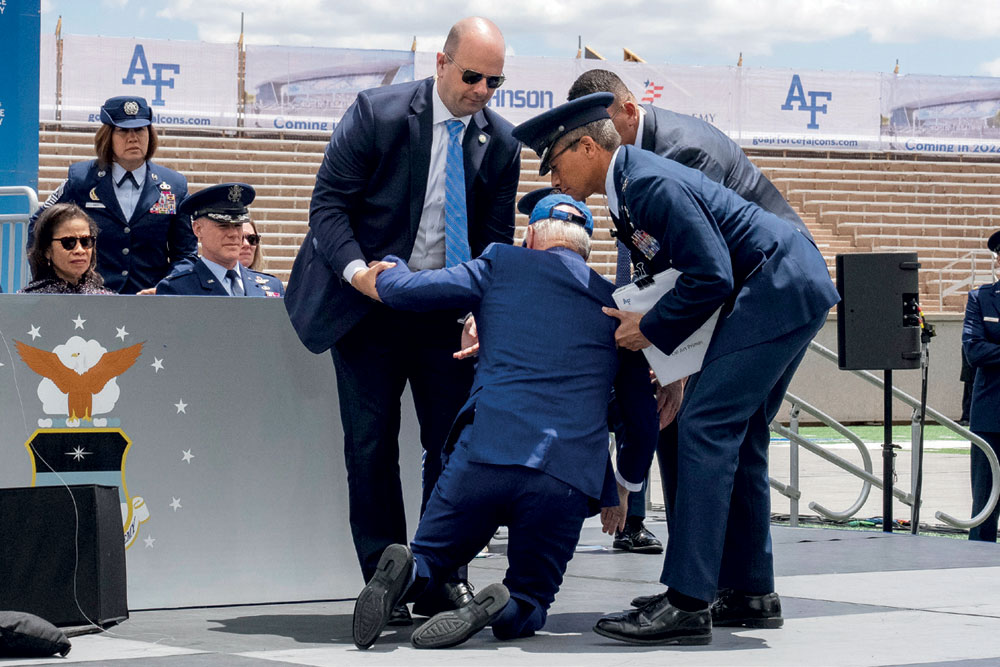
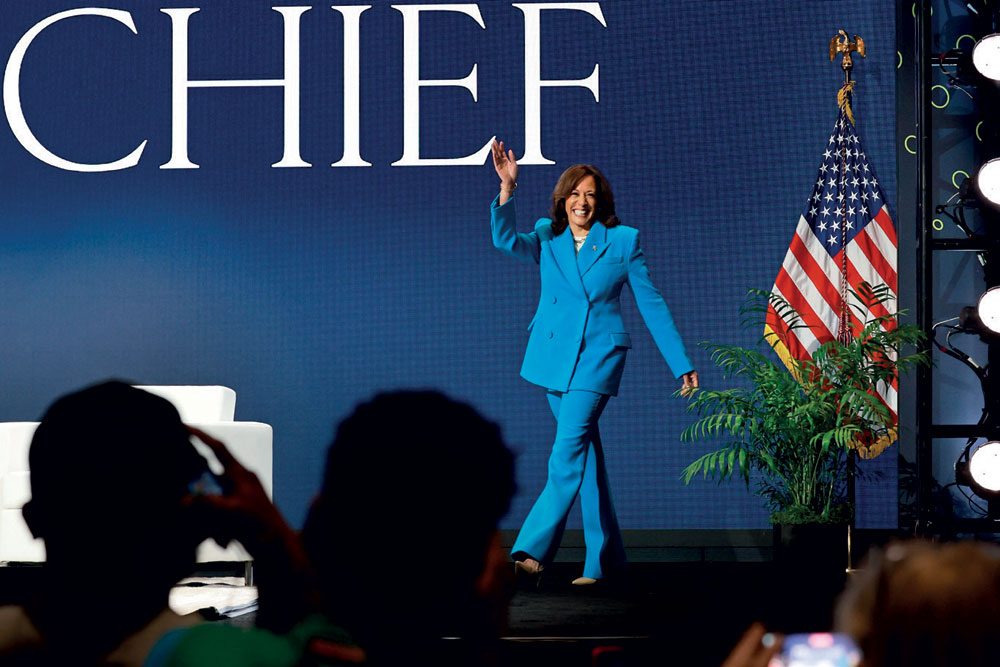
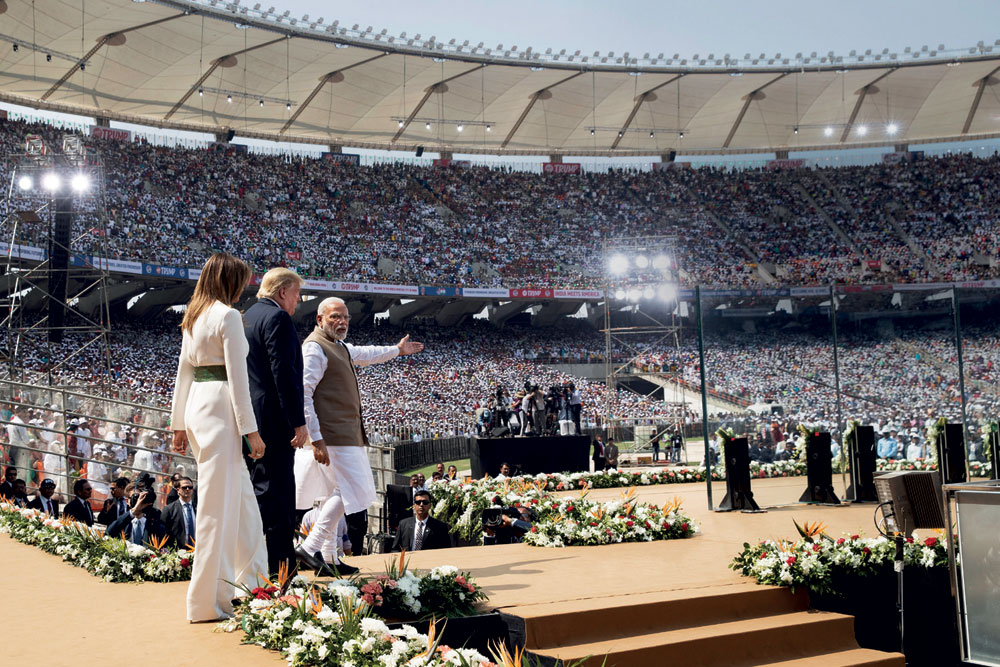
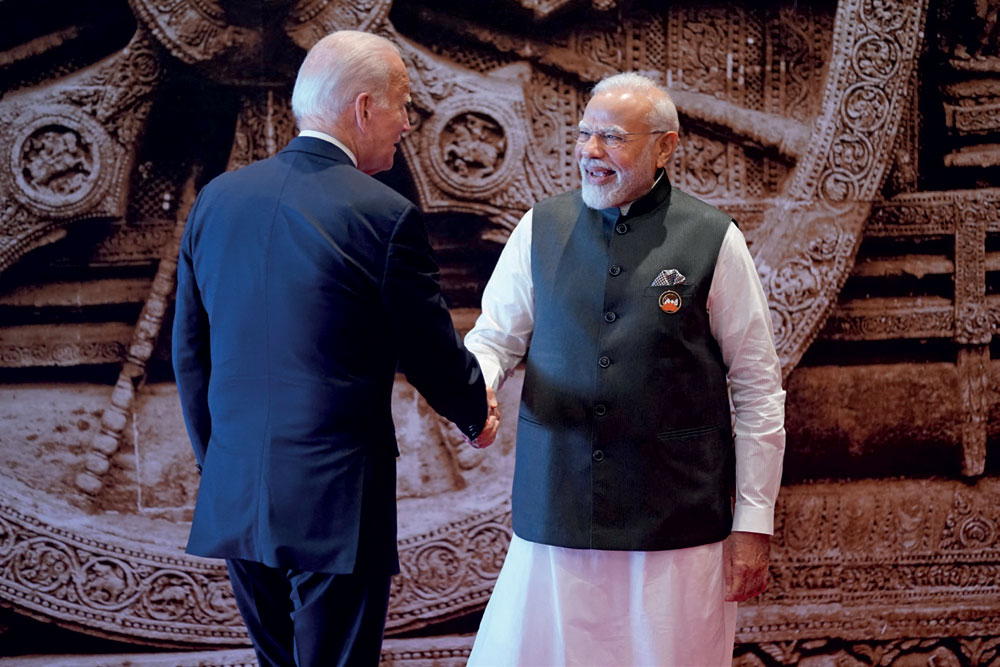
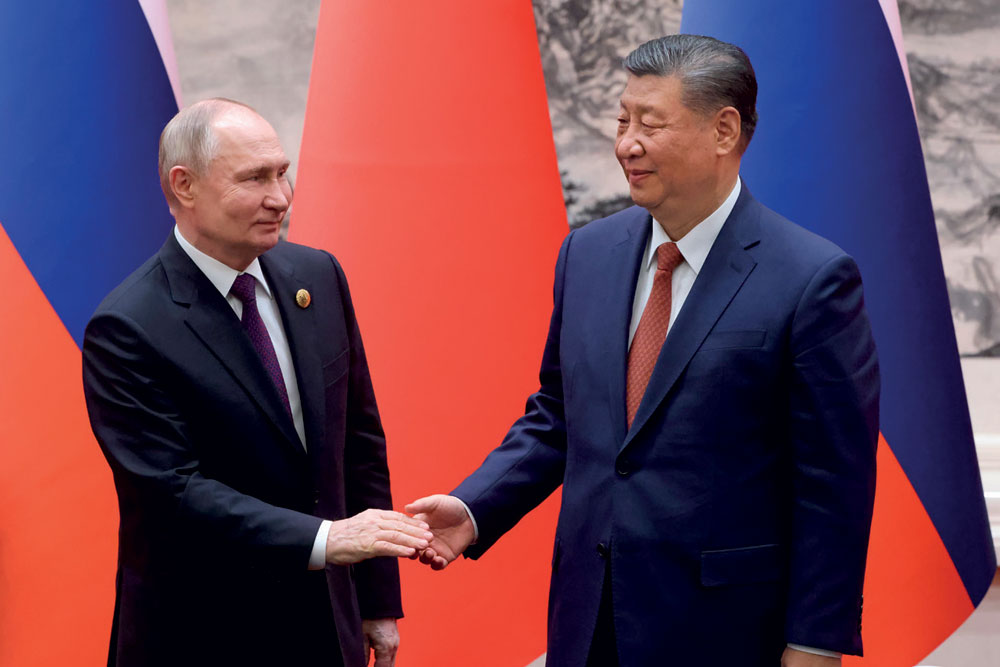



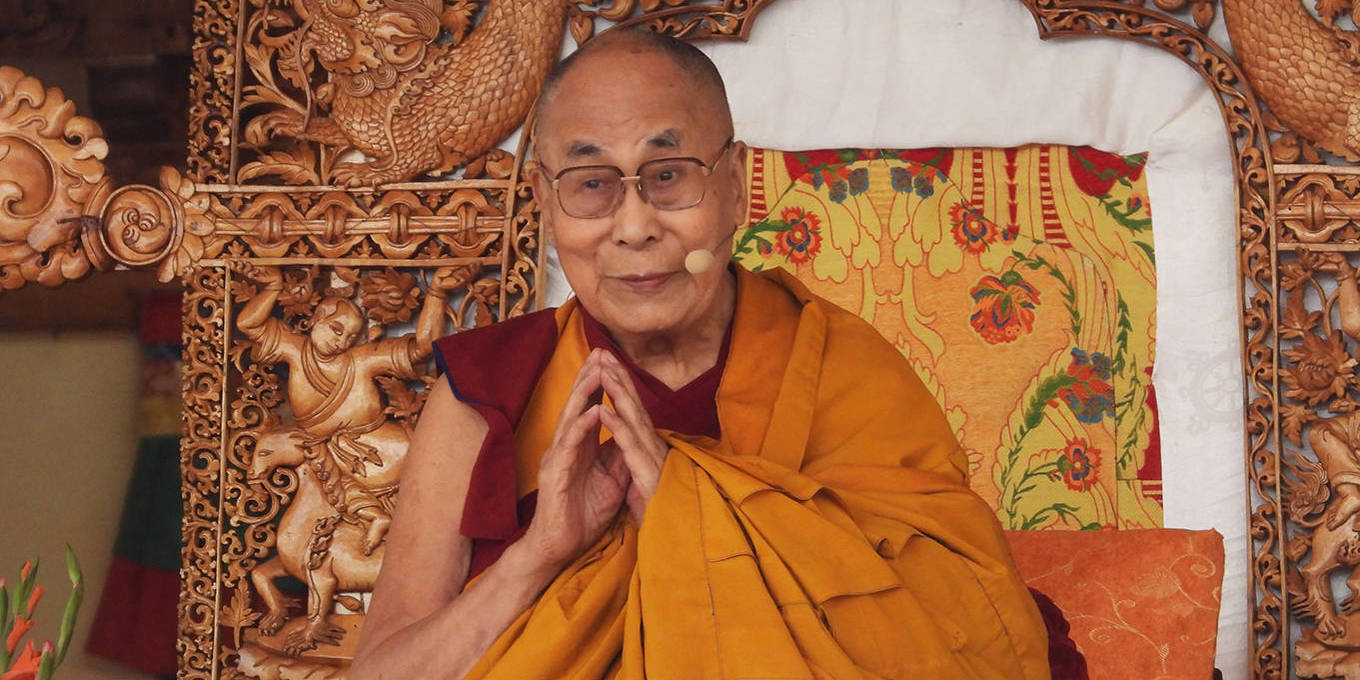


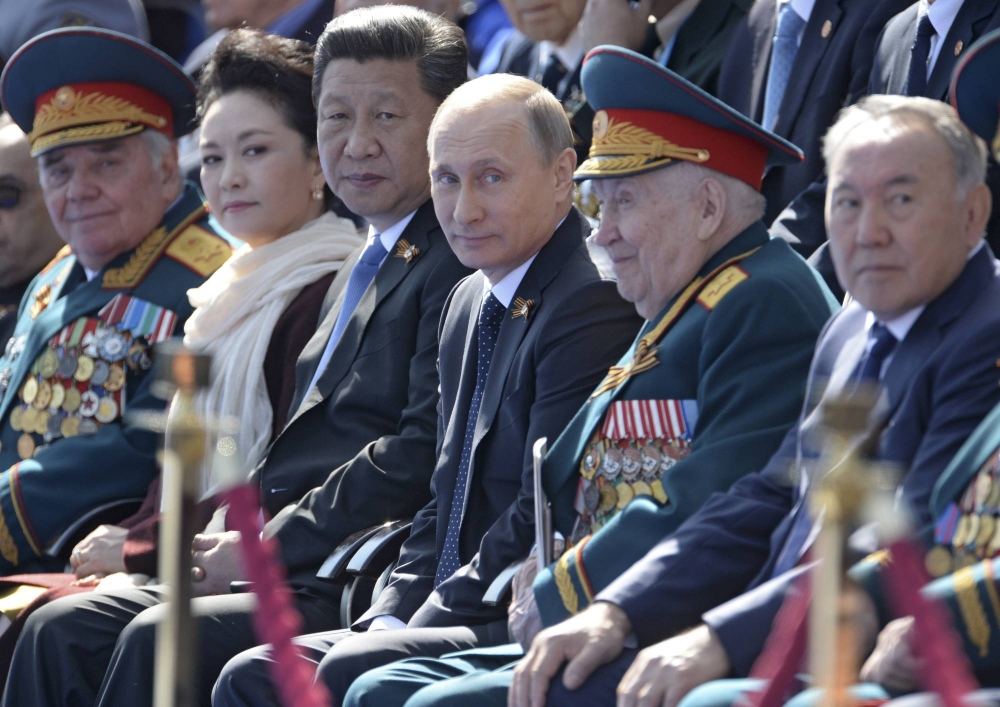
 Stagecraft and Statecraft
You must be logged in to post a comment.