Unknown's avatar

About Chellaney

Professor, strategic thinker, author and commentator

Time for India to Draw the Line With China

 
Will India-China border talks ever end?

(c) Japan Times

For 25 years, India has been seeking to settle by negotiation with China the disputed Indo-Tibetan frontier. Yet, not only have the negotiations yielded no concrete progress on a settlement, but they also have failed so far to remove even the ambiguities plaguing the long line of control.

Beijing has been so loath to clearly define the 4,057-km frontline that it suspended the exchange of maps with India several years ago. Consequently, India and China remain the only countries in the world not separated by a mutually defined frontline. By contrast, the Indo-Pakistan frontier is an international border, except in Kashmir, where there is a line of control that has been both clearly defined and delineated.

Every round of Sino-Indian border negotiations ends in predictable fashion — with warm handshakes and a promise to meet again. But after a quarter century of unrewarding negotiations with Beijing, India ought to face up to the reality that it is being taken round and round the mulberry bush by an adversarial state that has little stake in an early border resolution.

The more the talks have dragged on, the less Beijing has appeared interested in resolving the border disputes other than on its terms. In the period since 1981, China has realized a tectonic shift in its favor by rapidly building up its economic and military power. While keeping India engaged in sterile border talks, China has strengthened its negotiating leverage through its illicit nuclear and missile transfers to Pakistan and strategic penetration of Myanmar.

Today, Beijing gives the impression that an unresolved, partially indistinct border fits well with its interests. Indeed, it sees a strategic benefit in keeping hundreds of thousands of Indian troops pinned down along the Himalayas, thus ensuring that they will not be available against China’s "all-weather ally," Pakistan. This is the "third party whose interests China cannot disregard," as a Chinese official divulged at a "Track 2" dialogue that this writer co-organized in Beijing a few years ago. An unsettled border also endows China with the option to turn on the military heat along the now-quiet frontier if India plays the Tibet card or enters into a military alliance with the United States.

More importantly, China is sitting pretty on the upper Himalayan heights, having got what it wanted — by furtive encroachment or by conquest. It definitely sees no reason to strategically assist a potential peer competitor by lifting pressure on the borders through an amicable settlement.

Given these realities, India’s top priority from 1981 to 2002 was to get the line of control fully clarified while remaining open to any Chinese proposal for a complete border settlement. The accompanying confidence-building measures (CBM) were premised on the elimination of frontline ambiguities to help stabilize the military situation on the ground. But the process of adopting CBMs has advanced much faster than the parallel process of defining and delineating the frontline, farcically called "the line of actual control."

In 1996, the two countries, for example, signed a CBM prohibiting specific military activities at precise distances from a still-blurry frontline. That accord required the two countries, among other things, not to fly combat aircraft "within 10 kilometers of the line of actual control" (Article V.2) and not to "conduct blast operations within 2 kilometers of the line" (Article VI). The reality, though, is that there is no agreed frontline on maps, let alone on the ground.

It took two full decades of border talks before China agreed to exchange maps with India of even one border sector. In 2001, the Chinese and Indian sides exchanged maps showing each other’s military positions in the least-controversial middle sector. China then committed itself to an exchange of maps of the western sector in 2002 and the eastern sector in early 2003. The completion of an exchange of maps showing each other’s currently held military positions was intended — without prejudice to rival territorial claims — to define where actual control lay. Through such clarification of the frontline, the two sides intended to proceed toward mutual delineation on maps and perhaps even demarcation on the ground, pending a final settlement.

After the first exchange in 2001, however, China went back on its commitment, creating an impasse in the talks. Having broken its word, Beijing insisted that the two sides abandon years of laborious efforts to define the frontline and focus instead on finding an overall border settlement. That move clearly appeared to be a dilatory tactic intended to disguise its breach of promise.

If Beijing is not willing to take an elementary step of clarifying the frontline, why would it be willing to take far-bigger action to resolve the festering border problem through a package settlement? A final border settlement would be a complex process demanding not only a full resolution of the claims that involve large chunks of territory but also the demarcation of a clear-cut frontier.

The idea of a "package" settlement is not new. China began peddling that even before its 1962 invasion of India — as a red herring to divert attention from its aggressive designs. Since 1981, it has raised the same idea from time to time. But, to date, it has not once put forward a concrete proposal for consideration. If anything, the border talks have revealed that Beijing is not willing to settle on the basis of the status quo. This is manifest from its laughable claim to India’s Tawang region — as an extension of its annexation of Tibet.

Yet, during his 2003 Beijing visit, then Prime Minister Atal Bihari Vajpayee sought to propitiate China on two separate fronts: He formally recognized Tibet as "part of the territory of the People’s Republic of China," completing the process of India sacrificing its northern buffer; and he gave in to the Chinese demand to switch the focus of the border talks from frontline clarification to the elusive search for a package settlement. His concession to the hosts not only stalled the process of clarifying the frontline but also has taken India back to square one — to discussing the "principles" and "basic framework" of a potential settlement.

The two negotiating teams are now engaged in giving meaning to and implementing the six abstract principles trumpeted as another "breakthrough" in April 2005 during the New Delhi visit of Chinese Premier Wen Jiabao. The focus of the talks now, as admitted by both sides, is on applying the principles to devise a "basic framework" for negotiations. In other words, the two sides are still not close to actually discussing any package-settlement idea.

India needs to reflect on the wisdom of the course it has pursued. It not only rewarded Beijing in 2003 for an act of bad faith but also has played into its hands by switching from the practical task of clarifying the frontline to a conceptual enunciation of vacuous principles and a new framework for talks. A known strength of Chinese diplomacy is to discuss and lay out principles, and then interpret them to suit Beijing’s convenience, as India found out bitterly after signing the 1954 Panchsheel (Five Principles) agreement.

If New Delhi really believes in the maxim that good fences make good neighbors, it is time for it to draw the line, at least in the negotiations. But first it needs to re-evaluate the very utility of staying absorbed in a never-ending process that jibes well with Beijing’s India policy of engagement with containment.


Brahma Chellaney, professor of strategic studies at the privately funded Center for Policy Research in New Delhi, is a regular contributor to The Japan Times.
 
(c) Japan Times, 2006

Tibet is at the core of the India-China divide

Tibet is the Key

Brahma Chellaney

(c) Asian Age

The Sino-Indian spat over Arunachal Pradesh triggered by the Chinese ambassador’s loud-mouthed claim has brought home the truth that at the core of the India-China divide remains Tibet and that unless that issue is resolved, the chasm between the two demographic titans will not be bridged. After all, Beijing’s claim to Arunachal Pradesh or more specifically to a slice of it, Tawang, flows from Tibet’s putative historical or ecclesiastical ties with Arunachal.

Tibet thus lies at the heart of the disputes. To focus on Arunachal or even Tawang is not only to miss the wood for the trees, but also to play into the hands of China, which has sought to practise incremental territorial annexation. Having gobbled up Tibet, the historical buffer between the Indian and Chinese civilizations, Beijing now lays claim to Indian territories on the basis of not any purported Han connection to them but supposed Tibetan Buddhist ecclesiastical influence. A good analogy to China’s expansionist territorial demands was Saddam Hussein’s claim, following his 1990 invasion of Kuwait, to areas in Saudi Arabia on the basis of alleged Kuwaiti links to them.

Another reminder that Tibet remains the central issue was the recent shooting by Chinese border guards of unarmed Tibetans fleeing to India via Nepal through the 5,800-metre-high Nangpa-la Pass. There have been instances in the past of Tibetans being shot at by the paramilitary People’s Armed Police or the People’s Liberation Army at border crossings, but this was the first such incident captured on film and shown across the world on television.

The 41 survivors of that event who escaped gunfire and capture by Chinese troops on ice-covered Himalayan terrain have recounted in Dharamsala how the guards opened fire without warning on some 77 Tibetans, a majority of them teenage boys and girls seeking to pursue Tibetan Buddhist studies in schools run by the Dalai Lama. Beijing has confirmed two were killed, identified as a 25-year-old nun and a 13-year-old boy. The rest were arrested, and are likely to rot in jail.

       Beijing, having wrung the concessions it wanted out of India on Tibet, now is calculatedly signalling that Arunachal is its next priority. By publicly presenting Arunachal as an outstanding issue that demands “give and take,” it is cleverly putting the onus on India for achieving progress in the border negotiations. Lest the message be missed, New Delhi is being openly exhorted to make concessions on Arunachal, especially on strategic Tawang — a critical corridor between Lhasa and the Assam Valley of immense military import.

The choice before India now is stark: either to retreat to a defensive, unviable negotiating position where it has to fob off Chinese territorial demands centred on Arunachal or to take the Chinese bull by the horns and question the very legitimacy of Beijing’s right to make territorial jurisdiction claims ecclesiastically on behalf of Tibetan Buddhism when China has still to make peace with the Tibetans.

Either way it does not augur well for the border talks, already the longest between any two nations in modern world history. After a quarter-century of continuing negotiations, the border diplomacy has yielded no concrete progress on an overall settlement nor removed even the ambiguities plaguing the 4,057-kilometre frontline. Beijing has been so loath to clearly define the frontline with India that it broke its 2001 promise to exchange maps of the eastern and western sectors by the end of 2002.

Gently shining the diplomatic spotlight on the Tibet question will help India turn the tables on Beijing, whose aggressive territorial demands have drawn strength from New Delhi’s self-injurious and gratuitous acceptance of Tibet as part of China.  

At a time when China is threatening to divert the waters of River Brahmaputra, the subtle and measured revival of Tibet as an unresolved issue will arm India with leverage and international say on any Chinese effort to dam the Brahmaputra and reroute its waters. With water likely to emerge as a major security-related issue in southern Asia in the years ahead, India can hardly ignore the fact that the Indus, Sutlej and Brahmaputra originate in occupied Tibet.

       Tibet is the means by which India could coop up the bull in its own China shop. Beijing’s new hardline focus on Arunachal/Tawang is apparent not only from its failure to accept the Indian proposal for a new round of border talks in the run-up to President Hu Jintao’s India visit, but also from Chinese Ambassador Sun Yuxi’s extraordinary remarks on Indian soil that an entire Indian state belongs to his country. It is highly unusual for an envoy not only to make bellicose remarks, but also to do so on the eve of his president’s visit, unmindful of roiling the atmosphere.

As if to underscore that his statement to a television network was not unintentional, Ambassador Sun followed it up with another interview to an Indian wire service a couple of days later wherein he insisted that Arunachal was “a disputed area” and demanded that India agree to “mutual compromises” and “some give and take” in relation to that state. The Chinese foreign ministry, while harping on a negotiated settlement of the frontier disputes with India, did not take back anything that its ambassador said in New Delhi. It repeated its now-familiar slogan — “a solution that is fair, rational and acceptable” — even as it blocks progress in the border talks, continuing since 1981. 

Imperceptive or tactless statements or actions can hardly advance any country’s interests. But China, being a closed system, does not seem to understand that. That is the reason why communist China has a tradition of acting in ways unfavourable to its own long-term interests. One recent example of that is the way it helped rekindle Japanese nationalism by scripting anti-Japan mob protests in April 2005. Tokyo is now more determined than ever not to allow Beijing to call the shots in East Asia.

What is new is not China’s claim to Tawang or to the whole of Arunachal Pradesh but its brassy assertiveness in laying out in public its territorial demands, that too on the eve of Hu’s visit. What makes such forcefulness doubly astonishing is that its net effect will only be to reinforce India’s resolve not to cede further ground to China. Indian officials take an oath of office pledging to “uphold the sovereignty and integrity of India,” and it is unthinkable any Indian government would gift Tawang to China. As Foreign Minister Pranab Mukherjee has already put it, “Every inch of Arunachal is part of India.”

That Tawang is a Monba, not Tibetan, area is a conclusion that British surveyors Bailey and Moreshead painstakingly reached, leading Henry McMahon to draw his famous redline on the Survey of India map-sheets to Tawang’s north. Earlier at Simla in October 1913, the British Indian government and Tibet, represented by McMahon and Lonchen Shatra respectively, reached agreement on defining the frontier at that meeting, to which the Chinese delegate at the Simla Conference was not invited because all parties at that time, including China, recognized Tibet’s sovereign authority to negotiate its boundary with India. Even Ivan Chen’s map presented at the Simla Conference clearly showed Tawang as part of India.

An ecclesiastical relationship cannot by itself signify political control of one territory over another. However, in the two regions — Amdo (the birthplace of the present Dalai Lama) and Kham — where Tibet exercised undisputed ecclesiastical jurisdiction and political control, the occupying power has forcibly incorporated those areas in the Han provinces of Qinghai, Sichuan, Gansu and Yunnan. Before claiming Tawang to be part of Tibet, China should be told plainly to first restore Amdo and Kham to Tibet.


Yet, a disturbing pattern of belligerent Chinese statements is emerging without cause. A diplomat-cum-senior researcher at a Chinese foreign ministry-run think-tank, for instance, has suggested that India kick out the Dalai Lama if it wished to build “real and sustainable” relations with Beijing. In an interview with an Indian newspaper, Zheng Ruixiang said: “The Tibet problem is a major obstacle in the normalization of relations between India and China. India made a mistake in the 1950s by welcoming the Dalai Lama when he fled Tibet. It is now time for correcting the past mistake and building a real and sustainable relationship with China.”           

The pattern suggests that under the hardline Hu, who made his name in the Chinese Communist Party by ruthlessly quelling the 1989 anti-China protests in Lhasa as the martial-law administrator, Beijing may be striving to adopt a more forthright stance vis-à-vis India, including on the border disputes and the presence of the Dalai Lama and his government-in-exile in Dharamsala. Having consolidated his hold on power in the past year to emerge as China’s unchallenged ruler, Hu has begun suppressing dissent at home, strengthening the military and shaping a more nationalistic foreign policy. Hu may believe his regime can exert more strategic pressure on India, now that the railway to Tibet has been built and Pakistan’s Chinese-funded Gwadar port-cum-naval base is likely to be opened during his stop in Islamabad next week.

Given autocratic China’s penchant to act counterproductively, India should welcome the Chinese resurrection of the past and highlighting of bilateral disputes in public. What all this brings out is that Beijing is unwilling to settle the border disputes on the basis of the status quo. Not satisfied with the Indian territories it has occupied, either by conquest or by furtive encroachment, China wishes to further redraw the frontiers with India, even as it keeps up the charade of border negotiations.

The new Chinese brashness helps create the necessary leeway for India to re-evaluate its policy and approach and add more subtlety and litheness to its stance unilaterally accommodating China on Tibet and other issues. 

India needs to first grasp the damage to its China policy caused by Atal Bihari Vajpayee as prime minister. Both on Tibet and the border talks, he acquiesced to Chinese demands. He signed on to a document formally recognizing Tibet to be “part of the People’s Republic of China” and, by agreeing to a new framework of border talks focused on an elusive “package” settlement, he rewarded Beijing for its breach of promise to fully define the frontline through an exchange of maps.

China may have ceased its cartographic aggression on Sikkim through its maps, but the important point, often overlooked, is that it has yet to expressly acknowledge that Sikkim is part of India. While it now makes India accept in every bilateral communiqué the Vajpayee formulation that Tibet is “part of the People’s Republic of China,” Beijing till date has declined to affirm in a joint statement with New Delhi or even unilaterally that Sikkim is part of the Republic of India.

Sikkim was never an issue in Sino-Indian relations until Vajpayee made it one. He then ingeniously flaunted the Chinese “concession” on Sikkim as a cover to justify his kowtow on Tibet.

Tibet is India’s trump card, yet Vajpayee capriciously surrendered it to gain a dubious concession on Sikkim, over which China has never claimed sovereignty. All that China was doing was to depict Sikkim as an independent kingdom in its official maps. But such action made little difference to India. The world had accepted Sikkim’s 1975 merger with India, and it made little sense for New Delhi to surrender its Tibet card just to persuade Beijing to stop ploughing a lonely furrow — that too over a territory over which China had staked no claim. If an Indian concession on Tibet can ever be justified, it can only be in the context of making Beijing give up its claims on Indian territories, formalize the present borders and reach a deal with the Dalai Lama to bring him home from exile.

For India, the Dalai Lama is a powerful ally. When China annexed Tibet, India surrendered not only its extra-territorial rights over that buffer, but it also signed a pact in 1954 — the infamous “Panchsheel Agreement” — accepting Chinese sovereignty over Tibet without seeking any quid pro quo, not even the Chinese recognition of the then existing Indo-Tibetan border. That monumental folly stripped India of leverage and encouraged the Chinese communists to lay claims to Indian territories on the basis of Tibet’s alleged historical links with those areas.

The Panchsheel accord recorded India’s agreement both to fully withdraw within six months its “military escorts now stationed at Yatung and Gyantse” in the “Tibet Region of China” as well as “to hand over to the Government of China at a reasonable price the postal, telegraph and public telephone services together with their equipment operated by the Government of India in Tibet Region of China.”

If India still has any card against Beijing, it is the Dalai Lama. As long as the Dalai Lama remains based in Dharamsala, it is a great strategic asset for India. The Tibetans in Tibet will neither side with China against India nor accept Chinese rule over their homeland. If after the death of the present 71-year-old Dalai Lama, the institution of the Dalai Lama were to get captured by Beijing (like the way it has anointed its own Panchen Lama), India will be poorer by several army divisions against China.

It is not late for India to repair the damage from the blunders of Nehru and the closet-Nehruvian Vajpayee. The only way India can build counter-leverage against Beijing is to quietly reopen the issue of China’s annexation of Tibet and its subsequent failure to grant autonomy to the Tibetans, despite an express pledge contained in the 17-point agreement it imposed on Tibet in 1951.

This can be done by India in a way that is neither provocative nor confrontational. Building a mutually beneficial relationship with China does not demand appeasement on India’s part. And the alternative to appeasement is not provocation. Between appeasement and aggravation lie a hundred different options. 

India can start diplomatically making the point that China’s own security and well-being will be enhanced if it reaches out to Tibetans and grants genuine autonomy to Tibet through a deal that brings back the Dalai Lama from his exile in Dharamsala. If the Chinese ambassador to India can publicly demand “mutual compromises” on Arunachal — a statement portrayed by the Indian press as an attempt by him to “play down” his unabashed claim on Arunachal — is it too much to expect the new Indian ambassador in Beijing to genially appeal to China’s own self-interest and suggest it pursue “mutual compromises” with the Tibetans on Tibet?

(c) Asian Age November 18, 2006


When China Invaded India

The 1962 Chinese Invasion


Brahma Chellaney

(c) Hindustan Times 

At sunrise on October 20, 1962, China’s People’s Liberation Army invaded India with overwhelming force on two separate flanks – in the west in Ladakh, and in the east across the McMahon Line in the then North-East Frontier Agency.  The Chinese aggression, and the defeat and humiliation it wreaked on an unprepared India, remain deeply embedded in the Indian psyche.

            India was taken completely unawares by the invasion.  This reflected political naivete on its part.  It also bared a woefully flawed intelligence network that failed to pick up the movement of heavy artillery and other Chinese military activity along the Himalayan frontier in the months ahead.  The invasion of India was carefully planned well in advance and came after extended military preparations, including the improvement of logistics and the movement of heavy artillery from opposite Taiwan to Tibet, where PLA had since its annexation maintained infantry troops in large numbers to suppress the local population without the need to induct heavy weaponry.  That began to change by the spring of 1962, but Indian intelligence remained horrifically oblivious.

Decades later, some gnawing issues stand out.  One relates to the timing of the invasion masterminded by Mao Zedong.  The aggression was executed cunningly to coincide with the Cuban missile crisis that brought the United States and Soviet Union within a whisper of nuclear war. 

The timing, which precluded the possibility of India getting any immediate outside help, was made doubly favourable by two other developments – an American promise earlier in July to hold Taiwan from initiating hostilities across the straits that enabled China to single-mindedly mobilise against India, and Soviet leader Nikita Khrushchev’s subtle yet discernible tilt towards Beijing on the Sino-Indian border issue in an apparent effort to buy Chinese support in the looming Soviet confrontation with the United States.

            Two key interrelated questions need to be addressed. Why did Mao order the invasion?  And having captured most of the forward Indian military posts in both sectors in the first wave of assaults, why did Beijing carry out a second, more vicious round of attacks after a gap of three weeks?  Mao had several objectives on his mind in turning border skirmishes into a full-fledged war.  None was military.

            Mao’s aims were mainly political.  The military objectives had largely been achieved in the earlier years through furtive PLA encroachments that had, for example, brought Aksai Chin under Chinese control.  The PLA – not an independent power centre then – was merely an instrument to help Mao accomplish his political objectives in 1962.  Roderick MacFarquhar, in the third and final volume of his masterwork, The Origins of the Cultural Revolution, published in 1997, aptly calls the aggression “Mao’s India War”. 

            The first political objective was to humiliate India, China’s Asian rival.  Mao was determined to cut India to size and to undermine what India represented – a pluralistic, democratic model for the developing world that seemingly threatened China’s totalitarian political system. 

The PLA’s military adventure against India was clearly punitive in nature, a judgement reinforced by Premier Zhou Enlai’s ready admission that it was intended “to teach India a lesson” – a lesson India has not forgotten to this day.  The second wave of assaults was designed to heap ignominy by soundly thrashing India.  Such have been the long-lasting effects of the humiliation it imposed that China to this day is able to keep India in check, despite transferring weapons of mass destruction to Pakistan and opening a new strategic front through Myanmar.

            Another aim of Mao was to wreck the image of Nehru, who until then had been a towering figure on the international stage and an icon in many parts of the developing world.  Nehru stood diminished and demolished by November 1962.  Defeat, especially decisive defeat, usually turns a statesman into a beaten, worn-out politician and shatters a nation’s international standing.  The crushing rout, in fact, hastened Nehru’s death. 

            But more than Mao, it was Nehru who contributed to his own disgrace by blundering twice on China.  His first blunder was to shut his eyes to the impending fall of Tibet even when Sardar Patel had repeatedly cautioned him in 1949 that the Chinese communists would annex that historical buffer as soon as they installed themselves in Beijing.  An overconfident Nehru, who ran foreign policy as if it were personal policy, went to the extent of telling Patel by letter that it would be a “foolish adventure” for the Chinese Communists to try and gobble up Tibet – a possibility that “may not arise at all” as it was, he claimed, geographically impracticable!

            In 1962, Nehru, however, had to admit he had been living in a fool’s paradise.  “We were getting out of touch with reality in the modern world and we were living in an artificial atmosphere of our creation,” he said in a national address after the Chinese aggression.

Nehru had ignored India’s military needs despite the Chinese surreptitiously occupying Indian areas on the basis of Tibet’s putative historical ties with them, and setting up a land corridor to Pakistan-occupied Kashmir through Aksai Chin.  Although Indian military commanders after the 1959 border clashes and casualties began saying that they lacked adequate manpower and weapons to fend off the PLA, Nehru ordered the creation of forward posts to prevent the loss of further Indian territory without taking the required concomitant steps to beef up Indian military strength, including through arms imports.  Nehru had convinced himself grievously that the Chinese designs were to carry out further furtive encroachments on Indian territory, not to launch major aggression. 

            A third objective of Mao was to undermine India’s non-aligned status.  No sooner the PLA began the first wave of assaults than an unnerved Nehru appealed to the United States for military help.  He implored that Washington grant military aid without insisting on a formal alliance.  But no U.S. military aid came while the Chinese were still attacking India.  Kennedy waited until Khrushchev’s capitulation over missiles in Cuba before sending Nehru a letter promising “support as well as sympathy”. 

When the PLA launched the second series of attacks, the U.S. carrier force, USS Enterprise, steamed not towards the East or South China Sea but towards the Bay of Bengal to serve as a psychological prop to the besieged Indians.  John Kenneth Galbraith wrote in his memoirs, Ambassador’s Journal, that he had, as U.S. Ambassador to India, recommended the despatch of the aircraft carrier to ease Indian nerves.

Once Beijing declared a unilateral cease-fire, the issue of U.S. arms sales to India got caught in the perennial and still-prevalent U.S. demand – that New Delhi open talks with Pakistan on Kashmir – forcing the Nehru government to hold five rounds of futile discussions with Islamabad as a quid pro quo for receiving low-line American arms.  The Chinese aggression was seen in Washington as creating an opportunity for what America has always desired and still seeks to pursue – closer and better ties with India while maintaining old bonds with Pakistan – to help promote ‘regional stability’, a euphemism for subcontinental balance.    

            A fourth objective of Mao, who had been seething over Nehru’s grant of sanctuary to the Dalai Lama and his followers, was to effectively cut off India’s age-old historical ties with Tibet.  In one stroke, all outside links with Tibet – religious, temporal, cultural, medicinal and trade – collapsed.  This meant that Tibetans could no longer maintain their ancient ties with Gaya, Sarnath, Sanchi and other seats of monasteries, and that Indians no longer had access to Mansorovar Lake and Mount Kailash.

            Fifthly, the war came handy to Mao for domestic politics.  At a time when China’s economic calamities, including famines, and Mao’s insistence on a domestic class struggle were spurring grassroots problems, the swiftness and brute power with which he managed to teach India a lesson not only boosted China’s image internationally, but also helped him to politically consolidate at home.  Success, after all, has a thousand fathers, while defeat leaves an orphan.

            What Indian policy did not appreciate then and has yet to come to terms with is that the invasion was triggered more by a Chinese ambition to dominate Asia than by a territorial dispute.  In that sense, 1962 represented far more than the loss of national pride or territory for India; it meant the beginning of an undeclared war for pre-eminence in Asia – a raging war in which India has steadily lost ground, with China making inroads into even the traditional spheres of Indian influence, including Nepal, Sri Lanka, Myanmar and Bangladesh.

            For Mao, it was a victory for the asking, because the Indian leadership had made no effort to plug the glaring vulnerabilities in the defence of India.  In true Sun Tsu style, however, Mao waited for the right time to strike, invading India when it least expected to be attacked.  The PLA’s preparations to invade India started after 1959 but were camouflaged in the form of extended border negotiations that Beijing held with New Delhi.

Border negotiations with India were employed not only to feign reasonableness but, more importantly, to buy time for military consolidation and to bide time for the right opportunity to strike.  The building of border roads after 1959 was indicative of the Chinese efforts to upgrade military logistics along the mighty Himalayas.

In the same vein, the current series of largely fruitless border talks since 1981 – the longest continuing inter-state negotiations in post-World War II history – serve as a cover for China to pursue containment of India with engagement. 

Also, in a fashion reminiscent of the current Beijing approach to depict all Chinese actions as defensive and peaceful, Mao sought to paint India as the provoker with its ‘forward policy’ – a line of reasoning lapped up by some biased Western analysts, particularly a self-confessed Maoist, British journalist Neville Maxwell, who contended in his book, India’s China War, that it was India that had been the aggressor.

When the PLA marched hundreds of miles south to annex Tibet and establish a Sino-Indian military frontier for the first time in history, that was supposedly not expansionist or forward policy.  But when the Indian Army belatedly sought to set up posts along its unmanned frontier in Ladakh to try and stop further Chinese land grabs, this was christened ‘forward policy’ and dubbed provocative!

The Indian predilection for talk rather than action was on brazen display in the run-up to the 1962 war.  This was best illustrated by Nehru’s offhand remarks to reporters while leaving for Colombo on October 12: “Our instructions are to free our territory.  I cannot fix the date, that is entirely for the Army”.  Such loose talk was a god-send to the Chinese communists to fix the date for their attack.

            Mao needed no Indian provocation to launch a military attack.  He was provoked by his own logic to defeat the alternative model that India represented and the ideas and principles that Nehru symbolised.  Had India not started building forward posts, Mao would have found some other pretext to attack India.

In fact, Nehru, the architect of the Hindi-Chini bhai bhai festivity, had gone out of his way to propitiate communist China, accepting even the Chinese annexation of Tibet in a 1954 agreement without settling the Indo-Tibetan border.  While Nehru thought he had bought peace with China by accepting Chinese rule over Tibet on the basis of his doctrine of panchshila, or the five principles of peaceful co-existence, Mao and his team read this both as a sign of India’s weakness and a licence to encroach on strategically important areas of Ladakh.

Not only did the Nehru government cling to the belief that China was a benign neighbour despite the 1959 border clashes, its thinking and policy also precluded the defence of India on the Kautilyan principle that to maintain peace, a nation had to be ready to defend peace. 

Official policy had steadfastly refused to consider China to be a military threat, let alone to adopt counter-measures against the threat.  Forward posts were created not to militarily assert India’s claims by positioning troops at vantage points but to affirm a political line.  It was for reason that these posts were thinly manned and often on low ground in direct contravention of military logic.  In fact, the yawning mismatch between the officially encouraged perception of China and the ‘benign’ neighbour’s brutal aggression added to the severity of the shock that battered India.

So betrayed was Nehru by Mao’s war that he had this to say on the day the Chinese invaded: “Perhaps there are not many instances in history where one country has gone out of her way to be friendly and cooperative with the government and people of another country and to plead their cause in the councils of the world, and then that country returns evil for good”.

Four decades later, India has not forgotten the central lesson it was taught by Mao.  India’s rise as a military power with independent nuclear and missile capabilities is the consequence of a lesson learned.  Had the debacle not set in motion India’s military modernisation and reform of its defence techniques and strategies, India would not have fared well against Pakistan in the 1965 and 1971 wars.  In fact, without the post-1962 military buildup, it could well have lost the Kashmir valley to Pakistan in 1965.  However, with foreign policy still being shaped by personal predilections and idiosyncrasies rather than by institutional processes, India continues to repose faith in adversaries and then cries foul when they deceive it, as Kargil showed. 


II

A Question of Timing 

Brahma Chellaney

Mao directed two double-front attacks on India within a span of about a month.  In the style recommended by ancient Chinese strategist Sun Tzu who authored the treatise, The Art of War, Mao chose an exquisite time for perpetrating a ‘Himalayan Pearl Harbour’ against India.

The first wave of assaults on Indian border positions in Ladakh and NEFA began on October 20, 1962, five days after the CIA formally determined the presence of medium-range ballistic missiles in Cuba on October 15 through reconnaissance photographs taken the previous day, triggering a major U.S. showdown with Moscow. 

A day before the PLA launched the attacks on India, Radio Moscow was citing U.S. naval manoeuvres in the Caribbean as preparations for an invasion of Cuba.  And the day the Chinese forces came pouring across the Himalayas, U.S. President John F. Kennedy had already put into effect a naval quarantine of Cuba.  By the time the Chinese halted their weeklong incursions into NEFA, while continuing to pick and target Indian posts in Aksai Chin, the Cuban missile crisis had brought the world to the edge of a nuclear Armageddon.

            Not content with the PLA’s battlefield victories against the outnumbered and outgunned Indian forces, Mao decided to launch a second wave of military assaults on India while the Americans and Russians were still embroiled in the Cuban crisis.  The threat of a nuclear holocaust had eased after Khrushchev gave in on October 28 and agreed to withdraw the nuclear-armed missiles from Cuba.  But the missile crisis was still lingering, with troops in Cuban military uniform taking up positions around the Soviet missile sites and strongman Fidel Castro refusing UN on-site inspections in Cuba as well as the withdrawal of Il-28 bombers.

            Making the most of the continuing global preoccupation with the Cuban missile crisis, and rushing to capitalise further before the abating crisis wound up, Mao employed the PLA for a second round of two-front attacks on India starting on November 18, a day before Castro gave in to the withdrawal of Il-28s. 

So scared were Indian policy-makers by a self-created fear that Calcutta would be bombed that they did not employ their superior air force against the invading Chinese, ignorant as they were of the fact that China had only one or two airfields in Tibet and that its fighter aircraft (including Ilyushin 24) were distinctly inferior to India’s British-made Hunters.  Had India employed its offensive air power, it could have overcome its tactical disadvantage of lacking artillery in Ladakh and been in a position to hit hard the foot and mule columns of the Chinese in the Tawang area.  But New Delhi was possessed by an irrational fear of Chinese retaliation against Indian cities – a fear that created a sense of panic in Calcutta.

According to Colonel Anil Athale, who has co-authored the official history of the aggression, “the best-kept secret of the 1962 border war is that a large part of the non-military supplies needed by the Chinese reached them via Calcutta!  Till the very last moment, border trade between Tibet and India went on though Nathu La in Sikkim.  For the customs in Calcutta, it was business as usual and no one thought to pay any attention to increased trade as a battle indicator.”

And such was the panic in New Delhi to the advancing Chinese columns in NEFA that Jawaharlal Nehru thought the fall of the plains of Assam was imminent and pretty nearly said good-bye to the people there in a national broadcast.  On the evening of November 19, as the Army’s 4 Corps began preparations to pull out from Tezpur, a panic-stricken move that triggered the collapse of the local administration by the following day, Nehru told the nation: “Huge Chinese armies are marching into the northeast of India … yesterday we lost Bomdila, a small town in Kameng division. .. my heart goes out to the people of Assam”.  Till this day, Assamese extremists cite Nehru’s ‘abandonment’ of Assam to stir up secessionist sentiment.  

But on November 21, coinciding with Kennedy’s formal termination of Cuba’s quarantine, Beijing announced a unilateral ceasefire and its intent to withdraw from NEFA while keeping the gains on the west.  The first U.S. emergency military supplies to India began arriving by November 24 while the Chinese withdrawal from India’s northeast started from December 1.  Mao knew it would not be wise to continue waging war on India after the United States was free from the Cuban missile crisis.

Copyright: The Hindustan Times, 2002 
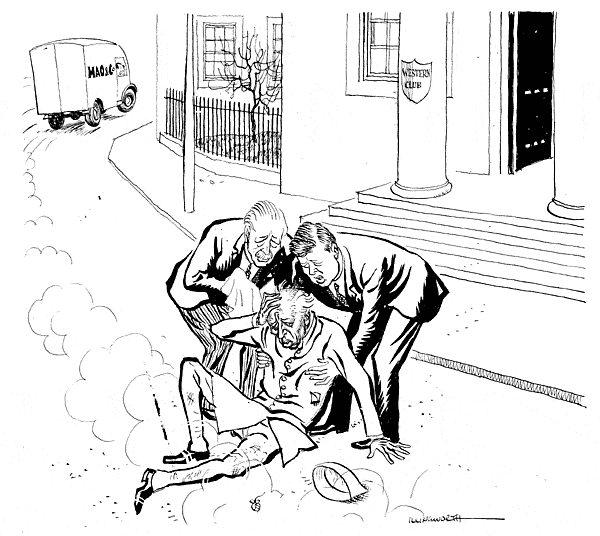
 

The Challenge to India From An Ascendant China

Mastering Martial Arts

While emphasizing cooperation, India needs to leverage its policy towards China  

 By BRAHMA CHELLANEY

 Hindustan Times


A key challenge for Indian foreign policy is to manage an increasingly intricate relationship with an ascendant China determined to emerge as Asia’s uncontested power. For different reasons, New Delhi and Beijing wish to play down the competitive dynamics of their relationship and put the accent on cooperation. This was on full display during Chinese President Hu Jintao’s New Delhi visit, which yielded a rhetoric-laden joint statement with nice jingles, such as “all-round mutually beneficial cooperation”.  

            It makes sense for India to stress cooperation while working to narrow the power disparity with China. Cooperation holds special appeal to India, given that territorially it is a status quo state that has traditionally baulked at anchoring its foreign policy in a distinct strategic doctrine founded on a “balance of power”, or “balance of threat”, or “balance of interest”.

            By contrast, an accent on cooperation suits China because it provides it cover to step up a strategic squeeze of India from diverse flanks. It also chimes with its larger strategy to advertise its ‘peaceful rise’. China’s choir book indeed has been built around a nifty theme: its emergence as a great power is unstoppable, and it is incumbent on other nations to adjust to that rise.

            In keeping with India’s growing geopolitical pragmatism, the wooden-faced Hu received a friendly but formal welcome in New Delhi. The prime minister did not shy away from giving vent to India’s disquiet over the slow progress of the 25-year-old border negotiations by calling for efforts to settle the “outstanding issues in a focused, sincere and problem-solving manner”. And by urging that the progress in ties be made “irreversible”, the PM implicitly pointed to the danger that blunt assertion of territorial claims or other belligerent actions could undo the gains.

            Still, the visit was a reminder that Indian foreign policy has yet to make the full transition to realism. Consider the following two paragraphs in the joint statement:

“The Indian side recalls that India was among the first countries to recognize that there is one China and that its one-China policy has remained unaltered. The Indian side states that it would continue to abide by its one China policy. The Chinese side expresses its appreciation for the Indian position.

“The Indian side reiterates that it has recognized the Tibet Autonomous Region as part of the territory of the People’s Republic of China, and that it does not allow Tibetans to engage in anti-China political activities in India. The Chinese side expresses its appreciation for the Indian position”.

Gratuitously and without any reciprocal Chinese commitment to a one-India policy, New Delhi again pledged to “abide by” a one-China policy despite the recent bellicose Chinese territorial claims. Needlessly and unilaterally, it reiterated its recognition of the central Tibetan plateau (what Beijing calls the “Tibet Autonomous Region”, or TAR) as part of China.

How can bilateral diplomacy become so one-sided that India propitiates and China merely records its ‘appreciation’? What about getting China to recognize Arunachal Pradesh, Jammu and Kashmir and Sikkim as part of the Republic of India? China has merely suspended its cartographic aggression on Sikkim without issuing a single statement thus far unequivocally recognizing it as part of India.

It is true that mistakes made in the past weigh down Indian policy. But should India continue or correct those slip-ups? Why should the present PM stick with his predecessor’s 2003 folly in recognizing TAR as “part of the territory of the People’s Republic of China”? In any event, Atal Bihari Vajpayee’s blunder did not come with an obligation for New Delhi to one-sidedly reaffirm that recognition at the end of every meeting between an Indian and Chinese leader. 

A second clue of the Indian predilection to bend backwards was the manner New Delhi willingly shielded Hu from the media by permitting no questions at what was officially labelled an ‘interaction’ with the press. Knowing that Indian and foreign journalists would ask searching questions, among others, on China’s expansionist territorial demands, the Chinese side persuaded the hosts to limit the ‘interaction’ to a reading out of statements by Hu and the PM.

It is paradoxical that to welcome the world’s leading autocrat, the largest democracy cracked down on Tibetan demonstrators and allowed Hu to appear at a news conference in the scripted style he sets at home. Not that this won India any gratitude: the scattered Tibetan protests were enough to rankle Beijing to demand that New Delhi live up to its word not to let Tibetans wage political activity.

What makes Hu’s shielding by India more surprising is that the official talks brought out his hardline stance on the territorial disputes. Yet the next day at Vigyan Bhawan Hu disingenuously called for an “early settlement of the boundary issues”. The reason the two countries are locked in what is already the longest and most-barren negotiating process between any two countries in modern world history is that China — not content with the one-fifth of the original state of J&K it occupies — seeks to further redraw its frontiers with India, coveting above all Tawang, a strategic doorway to the Assam Valley.

Seeking to territorially extend the gains from its 1950 annexation of Tibet, Beijing has followed a bald principle in the border talks: ‘what is ours is ours to keep, but what is yours must be shared with us’. India, having thrust aside potential leverage due to an unfathomable reluctance to play its strategic cards, has retreated to an unviable position to ward off demands flowing from China’s insistence that what it covets is ‘disputed’ and thus on the negotiating table.

It is past time India started building needed room for diplomatic manoeuvre through counter-leverage, even as it keeps cooperation the leitmotif of its relations with Beijing. Without strategic leeway, India will remain on the defensive, locked in unproductive negotiations and exposed to the Chinese use of direct and surrogate levers to nip at its heels. It is not that India has only two options: either persist with a feckless policy or brace for confrontation. That is a false choice intended to snuff out any legitimate debate on the several options India has between the two extremes.

Military and economic asymmetry in interstate relations does not mean that the weaker side should bend to the diktats of the stronger or pay obeisance to it. If that were so, only the most powerful would enjoy true decision-making autonomy. Diplomacy is the art of offsetting or neutralizing the effects of a power imbalance with another state by building countervailing influence.

A realpolitik approach offers India multiple cards to exert a counteracting power. The PM’s scheduled visit to Japan next month is an opportunity to discuss adding strategic content to a fast-growing relationship with a natural ally. Through close strategic collaboration, Taiwan can be to India what Pakistan is to China. Prosperous, democratic Taiwan indeed offers better economic lessons than China. 

New Delhi can begin modestly. Let it refine its Tibet stance to add some elasticity and nuance on an issue that defines the India-China chasm and forms the basis of Chinese claims on India. Without retracting its present Tibet position, can’t India propose to China that its path to greatness will be assisted if it initiated a process of reconciliation and healing in Tibet and reached a deal that ended the Dalai Lama’s exile? Seeking such a settlement is not a tactical ploy but a strategic necessity, because the Tibet issue will stay at the core of the India-China divide until it is resolved.

(c) Hindustan Times, November 27, 2006


World’s Worst Nuclear Proliferation Scandal

 
A quiet burial of a scandal that will haunt Washington


With global attention focused on the U.S.-led face-off with Tehran over the nuclear issue, Pakistan has ingeniously seized the opportunity to give a quiet burial to the worst proliferation scandal in world history, involving the Pakistani transfer of nuclear knowhow and equipment to three states — Iran, Libya and North Korea.

On May 2, Pakistan announced the closure in the scandal-related case, as it freed from jail the last of the 11 nuclear scientists imprisoned more than two years ago for suspected roles in the covert transfers. The 12th figure, Abdul Qadeer Khan, the ring’s alleged mastermind, was granted immunity from prosecution and has been made to stay at home under tight security since his February 2004 televised confession on illicit nuclear dealings.


Contrast the international crisis being contrived over Iran — a country that would take at least 10 years to acquire nuclear-weapons capability after freeing itself from International Atomic Energy Agency inspections — with the lack of any response to Pakistan’s defiant statement that "as far we are concerned this chapter is closed."

And notice the dramatic irony that at the very time Tehran is under pressure to come clean on its imports of Pakistani nuclear designs and items, the exporting country has announced closure of the probe. A full international investigation could yield answers to several key unresolved Iran-related issues cited by the IAEA in its report released April 28.

It was the Pakistani proliferation ring that gave the Iranian nuclear program its start.

No one to date has been charged, let alone put on trial, in Pakistan for involvement in a clandestine proliferation ring whose international-security ramifications thus far exceed Iran’s enrichment of a minute amount of uranium. None of the actors in the scandal has been allowed by Pakistan to be questioned by the IAEA or any other outside investigators, although Pakistani President Gen. Pervez Musharraf has acknowledged transfers of bomb know-how, including complete uranium-enrichment centrifuges, to Iran, North Korea and Libya from 1987 to 2003.

In fact, the principal actors are not A.Q. Khan and his fellow scientists but the Pakistan military and intelligence. To ensure that the role of the principal actors is not exposed, the entire blame was pinned on a group of 12 "greedy" scientists led by Khan, and then these very men have been religiously kept away from international investigators.

What’s more, the military — which has always controlled the nuclear program — claimed that it wasn’t aware that nuclear secrets were being sold until Libya and Iran began spilling the beans. As part of Pakistan’s nukes-for-missiles swap with North Korea, a Pakistani C-130 military transport aircraft, for example, was photographed loading missile parts in Pyongyang in 2002. Yet Musharraf claimed he was in the dark.

No country has concocted a more ridiculous tale than Pakistan as an excuse for roguish conduct. The uncovering of the proliferation ring should have persuaded Islamabad’s Western allies to distance themselves from the military and invest in the only real guarantee for Pakistan’s future as a stable, moderate state — its civil society. Instead, the Bush administration went along with Islamabad’s charade because it sees the Pakistan military as central to U.S. strategic interests in that country. It even lent a helping hand to the Musharraf regime to dress up the pretense as reality.

Such is America’s ability to shape international perceptions that the world has been made to believe that A.Q. Khan, on his own, set up and ran a nuclear Wal-Mart. And that Khan’s network of "private entrepreneurs" had only less than a dozen Pakistani scientists, including his right-hand man, Mohammad Farooq, who has just been freed from incarceration.

It was Libya, seeking to re-enter the international mainstream, that first disclosed the existence of the Pakistani proliferation ring, but the United States took the credit by stage-managing an event in October 2003. With the help of documents Tripoli had turned over to Washington, a German cargo ship was intercepted en route to Libya with centrifuge components routed through Dubai. The 21st-century fable of a Khan-run nuclear supermarket busted by the U.S. has now become part of American nuclear folklore.

Long before Khan turned from a national icon to a national scapegoat, he had been a favorite of the U.S. Central Intelligence Agency during the period when Washington knew that Pakistan was developing nuclear weapons. America turned a blind eye to the underground Pakistani bomb program for the same reason that China aided Islamabad’s nuclear and missile ambitions. Not only did the CIA twice shield Khan from arrest in Europe, it also had a likely hand in the disappearance of Khan’s legal files from the Amsterdam court that convicted him, according to recent Dutch revelations.

As disclosed by former Dutch Prime Minister Ruud Lubbers last August, the CIA protected Khan from arrest and prosecution in Europe in 1975 and 1986. The Dutch government did not take Khan into custody at the request of the CIA, which pretended that it wanted "to follow him."

Khan was sentenced in absentia by Judge Anita Leeser in 1983 to four years in prison for stealing Dutch enrichment secrets on the basis of which Pakistan’s Kahuta plant had by then been set up. After the conviction was overturned on a technicality, U.S. intelligence may have influenced the Dutch decision not to bring new charges against Khan, whose case files, according to Judge Leeser, disappeared "on purpose."

Now, karmic justice has caught up with Khan. After having been assisted for years by the CIA, Khan has become the butt of U.S. vilification.

More broadly, the U.S. should have foreseen the consequences of its action in winking at Pakistan’s covert nuclear program. It is well documented how the Pakistan military helped build nuclear weapons with materials and equipment illegally procured from overseas through intermediaries in Dubai and front companies set up in Europe by its Inter-Services Intelligence (ISI) agency. What could not be procured from the West was imported covertly from ally China.

With the ISI spearheading operations and Khan as the brain, the military ran the world’s most successful nuclear-smuggling ring. That success only bred proliferation in the reverse direction — out of Pakistan.

There is a long history to how Pakistani nuclear mendacity has been aided by America’s pursuit of politically expedient foreign-policy goals. Now, by whitewashing Islamabad’s official complicity in the sale of nuclear secrets, the U.S. can only spur more rogue proliferation in the future.

Despite a military quagmire in Iraq and instability in Afghanistan and Pakistan, the Bush administration is itching to fashion a continuous arc of volatility between Israel and India by taking on Iran. The White House openly seeks to foment regime change in Tehran while it simultaneously pursues coercive diplomacy, backed by the tacit threat of military strikes, on the nuclear issue.

Compare the Bush team’s leniency toward Pakistan with its belligerence against Iran. America and its allies want a U.N. Security Council resolution that would strip Iran of its legal rights under the 1970 Nuclear Nonproliferation Treaty by ordering it to cease all IAEA-safeguarded enrichment and reprocessing activities, including research and development and the construction of a heavy-water reactor. Yet, Washington and its three Tehran-bashing friends — Britain, France and Germany — have said nothing on the Musharraf regime’s use of the downward spiral on Iran to release the last remaining Pakistani scientist from preventive custody and cheekily announce that the proliferation case is over, with no further investigation planned or required.

America’s indulgence toward Pakistan defies logic. President George W. Bush invaded Iraq to eliminate weapons of mass destruction that were not there but has allowed Pakistan, with real WMD and al-Qaida sanctuaries, to escape international censure for its egregious nuclear transfers to three states.

The IAEA demands additional documentation or data from Iran regarding its P-1 and P-2 centrifuges. Consecutive IAEA reports have harped on the Iranian refusal to hand over a 1987 document from the Pakistani ring offering to supply "drawings, specifications and calculations" for an enrichment facility, along with "materials for 2,000 centrifuge machines" and data on "uranium re-conversion and casting capabilities." The IAEA, to "understand the full scope of the offer made by the network in 1987," is also seeking a copy of a second 15-page document.

A good way to get around Tehran’s reluctance to share full information is for Washington and its friends to facilitate IAEA investigations into the Pakistani ring. Several key outstanding issues on Iran could be readily settled if the IAEA were permitted to do the obvious — probe the front part of the supply line in the country where it originated. Yet the U.S.-backed Musharraf regime on May 2 again rejected that idea, declaring, "There is no question of direct access."

Even the task of containing the risks of further Pakistani leakage in the future cannot be met without verifiably unplugging the various links in the elaborate Pakistani nuclear-supply chain. A charade that hushes up the role of the military — in the interest of Musharraf and the U.S. — is hardly the answer to those risks.


Brahma Chellaney, professor of strategic studies at the privately funded Center for Policy Research, is a regular contributor to The Japan Times.
 
The Japan Times, May 13, 2006
(C) All rights reserved
 

World’s next big challenge: China

Rising Challenge

India needs to emulate China’s pragmatism and assertive pursuit of national interest

By BRAHMA CHELLANEY

(C) Hindustan Times   

It has become commonplace to compare India’s and China’s economic march and project future growth on the basis of their present relative advantage.  The comparisons inexorably pit India’s services-driven growth and institutional stability, founded on pluralism, transparency and rule of the law, against China’s resolute leadership, high savings rate, good infrastructure and manufacturing forte. Little noticed, however, is that globalisation threatens China’s autocracy, not India’s democracy.

            Whether China follows a stable or violent path to political modernisation will determine its continued unity and strength. In most other aspects, China knows what it takes to become a great power. While emergent realism in India has yet to overcome traditions of naïve idealism, Beijing epitomises strategic clarity and pragmatism, zealously erecting the building blocks of comprehensive national power.

            Broadly, demographics will drive economic growth. Economies with burgeoning young populations clearly have a leg up in the economic-growth race, as nations saddled with aging citizens like Japan and several in Europe struggle to grow at rates above zero. Which country becomes (or stays) a great power will be decided, however, not by demographics but by the quality of its statecraft and its ability to develop and exploit ‘hard power’, economic and military. A nation that seeks to be ‘politically correct’ or goody-goody can never acquire great-power status.

            That is where the India-China gulf becomes wide, not merely because one is a politically open and the other a politically closed society. China’s ruthless pragmatism and assertiveness contrast sharply with India’s sanctimonious worldview. Prone to seduction by praise, India is a nation that yearns to be loved, and feels best when its policies enjoy external affirmation. China, quite the opposite, wants to be held in respect and awe, and never muffles its view when any interest is at issue. Compare Beijing’s early warning against Patriot anti-missile system sale to India, with New Delhi’s silence on the EU move to lift arms embargo on China.

The gulf is not narrower even in the way they approach bilateral ties. India, with its good-boy approach, does not believe in strategic balancing and has no intent to employ Tibet or Taiwan for countervailing leverage. The Dalai Lama’s recent statement forsaking Tibet’s independence as his life’s mission was a cry in despair. Short of expelling him and denying refuge to more fleeing Tibetans, India has bended to China on Tibet.

Beijing, in contrast, pursues bilateral ties valuing the multiple strategic cards it holds against New Delhi, including a Himalayan line of control it steadfastly refuses to define (despite hype before any high-level visit about a likely ‘breakthrough’), its commitment to maintain Pakistan as a military counterweight to tie down India south of the Himalayas, its new strategic flank via Burma, its budding military ties with Bangladesh, and its depiction of three Indian states as outside India — Arunachal Pradesh, Sikkim and J&K.  China’s latest official map shows that, like Vajpayee’s new, superstitiously renumbered street address, there was nothing rational about his claim as PM that he won Chinese acceptance of Sikkim as part of India, in return for his kowtow on Tibet.

The point is that India has been steadily eroding its leverage and room for manoeuvre vis-à-vis its main long-term rival. Loath to shape up to the challenge posed by a rapidly rising China, India has become averse to treat China even as a competitor, preferring to shelter behind the calcinatory rhetoric of cooperation.

Cooperation on equal terms demands the will to face the competition. Today, without being at a disadvantage, India can cooperate with China on what? On promoting a multipolar world, when China seeks to fashion a unipolar Asia?  On energy, when China’s annual oil imports have soared 33 percent, or three times India’s, and its egotistical autocrats revel in outbidding others, even if it jacks up prices to artificial levels?  On helping China enter SAARC, as Pakistan wants?  If growing trade could connote political progress, China and Japan, with 10 times larger bilateral trade, would not be locked today in an emergent cold war.

Energy illustrates the surreal cooperation. Eager to play the new ‘Great Game’ on energy, India, copying China, has made state-owned companies buy oil and gas fields in pariah or problem states. But there is one vital difference: China made many such investments in the Nineties when oil was less than one-fifth of the current price level, while India began acquiring overvalued assets more recently at the high end of the pricing cycle. Multinationals hesitate to acquire such risky assets, but the bureaucrats running Indian and Chinese firms readily gamble with taxpayers’ money. 

Just like the misconceived idea of sourcing India’s main gas imports through Pakistan and opening the Indian economy to Pakistani blackmail, India cannot build ‘security’ by chasing an antiquated idea that legal ownership of far-flung assets is a better bet than buying oil on the world markets. Instead of fixing its energy mess (reflected in price distortions, cross subsidies, severely restricted competition and lack of a unified energy policy), India is ready to invest up to $25 billion more to buy oil assets overseas, when its commercial nuclear-power industry is crying for smaller funds. It could prove a profligate waste of capital if, emulating Kremlin’s recent example, the concerned nations were to reassert control over their assets. When that happens, China, with its greater power-projection force capability, could recover more of its investments than India.

While romanticised visions of cooperation remain popular in India, China pursues hardnosed realism, laced with a balance-of-power strategy. It backs greater engagement with India, even as it unflappably strives to expand its strategic leverage.

When the main deputy to China’s top autocrat arrives in India at the end of next week to talk cooperation, he would have first done his bit to constrict India’s strategic options.  Starting his tour from Pakistan, his country’s ‘all-weather’ and ‘tested-by-adversity’ friend, Premier Wen Jiabao would inaugurate the Chinese-built Gwadar port and naval base, close to Pakistan’s border with Iran. Gwadar will not only arm Pakistan with critical depth against a 1971-style Indian attempt to bottle up its navy, but it will also open the way to the arrival of Chinese submarines in India’s backyard, completing its strategic encirclement.

India has only one credible option now — a single-minded pursuit of comprehensive national power.  If instead of industrialising rapidly through infrastructure growth, reform of antediluvian labour laws and open competition in labour-intensive manufacturing, India remains content with a GDP growth of 6.6 per cent versus China’s 9.5 per cent, it will find it more difficult to build a level-playing field with Beijing. And if it continues to pare down its defence spending, it will enlarge the asymmetry. While China has maintained double-digit growth in annual military appropriations since 1990, India has allowed its defence spending to plummet from 3.59 per cent of GDP in 1987-88 to 2.35 per cent in the now-opening fiscal year.

More than the global fight against al-Qaeda, a grouping now splintered and holed up, China’s rise is going to pose the single biggest challenge to world security in the years to come.  Just as India bore the brunt of the rise of international terror, it will be frontally affected by the growing power of an opaque, calculating empire next door. It can ill-afford to persist with its traditions of escapism.  An India that remains soft and confused but miraculously enjoys international power due to its size or example is a fantasy. India’s main concern now should be to grow rich and strong speedily.

© Hindustan Times 2005

Let Iran Save Face

Defuse crisis by letting Tehran save face on nuclear issue


(C) Japan Times

NEW DELHI — With Iran rebuffing the United Nations Security Council, yet another global hot spot is emerging in the vast but volatile region between India and Israel. This arc of volatility between the only two democracies in the region has been made worse by the developments in Iraq, Lebanon, Gaza, Syria, Afghanistan and Pakistan.

Now U.S. President George W. Bush is itching for a showdown over Tehran’s defiant refusal to bow to the Security Council demand that it immediately suspend uranium enrichment. Eager to divert attention from his failures in Iraq and Afghanistan, Bush has pursued an approach on Iran in which carrots have been dangled merely to legitimize his first choice to use sticks. If Bush were to use the sticks against Iran — either by imposing new sanctions or carrying out punishing airstrikes — a bad situation would become worse in an arc already bristling with failed or failing states.

In its long-delayed response to the package of incentives offered by the five permanent Security Council members and Germany, Tehran has refused to suspend enrichment as demanded by the recent Security Council Resolution 1696. Instead it has shrewdly proposed immediate talks on finding a compromise settlement, tantalizingly leaving open the possibility that it might suspend enrichment as part of a negotiated bargain. Not surprisingly, this offer has been rejected by the Bush team.

The International Atomic Energy Agency (IAEA) is a technical organization whose governing board has increasingly been politicized over the Iran issue. In its assessments, the IAEA still insists it has neither seen any "indications of diversion" of nuclear materials for non-peaceful purposes nor found any "conclusive evidence" that Iran is attempting to produce nuclear weapons. Yet, such is the politics waged through the IAEA’s governing board and the Security Council that Iran has been commanded to accept standards not applicable to other nonnuclear states in the world.

For example, the IAEA board resolution of Feb. 4 seeks to hold Iran to a much higher standard. It demands that Iran commit itself to "implement transparency measures . . . which extend beyond the formal requirements of the Safeguards Agreement and Additional Protocol." More explicitly, Iran has been asked by the IAEA board and the U.N. Security Council to forgo its right under the Nuclear Nonproliferation Treaty (NPT) to pursue work on a nuclear fuel cycle even under stringent international monitoring.

While Iran is being put in the international penalty box before clinching evidence against it has been found, Pakistan has been allowed to go scot-free despite having been caught red-handed running the world’s biggest illicit nuclear-exports ring through its military and scientific establishments. Worse, the IAEA board has not empowered the IAEA’s inspectors to probe the Pakistani supply network even to find answers to the outstanding issues relating to Iran’s past unlawful imports.

Instead, a single individual, A.Q. Khan, was conveniently made the scapegoat for a far-reaching Pakistani proliferation ring involving admitted transfers of prohibited nuclear items and blueprints to Iran, Libya and North Korea.

Contrast also the diametrically opposite ways the Security Council has been used to deal with the Iran and Pakistan cases. Following the uncovering of the Pakistani proliferation ring, the Security Council passed Resolution 1540, which made no reference to Pakistan or any of its citizens but instead urged the entire world to share the responsibility. The resolution obligated all states to establish domestic controls to ensure that terrorists and other non-state actors do not get hold of materials related to weapons of mass destruction.

The United States invaded Iraq to eliminate WMD that were not there, but has allowed terrorist-haven Pakistan, with real WMD, to escape international scrutiny and censure for selling nuclear secrets to other states.

On the other hand, the U.S. succeeded last month in getting the Security Council to pass Resolution 1696 against Iran with harsh, intimidating language. The resolution, with its deadline of Aug. 31, demands that "Iran shall suspend all enrichment-related and reprocessing activities, including research and development" and threatens "appropriate measures under Article 41 of Chapter VII" of the U.N. charter.

There can be little doubt that Iran has engaged in illicit actions and provocative rhetoric. It was not until an Iranian dissident group blew the whistle in 2002 that Tehran admitted it had built secret facilities in Natanz and Arak. Nothing better illustrates Iranian President Mahmoud Ahmadinejad’s irresponsible rhetoric than his threat to "wipe out Israel."

Yet, with Tehran turning down the core demand of Resolution 1696, it will not be easy for the U.S. to keep Russia and China on its side as it attempts to take out the sticks against Iran. Moscow and Beijing voted for Resolution 1696 only after eliminating language that could have been used to justify punitive action against Iran. The resolution merely says "further decisions will be required" in case of Iranian noncompliance. The U.S. says Tehran cannot be trusted with fuel-cycle technologies and insists on an immediate cessation of Iranian enrichment work — a demand it can enforce only by militarily taking out the concerned Iranian facilities.

Rather than be a precondition to negotiations with Tehran, the demand for the sustained suspension of Iranian enrichment activity should have been pursued as part of a negotiated deal. Iran, which has always insisted on the legal right to enrich uranium, is being asked to concede the main point of negotiations before the talks have started. Had Iran been allowed to save face in public, it could have conceded the same demand as part of a negotiated bargain. Indeed, Iran so far has enriched only a minute amount of uranium — to less than 4 percent, well below the weapons-usable level.

The U.S.-encouraged referral of the Iran case to the Security Council only weakened the bargaining capacity of Washington and its three European partners, with Tehran responding by resuming low-level enrichment. Now the U.S. is dependent on securing the backing of Russia and China for any move.

The U.S. and Iran have both made a major strategic error in the current standoff. Had Tehran not agreed following the November 2004 Paris agreement to a voluntary but temporary halt to all enrichment and reprocessing activity, it would not have come under swirling international pressure to maintain such a moratorium. What Iran accepted of its own accord has become the very benchmark that the Security Council is now seeking to apply.

For its part, the U.S. has seriously erred in seeking to enforce an enrichment moratorium when a better way to choke Iran’s nuclear ambitions would have been to pressure it to ratify the Additional Protocol it already has signed. The Additional Protocol would give the IAEA enduring legal powers to subject Iran to stringent, challenging inspections. Now the current face-off has prompted Tehran not only to suspend its implementation of the Additional Protocol but also to hold out the threat to withdraw from the NPT and kick out IAEA inspectors — the route North Korea chose.

Despite Bush’s desire for punitive action against Iran, the wise way to tackle Iran is through sustained international pressure. Any penal steps against a theocratic state that has already faced assorted sanctions for more than a quarter-century would only play into the hands of the Iranian clergy and its political deputies led by Ahmadinejad. It should not be forgotten that Iran’s stance on the nuclear issue enjoys broad political support at home, including from moderates and those opposed to the clerical regime.

A confrontational approach indeed is likely to prove counterproductive, adding to the list of Western blunders on Iran, including the 1953 externally scripted overthrow of nationalist Mohammed Mossadeq and the 1980 U.S.-encouraged Iraqi aggression under Saddam Hussein against postrevolution Iran.

Today, historical sensitivity and prudent diplomacy are necessary to help steer Iran in the right direction. Diplomacy is clearly a much better option for several reasons.

First, there is no real military option against Iran. With U.S. troops already stretched thin in Iraq, the situation in Afghanistan deteriorating and the recent Israeli invasion of Lebanon not helping matters, Bush can only think of unleashing U.S. air power against Iran. Airstrikes, however, will only drive home the message that building nuclear bombs offers Iran the best line of defense.

Second, the world has already seen the larger consequences when the U.S. and Israel have embraced military options to complicated regional problems. Not only will airstrikes on Iran compound the security situation in Iraq, Afghanistan and Lebanon, but also tie down the U.S. military in the arc of states between Israel and India.

Third, the imposition of additional sanctions on Iran, especially in the energy realm, would only constrict the already-tight world oil supplies and further drive up prices, affecting the global economy. Penal measures against Iran (the second-largest producer in the Organization of the Petroleum Exporting Countries) would surely have a greater impact on world oil supplies and prices than the U.S. invasion of Iraq. Unlike in 2003, Saudi Arabia, Kuwait and other OPEC producers do not have the spare capacity to make up a supply deficit.

Fourth, a military or sanctions approach, and the likely Iranian reaction to it, will only fuel the turbulence, violence and extremism in the arc of volatility. The greater upheaval would mean that free, secular, pluralistic societies would become an even more likely target of international terrorism. The international emphasis should be on stabilizing this zone, not on adding fuel to the fires raging there.

Fifth, despite the justifiability of the efforts to make Iran fully comply with its international obligations and to ensure that it does not pursue a nuclear-weapons program, the nonproliferation challenge posed by the Iran issue should not be exaggerated. Iran is years away from acquiring the capability to build nuclear weapons. And it is unlikely to attain such capability as long as the IAEA is tightly monitoring its nuclear program, as it has been ever since it discovered undeclared Iranian nuclear activity.

Sixth, the attempt to single out Iran and enforce unique standards carries the risks of undermining the credibility and effectiveness of international institutions. When a Security Council resolution does not have even the pretense of equity, how can the target country be made to accept flagrantly discriminatory standards? By challenging the overt effort to divide nonnuclear states into two categories — those that can and cannot pursue nuclear fuel-cycle capabilities — Iran is determined to bring matters to a head in the crisis-torn NPT regime. Rather than arbitrarily fashion a double-layered regime of fuel-cycle possessors and fuel-cycle abstainers, a new global consensus on standards governing fissile materials should be sought.

Seventh, with the security scenarios in Iraq, Lebanon and Afghanistan getting very difficult, Iran realizes the West needs its help to stabilize the situation in those countries. Tehran, therefore, is likely to insist, more than ever before, on getting tangible diplomatic, economic and security benefits from the West before it makes nuclear concessions.

At issue today are Iran’s intentions, not actual capabilities. The intentions can be effectively monitored and checkmated through stepped-up IAEA inspections and by greater multilateral cooperation on export controls to ensure that no sensitive items or designs reach Iran, especially from China, Russia and Pakistan.

Tehran may still be willing to halt enrichment as an outcome of a successful bargaining process. For that to happen, it needs to be offered a face-saving formula. One way would be to allow Iran to pursue largely symbolic, research-related enrichment activity on a tiny scale under very tight IAEA monitoring. A variant of that could be to let Tehran do pre-enrichment activity — process natural uranium into uranium hexafluoride, to be shipped to Russia for enrichment and returned to Iran as finished fuel assemblies. A third way would be to try and reach agreement to halt national fuel-cycle activities across the Middle East.

Washington, for its part, can help strengthen the hands of moderates in Iran — the only Islamic state other than Turkey with a well-developed civil society — by agreeing to discuss the restoration of diplomatic relations with Tehran and the de-freezing of Iranian assets in the U.S. Given that Iran remains a part of Bush’s "axis of evil," Tehran would surely seek credible security assurances from the U.S.

Prudent diplomacy backed by stringent IAEA safeguards can ensure that Iran never develops nuclear weapons. But there can be no effective diplomacy without a constructive atmosphere. This means no preconditions, no artificial deadlines to negotiations, and no threats by any side.


Brahma Chellaney, professor of strategic studies at the Center for Policy Research in New Delhi, is a regular contributor to The Japan Times.
 
 
The Japan Times
(C) All rights reserved
August 31, 2006
 

India, an Ambivalent Power

AMBIVALENT POWER

Brahma Chellaney

(c) Asian Age  


The emerging US-India global strategic partnership foreshadows a geopolitical realignment in Asia. Such realignment will have an important bearing on global power relations. In an Asia characterized by a growing imbalance of power, a US-India partnership can help build long-term stability, order and equilibrium.

A strategic partnership with the US will be in India’s interest. But that does not mean India entrust its national security to America. The US is in search of dependable new allies, and a partnership with India holds valuable benefits for its continued prosperity and security. It will use such a partnership to assertively advance its interests, even at India’s expense.

For New Delhi, it is imperative that the partnership help underpin its power potential, rather than lopsidedly allow America to unduly influence Indian policies, to India’s long-term detriment. History testifies that a smaller power’s partnership with a globally dominant power has never been easy, given the inherent asymmetry. What is more, such a partnership has rarely helped the smaller power secure a reliable friend. 

That is why the current elation among some sections in India seems so premature and out of place. The nuclear deal has even been viewed as a defining moment paving the way to a US-India axis. The narrow focus on the deal loses the forest for the trees: the deal, far from being a turning point by itself, is actually embedded in a larger strategic framework whose more fundamental elements have become decipherable, one by one, over a year.

The deal is a product of, not a precursor to, an Indian strategic shift. Before America agreed to consider relaxing civilian nuclear export controls against India, New Delhi had already consented to team up with Washington on matters vital to US interests — from participating in US-led “multinational operations” and assenting to “conclude defence transactions” and share intelligence (see the June 28, 2005, defence-framework accord) to joining the US-directed non-proliferation regime (the first step of which was the May 2005 enactment by India of the Weapons of Mass Destruction Act).

When the nuclear deal was unveiled on July 18, 2005, it constituted just four paragraphs in a long “Joint Statement” which roped in India as America’s collaborator on yet more fronts — from a “Global Democracy Initiative” to an enduring, military-to-military “Disaster Response Initiative” designed, in the White House’s words, for “operations in the Indian Ocean region and beyond.” The July 18 statement also buttresses US economic interests through a far-reaching “Knowledge Initiative on Agriculture” that embraces research and outreach in India, as well as through new bilateral dialogues on commerce, finance and energy.

The nuclear deal still remains a four-paragraph affair. The March 2, 2006, oral announcement during President George W. Bush’s visit merely put the US stamp of approval on India’s civil-military “separation plan” — a sanitized version of which was presented to Parliament five days later. As Undersecretary of State Nick Burns put it on March 2, the US is now able to certify India’s “very complex” separation plan as “credible” and “transparent”.

Given the commitments New Delhi has already made, it is likely that in the coming months India will agree to provide logistical support to US forces, “conclude defence transactions” worth billions of dollars with US arms makers, and begin the process to join the controversial, US-controlled Proliferation Security Initiative, or PSI, which the “neoconservatives” in Washington have pugnaciously promoted. Such actions will leave little doubt about India’s movement into America’s strategic sphere.

Yet despite a fundamental reorientation of Indian foreign policy in full swing, there has been little debate. Other than the nuclear deal, the varied, broad policy moves by India have drawn little public scrutiny.

The direction of India’s relationship with America is set clearly — towards closer strategic collaboration. At issue, however, is not the direction but the content that is being added to the relationship largely at the pace and urging of the Bush administration. The content is in the form of firm, difficult-to-retract commitments or actions by India in return for US promises.

Unfortunately for India, the promises are by a president who is becoming increasingly unpopular at home and abroad. As the ruinous US occupation of Iraq entered its fourth year this week, an unabashed Bush vigorously defended his commitment to the war there while ruling out a troop pullout during his presidency. If Bush is still well-liked anywhere, it is in India, despite his rebuff to its claim to a UN Security Council permanent seat. Indeed, India embraced him like an “American maharajah,” as the New York Times said under the headline, "Bush Finds More Respect in India Than At Home."

Having hitched its fortunes to a beleaguered president who has been damaging US interests even as his approval ratings sink, India needs to face up to the risk that Bush has been too weakened to satisfactorily deliver on his promises. Even the nuclear deal is unlikely to be passed by US Congress without the attachment of grating, India-specific riders. India rushed into several far-reaching strategic initiatives (or “coalitions of the willing,” in Bush’s parlance) intended to subserve Bush’s misbegotten global agenda.

US and Indian interests now converge on several issues but they don’t come together on all matters, especially on Bush’s messianic missions. This is brought out by Bush’s just-released National Security Strategy Report­ — the first since 2002 — which tacitly expands his “axis of evil” by targeting seven “despotic” states, including two of India’s neighbours, Burma and Iran.

The report lays out US interests on most issues that form the basis of the “global-partnership” initiatives with India. It includes five of the eight areas of the July 18, 2005, US-India statement (three separate “coalitions of the willing” on disaster response, democracy advocacy and HIV/AIDS, plus stable energy markets and structural economic reforms), as well as the cooperation spheres defined earlier by the June 28, 2005, accord — counterterrorism, counter-proliferation, counter-narcotics and intelligence sharing. What the report brings out is the striking divergence of interests in the areas where America has brought in India as an international partner.

Take the issue of combating global terror. Not only have India’s concerns over Islamabad-directed terrorism been written off, the report actually portrays Pakistan as a victim of terror. India is not even among the 12 identified countries where “terrorists have struck.” In fact, India — with the world’s highest incidence of terrorist attacks, according to the CIA’s Office of Terrorism Analysis — finds no mention in the report’s extensive chapter titled, “Strengthen alliances to defeat global terrorism and work to prevent attacks against us and our friends.”

Democracy is India’s greatest asset, and the global promotion of liberty may sound an innocuous exercise until one reads Bush’s statements and his national-security report. For a president who maintains increasingly close ties with tyrannical regimes in every corner of the world, “the promotion of freedom” is just war by other means against target states.

Bush slights Indian democracy by propping up a Janus-faced dictatorship in Pakistan and arming it with lethal, India-specific weapons. He then seeks New Delhi’s partnership to effect a regime change in Burma — a state that has never acted against India — and in Iran, a lynchpin in India’s energy-import policy and geopolitical strategy vis-à-vis Pakistan, Afghanistan and Central Asia. Indeed, the sole superpower claims that today it “may face no greater challenge from a single country than from Iran,” and that it reserves the right to take “anticipatory action.”

Why should India subordinate its regional interests to America’s intent to play an active strategic role even in states that traditionally have been within the Indian sphere of influence, such as Nepal? Yet Bush designed his stagecraft on Indian soil to publicly demand democracy in Burma and Nepal, vilify Iran and acclaim Pakistan as “another important partner and friend of the US”. The White House even paints international disaster response in southern Asia in geopolitical colours in its report — as part of US efforts in “reconciling long-standing regional conflicts in Aceh and the Kashmir.”

If India followed Bush, it would be left with no independent strategic options in its own neighbourhood other those backed by the US. What kind of a regional power would India be if it played second fiddle to the US in its own neighbourhood and traditional pockets of influence? After making New Delhi cede some strategic space in its backyard, the White House states patronizingly through its report that, India now is poised to shoulder global obligations in cooperation with the United States in a way befitting a major power.”

Long after Bush becomes history, America will still be paying for its follies. An open question is whether India, with its pell-mell embrace of the Bush initiatives, would also end up paying costs.

Fundamentally, India has yet to decide if it wishes to become a true economic and military power, or a power “shouldering global obligations” assigned by the White House. The Indian ambivalence is manifest from the prime minister’s continued denial of permission to scientists to carry out the inaugural test-launch of the Agni 3 missile, which became ready some time ago.

If a mutually beneficial US-India global strategic partnership is to be built, without New Delhi reduced to a subaltern status or passively aiding Bush’s warped, hawkish agenda, sobriety, statecraft and close scrutiny are indispensable. In believing that America is courting it as part of a hedging strategy against a ruthlessly ambitious China, India should hedge against the risk that entanglement with the global hegemon could stunt its strategic potential and influence.  (c) The Asian Age, March 25, 2006

Love of Flattery

Lead us not into temptation

 India strives harder for external recognition than to build up its own strength

By BRAHMA CHELLANEY

Hindustan Times

Manmohan Singh’s address to the US Congress will attract more attention in India, where it has been billed as a major event, than in the US. In this interregnum between the Fourth of July holiday recess and Congress’ month-long August break, many lawmakers will be absent, and their seats will be filled by congressional staffers and their friends to create an impression of a full audience.

            Few in the US take such an event seriously. This is not the equivalent of a US president addressing the Indian Parliament, as Bill Clinton did, with appreciative MPs in full attendance and a live telecast captivating the nation’s attention. Yet because the Indians make a big deal of such an event, as when Vajpayee addressed Congress, the Americans find it useful to pander to Indian pride through such a gesture.

            India’s craving for international recognition and status is so apparent that other powers play to that weakness through pleasing if empty gestures or statements. The best way a foreign power can get a good press in India is by mouthing sweet nothings on India or lavishing attention on a visiting Indian dignitary. Each time the US president has ‘dropped by’ his national security adviser’s meeting with a visiting Indian minister, India has read the gesture as a sign of its growing importance in US policy.  

            India has come a long way since the gloom of the 1960s, a decade in which the Chinese invasion shattered its confidence, socialism began to fail and US wheat aid caricatured it as a begging-bowl nation. Today, a buoyant India is a knowledge powerhouse, a nuclear-weapons state and a food exporter. But it still manifests some of the same weak spots that led it to the earlier depths of despair.

            Much of Indian foreign policy quintessentially remains a search for status, a recognition from rich foreigners that India is not an assemblage of poor people repeatedly conquered by bands of outside invaders for nearly a thousand years. In seeking to play a greater international role, India unsuspectingly displays signs of its long subjugation, including a psychological dependency on outsiders to assist its rise. Pakistan also seeks status, as recompense for lacking a national identity, but it has a clear and immediate goal — undermining India. That aim gives a distinct focus to its foreign policy.

In contrast to India’s fuzziness on goals, China, also ravaged by colonialism, has defined a clear objective for itself — to emerge as “a world power second to none” — and is expanding its capabilities at the fastest pace possible. India strives more for external recognition than to build up its own economic and military strength, even though status comes with might. Indeed, it began economic reforms, unlike China, not by choice but under external compulsion.

Much of the Indian discourse centres not on how India can grow strong and rich speedily but on gauging how popular the nation is becoming with foreigners — to which clubs it is being invited, which country is offering to sell what arms to it, the level of FII flows, and the latest ‘special’ gestures and laudatory references by a foreign power. India allows China to dump cheap manufactured goods but will not open up competition in labour-intensive manufacturing at home to provide productive employment to a quarter billion impoverished Indians who constitute the world’s largest underclass. All important powers subsidise their military modernisation through arms exports but such is the lure of kickbacks and foreign trips that India’s ruling classes have developed a vested interest in keeping the nation dependent on imports for almost all its main conventional weapons.   

The absence of clear, long-term strategic goals and political resolve only swells the longing for outside approbation and recognition. India is the only known country that overtly moulds its policies to win international goodwill. Even when faced with aggression, like in Kargil, India did not open a new front to relieve pressure and allowed the US to midwife an end to the war because its main concern was international goodwill. The desire for external endorsement and certification is deep-seated.

The rise and fall of great powers is testament to the critical role of vision, leadership, tenacious goals, capability growth and enabling ideas. India, however, faces a triple deficit in the key propellants of national power — a leadership deficit, a strategic foresight deficit and an idea deficit. Old, tired, risk-averse leadership operating on the lowest common denominator can hardly propel any nation to greatness.  

A nation’s influence and prestige are built on capability and what it stands for. Ideas and themes serve as the rationale to the assertive pursuit of national interest, providing the moral veneer to the ruthlessness often involved in such endeavour. The philosophy of non-violence, on which India was founded, was crushed in 1962. Non-alignment has become passé. India is left only with advertising itself as a liberal, secular democracy — a notable achievement but hardly a galvanizing element. Some may ask what sort of liberal democracy India represents when its president and prime minister are both bureaucrats who never won a single direct election and came to office by accident.

India has to start thinking the ideas that would enhance its appeal and help aid its rise as a great power. What does India wish to promote or offer internationally? Like in domestic policy, would India shy away from hard decisions if it were in the UN Security Council, as it should be in the seat of international power? The old ways of thinking are breaking down in India. But clear new political ideas are still to emerge in their place. The idea deficit has been laid bare by the PM’s homage to British colonial rule and the leader of the opposition’s homage to the founder of Pakistan — a double blow to the dogmas on which India was founded.  

India’s love of flattery makes it particularly vulnerable to seduction by praise. Remember the elation that greeted Washington’s offer — made the day it decided to sell F-16s to Pakistan — to “help India become a major world power in the 21st century”? India has shown it can exercise power self-protectively to withstand external pressures. But the same India can be sweet-talked into ceding ground in a process of engagement. One act of defiance in May 1998, for instance, was followed by several acts of compliance, as Jaswant Singh fed the nation dreams sold to him by Strobe Talbott.

The itch to join every club, even if it’s just a talk-shop or doesn’t treat India fairly, needs to be contained. From showing up as an observer at the anaemic Shanghai Cooperation Organization to seeking membership of the US-led Nuclear Suppliers’ Group even as it remains its target, India weakens its leverage. On the way back from the G-8 meeting, the PM said India will “apply for membership” of the fusion-power consortium. India should join a group by invitation, not by application. An invitation, however, will not come to a supplicant. The best way India can end the nuclear embargo against it is not by flaunting its ‘impeccable non-proliferation credentials’, as it childlike does, but by employing proliferation as a strategic card like China.  

India should persist with its efforts to build a mutually beneficial strategic partnership with the US to help underpin its long-term interests. But if India allows process to matter more than results, the US will continue to play to its quest for status through syrupy promises while it develops aspects of the relationship beneficial to US interests. The warm ambience of Manmohan Singh’s meetings in Washington should not deflect India from insisting that the relationship progress in a balanced way so that it secures clear economic and strategic gains, not status-enhancing inducements.  

(c) The Hindustan Times

First published: July 18, 2005

Troubled Nepal: Elusive Peace

Will Nepal’s Peace Last?


By BRAHMA CHELLANEY
Wall Street Journal

After a decade of killings and human-rights abuses, the rebel guns in Nepal have finally fallen silent. The peace agreement reached last week between the government and Maoists, followed by the arms accord signed on Tuesday, constitutes the first real progress towards consolidating a seven-month-old ceasefire. But achieving lasting peace will be more difficult. That will depend on whether the Maoists are truly committed to democracy — and not simply another grab for power.

Political crises have been endemic in Nepal, where a series of shaky governments have stunted the growth of democracy since its introduction in 1990. The latest lurch into political chaos was triggered when King Gyanendra suspended the country’s democratic institutions in February 2005, seeking to return Nepal to an absolute monarchy. The mass protests that erupted — with Maoist support — forced the king to cede many of his powers, including military control. As parliament was restored, the new government that emerged quickly opened peace talks with the rebels.

Previous peace agreements between the government and Maoists foundered because of poor implementation. As a result, Nepal has suffered gradual state atrophy. Widespread lawlessness and corruption helped vault the rebels into a pivotal role of power, enabling them to run a de facto parallel state in some areas of the country. In barely a decade, the Maoists morphed from a ragtag band of armed revolutionaries, inspired by Mao Zedong’s Little Red Book, into the potent force now standing center stage in Nepalese politics.

Having waged a prolonged "people’s war" to overturn state institutions, the Maoists finally agreed on Nov. 21 to join the political mainstream. Their first order of business will be to help draft a new constitution. On the eve of the signing of the peace agreement last week, the rebels’ chairman, known by his nom de guerre, Prachanda, was publicly celebrated as a hero in New Delhi. He now hopes to become the first president of a republican Nepal.

India’s interest in Nepal goes back many years. The open, 1,600-kilometer-long border shared by the two countries allows for passport-free passage. After Mao’s annexation of Tibet brought Chinese troops to India’s frontiers, India linked Nepal to its security system through a 1950 treaty, creating a buffer with communist China. In recent years, India has watched with unease as China used Nepal’s political turmoil to increase its influence there. By brokering this peace accord, India hopes to stem the Chinese tide.

The agreement puts the Maoists on the same footing as the government, giving them joint responsibility for enforcing law and order. Under United Nations supervision, the Maoist and Nepalese armies are to lock up an equal quantity of weapons. And as the Maoist fighters are sequestered in special U.N.-supervised camps, Nepalese troops will be ordered to return to barracks. The Maoists expect their fighters to be merged with the official army.

India similarly hopes that the Maoists will be absorbed and tempered by Nepal’s governing institutions, but it would certainly not like to see the Maoists call the political shots, given their ideological leanings and cross-border links with Indian Maoists.

The deal’s implementation poses major challenges, with the success of establishing an enduring peace hinging on several questions: Will the Maoists abide by the rules of democracy, or try and usher in a proletariat dictatorship? Will they honor the deal by disbanding the parallel administration they run in many rural districts, or continue to levy taxes and mete out savage punishment upon those who fall foul of them? Will they lock up their guns in good faith, or continue to keep secret caches? Most importantly, will they run a fair campaign in next year’s Constitutional Assembly elections, or seek to win the vote by riding on their reputation of violence in the impoverished countryside?

The Communist influence will be strong in the new 330-member interim Nepalese parliament, with the Maoists and Nepal’s main communist party holding 73 seats each under the deal. The Maoists have set their sights on winning as many seats as possible in the Constitutional Assembly elections so that the new constitution will bear their permanent imprint. Until then, even as Prachanda has declined to forswear violence, the Maoists intend to exercise power without responsibility, with their top leaders declining to join the planned interim government, lest holding office dull their revolutionary sheen or erode their grassroots base.

The ascent of the Maoists carries the possibility of fashioning a "people’s revolution" through constitutional means. But if they don’t succeed in gaining elected power, they may return to their armed revolutionary ways, rather than sit on Parliament’s opposition benches. If that’s the case, then, once again, the peace will be short lived.

Mr. Chellaney is professor of strategic studies at the privately funded Center for Policy Research in New Delhi and most recently the author of "Asian Juggernaut" (HarperCollins, 2006).

(c) Wall Street Journal

December 1, 2006