From peace to power: How the Nobel Peace Prize turned political

Featured

Opposition leader Maria Corina Machado greets supporters during a protest against Venezuelan President Nicolas Maduro the day before his inauguration for a third term in Caracas, Venezuela, on Jan. 9, 2025. Photo by Associated Press

By Brahma Chellaney, The Hill

The Oslo-based Nobel Peace Prize committee may have turned down President Trump’s latest bid for glory. Yet by honoring Venezuelan opposition leader María Corina Machado — at a time when Trump is openly backing efforts to topple the government in Caracas — it has laid bare the extent to which the peace prize has become a political instrument.

Trump’s allies have predictably fumed over his snub, and the White House itself drove the point home by accusing the Nobel jury of putting “politics over peace.”

But Machado, Venezuela’s “iron lady,” has long courted the Trump camp and even dedicated her prize “to the people of Venezuela and to President Trump for his decisive support of our cause.” In an NPR interview, she went further, declaring that if Trump succeeded in overthrowing President Nicolás Maduro, it would “ignite regime change” across the Americas — including in Cuba to Nicaragua.

Over the decades, no Nobel award has courted more controversy than the peace prize, which — unlike the other five Nobel awards chosen by the Stockholm-based Nobel Foundation — is selected and bestowed in Norway. The prizes bear the name of Alfred Nobel, the Swedish arms tycoon who made his fortune selling cannons and explosives.

The irony is enduring: An arms dealer’s legacy, now dispensed by a committee that too often confuses politics for peace. Nobel’s own will was explicit. The prize, he wrote, should go to the person who has done “the most or the best work for fraternity between nations, for the abolition or reduction of standing armies, and for the holding and promotion of peace congresses.”

That mandate has been repeatedly ignored. Geopolitical convenience, not peace, has become the guiding principle. Machado’s award — ostensibly for “promoting democratic rights for the people of Venezuela” — reads less like a tribute to peacebuilding and more like an endorsement of regime change.

Trump, of course, is no peacemaker, despite his victory lap for brokering a Gaza ceasefire. By ordering airstrikes on Iran, he betrayed his own 2025 inaugural pledge that his “proudest legacy will be that of a peacemaker and unifier.”

Yet the Peace Prize has gone before to war-makers and bloodstained militarists. Henry Kissinger, architect of the secret carpet-bombing of Cambodia and Laos, shared the 1973 award. Yitzhak Rabin, who oversaw the “force, might, and beatings” policy during the Palestinians’ First Intifada, was another laureate.

Far from honoring genuine peacemakers, the Nobel committee has often used the award to advance Western foreign policy interests. Machado is simply the latest in a long line of anti-regime figures crowned to signal Western solidarity.

Aung San Suu Kyi, now detained in Myanmar, and China’s Liu Xiaobo, whose 2010 award froze Norway’s ties with Beijing for six years, are prime examples. Oslo eventually pledged not to support actions undermining “China’s core interests.” When the committee blamed Beijing for Liu’s premature death in 2017, it apparently forgot its own geopolitical calculus.

Then there is Muhammad Yunus. Awarded the peace prize in 2006, he was hailed as a bridge between Islam and the West at a time when post-9/11 fears had gripped the West. Today, Yunus presides over rampant rights abuses and extrajudicial killings as head of an Islamist-leaning regime in Bangladesh. Yet the Nobel committee, having served its political purpose, looks the other way.

Such choices erode the moral authority that once gave the peace prize its aura. By turning it into a geopolitical signal, the committee diminishes its power to inspire genuine peacemakers. Instead of being a universal emblem of hope, the prize risks becoming a partisan badge of ideological alignment.

There is another danger: Politicized prizes can deepen the conflicts they claim to ease. When the Nobel committee sides publicly with one faction in a polarized nation, it emboldens that camp while hardening the regime’s resolve — fueling repression under the convenient label of “foreign interference.”

The committee’s habit of rewarding intentions over achievements makes things worse. The peace prize has become a tool to encourage desired political transitions rather than celebrate actual peacemaking.

If the committee continues to align its selections with geopolitical agendas rather than universal peace principles, it risks moral bankruptcy. A prize seen as a tool of soft power cannot credibly honor those who challenge power.

The Nobel committee still has time to restore integrity to the world’s most famous award. It can begin by returning to Alfred Nobel’s mandate: rewarding tangible efforts to reduce armed conflict and foster fraternity between nations. That would mean fewer political signals, fewer premature coronations, and a renewed focus on results, not rhetoric.

The world does not need another politicized trophy. It needs a genuine celebration of peacemaking — one that transcends ideology, resists manipulation and reclaims its moral core. Only then can the Nobel Peace Prize once again stand as what it was meant to be: A beacon of peace in an increasingly divided world.

Brahma Chellaney is the author of nine books, including the award-winning “Water: Asia’s New Battleground.”
Xi’s Purges Reveal His Insecurity

Featured

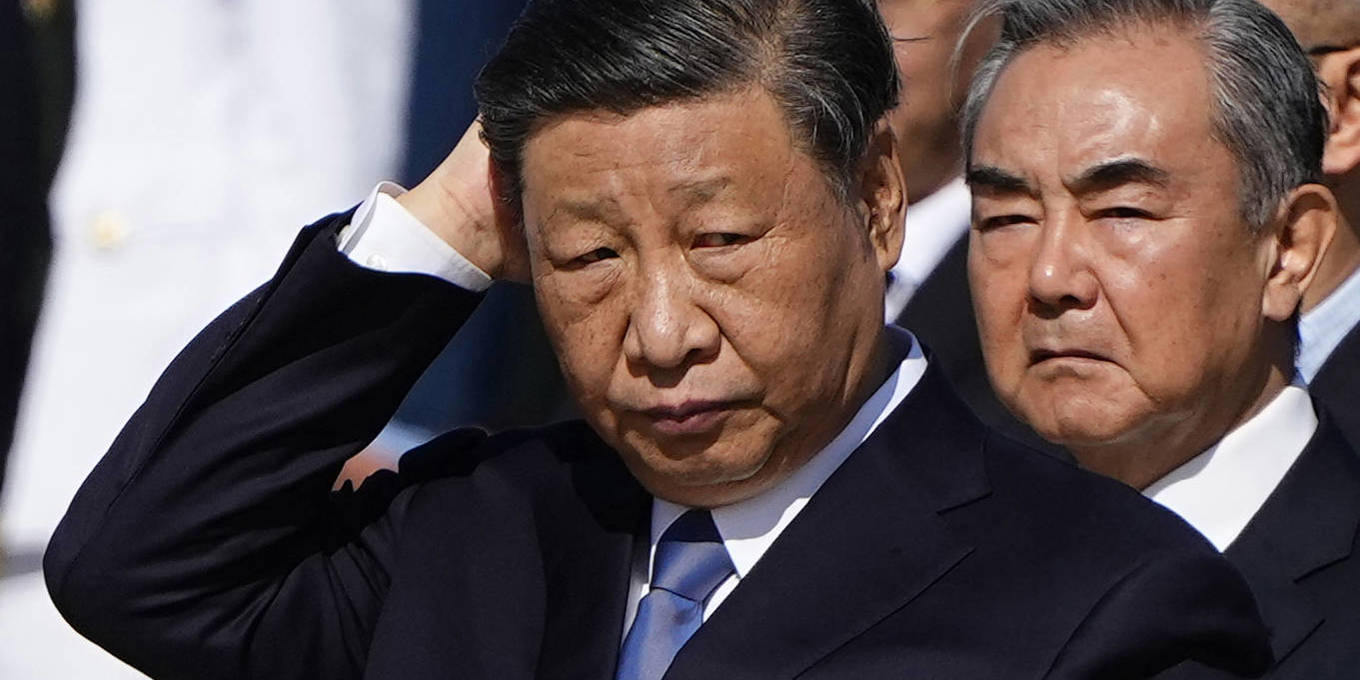
From surveilling and repressing Chinese citizens to firing and prosecuting potential rivals, Chinese President Xi Jinping seems able to rule only through fear. But fear is not a foundation for long-term stability, and the more Xi seeks to consolidate power, the more vulnerable his position becomes.

Brahma ChellaneyProject Syndicate

During his 13 years in power, Xi Jinping has steadily tightened his grip on all levers of authority in China – the Communist Party of China (CPC), the state apparatus, and the military – while expanding surveillance into virtually every aspect of society. Yet his recent purge of nine top-ranking generals, like those before it, shows that he still sees enemies everywhere.

After taking power in 2012, Xi launched a crackdown on corruption within the CPC and the People’s Liberation Army (PLA). The campaign was initially popular, because China’s one-party system is rife with graft and abuse of power. But it soon became clear that enforcement was highly selective – a tool not for building a more transparent or effective system, but for consolidating power in Xi’s hands. In Xi’s China, advancement depends less on competence or integrity than on earning the leader’s personal trust.

But even after more than a decade of promoting only loyalists, Xi continues to dismiss officials regularly, including top military commanders. According to the US Office of the Director of National Intelligence, nearly five million officials at all levels of government have been indicted for corruption under Xi. And this is to say nothing of those who simply disappear without explanation.

True to form, Xi’s regime claims that the military leaders swept up by his latest purge – including General He Weidong, a member of the Politburo, Vice Chair of the Central Military Commission, and the third-highest-ranking figure in China’s military hierarchy – committed “disciplinary violations” and “duty-related crimes.” But a more plausible explanation is that Xi is playing an interminable game of Whac-a-Rival, desperately trying to preserve his grip on power.

Xi’s fears are not entirely misplaced: each new purge deepens mistrust among China’s elite and risks turning former loyalists into enemies. From Mao Zedong to Joseph Stalin, there is ample evidence that one-man rule breeds paranoia. By now, Xi may well have lost the ability to distinguish allies from foes. At 72, Xi remains so insecure in his position that, unlike even Mao, he has refused to designate a successor, fearing that a visible heir could hasten his own downfall.

None of this bodes well for China. By refusing to lay the groundwork for an eventual leadership transition, Xi sharply increases the risk that the end of his rule – however that comes – will usher in political instability. In the meantime, Xi’s emphasis on personal fealty over ideological conformity is weakening institutional cohesion in a system once grounded in collective leadership. Coupled with his arbitrary firings and prosecutions, Chinese governance is now increasingly defined by sycophancy and anxiety, rather than competence and consistency.

China’s military is paying a particularly steep price for Xi’s insecurity. In recent years, the PLA has undergone sweeping structural reforms aimed at transforming it into a modern fighting force capable of “winning informationized wars.” But Xi’s purges risk undermining this effort by disrupting military planning and leadership. For example, his abrupt removal in 2023 of the leaders of the PLA’s Rocket Force, which oversees China’s arsenal of nuclear and conventional missiles, may have jeopardized China’s strategic deterrent.

Replacing experienced commanders with untested loyalists might ensure Xi’s political survival – and Chinese leaders have often used the military to safeguard their own power – but it does nothing for national security. And when generals are preoccupied primarily with political survival, both morale and operational readiness suffer. Can the PLA fight and win a war against a major adversary like the United States or India while operating under the political constraints Xi has imposed on it?

So far, Xi has advanced his expansionist agenda through stealth and coercion rather than open warfare. But a paranoid leader surrounded by sycophants unwilling or unable to challenge him is always at risk of strategic miscalculation. Recall that Stalin decimated the Red Army’s leadership on the eve of the Nazi invasion – with disastrous results. In Xi’s case, it might be China that does the invading, if he orders an amphibious assault on Taiwan.

For all the pomp surrounding China’s rise, the country is beset by structural problems, including a slowing economy, rising youth unemployment, and an aging and declining population. Popular discontent may well be growing, but it is masked by repression, just as any potential challenge to Xi’s leadership is preempted by purges and prosecutions. Ultimately, Xi seems able to rule only through fear.

But fear is not a foundation for long-term stability. A leader consumed by fear of disloyalty may command obedience but not genuine fidelity. Obedience is not merely a poor substitute for strength; it can become a source of fragility, as it leaves little room for creativity, competency, or collaboration. The great irony of Xi’s approach is that the more he seeks to consolidate power in his own hands, the more vulnerable his rule becomes.

Mao’s purges culminated in chaos and national trauma. Xi’s methods are more sophisticated, but the underlying logic is the same – as could be the results.

Brahma Chellaney, Professor of Strategic Studies at the New Delhi-based Center for Policy Research and Fellow at the Robert Bosch Academy in Berlin, is the author of nine books, including Water: Asia’s New Battleground (Georgetown University Press, 2011), for which he won the 2012 Asia Society Bernard Schwartz Book Award.

© Project Syndicate, 2025.

Trump’s foreign policy: Isolationist rhetoric, interventionist reality

Featured

By Brahma Chellaney, The Hill

The U.S. has carried out scores of covert and overt regime-change operations since the last century. Scholarly consensus is clear: such interventions rarely advance U.S. interests and usually produce unintended consequences that recoil on America itself.

Yet President Trump’s administration is engaged in a barely disguised effort to topple President Nicolás Maduro’s regime in Venezuela.

The dissonance between Trump’s rhetoric and policy could not be starker. He has repeatedly denounced decades of U.S. intervention abroad, especially military-backed attempts at regime change and “nation-building.” After his 2016 victory, he declared: “We will stop racing to topple foreign regimes that we know nothing about, that we shouldn’t be involved with.”

But in contrast to this “America First” non-interventionist pose, Trump’s approach to Venezuela has been one of the most sustained U.S. campaigns for regime overthrow in recent memory. His strategy has included crippling sanctions, narcoterrorism indictments against Maduro and his associates, and naval deployments under the fig leaf of an anti-narcotics operation.

In recent weeks, after ordering strikes on Venezuelan boats that killed at least 21 people, Trump dispatched warships, surveillance planes and even an attack submarine — a show of force calculated to weaken and ultimately topple Maduro.

Such adventurism clashes with Trump’s latest bid to crown himself a global peacemaker. At the United Nations, he claimed he had “ended seven un-endable wars” and boasted “everyone” wanted him to win the Nobel Peace Prize. The problem is that some of the seven “wars” never existed, others remain unresolved, and in one case (the Israel-Iran conflict) Trump joined the fight by ordering U.S. bombing of Iranian nuclear sites. In his telling, this was peace by another name.

In 2023, Trump thundered, “Either the Deep State destroys America or we destroy the Deep State.” Yet since returning to the White House, he has often acted as executor of the very Deep State agenda he rails against. His distinction seems to be that the Deep State should confine itself to foreign entanglements while steering clear of domestic politics.

Trump’s Venezuela gambit ignores the long trail of regime-change debacles, from Guatemala and Chile to Afghanistan and Libya. Libya, since the 2011 overthrow of Muammar Qaddafi, remains a a failed state. The roots of Iran’s 1979 Islamic Revolution can be traced to the 1953 CIA-led Operation Ajax, which ousted a democratically elected prime minister and installed the Shah’s dictatorship.

Similarly, U.S. involvement in the 1973 Chilean coup achieved the goal of removing a socialist president but at the cost of propping up Augusto Pinochet’s brutal dictatorship. The coup stained America’s reputation and left scars that still shape Chilean politics.

Even failed regime-change efforts have produced blowback. Violent jihadism in Syria was fueled by a multiyear CIA program — the second largest in its history after the 1980s Afghan campaign — to topple Bashar al-Assad. Launched in 2012 under Barack Obama, the $1 billion project trained and armed anti-Assad rebels, inadvertently boosting jihadist forces and helping spawn the Islamic State. Trump himself shut it down in 2017, acknowledging that U.S.-supplied weapons had ended up in the hands of al-Qaeda, which had emerged from CIA-trained Afghan “mujahideen.” 

The destabilization of Libya, Syria and Iraq fueled a refugee influx into Europe — 1.1 million into Germany alone in 2015. That wave, in turn, stoked radical Islamism across Europe, with terror attacks in Munich, Nice, Brussels and Paris.

Most recently, following Assad’s downfall last December, Trump embraced Syria’s new president — a former jihadist warlord with al-Qaeda roots whose regime has intensified sectarian violence against non-Sunni minorities. When terrorists become American assets, America’s moral authority is collateral damage.

The history of U.S. regime-change operations reveals three recurring outcomes. First, regime replacement usually yields civil war, prolonged insurgency or outright state collapse. Second, interventions more often install authoritarian rule than foster democracy. Third, interference breeds resentment, undermines U.S. credibility as a defender of democracy and galvanizes extremist movements.

Venezuela holds the world’s largest proven oil reserves, which helps explain Trump’s zeal for regime change there. U.S. oil sanctions are designed to choke off Maduro’s main source of revenue and force his ouster. But they have created a severe humanitarian crisis, fueling Latin America’s largest refugee exodus in history and straining Venezuela’s neighbors, especially Colombia and Peru.

Trump has brushed aside both the human suffering and the sobering lessons of past adventures. Oil, not democracy, is the real prize he seeks in Venezuela.

By personalizing foreign policy to the point where major decisions hinge on impulse rather than consultation with national security professionals, Trump has heightened the risk of miscalculation. His Venezuela gambit may yet produce the same blowback that has defined so many regime-change campaigns — leaving the U.S. weaker, not stronger, in Latin America and beyond.

Brahma Chellaney is the author of nine books, including the award-winning “Water: Asia’s New Battleground.”

What Western media call insurrection at home, they call revolution abroad

Featured

The selective storytelling applies double standards in domestic vs. global coverage

Bangladeshis celebrate in Dhaka on Aug. 5, the first anniversary of student-led protests that ousted former Prime Minister Sheikh Hasina.

By Brahma Chellaney
Contributing Writer, The Japan Times

Imagine if Western media had described the mob attack on the U.S. Capitol on Jan. 6, 2021, not as lawlessness and an assault on democracy but as democratic ferment against a corrupt system beholden to money and power. The thought is absurd. Yet in the Global South, politically driven riots — sometimes even violent mob attacks on state institutions — are routinely depicted in Western outlets as righteous uprisings against venal elites.

Western media have perfected a seductive but dangerous narrative: the romanticized tale of youth-led “revolutions” toppling supposedly repressive, graft-ridden governments abroad. In just the past month, coverage of political unrest in Madagascar, Nepal, Indonesia and the Philippines has followed the same script. The ouster of Sheikh Hasina in Bangladesh in 2024 was packaged as a heroic liberation, only for Islamist repression and chaos to follow.

This is not journalism. It is selective storytelling that applies one moral framework at home and abandons it abroad. What would be denounced as sedition in Washington is rebranded as democratic awakening in a fragile state.

Take Nepal. After mobs began torching one state institution after another — parliament, the supreme court, ministries, banks and even armories — the elected government fell. The West’s narrative machine promptly lionized the new interim prime minister, Sushila Karki, as an “anti-corruption crusader” and Gen Z icon. Her lack of constitutional legitimacy and her husband’s record as a 1973 plane hijacker barely merited a footnote. What mattered was a simple, digestible story: angry young people overthrowing a corrupt regime.

Such hero-making privileges narrative satisfaction over factual complexity. The coordinated arson that gutted Nepal’s public institutions was framed not as criminal destruction but as “youthful idealism.” In reality, democracy requires functioning courts, legislatures and bureaucracies — the very institutions that mobs incinerated. To glorify their destruction is not to defend democracy but to undermine it.

The double standards extend beyond violent upheavals. Consider disasters. In principle, journalism demands sensitivity in reporting grief. In practice, Western coverage of tragedies abroad often traffics in voyeurism, cultural stereotyping and sensationalism.

Japan’s 2011 Fukushima disaster is one case: Victims’ suffering was reduced to a backdrop for lurid stories about radiation. Workers at the nuclear plant were stereotyped as “nuclear samurai,” “human sacrifices” or “nuclear ninjas on a suicide mission.” Never mind that preventive evacuations ensured no radiation deaths occurred. Grossly misleading comparisons to Chernobyl fed hysteria rather than clarity.

The COVID-19 pandemic revealed the same skew. According to the World Health Organization, more people officially died in the West than in the non-Western world. The United States led in both cases and deaths. Yet the images Western audiences saw were overwhelmingly from India, Brazil or Africa. When India was ravaged by a two-month wave in the pandemic’s Delta phase, Western media beamed out haunting images of burning pyres and gasping patients in hospitals where foreign crews intruded even into emergency wards. But when mass graves were dug in New York or refrigerated trucks lined Western streets to store bodies, the imagery was sanitized.

Africa has long borne the brunt of such stereotypes. Coverage of the 2014 to 2016 Ebola epidemic, which killed 11,325 people, was drenched in images of body bags, burial rituals and despair. The Pulitzer Prize went to a photographer who shadowed body collectors. The fact that the epidemic was confined to three countries barely registered. To global audiences, Ebola became an “African” disease, cementing a continent-wide stigma.

This pattern extends to war. Western media rarely show images of dead American or European soldiers. Yet they freely publish photographs of slain Afghans, Iraqis, Libyans or Syrians. Grief is privatized at home but paraded abroad.

To be sure, Western outlets are not monolithic, nor are they incapable of occasionally sensationalizing domestic tragedy. But the larger pattern is unmistakable: When violence or disaster occurs outside the West, journalistic norms of restraint, accuracy and dignity are loosened or abandoned.

Why does this matter? Because Western media double as global media. Their frames and images shape international perceptions. When arson and mob violence are repackaged as “revolution” abroad, they gain moral cover that fuels instability rather than reform. When death and disaster are depicted through exoticized lenses, whole societies are reduced to stereotypes.

Consistency is the real test of credibility. If storming Congress is insurrection in Washington, storming parliament cannot be celebrated as democratic ferment in Nepal. If images of mass funerals in New York are shielded from the public eye, burning bodies in New Delhi should not be broadcast as a global spectacle.

The bifurcated lens does not merely distort. It legitimizes abroad what it denounces at home. It excuses destruction when it happens in the Global South while criminalizing it when it happens in the West.

It is time for Western media to abandon these double standards. Thoughtful, responsible journalism requires applying the same rules of coverage everywhere: respect for facts, consistency in moral frameworks and sensitivity toward human suffering. Otherwise, what poses as universal reporting is little more than cultural narcissism disguised as news.

Brahma Chellaney is a geostrategist and the author of nine books, including “Water: Asia’s New Battleground.”