Ending the Ukraine war is in America’s interest

By Brahma Chellaney, The Hill

Russian President Vladimir Putin speaks with recipients of Gold Star medal of Hero of Russia on “Defender of the Fatherland Day,” in Moscow, Russia, Sunday, Feb. 23, 2025. (Mikhail Metzel, Sputnik, Kremlin Pool Photo via AP)

Former President Joe Biden left President Trump a mess in Ukraine, with Russian forces continuing to occupy one-fifth of Ukrainian territory and advancing along the front lines. The U.S. faces diminishing options after three years of deepening entanglement in a brutal war that has devastated numerous Ukrainian cities, towns and villages.

The war has distracted America from pressing challenges in the Indo-Pacific region, the world’s emerging economic and geopolitical hub that is poised to shape the new international order. Worse still, China has emerged as the big winner, as the conflict has ensnared NATO and Russia.

China, significantly stronger than Russia in economic output, military spending and other strategic metrics, remains America’s chief global rival. As Biden’s national security strategy acknowledged, China is committed to achieving global dominance by surpassing the U.S. as the foremost world power.

The U.S.-led “hybrid war” and unprecedented sanctions against Moscow have inadvertently strengthened China’s hand, including by making it Russia’s banker. Russia now conducts much of its international trade in Chinese yuan and deposits the proceeds in Chinese banks, effectively granting Beijing a share in its financial returns.

More concerning is China’s strategic maneuvering to co-opt Russia in an unholy alliance against the U.S. Their “no-limits partnership,” declared in 2022, is creating a two-against-one geopolitical competition that threatens to accelerate America’s relative decline through strategic overreach. A formal Sino-Russian military and strategic alliance could produce a pan-Eurasian colossus — America’s worst geopolitical nightmare.

Given this backdrop, the U.S. needs to return to its old grand strategy, which helped the West win the Cold War by driving a wedge between Moscow and Beijing. Ending the Ukraine war would also enable the U.S. to reallocate military resources from Europe to the Indo-Pacific, where its global primacy is truly at stake.

Trump’s diplomatic outreach to Moscow — aimed at resolving the Ukraine war, as he promised to do in his campaign — has created not only a furor in some Western capitals but also a toxic and divisive political discourse at home. Even before the efforts to end the war have made any tangible progress, Trump already faces fierce criticism. Opponents accuse him of giving Moscow a free pass and endorsing a “Ukraine sellout.” Some claim he has lifted Russia’s international isolation, despite evidence that the West never succeeded in actually isolating Moscow.

But diplomacy between adversaries is crucial to defuse tensions and prevent direct conflict. Biden firmly shut the door to diplomacy with Russia, prolonging Ukraine’s suffering. Only after a change in U.S. leadership did the American and Russian leaders resume direct communication, agreeing to explore pathways to peace.

Ending the Ukraine war will require a complex and carefully negotiated resolution — one that is “enduring, sustainable, and acceptable to all parties,” as Secretary of State Marco Rubio put it. But the political backlash from pro-war factions in the West is making the search for peace even more difficult.

Regardless of how the peace process unfolds, the transatlantic alliance is set for a major transformation. Defense Secretary Pete Hegseth bluntly told European leaders recently to take “responsibility for [their] own security” so that the U.S. can focus on “deterring war with China.” Consequently, tens of thousands of American troops currently stationed in Europe may be redeployed to the Indo-Pacific.

The European Union, which dutifully followed Biden’s lead in escalating the Ukraine conflict through transfers of increasingly sophisticated weapons, now seeks a role in peace negotiations. But the EU is rudderless and deeply divided, grasping for common ground. Its inclusion would be a drag on the negotiations, which may explain why the U.S. and Russian delegations met not in Europe but in Saudi Arabia.

The fact is that the Ukraine conflict remains in many ways a proxy war between Russia and the U.S., with Ukraine caught in the middle — a pawn in the geopolitical chess game. Ukrainian President Volodymyr Zelensky, who has worked to snuff out the country’s nascent democracy through draconian measures, admitted this month that, without America’s continued military aid, it will be “very, very difficult” for Ukraine to “survive.”

By opening direct dialogue with Moscow, the Trump administration has demonstrated both its commitment to ending the war and the marginal role China plays in securing peace in Ukraine. The only nation that benefits from prolonging the war is China, which has more than doubled its nuclear arsenal since 2020 and is expanding its conventional forces faster than any other country has since World War II.

Trump’s decision to extricate America from the Ukraine conflict aligns with long-term U.S. strategic interests. The war, through the flood of Western arms supplies to Kyiv, has exposed the West’s military shortcomings, such as its depleted stocks of critical munitions and air defense systems, as well as America’s struggle to ramp up weapons production.

As Biden himself acknowledged, a “negotiated settlement” is the only viable path to ending the war. A U.S.-Russia peace deal must be reached before Beijing and Moscow can cement a strategic axis that erodes America’s global primacy and increases Taiwan’s vulnerability. A Chinese annexation of Taiwan would reshape the global order, ending America’s global preeminence and undermining its alliance system.

Brahma Chellaney is a geostrategist and the author of nine books, including the award-winning “Water: Asia’s New Battleground.”

Trump’s pivot to the Indo-Pacific from Europe is clear

White House meeting with Modi follows close on the heels of Ishiba’s visit

Avatar

Brahma Chellaney

Nikkei Asia

20250218 modi trumpDonald Trump and Narendra Modi prepare to shake hands as they attend a joint press conference at the White House in Washington on Feb. 13, 2025.  © Reuters

U.S. President Donald Trump is seeking to swiftly reorient foreign policy in his second term, shifting America’s strategic focus from Europe and the Middle East to the Indo-Pacific — an increasingly pivotal region in shaping the global order. Trump has already hosted the prime ministers of India and Japan separately and initiated efforts to end the Ukraine war, a conflict that has diverted U.S. attention from pressing Indo-Pacific challenges and made China the big winner.

Secretary of State Marco Rubio, on his first day in office, held a meeting of the foreign ministers of the Quad, a strategic alliance of leading Indo-Pacific democracies that Trump revived in his first term after a decade-long dormancy. Meanwhile, Defense Secretary Pete Hegseth, speaking in Brussels on Feb. 12, warned Europe that “the U.S. will no longer tolerate an imbalanced relationship which encourages dependency” and that Europe must take “responsibility for its own security” by leading “from the front” so that America prioritizes “deterring war with China” in the Indo-Pacific.

Vice President JD Vance followed up from European soil in Munich by reinforcing Hegseth’s warning — Europe needs to shape up before many of the more than 100,000 American troops stationed there begin to be shipped out. Vance’s statement that Europe’s main security threat is “from within” suggests the fraying transatlantic alliance is headed toward a fundamental transformation.

The U.S.-India strategic partnership was a cornerstone of Washington’s strategy from Trump’s first term for a “free and open Indo-Pacific,” a vision originally conceived by then-Japanese Prime Minister Shinzo Abe as a shorthand for a rules-based, liberal order. The China-Russia “no-limits partnership,” which developed during Joe Biden’s presidency, has only intensified the U.S. strategic imperative to forge a “soft” alliance with another nuclear-armed power: India.

Against this backdrop, Trump’s Feb. 13 meeting in Washington with Indian Prime Minister Narendra Modi underscored both leaders’ commitment to revitalizing the U.S.-India relationship.

Successive American presidents since Bill Clinton have left bilateral ties with India stronger than they inherited. However, under Biden, momentum stalled as differences cropped up, including over New Delhi’s reluctance to take sides in the Ukraine war and U.S. policies toward India’s neighbors, including Bangladesh, Myanmar and PakistanA Quad meeting is held on the sidelines of the G7 summit in Hiroshima, Japan, in May 2023.   © Reuters

The outcome of Modi’s White House visit attests to a good start toward rebuilding mutual trust. Trump and Modi, maintaining the warm rapport they developed in their first terms, exchanged a bear hug and projected unity at a joint news conference. Notably, they avoided discord over Trump’s hot-button issues like trade and immigration.

As he did with Japanese Prime Minister Shigeru Ishiba on Feb. 7, Trump touted strong bilateral ties while pressing Modi for “fair” and balanced trade, including increased Indian imports of American hydrocarbons and weapons. In his trademark style of blending some public flattery with hard bargaining, Trump called Modi “a much tougher” and “much better negotiator than me,” just as he had said Ishiba is “a very strong person, I wish he wasn’t so strong.”

Trump, along with the Japanese and Australian prime ministers, is set to visit India in the fall for the Quad leaders’ summit, by which time he hopes significant progress will have been made by negotiators on the U.S.-India trade agreement to which Modi committed in Washington. This strategy mirrors Trump’s previous approach in leveraging tariffs to secure a trade pact with Japan in 2019.

As the U.S. pivots to the Indo-Pacific, stronger ties have become essential with India and Japan, China’s main Asian rivals strategically located on its opposite flanks. The balance of power in the Indo-Pacific will be largely shaped by developments in East Asia and the Indian Ocean.

Japan, hosting over 80 U.S. military facilities and more American troops than any other U.S. ally, is critical to the defense of Taiwan, whose annexation by China would mark the end of U.S. global dominance. Meanwhile, India, locked in a lingering military standoff with China, has actively challenged Beijing’s power and capabilities in a way no other nation has in this century.

Long before Trump entered national politics, U.S. policymakers recognized the need to shift strategic focus to the Indo-Pacific, a region emerging as the world’s economic and geopolitical hub. In 2011, then-President Barack Obama unveiled a “pivot to Asia” strategy, but it remained largely rhetorical, lacking substantive strategic initiatives.

When Trump took office in 2017, he replaced Obama’s symbolic pivot with a comprehensive strategy for a “free and open Indo-Pacific.” He also fundamentally redefined U.S. policy toward Beijing, reversing a four-decade-old U.S. approach of aiding China’s economic rise by classifying that communist behemoth as a strategic rival and threat.

Biden maintained this approach, preserving the free and open Indo-Pacific strategy, including the Quad as a key pillar, while acknowledging China as America’s primary challenger that is bent on world dominance. However, his administration’s entanglement in conflicts in Ukraine and the Middle East left little space for a genuine pivot to the Indo-Pacific.

Trump’s new administration is prioritizing the resolution of these conflicts to focus on the Indo-Pacific, where U.S. global primacy is at stake. Ending involvement in the conflicts would free military resources for the Indo-Pacific, particularly from Europe.

More broadly, America’s grand strategy has long centered on driving a wedge between Moscow and Beijing — a strategy that helped the West win the Cold War without direct military confrontation. However, thanks to Biden-era policies, the U.S. has become the bridge that unites Russia and China.

Ending the Ukraine war could provide an opportunity for Washington to peel Moscow away from Beijing or weaken the Sino-Russian partnership to help isolate China.

More importantly, it would allow the U.S. to concentrate on countering the challenge from a globally ascendant China, with support from allies like Japan and strategic partners like India, whose rise as an independent power meshes with the Trump administration’s aversion to friends’ dependency on the U.S.

Brahma Chellaney, a professor of strategic studies at the independent New Delhi-based Centre for Policy Research and fellow at the Robert Bosch Academy in Berlin, is the author of nine books, including “Water: Asia’s New Battleground” (Georgetown University Press), which won the Bernard Schwartz Book Award.

Putting the Trump-Modi Bromance to the Test

Brahma ChellaneyProject Syndicate

Last time Donald Trump was president, ties between the United States and India flourished. But the bilateral relationship began to fray during Joe Biden’s presidency, owing not least to divisions over the Ukraine war. Will Indian Prime Minister Narendra Modi’s latest meeting with Trump at the White House mark the first step toward restoring this critical relationship?

Trump has made no secret of his conviction that personal bonds between leaders can underpin stronger bilateral relationships. And he and Modi certainly share an affinity: both are nationalist politicians who love little more than to please a roaring crowd with elaborate theatrics. In September 2019, the two came together for a public rally in Houston, attended by 50,000 Indian-Americans and several US legislators. The following February, Trump addressed more than 100,000 people in Ahmedabad. “America loves India,” he declared. “America respects India, and America will always be faithful and loyal friends [sic] to the Indian people.”

US-India relations took a turn for the worse after Russia’s full-scale invasion of Ukraine in 2022. The Biden administration mobilized America’s allies and partners to join its campaign to punish Russia – and, ideally, compel it to change its behavior. But far from joining this effort, India stayed neutral and seized the opportunity to secure cheap Russian oil.

There were other points of contention, as well. The Biden administration sought to weaken Myanmar’s military junta by imposing stringent sanctions on the country and sending “non-lethal aid” to rebel groups – a policy that has contributed to instability in India’s border state of Manipur. Biden also coddled Pakistan’s military-backed regime, including by approving a $450 million deal in 2022 to upgrade the country’s fleet of F-16 fighter jets.

Similarly, Biden welcomed the interim government that Bangladesh’s military installed following the overthrow of the country’s India-friendly government last August. Bangladesh’s rapid descent into lawlessness and Islamist violence since then has raised serious security risks for India, which is already home to millions of illegally settled Bangladeshis.

America’s approach to Sikh separatist leaders on its soil has also raised India’s hackles. Under the Biden administration, the US carried out a criminal investigation into India’s alleged involvement in supposed assassination plots against Sikh militants in the US and Canada. Last September, just days before Biden met with Modi in Delaware, senior White House and US intelligence officials met with Sikh separatists to assure them that they would be protected from “transnational repression.” The following month, the US charged a former Indian intelligence officer in an alleged failed plot to kill a New York-based Sikh militant, who is on India’s most-wanted list.

Against this backdrop, it is easy to see why Trump’s victory in last November’s presidential election raised hopes in India for a reset in bilateral relations. It helps that Trump has repeatedly pledged to negotiate a quick conclusion to the Ukraine war, meaning that India’s choice not to pick a side in that conflict would no longer matter.

A few weeks into Trump’s second presidency, however, there are reasons to doubt this rosy scenario. So far, Trump has done nothing to spare India from his frenetic push to implement his campaign promises, from raising tariffs to deporting undocumented immigrants. When the Trump administration sent more than 100 Indian nationals back to India on a military aircraft – a 40-hour ordeal – their hands and feet were shackled. Modi said nothing.

In fact, far from standing up to Trump, Modi has preemptively slashed tariffs on US imports, hoping that this would keep India out of “Tariff Man’s” sights. But a dissatisfied Trump, who has called India a “very big abuser” of tariffs, has not spared India from his steel and aluminum levies. He wants India to wipe out its $35 billion bilateral trade surplus, by buying more oil and petroleum products, and more weapons, from the US.

India is the world’s third-largest primary energy consumer, after China and the US, and the largest source of oil demand growth. That makes the country a highly attractive market for a US administration that is committed to increasing domestic oil and gas production. It also means that Trump’s commitment to pushing down oil prices, including by applying pressure on OPEC leader Saudi Arabia, would benefit India’s economy.

But Trump has never been particularly concerned about ensuring that his trade agreements are mutually beneficial. Regarding India, his plan may well be to use the threat of tariffs to compel Modi’s government to accept the trade deal of his choosing. That is what he did to Japan during his first presidency. He also tried to do it to India, but failed, so he stripped India of its special trade status instead, prompting India to impose retaliatory tariffs on some US products.

If Trump ends up slapping more tariffs on India, the Indian economy could slow, at least marginally. More broadly, Trump’s “America First” trade agenda – which clashes with Modi’s “Make in India” initiative – threatens to undermine India’s status as the world’s “back office,” providing extensive IT and business services to US companies.

Where trade is concerned, Trump treats friends and foes alike. But it matters that India is a friend – and Trump should want to keep it that way. The US-India strategic partnership helps advance the two countries’ shared interests in the Indo-Pacific region, the world’s emerging economic and geopolitical hub, including strengthening maritime security and supporting a stable balance of power. Already, the two countries are working to deepen military interoperability, and the US has overtaken Russia as India’s leading weapons supplier, as new contracts show.

As Trump and Modi build on their rapport, both should recognize that India is America’s most important partner in countering China’s hegemonic ambitions. It is thus in both countries’ interest to restore and deepen the bilateral relationship, including by strengthening collaboration on critical and emerging technologies, from artificial intelligence to biotechnology. Warm personal relations are an added bonus.

Brahma Chellaney, Professor of Strategic Studies at the New Delhi-based Center for Policy Research and Fellow at the Robert Bosch Academy in Berlin, is the author of nine books, including Water: Asia’s New Battleground (Georgetown University Press, 2011), for which he won the 2012 Asia Society Bernard Schwartz Book Award.

© Project Syndicate, 2025.

As Trump meets with India’s Modi, Bangladesh demands attention

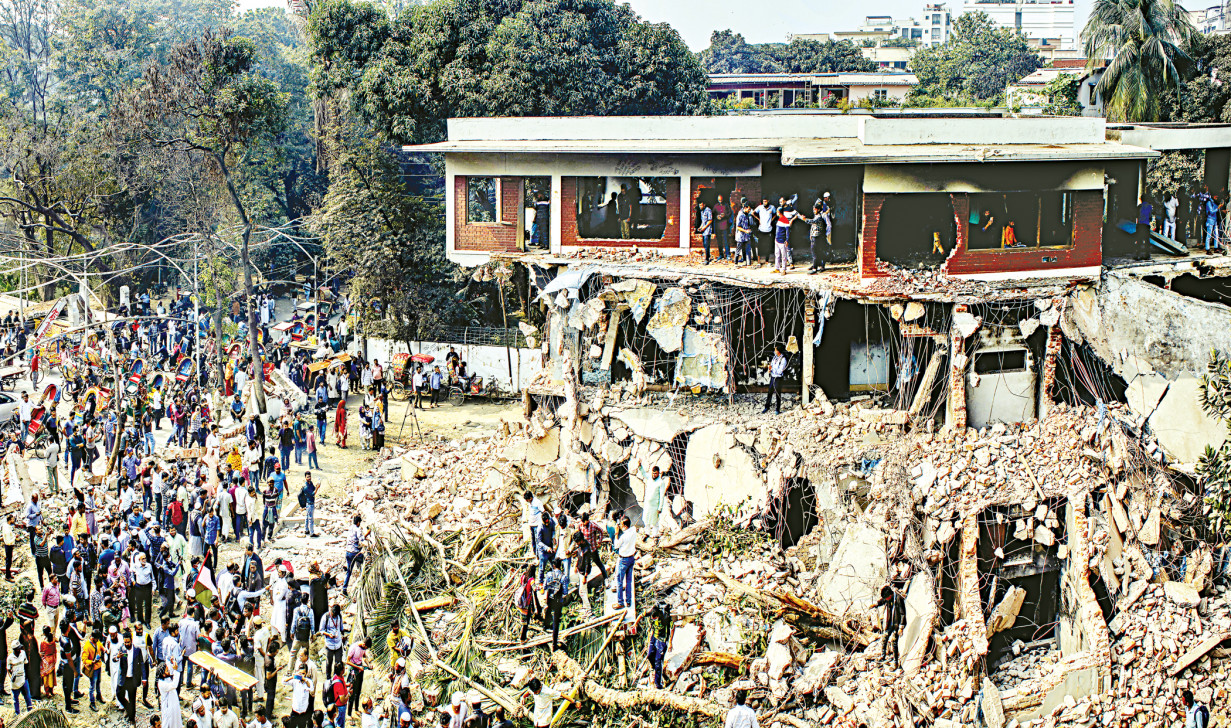
A mob demolished the national memorial museum where the country’s independence was proclaimed. (Photo courtesy The Daily Star)

By Brahma Chellaney, The Hill

Bangladesh’s recent descent into lawlessness poses a foreign policy challenge for President Trump, especially because his predecessor supported last August’s regime change there.

The world’s most densely populated country (excluding microstates and mini-states) risks sliding into jihadist chaos, threatening regional and international security.

Bangladesh has also emerged as a sore point in U.S.-India relations, with the issue likely to figure in Indian Prime Minister Narendra Modi’s discussions with Trump at the White House this week. New Delhi is smarting from the overthrow of Bangladesh Prime Minister Sheikh Hasina’s India-friendly government and the installation of a new military-chosen “interim” administration with ties to Islamists whom India sees as hostile.

The new regime is led by the 84-year-old Muhammad Yunus, who publicly lamented Trump’s 2016 election win as a “solar eclipse” and “black day.” Yunus received the 2006 Nobel Peace Prize after former President Bill Clinton lobbied for him, a fact the Norwegian Nobel Committee chairman acknowledged in his award ceremony speech.

Megadonor Alex Soros — who says that “Trump represents everything we don’t believe in” while vowing to “fight back” — has pledged continued support to the regime in Bangladesh, where he recently went by private jet to meet Yunus, despite the country’s downward spiral into violent jihadism. This was his second meeting with Yunus since September, when the two met in New York.

The lawlessness in Bangladesh was on stark display last week as regime supporters went on a rampage, setting ablaze or demolishing properties in a coordinated manner, including the national memorial to Hasina’s assassinated father, Sheikh Mujibur Rahman, the country’s charismatic founding leader. Mobs also looted and burned down Hasina’s private residence and the homes of several leaders of her Awami League party.

In a sign of regime complicity in the attacks, security forces stood by and watched quietly as mobs ran amok, including storming the memorial museum, where the country’s independence was proclaimed in 1971. The attackers, after failing to burn down the memorial with the fire they lit, brought excavators and manually tore down the memorial over two days, prompting Islamist celebrations at the site with an Islamic State banner. Only after the various attacks were over did Yunus appeal for calm.

The razing of the memorial museum, which was originally the founding leader’s residence and where he and much of his family were murdered in a 1975 predawn army coup, could help advance the current regime’s effort to redefine or erase key aspects of Bangladesh’s history. In fact, this was the second assault on the memorial since the regime change, with the first attack leaving it partially damaged and without family archives owing to looting and arson.

Last week’s spate of attacks across the nation showed why the regime, as Bangladeshi media highlighted, is struggling to restore law and order or reverse the downturn in a once-booming economy, which, under Hasina’s secular government, lifted millions of people out of poverty. Now, as foreign reserves plummet and foreign debt spirals upward, the country is seeking international bailouts.

Since its first coup in 1975, which led to more military interventions and counter-coups, Bangladesh has remained trapped in a cycle of violence and deadly retributions. The military-backed ouster of Hasina — the “iron lady” who kept both the military and Islamist movements in check, but who lurched toward authoritarianism — followed weeks of student-led, Islamist-dominated violent protests.

After police fired on rioting protesters, mobs captured dozens of policemen, beating them to death and hanging the bodies of some from bridges. A total of 858 people reportedly died in what the Yunus regime and its supporters have called a “revolution.” The military used the violence to pack Hasina off to neighboring India before she could even resign.

Violence, however, has only escalated under the Yunus administration, especially against political opponents, religious and ethnic minorities, and anyone seen as a critic of the regime. Just days before the American election in November, Trump posted, “I strongly condemn the barbaric violence against Hindus, Christians, and other minorities who are getting attacked and looted by mobs in Bangladesh, which remains in a total state of chaos.”

Islamist violence has gained ground largely because Yunus has lifted bans on jihadist groups with links to terrorism and freed violence-glorifying Islamist leaders. Hundreds of Islamists have escaped from prisons. Extremist groups — including Hizb ut-Tahrir, proscribed by several Western governments as an international terrorist threat — now operate freely in Bangladesh, from demolishing shrines of minorities to staging anti-Trump marches.

In fact, a dysfunctional Bangladesh is becoming a mirror image of its old nemesis, Pakistan, from which it seceded following a bloody war of liberation that left up to 3 million civilians dead in a genocide led by the Pakistani military.

Given the country’s porous borders, the current violence and chaos in Bangladesh affect India’s security. Already home to millions of illegally settled Bangladeshis, India faces growing pressure on its borders from those seeking to flee religious or political persecution in Bangladesh. Fearing infiltration by freed terrorists, India has sought to tighten border security. A lawless Bangladesh is also not in America’s interest.

As Trump seeks to build on his rapport with Modi to restore America’s fraying relationship with India, a shift away from the Biden policy of mollycoddling the Yunus regime could help ease Indian security concerns. If the U.S.-India strategic partnership is to advance a stable balance of power in Asia, the two powers must work in sync with one another in India’s own neighborhood to help build mutual trust.

Brahma Chellaney is a geostrategist and the author of nine books, including the award-winning “Water: Asia’s New Battleground.”

Brash Trump diplomacy a better bet

Taipei Times, February 10, 2025

For Taipei, last year was a particularly dangerous period, with China stepping up coercive pressures on Taiwan amid signs of US President Joe Biden’s cognitive decline, which eventually led his Democratic Party to force him to abandon his re-election campaign.

The political drift in the US bred uncertainty in Taiwan and elsewhere in the Indo-Pacific region about American strategic commitment and resolve. With America deeply involved in the wars in Ukraine and the Middle East, the last thing Washington wanted was a Taiwan Strait contingency, which is why Biden invested in personal diplomacy with China’s dictator Xi Jinping (習近平).

The return of Donald Trump to the White House is anything but good news for Xi’s regime. In his first term, Trump fundamentally changed America’s approach to Beijing by ending a four-decade-long US policy since the Richard Nixon era of aiding China’s economic rise, saying his predecessors “created a monster.” Trump’s national security strategy identified China as a strategic rival and threat.

Now, in his second term, Trump has fired a warning shot across Beijing’s bow by imposing new tariffs on imports from China.

The additional 10 percent US tariffs place Xi’s regime in a predicament. Any retaliatory Chinese measures would likely invite further rounds of American tariffs, resulting in Beijing exhausting US exports to target, as happened in the first Trump administration when tariffs were initially slapped on China in 2018. But doing little against Trump’s latest punitive action would make Xi look weak at home.

Given China’s sputtering economic-growth engine, a widening trade war with the US, with its likely international spillover, would seriously harm Chinese interests. China not only exports almost four times more goods to the US than it imports, but also its economic troubles at home have made it even more reliant on exports of excess industrial output that cannot be absorbed in the domestic market.

To make matters worse, China is running into long-term structural constraints, including a shrinking and rapidly aging population and slowing productivity growth, as well as a Western pushback against its neo-imperial ambitions. This may well explain why Xi seems to have concluded that China has a narrow window of strategic opportunity to shape the Asian and international order in its favor. Still, Xi is likely to think twice before seeking to provoke the US on Trump’s watch.

To be sure, Trump’s return is also set to create challenges for Taipei in its economic relationship with the US, given that Taiwan’s trade surplus with America has reached a record high. Trump is intent on wielding the tariffs card to close all of America’s bilateral trade deficits.

Many countries run trade deficits with China that they partly or wholly offset by running trade surpluses with the US. But Taiwan has large trade surpluses with both China and the US.

Trump views tariffs as a game-changing instrument to help fill the nation’s coffers and bring manufacturing back to the US. As he vowed in his inaugural address, “Instead of taxing our citizens to enrich other countries, we will tariff and tax foreign countries to enrich our citizens.”

Taiwan’s growing trade surplus with the US puts it in the crosshairs of Trump’s tariff strategy. Trump has already lamented that chip production “left us and went to Taiwan,” while slamming his predecessor’s US$6.6 billion funding award to the Taiwan Semiconductor Manufacturing Company (TSMC) in November to establish three chipmaking facilities in Arizona.

While stepping up pressure on Taipei to boost its defense spending, Trump could use the tariff card against Taiwan as part of his broader plan to cut reliance on foreign suppliers for critical semiconductors by reversing decades of offshoring in the technology industry. Almost all of the advanced chips used in the US are currently imported from Taiwan.

Against this backdrop, Taipei may have little choice but to encourage its semiconductor companies to significantly boost investments in America for producing next-generation chips. That could help tame Trump’s tariff threat, given that tariffs alone cannot help the US to replicate at home Taiwan’s semiconductor model. Taipei could also seek to placate the Trump administration by offering to jointly establish an international semiconductor supply chain.

It is in Taiwan’s own interest to significantly boost its defense spending so as to deter a Chinese attack. Unfortunately, Taiwan’s opposition-controlled legislature recently imposed significant cuts to the defense budget, including programs for developing asymmetric capabilities like drones.

Diplomacy is in part transactional, and Trump’s predecessors gave precedence to national security and geopolitical calculations even if it meant ignoring human rights and democratic governance issues. One example was Nixon’s China “opening” of 1970-71. Another example was Jimmy Carter’s presidential memo to various US government departments instructing them to help in China’s economic rise.

What stands out about Trump is that he is first and foremost a dealmaker. To advance US interests, he is willing to cut deals with America’s friends and adversaries.

Trump’s new tariffs against China, however, seem to be part of an effort to turn the tables on a country whose foreign policy has long been driven by assertive mercantilism. The deal Trump may eventually offer is likely to be too unpalatable for Beijing.

Yet, with its economic slowdown deepening, China may be reluctant to escalate tensions with the US, let alone risk a military confrontation with a Trump-led America by launching overt aggression against Taiwan.

Brahma Chellaney, professor of strategic studies at the independent Center for Policy Research in New Delhi, is the author of nine books, including the award-winning Water: Asia’s New Battleground (Georgetown University Press).