China Must Not Choose the Next Dalai Lama

With his relentless espousal of non-violence, the Dalai Lama embodies Tibetan resistance to Chinese occupation. This helps to explain why China is so intent on choosing his successor, and why the US and India must make sure that it does not.

BRAHMA CHELLANEY, Project Syndicate

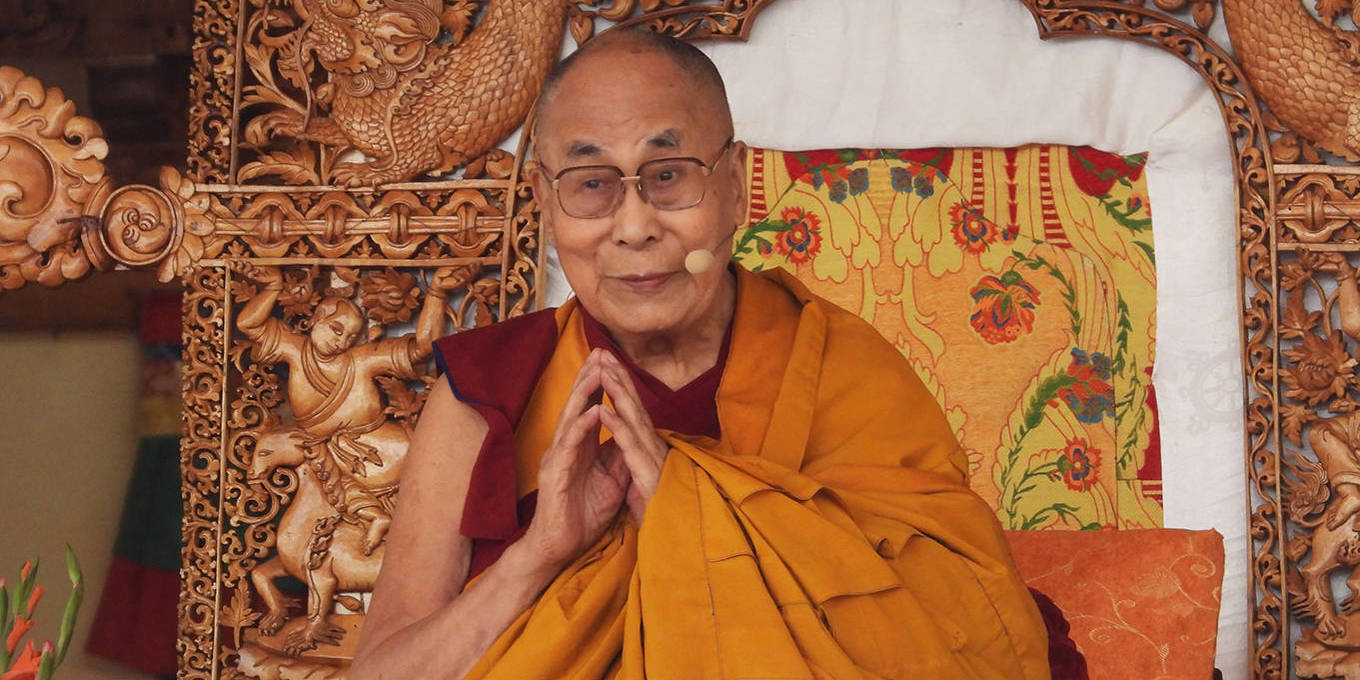
As the Dalai Lama – the spiritual leader of Tibet – visits the United States to receive medical treatment on his knees, concerns over who will succeed him have become acute. While Tibetans around the world pray that the 88-year-old Tenzin Gyatso, the 14th Dalai Lama, still has plenty of life ahead of him, China is eagerly awaiting his demise, so that it can install a puppet successor.

Tibetans regard the Dalai Lama as the living incarnation of Buddha. Since 1391, the Dalai Lama has been reincarnated 13 times. When one Dalai Lama dies, the search for the next one begins, with a council of senior disciples taking responsibility for identifying him, based on signs and visions. But in recent years, the Chinese government has insisted that only it has the right to identify the next Dalai Lama.

This would not be the first time China selected a leader of Tibetan Buddhism. In 1995, it anointed its own Panchen Lama, whose spiritual authority is second only to that of the Dalai Lama, after abducting the actual Panchen Lama – a six-year-old boy who had already been confirmed by the Dalai Lama. Almost three decades later, the real Panchen Lama is among the world’s longest-serving political prisoners.

China also appointed the Karmapa, Tibetan Buddhism’s third most important spiritual leader and the head of the Karma Kagyu sect. But in 1999, its appointee, Ogyen Trinley Dorje, fled to India. The ease with which the 14-year-old Karmapa escaped China raised suspicions among Indians about his loyalties. After imposing travel restrictions on him, India decided in 2018 no longer to recognize the China-anointed Karmapa as the legitimate head of his sect. Now, he and his rival Karmapa, Trinley Thaye Dorje, have issued a joint statement pledging to cooperatively resolve the leadership split in the Karma Kagyu sect.

But the Dalai Lama is China’s “white whale.” The incumbent – who was identified as the Dalai Lama in 1937, at age two – has been a thorn in the side of the Communist Party of China (CPC) since China’s 1951 annexation of Tibet. With his relentless espousal of non-violence, the Dalai Lama, who won the Nobel Peace Prize in 1989, embodies Tibetan resistance to the Chinese occupation. (Had Tibet remained self-governing like Taiwan, it would be the world’s tenth-largest country by area.)

In his past incarnations, the Dalai Lama was not only Tibet’s spiritual leader, but also its political leader, making him a kind of cross between a pope and a president. But the Dalai Lama ceded his political role in 2011 to a Tibetan government-in-exile, which is democratically elected every five years by Tibetan refugees living in India and elsewhere.

Moreover, the Dalai Lama has declared that he might choose not to be reborn – a decision that would undermine the legitimacy of any Chinese-anointed successor. He knows that, for China, a Dalai Lama devoted to the CPC is much more useful than no Dalai Lama at all. He also knows that, while he has retained his mental acuity, his body is weakening. In 2016, he underwent radiation therapy for prostate cancer. He says he was “completely cured,” but he continues to struggle with his knees. Given his advanced age, more health problems are to be expected.

The Dalai Lama’s frailty is one reason why his travel schedule has slowed considerably. But it is not the only one: bowing to Chinese pressure, most countries – including European democracies and Asia’s Buddhist states (except Japan) – are unwilling to grant him entry. Fortunately, some countries have retained their backbones. The US is hosting the Dalai Lama for knee treatment, and India has proudly been his home for more than 65 years. India has officially designated the Dalai Lama its “most esteemed and honored guest,” while the Tibetan leader describes himself as a “son of India.”

In fact, India is home to the vast majority of Tibetan exiles, and has played a central role in helping to preserve the Tibetan culture, including by supporting Tibetan-language schools. By contrast, China has been working actively to destroy Tibetan culture and identity, especially since Chinese President Xi Jinping has been in charge.

Meanwhile, China’s appropriation of Tibetan natural resources has gone into overdrive, with consequences that extend far beyond the Tibetan Plateau. Resource-rich Tibet is a source of fresh water for more than one-fifth of the world’s population and a global biodiversity hotspot. The plateau influences Asia’s weather and monsoonal patterns, as well as the Northern Hemisphere’s “atmospheric general circulation” – the system of winds that helps transport warm air from the equator toward higher latitudes, creating different climate zones.

It is imperative that the US and India work together to foil China’s plan to handpick the next Dalai Lama. Already, America’s Tibetan Policy and Support Act, which took effect in 2020, says that “the wishes of the 14th Dalai Lama, including any written instructions, should play a determinative role in the selection, education, and veneration of a future 15th Dalai Lama.” And it calls for sanctions on Chinese officials who interfere with Tibetan Buddhist succession practices.

But more must be done. For starters, US President Joe Biden should take the opportunity presented by the Dalai Lama’s knee treatment to fulfill a 2020 campaign promise to meet with the Dalai Lama. More broadly, the US should work with India to devise a multilateral strategy to counter Xi’s plan to capture the more than 600-year-old institution of the Dalai Lama. This must include efforts to persuade the Dalai Lama to spell out, once and for all, the rules that must be followed to identify his successor.

Brahma Chellaney, Professor of Strategic Studies at the New Delhi-based Center for Policy Research and Fellow at the Robert Bosch Academy in Berlin, is the author of nine books, including Water: Asia’s New Battleground (Georgetown University Press, 2011), for which he won the 2012 Asia Society Bernard Schwartz Book Award.

© Project Syndicate, 2024.

Is the U.S. prepared for a Taiwan invasion?

Brahma Chellaney, Taipei Times

Preserving its global dominance appears to have driven the West’s expanding involvement in the Ukraine conflict, with former British Prime Minister Boris Johnson recently arguing in a column that a Russian victory would be “a turning point in history, the moment when the West finally loses its post-war hegemony.” Such a decisive outcome, however, seems doubtful, given the attritional character of the Ukraine war and the progressively escalating Western involvement in the conflict.

The defining moment that formally brings the era of Western preeminence to an end is more likely to be a surprise Chinese aggression aimed at subjugating Taiwan.

With the wars in Ukraine and the Middle East testing U.S.-led alliances and with America already looking overextended, Chinese aggression against Taiwan could come sooner than many in U.S. policy circles expect.

There are ominous signs that Chinese President Xi Jinping is preparing his country for a war over Taiwan. But whether the U.S. is prepared to respond to such a contingency is becoming a vexed question, especially as international concerns grow that Xi might view America’s preoccupation with extended conflicts in Europe and the Middle East as a window of opportunity to act, without triggering a full-fledged war with the U.S.

The defense of Taiwan is assuming greater significance for international security for two other reasons. The first is the possibility that Xi might seek to replicate in the Taiwan Strait the techniques of incremental expansionism that his regime has successfully honed in the South China Sea without drawing a concerted U.S. response.

Tellingly, three successive U.S. administrations have failed to credibly push back against China’s intensifying expansionism in the South China Sea, relying instead on rhetoric or symbolic actions. As a result, the American debate now largely centers on how the South China Sea was effectively lost and what can be done now to respond to China’s increasingly aggressive sea tactics aimed at tightening its grip on this strategic corridor between the Pacific and Indian Oceans.

These tactics are triggering a number of incidents with other claimant states, particularly the Philippines and Vietnam, even as China seeks to interfere with U.S. and allied air and maritime transits.

China’s recent menacing military drills that encircled Taiwan seemed to be a rehearsal for implementing at least a blockade with the aim of slowly throttling the island democracy. In fact, this was the third Chinese dress rehearsal in less than two years for an assault on Taiwan.

Compared to the first large-scale Chinese military exercise in August 2022, when then-U.S. House Speaker Nancy Pelosi visited Taipei, the latest drills were more sophisticated, elaborate and geographically expansive.

The second reason is the U.S. failure to genuinely pivot to Asia and the wider Indo-Pacific, despite U.S. Defense Secretary Lloyd Austin claiming that this region is “our priority theater of operations” and “the heart of American grand strategy.”

A just-released book, “Lost Decade: The U.S. Pivot to Asia and the Rise of Chinese Power,” by two former American policymakers, Robert Blackwill and Richard Fontaine, bemoans that America’s “pivot to Asia” strategy (first unveiled in 2011) has failed thus far because a coherent approach to the Indo-Pacific remains largely absent. Consequently, the U.S. has been unable to respond adequately to China’s aggressive rise, in what the authors call one of the greatest mistakes in American foreign policy in the post-World War II period.

The plain fact is that, as long as conflicts elsewhere distract the U.S. from the pressing Asian security challenges, the Indo-Pacific is unlikely to become the hub of its grand strategy.

The latest American foreign assistance package that provides $60.8 billion for Ukraine and a meager $8.1 billion for Indo-Pacific security, including Taiwan, has dimmed the prospects of a correction in skewed strategic priorities. In fact, U.S. President Joe Biden recently plunged the U.S. deeper into the Ukraine war by permitting Kyiv to use American-donated weapons to strike inside Russia.

More fundamentally, the drawn-out Ukraine war is crimping America’s China policy and weakening its deterrent posture in the Indo-Pacific, thereby making a Taiwan Strait crisis more likely.

In an effort to forestall the U.S. from realizing its worst geopolitical nightmare, a formal Sino-Russian alliance, and to dissuade China from directly aiding the Kremlin’s war machine, Biden has been compelled to adopt a more conciliatory approach to Beijing.

This approach, in turn, is emboldening China vis-à-vis Taiwan. While stepping up coercive pressures on Taiwan, Beijing is making its ultimate goal clearer. Xi recently declared that the “essence” of his national rejuvenation drive is “the unification of the motherland.” And his new defense minister, Dong Jun, while accusing the U.S. of “malign intentions [that] are drawing Taiwan to the dangers of war,” told the annual Shangri-La Dialogue in Singapore that, “Anyone who dares split Taiwan from China will be smashed to pieces and court their own destruction.”

Yet some in the West insist that the U.S. must first rout Russia on the Ukrainian battlefield before turning to deter China. As if Xi would wait to move against Taiwan until the U.S. has humiliated Russia in Ukraine in a long war and then turned its attention to containing China. Indeed, the last thing Xi wants is an end to the Ukraine war because that would leave the U.S. free to pivot to Asia.

Make no mistake: With China’s lengthening shadow belligerently darkening Taiwan’s doorstep, the risks of failing to deter Chinese aggression against the self-governing island are increasing. Consequently, calls are growing in the U.S. that Washington must embrace strategic clarity in relation to Taiwan’s defense by abandoning its outdated strategic ambiguity policy, which was formulated when China was still backward and in no position to annex Taiwan.

America’s deepening involvement in the Ukraine war at a time it seems ill-prepared for armed conflict over Taiwan is a strategic mistake that could eventually come to haunt its long-term security.

Brahma Chellaney, professor of strategic studies at the independent Center for Policy Research in New Delhi, is the author of nine books, including the award-winning Water: Asia’s New Battleground (Georgetown University Press).

India’s global role will grow in Modi’s third term

Photo by AFP: Supporters of Narendra Modi, India’s Prime Minister and leader of Bharatiya Janata Party (BJP), celebrate vote counting results for India’s general election, at BJP headquarters in New Delhi on June 4, 2024.

BY BRAHMA CHELLANEY, The Hill

India’s election, the world’s largest democratic exercise, may have delivered a stunning surprise by denying Prime Minister Narendra Modi’s party an outright majority in parliament, but this setback is unlikely to affect the stability or direction of his third-term government.

The primary reason is that the ruling Bharatiya Janata Party, or BJP, contested the election in alliance with several small political groups, with the coalition winning a majority of seats in parliament’s ruling lower house.

Still, the BJP’s loss of its commanding majority in the lower house represents a blow to Modi’s political standing, including puncturing his air of invincibility. After stacking up political win after win, an overconfident Modi had predicted even before the campaign formally began that the BJP would secure more than two-thirds of the seats in the lower house.

The BJP’s failure to win a simple majority on its own, however, is unlikely to have a direct bearing on Modi’s national agenda or foreign policy. The allied parties Modi will depend on are provincial groups with no national vision or ideas.

Moreover, while the fragmented opposition may have unified to stop Modi’s juggernaut in the election, it lacks a common agenda or leader, which raises the question of whether its unity will endure. In fact, the combined number of seats won by the multiple parties in the opposition coalition is slightly less than what the BJP secured on its own.

Modi, 73, is entering a second decade as prime minister, despite a strong anti-incumbency sentiment in Indian society. Only one other Indian leader, Jawaharlal Nehru, secured a third term decades ago.

Modi’s leadership has given India political stability, robust economic growth and accelerated military modernization. India’s international profile and geopolitical weight are rising, partly because the end of China’s economic boom has thrown into relief the emergence of Asia’s other demographic giant as a geopolitical and economic force. India is now the world’s fastest-growing major economy.

After the election results, Modi declared that his third term would represent a “new chapter of big decisions.” But, given India’s fractious politics, big decisions often tend to fuel division and polarization, especially when they challenge entrenched interests. In his second term, Modi, for example, was compelled to repeal farm reform laws after a year of opposition-backed grassroots protests.

With his pro-growth and pro-market agenda, Modi is aiming to transform India into a global manufacturing hub at a time when Western companies are interested in shifting production away from China. Consequently, his new term is likely to see greater government spending not just in manufacturing and infrastructure but also on human capital, particularly in education and training.

The new government will have to urgently consider the nation’s foreign policy challenges, above all the military standoff with China, which recently entered its fifth year. The tense standoff, triggered by furtive Chinese encroachments on some Indian borderlands, may not be grabbing international headlines, but China persists with a frenzied buildup of force deployments along the Himalayan border, as if it is preparing for war. China recently deployed its most advanced J-20 stealth fighter jets near the India frontier.

India’s most-pressing foreign policy challenges relate to its troubled neighborhood, not least a strengthening strategic axis between China and Pakistan, with both these nuclear-armed allies staking claims to swaths of Indian territory. India is already the world’s third-largest defense spender, behind the U.S. and China.

More fundamentally, Modi has helped shape a pragmatic foreign policy vision. Shorn of ideology, Indian foreign policy has sought to revitalize the country’s economic and military security, while avoiding having to overtly choose one power over another as a dominant partner.

In practice, however, closer cooperation with the U.S. has remained Modi’s signature foreign policy initiative, despite some new irritants in the bilateral relationship, including the role of U.S.- and Canada-based Sikh militants.

While tilting toward the West, India remains loath to enter into a formal military alliance with the Western bloc. President Joe Biden’s reluctance to say anything on the Sino-Indian military standoff, let alone side with New Delhi, reminds India that it must defend itself all on its own.

India’s independent approach to international affairs is unlikely to change given that New Delhi believes in friendship without dependence. This makes India the world’s ultimate “swing state” in the current transition from the post–World War II American-led order to a new global order whose contours are still not clearly visible.

In contending with China, its sole challenger at the global level, the U.S. needs a degree of adaptability in forging partnerships, instead of hewing to the Cold War–style “us versus them” approach. A country as large as India cannot become just another Japan or Britain to America. Yet no anti-China alliance can play a strategically meaningful role without India, which has locked horns with the Chinese military in a way no other power has done in this century.

To be sure, India’s size and diversity pose enormous challenges. It is now the world’s most populous nation and is demographically and culturally very heterogeneous.

Still, as the latest election highlights, India’s democratic framework serves as a pillar of inclusion, stability and strength. By empowering people at the grassroots level through participatory processes and open dialogue, the Indian political system has enabled members of historically marginalized classes and castes to gradually gain prominence in politics and bureaucracy. Modi’s own humble beginnings illustrate this.

India today is an ascendant global player, and Modi’s focus in the third term will likely be on enabling India to play a bigger role on the world stage. India’s accelerated rise will not only increase its salience in the global balance of power but also help advance American goals in the Indo-Pacific region, the world’s new economic and geopolitical hub.

Brahma Chellaney is a geostrategist and the author of nine books, including the award-winning “Water: Asia’s New Battleground” (Georgetown University Press).